
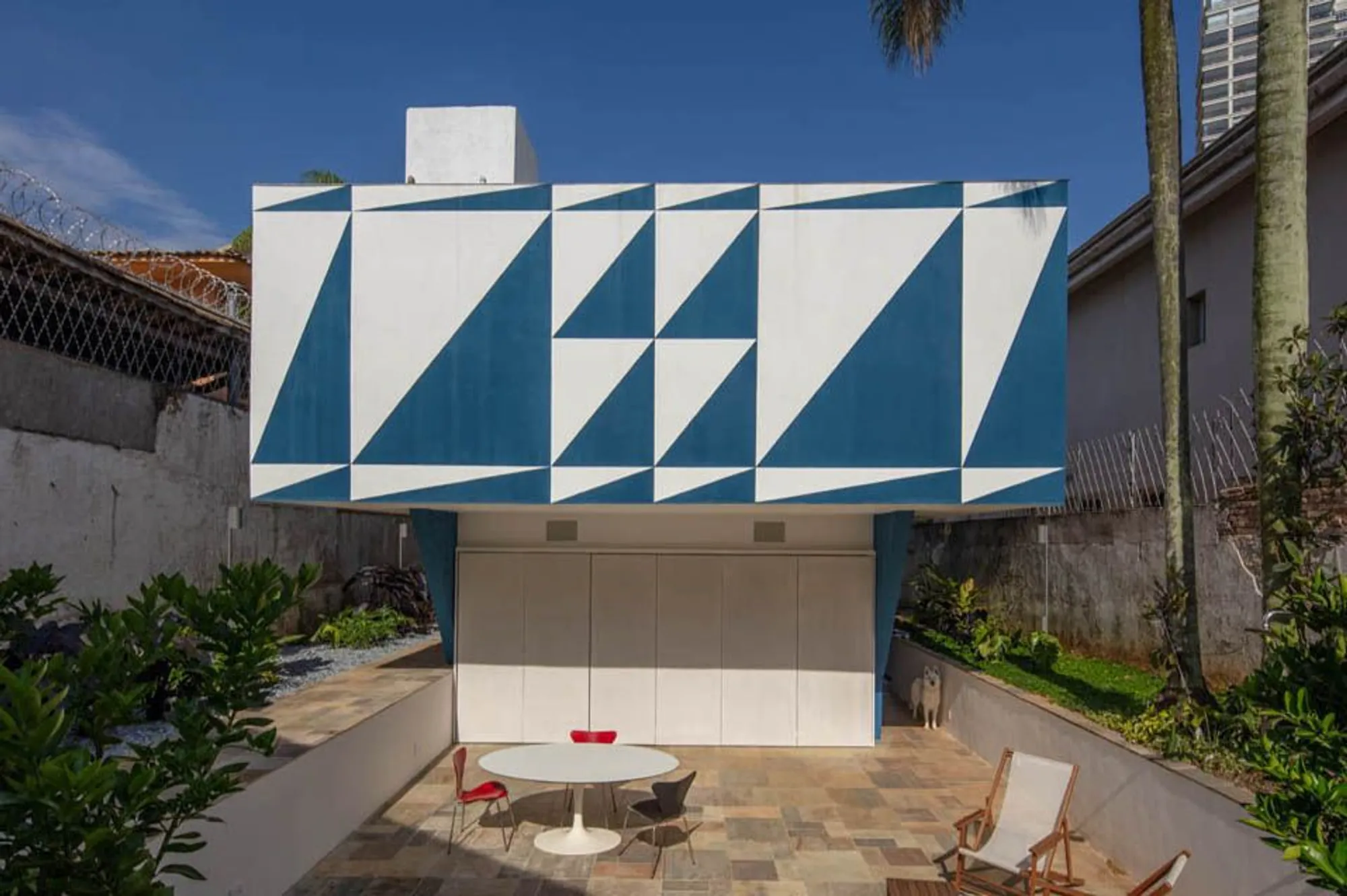
Metrópole Arquitetos Strips Back a 1956 Vilanova Artigas House to Reveal Its Original Logic
In São Paulo, a careful restoration of the Casa dos Triângulos recovers the split-level clarity Artigas intended before decades of alteration.


Vilanova Artigas designed the Residência Rubem Mendonça in 1956, a house better known as the Casa dos Triângulos for the bold geometric panels that wrap its cantilevered upper volume. The building is a critical stepping stone in Artigas's career: its split-level organization around a central void, its structural cantilevers, and its insistence on collapsing boundaries between served and servant spaces all point directly toward the FAUUSP building he would complete a decade later. By the time Metrópole Arquitetos, led by Anna Helena Vilella and Silvio Oksman, took on the restoration in 2021, the house had accumulated layers of partition walls, service additions, and spatial compromises that obscured the very qualities that make it significant.
The restoration is not a museum-style freeze. It is an act of selective removal. Metrópole demolished the servants' quarters, stripped out non-structural partitions that had already been heavily altered, and opened the house to its gardens on all sides, eliminating the old hierarchy of a social front and a service back. The result is a house that breathes again: more light, more air, more spatial continuity between half levels, and a legible relationship between concrete structure and domestic life.
Triangles as Identity
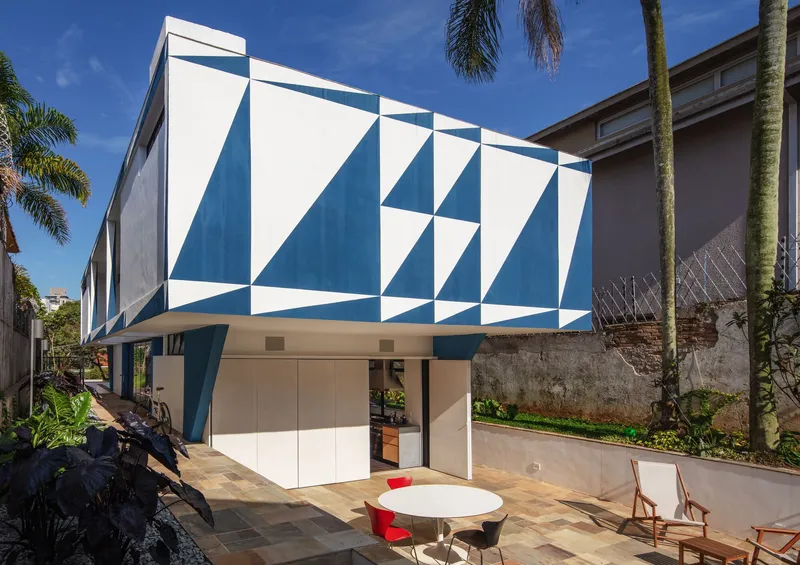
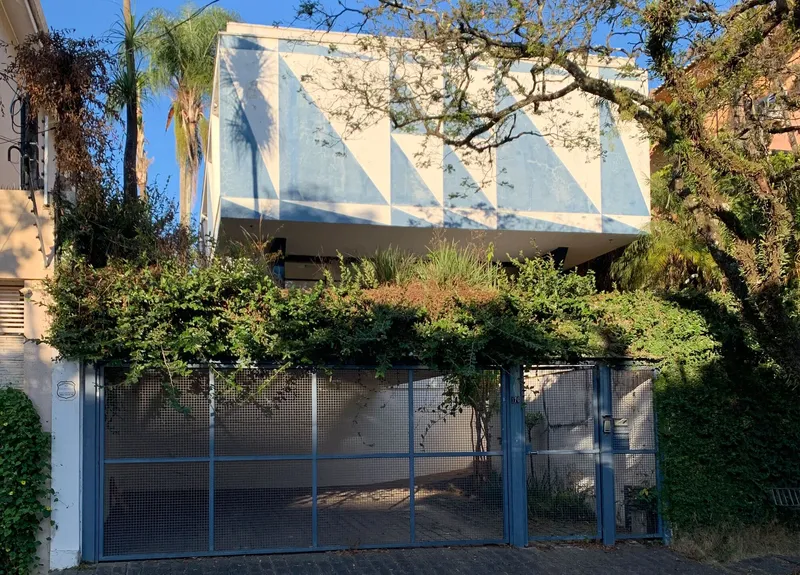
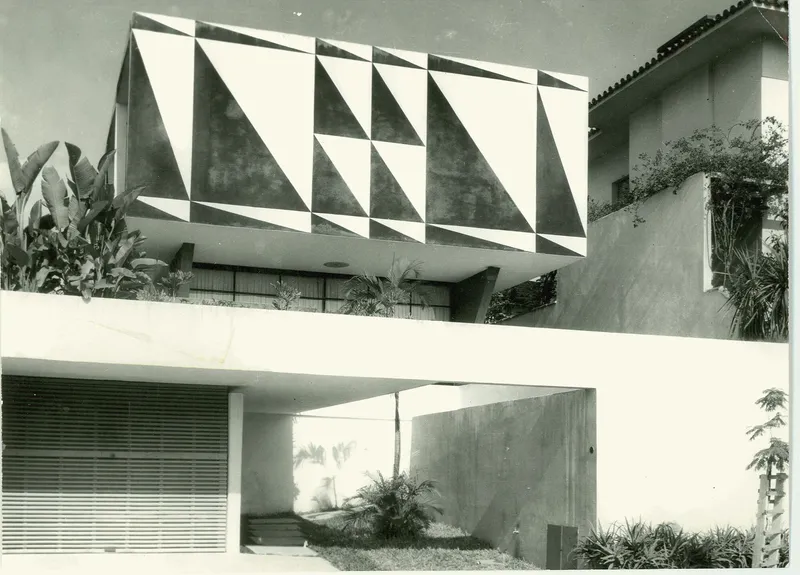
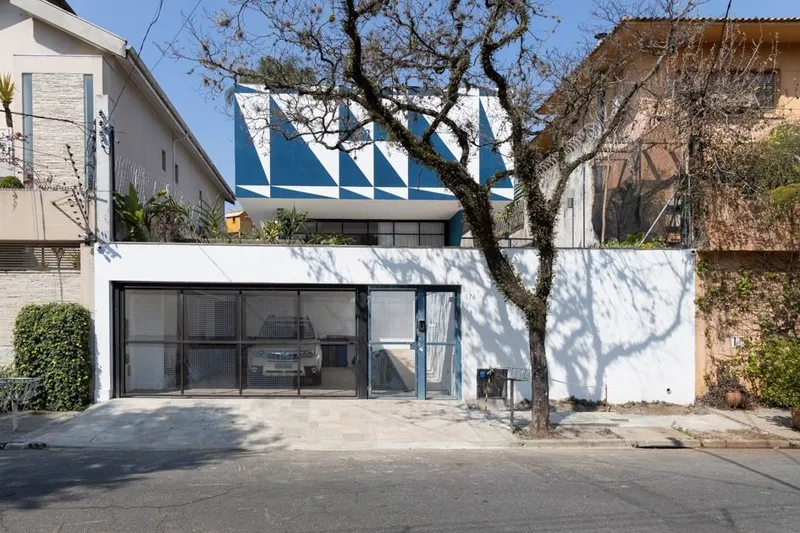
The house announces itself from the street with an unmistakable graphic: blue and white triangular panels that tile the upper volume like a Concrete art canvas. These panels, conceived alongside an artistic panel by Mário Gruber and executed by Francisco Rebolo, are not applied decoration. They are integral to the facade plane that reads as a single abstract surface hovering above the open ground floor. The restoration cleaned and conserved them without reinterpreting or softening their boldness.
From the street, the composition is deceptively simple: a solid geometric box floating on a transparent base. But walk around to the rear and the same triangular pattern reappears, confirming that Artigas treated the entire envelope as a continuous graphic field. The mesh gate, the boundary wall, and the bare tree in the foreground are all secondary to that hovering volume. The restoration ensures nothing competes with it.
The Cantilever and the Ground
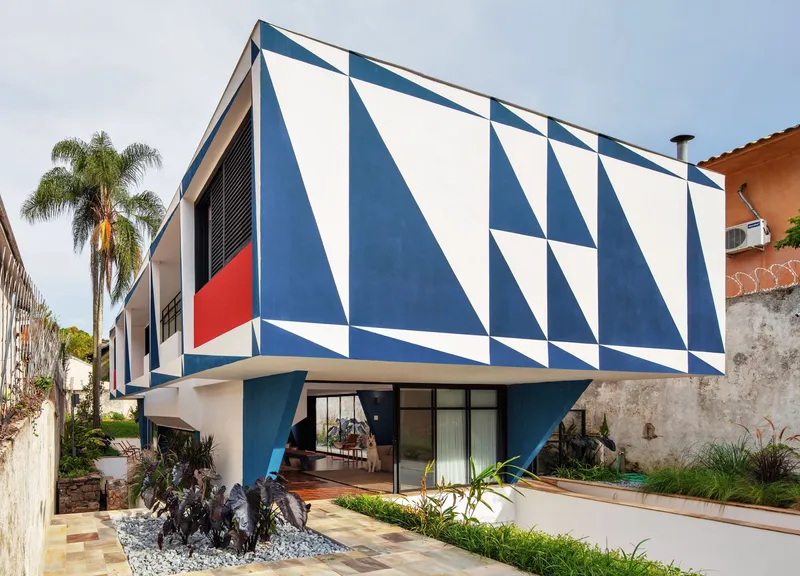
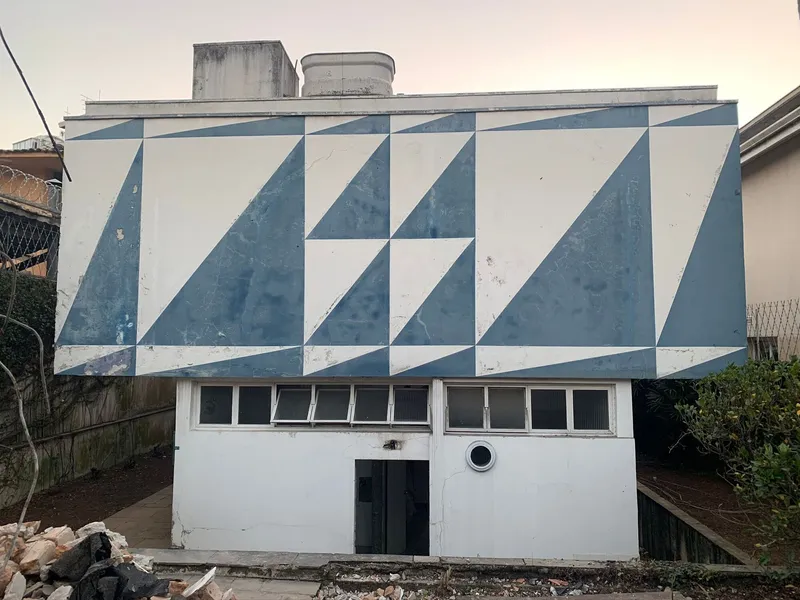
Artigas pushed the upper volume past the footprint of the ground floor at both ends, creating cantilevers that shelter arrival and courtyard spaces beneath. The structural ambition is clear: the house wants to lift itself off the earth, touching down only where absolutely necessary. At the rear, the dusk photograph reveals how the cantilevered mass casts the lower level into shadow while the triangular facade catches the last light. It is theatrical and entirely deliberate.
Metrópole's intervention clarified this relationship by removing built additions that had filled in the sheltered zones beneath the cantilevers. Paved courtyards and planted beds now occupy these spaces, restoring the sense that the house hovers. Palm trees punctuate the courtyards, their vertical lines reinforcing the height of the volume above.
Split Levels and the Central Void
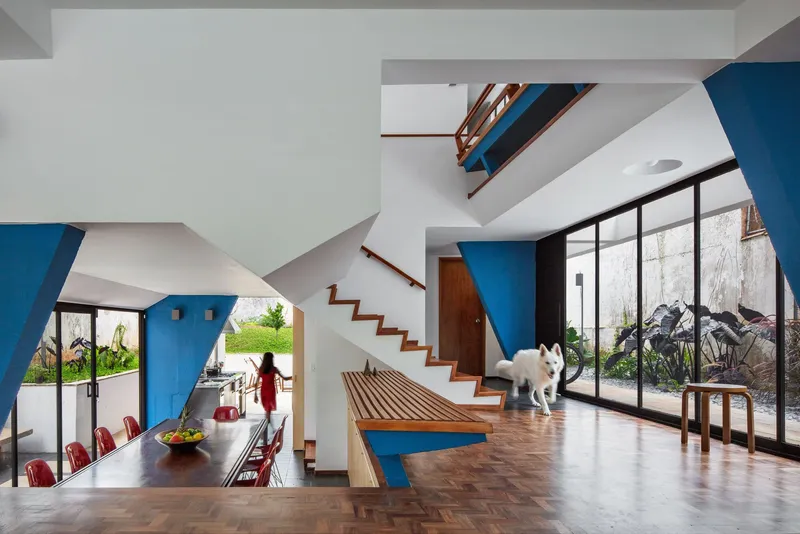
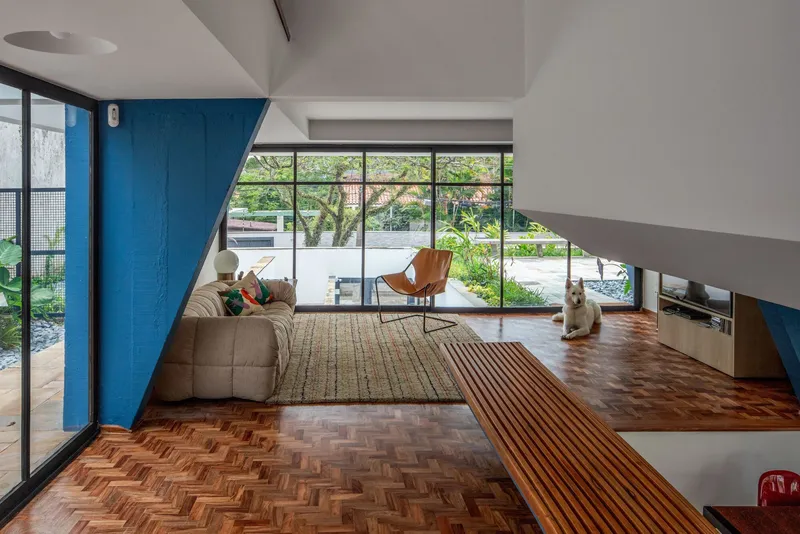
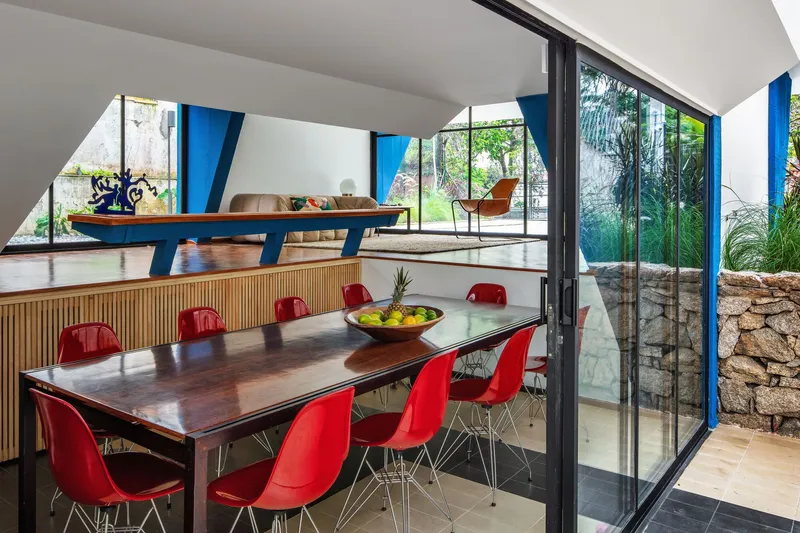
The interior is organized across four floors arranged in half levels around a central void. This is the spatial engine of the house. You never occupy a single plane; every room looks up or down into another zone of domestic life. The timber staircase, the angled blue structural columns, and the herringbone parquet flooring are all original elements that Metrópole retained and restored. The blue columns are not painted for decoration. They are the same structural members that make the cantilevers possible, brought inside and left visible as a kind of domestic honesty.
From the dining area, you look up to the raised living level through a gap framed by one of those angled blue beams. Red mid-century chairs sit casually in the foreground. A dog wanders across the herringbone floor. The house is lived in, not exhibited, and the restoration succeeds precisely because it allows this informality. By removing partition walls that had chopped up the half levels, the architects recovered the visual porosity Artigas intended.
Light from Above and Beyond
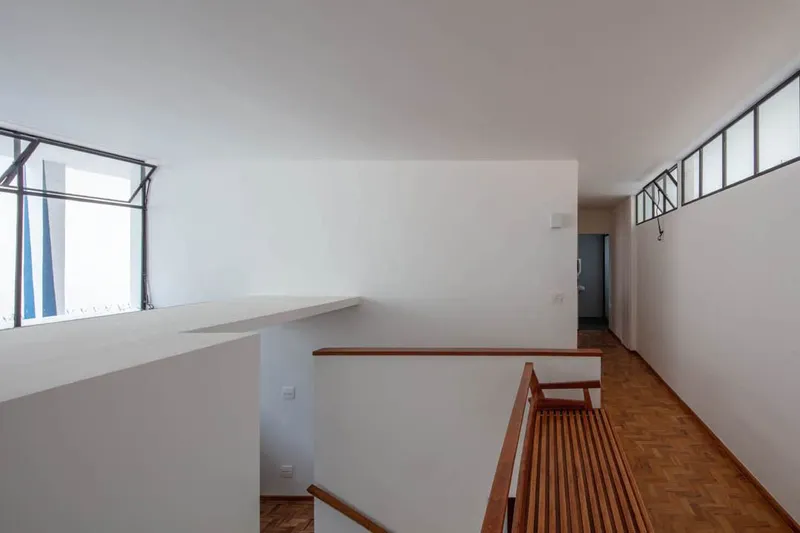
Clerestory windows along the upper hallway wash the stairwell with diffused light that filters down through the central void. The upper level corridor, with its wooden railing and white walls, feels almost monastic in its restraint. This is where the restoration's strategy of increasing illumination and ventilation becomes palpable. Walls that once blocked these light paths are gone.
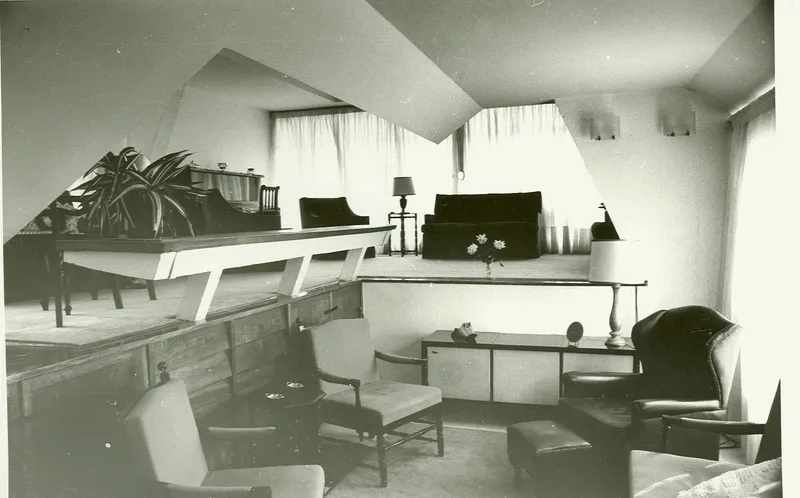
At the split level below, angular ceiling planes direct the eye toward garden views while mid-century furniture and potted plants anchor the space in everyday use. The interplay between natural light and the faceted geometry of the ceiling is one of the house's quiet strengths. Without the clutter of later additions, these qualities read clearly for the first time in decades.
Garden on All Sides
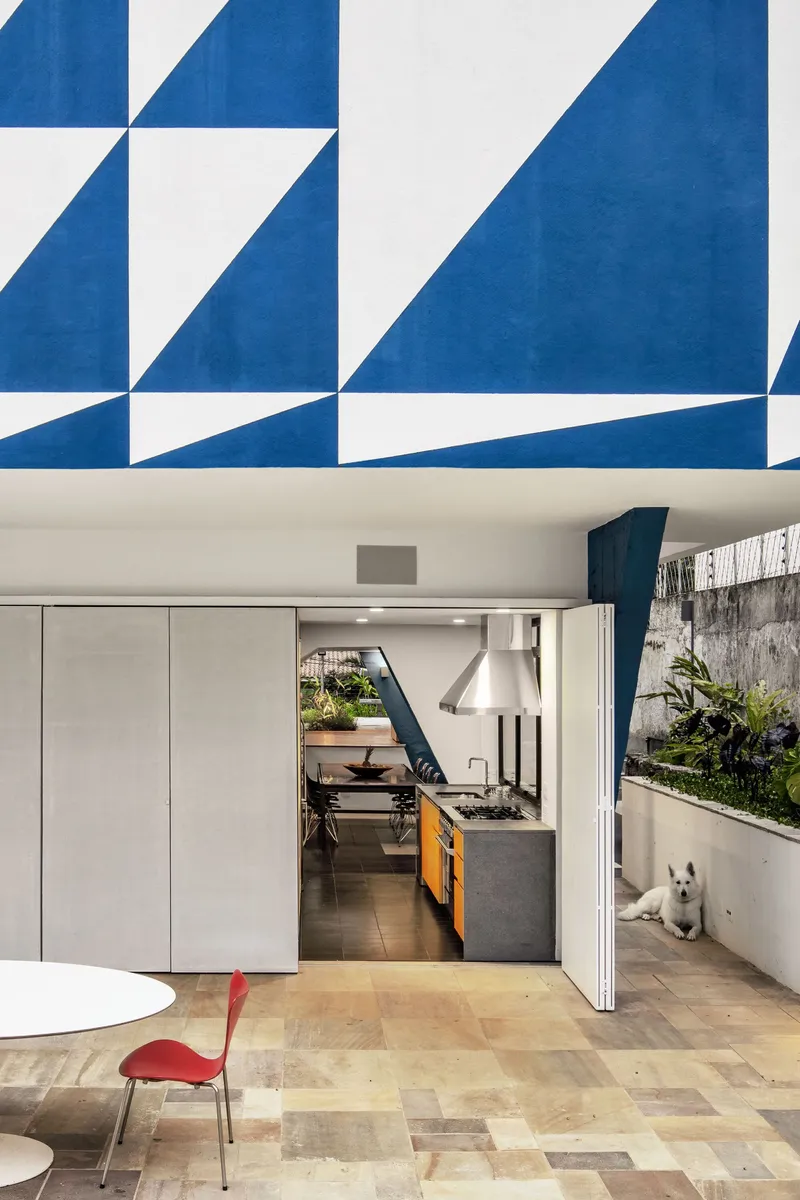
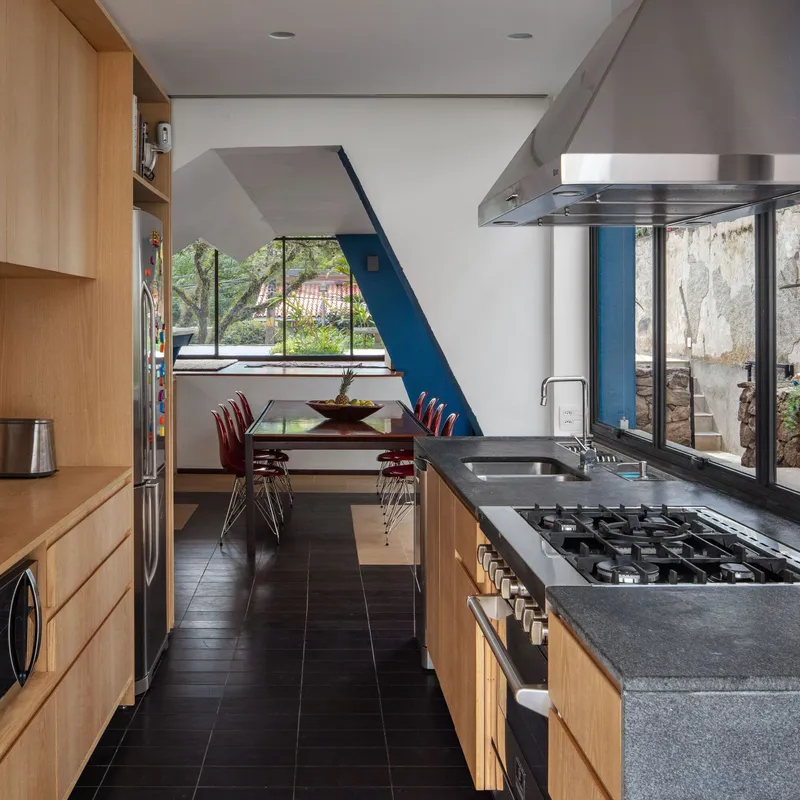
The most consequential decision in the restoration was eliminating the distinction between a presentable front garden and a utilitarian service yard at the back. By demolishing the servants' facilities and opening the kitchen and terrace to the surrounding landscape, Metrópole created a house that relates to its gardens equally on all sides. The covered terrace, with its patterned ceiling overhang, now opens directly to a planted bed and the kitchen beyond, collapsing any lingering hierarchy between cooking and entertaining.
The kitchen itself, with its light wood cabinetry and views through to the dining area and garden, is a contemporary insertion that respects the house's material language without pretending to be original. Sliding doors and generous glazing ensure that the boundary between inside and outside remains porous. From the street, the glazed garage door and white boundary wall maintain a clean civic face, but behind that wall, the entire perimeter is activated.
Plans and Drawings
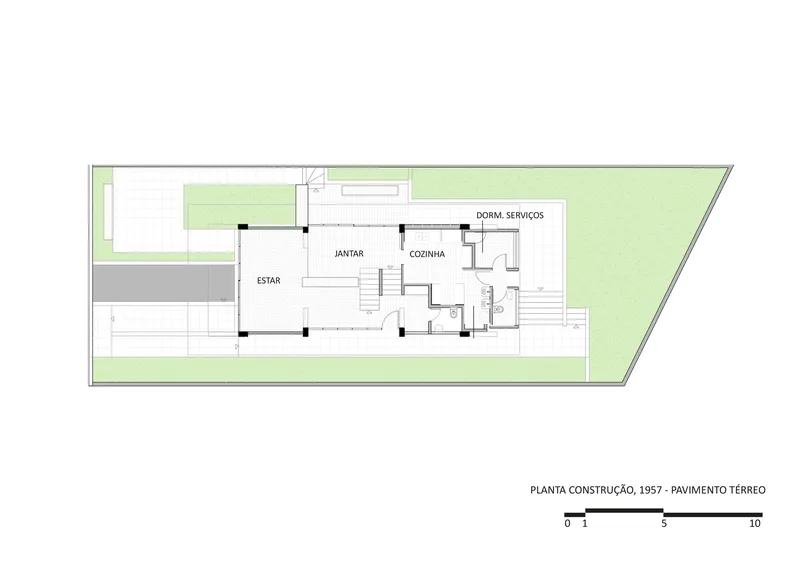
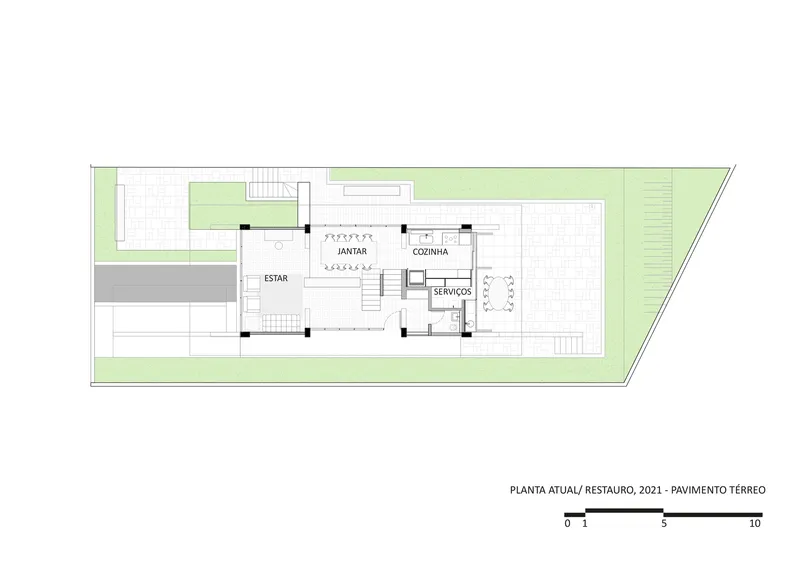
Comparing the original and reconfigured ground floor plans reveals the scope of the intervention. The linear arrangement of living areas and service spaces in the original plan gave way to a more open layout with a central service core. Walls that once divided the plan into discrete rooms have been removed, allowing the half-level shifts to register spatially across the full width of the house.
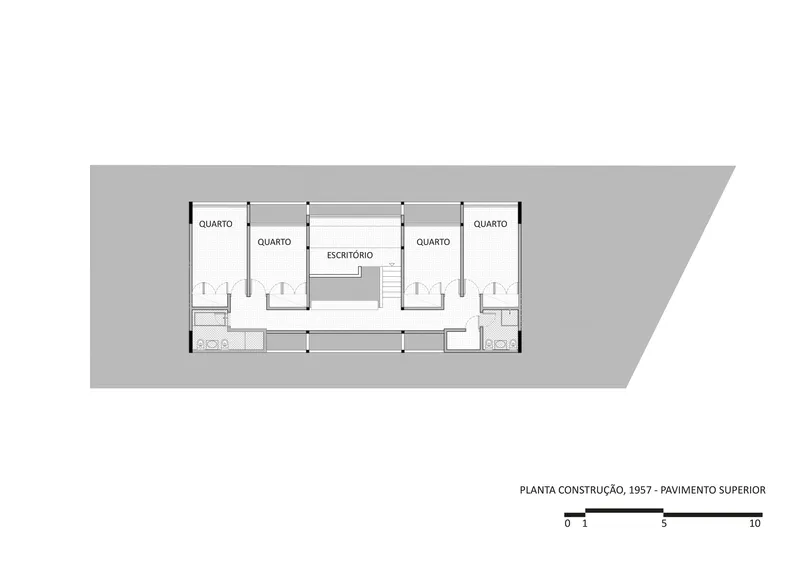
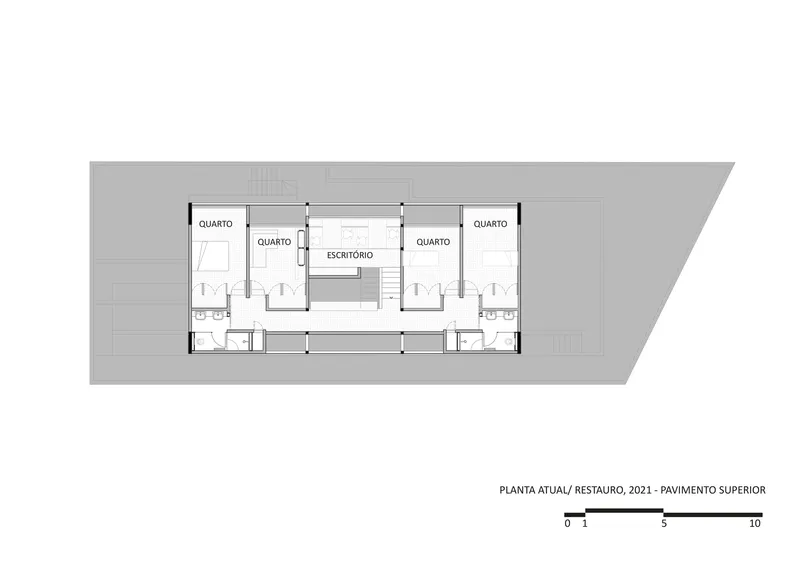
At the upper level, the bedroom wing retains its basic geometry but gains additional closet and bathroom spaces that reflect contemporary expectations. The revisions are pragmatic rather than ideological: the house must function for a family in the 2020s, not perform as a period piece.
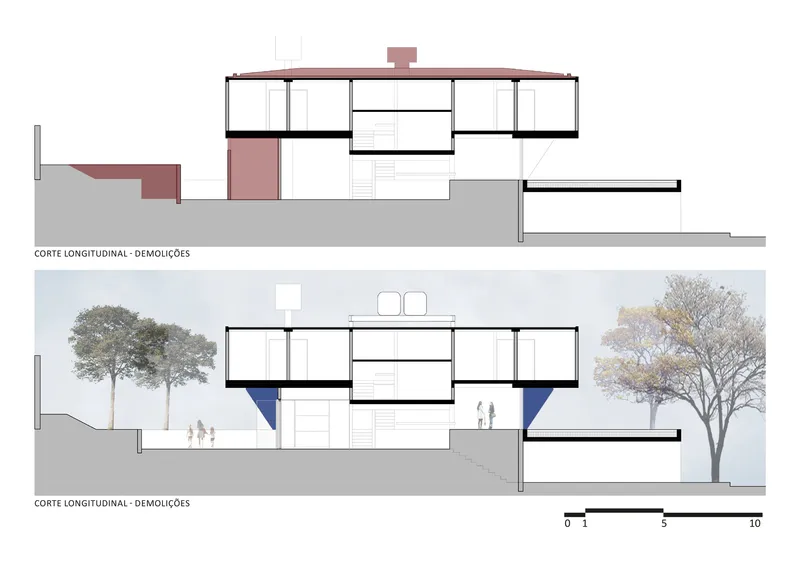
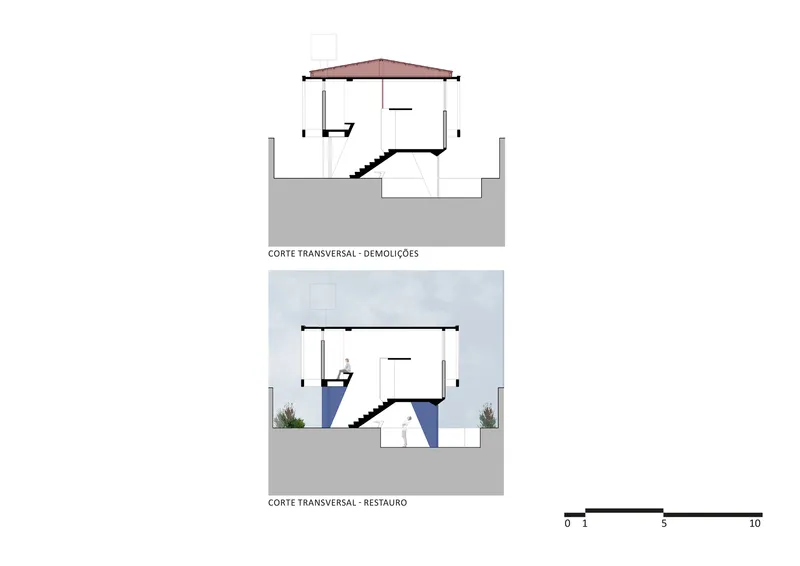
The longitudinal and transverse sections are the most revealing drawings. They show how the split levels interlock around the central staircase beneath a pyramidal roof, with the overhanging volumes extending past the planted edges. The sections make legible what the photographs only imply: that the house is not four separate floors but a single continuous spatial helix organized around a void.
Why This Project Matters
The Casa dos Triângulos is not just a house; it is evidence of a thought process. Artigas was working through ideas about structure, spatial continuity, and the politics of domestic space that would define Brazilian modernism for the next two decades. Restoring the house is therefore not merely an act of preservation. It is an act of interpretation, and Metrópole's interpretation is persuasive: strip away what was added, reveal what was always there, and let the spatial logic speak for itself.
The project also offers a useful counter-narrative to the fetishization of the "untouched" modernist landmark. The Casa dos Triângulos was not frozen in 1956. It was lived in, altered, patched, and subdivided over six decades. Metrópole's restoration acknowledges that history by choosing what to keep and what to discard based on spatial reasoning rather than nostalgia. The result is a house that feels more like Artigas intended it to than it has in half a century, precisely because it does not try to rewind the clock.
Casa dos Triângulos Restoration, São Paulo, Brazil. Restoration by Metrópole Arquitetos, led by Anna Helena Vilella and Silvio Oksman. Original design (1956) by Vilanova Artigas. Completed 2021. Photography by Nelson Kon and Silvio Oksman.
About the Studio
Share Your Own Work on uni.xyz
If projects like this are the kind of work you want to make, uni.xyz is a place to publish your own, find collaborators, and enter design competitions.



Popular Articles
Popular articles from the community


The Musturak Paradise: Senior Living Architecture for a Connected Future in Temara, Morocco
The Musturak Paradise reimagines senior living architecture in Temara via private homes, social spaces, culture, community, and shared care.

Hill & Cross Opera: Sculptural Opera House Architecture Shaped by Tallinn’s Landscape and Identity
Hill & Cross Opera reimagines opera house architecture in Tallinn through its sculptural hill, civic plaza, glass wave and a luminous cross.

Riyadh For All: Intergenerational Urban Design for Active Aging in Rabat
Riyadh For All reimagines urban design in Rabat with intergenerational co-living, adaptive courtyards, and Moroccan cultural exchange today.

Conexión: Biophilic Design Reimagines High-Rise Living in Hong Kong
Conexión reimagines high-rise living in Hong Kong through biophilic design, green facades, shared spaces, daylight, water and nature within.
Similar Reads
You might also enjoy these articles

Bao Huynh Watercolor Atelier: A Serene Art Retreat in Hội An
Bao Huynh Watercolor Atelier in Hội An blends multifunctional art spaces, sustainable design, local materials, and family-friendly living in a serene environment.

Atelier Macri Concept Store Interior Design by CASE-REAL
Atelier Macri store features a "ko" counter, walnut wood details, cork displays, blending retail, gallery, and seamless customer experiences.

Manuel Vargas Izquierdo Stadium and High-Performance Sports Center: Architectural Excellence in Jalpa de Méndez
The Manuel Vargas Izquierdo Stadium blends sustainable design, inclusive sports facilities, and cultural-inspired architecture, revitalizing Jalpa de Méndez’s public spaces.

KAKR Buluh Awar Hall: Revitalizing Community and Ecology Through Bamboo Architecture
Community built bamboo hall revitalizes Buluh Awar village, empowering youth, restoring ecology, celebrating vernacular craftsmanship through sustainable architecture and culture.

Explore Architecture Competitions
Discover active competitions in this discipline



Challenge to reimagine the Iron Throne


Photograph architecture without architects


Illustrate the lost glory of Angkor Wat - Render Challenge


Design challenge to reuse E-waste
Comments (0)
Please login or sign up to add comments
No comments yet. Be the first to comment!