
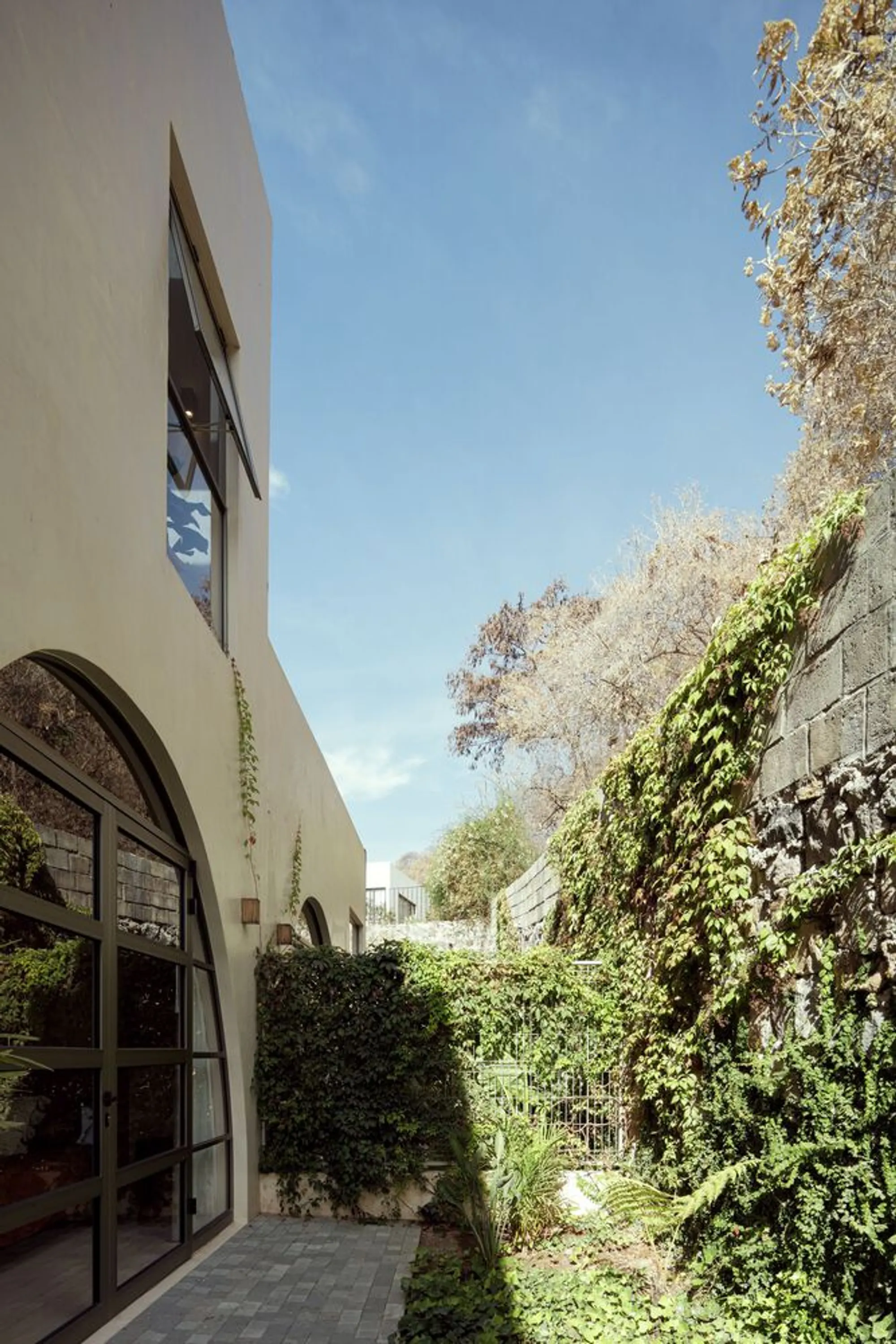
TAQ Arquitectura Channels a Lake Chapala Prison Island into a Vacation House in Jalisco
Mezcala House in San Juan Cosalá draws on fortress architecture, an existing Ahuilote tree, and chukum-inspired finishes to root itself in place.


Most lakeside vacation houses in Mexico lean on the view and stop there. TAQ Arquitectura, led by general director Tania Quirarte, took a different route with Mezcala House. The 540 square meter residence in San Juan Cosalá, near Lake Chapala in Jalisco, is named after Mezcala Island, a historic fortification and former prison sitting in the middle of the lake. That reference is not decorative. It is structural: the house borrows the island's strategies of controlled light, thick walls punctured by small openings, elevated vantage points, and rooftops used as living platforms. The result is a home that feels defensive and generous at the same time.
What makes the project genuinely interesting is the collision of references. On one hand, the micro cement walls recall chukum, the traditional Mayan waterproofing technique from the Yucatán, applied here hundreds of kilometers west in Jalisco. On the other, the spatial sequence revolves around a pre-existing Ahuilote tree on the site, which the architects refused to remove and instead made the organizational anchor of the plan. The house is not one volume but two angled bars connected by corridors, their geometry bent to honor the tree, the slope, and the distant water. Arched openings, narrow passages, and an upper-level pool oriented toward Lake Chapala complete a project that treats its region's history as a design manual rather than a mood board.
A Facade That Earns Its Thickness
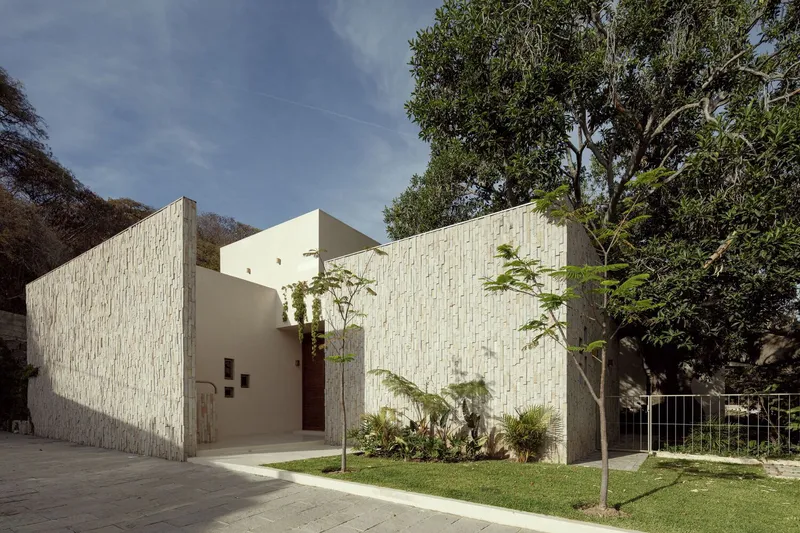
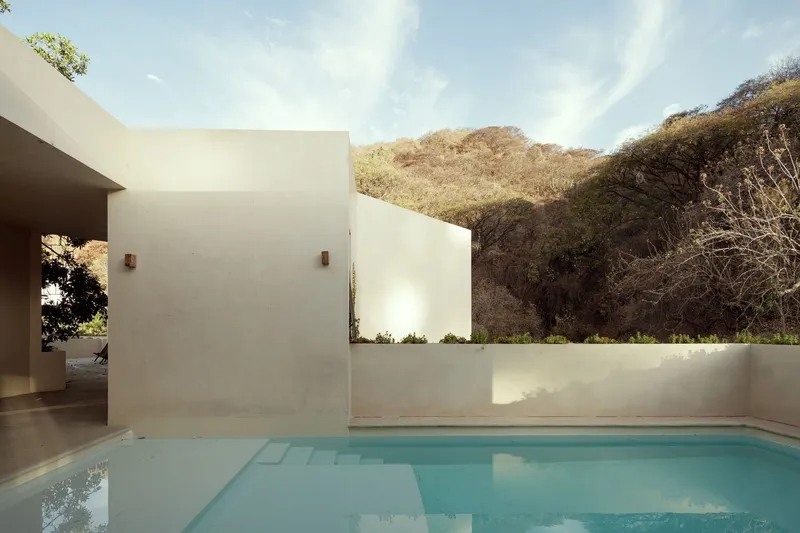
From the street, Mezcala House presents a white brick wall that reads almost civic in its restraint. There is no grand gesture, no cantilever waving at the road. Young trees and a planted lawn soften the perimeter, but the message is clear: the experience is inside. The stucco finish is left unpainted, a deliberate choice that allows the surface to develop patina over time rather than demanding periodic recoating. It is a low-maintenance move that also happens to be the honest one for this climate.
Around the pool courtyard the walls open up, but only partially. The dry hillside visible beyond the pool fence keeps the landscape present without surrendering privacy. TAQ Arquitectura positioned the pool on the upper level so that swimmers look out over both the hill and Lake Chapala, echoing the lookout function that Mezcala Island historically served. The elevated placement also improves ventilation across the living spaces below.
Passages, Arches, and Controlled Light
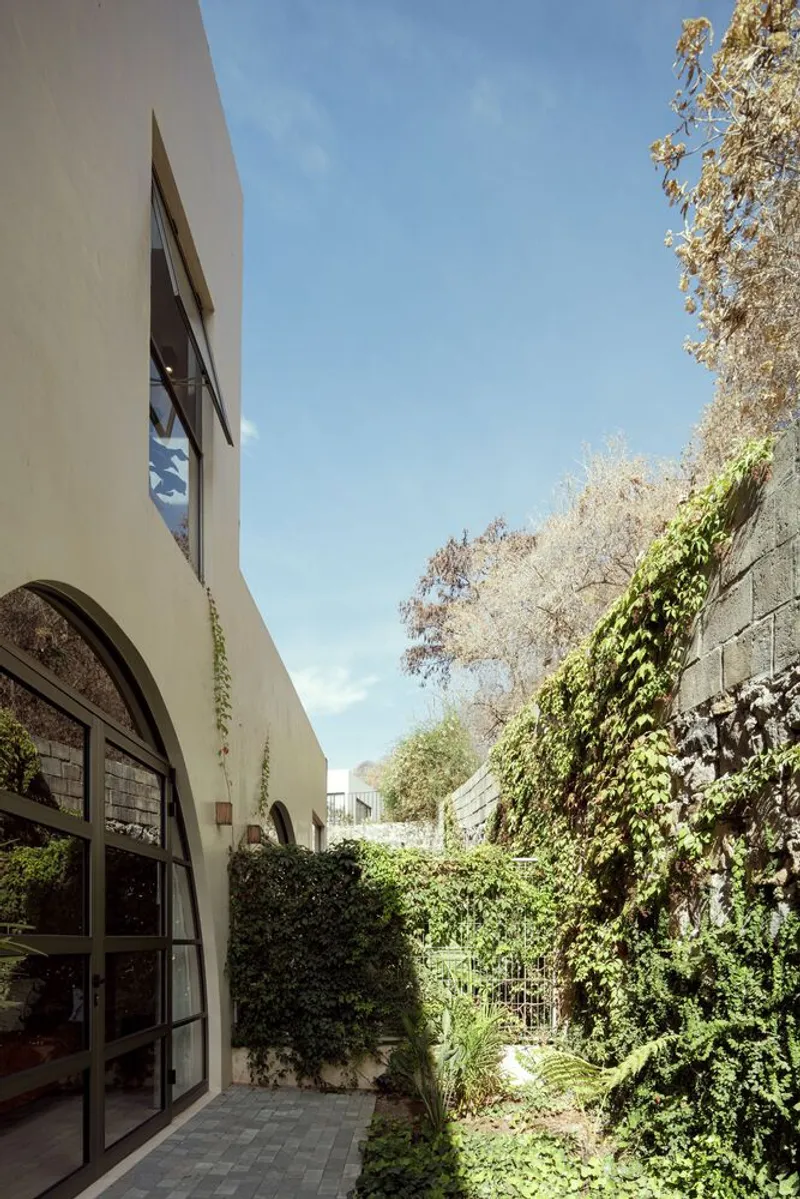
The most atmospheric moments in the house happen in its between-spaces. An exterior passage runs between arched glazed doors and a vine-covered hillside retaining wall, creating a threshold that feels closer to a cloister than a corridor. The arches here are not stylistic nostalgia. They reference the masonry openings found on Mezcala Island's fortifications, where light was deliberately rationed through small, deep apertures. In the house, these arched openings modulate daylight and frame views of vegetation rather than water, pulling the garden into the circulation sequence.
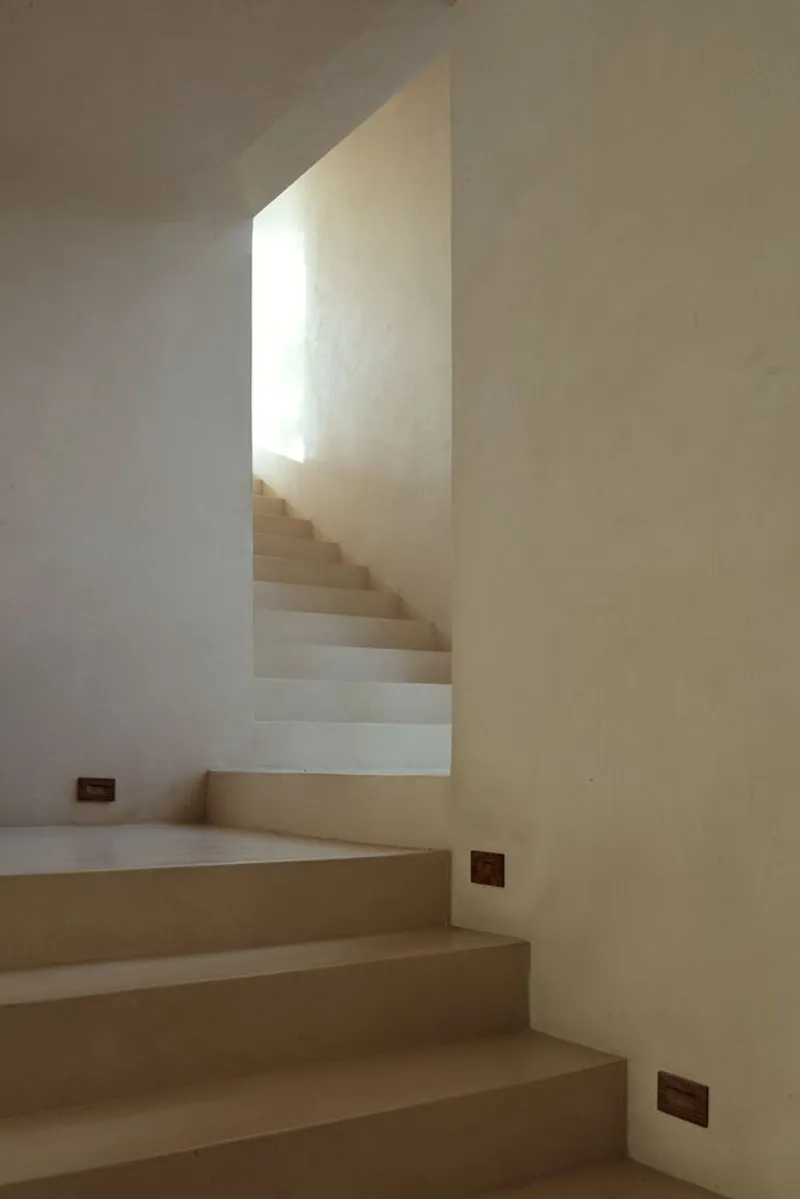
A cantilevered stone staircase turning around a white plaster wall demonstrates the same discipline. Small recessed floor lights provide just enough orientation after dark, reinforcing the principle that illumination should be scarce and intentional. The stair itself is a solid, minimal object: no railing theatrics, no floating treads, just stone meeting wall.
Material Warmth Without Material Excess
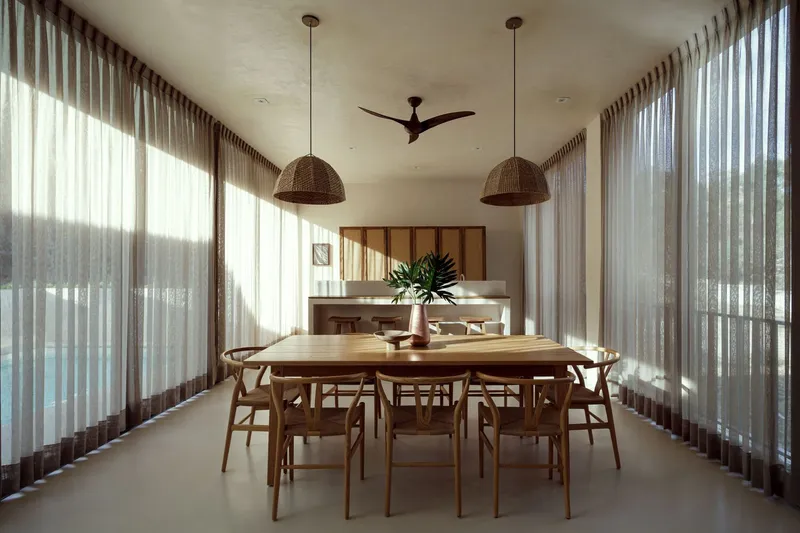
Inside, the palette tightens to natural oak, jute, beige slate stone, and the same micro cement that covers the exterior. The dining room pairs a solid timber table with woven pendant lights hung beneath sheer curtains that filter the Jalisco sun into a soft diffused glow. This is comfort architecture without the overwrought softness that plagues resort design. The curtains do real work: they cut glare, they slow the light, and they create a sense of layered depth between the table and the garden beyond.
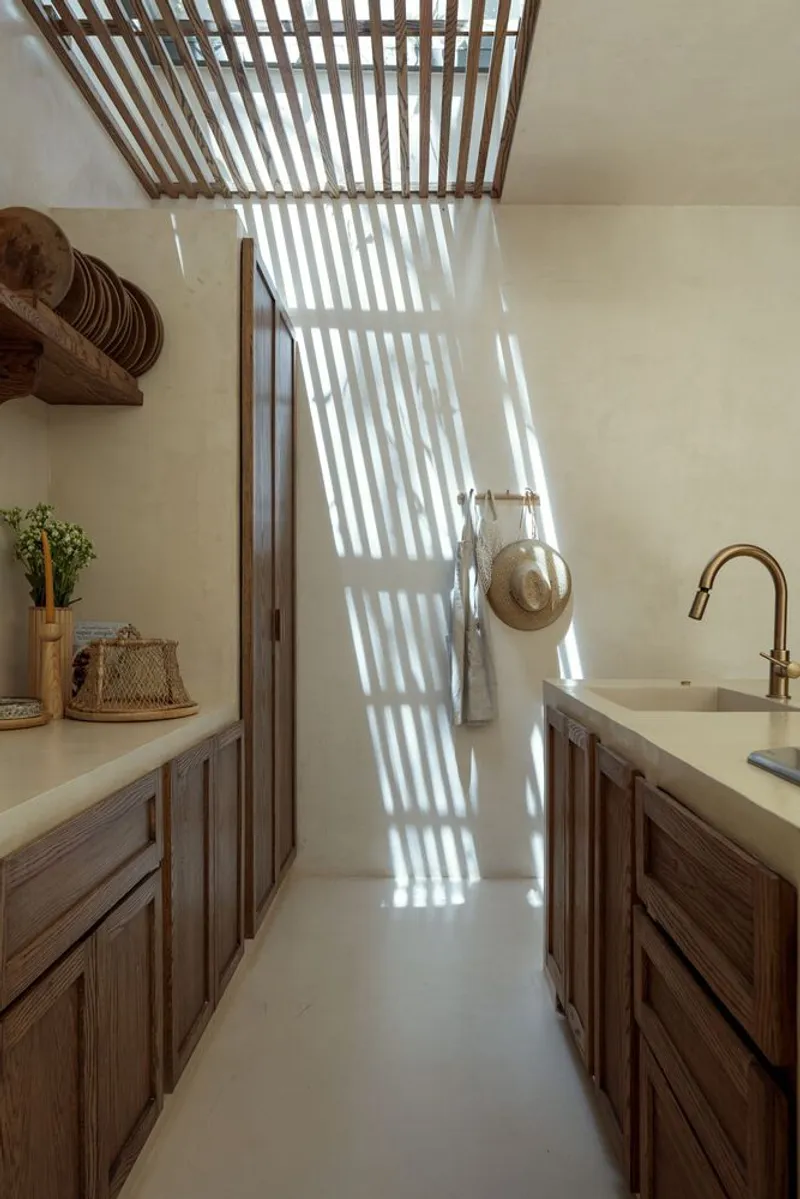
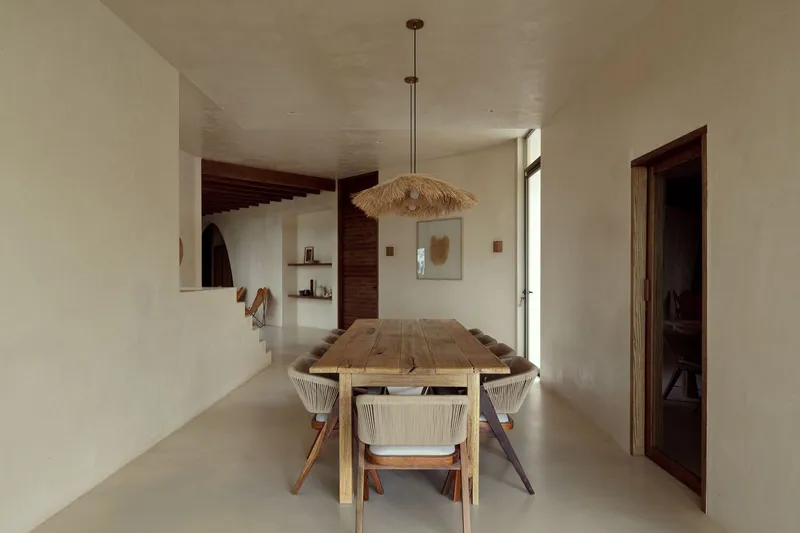
The galley kitchen pushes the material logic further. Timber cabinetry lines both walls, while a slatted overhead screen casts striped shadows that migrate across the surfaces throughout the day. It is the kind of detail that costs nothing extra but delivers constant visual interest. The adjacent dining space, visible through open thresholds, repeats the raffia pendant and timber table pairing but opens laterally into living areas, allowing the ground floor social zone to breathe without losing its intimate scale.
The neutral tone strategy is cohesive but never monotonous. Each material, from the rough slate underfoot to the smooth micro cement walls to the warm grain of the oak, occupies a different register of texture. The architects understood that when you restrict color, texture has to carry the entire sensory load, and they distributed it accordingly.
Organizing Around a Tree
The Ahuilote tree was on the site before TAQ Arquitectura arrived, and the firm made the decision early to let it dictate the plan. The long hallway that serves as the entrance vestibule has its furniture oriented to face the tree, not the lake. This is an uncommon hierarchy in a vacation house. Most clients pay for the water view and demand it from every seat. Here, the tree gets the prime sightline, and the lake is reserved for the rooftop and pool.
Multiple patios form at the intersections where the two angled construction volumes meet. These outdoor rooms are not leftover space. They are the connective tissue that allows tropical plants and cacti to coexist with the built form, creating micro-environments of shade and breeze that make the Jalisco heat manageable without mechanical intervention. An interior courtyard with a water fountain greets visitors at the entry, setting the tone before any room is entered.
Plans and Drawings
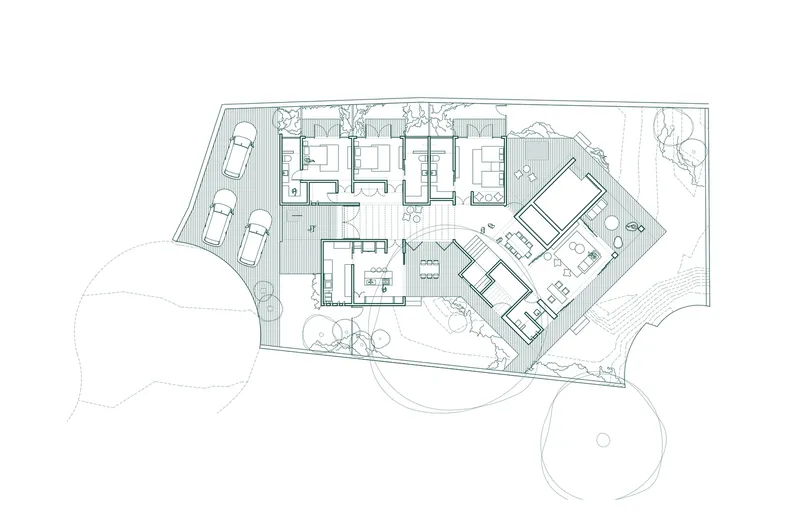
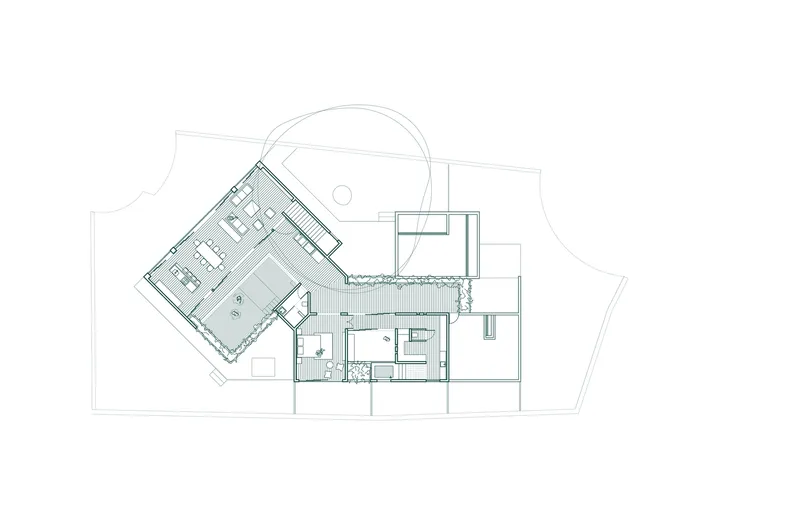
The floor plans reveal the angular logic that photographs only hint at. Two elongated volumes splay apart at a gentle angle, connected by corridors that create the courtyard and patio conditions visible throughout the house. Circular tree canopies are drawn prominently on the ground floor plan, confirming that the vegetation is not landscaping applied after the fact but geometry that shaped the architecture from the start. The upper level plan shows how the angled room layout follows the curved site boundary, adapting to the terrain rather than fighting it.
The program distribution is clearly legible: social spaces, kitchen, dining, study, wine cellar, and service rooms occupy the ground floor around the tree and courtyards, while bedrooms and the pool terrace sit above. The separation is clean but never rigid, with the staircase and corridors offering continuous visual connection between levels.
Why This Project Matters
Mezcala House matters because it proves that regional specificity is not a limitation but a design engine. TAQ Arquitectura did not borrow a generic tropical modern vocabulary and drop it on a lakeside lot. They studied a prison island, an indigenous waterproofing technique, and a single tree, then built a house that could only exist in this exact place. The chukum-inspired micro cement, the fortress-like light control, the angled plan deferring to an Ahuilote: each decision ties the architecture to a precise cultural and ecological context.
For a vacation house, that specificity is rare. The instinct in resort architecture is to flatten context into a generic paradise. Here, the context is not flattened but amplified. The patina that will accumulate on the stucco walls, the shadows that will shift through the kitchen screen, the tree that will continue to grow and reshape the courtyard proportions: this is architecture designed to change with its site rather than resist it. That is a quiet ambition, but it is the right one.
Mezcala House by TAQ Arquitectura, San Juan Cosalá, Jalisco, Mexico. 540 m². Completed 2023. Photography by Lorena Darquea.
About the Studio
Share Your Own Work on uni.xyz
If projects like this are the kind of work you want to make, uni.xyz is a place to publish your own, find collaborators, and enter design competitions.




Popular Articles
Popular articles from the community


Conexión: Biophilic Design Reimagines High-Rise Living in Hong Kong
Conexión reimagines high-rise living in Hong Kong through biophilic design, green facades, shared spaces, daylight, water and nature within.

Play: Fragments of Their World
Familiar architecture becomes modular playground design, creating safe spaces where displaced children can learn, connect, imagine and play.

Co-life: Sustainable Architecture for Age-Friendly Community Living
Co-life reimagines sustainable architecture for seniors through courtyards, rammed earth, shared gardens, and spaces designed for belonging.

Co-Life: Senior Housing Design That Reconnects Older Adults With the City
Co-Life reimagines senior housing design through healing gardens, shared streets, workshops, and a sustainable community across generations.


Similar Reads
You might also enjoy these articles


Hodi-Mandai Geram
Project Function: Preservation and revitalization of the Intangible heritage and socio-spatial identity of the Hodi by Housing, Cultural Memory Center, Sacred Grove, landscape, local tourism economy


Olio Towers: A Mid-Rise for Performers That Fuses Housing, Rehearsal, and Stage
Located blocks from Houston's Theater District, this modular tower stacks living units around a central performance atrium.

Oasis: Modular Green Housing Carved into Dhaka's Urban Fabric
A shortlisted Plugin Housing entry reclaims unauthorized settlements in Dhaka with stepped concrete volumes, green roofs, and ventilation-driven design.

Black Hole: A Floating Megastructure for the Post-Physical Era
Emiliano Mazzarotto envisions a spherical, self-scaling arena where e-sports, digital hotels, and holographic stadiums replace traditional public space.


Explore Mexican Design Competitions
Discover active competitions in this discipline



Challenge to reimagine the Iron Throne


Photograph architecture without architects


Illustrate the lost glory of Angkor Wat - Render Challenge


Design challenge to reuse E-waste
Comments (0)
Please login or sign up to add comments
No comments yet. Be the first to comment!