
MGAO Wraps a Rammed Earth Courtyard House Around a Private Pool in Coastal Victoria
Thirteenth Beach House turns inward with 600mm rammed earth walls and charred timber to carve out seclusion on a golf course estate.


In a rapidly densifying housing estate along Victoria's coastline, the instinct to build outward and capture views is strong. MGAO, led by Matt Goodman, did the opposite. Thirteenth Beach House turns its back on the Links Golfcourse development at Barwon Heads, presenting a near-opaque facade of charred timber to the street while organizing 220 square metres of living space around a central courtyard, pool, and a series of outdoor rooms that belong entirely to the inhabitants.
What makes the project worth studying is the precision of its defensive posture. The house is not hostile; it simply refuses to participate in the visual economy of suburban frontage. Massive rammed earth walls, 600mm thick, act simultaneously as structure, thermal mass, and spatial dividers, creating a pinwheel plan that spins three distinct programmatic zones around a shared void. The result is a house that feels expansive despite its modest footprint, generous with light despite being largely screened from its neighbours.
A Street Presence Built on Refusal
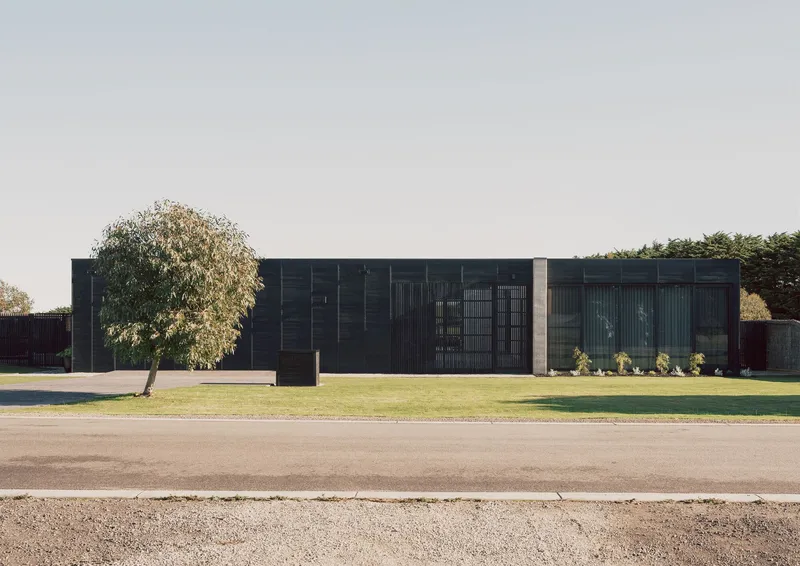
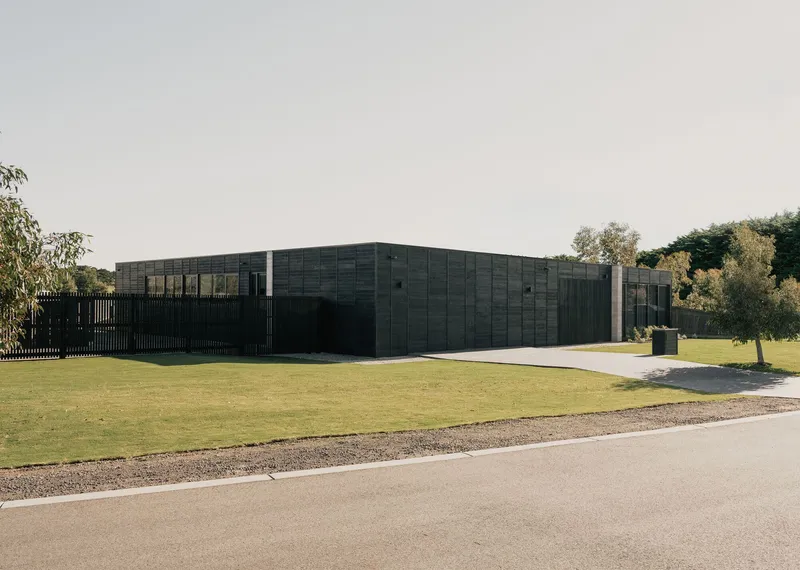
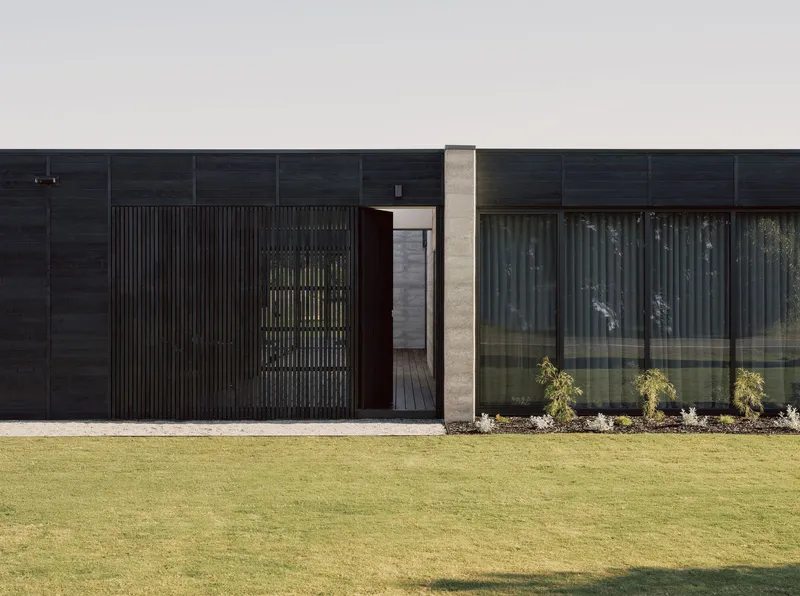
From the street, Thirteenth Beach House reads as a long, low volume wrapped in black-stained timber cladding. Vertical louvres filter any oblique glimpse of the interior while maintaining airflow and a sense of depth in the facade. A mature tree on the lawn is the most welcoming gesture the house makes toward the public realm. There is no picture window, no visible entry sequence, and no attempt to signal domestic life behind the screen.
The entry itself is compressed and deliberately understated: a concrete column, a slatted timber screen, and a narrow threshold that forces a shift in attention from the neighbourhood outside to the courtyard within. It is a move borrowed from courtyard traditions worldwide, but it works here because the surrounding context genuinely warrants it. In a dense golf course estate where lots sit close together, opacity is not an aesthetic choice. It is a functional one.
The Courtyard as Organizing Core
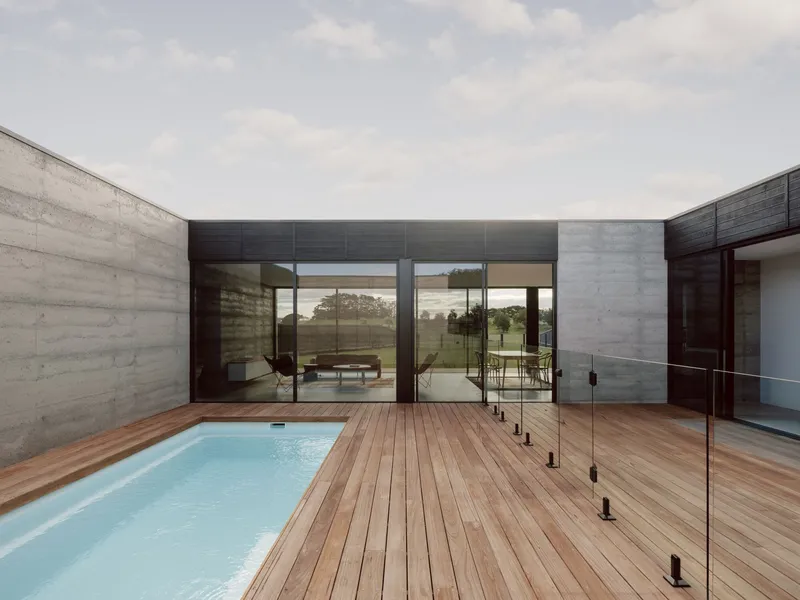
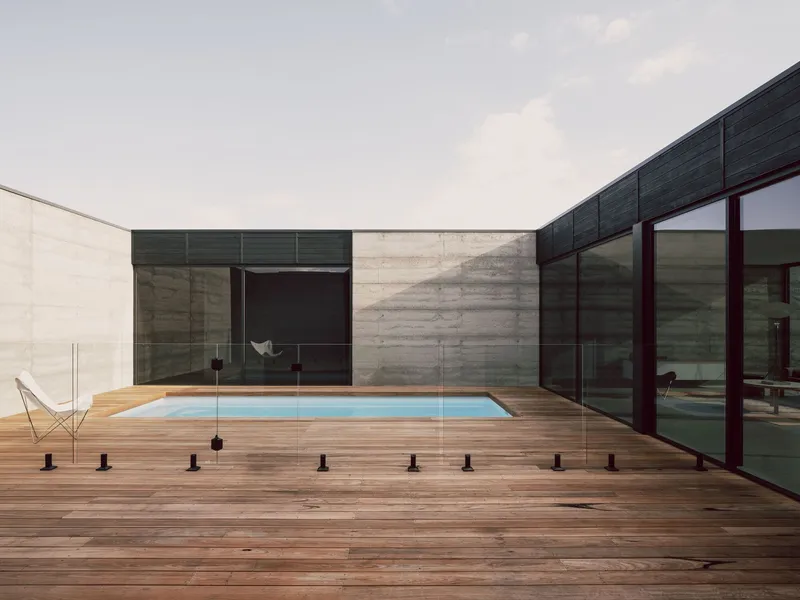
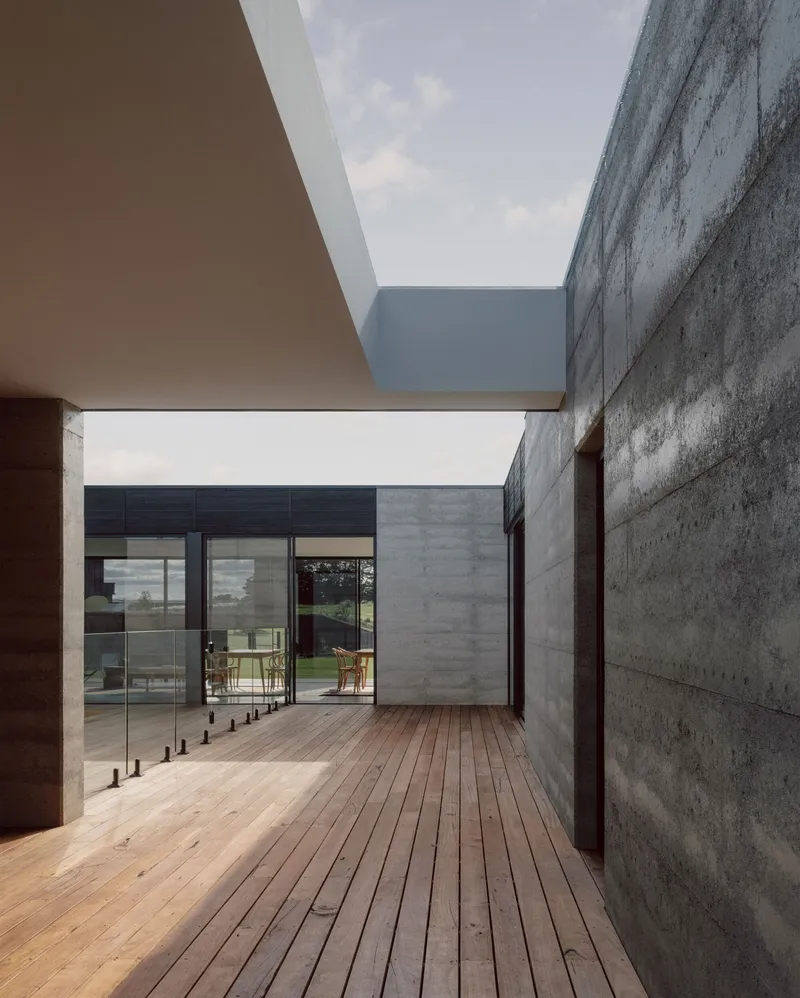
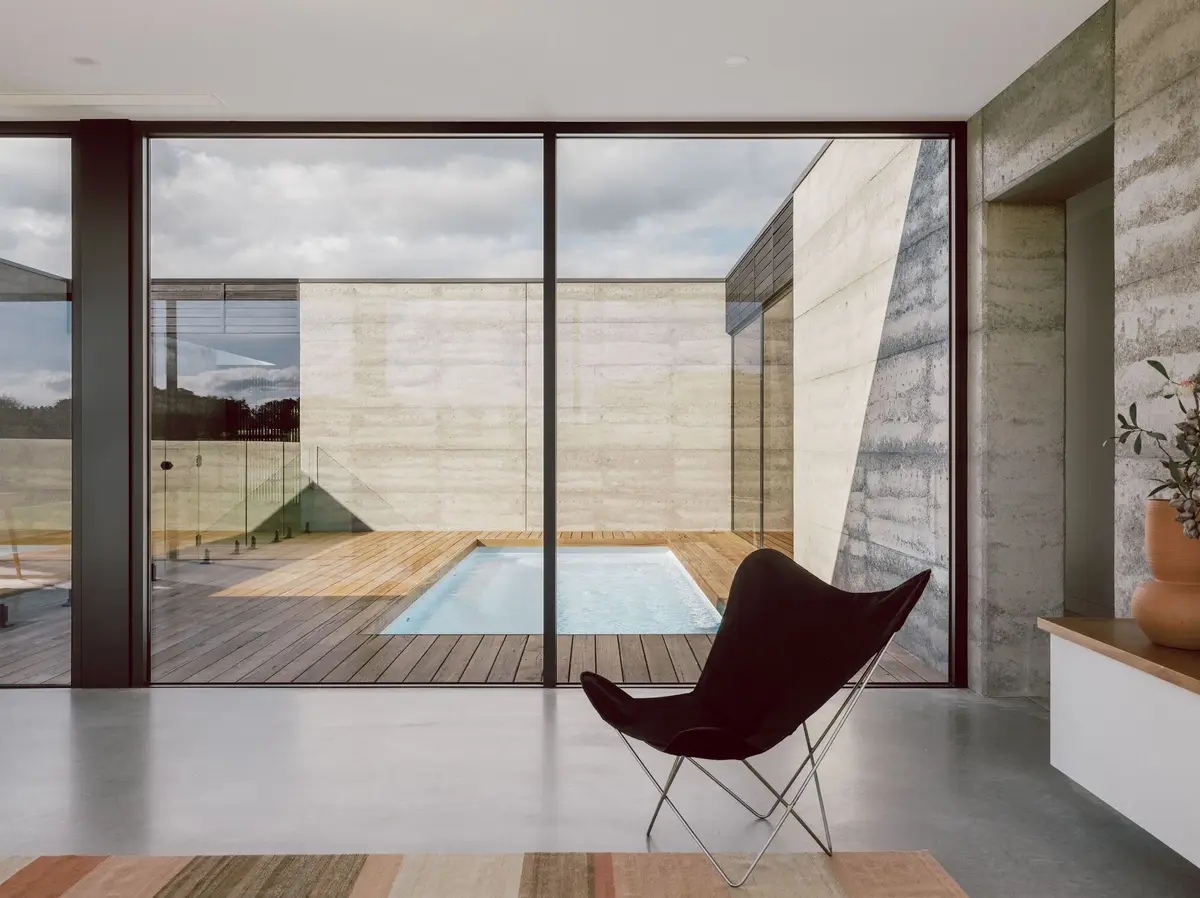
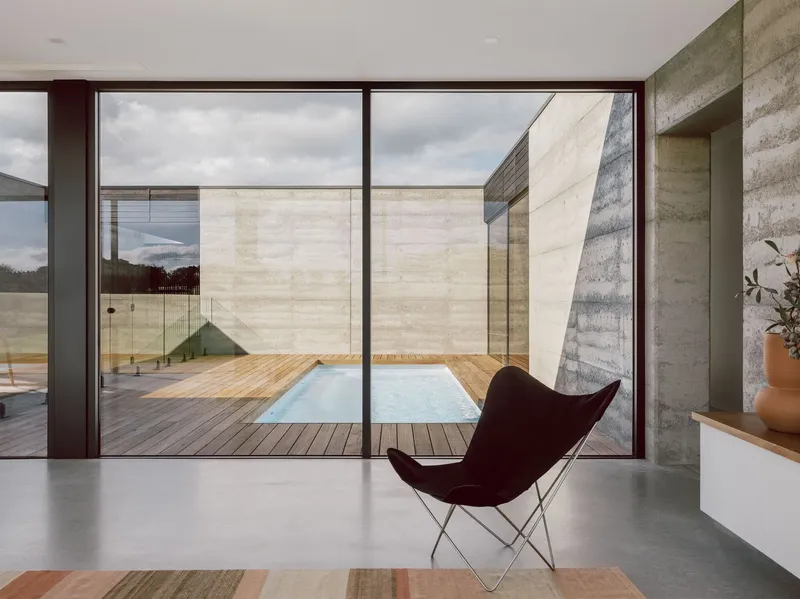
The central courtyard is the real heart of the plan. A rectangular lap pool occupies much of its length, flanked by timber decking and framed on three sides by board-formed concrete walls that carry the texture of their formwork like geological strata. The fourth side opens through full-height glazing into the living spaces, collapsing the boundary between inside and out in a single gesture.
Covered and uncovered zones within the courtyard allow occupation in varied weather conditions, which matters on a stretch of coast where overcast skies and strong winds are as common as sunshine. The cantilevered overhang shelters a portion of the deck, creating a threshold space that is neither fully interior nor fully exposed. It is the kind of in-between zone that makes courtyard houses livable rather than merely photogenic.
Rammed Earth as Wall, Structure, and Atmosphere
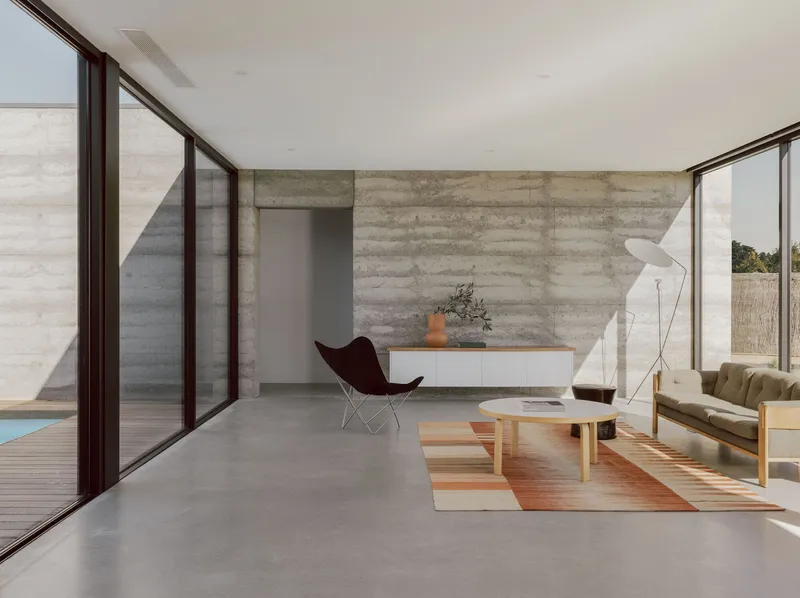
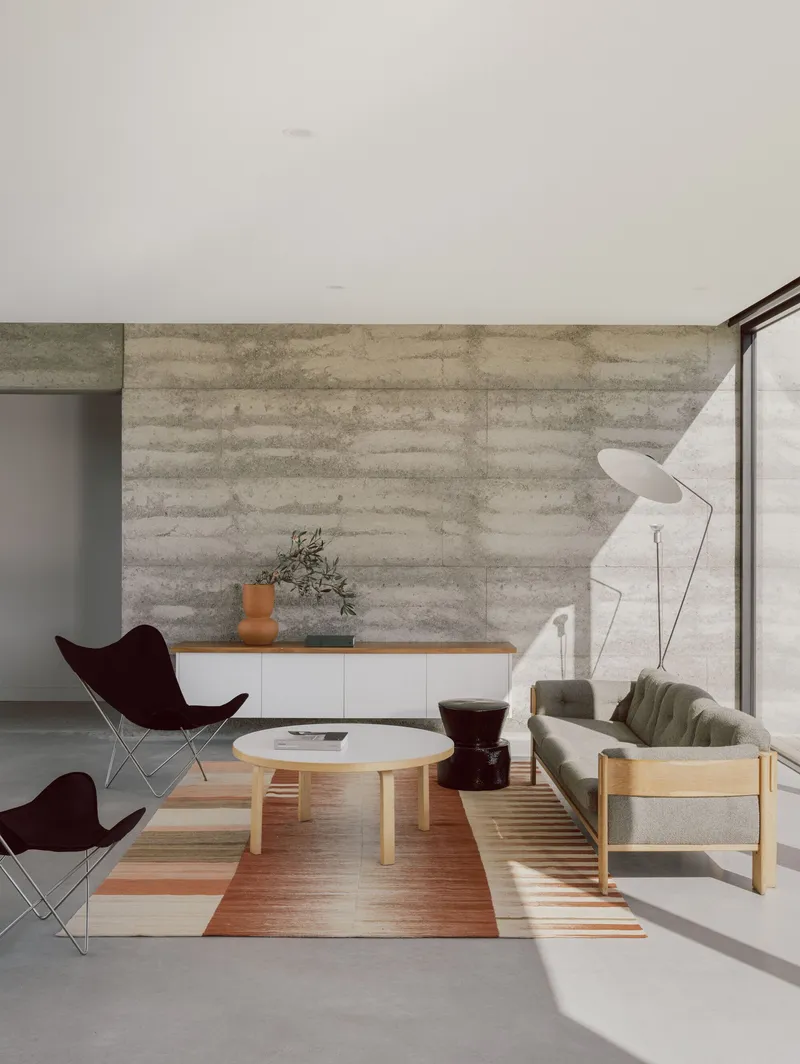
The 600mm rammed earth walls do significant work across multiple registers. Structurally, they carry loads and define the pinwheel arrangement of the three wings: a guest and service zone, a central living area, and a private family wing. Environmentally, their thermal mass moderates temperature swings in a coastal climate that can shift rapidly. Atmospherically, their layered, striated surfaces catch diagonal afternoon light in ways that polished concrete or plasterboard simply cannot.
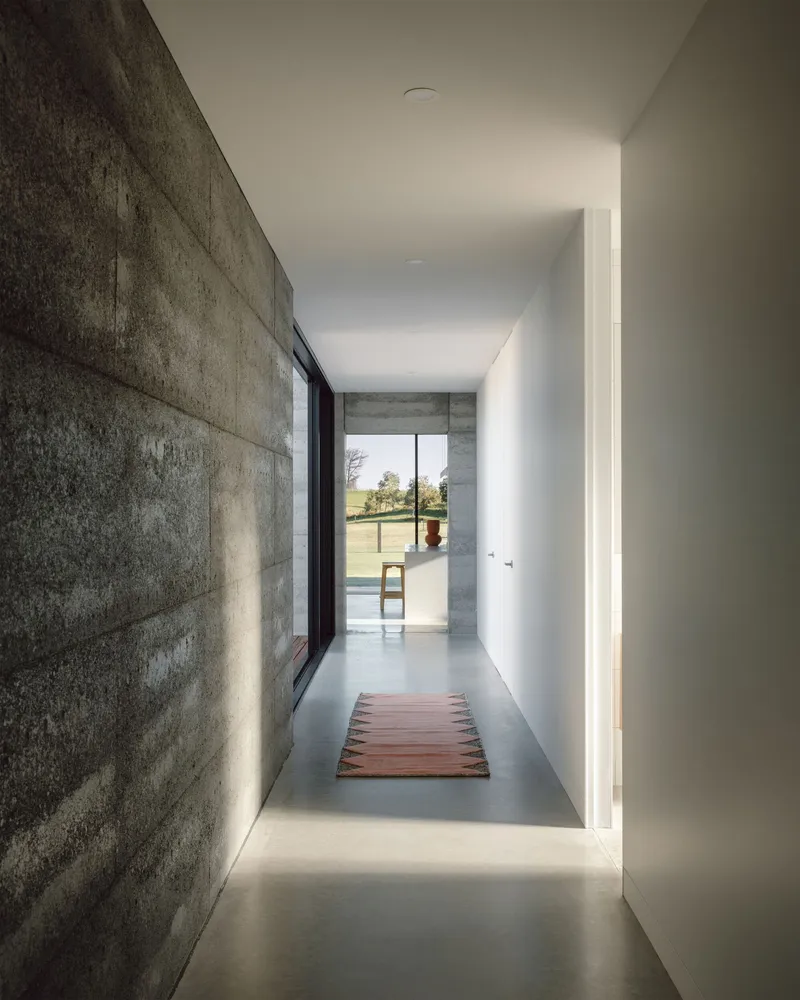
MGAO pairs the rammed earth with board-formed concrete walls and polished concrete floors, creating a material palette that is consistent in its rawness but varied in texture. The effect is calm without being bland. Afternoon sunlight rakes across the living room floor and climbs the concrete wall, shifting the character of the space by the hour. These are not decorative surfaces; they are working elements that happen to age well.
Living Spaces That Open Wide
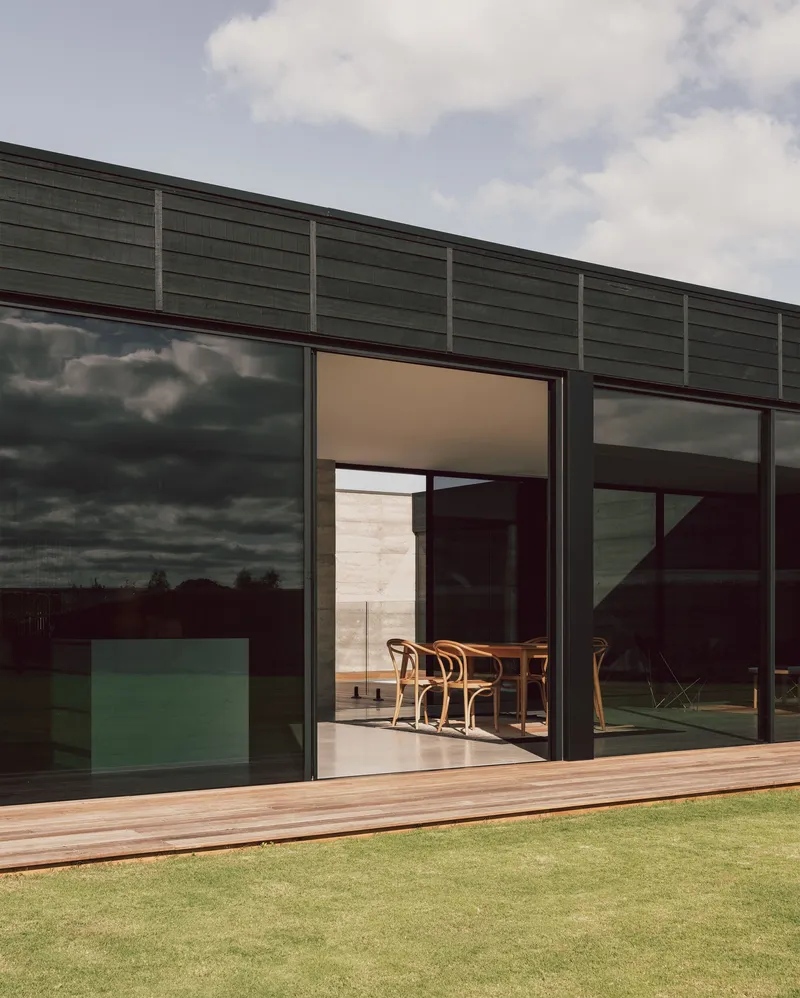
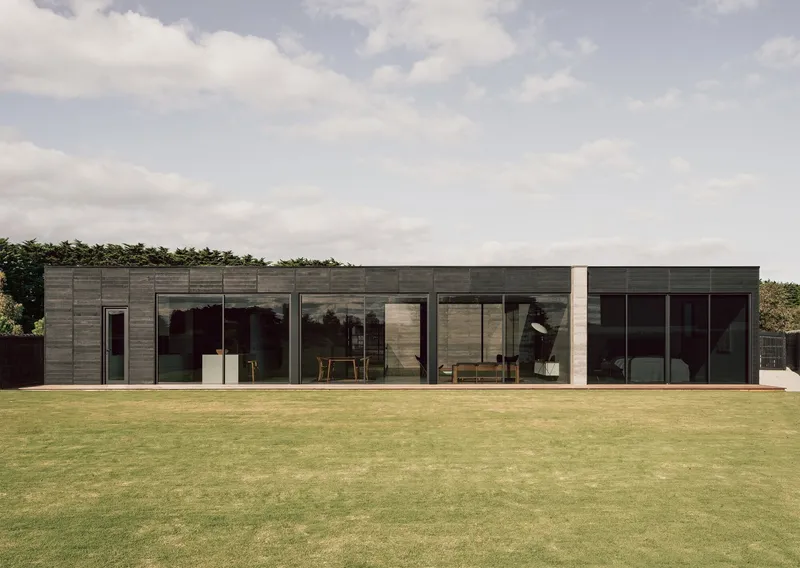
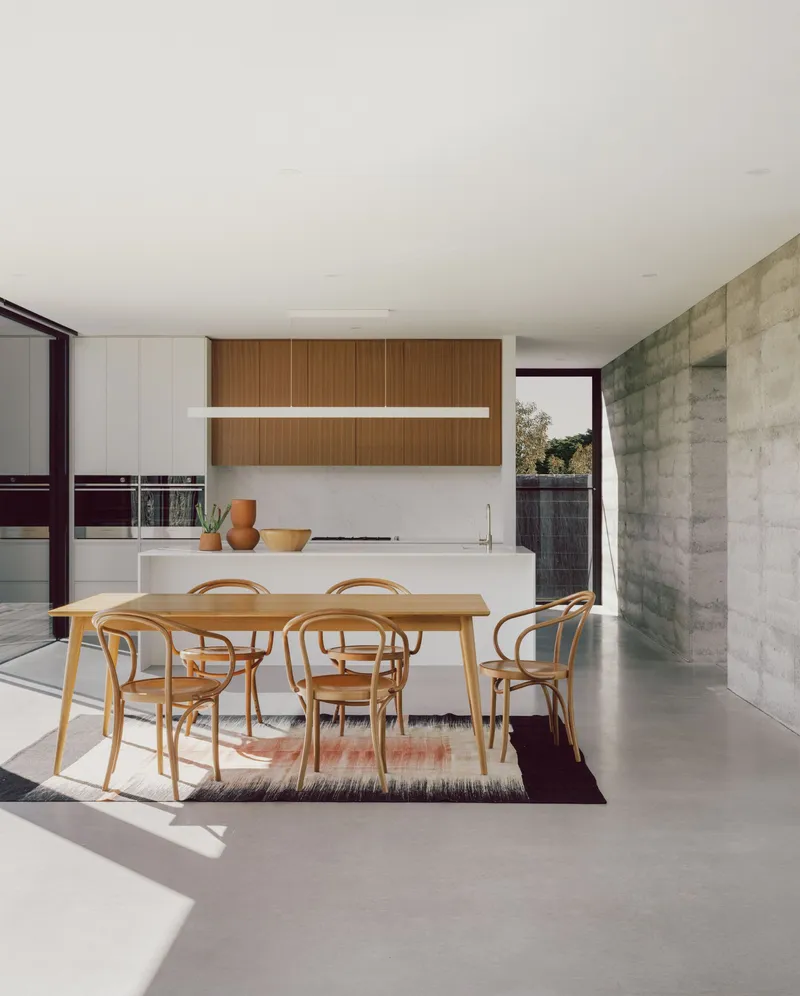
Where the street facade is closed, the courtyard-facing elevation dissolves almost entirely into glass. Floor-to-ceiling sliding doors retract to merge the dining area with the timber deck, making the courtyard an extension of the kitchen and living room during warmer months. The dining table sits right at the threshold, positioned so that meals happen half inside, half out.
The garden elevation on the opposite side of the house also employs full-height glazing, but here it is set back behind the plane of horizontal timber cladding, offering a more controlled relationship with the landscape beyond. The contrast between these two glass walls is intentional: one is about immersion in the courtyard, the other about framing a more distant view. The house breathes in two directions without ever losing its sense of enclosure.
Private Rooms and Quiet Details
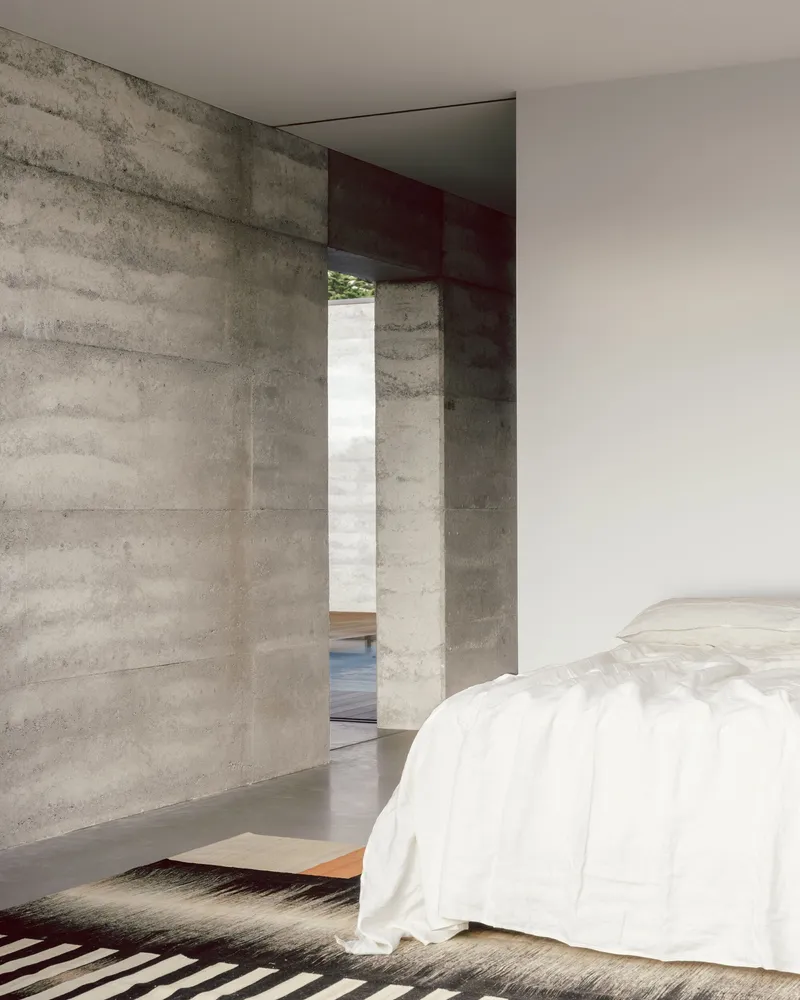
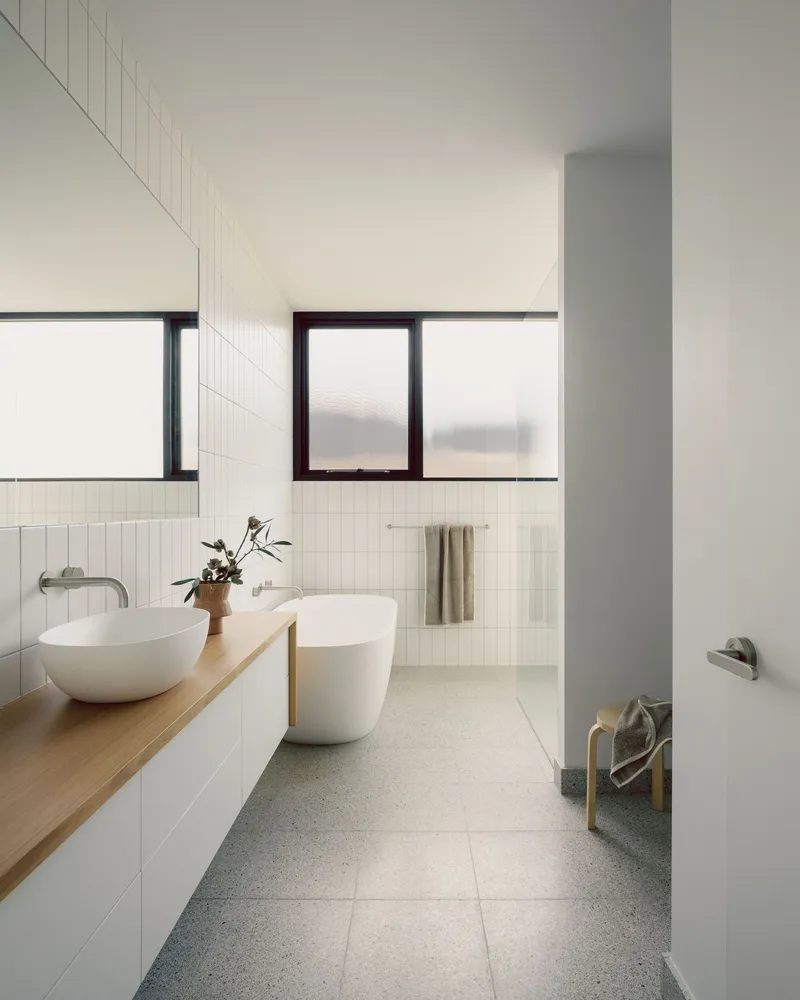
The private family wing pulls the same material palette into more intimate proportions. A bedroom frames its doorway with a deep red steel beam that reads as a deliberate punctuation mark against the surrounding concrete. It is one of the few moments of colour in the house, and it lands precisely because of its restraint. The bathroom pairs white vertical tiles with a timber vanity and a freestanding tub, balancing warmth and cleanliness without resorting to the usual spa clichés.
A concrete hallway with cove lighting connects the private wing to the pool terrace, functioning as a decompression corridor between the social and intimate zones of the house. The polished floor reflects the strip of light above, elongating the passage visually. It is a small move that reinforces the architectural hierarchy of the plan: public courtyard, semi-public living spaces, private bedrooms, each accessed through a sequence that asks you to slow down.
Thresholds and Transitional Spaces
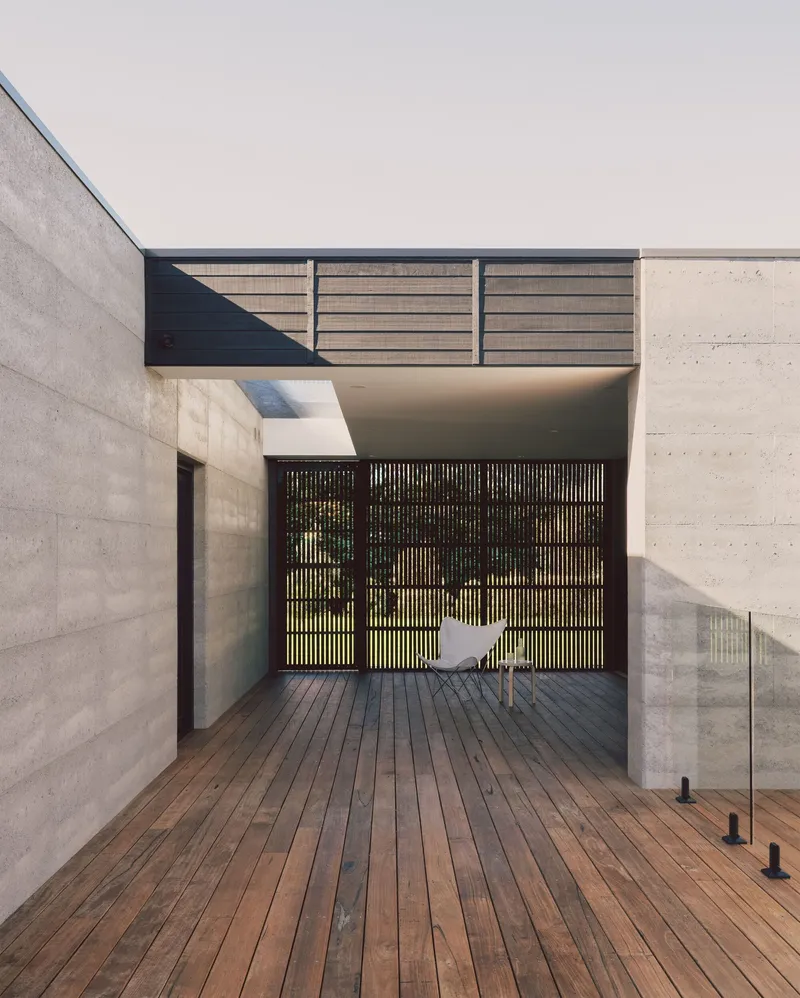
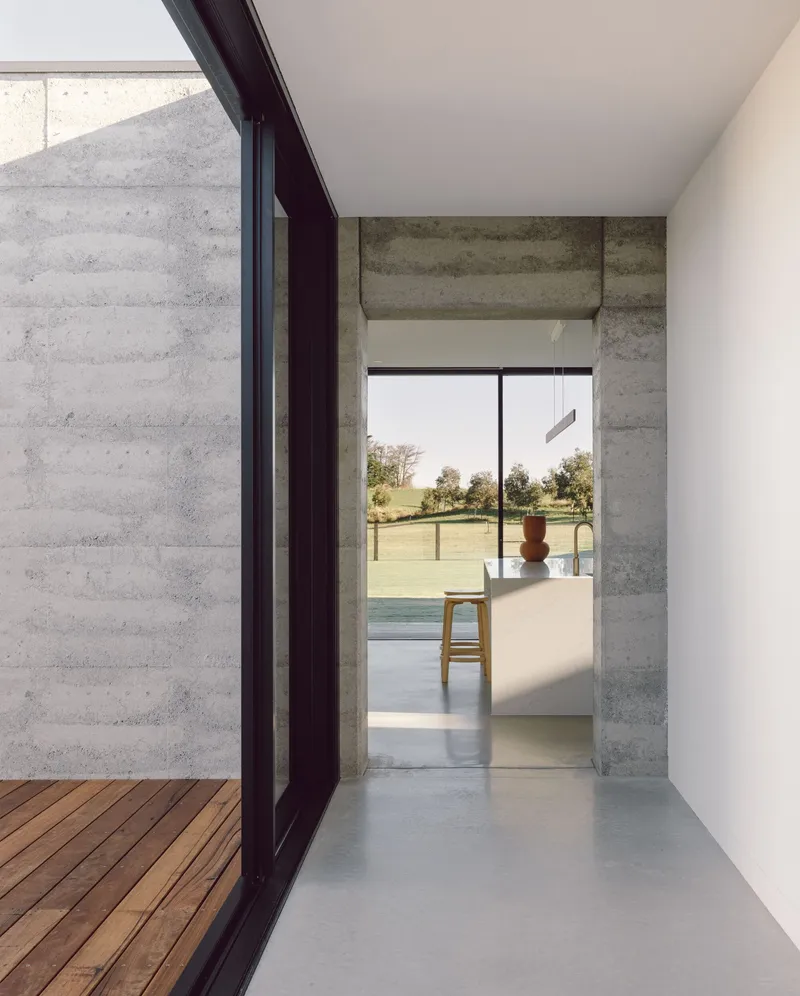
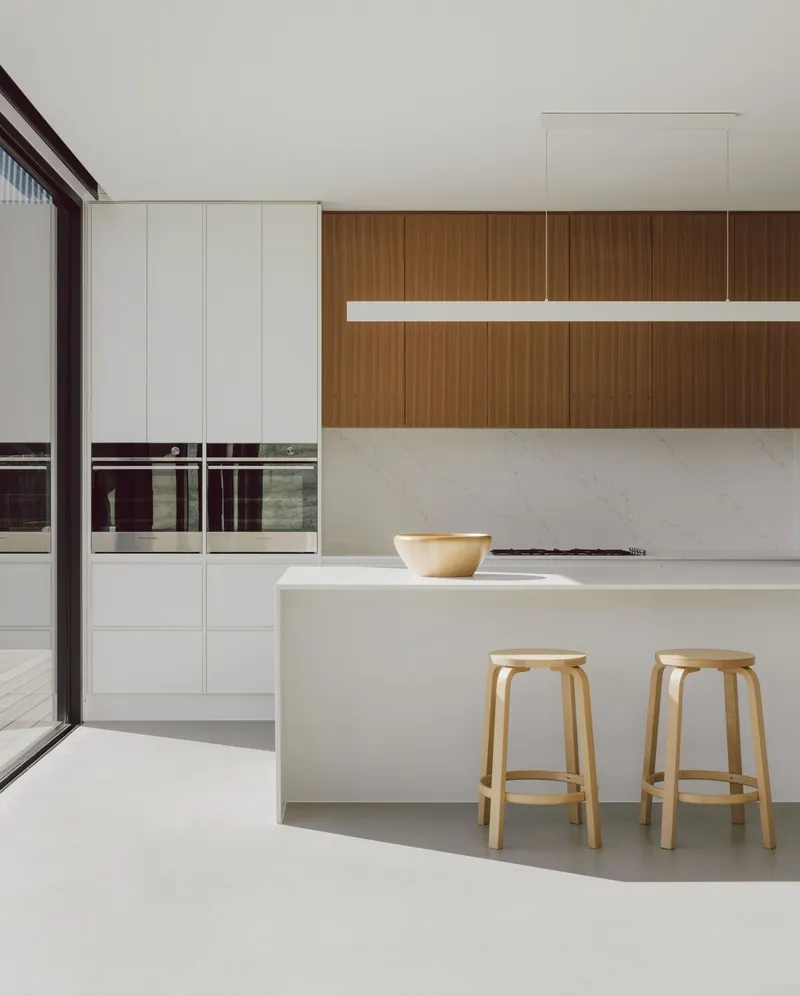
The covered entry deck, with its vertical slatted screen and concrete canopy, sets the tone for the entire house. Light filters through the slats in parallel lines, casting moving shadows across the floor as the day progresses. A single white chair sits in this zone, suggesting it is not merely a pass-through but a place to pause. The kitchen, by contrast, is clean and contemporary: a white island bench with timber stools beneath walnut cabinetry and a linear pendant, efficient and uncluttered.
These transitional moments matter because they give the house its rhythm. Moving from the filtered entry to the compressed hallway to the expansive courtyard creates a sequence of spatial events that a conventional open-plan layout would flatten. MGAO understands that seclusion is not about building bigger walls; it is about choreographing the experience of moving between them.
The Garden Side
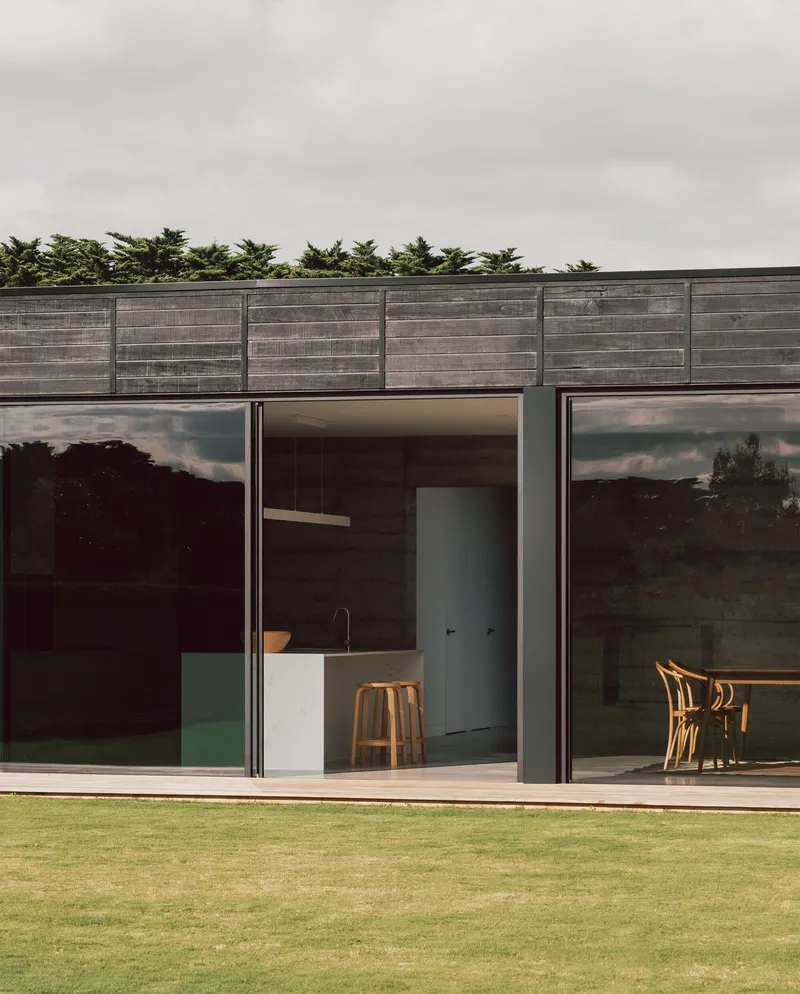
The rear elevation presents a softer face than the street side. Full-height glazing sits beneath horizontal timber cladding, and existing trees are retained to screen the house from neighbouring properties. It is a quieter composition, less assertive, but it serves an important role in balancing the house's relationship with its surroundings. Not everything needs to be a fortress; the garden side acknowledges that landscape, when it is your own, can be invited in.
Plans and Drawings
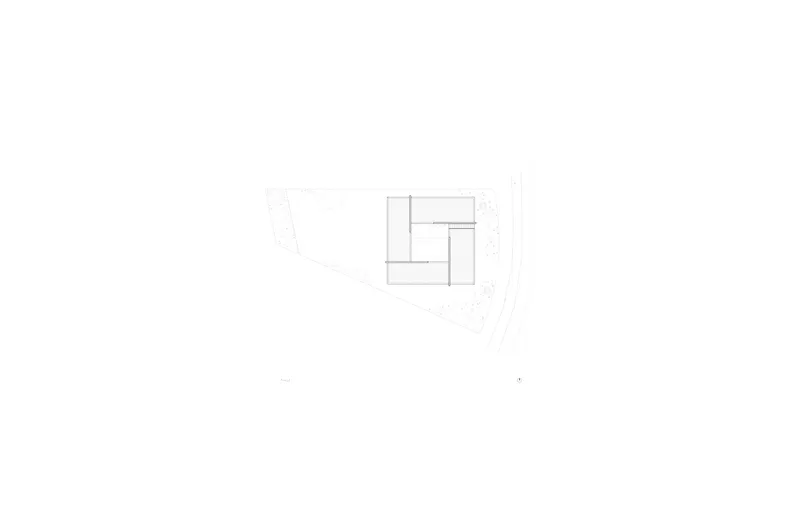
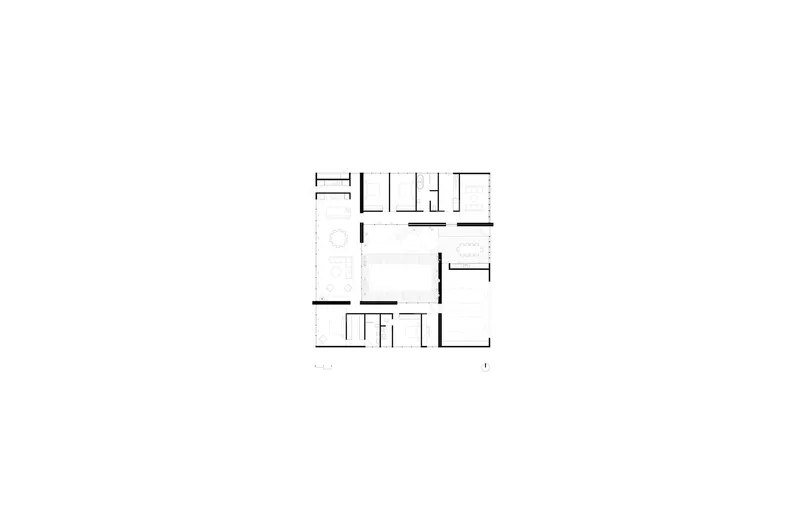
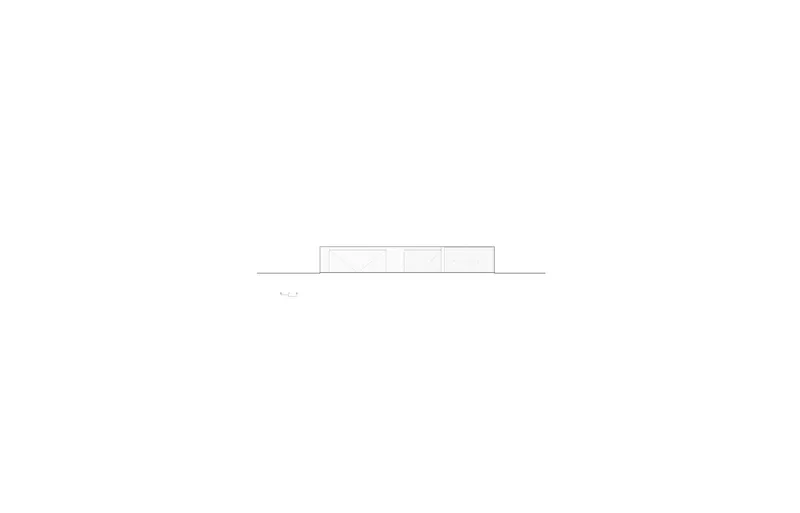
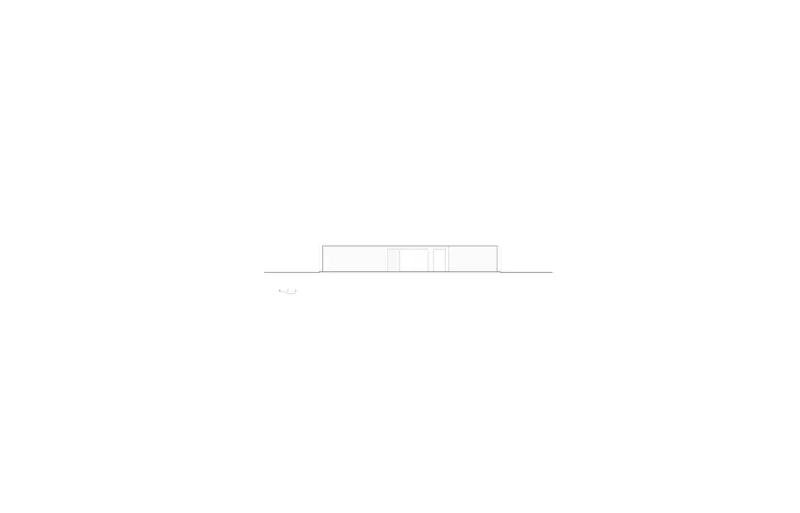
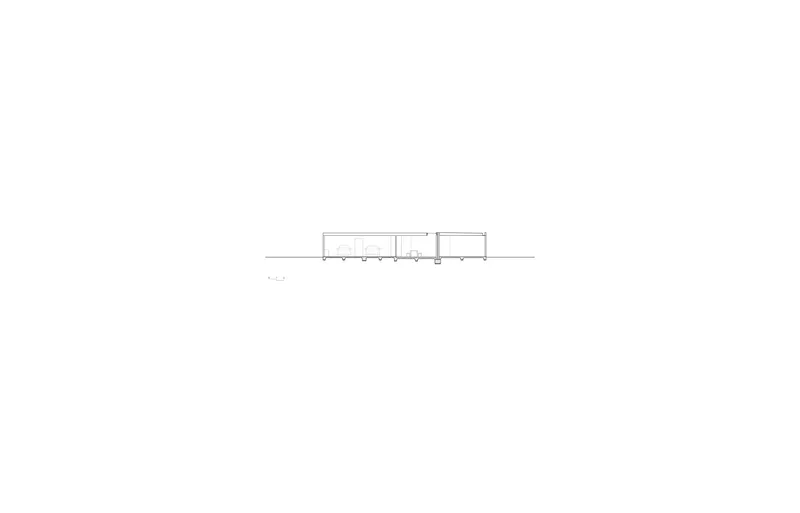
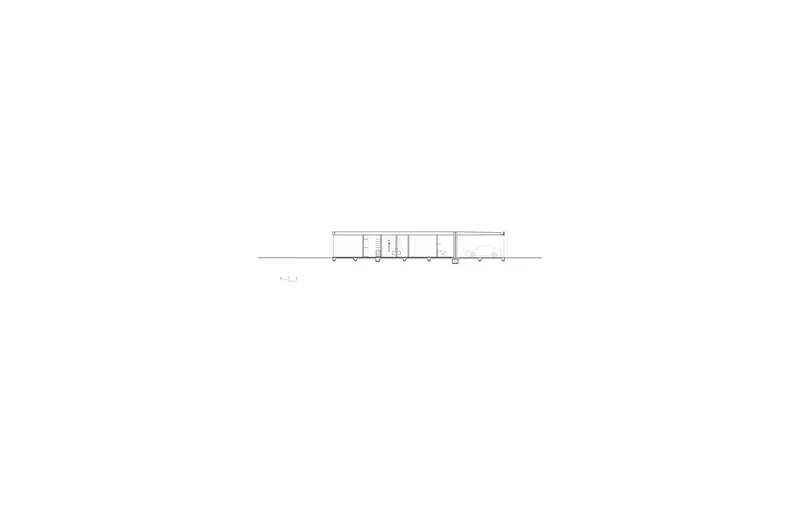
The floor plan reveals the pinwheel logic clearly: four rammed earth walls radiate from the courtyard, dividing the house into its three wings while creating sheltered outdoor pockets at each corner. The site plan shows how tightly the rectangular footprint is nested among surrounding vegetation, explaining the inward strategy. Elevations confirm the low horizontal profile, and sections illustrate the generous relationship between slab roof, columns, and the ground plane, with room heights kept deliberately modest to reinforce a sense of groundedness.
Why This Project Matters
Thirteenth Beach House is a useful corrective to the idea that coastal houses should be transparent. In a dense estate where proximity to neighbours is unavoidable, MGAO demonstrates that privacy can be achieved not through tall fences or setback distance but through plan geometry and material weight. The courtyard typology is ancient, but applying it to a 220 square metre house in a golf course subdivision is a specific, contemporary act. It works because the architect committed to the strategy fully rather than hedging with token street-facing windows.
The material palette of rammed earth, charred timber, and board-formed concrete is coherent enough to unify the composition but varied enough to sustain interest across the scale of the building. Built on Wadawurrung land, the house sits lightly in plan despite its massive walls, occupying its lot with restraint and directing energy inward. In a market flooded with glass-box holiday homes, this is a house that earns its seclusion the hard way: through disciplined architecture.
Thirteenth Beach House by MGAO (lead architect: Matt Goodman). Located in Thirteenth Beach, Victoria, Australia. 220 m². Completed in 2021. Builder: Basebuild Construction. Engineers: PM Design Group and Adam O'Halloran & Associates. Photography by Dan Preston.
About the Studio
Share Your Own Work on uni.xyz
If projects like this are the kind of work you want to make, uni.xyz is a place to publish your own, find collaborators, and enter design competitions.


Popular Articles
Popular articles from the community


Play: Fragments of Their World
Familiar architecture becomes modular playground design, creating safe spaces where displaced children can learn, connect, imagine and play.

ALGAL REALM: A Bio-Integrated Lunar Habitat Design for Life Beyond Earth
ALGAL REALM reimagines lunar habitat design with algae-powered life support, 3D-printed regolith, and vertical living for a lunar future.

The Ocean Hive: Sustainable Architecture for a Self-Sufficient Civilization at Sea
The Ocean Hive imagines sustainable architecture at sea, where modular habitats, algae, wave power and ocean waste sustain a growing colony.

Little Red Riding Hood: Architectural Design as a Journey Through Fear, Light, and Storytelling
Little Red Riding Hood reimagines the fairy tale through architectural design shaped by fear, light, scale, memory, uncertainty, and choice.

Similar Reads
You might also enjoy these articles

Bao Huynh Watercolor Atelier: A Serene Art Retreat in Hội An
Bao Huynh Watercolor Atelier in Hội An blends multifunctional art spaces, sustainable design, local materials, and family-friendly living in a serene environment.

Atelier Macri Concept Store Interior Design by CASE-REAL
Atelier Macri store features a "ko" counter, walnut wood details, cork displays, blending retail, gallery, and seamless customer experiences.

Manuel Vargas Izquierdo Stadium and High-Performance Sports Center: Architectural Excellence in Jalpa de Méndez
The Manuel Vargas Izquierdo Stadium blends sustainable design, inclusive sports facilities, and cultural-inspired architecture, revitalizing Jalpa de Méndez’s public spaces.

KAKR Buluh Awar Hall: Revitalizing Community and Ecology Through Bamboo Architecture
Community built bamboo hall revitalizes Buluh Awar village, empowering youth, restoring ecology, celebrating vernacular craftsmanship through sustainable architecture and culture.


Comments (0)
Please login or sign up to add comments
No comments yet. Be the first to comment!