
MIA Design Studio Wraps a Phu Quoc Clubhouse in Perforated Brick Inspired by Silk Lanterns
A hospitality pavilion on Vietnam's largest island uses layered masonry screens to filter tropical light and channel ocean breezes.


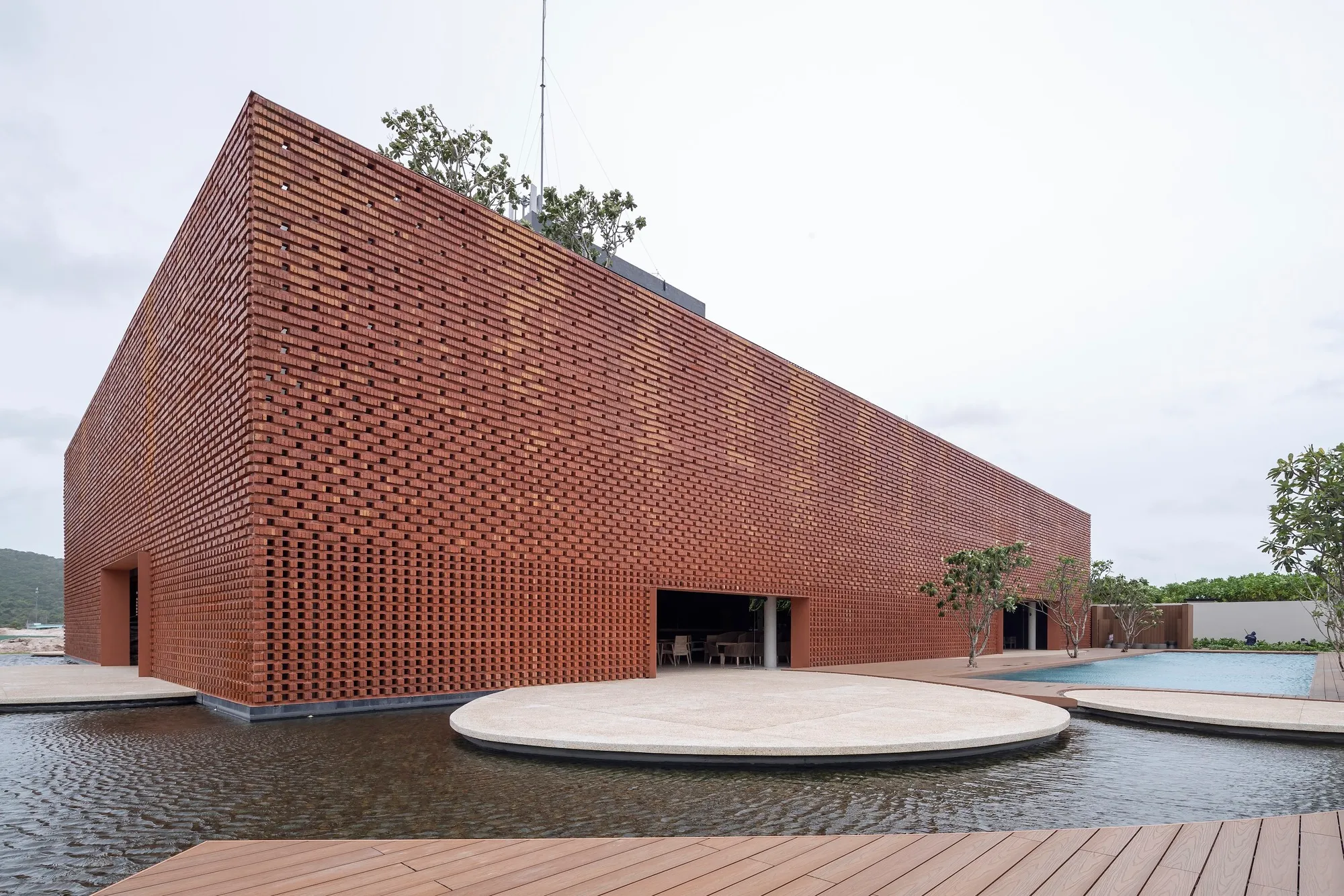
On Phu Quoc, Vietnam's largest island and one of its fastest-developing resort territories, MIA Design Studio has completed a 4,495-square-meter clubhouse for the Wyndham resort complex. Designed beginning in 2016 and completed in 2022, the building serves as the social and programmatic anchor for a gridded masterplan of private villas. Rather than defaulting to the glass-and-steel transparency that resort architecture tends to favor in tropical settings, MIA chose bare brick as the primary material, wrapping the entire structure in perforated masonry screens whose density and orientation shift across every facade. The result is a building that reads simultaneously as solid and porous, monumental and handcrafted.
The conceptual driver is the silk lantern, a ubiquitous object in Vietnamese craft traditions. Where a lantern traps light and radiates it outward through fabric, this clubhouse reverses the operation: it intercepts Phu Quoc's intense sunlight and softens it on the way in. The brick screens create layered veils that modulate glare, invite ventilation through wind convection, and cast shifting shadow patterns across interior floors throughout the day. It is a genuinely passive climate strategy dressed in the language of ornament, and it works precisely because MIA committed to brick at every scale, from the broad chevron patterns on the street facade down to the staggered bonds visible at arm's length.
A Lantern in the Landscape


From a distance, the clubhouse registers as a compact terracotta volume rising from a field of green roofs and planted courtyards. The aerial views make its contextual role clear: surrounded on three sides by smaller, more intimate villas, the building anchors the development without towering over it. A curved water feature arcs along one side of the front lawn, while the rooftop garden blurs the boundary between built form and landscape. MIA's decision to use bare brick rather than render or cladding gives the clubhouse a warmth and tactile quality that concrete-heavy resort architecture rarely achieves.
The green roof is not decorative afterthought. Dense perimeter planting at the upper levels, visible in both aerial and section views, contributes to the building's thermal performance and ties it visually to the lush masterplan below. The clubhouse does not sit on the landscape so much as grow out of it.
The Craft of Perforation
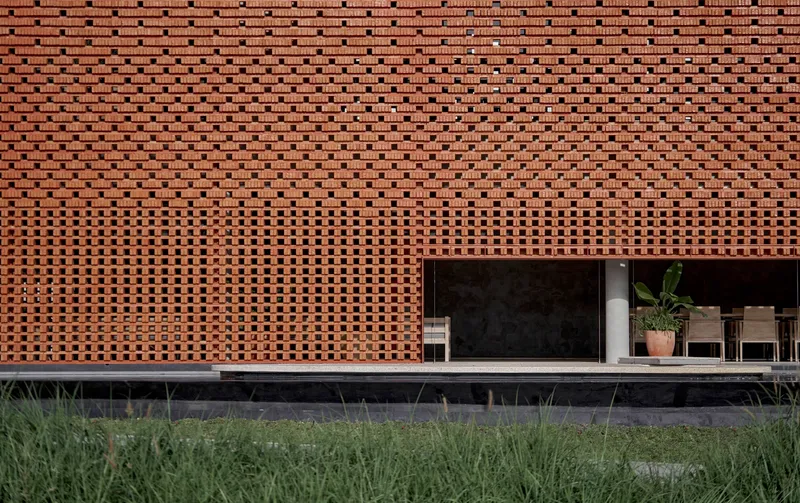
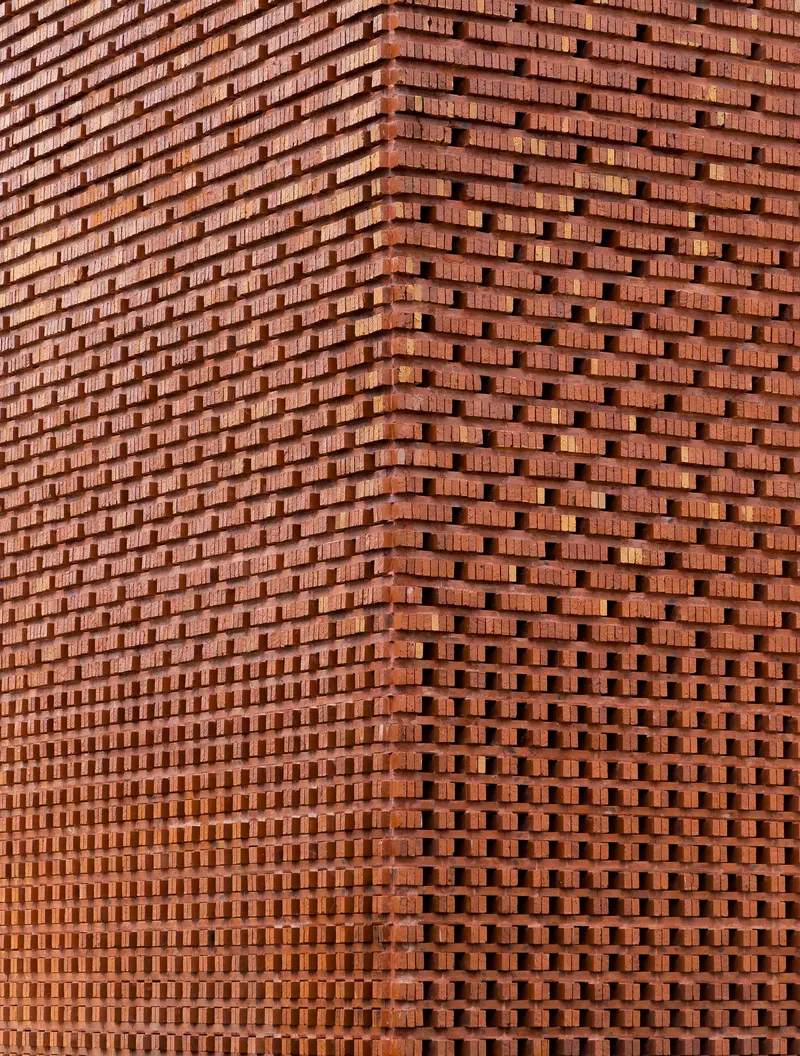
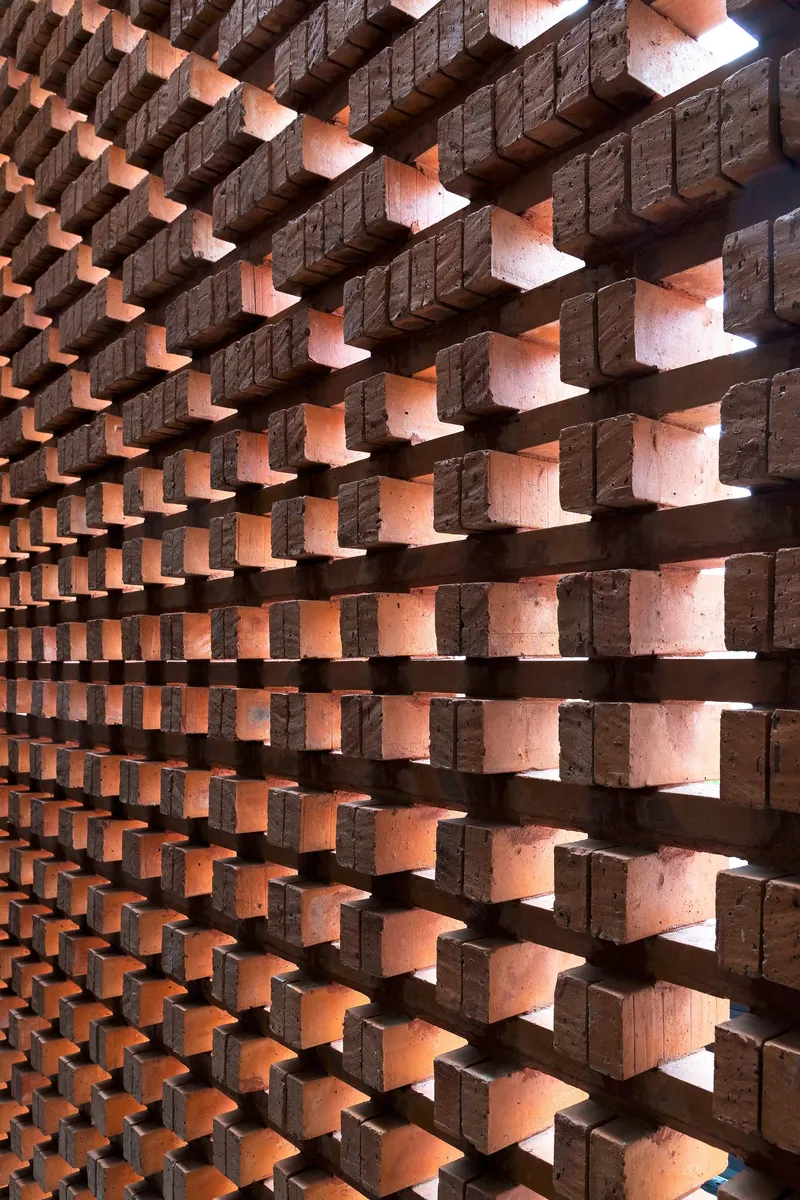
The most compelling aspect of the project is how many distinct patterns MIA extracted from a single material. Up close, the brick screens reveal an astonishing range: staggered bonds with finger-width gaps, undulating surfaces where bricks are rotated at incremental angles, and tighter lattice assemblies where headers are laid to create smaller apertures near the base. This gradient in perforation density is not arbitrary. At lower levels, where privacy and structural loads are greater, the brick is denser. Higher up, the screens open to allow more air and light, thinning out as they approach the roofline.
Perforated brick is a building tradition throughout South and Southeast Asia, and MIA is drawing on a deep regional vocabulary here. What distinguishes this project is the precision of execution. Local mason craftsmanship is evident in the crispness of every joint and the consistency of every rotation. Each pattern was clearly prototyped and calibrated, not improvised on site. The building is, in a real sense, a showcase for brick's capacity to perform simultaneously as structure, envelope, shading device, and ornament.
Threshold and Entry
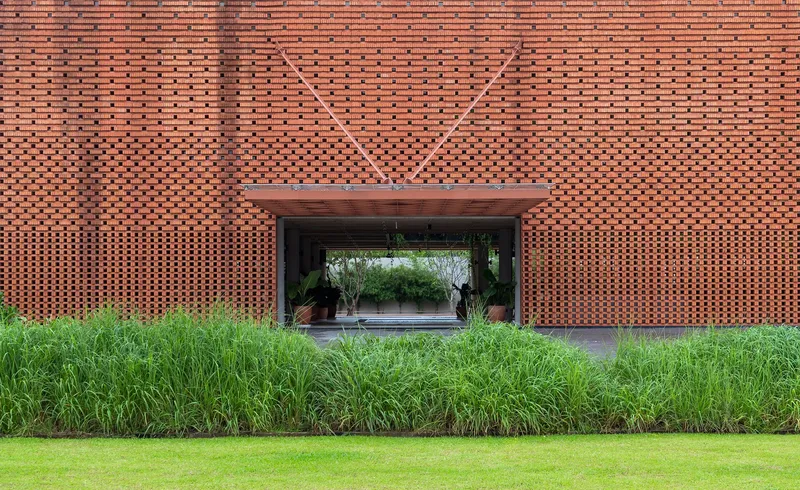
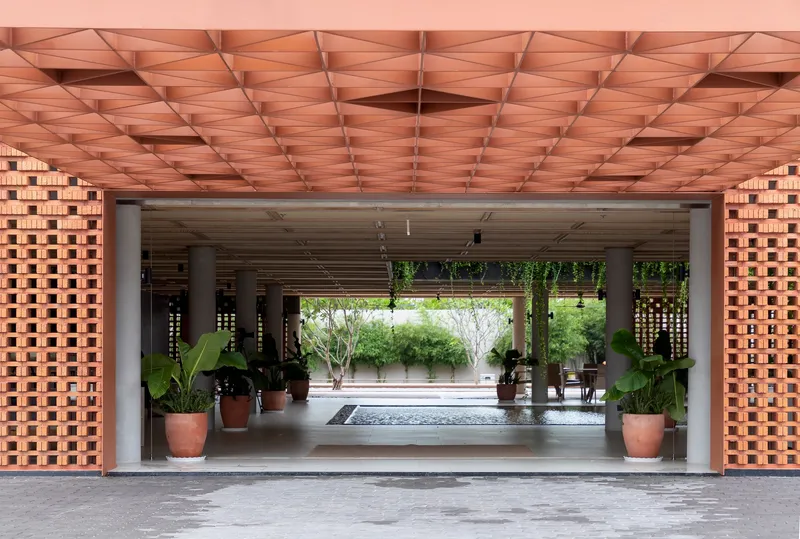

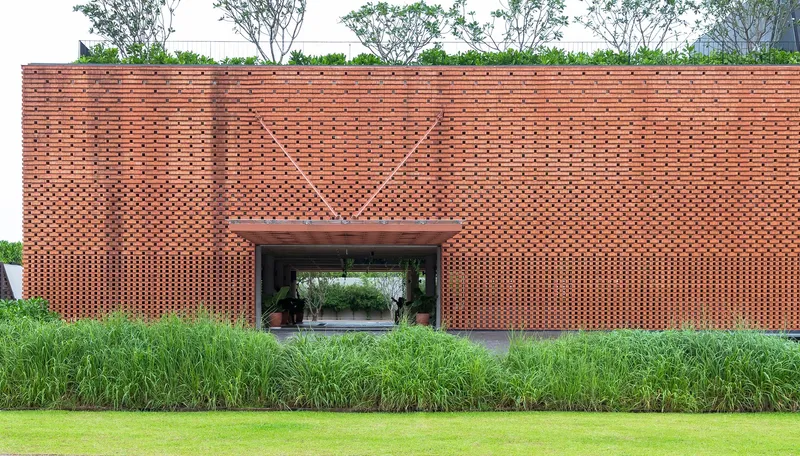
The entry sequence is handled with real care. A covered passage punches through the main brick facade, framed by geometric relief patterns on either side. The transition from exterior sunlight to shaded interior is mediated by a timber ceiling with its own gridded geometry, casting a second layer of dappled light across the walkway. Potted plants and ornamental grasses soften the edges. The experience is one of compression and release: you move from the open lawn through a narrow, shadowed corridor before arriving at the interior courtyard.
MIA uses ceiling articulation throughout the project to reinforce spatial transitions. The coffered and gridded timber ceilings are not just decorative; they echo the perforation logic of the brick walls above, creating a continuous language of filtered light that extends from facade to interior.
Water as Organizing Element
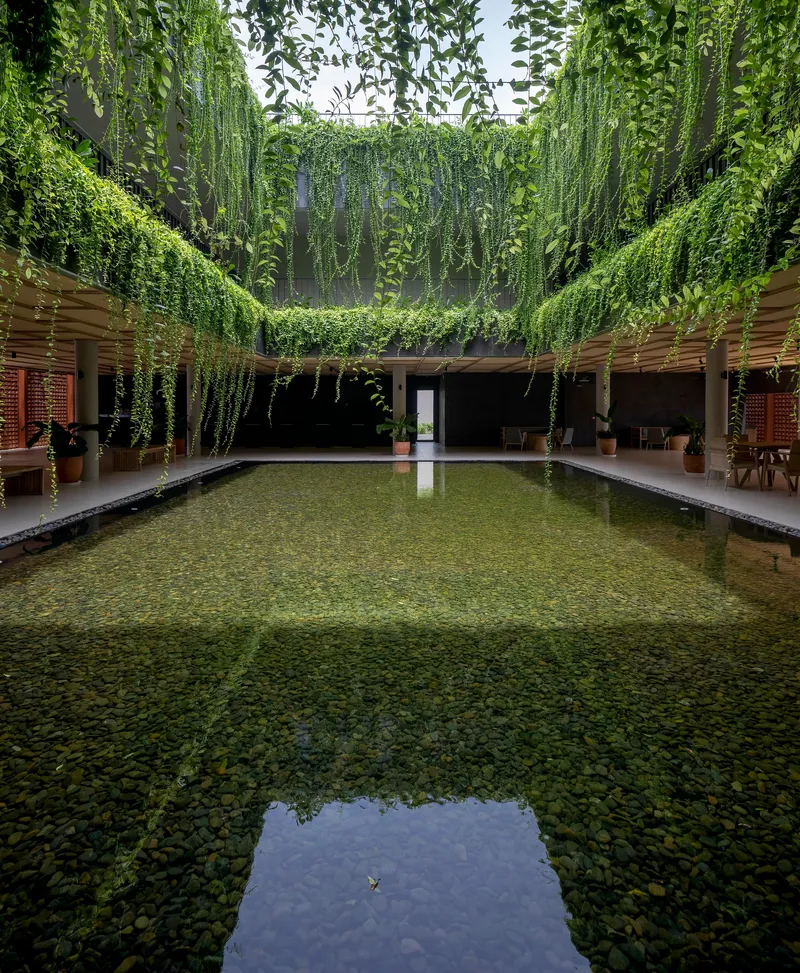

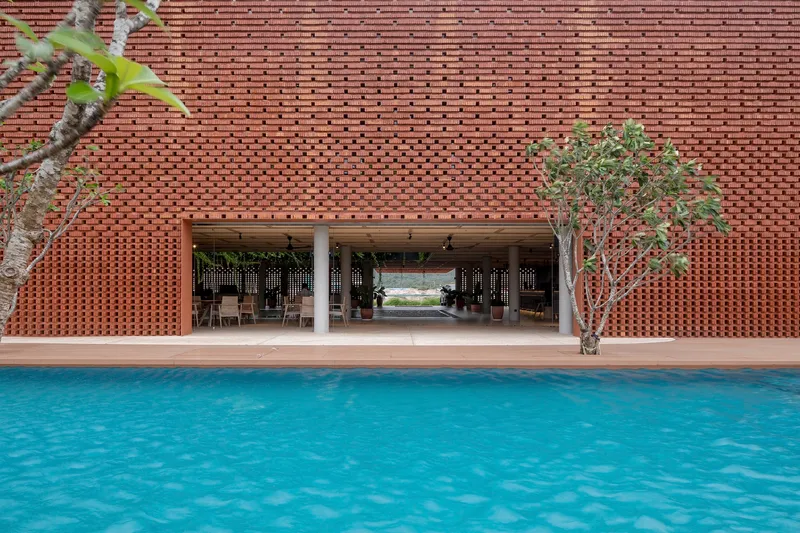
Water appears at every level of the building. At ground level, a rectangular pool at the rear provides a buffer zone between the clubhouse's public spaces and the surrounding villas. A central courtyard pool, framed by trailing vines suspended from a perimeter trellis, brings reflected light deep into the plan. The interplay between water, greenery, and masonry is the project's atmospheric engine: breezes off Phu Quoc's coast move across the reflecting pools, carrying cooled air into covered walkways and dining terraces.
The covered walkway alongside the main pool is one of the building's most successful spatial moments. Cascading greenery overhead, coffered ceilings, and the glint of water below create an environment that feels luxurious without relying on expensive finishes. The indigenous materials, bamboo, wood, and grindstone, do the work that marble and polished stone would do in a less thoughtful project.
Interior Light and Shadow
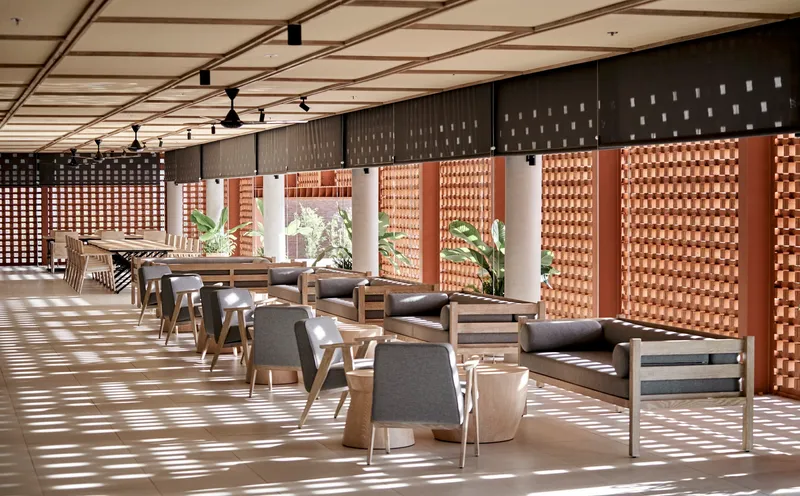
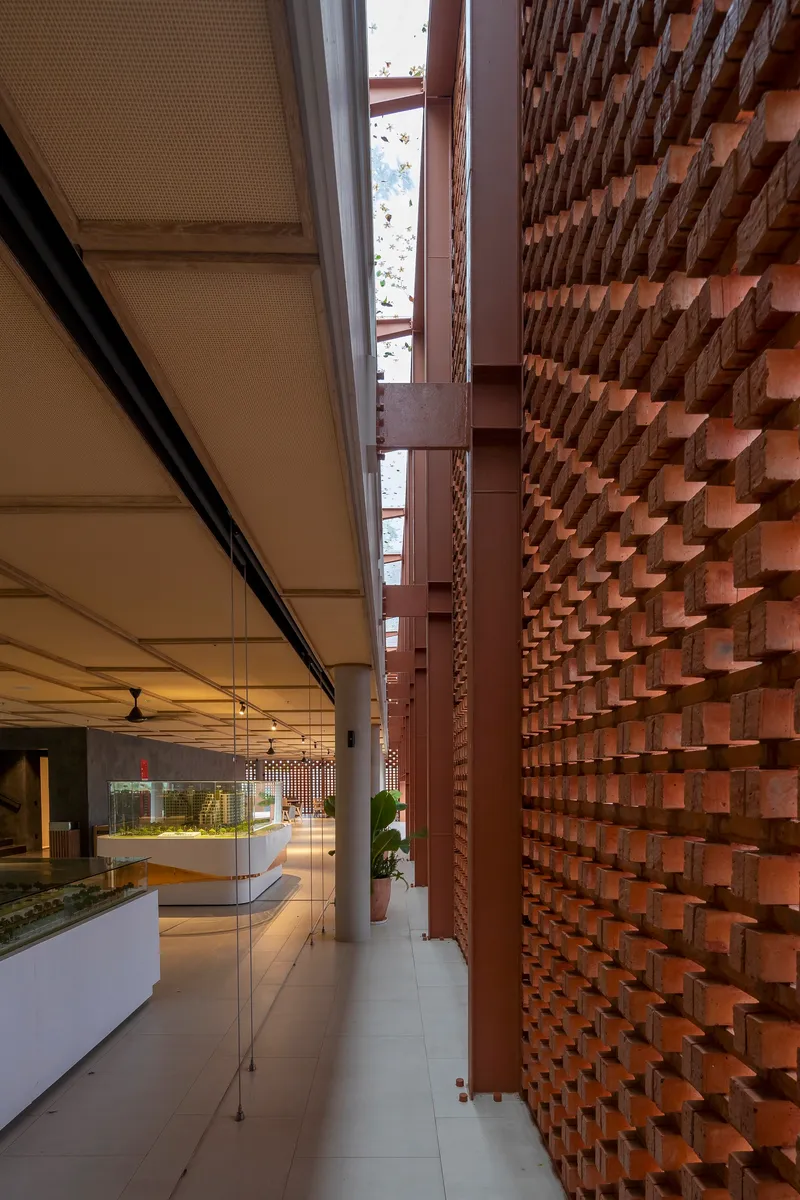

Inside, the perforated brick delivers exactly the atmospheric payoff that the exterior promises. In the dining areas, lattice screens filter sunlight into crisp diamond and dot patterns across pale terrazzo floors and timber furniture. The effect changes hour by hour as the sun moves, transforming a static interior into something kinetic. Narrow skylights between brick walls and interior volumes create vertical shafts of light that punctuate circulation spaces.
MIA describes their approach as techniques for exploiting, softening, or contrasting natural light, and the interiors bear this out. There is no single lighting strategy; instead, each space negotiates its own relationship with the sun. The dining room gets diffuse, scattered light. The narrow passage alongside it gets a bright skylit strip. The courtyard gets full, unfiltered exposure. The variety keeps the interior from feeling monotone despite the consistency of materials.
Courtyards and Vertical Green


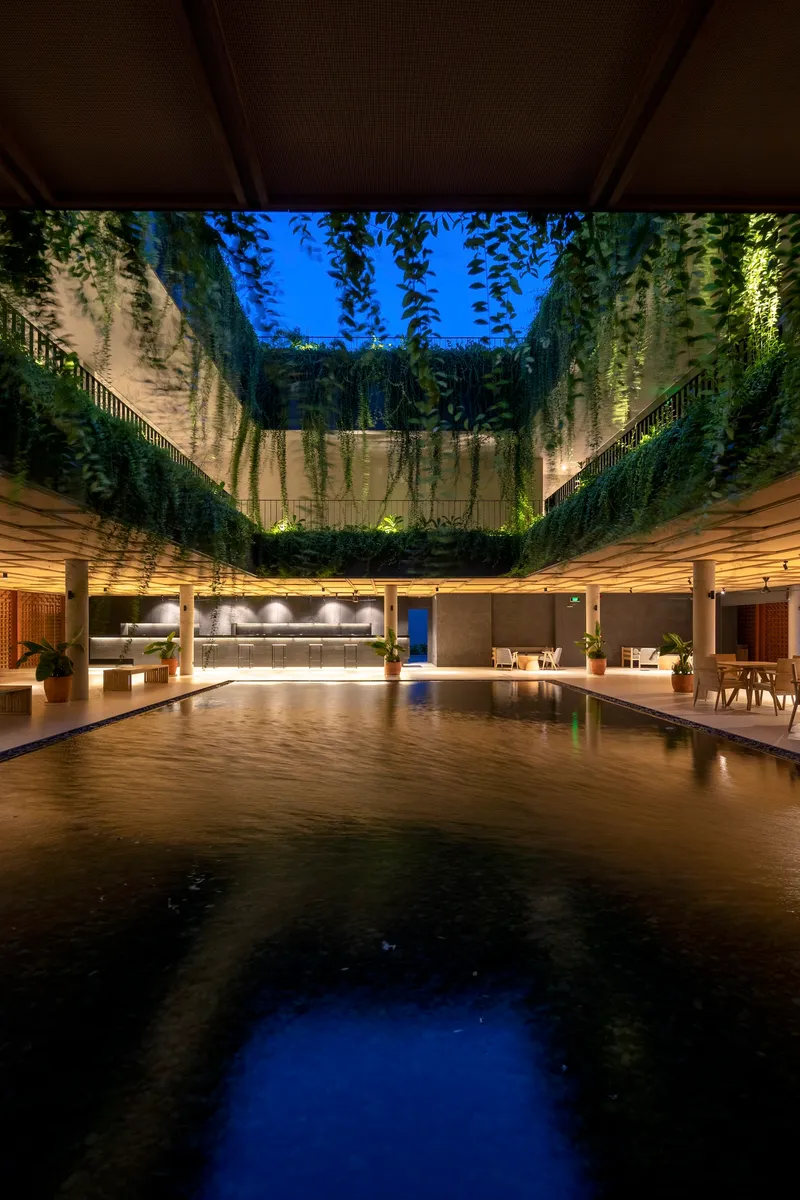
The central courtyard is the heart of the clubhouse, and MIA uses it to solve a problem that many resort buildings ignore: how to bring daylight into the core of a deep plan without overheating it. The courtyard pool, fringed by cascading vines and viewed through a gridded timber ceiling, acts as both light well and cooling device. Evaporation from the water surface and transpiration from the plants lower air temperatures in the surrounding spaces, a passive strategy that is far more effective than air conditioning alone in Phu Quoc's humid tropical climate.
A secondary triangular courtyard, enclosed by black vertical railings and dense planting, introduces a different spatial character: tighter, more intimate, almost domestic in scale. Strategic placement of greenery in spaces with timed light entry means that plant species were selected not just for appearance but for their ability to thrive under specific sun angles. The landscape is as rigorously designed as the architecture.
Dusk and the Lantern Effect
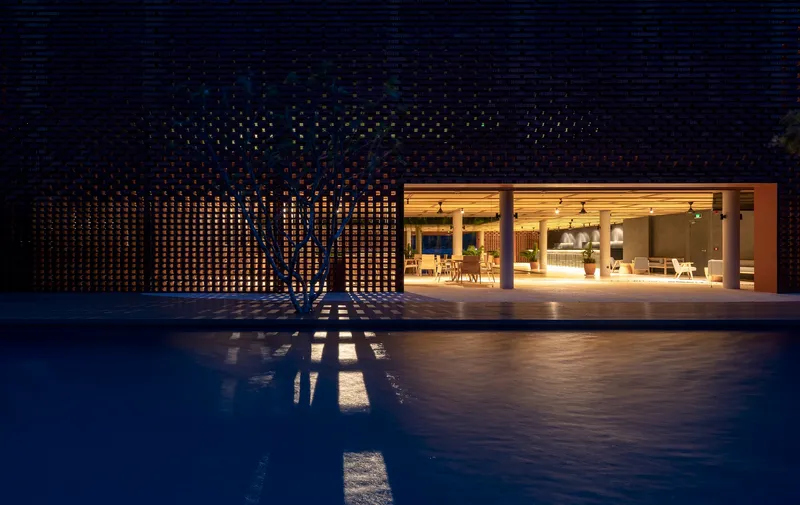

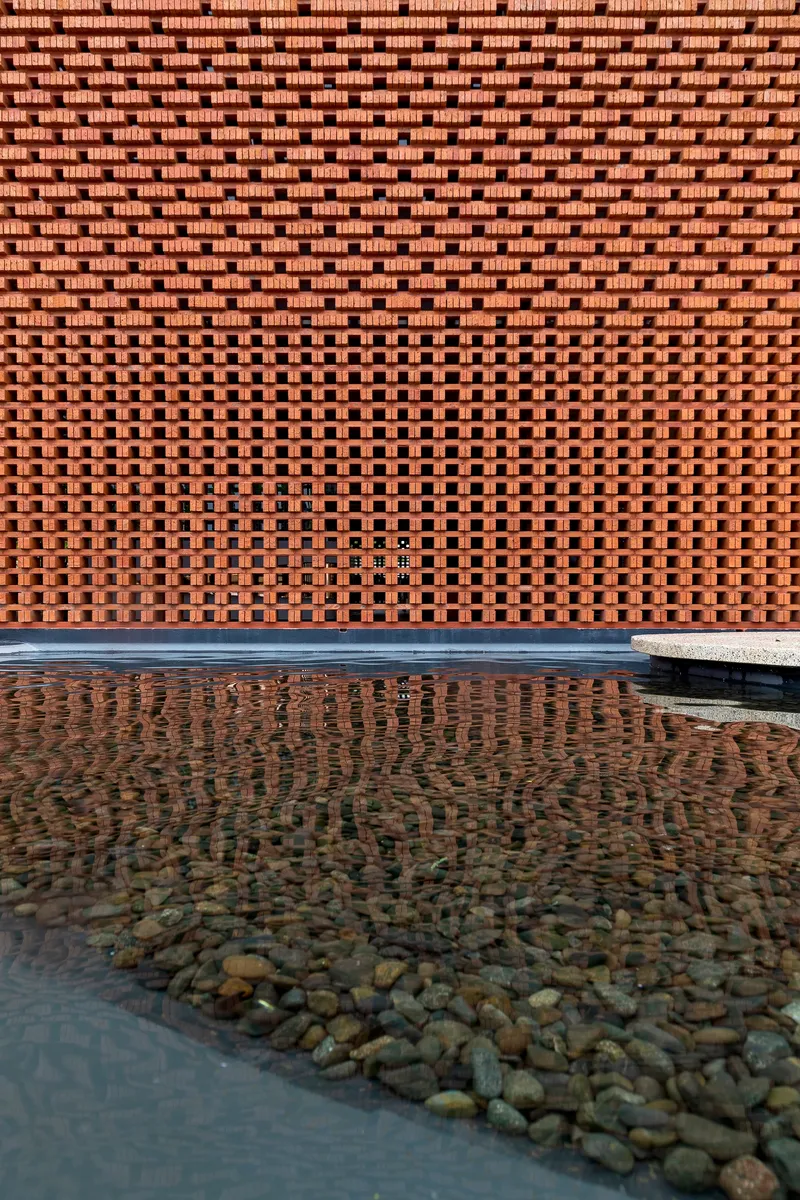
At dusk, the lantern metaphor becomes literal. Interior lighting reverses the daytime logic: instead of filtering sunlight inward, the perforated screens now radiate warm light outward through their thousands of apertures. The building glows. Shallow water pools at the base reflect the illuminated brick, doubling the effect. River stones in the reflecting pools add a textural counterpoint to the precision of the masonry above.
It is worth noting how few resort buildings reward a second look at night. Most hospitality architecture treats exterior lighting as a branding exercise: uplighting, feature walls, logo illumination. Here, the building itself is the light fixture. The same perforations that manage solar gain during the day become the source of the building's nocturnal identity. Form and performance are genuinely unified.
Plans and Drawings
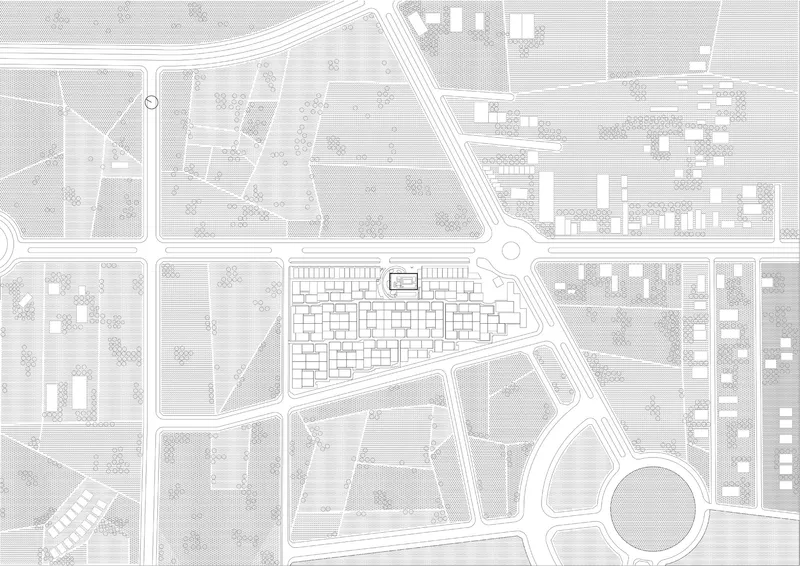
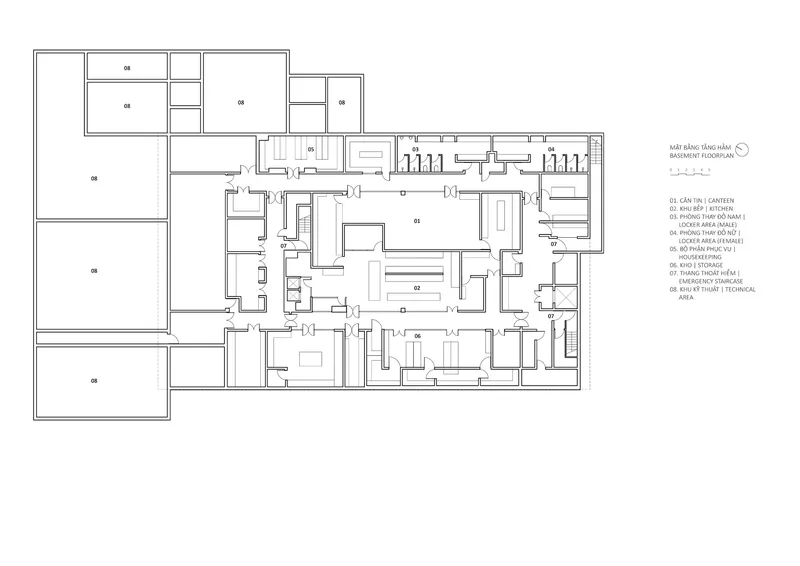
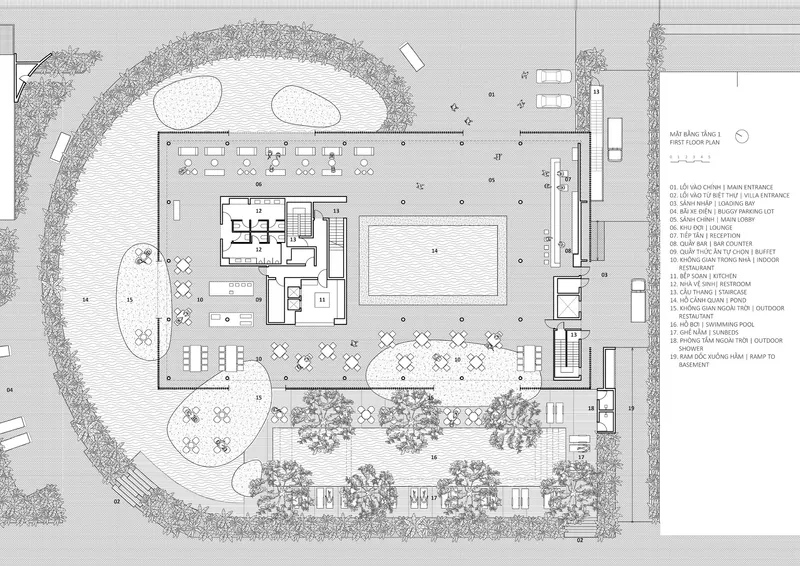
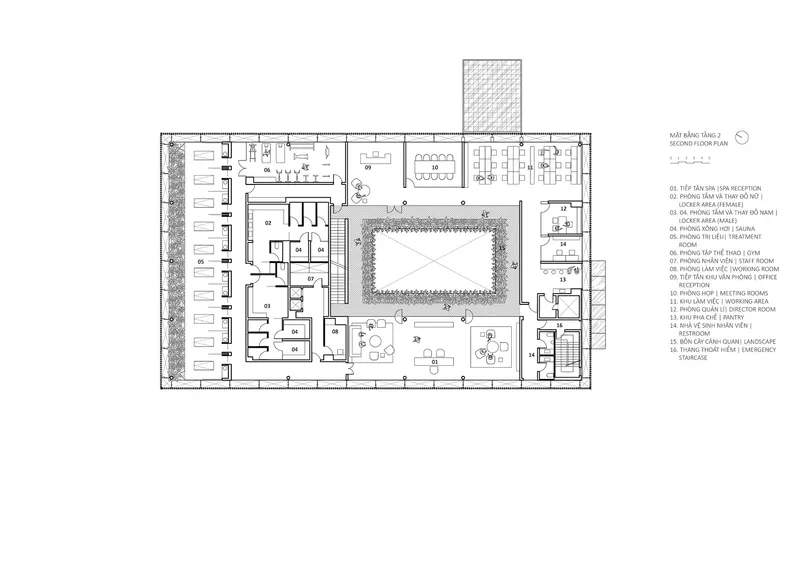
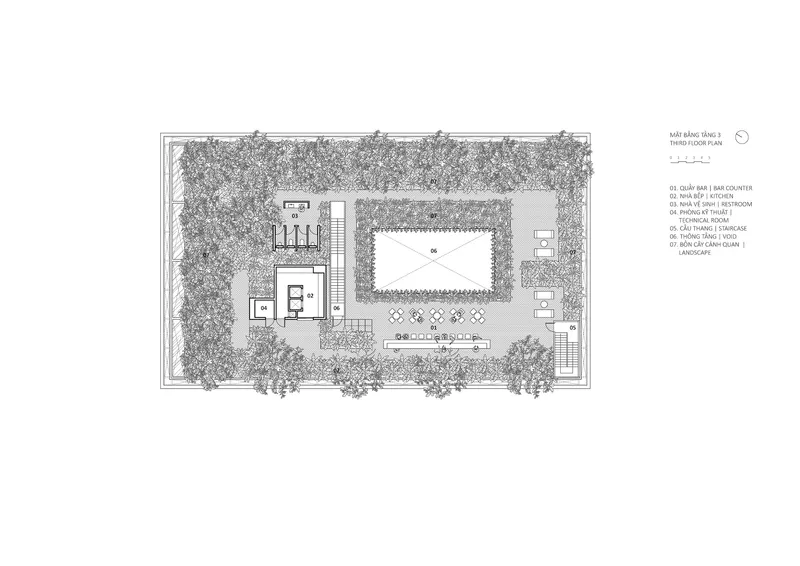
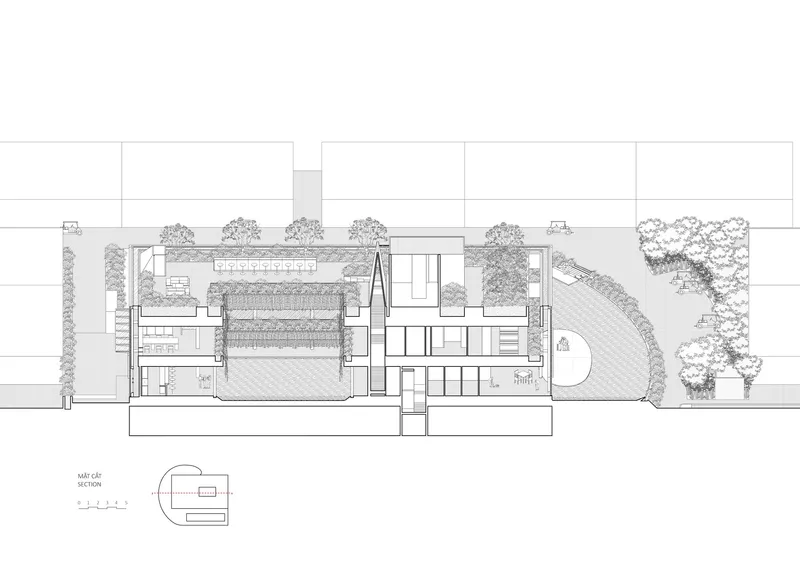

The drawings reveal a spatial complexity that the photographs only hint at. The site plan shows the clubhouse occupying a triangular block within the residential grid, an irregular footprint that MIA uses to generate the building's varied geometries. The ground floor plan confirms the central pool as the organizing spine, with outdoor dining terraces and perimeter landscaping wrapping the building's edges. Upper floors add meeting rooms, working areas, and reception spaces around the courtyard void, while the rooftop plan shows a lap pool, bar counter, and dense planting that effectively extends the landscape to the building's highest point.
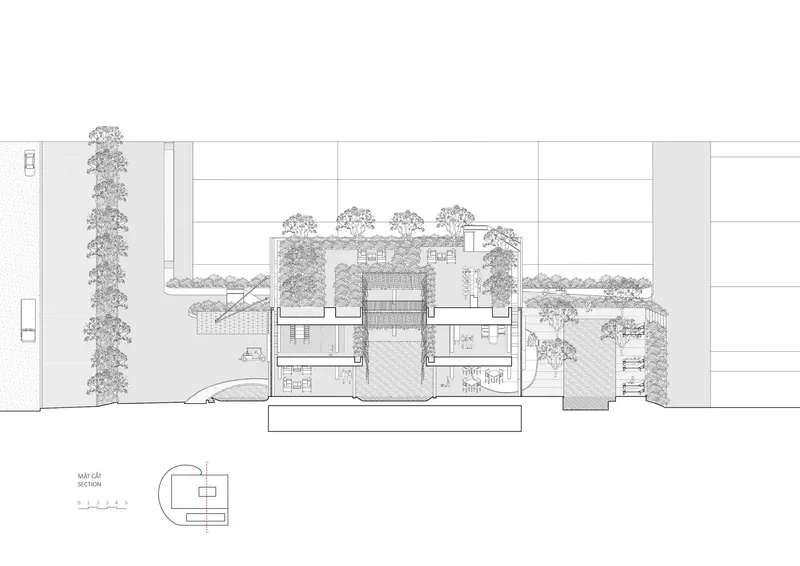
The sections are particularly revealing. Double-height volumes in the interior create the generous spatial proportions visible in the photographs, while planted terraces at multiple levels explain the cascading greenery that appears in nearly every view. The axonometric drawing clarifies the relationship between the timber-toned rooftop frame and the more transparent lower levels, showing how the building's mass is concentrated above while its base opens to the landscape. It is a sophisticated sectional strategy that reads as effortless in person.
Why This Project Matters
Resort architecture in Southeast Asia has a credibility problem. Too many projects default to a generic tropical modernism: flat roofs, infinity pools, imported materials, and air conditioning doing all the climate work. The Wyndham Clubhouse offers an alternative that is both more rigorous and more generous. By committing fully to perforated brick, a material rooted in the region's masonry traditions, MIA produced a building that manages solar gain, promotes natural ventilation, and creates constantly shifting interior atmospheres without relying on mechanical systems as a crutch. The six-year timeline from design to completion suggests a process that prioritized craft over speed.
More broadly, the project demonstrates that ornament and performance need not be separate conversations. The brick screens are decorative, structural, and environmental all at once. In an era when sustainability is too often reduced to certification checklists and energy modeling, the Wyndham Clubhouse makes a case for passive design as a spatial and aesthetic practice. The lantern metaphor could easily have remained a conceptual footnote in a design presentation. Instead, MIA built it into every brick.
Wyndham Clubhouse by MIA Design Studio. Located in Phu Quoc, Vietnam. 4,495 m². Completed 2022. Photography by Trieu Chien.
About the Studio
Share Your Own Work on uni.xyz
If projects like this are the kind of work you want to make, uni.xyz is a place to publish your own, find collaborators, and enter design competitions.



Popular Articles
Popular articles from the community


Conexión: Biophilic Design Reimagines High-Rise Living in Hong Kong
Conexión reimagines high-rise living in Hong Kong through biophilic design, green facades, shared spaces, daylight, water and nature within.
EW PARK: Sustainable Architecture Reimagines the Future of Urban Parking
EW PARK reimagines city parking as a modular wooden tower combining automation, solar energy, electric mobility, and adaptable urban design.

The Ocean Hive: Sustainable Architecture for a Self-Sufficient Civilization at Sea
The Ocean Hive imagines sustainable architecture at sea, where modular habitats, algae, wave power and ocean waste sustain a growing colony.

Co-Life: Senior Housing Design That Reconnects Older Adults With the City
Co-Life reimagines senior housing design through healing gardens, shared streets, workshops, and a sustainable community across generations.


Similar Reads
You might also enjoy these articles

Bao Huynh Watercolor Atelier: A Serene Art Retreat in Hội An
Bao Huynh Watercolor Atelier in Hội An blends multifunctional art spaces, sustainable design, local materials, and family-friendly living in a serene environment.

Atelier Macri Concept Store Interior Design by CASE-REAL
Atelier Macri store features a "ko" counter, walnut wood details, cork displays, blending retail, gallery, and seamless customer experiences.

Manuel Vargas Izquierdo Stadium and High-Performance Sports Center: Architectural Excellence in Jalpa de Méndez
The Manuel Vargas Izquierdo Stadium blends sustainable design, inclusive sports facilities, and cultural-inspired architecture, revitalizing Jalpa de Méndez’s public spaces.

KAKR Buluh Awar Hall: Revitalizing Community and Ecology Through Bamboo Architecture
Community built bamboo hall revitalizes Buluh Awar village, empowering youth, restoring ecology, celebrating vernacular craftsmanship through sustainable architecture and culture.

Explore Architecture Competitions
Discover active competitions in this discipline



Challenge to design a portable theatre


Challenge to design a portable music platform


Challenge to design an open learning module for the elderly


Challenge to reimagine the Iron Throne
Comments (0)
Please login or sign up to add comments
No comments yet. Be the first to comment!