
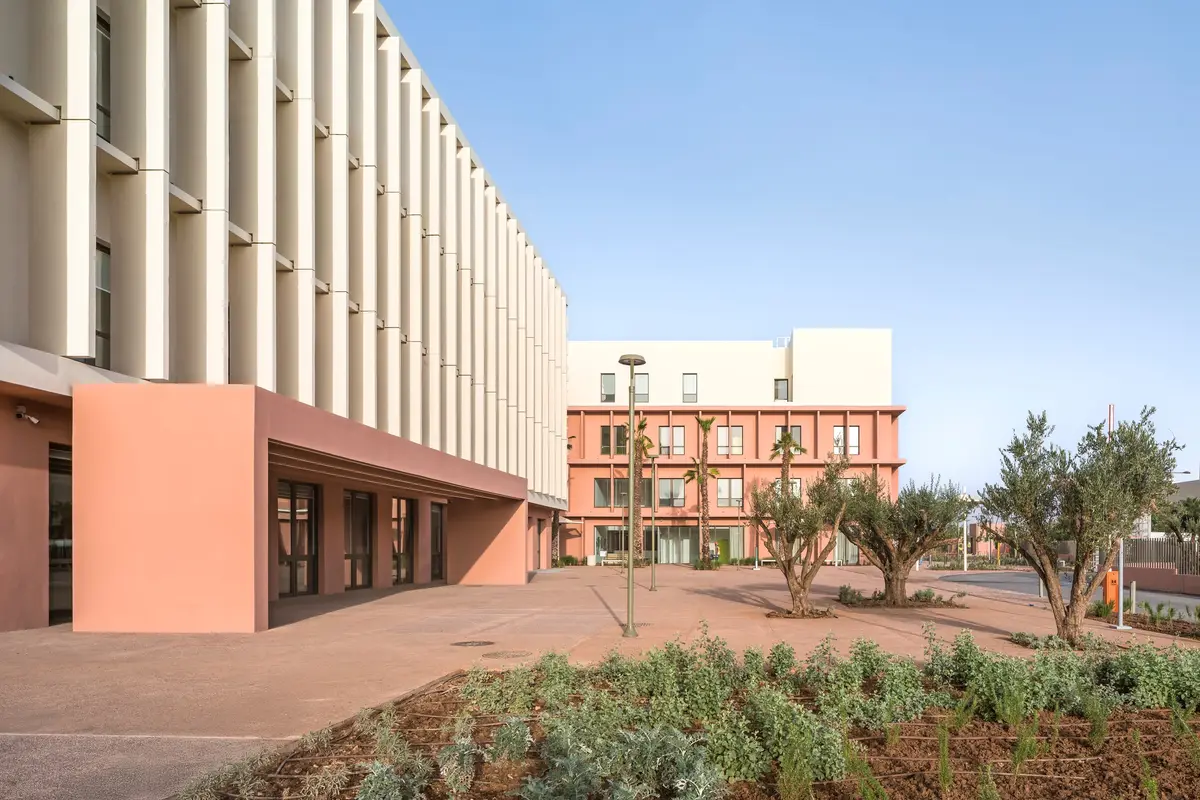
Michel Rémon, Associés, and ARCHIMATH Reinvent the Courtyard Hospital in Morocco's Desert
A 58,000 m² medical campus near Marrakech channels the ancient Bîmâristân through fiber-concrete moucharabieh and sun-driven planning.


Hospitals built in extreme climates tend to fall into two camps: sealed glass boxes that ignore the sun, or earth-toned pastiche that ignores modern medicine. The Hospital of the Smart Health Care City, completed in 2024 on the edge of Ben Guerir in Morocco's desert interior, refuses both. Designed by a three-way collaboration between Michel Rémon & Associés, and ARCHIMATH, this 58,000 m² complex houses a 200-bed general hospital, a 120-bed rehabilitation center, and a 70-bed geriatrics facility, all organized around gardens that function as the building's lungs and its social heart.
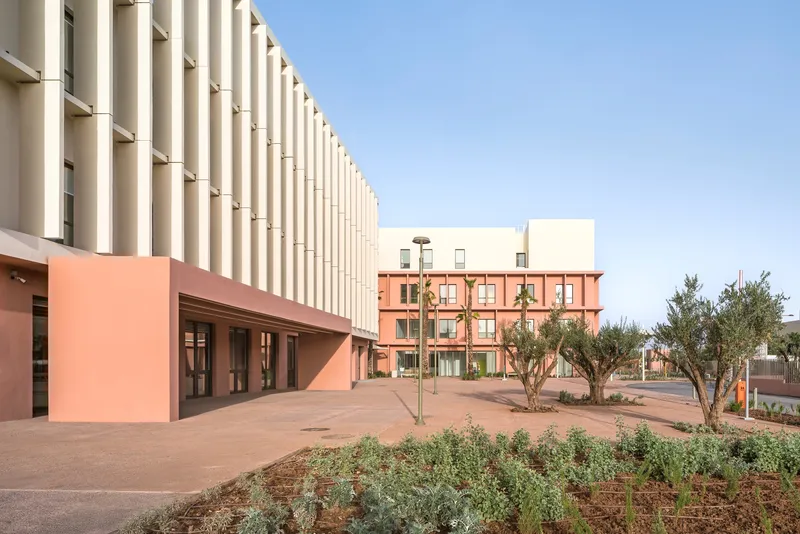
What makes the project genuinely interesting is the directness of its logic. The general hospital is a compact quadrangle, 105 meters by 108 meters and 17 meters high, explicitly modeled on the Bîmâristân, the medieval Islamic hospital typology in which wards surround a planted courtyard. Here, two internal gardens replace one, and circulation wraps around them so that visitors and patients move through daylight and greenery rather than the windowless spines typical of modern hospital planning. Three anti-seismic structures sit on a shared basement of logistics and technical services, connected below grade so the campus reads as separate buildings above while operating as a single organism beneath.
Two Facades, Two Material Arguments
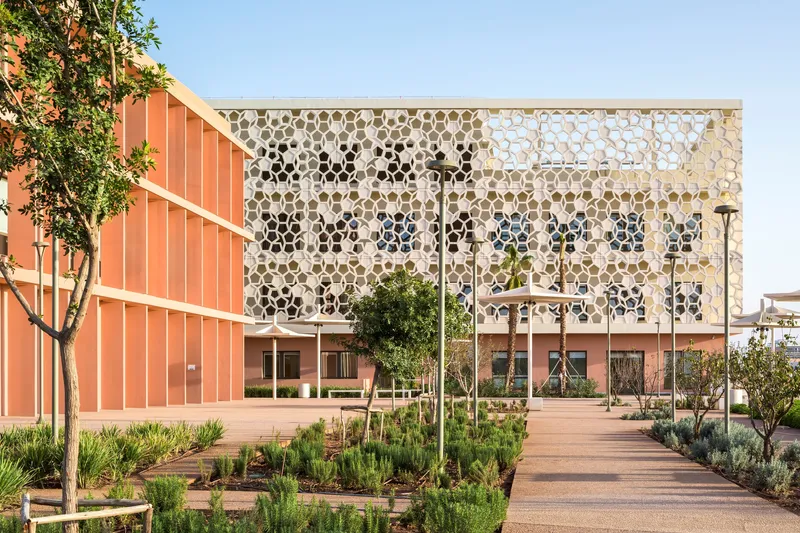
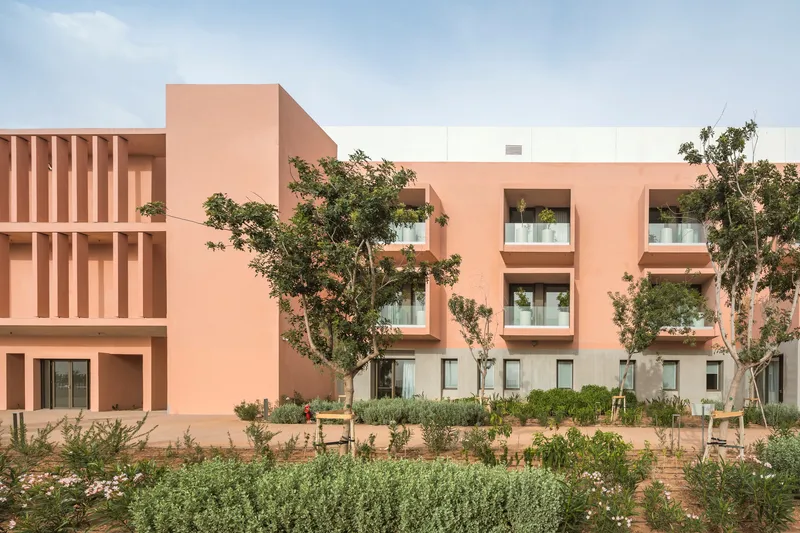
The campus presents two distinct material identities, each calibrated to the program it wraps. The general hospital is a raised white horizontal volume, its upper floors screened in fiber-concrete moucharabieh that filters Moroccan light while shielding patients from direct solar gain and the gaze of passersby. The perforated honeycomb pattern across levels R+1 through R+3 is not decorative appliqué; it is a fixed solar protection device with a partly structural role, carried on large vertical elements that double as load paths.
The SSR (follow-up care and rehabilitation) building, by contrast, anchors itself to the ground with vertical earth-red moldings. Where the hospital expresses clinical lightness, the SSR expresses domesticity. Its terracotta brise-soleil varies in depth depending on orientation, deeper on the northwest and southwest exposures, shallower where the sun strikes less aggressively. The geriatrics center, south of the park, picks up this warmer palette while maintaining its own trapezoidal footprint. Walking the campus, the shift between white perforated screens and red vertical fins tells you immediately which building you are approaching and what kind of care happens inside.
Gardens as Organizing Principle
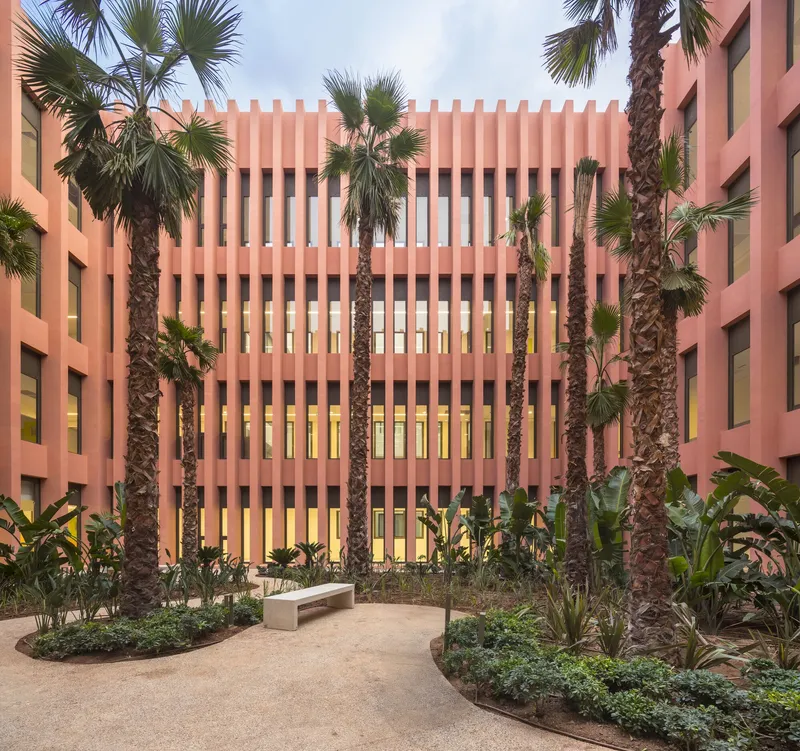
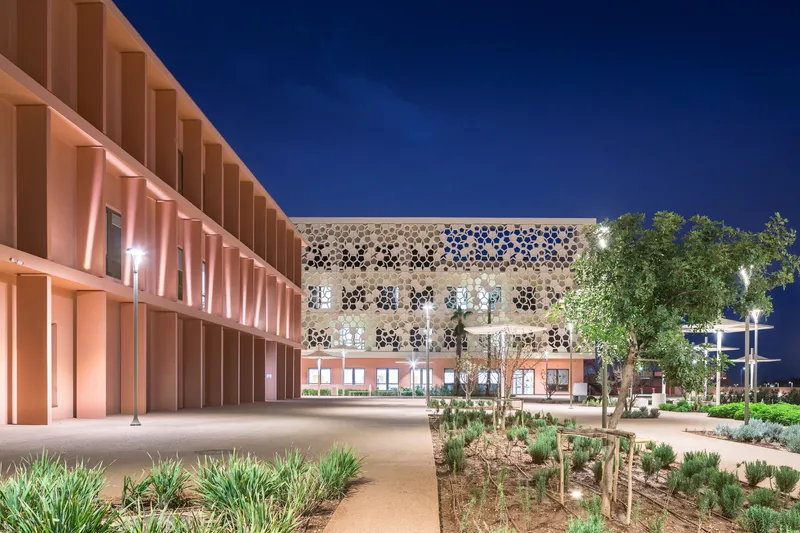
The two gardens at the center of the general hospital plan are not leftover voids. They serve as welcome areas and waiting spaces for families, giving visitors a destination that is neither corridor nor cafeteria. General circulation surrounds them without breaching the privacy of clinical rooms, a simple topological move that solves one of the chronic problems in hospital design: the collision between public flow and patient intimacy.
At night, the courtyards become luminous rooms. The moucharabieh glows from within as the perforated screen and the terracotta louvered facade face each other across planted beds, and the contrast between the two material systems reads most clearly. Palms and olive trees soften the geometry and anchor the project in its North African landscape, but they also provide evaporative cooling at the micro-scale, pulling heat out of the air before it reaches the facade.
Interior Light and Circulation
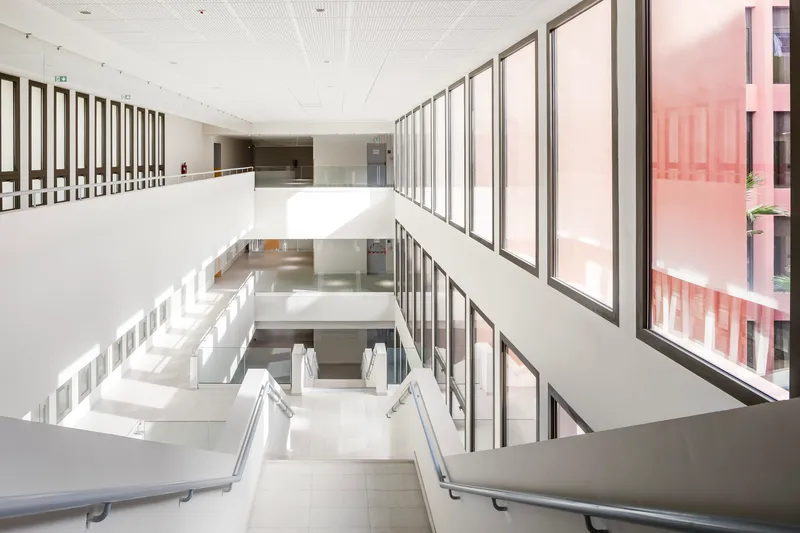
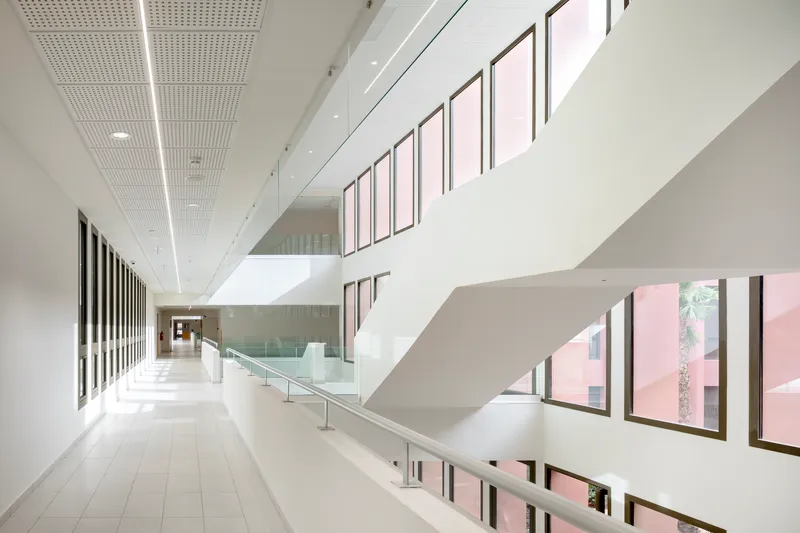
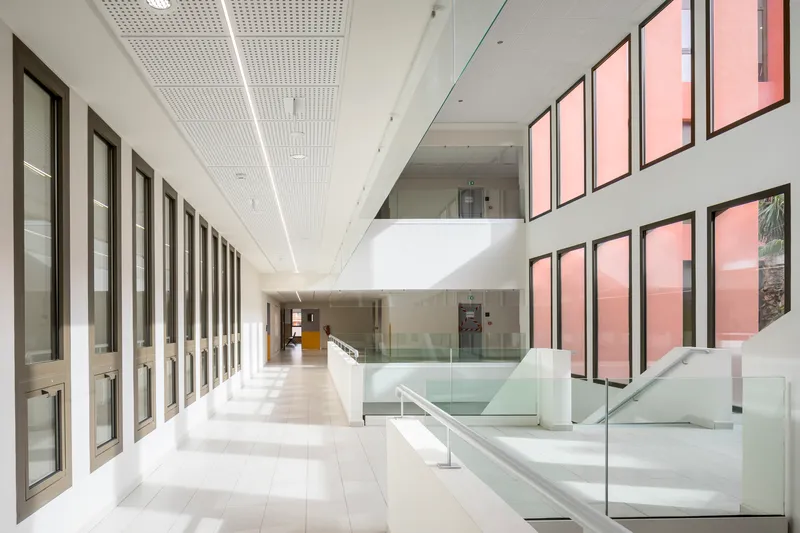
Inside, the architects commit to a material palette of white surfaces, continuous glazing onto the courtyards, and perforated ceiling panels that distribute daylight evenly across corridors. The central atrium drops three levels below the entry, pulling natural light deep into the building section. Glass balustrades along multilevel circulation spaces keep sightlines open so that orientation is intuitive: you can almost always see a garden or a courtyard wall, which means you can almost always locate yourself.
Corridors are wide enough for bed transport but not so wide they feel institutional. Repetitive window frames along the white-tiled passages create a rhythm that compresses and releases as you move through the plan, and the architects use color sparingly. A pink courtyard view through vertical windows, a flash of terracotta visible through a gap: the exterior material identity leaks into the interior experience at controlled moments.
Clinical Spaces That Don't Punish Their Occupants
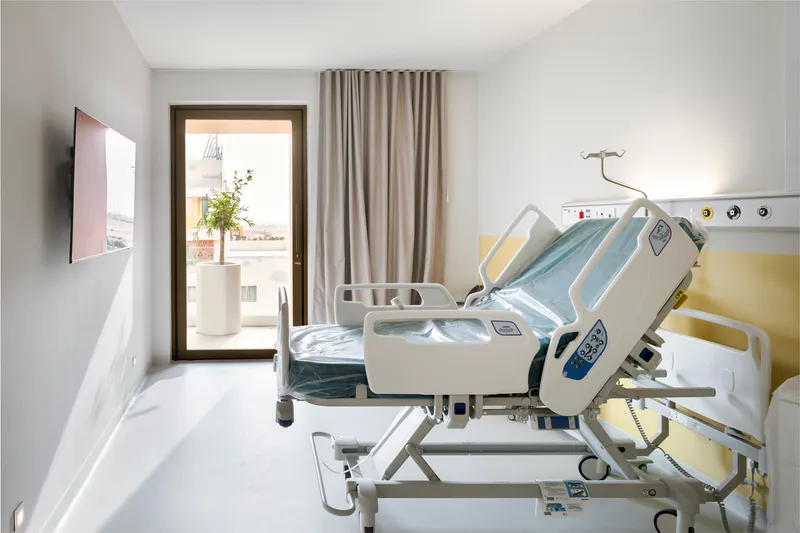
The patient room shown here, with its yellow headwall panel, glazed door to an exterior terrace, and clean geometry, represents a quiet but significant departure from standard Moroccan hospital design. Each room opens onto daylight and outdoor air, which is not a luxury in a building with fixed solar protection; it is a direct consequence of the moucharabieh strategy. The screen permits the terrace doors to exist without turning rooms into ovens.
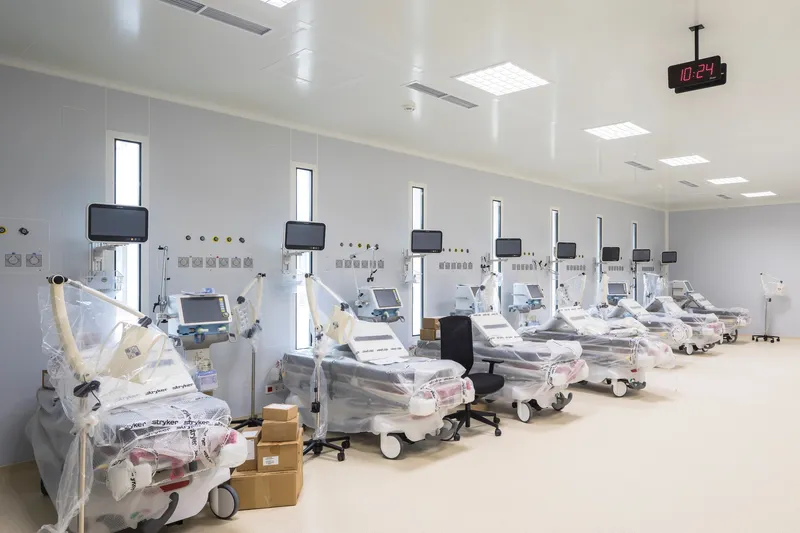
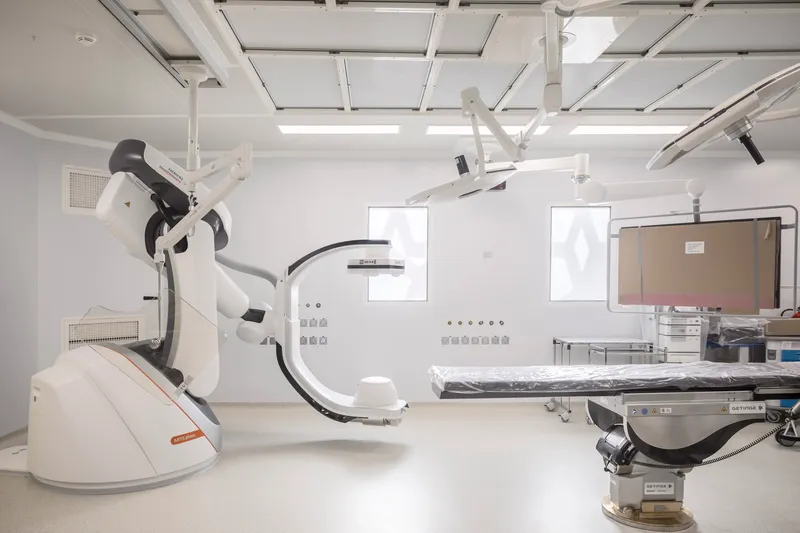
Technical spaces, including the medical imaging suite with its robotic arm and the row of dialysis stations, are housed in the lower levels where the exposed coffered ceiling accommodates heavy services without the usual forest of dropped tiles. The design does not attempt to disguise these rooms as something other than what they are, but it gives them consistent ceiling heights, clear lighting, and enough spatial generosity that staff can work without claustrophobia.
Public Grounds and Campus Scale
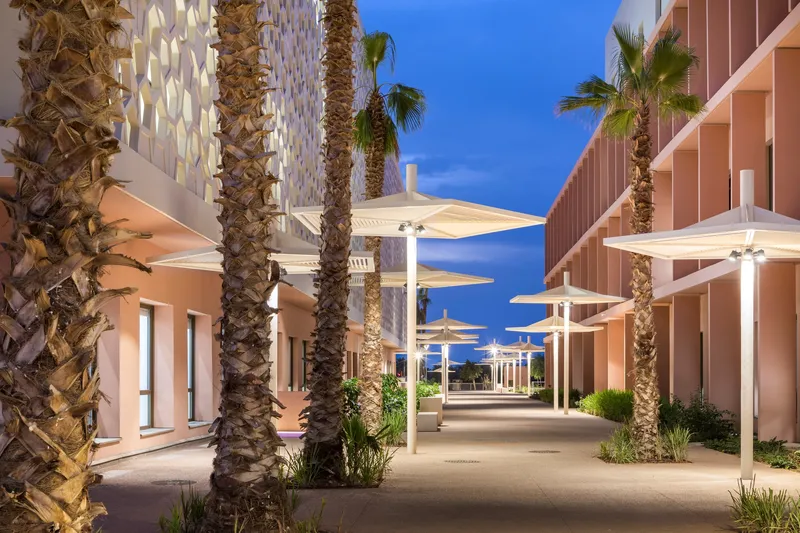
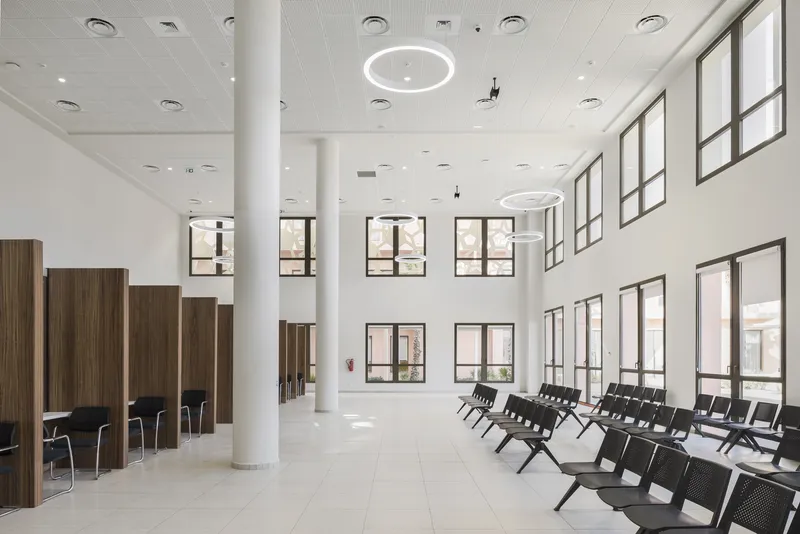
The campus fronts Avenue No. 200 in Ben Guerir, immediately adjacent to Mohammed VI University, and the landscape architects at POA have treated the ground plane as connective tissue between medical and academic programs. Pedestrian walkways lined with palms and white shade canopies create covered routes that are functional in 40-degree heat, not decorative promenades. The main emergency entrance faces southeast toward the rising sun, a deliberate orientation that provides strong morning light for ambulance approach without the punishing afternoon exposure of a southwest-facing entry.
The double-height lobby, with its white columns and timber privacy screens, manages the transition from desert exterior to conditioned interior without the shock of a hard threshold. Rows of seating accommodate the large family groups that characterize hospital visits in Moroccan culture, a programmatic acknowledgment that healing here is a communal event.
Plans and Drawings
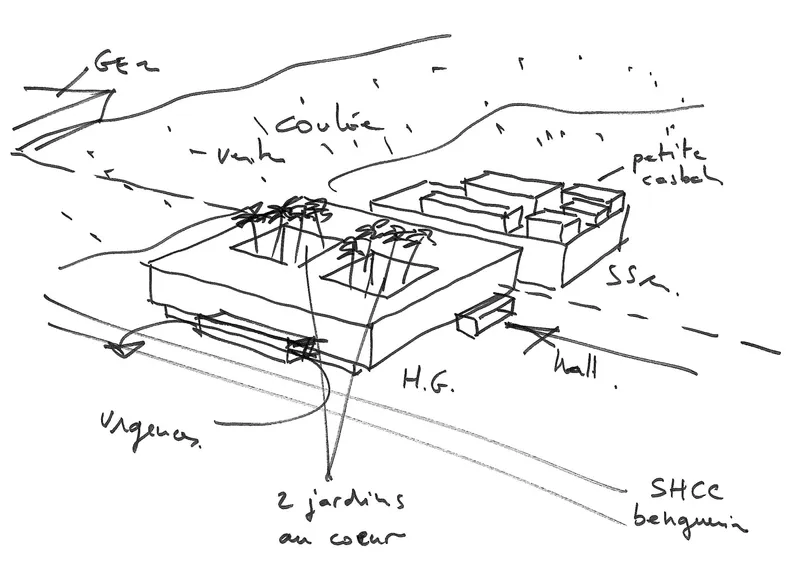
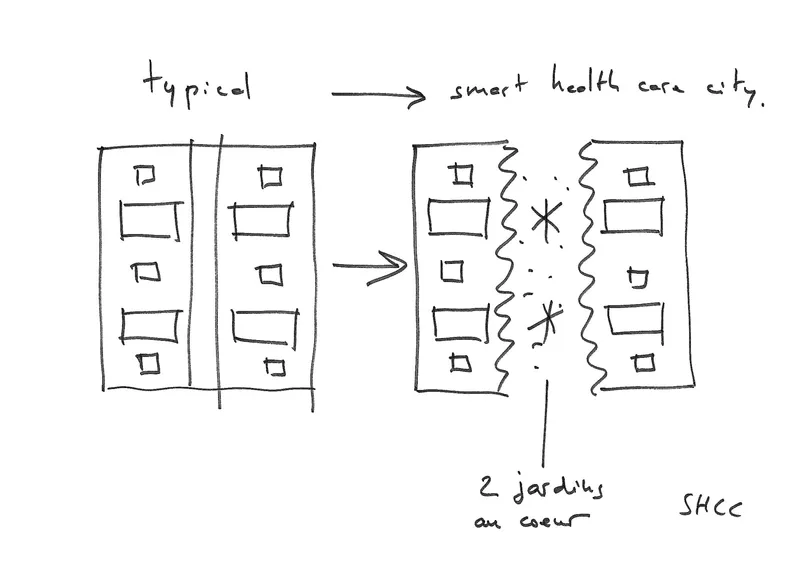
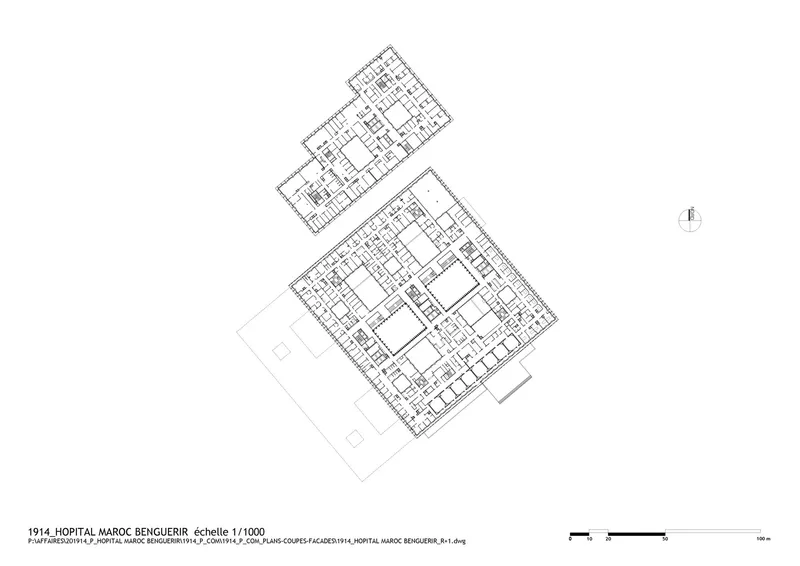
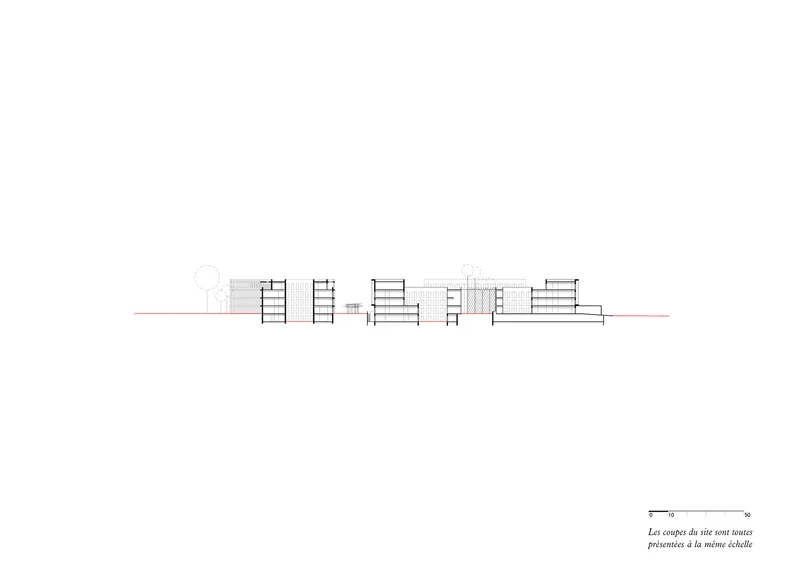
The axonometric and conceptual diagrams make the parti legible at a glance: a typical hospital bar is split open to create a central courtyard, then doubled to produce two gardens that organize the entire plan. The floor plan confirms the modular room layouts that wrap the courtyards, with connected building wings sharing a continuous basement of logistics. The section drawing reveals the varying heights across the campus: the four-level general hospital, the five-level SSR, and the lower geriatrics center, all held together by a common horizontal datum that gives the complex visual coherence from the street.
What the drawings also reveal is the compactness of the scheme. At 105 by 108 meters, the general hospital quadrangle minimizes distances between operating theaters, intensive care, and wards. Eight operating theaters and 15 ICU beds sit at the plan's center of gravity, equidistant from the ward wings, a layout that privileges clinical adjacency over architectural drama.
Why This Project Matters
Hospital architecture in rapidly developing regions often defaults to imported typologies: the American campus model dropped into a climate it was never designed for, or the European compact block stripped of the passive strategies that made it work in temperate latitudes. The Smart Health Care City hospital breaks from this pattern by returning to a courtyard typology that has deep roots in the region while meeting contemporary seismic, clinical, and environmental standards. The 22-month construction timeline, from October 2022 to completion in 2024, suggests that the design was also pragmatic enough to build quickly, no small feat for a 58,000 m² medical facility.
More broadly, the project demonstrates that fixed, passive solar strategies and culturally resonant facades are not obstacles to a high-performance hospital. The moucharabieh is not ornament reclaimed; it is environmental engineering made visible. When three firms across two continents (Michel Rémon & Associés in France, ARCHIMATH in Morocco) can produce a building this coherent in eight months of design and 22 months of construction, it raises a pointed question for healthcare projects elsewhere: why are so many hospitals still ignoring the sun?
Hospital of the Smart Health Care City, designed by Michel Rémon & Associés and ARCHIMATH. Ben Guerir, Morocco. 58,000 m². Completed 2024. Photography by Sergio Grazia.
About the Studio
Share Your Own Work on uni.xyz
If projects like this are the kind of work you want to make, uni.xyz is a place to publish your own, find collaborators, and enter design competitions.


Popular Articles
Popular articles from the community


Aquadapt: An Underwater Habitat That Rewrites Its Rooms by the Hour
Curved modules ring the seabed while one shell shifts from breakfast room to cinema, farm and football pitch as residents' needs change.

Opera on the Sea: Driftwood Logic Shapes a Timber Opera House on Estonia's Coast
Trevor Orgill's opera house translates the entangled drift of floating timber into a civic building where wood, water, and music converge.

Manzana Morphosis: Stretching Barcelona's Grid into a Living Landscape for 2050
A radical reworking of the Eixample manzana turns density into a tool for generous public space, vertical ecology, and environmental performance.

The Amber Palace Opera: A Geological Fiction Surfaces on Tallinn's Baltic Waterfront
Pierre Brillard reimagines a Baltic legend as a public landscape, opera house, and waterfront promenade rooted in Tallinn's coastal identity.

Similar Reads
You might also enjoy these articles

LAVA Architecten Gives Vocational Education a Sawtooth-Roofed Face on a Mechelen School Campus
In Mechelen, Belgium, a 2,053 m² STEM school on a 6×6 m grid turns workshops and classrooms into rooms that can be rearranged as teaching changes.

KEMA Studio Turns a Derelict Marvila Attic into a 60 m² Lighthouse Apartment Above Lisbon
In Lisbon's Marvila district, a rebuilt roof, four skylights and two plywood volumes turn an unlivable attic into a bright home facing the Tagus.

Pixel Gardens: One Repeated Module Stacked Into a Terraced Social Housing Tower for Famagusta
Salem Bader's shortlisted housing tower builds a vertical neighbourhood from one repeated module, offsetting units to carve terraces, light and air.

Bao Huynh Watercolor Atelier: A Serene Art Retreat in Hội An
Bao Huynh Watercolor Atelier in Hội An blends multifunctional art spaces, sustainable design, local materials, and family-friendly living in a serene environment.

Explore Smart City Competitions
Discover active competitions in this discipline

Challenge to design locus for the upliftment of human rights

Challenge to design public laboratory

Design challenge to reuse E-waste
Comments (0)
Please login or sign up to add comments
No comments yet. Be the first to comment!