

Miller Hull Partnership Builds a Mass Timber Senate Office on Washington's Capitol Campus
The first new structure in nearly 70 years on Olympia's historic Capitol Campus replaces a crumbling 1934 building with locally sourced Douglas Fir and ste


Adding a building to a National Historic District is a political act as much as an architectural one. On Washington State's Capitol Campus in Olympia, a collection of neoclassical structures dating to the 1920s sits on a bluff with axial views toward Mount Rainier and the Olympic Mountains, laid out by the Olmsted Brothers. Nothing has been added to this part of the campus in nearly seven decades. The original Newhouse Building, a brick and sandstone structure erected in 1934 as a temporary measure, had long outlived its welcome, plagued by water intrusion, mold, and obsolete systems. Miller Hull Partnership was tasked not just with replacing it but with doubling its footprint to nearly 60,000 square feet while convincing the campus that a contemporary building could belong here.
What makes this project genuinely interesting is the answer Miller Hull found: not pastiche, not contrast for its own sake, but a hybrid structural language of mass timber and steel that takes formal cues from its neoclassical neighbors while performing at a level none of them can match. The building is LEED Platinum certified, net-zero ready, and achieves a 75% energy reduction over baseline. Nearly every material, from the Douglas Fir ceiling decks to the precast concrete facade, was sourced within Washington State. Rather than demolishing the old Newhouse, the team deconstructed it, salvaging facade stone and marble for reuse. The result is a senate office building that treats sustainability not as a talking point but as a material discipline rooted in regional supply chains.
A Neoclassical Silhouette in Modern Dress


The facade is organized around tall vertical fins that echo the pilasters and column rhythms of the existing campus buildings without replicating their ornament. From the street, the symmetrical form reads clearly: a central entrance flanked by regular bays, the proportions deliberate enough to hold their own beside a domed legislative building visible just beyond. The white fins provide solar shading while establishing a visual cadence that rhymes with the historic campus without mimicking it.
Miller Hull's elevation studies, comparing window ratios and facade proportions to the adjacent neoclassical structures, show a design team working analytically rather than intuitively. The fins are not decorative appliqué; they calibrate daylight, manage thermal gain, and give the glass curtain wall a vertical emphasis that grounds it in its context. Mature evergreens and the Olmsted landscape plan do the rest, softening the transition between old and new.
The Entry Screen as Civic Threshold


The most striking element of the exterior is the perforated metal screen panel above the main entrance. It is not arbitrary pattern-making. The design team derived the tessellation from historic motifs found on the Capitol Campus, abstracting them into a geometric screen that reads differently at every scale and in every light condition. At dusk, illuminated from within, it transforms the entry into a lantern. During the day, it casts intricate shadow patterns into the lobby.
Bronze-framed glass doors beneath the screen establish a material warmth at the threshold, signaling that this is a civic building meant to be entered, not admired from a distance. The screen works both as a branding gesture and as a functional element, filtering light and mediating between the formality of the campus and the transparency of the interior. It is the building's handshake.
The Mixing Chamber: A Staircase That Is Also a Room
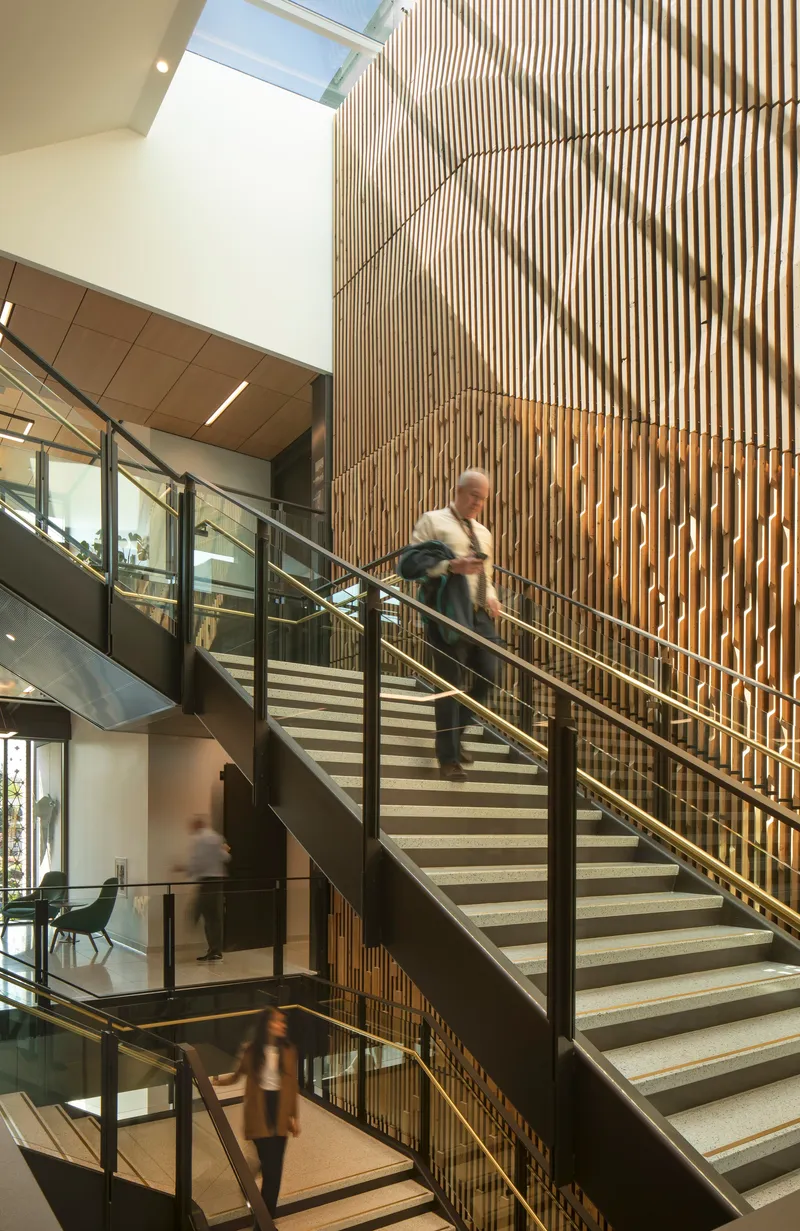


At the core of the building is what Miller Hull calls the Mixing Chamber: a four-story stairwell threaded together by a skylight and flanked by a sculptural wall of vertical timber slats. It is simultaneously a circulation spine and a social space, designed to pull senators, staff, and the high school students who attend the legislative page school into unplanned contact. The logic is simple. If you make the stair more compelling than the elevator, people will use it, and they will talk to each other on the way.
Looking up through the atrium void, the structural system is on display: steel beams, glass bridges connecting floors, and the warm underside of Dowel Laminated Timber decks. The interplay of steel and timber is honest and legible. Glass balustrades keep sightlines open across floors, reinforcing the sense that this is a single room stretched vertically rather than four separate levels. Clerestory skylights wash the timber slat wall with changing daylight, turning circulation into an event.
Timber Detailing as Acoustic and Aesthetic Strategy


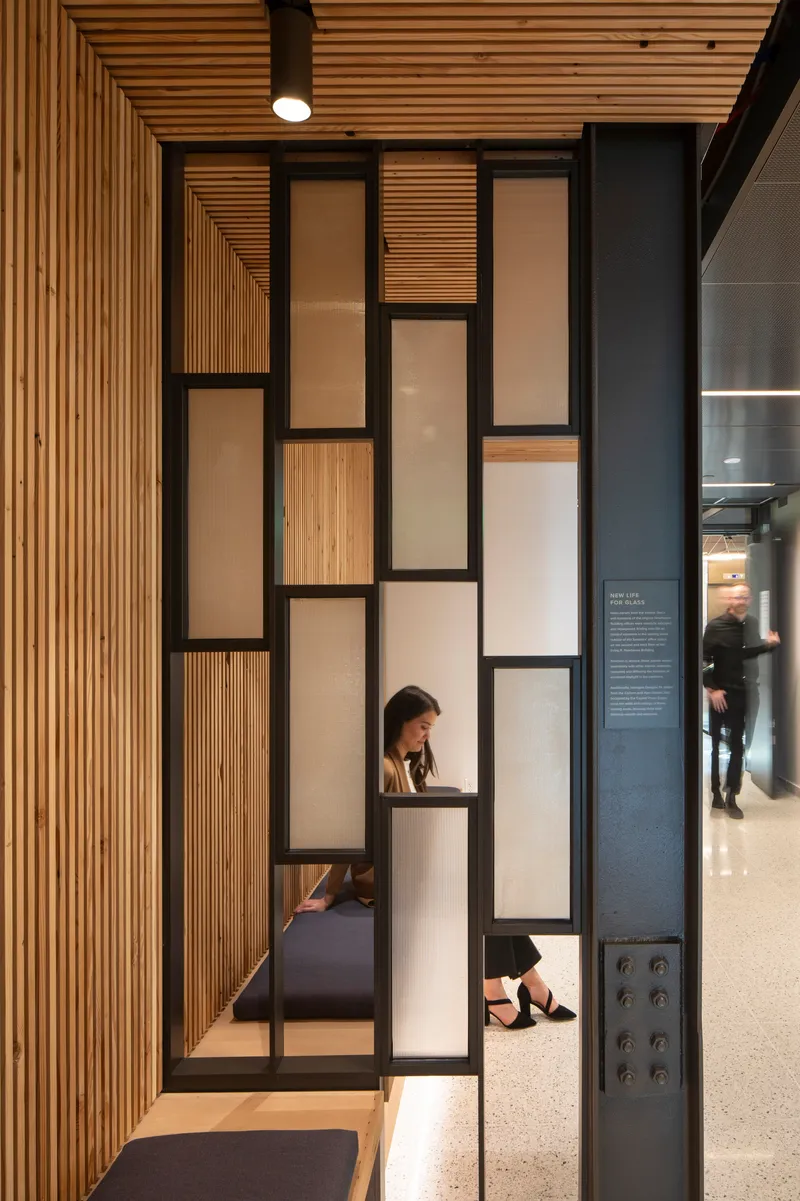
The timber slat walls throughout the building are not one-note. Offset slats form diagonal patterns that add visual complexity, while routed grooves accept formaldehyde-free recycled polyester insulation for sound absorption. This is the first known application of Fsorb, a formaldehyde-free acoustic insert, in a building of this type. The Acoustic Dowel Laminated Timber floor decks themselves use precision-milled grooves with acoustical insulation, meaning the structure does double duty as a finish and a sound management system.
The result is an interior where Douglas Fir is omnipresent but never monotonous. Steel partitions with alternating timber and frosted glass panels break the rhythm, introducing moments of opacity and translucency. The timber is locally sourced, one of Washington's most abundant resources, and its presence here is both a sustainability argument and a regional identity statement.
Working and Gathering in Daylight

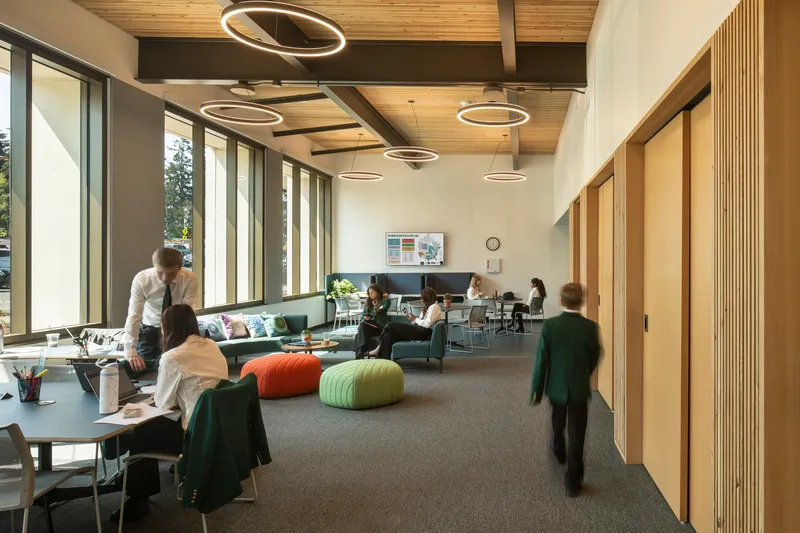

Every office in the building has operable windows. That fact alone separates this project from most contemporary government buildings, where sealed envelopes and mechanical conditioning are the default. Corner offices frame views of the domed Capitol through dark steel mullions, making the act of governance literally visible from the workspace. The decision to give each senator control over their own ventilation is both a comfort strategy and a political metaphor worth noting.
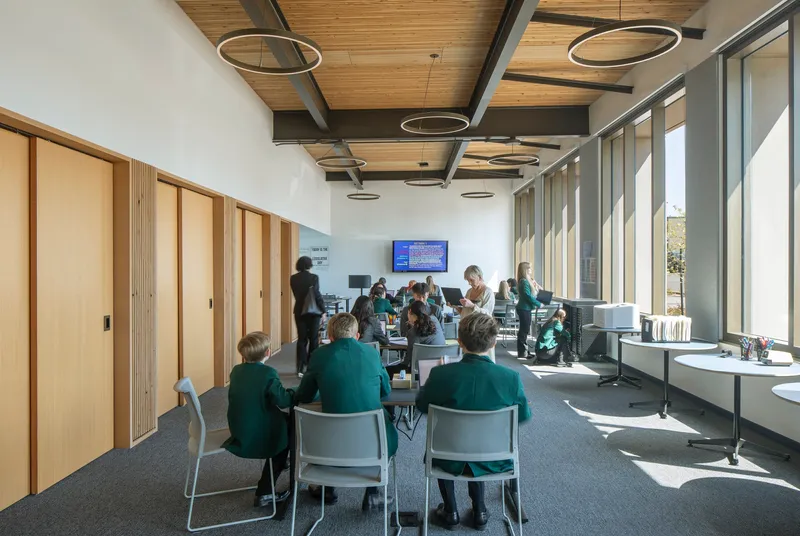
Shared spaces, including lounges and a dining area, line the perimeter with floor-to-ceiling glazing. Circular ring pendants and timber ceiling panels define these zones without enclosing them. The atmosphere is closer to a well-funded university library than a bureaucratic office. Students from the legislative page school use these same spaces, and the building's program deliberately avoids segregating them from senate staff. The architecture does not distinguish between who is learning and who is governing.
Pattern, Screen, and Filtered Light


Geometric metal screens appear at several points in the building, filtering sunlight and casting shadow patterns across floors and seating areas. A silhouetted figure standing before one of these screens, with autumn foliage visible beyond, captures the intended effect: the boundary between inside and outside is not a wall but a gradient. Corridors with slatted timber ceilings include seating nooks where someone can sit and read, turning leftover space into occupied space.
These moments are small but they accumulate. A building that accommodates pause and reflection alongside its programmatic obligations is a building that understands its users. Miller Hull has treated every surface as an opportunity for environmental calibration, whether through light modulation, acoustic dampening, or simply providing a bench in a corridor.
The Building at Dusk
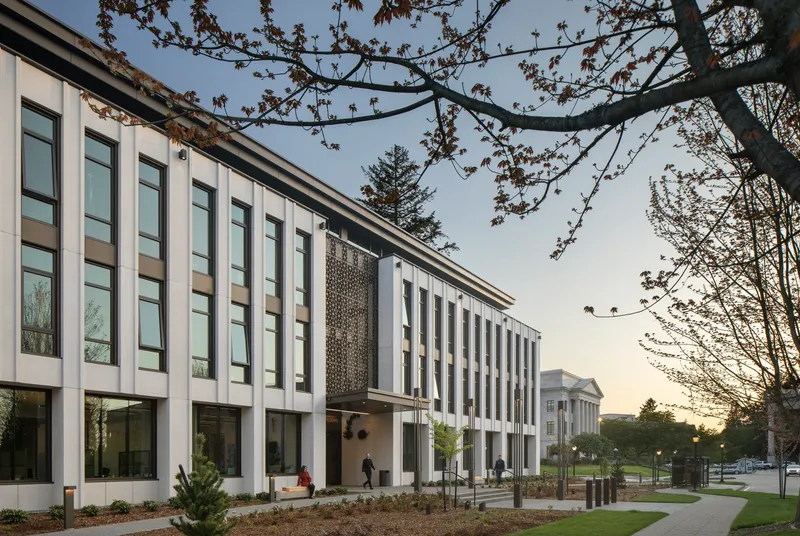

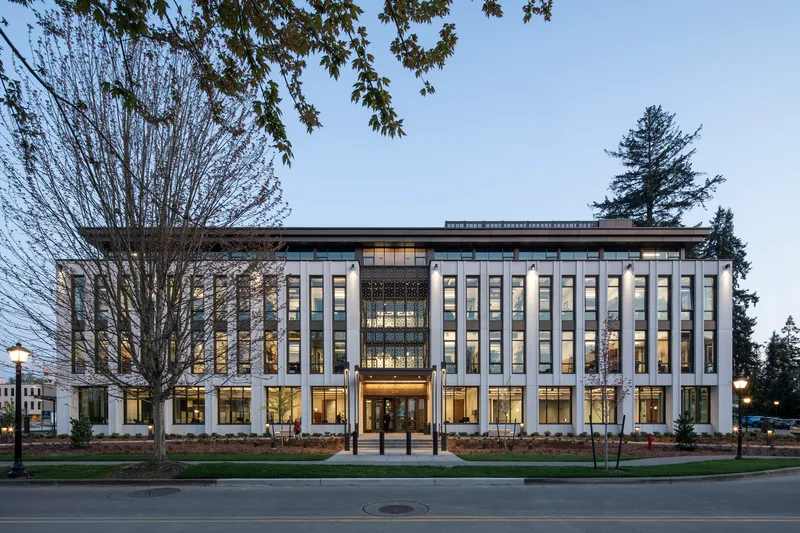
At twilight, the building reveals its double identity. The vertical fins that read as solid during the day dissolve into a frame for the illuminated glass volume behind them. The entry screen glows. The Capitol dome appears in the background, and the two buildings, separated by decades and ideologies, share the same sky. It is a calculated photographic moment, but it is also an honest one: the building genuinely performs differently at night, becoming more transparent, more inviting, more visibly occupied.
The aerial view confirms the rooftop strategy: a 90-kilowatt photovoltaic array covers the upper surface, accounting for roughly 20% of the building's energy demand. Combined with the all-electric design and an estimated energy use intensity of 24 kBtu per square foot per year, the building is net-zero ready. Green roof areas soften the fifth facade and manage stormwater, completing a sustainability profile that is thorough without being ostentatious.


Plans and Drawings
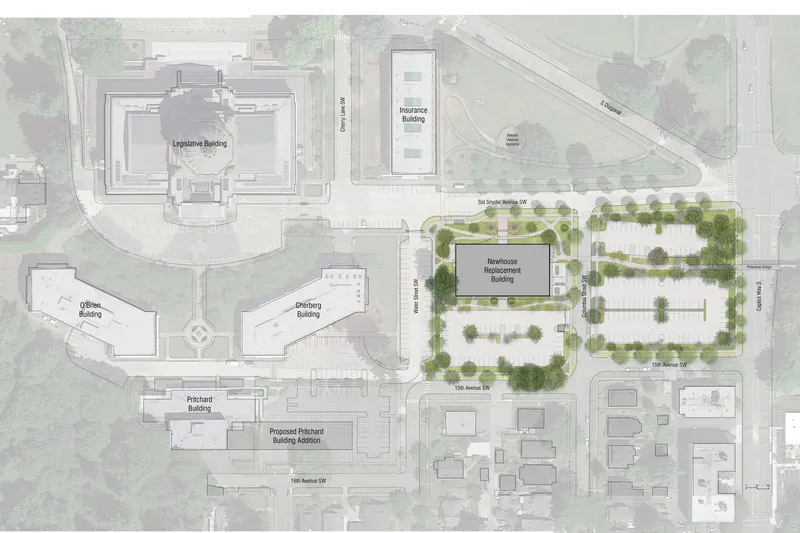


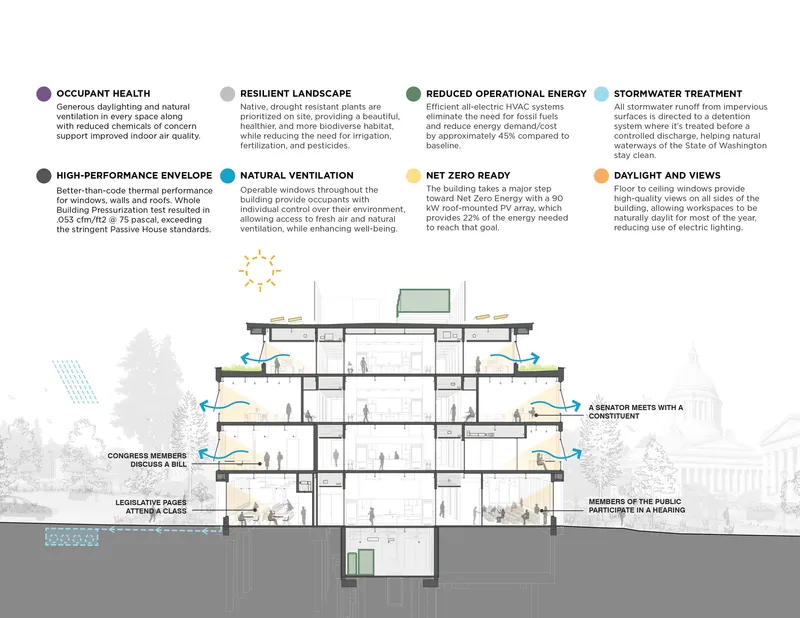

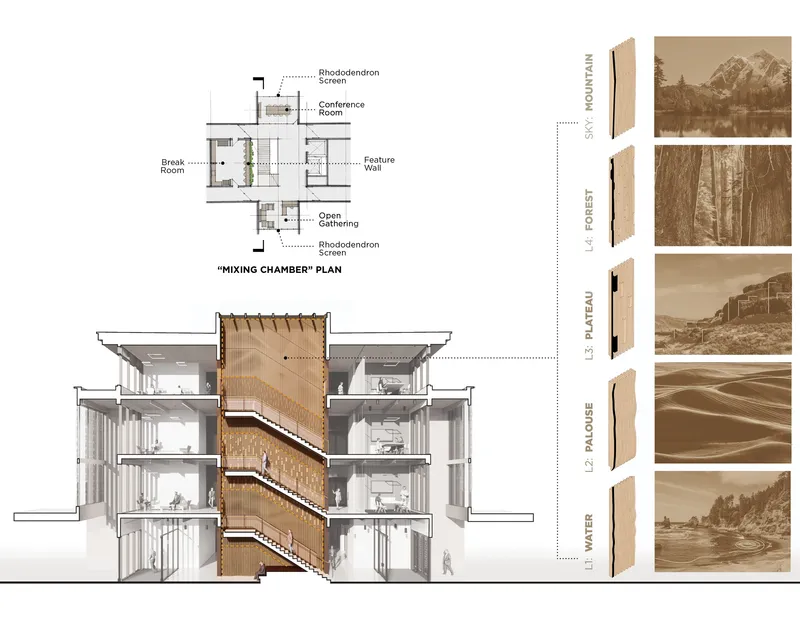


The drawings reveal the rigor behind the building's apparent ease. Section drawings illustrate natural ventilation and daylighting strategies with clarity, showing how the Mixing Chamber acts as a thermal chimney and how operable windows coordinate with mechanical systems. The axonometric diagram of the campus places the new volume in the Olmsted framework, demonstrating alignment with existing axes. Detail sections of the mass timber connections, showing acoustic layers, terrazzo tile, and glue-free doweled joints, confirm that the sustainability claims are not abstract; they are embedded in every connection.
The facade pattern derivation diagram is particularly telling. It traces the journey from a historic campus motif through geometric abstraction to the final tessellated screen, making explicit what the building implies: that context is not copied but translated. The program organization diagram shows how senate offices, caucus spaces, classrooms, and public meeting rooms are arranged around the central stair core, with mechanical channels integrated into the service zone rather than consuming floor area.
Why This Project Matters
Government buildings in the United States have a credibility problem. They tend toward either the pompous, clad in stone to project authority, or the anonymous, wrapped in curtain wall to project efficiency. Miller Hull's Newhouse Replacement is neither. It is a building that takes its historic context seriously enough to study its proportions and pattern language, but confident enough to answer in Douglas Fir and steel rather than limestone. The decision to deconstruct the old building and salvage its materials rather than bulldoze it sets an ethical precedent for how public institutions should handle their own obsolescence.
More importantly, the building demonstrates that mass timber construction can deliver civic architecture at a meaningful scale. At nearly 60,000 square feet and four stories, this is not a pavilion or a visitor center. It is a working government office that houses senators, staff, and students, and it does so with an energy profile that shames most buildings half its size. The fact that nearly all of its materials were sourced within Washington State turns a sustainability metric into an economic argument. If a state capitol can be built from its own forests, its own concrete plants, its own labor, then the case for regional material economies is no longer theoretical. It is legislative.
Newhouse Building Replacement by Miller Hull Partnership. Located in Olympia, Washington, United States. Approximately 60,000 square feet. Completed in 2025. Photography by Lara Swimmer Photography.
About the Studio
Share Your Own Work on uni.xyz
If projects like this are the kind of work you want to make, uni.xyz is a place to publish your own, find collaborators, and enter design competitions.


Popular Articles
Popular articles from the community


The Amber Palace Opera: A Geological Fiction Surfaces on Tallinn's Baltic Waterfront
Pierre Brillard reimagines a Baltic legend as a public landscape, opera house, and waterfront promenade rooted in Tallinn's coastal identity.


David Ortega Stacks a Two-Story Mexico City Penthouse Around a Steel Stair and a Pergola-Shaded Roof Terrace
In Colonia Roma, a 300 m² penthouse uses oak joinery, a planted steel stair and a slatted roof pergola to make a new-build apartment feel like a house.

Cube Design Draws an Ecological Corridor Between Two Shenzhen Hills with the Nankai Building
Beside Shenzhen's container docks, the Nankai Building pairs stacked balconies with a climbing green screen to connect two hillsides across its height.

graciastudio Turns a Viewless Tijuana Lot Inward Around a Courtyard of Concrete, Timber and Trees
In Tijuana, Jorge Gracia's GA2 House stacks a timber-clad private floor over exposed concrete and replaces a missing view with a planted interior patio.

Similar Reads
You might also enjoy these articles

LAVA Architecten Gives Vocational Education a Sawtooth-Roofed Face on a Mechelen School Campus
In Mechelen, Belgium, a 2,053 m² STEM school on a 6×6 m grid turns workshops and classrooms into rooms that can be rearranged as teaching changes.

KEMA Studio Turns a Derelict Marvila Attic into a 60 m² Lighthouse Apartment Above Lisbon
In Lisbon's Marvila district, a rebuilt roof, four skylights and two plywood volumes turn an unlivable attic into a bright home facing the Tagus.

Pixel Gardens: One Repeated Module Stacked Into a Terraced Social Housing Tower for Famagusta
Salem Bader's shortlisted housing tower builds a vertical neighbourhood from one repeated module, offsetting units to carve terraces, light and air.

Bao Huynh Watercolor Atelier: A Serene Art Retreat in Hội An
Bao Huynh Watercolor Atelier in Hội An blends multifunctional art spaces, sustainable design, local materials, and family-friendly living in a serene environment.


Comments (0)
Please login or sign up to add comments
No comments yet. Be the first to comment!