

ESTUDIO 87 Arquitectura Lines Up Glass Pavilions Around a Courtyard Tree in Buenos Aires
The Air House is a single-story dwelling where cross-ventilation, timber detailing, and planted courtyards dissolve the boundary between inside and out.


A house named after air had better deliver on the promise. ESTUDIO 87 Arquitectura's Air House, sited on a tapered suburban lot somewhere in greater Buenos Aires, takes cross-ventilation as its organizing logic: a linear chain of glass-walled pavilions threaded along a single axis, each one bookended by sliding panels that turn solid rooms into breezeways. A mature tree, preserved at the center of the plan, rises through an oval skylight and anchors the sequence. Everything else, the timber ceilings, the polished concrete floors, the hedged garden rooms, radiates outward from that central void.
What makes the project worth studying is not its minimalism (plenty of Argentine houses flatten their roofs and glaze their walls) but the discipline with which it resolves airflow, privacy, and material warmth across a single story. The plan is essentially a bar, yet it never feels like a corridor. Courtyards puncture the volume at strategic points, pulling daylight and wind deep into the interior while screening neighbors. Timber cladding wraps walls and ceilings in a continuous register that reads as furniture rather than structure. The result is a house that feels both open and enclosed, generous yet precise.
A Linear Plan That Reads as a Garden Wall
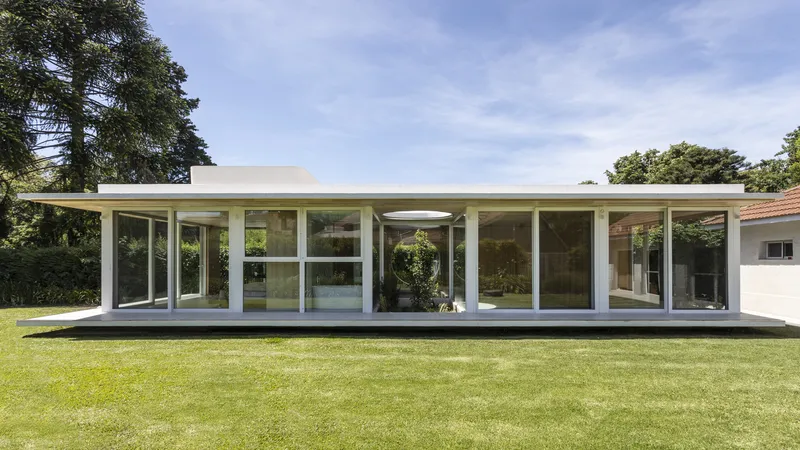
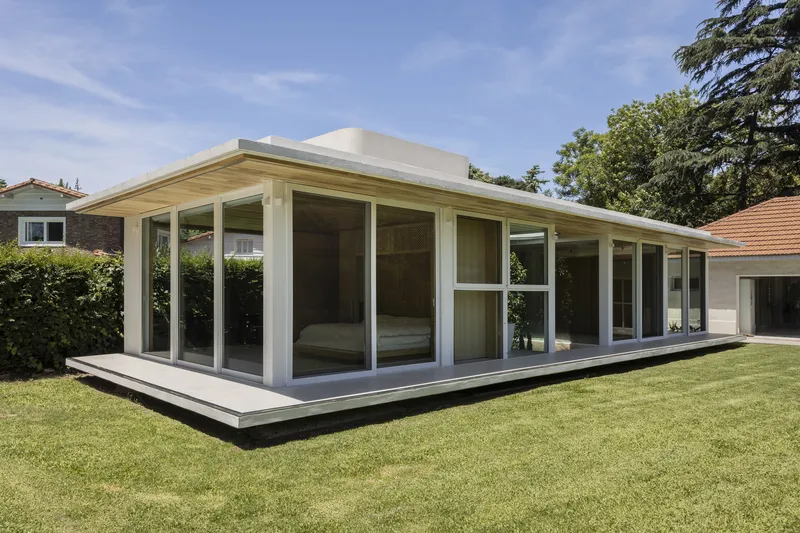
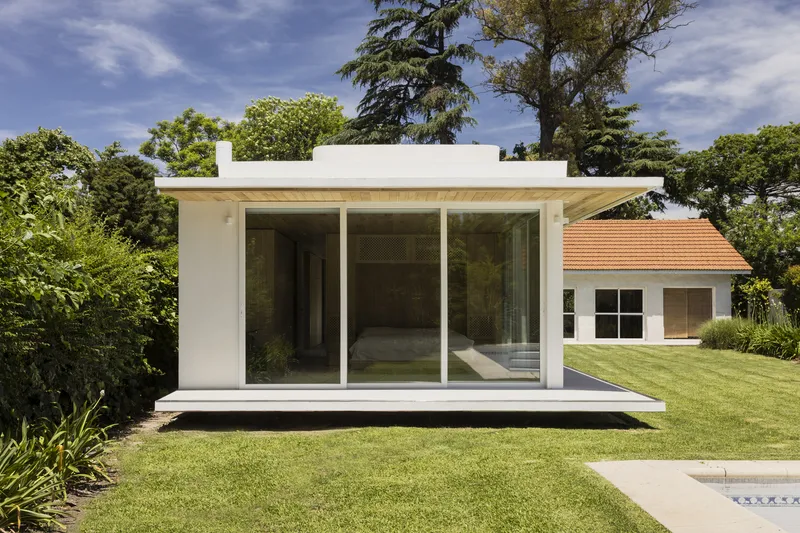
From the garden, the house registers as a long, low datum: a flat roof floating on a grid of slender aluminum mullions, set back far enough from the property line to let lawn flow under and around it. The roof overhang is generous, casting a deep shadow that keeps the glass facade from overheating while giving the elevation a horizontal emphasis that echoes the flat terrain. A raised plinth lifts the entire volume just enough to separate interior floors from wet ground and to establish a terrace that doubles as a threshold between living rooms and lawn.
Seen from the side, the pavilion form reveals its strategy: each segment of the bar is identifiable by its cladding. Glass dominates the garden face; vertical timber boards close off the street face. The house is legible as a sequence of rooms even before you step inside, which is a small but telling design decision. It means the exterior tells you something honest about the plan.
The Courtyard Tree and Its Oval Skylight
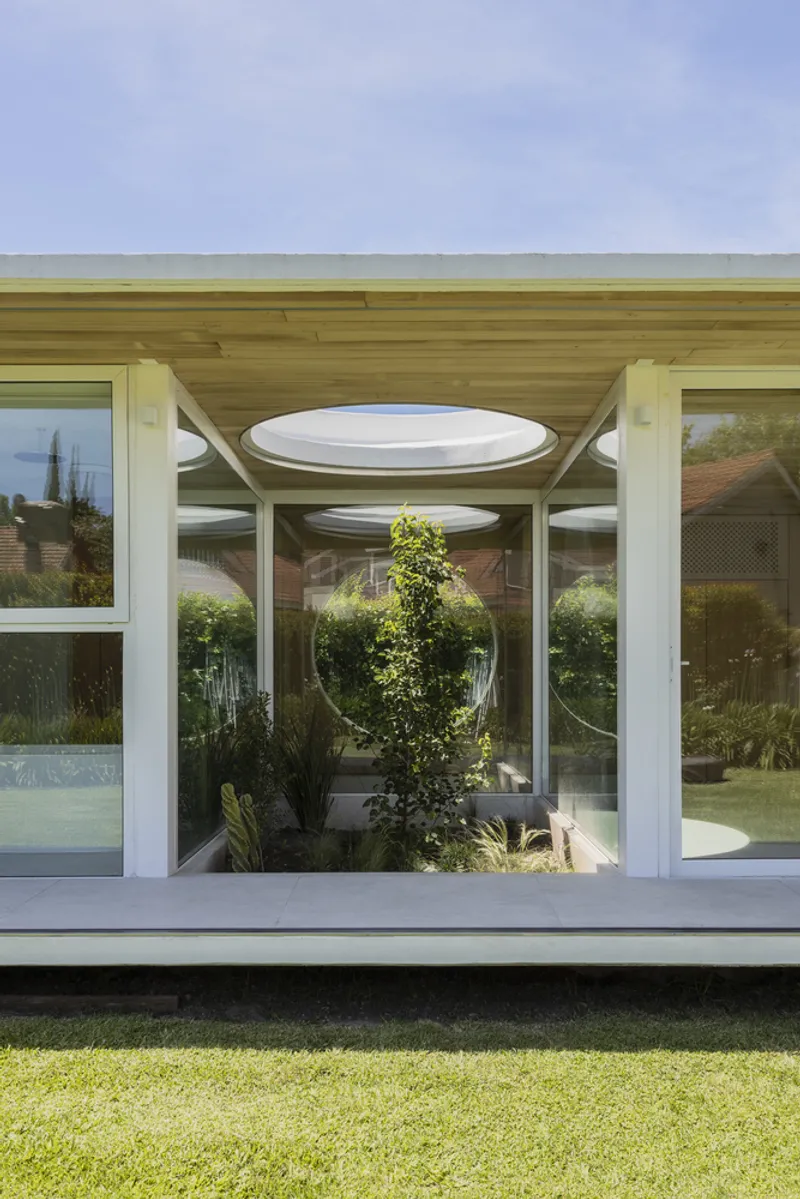
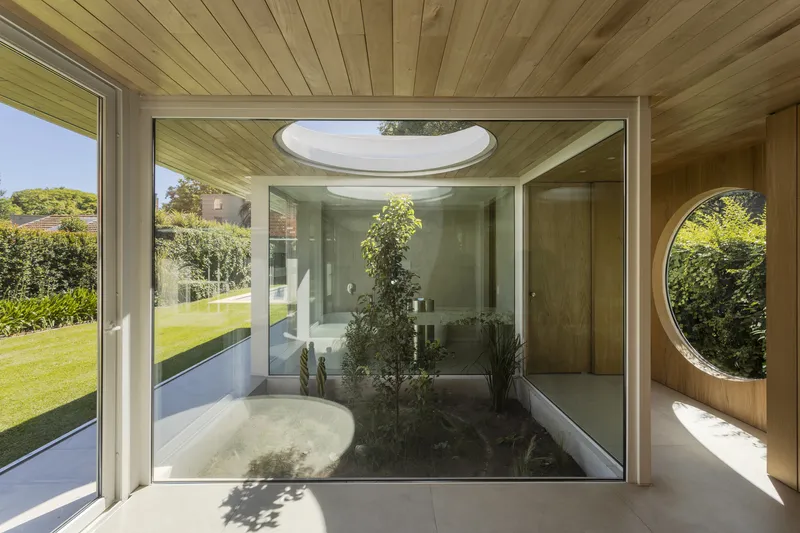
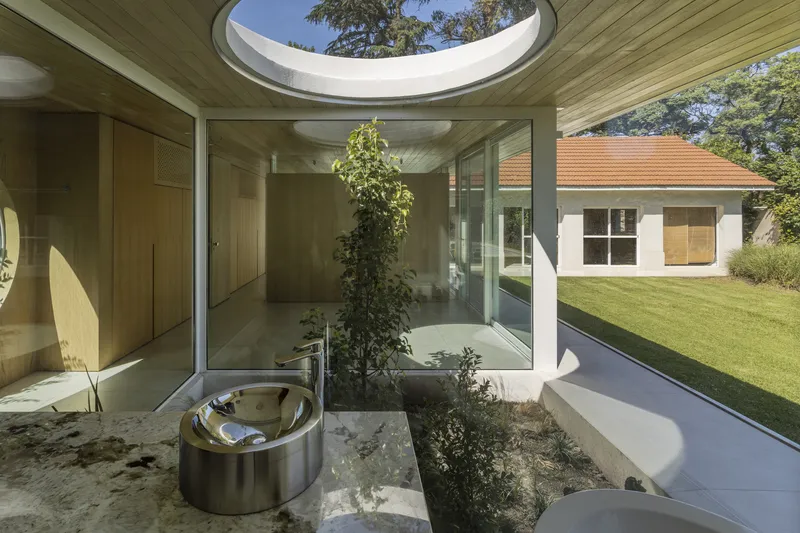
At the center of the plan, the roof opens up. An oval oculus frames a single tree rising from a planted bed set into the floor slab. The courtyard is small, almost room-sized, but it does enormous spatial work. It splits the house into public and private halves, pulls daylight into the deepest part of the plan, and creates a microclimate: warm air rises through the opening, drawing cooler garden air through the sliding panels at either end of the bar. The courtyard is, literally, the engine of the house's ventilation strategy.
Materially, the courtyard is where the house's three primary surfaces converge. Timber planks line the ceiling and walls; polished concrete defines the floor; and glass mediates between inside and out. A freestanding stainless-steel bathtub sits in the courtyard zone, a deliberate provocation that collapses the boundary between bathing, gardening, and living. It is the kind of move that could feel gimmicky, but here the tub's placement reads as logical: this is the most private, most sheltered spot in the plan, and the skylight above turns a bath into an encounter with weather.
Glass Walls and the Rhythm of Sliding Panels
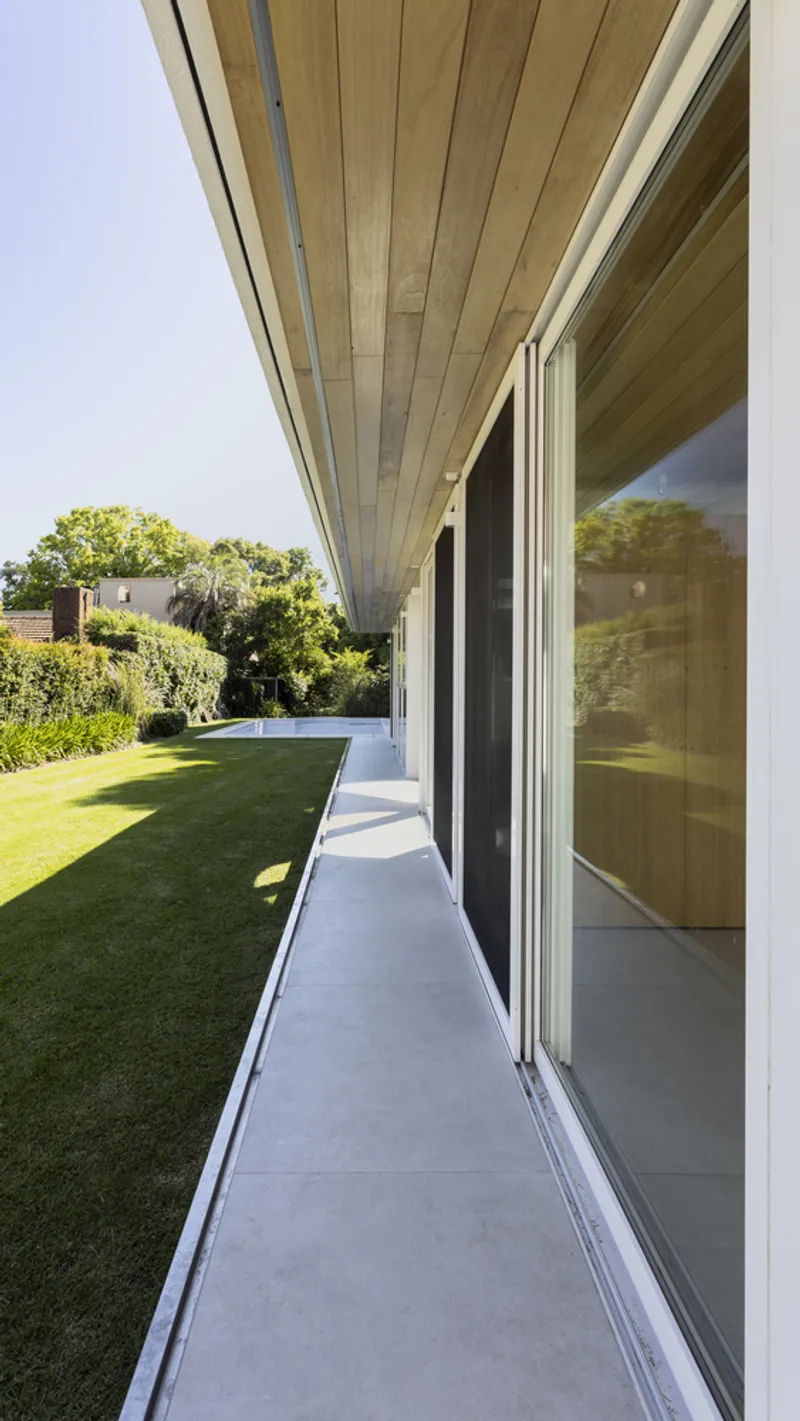
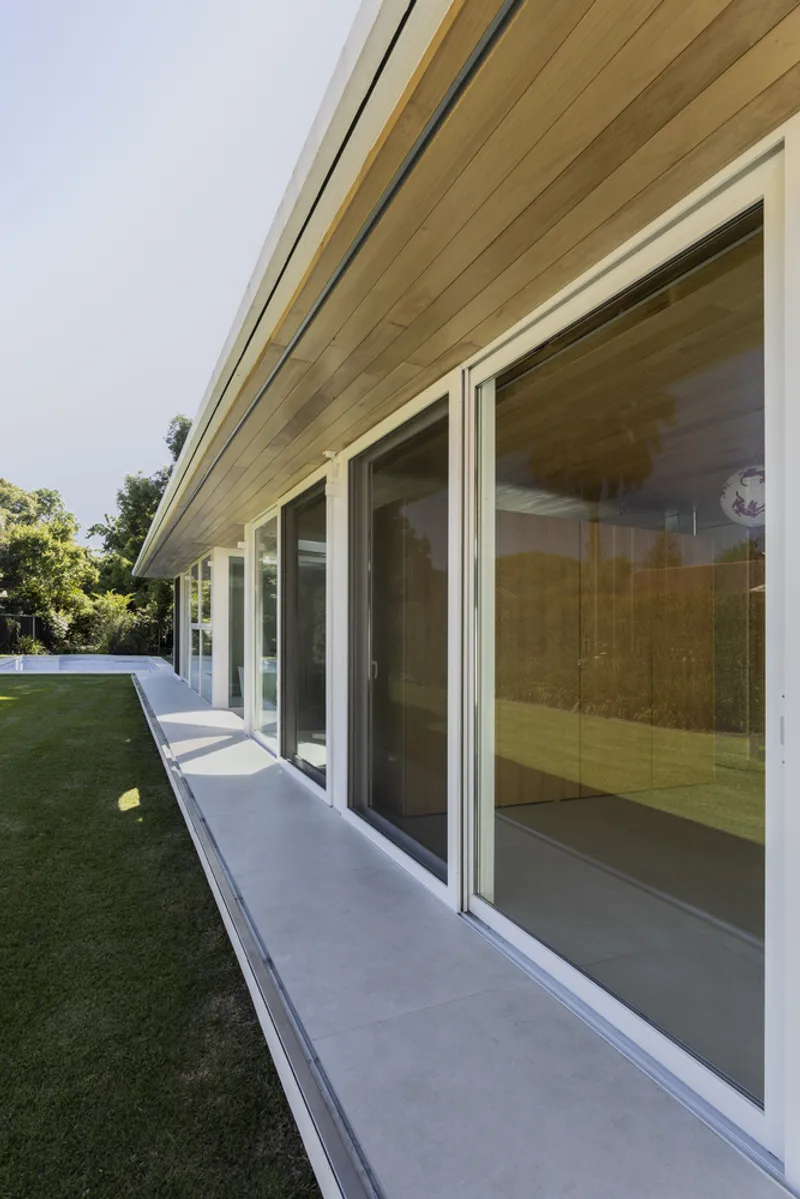
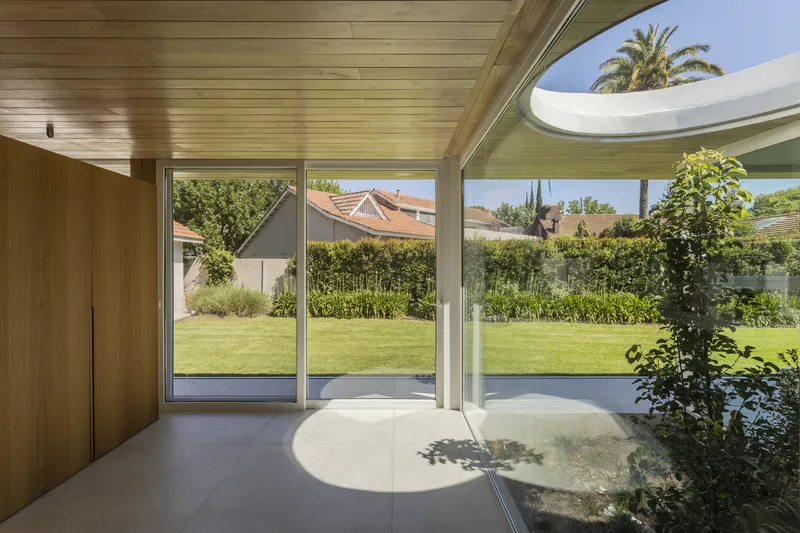
The garden-facing facade is almost entirely glazed, but its character changes depending on how many panels are open. When fully retracted, the living space becomes an open-air terrace beneath a timber soffit. When closed, the aluminum frames create a taut, reflective surface that mirrors the lawn and sky. The architects use a consistent module for the sliding panels, giving the facade a measured cadence that prevents the long elevation from reading as monotonous.
From inside, the effect is immersive without being exposed. The deep overhang and the hedged garden perimeter mean you can stand at the glass wall and look out at greenery rather than at neighbors. The covered walkway that runs along the garden face acts as a transitional zone, neither fully inside nor out, where the timber ceiling is close overhead and the concrete floor extends to the drip line. It is one of those spaces you end up using more than the rooms it connects.
Timber as Interior Atmosphere
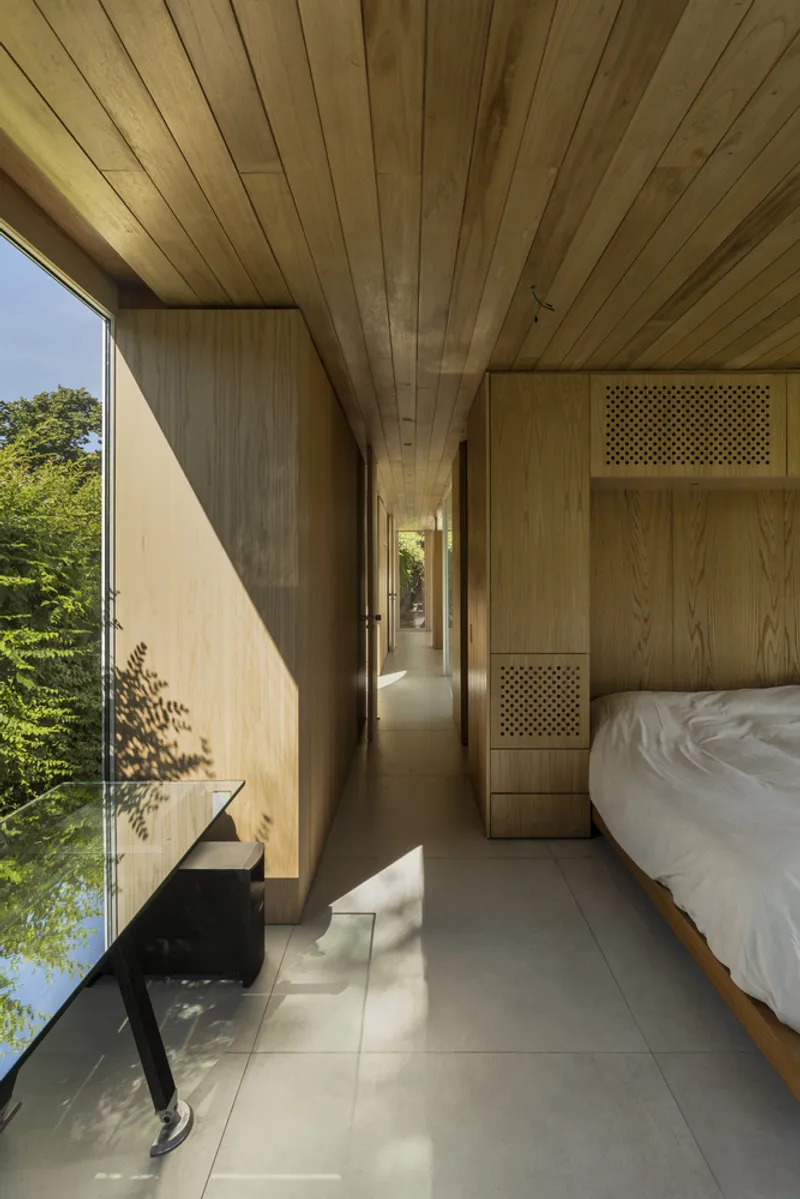
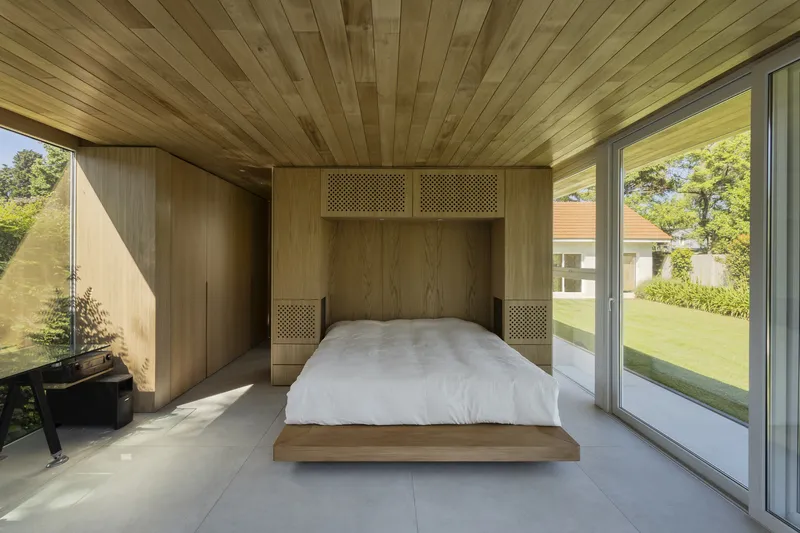
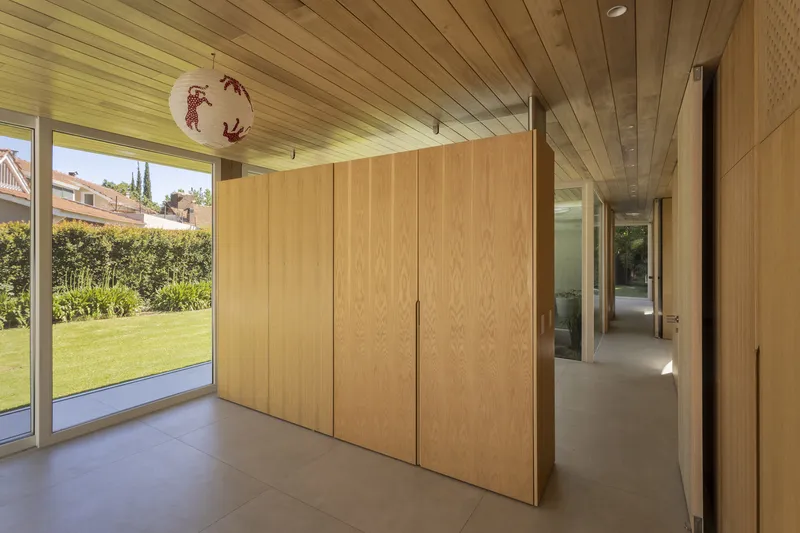
Step away from the glass facade and the house shifts register entirely. Bedrooms and corridors are lined floor to ceiling in oak: plank ceilings, paneled walls, built-in wardrobes and headboards that merge into the surface. The grain runs consistently, and the joints are tight enough to read as continuous planes rather than assembled boards. Morning sunlight rakes across these surfaces and turns them warm amber, which is a quality that photographs hint at but never fully capture.
The bedroom pavilion is perhaps the quietest space in the plan. Sliding glass walls open one side to the garden, but the timber wrapping on the remaining three walls gives the room a cocoon-like warmth. An integrated headboard wall doubles as a partition, hiding storage and services behind a clean face. The material discipline here is not austere; it is generous in a way that rewards close looking.
Detailing: Ventilation Grilles, Hinges, and Circular Windows
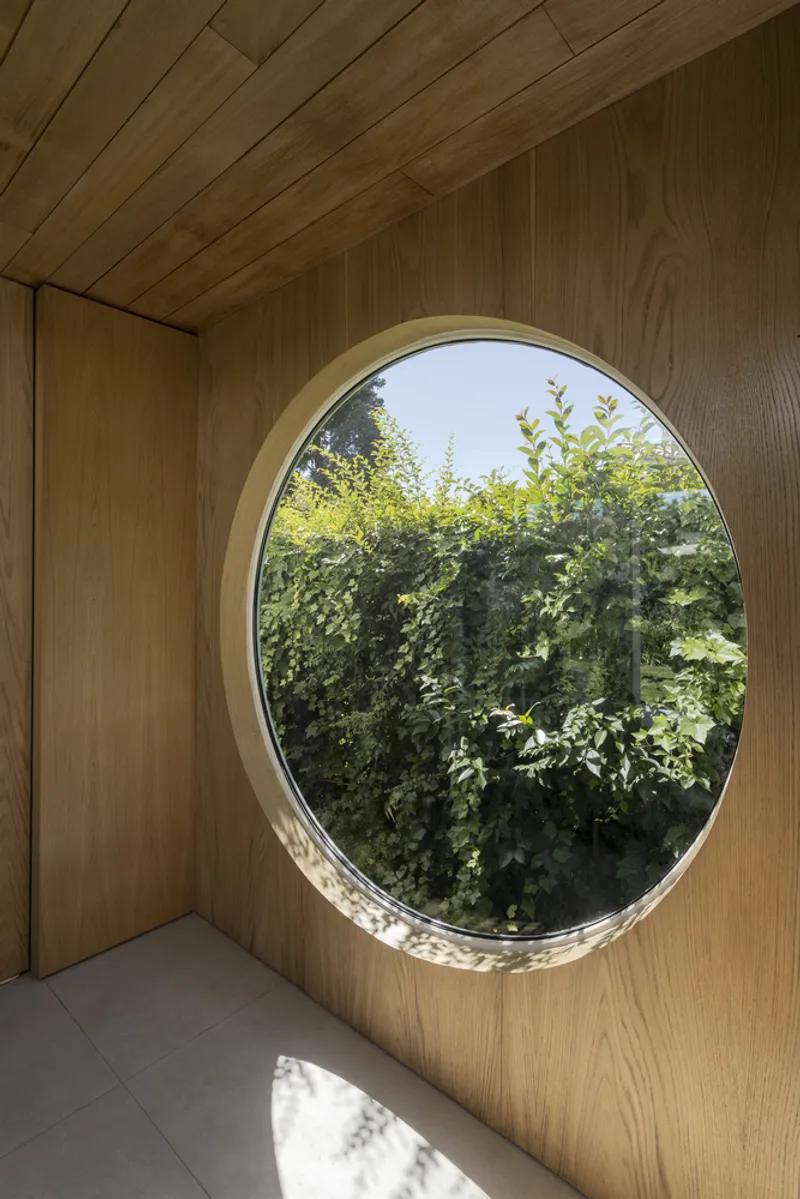
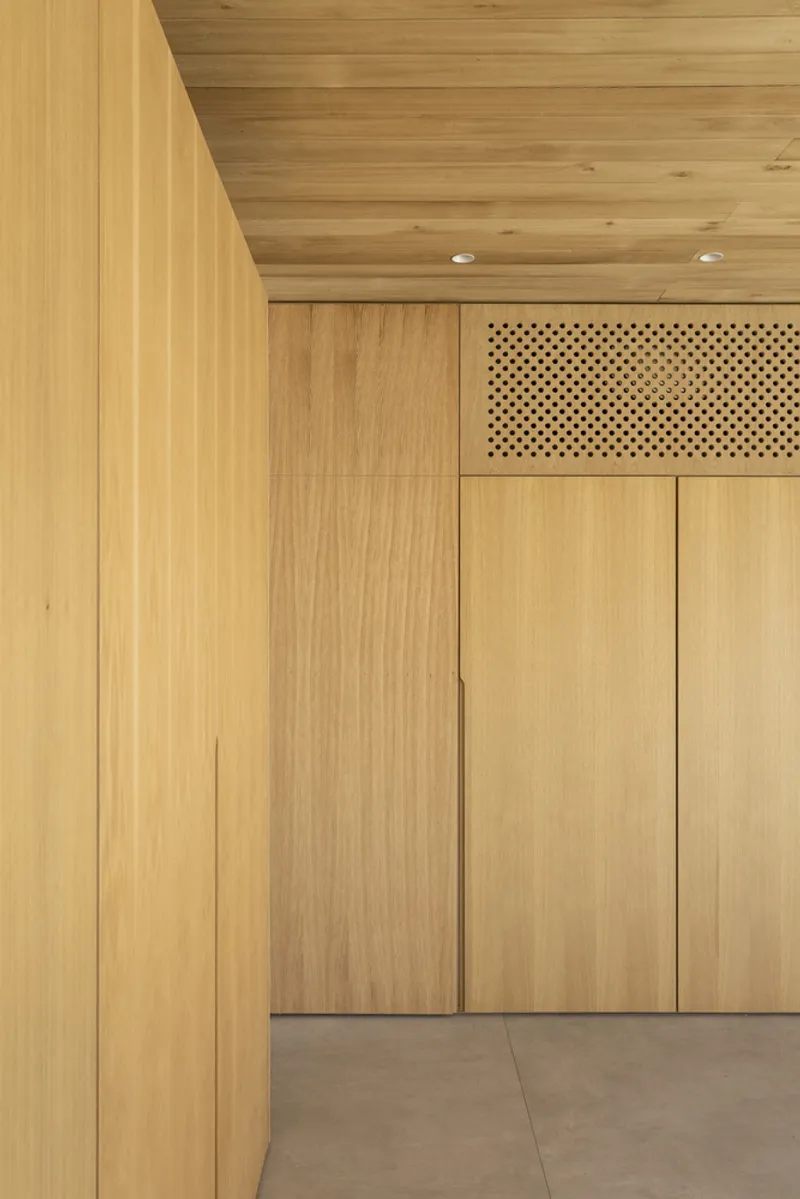
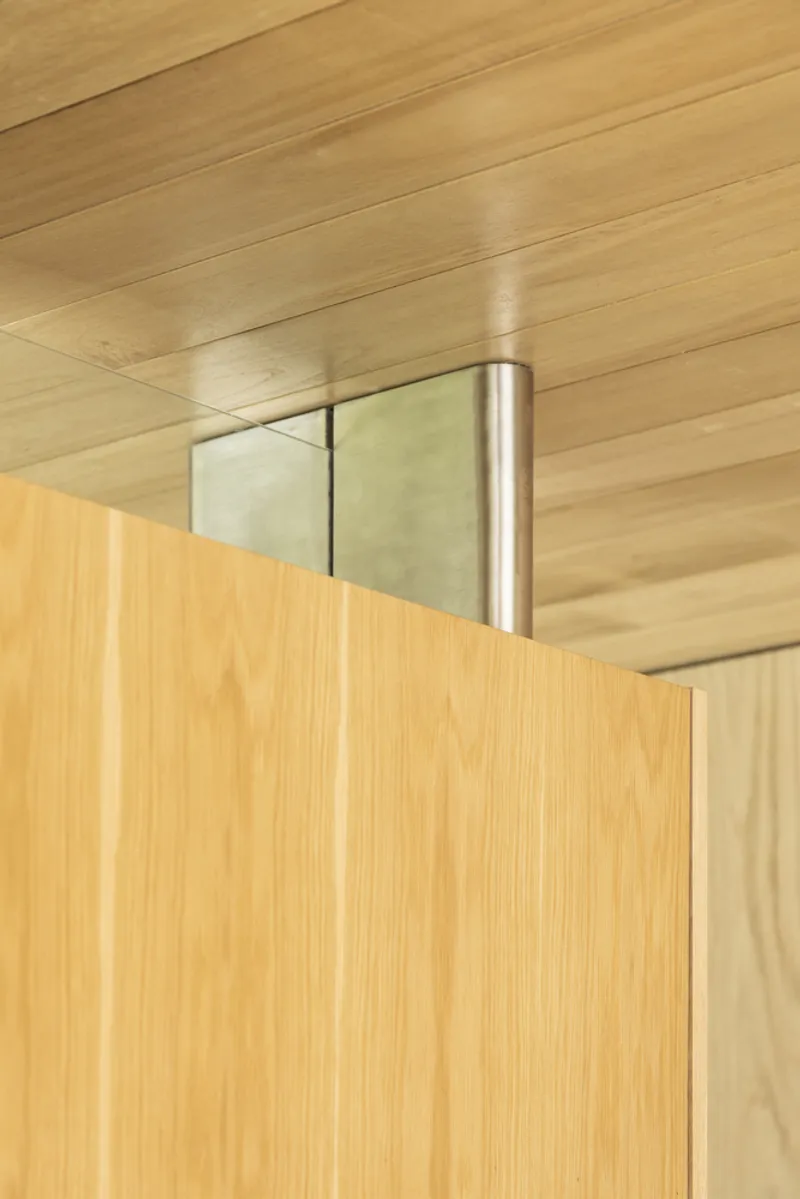
The house's name commits it to airflow, and the detailing follows through. Perforated ventilation grilles are integrated into the timber wall panels above built-in storage, allowing air to circulate between rooms without compromising visual privacy. The perforations are fine enough to read as texture rather than hardware, a small refinement that elevates the entire interior. Cylindrical steel hinges connect pivoting wood panels beneath the timber ceiling, each one machined with a precision that belongs more to furniture than to construction.
A circular window cut into the oak-clad wall frames dense hedgerow beyond. It is an unexpected move in a house otherwise defined by rectangular geometry, and it works precisely because it breaks the rule: the circle becomes a portrait of the garden, a deliberate focal point in a long corridor. The same motif appears at larger scale in the courtyard skylight, tying the two gestures together across the plan.
Wet Rooms and Material Contrasts
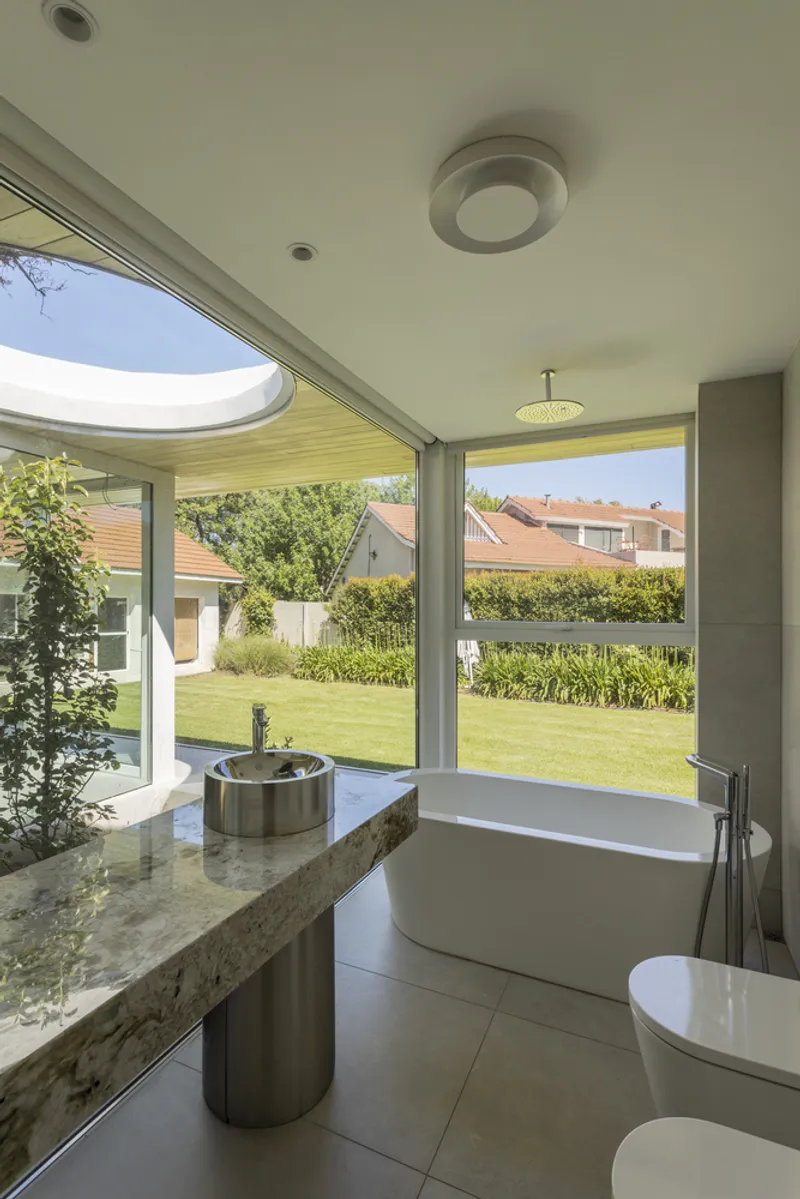
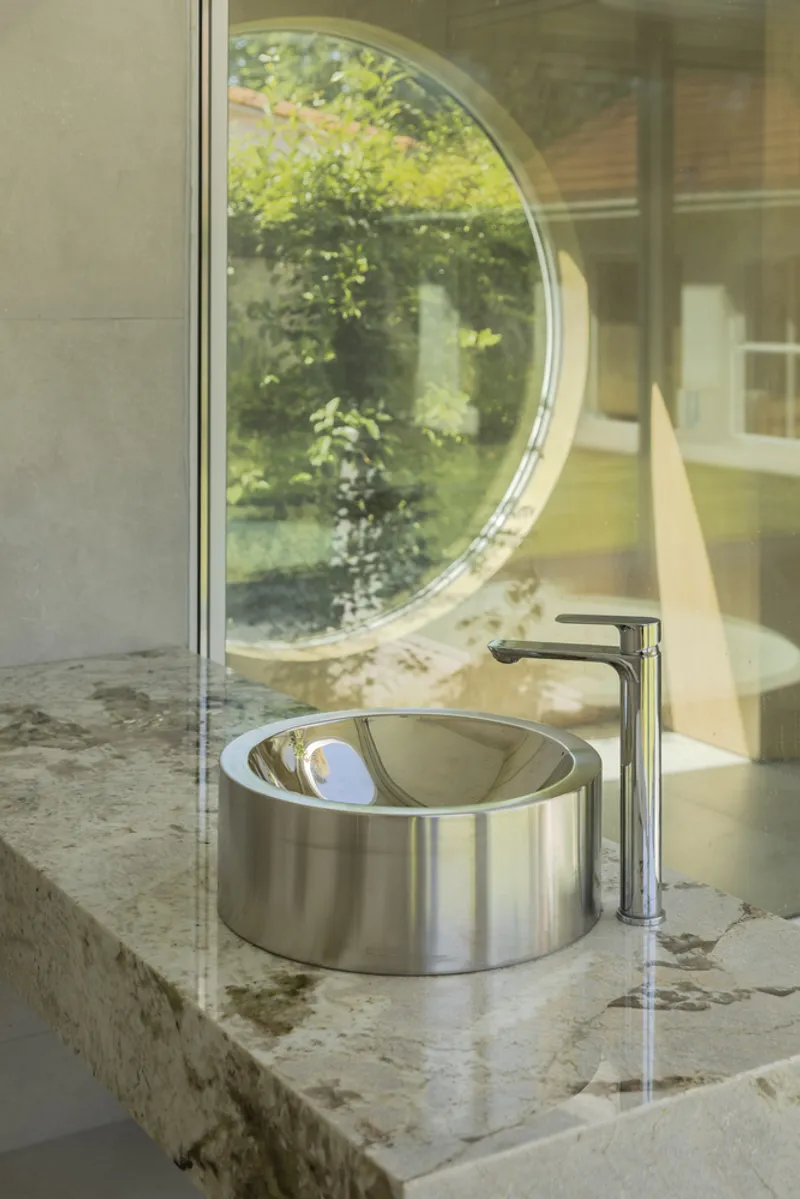
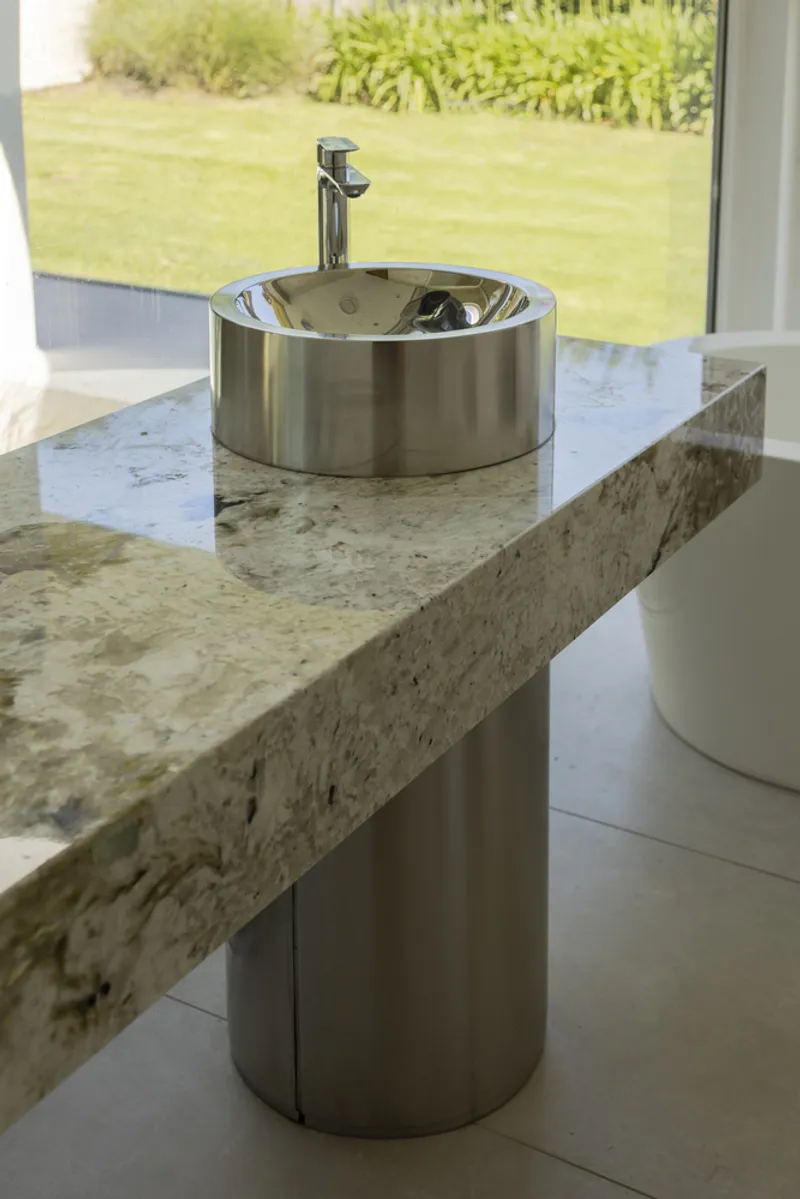
The bathrooms play a deliberate game of material contrast. Stainless-steel vessel sinks sit on rough-textured stone countertops, reflecting the garden window behind them. A freestanding tub in one bathroom is positioned beneath the circular skylight, turning the act of bathing into something almost ceremonial. The juxtaposition of polished metal, raw stone, and warm timber is simple but effective: each material gains clarity from the others.
There is nothing accidental about the palette. Every surface, from the concrete floor to the perforated timber panels, is chosen for how it ages and how it channels light. Stone absorbs it, steel bounces it, timber warms it. The architects have clearly thought about maintenance too: the materials are robust, the details are flush, and the sliding mechanisms are heavy-duty. A house this open to the garden needs to be tough, and this one looks like it can take it.
Plans and Drawings
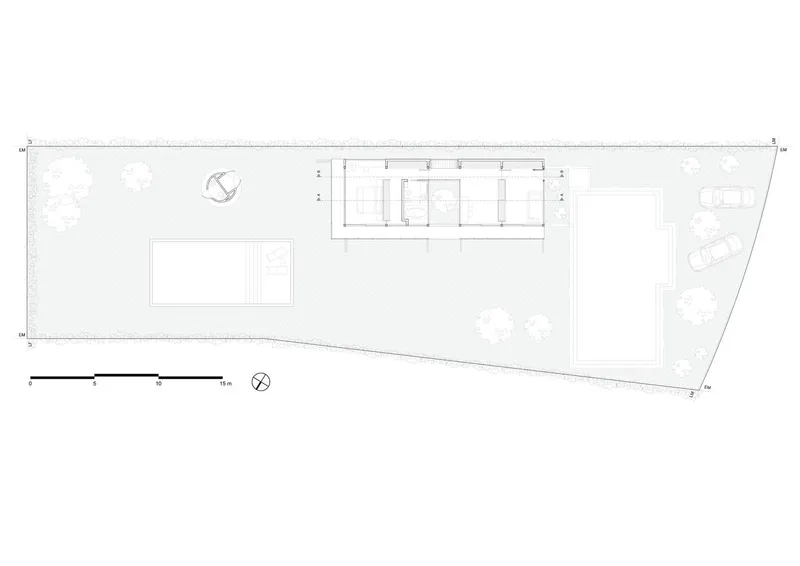
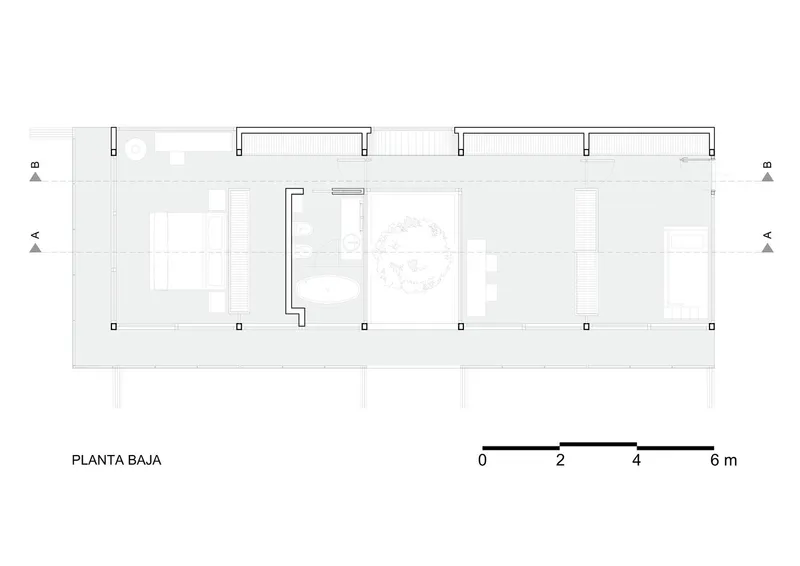
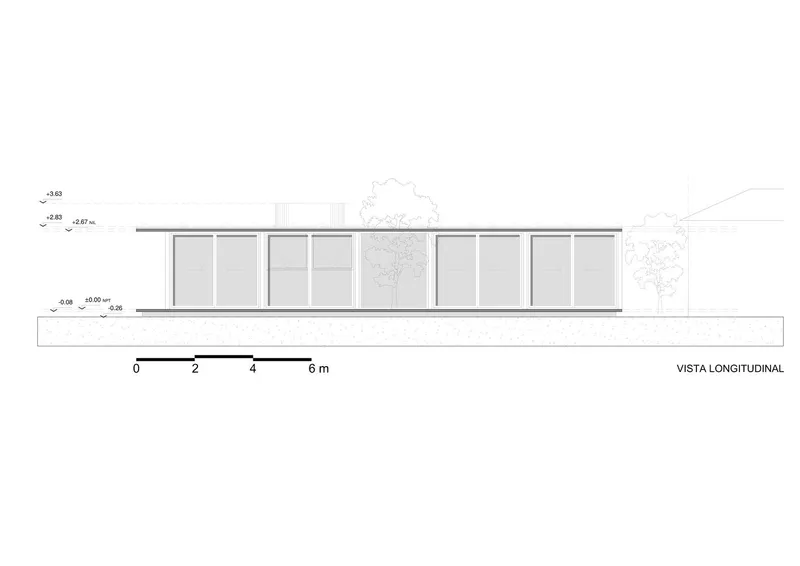
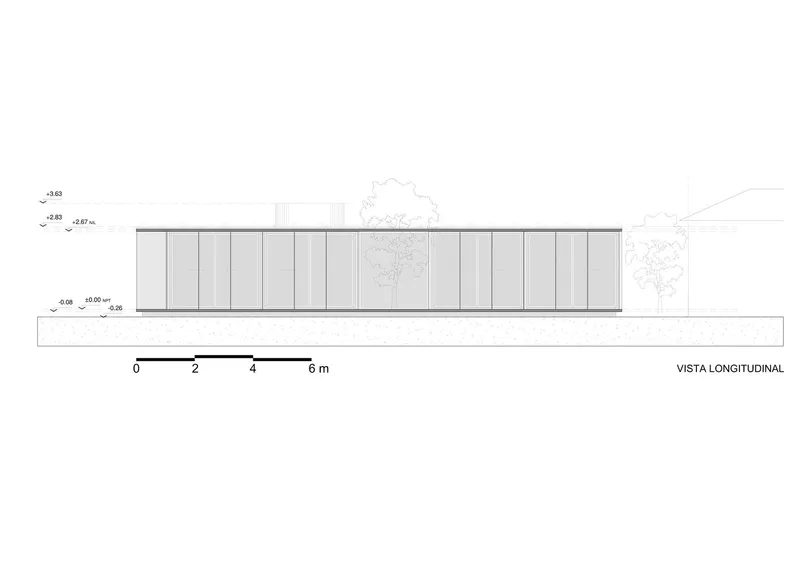
The site plan reveals the logic that the photographs only suggest. The building occupies a narrow, tapered lot, and the linear plan exploits the full depth of the site. A swimming pool sits at the rear, separated from the house by a planted buffer. The floor plan shows rooms arranged in strict sequence: entry, living, courtyard with tree, bedrooms, and service spaces, all linked by a continuous circulation spine along the garden face.
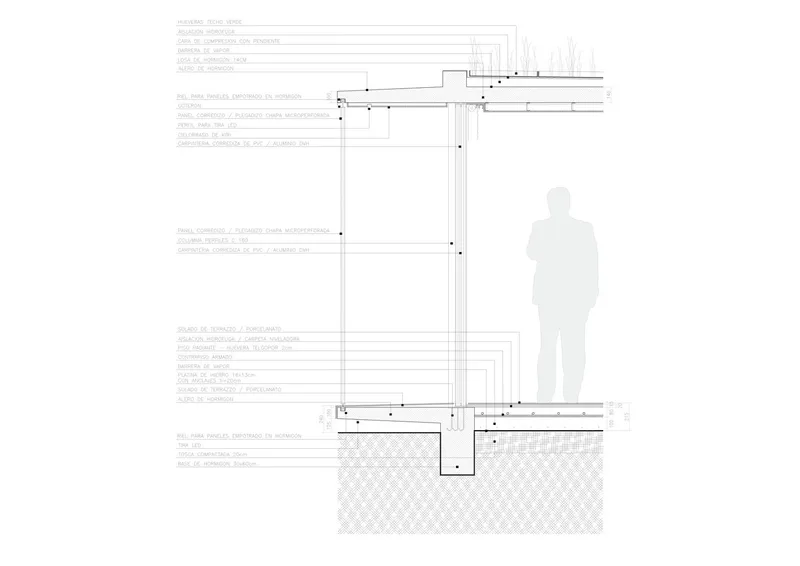
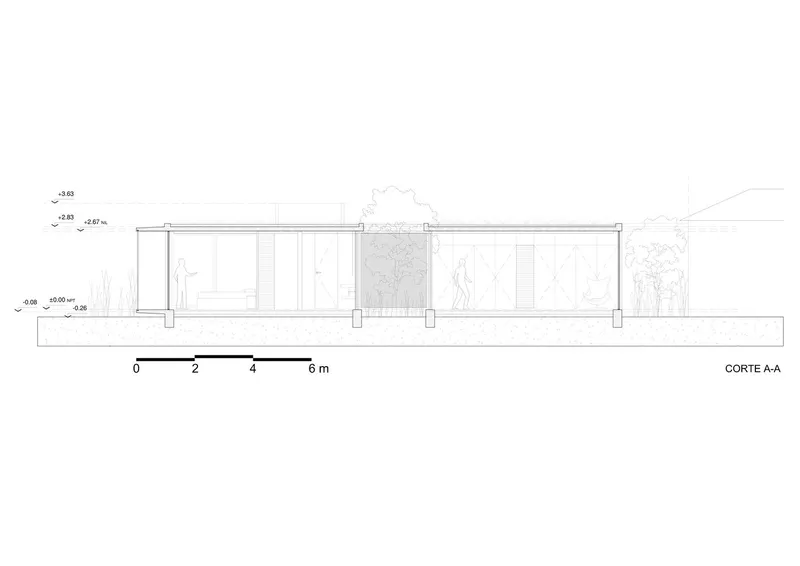
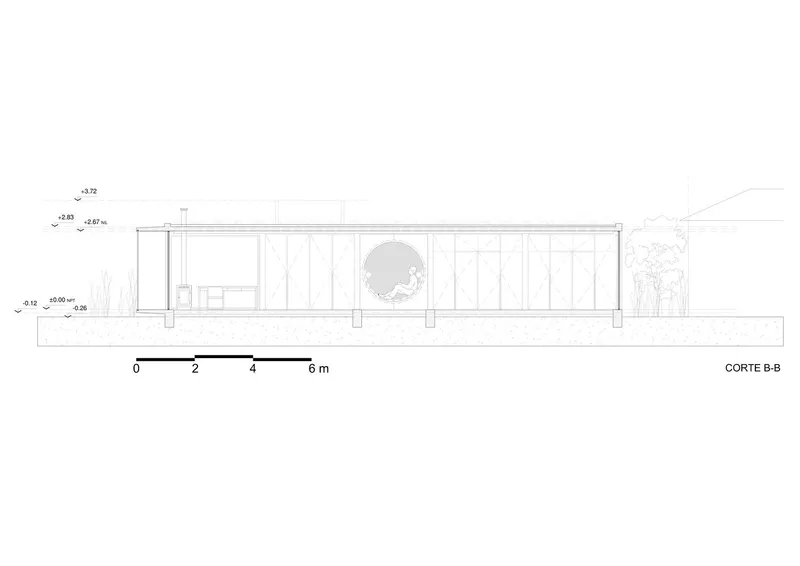
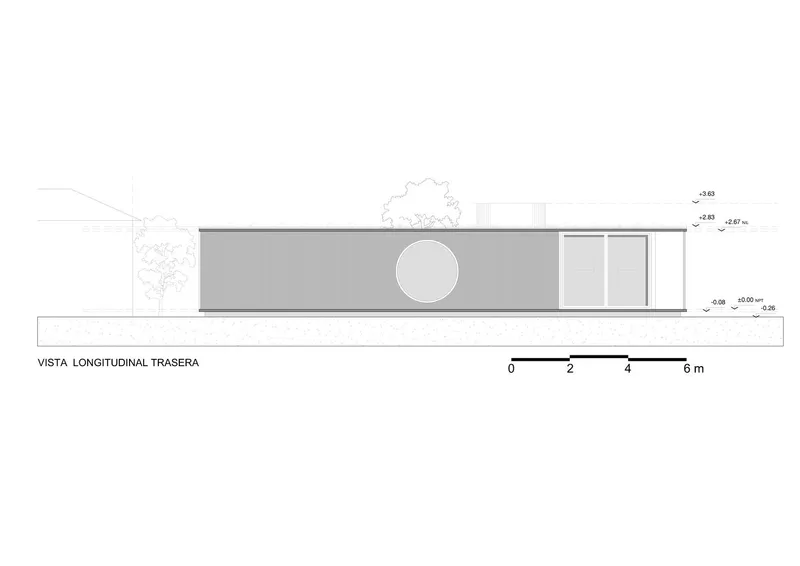
The sections are where the construction method becomes legible. A flat roof spans between slender steel columns, with timber planks forming the visible soffit below. The wall assembly, visible in a detailed construction section, shows an insulated cavity between the interior timber lining and the exterior cladding, with the raised floor slab sitting on a gravel bed above the foundation. The circular window and the oval skylight appear in the elevations as the two primary compositional events on an otherwise understated facade. The rear elevation, clad entirely in vertical timber boards with a tree-shaped cutout, is arguably the most graphic face of the house: a long timber wall with one deliberate opening that frames a tree like a piece of land art.
Why This Project Matters
The Air House is a reminder that passive ventilation is not a technical footnote but a design driver. When airflow organizes the plan, determines the placement of courtyards, dictates where walls stop and where glass begins, the result is a building that feels inevitable rather than composed. ESTUDIO 87 Arquitectura has produced a house where every room has at least two ways to breathe, and where the central courtyard does triple duty as light well, garden, and chimney. That kind of integration is harder to achieve than it looks.
The project also demonstrates that material restraint and sensory richness are not opposites. Three or four materials, deployed with real precision, create spaces that change character across the day as light moves through them. The timber detailing, in particular, rewards attention: ventilation grilles that double as ornament, hinges that read as jewelry, a circular window that turns a hedge into a painting. These are small moves, but they accumulate into an architecture that feels considered at every scale, from the site plan down to the door handle.
The Air House by ESTUDIO 87 Arquitectura, Buenos Aires Province, Argentina. Photography by Albano Garcia.
About the Studio
Share Your Own Work on uni.xyz
If projects like this are the kind of work you want to make, uni.xyz is a place to publish your own, find collaborators, and enter design competitions.


Popular Articles
Popular articles from the community

Extended Shell: Retrofitting Kolkata's Balconies as Living Urban Thresholds
A modular retrofit system recovers the social and environmental intelligence of Kolkata's historic verandas for contemporary Park Street residents.

The Amber Palace Opera: A Geological Fiction Surfaces on Tallinn's Baltic Waterfront
Pierre Brillard reimagines a Baltic legend as a public landscape, opera house, and waterfront promenade rooted in Tallinn's coastal identity.
Tsunami Convergenics: Turning Catastrophic Ocean Forces into Underwater Housing Infrastructure
A speculative underwater settlement off the coast of Onagawa, Japan, treats tsunamis and typhoons as energy sources rather than threats.

Opera on the Sea: Driftwood Logic Shapes a Timber Opera House on Estonia's Coast
Trevor Orgill's opera house translates the entangled drift of floating timber into a civic building where wood, water, and music converge.

Similar Reads
You might also enjoy these articles


Hodi-Mandai Geram
Project Function: Preservation and revitalization of the Intangible heritage and socio-spatial identity of the Hodi by Housing, Cultural Memory Center, Sacred Grove, landscape, local tourism economy


Olio Towers: A Mid-Rise for Performers That Fuses Housing, Rehearsal, and Stage
Located blocks from Houston's Theater District, this modular tower stacks living units around a central performance atrium.

Oasis: Modular Green Housing Carved into Dhaka's Urban Fabric
A shortlisted Plugin Housing entry reclaims unauthorized settlements in Dhaka with stepped concrete volumes, green roofs, and ventilation-driven design.

Black Hole: A Floating Megastructure for the Post-Physical Era
Emiliano Mazzarotto envisions a spherical, self-scaling arena where e-sports, digital hotels, and holographic stadiums replace traditional public space.

Explore Architecture Magazine Competitions
Discover active competitions in this discipline

Challenge to reimagine the Iron Throne

Photograph architecture without architects

Illustrate the lost glory of Angkor Wat - Render Challenge

Design challenge to reuse E-waste
Comments (0)
Please login or sign up to add comments
No comments yet. Be the first to comment!