
Minimalist Architecture and Design Studio Wrap a Ludhiana Home in a Classical Exoskeleton
Residence ASL 42 pairs columned terraces and arched openings with restrained interiors across four floors in Punjab, India.


There is something genuinely disorienting about a house in Ludhiana that looks like it could have been plucked from a Mediterranean hillside, then gutted and refitted by someone who only owns grey linen and brass. Residence ASL 42, a collaboration between Minimalist Architecture and Design Studio, makes the tension between its neoclassical shell and its pared-back interior the entire point. Completed in 2025 and photographed by Purnesh Dev Nikhanj, the house stacks columned terraces, arched openings, and planted balconies into a street facade that announces itself as monumental. Step inside, and the mood shifts completely.
What keeps this from becoming pastiche is the degree of control. The columns are not decorative appliqué; they are structural members that support deep, habitable terraces on every level. The interiors, meanwhile, are almost aggressively calm: sheer curtains in double-height volumes, fluted stone surfaces, and materials limited to a palette of warm neutrals and brass accents. The real design proposition is that classical proportions and minimalist detailing are not opposites but rather two registers of the same discipline. Whether the house pulls that off is worth examining floor by floor.
A Facade That Commits to Its Ambitions
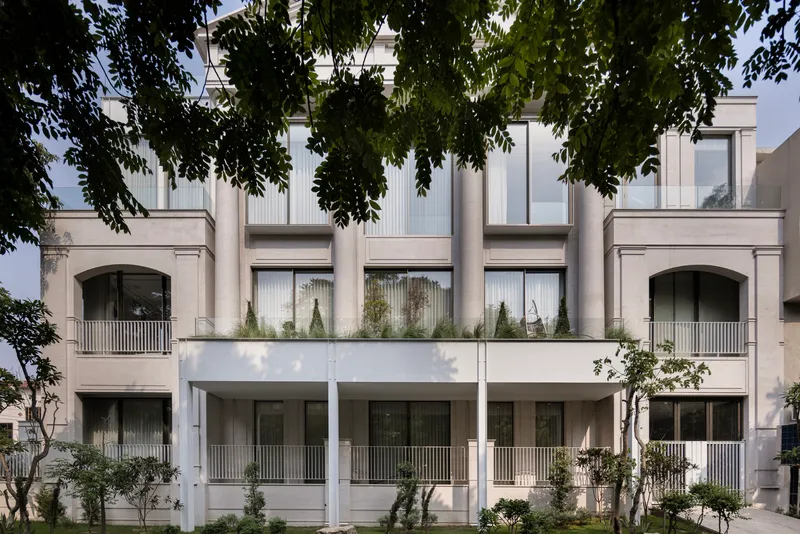
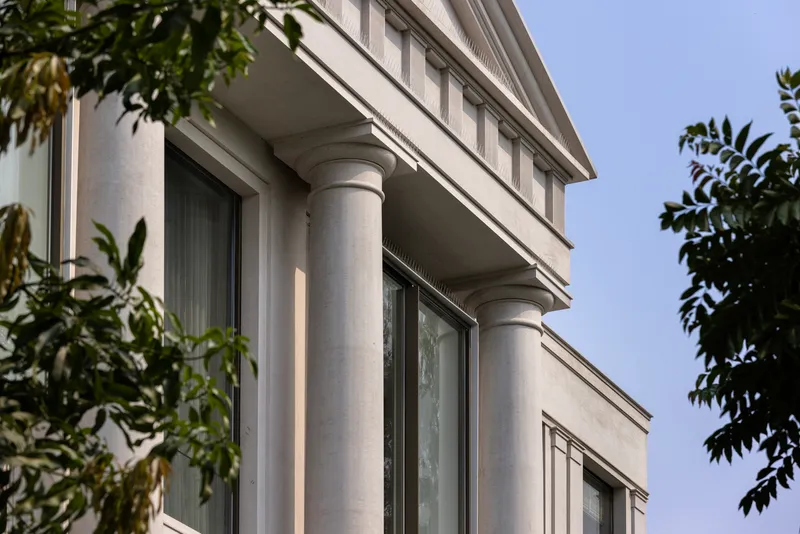
The street elevation reads as a layered composition of solid and void. Stacked stone columns carry continuous horizontal balconies, while arched openings at the lower levels introduce rhythm and depth. Planted terraces soften what could easily feel heavy, and mature tree branches in the foreground blur the line between architecture and landscape. The facade does not shy away from grandeur, and it is all the more convincing for it.
Detail matters here. The columns are not slender or ornamental; they have real presence and read as load-bearing even from the street. The balconies are deep enough to be rooms in their own right, not token ledges. In Punjab's climate, where shading and outdoor living are necessities rather than luxuries, this depth has practical justification. The overcast sky in the photographs flattens the white surfaces, which lets you see the composition as pure form.
The Interior Courtyard as Vertical Event
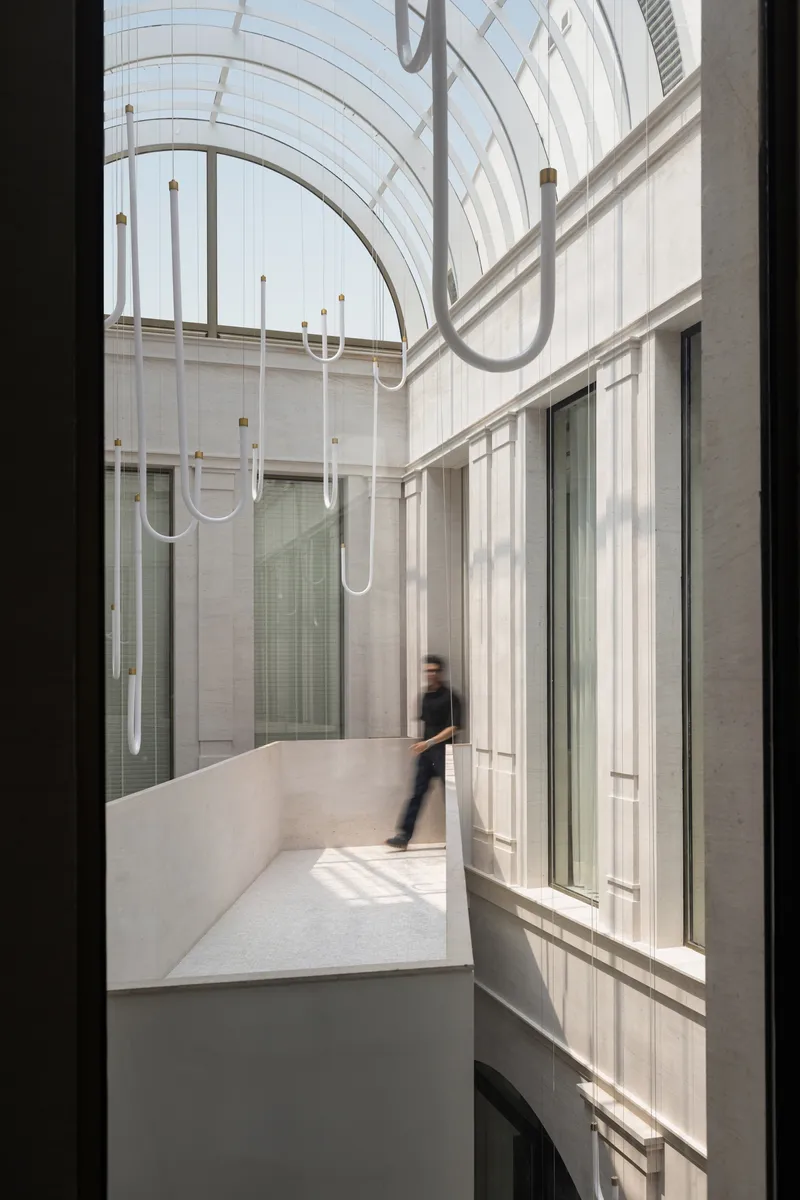
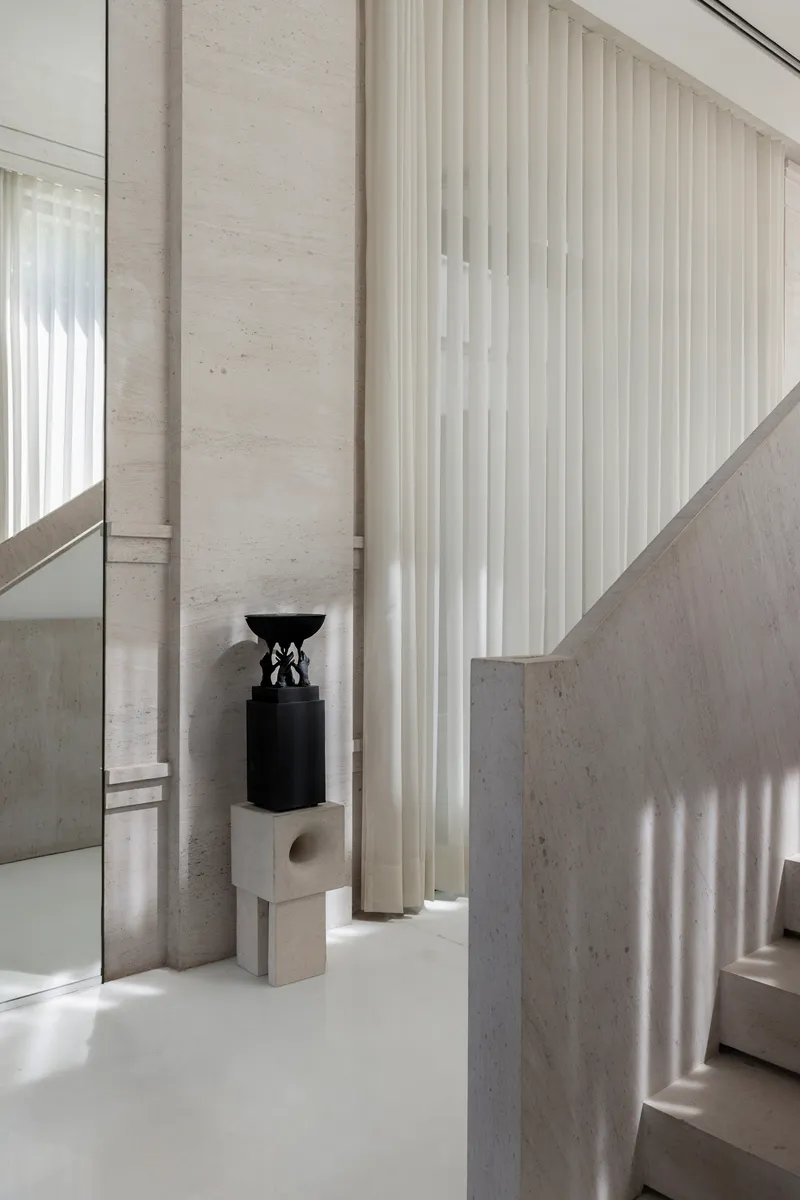
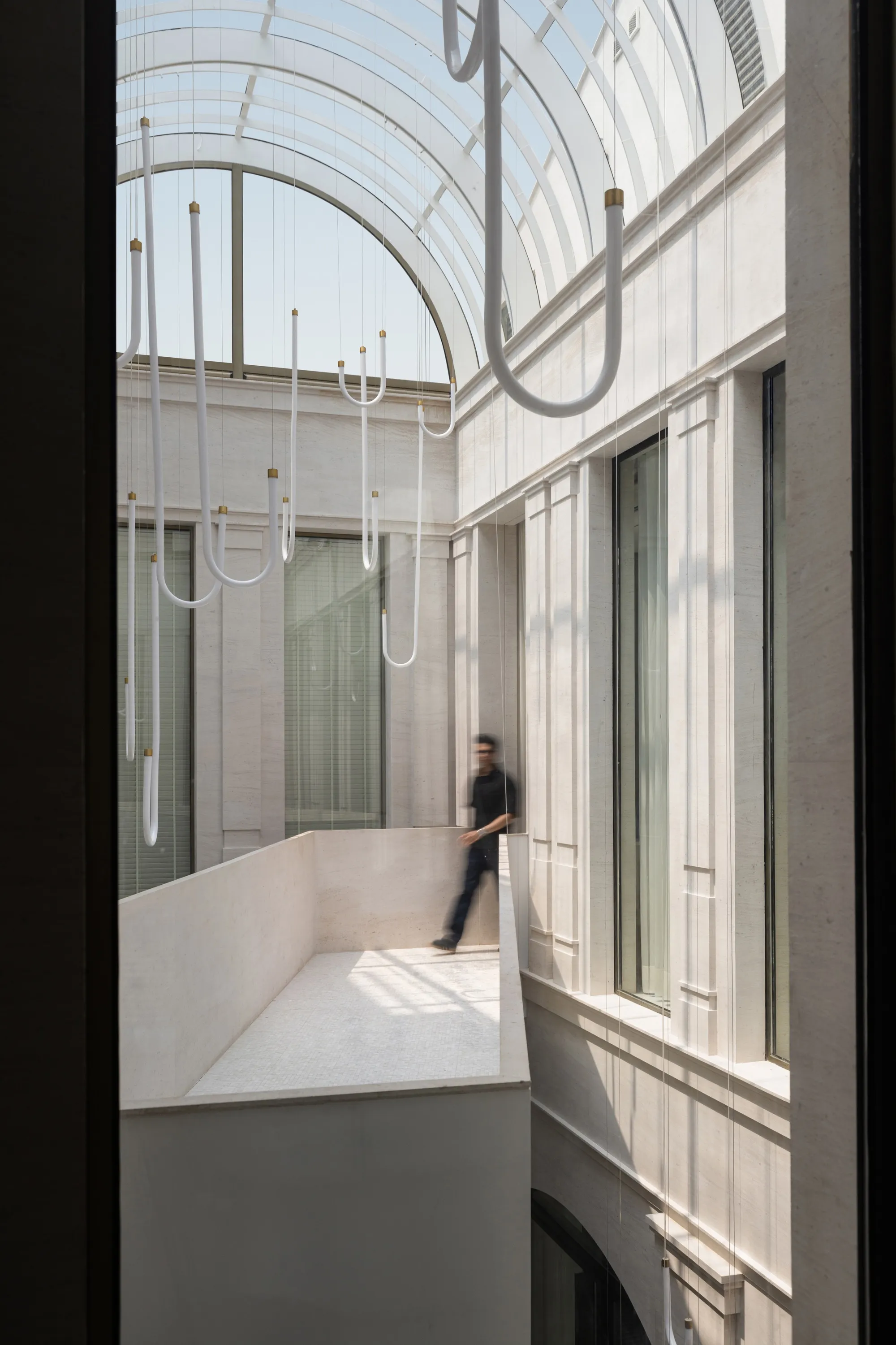
The most compelling interior moment is the central courtyard, spanned by a curved glass roof and threaded with linear pendant lights that draw the eye upward. A bridging walkway crosses the void, turning vertical circulation into theater. You can see a figure mid-crossing in the photograph, and the scale becomes immediately legible: this is not a light well but a genuine atrium, tall enough to organize the spatial logic of the entire house.
Flanking the courtyard, stone walls and vertical curtains frame views into adjacent rooms. A black sculpture on a pale plinth introduces one of the few moments of visual contrast in an otherwise tonally restrained palette. The courtyard acts as the hinge between the extroverted facade and the introverted domestic spaces. It brings daylight deep into the plan without sacrificing privacy, a recurring challenge in dense Ludhiana plots.
Living Spaces Built on Layered Light
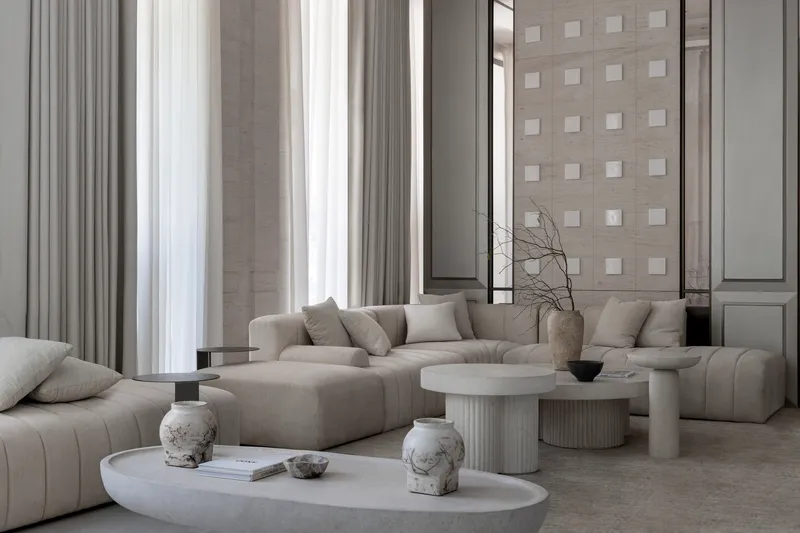
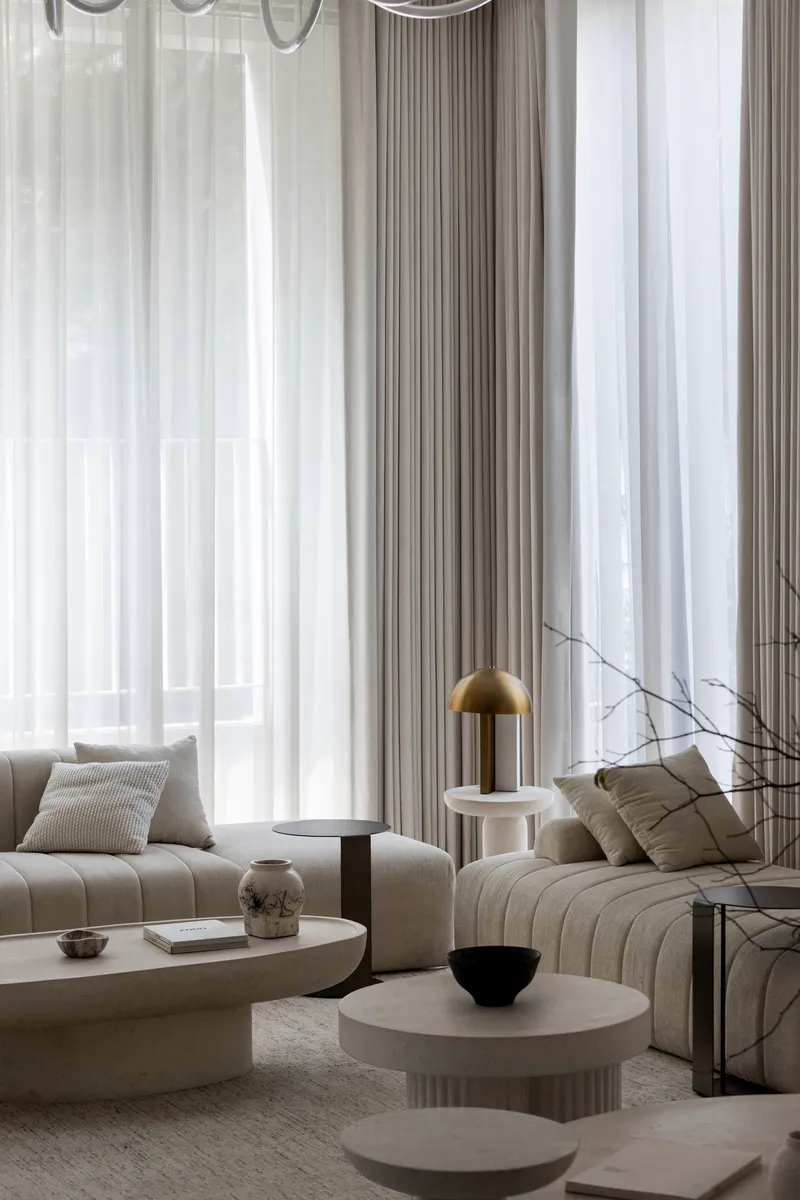
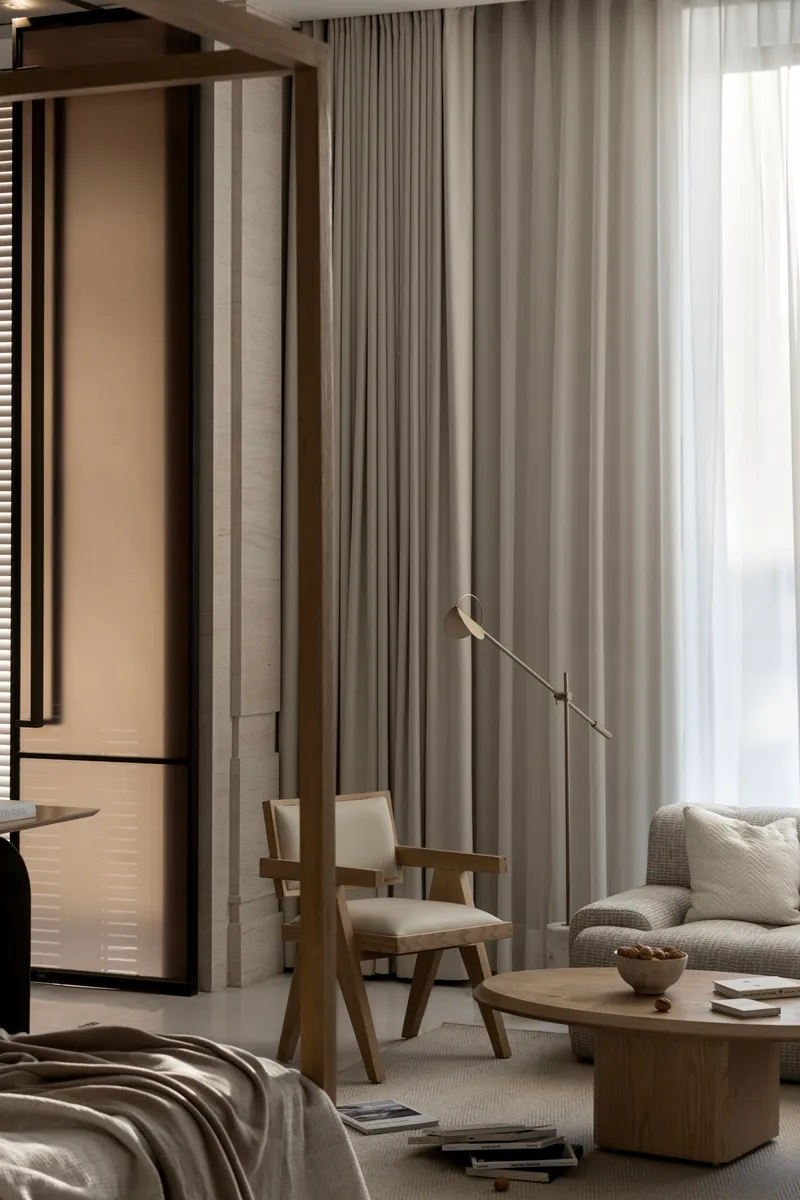
The living areas across multiple floors share a common strategy: floor-to-ceiling sheer curtains that filter daylight into soft, diffused planes. Grey upholstered seating, circular and fluted stone tables, and a consistent material warmth tie these rooms together without making them feel identical. The double-height volume in the main living room is generous enough to absorb multiple seating arrangements without feeling crowded.
A brass articulating floor lamp and carefully placed timber chairs prevent the rooms from tipping into sterility. The curtains do real work here: they manage solar gain, establish visual privacy from the deep terraces beyond, and create a luminous backdrop that changes character through the day. It is a simple move, but applied with enough conviction to define the atmosphere of the entire house.
Dining, Kitchen, and the Brass Register
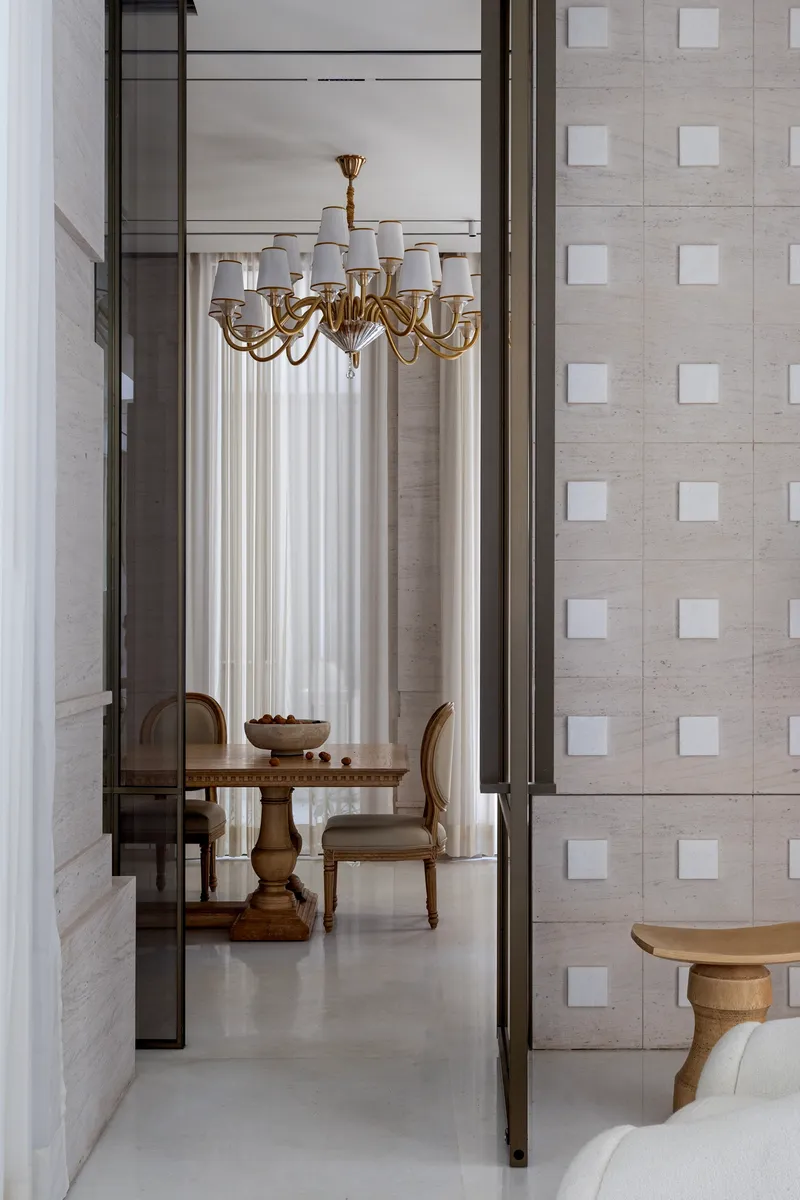
Bronze-framed glass doors open onto a dining room where a brass chandelier hangs above a table set against a stone grid wall. The material shift is deliberate: where the living spaces lean into fabric and softness, the dining zone introduces harder surfaces and metallic reflections. The stone grid wall is one of the few moments where the architects allow texture to dominate, and it anchors the room visually.
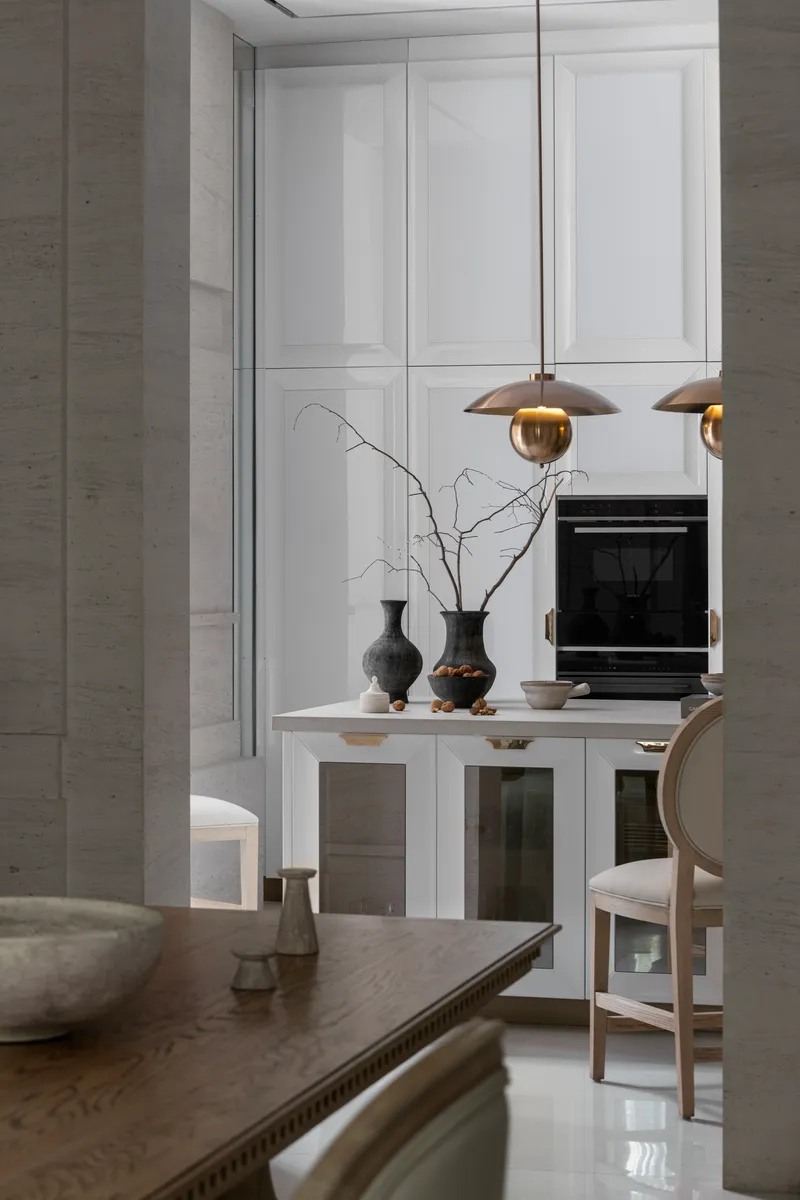
The kitchen extends this logic with brass pendant lights over a generous island, backed by white paneled cabinetry and a decorative arrangement of bare branches. It is unapologetically styled, but the spatial proportions keep it grounded. The island is large enough to function as a work surface, a gathering point, and a visual anchor all at once. Brass as a through-line, from lighting to hardware to framing, gives the interiors a coherence that holds up across very different rooms.
Private Quarters: Timber and Restraint
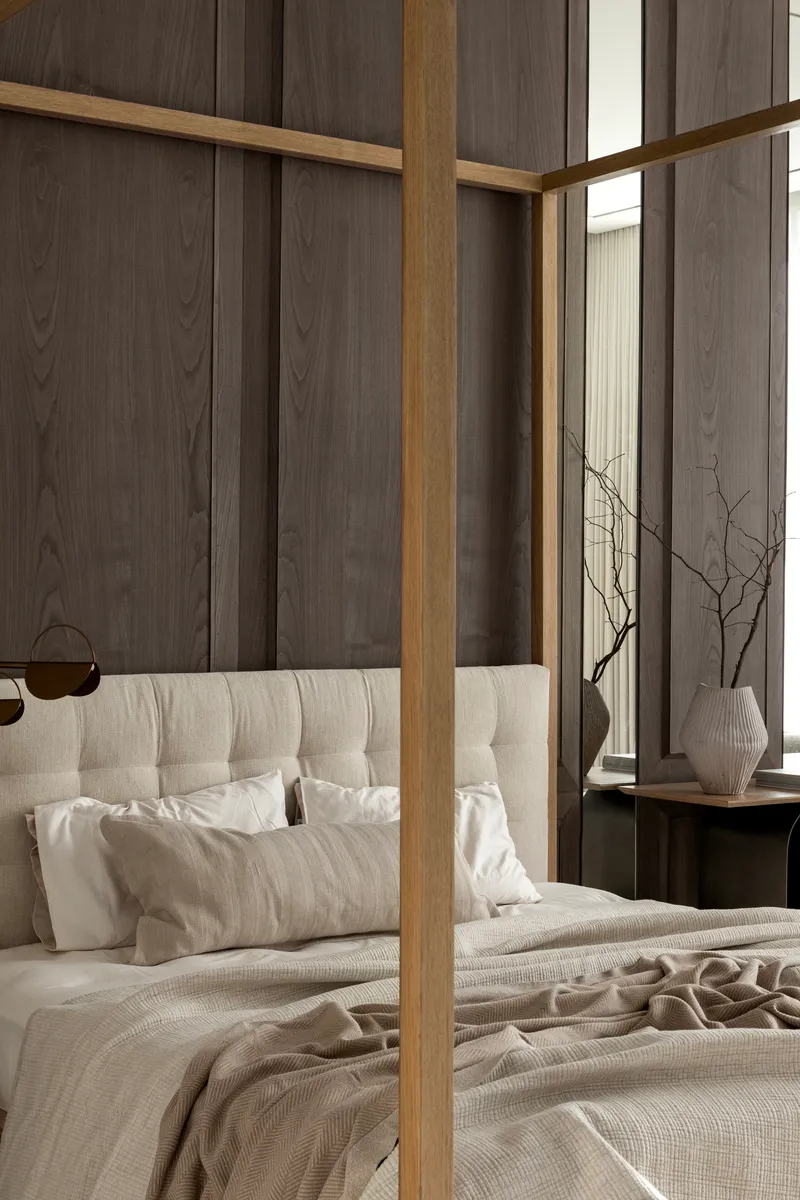
The bedroom suites retreat into darker, warmer materials. A timber-framed canopy bed set against dark wood paneled walls signals a clear shift in register from the public floors below. Sheer curtains reappear, maintaining the filtered-light strategy, but the enclosure feels more intimate. The canopy bed is not a period gesture; its frame is clean and contemporary, using the language of the house rather than borrowing from elsewhere.
This calibrated shift from public lightness to private warmth is one of the stronger organizational decisions in the project. It gives the house a narrative arc as you move upward through it, and it means the bedrooms feel like distinct destinations rather than variations on the ground-floor theme.
Plans and Drawings
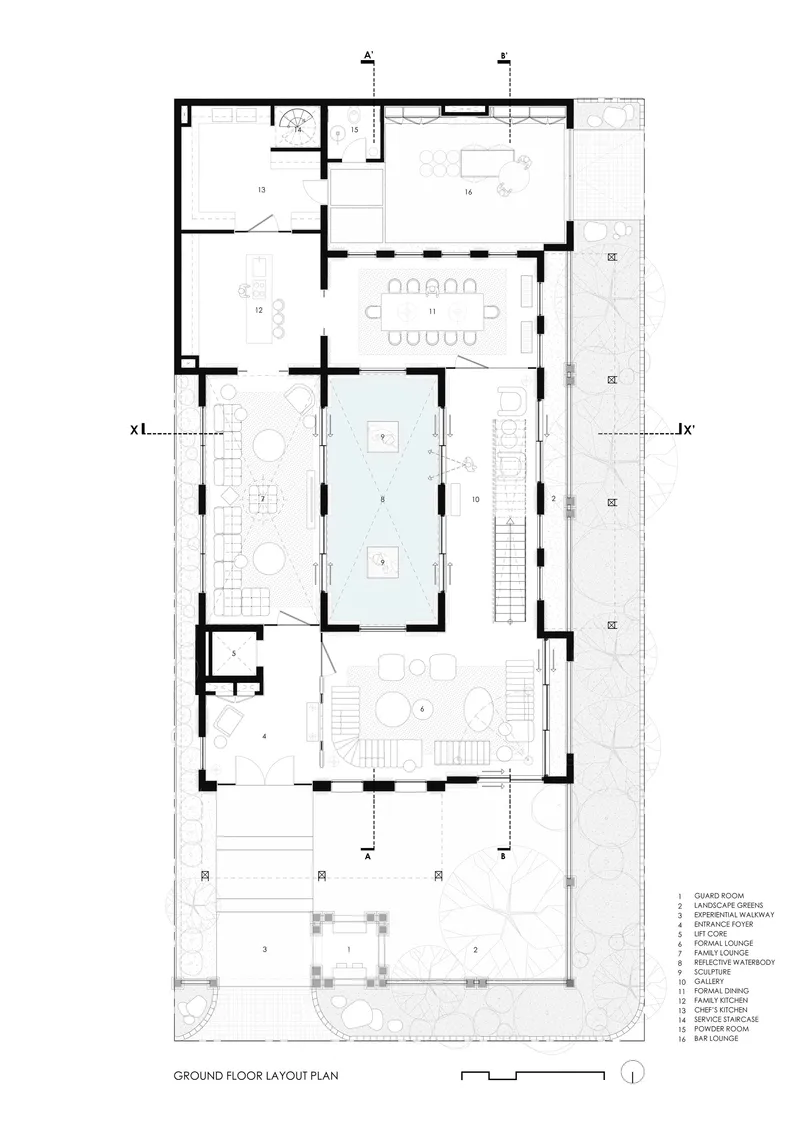
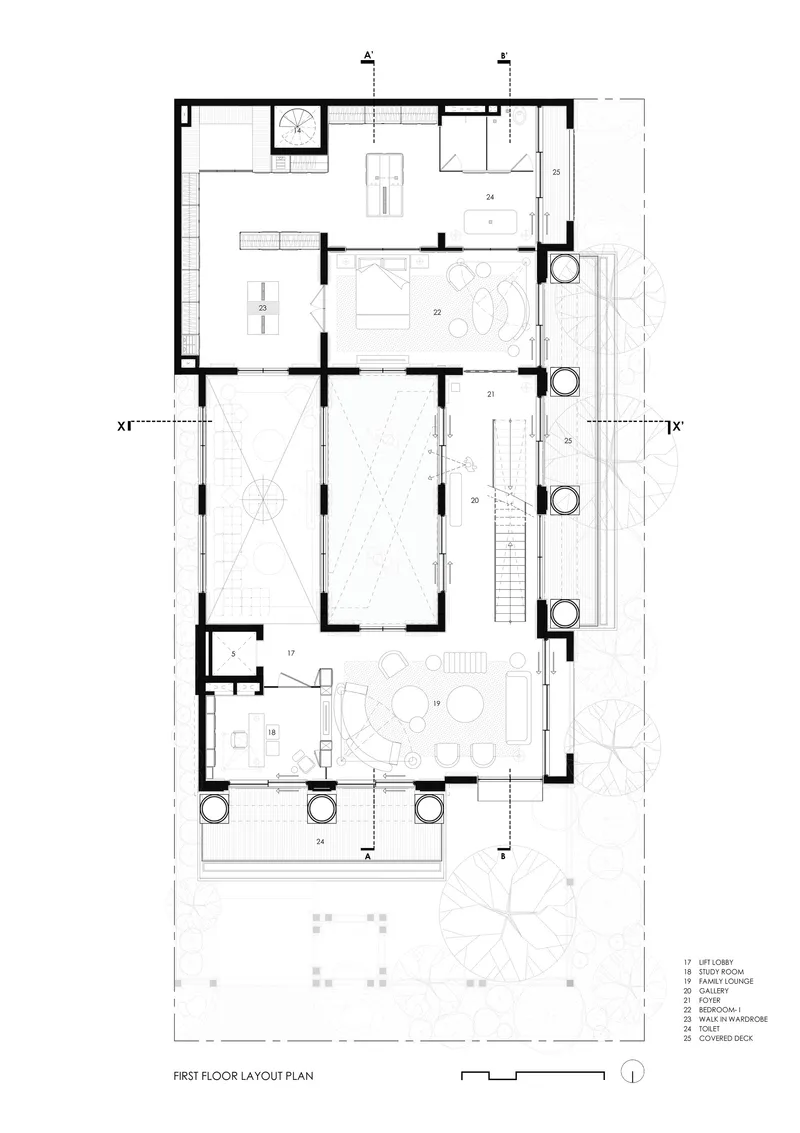
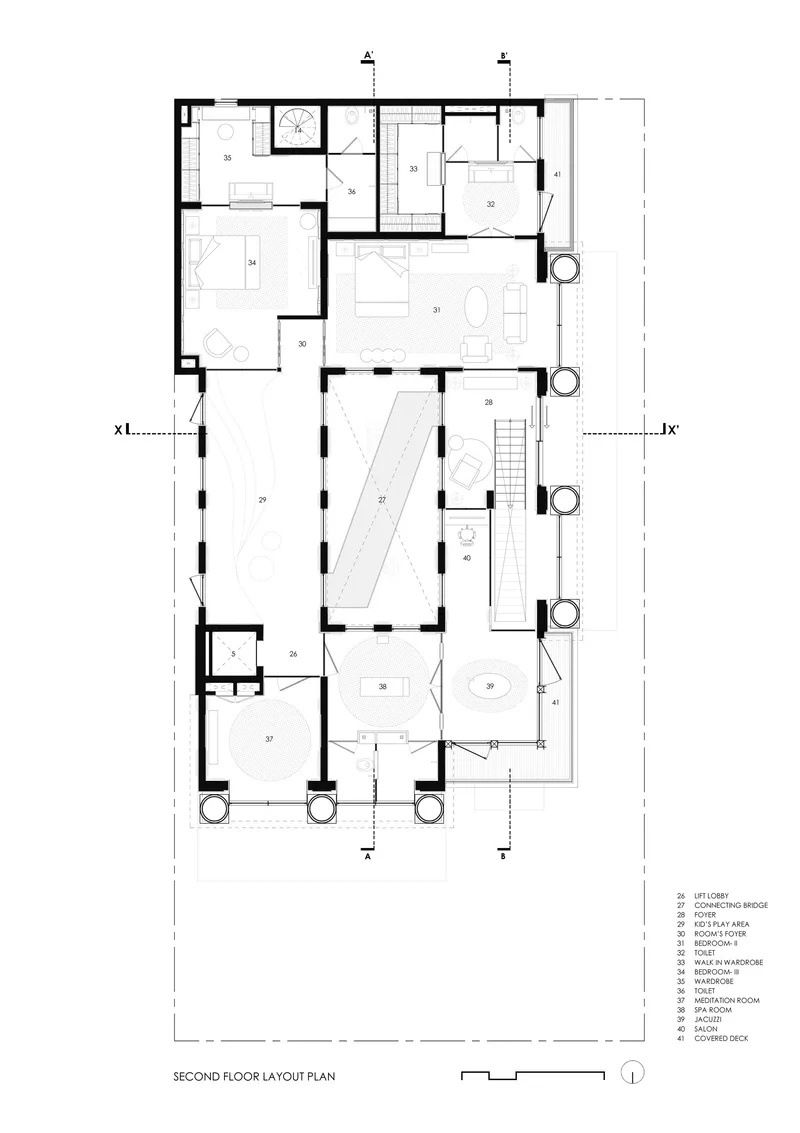
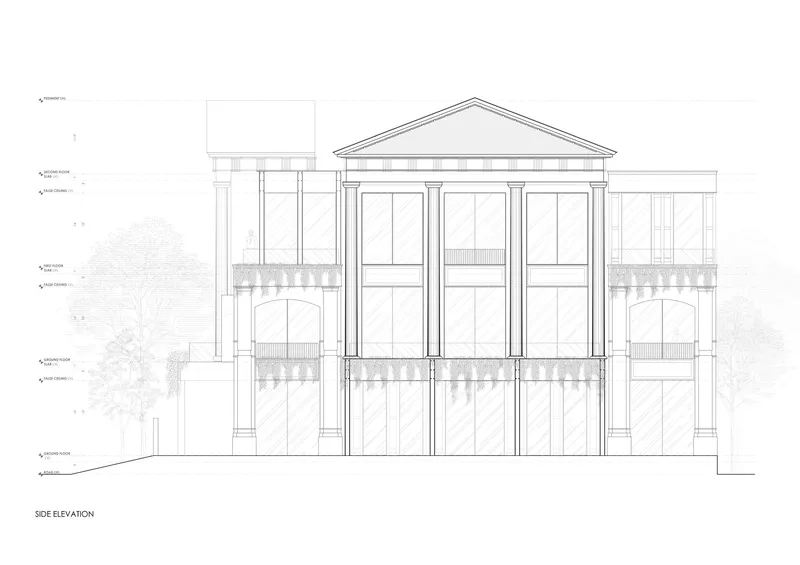
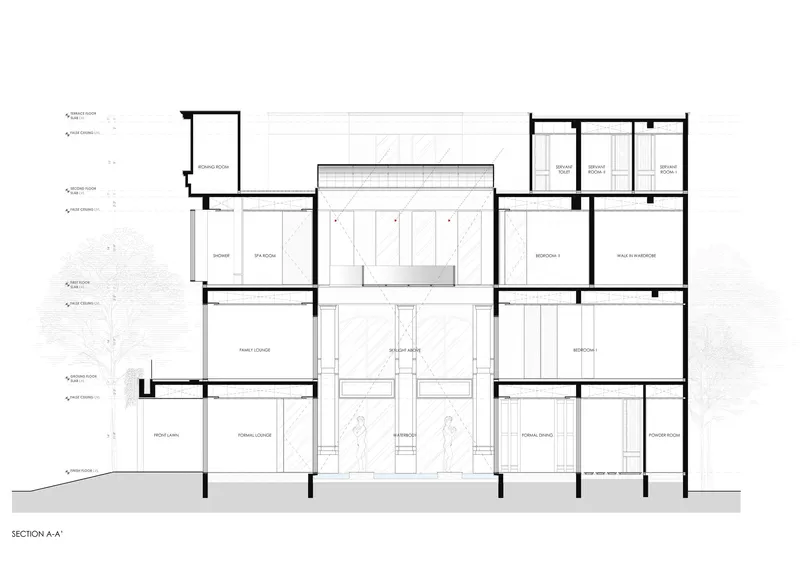
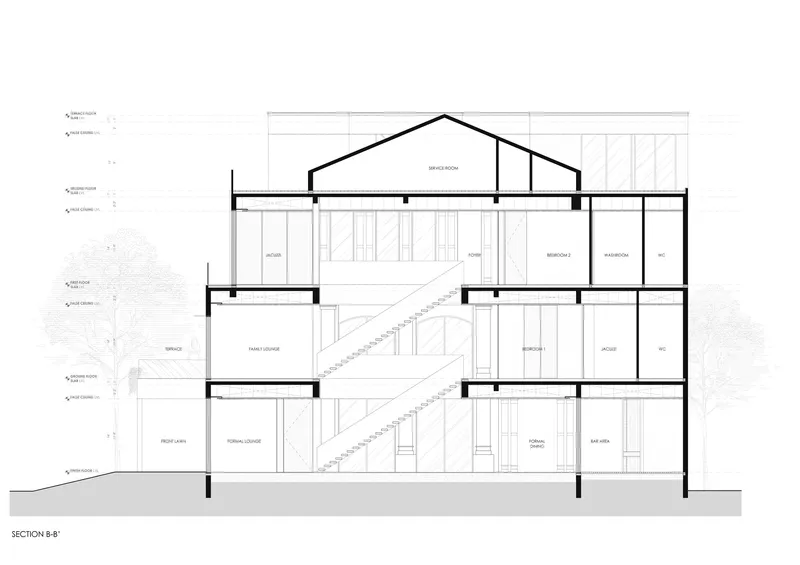
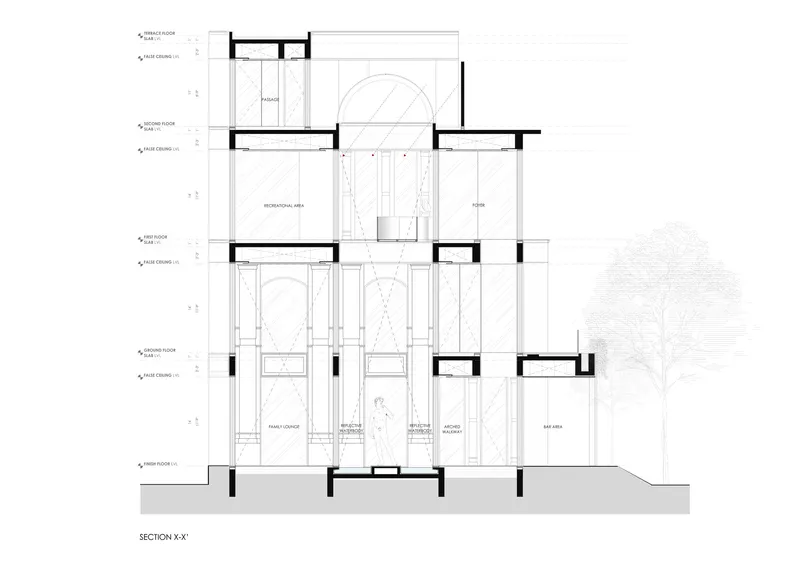
The floor plans reveal the organizational clarity behind the house. At ground level, a central pool and dining spaces are ringed by outdoor terraces, confirming that the deep facade is integral to the plan rather than superficial. The first floor distributes bedroom suites around a central staircase, while the second floor introduces a diagonal stair cutting through the central living volume, a bold geometric move that breaks the symmetry of the lower floors.
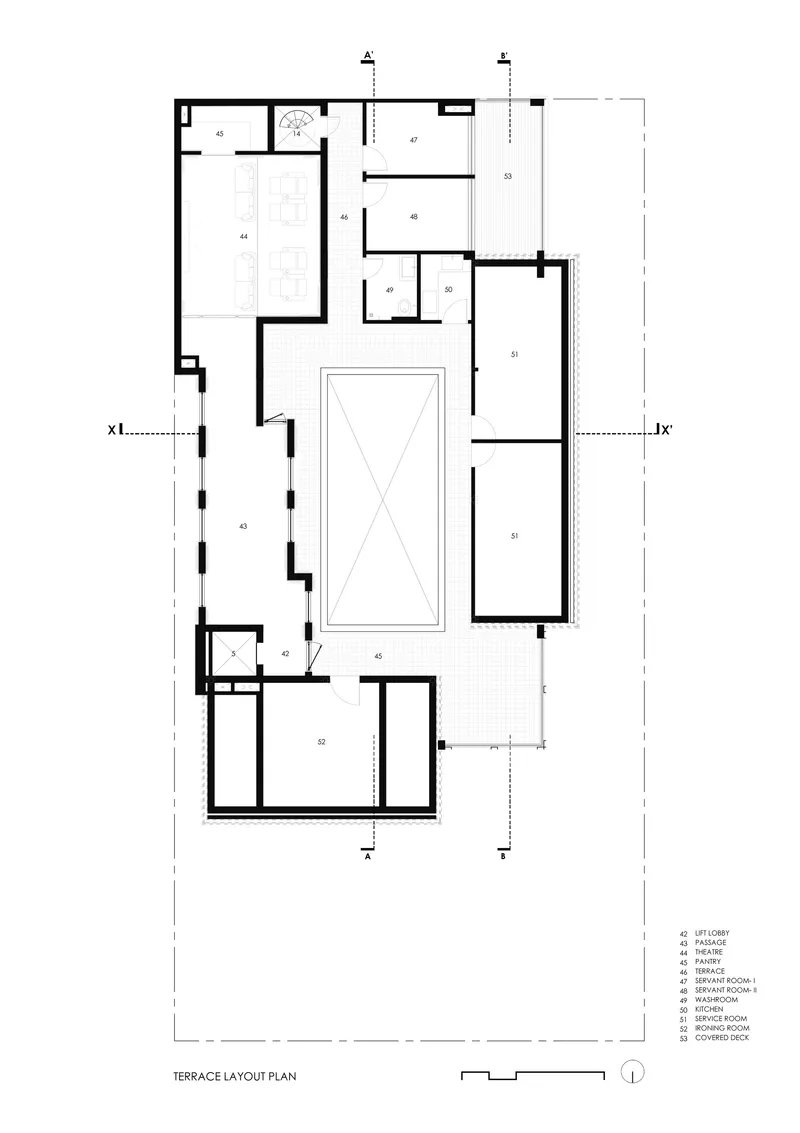
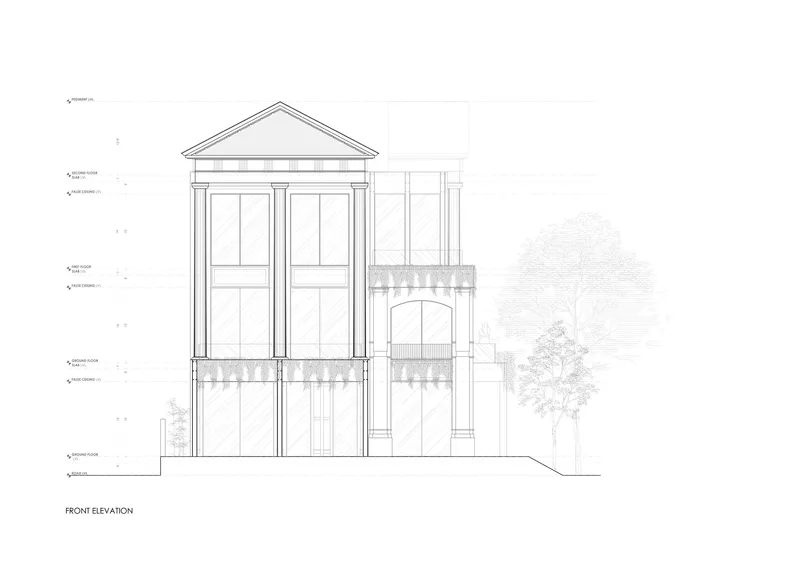
The terrace plan shows a central rectangular pool flanked by covered and open zones, completing the vertical sequence from enclosed living to open sky. In the elevations, the columned facade and gabled volume are drawn with precision: the proportions are deliberate, the column spacing regular, and the relationship to neighboring structures carefully considered. The sections are especially revealing, showing how room heights vary floor to floor and how the pitched roof creates usable volume at the upper levels. The central staircase reads as a spine, ascending through all three levels and organizing movement around the courtyard void.
Why This Project Matters
Residence ASL 42 is significant not because it revives classical forms but because it treats them as a live material to be worked with rather than quoted. The columned terraces are not scenographic; they structure the plan, manage the climate, and create genuine outdoor rooms. The minimalist interiors do not contradict the facade; they sharpen it. By committing fully to both registers, Minimalist Architecture and Design Studio avoid the halfway gestures that plague most attempts to merge tradition with contemporary restraint.
In Ludhiana's built landscape, where residential plots demand both density and comfort, this house offers a proposition about how to build vertically without sacrificing spatial generosity. The courtyard, the deep terraces, and the layered curtain walls are all responses to site and climate as much as they are aesthetic choices. That is what separates the project from mere styling: every formal decision carries functional weight. The result is a house that earns its ambitions.
Residence ASL 42 by Minimalist Architecture and Design Studio. Ludhiana, India. Completed 2025. Photography by Purnesh Dev Nikhanj.
About the Studio
Share Your Own Work on uni.xyz
If projects like this are the kind of work you want to make, uni.xyz is a place to publish your own, find collaborators, and enter design competitions.


Popular Articles
Popular articles from the community


The Musturak Paradise: Senior Living Architecture for a Connected Future in Temara, Morocco
The Musturak Paradise reimagines senior living architecture in Temara via private homes, social spaces, culture, community, and shared care.

The Ocean Hive: Sustainable Architecture for a Self-Sufficient Civilization at Sea
The Ocean Hive imagines sustainable architecture at sea, where modular habitats, algae, wave power and ocean waste sustain a growing colony.

Hill & Cross Opera: Sculptural Opera House Architecture Shaped by Tallinn’s Landscape and Identity
Hill & Cross Opera reimagines opera house architecture in Tallinn through its sculptural hill, civic plaza, glass wave and a luminous cross.

The Earth Pod: 3D Printed Homes for Resilient Refugee Communities
The Earth Pod reimagines refugee housing through 3D printed homes made from clay, combining resilience, self-sufficiency, and rapid shelter.


Similar Reads
You might also enjoy these articles

Bao Huynh Watercolor Atelier: A Serene Art Retreat in Hội An
Bao Huynh Watercolor Atelier in Hội An blends multifunctional art spaces, sustainable design, local materials, and family-friendly living in a serene environment.

Atelier Macri Concept Store Interior Design by CASE-REAL
Atelier Macri store features a "ko" counter, walnut wood details, cork displays, blending retail, gallery, and seamless customer experiences.

Manuel Vargas Izquierdo Stadium and High-Performance Sports Center: Architectural Excellence in Jalpa de Méndez
The Manuel Vargas Izquierdo Stadium blends sustainable design, inclusive sports facilities, and cultural-inspired architecture, revitalizing Jalpa de Méndez’s public spaces.

KAKR Buluh Awar Hall: Revitalizing Community and Ecology Through Bamboo Architecture
Community built bamboo hall revitalizes Buluh Awar village, empowering youth, restoring ecology, celebrating vernacular craftsmanship through sustainable architecture and culture.




Comments (0)
Please login or sign up to add comments
No comments yet. Be the first to comment!