
MIT and Mota-Engil Build Two Pavilions from Roller Coaster Wood and 3D-Printed Clay in Mexico City
Installed at Alameda Central for Mextrópoli 2022, the twin pavilions fuse Mesoamerican craft traditions with computational design to reimagine affordable h


The recycled wood holding up the pink canopy once carried screaming riders along the Montaña Rusa, the beloved 1964 roller coaster at Mexico City's La Feria amusement park that closed in 2019. That biographical detail is not incidental. It is the organizing logic of Sueños con Fiber/Timber, Earth/Concrete, a participatory installation by MIT's Leventhal Center of Advanced Urbanism and Grupo Mota-Engil that treats every material as a vessel for collective memory and future possibility. Erected on the corner of Alameda Central for the 2022 Mextrópoli Architecture and City Festival, the twin pavilions ask a deceptively simple question: can the materials already embedded in a city's history also be the ones that solve its housing crisis?
The answer the project proposes is layered. One pavilion, Dreams of Fiber/Timber, wraps recycled lumber and Otomi amate paper into a structure that adapts papel picado, the pre-Columbian perforated paper art whose openings traditionally invite ancestors to pass through to the present. The other, Dreams of Earth/Concrete, pairs sun-dried tepetate blocks and 3D-printed clay units with post-tensioned precast concrete beams, cutting material use by half compared to conventional systems. Together, the pavilions demonstrate that digital manufacturing and indigenous craft are not opposite poles on a timeline but complementary tools for the same problem.
Timber Resurrected
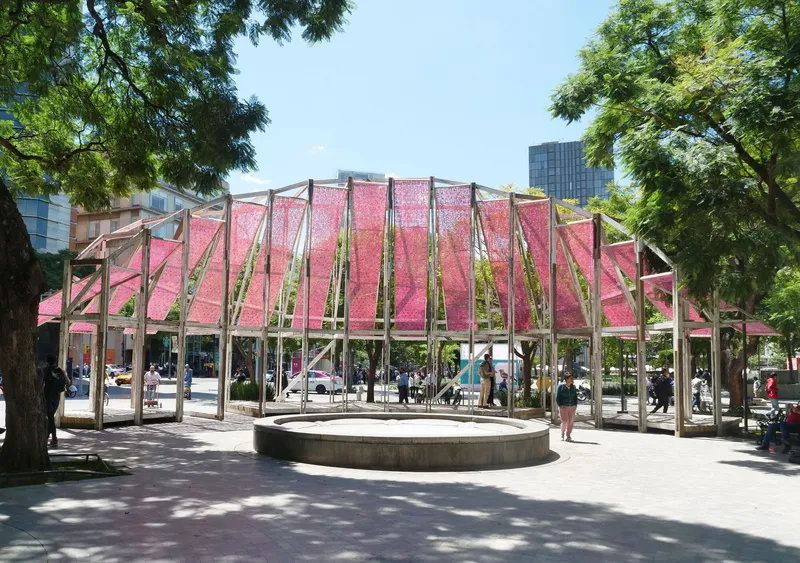
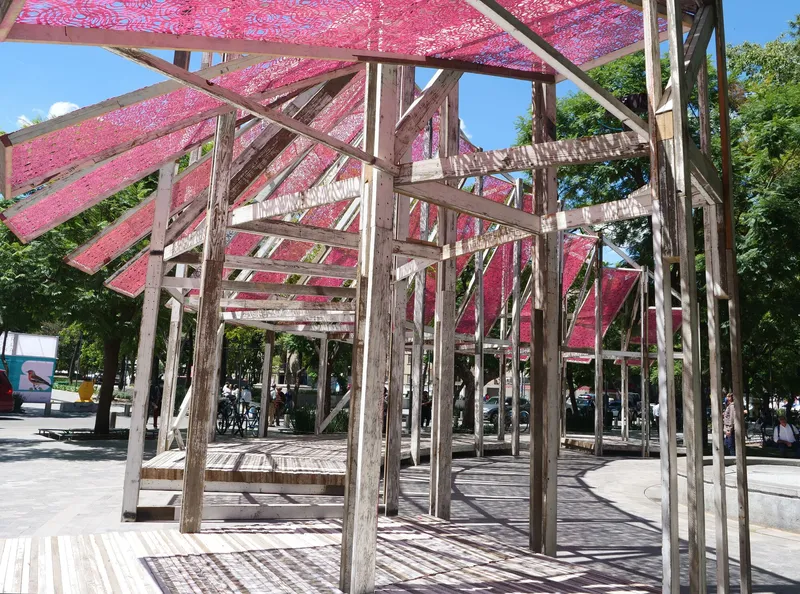
The timber pavilion is immediately legible as a hybrid of salvage and precision. Cross-braced frames of reclaimed roller coaster wood rise at confident angles, supporting a translucent pink canopy that casts the ground below in warm, diffused light. The structural logic reads clearly, almost didactically, with every joint exposed and every brace visible. There is a directness here that sidesteps the precious tendencies of "upcycled" architecture: the wood is not distressed for effect. It is simply old, and strong, and doing a new job.
Beneath the canopy, the space is intimate despite being fully open to the park. The angled members create a rhythm of overhead compression that draws your eye upward through layers of translucent fabric to the tree canopy beyond. It is a pavilion that works doubly as urban shade structure and as argument: that the life span of construction timber need not end when its first building does.
Earth and Algorithm
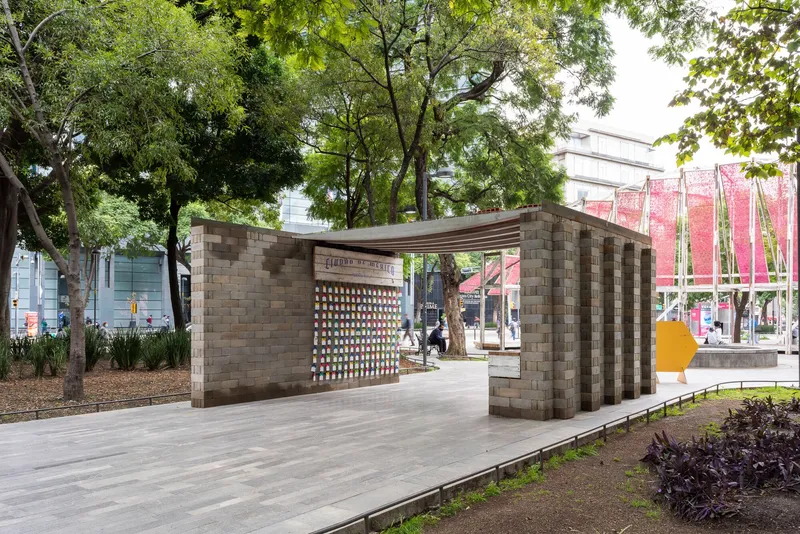
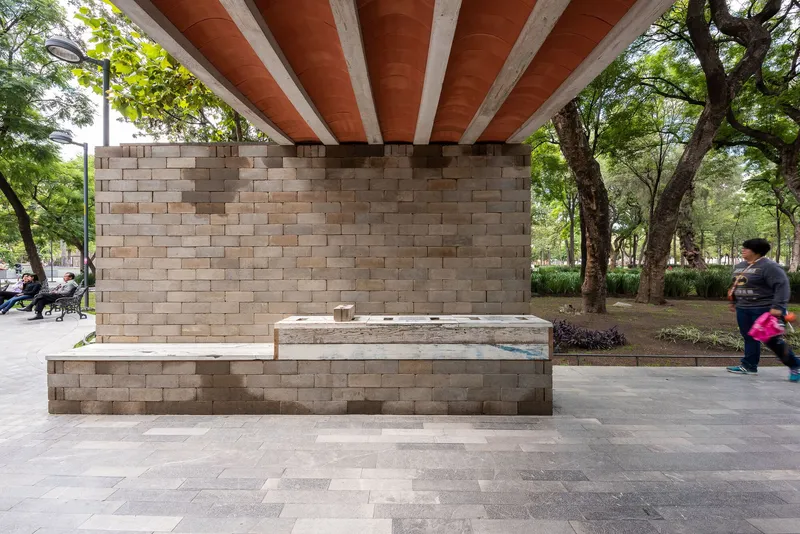
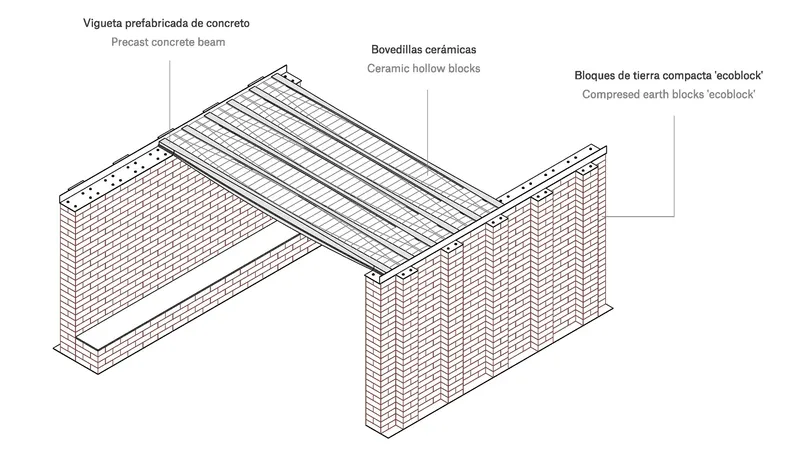
The earth and concrete pavilion is the quieter of the two, and in some ways the more radical. Its perforated walls are built from a combination of tepetate blocks, a compressed sun-dried local soil with high clay content, and 3D-printed ceramic units manufactured by MANUFACTURA and ANFORA Studio. The ceramic blocks were computationally designed by MIT researchers to achieve varying widths and depths, then printed to minimize both material and fabrication time. They sit between precast concrete beams in a vigueta y bovedilla (joist and vault) arrangement that is indigenous to Mexican construction practice but here re-engineered with post-tensioning to allow assembly and disassembly.
Walking past the stone block bench and perforated wall, you encounter a texture that is simultaneously ancient and algorithmic. The blocks are not uniform; their geometries shift subtly, evidence of computational optimization rather than hand variation, though the clay surface retains the warmth of a fired earthenware. Tepetate blocks have been used successfully in Mexican housing for over thirty years. The project's contribution is to prove that pairing them with digitally fabricated counterparts can halve the concrete required without sacrificing structural integrity.
Material as Memory
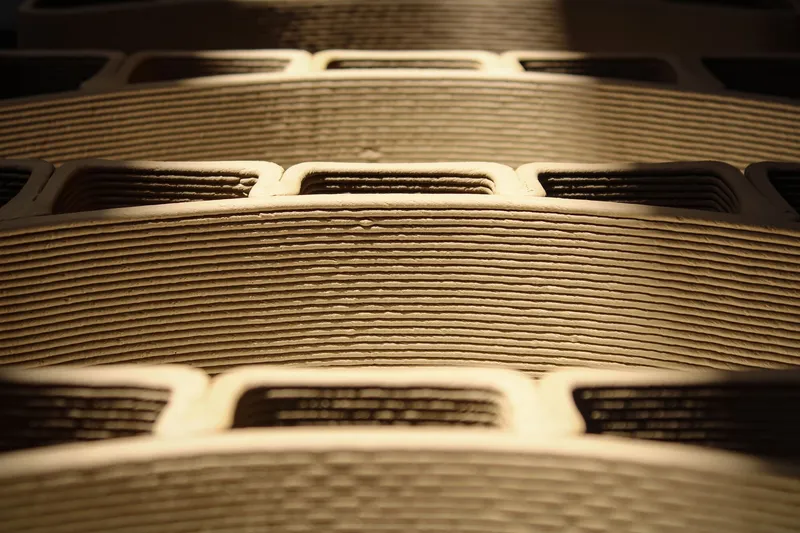
A close detail reveals the laminated and layered quality of the amate paper elements: horizontal striations and rectangular cutouts that reference the perforated patterns of papel picado. Produced by Otomi artisans from bark fibers, this material carries centuries of ceremonial meaning. In the pavilion it becomes a screen, a partition, a medium through which light passes and, symbolically, through which the past reaches into the present. The adaptation is not decorative. It is structural in the broadest sense: it holds the project's conceptual framework together.
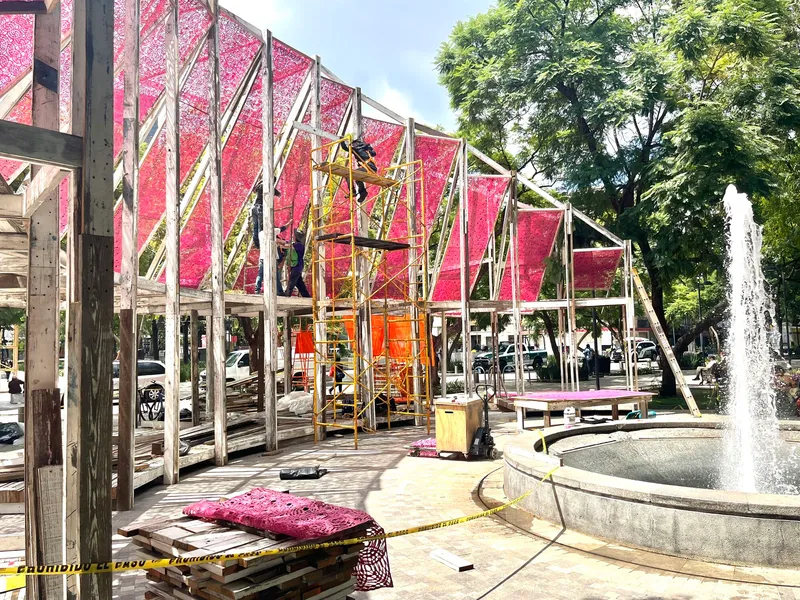
Alongside, the construction view catches the pavilion mid-assembly, scaffolding still in place, the circular fountain spraying in the afternoon light. There is something productive about seeing the structure incomplete. It reinforces the project's insistence on legibility, on showing the means by which things are made. A post-tensioned beam that can be taken apart is a beam that advertises its own logic.
Night Activation
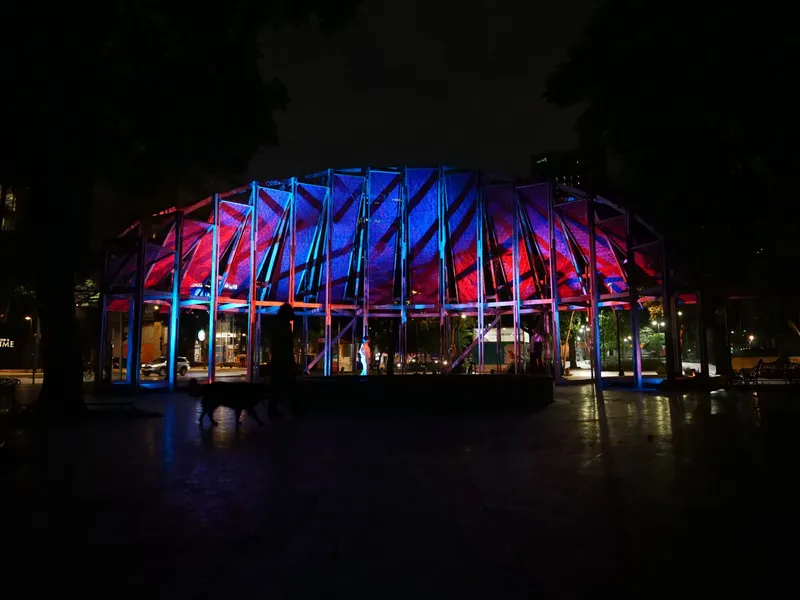
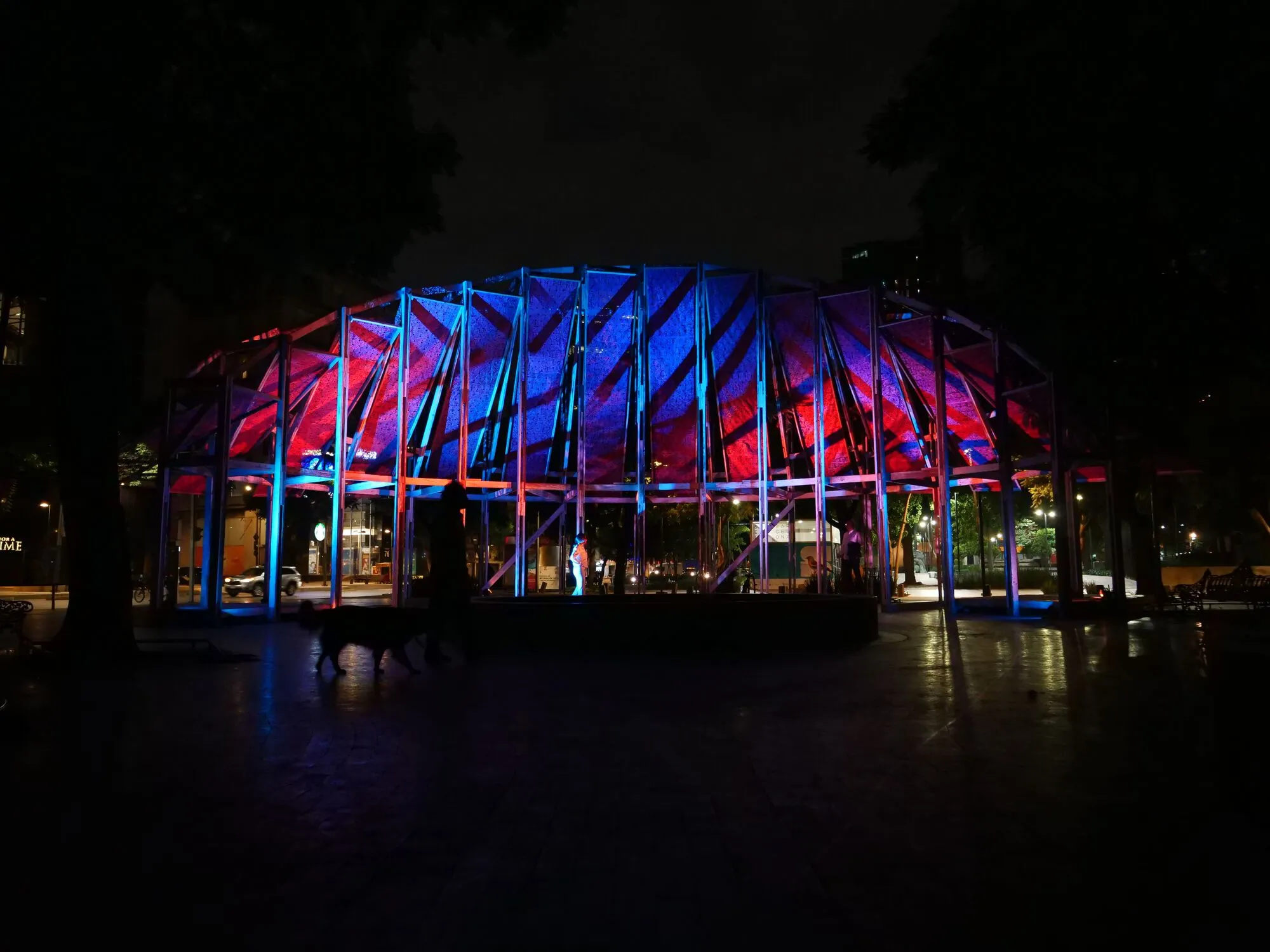
At night the pavilion shifts register entirely. Blue and red light washes the timber frame, transforming the structure from a study in material reuse into something closer to a lantern or a stage set. The lighting design emerged from dialogues with Otomi artisans, and it gives the installation a second life after sunset, turning the corner of Alameda Central into an occupied public room rather than a dark edge. For a temporary structure, this kind of round-the-clock activation is essential: it justifies the effort of building something that will be taken apart.
The contrast between day and night readings is worth noting. During the day, the pavilion is didactic and material, inviting close inspection of joints and surfaces. At night, it is atmospheric and social, a beacon in the park. Good temporary architecture must operate on both registers, and the lighting scheme here is the mechanism that allows it.
Plans and Drawings
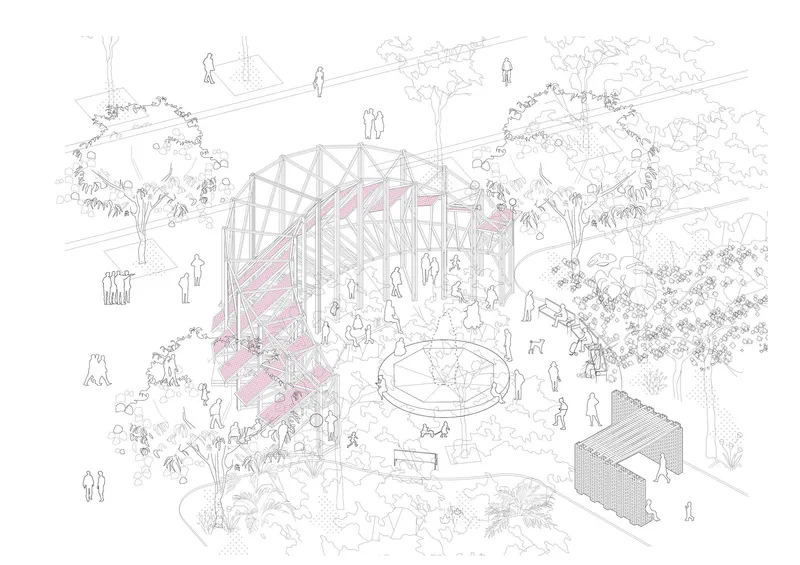
The isometric drawing shows the pavilion in its urban context, surrounded by the mature trees of Alameda Central, with figures moving through and around the structure. It communicates scale effectively: the pavilion is modest, roughly the footprint of a small house, which reinforces its role as a prototype rather than a monument. The drawing also reveals how the two pavilions relate spatially, framing a shared public zone between them.
The axonometric detail of the earth and concrete assembly is the most technically revealing image in the set. It explodes the vigueta y bovedilla system to show how 3D-printed clay blocks nest between precast concrete beams, with compressed earth walls rising alongside. The drawing makes clear the 50% material reduction claim: the beams are optimized in cross-section, and the clay blocks serve as lost formwork, contributing to the vault geometry before a thin topping slab locks everything together. It is a tidy system, and its clarity on paper suggests real viability at scale.
Why This Project Matters
Sueños matters because it refuses the false binary between heritage and technology that dominates so much discourse around housing in the Global South. Tepetate has a thirty-year track record. Papel picado has a five-hundred-year lineage. 3D-printed clay is a technology still being calibrated. The project insists that all three belong in the same structural assembly, and it builds that assembly at full scale on one of Mexico City's most visible public squares. That is not a thesis statement; it is a proof of concept.
The collaboration itself is part of the argument. MIT researchers, a Portuguese-origin engineering conglomerate, Otomi artisans, Mexican ceramic manufacturers, and a festival audience all contributed to a structure designed to be disassembled and, implicitly, reassembled elsewhere. If affordable housing in Mexico is going to improve meaningfully, it will require exactly this kind of coalition: academia generating the computational geometry, industry supplying the precast systems, and local craft ensuring that the result belongs to its place. Sueños sketches that coalition in timber, paper, earth, and concrete, and it does so with enough rigor that the dream in its title feels less like aspiration and more like a plan.
Sueños con Fiber/Timber, Earth/Concrete by MIT Leventhal Center of Advanced Urbanism and Grupo Mota-Engil. Located at Alameda Central, Mexico City, Mexico. Completed in 2022. Photography by Marisa Morán, Arturo Arrieta, Dinorah Schulte, Walter Shintani, and Rafi Segal.
About the Studio
Share Your Own Work on uni.xyz
If projects like this are the kind of work you want to make, uni.xyz is a place to publish your own, find collaborators, and enter design competitions.



Popular Articles
Popular articles from the community


Riyadh For All: Intergenerational Urban Design for Active Aging in Rabat
Riyadh For All reimagines urban design in Rabat with intergenerational co-living, adaptive courtyards, and Moroccan cultural exchange today.

Co-Life: Senior Housing Design That Reconnects Older Adults With the City
Co-Life reimagines senior housing design through healing gardens, shared streets, workshops, and a sustainable community across generations.

Conexión: Biophilic Design Reimagines High-Rise Living in Hong Kong
Conexión reimagines high-rise living in Hong Kong through biophilic design, green facades, shared spaces, daylight, water and nature within.

Play: Fragments of Their World
Familiar architecture becomes modular playground design, creating safe spaces where displaced children can learn, connect, imagine and play.


Similar Reads
You might also enjoy these articles

Bao Huynh Watercolor Atelier: A Serene Art Retreat in Hội An
Bao Huynh Watercolor Atelier in Hội An blends multifunctional art spaces, sustainable design, local materials, and family-friendly living in a serene environment.

Atelier Macri Concept Store Interior Design by CASE-REAL
Atelier Macri store features a "ko" counter, walnut wood details, cork displays, blending retail, gallery, and seamless customer experiences.

Manuel Vargas Izquierdo Stadium and High-Performance Sports Center: Architectural Excellence in Jalpa de Méndez
The Manuel Vargas Izquierdo Stadium blends sustainable design, inclusive sports facilities, and cultural-inspired architecture, revitalizing Jalpa de Méndez’s public spaces.

KAKR Buluh Awar Hall: Revitalizing Community and Ecology Through Bamboo Architecture
Community built bamboo hall revitalizes Buluh Awar village, empowering youth, restoring ecology, celebrating vernacular craftsmanship through sustainable architecture and culture.
Explore Urban Design Competitions
Discover active competitions in this discipline


Challenge to design a portable theatre


Challenge to design a portable music platform

Challenge to design an open learning module for the elderly
Comments (0)
Please login or sign up to add comments
No comments yet. Be the first to comment!