
Sandro Durrer Reimagines the Alpine Hut as Three Timber Houses on a Liechtenstein Ski Slope
At 1,600 meters in Malbun, three oak-lined residences channel the Maiensäss tradition through Minergie-standard precision and slatted facades.


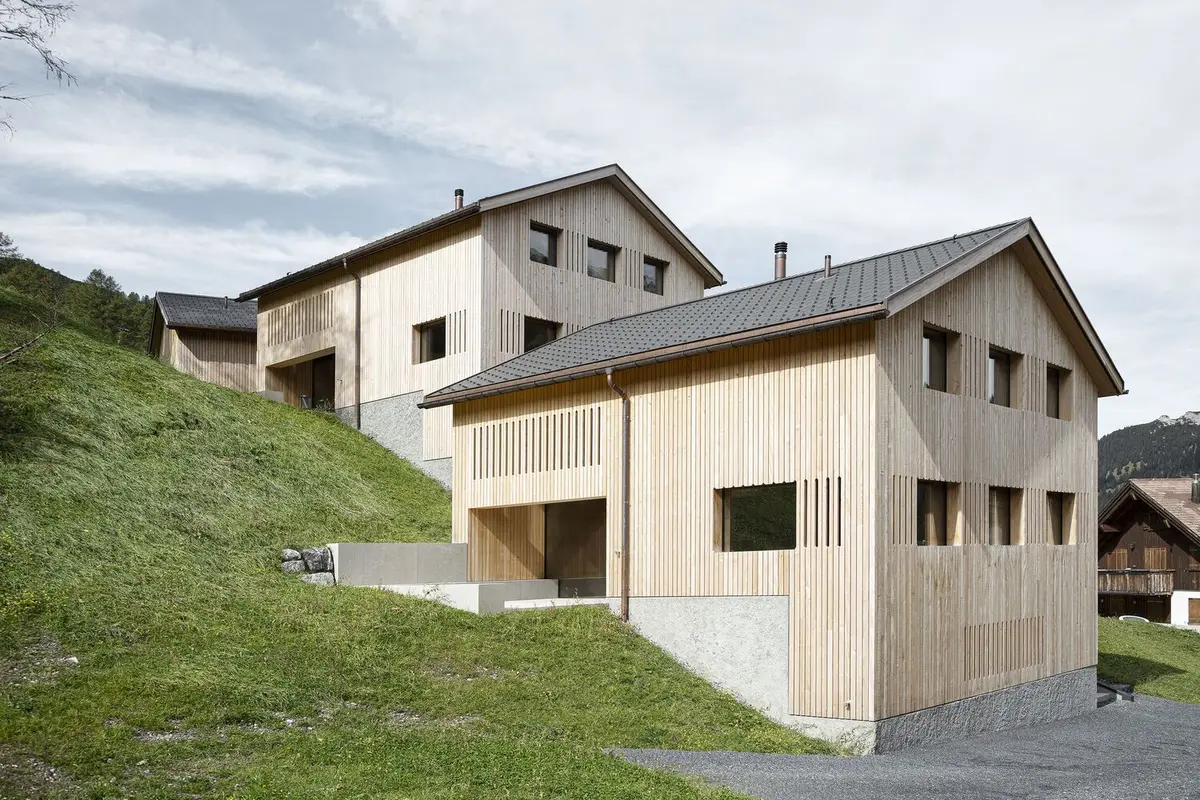
The Maiensäss is one of the most quietly powerful building types in the Alps: a seasonal hut, stripped to essentials, built where farmers once spent summers tending livestock on high pastures. It is not heroic architecture. It is architecture that knows its place. In Malbun, Liechtenstein, at roughly 1,600 meters above sea level and right on the edge of a ski run, Sandro Durrer has completed three houses that take the Maiensäss as a conceptual departure point rather than a nostalgic template. The result is a cluster of gabled timber volumes that look restrained from the outside and feel unexpectedly warm and sophisticated inside.
Completed in 2023, the Malbun Houses are interesting not because they reinvent Alpine housing but because they refuse to. Durrer keeps the rooflines steep, the footprints modest, and the cladding honest. What changes is the interior standard: oak paneling, green slate, flamed limestone, quartz surfaces, KNX home automation with Loxone control, and Vola fittings. The gap between the humble shell and the considered interior is exactly where the project's intelligence lives. Each house harmonizes architecturally with the others yet stands alone, staggered across the hillside in response to topography rather than a rigid site grid.
Three Gables on a Steep Slope
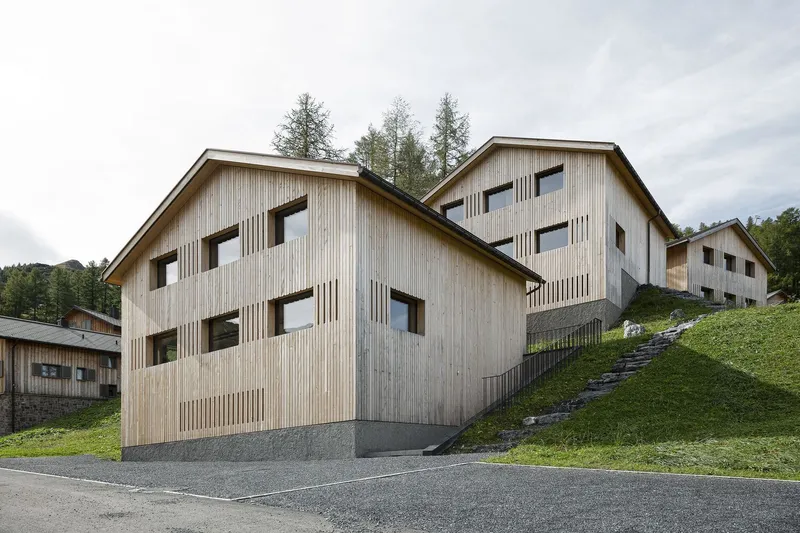
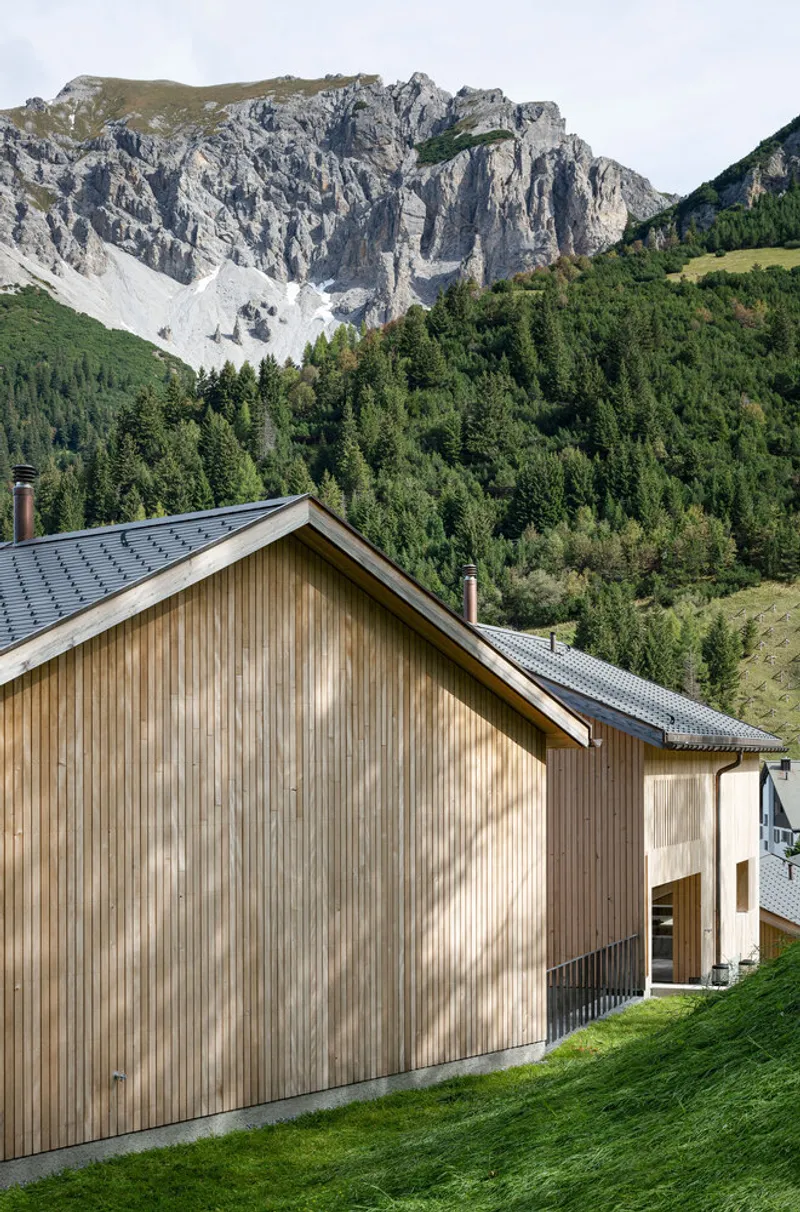
From a distance, the three houses read as a single composition: vertical timber cladding, sharp gable profiles, and slatted screens that wrap the glazing bands. The material palette is deliberately limited. There is no render, no exposed concrete, no contrasting metal panel to signal modernity. Instead, the contemporary ambition shows up in proportion and placement. The volumes step down the hillside at staggered intervals, responding to the slope's gradient with enough separation to give each house its own sightline toward the surrounding limestone cliffs and forest.
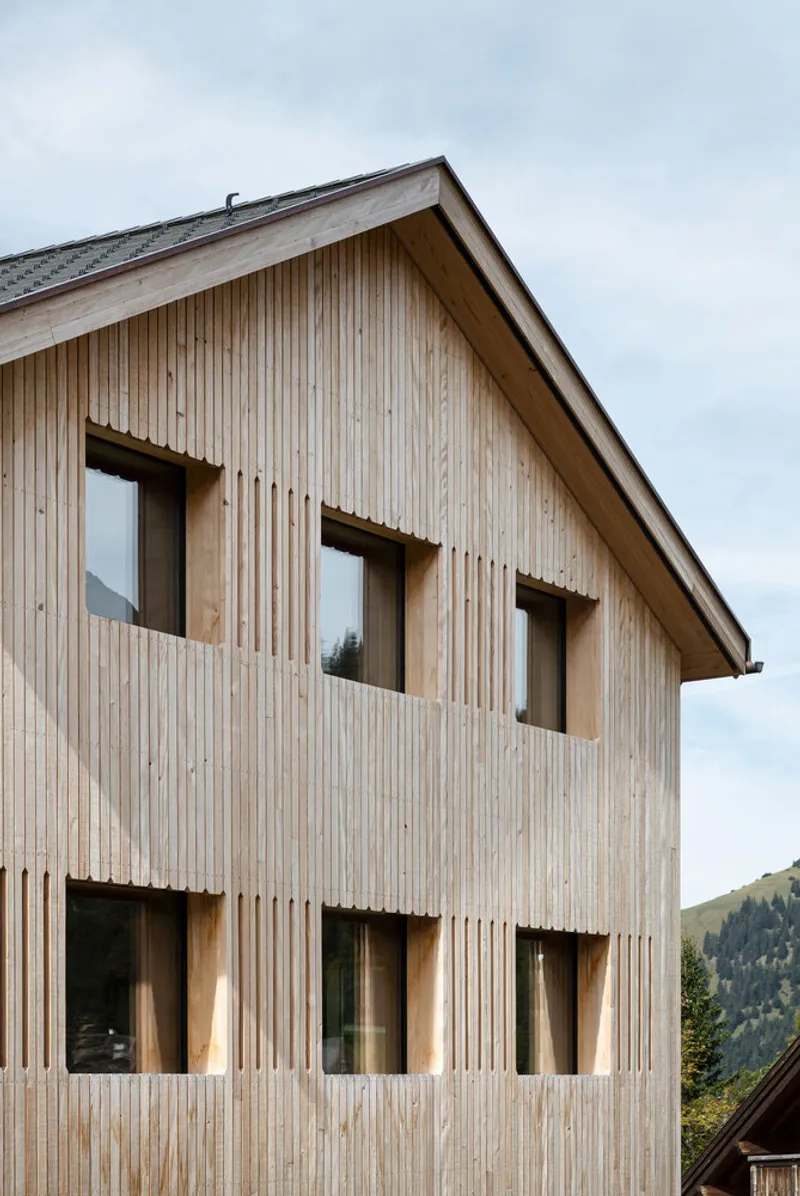
The wooden slat facade does double duty. It provides solar filtering, casting shadow patterns that shift with the seasons, and it visually unifies the glazing behind it so that the houses do not read as glass boxes wearing timber hats. The screens also recall the louvered ventilation openings found on traditional barns and hay stores across the region, a functional detail that Durrer elevates into a primary architectural gesture.
Oak, Slate, and the Interior Argument
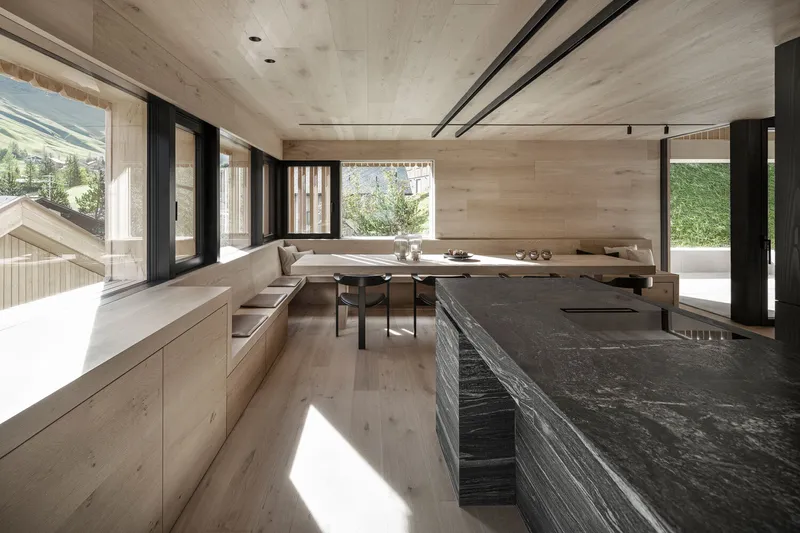
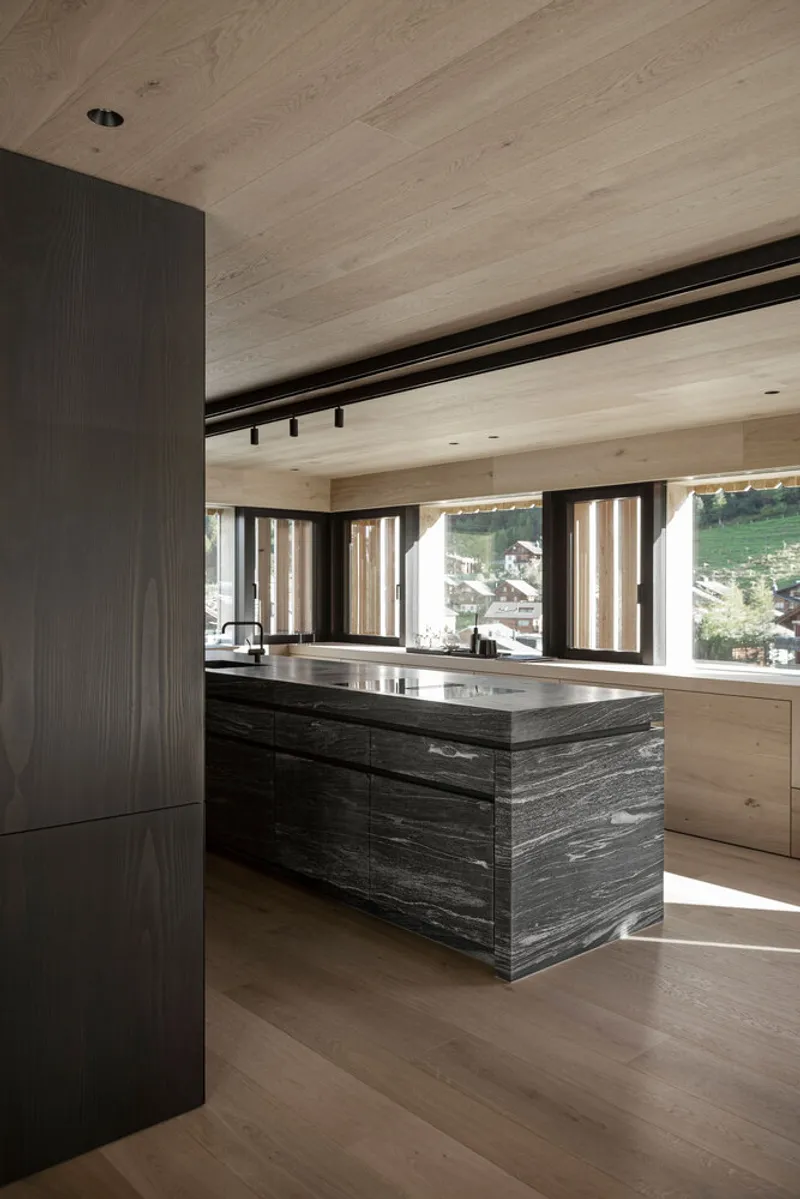
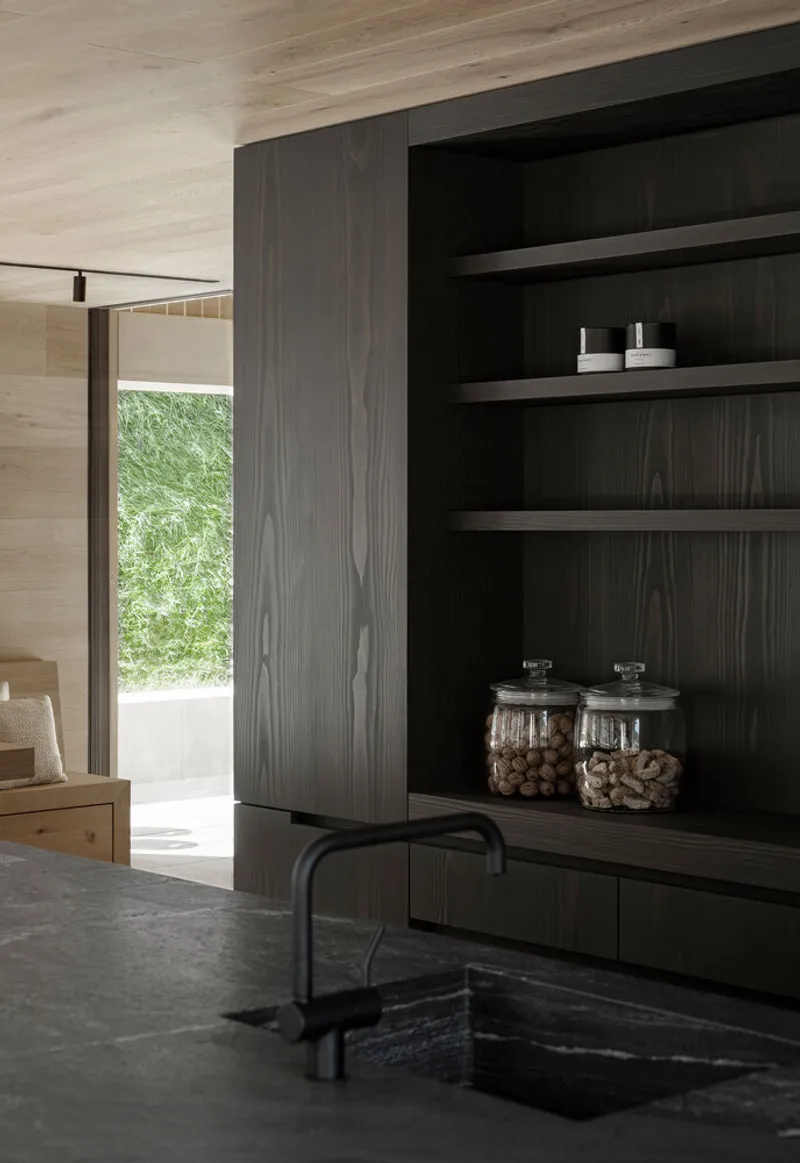
Step inside and the mood changes register immediately. Pale oak dominates: flooring, wall panels, ceiling planks, even the kitchen cabinetry. It is not the bleached Scandinavian oak of a Copenhagen apartment. It has grain, warmth, and visible texture that connects it to the timber exterior without mimicking it. Against this light wood base, the green slate kitchen island operates as a geological anchor, its striated surface introducing color and weight to the open living area.
Durrer's material pairings are deliberate. Dark timber veneer wraps the fireplace wall and shelving units, creating focal points without resorting to accent paint or decorative tile. The green slate countertops meet flush-set timber edges with the precision you would expect from Swiss-adjacent craftsmanship. Every surface junction is clean. Track lighting runs along ceiling planks rather than punctuating them, so the overhead plane reads as continuous timber rather than an illuminated grid.
Filtered Light as a Design Tool
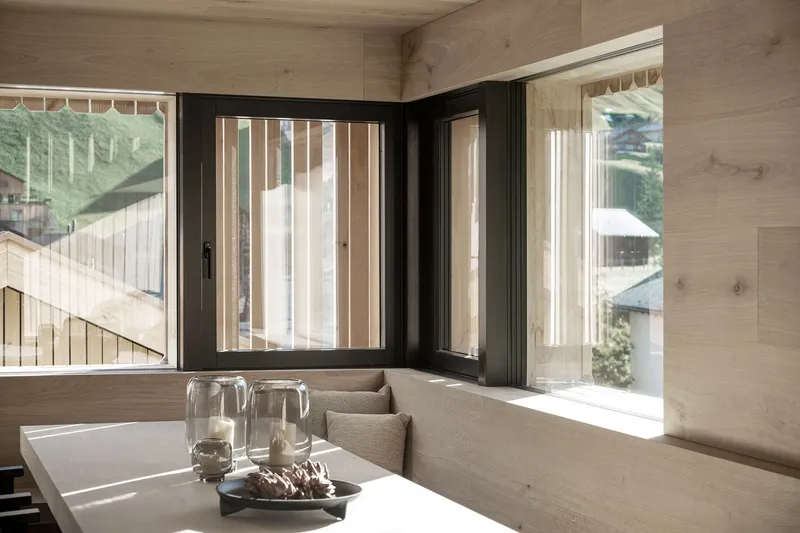
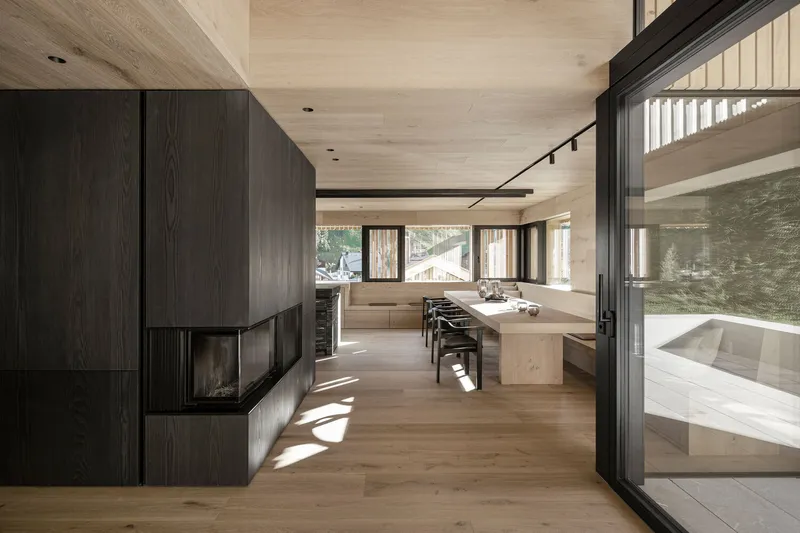
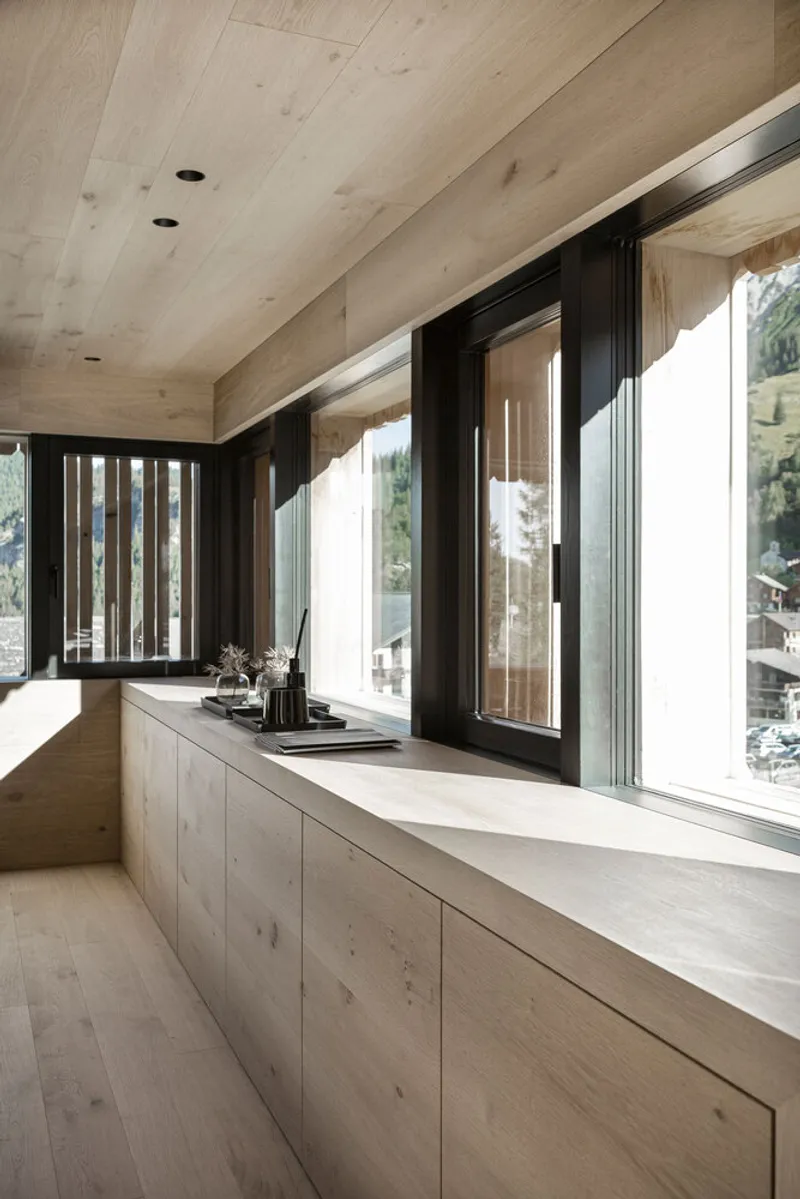
Natural light enters the Malbun Houses through wide bands of black-framed glazing set behind the slatted screens. The effect is cinematic. In the dining nook, a built-in corner bench sits beneath vertical timber slats that stripe sunlight across the tabletop. In the main living space, full-height glazing behind the fireplace wall pulls the forested hillside into the room. The minimum ceiling height of 2.85 meters gives the light room to travel, and the pale oak surfaces bounce it deeper into the plan than you would expect from a mountain house.
This is where the Minergie certification becomes more than a sticker on a door. Controlled ventilation means the windows serve daylight and view rather than airflow. That distinction allows Durrer to compose the glazing for visual effect, knowing the envelope performs thermally regardless of whether a window is cracked open. The district heating connection to Malbun's local network and underfloor distribution complete a low-key energy strategy that avoids visible mechanical systems entirely.
Bedrooms and the Vaulted Ceiling
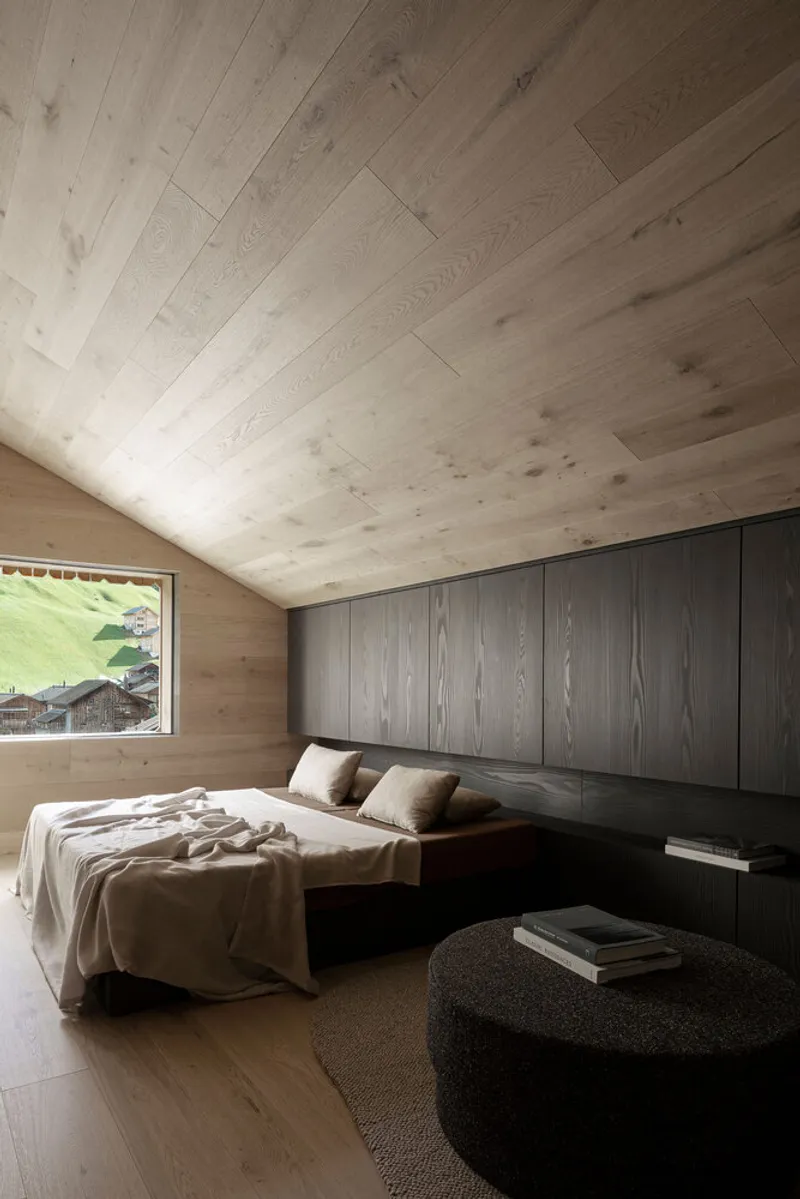
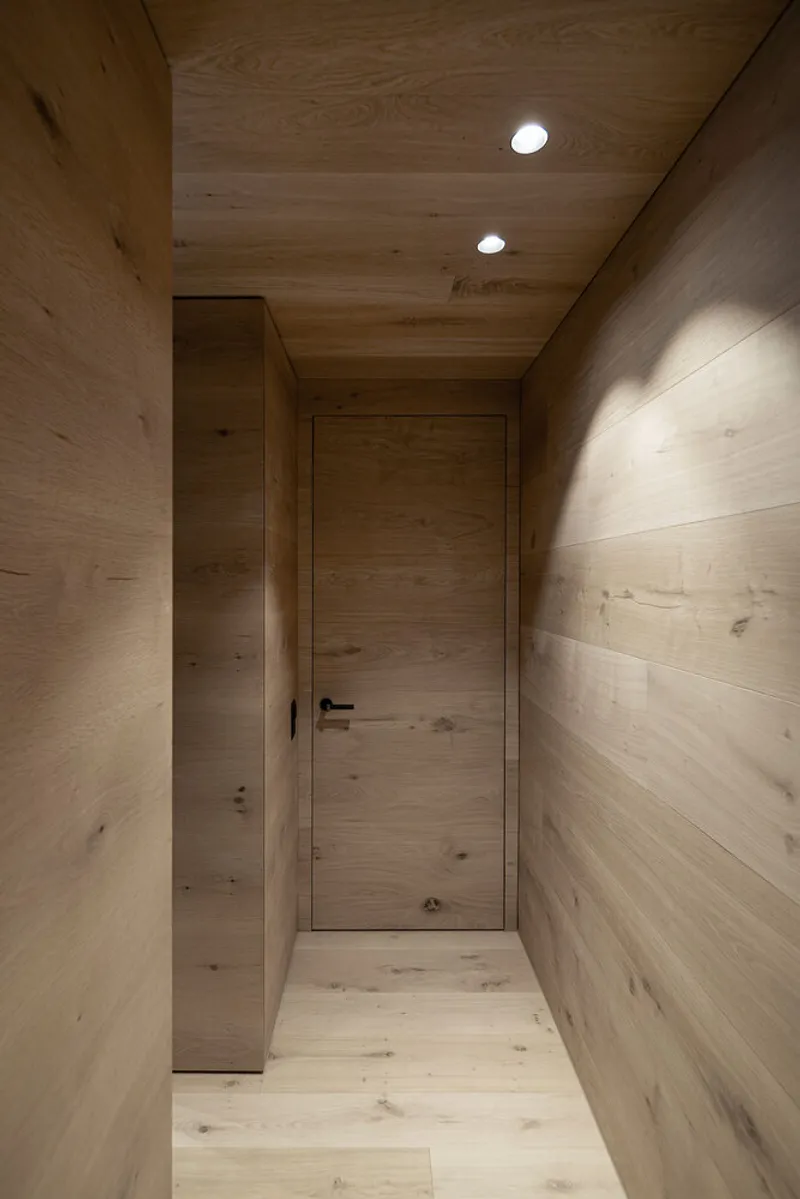
The upper levels pull the gable geometry inward. In the bedrooms, vaulted timber ceilings follow the roof slope, creating a compressed intimacy that contrasts with the generous proportions downstairs. A dark wood headboard wall anchors the bed against a picture window that frames the hillside village below, and the view is composed as carefully as a painting hung on a gallery wall. The corridor leading to the rooms is softly lit with recessed ceiling lights that wash the timber walls in a warm gradient.
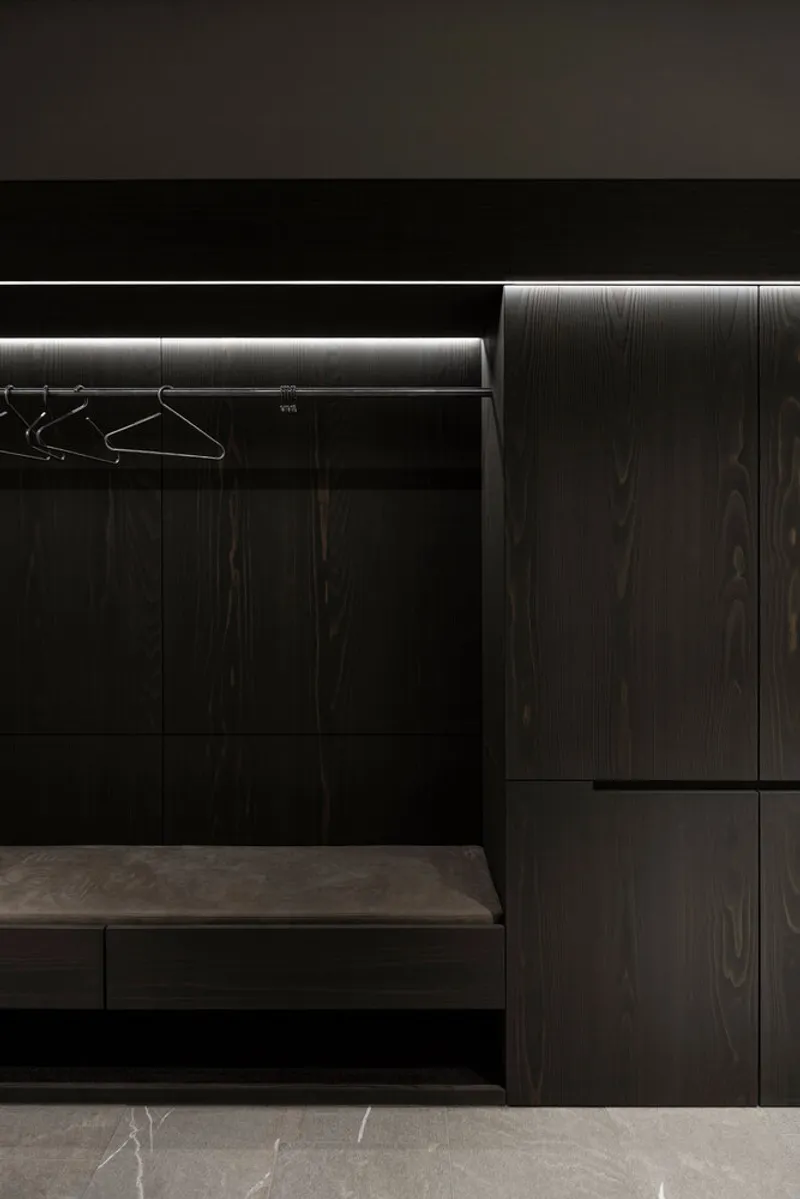
Storage is handled with characteristic precision. A dark timber closet with an illuminated hanging rail turns a utilitarian element into a considered detail. The lighting concept across the houses, individually coordinated for each space, is evident here: nothing is over-lit, nothing is an afterthought. Even the corridor floors shift to stone, marking a material transition between circulation and habitation.
Wet Rooms in Stone and Light
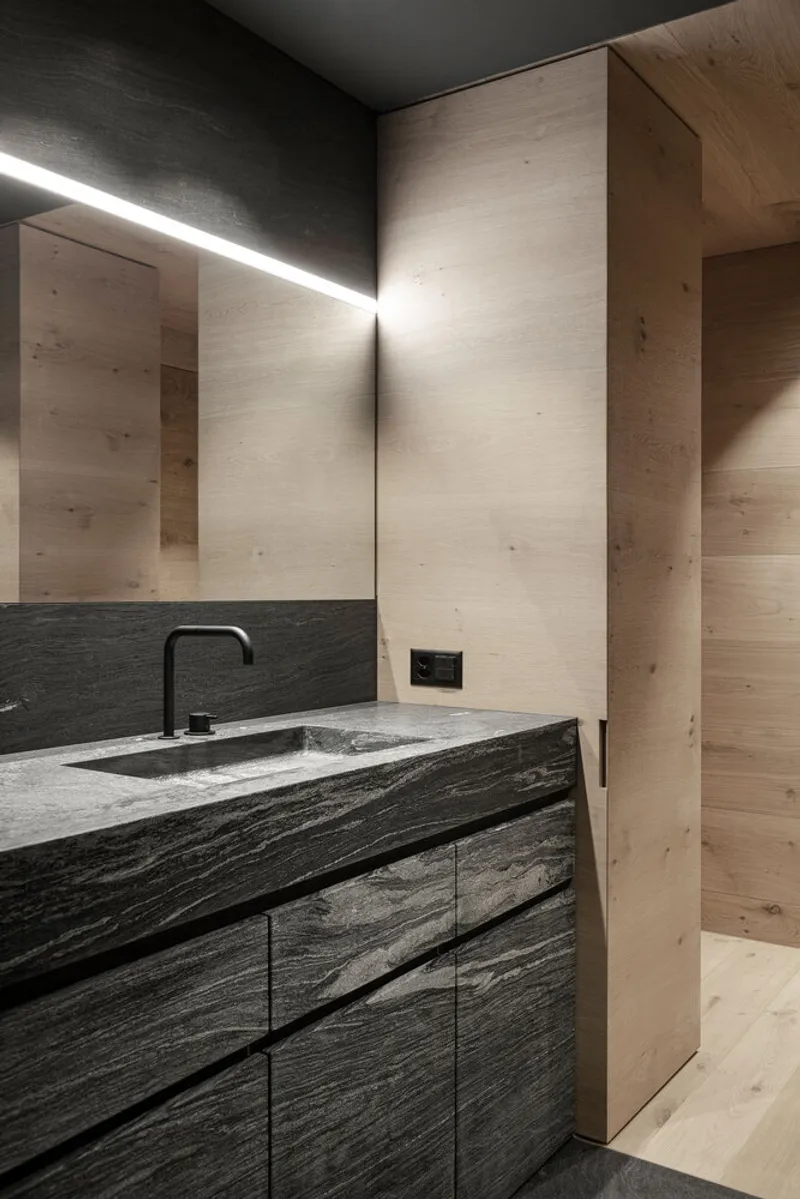
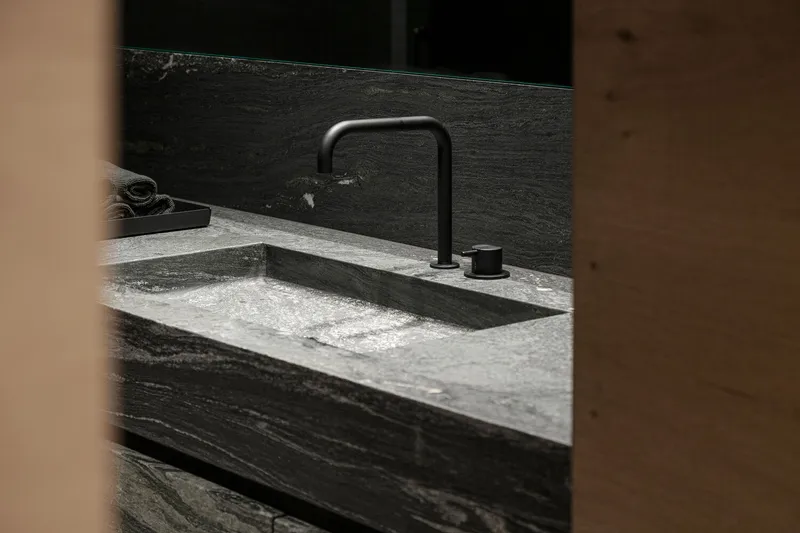
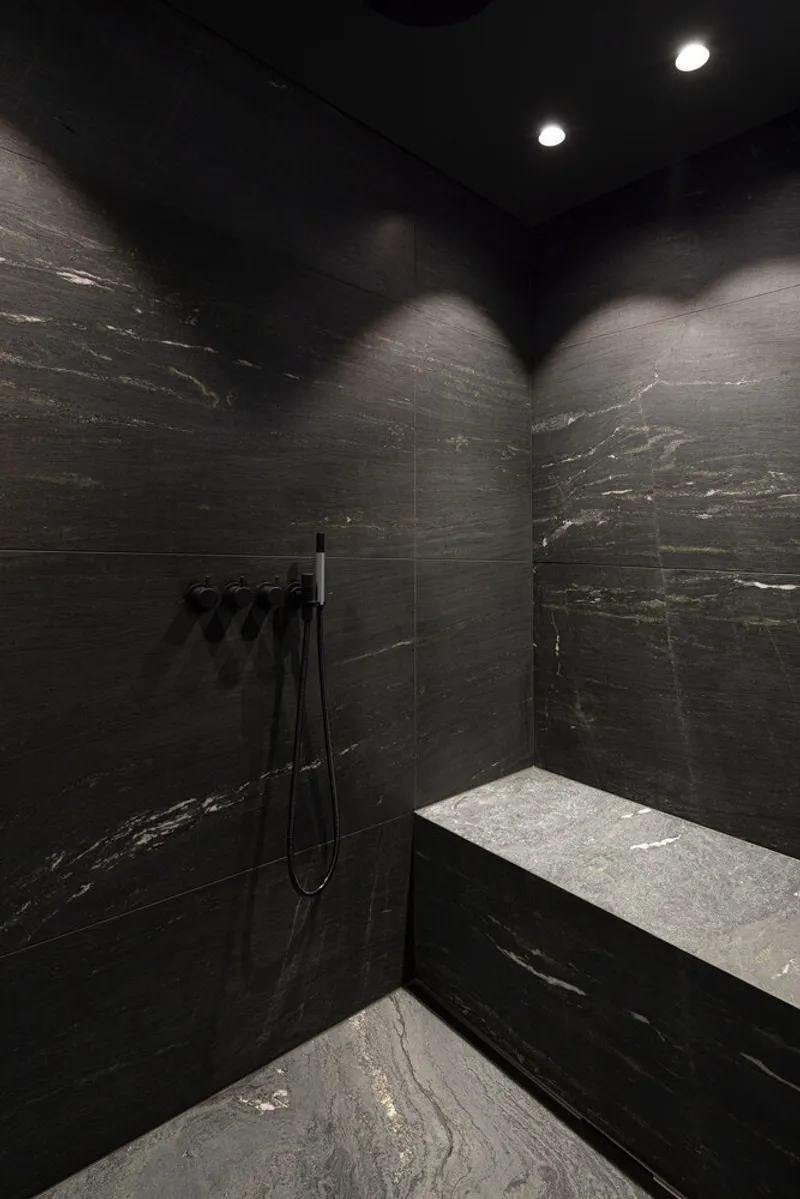
The bathrooms are where Durrer's material strategy reaches its most concentrated expression. Quartz slate lines the shower enclosures, floor to ceiling, with recessed spotlights overhead and an integrated stone bench that doubles as a shelf. Natural stone vanity tops with integrated basins sit beneath linear light bars, flanked by the same pale timber panels found elsewhere in the house. Vola fittings in matte black provide the only hardware visible against the stone, and their minimal silhouette avoids competing with the surface textures around them.
The close-up of a matte black faucet against veined stone, framed by a timber doorway, could be mistaken for a product photograph. That is the point. At this scale, the architecture becomes about the relationship between a metal arc and a mineral surface, between warm wood grain and cool stone veining. Durrer treats these moments with the same compositional care he applies to the hillside massing.
Thresholds and Transitional Spaces
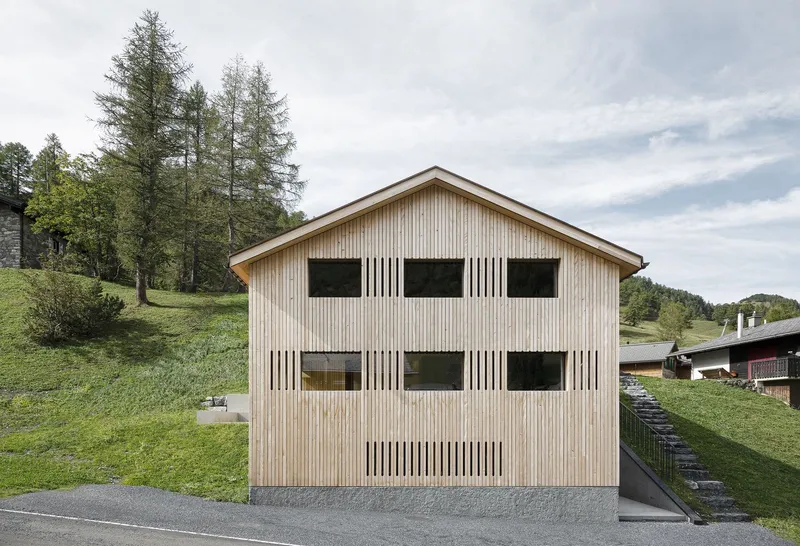
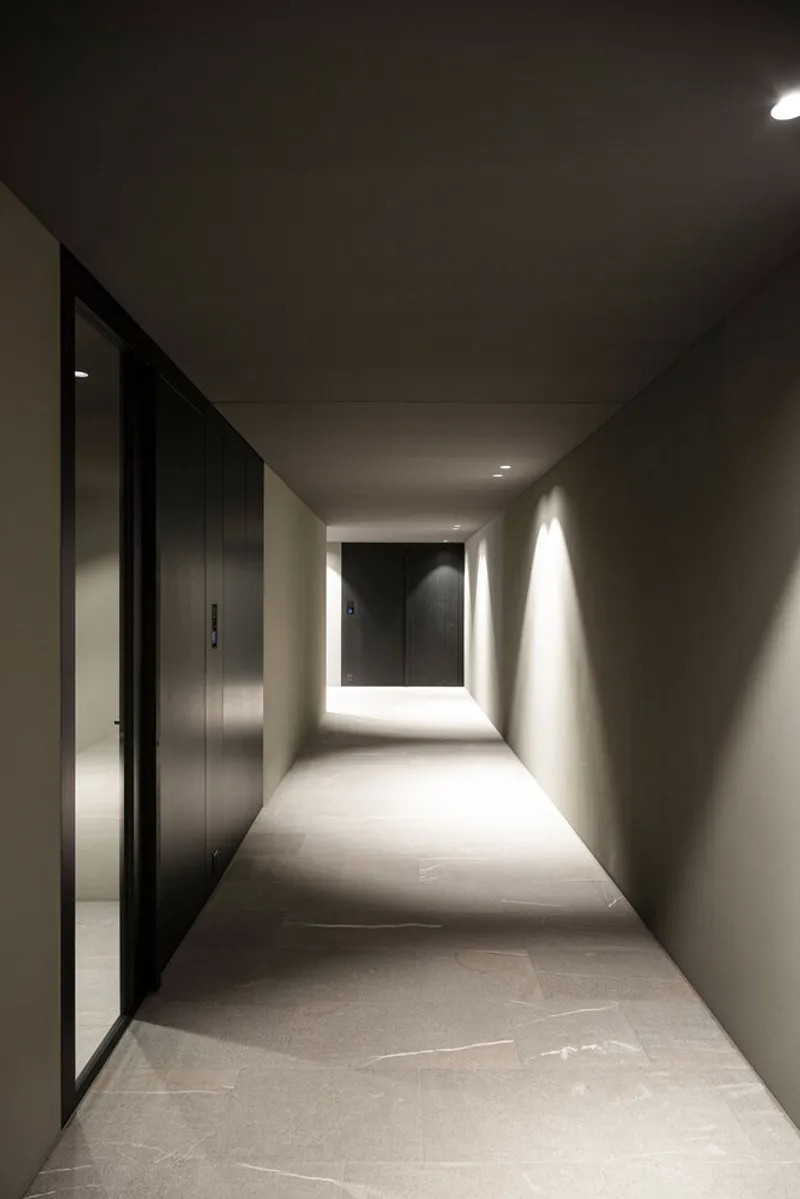
A concrete-floored corridor with darkened walls and a backlit doorway at its end reveals how Durrer handles transition. The passage from exterior to interior, from public face to private room, is choreographed through shifts in material, light level, and ceiling height. The gable facade, with its rhythmic window openings and slatted screens seen from the grassy hillside, presents a composed face to the village. Step through the door and the palette warms, the light softens, and the Alpine world outside becomes a framed view rather than an immersive environment.
Plans and Drawings
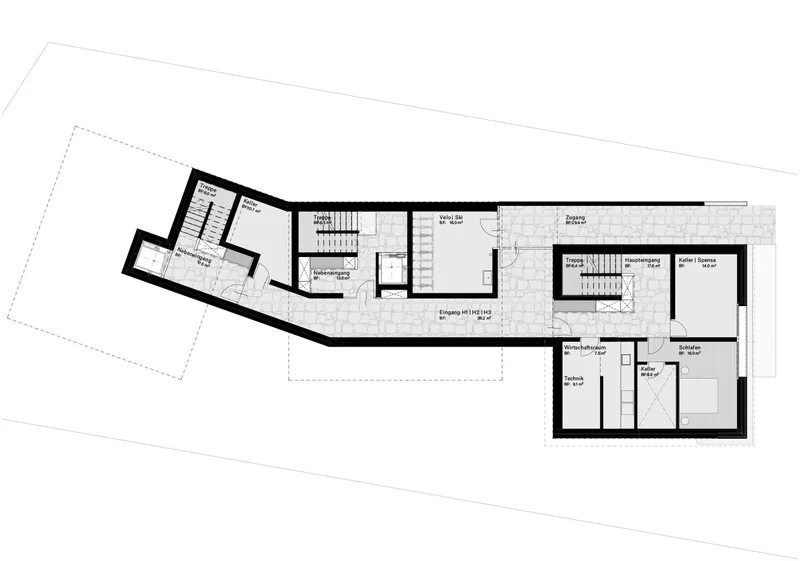
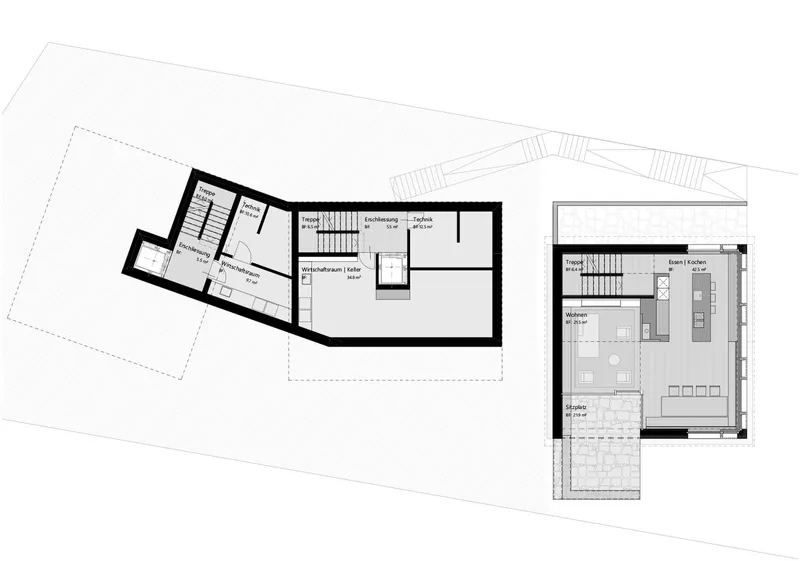
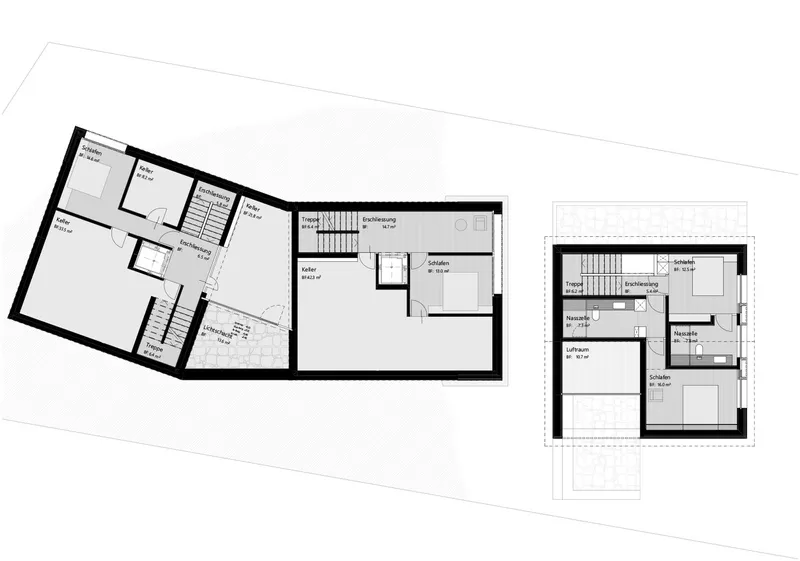
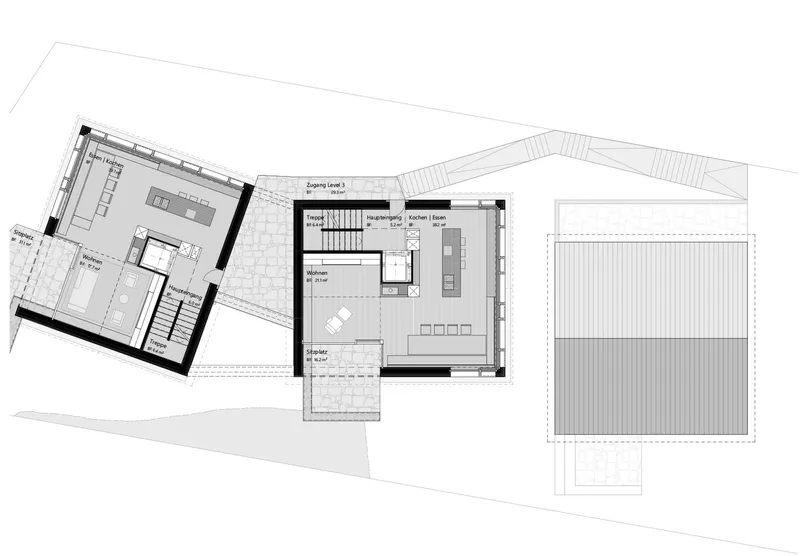
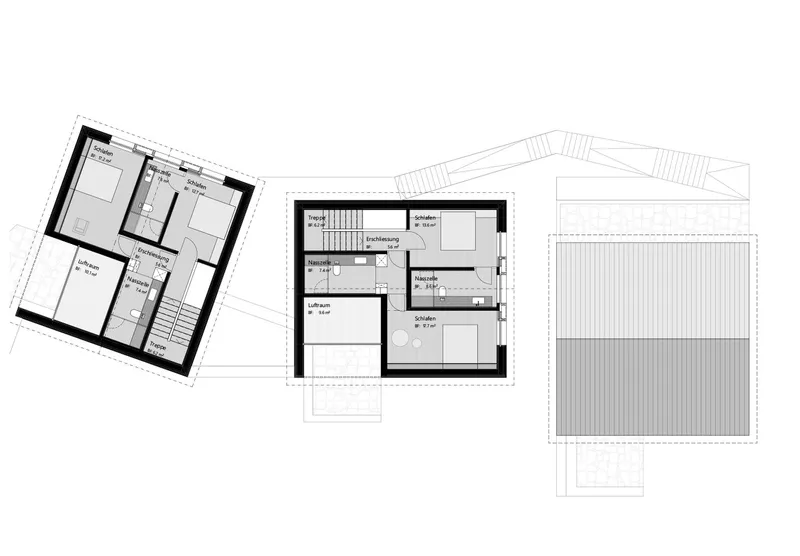
The floor plans confirm what the photographs suggest: the houses are organized around a central staircase with living spaces oriented toward the valley views and service rooms tucked against the uphill side. Angled wings respond to site geometry, creating sheltered outdoor terraces and, in one case, an adjacent pool terrace at the upper level. The elongated layouts maximize the glazing frontage while keeping the building footprint narrow enough to sit on the steep terrain without excessive excavation. Rooftop terraces with timber decking appear on the upper-level plans, offering outdoor space that the compact sites cannot provide at grade.
Why This Project Matters
Alpine architecture has a credibility problem. Too many mountain houses either cosplay as chalets, piling on reclaimed timber and antler chandeliers, or overcorrect into glass-and-concrete minimalism that ignores its context entirely. The Malbun Houses sidestep both traps. They acknowledge the Maiensäss tradition without fetishizing it, and they deploy a high level of interior finish without turning the houses into luxury brochures. The restraint is the design.
What Sandro Durrer demonstrates here is that vernacular intelligence and contemporary performance can coexist without compromise. Minergie certification, KNX automation, district heating, and a meticulous lighting concept all live inside a form that a 19th-century farmer would recognize. The houses do not shout. They settle into the slope, filter the light, and let the oak and stone do the talking. For a discipline that often confuses ambition with spectacle, that is a quietly radical position.
Malbun Houses by Sandro Durrer. Malbun, Liechtenstein. Completed 2023. Photography by Samuel Holzner.
About the Studio
Share Your Own Work on uni.xyz
If projects like this are the kind of work you want to make, uni.xyz is a place to publish your own, find collaborators, and enter design competitions.


Popular Articles
Popular articles from the community


Co-Life: Senior Housing Design That Reconnects Older Adults With the City
Co-Life reimagines senior housing design through healing gardens, shared streets, workshops, and a sustainable community across generations.

Lunar Spiral: Space Architecture Shaped by the Mathematics of the Universe
Lunar Spiral reimagines space architecture through Fibonacci geometry, lunar regolith, levitating habitats, and self-sustaining Moon living.

Hill & Cross Opera: Sculptural Opera House Architecture Shaped by Tallinn’s Landscape and Identity
Hill & Cross Opera reimagines opera house architecture in Tallinn through its sculptural hill, civic plaza, glass wave and a luminous cross.

Little Red Riding Hood: Architectural Design as a Journey Through Fear, Light, and Storytelling
Little Red Riding Hood reimagines the fairy tale through architectural design shaped by fear, light, scale, memory, uncertainty, and choice.

Similar Reads
You might also enjoy these articles

Bamboo Housing Challenge 2026: Design Affordable, Sustainable Homes Using Bamboo
An international design competition by Bamboo U and IBUKU inviting architects and designers to reimagine affordable housing using bamboo — with the winning design built full-scale in Bali.

Computational Design & Education: Beegraphy Design Awards Introduces 7th Category (Featuring Jiyun's Innovative Approach)
Dive into Beegraphy’s 7th Design Awards category, where computational design meets education to create immersive, interactive learning tools, inspired by Jiyun’s work.

From Parametric Lighting to Urban Furniture: Join the 2nd Workshop in Beegraphy’s Computational Design Series
Dive into Cutting-Edge Design Techniques and Practical Applications with Industry Experts

Last Call: Unleash Your Architectural Genius in SHAK's Kindergarten Design Competition
Urgent call for architects to join SHAK's kindergarten design competition before the looming deadline

Explore Architecture Competitions
Discover active competitions in this discipline

Challenge to reimagine the Iron Throne

Photograph architecture without architects

Illustrate the lost glory of Angkor Wat - Render Challenge

Design challenge to reuse E-waste
Comments (0)
Please login or sign up to add comments
No comments yet. Be the first to comment!