

Kuklica x Smerek Split a Bratislava Apartment Building into a Chimney and a Box
On Podunajská Street, two interlocking volumes sort residents by household size while holding the emerging urban edge together.


Bratislava's Podunajská Street has the unfinished quality of a sentence interrupted mid-thought: buildings trail off, setbacks shift without logic, and the streetwall dissolves into leftover parcels. The Podun Apartment Building by Kuklica x Smerek Architekti does not try to repair all of that at once. Instead it offers a credible fragment, two joined volumes that hold the bend in the road and set a datum line for whatever comes next. It is a modest building with an unusually clear idea about who lives where and why.
The organizing concept is straightforward: a tall, narrow "chimney" stacks compact 1.5-bedroom flats for singles and couples, while a broader "box" accommodates 2.5-bedroom family apartments with generous balconies. Splitting the program into two legible masses keeps the street elevation from reading as a single slab and gives each unit type the proportions it actually needs. The result is a 283-square-meter footprint that punches well above its size in spatial variety, offering gardens, terraces, loggias, winter gardens, and a pair of loft apartments crowned by green rooftop terraces nearly six meters high.
Two Volumes on the Bend
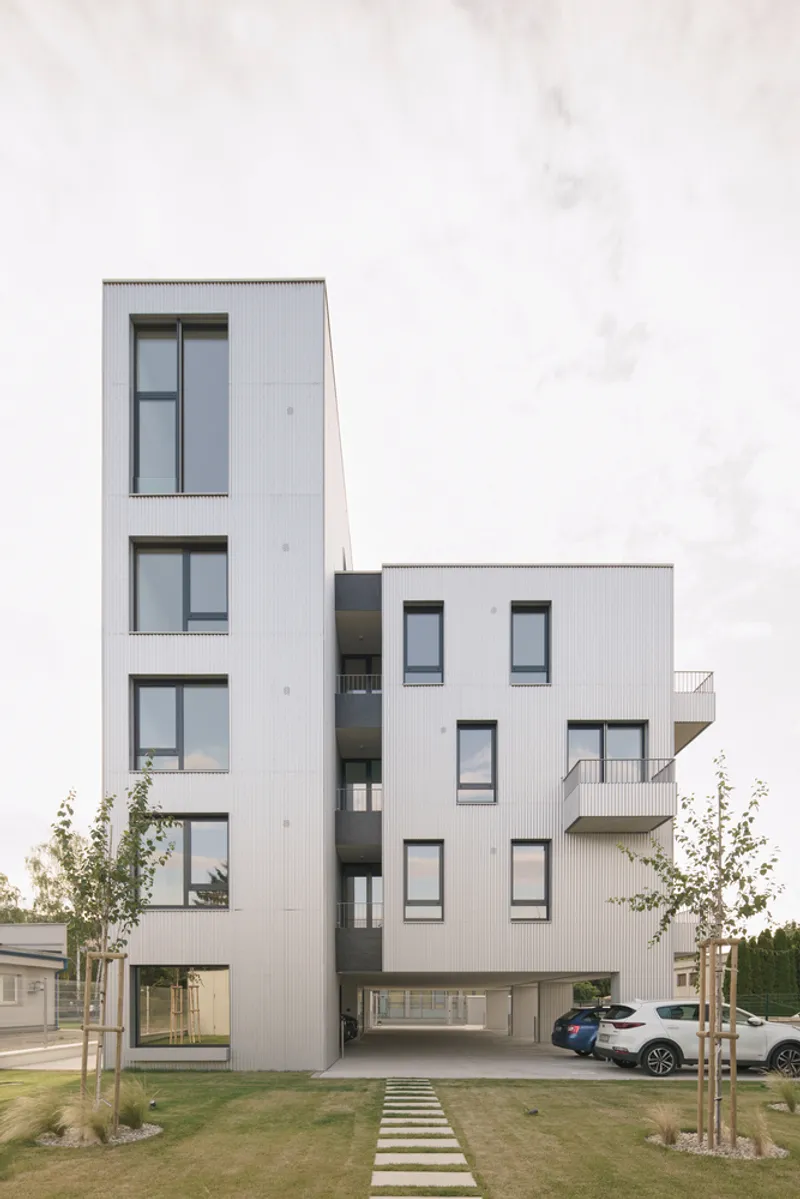
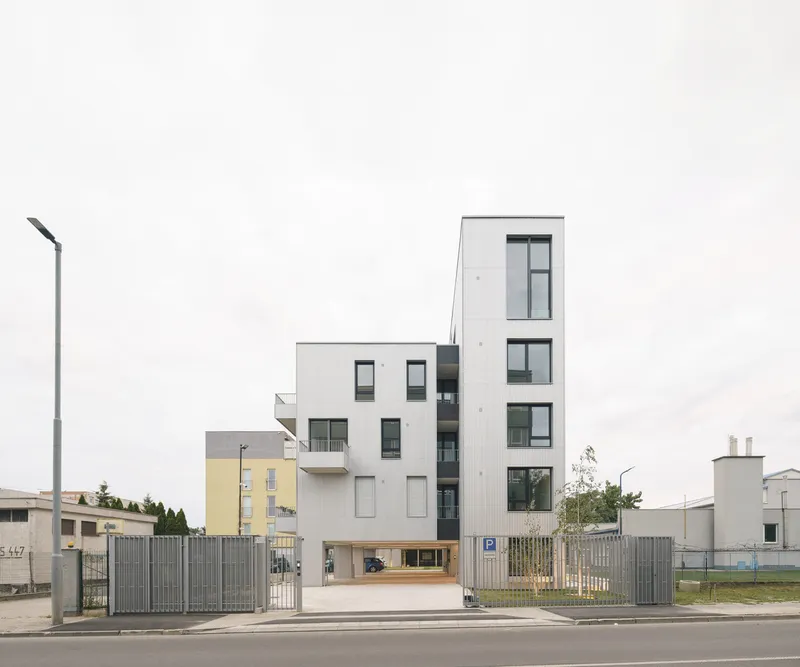
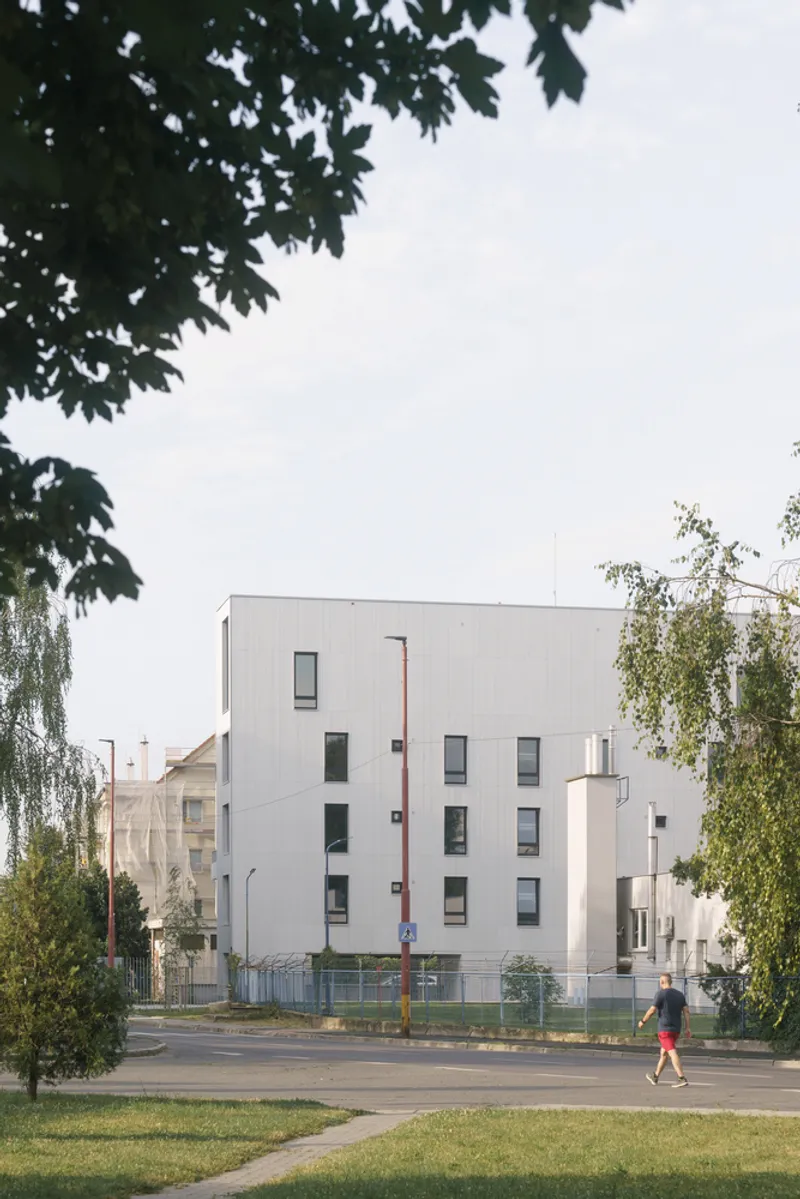
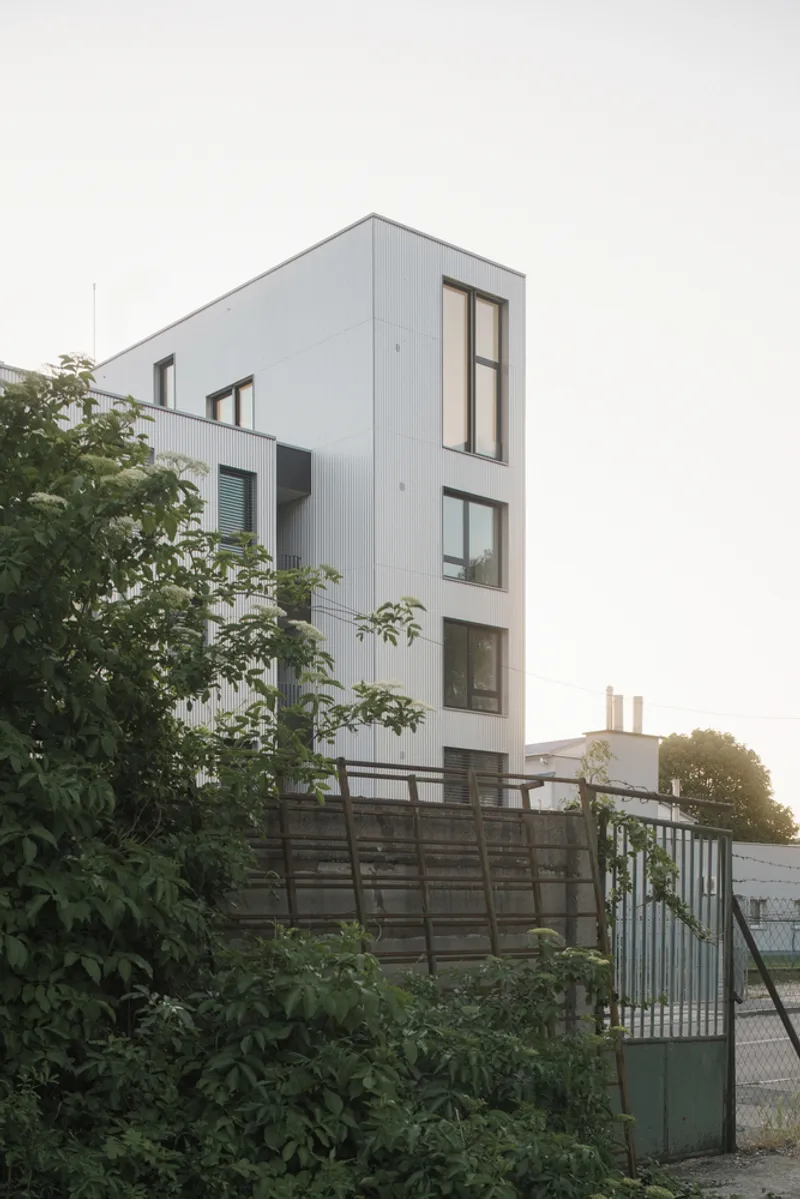
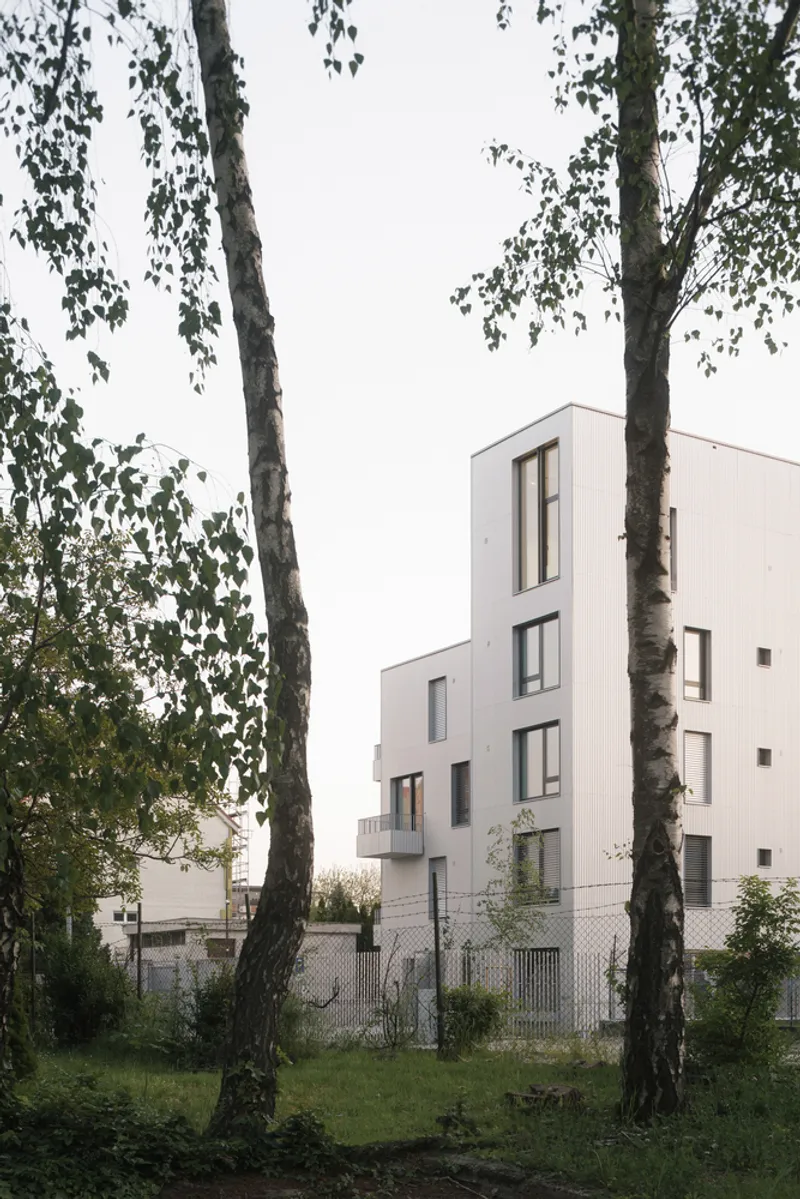
Seen from the street, the chimney rises as a slender tower with recessed balconies that emphasize its verticality, while the box sits lower and wider beside it. The stepped composition tracks the bend in Podunajská Street, engaging the curve rather than ignoring it. Where many infill apartment projects default to a single extrusion, Kuklica x Smerek break the massing into parts that correspond to genuine programmatic differences. The chimney's narrowness gives its corner units dual orientation for cross-ventilation and daylight, while the box's depth accommodates the larger floor plates families need.
The shift in volume also calibrates scale. Surrounding technical structures and low-rise houses set a fragmented skyline; the Podun building acknowledges that context by keeping its tallest element thin enough to avoid overwhelming adjacent rooflines. At dusk the white volumes glow against the suburban periphery, registering as a deliberate urban marker rather than a leftover development parcel.
Corrugated Metal as Urban Skin
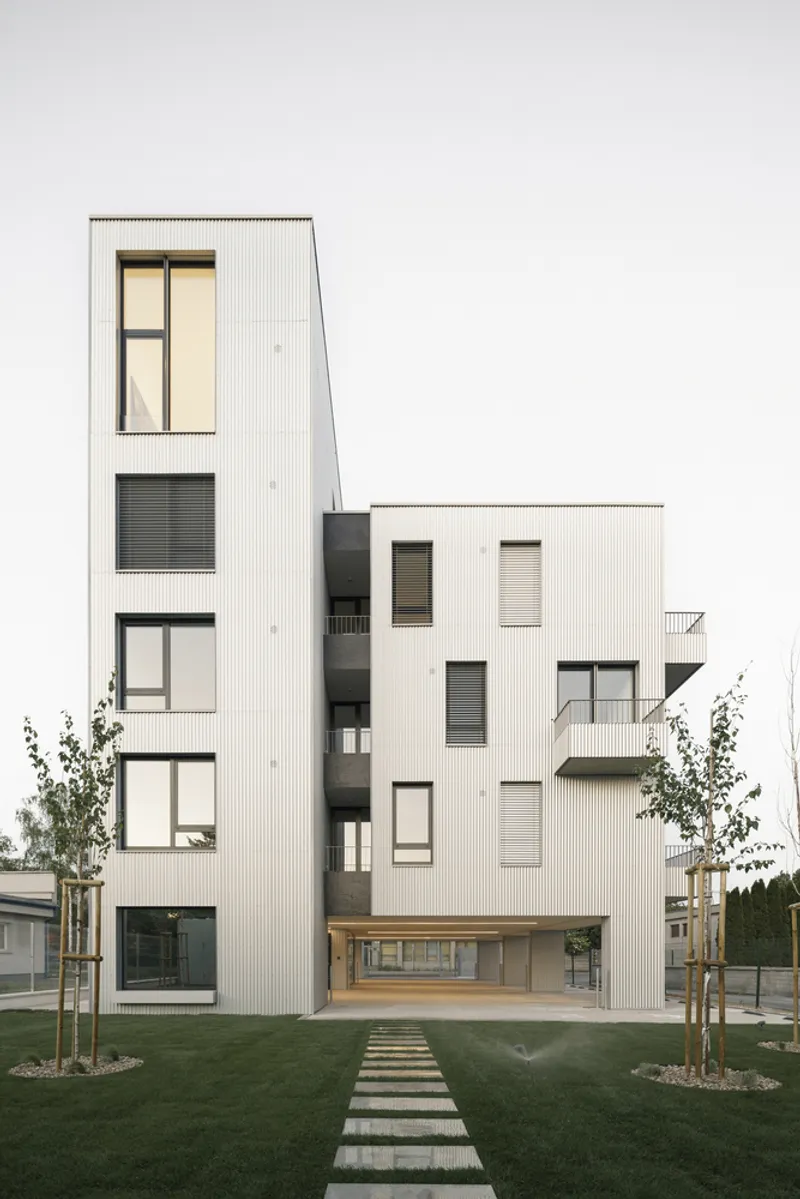
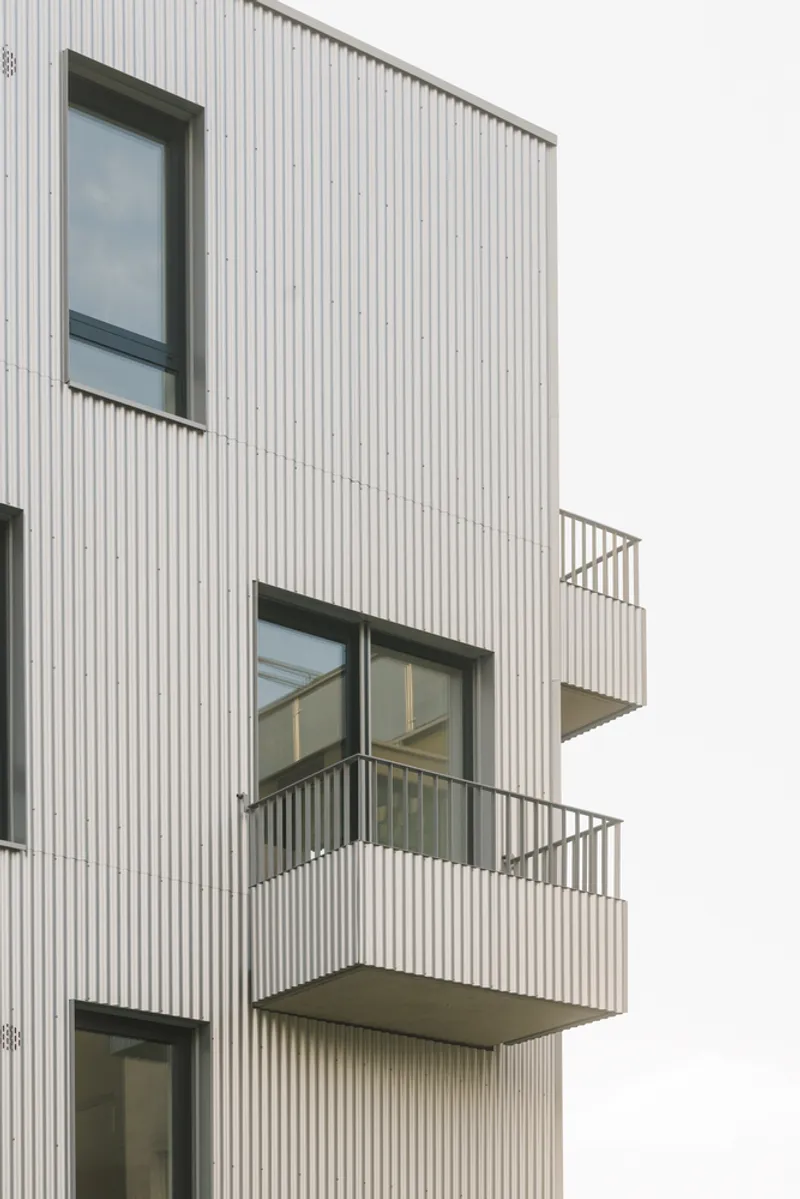
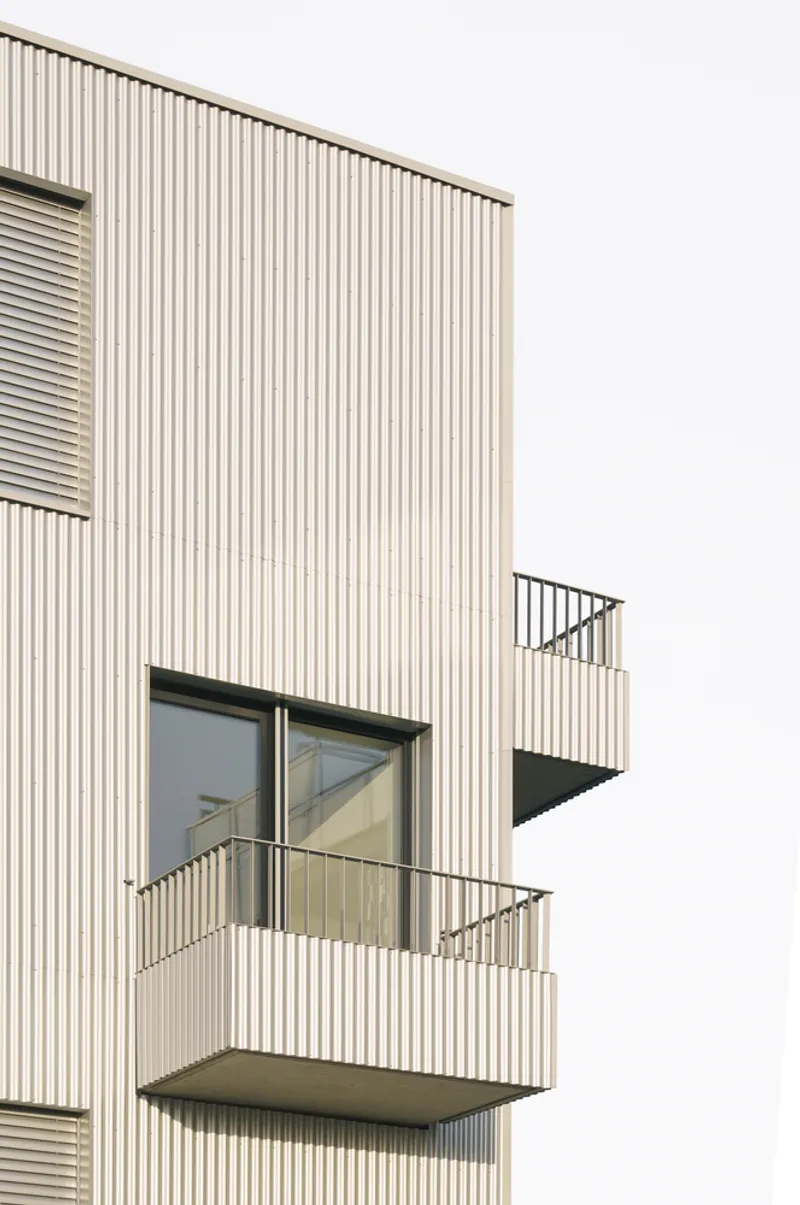
White corrugated metal wraps both volumes, lending the building a crisp, industrial character that nods to the technical structures already present on the street. The ribbed profile catches raking light beautifully, shifting from flat white at midday to a fine-grained texture in the golden hour. It is also a pragmatic choice: corrugated sheet is durable, low-maintenance, and fast to install, three qualities that matter on a tight urban site.
Windows and balconies punch through the cladding at irregular intervals, giving each facade the quality of a carefully composed elevation drawing rather than a repetitive grid. Black-framed openings and cantilevered balconies with dark mosaic tile parapets provide just enough contrast to read as inhabitable voids within the white field. Sliding louvered shutters appear on select openings, hinting at a layer of occupant control over privacy and solar gain without cluttering the overall composition.
The Permeable Ground Floor
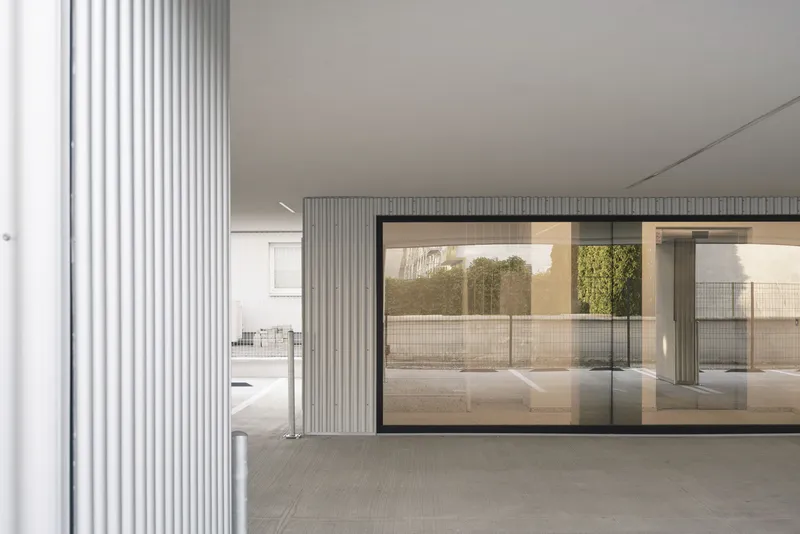
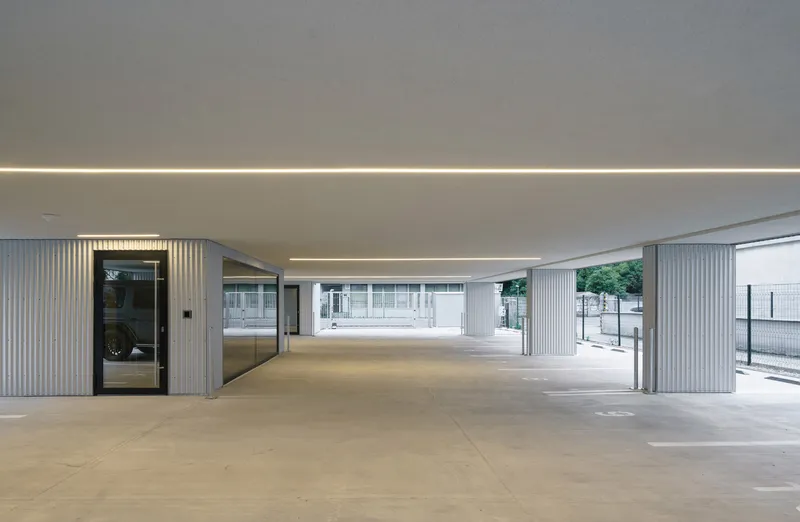
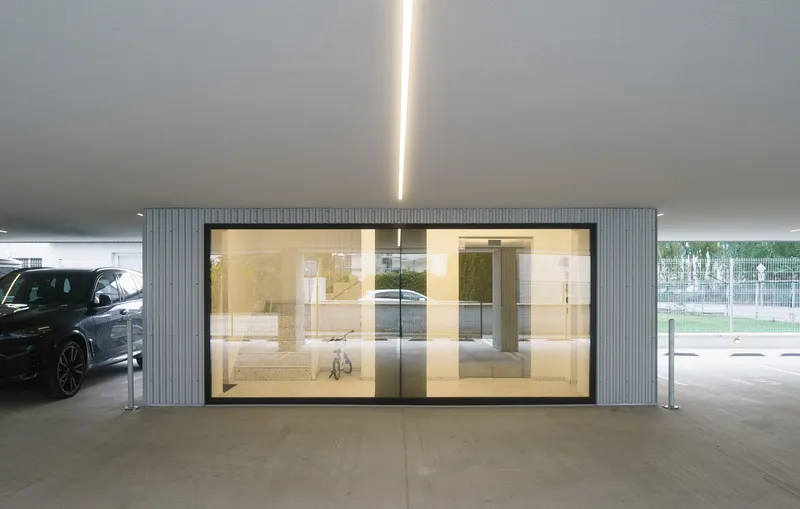
The ground level is perhaps the building's most generous civic gesture. Rather than sealing the perimeter with parking or storage, the architects lifted the volumes to create a covered carport and open passage that allows visual and physical permeability from street to garden. Fluted column wrappings give the pilotis a tactile refinement, and continuous slot lighting in the carport ceiling keeps the undercroft welcoming after dark.
A glass-walled lobby and full-height glazed openings dissolve the boundary between inside and outside, letting passersby glimpse the rear garden. The effect is closer to a small covered square than a conventional apartment entrance: a place where residents cross paths, store bikes, and transition between the public realm and their private domain.
Garden, Gazebo, and Community Space
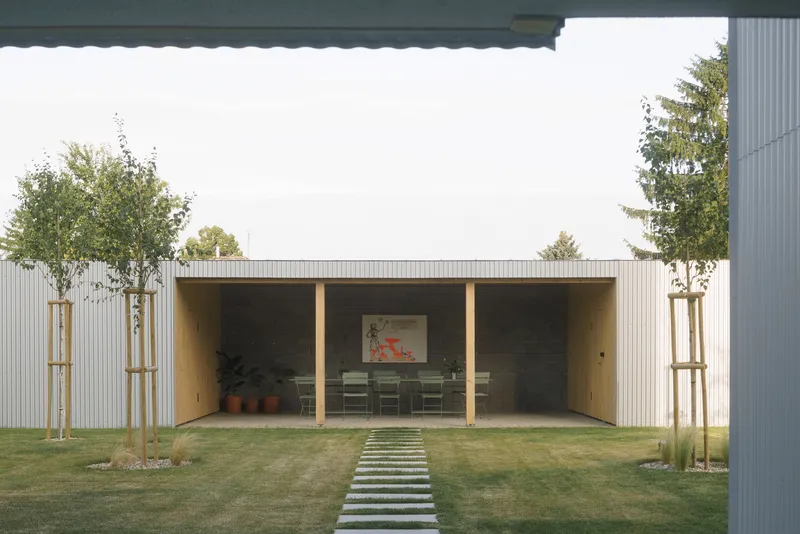
Behind the building, a quiet garden and timber-framed gazebo with a communal kitchen give residents outdoor space that feels domestic rather than institutional. Young birch trees and lawn soften the boundary between the site and surrounding lots, and the planting strategy is designed to benefit pedestrians on the adjacent path as much as the residents themselves. Cultivated greenery is doing double duty here: it screens the parking below, anchors the building to its site, and signals that this is a place that values collective life.
The gazebo, clad in the same corrugated metal as the main building, reads as a miniature pavilion rather than an afterthought. It is a simple move, a roof, some posts, a kitchen counter, but it reframes the rear garden as a genuine social amenity. For a project of only 283 square meters, allocating this much ground-floor area to shared outdoor life is a notable commitment.
Loft Living Under the Roof
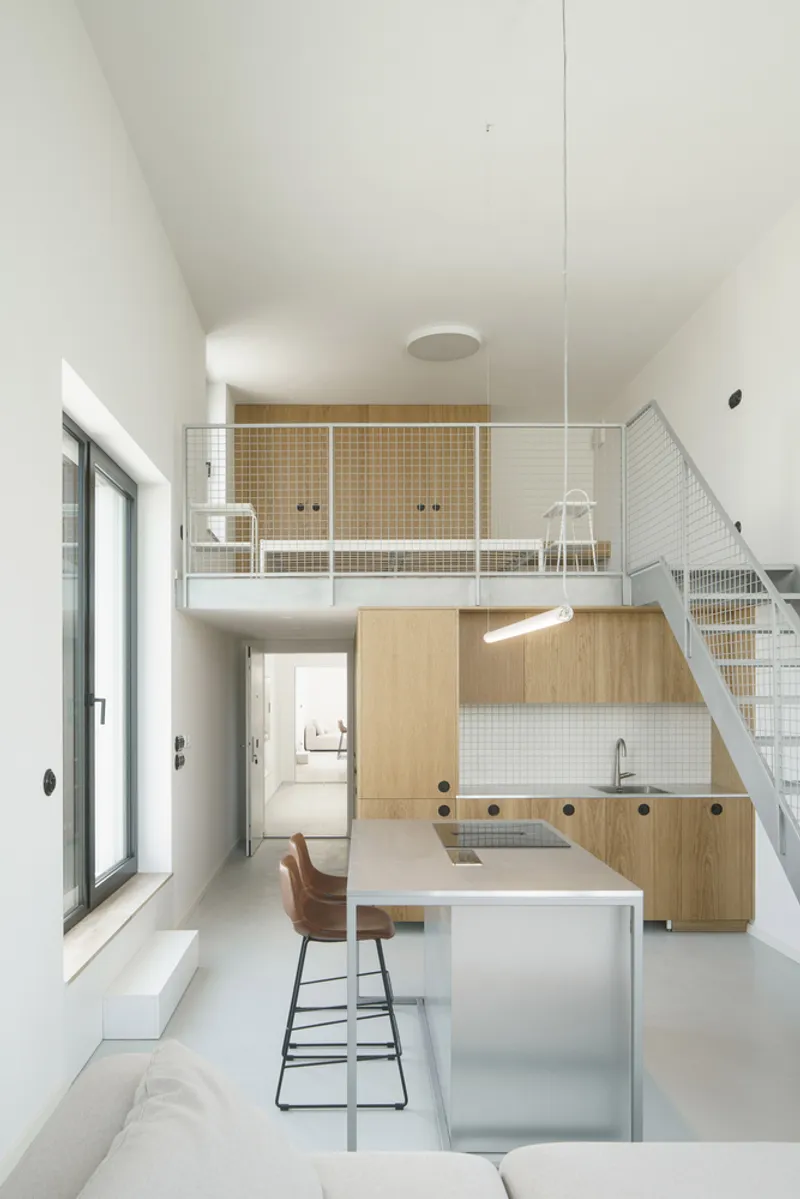
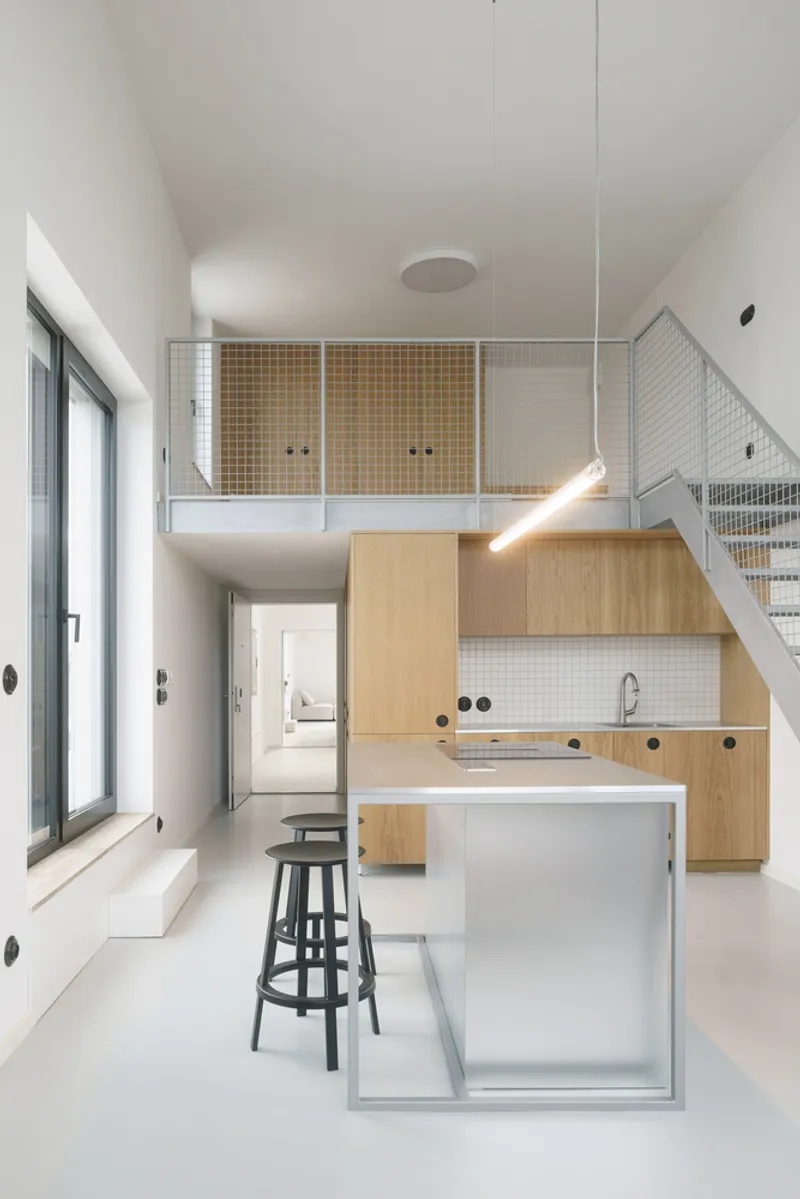
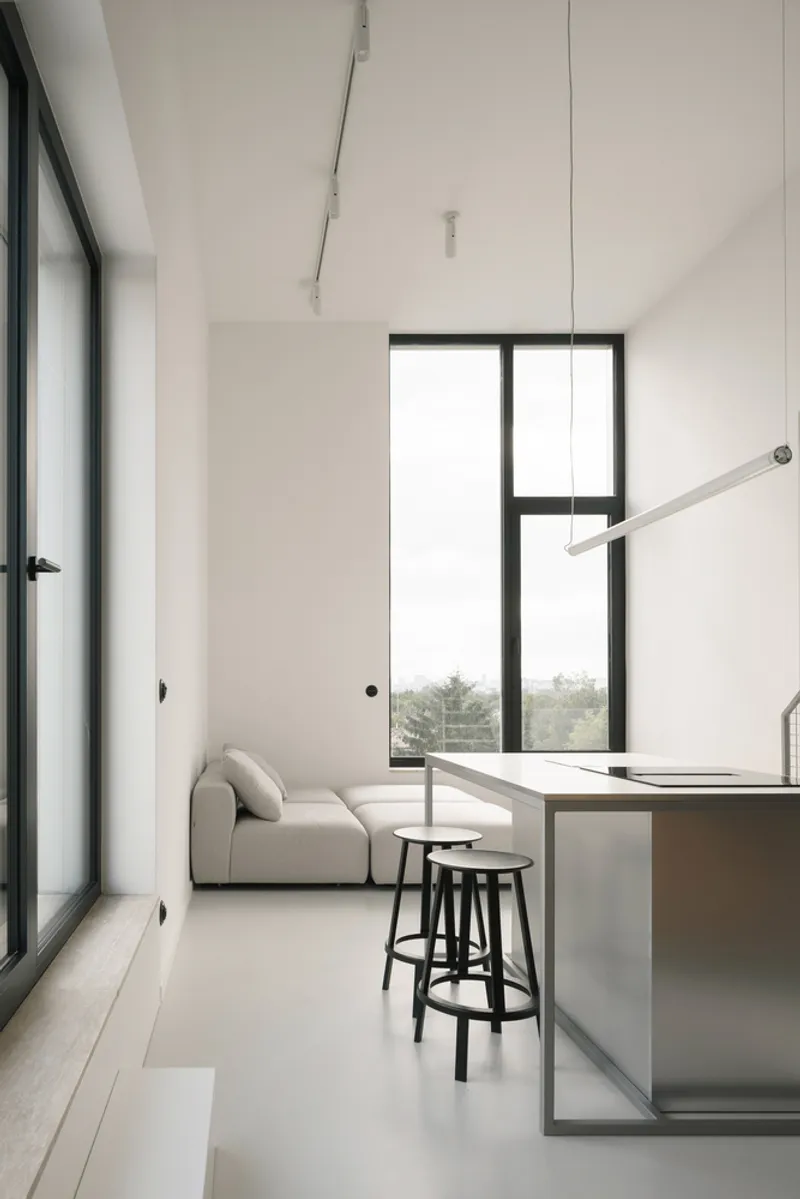
The topmost units in the chimney volume are double-height lofts with nearly six meters of headroom, a rare luxury in a compact apartment building. Wire mesh mezzanine railings and plywood kitchen cabinetry give these spaces a deliberately unfinished, workshop-like character that contrasts with the more composed lower floors. The sloped ceiling channels light down through the section, and tall windows frame long views over the neighborhood's tree canopy.
These lofts open onto green roof terraces, extending the living area outdoors and contributing to the building's overall ecological footprint. The interplay of raw materials, height, and rooftop landscape makes these apartments feel like small houses stacked on top of the chimney, a fitting crown for the building's most vertical element.
Circulation and Interior Detail
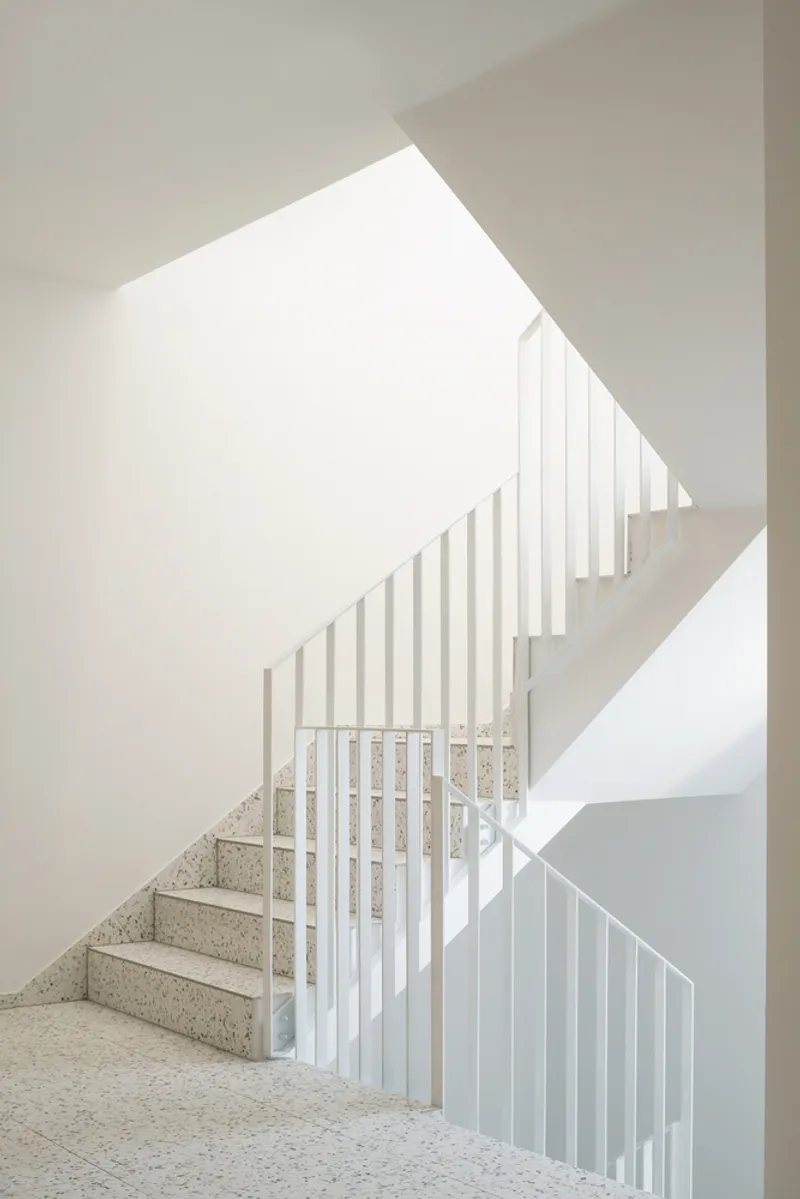
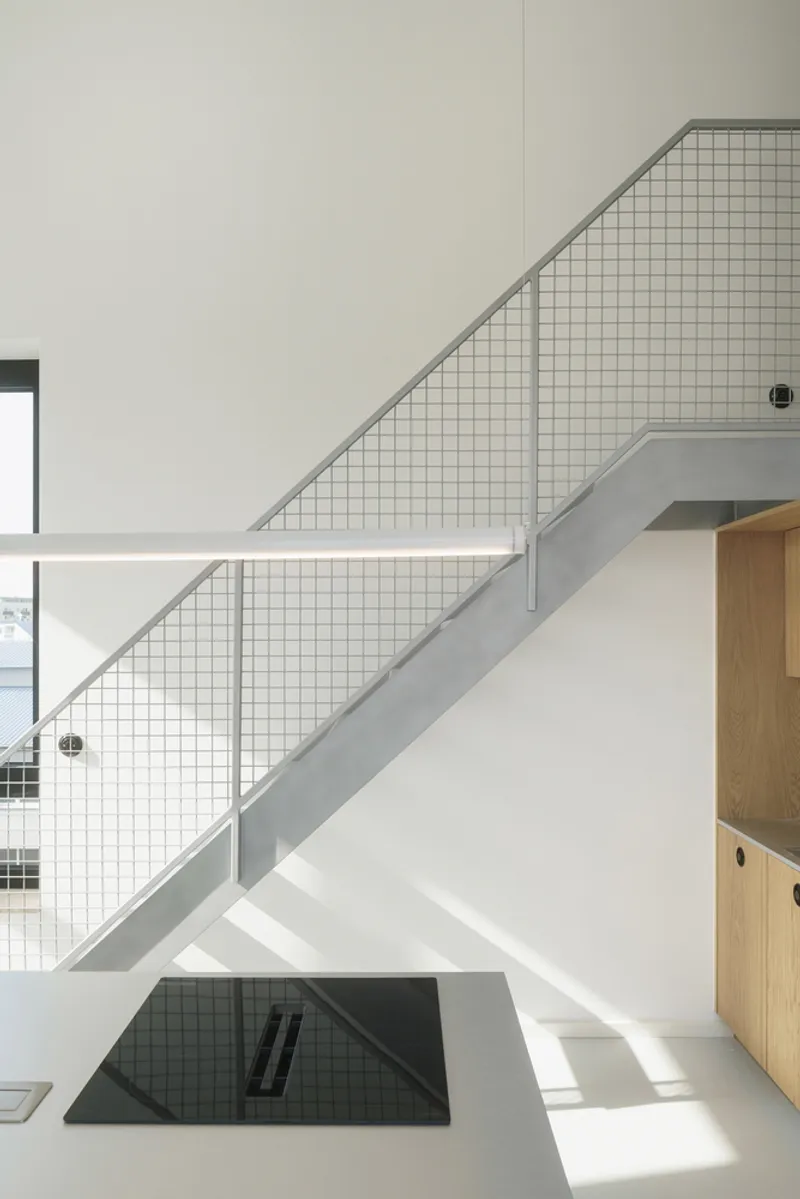
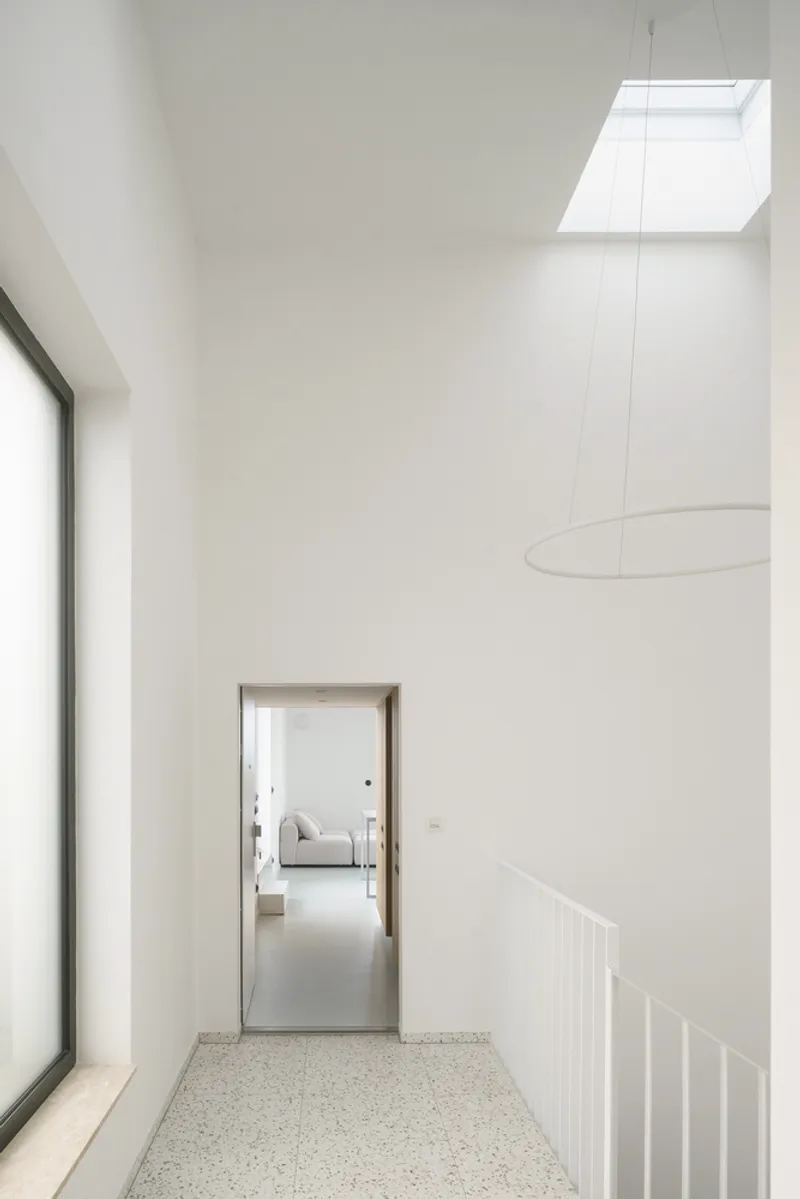
Common circulation spaces are treated with the same material clarity as the facades. Terrazzo treads, white vertical slat balustrades, and a slanted skylight turn the main stairwell into a bright, almost gallery-like passage. Metal staircases with wire grid infill panels appear in the loft units, letting light filter between levels and reinforcing the industrial vocabulary established on the exterior.
A double-height corridor with a skylight above the doorway between units brings natural light deep into the plan, a detail that elevates the everyday experience of walking to one's front door. These are not expensive interventions, but they require the kind of sectional thinking that many speculative apartment projects simply skip.
Balconies, Loggias, and the In-Between
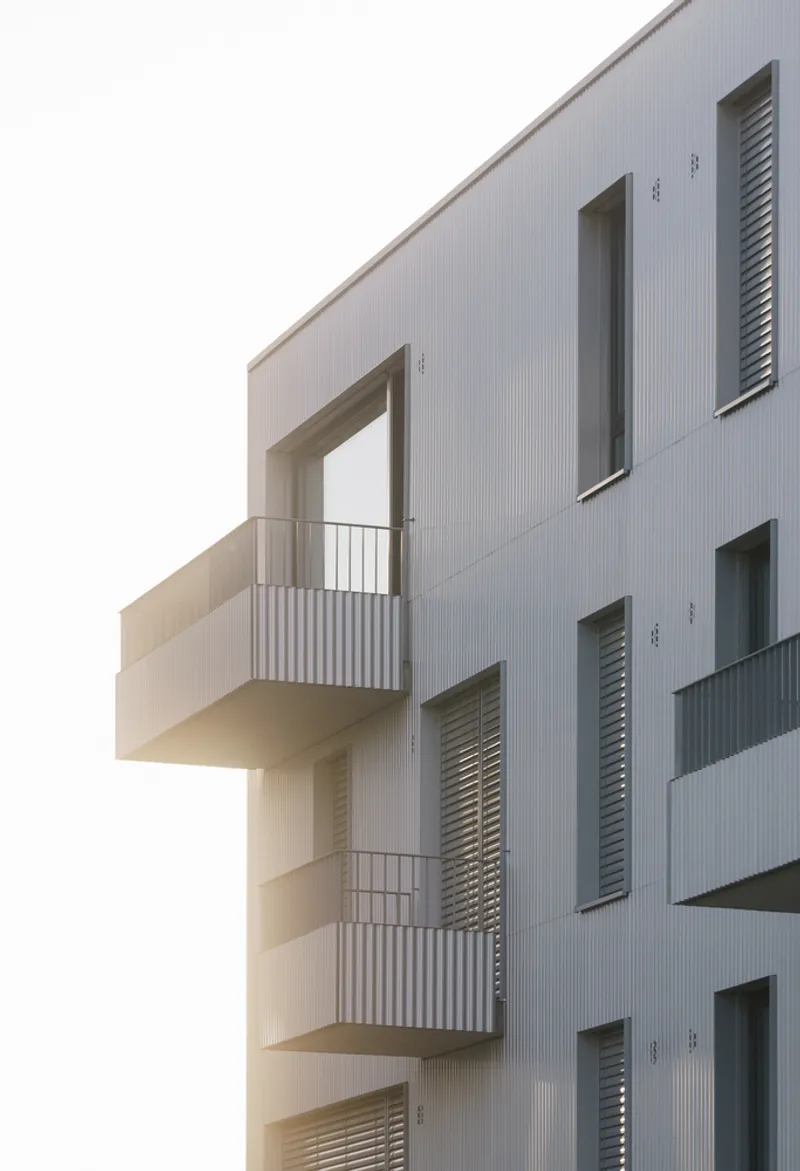
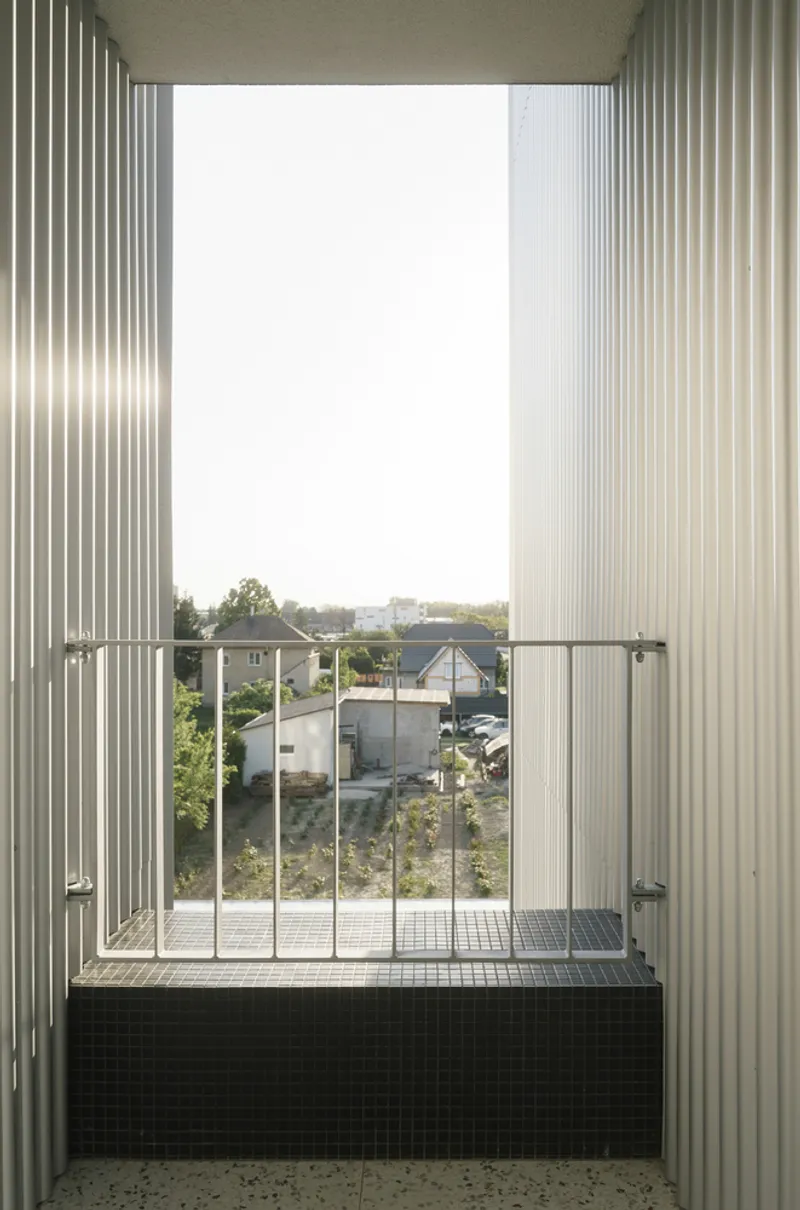
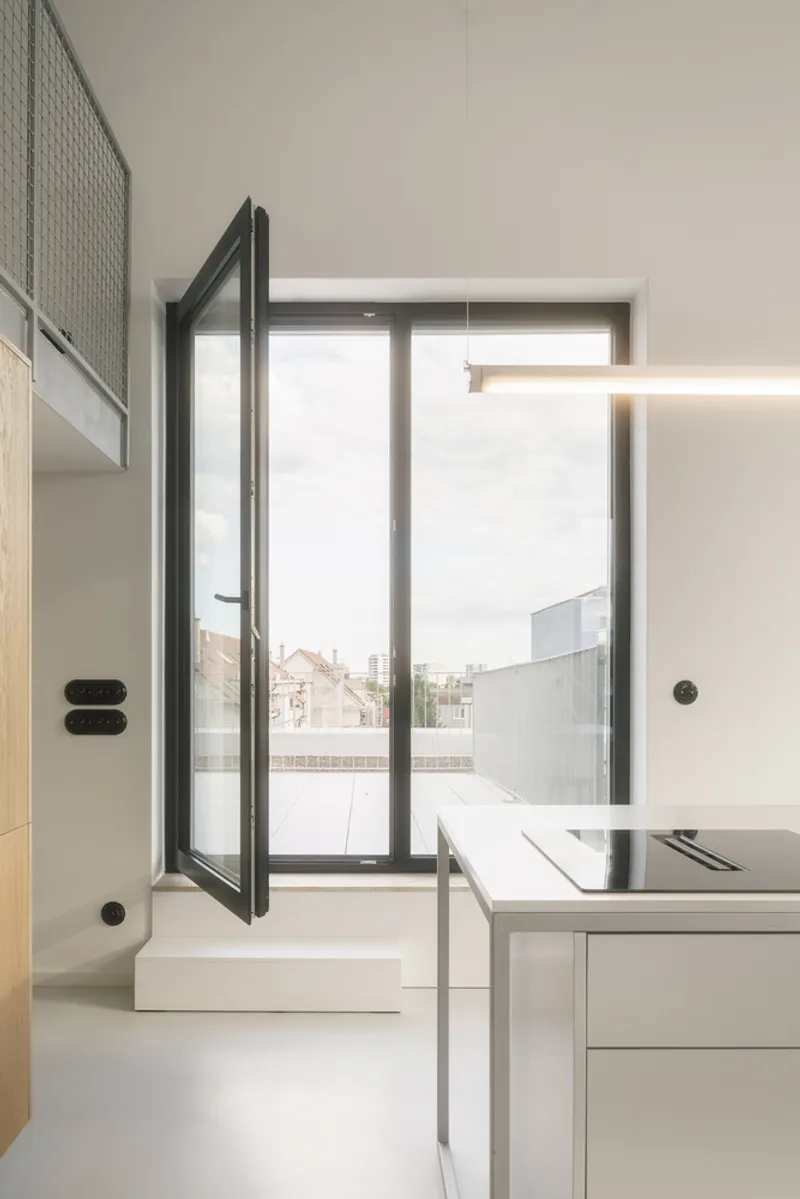
Every unit in the Podun building gets some form of private outdoor space, but the type varies by volume. The chimney's compact flats receive loggias carved into the mass, protected from wind and acoustically shielded by the concrete structure. The box's family apartments have cantilevered balconies that project outward, maximizing usable area. The lofts get rooftop terraces. This graduated palette of outdoor rooms is one of the project's strongest moves: it acknowledges that a couple on the fourth floor and a family on the second have different spatial needs and calibrates the architecture accordingly.
From the balconies, residents look out over neighboring pitched roofs, young street trees, and the low suburban horizon. The dark mosaic tile parapets give each balcony a distinct material identity, readable from the street as punctuation marks in the corrugated facade.
Plans and Drawings
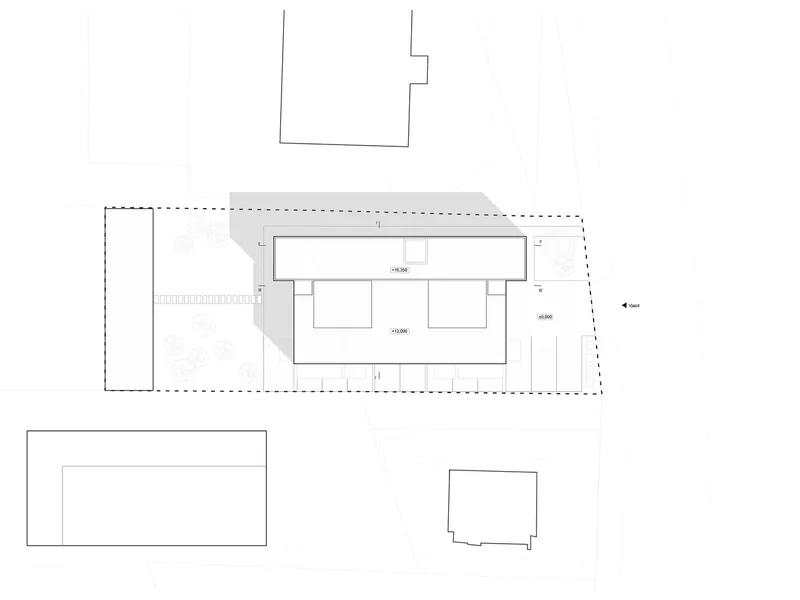
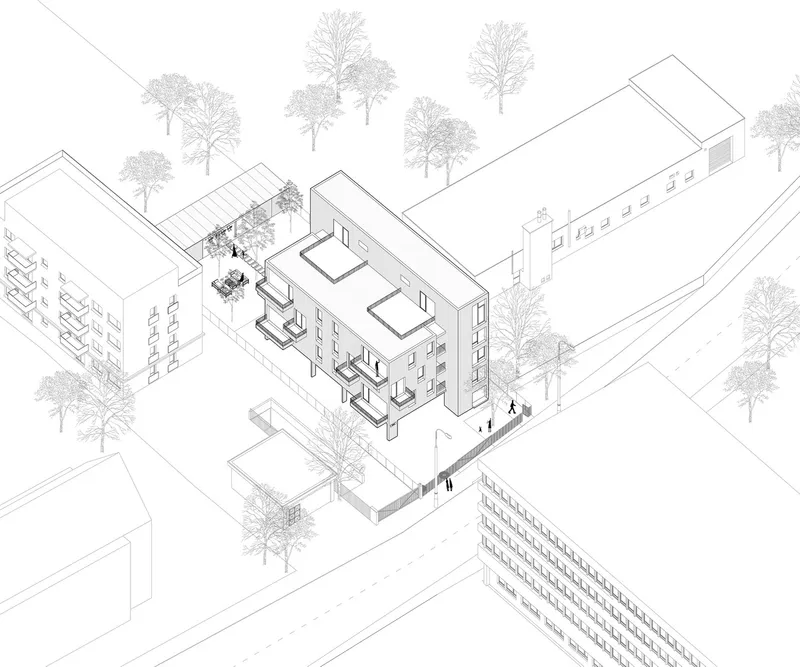
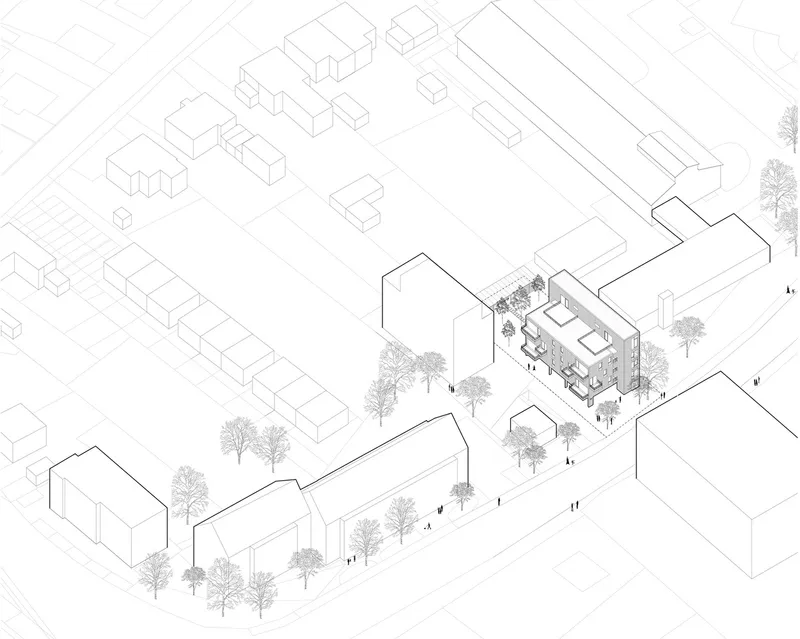
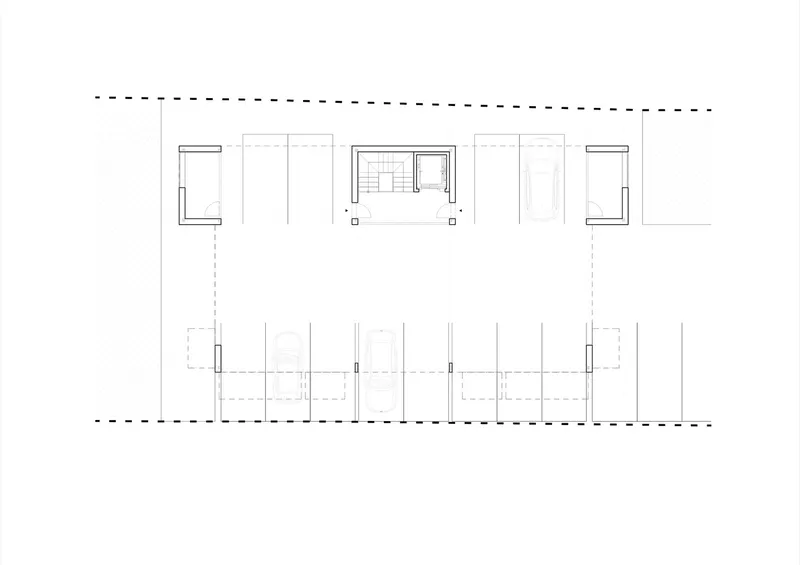
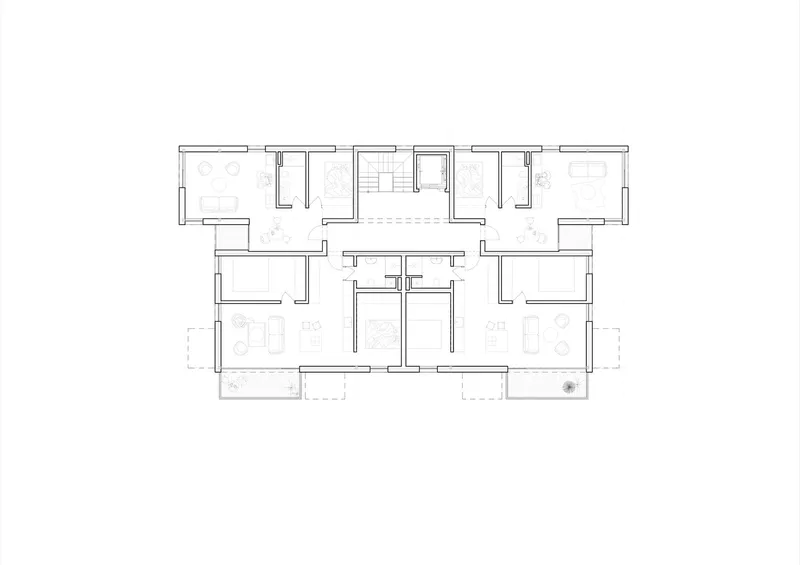
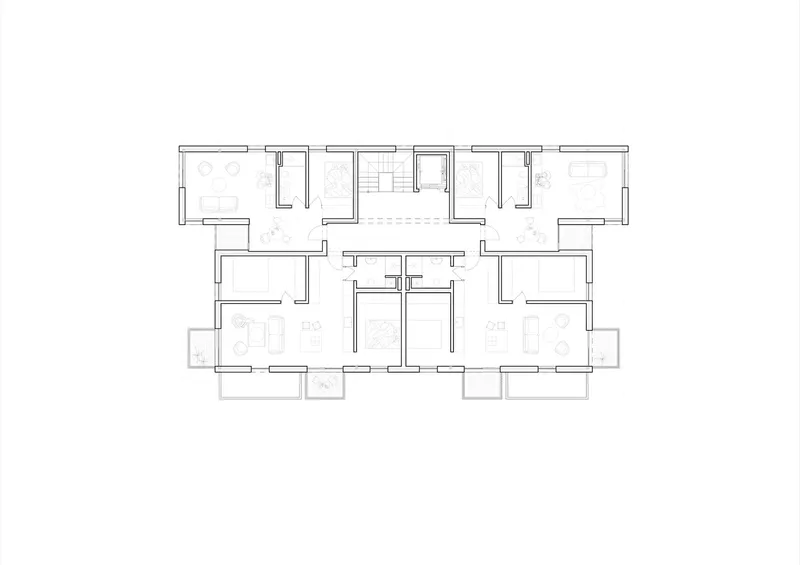
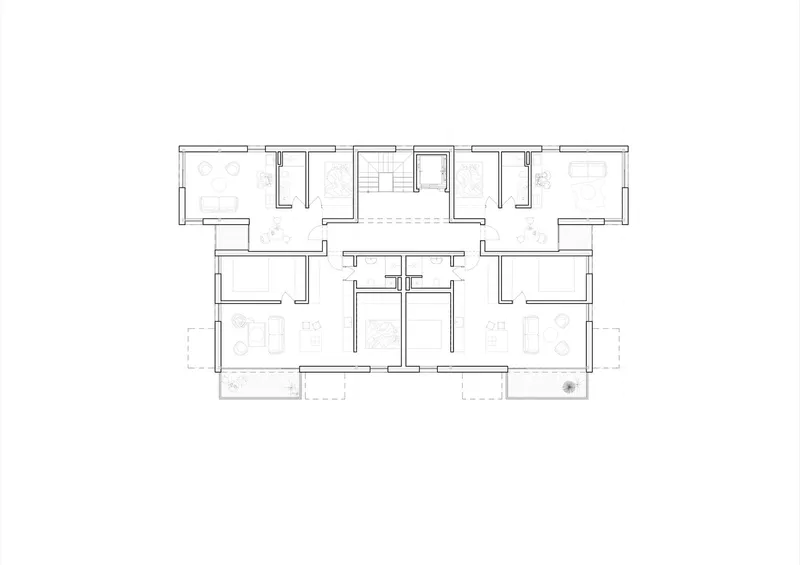
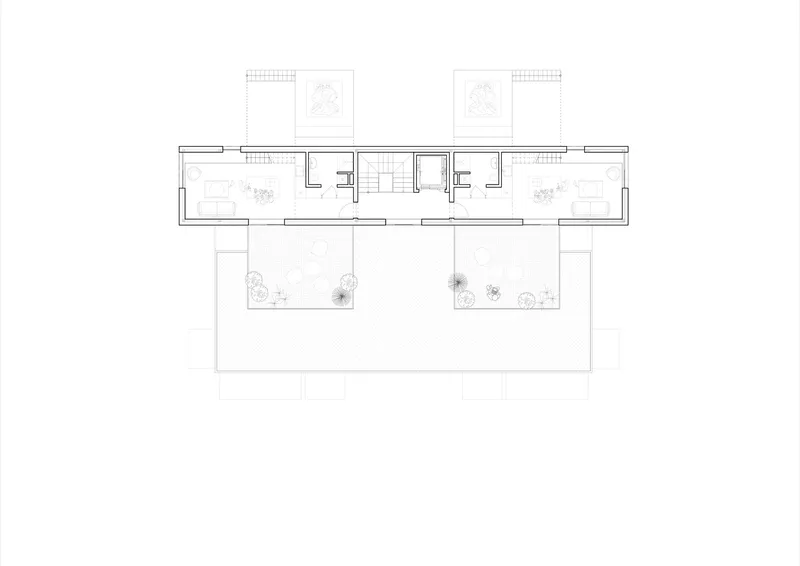
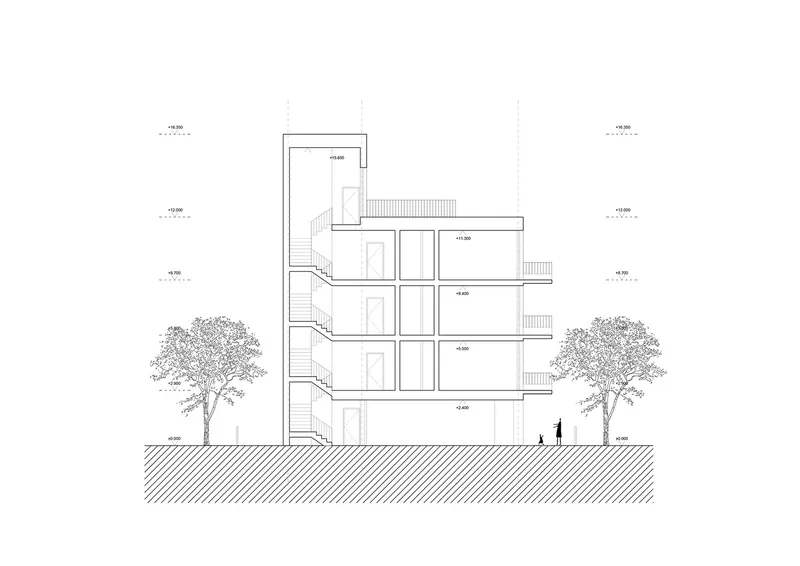
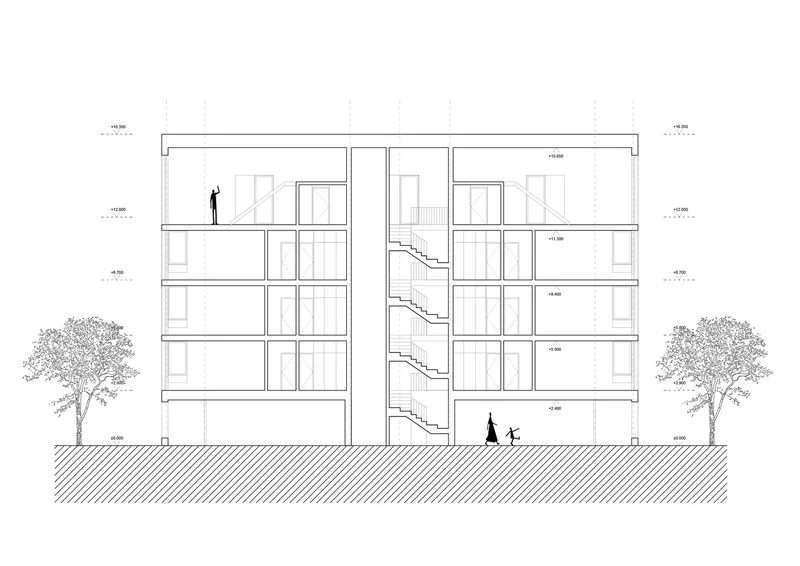
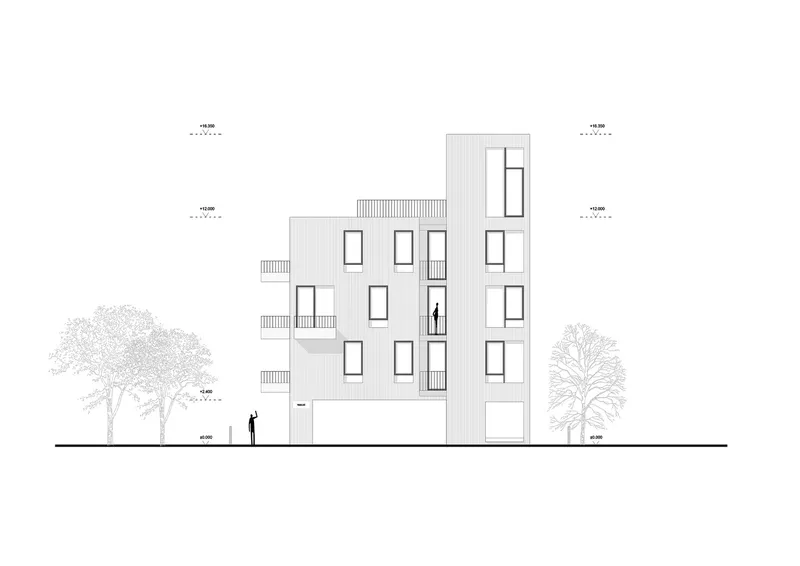
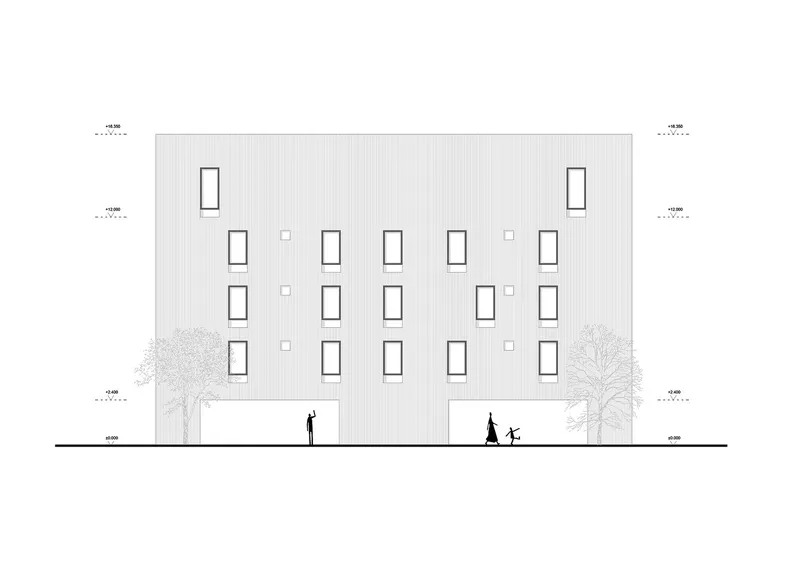
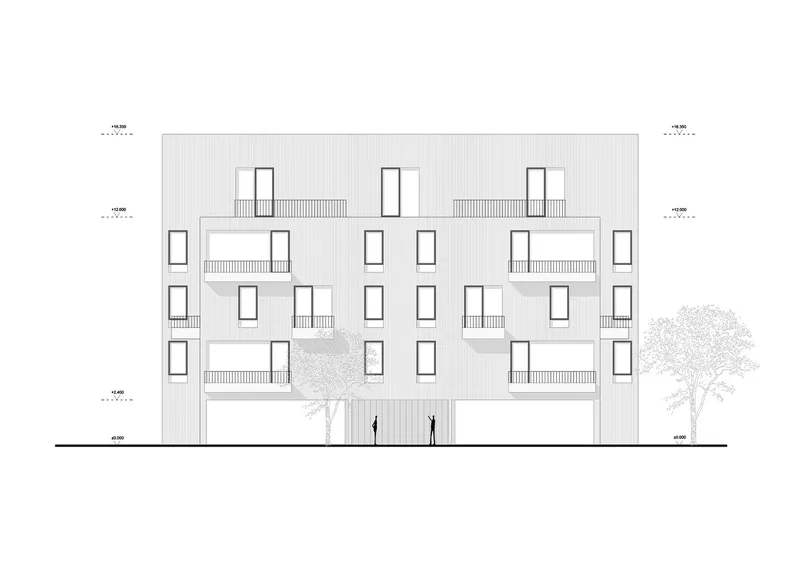
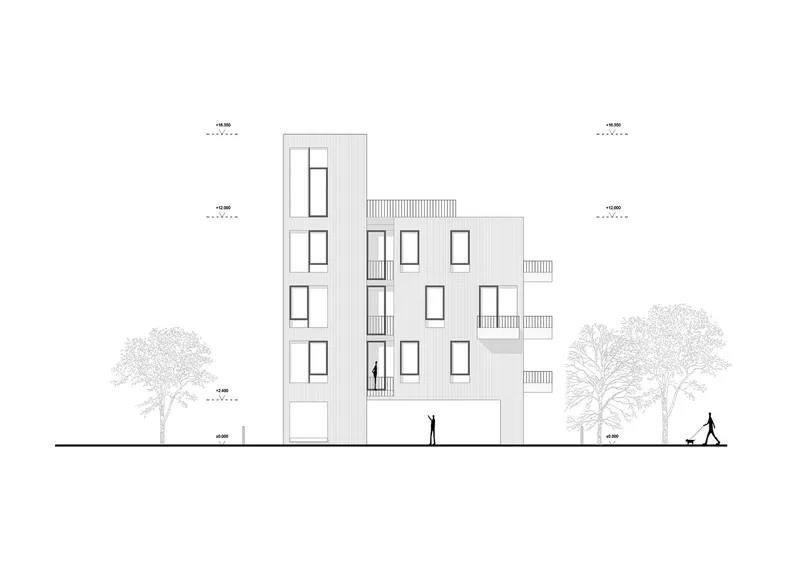
The floor plans confirm what the exterior suggests: a central stair core efficiently serves mirror-image units on either side, and every apartment occupies a corner position with windows on at least two facades. The sections reveal the zigzag stair threading through the chimney volume and the dramatic height of the uppermost lofts. Axonometric drawings place the building within its block context, illustrating how the two volumes negotiate the street bend and create a sheltered courtyard at the rear. The elevations document the rhythmic fenestration pattern and the careful differentiation between front, side, and rear facades.
Why This Project Matters
The Podun Apartment Building demonstrates that small-scale urban housing does not have to be generic. By splitting the program into two volumes tuned to different household types, Kuklica x Smerek achieve a range of dwelling options, from tight lofts with rooftop gardens to proper family flats with balconies, within a footprint that many developers would fill with a single, undifferentiated block. The permeable ground floor and communal garden extend that generosity to the public realm, treating the street and the neighbors as stakeholders rather than obstacles.
In a European housing market increasingly dominated by repetitive investor-grade apartments, a project that thinks hard about who actually lives inside, and designs distinct spatial conditions for each group, deserves attention. The corrugated metal skin is sharp, the detailing is disciplined, and the urban strategy is legible at every scale from the street corner to the site plan. Bratislava's Podunajská Street finally has a sentence worth finishing.
Podun Apartment Building, Bratislava, Slovakia. Architect: Kuklica x Smerek Architekti (lead architects Peter Kuklica and Martin Smerek). Area: 283 m². Completed 2024. Photographs by Alex Shoots Buildings.
About the Studio
Share Your Own Work on uni.xyz
If projects like this are the kind of work you want to make, uni.xyz is a place to publish your own, find collaborators, and enter design competitions.


Popular Articles
Popular articles from the community


ETEH Reworks the Shared Spaces of São Domingos School in Brazil Around Timber, Color and Hanging Plants
At São Domingos School in Brazil, 436 m² of hall, refectory and library are recast with timber joinery, a yellow and blue code and trailing greenery.

FCC Arquitectura Expands a Portuguese Granite House with a Board-Marked Concrete Wing
In Portugal, JV House pairs a cleaned-up whitewashed and granite dwelling with a timber-shuttered concrete extension, courtyards and a garden pool.


Aquadapt: An Underwater Habitat That Rewrites Its Rooms by the Hour
Curved modules ring the seabed while one shell shifts from breakfast room to cinema, farm and football pitch as residents' needs change.

Cube Design Draws an Ecological Corridor Between Two Shenzhen Hills with the Nankai Building
Beside Shenzhen's container docks, the Nankai Building pairs stacked balconies with a climbing green screen to connect two hillsides across its height.

Similar Reads
You might also enjoy these articles


Hodi-Mandai Geram
Project Function: Preservation and revitalization of the Intangible heritage and socio-spatial identity of the Hodi by Housing, Cultural Memory Center, Sacred Grove, landscape, local tourism economy


Olio Towers: A Mid-Rise for Performers That Fuses Housing, Rehearsal, and Stage
Located blocks from Houston's Theater District, this modular tower stacks living units around a central performance atrium.

Oasis: Modular Green Housing Carved into Dhaka's Urban Fabric
A shortlisted Plugin Housing entry reclaims unauthorized settlements in Dhaka with stepped concrete volumes, green roofs, and ventilation-driven design.

Black Hole: A Floating Megastructure for the Post-Physical Era
Emiliano Mazzarotto envisions a spherical, self-scaling arena where e-sports, digital hotels, and holographic stadiums replace traditional public space.

Explore Brutalist Architecture Competitions
Discover active competitions in this discipline

Challenge to reimagine the Iron Throne

Photograph architecture without architects

Illustrate the lost glory of Angkor Wat - Render Challenge

Design challenge to reuse E-waste
Comments (0)
Please login or sign up to add comments
No comments yet. Be the first to comment!