

Dominique Coulon Wedges a Triple-Height Cultural Centre into a Railway Embankment in Bourg-la-Reine
A 2,550 sqm cultural hub on an L-shaped plot south of Paris turns its constrained site into a theatrical sequence of light and color.


Most cultural centres in small French communes play it safe: a clean rectangular volume, a polite setback from the street, a lobby that says nothing. The new Cultural Centre in Bourg-la-Reine, designed by Dominique Coulon & Associés, refuses every one of those defaults. Sited on a narrow L-shaped plot pressed against a regional rail embankment at 11 rue des Rosiers, the building packs a 250-seat theatre, two dance studios, music and language rooms, exhibition space, visual arts workshops, a learning kitchen, a bar, and administrative offices into just 2,550 square metres of gross floor area. Completed in July 2023 after a competition won in 2016, the project cost roughly €6 million, a remarkably lean budget for the ambition on display.
What makes the building genuinely compelling is not the program list but how Coulon converts a site liability into a spatial engine. The wooded embankment that could have been a wall of noise and shadow becomes instead a source of borrowed greenery, passive cooling, and dappled light. The angular geometry forced by the plot generates oblique views and intertwined volumes that reward movement through every floor. And a bold, selective use of color, specifically a magenta ceiling plane that threads through the triple-height hall, transforms raw board-formed concrete into something close to joyful.
A Facade That Announces Itself
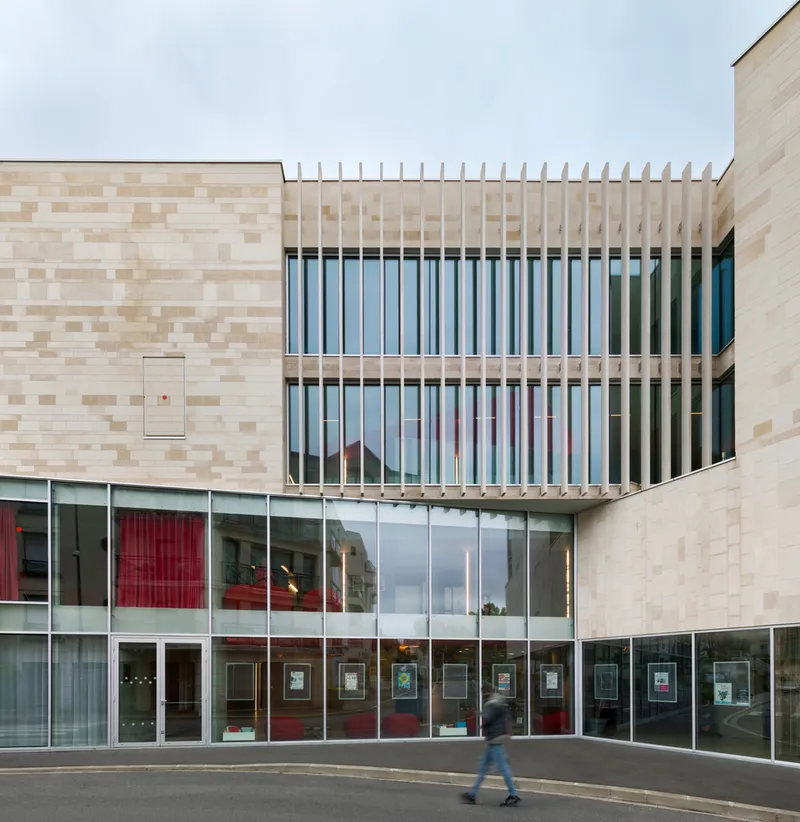
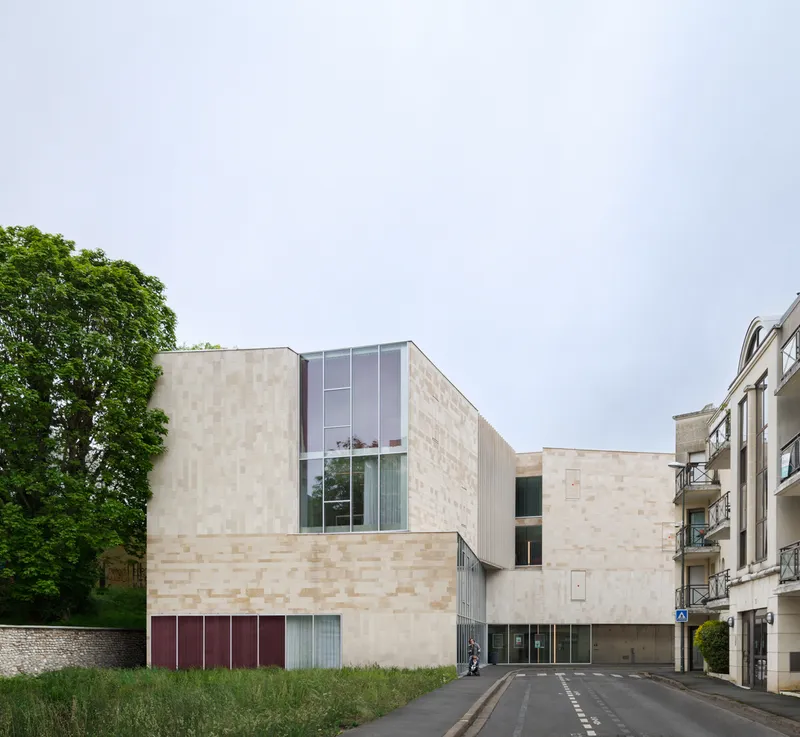
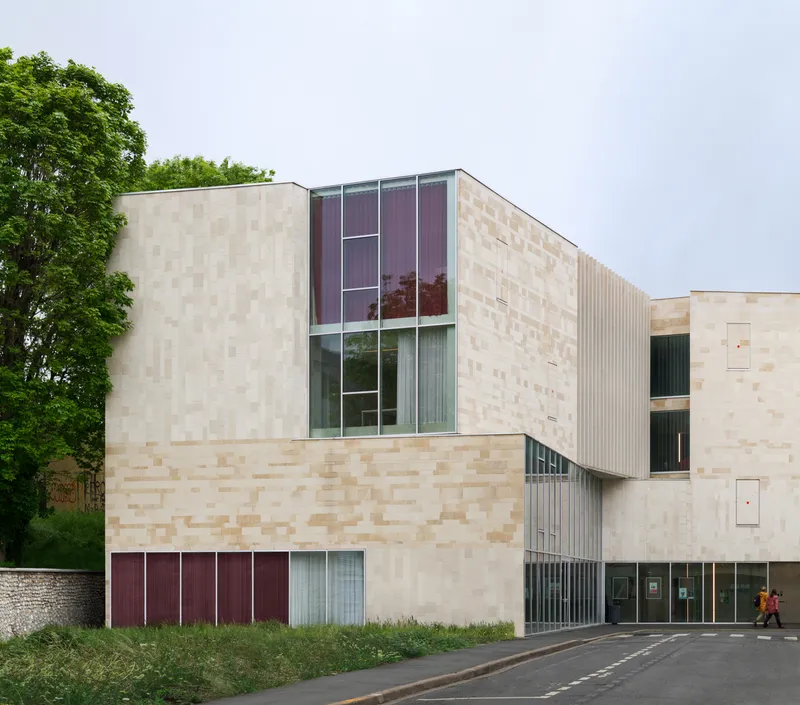
The street elevation reads as a deliberate act of civic declaration. Paris limestone, laid in a chequered pattern, gives the building a material weight that distinguishes it from the modest residential fabric on either side. Large windows are punched deep into the stone surface, creating hollows that shift in shadow throughout the day. Vertical metal fins and timber brise-soleil modulate light entry while adding a finer grain to the otherwise monolithic composition.
The choice of limestone is not merely aesthetic. It ties the building to the regional geology and, more practically, provides a durable rain screen that ages well against the constant vibration and microclimate effects of the adjacent railway. At street level, glazed openings make the ground floor legible as a public threshold, an invitation rather than a barrier.
The Triple-Height Hall as Social Engine
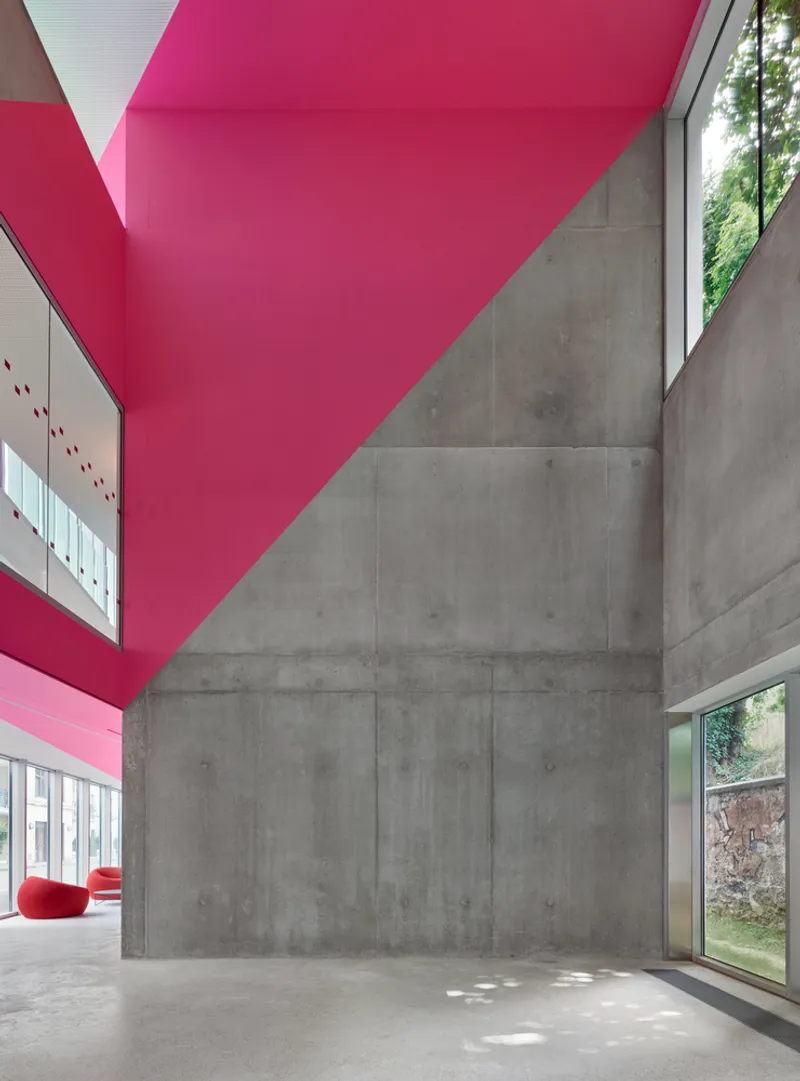
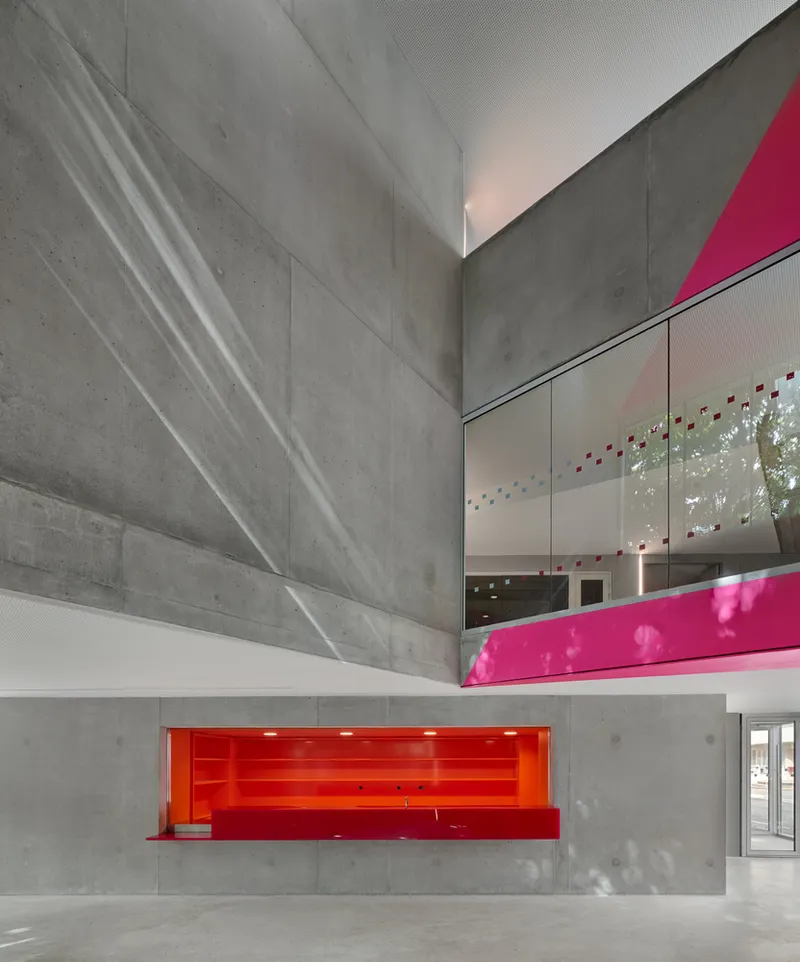
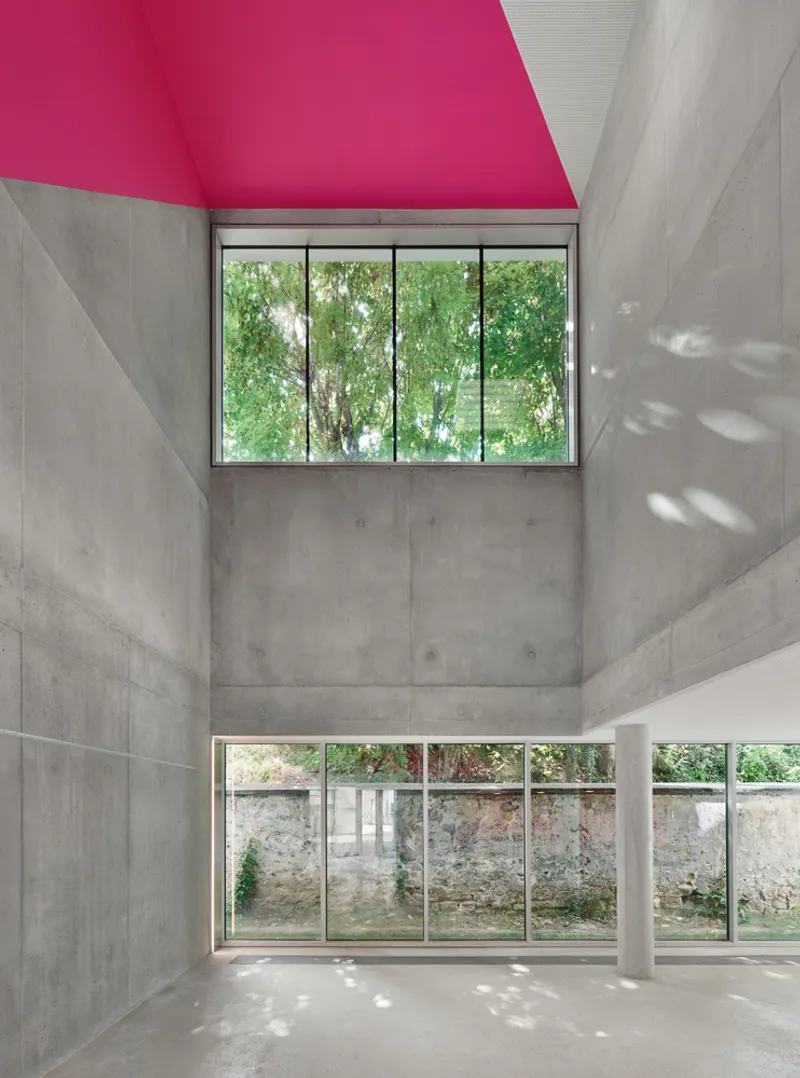
Coulon places the entrance hall at the curve where the two building wings meet, a hinge point that is both structurally logical and socially strategic. Rising through three levels, the hall captures sunlight despite the embankment's proximity, pulling it down through high openings and bouncing it off board-formed concrete walls. The result is a space that feels far larger than its footprint suggests.
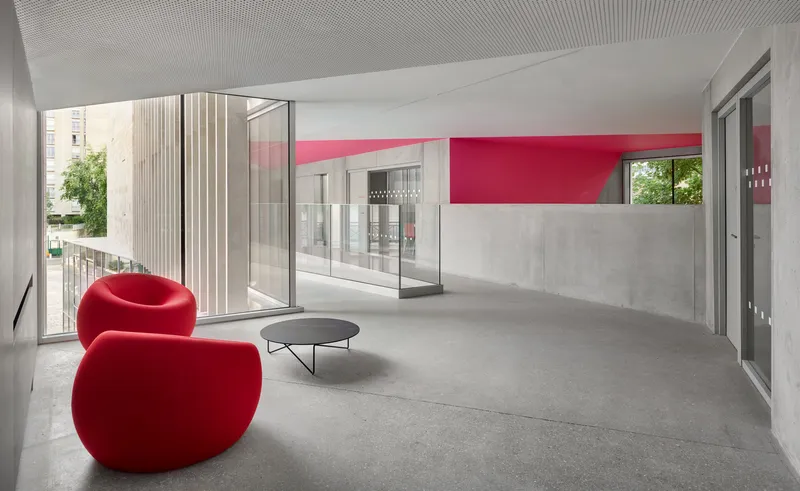
The magenta ceiling plane deserves particular attention. It is not decorative wallpaper; it acts as a spatial datum, a horizontal reference that ties together walkways, suspended spaces, and double-height voids across multiple levels. Paired with an orange-red reception desk and occasional red-lit niches, the color strategy is precise and restrained: enough chromatic punch to energize the concrete without turning the interior into a theme park.
Circulation as Spectacle
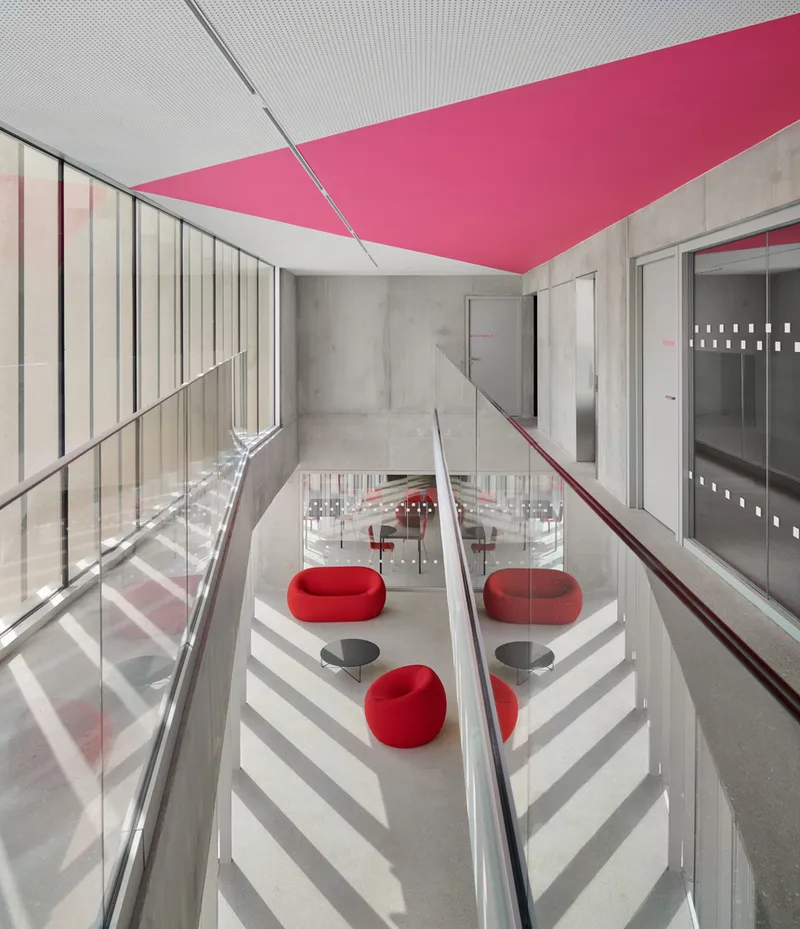
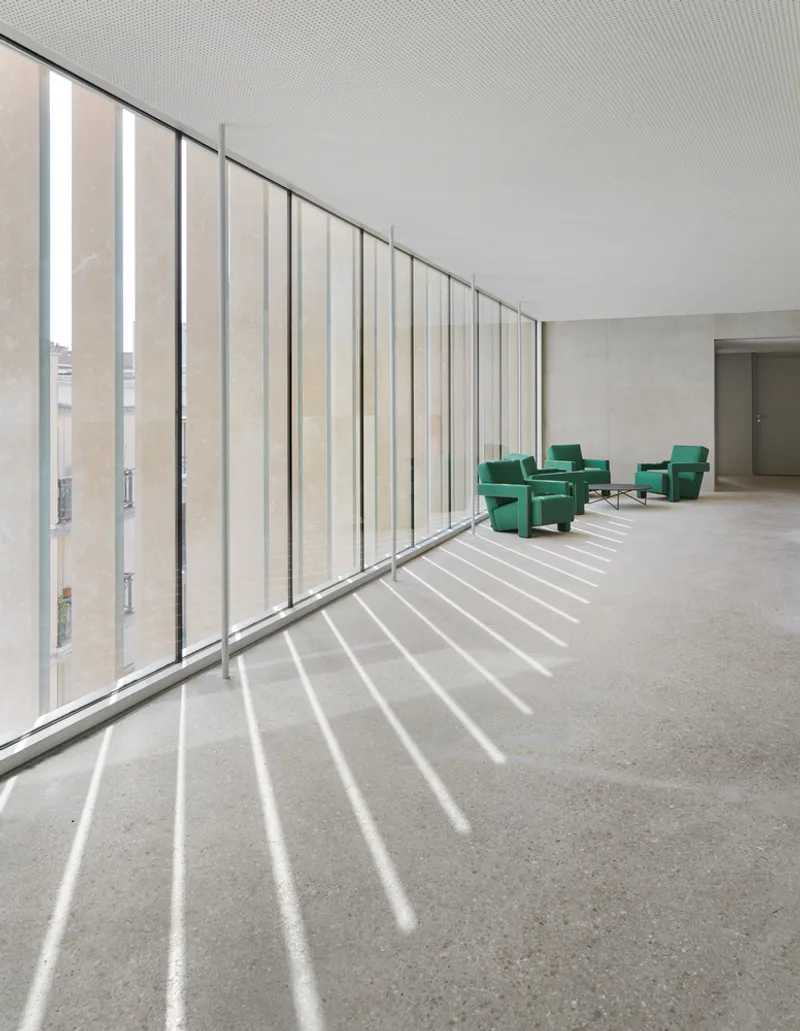
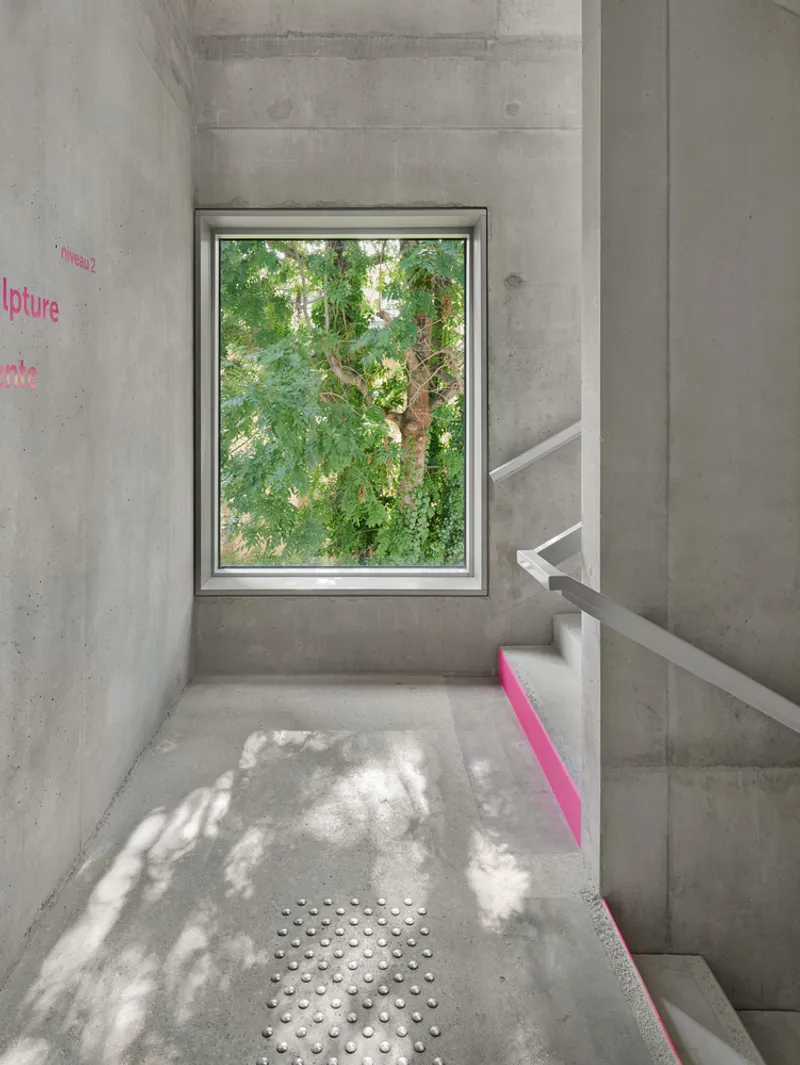
In many mid-sized public buildings, corridors are afterthoughts, leftover space between rooms. Here, they are the primary experience. Upper-level walkways with glass balustrades offer diagonal views down into the hall and across to the embankment garden. Vertical louvers on the facade cast precise striped shadows across terrazzo floors, turning an ordinary hallway into a kinetic light installation that changes by the hour.
The stairwell, framed by a window that fills with green foliage, functions as a decompression chamber between the intensity of rehearsal rooms and the openness of the hall. Coulon understands that a cultural centre's real work happens in transitions: encounters on staircases, overheard music from a walkway, the glimpse of a dance class through a glazed partition.
The Theatre and Its Acoustic Skin
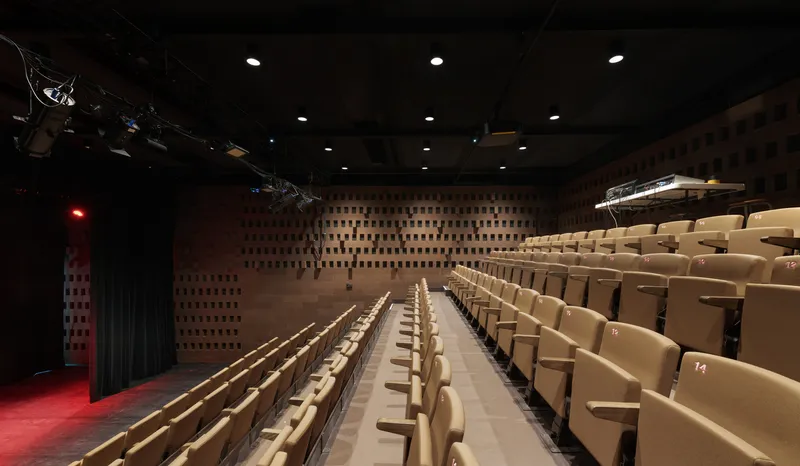
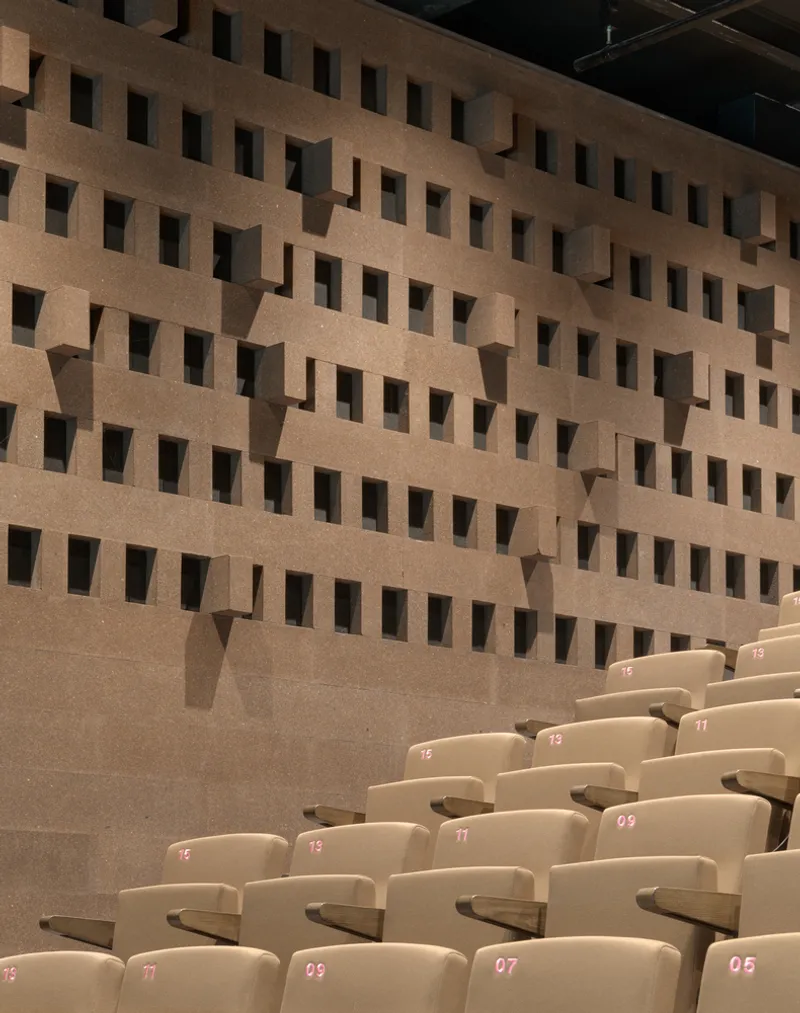
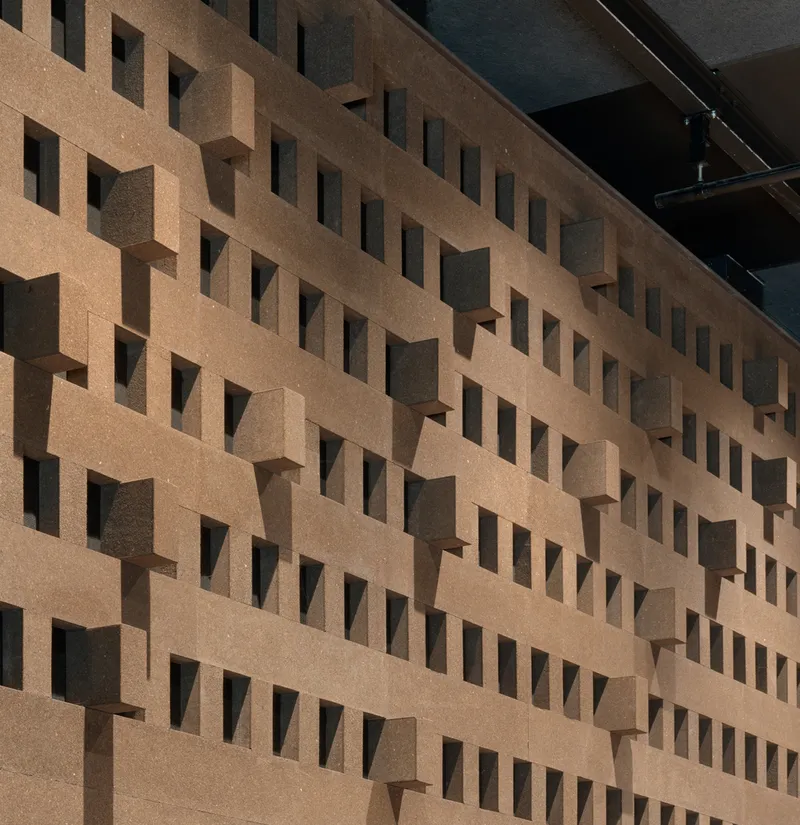
The 250-seat theatre is the programmatic anchor, and its acoustic treatment is the most visually distinctive interior move. Cork wall panels, three-dimensional and staggered with rectangular openings, wrap the auditorium in a textured skin that absorbs and diffuses sound. The protruding blocks create a topography that is both functional and sculptural, lending the room a geological quality that contrasts sharply with the polished concrete elsewhere.
Beech seating risers and warm stage lighting soften what could be a stark volume. A sliding bay window at the rear of the auditorium can open to admit cool air from the embankment on summer days, a passive ventilation strategy that doubles as a scenic connection to the landscape. When the glass doors are closed with black curtains drawn, the room seals into a focused performance box.
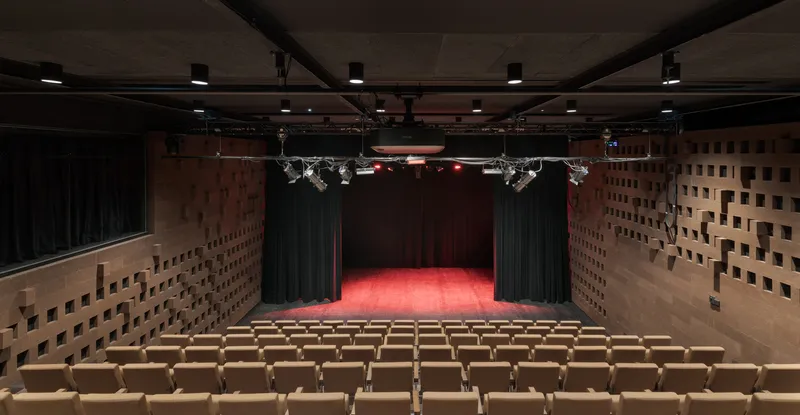
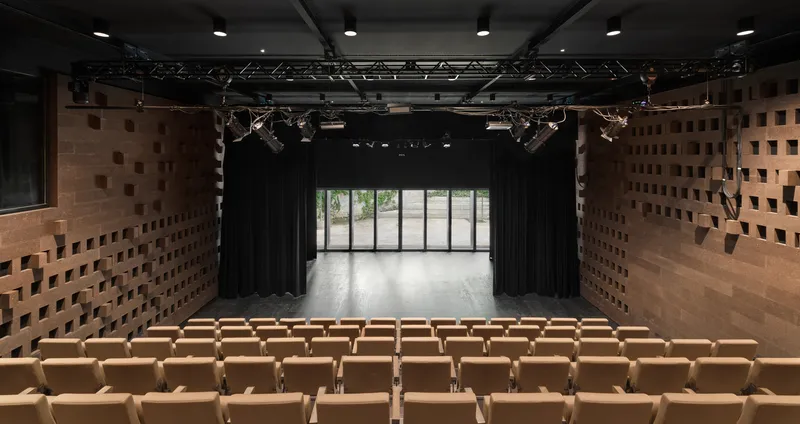
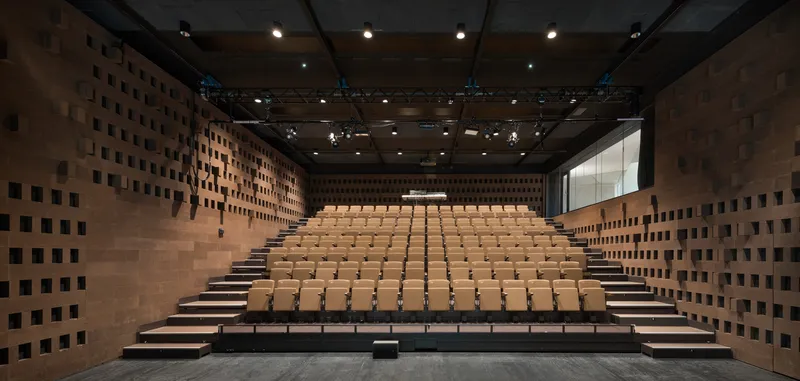
Different configurations of the auditorium space reveal Coulon's flexibility. Perforated timber sidewalls and an exposed black ceiling grid accommodate technical rigging without visual clutter. The theatre's proportions, compact but generous in height, suit both intimate spoken word and amplified performance equally well.
Studios, Workshops, and the Pedagogy of Materials
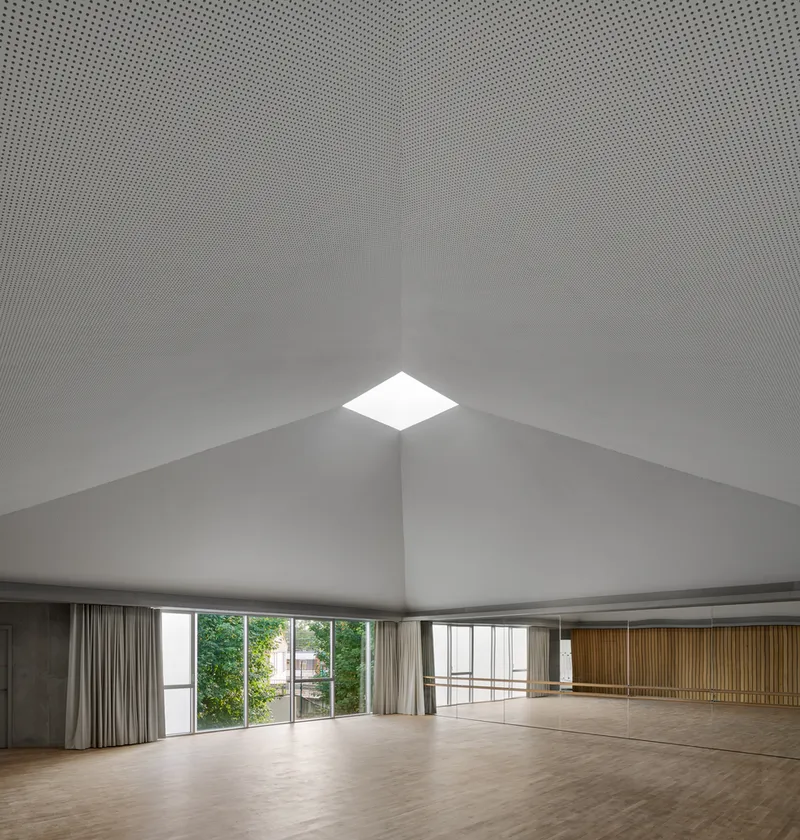
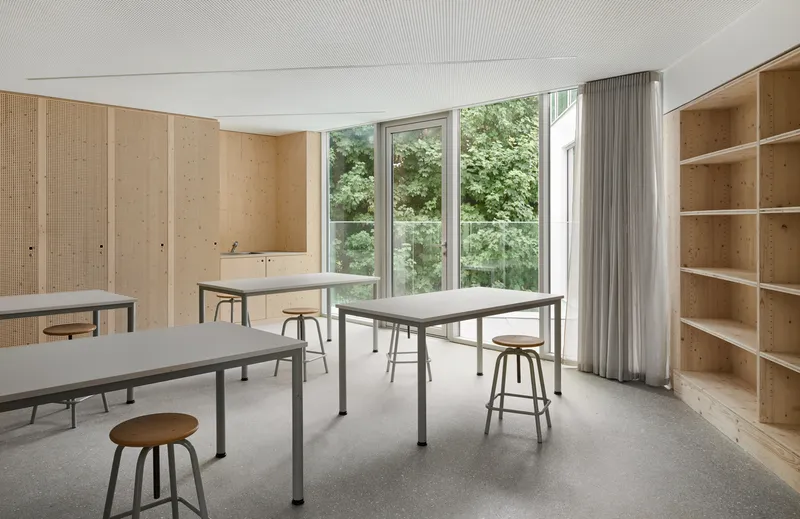
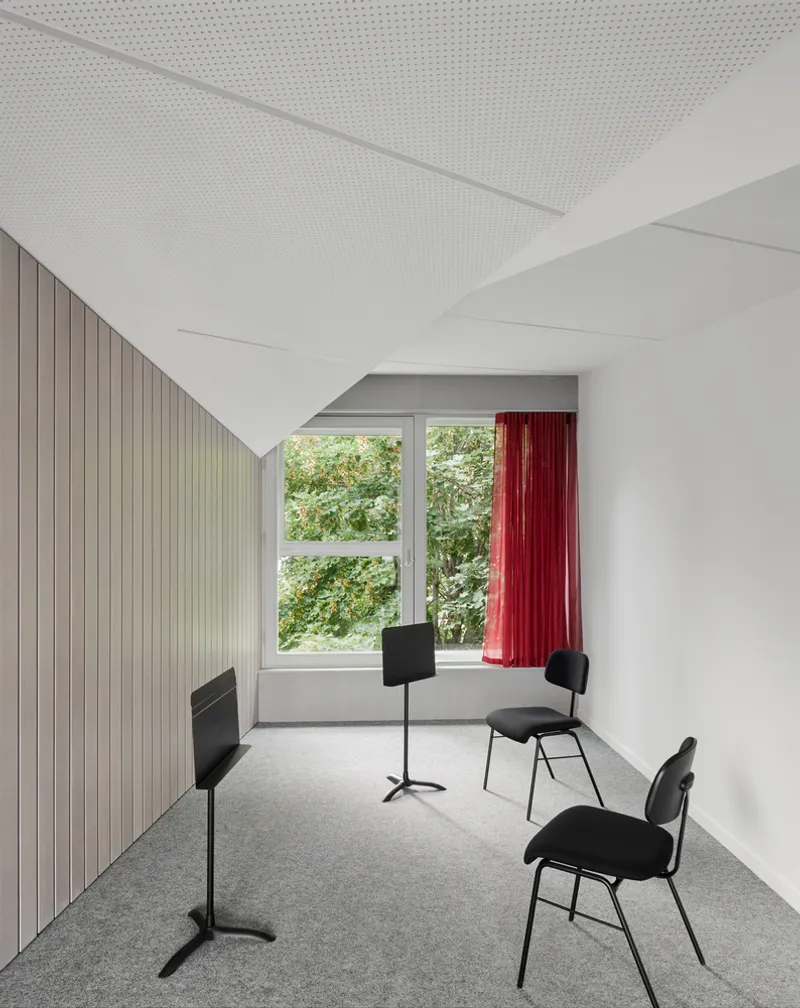
Each programmatic room receives its own material identity. The dance studio features perforated acoustic ceiling panels and a square skylight that washes the space in even, overhead light, critical for rehearsal. Pine-clad walls in the visual arts workshops absorb noise and provide a warm backdrop for making. A white rehearsal room with vertical timber cladding and red curtains achieves near-clinical acoustic neutrality.
This room-by-room material differentiation, pine for art, cork for theatre, oak parquet for dance, polished concrete for circulation, is what elevates the building beyond its budget. Coulon uses material specificity as wayfinding: you know where you are by what you touch and hear, not just by signage.
Everyday Rooms, Carefully Made
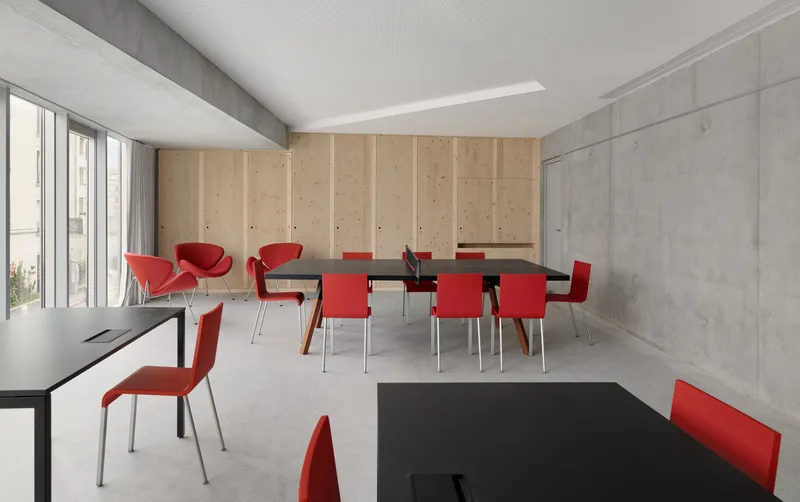
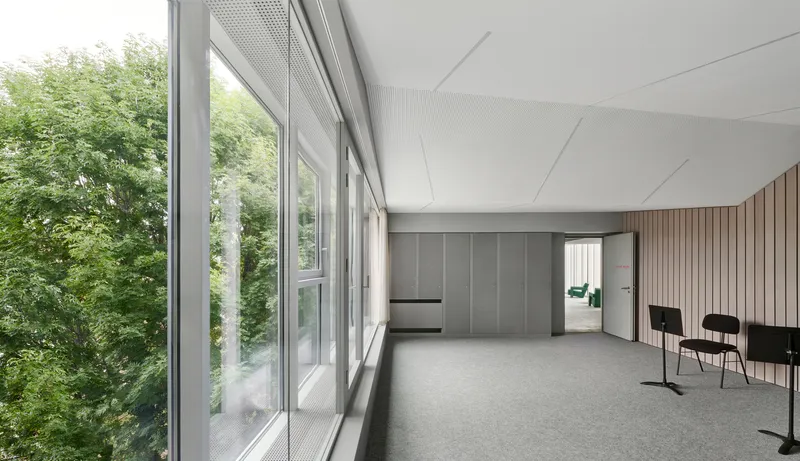
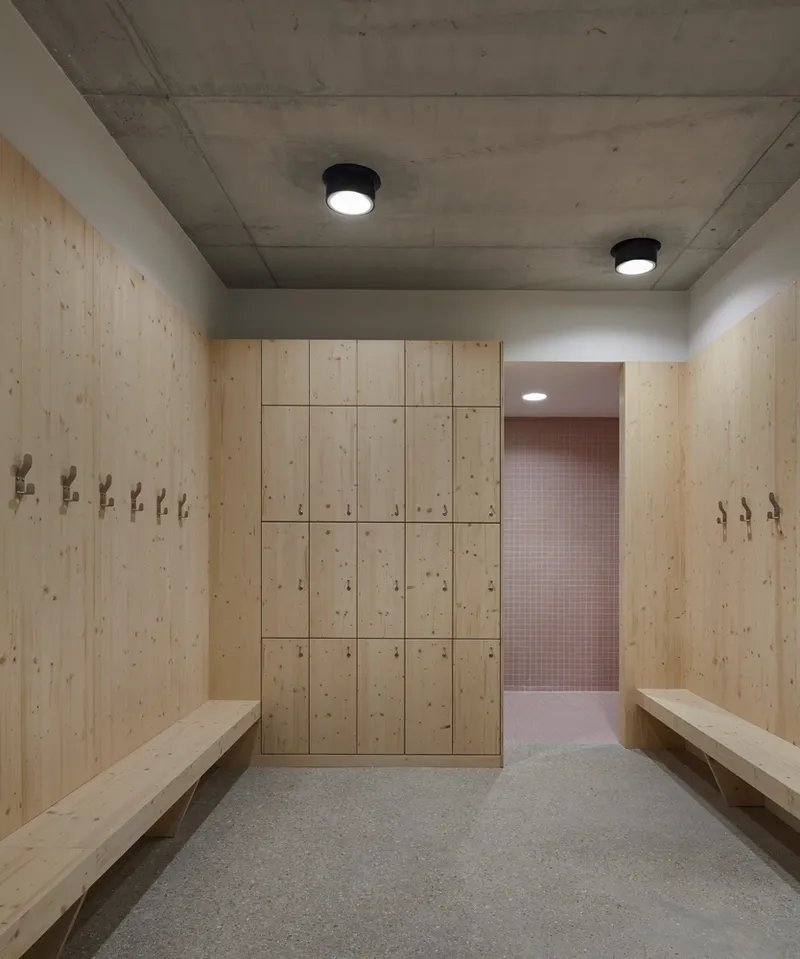
The meeting room, with its exposed concrete walls, plywood cabinetry, and red upholstered chairs, could have been an anonymous utility space. Instead it reads as a curated interior with a clear palette. The same discipline applies to classrooms overlooking summer trees and to the changing room, where light wood lockers and a glimpse of pink tile beyond suggest that care extends to every programmatic corner.
These are the rooms that will be used daily, not for special events. Their quality speaks to a conviction that dignity in public architecture is not reserved for lobbies and auditoria.
Landscape and the Borrowed View
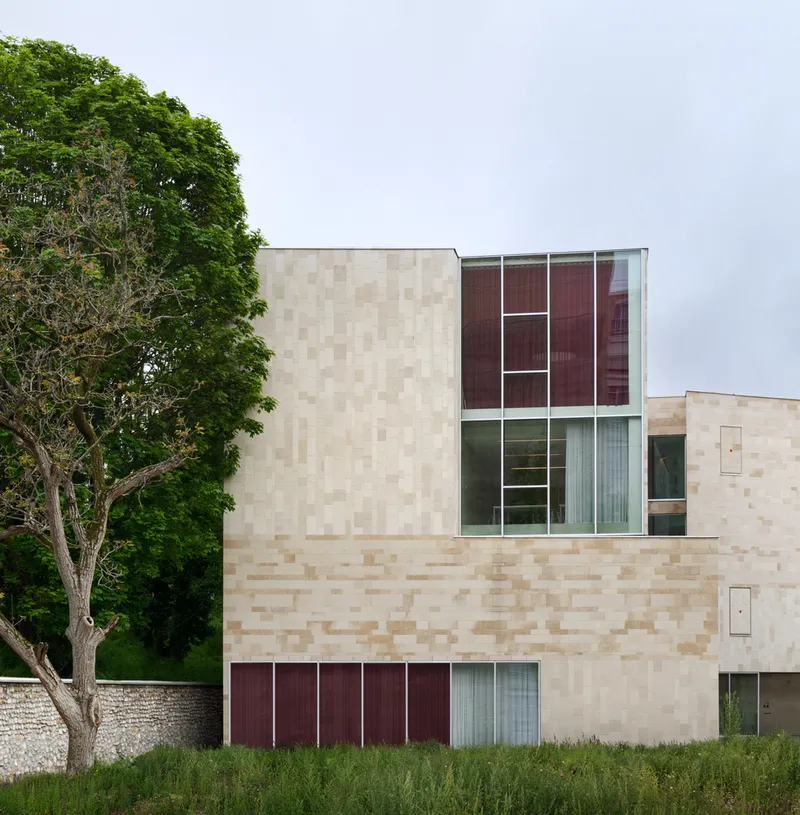
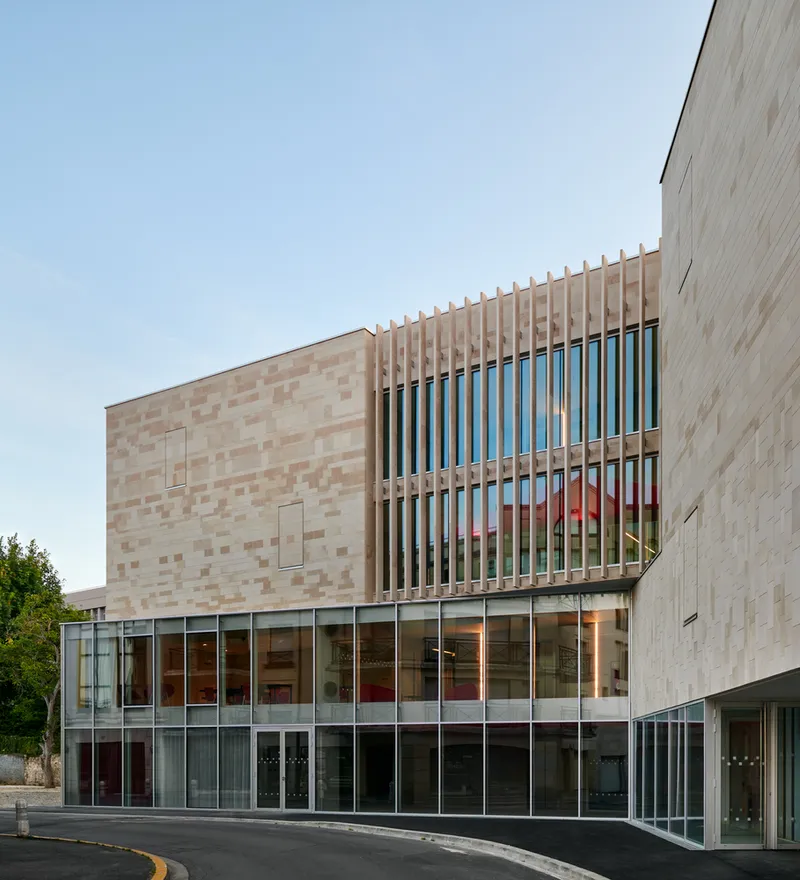
The vegetation-covered embankment that carries the regional trainline is the building's most unlikely asset. Rather than treating it as a nuisance, Coulon orients key windows toward the wooded slope, borrowing its greenery as an interior finish. At dusk, the timber-louvered upper volume glows above a glazed ground floor, and the mature trees along the street become part of the composition.
Inside, corridors with pink wall bands and red seating face glass-enclosed rooms that in turn frame exterior garden views. The layering of interior color against exterior green creates a depth of field that makes the building feel embedded in its landscape rather than merely adjacent to it.
Plans and Drawings
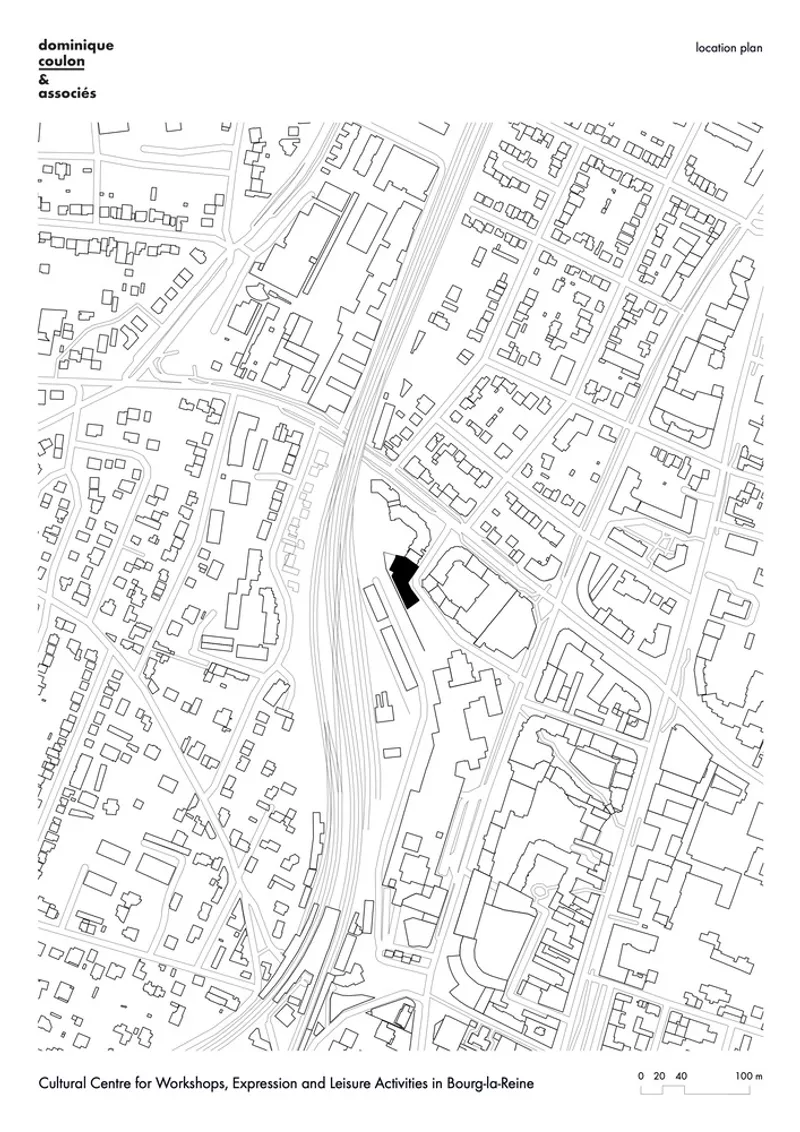
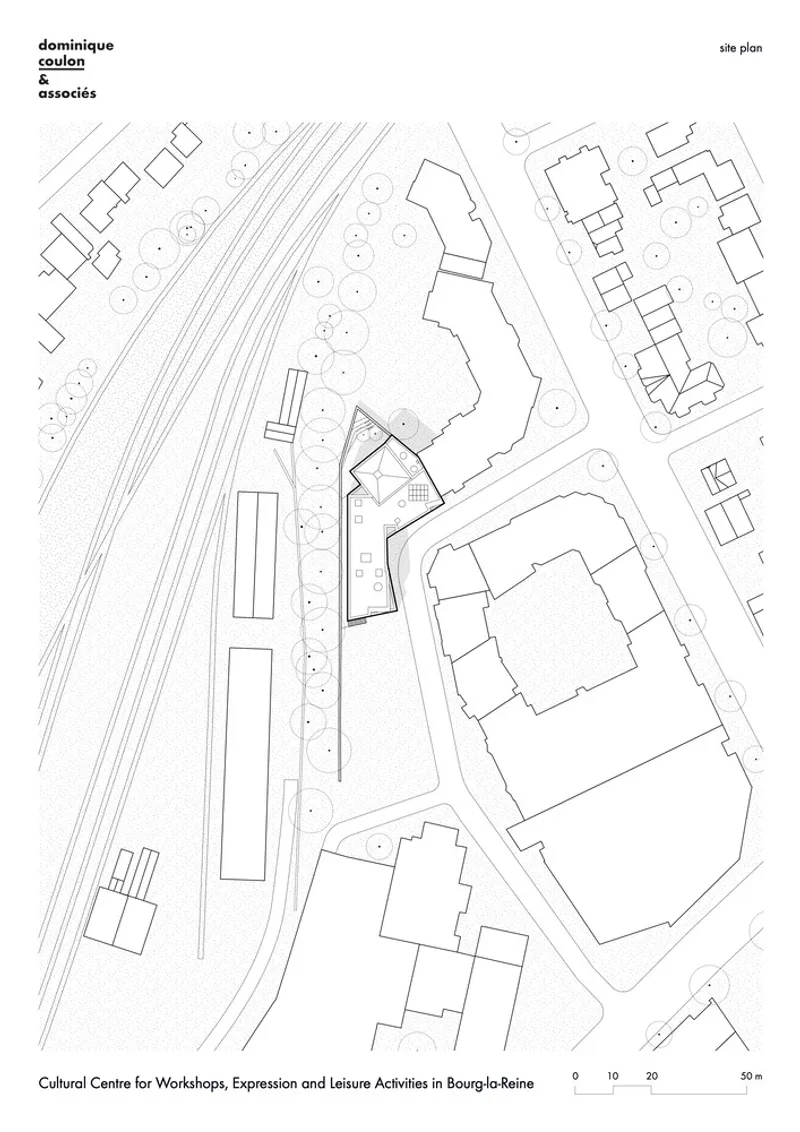
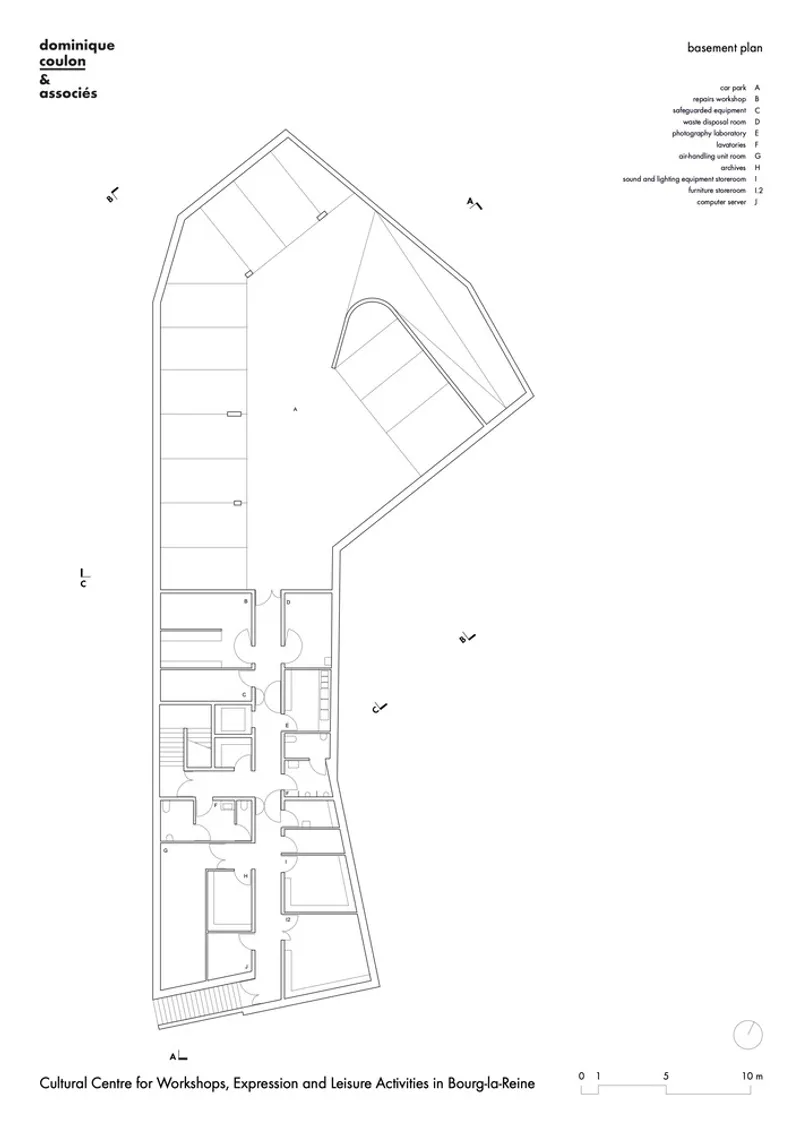
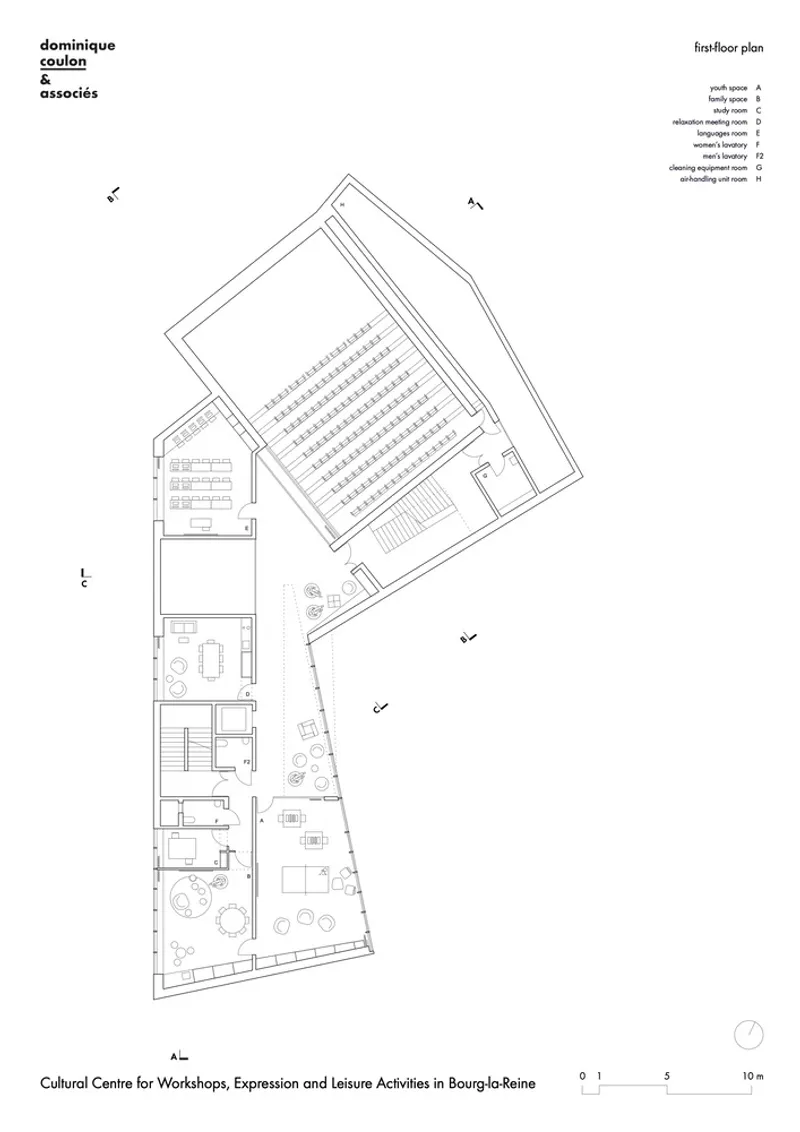
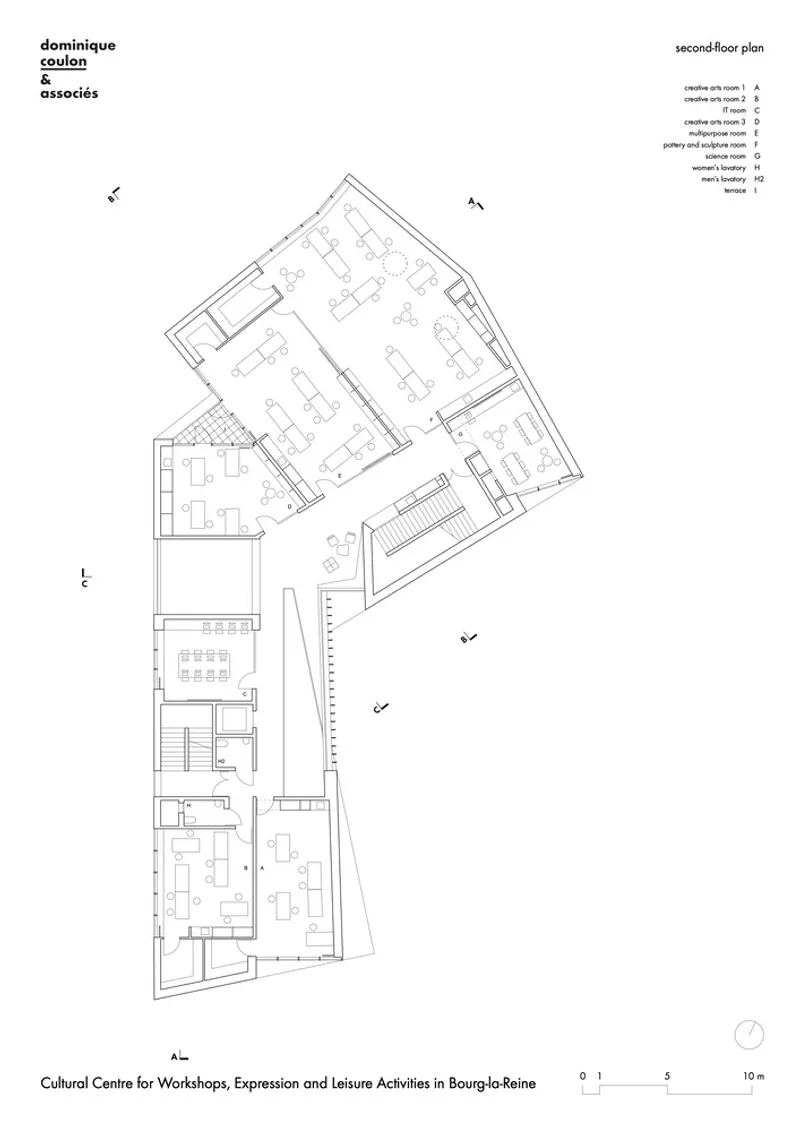
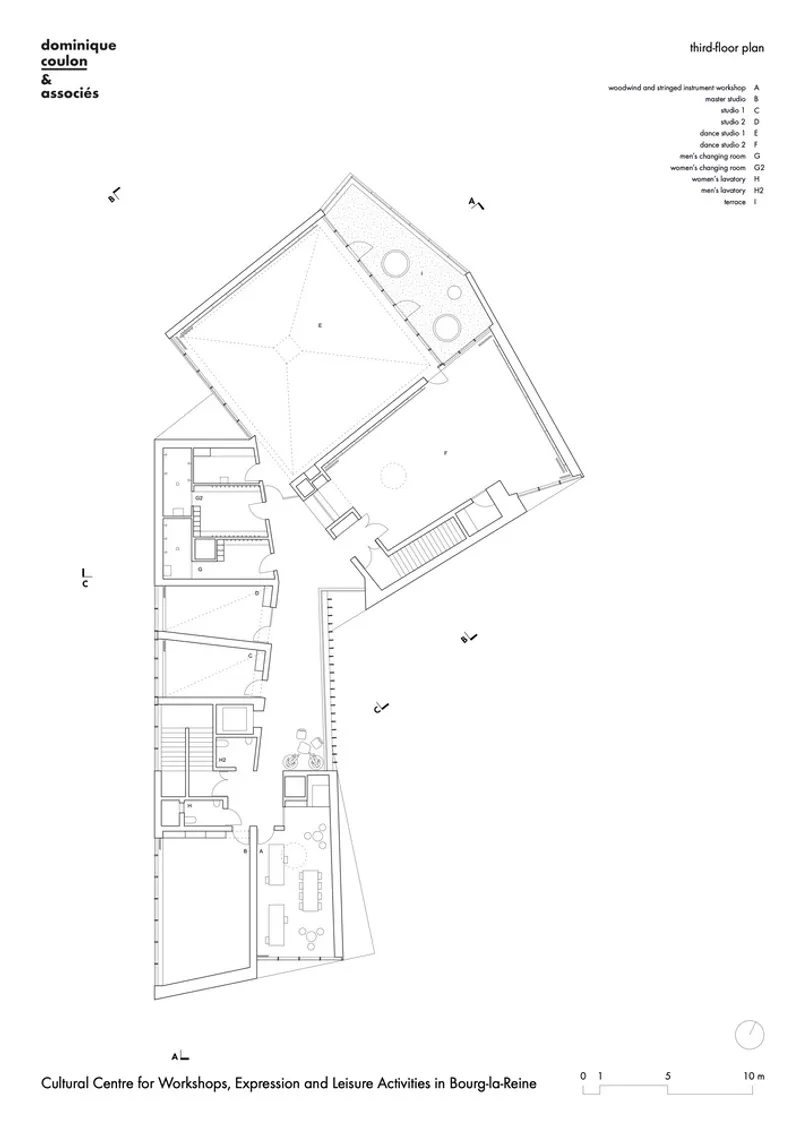
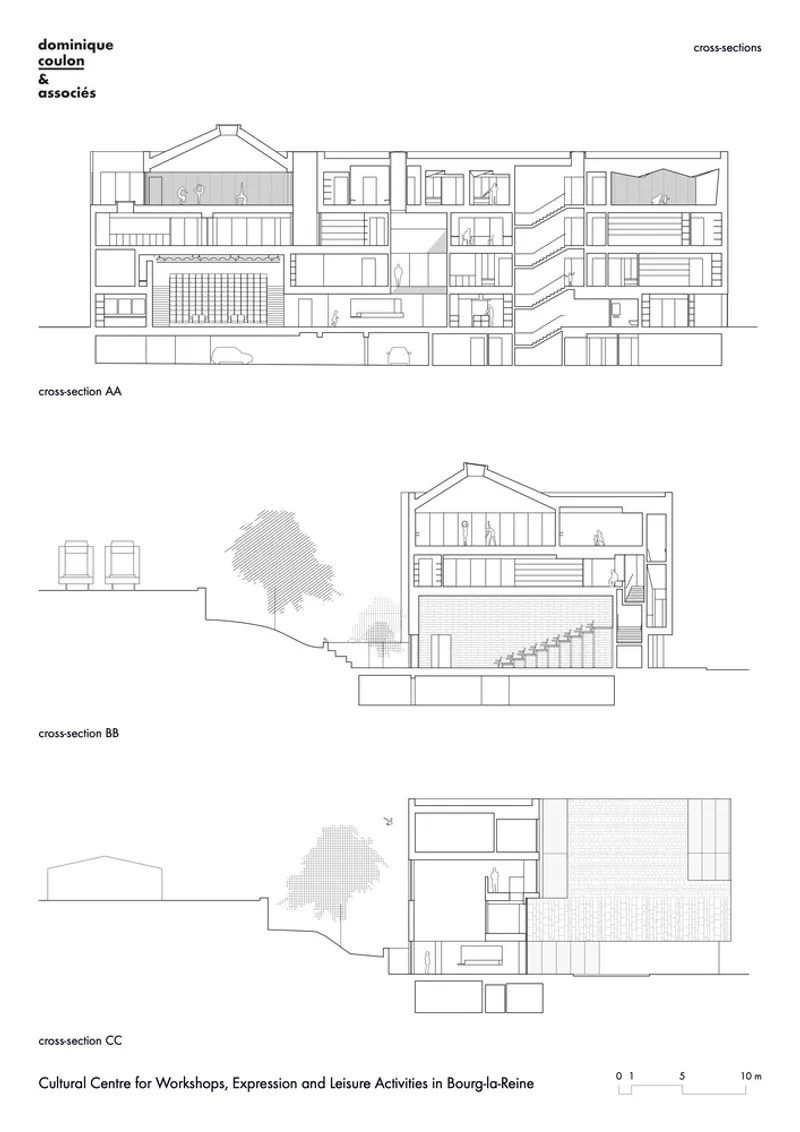
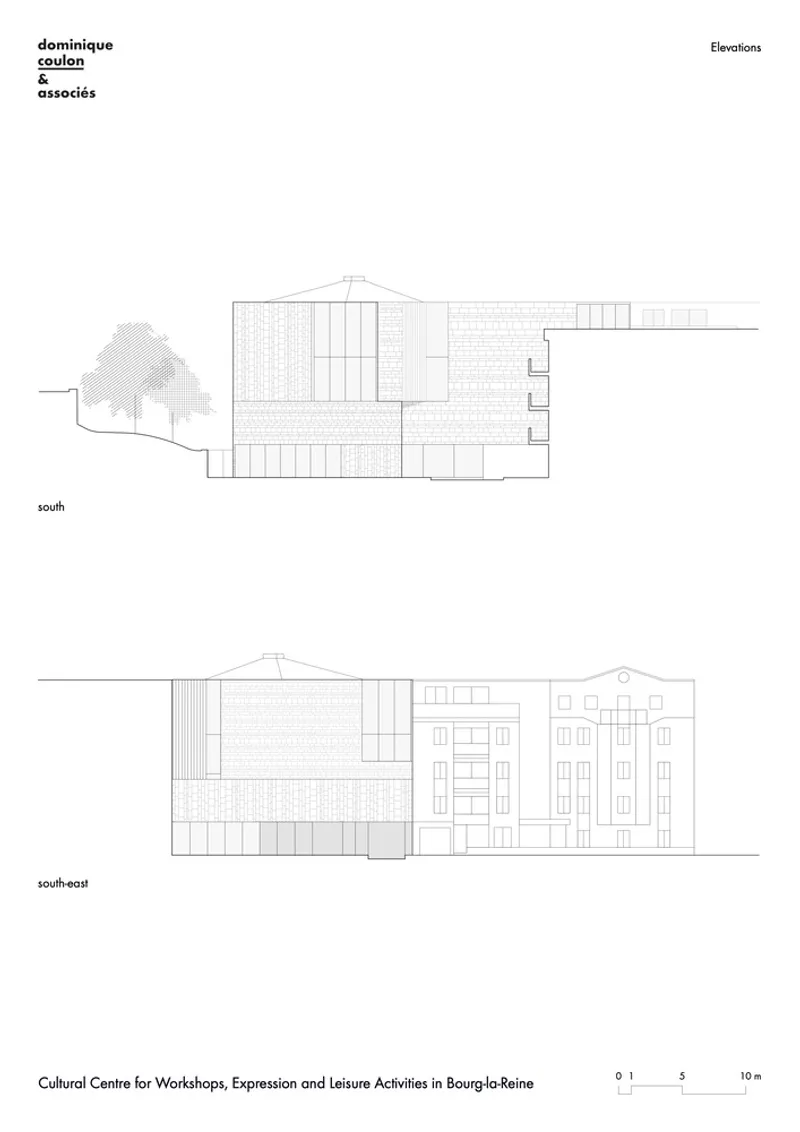
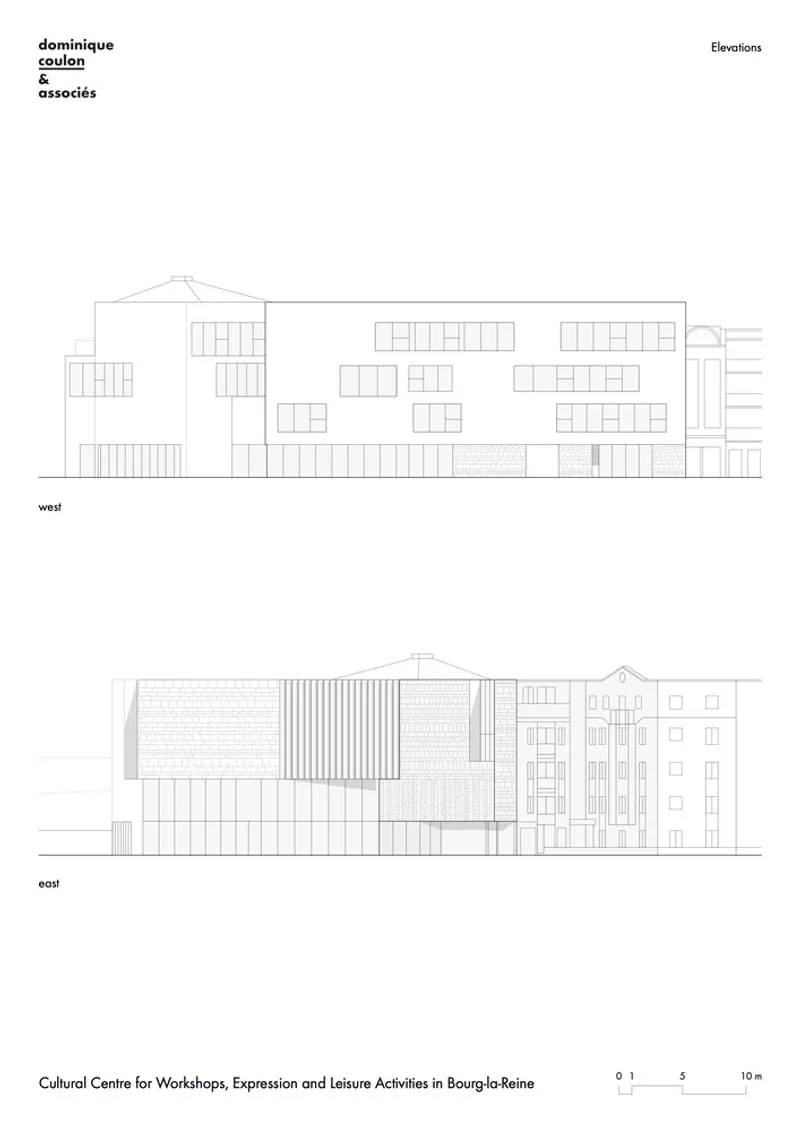
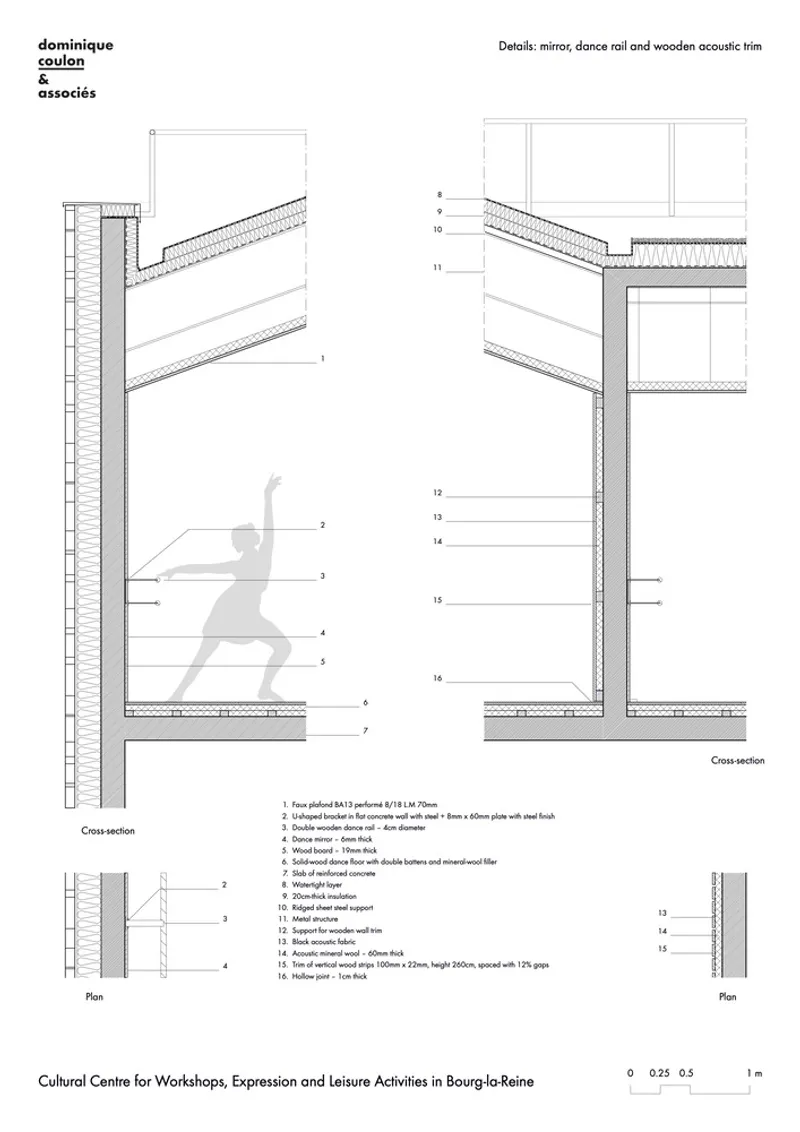
The plans reveal the angular logic that the photographs only hint at. The building's footprint, visible in the site plan, is a fractured L that maximizes distance from the railway while creating pockets of outdoor space toward the street. Floor plans show how the auditorium anchors the lower wing while studios and workshops stack upward in the other, connected at every level by the central hall. Cross-sections make explicit the triple-height void's role in pulling daylight deep into the plan, and the elevations document the full catalogue of facade treatments: chequered limestone, vertical metal fins, timber louvers, and burgundy glazed panels, all disciplined into a coherent composition.
The detail section of the dance hall wall, with its wooden acoustic trim, confirms that the acoustic strategy is not applied surface treatment but integral construction. Every layer, from structure to finish, serves a dual purpose.
Why This Project Matters
Small-commune cultural centres in France too often oscillate between two poles: the over-designed icon that ignores its context, or the anonymous box that satisfies the program brief and nothing else. Coulon's building at Bourg-la-Reine occupies a productive middle ground. It is unmistakably a public building, legible from the street as something that belongs to the community, but it draws its spatial richness from the specific constraints of its site rather than from imported formal gestures.
The lesson here is about economy of means. A €6 million budget, a narrow L-shaped lot beside a railway, a program that could have been banal: none of these conditions suggested the triple-height, color-saturated, materially specific building that resulted. Coulon's achievement is proving that constraint, taken seriously and read generously, remains the most reliable generator of architectural quality. For a town of 21,000 people south of Paris, that is no small gift.
Cultural Centre, Bourg-la-Reine, France. Architect: Dominique Coulon & Associés. Location: 11 rue des Rosiers, 92340 Bourg-la-Reine, France. Area: 2,550 sqm. Year: 2023. Photographs by Eugeni Pons.
About the Studio
Share Your Own Work on uni.xyz
If projects like this are the kind of work you want to make, uni.xyz is a place to publish your own, find collaborators, and enter design competitions.


Popular Articles
Popular articles from the community


longwave studio Reorganizes a 112 m² Tainan Apartment Around the Daily Routines of a Family and Two Cats
In Tainan, Taiwan, birch plywood, rust-red furniture and a freestanding plaster wall link arrival, storage, work and family life in one apartment.

Cube Design Draws an Ecological Corridor Between Two Shenzhen Hills with the Nankai Building
Beside Shenzhen's container docks, the Nankai Building pairs stacked balconies with a climbing green screen to connect two hillsides across its height.

David Macias Steps a Doorless Stone and Plaster House Down a Tropical Colombian Hillside
In the humid hills of Colombia, Threshold House replaces the front door with an open void and terraces its 850 m² down the slope instead of fighting it.

Jaramillo Van Sluys Arquitectura and Urbanismo Turn a Demolished Registry Lot in Quito into an Orchard Plaza
In Quito's Centro Histórico, a 2,800 m² plaza exposes the San Agustín convent wall and redraws its lost Augustinian orchard in volcanic stone.

Similar Reads
You might also enjoy these articles


Hodi-Mandai Geram
Project Function: Preservation and revitalization of the Intangible heritage and socio-spatial identity of the Hodi by Housing, Cultural Memory Center, Sacred Grove, landscape, local tourism economy


Olio Towers: A Mid-Rise for Performers That Fuses Housing, Rehearsal, and Stage
Located blocks from Houston's Theater District, this modular tower stacks living units around a central performance atrium.

Oasis: Modular Green Housing Carved into Dhaka's Urban Fabric
A shortlisted Plugin Housing entry reclaims unauthorized settlements in Dhaka with stepped concrete volumes, green roofs, and ventilation-driven design.

Black Hole: A Floating Megastructure for the Post-Physical Era
Emiliano Mazzarotto envisions a spherical, self-scaling arena where e-sports, digital hotels, and holographic stadiums replace traditional public space.

Explore Culture & Art Centre Competitions
Discover active competitions in this discipline

Challenge to reimagine the Iron Throne

Photograph architecture without architects

Illustrate the lost glory of Angkor Wat - Render Challenge

Design challenge to reuse E-waste
Comments (0)
Please login or sign up to add comments
No comments yet. Be the first to comment!