
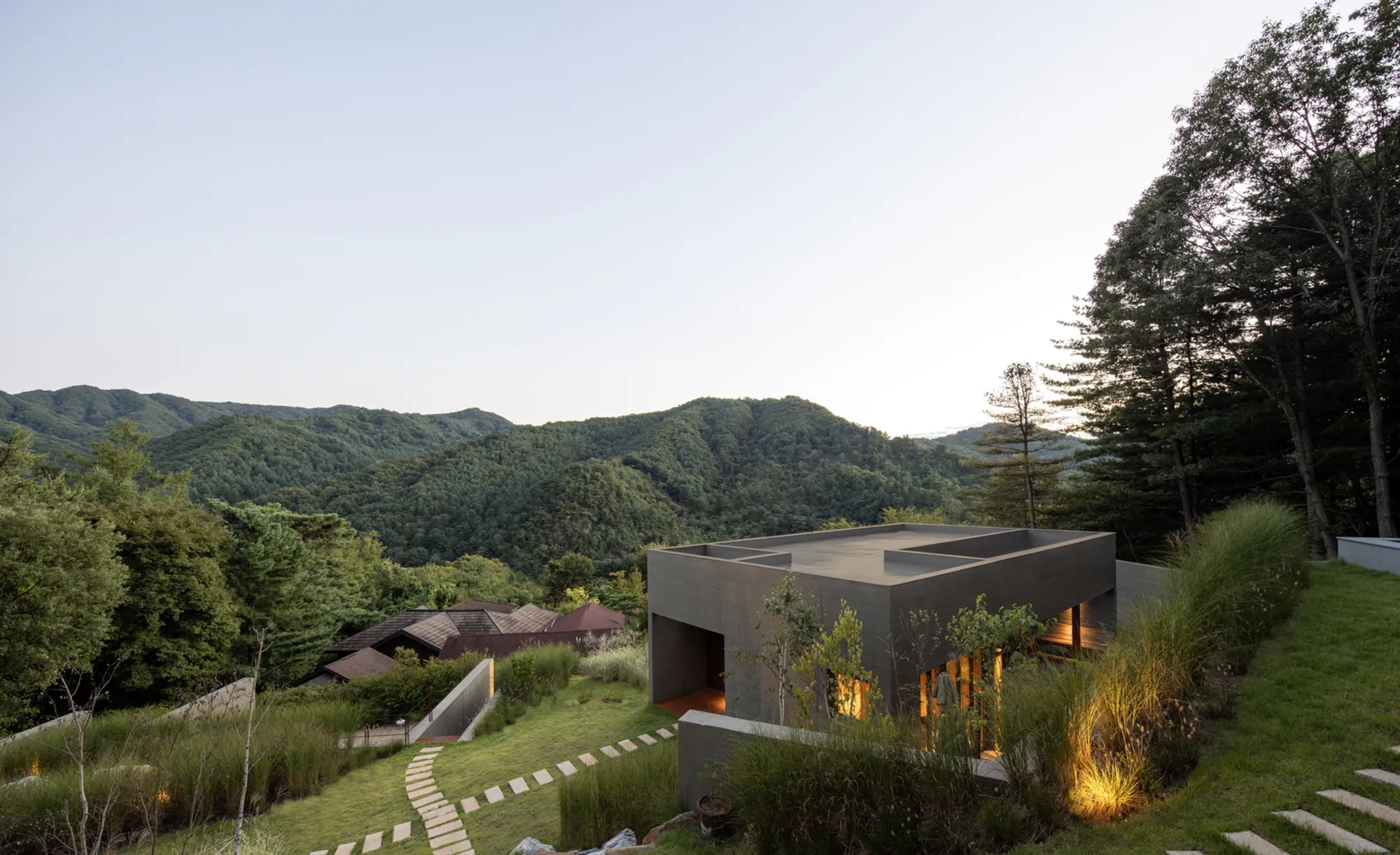
100A Associates Tucks a 68-Square-Meter Retreat into a Korean Mountainside
Ooort House in Gyeonggi-do uses board-formed concrete and Corten steel to slowly dissolve into the forests of Cheonggyesan.


At 68 square meters, Ooort House is barely larger than a generous apartment. But its ambitions run far deeper than its footprint. Designed by Seoul-based 100A associates and completed in 2024, the house sits on a steep slope embracing the ridgeline of Cheonggyesan in Gyeonggi-do, South Korea. Lead architects Kwang-il An and Sol-ha Park conceived it not as a building dropped onto terrain, but as a set of volumes that accept the hill's logic, following its grade and using its elevation changes as structural starting points.
The name itself, a portmanteau of the Korean words for "edge" and "place," points to the house's defining tension: it is both a refuge from urban life and a threshold toward wildness. What makes it genuinely interesting is its commitment to disappearance. Every material, from the wood-grain-imprinted concrete to the Corten steel panels, is chosen to weather, patinate, and eventually merge with the surrounding forest. Most hillside houses try to announce themselves against the landscape. Ooort House is designed to become part of it.
A Compound Carved from the Slope
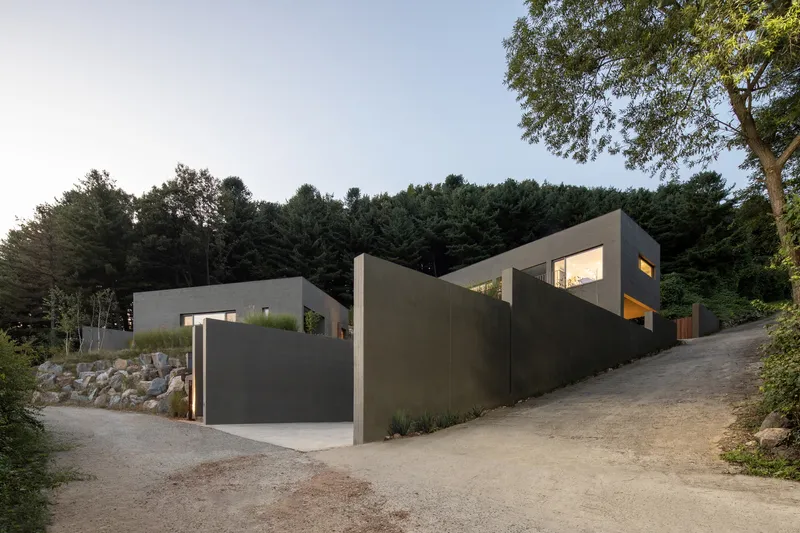
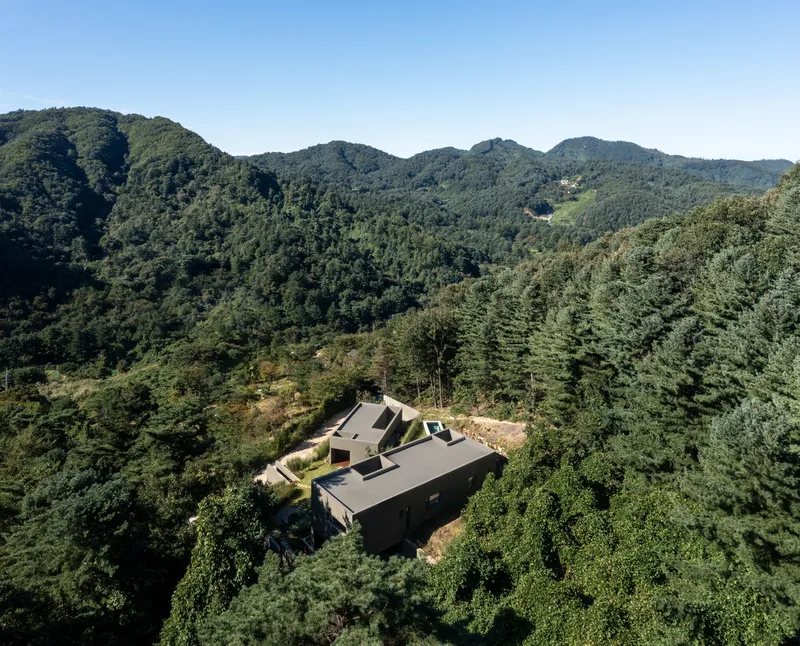
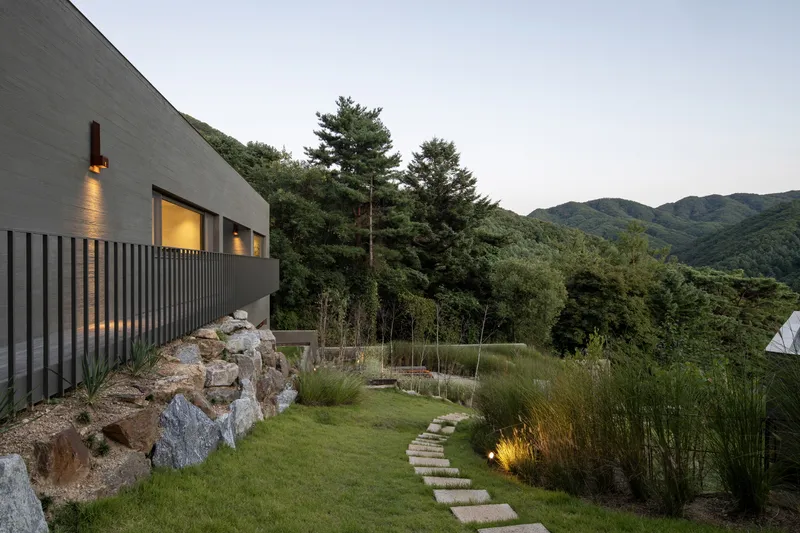
Seen from the street or from the air, Ooort House reads as a cluster of dark, angular volumes pressed into dense tree cover. The compound splits into two distinct buildings, a main house and a detached guest volume, each oriented to follow the slope's natural contour rather than fight it. The architects used the site's accumulated level differences as the organizing principle, letting the terrain dictate where walls begin and rooflines end.
Terraced lawns and stone stepping paths stitch the buildings to the ground plane, and vertical slat screening at the lower levels provides a visual transition between the hard geometry of concrete and the organic sprawl of the hillside. The result, especially at twilight when interior lights glow against the forest canopy, is a project that feels embedded rather than erected.
Concrete as Landscape
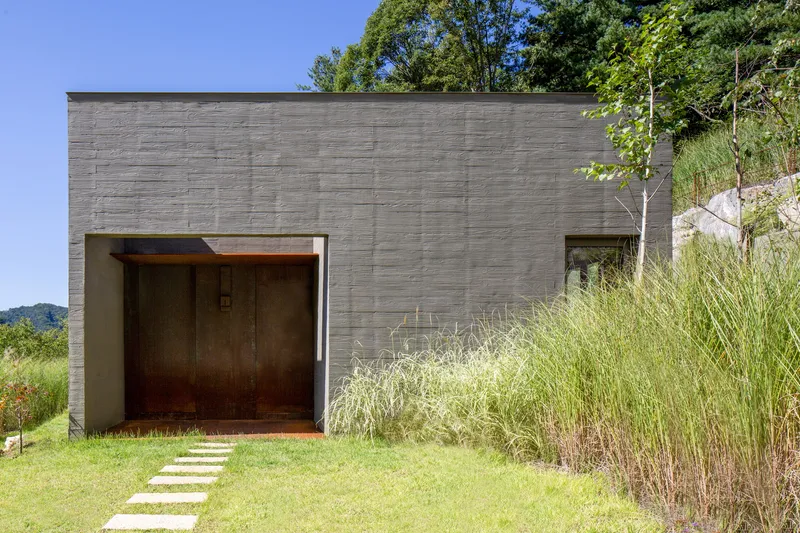
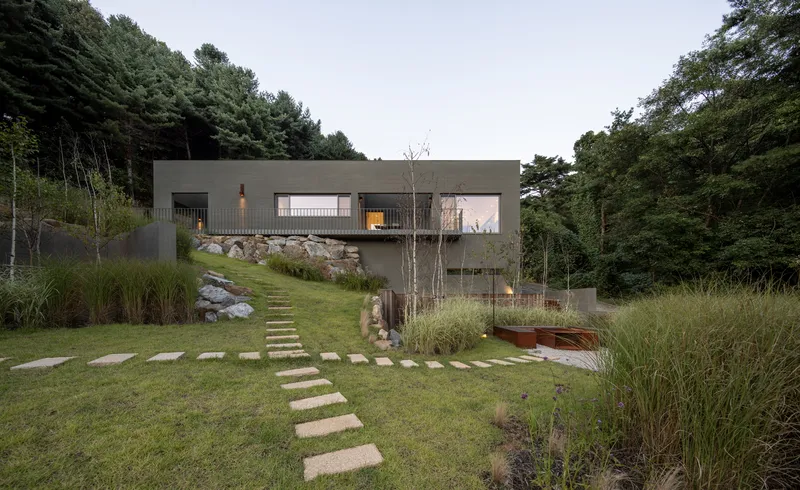
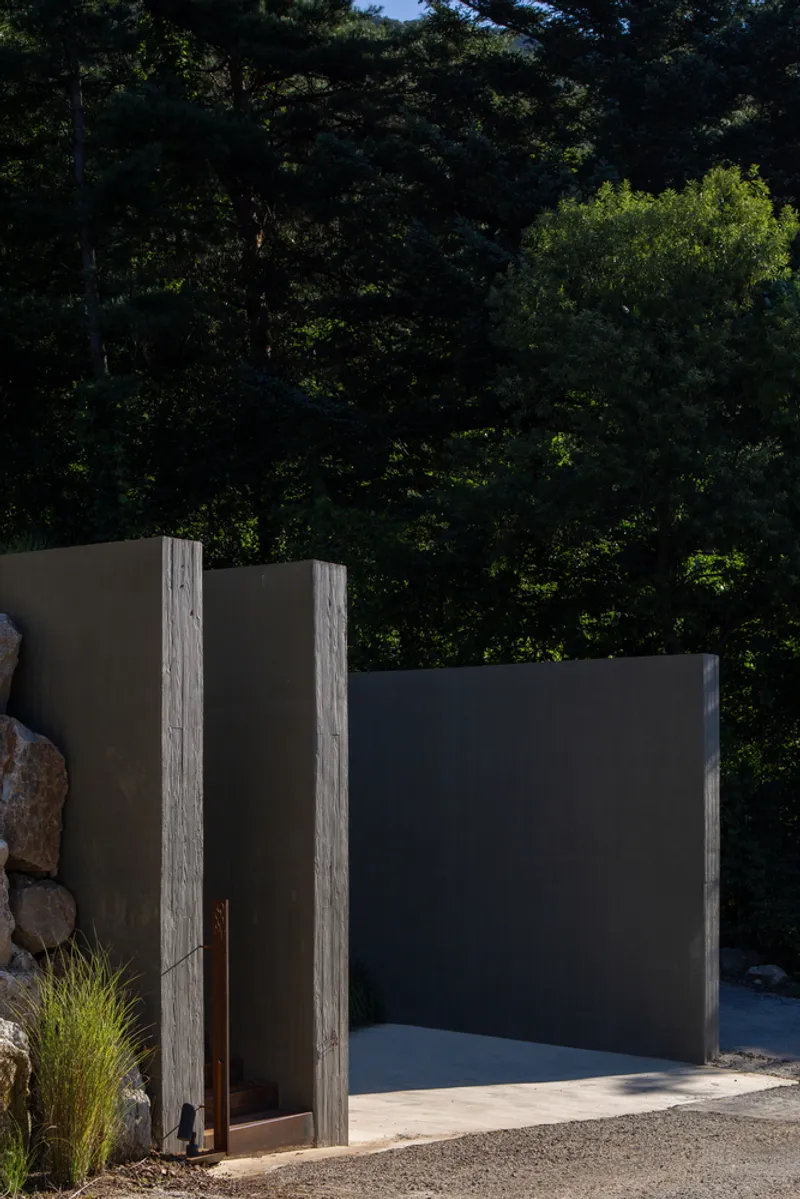
The retaining wall is the project's most forceful gesture. Rather than treating it as infrastructure to be hidden, 100A associates made it the architectural protagonist. The horizontally striated, board-formed concrete carries the memory of its timber formwork, creating a surface that oscillates between industrial weight and organic texture. It reads differently at every hour: flat and austere under midday sun, deeply shadowed and almost geological at dusk.
At the entry, alternating panels of dark metal and wood-textured concrete flank a pivoting door, establishing a threshold that is simultaneously inviting and monumental. The effect is deliberate: you approach the house through a sequence of hard, weathering surfaces that gradually yield to softer interior conditions. The retaining wall does not merely hold back the earth; it announces a tectonic philosophy where structure and site are inseparable.
The Courtyard as Mediator
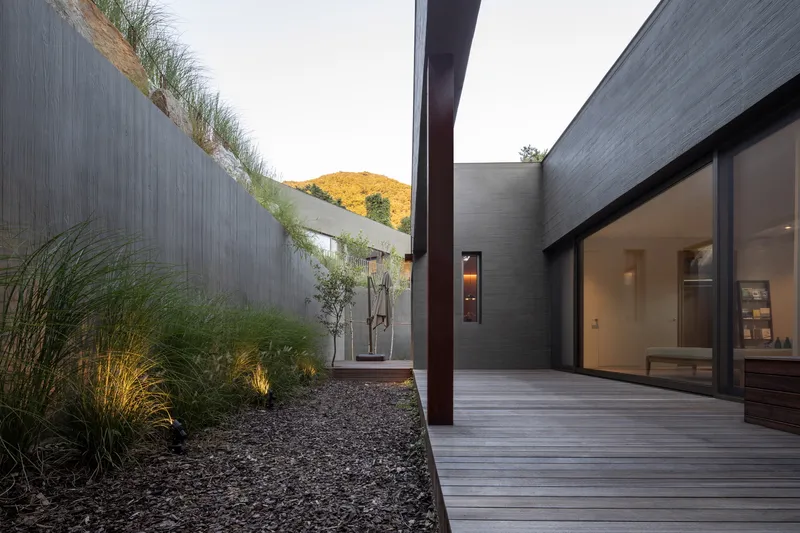
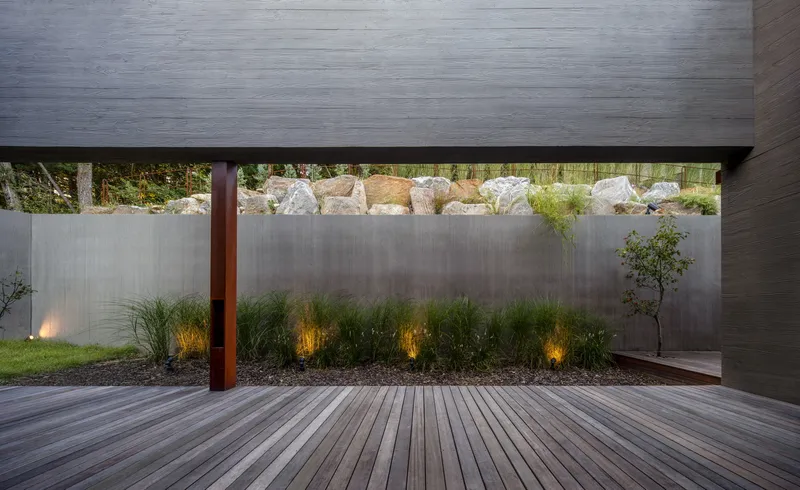
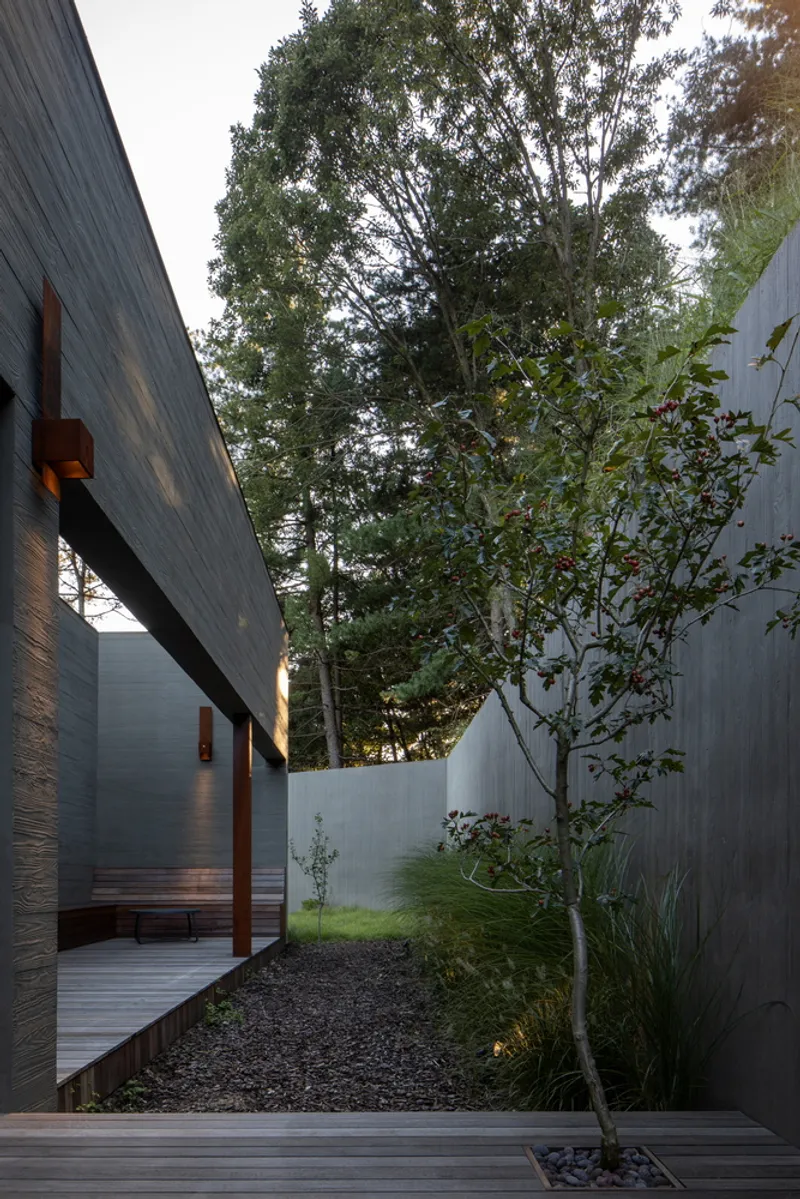
Between the main house and the guest volume, a timber deck courtyard operates as the heart of the project. Framed on both sides by board-formed concrete walls and planted with tall ornamental grasses, this interstitial space is where the architecture pauses. It is not a room, exactly, and not a garden, but something in between: a decompression chamber between the private world of the house and the wildness of the mountain.
At dusk, uplighting washes the grasses from below, throwing long shadows onto the concrete and turning the courtyard into a kind of stage set. The planting is carefully calibrated: species that move in wind, change color with the seasons, and grow tall enough to filter views without blocking them. The architects describe the space as a "sensory bridge," and the term feels earned. Standing on the timber deck, you are simultaneously inside the architecture and inside the landscape.
Interior Warmth Against Raw Walls
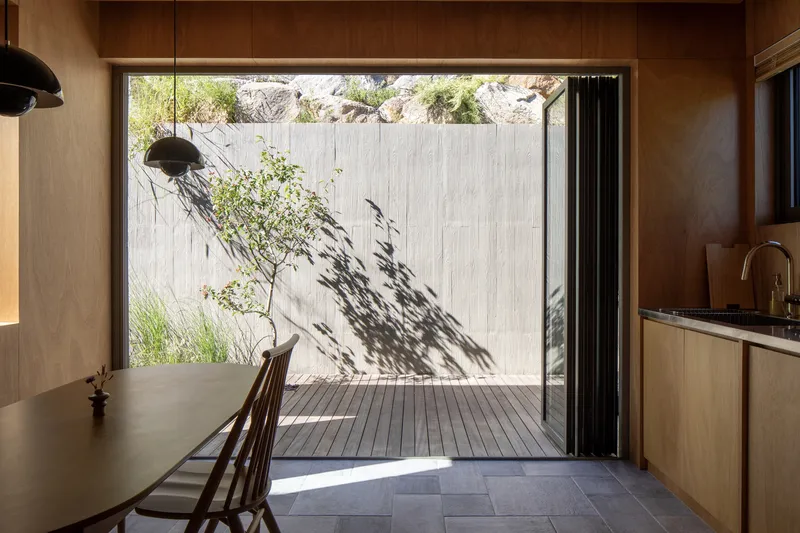
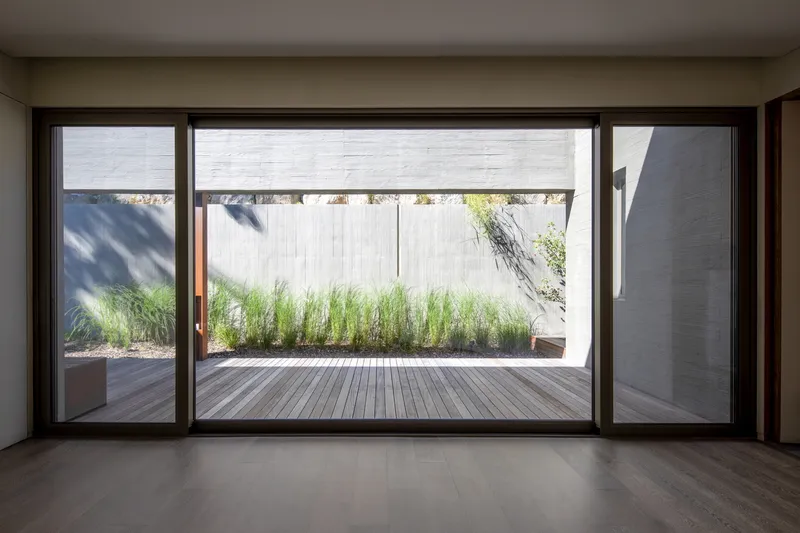
Inside, the material palette softens without sentimentality. Timber-lined walls and ceilings in the dining area open directly onto the deck courtyard through generous glazing, collapsing the boundary between interior and exterior. The concrete that dominates outside continues inward at selective moments, appearing as accent walls or frames, but is always counterbalanced by the warmth of wood and the quietness of natural light.
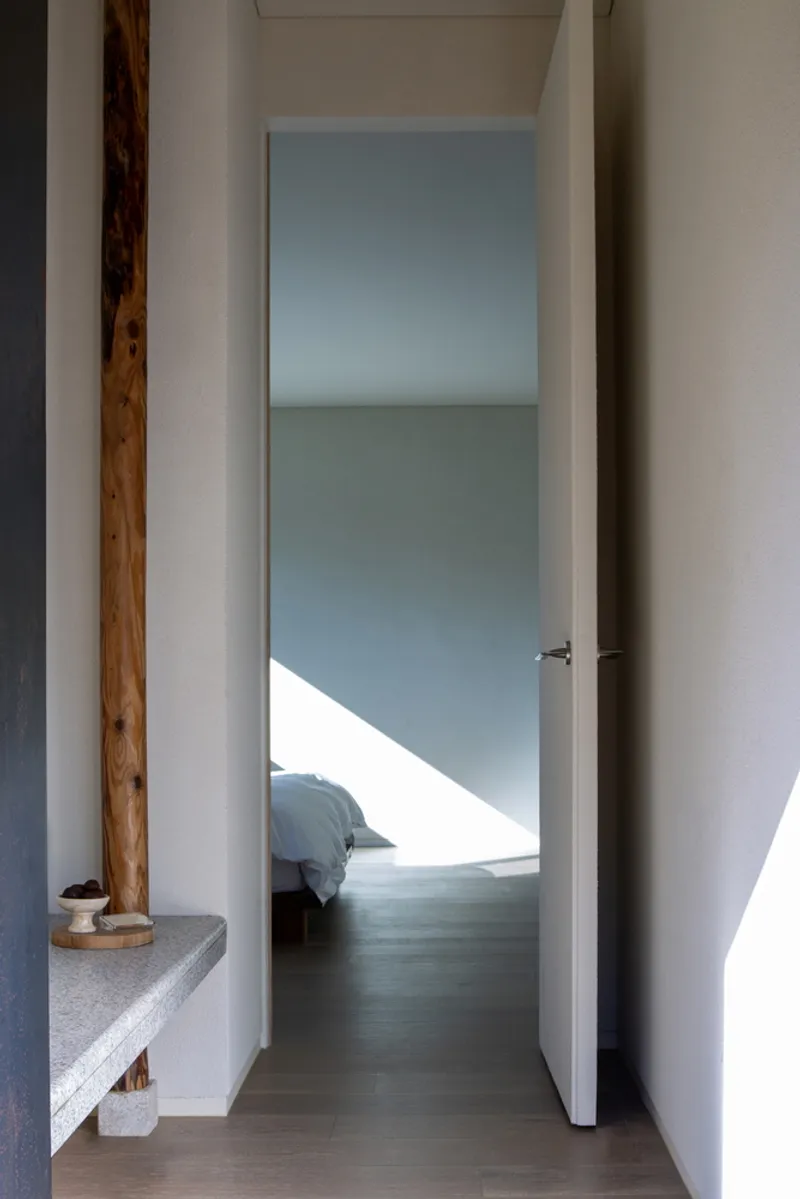
A narrow hallway punctuated by a natural timber post and a stone shelf leads toward the bedroom, where angled afternoon sunlight carves across the floor. These are not grand rooms. They are deliberately intimate, scaled to the rituals of two people living slowly. The architects left strategic voids throughout the plan, openings that serve no programmatic purpose except to let light shift and time register on surfaces.
Views Framed Like Paintings
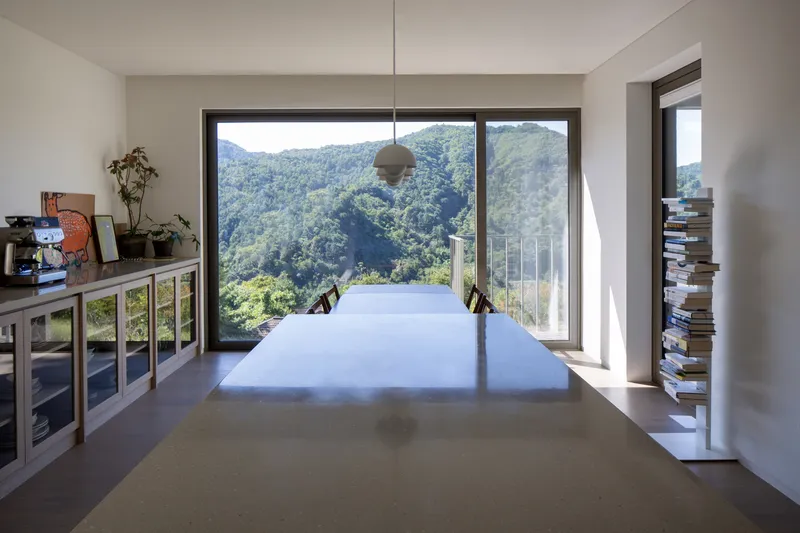
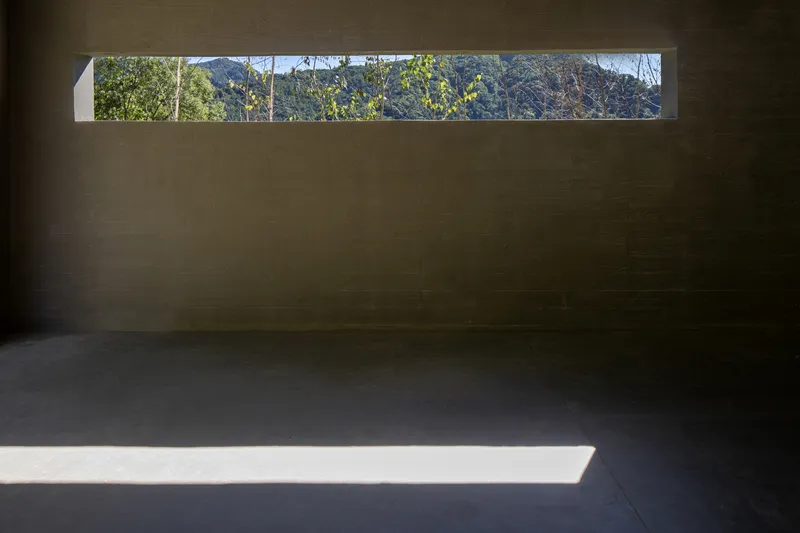
100A associates use windows as editorial instruments. The workspace features a panoramic window that frames a forested mountain valley like a horizontal scroll painting. Elsewhere, a narrow slot window captures a distant hillside under afternoon light, cropping the landscape into a single, still composition. These are not transparent walls that dissolve the building envelope; they are precise cuts that select exactly what you see.
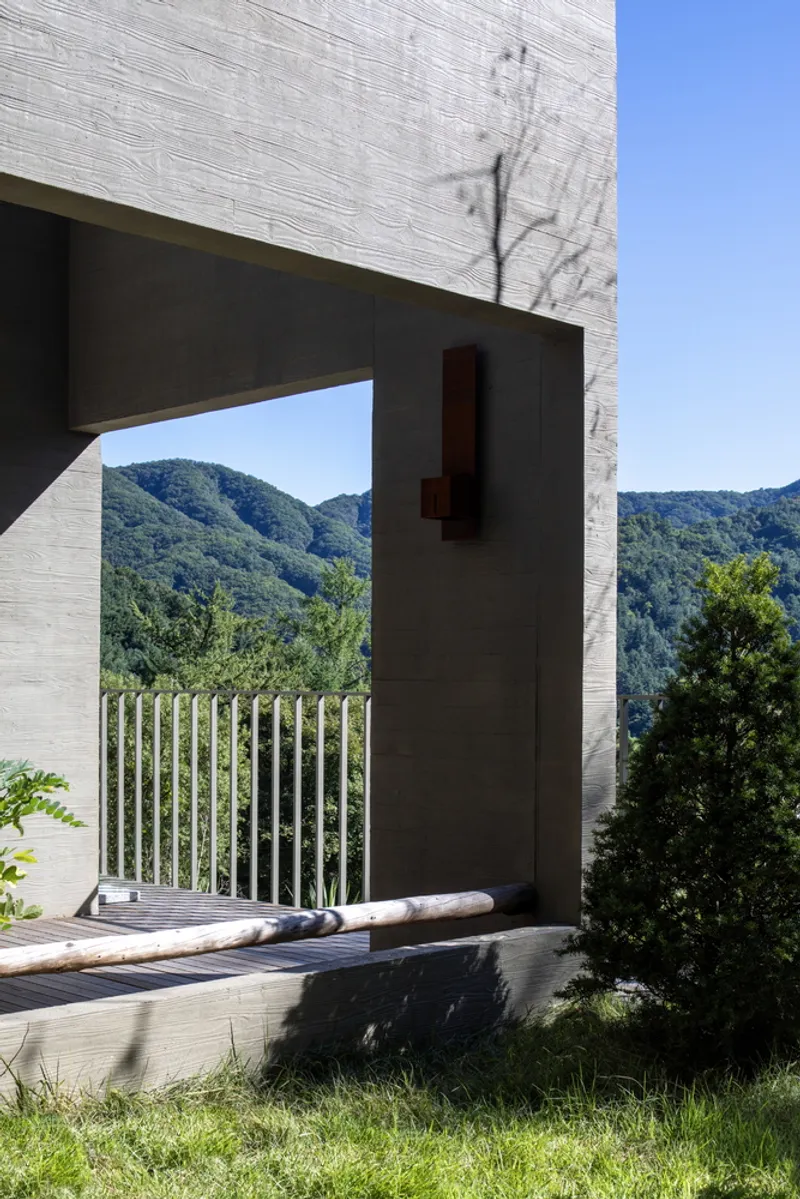
The cantilevered terrace pushes this logic outdoors, offering a full panorama of forested mountains through vertical metal railings that keep the view slightly fragmented, never quite panoramic. The effect reinforces the project's philosophy: nature is not consumed here, it is encountered through carefully constructed moments.
Corten, Gravel, and the Promise of Aging
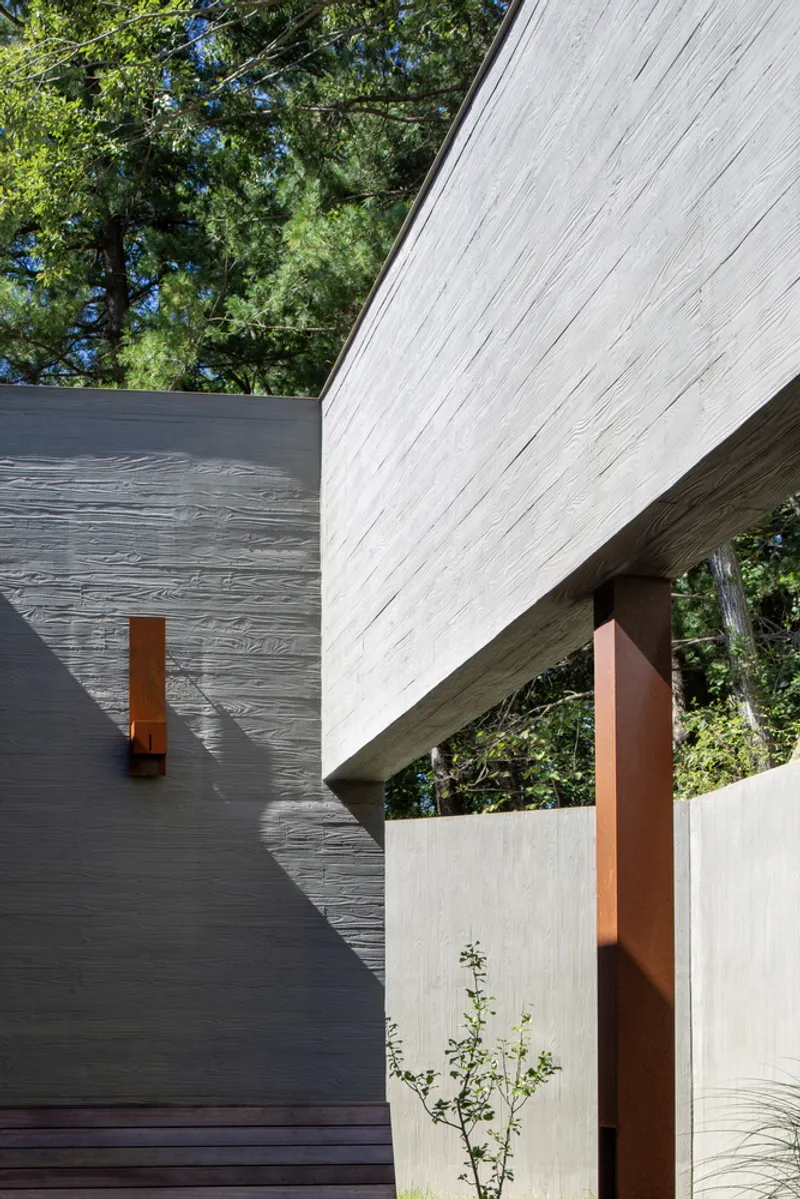
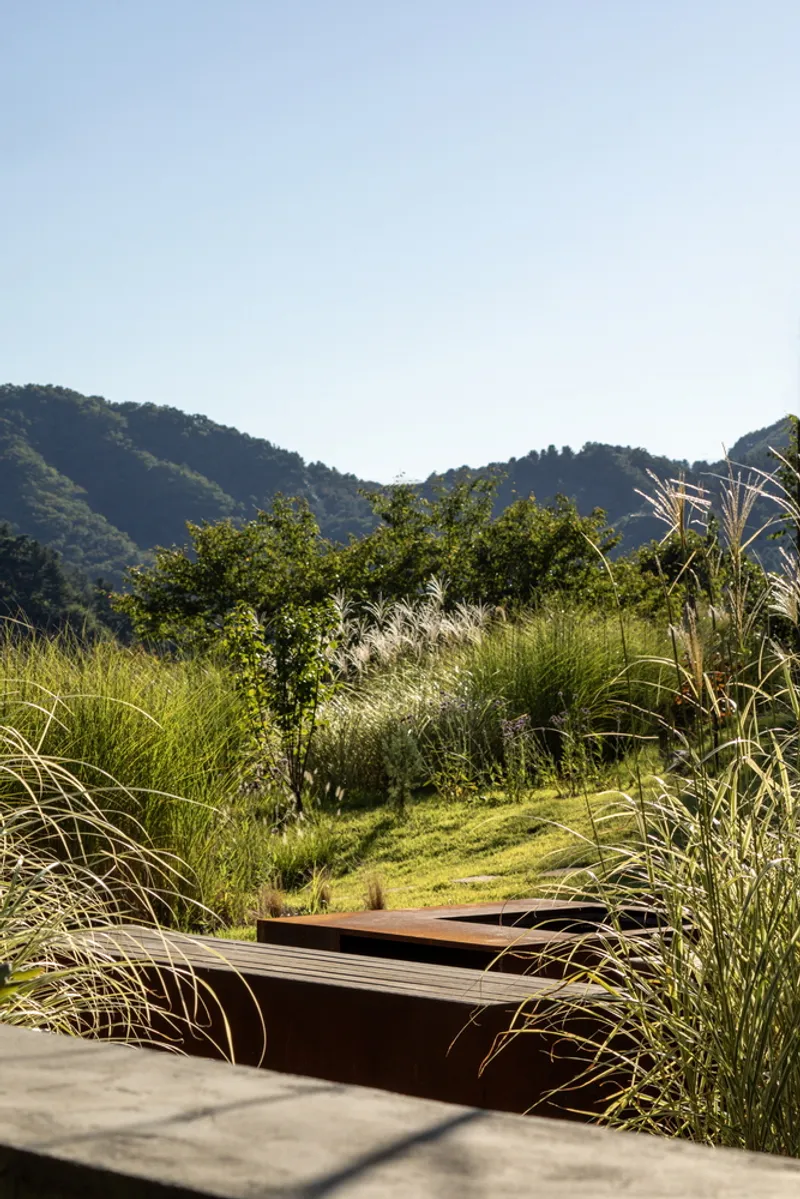
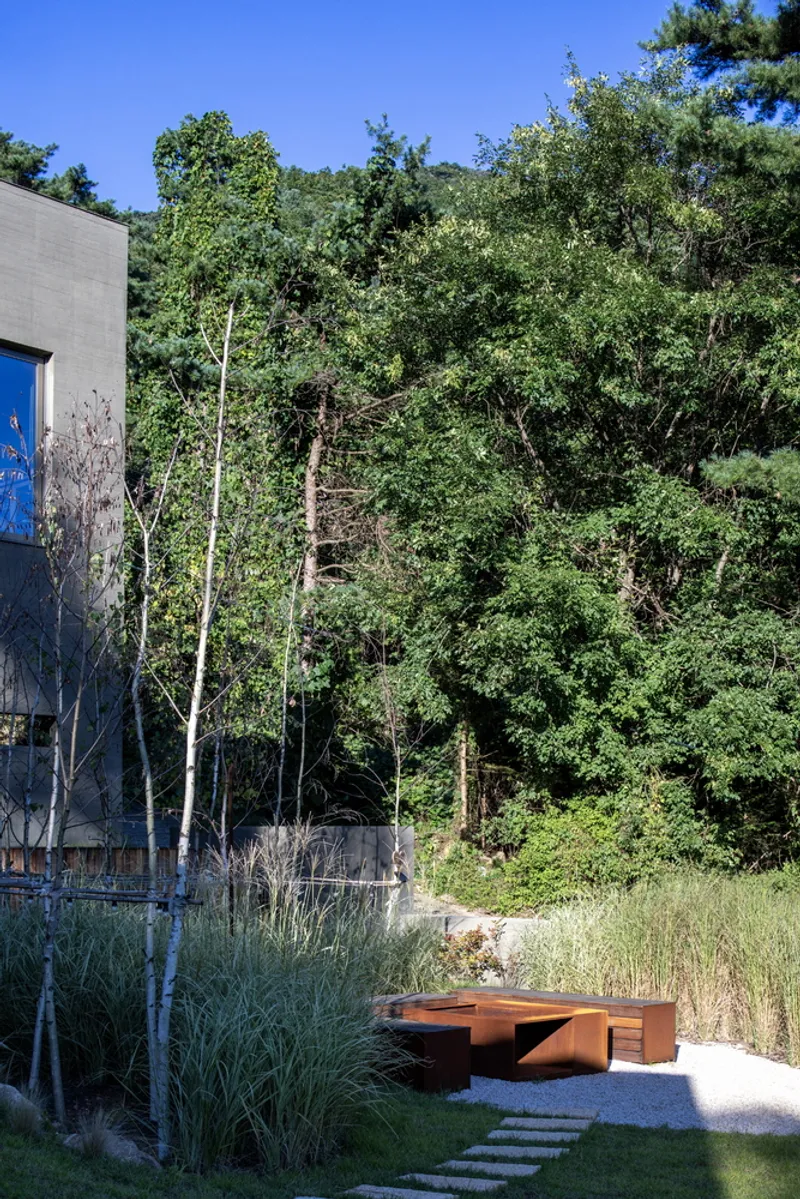
Corten steel appears at structural moments, as a column supporting an angled roof overhang, as a water feature surrounded by ornamental grasses, as a bench on a gravel terrace. Its ruddy oxidation is not an afterthought but a commitment to a material vocabulary that changes with exposure. In a few years, the Corten surfaces will deepen to near-black, and the board-formed concrete will take on moss and mineral staining from the humid Korean climate.
The architects describe this process as the architecture "gradually fading." That is a bold aspiration for any building, and a rare one in residential work, where permanence and pristine finishes tend to be selling points. At Ooort House, impermanence is the point. The building is designed to be beautiful now and more beautiful later, as it accumulates the marks of weather and time.
Bathing as Ritual
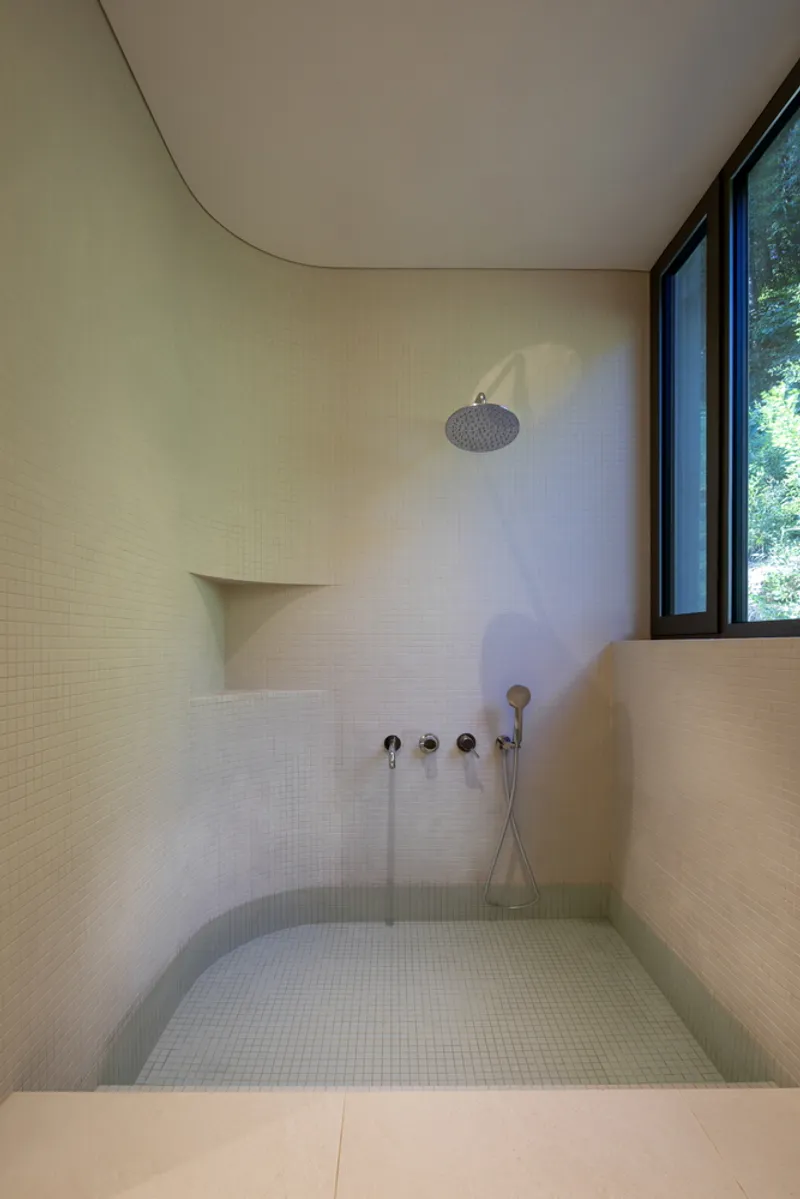
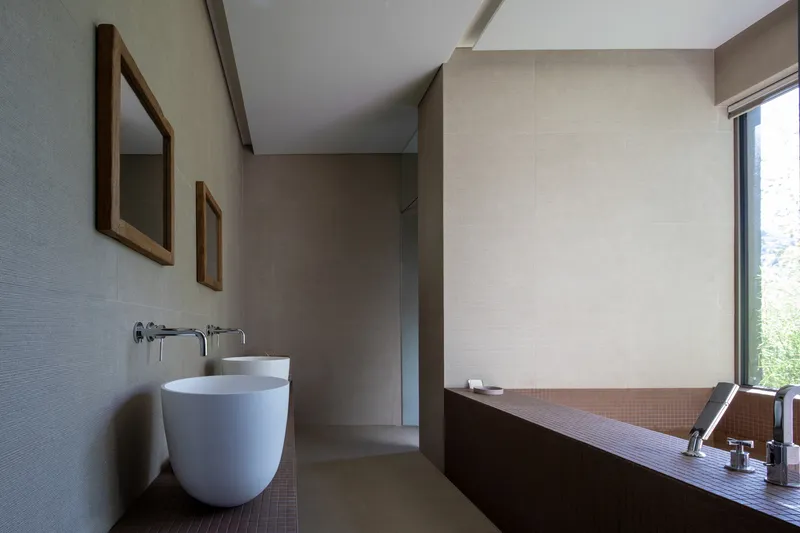
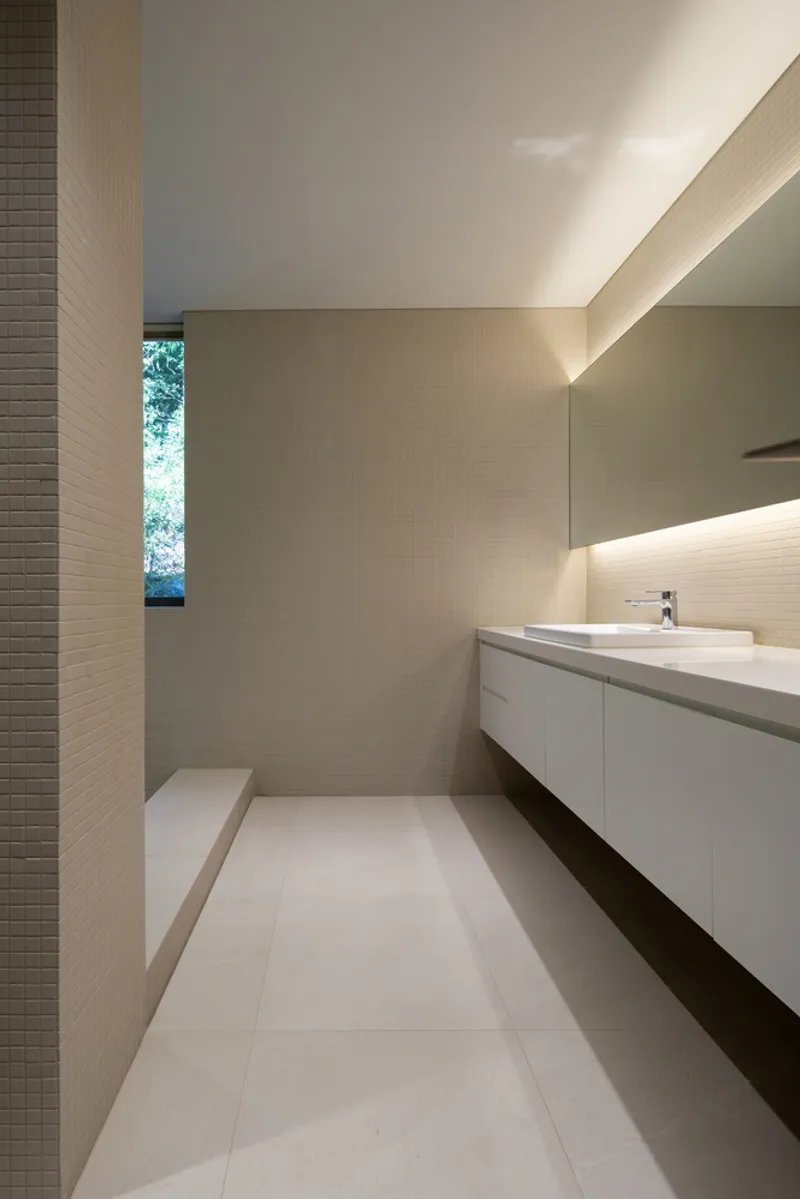
The bathrooms receive an unusual degree of attention for a house this size. A sunken mosaic-tiled bathing pool with wall-mounted fixtures and a curved ceiling plane suggests something closer to a private oncheon than a conventional bathroom. Elsewhere, a freestanding vessel sink sits beside a tile-clad tub surround overlooking greenery. A vanity with a backlit mirror and a narrow vertical window framing trees turns morning routines into quiet contemplations.
These are not luxury gestures for the sake of indulgence. They align with the project's core proposition: that dwelling should engage the senses, and that even utilitarian spaces can serve as points of connection with the natural world outside. The curved ceiling in the bathing pool catches light differently from every other surface in the house, reinforcing the sense that each room has its own atmospheric identity.
Plans and Drawings
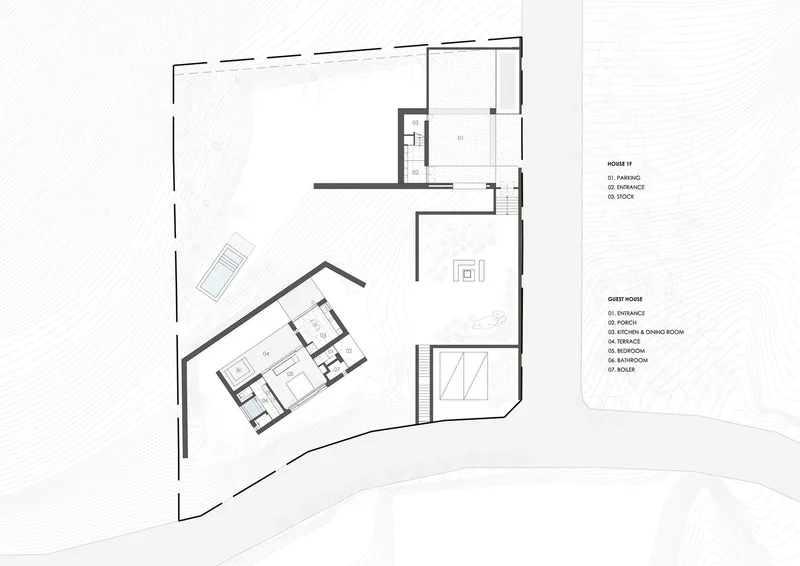
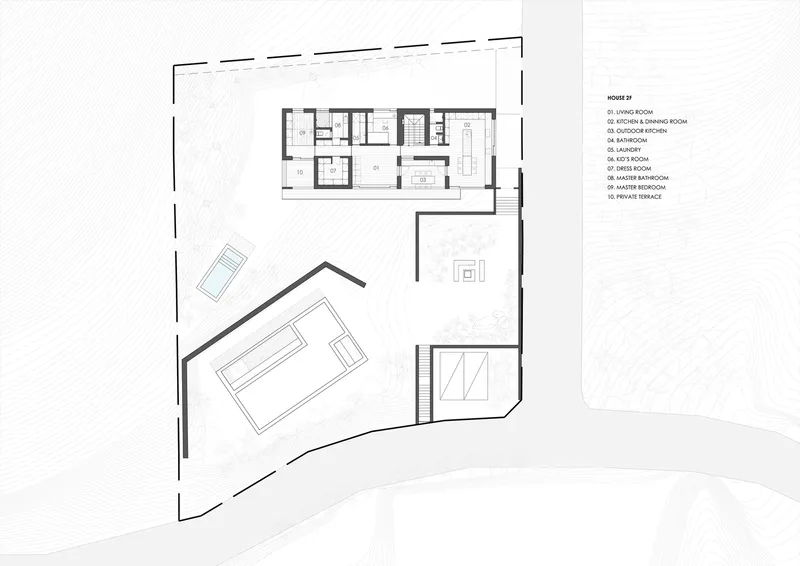
The ground floor plan reveals the compound logic clearly: two angled volumes, the main house and the guest building, set at slightly different orientations to follow the topographic contours of the hillside. The courtyard occupies the space between them, acting as both connector and separator. The upper floor plan shows how the architects concentrated the primary living spaces and bedroom within the rectangular main volume, keeping circulation tight and views outward.
What the plans make visible is the efficiency of the scheme. At 68 square meters, there is no wasted space, yet the experience of the house never feels compressed. The architects achieved this by externalizing much of the living area into courtyards, decks, and terraces, borrowing volume from the landscape rather than trying to contain it within walls.
Why This Project Matters
Ooort House matters because it refuses to choose between restraint and ambition. In 68 square meters, 100A associates have packed a full residential program, a guest house, a courtyard garden, a sunken bath, a workspace with a mountain view, and a terrace cantilevered over the forest. The trick is that none of it feels packed. The project distributes its program across the hillside rather than stacking it within a single envelope, borrowing generosity from terrain and sky.
More importantly, it proposes a different relationship between a house and its lifespan. Buildings that are designed to age, to accept patina, to recede into their surroundings, challenge the dominant model of architecture as a fixed, finished object. Ooort House insists that a building's best years may still be ahead of it, accumulating slowly with every rain, every frost, every season of growth in the grasses that surround it. That is a rare and compelling proposition.
Ooort House by 100A associates (lead architects: Kwang-il An, Sol-ha Park). Located in Gyeonggi-do, South Korea. 68 m². Completed 2024. Photography by Jae-yoon Kim.
About the Studio
Share Your Own Work on uni.xyz
If projects like this are the kind of work you want to make, uni.xyz is a place to publish your own, find collaborators, and enter design competitions.




Popular Articles
Popular articles from the community


Conexión: Biophilic Design Reimagines High-Rise Living in Hong Kong
Conexión reimagines high-rise living in Hong Kong through biophilic design, green facades, shared spaces, daylight, water and nature within.

The Earth Pod: 3D Printed Homes for Resilient Refugee Communities
The Earth Pod reimagines refugee housing through 3D printed homes made from clay, combining resilience, self-sufficiency, and rapid shelter.

Co-life: Sustainable Architecture for Age-Friendly Community Living
Co-life reimagines sustainable architecture for seniors through courtyards, rammed earth, shared gardens, and spaces designed for belonging.

Play: Fragments of Their World
Familiar architecture becomes modular playground design, creating safe spaces where displaced children can learn, connect, imagine and play.

Similar Reads
You might also enjoy these articles


Hodi-Mandai Geram
Project Function: Preservation and revitalization of the Intangible heritage and socio-spatial identity of the Hodi by Housing, Cultural Memory Center, Sacred Grove, landscape, local tourism economy


Olio Towers: A Mid-Rise for Performers That Fuses Housing, Rehearsal, and Stage
Located blocks from Houston's Theater District, this modular tower stacks living units around a central performance atrium.

Oasis: Modular Green Housing Carved into Dhaka's Urban Fabric
A shortlisted Plugin Housing entry reclaims unauthorized settlements in Dhaka with stepped concrete volumes, green roofs, and ventilation-driven design.

Black Hole: A Floating Megastructure for the Post-Physical Era
Emiliano Mazzarotto envisions a spherical, self-scaling arena where e-sports, digital hotels, and holographic stadiums replace traditional public space.

Explore Architecture Competitions
Discover active competitions in this discipline



Challenge to reimagine the Iron Throne


Photograph architecture without architects


Illustrate the lost glory of Angkor Wat - Render Challenge


Design challenge to reuse E-waste
Comments (0)
Please login or sign up to add comments
No comments yet. Be the first to comment!