

NatureHumaine Builds a Brick Palisade Between a Busy Road and a Quiet Canadian Lake
Palissade Cottage in Austin, Quebec, turns its fortified masonry face to the street and opens fully toward Lake Orford's waterfront.


A cottage that looks like a small fortress from the street and dissolves into glass on the waterfront: that is the central gambit of Palissade Cottage, a 294-square-meter lakeside house completed in 2024 by NatureHumaine in Austin, Quebec. Sitting on a narrow, steep lot squeezed between Route 112 and Lake Orford, the house had to negotiate a southern road and a northern lake, proximity to neighbors, and a flood zone that swallowed the previous boathouse. The architects responded by pushing the new structure closer to the road, planting it on safer ground, and splitting the program across two levels that step down with the terrain.
What makes the project genuinely interesting is its material argument. Where most contemporary cottages default to dark-stained cedar or standing-seam anonymity, NatureHumaine chose beige brick by Van der Moortel as its primary exterior cladding, treating the street facade as an acoustically massive wall that absorbs road noise and reads like a defensive palisade. The name is literal. From the road, you see almost no glass. Walk through to the lake side, and floor-to-ceiling glazing, cantilevered terraces, and a low-pitched roof hovering above a clerestory band create an entirely different building. The duality is not subtle, and it does not need to be.
Two Faces of the Same House


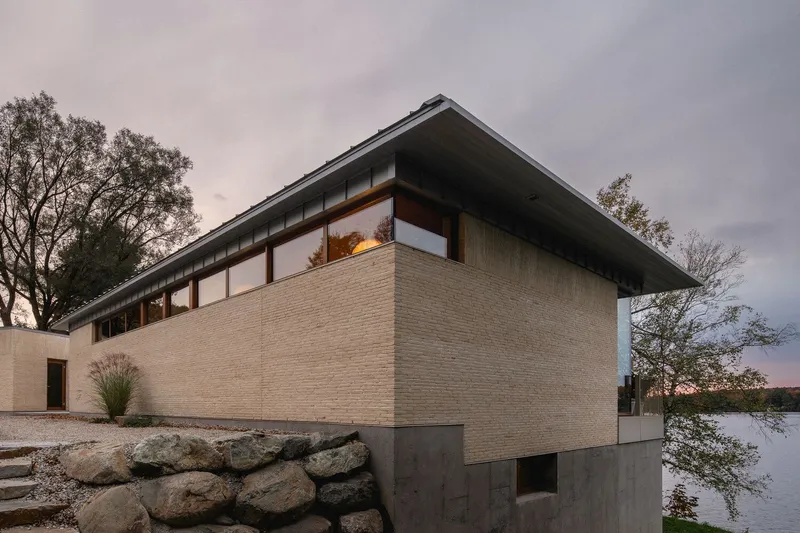
The street elevation is almost pure masonry: a monolithic brick volume with copper-framed clerestory windows barely visible beneath the painted steel roof. A small detached garage, clad in the same brick, flanks the main house and reinforces the compound-like character. A sculptural relief pattern around the entry door is the only concession to ornament. The effect is deliberate restraint, a building that refuses to perform for passing traffic.
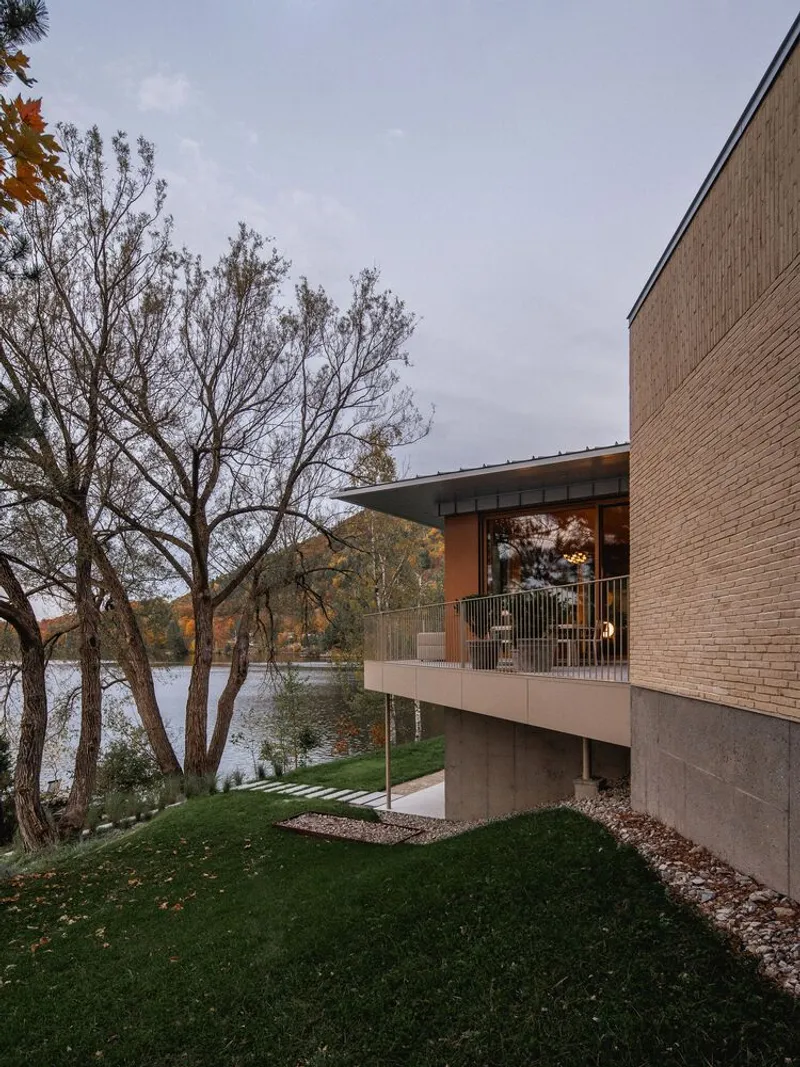
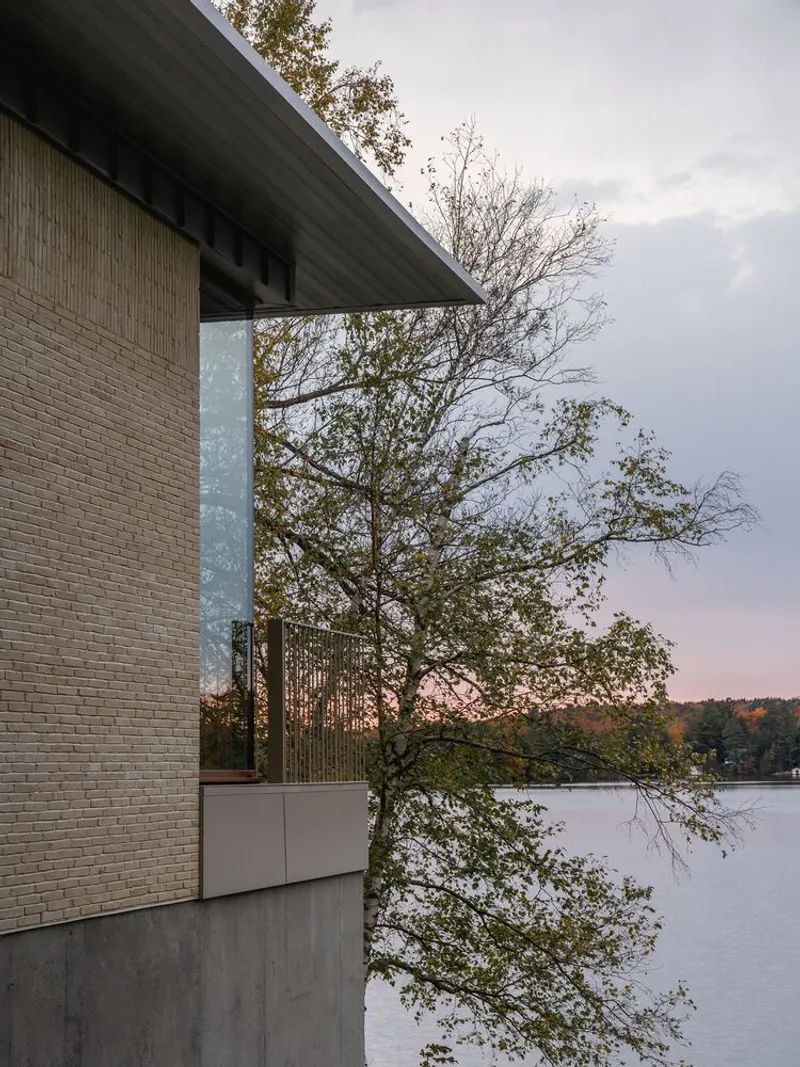
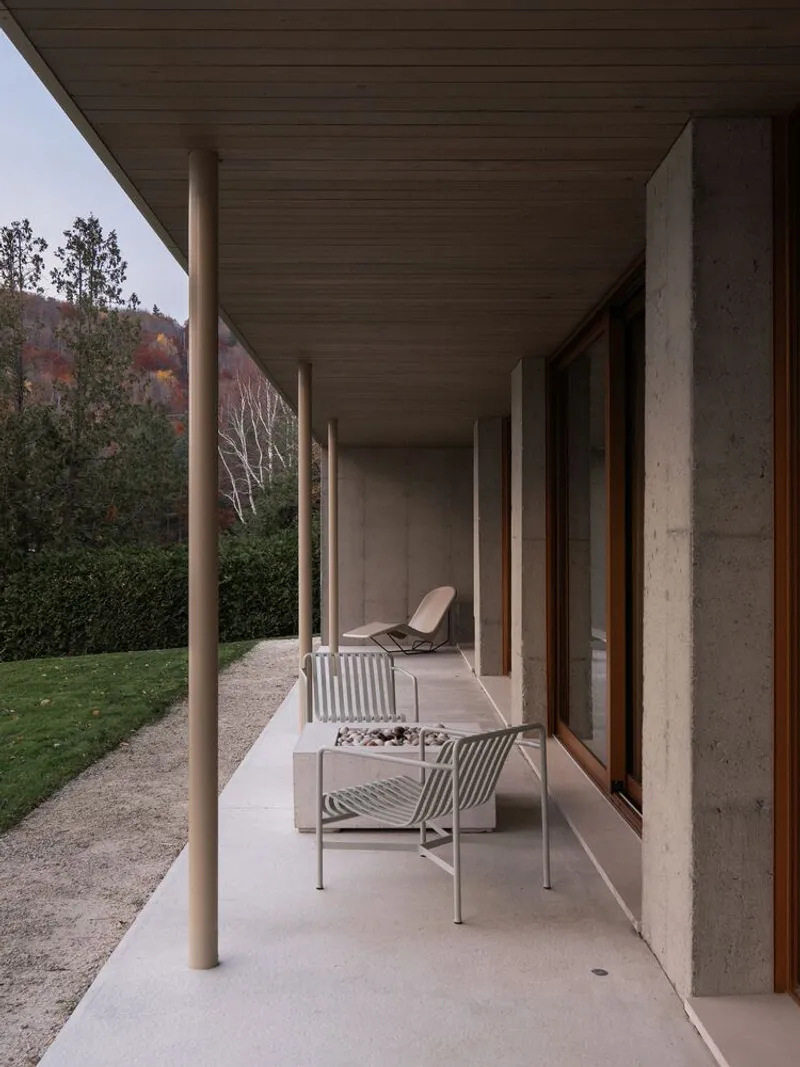
Flip to the lake side and the posture inverts entirely. The roof lifts off the walls via a continuous horizontal window band, creating the illusion that it floats. Terraces extend outward on multiple levels, and the lower garden floor opens directly onto the sloping lawn that runs to the water. The separation between these two identities is managed by a diagonal structural wall that divides the street-level program from the garden-level program, a clever piece of engineering by Côté Jean et associés that does double duty as spatial organizer and load-bearing element.
The Clerestory Strategy

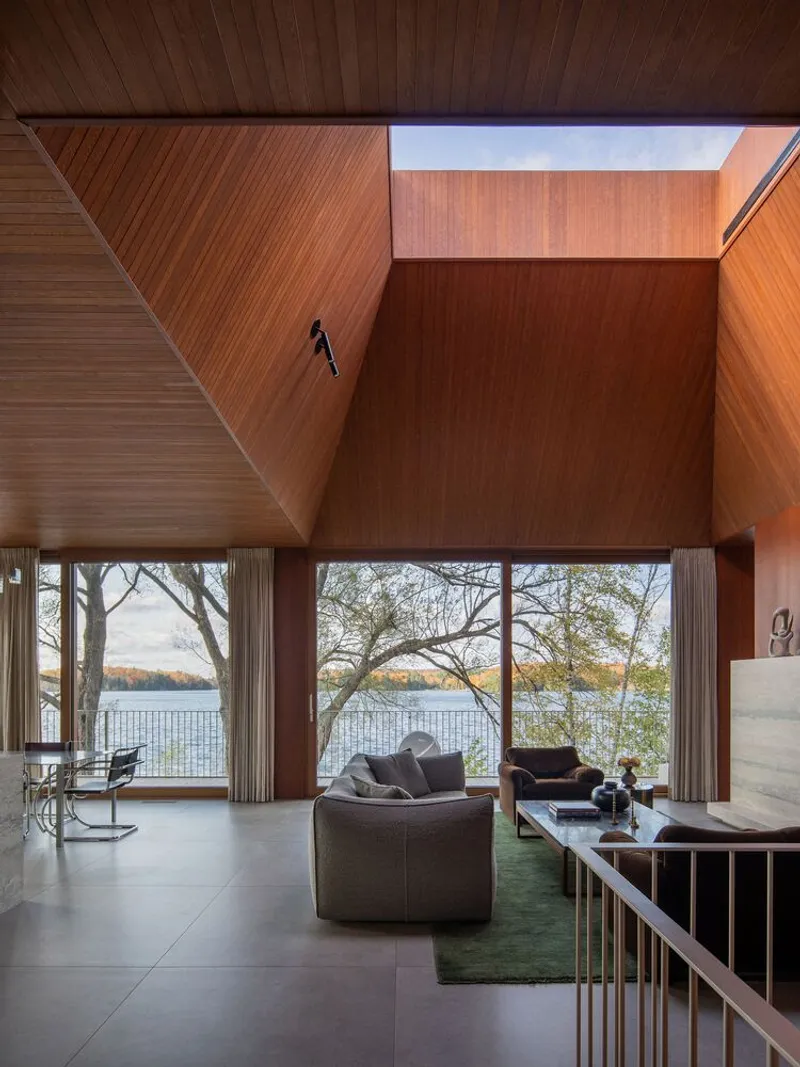
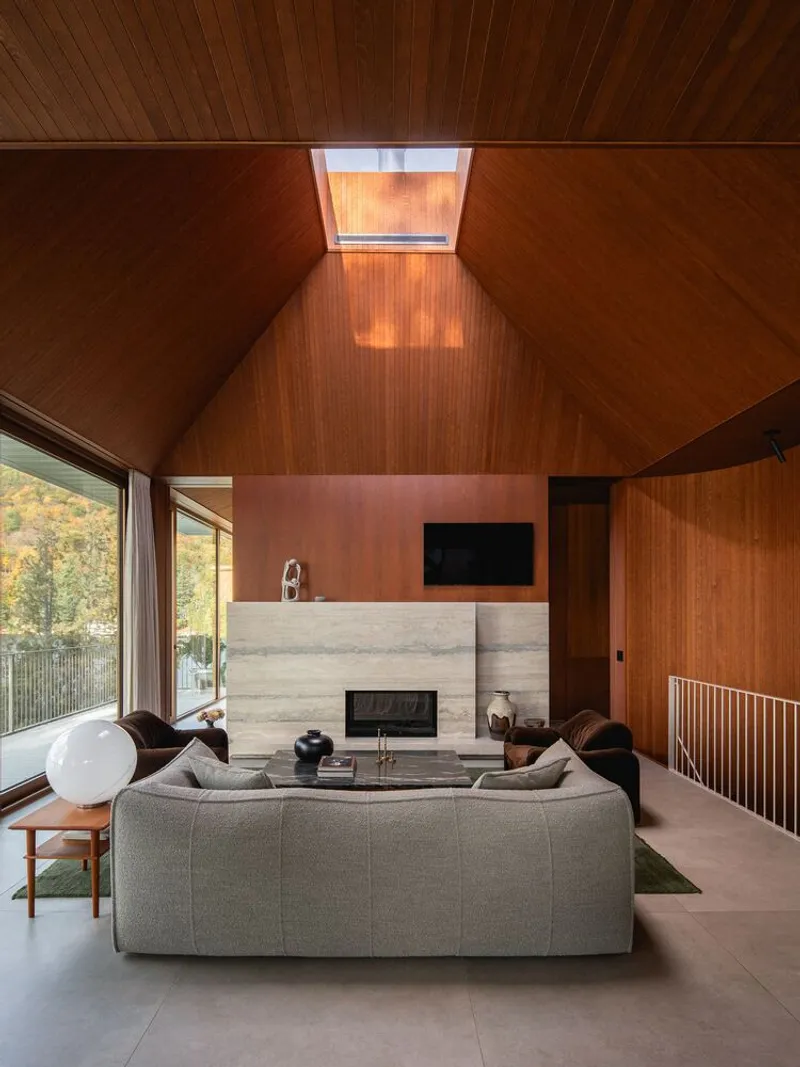
With the south-facing facade kept nearly opaque for acoustic and privacy reasons, the architects needed another way to flood the interior with daylight. Their solution is a clerestory slot running along the perimeter where the roof separates from the walls, combined with a centrally positioned skylight by Verplex that cuts through the pitched ceiling right above the main circulation spine. Together, these two moves pull light deep into the plan without compromising the fortified street elevation.
The result is a double-height living room that glows from above even on overcast days. Stained wood paneling on the ceiling catches and warms the incoming light, while floor-to-ceiling windows on the lake side contribute horizontal illumination throughout the afternoon. It is a simple strategy, but the execution is precise: the skylight is framed by angled timber ceiling planes that funnel the eye upward, giving the room a sense of volume that the modest 294-square-meter footprint would not otherwise suggest.
Living Toward the Lake


The spatial hierarchy is clear: service and entry functions face the road, living spaces face the water. On the upper level, the kitchen, dining, and living areas occupy an open plan oriented north toward the lake, with a timber shelving wall framing glazed doors that swing open to the lawn. The kitchen's functional wall extends through the envelope to a covered terrace on the west side, where a built-in outdoor grill takes advantage of sunset views. It is a programmatic detail that sounds small on paper but fundamentally changes how the house is used during warm months.
Cantilevered balconies at the lower level offer a more intimate relationship with the landscape. The metal railings are deliberately slender, almost disappearing against the autumn foliage. From these perches, the lake and the surrounding hills feel close enough to touch, and the house above recedes from consciousness.
A Material Palette That Refuses to Be Neutral
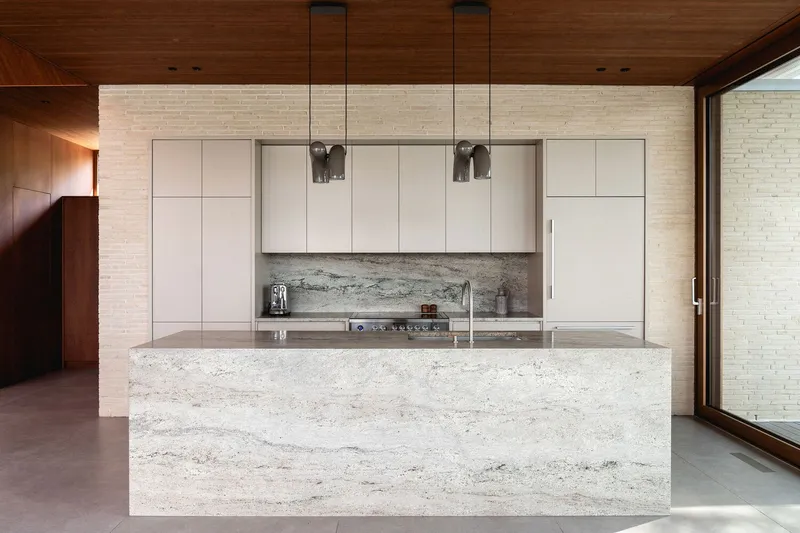

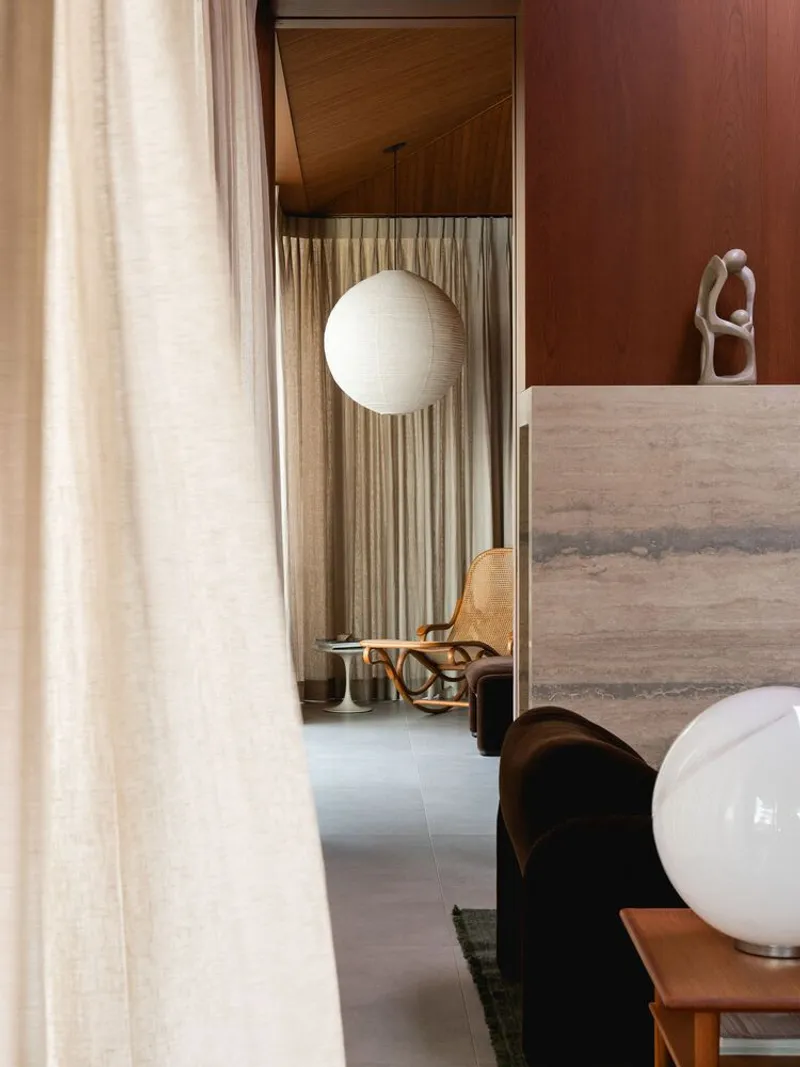
The clients asked NatureHumaine to avoid the all-white contemporary interior that dominates the cottage market, and the architects delivered. Cherry veneer lines the walls. Stained wood paneling wraps the ceilings. The fireplace and kitchen island are carved from natural stone, likely travertine based on the warm veining visible in photographs. Copper window frames, chosen to harmonize with the wood tones, add a layer of warmth that ages well. It is a palette that leans decisively toward earth tones without slipping into rustic pastiche.
The beige brick reappears inside, most notably on the kitchen wall where a recessed cabinet niche in taupe tones creates a subtle figure-ground shift. Lime plaster on the fireplace surround and in the bathrooms provides textural contrast against the harder surfaces. The overall effect is a material richness that rewards close looking, something you notice more on a second visit than a first.
Private Rooms and Borrowed Views

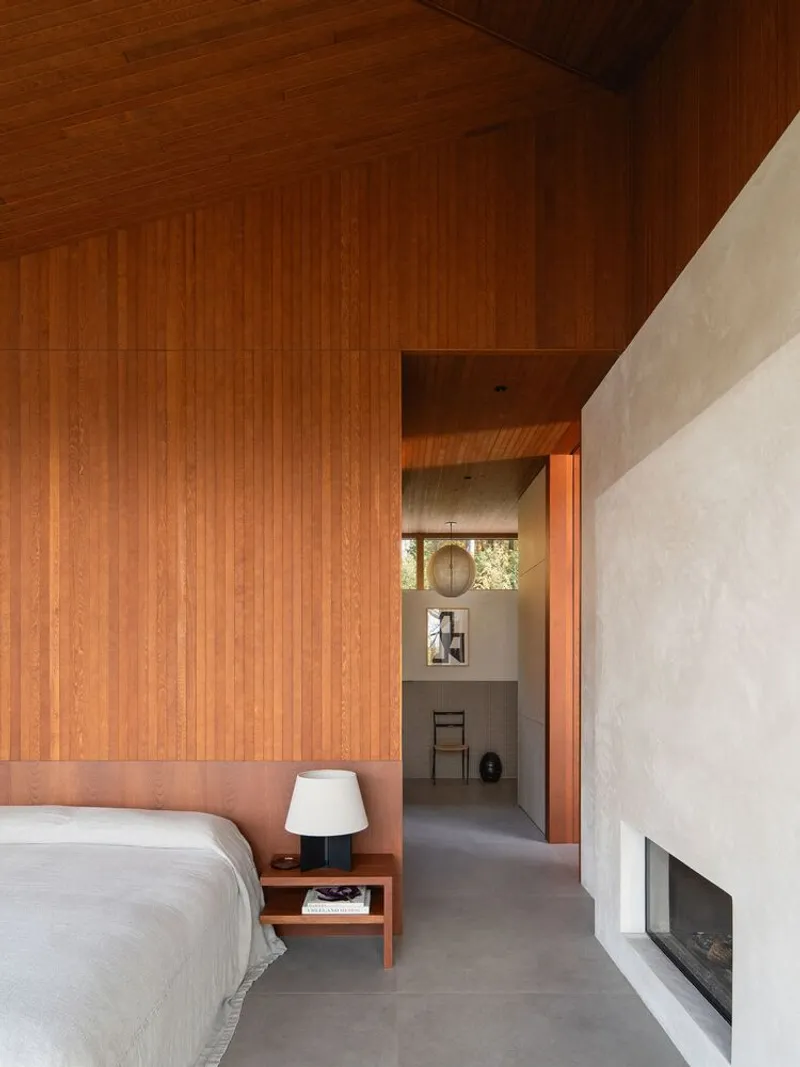
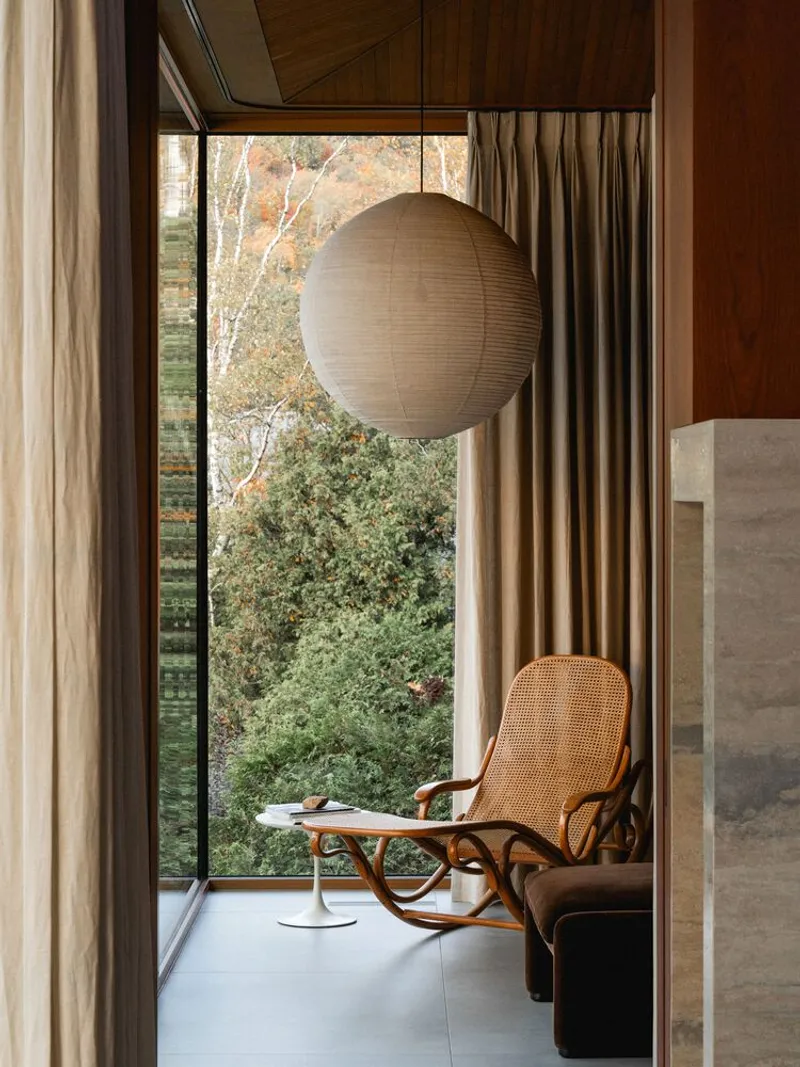
The master bedroom shares a two-sided fireplace with the living room, an arrangement that gives both spaces warmth without duplicating mechanical systems. Because a neighboring building sits close to the east, the architects kept glazing to a minimum on that wall. Instead, they introduced a glazed corner that frames a specific view: morning sunlight hitting Mount Orford. It is a selective aperture, not a panoramic one, and it works precisely because it is so targeted.
On the lower garden level, additional bedrooms and a small sitting room maintain the same material language but at a more compressed scale. Vertical wood-paneled walls, concrete floors, and white plaster fireplace walls define these rooms. A reading nook beside a floor-to-ceiling window offers a quiet perch overlooking the autumn garden, the kind of corner that justifies the entire project for anyone who has spent a weekend reading in a dark cabin.
Water, Terrain, and Responsibility
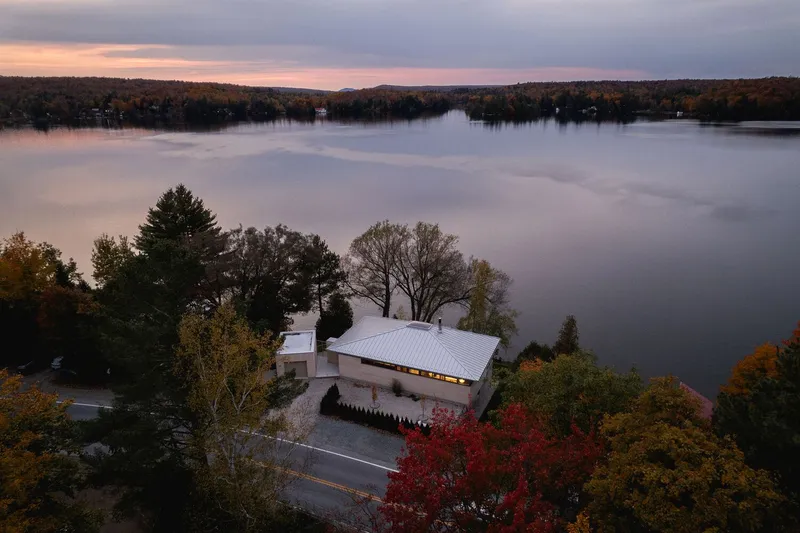
The decision to rebuild closer to the road was not merely aesthetic; it was a direct response to the flood risk that made the old boathouse untenable. The new house sits on higher ground, and a perimeter system captures and reroutes rainwater, filtering it through a gravel pool before it reaches the lake. This is responsible lakeside development, not the kind of building-on-stilts-and-hoping approach that too many waterfront projects rely on.
The aerial view at sunset reveals how deliberately the house sits within its context: a low-slung roof barely breaking the tree canopy, its form hugging the contour of the hillside rather than asserting itself against it. From the lake, the building reads as part of the shore. From the road, it reads as a wall. Both readings are correct, and neither is accidental.
Craft in the Details
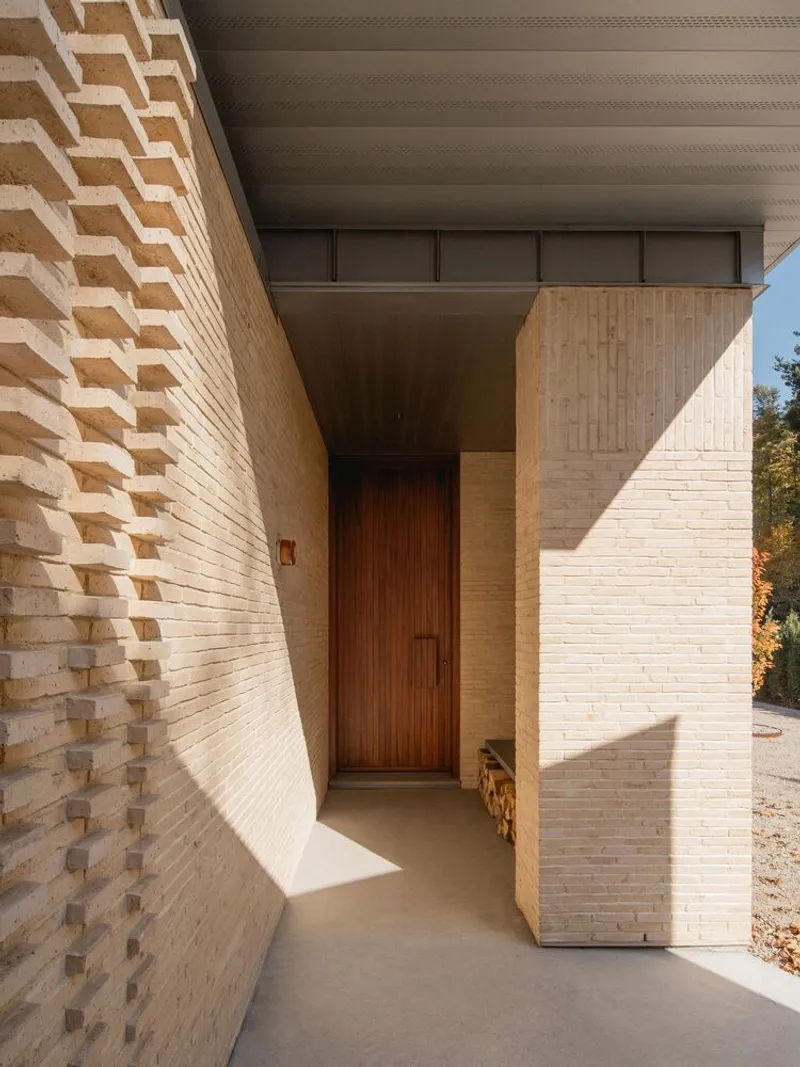


Zooming into the entry sequence clarifies the level of craft at play. The timber entrance door by Porte Bourassa is set deep within a projecting brick wall that creates a compressed, almost defensive threshold. The sculptural brick relief around the door is not decorative whimsy; it calibrates the transition from the public street to the private interior, compressing sight lines before the house opens up.
Interior details follow the same logic. The metal stair railing uses closely spaced vertical bars that echo the vertical wood paneling on adjacent walls, creating visual continuity between steel and timber. In the bathrooms, veined marble vanities sit against mosaic tile surfaces beneath the sloped wood ceiling, with clerestory windows filtering warm afternoon light. Every joint, every material meeting, is considered. Nothing defaults to the generic.
Plans and Drawings
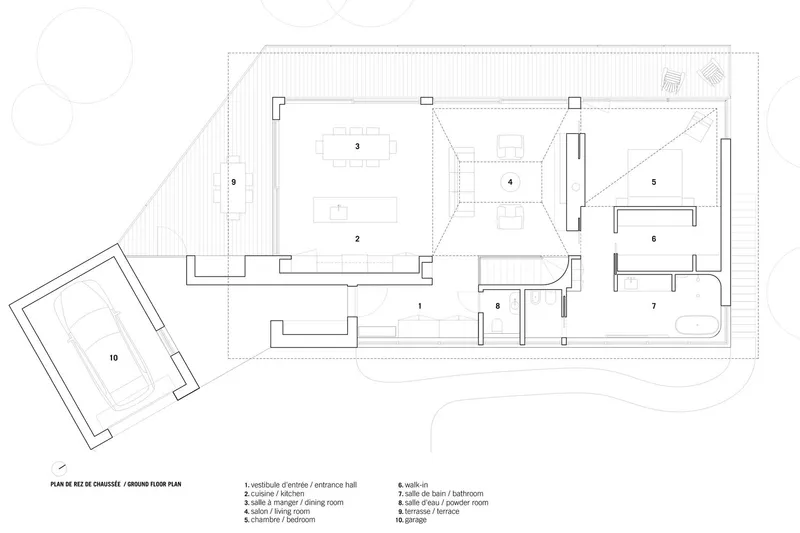


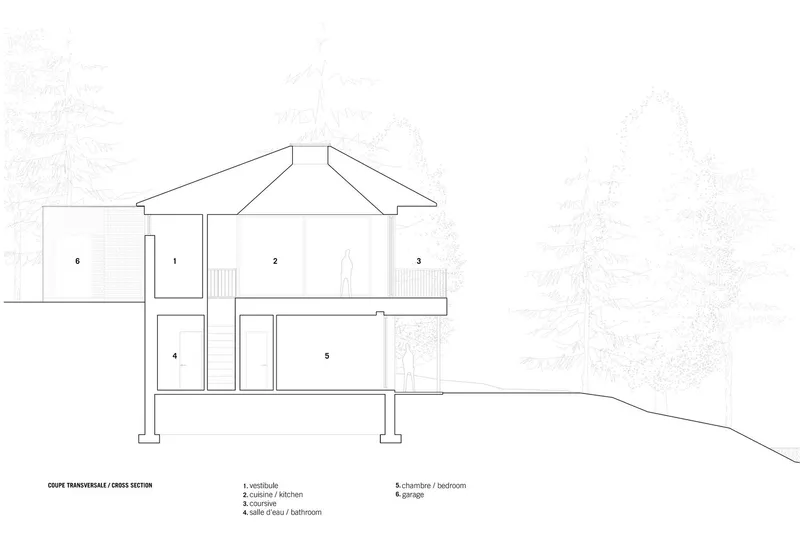
The floor plans reveal the logic that photographs can only hint at. The upper level places the kitchen, living, and dining zones in a continuous band oriented toward the lake, with the master bedroom tucked to one side sharing the fireplace wall. The detached garage sits at an angle to the main volume, creating a sheltered entry court between the two structures. The site plan shows topographic contours dropping sharply toward the water, explaining why the house steps down to a garden level with its own set of bedrooms and sitting room. The cross section confirms the low-pitched roof geometry and the clerestory gap that defines the building's silhouette.
Why This Project Matters
Palissade Cottage matters because it rejects the false choice between defensiveness and openness that plagues roadside residential design. Too many lakefront houses either ignore the road entirely, leaving themselves exposed to noise and traffic, or fortify so aggressively that they lose the landscape they were built to enjoy. NatureHumaine found a third option: a house that is two buildings in one, each calibrated to its specific orientation, acoustic environment, and privacy requirement. The brick palisade is not a gimmick. It is a structural, environmental, and experiential strategy that earns its name.
The material palette deserves recognition as well. In a market saturated with white-walled minimalism, the decision to build with cherry veneer, stained wood, natural stone, lime plaster, and copper frames is a statement of intent. These materials will age, darken, and patinate. They will look better in ten years than they do now. For a cottage intended to last on a lakeshore that has already outlived one building, that kind of durability, both physical and aesthetic, is exactly the right ambition.
Palissade Cottage by NatureHumaine, Austin, Quebec, Canada. 294 square meters. Completed 2024. Photography by Raphaël Thibodeau.
About the Studio
Share Your Own Work on uni.xyz
If projects like this are the kind of work you want to make, uni.xyz is a place to publish your own, find collaborators, and enter design competitions.


Popular Articles
Popular articles from the community


Cube Design Draws an Ecological Corridor Between Two Shenzhen Hills with the Nankai Building
Beside Shenzhen's container docks, the Nankai Building pairs stacked balconies with a climbing green screen to connect two hillsides across its height.

longwave studio Reorganizes a 112 m² Tainan Apartment Around the Daily Routines of a Family and Two Cats
In Tainan, Taiwan, birch plywood, rust-red furniture and a freestanding plaster wall link arrival, storage, work and family life in one apartment.

Jaramillo Van Sluys Arquitectura and Urbanismo Turn a Demolished Registry Lot in Quito into an Orchard Plaza
In Quito's Centro Histórico, a 2,800 m² plaza exposes the San Agustín convent wall and redraws its lost Augustinian orchard in volcanic stone.

Architekt Andreas Gruber Scatters 23 Dark Timber Chalets Across a South Tyrolean Forest Edge
In Molini di Tures, Amonti Chalets breaks a resort into a hamlet of gabled timber houses, with parking, storage and services pushed into the slope.

Similar Reads
You might also enjoy these articles

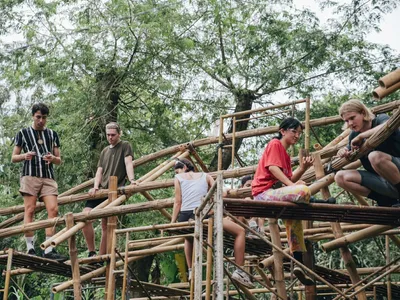
Bamboo Housing Challenge 2026: Design Affordable, Sustainable Homes Using Bamboo
An international design competition by Bamboo U and IBUKU inviting architects and designers to reimagine affordable housing using bamboo — with the winning design built full-scale in Bali.

Computational Design & Education: Beegraphy Design Awards Introduces 7th Category (Featuring Jiyun's Innovative Approach)
Dive into Beegraphy’s 7th Design Awards category, where computational design meets education to create immersive, interactive learning tools, inspired by Jiyun’s work.

From Parametric Lighting to Urban Furniture: Join the 2nd Workshop in Beegraphy’s Computational Design Series
Dive into Cutting-Edge Design Techniques and Practical Applications with Industry Experts

Last Call: Unleash Your Architectural Genius in SHAK's Kindergarten Design Competition
Urgent call for architects to join SHAK's kindergarten design competition before the looming deadline

Explore Architecture Competitions
Discover active competitions in this discipline

Challenge to reimagine the Iron Throne

Photograph architecture without architects

Illustrate the lost glory of Angkor Wat - Render Challenge

Design challenge to reuse E-waste
Comments (0)
Please login or sign up to add comments
No comments yet. Be the first to comment!