

croixmariebourdon Wraps Courbevoie's New Market Hall in an Elliptical Timber Shell
A 2,400-square-meter market hall near La Défense replaces a 1969 urban complex with a curved timber pavilion, underground parking, and a public esplanade.


The original Charras Centre opened in 1969 as a sprawling urban complex: swimming pool, skating rink, hotel, shopping center, and car parks all bundled under the shadow of mid-century residential towers named after Alexandre Dumas characters. By the time croixmariebourdon architectes associés won the commission to reimagine the site, the complex had aged past the point of renovation. What Courbevoie needed was not a facelift but a new civic anchor, something that could stitch together the early-twentieth-century brick fabric to the north, the fifteen-story modernist slabs to the south, and the commercial gravity of La Défense just beyond.
The answer is a teardrop-shaped market hall, 2,400 square meters of timber-framed, glass-wrapped public space that sits on top of 600 underground parking spaces and opens onto a generous pedestrian esplanade. Completed in 2020 on a €20.7 million budget, the building is genuinely interesting for its refusal to impose a singular facade on the neighborhood. The elliptical plan has no front and no back. It slopes down toward the closest residential buildings and rises toward the street and shopping center, calibrating its profile to every direction at once. It is a market hall that behaves more like a piece of landscape than a building.
A Form Without a Front
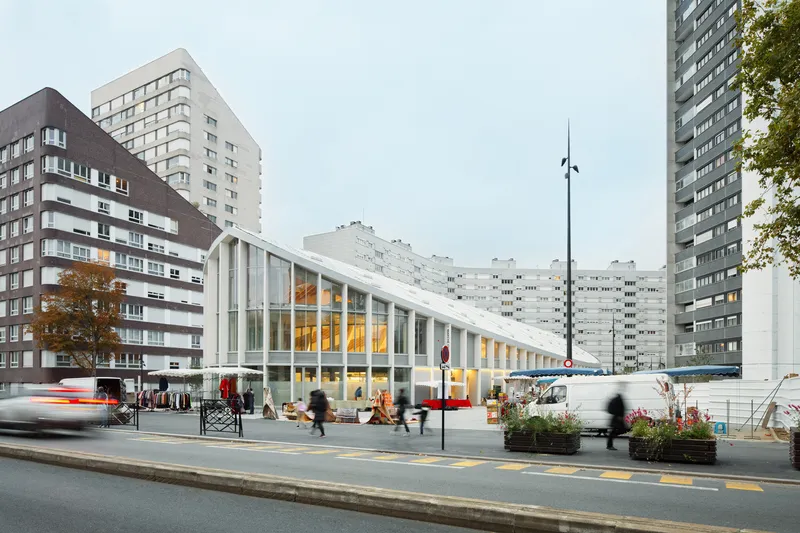
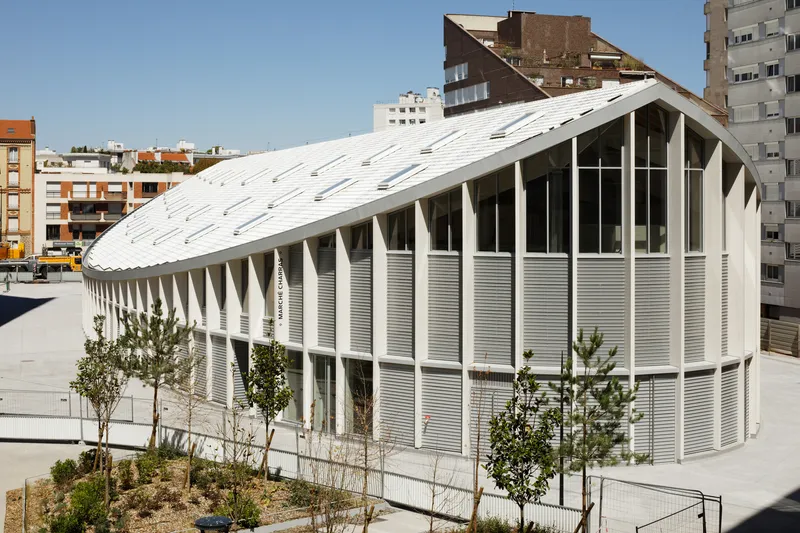

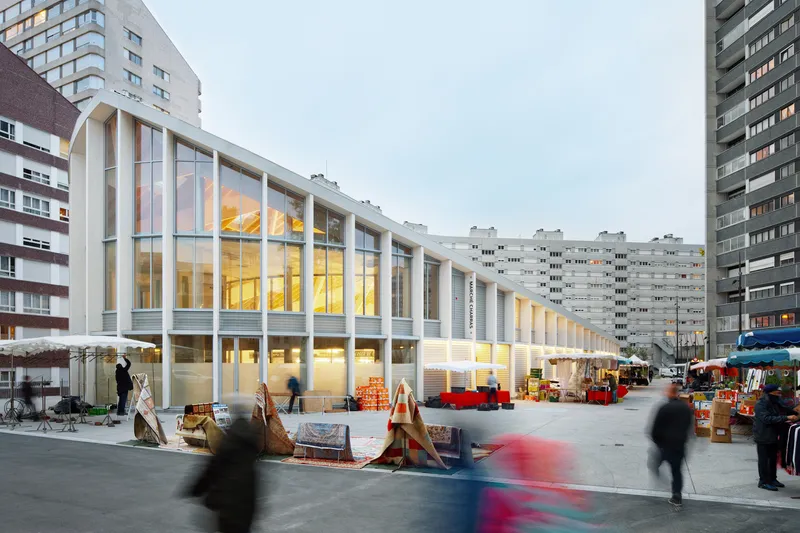
The elliptical footprint is the project's most consequential decision. Positioned perpendicular to the main street and extending toward the center of the 6,940-square-meter site, the building creates a north-south pedestrian path that connects the town hall to the shopping center. Because the plan curves continuously, the market never presents a blank wall to any neighbor. White-stained wood posts form a peristyle around the perimeter, spaced at 1.80-meter intervals, giving the facade a vertical rhythm that reads as open and permeable from every angle.
The pitched roof rides the building's asymmetry. It dips toward the five-story brick buildings on the north side, keeping the scale domestic, and lifts on the street side, announcing the market to passersby. The form is derived not from any stylistic posture but from a careful overlay of contextual data: building heights, sightlines, solar angles, pedestrian desire lines. croixmariebourdon calls this design without a priori assumptions, and the result is a building that looks inevitable rather than willful.
Timber Trusses and Acoustic Coffers
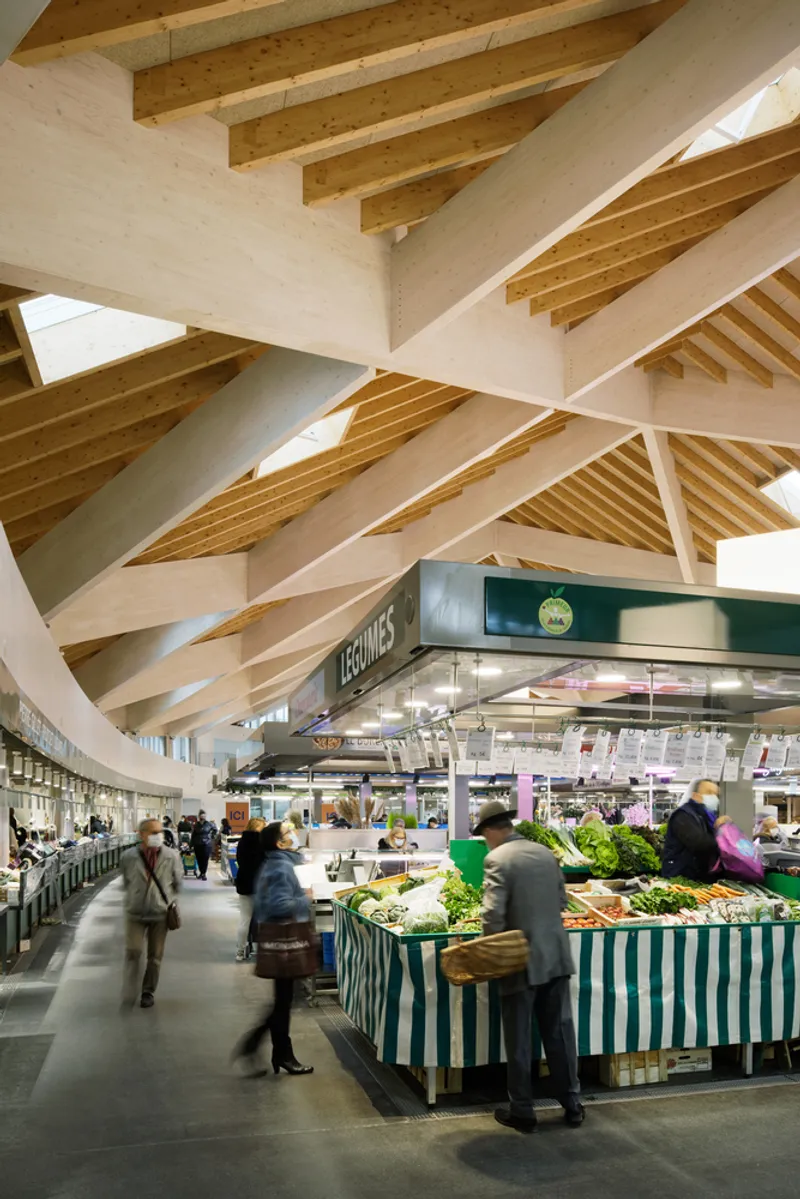

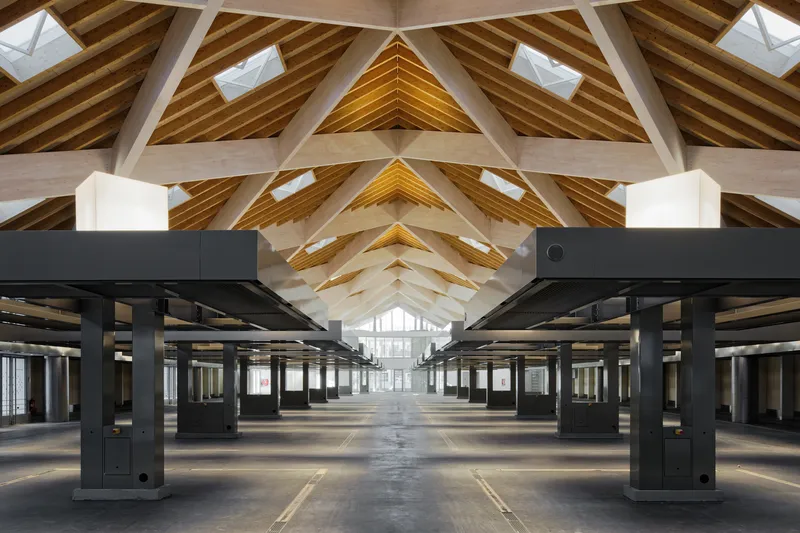
Step inside and the structure takes over. Diagonal timber trusses span the full width of the hall, forming deep acoustic coffers overhead. Between the rafters, Fibralith insulation panels absorb the noise that a busy market generates: vendors calling, shoppers chatting, carts rolling on hard floors. The result is a space that feels voluminous without being echoic, a quality that most market halls, frankly, fail to achieve.
Triangular skylights punctuate the ridgeline, washing the interior with diffuse daylight and reducing the building's dependence on artificial lighting during operating hours. The laminated timber arches radiate outward from the spine, and their pale finish keeps the interior bright even on overcast days. There is a clear lineage to the Baltard halls of nineteenth-century Paris: pitched roof, exposed structure, a single generous volume. But the timber construction and the curved plan push the type into new territory.
Market Life and Adaptive Programming
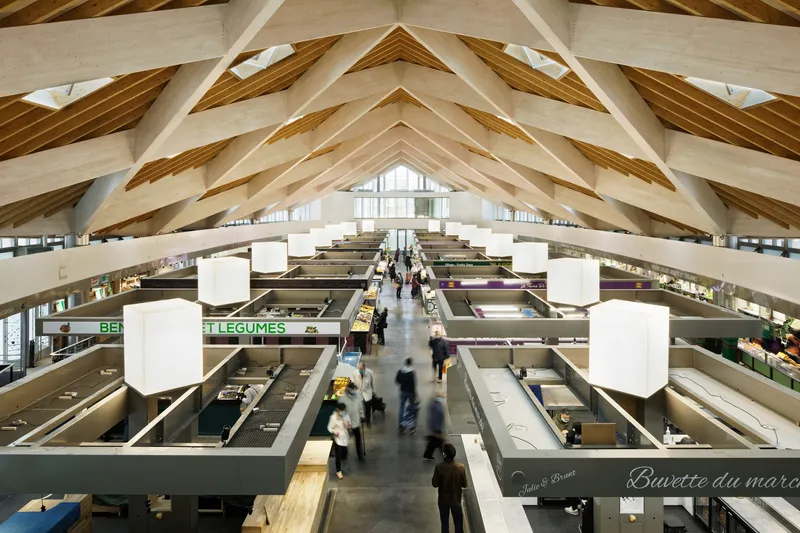
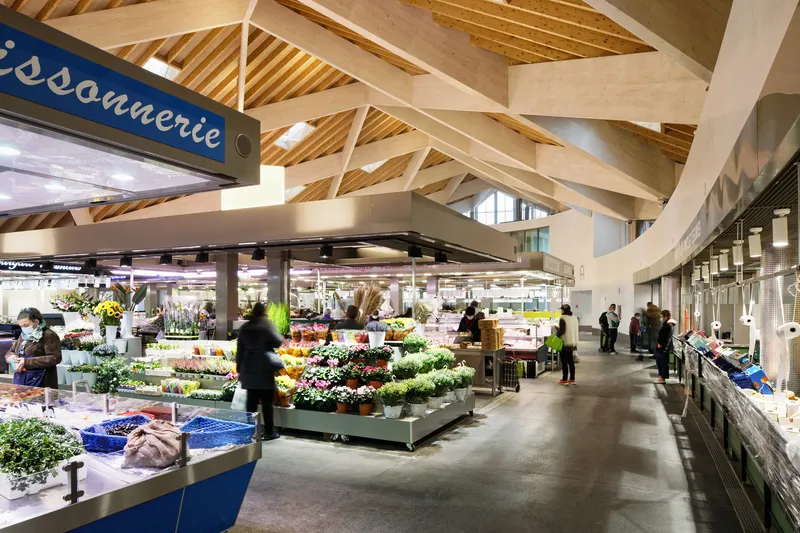
The market operates three days a week with traders occupying versatile metal stalls whose structure can be adapted to each vendor's needs. On non-market days, the hall's open floor plan accommodates community events and temporary programming. A two-story brasserie occupies the street-facing end of the building, activating the frontage seven days a week and blurring the boundary between market and restaurant. On the south edge, a concierge service handles parcel pickup and prepared basket collection, a practical detail that acknowledges how contemporary residents actually shop.
The market hall is deliberately unheated. This is not austerity; it is strategy. An unheated volume of this size would be ruinously expensive to condition, and the building's integrated external blinds provide comfort through shade control rather than mechanical cooling. The glass curtain wall, a TECHNAL system mounted on the curved timber frame with RAL 9006 lacquered finishes, admits daylight while the blinds manage solar gain. It is passive design at the scale of a civic building, and it works because the architects treated the envelope as a climate filter rather than a sealed barrier.
The Roof as Urban Surface
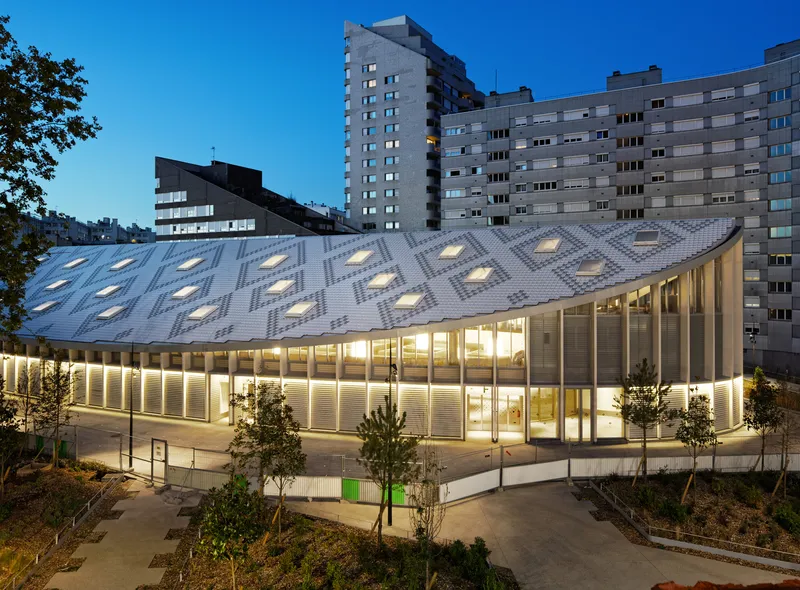
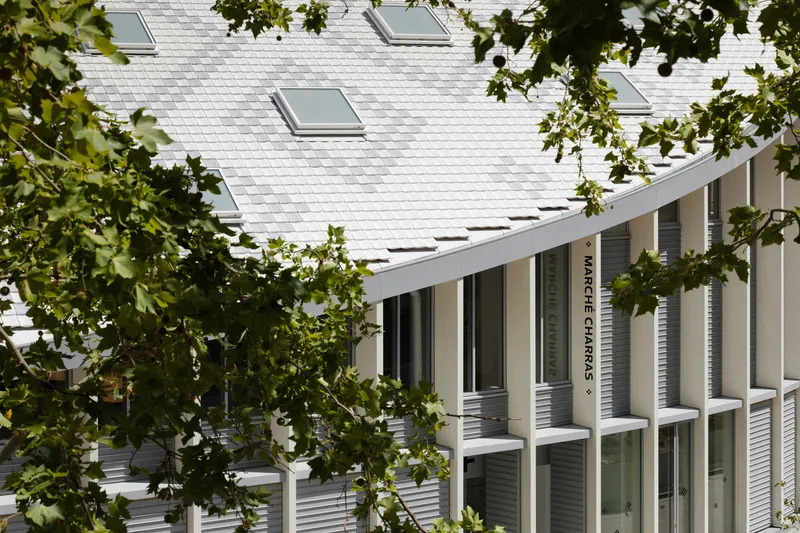
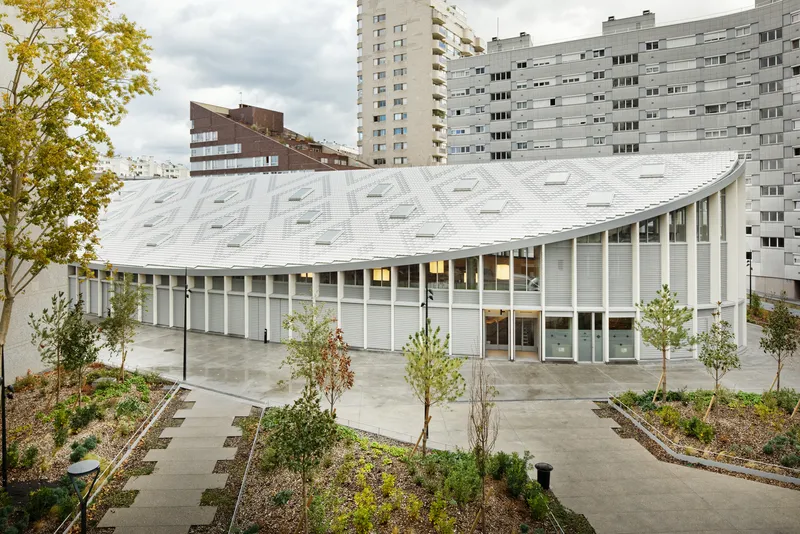
From the towers that ring the site, the roof is the building's primary elevation. The architects treated it accordingly. White varnished tiles laid in a grey-pearl mat diamond pattern give the surface a textile-like quality, while the triangular skylights read as a line of light along the ridge. At dusk, perimeter lighting traces the elliptical plan, turning the market into a glowing civic lantern visible from the upper floors of the surrounding residential towers.
The decision to articulate the roof so carefully is a smart acknowledgment of how high-density neighborhoods actually perceive low-rise buildings. For the residents of the Zodiac complex or the Dumas towers, the market is experienced as a fifth elevation almost exclusively. The diamond pattern and the skylights ensure that it registers as architecture, not as a parking garage lid.
Below Grade: 600 Spaces over Three Levels
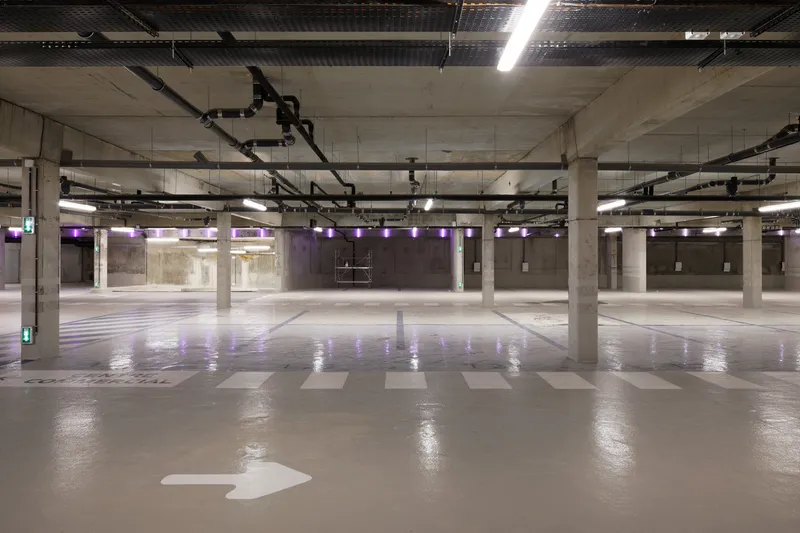
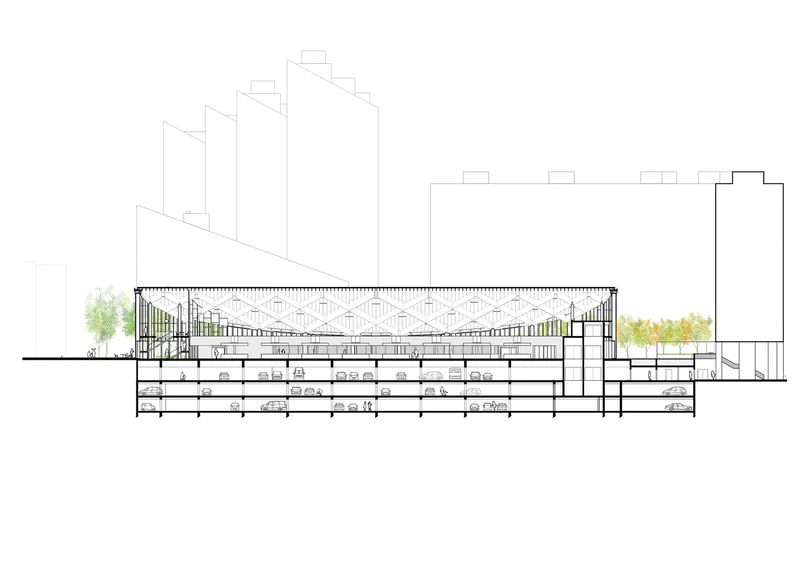
Beneath the market, 8,400 square meters of underground parking accommodate 600 vehicles across three subterranean floors. The first basement level is dimensioned to accept delivery vans, with a freight elevator connecting directly to the market floor. A single entry ramp on the east side manages incoming traffic; vehicles exit through the adjacent existing parking facility, a clever routing decision that eliminates the need for a second ramp and preserves the integrity of the esplanade above.
The engineering was anything but straightforward. The design team had to navigate co-ownership boundaries, existing utility networks, and an active urban heating system running beneath the site. Painted wayfinding arrows on the parking floor guide drivers through a simple circulation loop, and exposed concrete columns and mechanical piping are left visible rather than concealed, keeping costs down and maintenance access easy.
Construction and Assembly
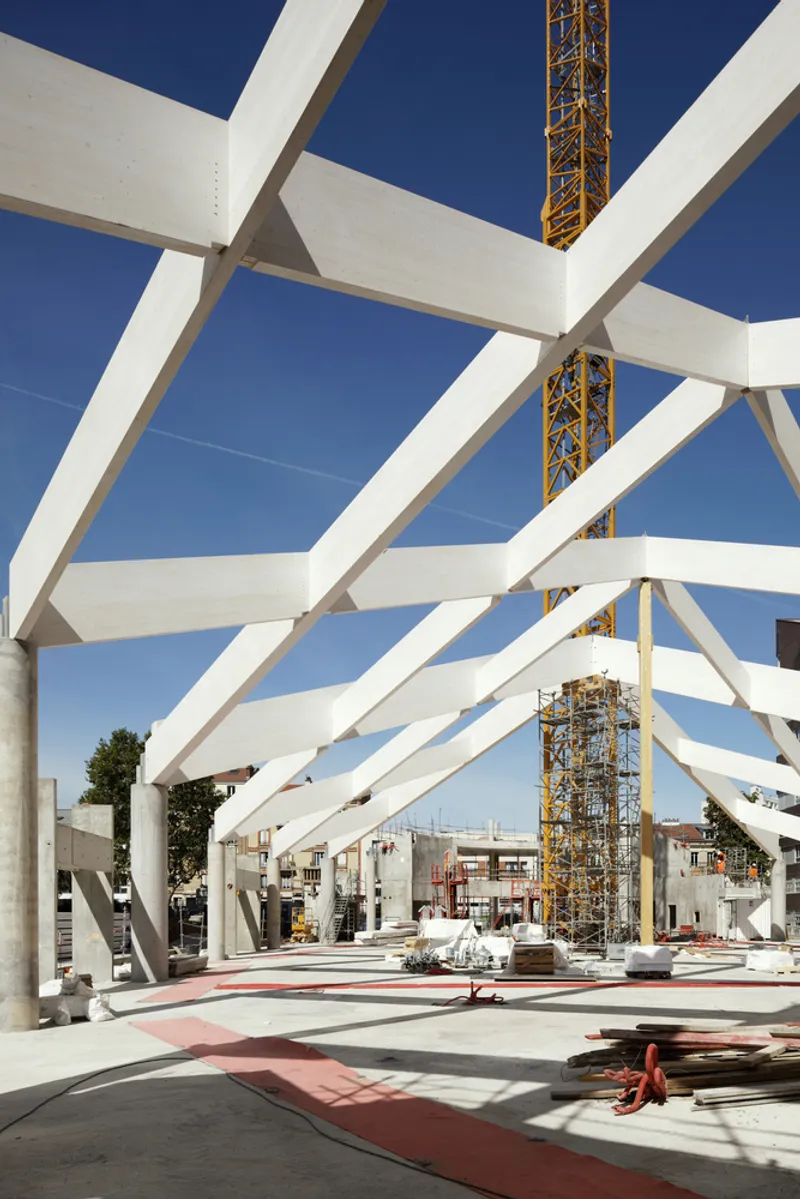
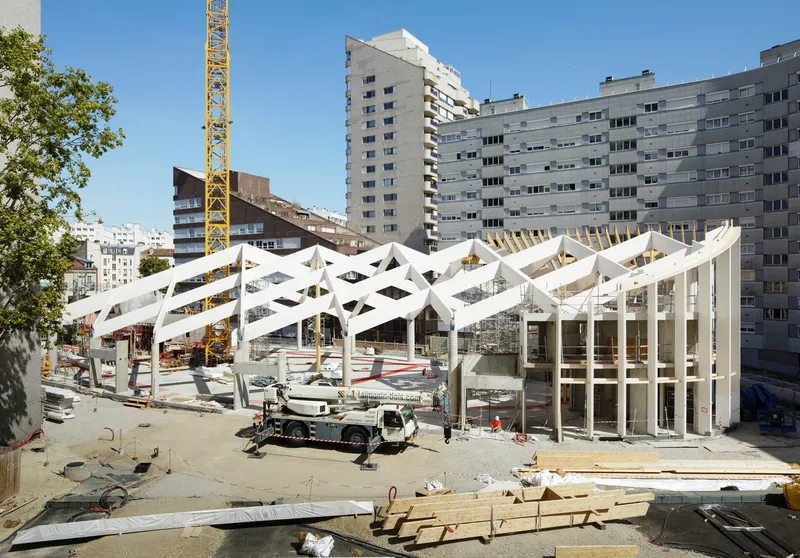
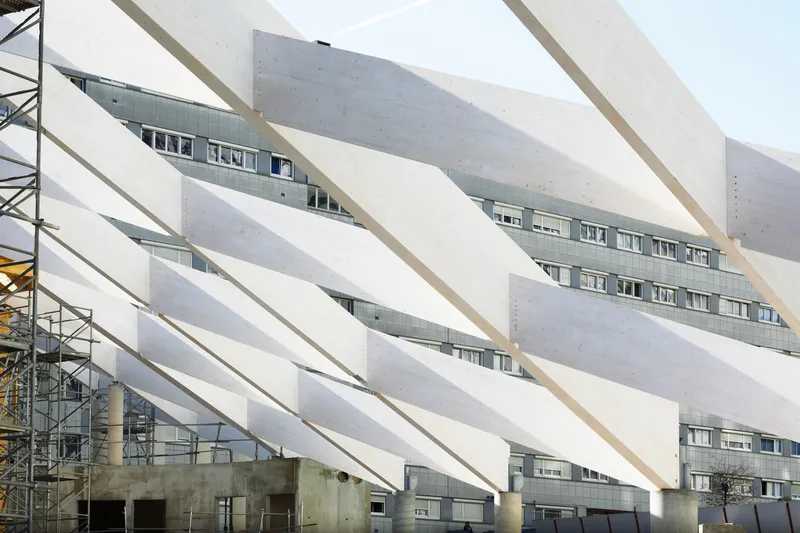
Construction photographs reveal the ambition of the timber structure. White laminated arches were lifted into place against an open sky, their zigzag profile clearly legible before the roof cladding closed over them. The images show a remarkably clean assembly process for a curved building of this size: prefabricated timber elements arriving on site and being craned into position, with the curtain wall glazing following the curvature of the plan without visible distortion.
The layered structural beams wrapping the facade demonstrate how the architects translated the elliptical geometry into buildable segments. Each section of the peristyle follows the curve, and the stainless steel infill panels between the wood posts accommodate the changing angles without custom joinery at every connection. It is a timber building that uses industrial precision rather than craft heroics to achieve its form.
Evening Presence

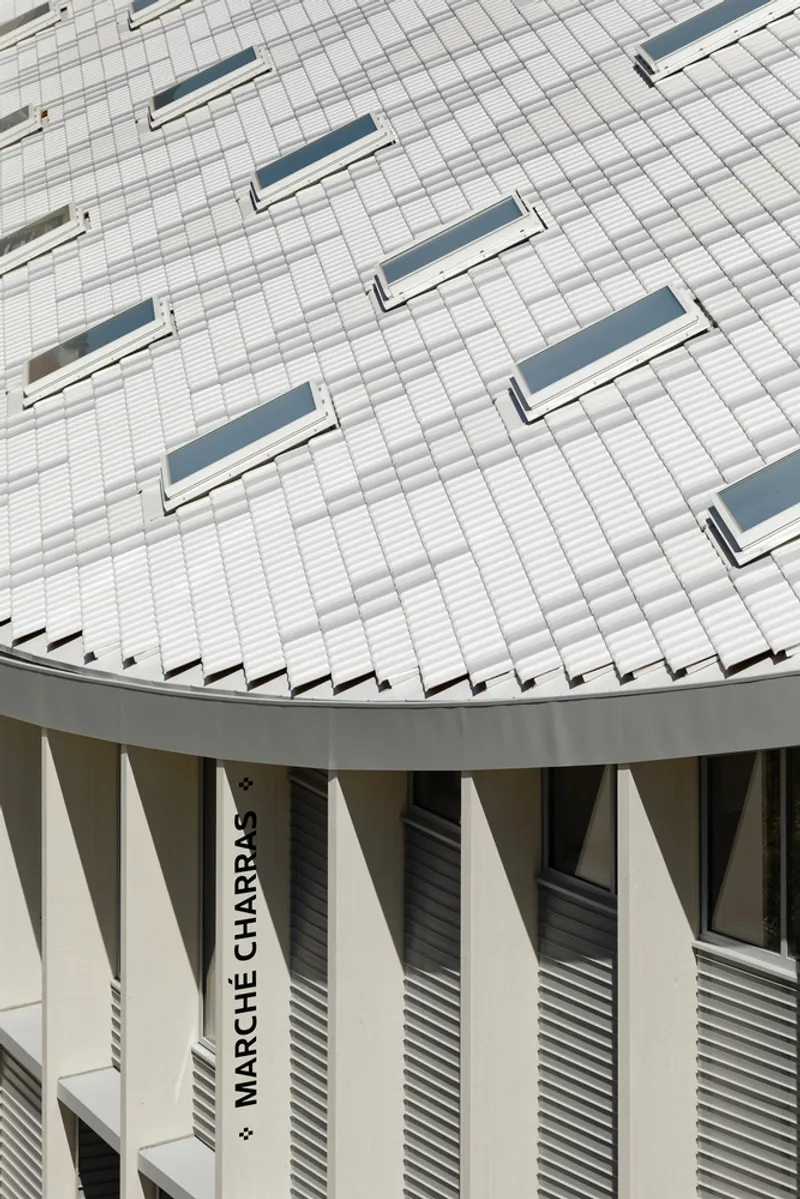
At twilight, the building shifts character entirely. The vertical louvers glow from within, the arched openings frame warm interior light, and the perimeter strip lighting traces the roof's elliptical edge against the darkening sky. The market hall becomes a beacon in a neighborhood that, until recently, had no real center of gravity after business hours.
The detail of the curved roof edge, with its horizontal metal tiles and triangular vents, reads cleanly even at night. The architects resisted the temptation to over-light the facade, letting the building's own transparency do the work. The result is a structure that participates in the streetscape without overwhelming it, a quality that too many civic buildings sacrifice in pursuit of spectacle.
Plans and Drawings
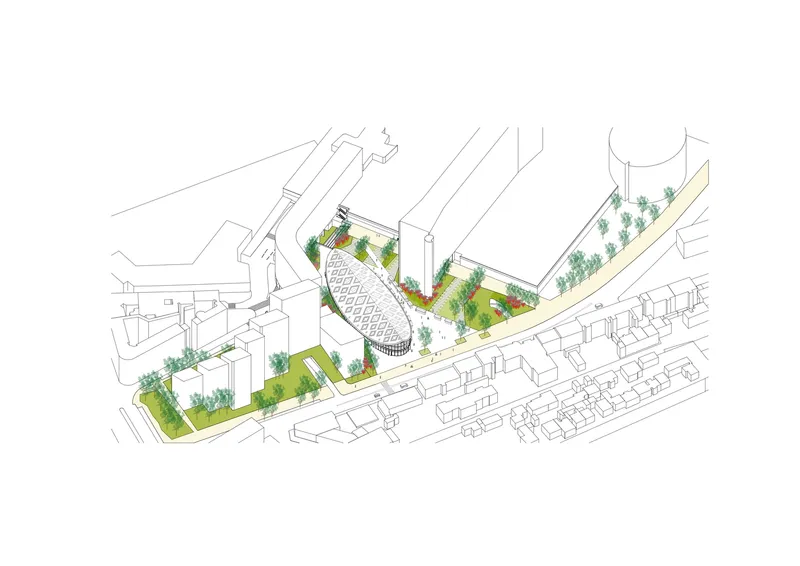
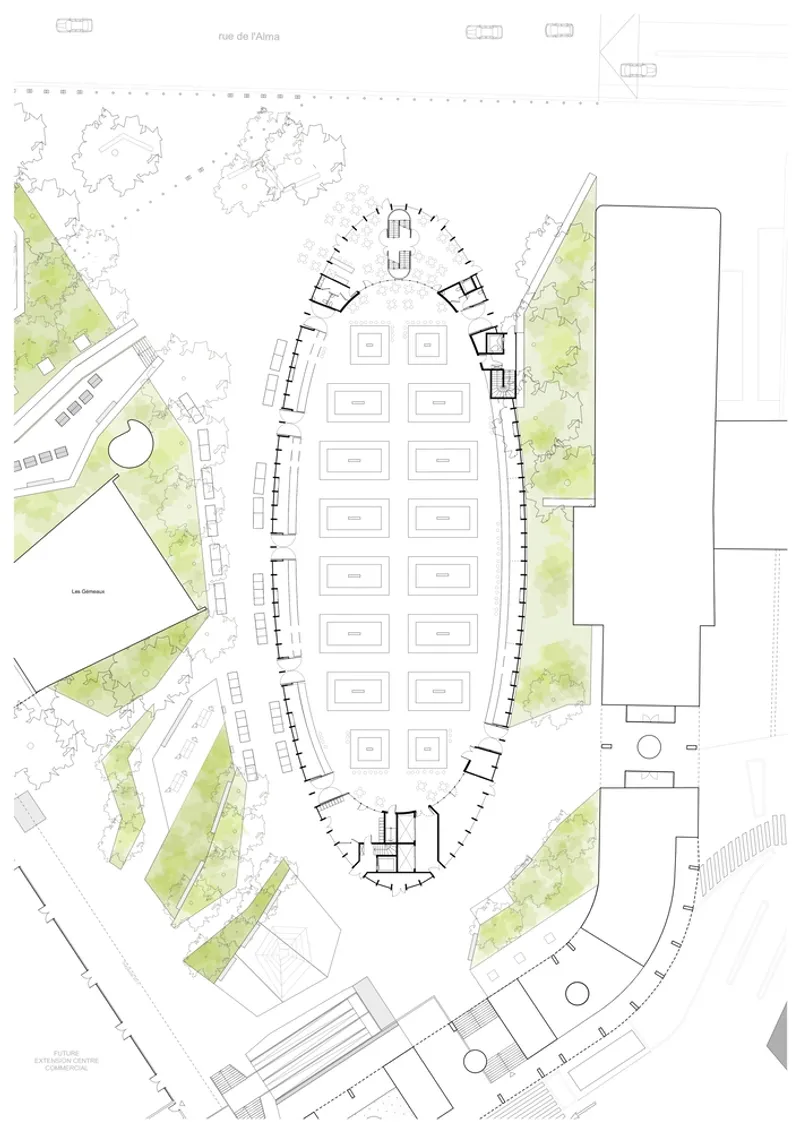

The axonometric drawing makes the building's relationship to its context legible at a glance: an oval form set in a field of trees, surrounded by orthogonal urban blocks, acting as a hinge between two very different neighborhood scales. The site plan confirms how the north-south pedestrian path passes through the building's orbit, turning the market into a waypoint rather than a destination.
The longitudinal and cross sections are the most revealing drawings. The longitudinal section shows the diamond-patterned roof structure spanning the full length of the hall, with three underground parking levels dropping below. The cross section cuts through the gabled roof and central atrium, illustrating how daylight penetrates through the ridge skylights to the market floor. Yellow light diagrams indicate the depth of natural illumination, confirming that the passive daylighting strategy is not aspirational but engineered.
Why This Project Matters
The Charras Market Hall succeeds because it treats a market as infrastructure, not as a boutique experience. The unheated timber shell, the 600-space car park, the delivery logistics, the concierge service: these are the unglamorous systems that make a civic building work day after day. croixmariebourdon embedded all of them into a single coherent form without letting any one system dominate the architecture. The building is simultaneously a piece of urban landscape, a climate-responsive envelope, and a functioning commercial platform.
More broadly, the project offers a replicable model for European cities grappling with aging mid-century urban complexes. Rather than demolishing the Charras Centre and starting from scratch, the phased redevelopment strategy preserves the site's role as a civic hub while replacing its obsolete buildings one at a time. The market hall is the first move in that sequence, and it sets a high bar. It proves that a timber structure can perform at the scale of a public building, that an elliptical plan can be built without excessive cost, and that a market hall can anchor a neighborhood without needing to shout.
Charras Centre Market Hall, Public Car Park, and Esplanade by croixmariebourdon architectes associés. Courbevoie, France. 2,400 m² market hall; 8,400 m² parking; 6,940 m² site. Completed 2020. Photography by Takuji Shimmura.
About the Studio
Share Your Own Work on uni.xyz
If projects like this are the kind of work you want to make, uni.xyz is a place to publish your own, find collaborators, and enter design competitions.




Popular Articles
Popular articles from the community


Hill & Cross Opera: Sculptural Opera House Architecture Shaped by Tallinn’s Landscape and Identity
Hill & Cross Opera reimagines opera house architecture in Tallinn through its sculptural hill, civic plaza, glass wave and a luminous cross.

The Earth Pod: 3D Printed Homes for Resilient Refugee Communities
The Earth Pod reimagines refugee housing through 3D printed homes made from clay, combining resilience, self-sufficiency, and rapid shelter.

Conexión: Biophilic Design Reimagines High-Rise Living in Hong Kong
Conexión reimagines high-rise living in Hong Kong through biophilic design, green facades, shared spaces, daylight, water and nature within.

The Musturak Paradise: Senior Living Architecture for a Connected Future in Temara, Morocco
The Musturak Paradise reimagines senior living architecture in Temara via private homes, social spaces, culture, community, and shared care.


Similar Reads
You might also enjoy these articles


Hodi-Mandai Geram
Project Function: Preservation and revitalization of the Intangible heritage and socio-spatial identity of the Hodi by Housing, Cultural Memory Center, Sacred Grove, landscape, local tourism economy


Olio Towers: A Mid-Rise for Performers That Fuses Housing, Rehearsal, and Stage
Located blocks from Houston's Theater District, this modular tower stacks living units around a central performance atrium.

Oasis: Modular Green Housing Carved into Dhaka's Urban Fabric
A shortlisted Plugin Housing entry reclaims unauthorized settlements in Dhaka with stepped concrete volumes, green roofs, and ventilation-driven design.

Black Hole: A Floating Megastructure for the Post-Physical Era
Emiliano Mazzarotto envisions a spherical, self-scaling arena where e-sports, digital hotels, and holographic stadiums replace traditional public space.


Explore Architecture Competitions
Discover active competitions in this discipline



Challenge to reimagine the Iron Throne


Photograph architecture without architects


Illustrate the lost glory of Angkor Wat - Render Challenge


Design challenge to reuse E-waste
Comments (0)
Please login or sign up to add comments
No comments yet. Be the first to comment!