
ARHINGinženjering Rebuilds a Lost Ottoman Mosque in Podgorica with Stone, Slope, and Restraint
The Hadrovića Mosque in Drač reclaims a demolished site of worship through vernacular rooflines and brushed stone materiality.


Until 1958, an Ottoman mosque occupied the intersection of four streets in Drač, a dense residential quarter of Podgorica, Montenegro. Then the communist government tore it down. Foundations were buried, records scattered, and only a single photograph survived. When an early 21st century urban plan designated the site for a new house of worship, ARHINGinženjering faced a problem more complex than design: how to return a mosque to a neighborhood that had spent decades absorbing its absence.
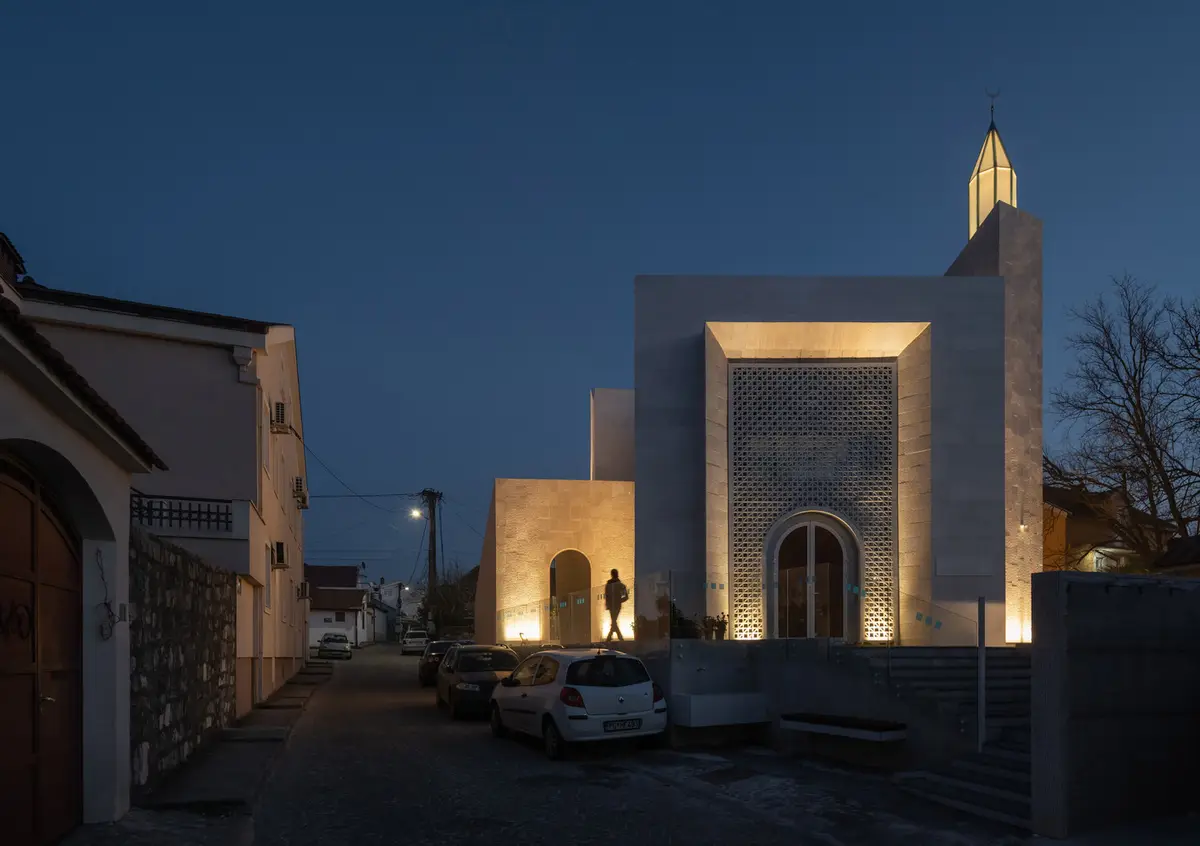
The answer, completed in 2024 and spanning 590 square meters, is not a replica or a monument to loss. It is a building that reads the neighborhood's own architectural grammar, the single-pitched roofs and courtyard walls of Drač's vernacular houses, and speaks it back in a sharper, more deliberate register. Lead architects Rifat Alihodžić, Jasmina Salković, Elvira Muzurović, and Branko Rabrenović sidestepped the familiar vocabulary of domes and pointed arches. Instead they produced two connected volumes, one for prayer and one for ablution, joined by a sloping courtyard wall and crowned by a minaret that rises like a vertical extension of the same logic. The result is a mosque that belongs to its street before it belongs to any canon.
A Neighborhood's Roofline, Taken Seriously


The most provocative decision here is also the most quiet one: single-pitched roofs. In Islamic architecture, there is no canonical mandate for a dome. Yet communities worldwide have calcified the dome as a non-negotiable signifier, and proposing anything else invites resistance. ARHINGinženjering chose the single pitch because that is what Drač already does. The residential buildings surrounding the site slope their roofs inward, directing rainwater toward interior courtyards where it has historically been collected for hygiene and household use. The mosque simply joins this collective choreography of water.
Seen from the street, the building's angled planes read as a slightly more assertive neighbor rather than an alien insertion. The volumes tilt and meet, creating an interplay of ascending and descending masses that feels spontaneous, almost geological, even though every angle is calibrated. It is civic architecture that earns its authority by listening first.
Stone Old and New
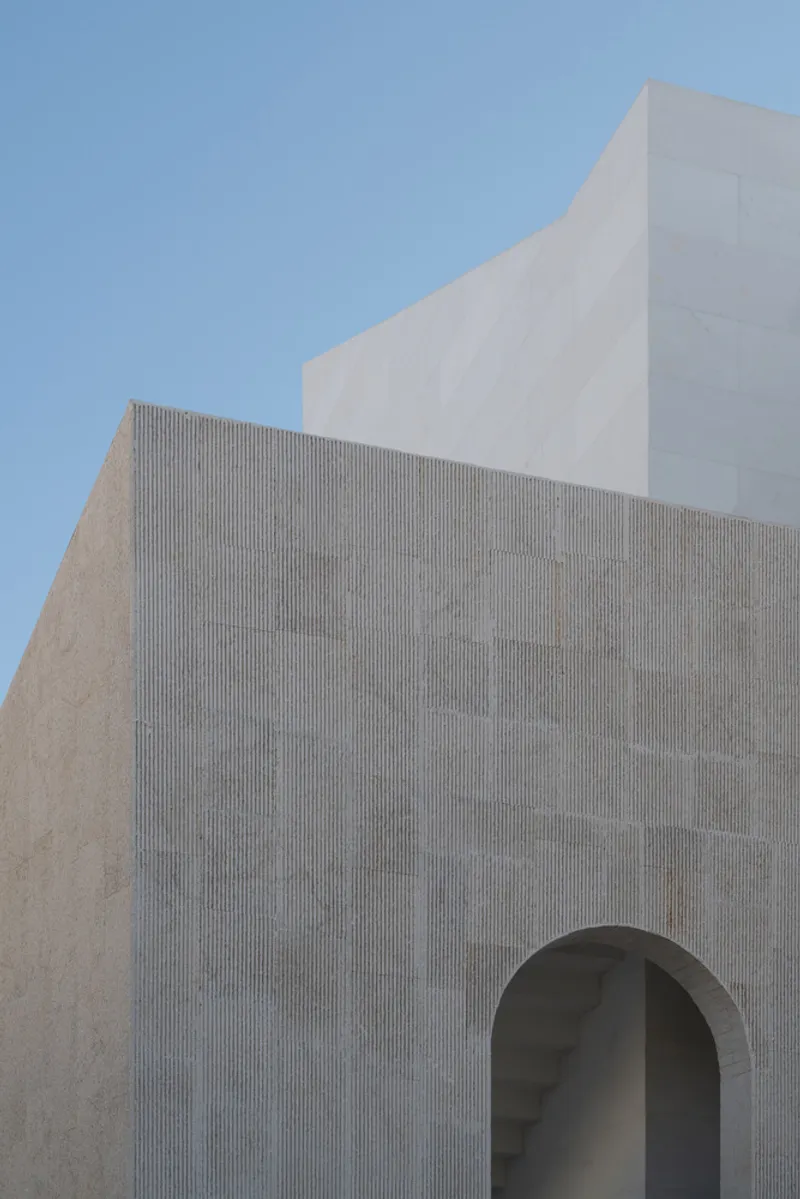
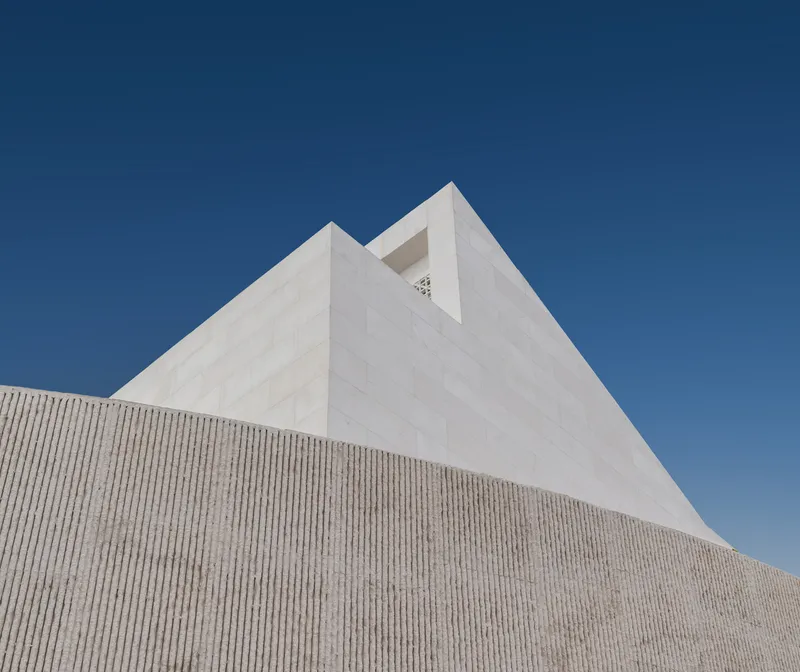
Stone is the dominant material in Drač. ARHINGinženjering honored that fact but refused nostalgia. The minaret and enclosure walls are clad in brushed stone with a pronounced tactile grain, a surface that catches light and shadow in ways that shift throughout the day. Against this, the main prayer volume wears smooth white marble, precise and luminous. The contrast is deliberate: rough tradition meeting polished intention.
At the base, ridged concrete panels introduce a third register of texture. These are neither ornamental nor structural in the traditional sense; they articulate the building's grounding, its literal contact with the earth where Ottoman foundations once lay. Manufacturers including Maljat Stone and Ceramiche Refin contributed to a material palette that is narrow in range but deep in effect. Nothing here is decorative for its own sake. Every surface does work.
The Minaret as Vertical Landscape
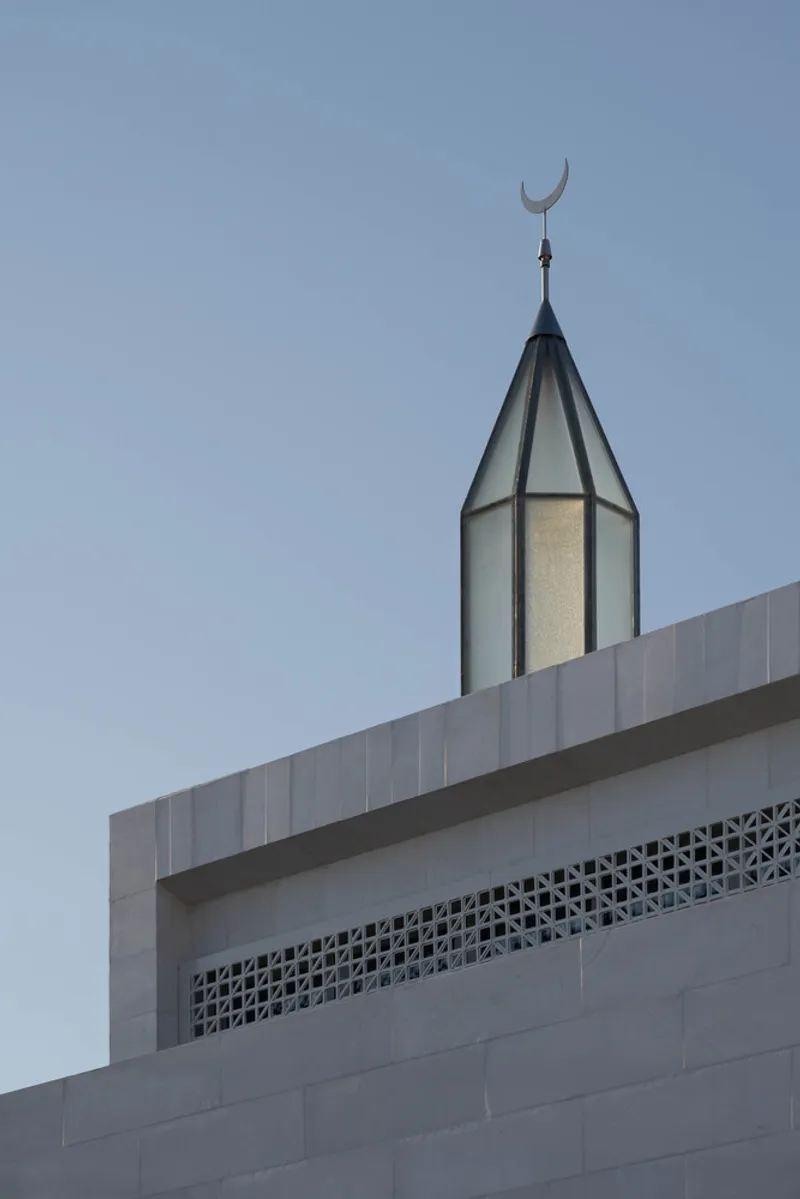
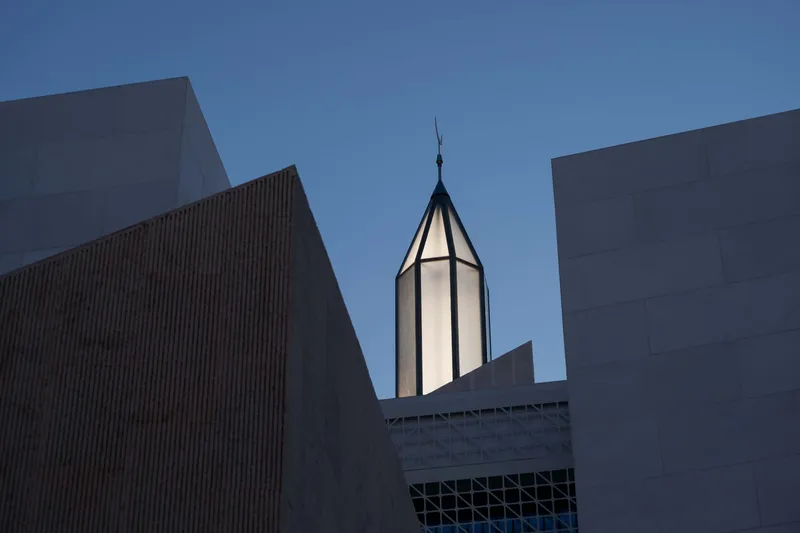

Most minarets announce themselves as freestanding towers, structurally and visually independent of the building they serve. Here the minaret grows from the same sloped wall system that defines the courtyard, rising as a logical culmination of the building's geometry rather than an appliqué. Seen from below, it is framed by the angular facades of the surrounding volumes, an octagonal shaft that narrows as it ascends, topped with a crescent finial that catches the last light at dusk.
At night, the glazed upper portion of the minaret glows against the rooftops of the neighborhood, visible from a distance but never domineering. It functions as a landmark without requiring spectacle, a lantern rather than a beacon. The architects understood that in a dense quarter like Drač, scale matters less than presence.
Thresholds and Perforated Light
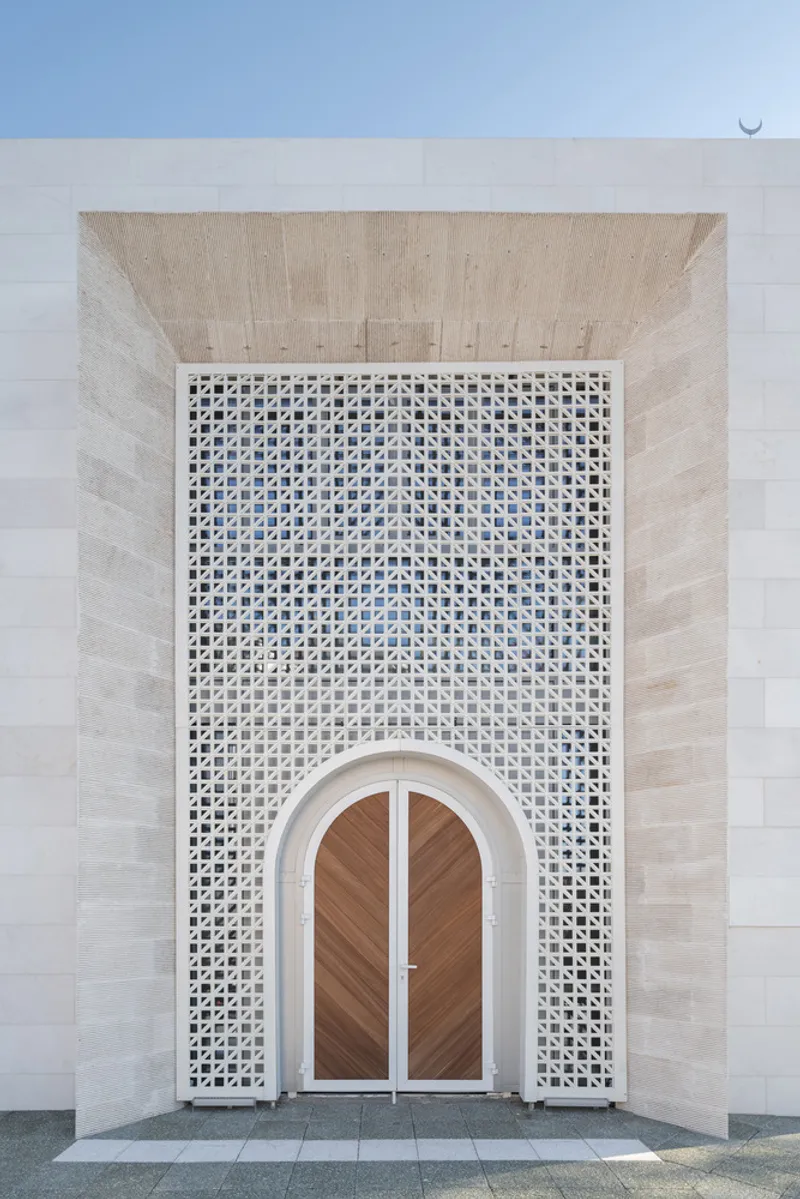
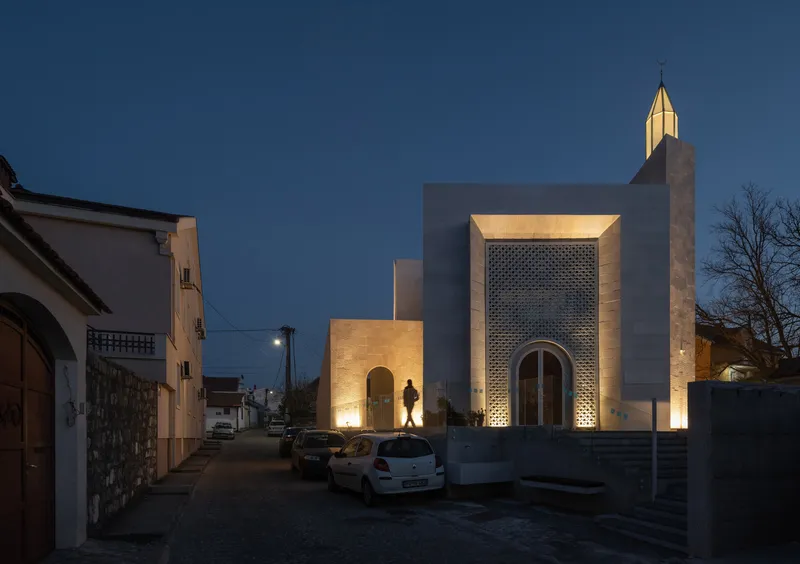
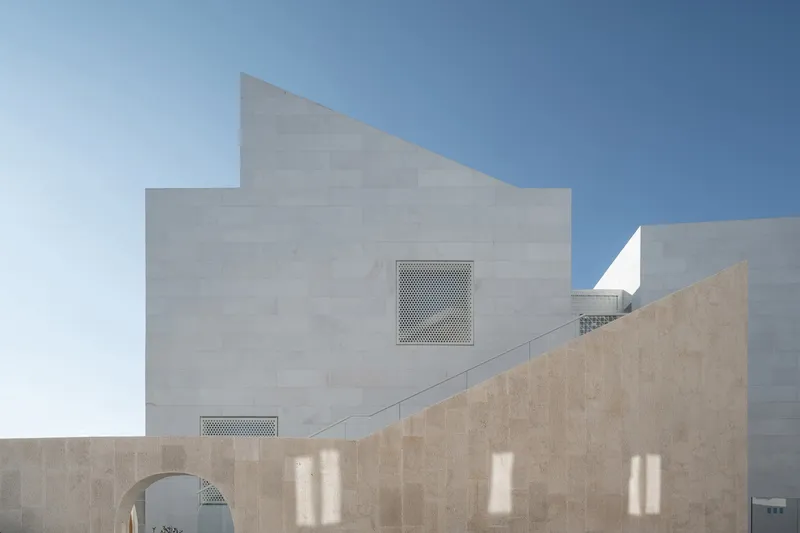
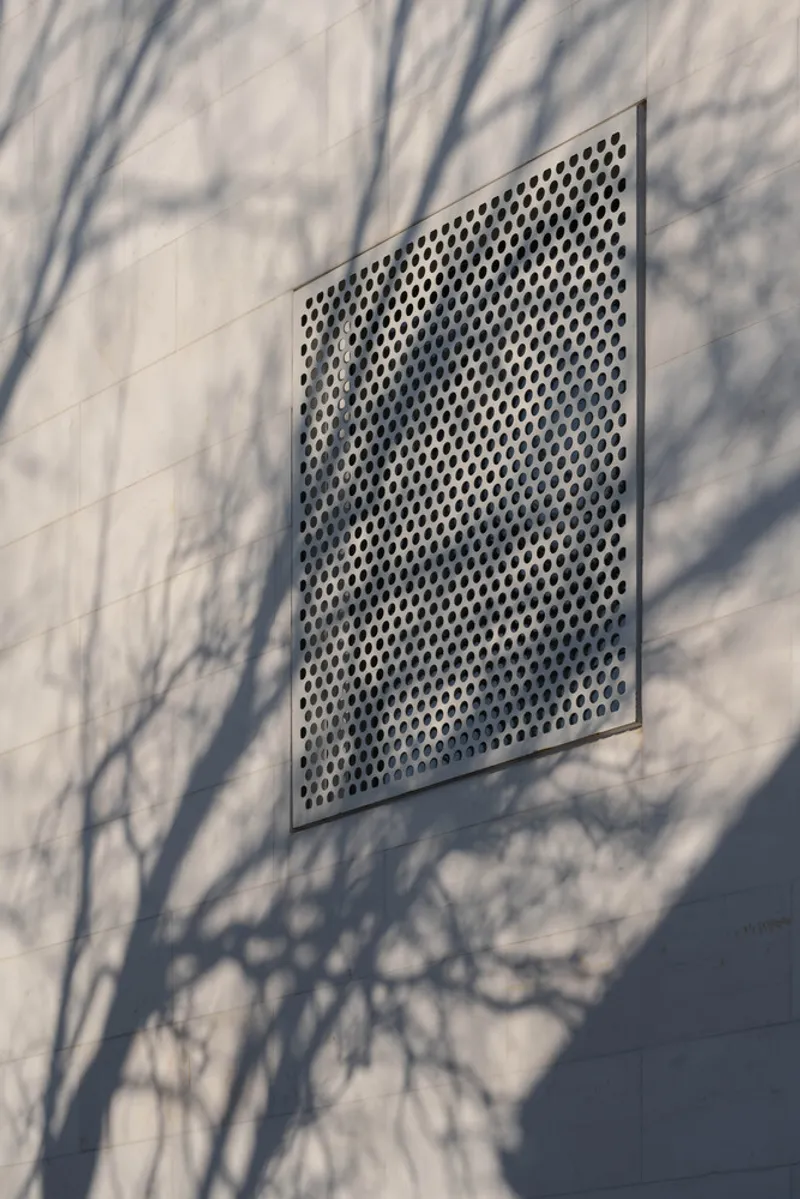
The entrance sequence is compressed and carefully orchestrated. Timber arched doors sit within a recessed stone canopy, behind which perforated screens filter daylight into geometric patterns. These screens appear throughout the building, on parapets, walls, and above doorways, and they serve a double function. Practically, they modulate light and air. Symbolically, they mark the transition from secular street to sacred interior, creating zones of deepening privacy without the bluntness of a solid wall.
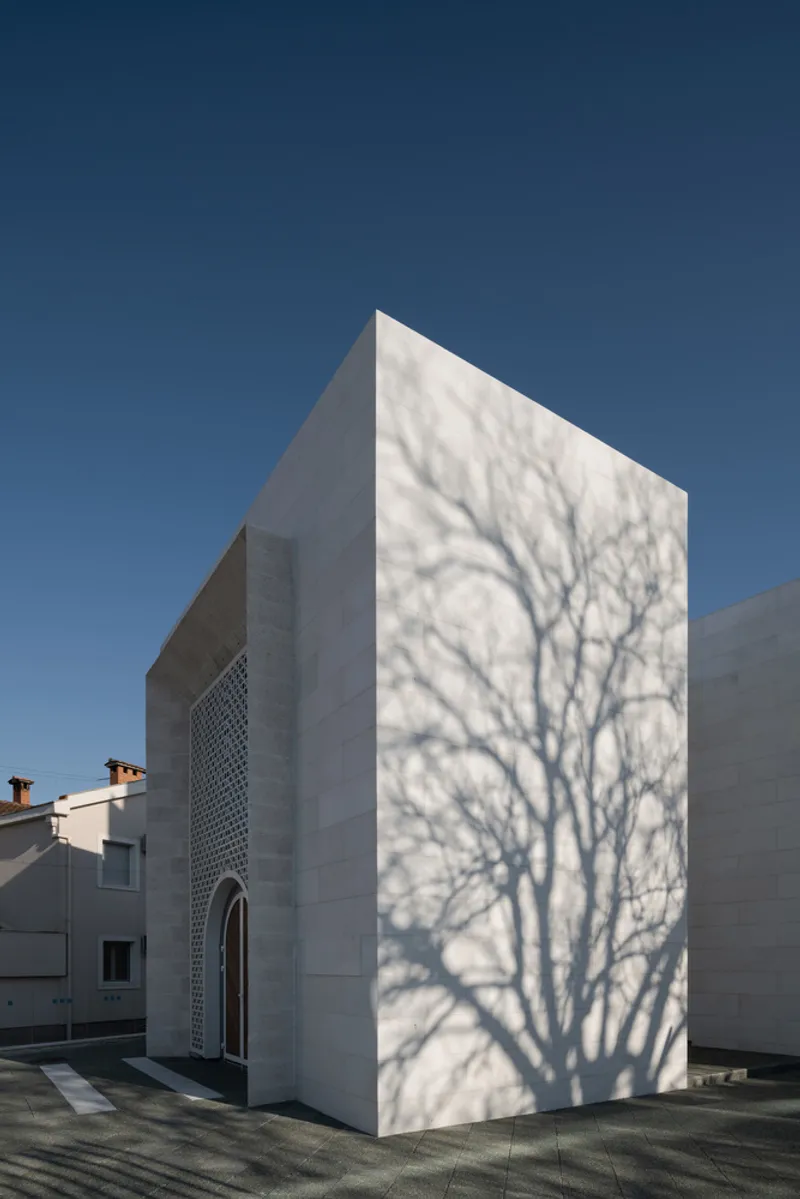
Narrow passages between the white volumes compress the visitor's field of vision before the interior opens up. Tree shadows fall across the plastered surfaces, adding an organic layer of pattern that the architects clearly anticipated. The building is designed to be inhabited not just by people but by weather, light, and time.
Inside the Prayer Hall

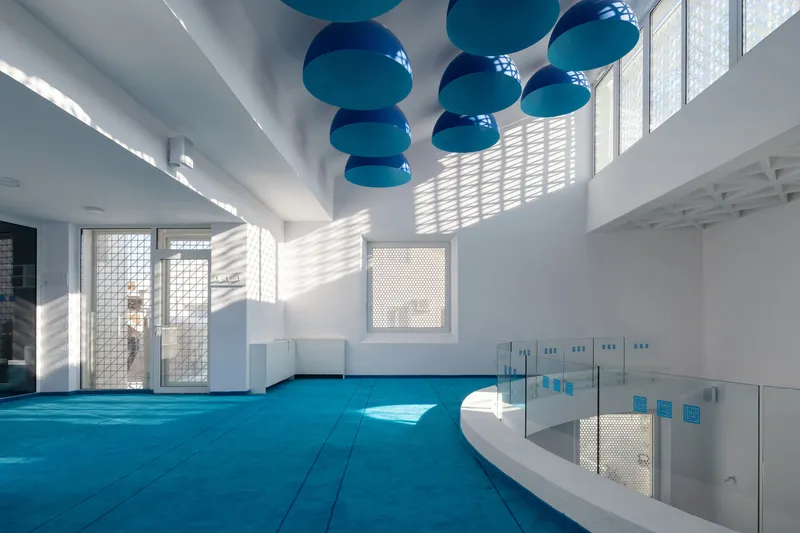
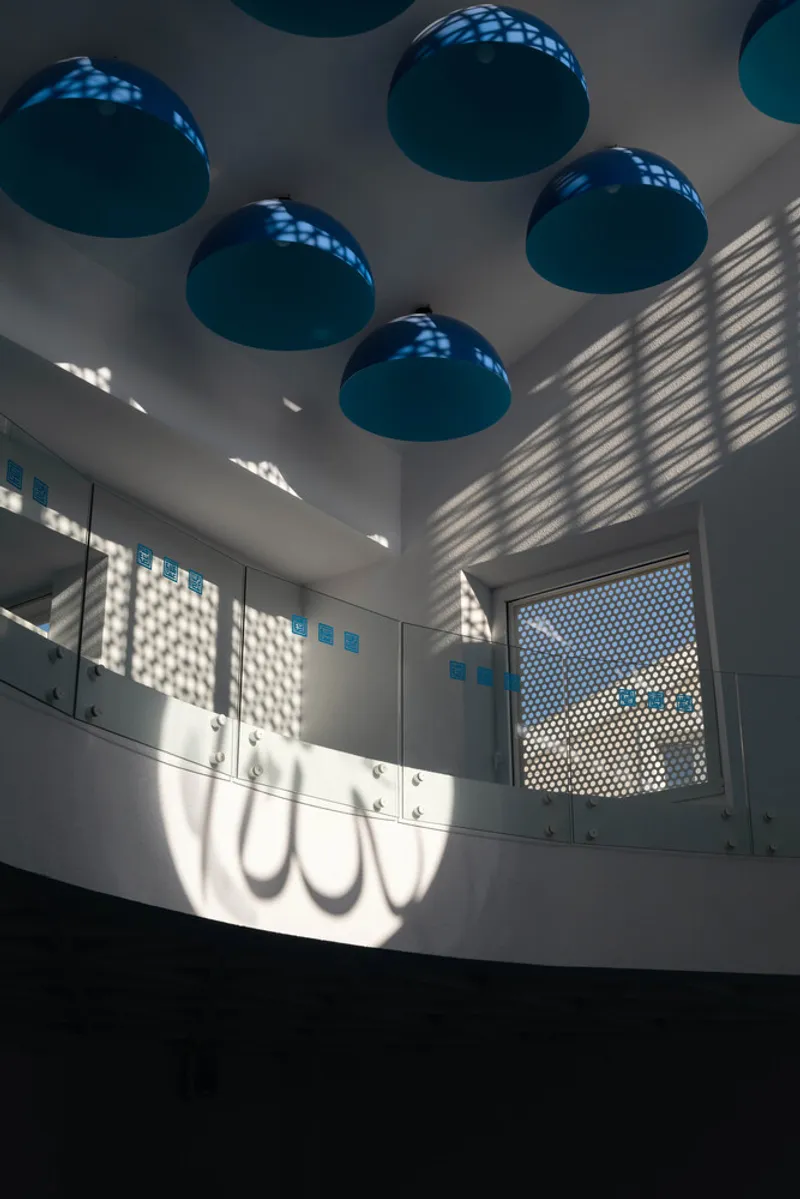
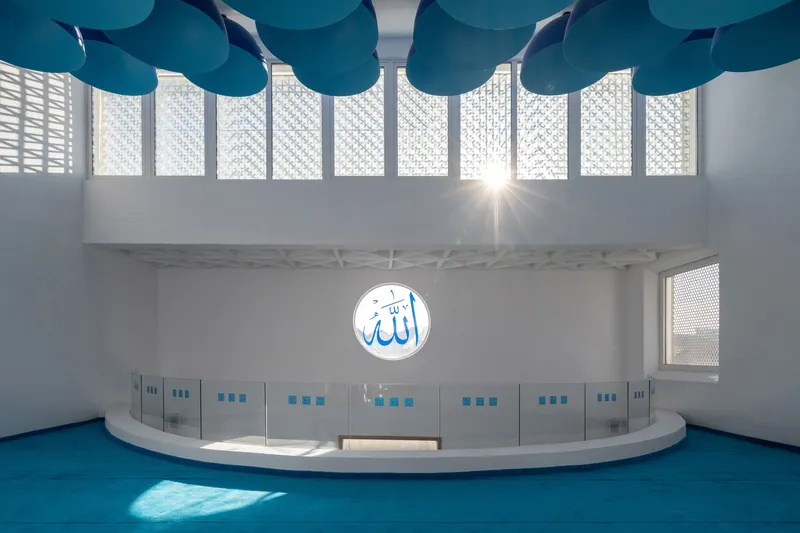
The prayer hall is the building's most resolved space. A geometric folded ceiling in white panels hovers above blue carpet and teal pendant lights, creating a luminous interior that owes more to the play of light through perforated screens than to any applied decoration. The mihrab niche is framed in timber, simple and direct, beneath a circular window bearing calligraphic inscriptions that projects shadow patterns onto the opposite wall when the sun aligns.
Color is restrained but specific. The blue floor tiles and teal acoustic discs suspended from the ceiling introduce coolness and calm without competing for attention. Striped light projections from the perforated screens move across these surfaces throughout the day, so the room is never static. It is a prayer hall that changes with the hours, rewarding sustained attention rather than a single dramatic reveal.
Ablution and Ritual Infrastructure


The second volume, dedicated to ritual washing and sanitation, receives equally considered treatment. A circular skylight drops light onto geometric relief wall panels and a row of blue ceramic ablution basins, turning a utilitarian program into something contemplative. The curved raised platform beneath clerestory windows, screened with patterned panels and capped with teal acoustic ceiling discs, demonstrates that ARHINGinženjering treated every function as worthy of architectural ambition.
The single-pitched roofs direct rainwater toward the inner courtyard, echoing the Drač tradition of harvesting water for hygiene. This is not a symbolic nod. It is working infrastructure integrated into the building's geometry, a case where contextual intelligence and environmental performance are the same thing.
Shadow, Pattern, and Circular Geometry
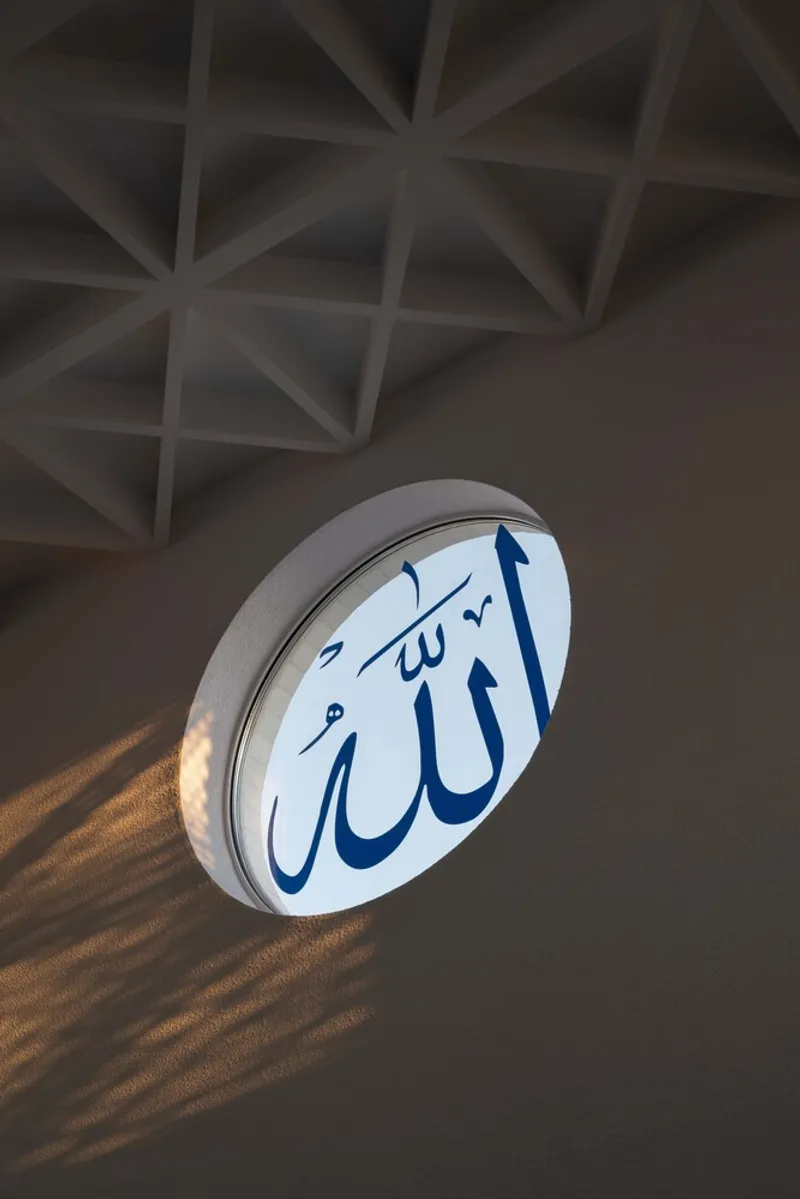
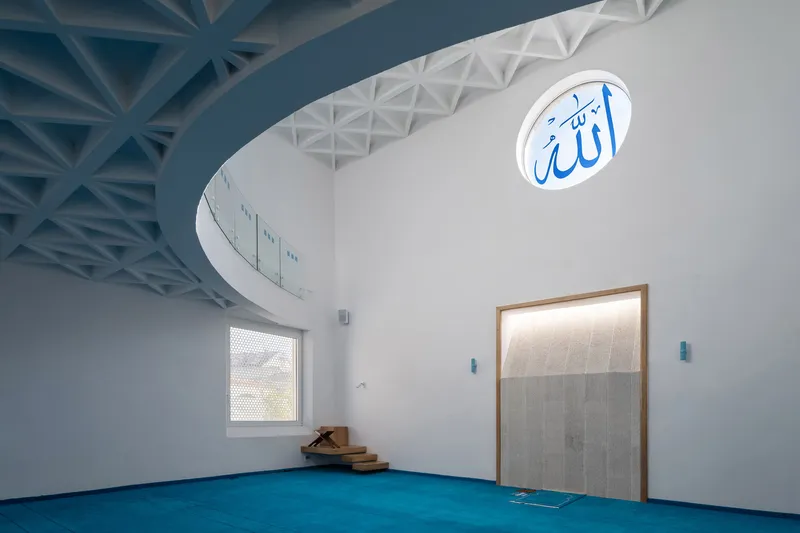
Circular motifs recur throughout the building: the large round window on the street facade, the backlit calligraphic disc in the prayer hall, the teal ceiling pendants. These forms soften the angular volumes and introduce a geometry that reads as spiritual without being literal. The calligraphic window is the most powerful instance, projecting a halo of shadow below the coffered ceiling that shifts with the sun's angle.
Outside, the same logic of projected pattern plays out on a larger scale. Tree branches cast organic shadows across the perforated screens, layering natural geometry over designed geometry. It is the kind of effect that only works when a building is sited precisely and its surfaces are tuned to receive the environment rather than repel it.
Plans and Drawings

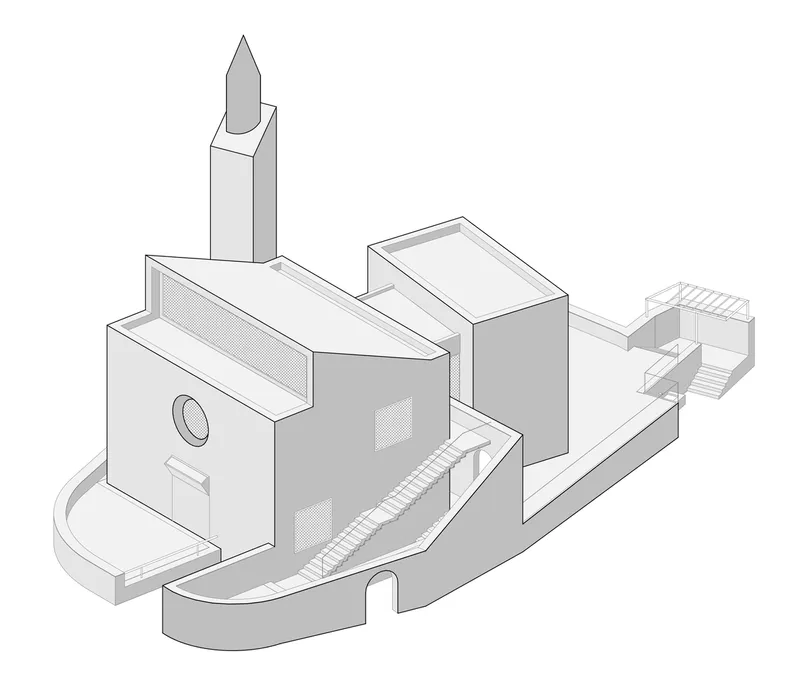


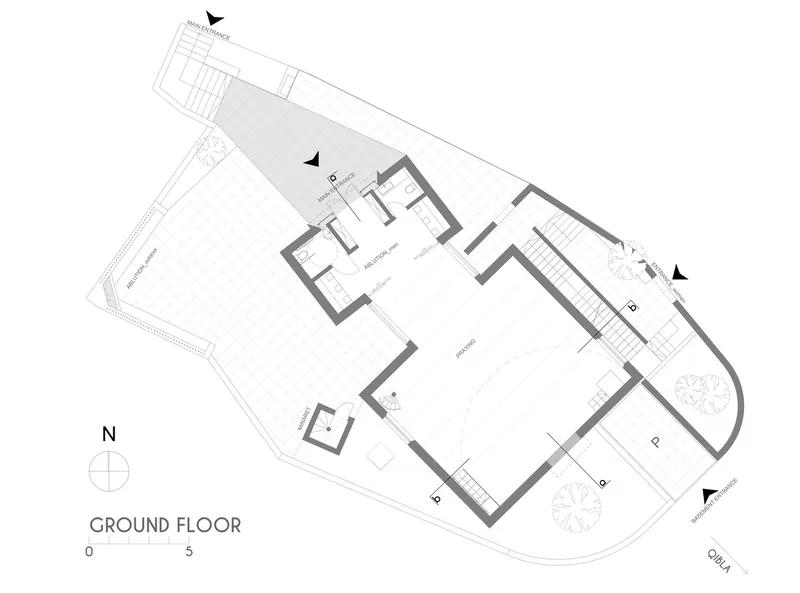

The axonometric drawings reveal what the photographs only imply: the two volumes are not simply placed side by side but interlocked through the courtyard wall, which acts as both separator and connector. A curved ramp links multiple levels, accommodating the sloping site without resorting to a flat plinth. The section drawing makes the varied roof forms legible, showing how the interior spaces step down with the terrain while the roofs slope in coordinated but independent directions.
The site plan locates the mosque within its block, confirming how tightly it is woven into the residential fabric. The ground floor plan shows an irregular perimeter that responds to the four-street intersection, with rooms arranged around a central hall and a corner terrace that opens toward the neighborhood. At the first floor, a curved wall encloses a semicircular room, likely for women's prayer, with adjacent rectangular service spaces. Nothing about the plan is arbitrary; every irregularity is a negotiation with the site.
Why This Project Matters
The Hadrovića Mosque matters because it proves that religious architecture does not need to import its forms from elsewhere. In a global landscape where mosques frequently default to Ottoman or Gulf-state typologies regardless of local context, ARHINGinženjering looked at the buildings already standing on the same streets and derived a design language from what was there. The single-pitched roof, the courtyard wall, the brushed stone: these are Drač's own materials and geometries, elevated to civic scale.
It also matters because it confronts a specific historical wound without sentimentality. The Ottoman mosque was destroyed. No amount of documentation survived to enable reconstruction. Rather than building a speculative replica or an abstract memorial, the architects built a functioning mosque that belongs to the present while acknowledging the ground it stands on. That is a harder, more honest project than nostalgia, and the result is one of the most thoughtful pieces of religious architecture completed in the Balkans in recent years.
Hadrovića Mosque by ARHINGinženjering. Drač, Podgorica, Montenegro. 590 m². 2024. Lead Architects: Rifat Alihodžić, Jasmina Salković, Elvira Muzurović, Branko Rabrenović.
About the Studio
Share Your Own Work on uni.xyz
If projects like this are the kind of work you want to make, uni.xyz is a place to publish your own, find collaborators, and enter design competitions.


Popular Articles
Popular articles from the community


Conexión: Biophilic Design Reimagines High-Rise Living in Hong Kong
Conexión reimagines high-rise living in Hong Kong through biophilic design, green facades, shared spaces, daylight, water and nature within.

Hill & Cross Opera: Sculptural Opera House Architecture Shaped by Tallinn’s Landscape and Identity
Hill & Cross Opera reimagines opera house architecture in Tallinn through its sculptural hill, civic plaza, glass wave and a luminous cross.

Co-Life: Senior Housing Design That Reconnects Older Adults With the City
Co-Life reimagines senior housing design through healing gardens, shared streets, workshops, and a sustainable community across generations.

Co-life: Sustainable Architecture for Age-Friendly Community Living
Co-life reimagines sustainable architecture for seniors through courtyards, rammed earth, shared gardens, and spaces designed for belonging.

Similar Reads
You might also enjoy these articles

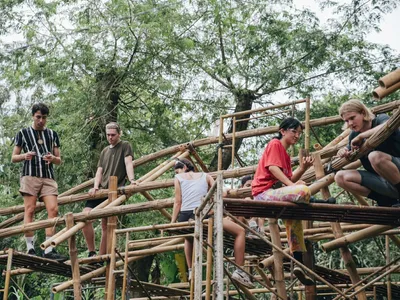
Bamboo Housing Challenge 2026: Design Affordable, Sustainable Homes Using Bamboo
An international design competition by Bamboo U and IBUKU inviting architects and designers to reimagine affordable housing using bamboo — with the winning design built full-scale in Bali.

Computational Design & Education: Beegraphy Design Awards Introduces 7th Category (Featuring Jiyun's Innovative Approach)
Dive into Beegraphy’s 7th Design Awards category, where computational design meets education to create immersive, interactive learning tools, inspired by Jiyun’s work.
From Parametric Lighting to Urban Furniture: Join the 2nd Workshop in Beegraphy’s Computational Design Series
Dive into Cutting-Edge Design Techniques and Practical Applications with Industry Experts

Last Call: Unleash Your Architectural Genius in SHAK's Kindergarten Design Competition
Urgent call for architects to join SHAK's kindergarten design competition before the looming deadline

Explore Arabic Architecture Competitions
Discover active competitions in this discipline

Challenge to reimagine the Iron Throne

Photograph architecture without architects

Illustrate the lost glory of Angkor Wat - Render Challenge

Bring back Drive In's
Comments (0)
Please login or sign up to add comments
No comments yet. Be the first to comment!