
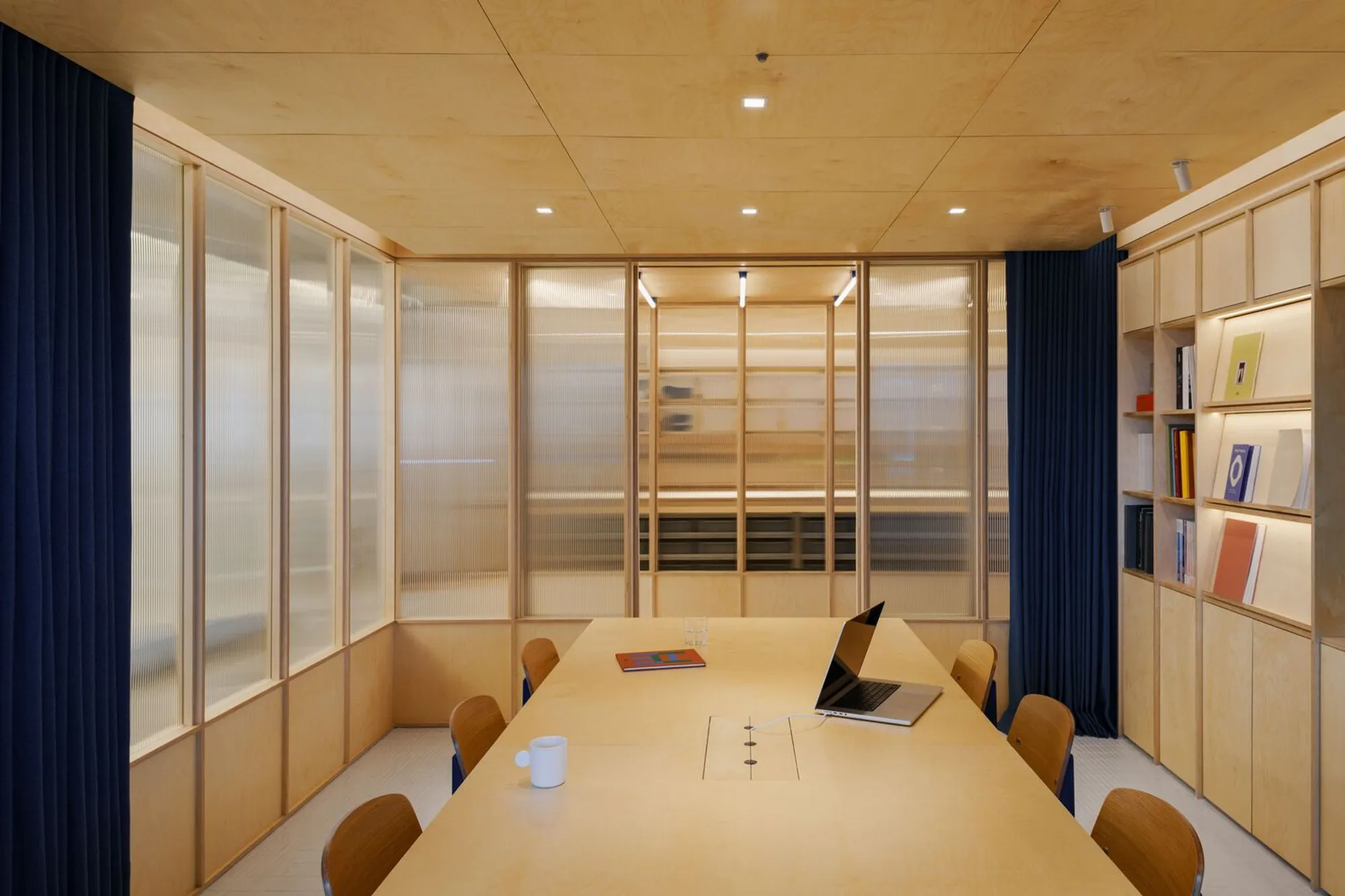
InOrder Studio Wraps a Taichung Office in Birch Plywood for a Ceiling Fan Manufacturer
KUBRICK Office in Taichung, Taiwan, distills 190 square meters of workspace into a warm, material-driven interior for a global design center.


Most offices designed for product companies settle for displaying the goods and calling it a day. InOrder Studio, led by designer Ching-Ju Chen, took a different route with the KUBRICK Office in Taichung, Taiwan. Rather than turning the 190-square-meter space into a showroom for its client, a global ceiling fan manufacturer, the studio built an interior that performs the same values the brand claims to hold: material honesty, fine craft, and a deep regard for natural textures. The result is a workspace that feels less like a corporate headquarters and more like the workshop of a company that actually cares about how things are made.
What makes KUBRICK genuinely interesting is not the amount of birch plywood used, though there is a lot of it, but the discipline with which it is deployed. Every surface, partition, counter, and storage unit is carved from the same material vocabulary, yet the space never reads as monotonous. InOrder Studio introduces just enough counterpoints, white brick, ribbed glass, a single deep navy curtain, seamless grey flooring, to keep the eye moving. The real trick is spatial: in under 200 square meters, the office manages to contain individual workstations, a conference room, a kitchenette, a reading nook, mobile brainstorming walls, and a planted terrace without any of them feeling crowded or compromised.
Plywood as System, Not Surface
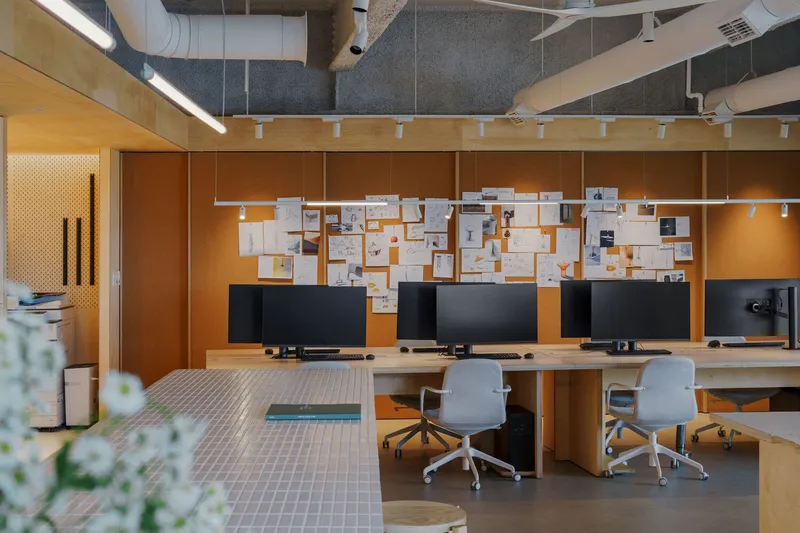
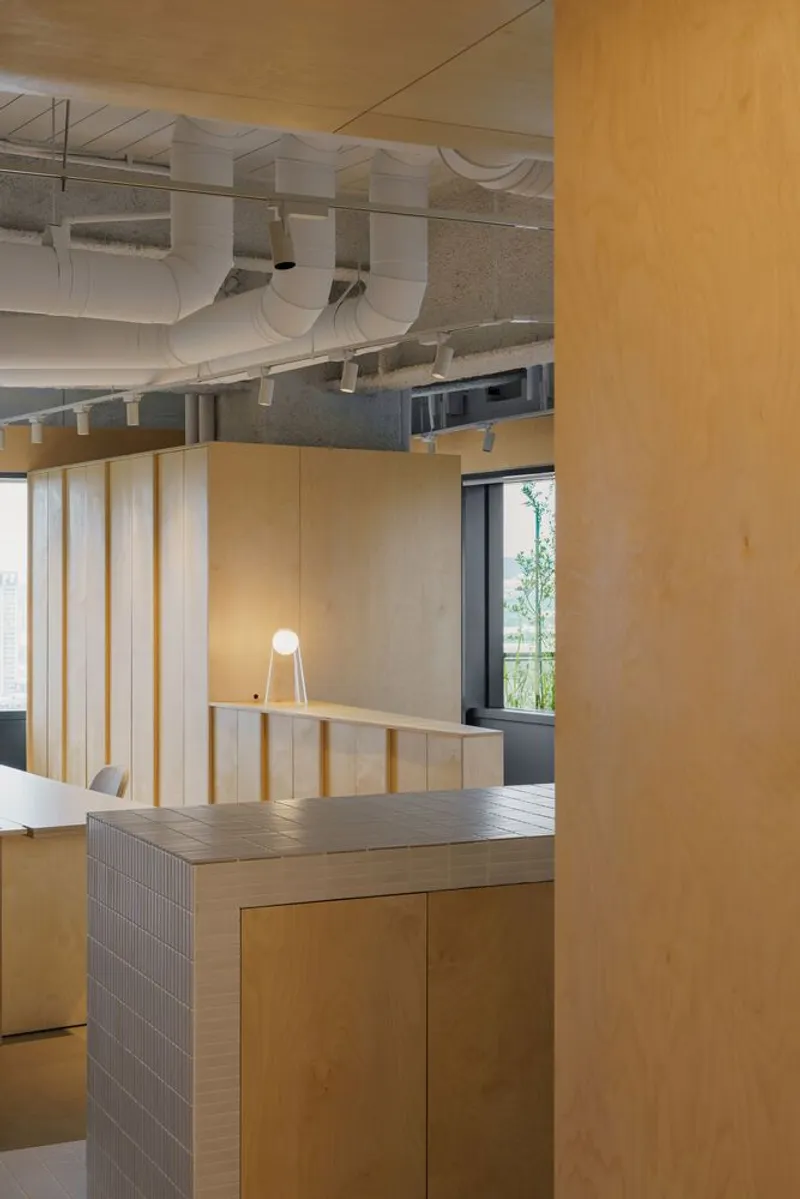

Birch plywood is everywhere in the KUBRICK Office, but InOrder Studio treats it as a structural logic rather than a finish. Desks, partitions, cabinetry, and ceiling elements are all built from the same material, creating a continuous spatial system where one component flows into the next. The exposed ductwork and concrete ceiling overhead are left deliberately raw, establishing a tonal contrast that makes the warmth of the wood feel intentional rather than decorative.
Look closely at the corner details and you see the care: precise miters, clean reveals, and a knurled metal footrest rail beneath a counter that would be invisible in a photograph if you weren't paying attention. The plywood is not masking anything. It is the architecture.
Reception and Entry: A Quiet Declaration
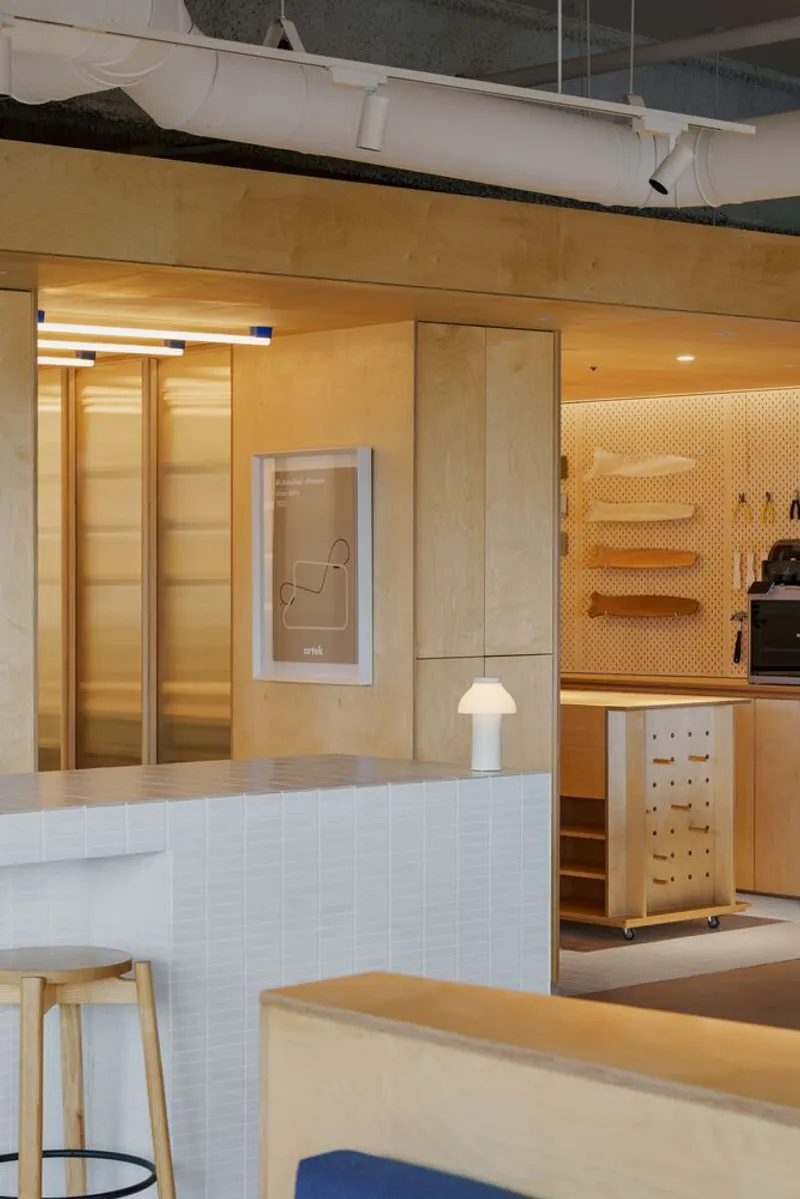
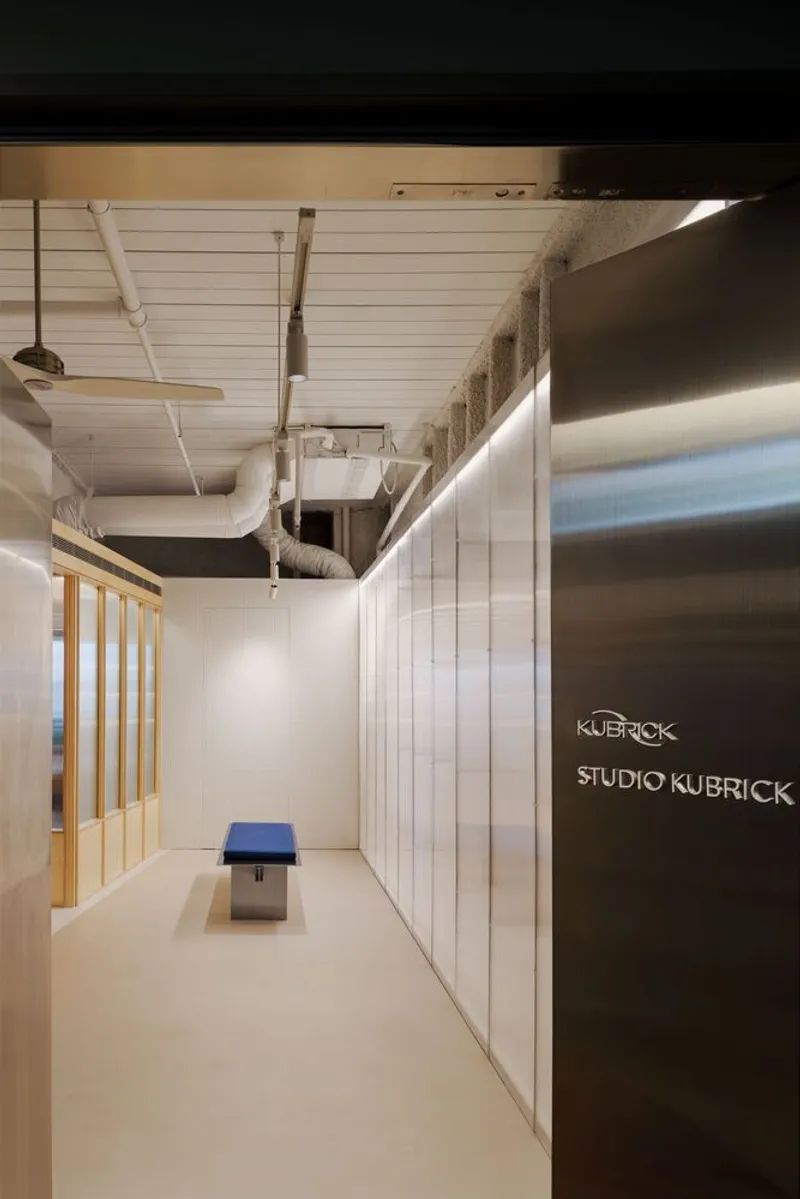
The entry sequence sets expectations with restraint. A reception counter finished in white mosaic tile sits alongside a pegboard wall and plywood-clad elevator doors. A single bench rests against a clean white wall beneath exposed ductwork and a horizontal plank ceiling. There is no feature wall, no oversized logo, no attempt to impress through volume. Instead, the materials do the talking: the tile is tactile, the plank ceiling is warm, and the pegboard hints at the hands-on culture behind the door.
Translucent Boundaries
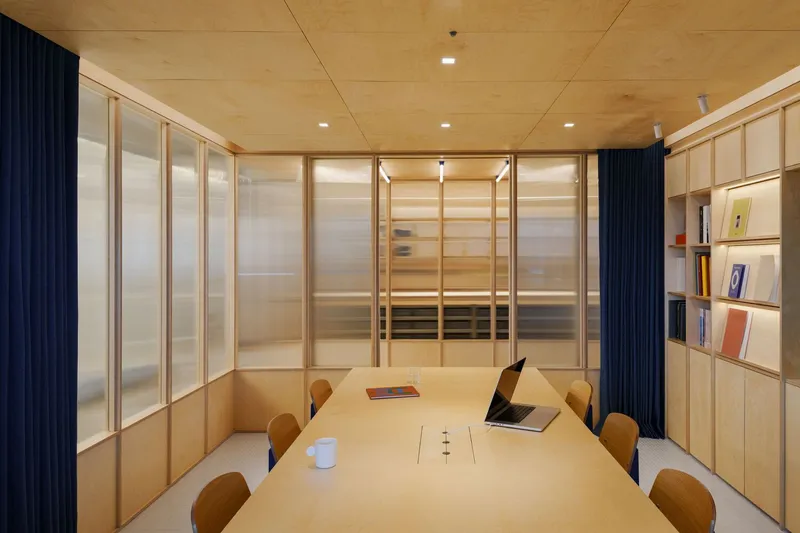
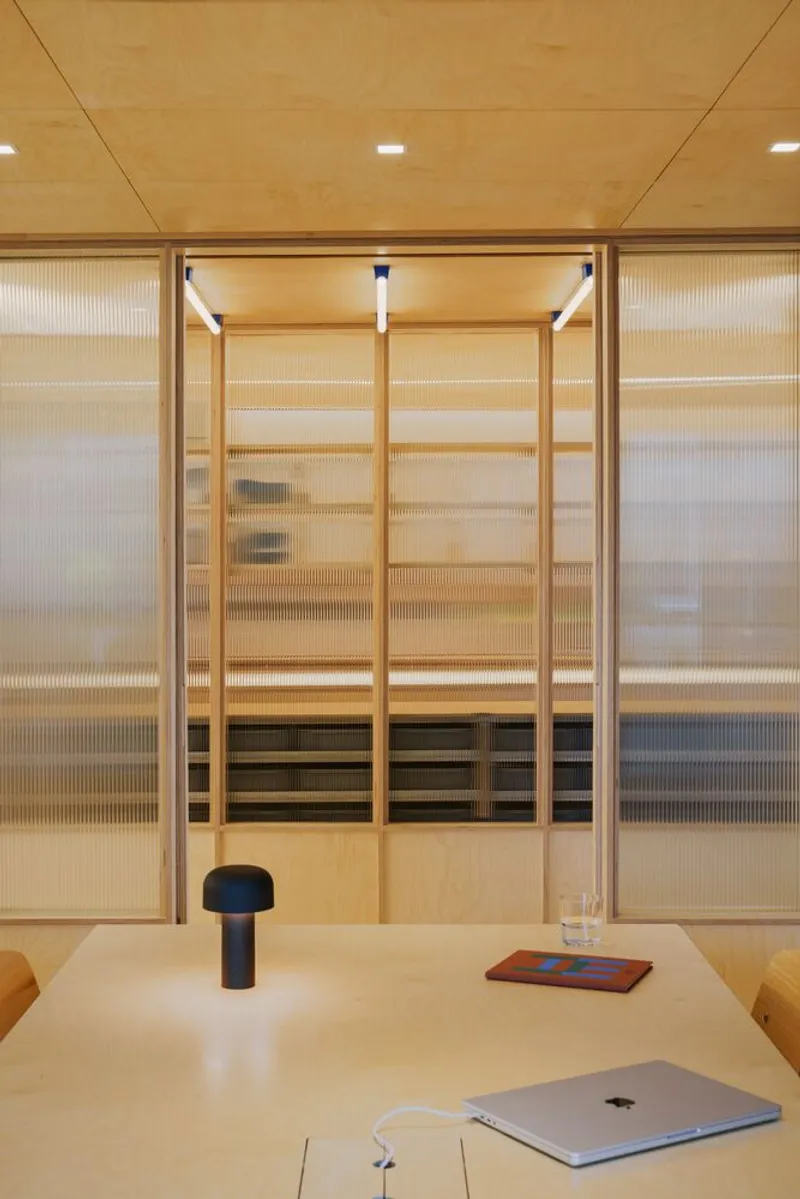
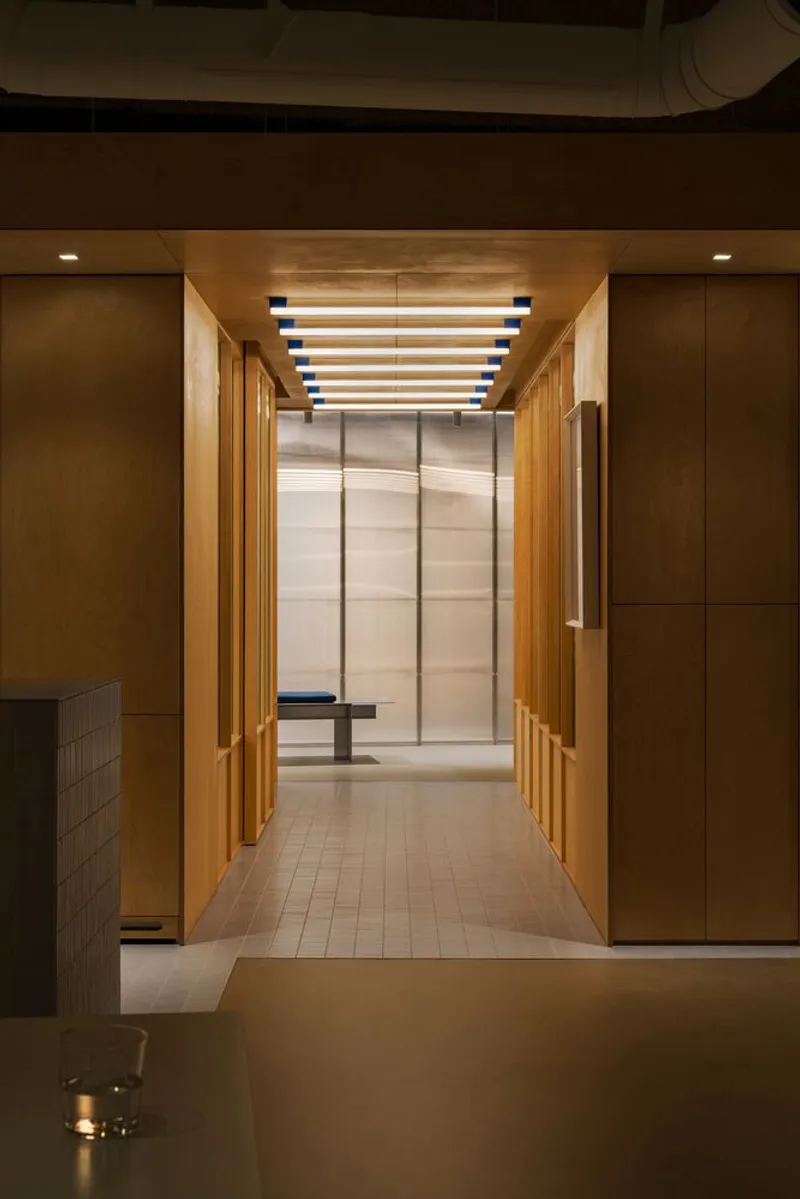
Privacy in a small office is a design problem that most firms solve with solid walls or nothing at all. InOrder Studio chose a middle path: timber-framed partitions filled with fluted glass panels. The ribbed texture admits light while blurring the view, giving the conference room and corridor zones a sense of enclosure without severing them from the rest of the plan. You know there are people on the other side; you just cannot read their screens.
The corridor formed between parallel runs of these partitions becomes one of the most atmospheric moments in the office. Linear fixtures mounted on blue metal brackets cast even light down the passage, and the reeded glass catches it at every angle. It is a hallway that earns its keep as architecture.
Flexibility Built into Furniture
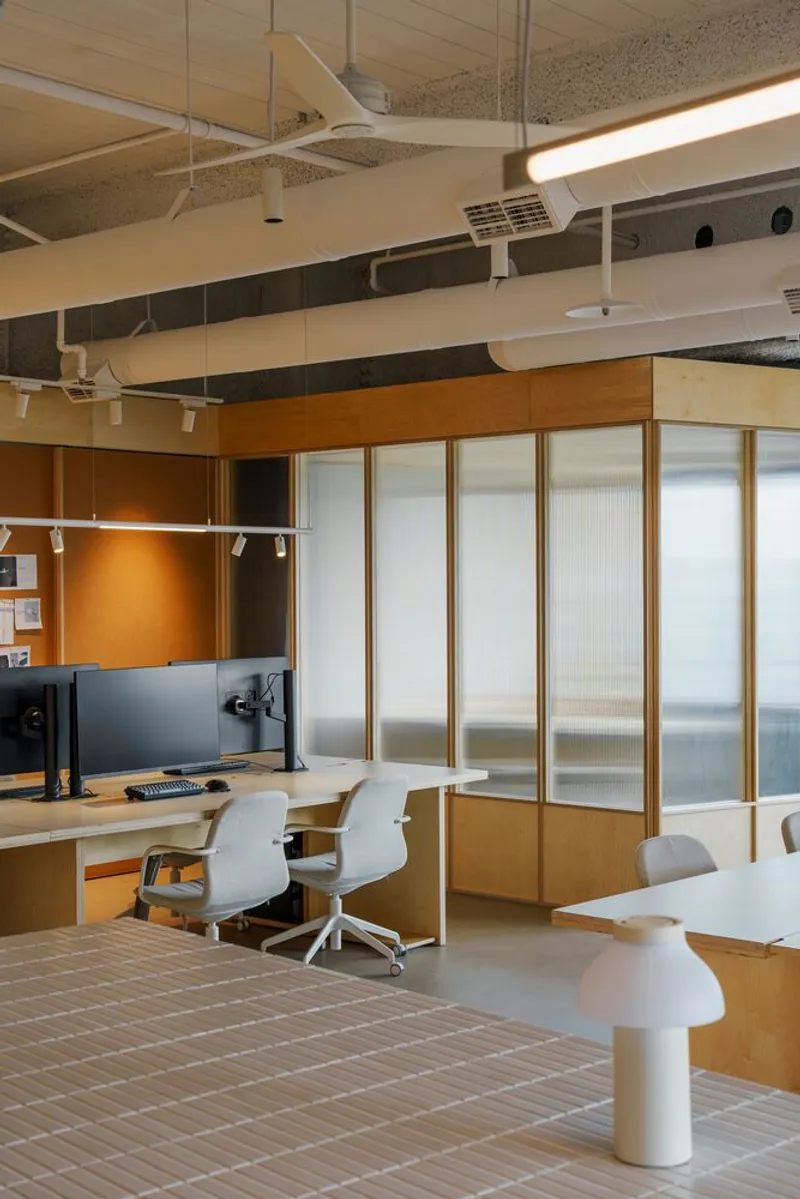
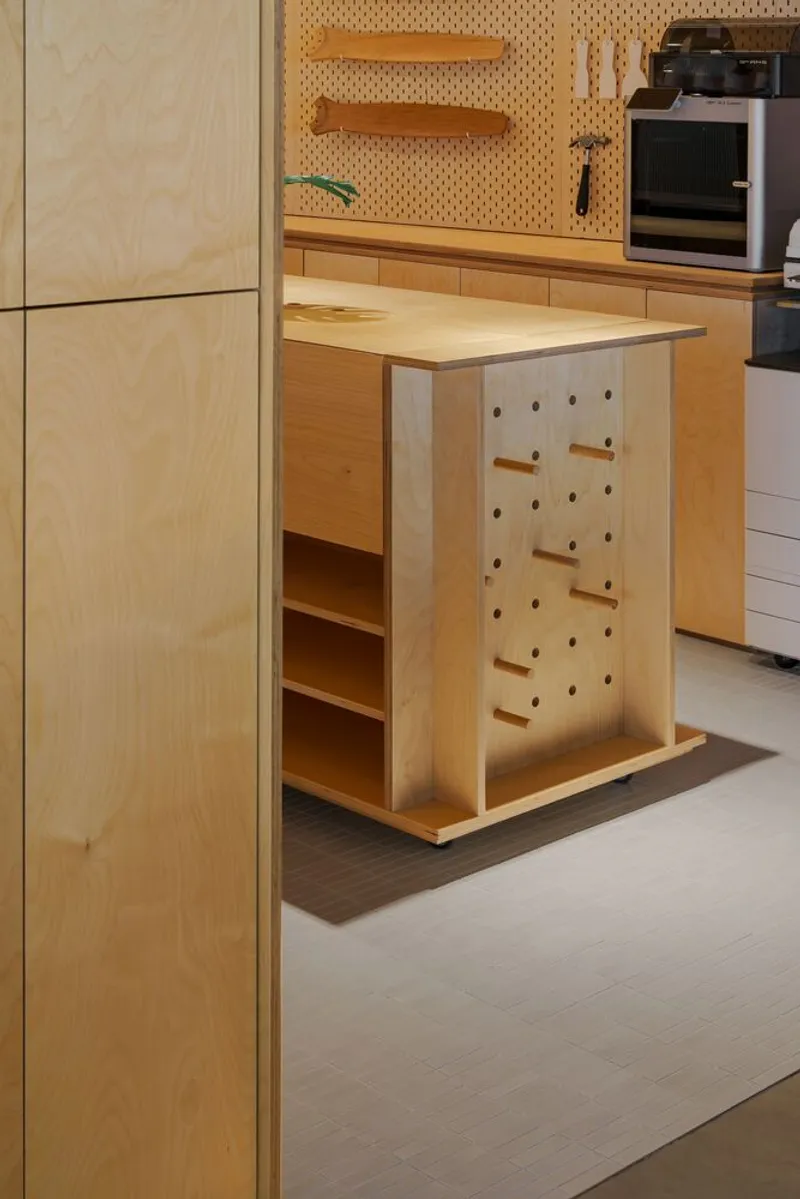
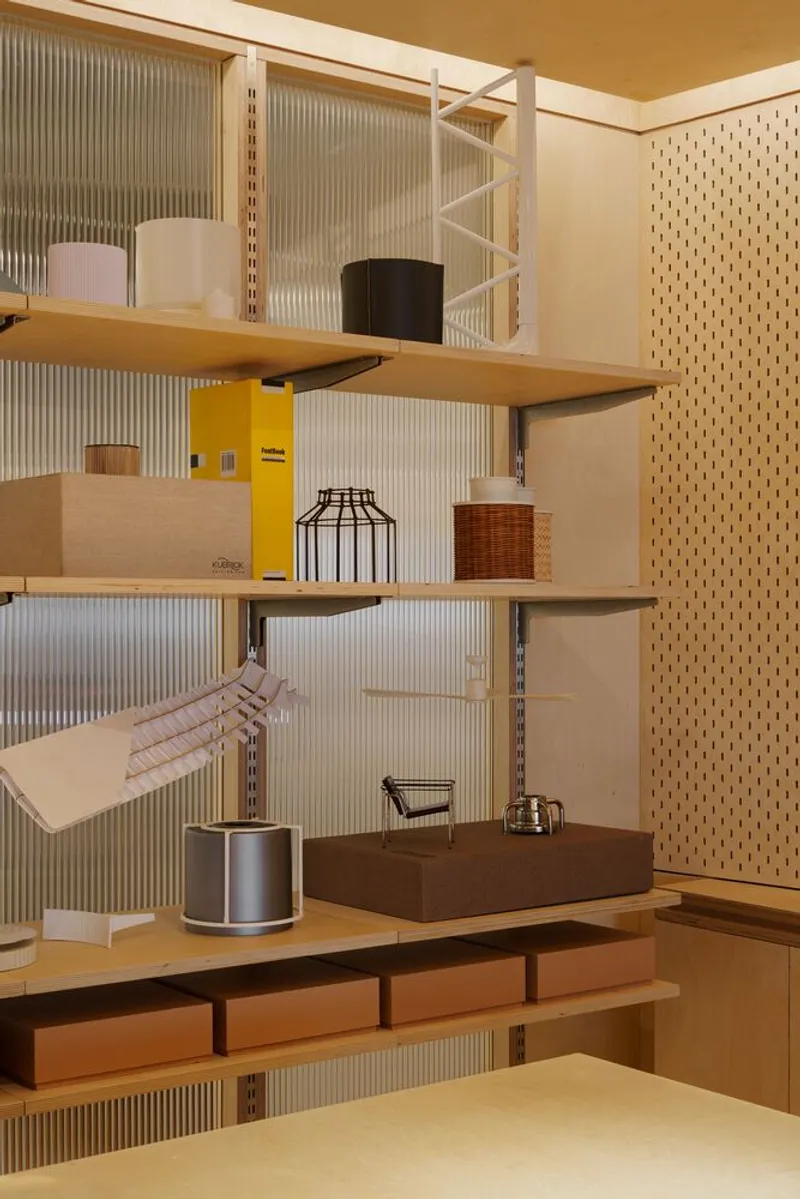
KUBRICK's most practical move is its mobile infrastructure. Translucent sliding partitions in timber frames allow the workstation zone to be reconfigured on demand. A plywood cart on casters, outfitted with a pegboard panel and wooden dowel hooks, rolls between stations as a portable brainstorming surface. Open shelving units with adjustable plywood shelves hold office supplies in full view, treating storage as part of the room's texture rather than something to hide.
These are not gimmicks. For a 190-square-meter office, the ability to compress or expand program zones throughout the day is the difference between a space that works and one that frustrates. InOrder Studio designed the furniture to move so the walls could stay put.
Kitchen, Nook, and the Social Core
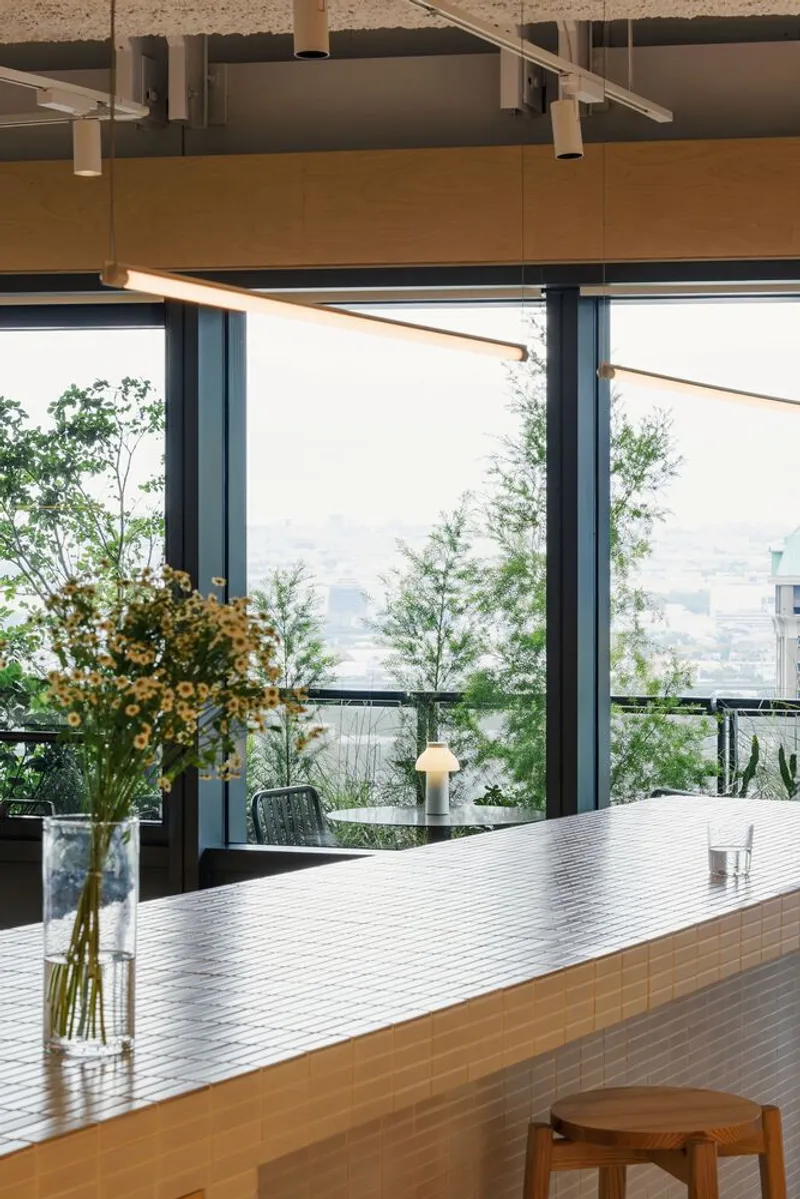

The kitchenette anchors the social life of the office. A timber island with a ribbed metal counter faces floor-to-ceiling windows and the planted terrace beyond, turning a coffee break into a moment of genuine decompression. Around the corner, a white-tiled counter with two wooden stools offers a more intimate perch. These are not afterthoughts crammed into leftover space; they are positioned to draw people toward the natural light and greenery at the building's edge.
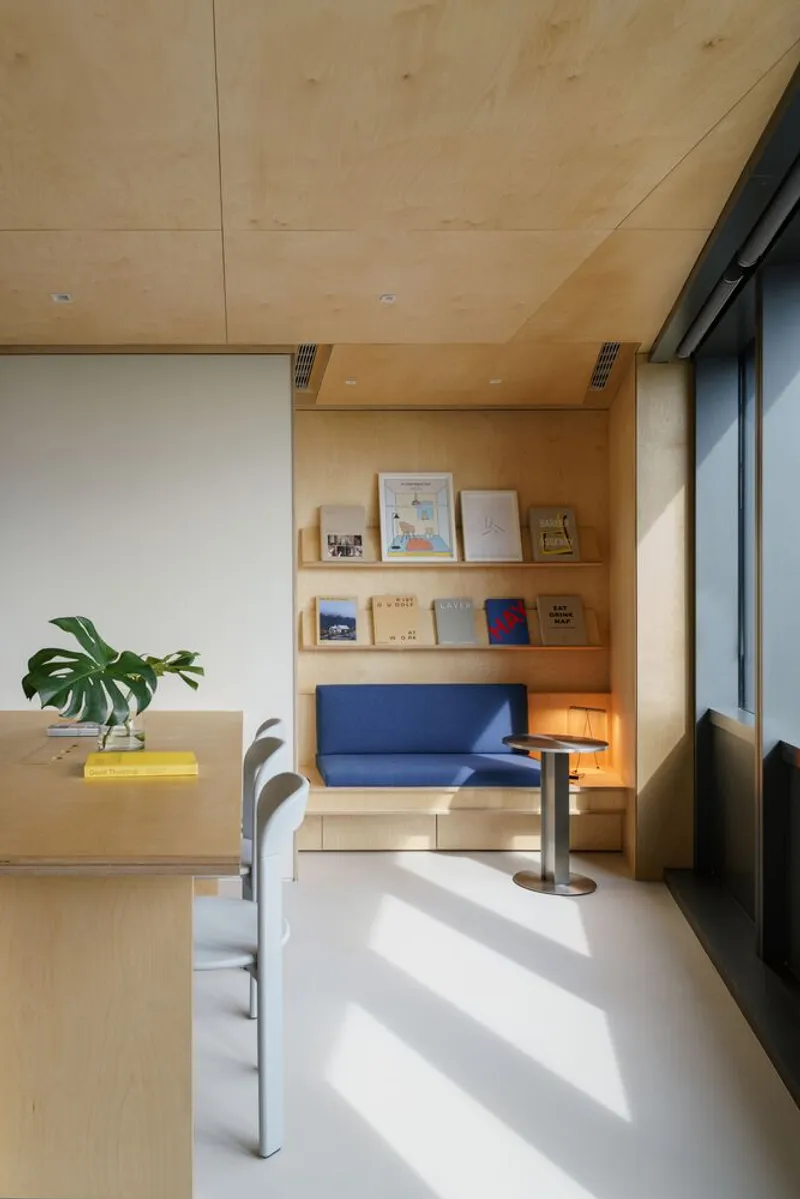
The reading nook is a small gem: a plywood-lined alcove with a blue bench cushion and display shelves, angled to catch afternoon sunlight. In an office this compact, dedicating square meters to a space with no explicit productive function is a statement about what kind of work culture the client values.
Terrace and the After-Dark Office
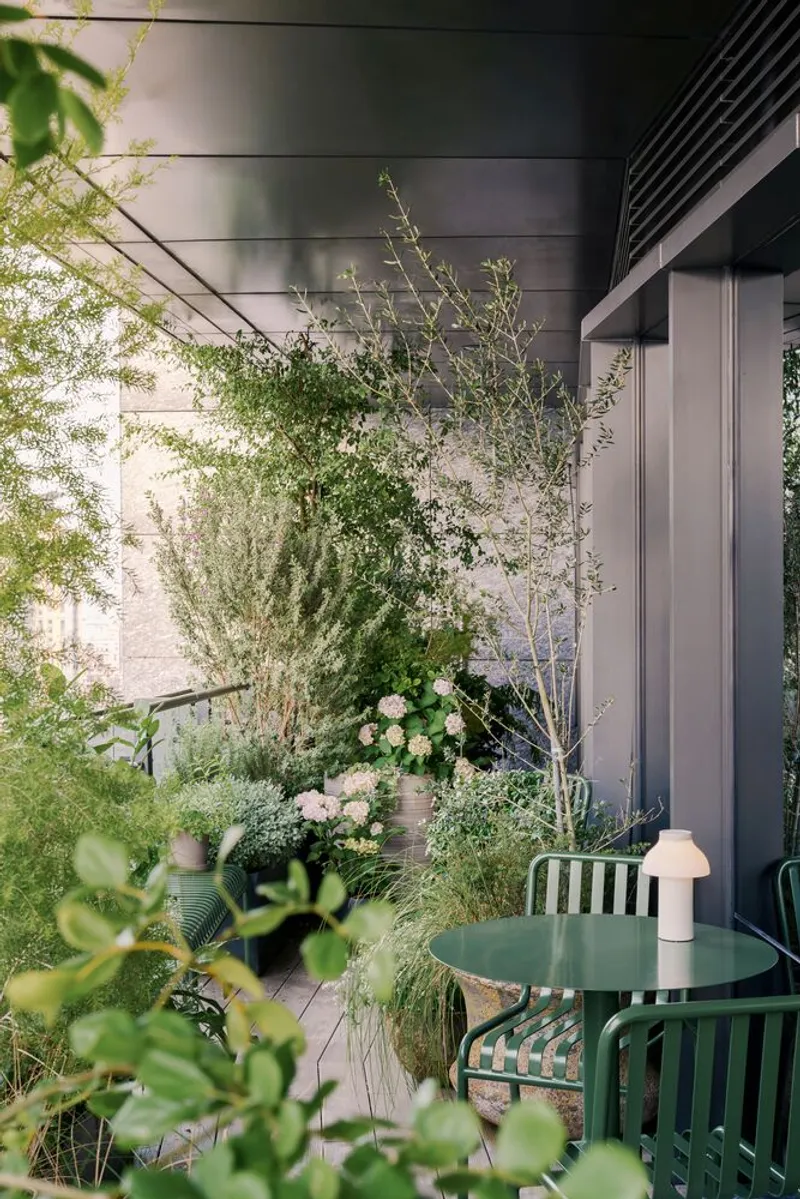
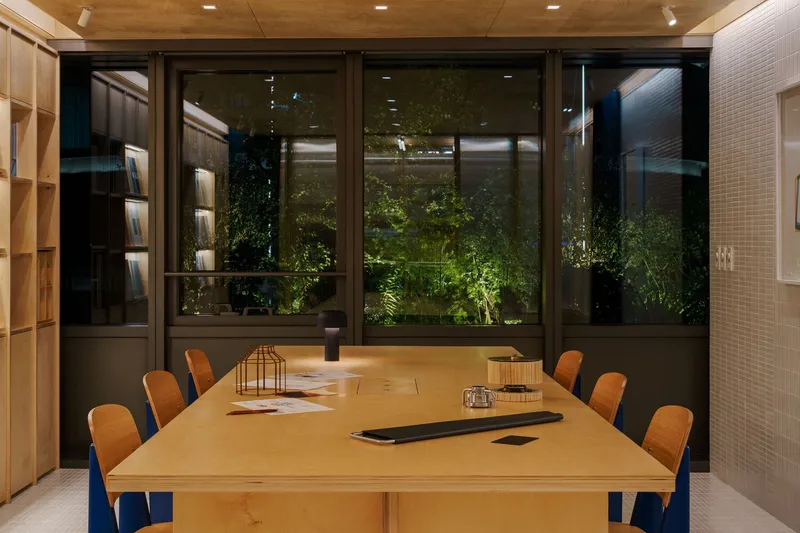
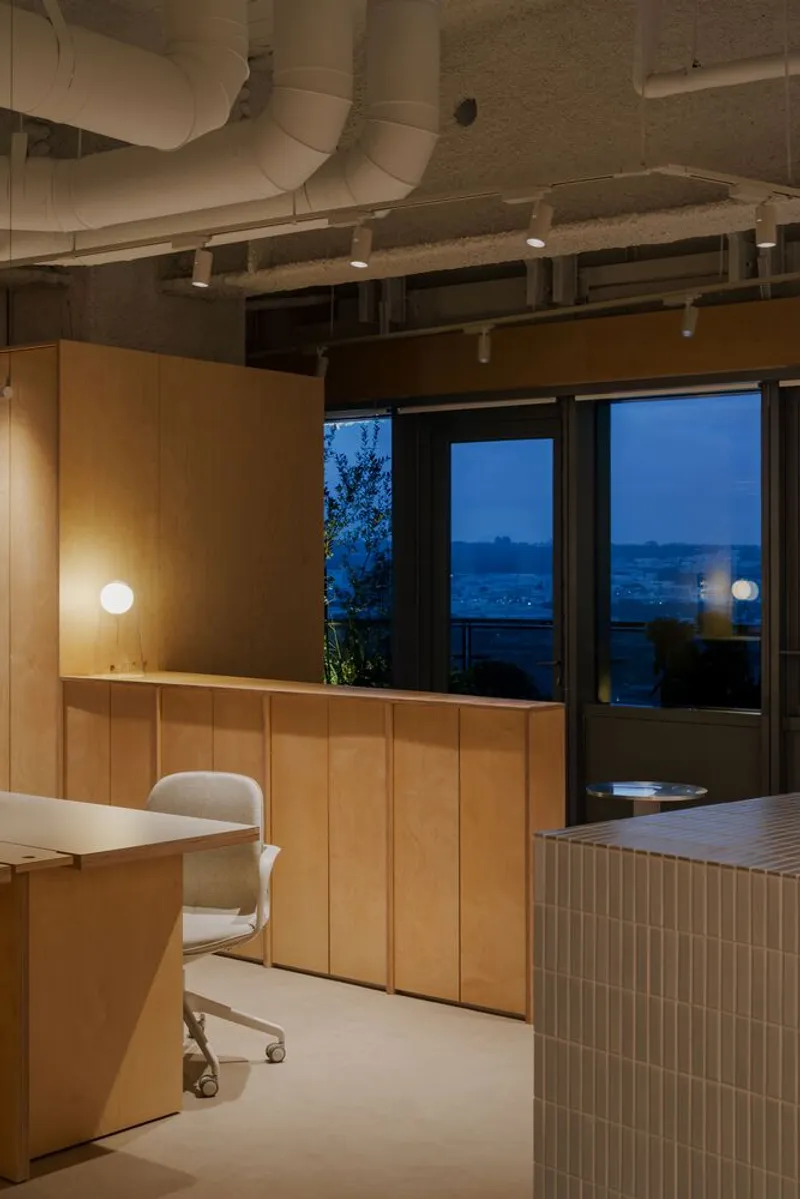
The outdoor terrace, with its green metal furniture, potted plants, and climbing vines, extends the workspace into the air. It is a modest footprint, but it provides the kind of sensory reset that no amount of indoor biophilia can replicate. At night, the planted courtyard becomes a backdrop visible through the conference room glazing, glowing warmly against the dark city beyond. The dusk shots reveal a second personality for the office: softer, more intimate, with the timber millwork and city lights sharing the frame.
Material Details Worth Noticing
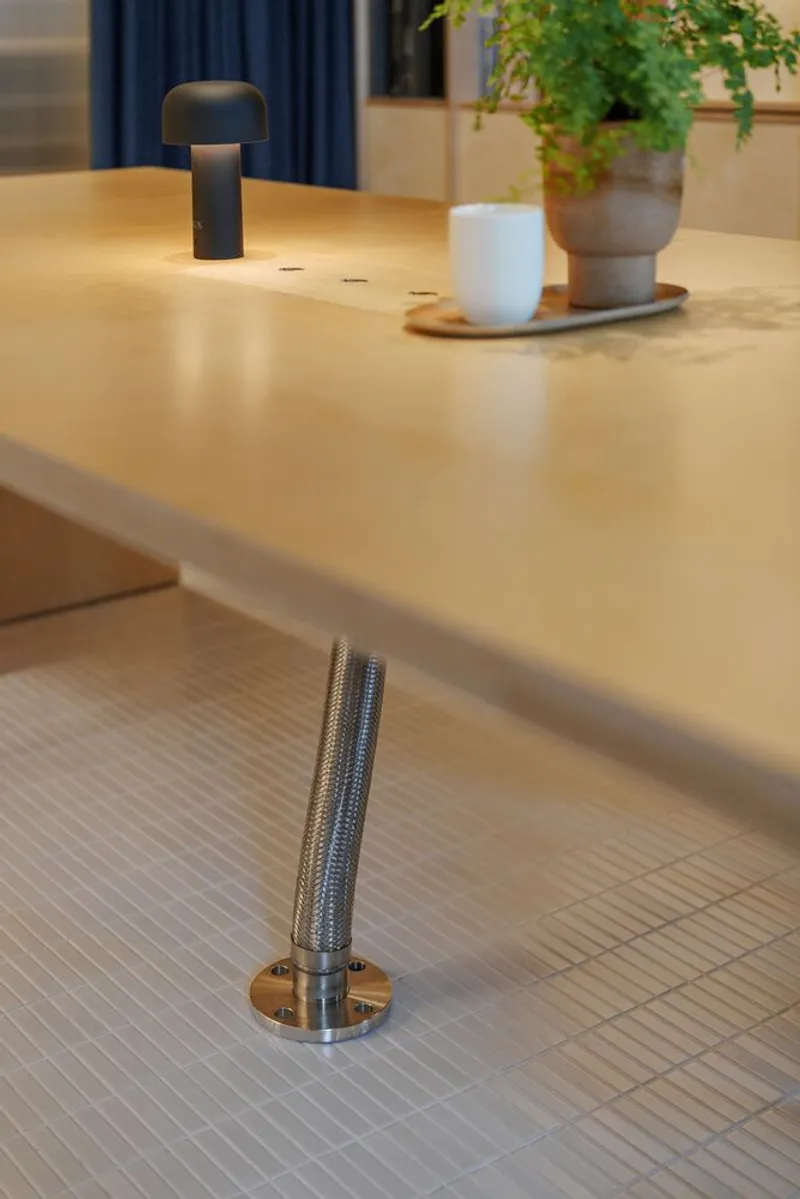

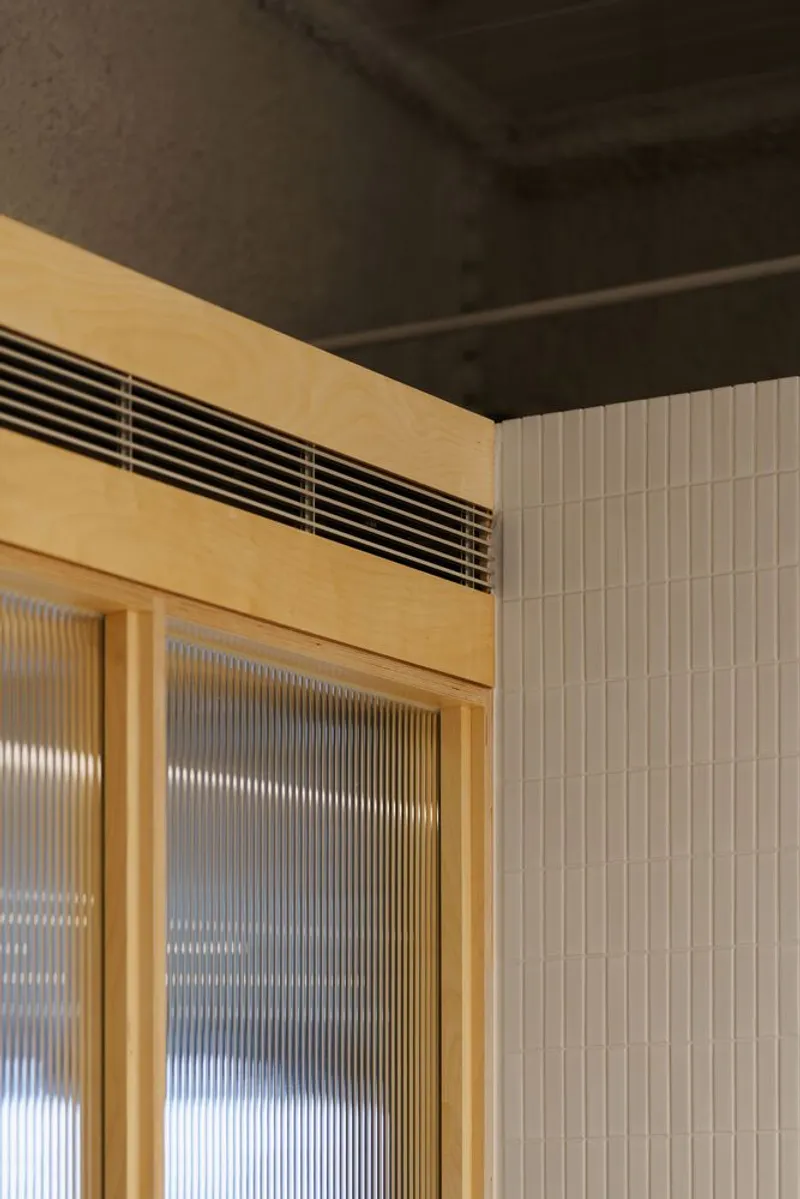
The details reward attention. A knurled metal footrest rail meets a white tiled floor with the precision of furniture design, not fitout. Fluted wood panels meet mosaic tile at a corner junction that is resolved cleanly enough to be a catalog image. The timber-framed partitions include horizontal ventilation grilles mounted above the frame, solving a mundane technical problem with the same visual language as the rest of the interior.
InOrder Studio's foundational principle here, articulating function while stripping away superfluous expression, is visible in these junctions. Nothing is added for effect. Every element either holds something, separates something, or moves air.
Plans and Drawings
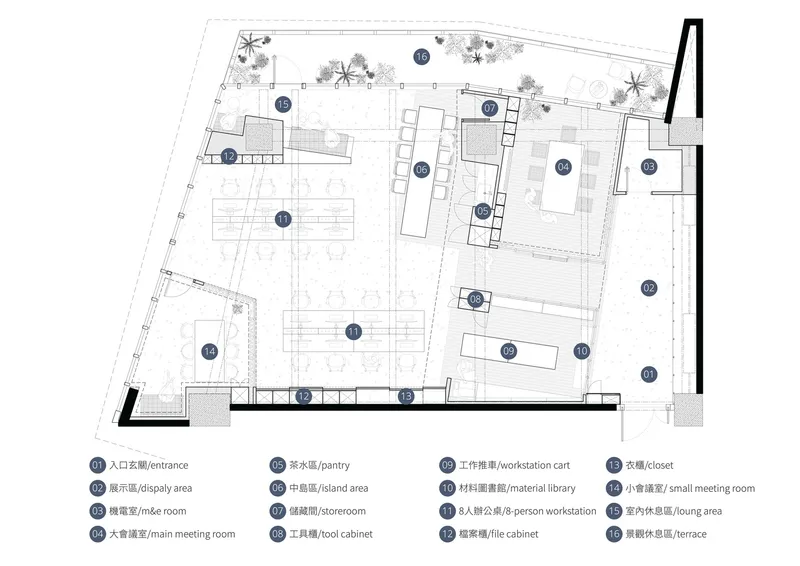
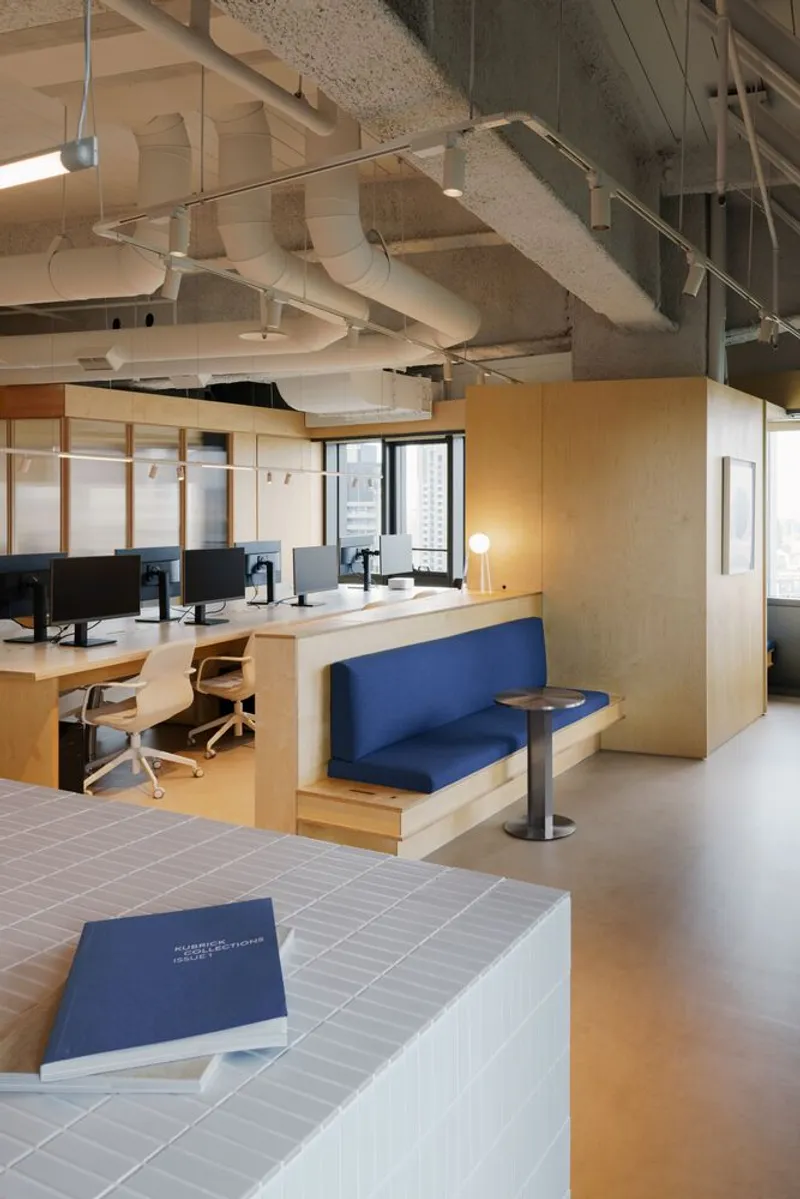
The floor plan reveals the angular geometry that makes the KUBRICK Office work. The space is not a simple rectangle; it follows the building's footprint with angled walls that create diagonal sightlines and prevent the compact plan from feeling boxy. Numbered zones on the drawing show how the terrace areas anchor the perimeter, pulling daylight deep into the interior. The integrated bench seating visible in the open office area confirms that even the furniture is drawn into the plan as architecture, not placed after the fact.
Why This Project Matters
The KUBRICK Office is not trying to reinvent workplace design. Its ambitions are more precise: to prove that a compact office for a manufacturing brand can be built with the same rigor and material sensitivity as the products the brand sells. InOrder Studio achieves this by refusing to decorate. Every piece of plywood, every ribbed glass panel, every detail of the blue metal brackets overhead is there because the space requires it. The discipline is quiet, but the cumulative effect is powerful.
For studios working on small commercial interiors, this project is a useful case study in how much program you can fit into 190 square meters without resorting to generic open-plan solutions. The answer, it turns out, is a lot, if you are willing to design the furniture, the partitions, and the storage as a single integrated system. KUBRICK does not shout about sustainability or wellness. It simply builds a workspace where natural materials, good light, and careful craft make those conversations unnecessary.
KUBRICK Office by InOrder Studio, designed by Ching-Ju Chen. Located in Taichung, Taiwan. 190 m². Completed in 2024. Photography by studio vwp.
About the Studio
Share Your Own Work on uni.xyz
If projects like this are the kind of work you want to make, uni.xyz is a place to publish your own, find collaborators, and enter design competitions.



Popular Articles
Popular articles from the community


Lunar Spiral: Space Architecture Shaped by the Mathematics of the Universe
Lunar Spiral reimagines space architecture through Fibonacci geometry, lunar regolith, levitating habitats, and self-sustaining Moon living.

The Ocean Hive: Sustainable Architecture for a Self-Sufficient Civilization at Sea
The Ocean Hive imagines sustainable architecture at sea, where modular habitats, algae, wave power and ocean waste sustain a growing colony.

Play: Fragments of Their World
Familiar architecture becomes modular playground design, creating safe spaces where displaced children can learn, connect, imagine and play.

The Earth Pod: 3D Printed Homes for Resilient Refugee Communities
The Earth Pod reimagines refugee housing through 3D printed homes made from clay, combining resilience, self-sufficiency, and rapid shelter.


Similar Reads
You might also enjoy these articles


Hodi-Mandai Geram
Project Function: Preservation and revitalization of the Intangible heritage and socio-spatial identity of the Hodi by Housing, Cultural Memory Center, Sacred Grove, landscape, local tourism economy


Olio Towers: A Mid-Rise for Performers That Fuses Housing, Rehearsal, and Stage
Located blocks from Houston's Theater District, this modular tower stacks living units around a central performance atrium.

Oasis: Modular Green Housing Carved into Dhaka's Urban Fabric
A shortlisted Plugin Housing entry reclaims unauthorized settlements in Dhaka with stepped concrete volumes, green roofs, and ventilation-driven design.

Black Hole: A Floating Megastructure for the Post-Physical Era
Emiliano Mazzarotto envisions a spherical, self-scaling arena where e-sports, digital hotels, and holographic stadiums replace traditional public space.


Explore Office De Architects Competitions
Discover active competitions in this discipline



Challenge to reimagine the Iron Throne


Photograph architecture without architects


Illustrate the lost glory of Angkor Wat - Render Challenge


Design challenge to reuse E-waste
Comments (0)
Please login or sign up to add comments
No comments yet. Be the first to comment!