
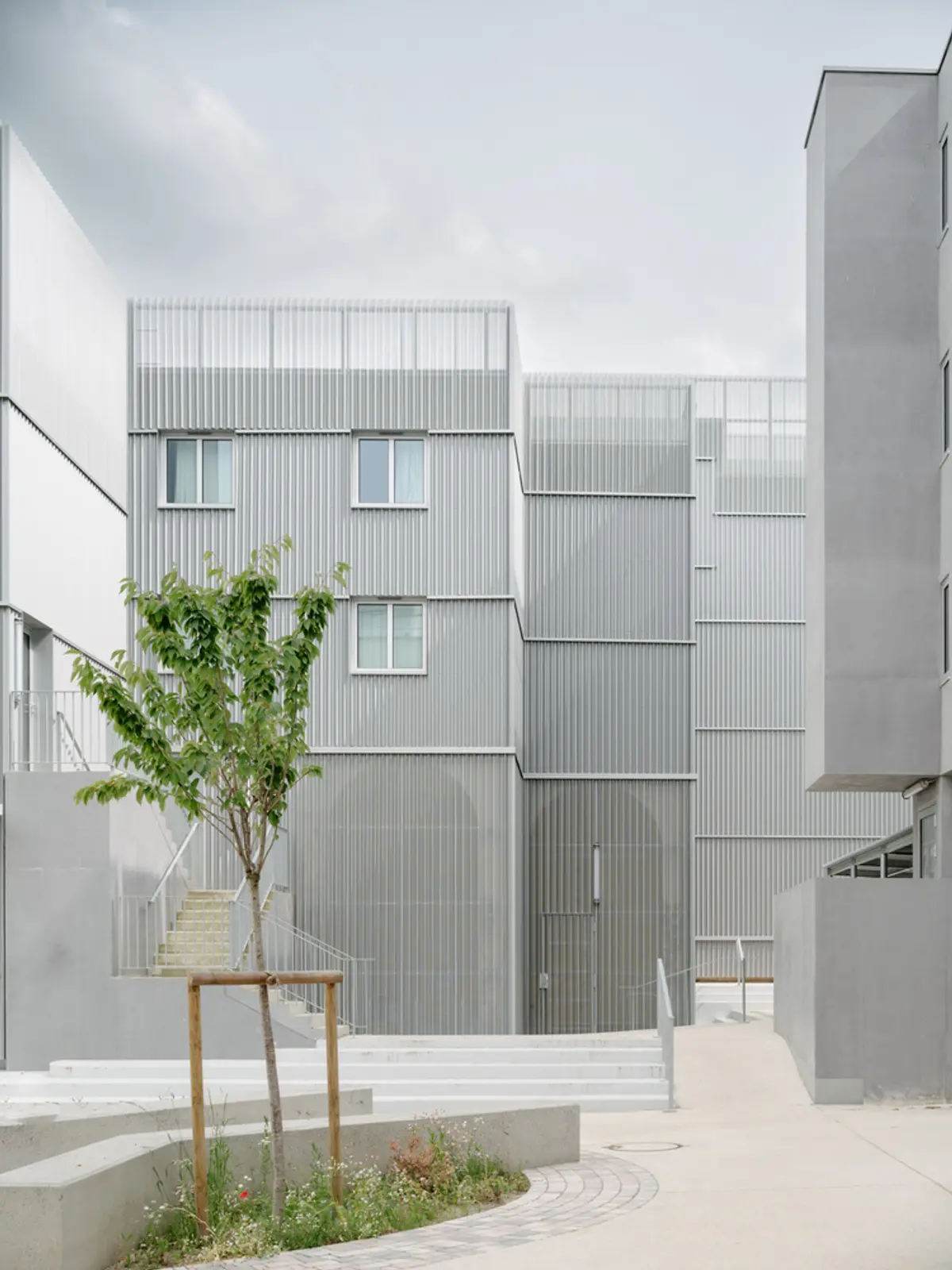
graal Architecture Wraps a 1965 Student Residence in Folded Steel Instead of Demolishing It
In Cergy, France, four aging dormitory blocks and one new building gain a unified metal skin that rethinks renovation as design.


The default instinct when a 1960s student dormitory starts falling apart is to tear it down and start fresh. graal architecture rejected that instinct. Faced with a complex of ten buildings in Cergy originally erected for the Crous in 1965, complete with asbestos-laced plasterwork and a concrete skeleton showing its age, the studio chose preservation over demolition. Four existing buildings were kept, one new building was added, and the whole ensemble was given a continuous cladding of folded steel that transforms the residence into something legible as a single urban gesture on the Boulevard de la Viosne.
What makes this project genuinely interesting is not just the decision to save old structures; it is the architectural argument that facade and volume can be designed as separate operations. The new external skin handles thermal performance and visual identity, while the inherited interior morphologies, with their half-levels, loggias, and irregular access points, are embraced rather than ironed out. The result is a 144-apartment residence with 4,319 square meters of interior space and 1,300 square meters of exterior space that reads as calm and unified from the street but reveals complexity at every threshold.
A Unified Skin for Disparate Bodies
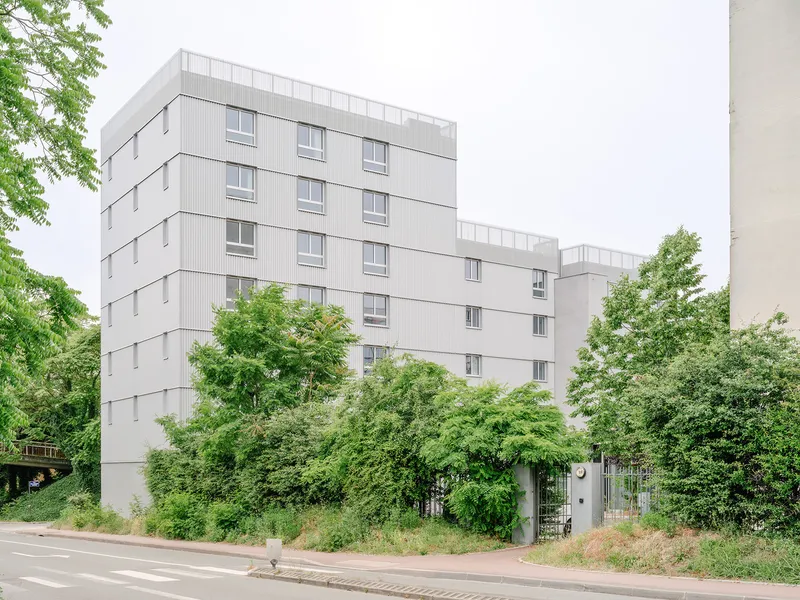
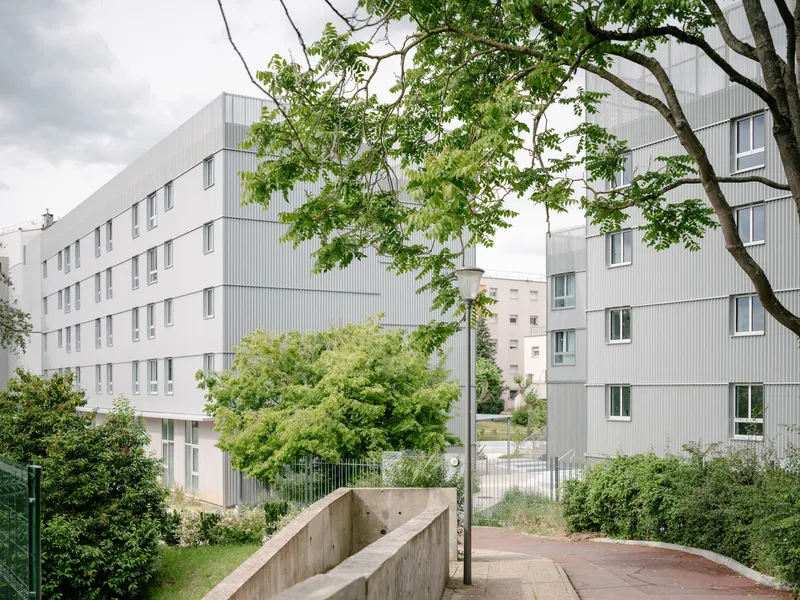
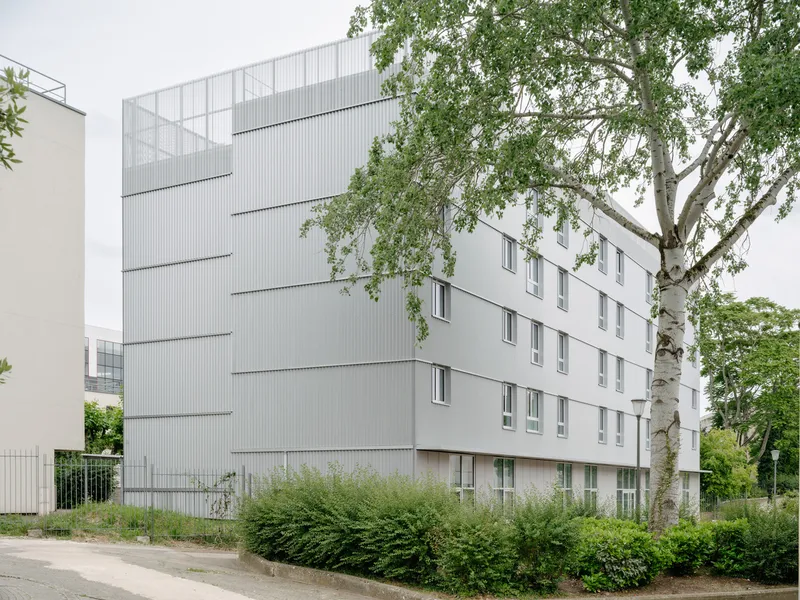
The folded steel cladding is the project's most visible move, and its most strategic one. Unlike a conventional rehabilitation that wraps aging blocks in external insulation and light-colored render, graal architecture uses the corrugated metal as an architectural surface in its own right. Each fold reflects sunlight at two angles, so the facade shifts in tone throughout the day, from near-white to a silvery grey that absorbs the overcast skies common in the Île-de-France region.
The uniformity of the material also solves a practical problem. The original buildings were not identical in section or height, and the new addition needed to blend in rather than announce itself. Wrapping everything in the same corrugated sheet collapses those differences at the urban scale. From the boulevard, you read one residence. Up close, the staggered volumes and varying window rhythms reassert themselves.
The Courtyard as Common Ground
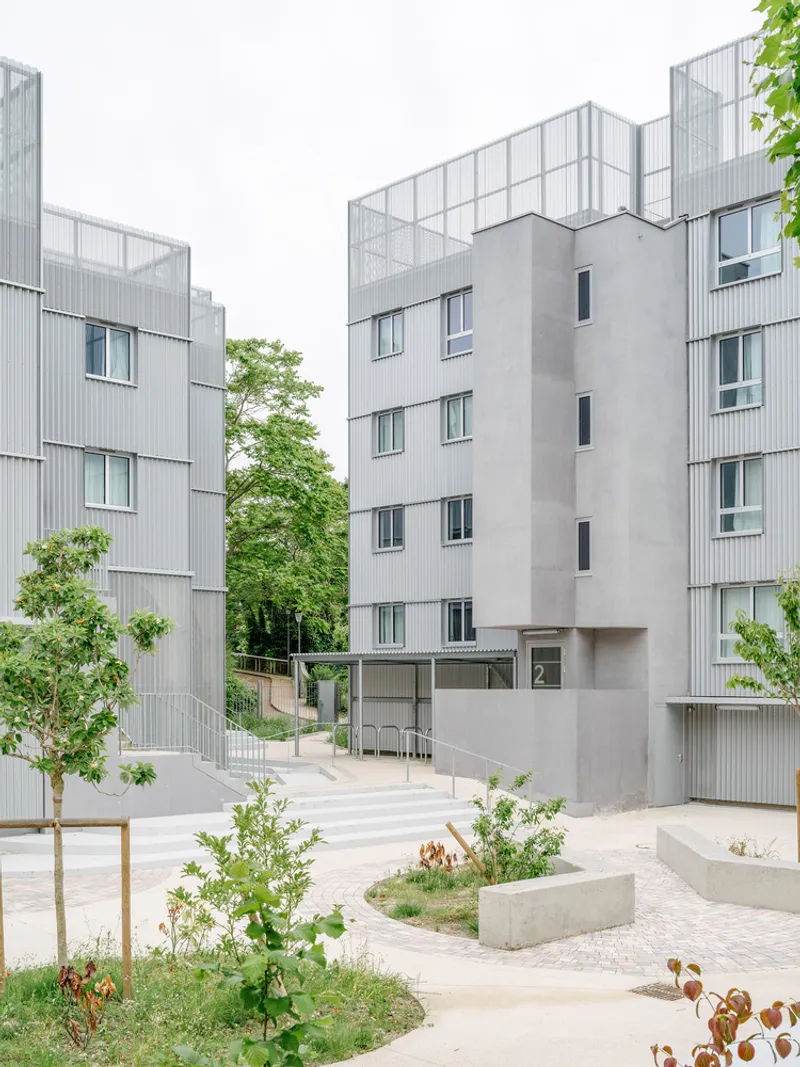
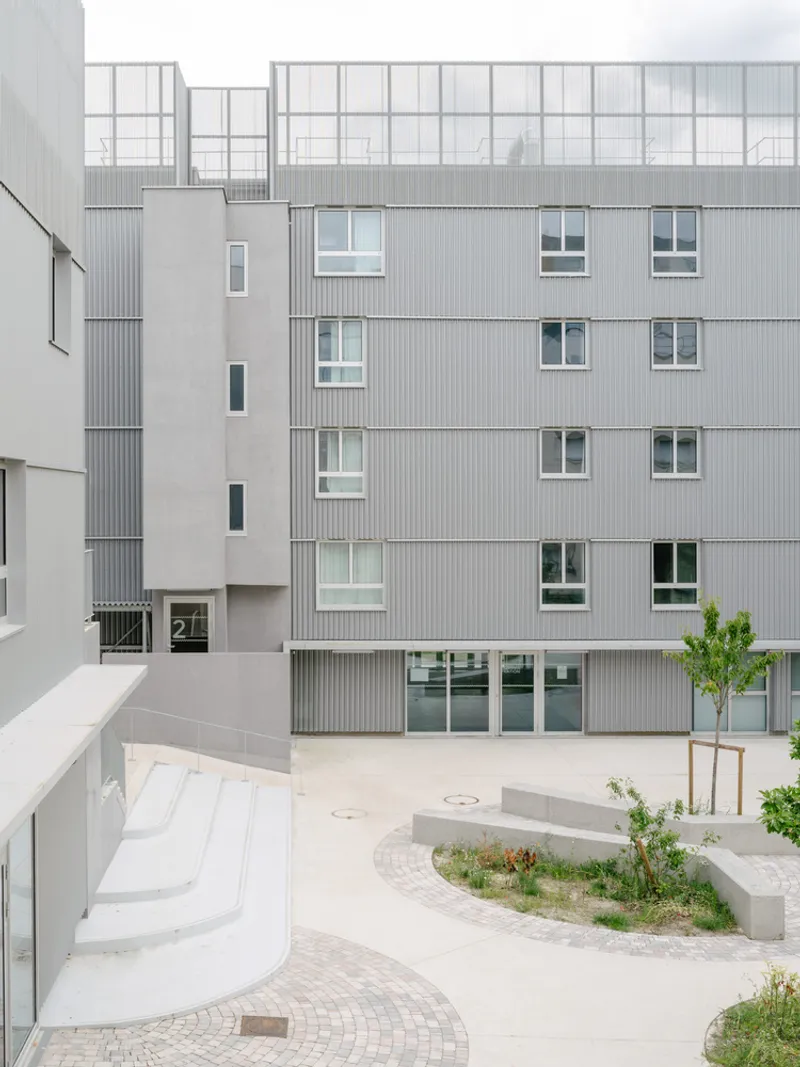
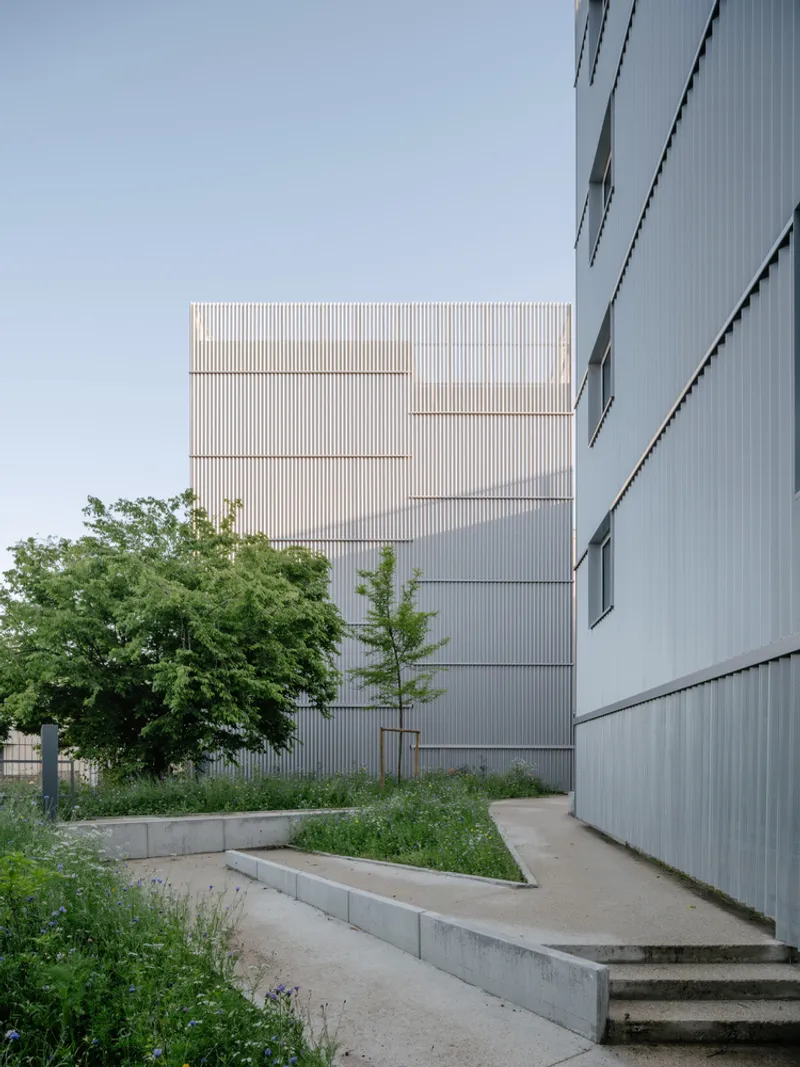
The original 1965 layout organized ten buildings around a planted courtyard. graal architecture kept that logic intact, understanding that the courtyard is not just leftover space between buildings but the social infrastructure of the residence. Circular planters with young trees, paved paths, and planted beds define zones for circulation and pause without fencing anything off.
At dusk, the concrete steps leading through the courtyard toward the ribbed facades take on a quiet monumentality that belies the modest budget of 11.1 million euros. The light-grey cladding frames the greenery effectively, keeping the eye inside the courtyard rather than letting it drift to the surrounding urban context. For 144 students, this planted enclosure is the closest thing to a private garden they will have.
Ground Level: Lobbies and Communal Rooms
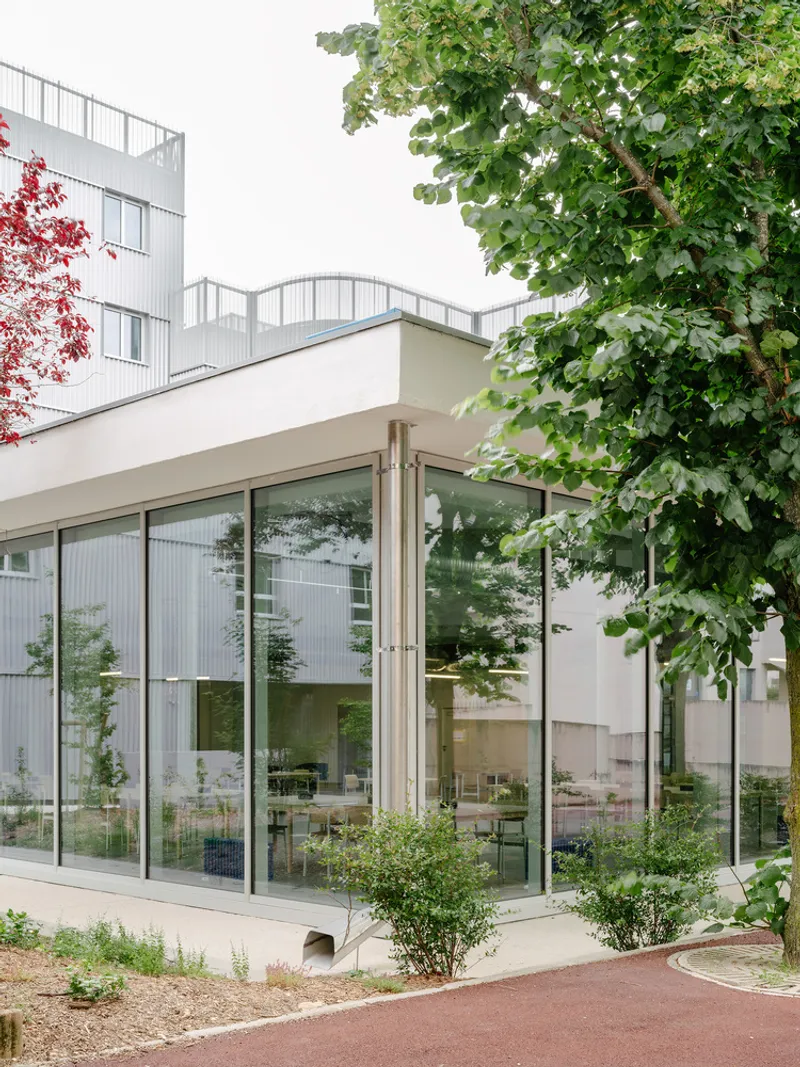
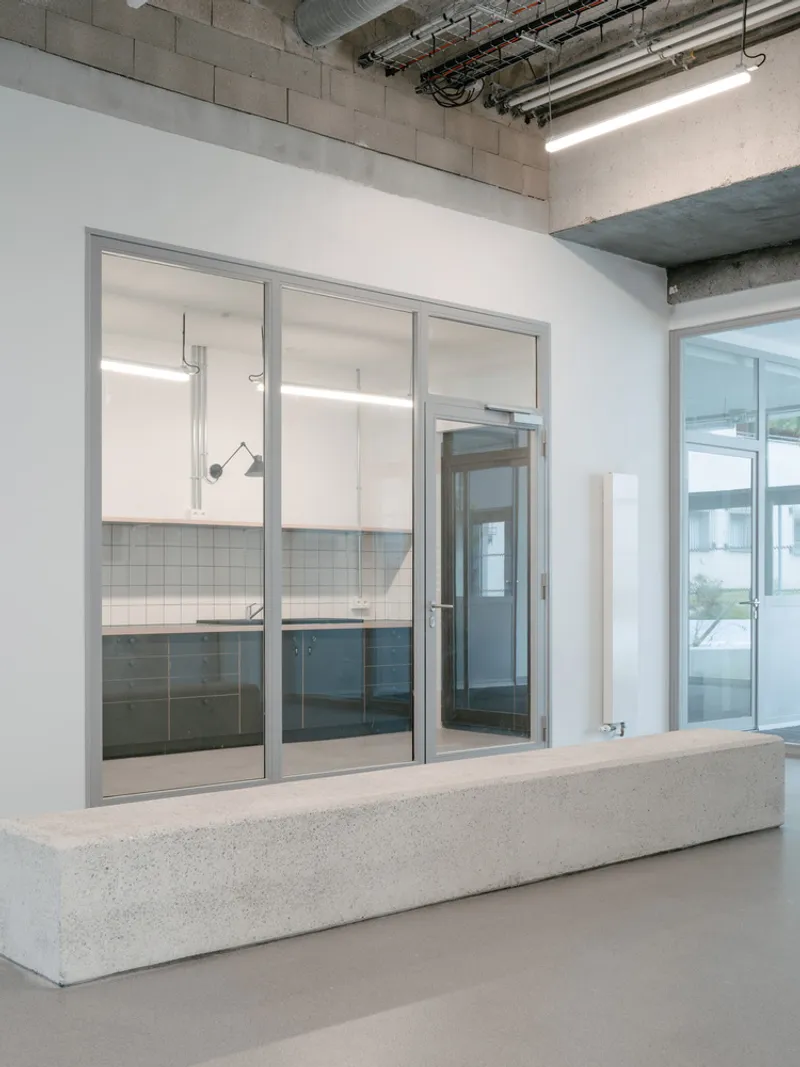
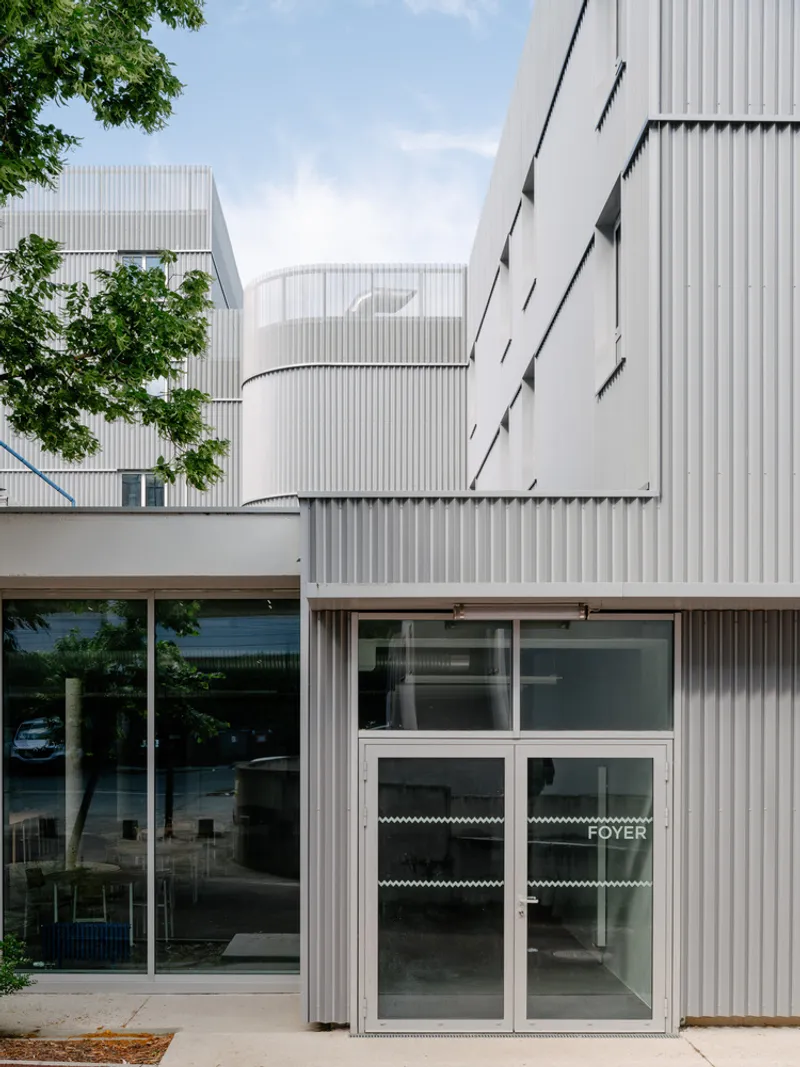
The ground floor hosts the shared life of the residence: administrative offices, a glazed corner pavilion, and communal spaces where exposed concrete beams and mechanical systems are left visible. The glazed partition walls let daylight pass deep into the lobby while maintaining a visual connection to the courtyard. There is no attempt to hide the building's bones. Concrete ceilings, cinder block walls, and chrome ventilation ducts form an honest palette of greys that the white partitions simply punctuate.
The entrance sequence, framed by tree branches and marked by a glass door set within the corrugated cladding, is deliberately understated. There are no grand gestures here, just a clear threshold that signals arrival without pretension. For a student housing project, that calibration feels exactly right.
Communal Interiors: Concrete, Chrome, and Color
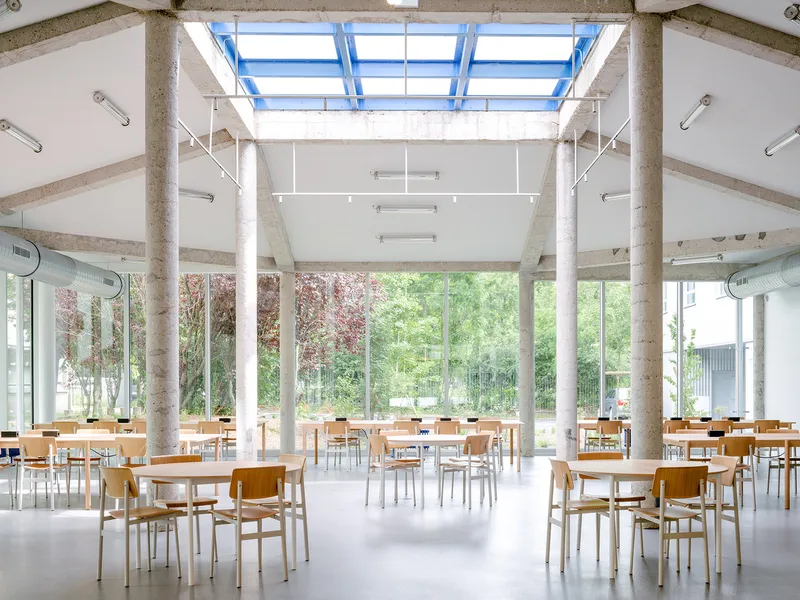
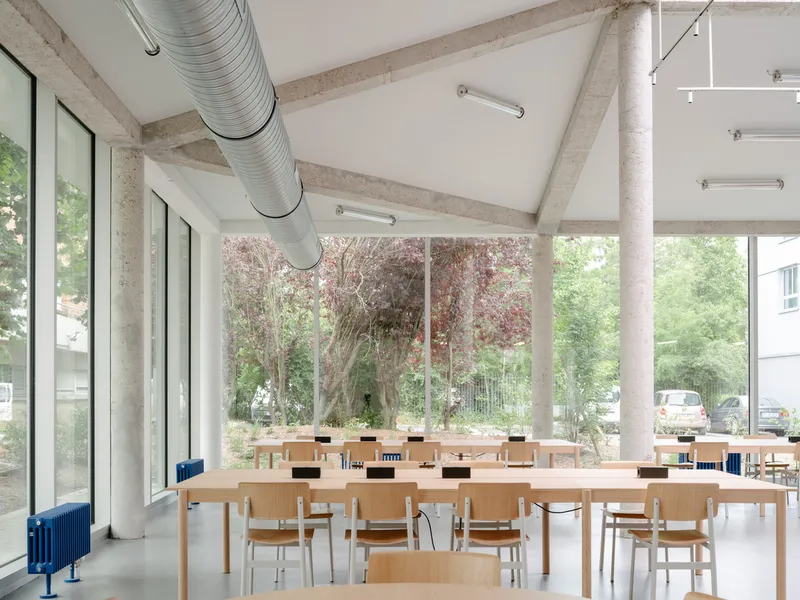
The communal dining hall is one of the most resolved spaces in the project. Timber tables and chairs sit under exposed concrete beams, with a blue-framed skylight pulling light down into the center of the room. Circular chrome ductwork runs openly along the ceiling, treated as a graphic element rather than something to be concealed. The overall feeling is warm but industrial, a combination that student housing rarely manages because it either over-designs toward hotel-like comfort or under-designs toward institutional austerity.
Looking out from the dining area toward the courtyard trees, you sense the continuity graal architecture was after: the interior and exterior share the same muted palette, so moving between them feels seamless. The elongated white concrete benches visible in the communal zones reinforce this geometric language, giving students places to sit that are not furniture but architecture.
Inside the Units
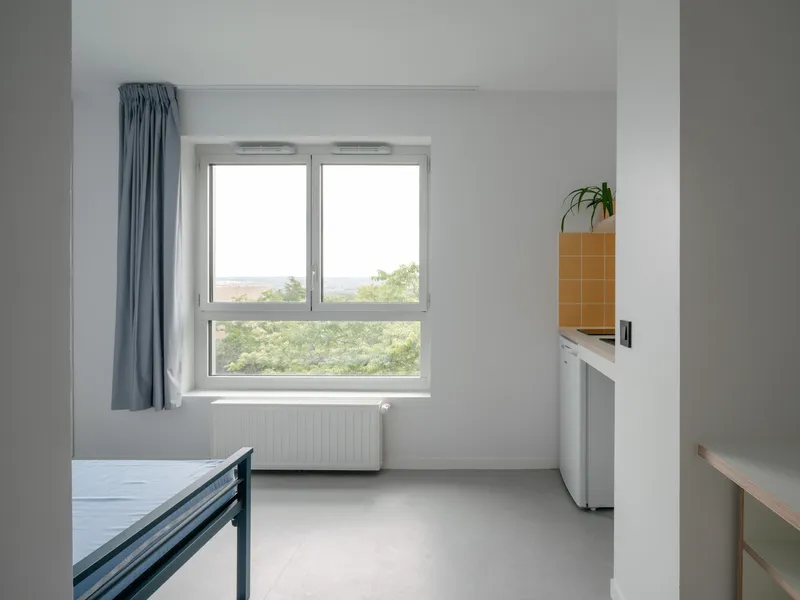
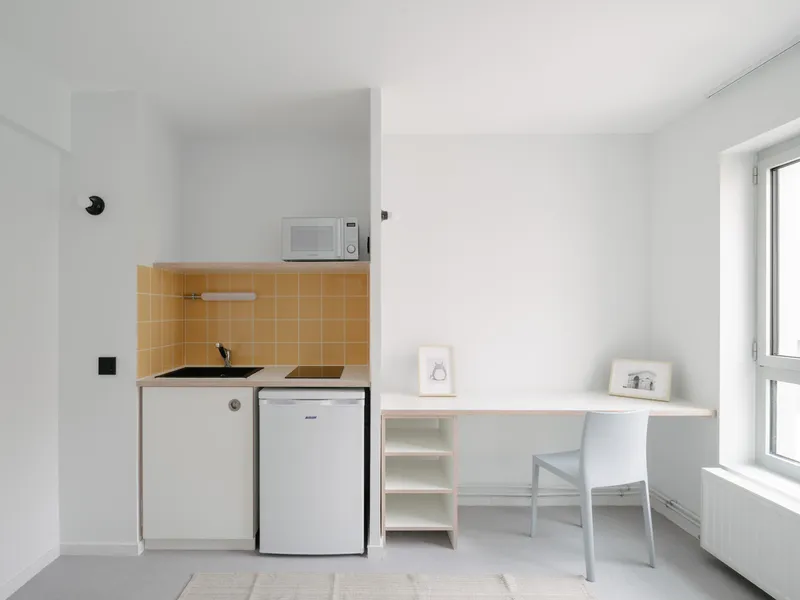
The 144 apartments are compact, as student units tend to be, but graal architecture introduces moments of material generosity. Ochre-tiled kitchenette backsplashes bring warmth to what are otherwise white-walled rooms. Blue curtains and the occasional pop of color create individuality within a systematic layout. Each unit overlooks greenery, a benefit of the courtyard configuration that makes even the smallest room feel connected to something larger.
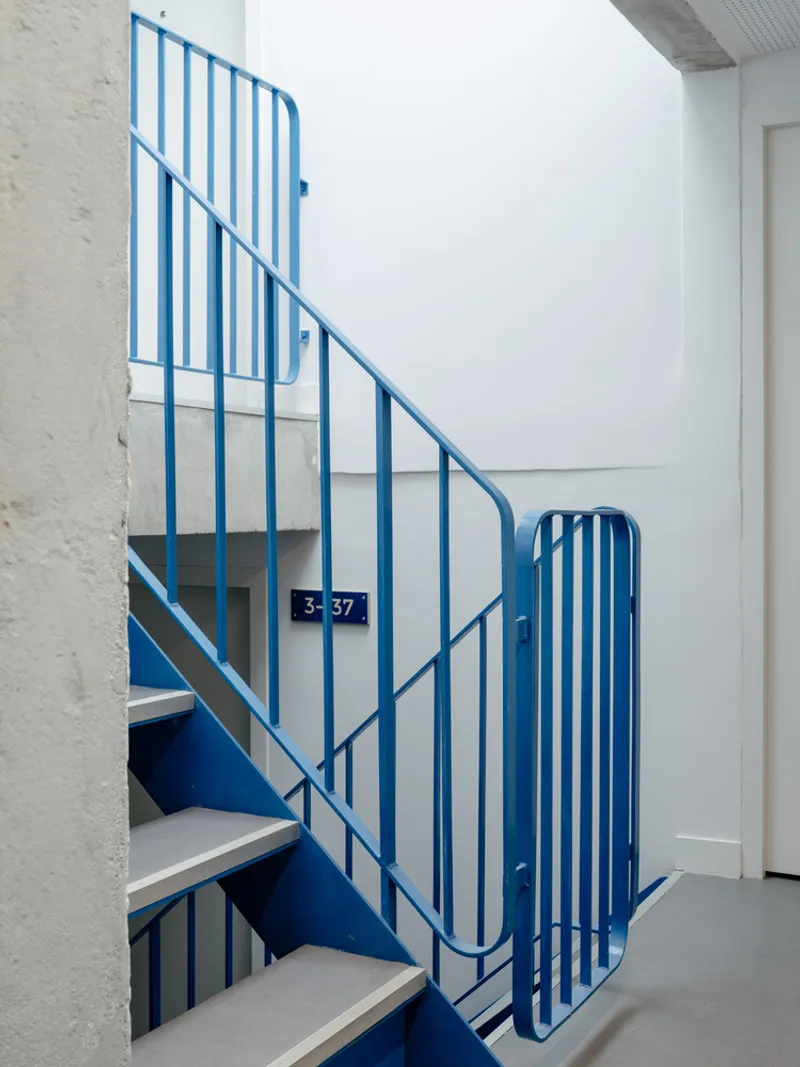
The circulation corridors deserve mention. Metal staircases repainted in a vibrant blue become wayfinding elements as much as functional connections. Unit number plaques mounted on white walls beside vertical bar railings keep the aesthetic spare but legible. The half-level organization inherited from the 1965 structure means that no two routes through the building feel exactly alike, an accidental richness that demolition would have erased.
The Facade as Energy Device
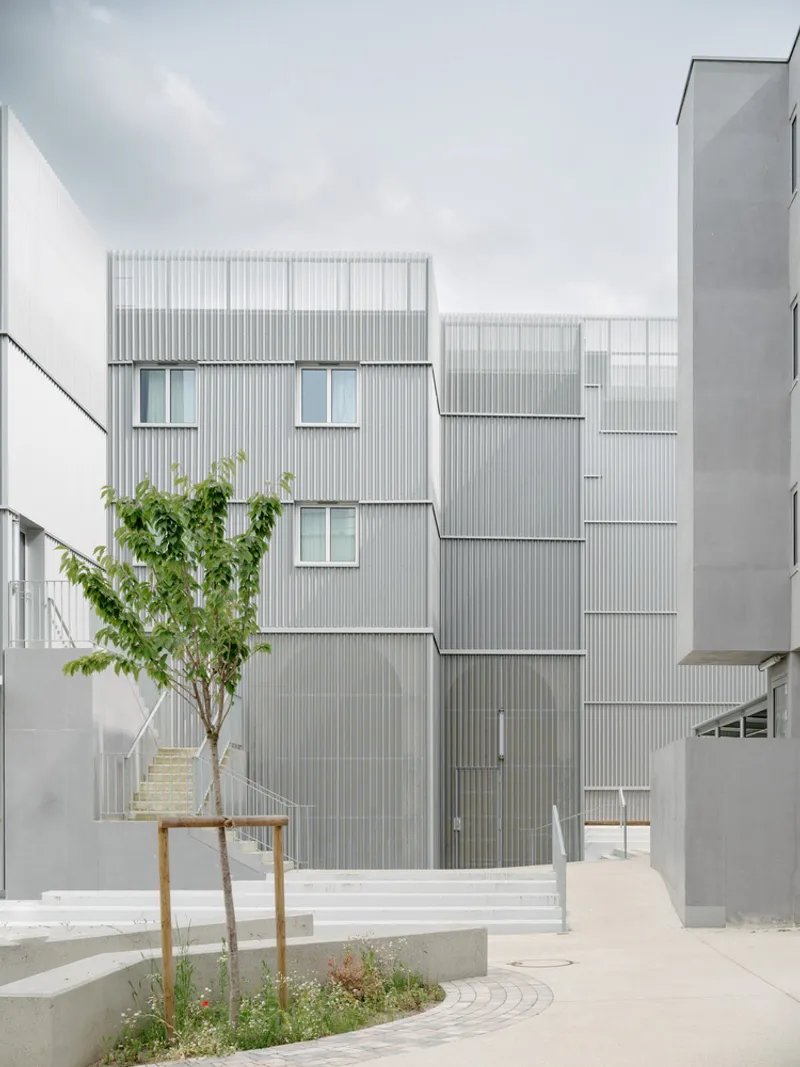
Separating the facade from the volume is not just a conceptual exercise here; it is a climate strategy. The external insulation system sits behind the folded steel, improving thermal performance without requiring the kind of interior demolition that would have been nightmarish on an occupied site with asbestos-laden plaster. On the top floor, the cladding transitions to a perforated mesh, improving natural ventilation while visually dissolving the building mass against the sky.
The re-entrant angles of the original architecture, where buildings step back or jog sideways, receive the same perforated treatment, allowing the cladding to breathe where the geometry tightens. It is a detail that acknowledges the awkwardness of wrapping a non-standard form in a standardized panel system, and it turns that acknowledgment into something architecturally productive.
Plans and Drawings
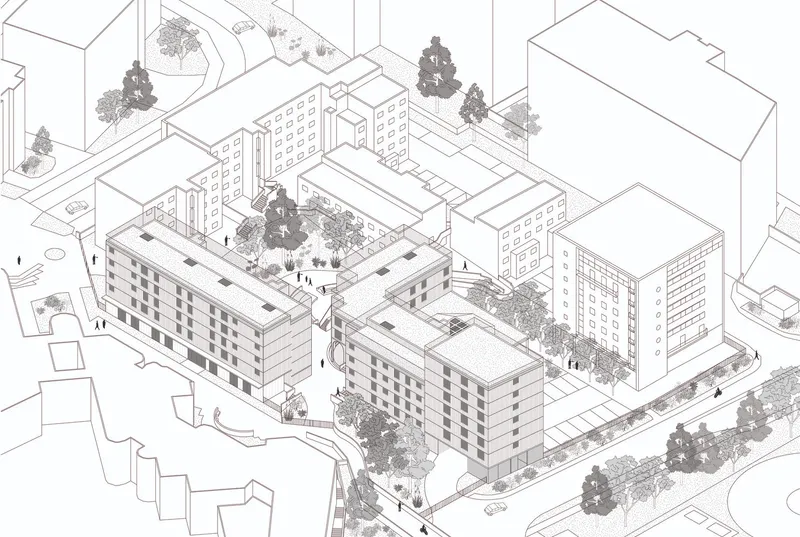
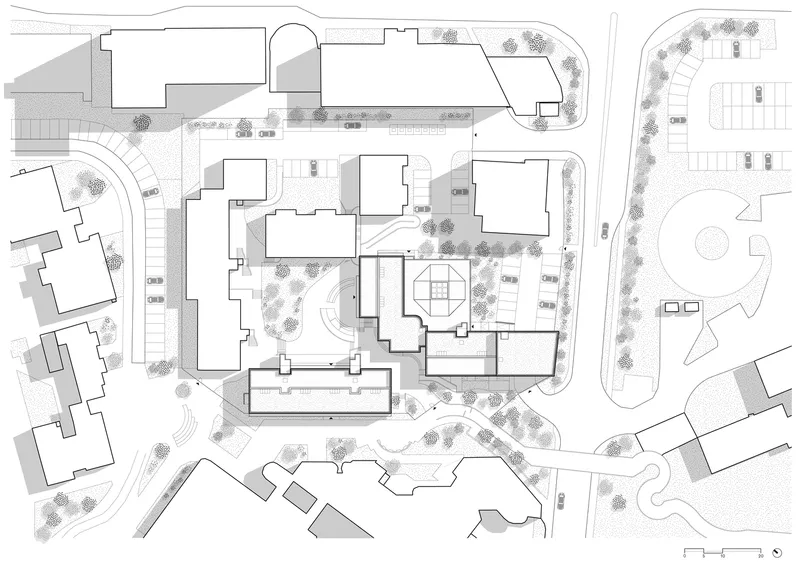
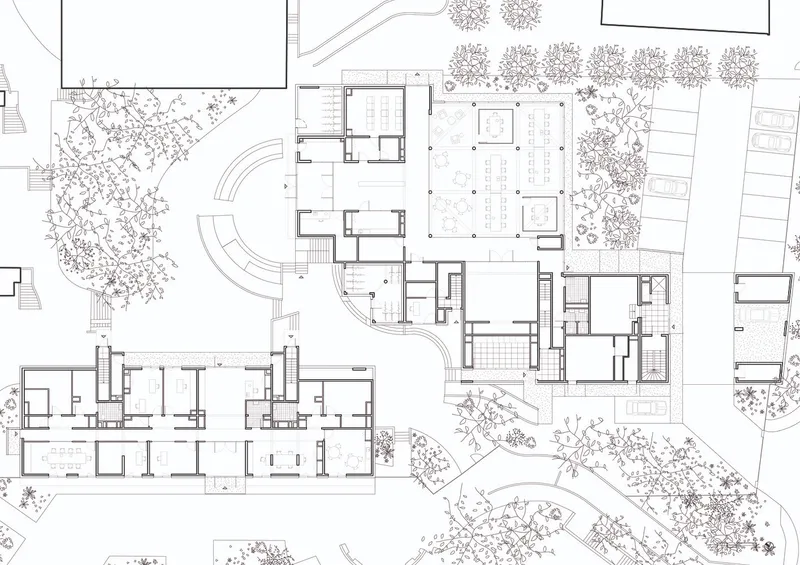
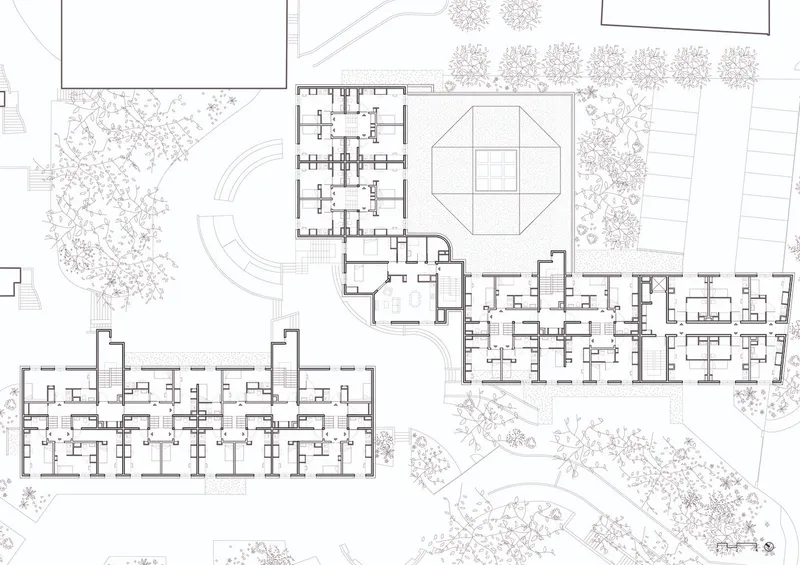
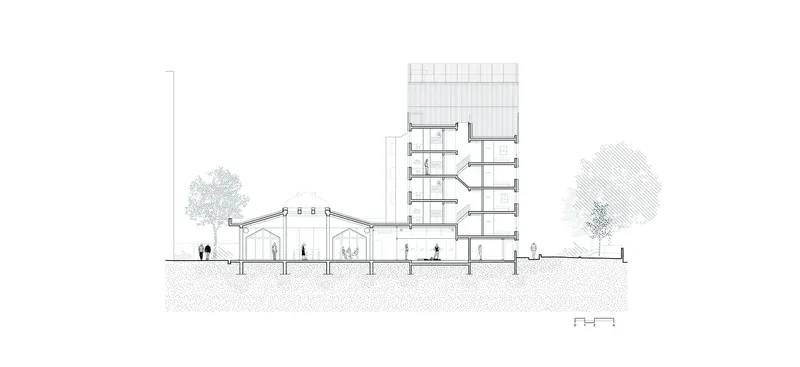
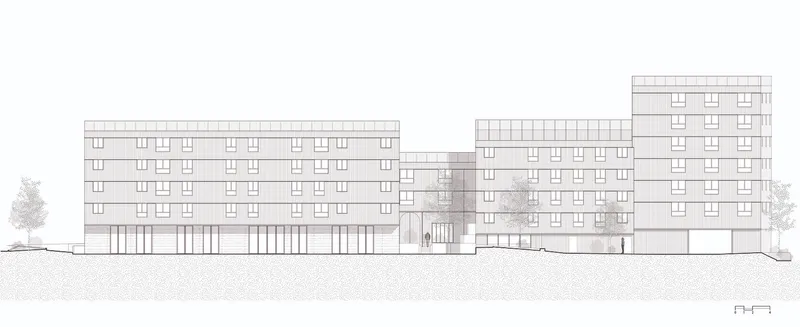
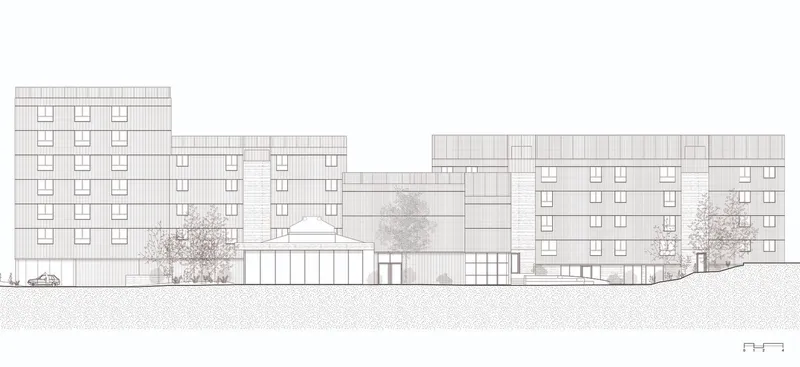
The axonometric drawing makes the courtyard logic immediately legible: residential blocks define a perimeter, pedestrian paths weave through the planted center, and the new building slots into the ensemble without asserting its novelty. The section drawing reveals the scalar tension at the heart of the project, a low-rise vaulted volume (the communal pavilion) sitting beside a multi-story tower, connected by the same continuous cladding system.
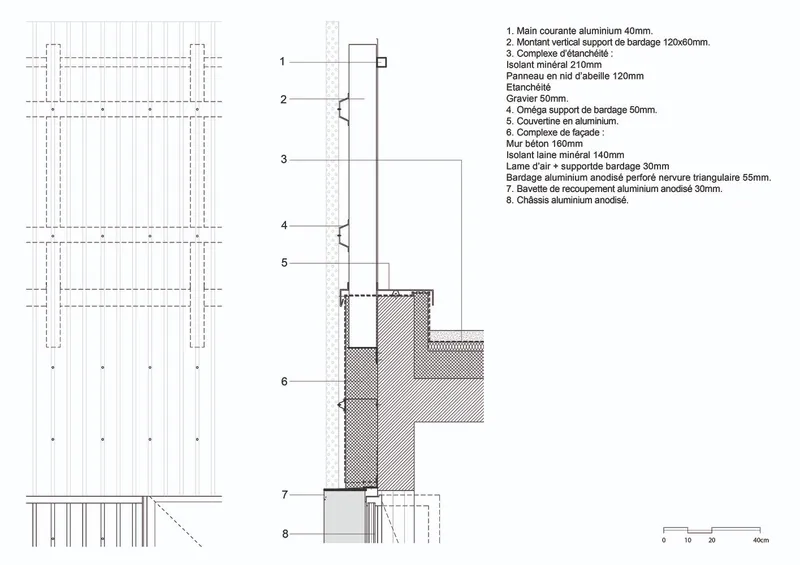
The construction detail drawing of the aluminum facade assembly is worth studying. Labeled insulation layers, support rails, and cladding panels demonstrate the gap between the old concrete wall and the new steel skin. This is where the project's central argument, that facade and structure can be independent systems, becomes technically explicit. The floor plans, meanwhile, show how the existing half-level organization creates a staggered section that cannot be reduced to a simple repeated plate, explaining both the richness and the difficulty of the interior renovation.
Why This Project Matters
Student housing rarely gets serious architectural attention, and renovation of student housing gets even less. graal architecture's work at Cergy is significant because it demonstrates that preservation and transformation are not compromises but genuine design opportunities. The decision to keep four buildings and add one rather than demolish all ten saved material, reduced waste, and respected the spatial idiosyncrasies that a blank-slate approach would have eliminated. It also meant working on an occupied site with hazardous materials, a level of logistical difficulty that the clean photographs do not convey.
The broader lesson is about the relationship between envelope and structure. By treating the facade as a separate layer, detached from the inherited concrete frame, graal architecture found a way to meet contemporary energy standards without gutting the interiors. That strategy is applicable far beyond Cergy, far beyond student housing. In a period when Europe faces millions of square meters of postwar housing stock in need of thermal upgrading, this project offers a replicable and architecturally ambitious model for how to do it without pretending the old buildings do not exist.
Student Residence Cergy by graal architecture. Located at 1, rue des Linandes Mauves, 95000 Cergy, France. 4,319 m². Completed 2024. Photography by Giaime Meloni.
About the Studio
Share Your Own Work on uni.xyz
If projects like this are the kind of work you want to make, uni.xyz is a place to publish your own, find collaborators, and enter design competitions.


Popular Articles
Popular articles from the community


Juan García Correa, John González and Claudia Rueda Sink a Circular Amphitheater into a Manizales Engineering Building
On the La Nubia campus in Manizales, Colombia, the S1 Building folds labs and offices into a hillside of ramped lawns that double as a campus route.

David Ortega Stacks a Two-Story Mexico City Penthouse Around a Steel Stair and a Pergola-Shaded Roof Terrace
In Colonia Roma, a 300 m² penthouse uses oak joinery, a planted steel stair and a slatted roof pergola to make a new-build apartment feel like a house.

Jaramillo Van Sluys Arquitectura and Urbanismo Turn a Demolished Registry Lot in Quito into an Orchard Plaza
In Quito's Centro Histórico, a 2,800 m² plaza exposes the San Agustín convent wall and redraws its lost Augustinian orchard in volcanic stone.

Architekt Andreas Gruber Scatters 23 Dark Timber Chalets Across a South Tyrolean Forest Edge
In Molini di Tures, Amonti Chalets breaks a resort into a hamlet of gabled timber houses, with parking, storage and services pushed into the slope.

Similar Reads
You might also enjoy these articles


Hodi-Mandai Geram
Project Function: Preservation and revitalization of the Intangible heritage and socio-spatial identity of the Hodi by Housing, Cultural Memory Center, Sacred Grove, landscape, local tourism economy


Olio Towers: A Mid-Rise for Performers That Fuses Housing, Rehearsal, and Stage
Located blocks from Houston's Theater District, this modular tower stacks living units around a central performance atrium.

Oasis: Modular Green Housing Carved into Dhaka's Urban Fabric
A shortlisted Plugin Housing entry reclaims unauthorized settlements in Dhaka with stepped concrete volumes, green roofs, and ventilation-driven design.

Black Hole: A Floating Megastructure for the Post-Physical Era
Emiliano Mazzarotto envisions a spherical, self-scaling arena where e-sports, digital hotels, and holographic stadiums replace traditional public space.

Explore Student Housing Competitions
Discover active competitions in this discipline

Challenge to reimagine the Iron Throne

Photograph architecture without architects

Illustrate the lost glory of Angkor Wat - Render Challenge

Design challenge to reuse E-waste
Comments (0)
Please login or sign up to add comments
No comments yet. Be the first to comment!