
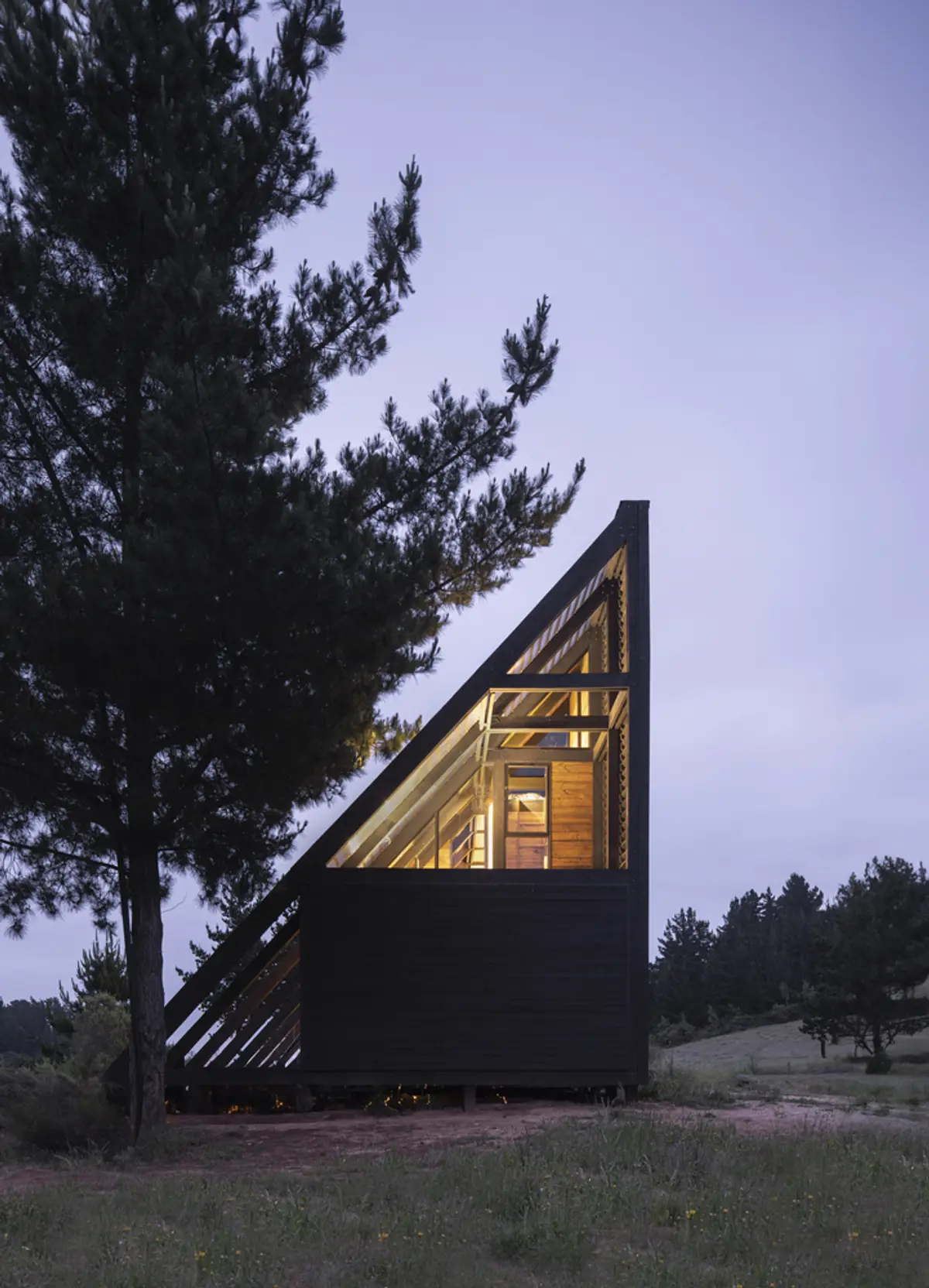
Gonzalo Rufin Arquitectos and Felipe Toro Stack a Wind-Battered Cabin Vertically on a Chilean Hillside
Shelter 45 rises through three timber-and-steel levels on a narrow mountain perch above Matanzas, Chile's windsurfing coast.


A flat patch of land on a windy hillside overlooking Chile's central coast is not the most forgiving site for a cabin. Gonzalo Rufin Arquitectos and Felipe Toro treated every constraint as a design driver. Shelter 45, completed in 2023 in the mountains above Matanzas, packs 80 square meters of living space into a structure that reads simultaneously as an A-frame, a watchtower, and a modular timber grid. The building is composed of a single bay repeated nine times across its length, each bay framed by pine trusses reinforced with steel joints. That repetitive logic produces a long, narrow volume that can sit on the only buildable sliver of ground without excavating the ravines on either side.
What makes Shelter 45 worth studying is the tension between its compactness and its ambition. Three stories in 80 square meters means every level has a distinct character: communal on the ground floor, private on the second, intimate under the slope of the roof. The cabin tapers as it climbs, so the section is not a simple extrusion but a wedge that channels wind over its back and frames a triangular gable of glass toward the forest. It is a small building with large structural ideas, and the economy of means is the point.
A Hillside Anchor
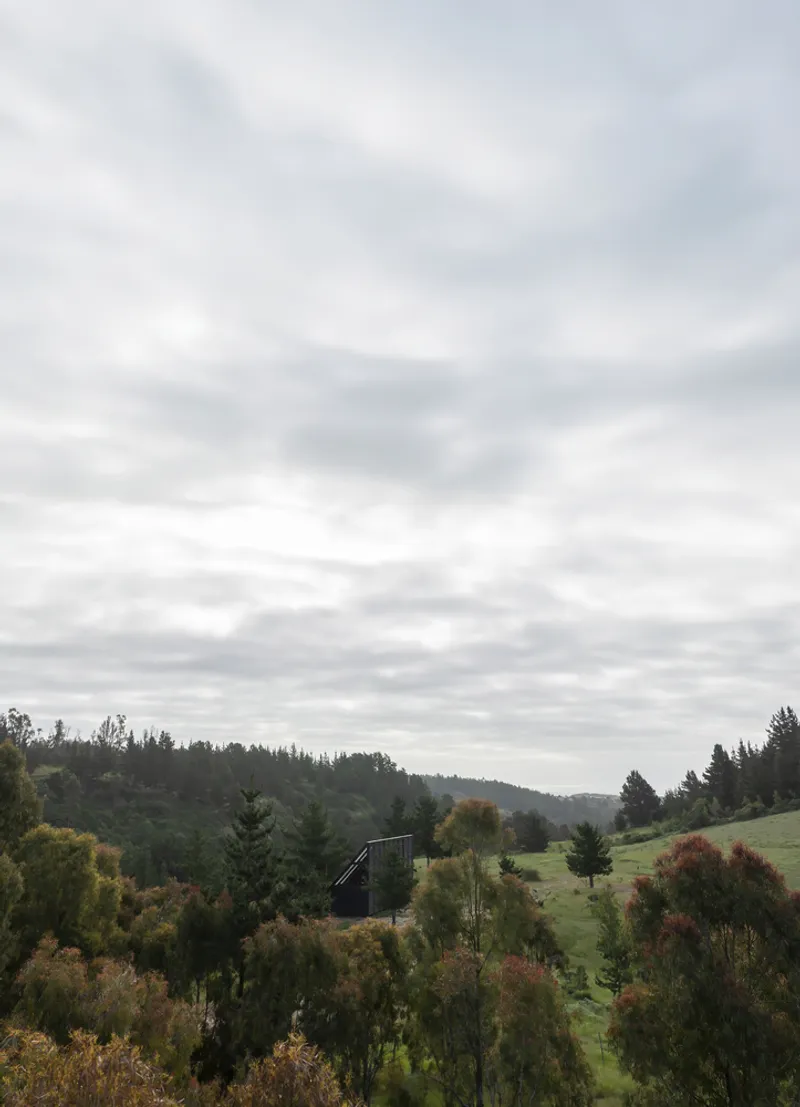
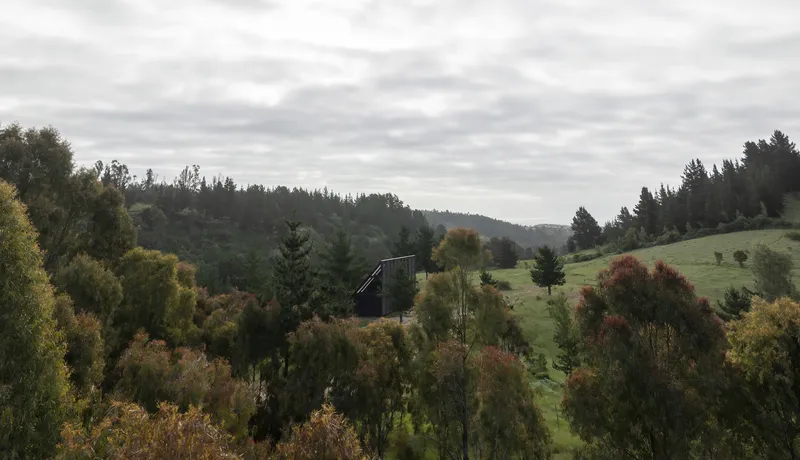
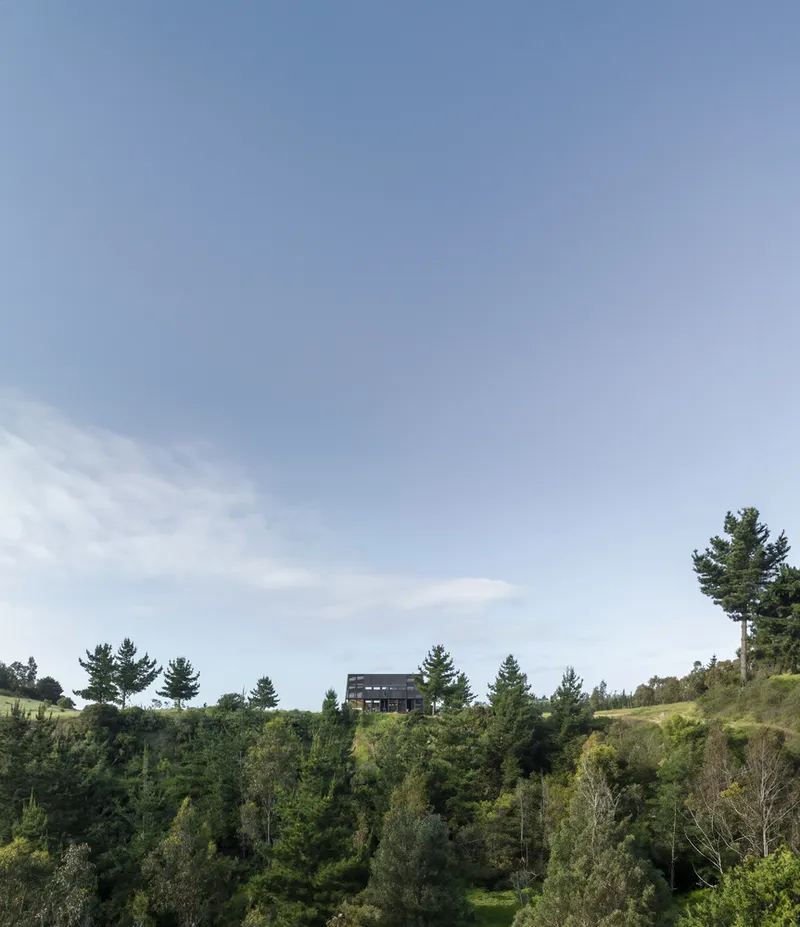
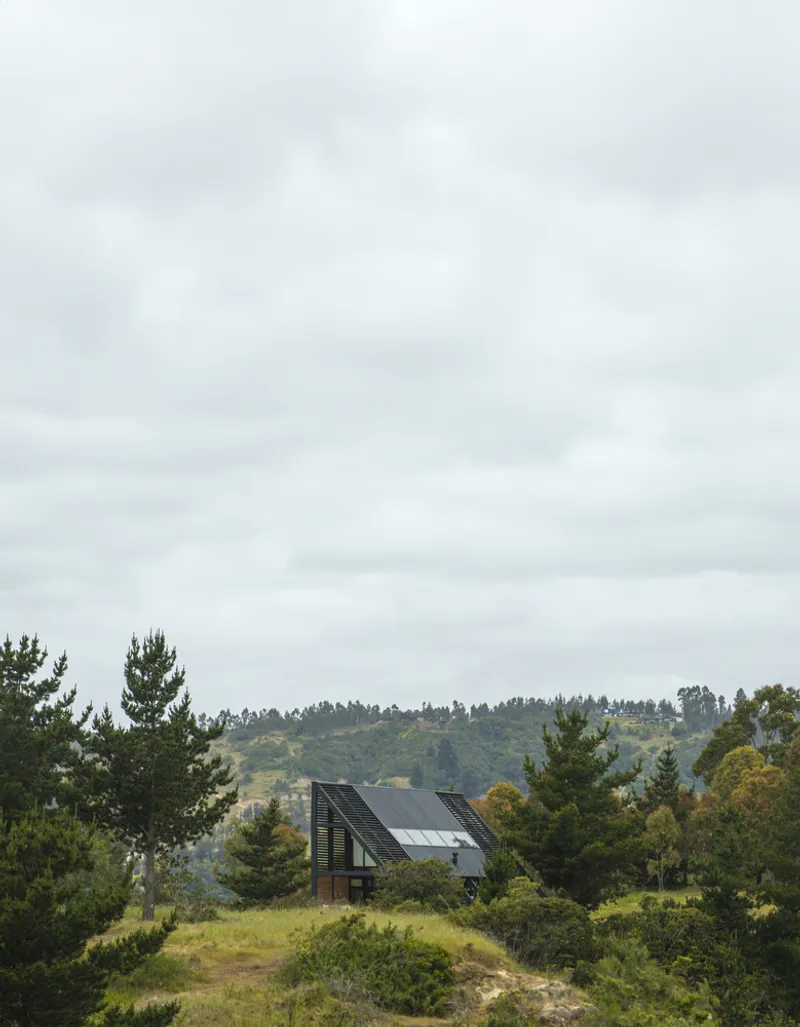
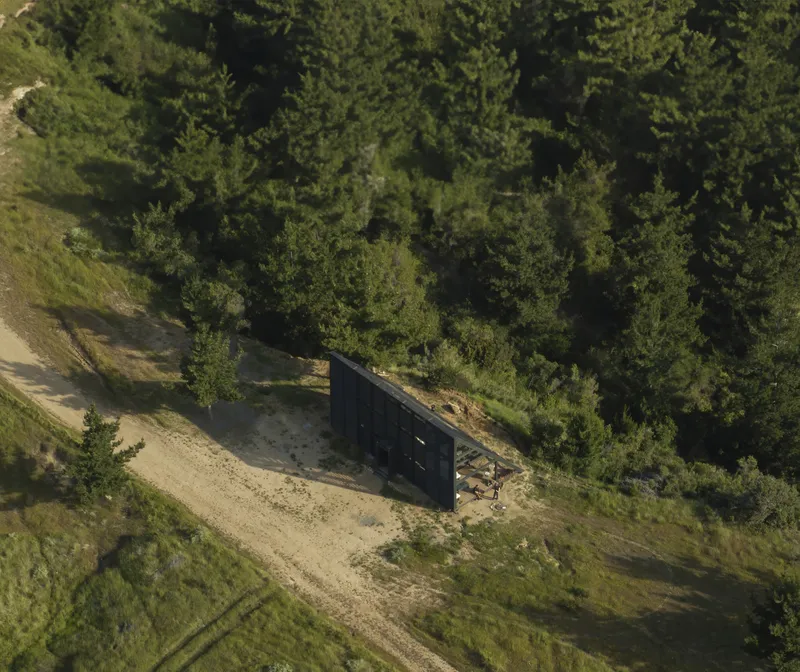
Matanzas sits roughly three hours south of Santiago, known more for kitesurfing than architecture. The terrain above the coast is steep, forested, and exposed to relentless wind. From a distance, Shelter 45 appears as a dark, angular mass perched on a grassy shoulder of the mountain, barely wider than a shipping container but noticeably taller than the surrounding scrub. The dark cladding absorbs into the hillside under overcast skies and becomes a silhouette against golden autumn foliage.
The siting is deliberate. The architects placed the cabin on the only flat chord of the mountainous parcel, orienting its long axis to frame views of the ravines and ocean while exposing the narrow gable ends to the prevailing wind. This orientation minimizes the surface area that takes the brunt of gusts and maximizes the glazed openings on the sheltered flanks.
The Modular Truss
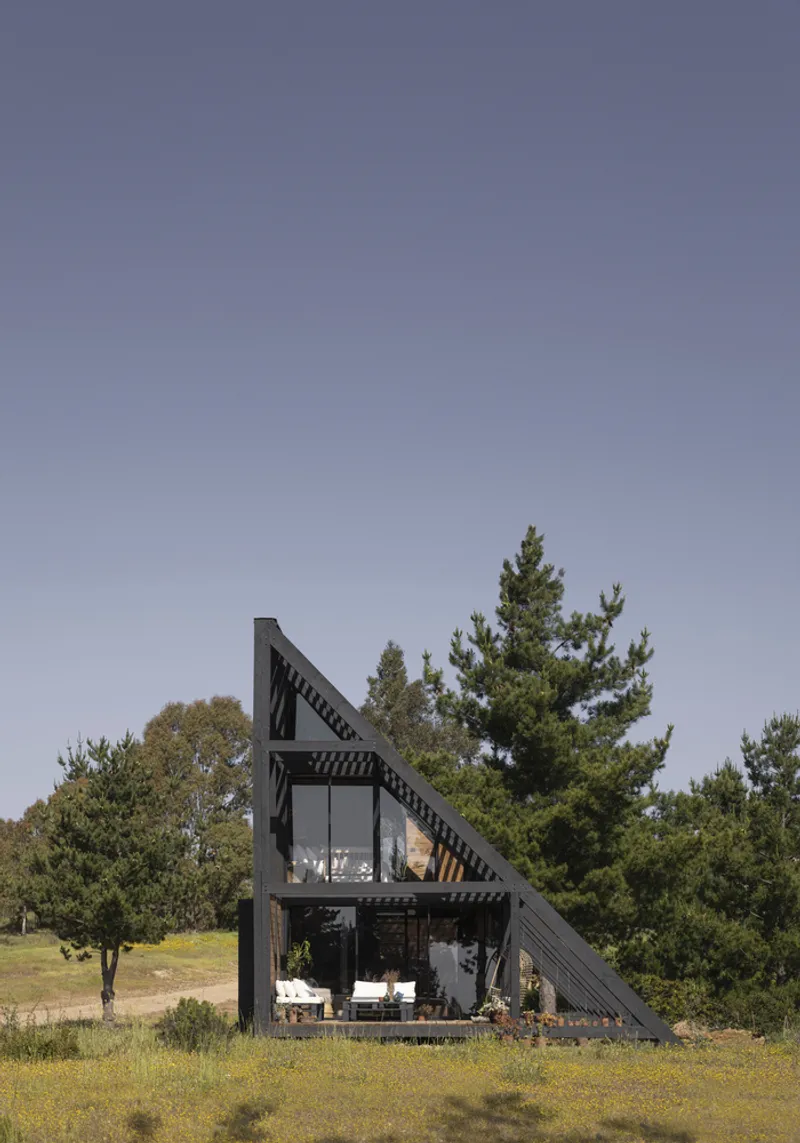
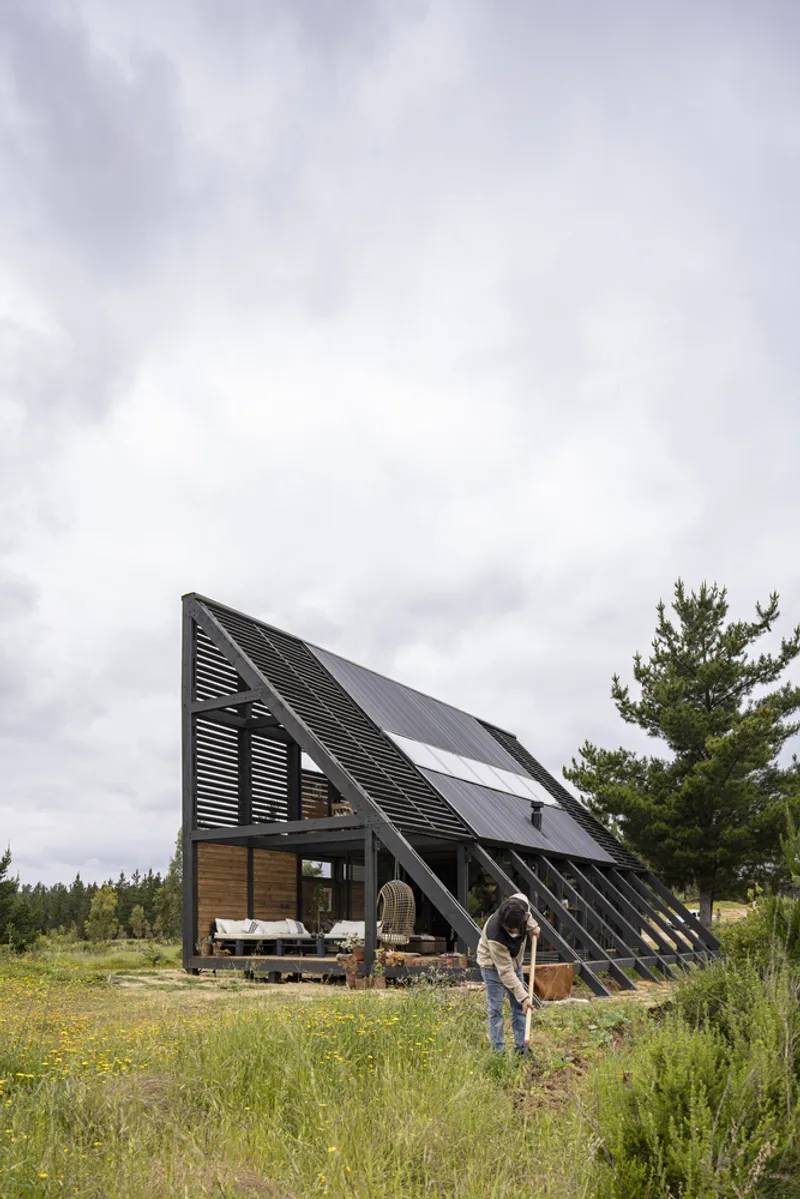
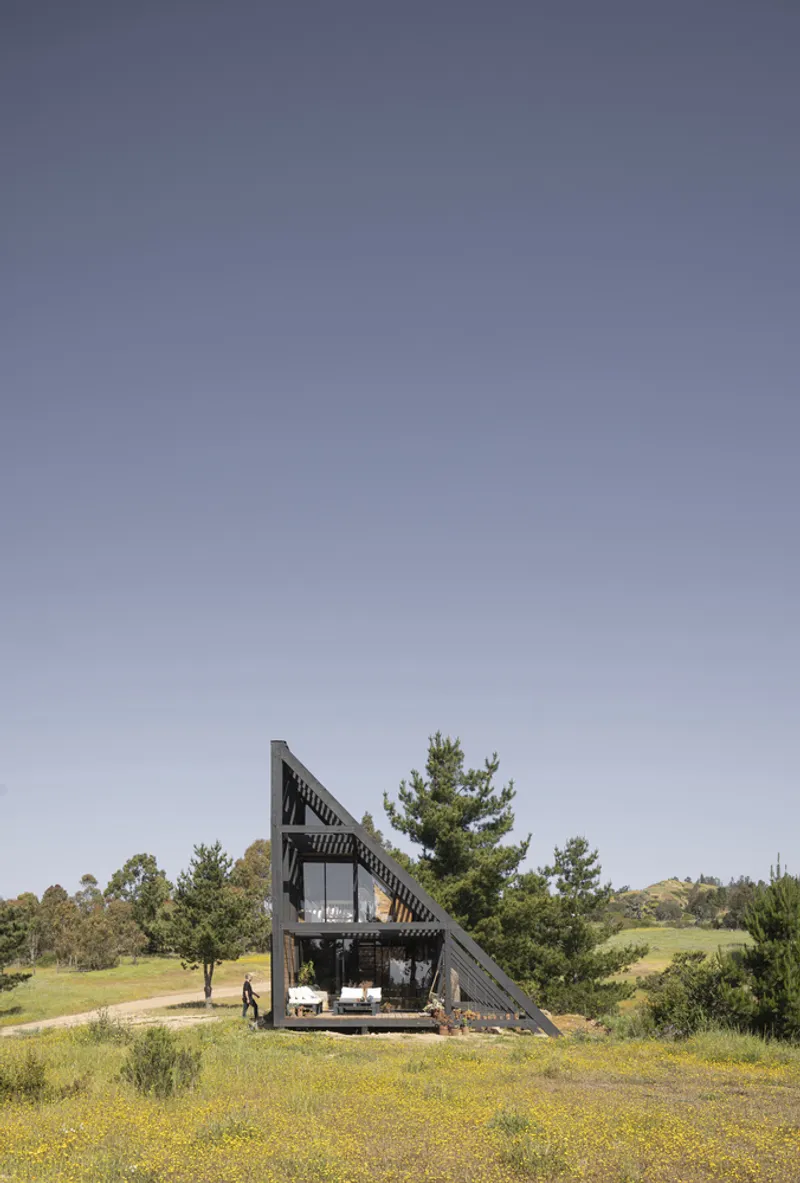
The structural concept is legible from every angle. Ten timber trusses, each braced with steel ties, march along the length of the building at regular intervals. From the gable end the exposed framing reads as a triangular portal; from the side it compresses into a rhythmic sequence of louvers and openings. The result is a skeleton that doubles as ornament, an approach that keeps construction straightforward and reduces the need for secondary finishes.
Repetition of a single module also simplified logistics on a remote site. Builder Constructora Guay Guay could prefabricate each bay and assemble them sequentially. The modular system turns a potential liability, a narrow and inaccessible building site, into a constructive advantage: the cabin grows bay by bay, like stacking vertebrae.
Facade as Climate Filter
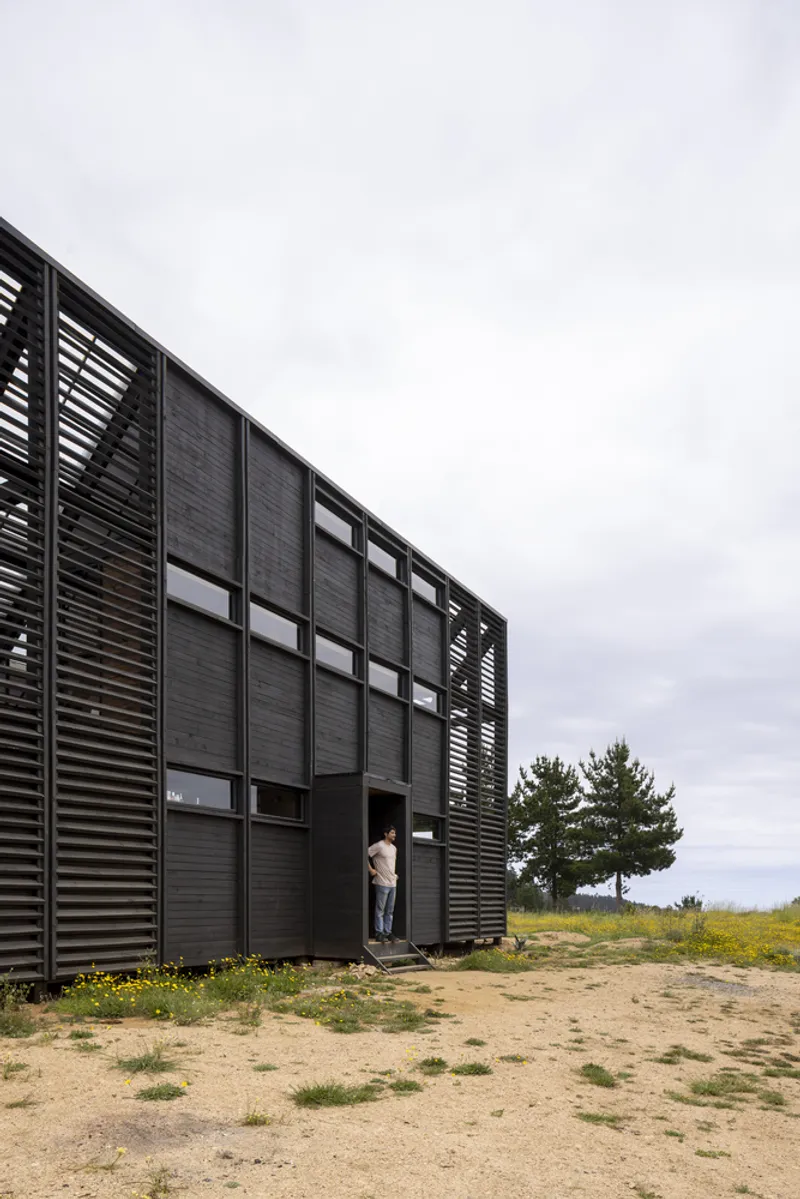
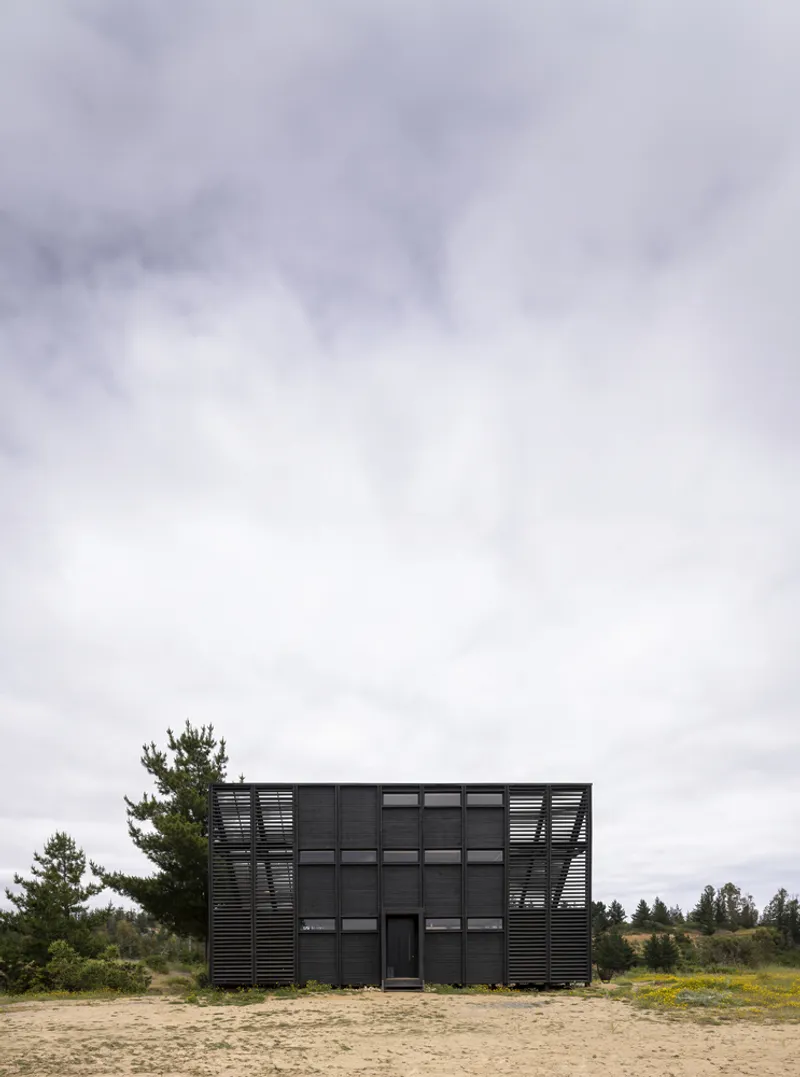
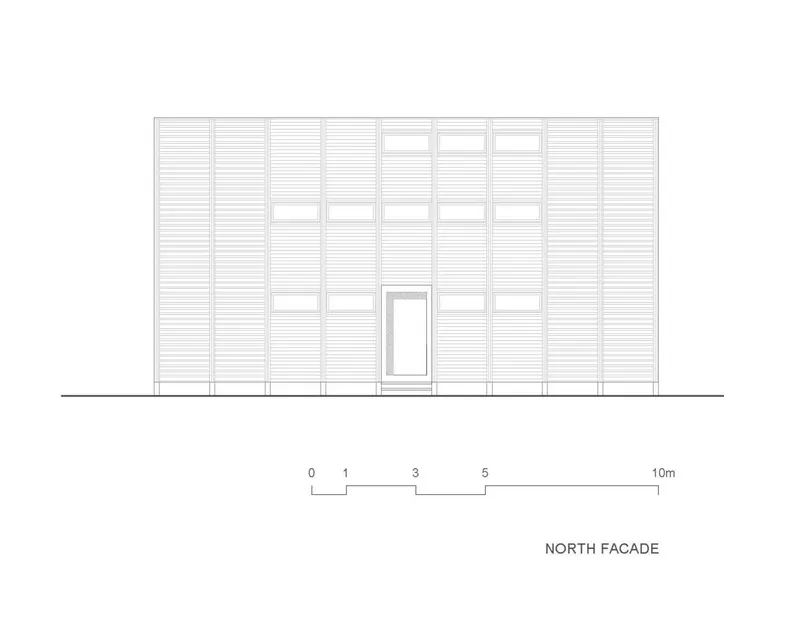
The northern facade, which receives the most direct sun in the Southern Hemisphere, is armored with timber blinds that layer over the terraces at each level. These louvers control solar gain and deflect rain without sealing the facade. Air still moves through, which matters on a hillside where humidity and wind alternate throughout the day. The black corrugated cladding elsewhere absorbs and reradiates heat quickly, keeping the thermal mass low and the structure responsive to rapid weather shifts.
The side elevations take the opposite approach: large glazed panels open the living spaces to horizontal views of forest and ravine. This dual strategy, opaque and filtered where the sun hits, transparent where the landscape unfolds, gives each facade a distinct performance. It is passive design executed without mechanical complexity.
Living Under the Slope
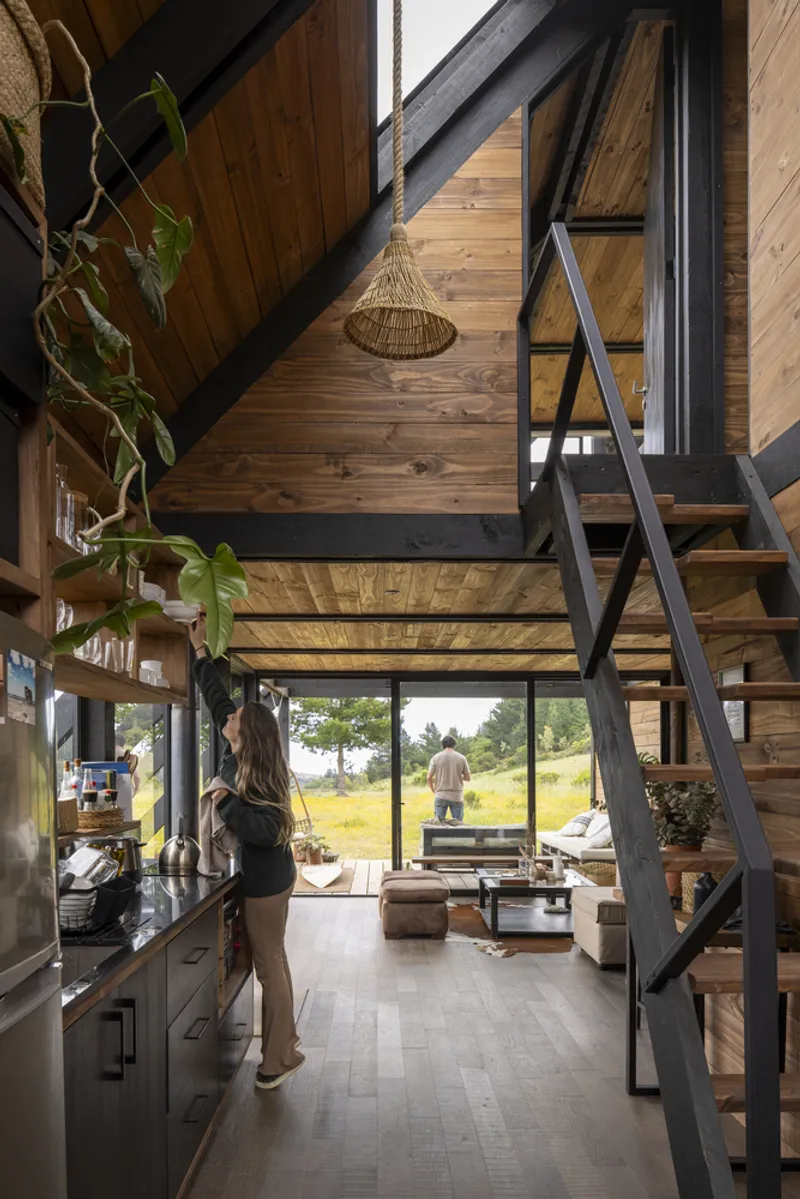
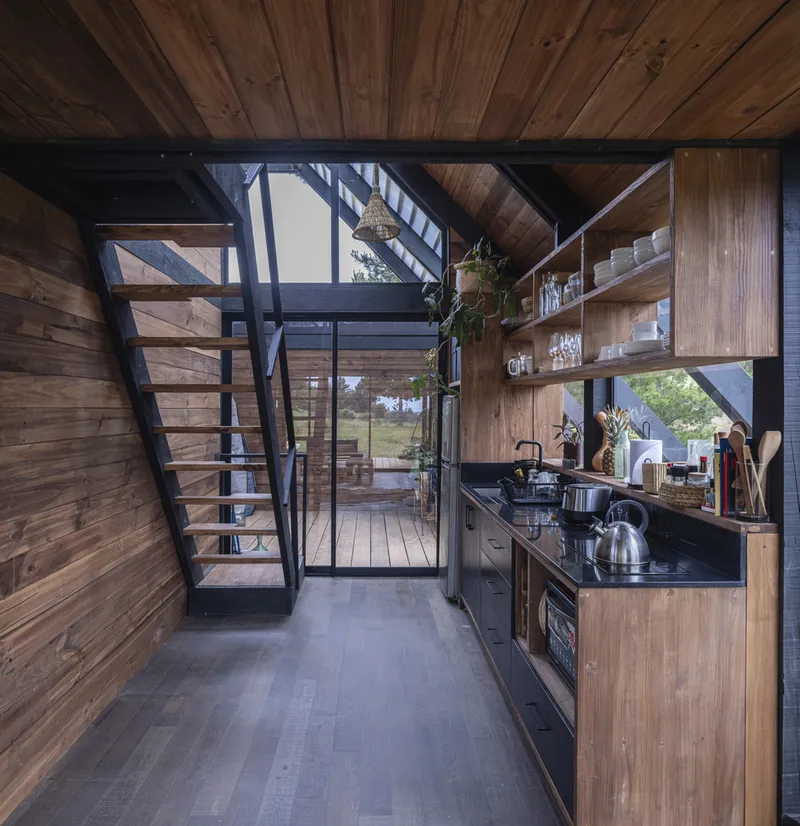
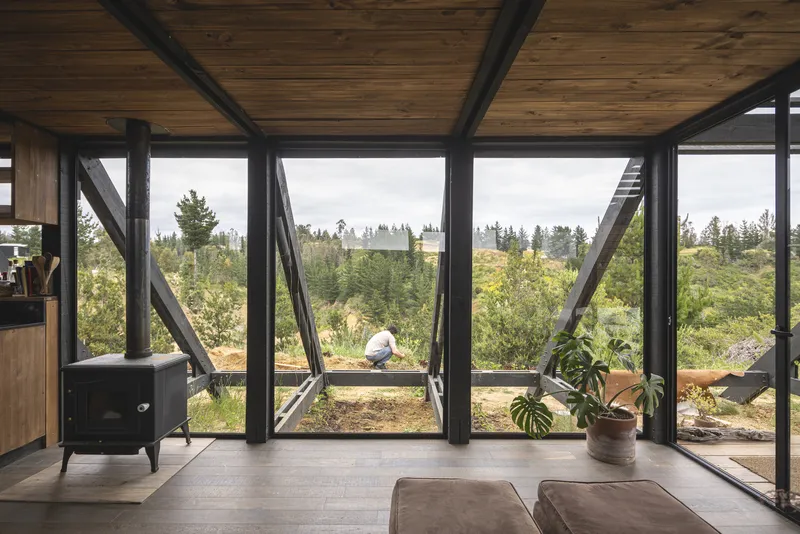
The ground floor is the most generous space: kitchen, living area, and bathroom arranged in a linear sequence that flows directly onto an outdoor terrace. A steel ladder punches through the timber ceiling to the second floor, where the primary bedroom occupies the full width of the cabin. Above that, a compact loft tucked under the sloping roof serves as a children's or guest sleeping area. The section drawing makes the narrowing clear; each successive floor loses area to the angled roofline, concentrating activity at the base and rest at the top.
Exposed structural bracing doubles as spatial definition. The diagonal steel ties that stabilize the trusses cross over the kitchen and living area, creating a visual rhythm that draws the eye upward. The galley kitchen tucks neatly under these diagonals, with timber shelving built into the truss depth. Nothing is added that the structure does not already provide.
Interior Light and Warmth
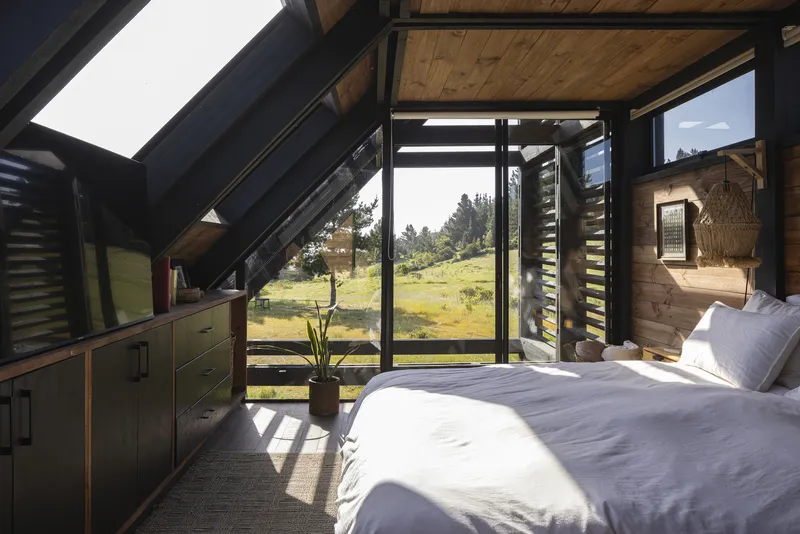
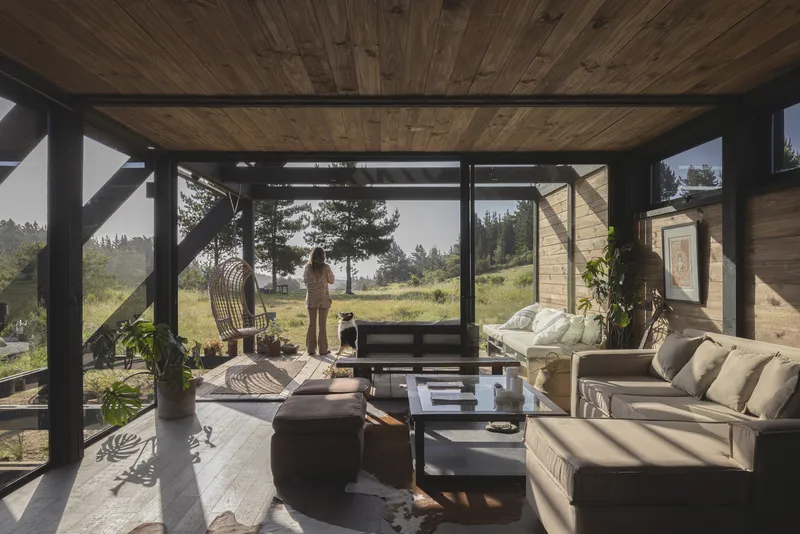
The bedroom on the second floor is one of the most compelling rooms in the project. A sloped timber ceiling presses down toward the glazed wall, where black steel mullions frame the landscape in a grid. Morning light rakes across white bedding and bare wood, producing the kind of atmosphere that justifies the word shelter. There is no ornamentation, no color palette to speak of, just the material grain of pine and the weather outside.
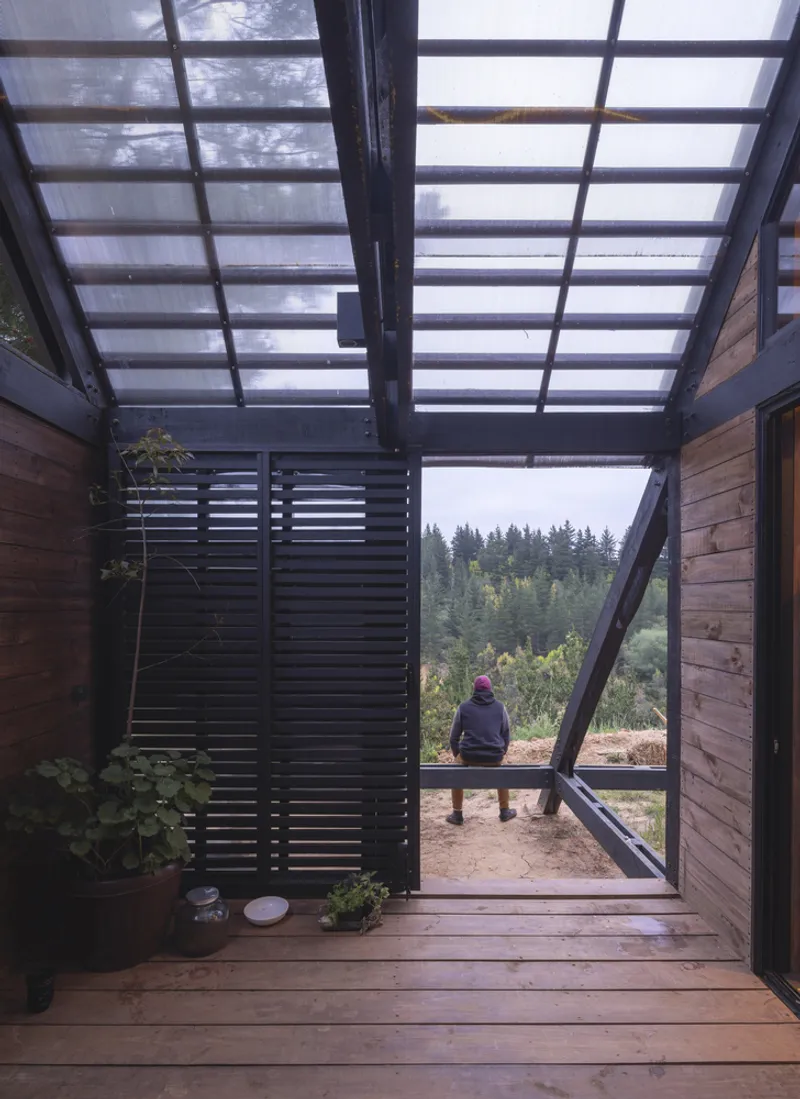
The covered deck on the northern side extends the interior into a semi-outdoor zone where translucent roof panels admit diffused light. Sitting here, overlooking the forested slope, the cabin feels larger than its 80 square meters because the boundaries between inside and out are calibrated rather than fixed. The timber blinds filter wind and sun without closing off the view, and the steel-framed doors swing wide enough to erase the wall plane entirely.
Dusk Reveals the Frame
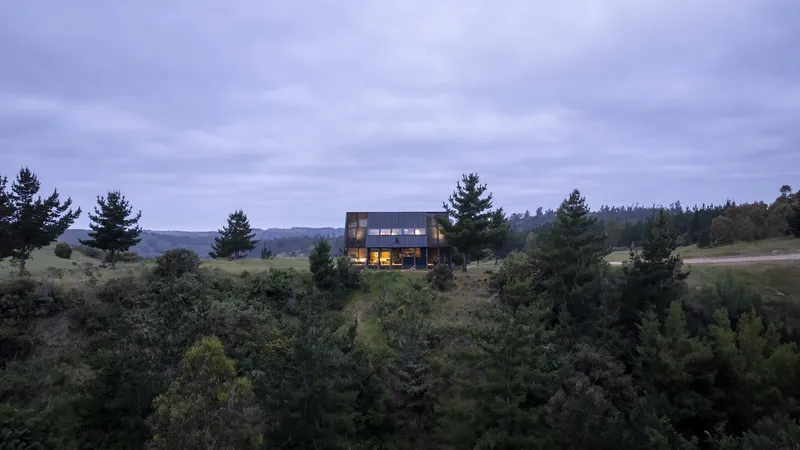
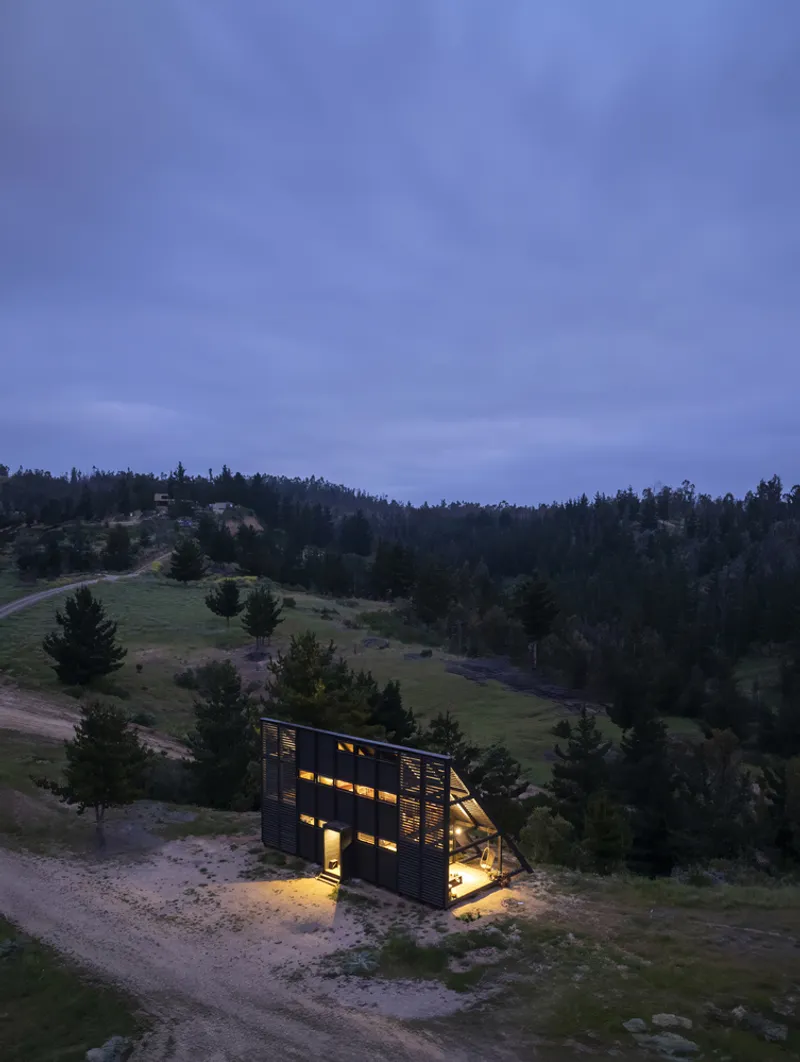
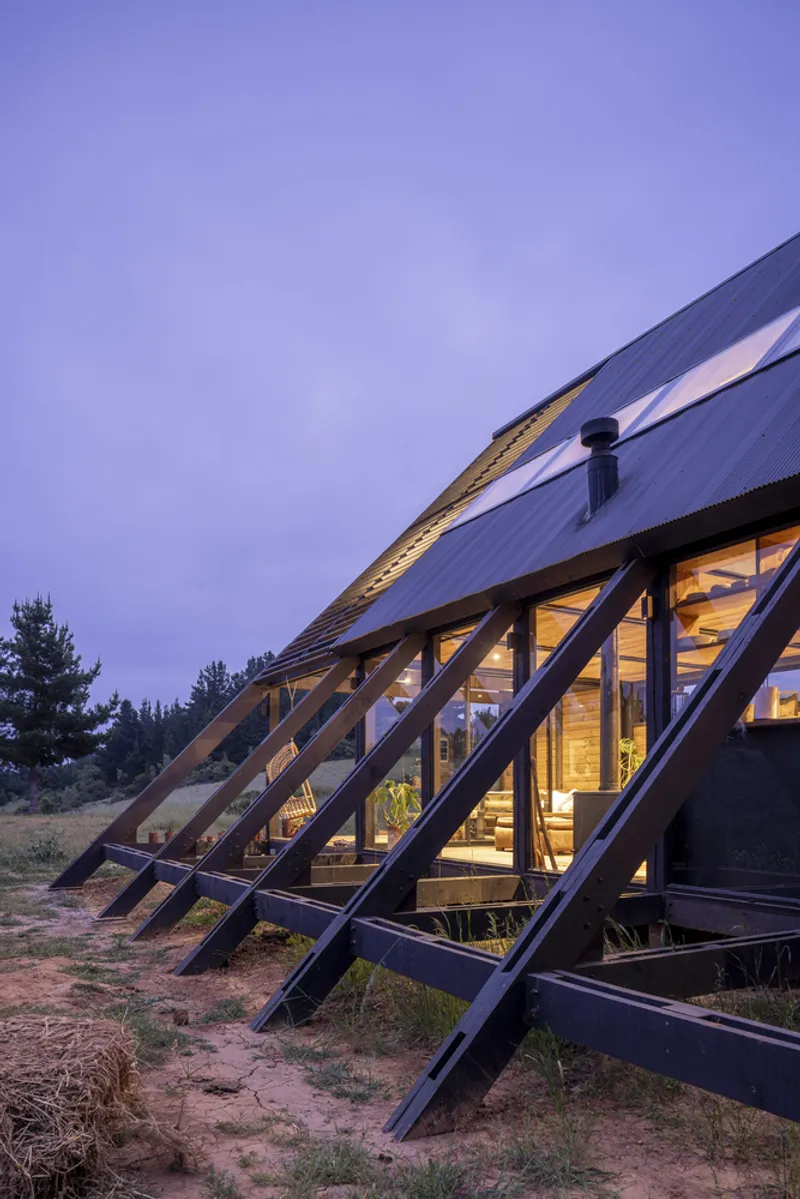
At twilight, Shelter 45 transforms. The interior lights turn the triangular gable into a lantern, and the structural frame becomes a dark lattice against a warm glow. The diagonal steel bracing, invisible during the day behind reflections on the glass, now reads as a graphic overlay on the illuminated interior. The aerial view at dusk is particularly striking: the cabin is a small rectangle of warmth in a dark meadow, surrounded on all sides by forest.
These twilight images reveal something the daytime photographs cannot: the cabin is fundamentally about framing domestic life within a wild landscape. The exposed structure is not a stylistic choice but a legible record of how the building resists the forces acting on it. Seeing it lit from within, you understand the name. Shelter 45 is exactly that.
Plans and Drawings
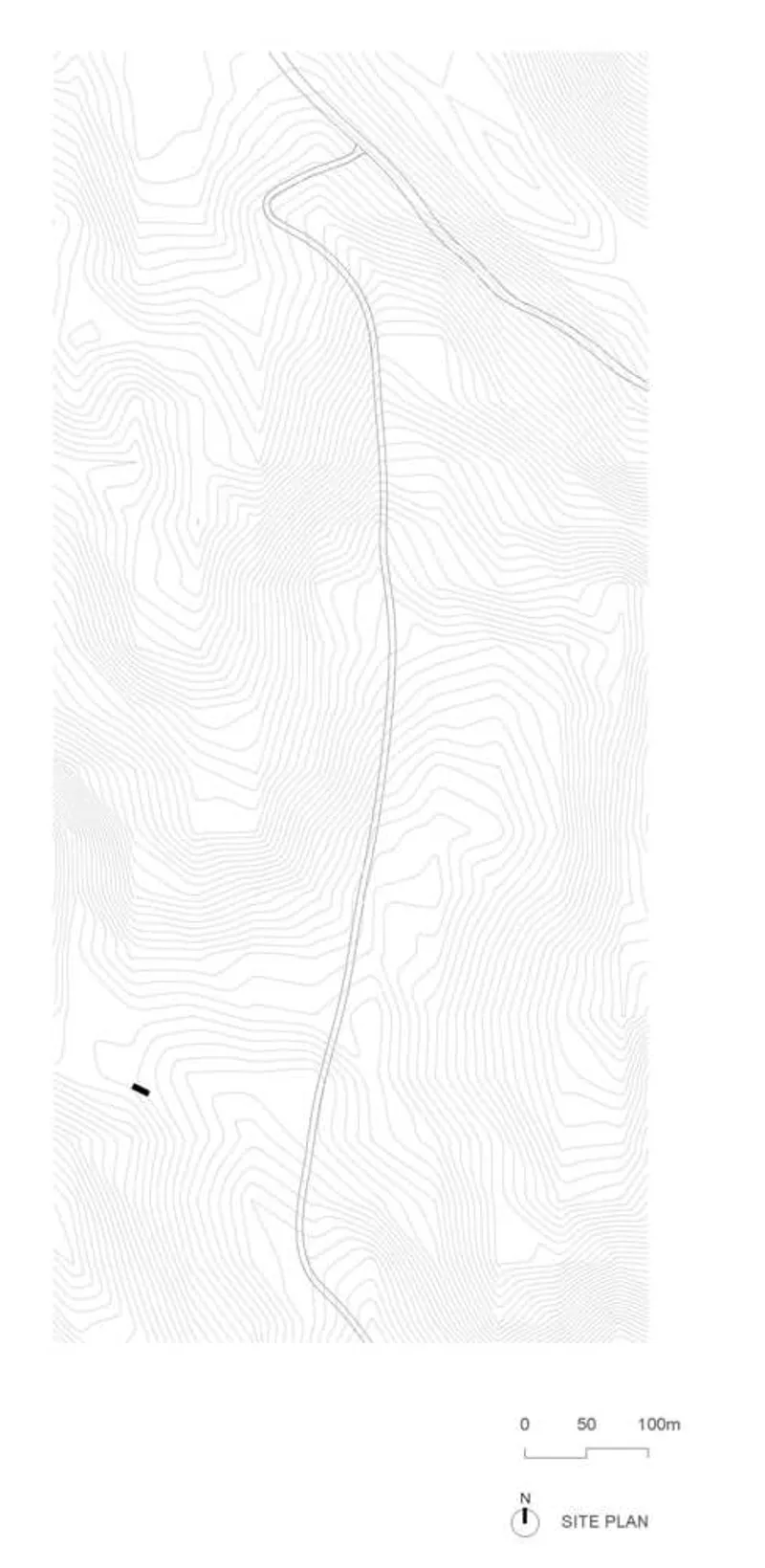
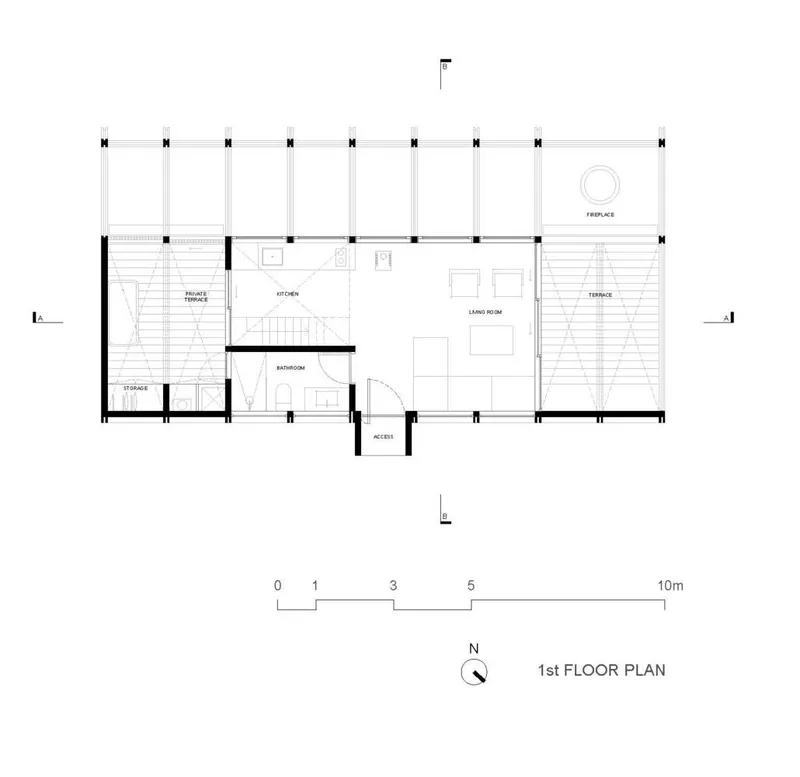
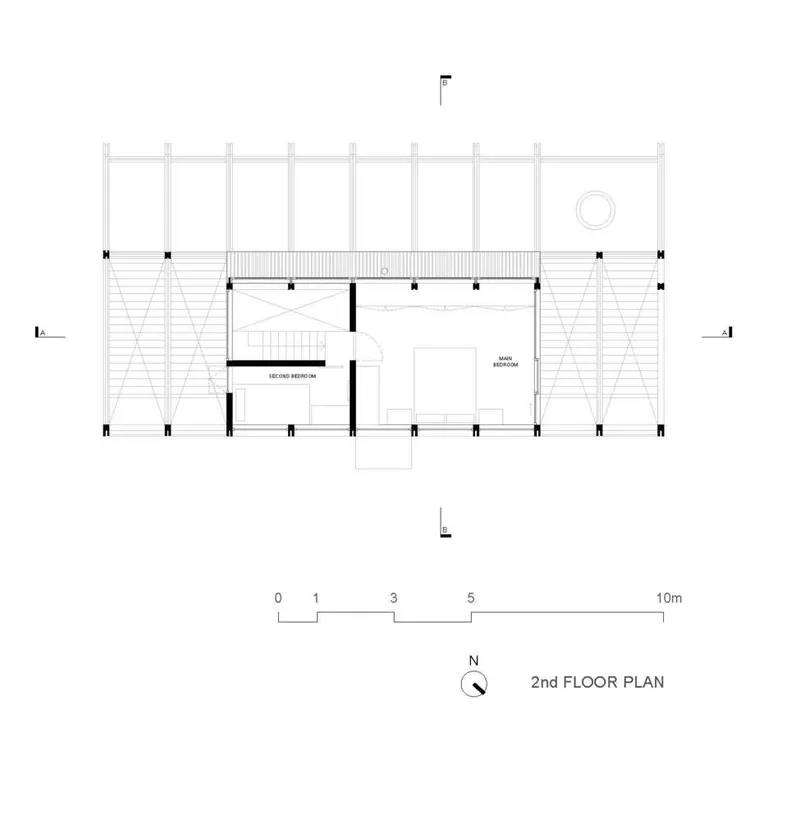
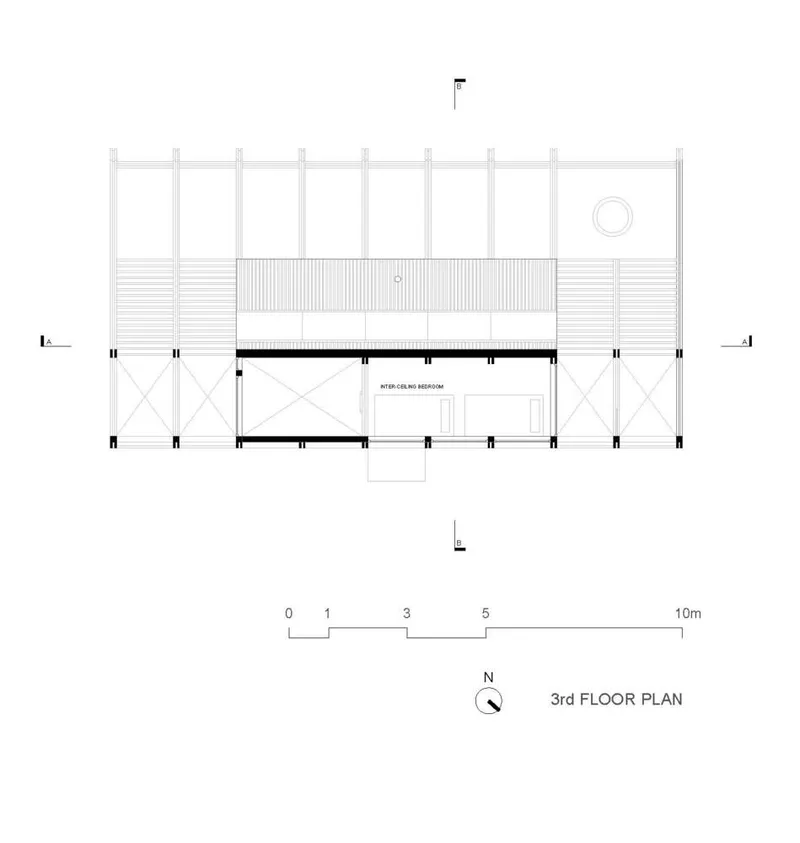
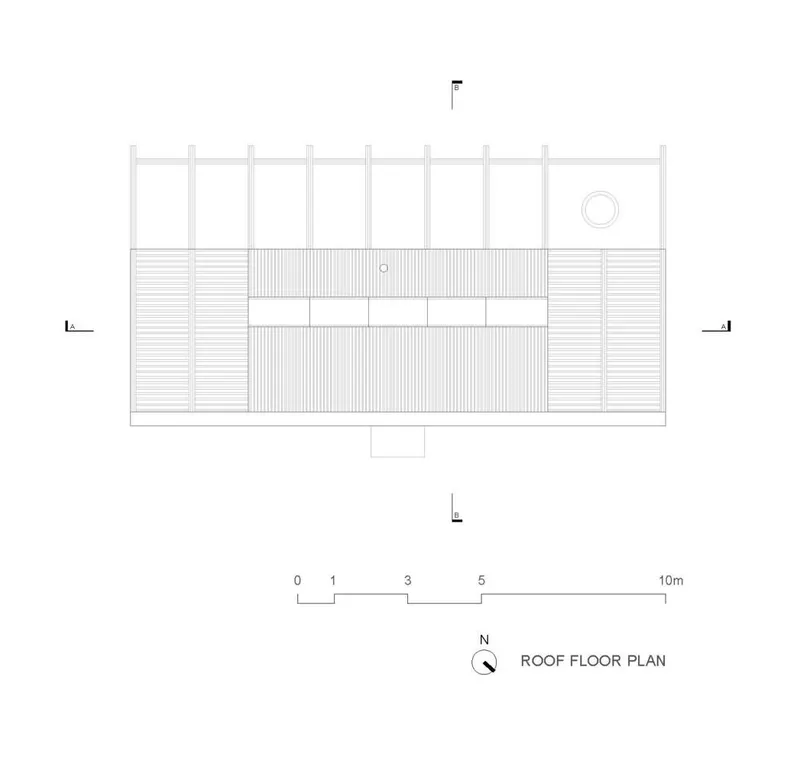
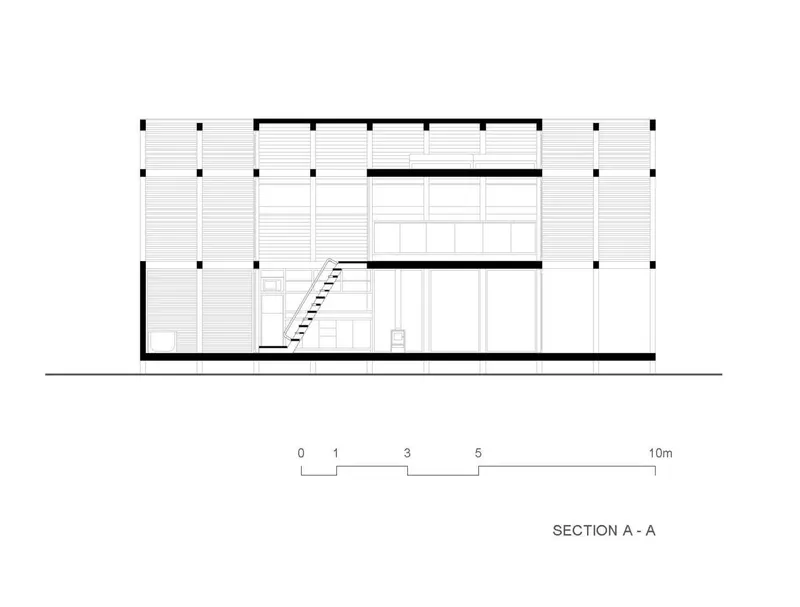
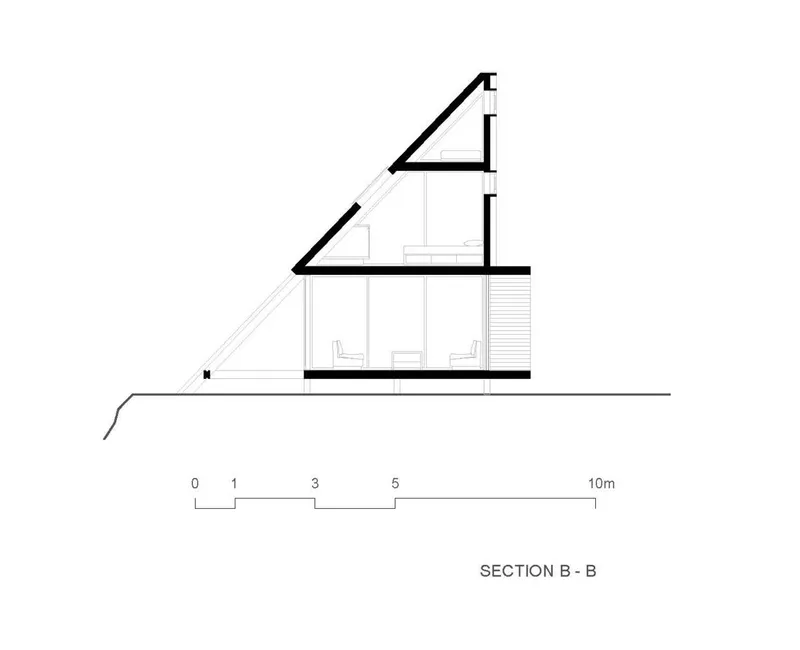
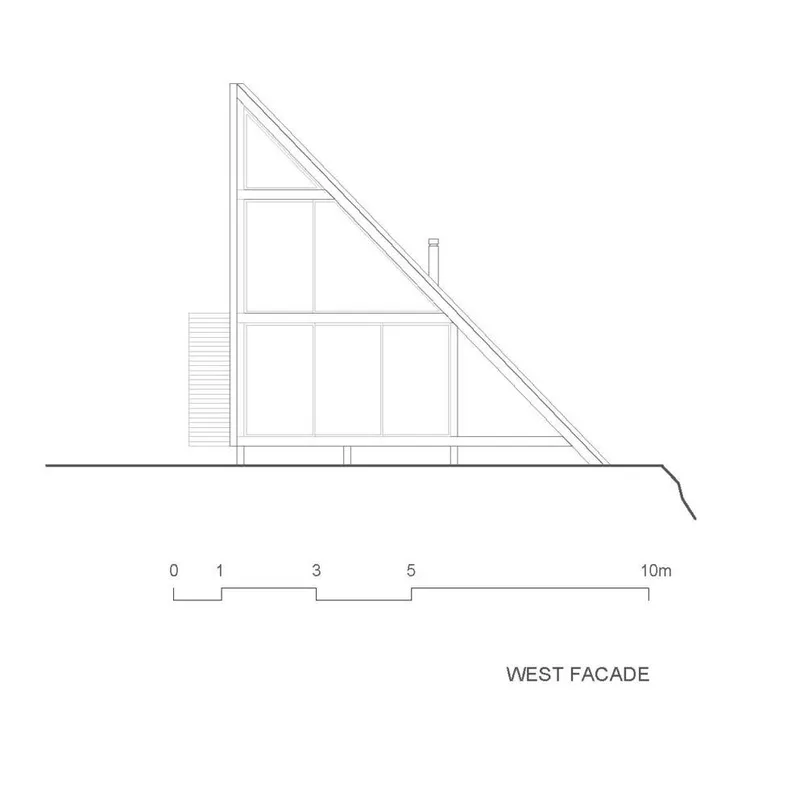
The site plan confirms the precision of the placement: the cabin sits on a narrow contour band, oriented along the slope so that its footprint does not require cut or fill. The floor plans show how the three levels thin out. The ground floor is flanked by terraces on both ends with diagonal cross-bracing clearly drawn into the living room bay. The second floor accommodates two bedrooms and additional terrace area, while the third floor is a single room under the converging roofline. A circular skylight in the roof plan adds a point of zenith light to the uppermost space.
The sections are the most revealing drawings. They show the three interior levels stepping slightly with the terrain and the sloped roof sweeping down from the ridge to create the wedge profile visible in photographs. The north elevation drawing illustrates the layered louver system, with horizontal timber slats alternating with vertical window bays. The west elevation confirms the triangular gable as the dominant formal gesture, a single clear shape that resolves roof, wall, and structure into one gesture.
Why This Project Matters
Shelter 45 is a reminder that constraint breeds invention. Eighty square meters on a windswept hillside with limited flat ground is a brief that could produce something cramped and defensive. Instead, Gonzalo Rufin Arquitectos and Felipe Toro delivered a cabin that is vertical without being awkward, open without being exposed, and structurally expressive without being showy. The modular truss system is both the architecture and the construction method, collapsing design and fabrication into a single logic.
For anyone designing small buildings on difficult terrain, this project offers a transferable lesson: let the structural system do more than hold the building up. When the frame is the facade, the spatial divider, and the climate screen, every element earns its place. That economy is what separates a competent cabin from one that sticks in your memory.
Shelter 45 by Gonzalo Rufin Arquitectos and Felipe Toro. Matanzas, Chile. 80 m². 2023. Photographs by Pablo Casals.
About the Studio
Share Your Own Work on uni.xyz
If projects like this are the kind of work you want to make, uni.xyz is a place to publish your own, find collaborators, and enter design competitions.


Popular Articles
Popular articles from the community


Little Red Riding Hood: Architectural Design as a Journey Through Fear, Light, and Storytelling
Little Red Riding Hood reimagines the fairy tale through architectural design shaped by fear, light, scale, memory, uncertainty, and choice.

ALGAL REALM: A Bio-Integrated Lunar Habitat Design for Life Beyond Earth
ALGAL REALM reimagines lunar habitat design with algae-powered life support, 3D-printed regolith, and vertical living for a lunar future.

Co-Life: Senior Housing Design That Reconnects Older Adults With the City
Co-Life reimagines senior housing design through healing gardens, shared streets, workshops, and a sustainable community across generations.

Play: Fragments of Their World
Familiar architecture becomes modular playground design, creating safe spaces where displaced children can learn, connect, imagine and play.

Similar Reads
You might also enjoy these articles


Hodi-Mandai Geram
Project Function: Preservation and revitalization of the Intangible heritage and socio-spatial identity of the Hodi by Housing, Cultural Memory Center, Sacred Grove, landscape, local tourism economy


Olio Towers: A Mid-Rise for Performers That Fuses Housing, Rehearsal, and Stage
Located blocks from Houston's Theater District, this modular tower stacks living units around a central performance atrium.

Oasis: Modular Green Housing Carved into Dhaka's Urban Fabric
A shortlisted Plugin Housing entry reclaims unauthorized settlements in Dhaka with stepped concrete volumes, green roofs, and ventilation-driven design.

Black Hole: A Floating Megastructure for the Post-Physical Era
Emiliano Mazzarotto envisions a spherical, self-scaling arena where e-sports, digital hotels, and holographic stadiums replace traditional public space.

Explore Architecture Competitions
Discover active competitions in this discipline

Challenge to reimagine the Iron Throne

Photograph architecture without architects

Illustrate the lost glory of Angkor Wat - Render Challenge

Design challenge to reuse E-waste
Comments (0)
Please login or sign up to add comments
No comments yet. Be the first to comment!