
East Architecture Studio Weaves a Carbon-Negative Prayer Pavilion from 150 Date Palm Trees
At Jeddah's Islamic Arts Biennale, a modular musalla built entirely from palm waste channels ancient craft into a nomadic sacred space.

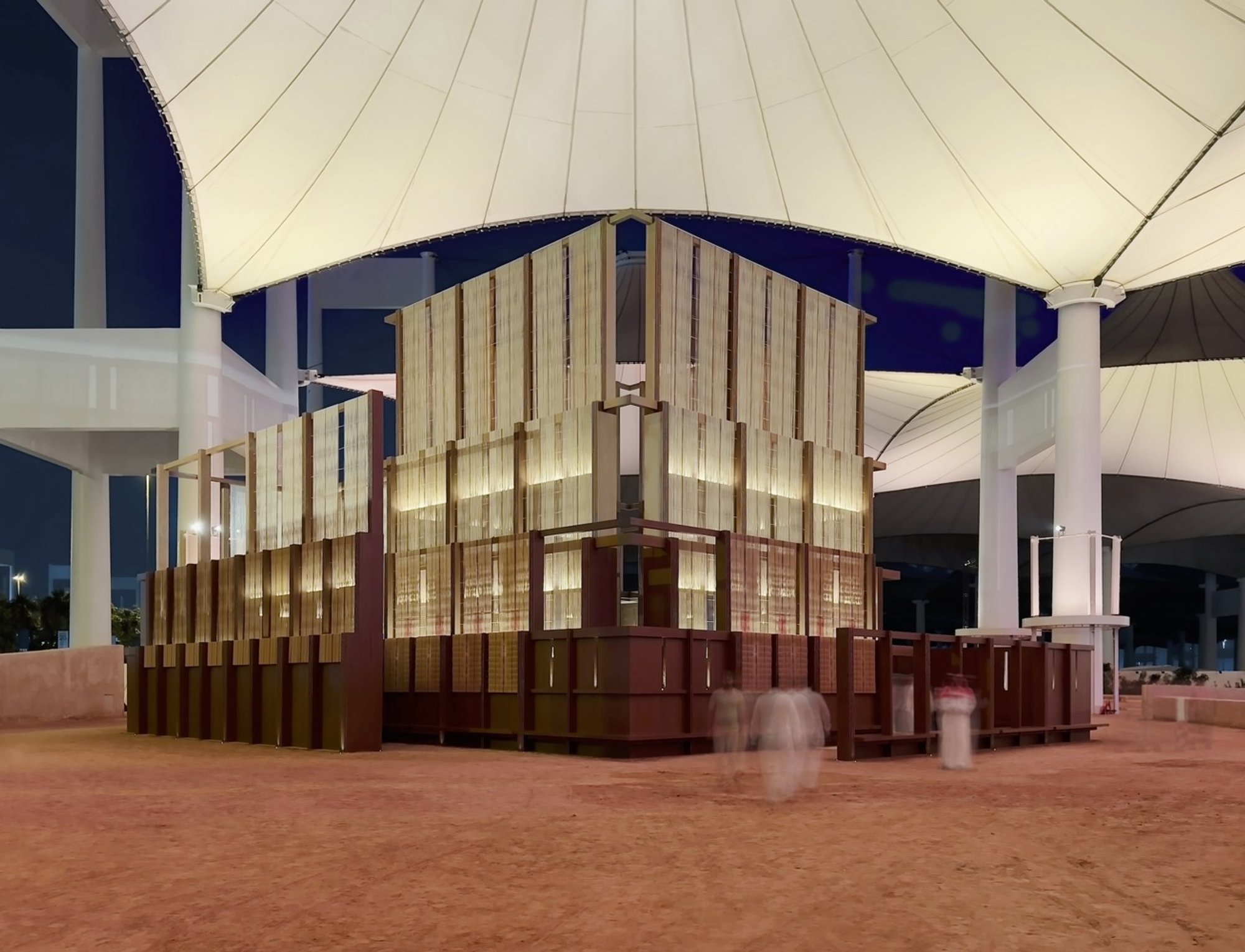
A musalla is, by definition, a prayer space that can be set up and taken down. It is architecture with a built-in expiration date, a structure that belongs to a moment and a community before moving on. East Architecture Studio took that nomadic logic seriously when they designed AlMusalla for the Islamic Arts Biennale, installed beneath the iconic tensile canopy of Jeddah's Western Hajj Terminal. The pavilion is assembled entirely from the waste of 150 date palm trees, compressed and laminated into an engineered composite, then woven and stacked into a modular kit of parts. Every element can be disassembled, shipped, and rebuilt somewhere else.
What makes the project genuinely interesting is not just the sustainability claim, though a carbon-negative structure built from agricultural waste is noteworthy. It is the way the design collapses three distinct regional traditions into a single tectonic system: the courtyard typology of historic Jeddah, the date palm construction methods still practiced across the Arabian Peninsula, and the weaving techniques of Gulf textile craft. The result is a building that functions simultaneously as structure, ornament, and cultural argument.
A Sacred Space Under SOM's Canopy
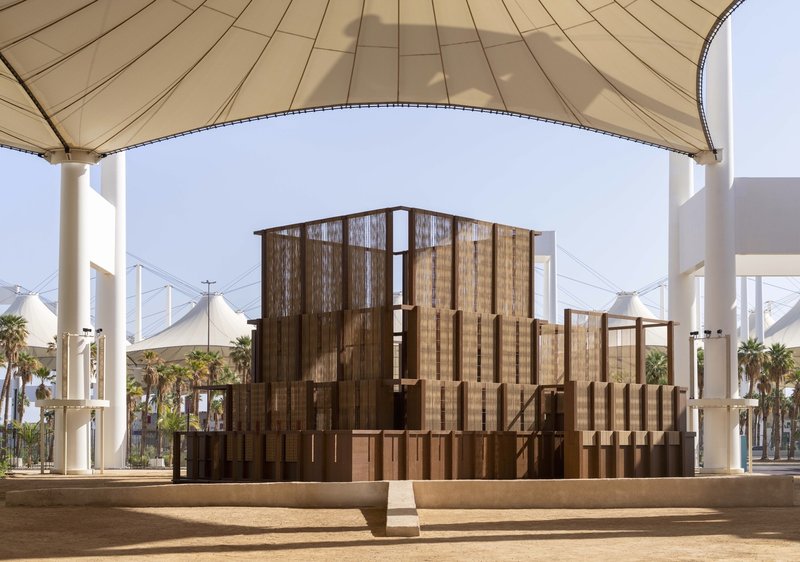
Siting the musalla at King Abdulaziz International Airport's Hajj Terminal is a deliberate provocation. The terminal, designed by Skidmore, Owings & Merrill with its signature semi-conical fabric vents, has served as the symbolic threshold for pilgrims heading to Makkah and Madinah for decades. Placing a prayer pavilion beneath that canopy establishes a direct lineage between the monumental infrastructure of modern pilgrimage and the intimate, portable architecture of worship.
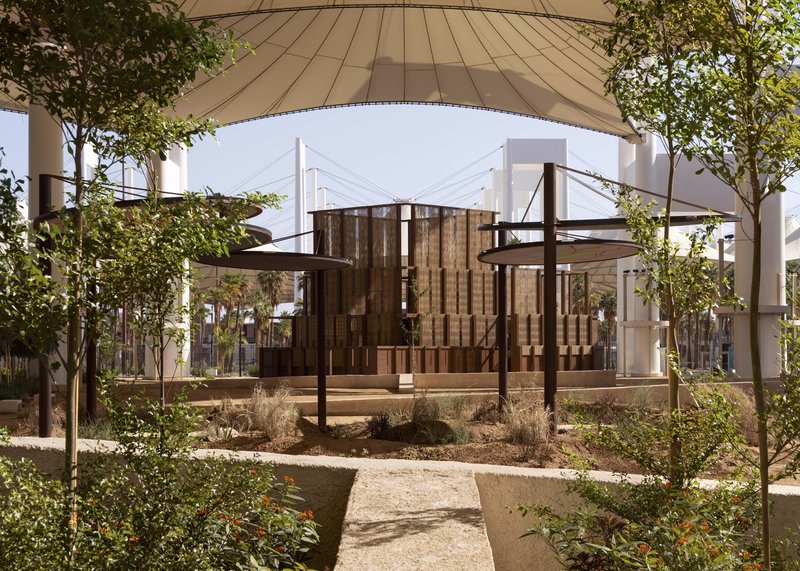
The pavilion sits within a landscape grid modeled on Saudi Arabian palm tree plantations, organized in 6 x 6 meter increments. Young trees and grasses grow around the structure, turning what could have been a stand-alone object into a planted precinct. The effect is less exhibition pavilion, more oasis fragment dropped into the terminal's vast sandy floor.
Facades That Breathe and Filter
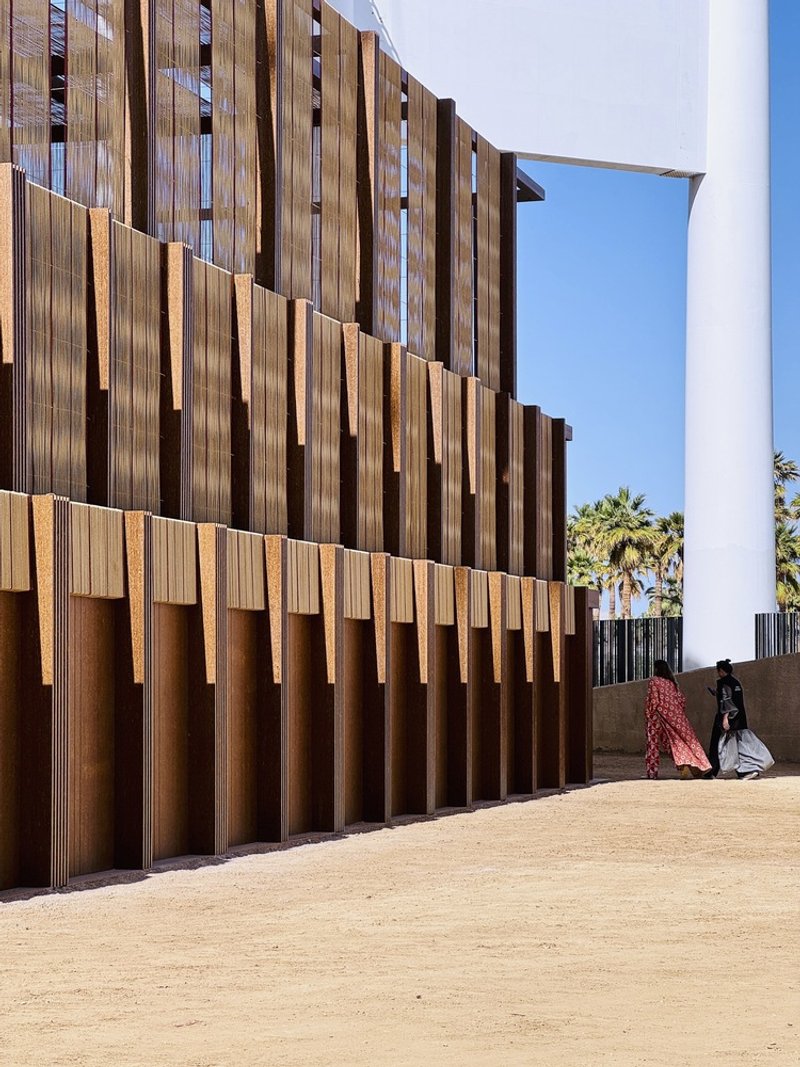
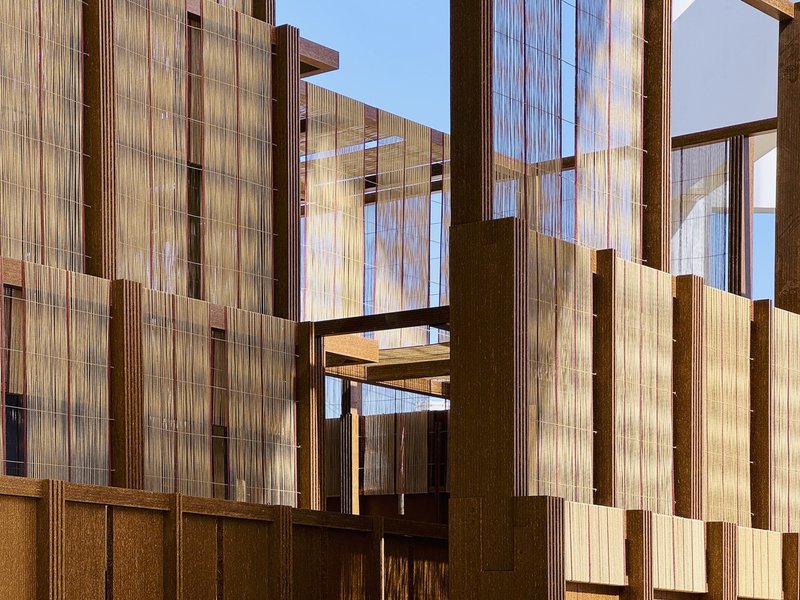
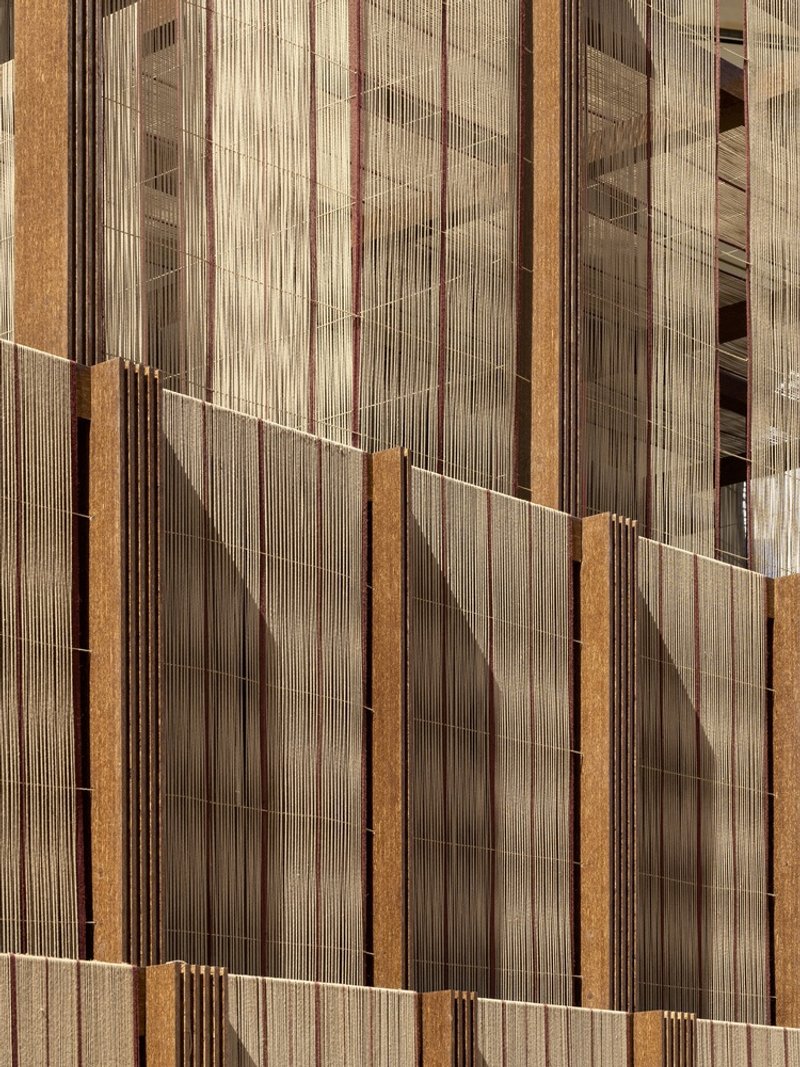
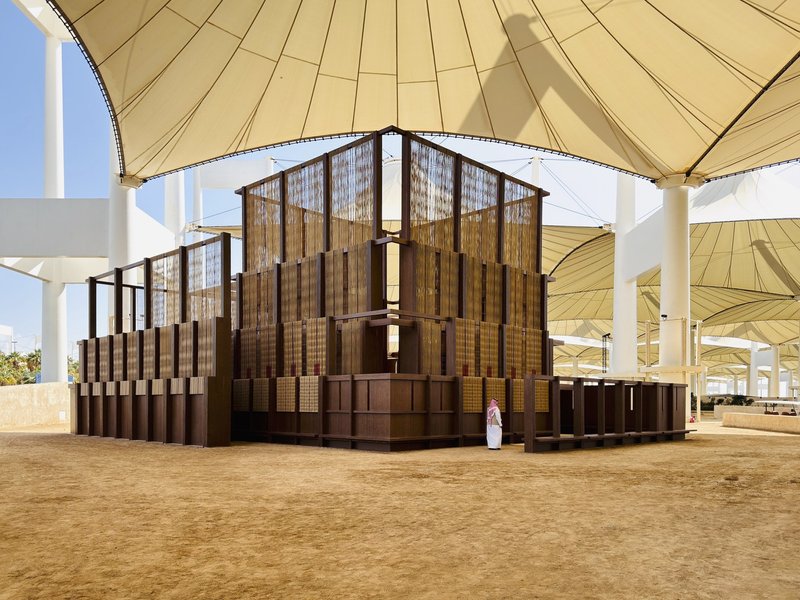
The exterior skin is the most immediately legible expression of the project's thesis. Palm fronds and fibers are woven into translucent curtain panels that layer over darker vertical slats, creating a depth of field that shifts as you walk around the building. Gaps between elements allow air to circulate and light to enter, so the facades are not barriers but membranes. At dusk, the interior glow turns the whole structure into a lantern, the woven texture reading as a textile draped over a timber skeleton.
The staggered slat system serves triple duty. Structurally, double-sided pedestals interlock and thin as they rise, carrying load while expressing a vertical rhythm. Environmentally, the layered skin filters harsh desert sun into soft, dappled patterns. Ornamentally, the compressed palm waste reveals stratified cross-sections that evoke the natural grain of the trunk itself. It is one of those rare moments where engineering, climate response, and decoration are genuinely the same thing.
Light as Liturgy
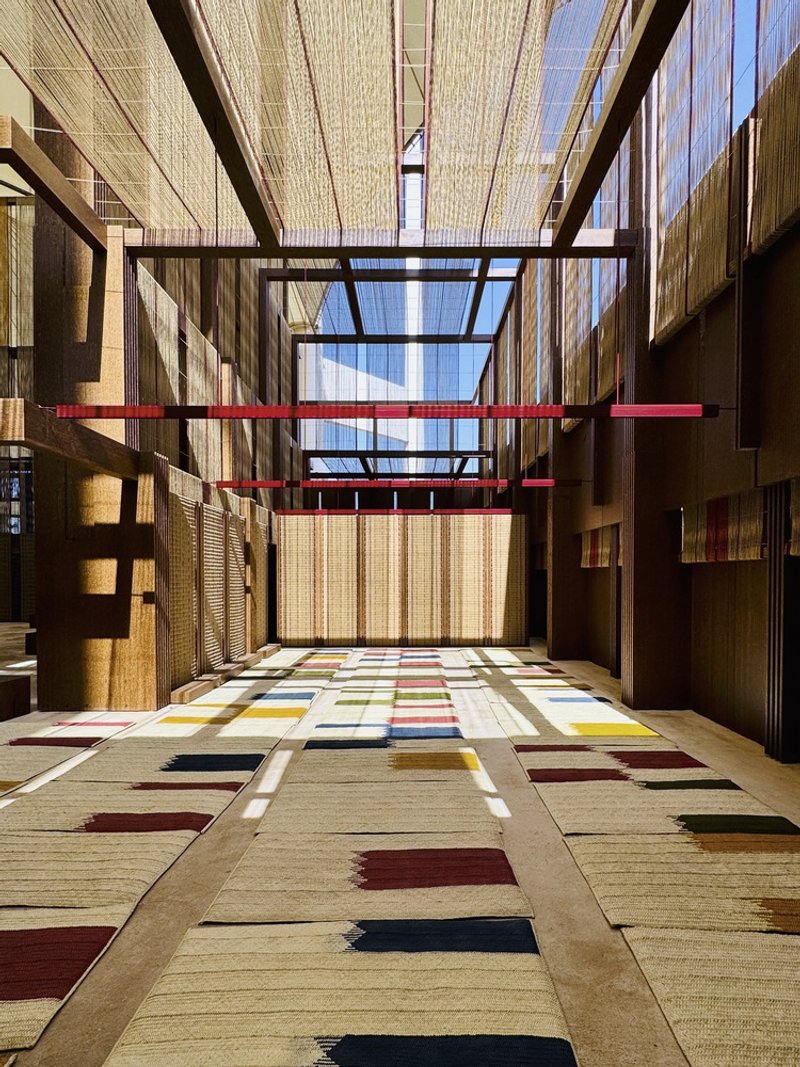
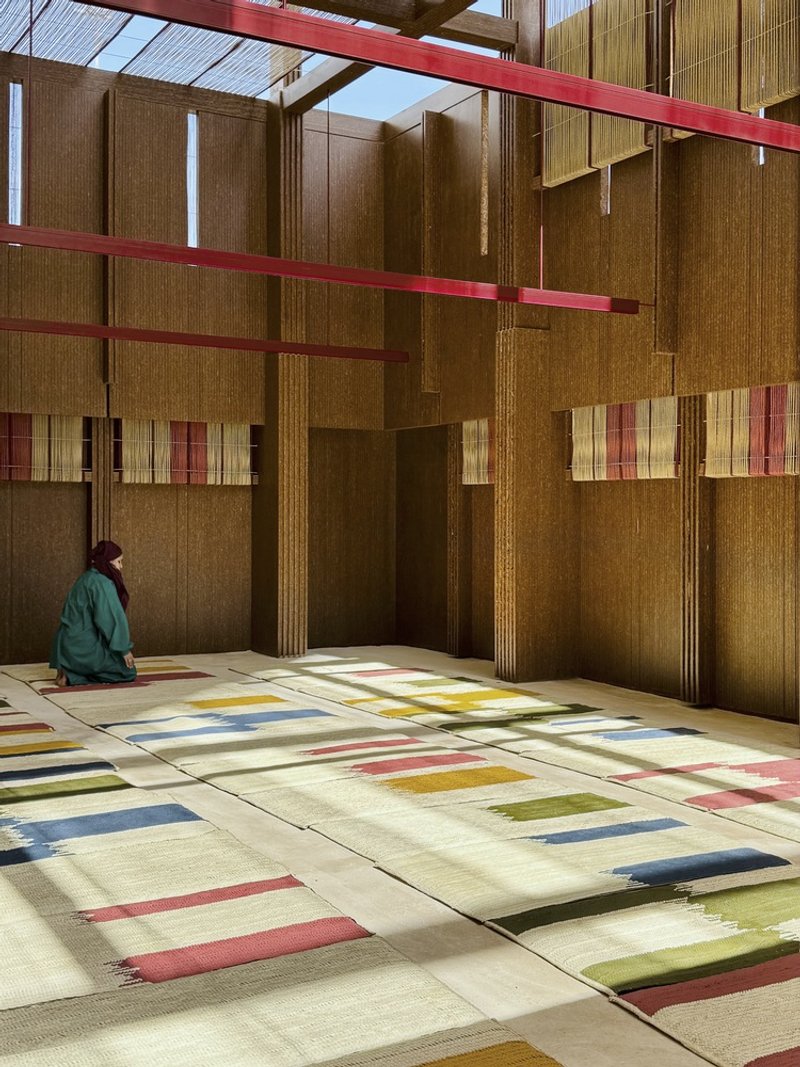
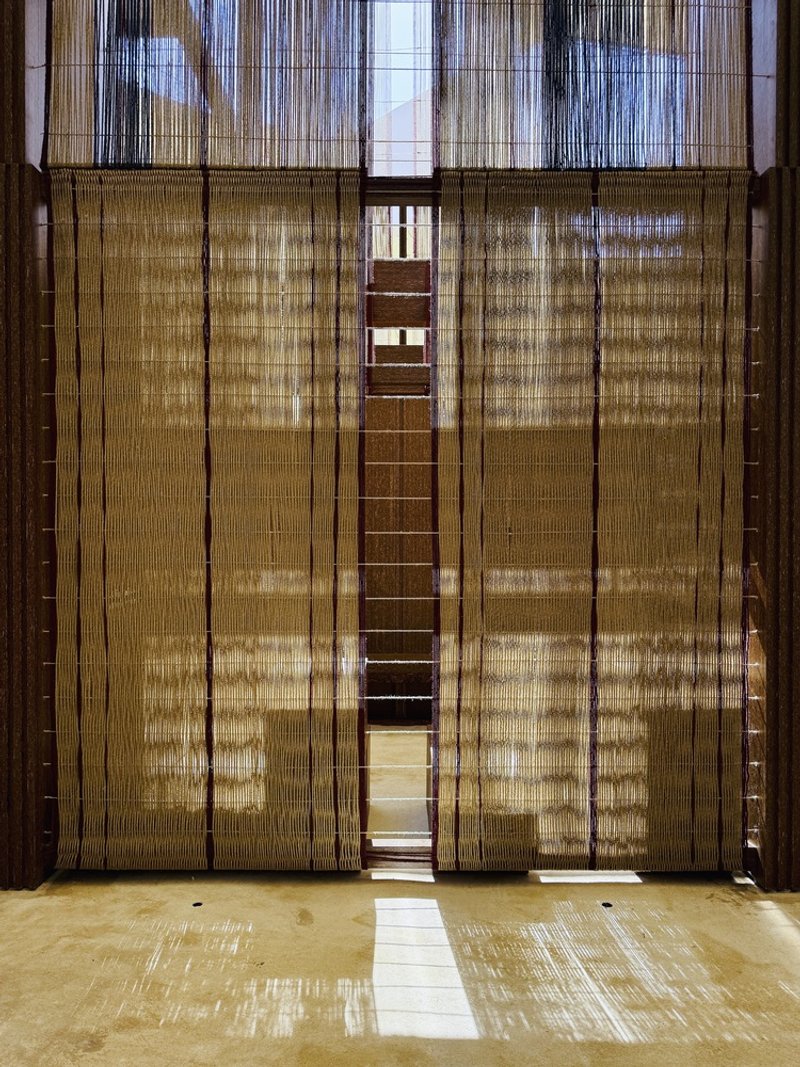
Inside, the interplay between screens and daylight produces something close to liturgical atmosphere. Colored shadows, generated by textiles treated with natural pigments (reds extracted from local plants for earth, blues for water, greens for land) fall across polished stone floors in shifting geometries. The effect is not decorative wallpaper but a calibrated environmental experience that changes with the sun's position.
The tall woven fiber doors, framed in timber, act as thresholds between states of mind as much as between rooms. Light streams through them onto the interior floor in broad stripes, pulling visitors deeper into the structure. The spatial circulation references Tawaf, the ritual circumambulation of the Kaabah in Makkah, so movement through the building is not arbitrary but choreographed by openings, screens, and the qibla orientation that organizes the plan.
The Central Courtyard and Inner Sanctum
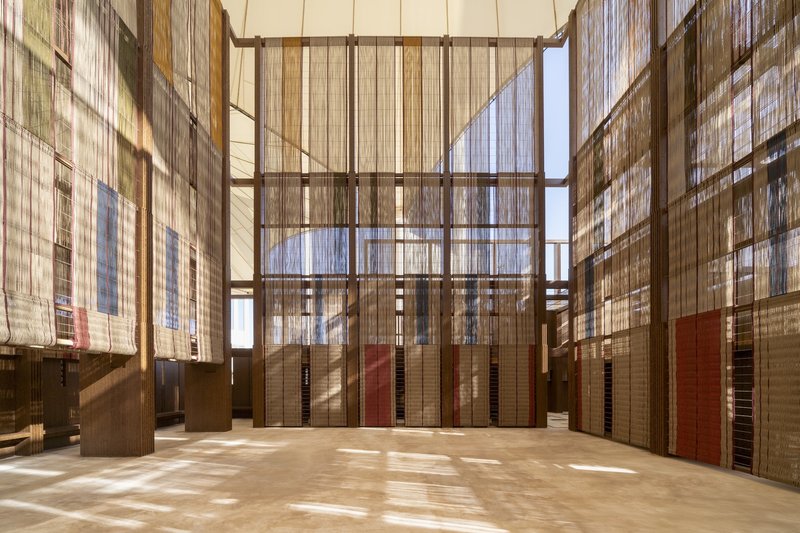
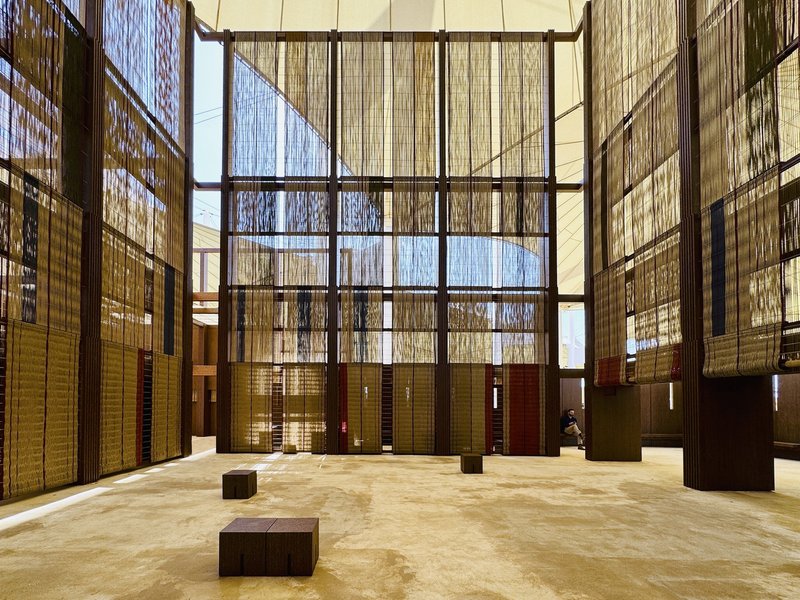
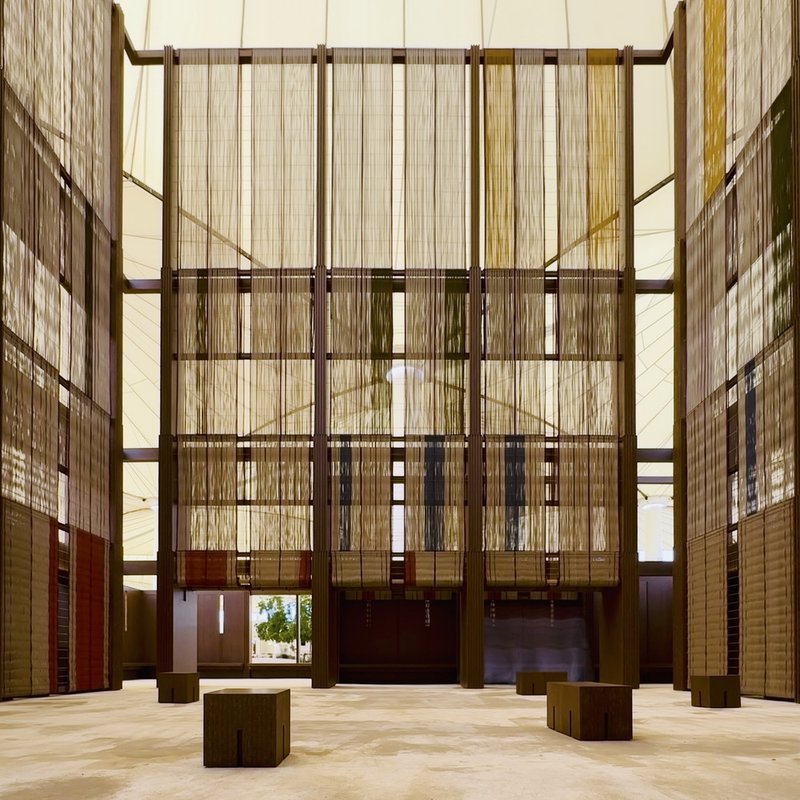
The open central courtyard is the organizational heart of the musalla, referencing the courtyard mosques that define Islamic architecture from Damascus to Córdoba. But where those precedents deploy masonry mass and geometric tile, East Architecture Studio builds the enclosure entirely from woven and laminated palm, so the courtyard walls shimmer with the organic irregularity of natural fiber. Timber columns rise through the space, and the layered screens above create a filtering canopy that mediates between sky and floor.
Adjacent contemplation spaces, the double-height halls with dark timber benches and suspended translucent panels, offer quieter registers. These rooms are designed for individual reflection rather than communal prayer, and their material palette shifts accordingly: darker, more enclosed, with light arriving from above through narrow slots rather than through the broad woven walls of the courtyard.
Material Intelligence: From Waste to Structure
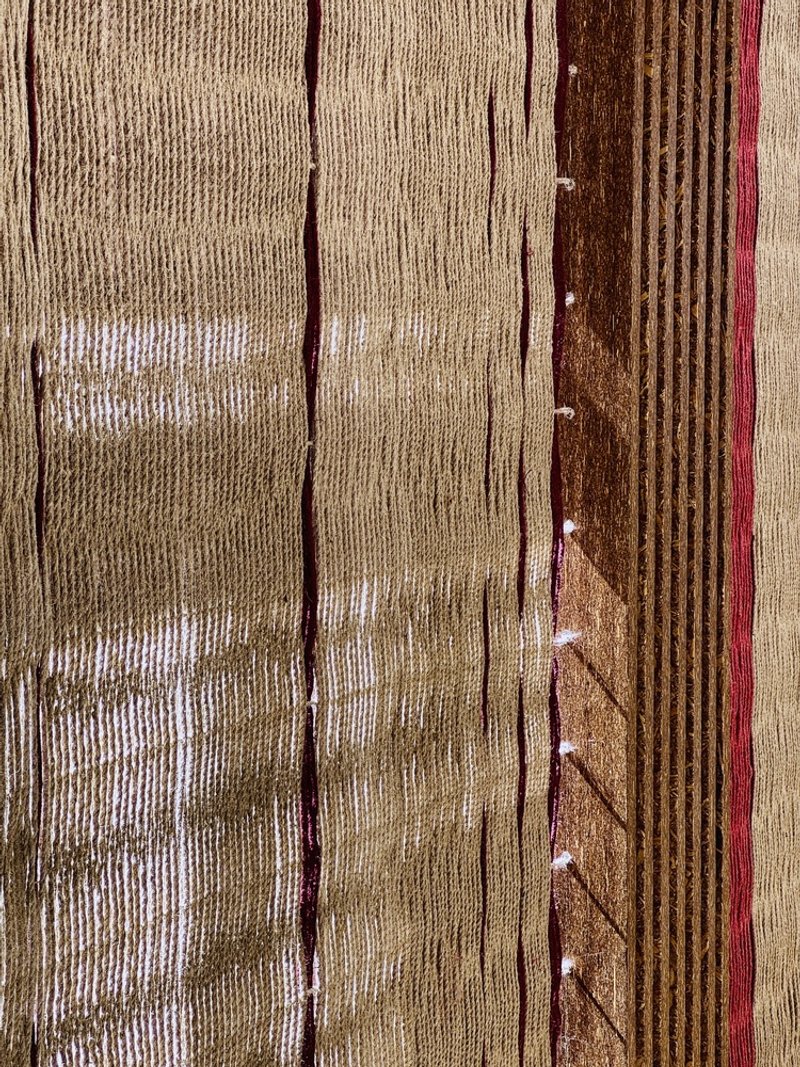
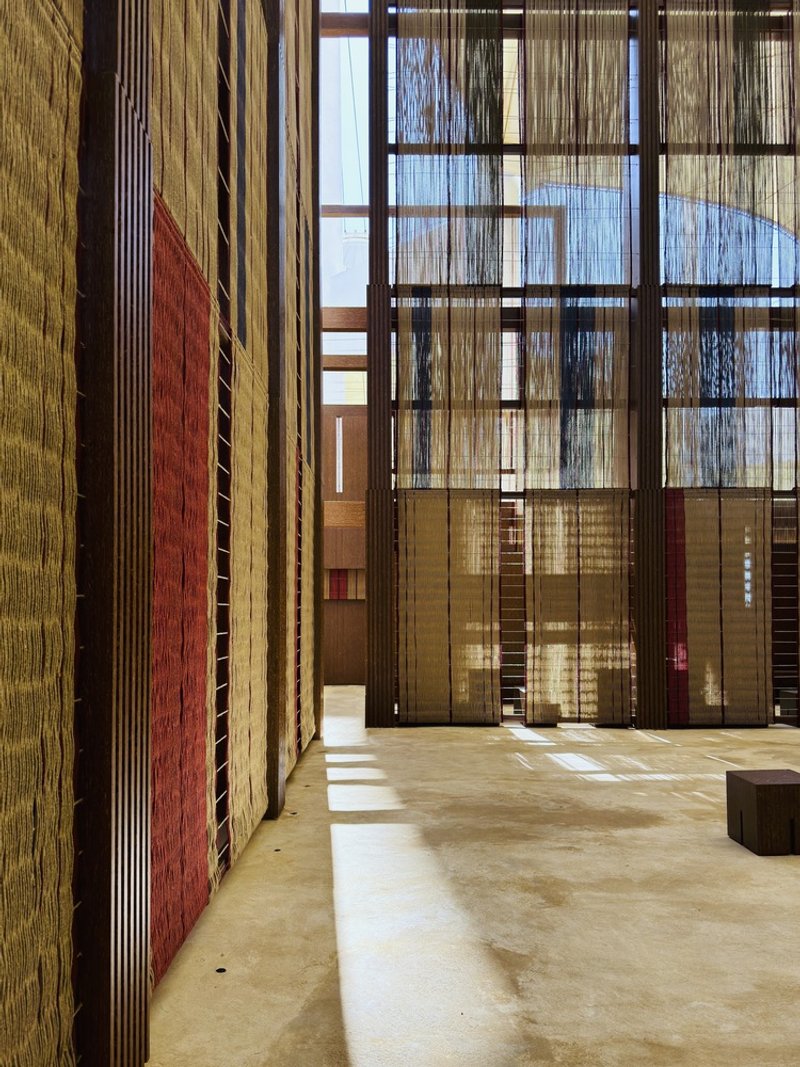
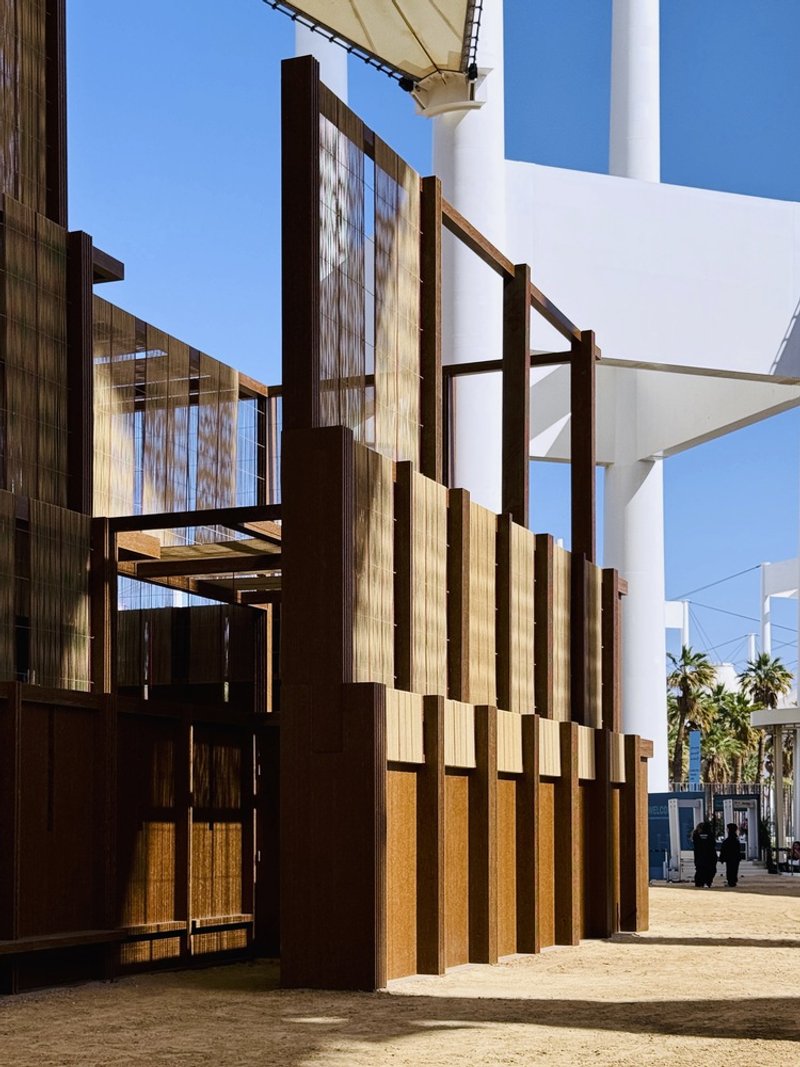
The material story deserves scrutiny beyond the headline. The engineered palm wood composite is a glue-laminated product made from the waste of 150 palm trees, bound with biodegradable PVC. The total fiber used is equivalent to a journey of 200 kilometers, roughly the distance between Jeddah and Mecca. Compressed palm waste panels reveal stratified surfaces that recall geological cross-sections, and exposed metal fasteners are left visible rather than concealed, treating the joint as part of the aesthetic vocabulary.
Red louvered wall panels add punctuation to the predominantly warm timber palette. These elements, together with naturally dyed textiles, introduce controlled chromatic accents that reference the mineral pigments historically used in the buildings of AlBalad, Jeddah's historic district. The building footprint is 300 square meters on a 2,025 square meter site, so the landscape is not residual space but a deliberate extension of the architecture.
Interior Atmospheres
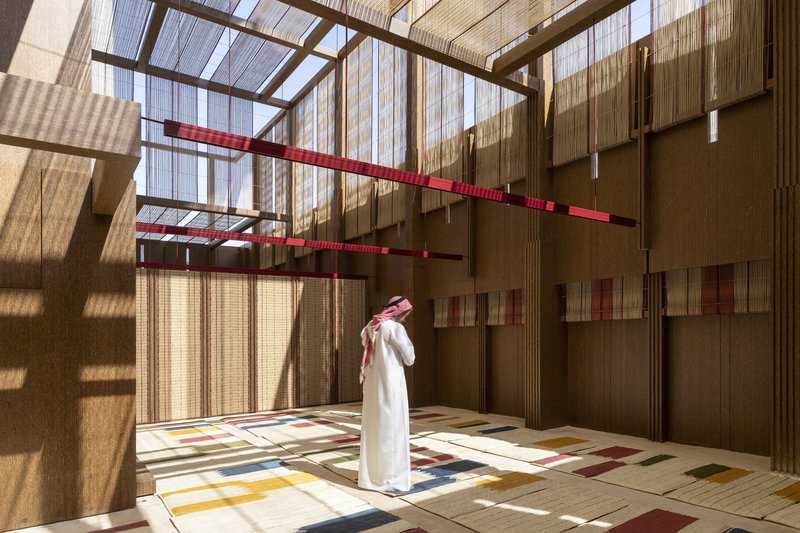
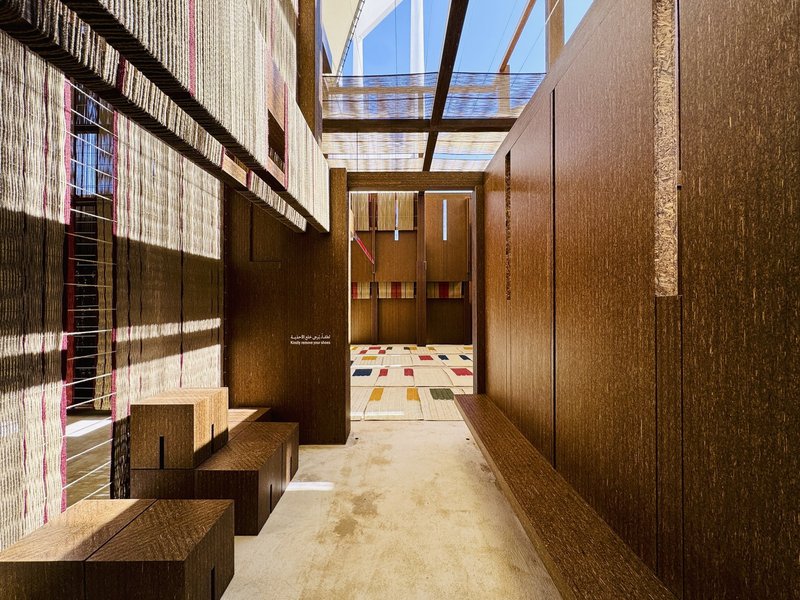
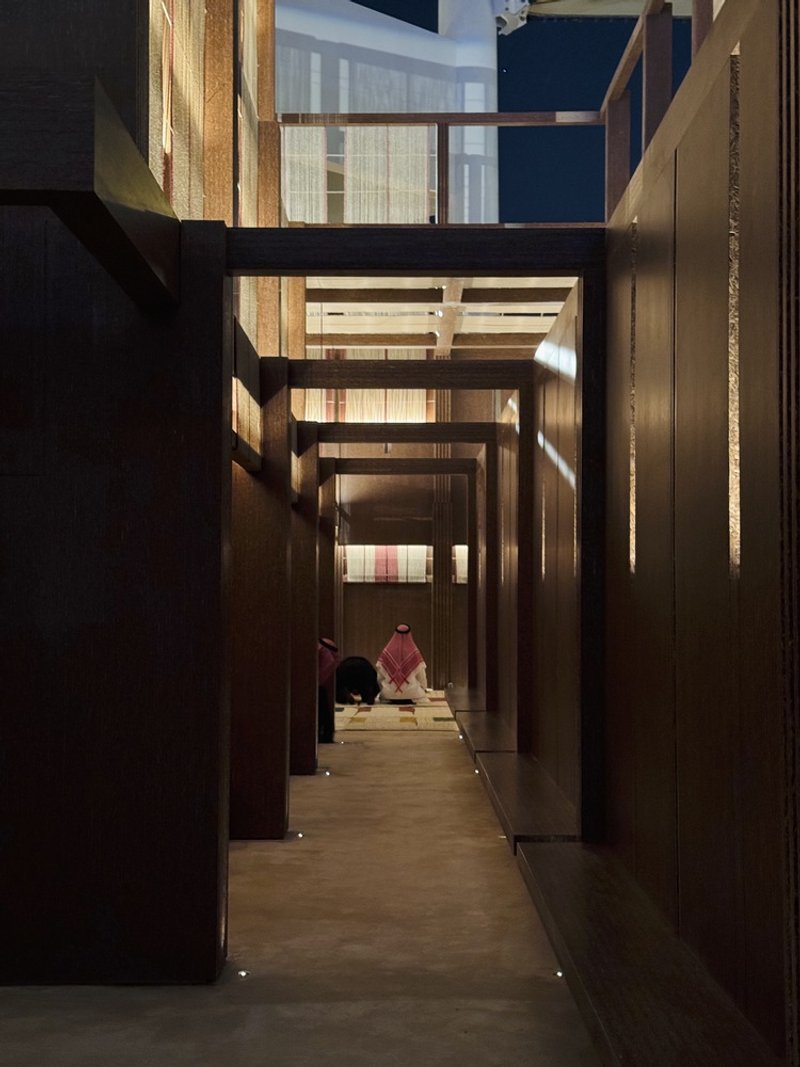
The range of interior conditions is wider than a 300 square meter pavilion has any right to produce. Narrow corridors with timber benches and deep shadow give way to sunlit rooms with patterned floor tiles and suspended red fabric elements. The transition from compressed, dark passages to open, luminous prayer spaces is handled through section changes and screen density rather than conventional walls and doors. At dusk, recessed floor lighting and overhead bridges transform the corridors into something almost theatrical.
A person in traditional dress standing in one of these interiors does not look like a visitor to an exhibition. They look like someone using a building. That distinction matters. The musalla succeeds because it creates genuinely inhabitable space rather than scenography, despite its temporary status.
Volumetric Layering and the Atrium
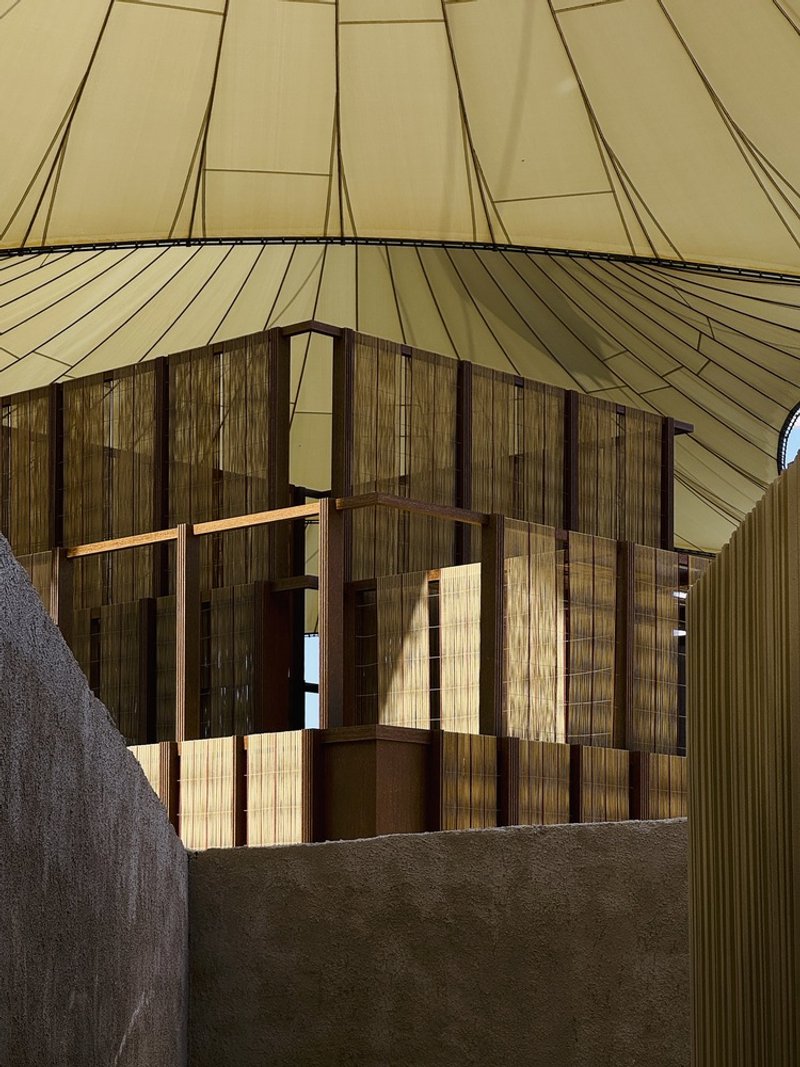
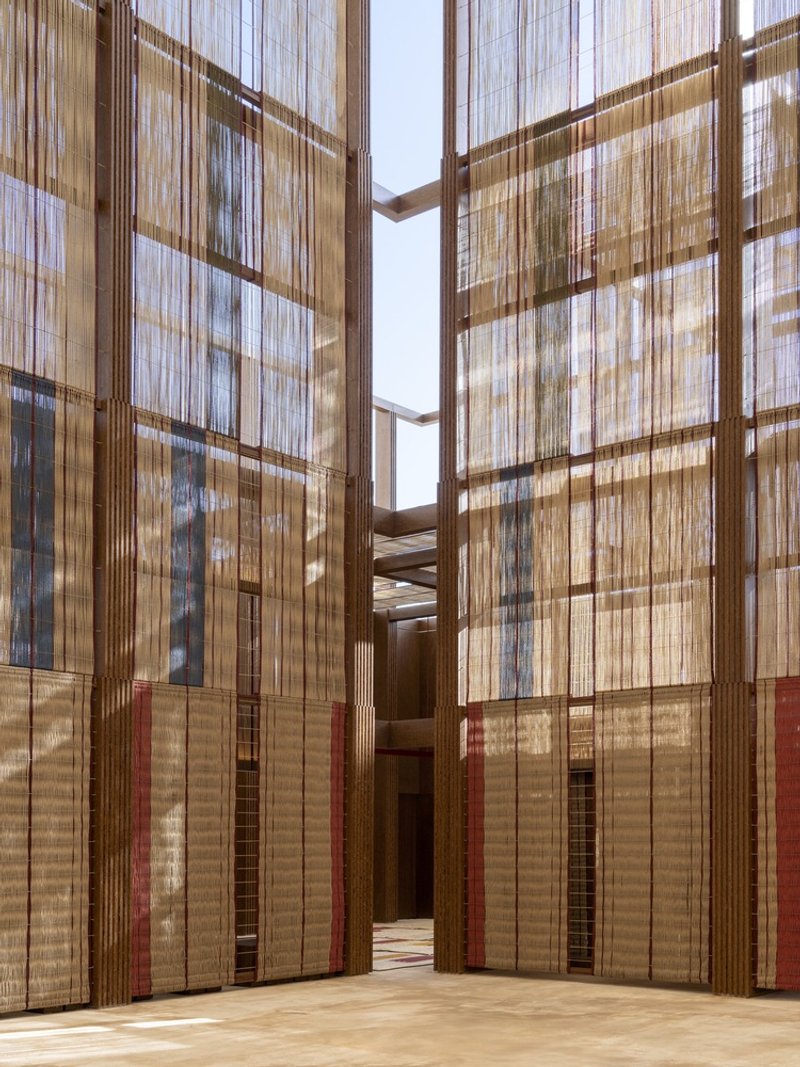
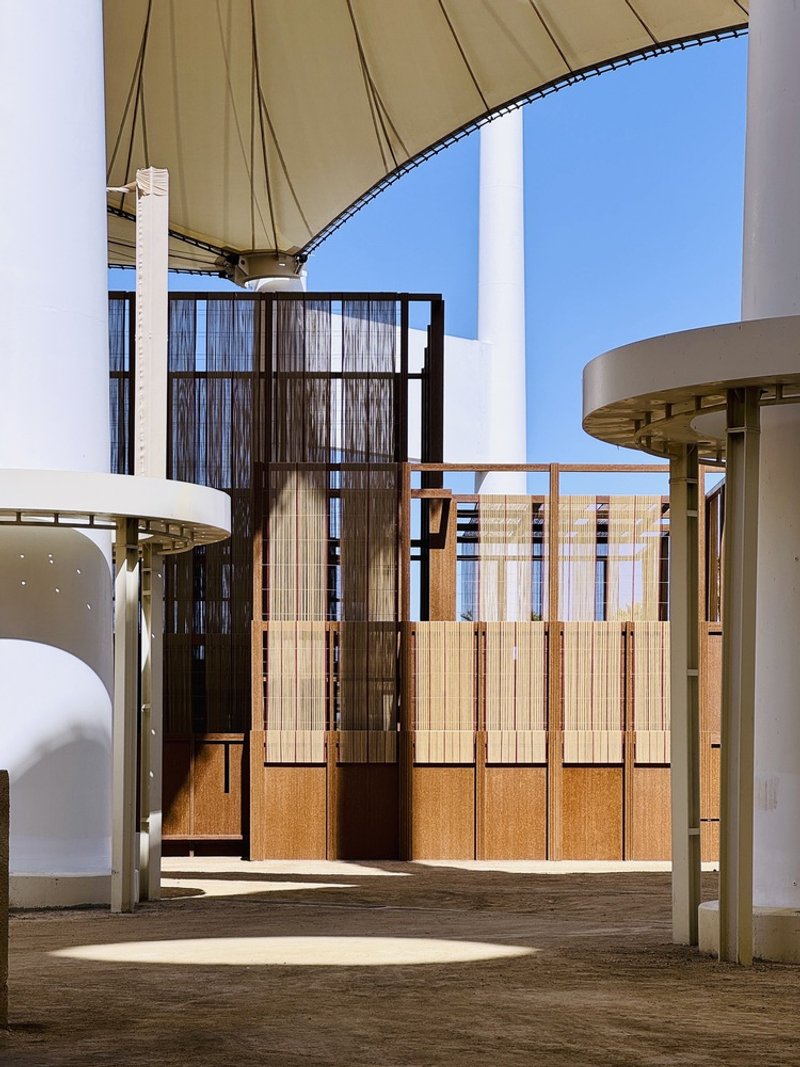
Seen from inside the multi-story atrium, the structure reads as a series of nested screens, each layer slightly different in density and orientation. The pleated fabric ceiling of the Hajj Terminal is visible above, creating an unexpected dialogue between two very different canopy logics: one engineered from steel cables and Teflon-coated fiberglass, the other assembled from palm fronds and compressed fiber. The musalla does not compete with SOM's terminal; it nests within it, creating intimacy at a different scale.
The massing strategy uses an oculus as a reference parameter, coupling it with qibla orientation to organize the plan and section simultaneously. The result is a building that reads differently from every angle, its layered screens compressing and expanding the view depending on where you stand.
Plans and Drawings
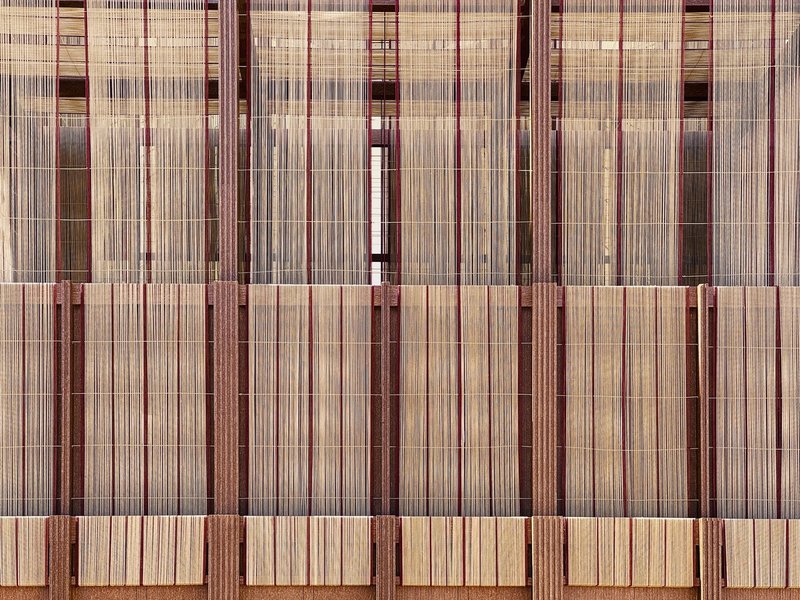
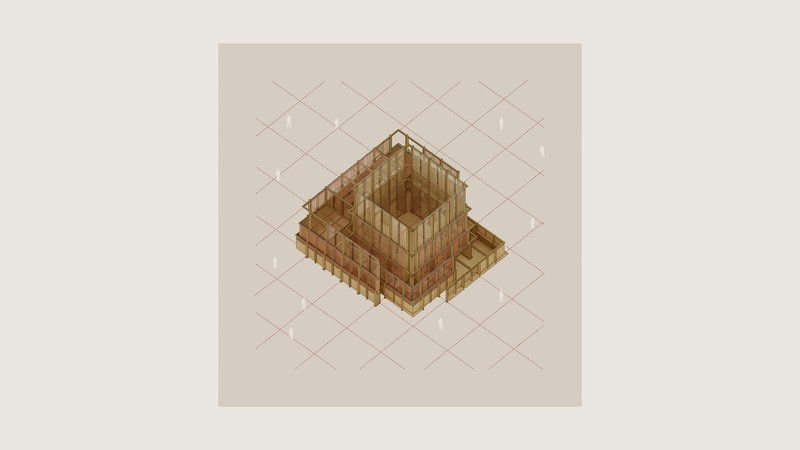
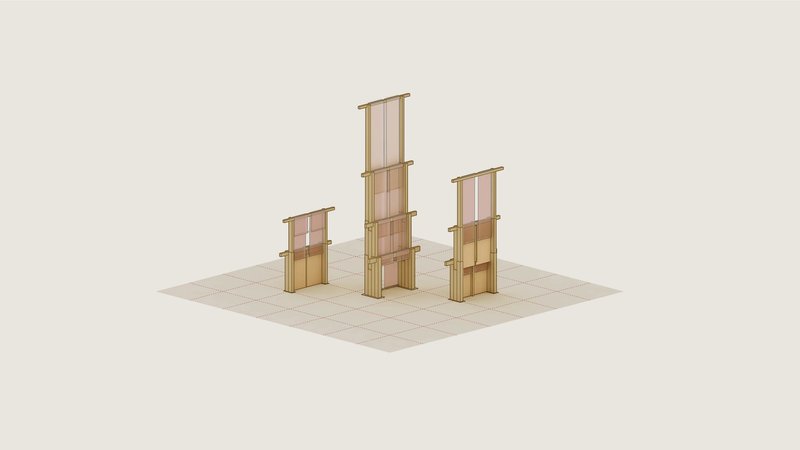
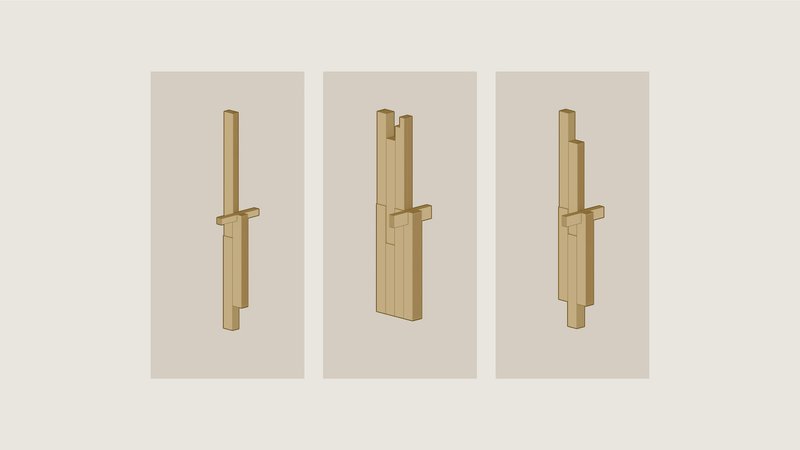
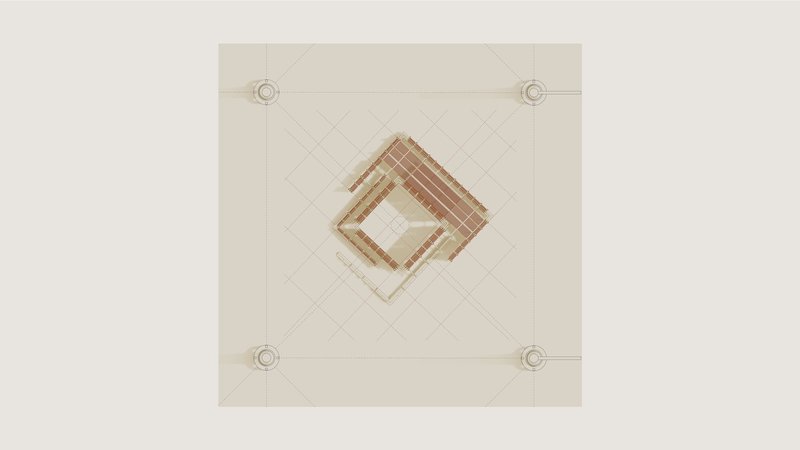
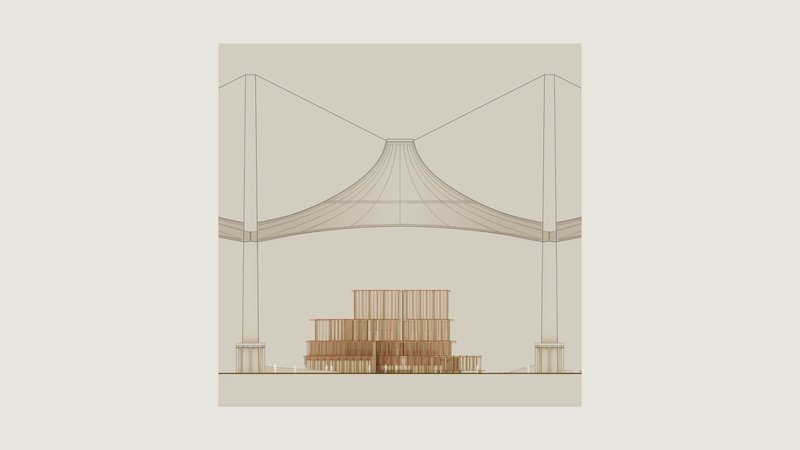
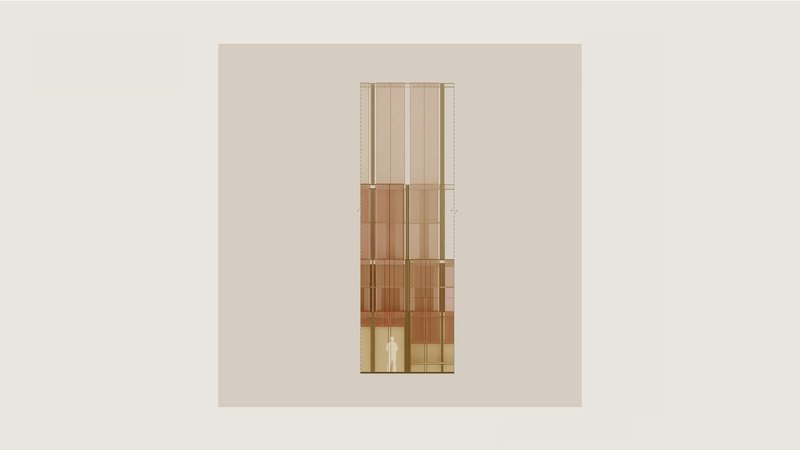
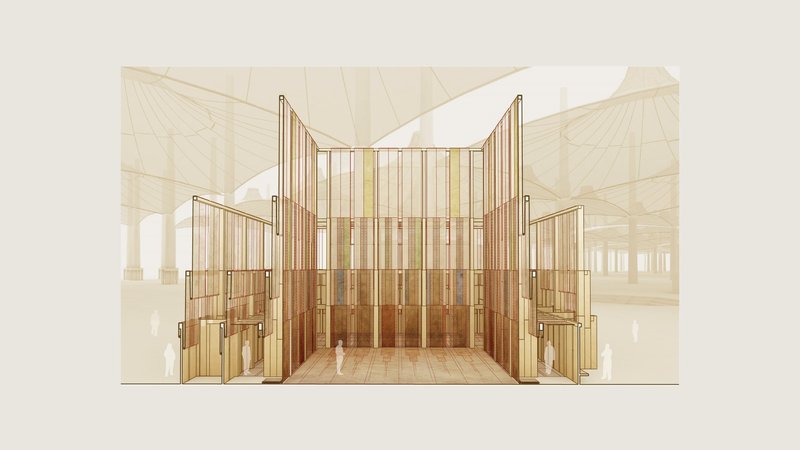
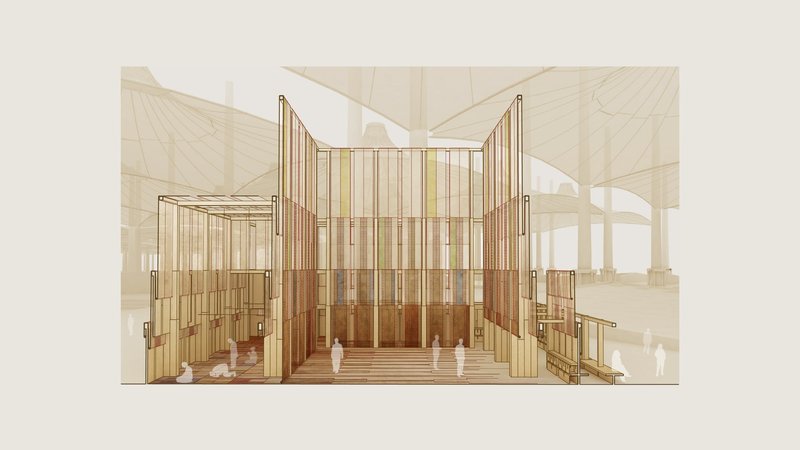
The drawings reveal the rigorous modular logic beneath the apparently organic surfaces. The plan shows a square perimeter of layered walls wrapping an open central void, while the axonometric and isometric views expose how the timber tower structures sit on the 6 x 6 meter grid. The elevation drawings of individual column assemblies demonstrate three distinct configurations of connector elements, confirming that the structure is genuinely a kit of parts rather than a bespoke construction.
The section drawing is particularly telling: it shows the pavilion's modest height in relation to the soaring cable-supported terminal canopy, establishing the scalar relationship that makes the musalla feel sheltered rather than overwhelmed. Perspective sections depict the timber screen walls in double-height volumes with figures on multiple levels, illustrating how the woven facades create varying degrees of enclosure across the building's depth.
Why This Project Matters
AlMusalla matters because it reframes sustainability as a cultural project rather than a technical one. Using palm waste is not just a carbon accounting exercise; it is an act of material reclamation that connects contemporary fabrication to millennia of Arabian building practice. The modular assembly logic, the courtyard typology, the woven facades, and the qibla-oriented plan are not nostalgic references but active design parameters that produce a building which is functionally, environmentally, and spatially coherent.
More broadly, the project offers a counter-narrative to the Gulf region's prevailing architectural trajectory of imported materials, imported typologies, and imported labor. East Architecture Studio demonstrates that a contemporary prayer space can be built from local waste, organized by local spatial traditions, and assembled with techniques derived from local craft. That it can also be taken apart and rebuilt elsewhere only strengthens the argument. The most radical thing about AlMusalla is not its materiality or its modularity but its insistence that architecture in the Arabian Peninsula already has everything it needs.
AlMusalla Pavilion, designed by East Architecture Studio. Located at the Western Hajj Terminal, King Abdulaziz International Airport, Jeddah, Saudi Arabia. Building area: 300 m² on a 2,025 m² site. Photography by Marco Cappelletti and Mansor Alsofi.
About the Studio
Share Your Own Work on uni.xyz
If projects like this are the kind of work you want to make, uni.xyz is a place to publish your own, find collaborators, and enter design competitions.




Popular Articles
Popular articles from the community

RDTH architekti Rips Out Nearly Every Wall in a Prague Apartment and Replaces Them with Furniture
A 101-square-meter post-war flat in Prague trades rigid partitions for a single rotated furniture block, curtains, and glass concrete.
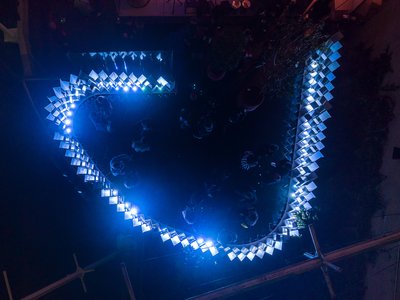
Rojkind Arquitectos and Think Parametric Build a Glueless Pavilion from 67 Interlocking Panels
A serpentine fiber-cement installation in Chapultepec Park celebrates a decade of architectural media in Mexico City.
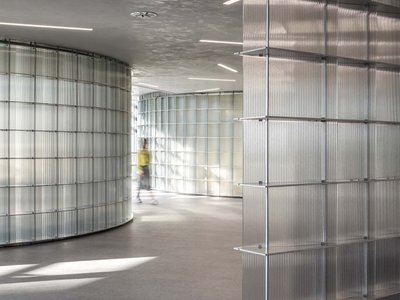
HCCH Studio Wraps a Shanghai High-Rise Office in Curved Walls of Translucent Glass
A 1,000 square meter fit-out in Lujiazui replaces the typical tech-office palette with layered glass, micro-cement, and quiet rigor.
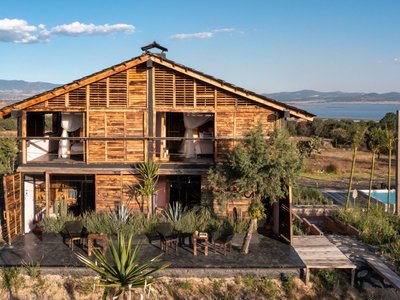
Fausto Terán and Toro Fuse Japanese Craft with Mexican Tradition in a Lakeside Retreat
Nakamura House pairs Shou-Sugi-Ban charred pine with handmade clay tile at the foot of Atlangatepec Lagoon in Mexico.


Similar Reads
You might also enjoy these articles

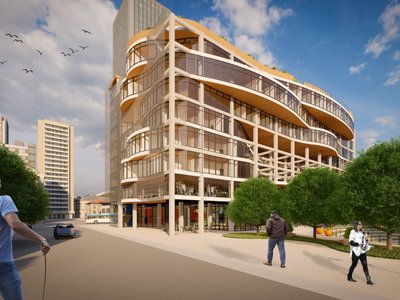
Olio Towers: A Mid-Rise for Performers That Fuses Housing, Rehearsal, and Stage
Located blocks from Houston's Theater District, this modular tower stacks living units around a central performance atrium.
Oasis: Modular Green Housing Carved into Dhaka's Urban Fabric
A shortlisted Plugin Housing entry reclaims unauthorized settlements in Dhaka with stepped concrete volumes, green roofs, and ventilation-driven design.

Black Hole: A Floating Megastructure for the Post-Physical Era
Emiliano Mazzarotto envisions a spherical, self-scaling arena where e-sports, digital hotels, and holographic stadiums replace traditional public space.
Compact & Sustainable Living in Piraeus: A Four-Level Family Home Built Around Light and Air
A narrow townhouse in one of Greece's densest port cities uses a central atrium and passive strategies to house three generations under one roof.


Explore Architecture Competitions
Discover active competitions in this discipline




The International Standard for Design Portfolios


The Global Benchmark for Architecture Dissertation Awards


The Global Benchmark for Graduation Excellence


Challenge to reimagine the Iron Throne
Comments (0)
Please login or sign up to add comments
No comments yet. Be the first to comment!