
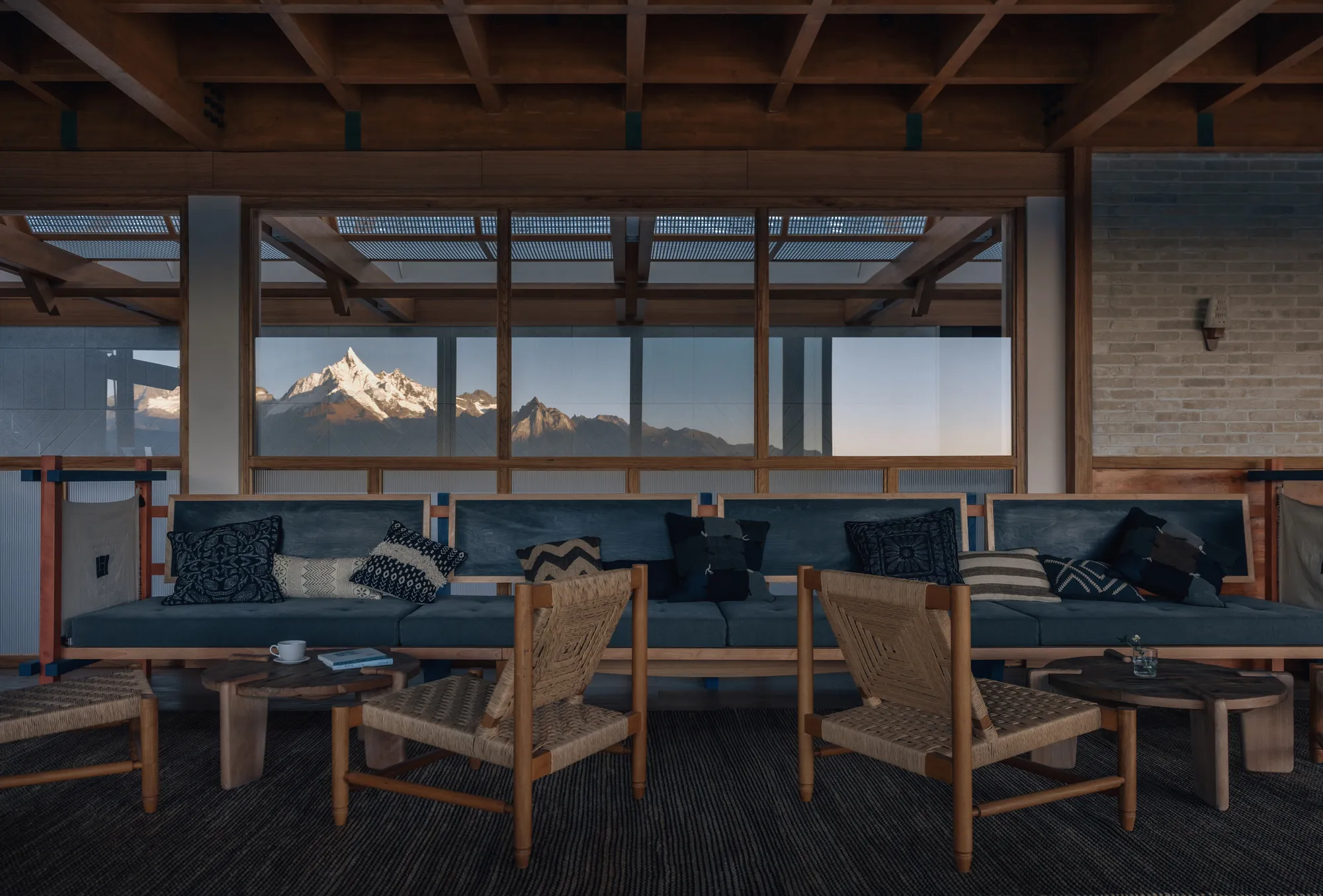
Moguang Studio Carves a Meditative Hotel into the Tourist Chaos of Meili Snow Mountain
A 16-room timber hotel at the Thirteen Pagodas Viewing Platform in Yunnan rejects spectacle in favor of stillness and ritual procession.


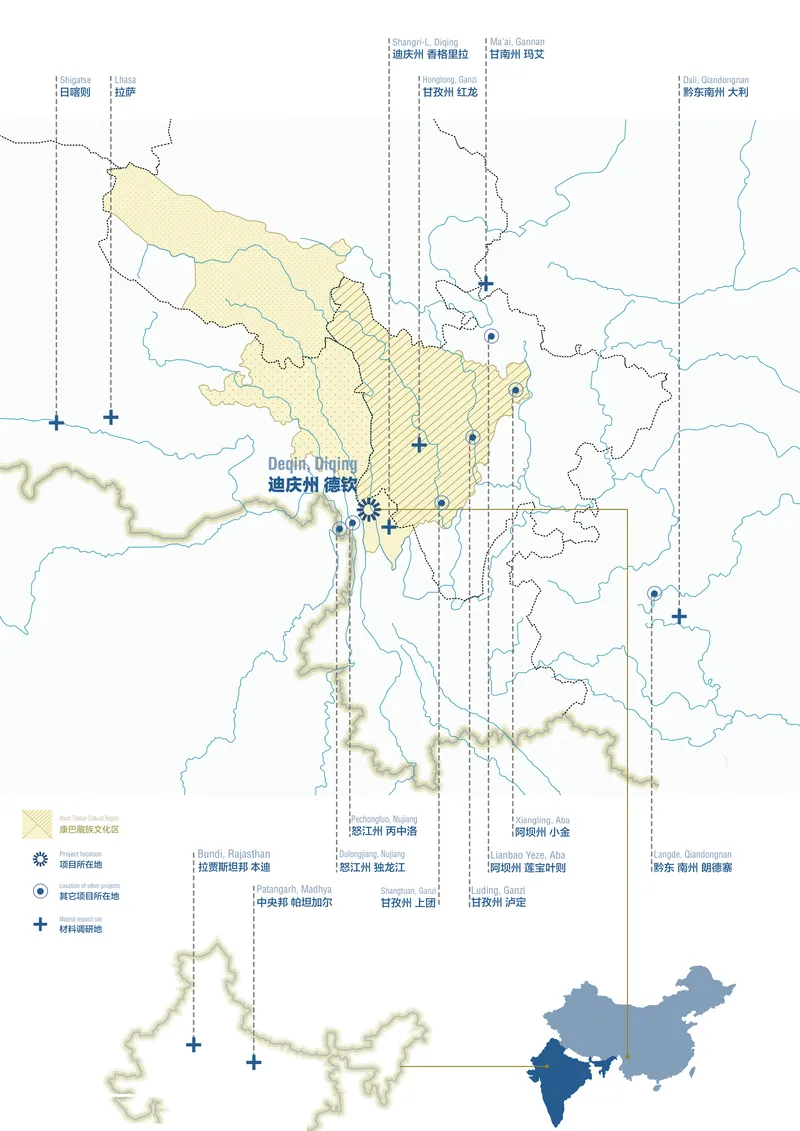
The roadside edge of Meili Snow Mountain National Park is not the pristine alpine tableau you might imagine. The Thirteen Pagodas Viewing Platform in Deqin, Yunnan, is lined with temporary structures, visual clutter, and aggressive tourism development. The famous sunrise 'golden mountain' effect on Kawagebo's peak only appears about a third of the year. The rest of the time, you get cold, cloud, rain, and snow. It is into this honest reality that Moguang Studio, led by principals Jiaying Li and Xin Feng, has placed a 2,500-square-meter hotel that refuses to perform an imagined version of Tibet.
What makes the Kawagebo Snow Mountain Hotel genuinely interesting is its refusal. Rather than constructing another roadside spectacle or a neo-vernacular fantasy, the building turns inward and upward, choreographing a clockwise procession through its 16 rooms and communal spaces that references the ambulatory movement of nearby Tibetan temples. The building sits on a former storage yard belonging to the village collective, with a buildable footprint of just 560 square meters, roughly 27 by 21 meters, and a 15-meter height limit. Within those constraints, Moguang Studio has built something that functions more like an inhabited instrument for seeing mountains than a conventional hotel.
A Street Facade That Absorbs Rather Than Projects

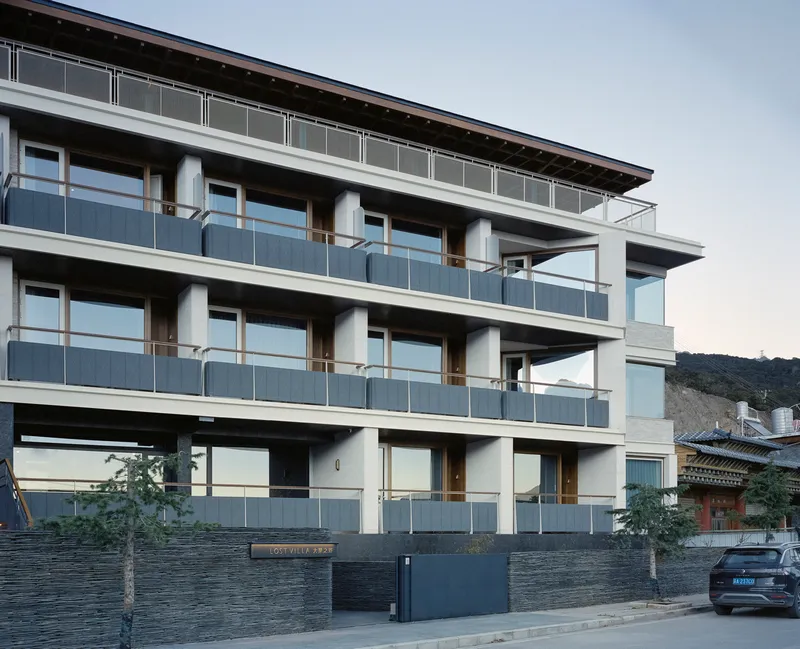
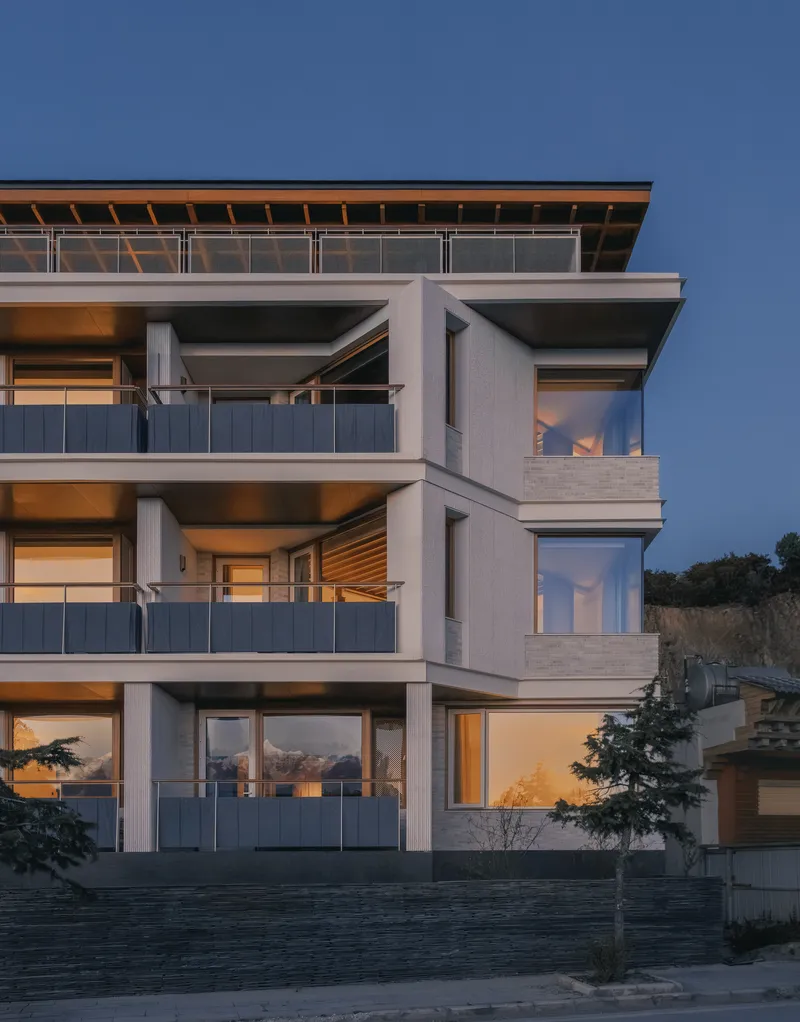
The south elevation is deliberately pulled away from the street, and the entry floor is raised 1.8 meters above ground. The effect is a building that steps back from the roadside noise rather than competing with it. At street level, a dark stone base wall anchors the structure, while the upper floors recede behind continuous deep balconies. The timber-clad top floor reads as a separate pavilion, lighter and more transparent than the mass below.
A neighboring construction project already protrudes six meters toward the mountain view, which explains why the hotel's facade strategy is not about openness to the street but about controlled recession. The balconies are not decorative. They are buffers, thresholds between the chaos of the roadside edge and the calibrated stillness inside. At dusk, the building glows rather than shouts.
The Atrium as Vertical Pilgrimage
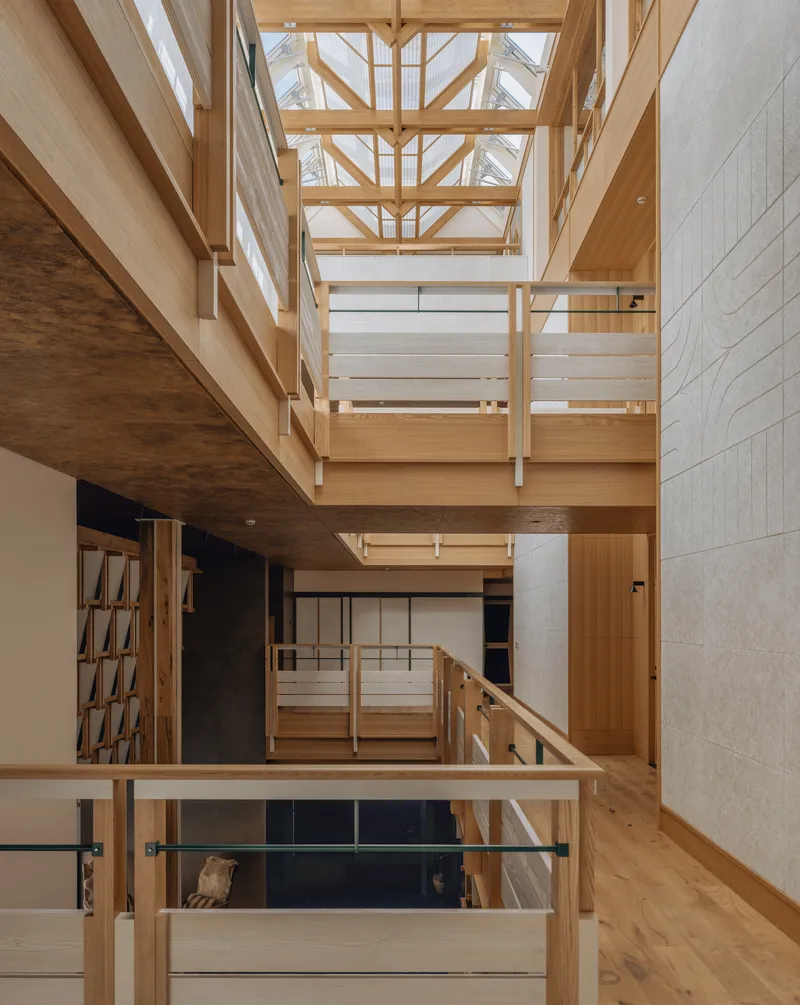
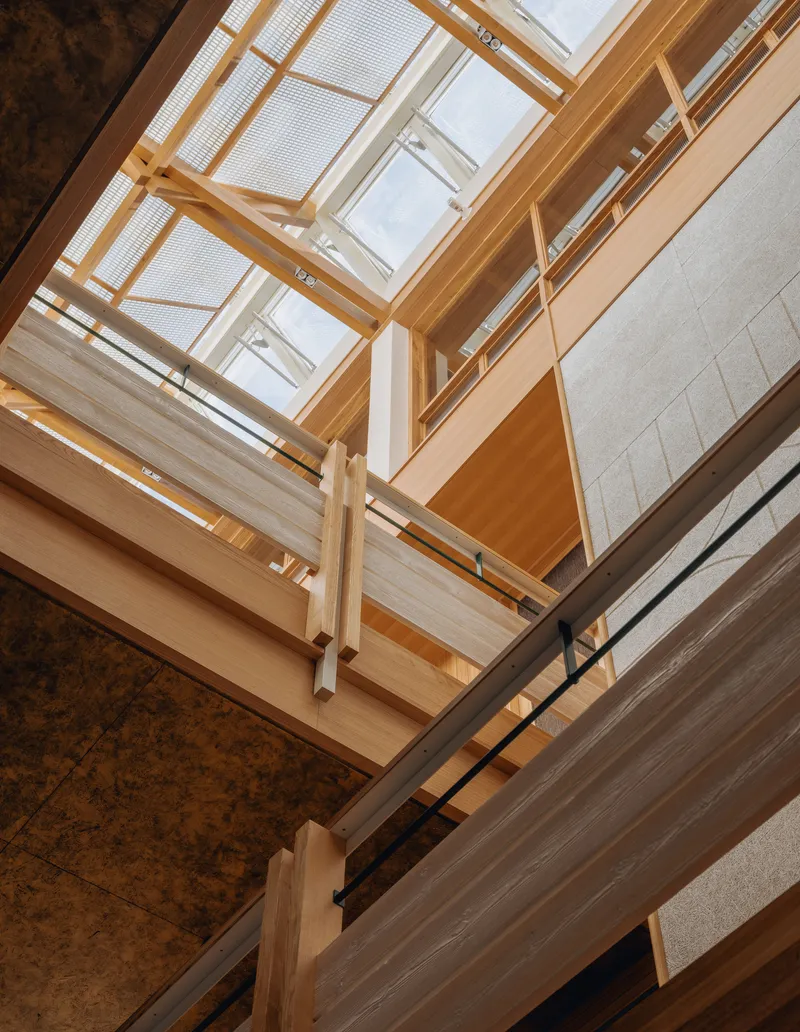
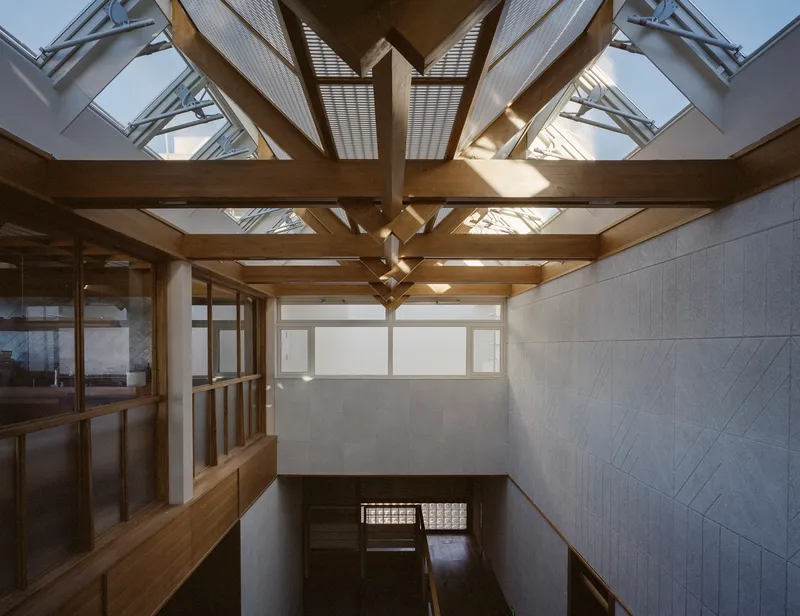
The central timber atrium is the building's engine. Looking up through the stairwell, exposed rammed earth walls and timber framing spiral past each other toward a skylight that crowns the four-story volume. A single column pierces the void, and according to the architects, it marks the divide between everyday hotel functions and something closer to spiritual observance. That's a bold claim for a column, but the spatial sequence earns it: the clockwise circulation pattern deliberately echoes the ambulatories of Tibetan temples and village houses nearby.
The timber structure, engineered with consultants from iStructure and Rothoblaas, is fully exposed. Roof trusses, beam joinery, and coffered ceilings are legible from every angle. There is no drywall hiding the work. The structural design by Zhigang Ma treats the timber frame as both architecture and ornament, which is a risk that pays off because the joinery is genuinely precise.
Communal Rooms Framed for Bad Weather
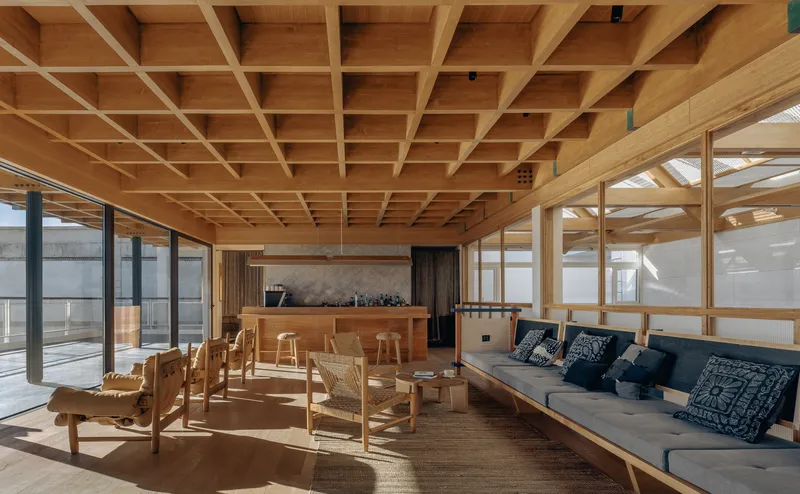
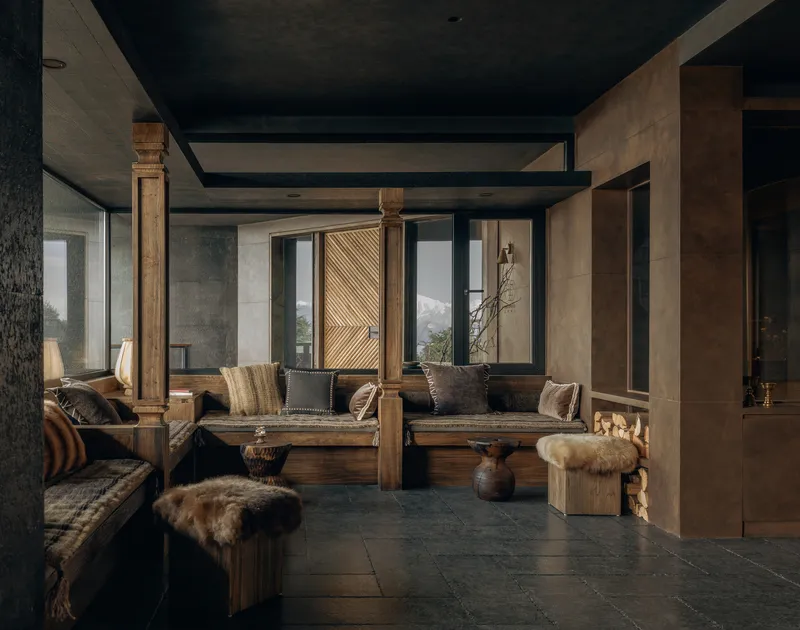
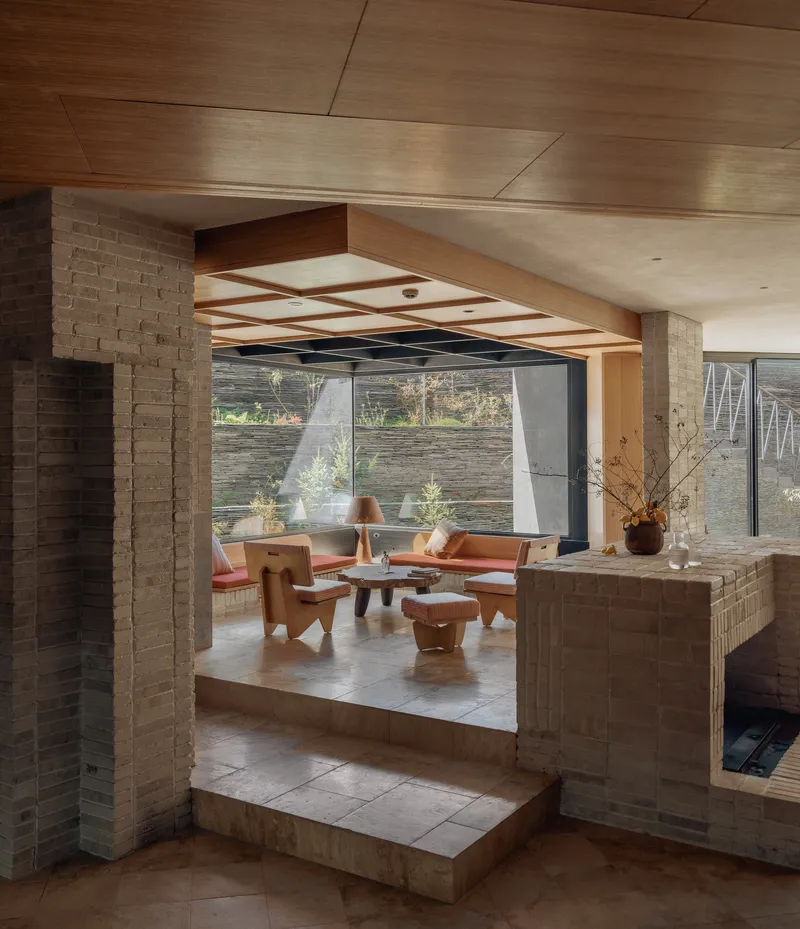
The communal spaces deserve specific attention because they are designed for the two-thirds of the year when the mountain is invisible. The lounge areas, with their carved wooden columns, dark ceiling beams, and sunken platforms, are not waiting rooms for sunrise. They are destinations in themselves. Full-height glazing frames the southwest view toward Kawagebo's peaks, but the interiors are warm, low-lit, and gravitational rather than transparent and aspirational.
Yak-wool and yak-leather textiles, produced by Tibetan pastoral communities in Ganzi and Qinghai, appear throughout the public spaces. These are not props. The material palette, from handwoven carpets by Ganzi Nire to furniture by Chengdu Qianshu and NAZA Furniture Design, roots the building in a specific supply chain of craft that extends well beyond the immediate site.
Fire and Earth at the Core

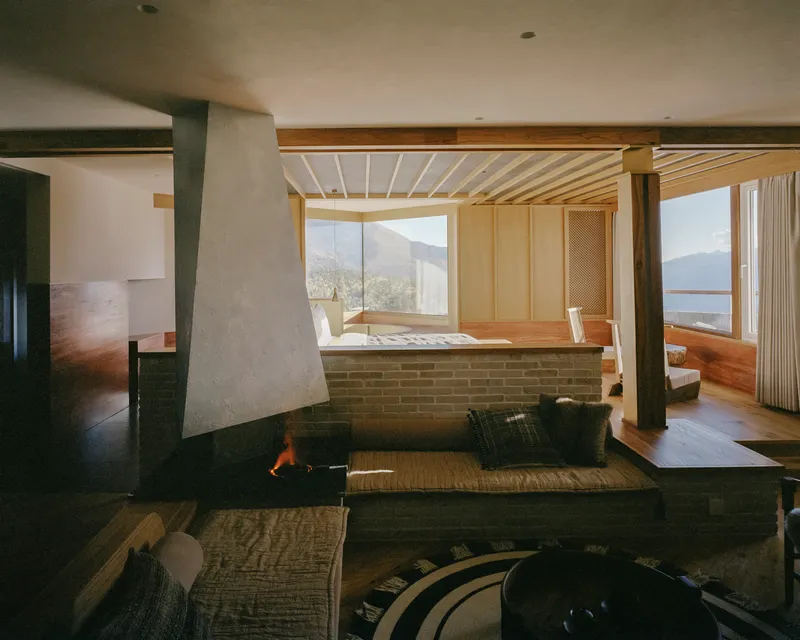
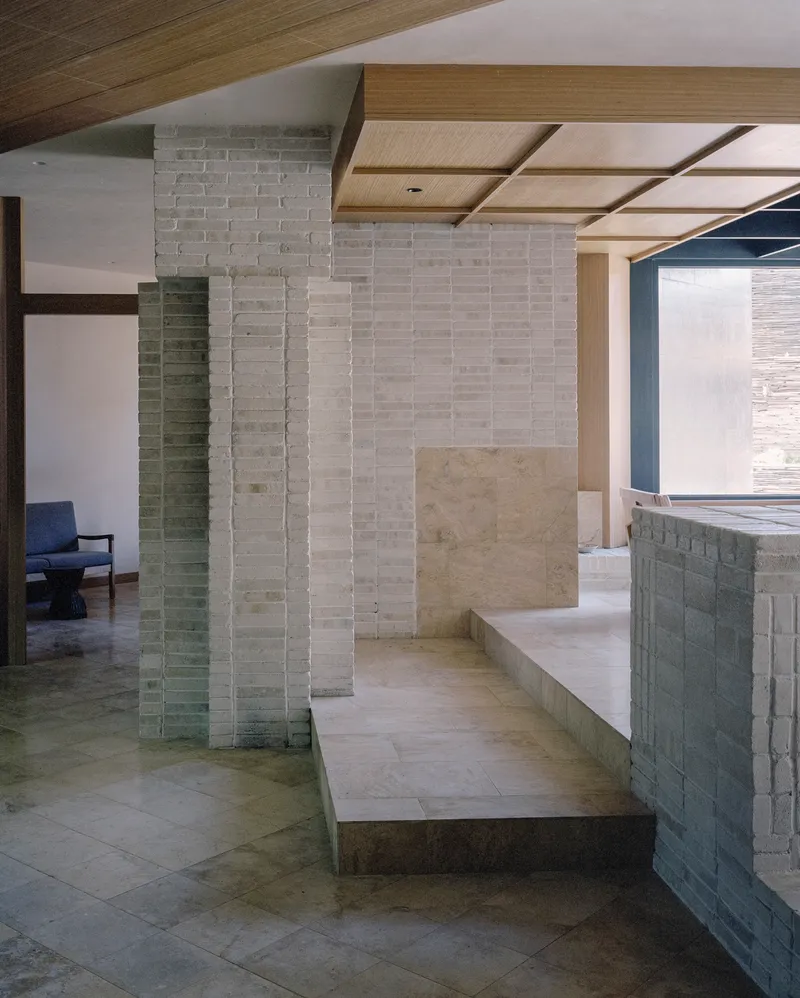
Fireplaces anchor both the guest rooms and the top-floor gathering space, which is essential in a place where cold and cloud dominate the calendar. The pyramidal copper fireplace suspended over a sunken seating platform is the single most striking interior moment: it hangs like a geometric pendant above a diamond-patterned wall, converting the act of warming yourself into something ceremonial. The stepped brick platforms and columns on the lower level create secondary hearth-like zones under the coffered timber ceiling.
These spaces are not about views. They are about the body's relationship to warmth, enclosure, and ground. The sunken living areas reference a verticality that runs through the whole building: you descend to rest, ascend to look.
The Top Floor Pavilion and Terrace
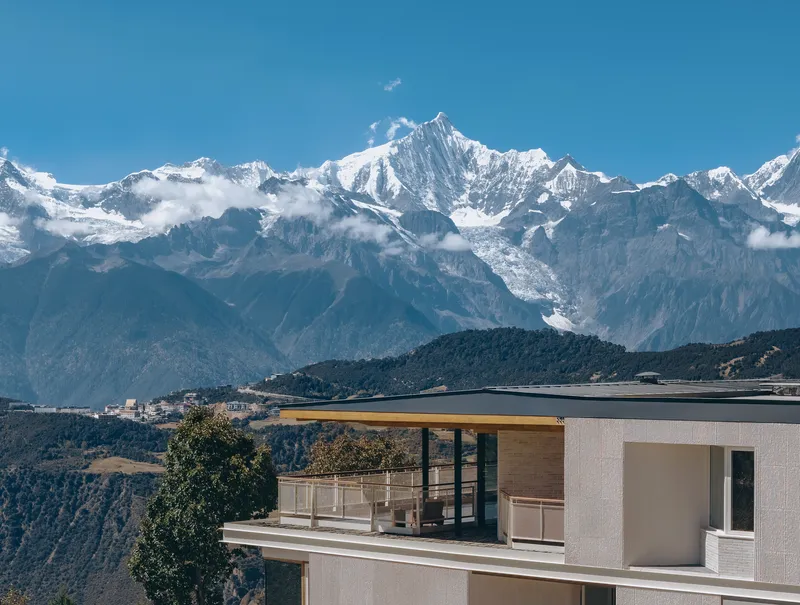
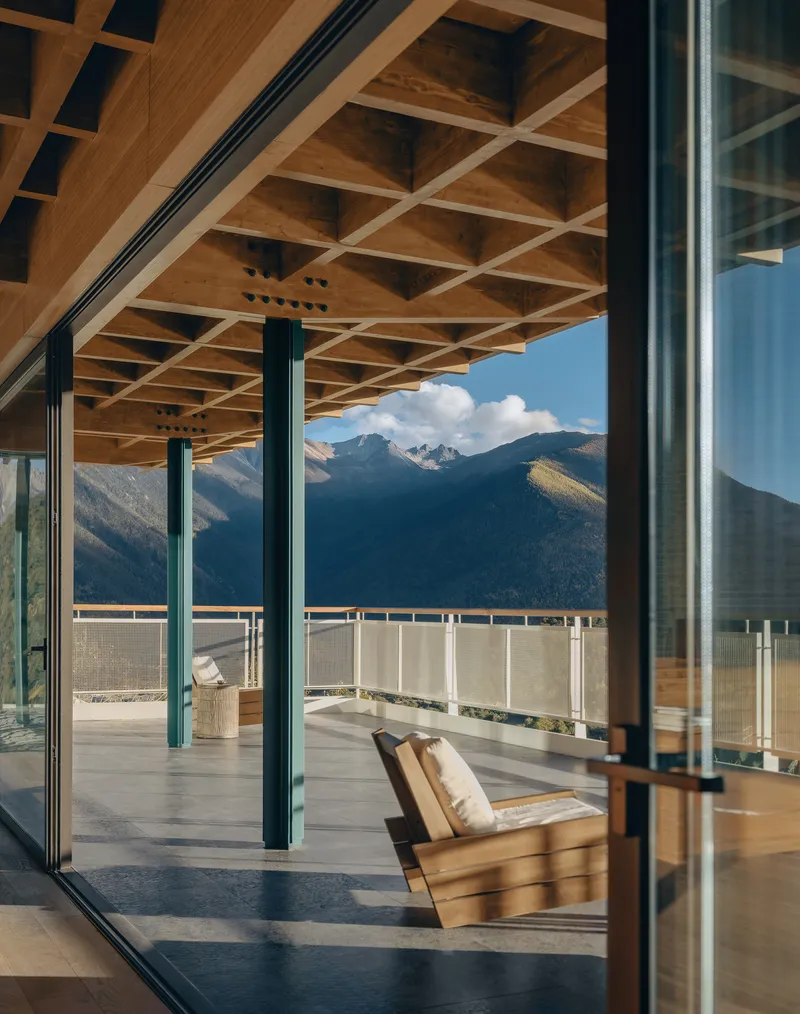

The top floor café-bar is separated from the atrium by glass, creating a transparent pavilion beneath the roof. Step outside onto the rooftop terrace and a timber canopy with glass railings opens the full panorama of snow-capped peaks. The move is straightforward but effective: the journey through the building's compressed, introverted lower levels makes the release at the top feel earned rather than given.
The covered terrace on another level, with its steel columns and timber grid ceiling, functions as a middle register between full enclosure and open sky. These layered thresholds, from atrium to corridor to balcony to terrace to sky, are the building's real architecture. The mountain view is treated as something you arrive at through spatial effort, not something that hits you at check-in.
Rooms and Arrivals
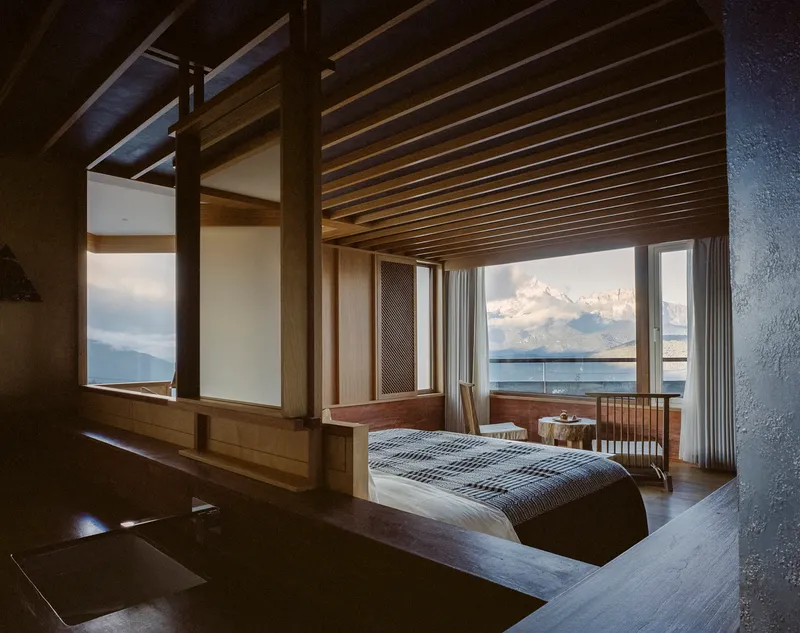
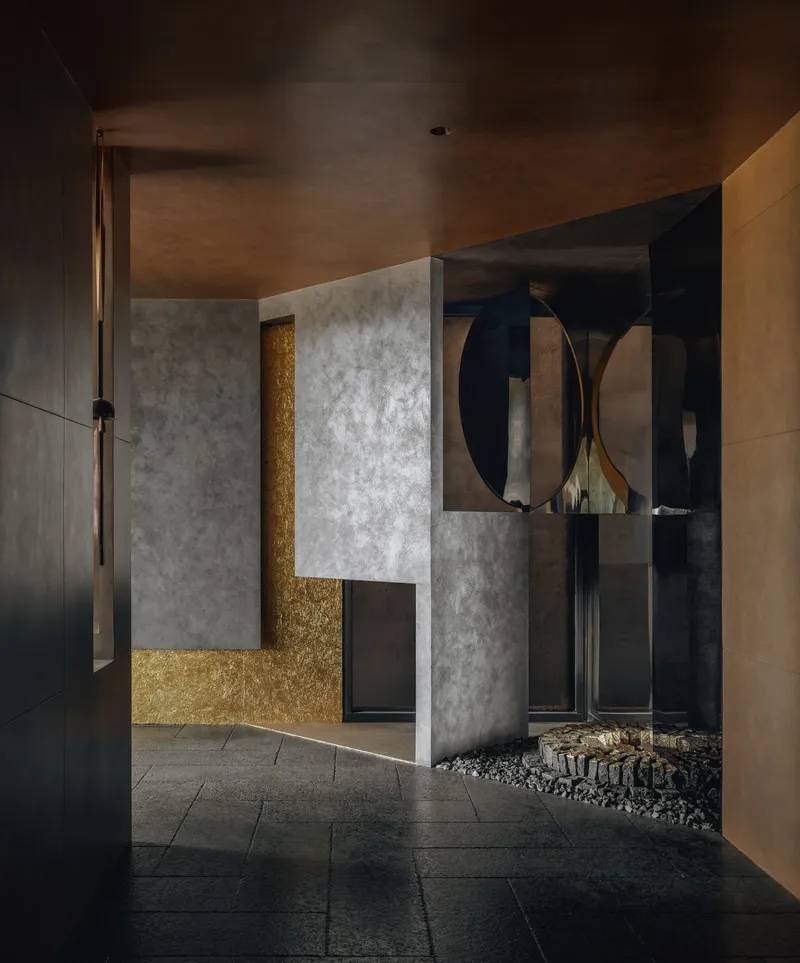

The 16 guest rooms are modest in number but generous in framing. Exposed timber beams overhead and full-height windows toward the southwest give each room a direct relationship to the landscape, or to the clouds that usually fill it. The entry sequence, with its gold-leaf wall panel behind a concrete partition, establishes a material richness that never tips into luxury hotel cliché. A reception desk carved from timber sits beneath the suspended walkway structure of the atrium above.
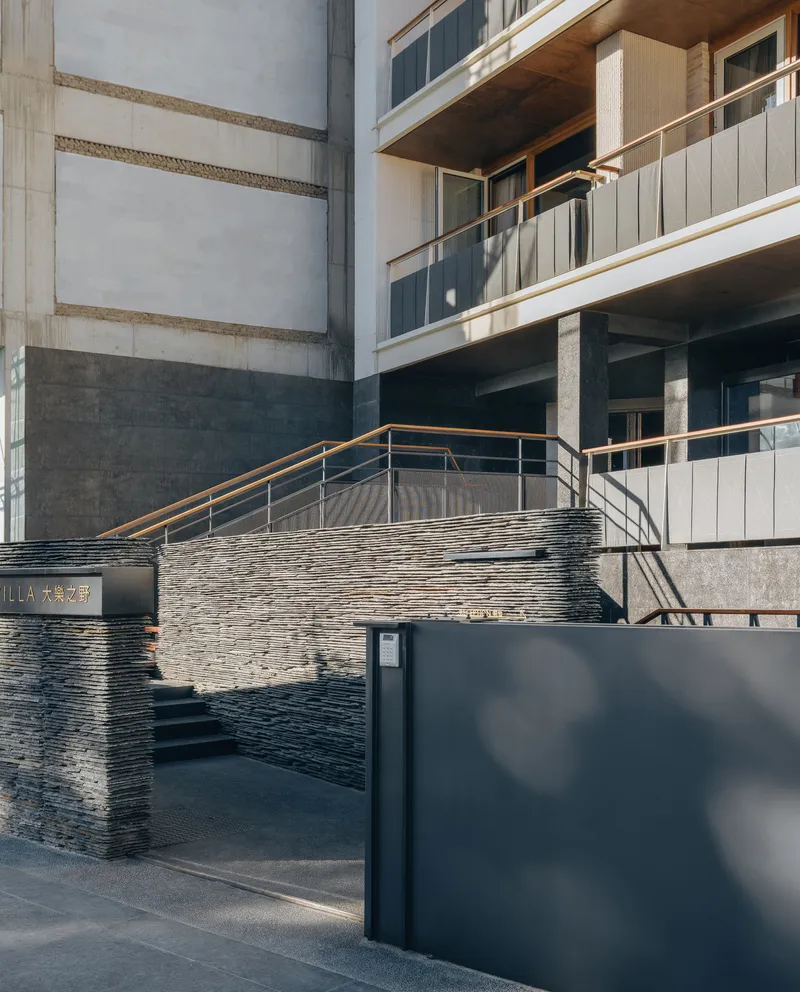
The entrance stairway, with horizontally stacked stone walls and a metal handrail, sets the tone: you climb into this building. The raised first floor is not an accessibility failure but a deliberate separation from the street, a threshold that asks for physical engagement. Lighting design by Shanghai Inverse keeps the interiors warm without theatrical drama.
Material Details and Thresholds
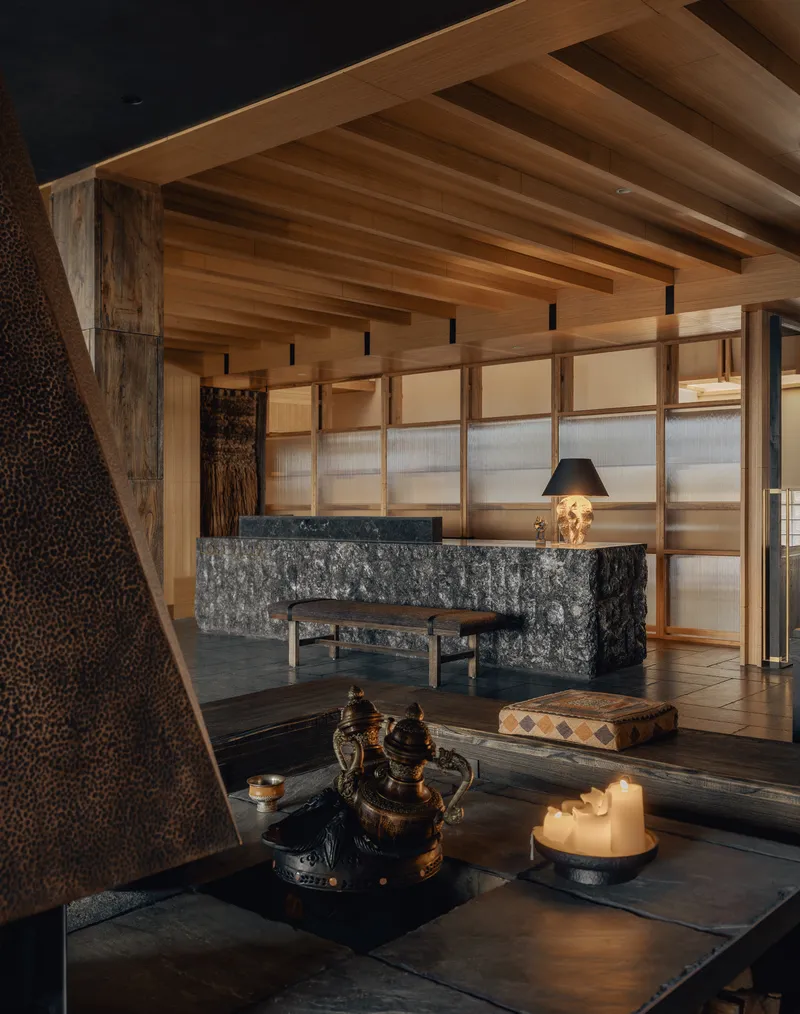
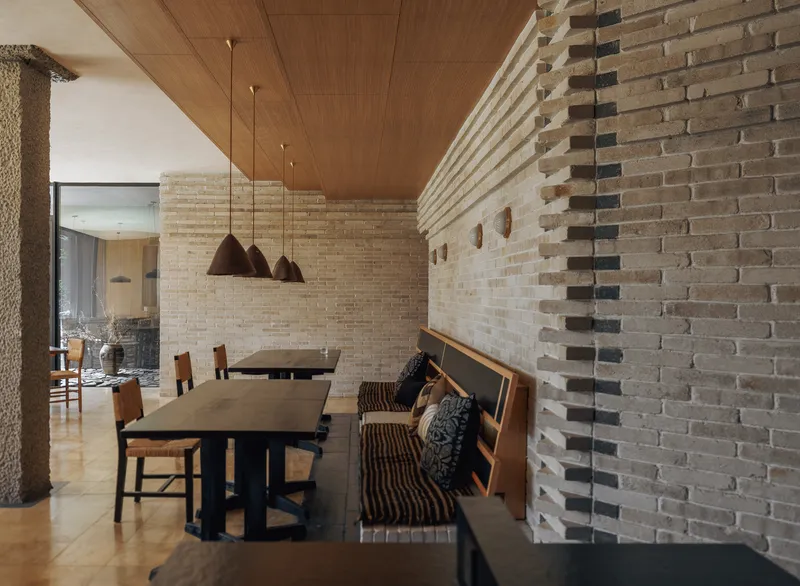
The material transitions are handled with care. Stone gives way to timber which gives way to translucent panels and glass. The dining space, with its striped brick wall and timber-framed shoji screens, introduces a horizontal rhythm that counters the vertical drama of the atrium. These are not accent walls; they are tectonic shifts that signal different spatial registers within a compact footprint.
Translucent wall panels at the reception desk glow at dusk, collapsing the boundary between interior warmth and exterior cold into a single luminous surface. The stone-clad desk itself sits heavy beneath the timber ceiling, a grounding element in a building that could otherwise feel too light.
Plans and Drawings
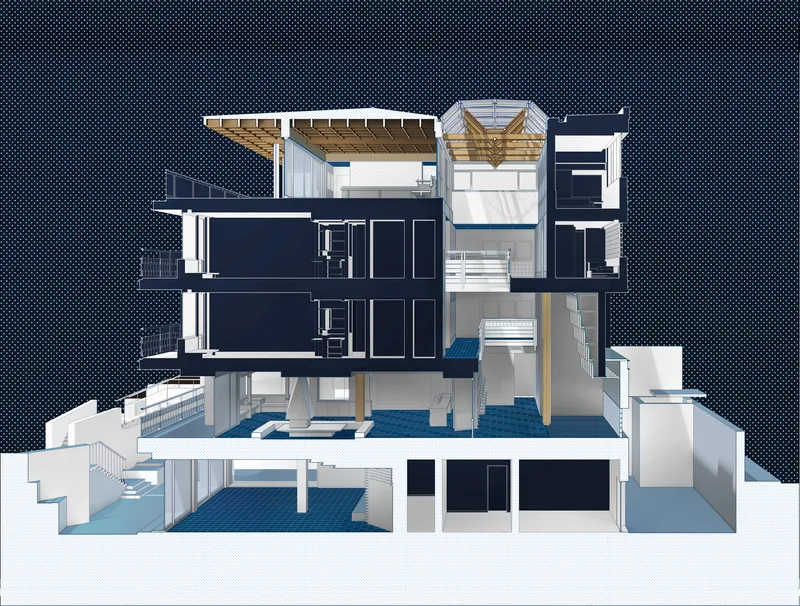

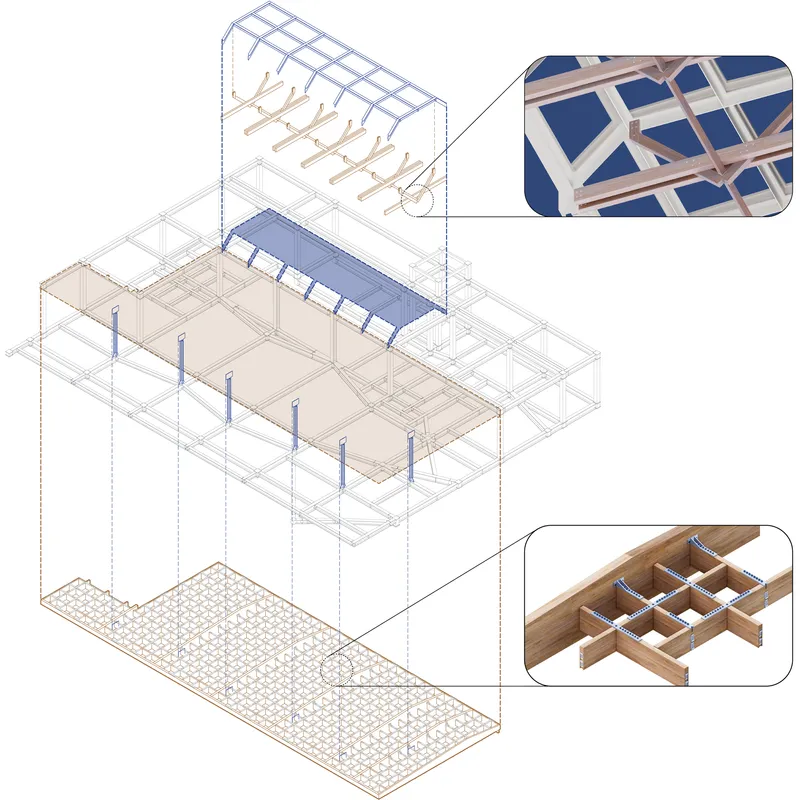
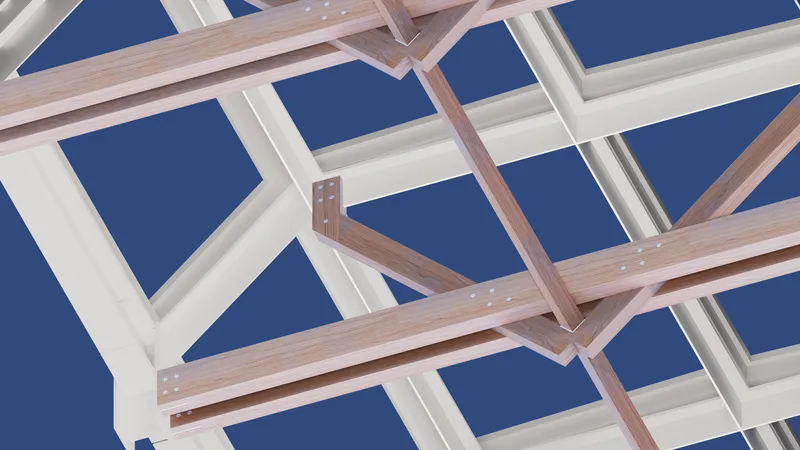
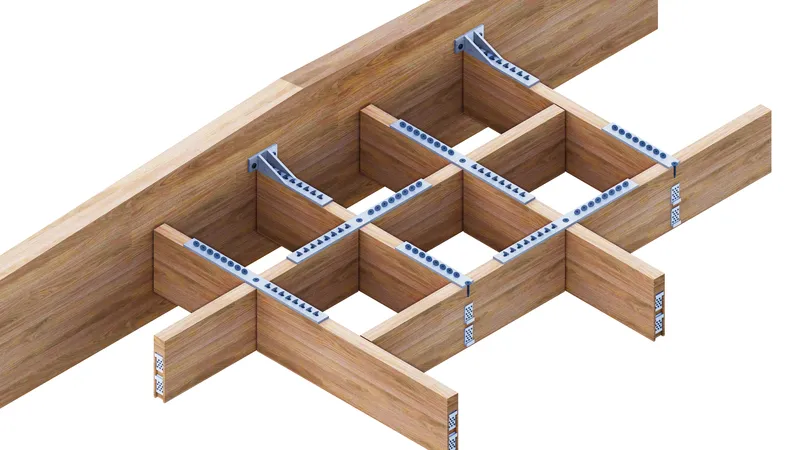
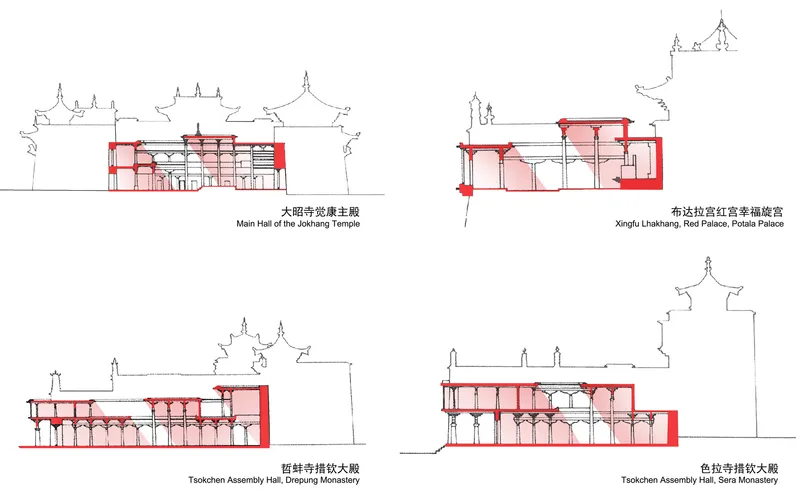
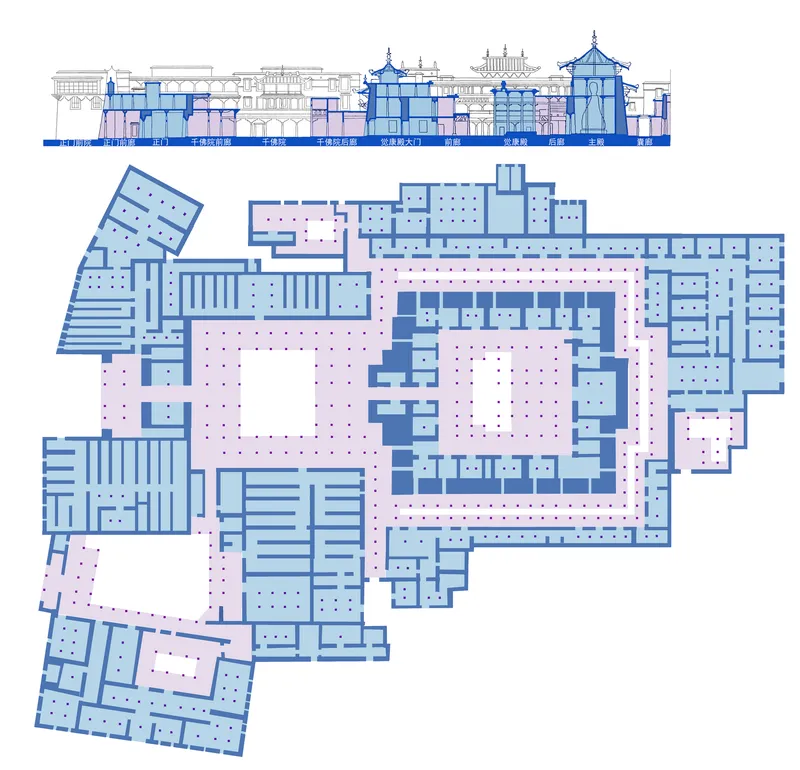

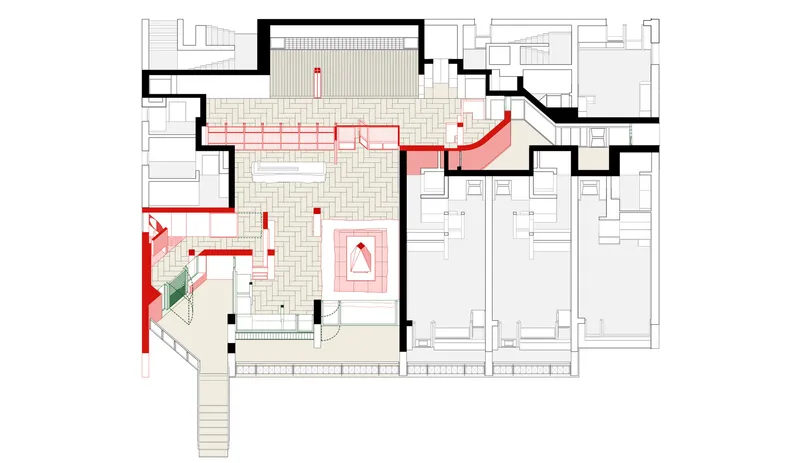

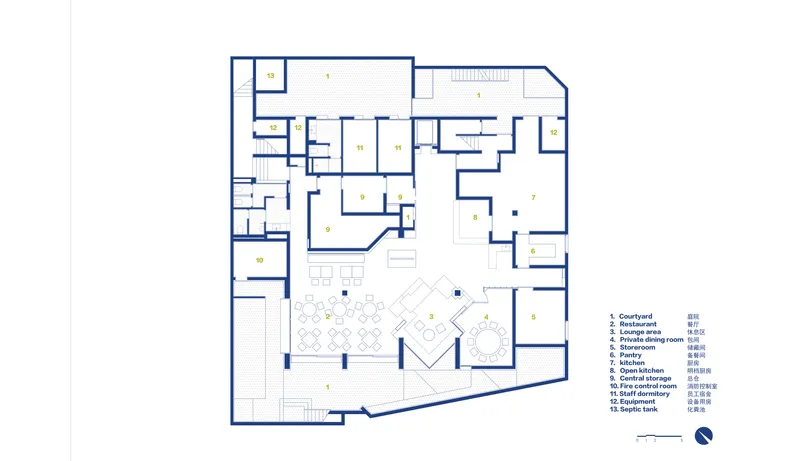
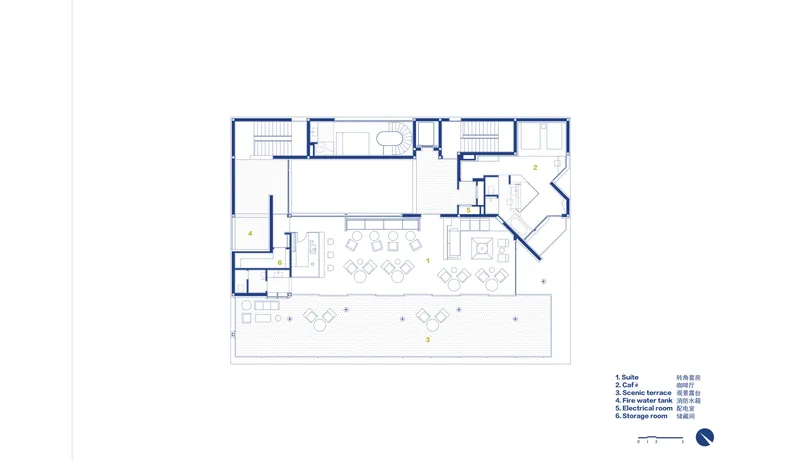
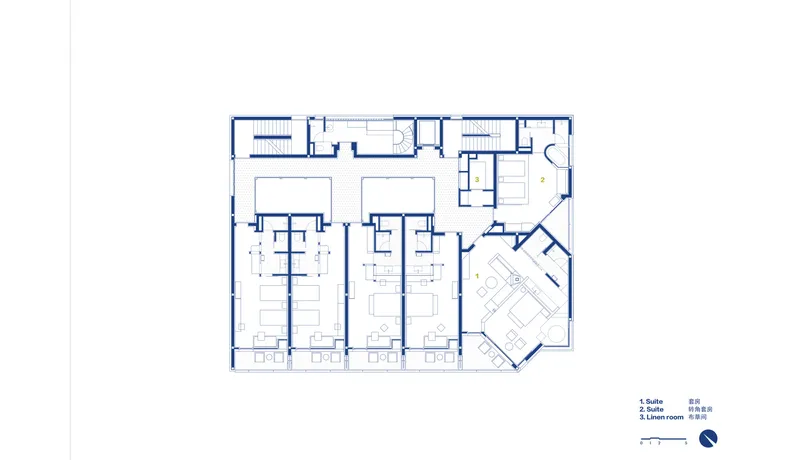

The section models reveal the building's true ambition: four levels of varying ceiling heights stacked within a 15-meter envelope, with the timber roof structure acting as a spatial crown. The floor plans show the clockwise circulation paths in red, confirming that movement through the building is not incidental but designed as a continuous loop. The axonometric drawing of the structural system, with its diagonal timber lattice and steel connection plates, demonstrates the engineering rigor behind what appears effortless in the built work. Reference drawings of traditional temple sections, with timber structure highlighted in red, show the sources that informed the roof geometry.
The floor plans across all levels reveal how much program is compressed into the 560-square-meter footprint: reception, restaurant, lounge, 16 suites with ensuite bathrooms, café, terrace, and service spaces, all organized around the central atrium void. The angled walls and diagonal paving patterns in the courtyard-level plans suggest that the geometry is not orthogonal by default but calibrated to views, solar orientation, and the irregular site boundary.
Why This Project Matters
The Kawagebo Snow Mountain Hotel matters because it takes an honest position on tourism architecture in a context where dishonesty is the norm. Rather than building a stage set for Instagram sunrises, Moguang Studio has created a building that works when the mountain is hidden. The interiors, the fireplaces, the ambulatory circulation, the yak-wool textiles: these are not consolation prizes for bad weather. They are the primary experience. The mountain, when it appears, is a bonus.
The project also demonstrates that a small footprint and a tight height limit are not obstacles to spatial complexity. Four levels, 16 rooms, and a full program of public spaces fit within 560 square meters of ground coverage because the section is worked as hard as the plan. The clockwise procession borrowed from Tibetan temple ambulatories is not applied symbolism; it is a genuine organizing principle that shapes how you move, look, and pause. In a landscape saturated with spectacle, the most radical thing an architect can do is build for stillness.
Kawagebo Snow Mountain Hotel by Moguang Studio (Jiaying Li, Xin Feng). Located in Diqing Tibetan Autonomous Prefecture, Yunnan, China. 2,500 m². Completed 2025. Photography by Yumeng Zhu, Haiting Sun, and Moguang Studio.
Share Your Own Work on uni.xyz
If projects like this are the kind of work you want to make, uni.xyz is a place to publish your own, find collaborators, and enter design competitions.



Popular Articles
Popular articles from the community


Conexión: Biophilic Design Reimagines High-Rise Living in Hong Kong
Conexión reimagines high-rise living in Hong Kong through biophilic design, green facades, shared spaces, daylight, water and nature within.

The Earth Pod: 3D Printed Homes for Resilient Refugee Communities
The Earth Pod reimagines refugee housing through 3D printed homes made from clay, combining resilience, self-sufficiency, and rapid shelter.

Co-life: Sustainable Architecture for Age-Friendly Community Living
Co-life reimagines sustainable architecture for seniors through courtyards, rammed earth, shared gardens, and spaces designed for belonging.

Hill & Cross Opera: Sculptural Opera House Architecture Shaped by Tallinn’s Landscape and Identity
Hill & Cross Opera reimagines opera house architecture in Tallinn through its sculptural hill, civic plaza, glass wave and a luminous cross.


Similar Reads
You might also enjoy these articles

Bao Huynh Watercolor Atelier: A Serene Art Retreat in Hội An
Bao Huynh Watercolor Atelier in Hội An blends multifunctional art spaces, sustainable design, local materials, and family-friendly living in a serene environment.

Atelier Macri Concept Store Interior Design by CASE-REAL
Atelier Macri store features a "ko" counter, walnut wood details, cork displays, blending retail, gallery, and seamless customer experiences.

Manuel Vargas Izquierdo Stadium and High-Performance Sports Center: Architectural Excellence in Jalpa de Méndez
The Manuel Vargas Izquierdo Stadium blends sustainable design, inclusive sports facilities, and cultural-inspired architecture, revitalizing Jalpa de Méndez’s public spaces.

KAKR Buluh Awar Hall: Revitalizing Community and Ecology Through Bamboo Architecture
Community built bamboo hall revitalizes Buluh Awar village, empowering youth, restoring ecology, celebrating vernacular craftsmanship through sustainable architecture and culture.


Explore Hospitality Building Competitions
Discover active competitions in this discipline



Challenge to reimagine the Iron Throne


Photograph architecture without architects


Illustrate the lost glory of Angkor Wat - Render Challenge


Design challenge to reuse E-waste
Comments (0)
Please login or sign up to add comments
No comments yet. Be the first to comment!