

Mohamed Amine Siana Sculpts a Casablanca Villa Around Oval Courtyards and Modernist Memory
Villa LL channels the riad tradition and Morocco's postwar Modernism into a curvilinear concrete house on a 1,000 sqm plot in North Casablanca.


Morocco's postwar Modernist architects, Jean-François Zevaco and Elie Azagury among them, built a vocabulary of bold concrete planes, sensual curves, and climate-conscious interiority that still feels radical. Villa LL, completed in 2021 by Mohamed Amine Siana in a residential quarter of North Casablanca, picks up that conversation without nostalgia. On a generous 1,000 sqm plot, the house compresses its 290 sqm of program into a single-story plan organized around two courtyards: one oval and enclosed, the other open to a circular swimming pool. The result is a dwelling that turns inward like a riad yet breathes through carefully calibrated openings.
What makes this project worth studying is not just its formal language, the undulating ceilings, the sculpted wall planes, the asymmetrical canopy, but the way every curve serves a climatic and spatial argument. The client, an artist, asked for lines that were "sensual, thin yet discreet, protective without being stifling." Siana answered by treating the house as a sequence of carved volumes that frame light, channel air, and guard privacy from the busy streets outside.
A Facade That Reveals Nothing and Everything
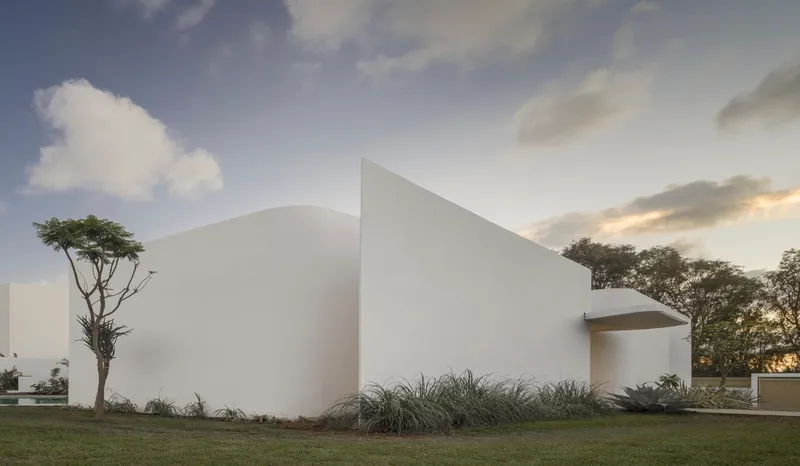
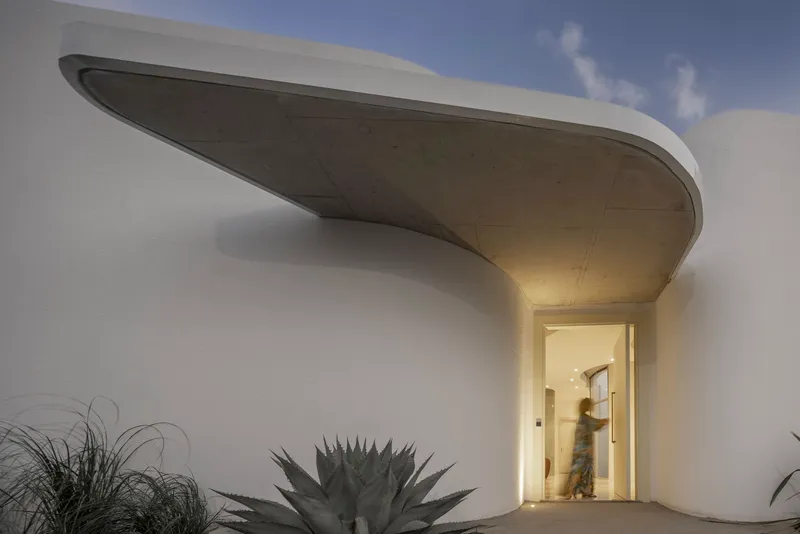
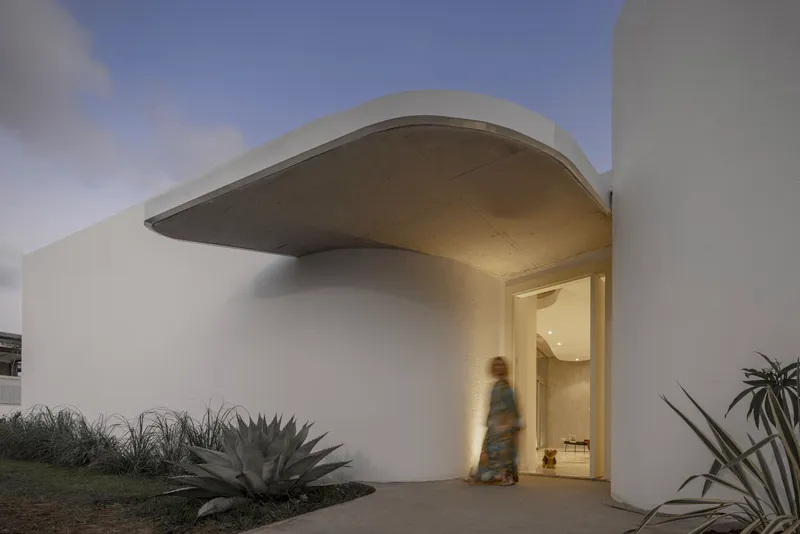
From the street, Villa LL presents itself as a composition of white plaster-covered concrete planes. There is no large window, no balcony, no obvious domestic signifier. A sweeping curved opening in the front wall hints at depth, and an asymmetrical concrete canopy marks the entrance with a gesture that is simultaneously protective and sculptural. At dusk the canopy glows from concealed lighting, turning the threshold into a kind of stage. Agave and ornamental grasses soften the base of the wall, grounding the abstraction in the local landscape.
The decision to make the street facade almost entirely opaque is not merely aesthetic. Siana extends and sculpts the vertical wall planes so that the few openings that do exist generate views outward without allowing views in. It is an old riad principle recast in Modernist terms: the city is kept at a distance, and domestic life unfolds around the courtyards inside.
The Entrance Canopy as Threshold
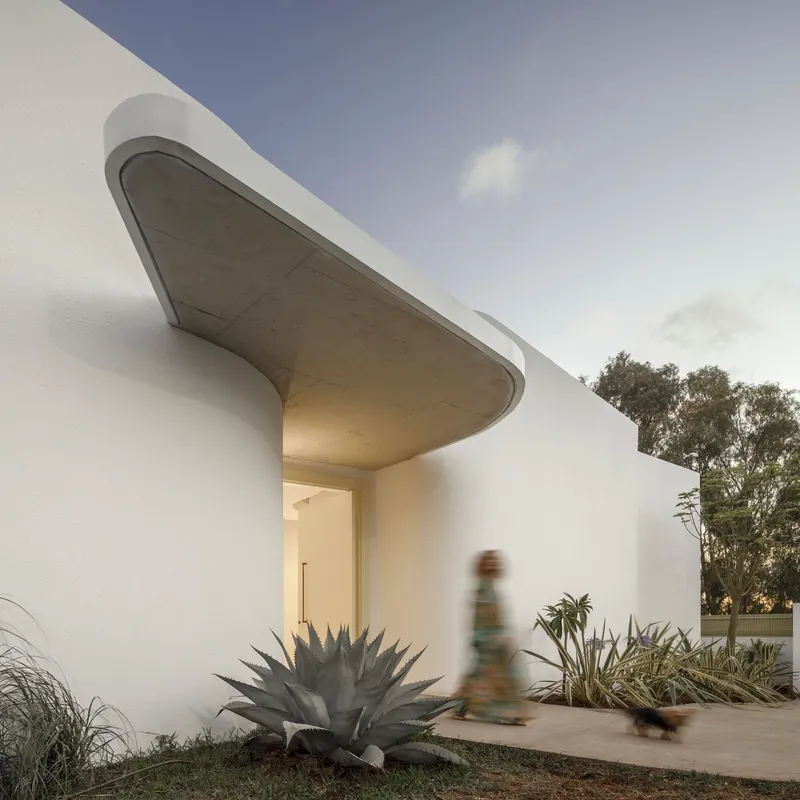

Walking beneath the curved concrete soffit toward the front door, you experience a compression of space that makes the interior release feel deliberate. The canopy's corners are rounded, its underside smooth, and the path it shelters is flanked by desert plantings that reinforce the sense of moving from a harsh exterior into a protected realm. On the opposite side of the house, a ribbed wall panel and a papaya tree in a courtyard offer a quieter counterpoint, suggesting that the entire perimeter has been considered as a series of encounters rather than a uniform enclosure.
The Oval Courtyard: A Riad in Miniature
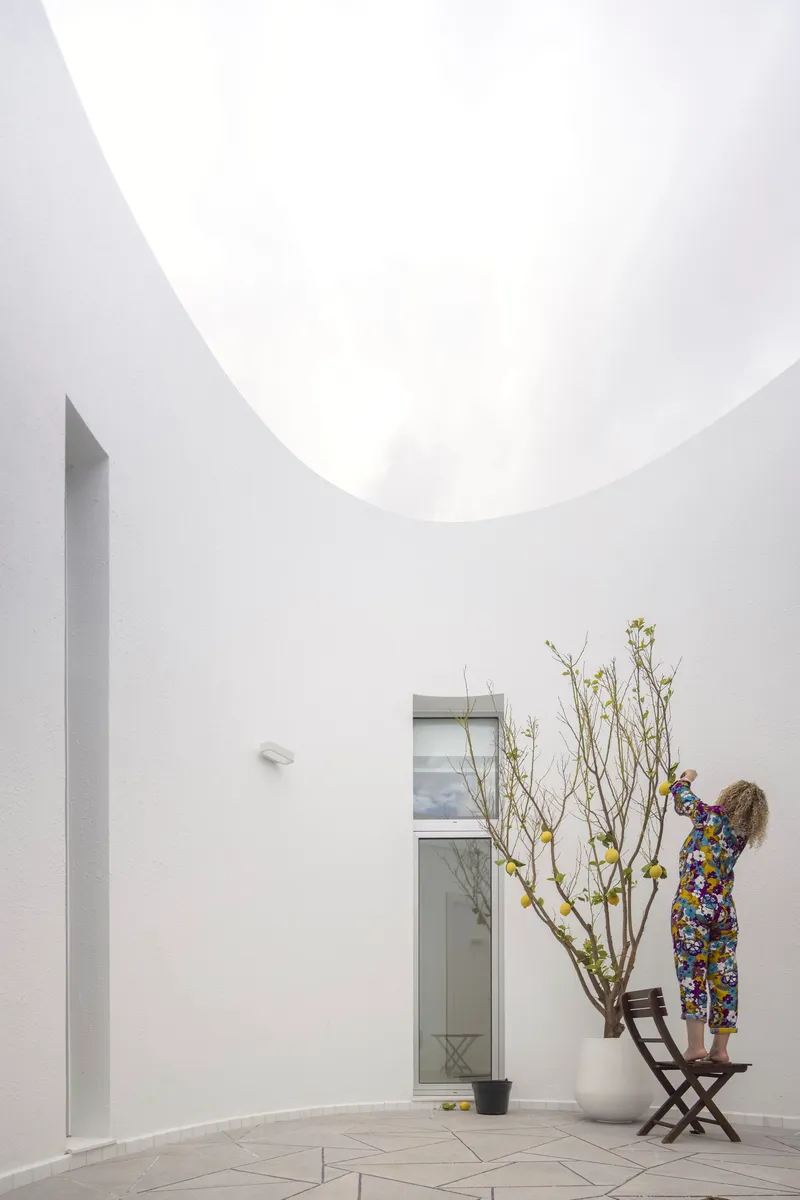
At the heart of the plan sits an oval courtyard encircled by five windows that serve the kitchen and three guest rooms. Overhead, a circular oculus draws light down into the void, while a potted tree anchors the composition and introduces a living element to the otherwise mineral space. Siana describes this courtyard as a miniature version of the traditional Moroccan riad's central courtyard, and the analogy holds: it is the organizational spine from which rooms radiate, the source of cross-ventilation, and the social center of the house.
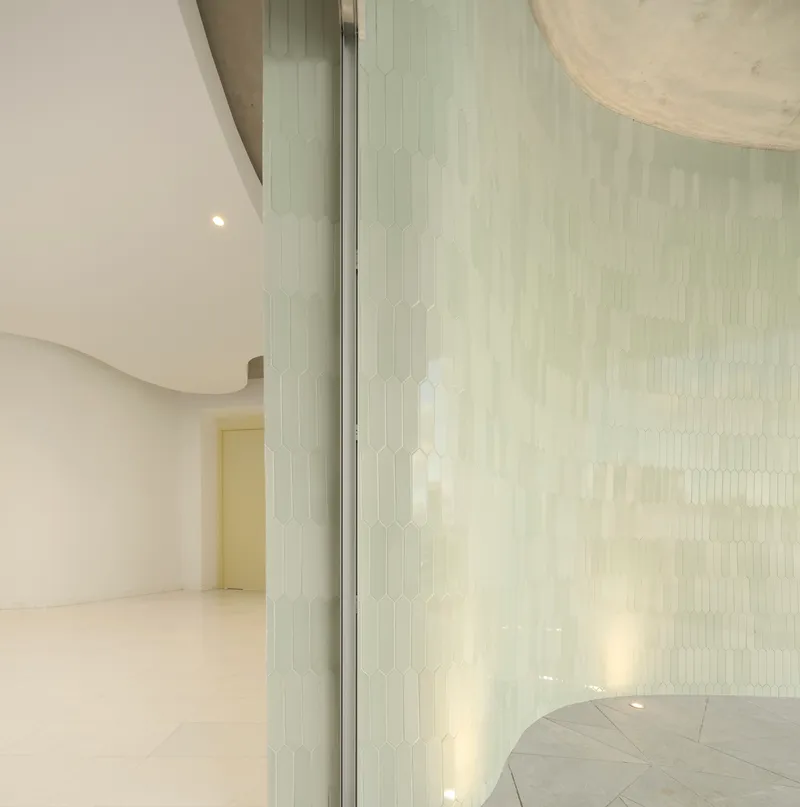
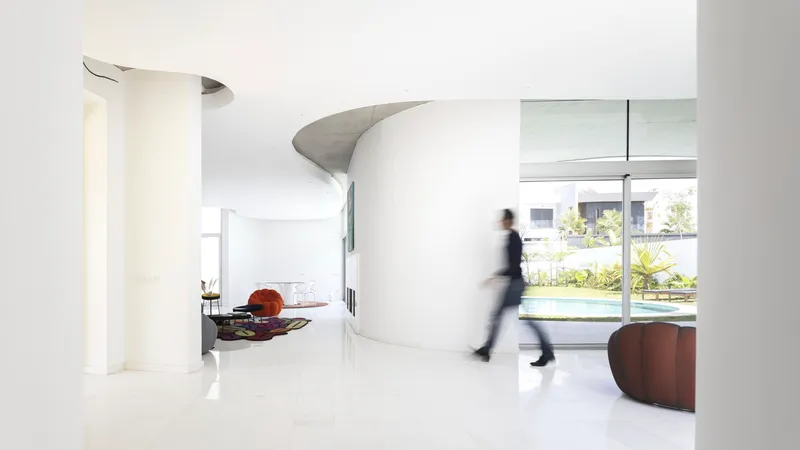
Adjacent interior spaces pick up the courtyard's curvilinear logic. A translucent tiled partition wall separates volumes with a screen-like delicacy, filtering natural light while maintaining acoustic separation. The white polished marble floors reflect every shift in brightness, making the interior feel larger and more luminous than its footprint suggests. Figures passing through these rooms appear almost cinematic, framed by curved walls and soft shadows.
Undulating Ceilings and Concrete Craft

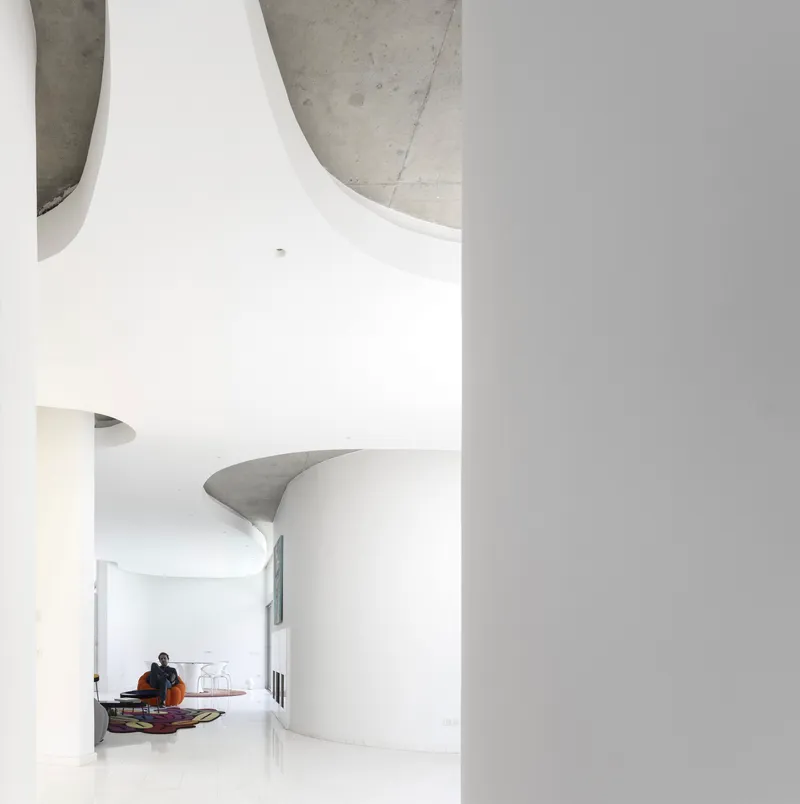
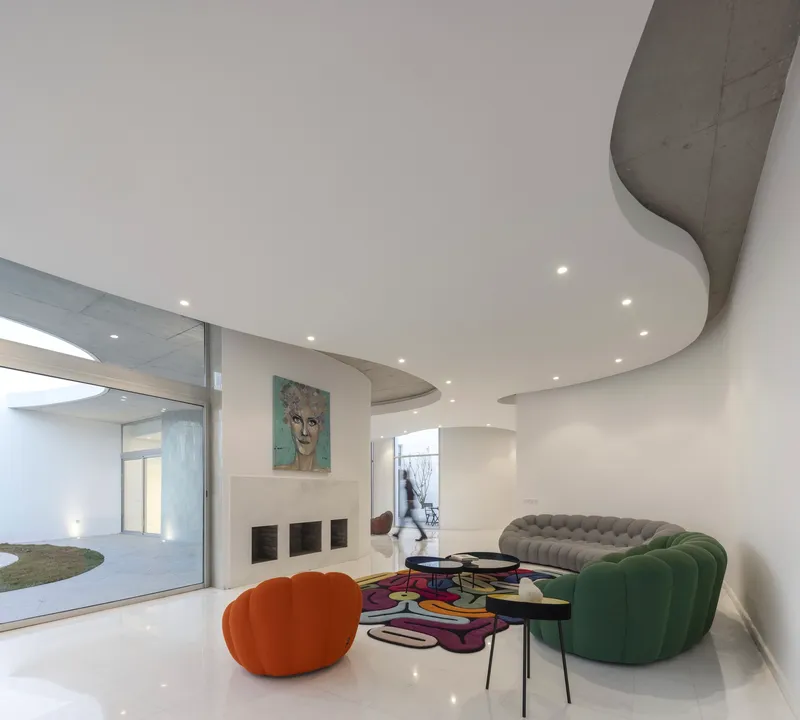
The most striking interior detail is the ceiling. Siana clads the concrete slab in traditional hand-applied plaster, then carves undulating cutouts that expose the raw concrete above. The effect is theatrical but controlled: the plaster's smooth, white surface reads as a suspended plane, and the concrete peeks through at the edges like a geological layer revealed by erosion. In the living room, these ceiling forms interact with colorful furniture, a patterned rug, and generous daylight to create a space that feels both modern and deeply handmade.
The technique speaks to a broader interest in hybridizing craft traditions with contemporary construction. The hand-applied plaster is a labor-intensive finish common in Moroccan architecture, but here it is deployed against the brutalist honesty of exposed concrete in a way that neither material dominates. The conversation between the two is what gives the interior its particular tension.
Living Between Two Courtyards
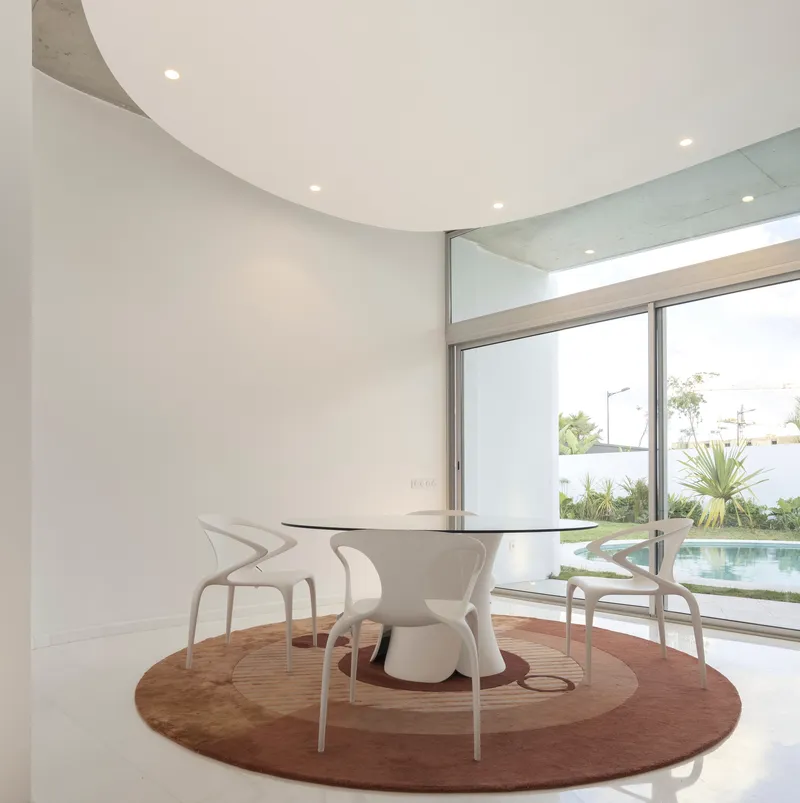
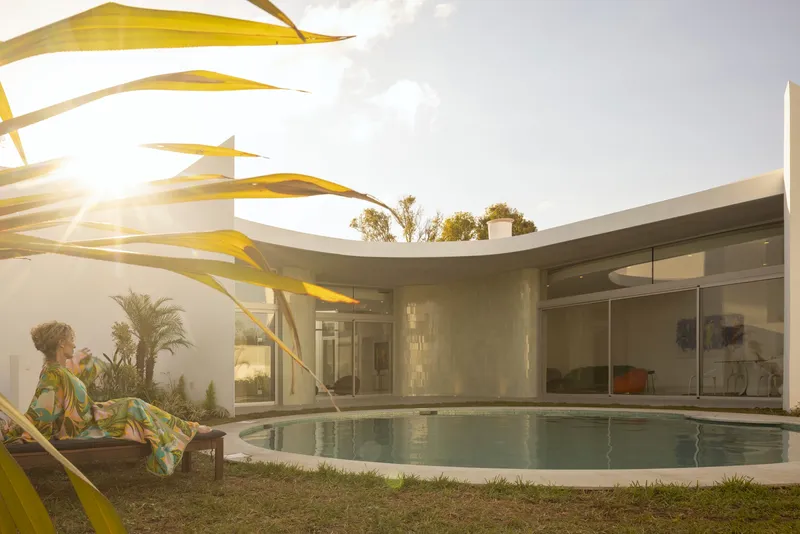
The second courtyard wraps the living room, dining area, and primary bedroom around a circular swimming pool set in a grass lawn. A large window at the far end of the living room frames the pool and its planted surround, collapsing the boundary between interior and landscape. The dining table, circular and centered on a round rug, echoes the pool's geometry in a move that feels deliberate without being heavy-handed. Late afternoon light enters at a low angle through palm fronds, casting long shadows across the water.
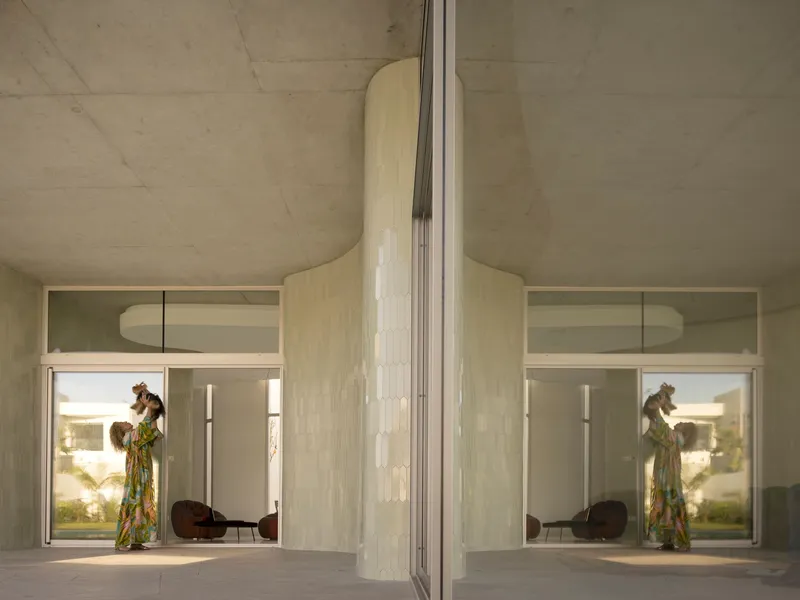
From the pool courtyard, reflections in the floor-to-ceiling glass walls dissolve the reading of inside and outside. A seated figure by the pool, a dog crossing the lawn: the house frames domestic life as a series of framed moments, each one filtered through the architect's careful placement of openings. The primary bedroom, positioned opposite the living room, receives the same generous glazing toward the pool, ensuring that the most private room in the house still participates in the collective landscape.
The Pool Courtyard at Golden Hour
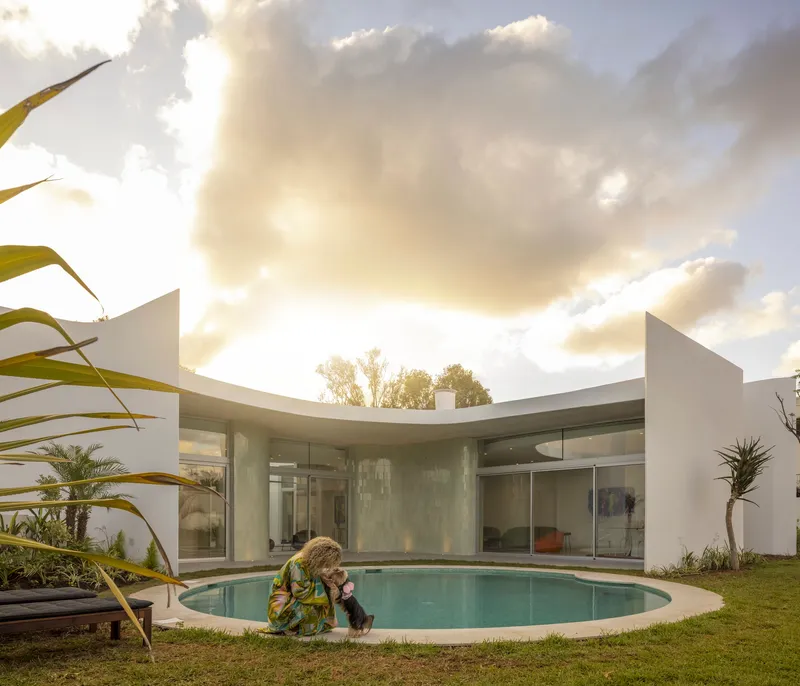
Fernando Guerra's photographs catch the pool courtyard at its most atmospheric: a figure and a dog silhouetted against a Casablanca sunset, the circular water surface glowing amber. The image underscores what is perhaps the project's most important quality, its capacity to produce intimacy and calm within a dense urban fabric. The tall white walls screen the neighbors entirely, creating a private landscape that could be a rural estate rather than a house in North Casablanca.
Plans and Drawings
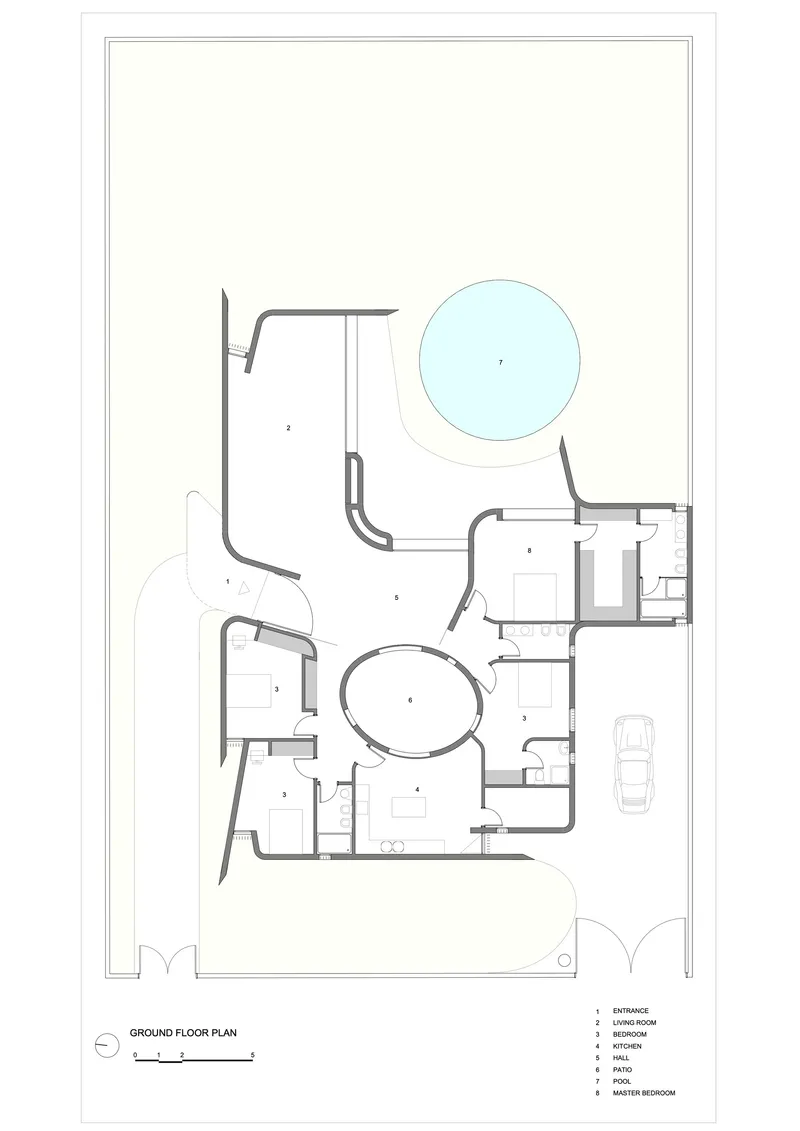
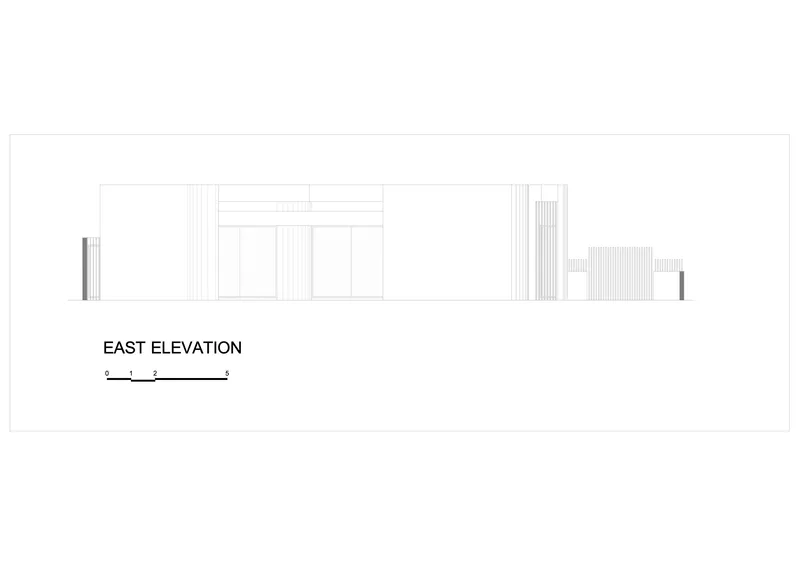
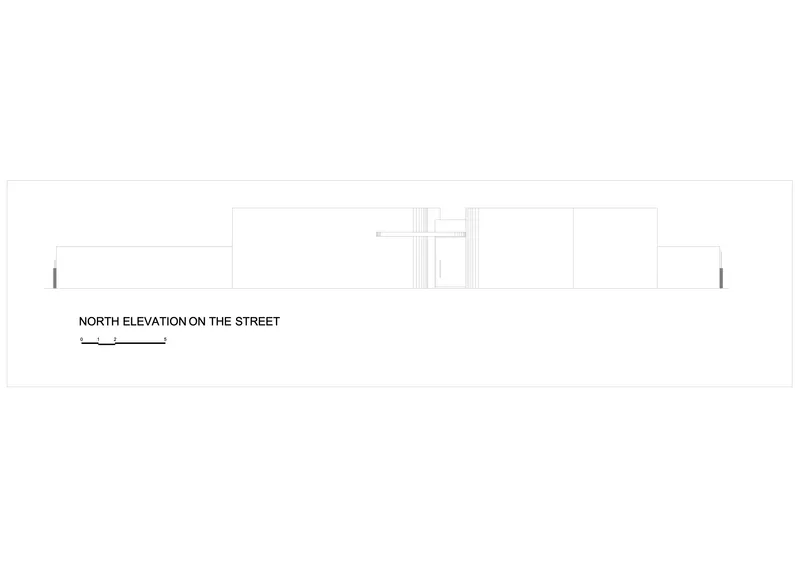
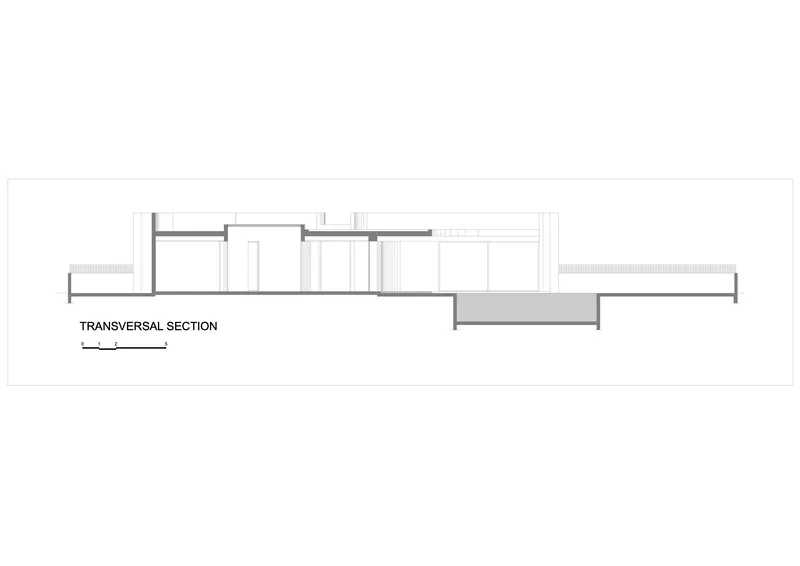
The ground floor plan reveals the full logic of the double-courtyard organization. Curvilinear rooms radiate from the central oval void, and the buildable rectangle of 20 by 15 meters is almost entirely consumed by program. The elevations confirm the street facade's opacity: the east elevation shows a flat roofline punctuated by vertical ribbed panels and a single central opening, while the north elevation presents the recessed entrance sandwiched between planar volumes. The transversal section exposes the single-story structure's modest height and the sunken volume of the oval courtyard, clarifying how the house keeps its roofline low while still achieving generous interior volume.
Why This Project Matters
Villa LL matters because it demonstrates that the riad typology is not a relic but a living strategy. By centering the plan on courtyards, Siana solves for privacy, ventilation, and natural light simultaneously, without relying on mechanical systems or fussy shading devices. The formal language, the curves, the sculpted walls, the undulating ceilings, is genuinely rooted in Morocco's Modernist lineage rather than imported wholesale from European or East Asian precedents. That lineage, the work of Zevaco and Azagury in the decades after independence, remains underexplored in global architectural discourse. Projects like this keep it alive.
More practically, the house is a reminder that 290 sqm of built area can feel expansive when organized around outdoor rooms. The two courtyards double the livable space without adding a single square meter of conditioned floor area. In a climate as hot as Casablanca's, that is not a poetic gesture but a functional one, and it is one that architects working in similar latitudes would do well to study closely.
Villa LL by Mohamed Amine Siana. Casablanca, Morocco. 290 m². Completed 2021. Photography by Fernando Guerra.
About the Studio
Share Your Own Work on uni.xyz
If projects like this are the kind of work you want to make, uni.xyz is a place to publish your own, find collaborators, and enter design competitions.


Popular Articles
Popular articles from the community


Opera by the Sea Estonia: Three Shells Dissolving Architecture into Tallinn's Coastline
A winning opera house proposal replaces monumental form with interconnected shells that blur the boundary between building, park and Baltic Sea.

Faces of the Soviet Avant-Garde: Turning Moscow's Street Names into an Open-Air Museum
A network of sculptural installations across a Moscow residential district transforms forgotten architect names into spatial encounters with cultural memor

Extended Shell: Retrofitting Kolkata's Balconies as Living Urban Thresholds
A modular retrofit system recovers the social and environmental intelligence of Kolkata's historic verandas for contemporary Park Street residents.

Cloaked Colonization: A Mobile Underwater Habitat That Moves Like a Fish
Micah Abaya's shortlisted EHC Pacific entry reimagines ocean settlement as a dispersed network of self-sustaining architectural organisms.

Similar Reads
You might also enjoy these articles

Pixel Gardens: One Repeated Module Stacked Into a Terraced Social Housing Tower for Famagusta
Salem Bader's shortlisted housing tower builds a vertical neighbourhood from one repeated module, offsetting units to carve terraces, light and air.

Bao Huynh Watercolor Atelier: A Serene Art Retreat in Hội An
Bao Huynh Watercolor Atelier in Hội An blends multifunctional art spaces, sustainable design, local materials, and family-friendly living in a serene environment.

Atelier Macri Concept Store Interior Design by CASE-REAL
Atelier Macri store features a "ko" counter, walnut wood details, cork displays, blending retail, gallery, and seamless customer experiences.

Manuel Vargas Izquierdo Stadium and High-Performance Sports Center: Architectural Excellence in Jalpa de Méndez
The Manuel Vargas Izquierdo Stadium blends sustainable design, inclusive sports facilities, and cultural-inspired architecture, revitalizing Jalpa de Méndez’s public spaces.


Comments (0)
Please login or sign up to add comments
No comments yet. Be the first to comment!