

Space Exploration and Learning Center
Let's go on a 'Moontrip'


Storyline
50 years ago, on July 20, 1969, Neil Armstrong became the first man to step on the moon. Upon landing, the first words that he quoted were “That's one small step for man, one giant leap for mankind.” True to his words, the world has never seen back since and new dimensions of space explorations were open following that day. Every space mission has always inspired humanity to think beyond and, this marvellous feat has been the pinnacle of those.
Science has moved miles ahead exploring unheard domains and understanding the mysteries of the universe. Every space mission has always inspired humanity to think beyond and, this marvellous feat has been the pinnacle of those. In the past few decades space travel and exploration has lost significant public interest, however, our recent innovations have again sparked curiosity in this domain.
The Apollo 11 mission wasn’t just a leap in scientific achievement, it was a source of inspiration and motivation for generations to come. Becoming an astronaut became one of the most sought-after career choices for kids in the USA and worldwide.
Challenge
Unfuse launched an architectural challenge for designing a Space exploration Center that reflects on the never-ending knowledge quest of children and gives them an opportunity to indulge in fun learning activities.
The brief asked to mark the completion of 50 years of this milestone, and all the contributions in the field of space exploration in the last half-century, and challenged participants to design a space centre to enlighten the young generation about the moon trip, the role of different people and other advancements in space explorations.
The space centre should have a comprehensive set of provisions for giving a holistic experience of how space travel works, encouraging new participants and attracting a new generation to consider this field as a career. Space can be seen as one of the most remarkable inventions of the century and we expect to see a lot of it in the coming centuries.
How can we breed more interest within our younger generation to make this dream come to true realistically quicker?
The challenge was to design a space exploration centre primarily for kids and teenagers to ignite the spark for learning about outer space. The centre for space is not a space history museum. It is a place where the young generation can learn and be a part of activities about outer space, experience the life of an astronaut through simulation and could engage themselves in other fun learning activities. The centre reflected upon the values of a never-ending quest for knowledge and will to explore beyond bounds. It came out to be a manifestation of human achievement and a symbol of hope for the future.
The jury for the competition consisted of esteemed designers, professionals and academicians from around the world. The Lead Jurors for the competitions were as follows:
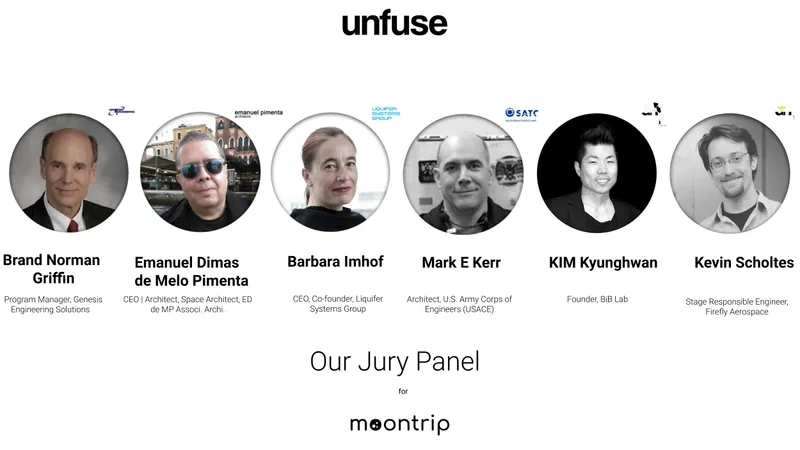
Brand Norman Griffin, Program Manager, Genesis Engineering Solutions, United States
Emanuel Dimas de Melo Pimenta, CEO | Architect, Space Architect, Urban Planner at Emanuel Dimas de Melo Pimenta Associated Architects
Mark Kerr, Architect, U.S. Army Corps of Engineers (USACE), USA
Barbara Imhof, CEO, Co-founder, Liquifer Systems Group, Austria
KIM Kyunghwan, Founder, BiB Lab, France
Kevin Scholtes, Stage Responsible Engineer, Firefly Aerospace
Some of the Best of competition projects are as follows:
Winning Project: MOONTRIP Interactive Space Education Center
By: Jonasz Matuszczyk & Wojciech Remer

Description: It's been 50 years since we first landed on the Moon. What would the future of space education look like in the next 50 years? Proposed MOONTRIP Interactive Space Education Center is one possible outcome. Interactive environment, taking advantage of rapidly developing technologies to inspire and educate young generations about space exploration process.
Runner - Up: SPECtre
By: Ilko Iliev & Chris Donatello

Description: The SPECtre is a publicly-accessible architectural utility capable of facilitating the research, development and exhibition of artifacts and knowledge relevant to space travel. This resulting new typology of the living exhibition - a facility capable of producing and displaying its own contents - acts to engage the public in education and recreation.
Honorable Mention: Moongazing Science Centre
By: Martina Ivanova

Description: The Project celebrates the Moon Landings as Giant Leaps in Space Exploration with eyes looking up to the Sky. Moongazing is the key concept idea to define the form of the building. The Dome of the Building represents the Celestrial Sphere under which a Microcosmos lives.
Honorable Mention: MoonCape Park
By: Giuseppe De Guglielmo

Description: Mooncape is a park dedicated mostly to children where they can play and learn about the moontrip and the main notions that made it possible. The structure is designed to become an iconic sign from the city and to stimulate the imagination of users.
Honorable Mention: Space Odyssey (A jounrey to space)
By: Vikram Ghattora & Ankur Gupta

Description: To ignite the spark in kids and teenagers for space exploration , almost every major aspect regarding space launch is taken in consideration while designing this space exploration centre. From engineering workshops to space simualtion with anti- gravity simulation in basement so that kids can experience most of the things.
Honorable Mention: Apollo 20
By: Галина Богданова
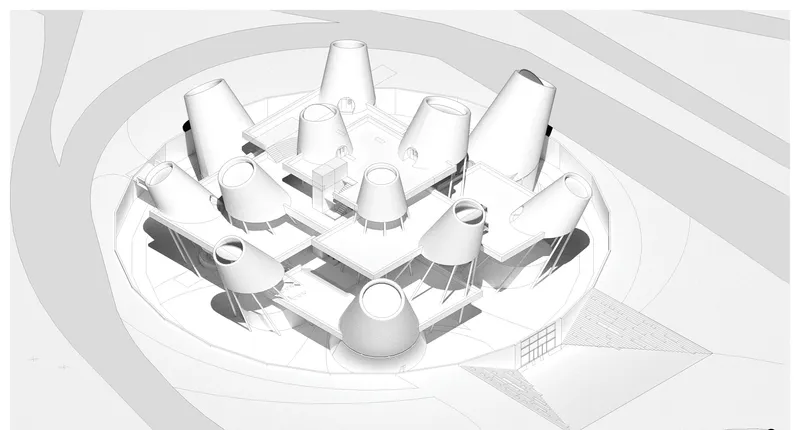
Description: The main idea of this project is to create a form that would speak for itself. The exterior of the building is thematic focused on what it is - space exploration center for kids.
People’s Choice: Ascension
By: Eduardo Sanchez & Fernanda Saldana

Description: The concept behind this design is ascension. A sensory journey towards discovery is what defines ascension to us. Programming, materiality, and overall experience were key components to bring the design to full fruition.
Institutional Excellence Award: Quasar Forest
By: Catinca Joita & Stefan Palaghia
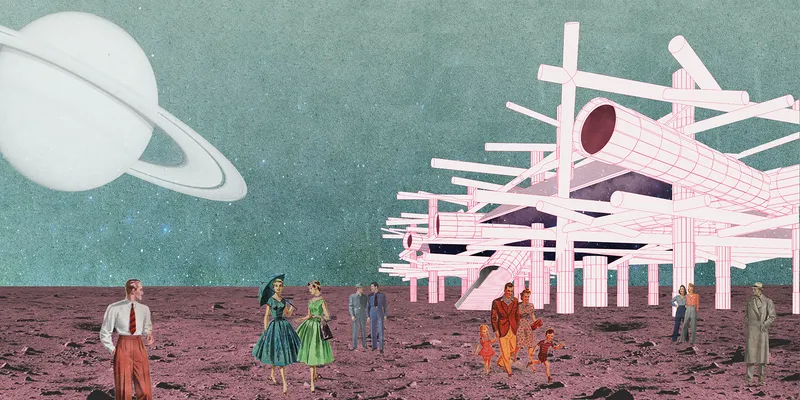
Description: Our design challenges the idea of relativity; the intricate shapes of the inner spaces have behind a simple concept: the pipe. This element acts as circulation, air, water and electricity providers as well as a link between the introvert inside and the cityscape outside.
Editor’s Choice: A piece of moon
By: Chiming Wong & Kuai Yu

Description: A piece of continuous spherical space has been created on the site, representing the surface of star. As an alien spacecraft, it lands by the water edge and form a striking landmark in this area. At night, the 40-meter structure which combines the art of laser projection, will become a symbol of 50th anniversary moon landing. Explore beyond limit and high dimension is an important attitude to science study, tower contains observation deck and G-zero training facility.
Editor’s Choice: Dark Side of the Moon
By: Tamas Balint & Daria Kruczek
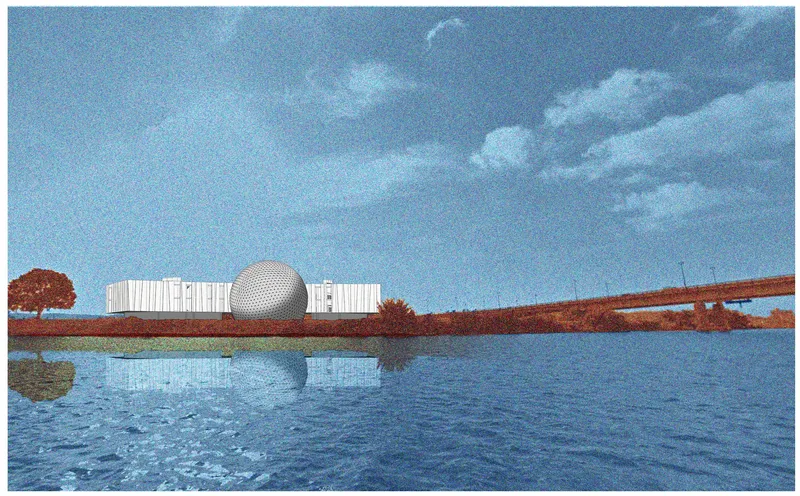
Description: Usually the "dark side" of the moon refers to the unknown, the yet to be discovered. Since we always see one side of the moon, the other side remains unseen to the human eye. Thus the project aims to discover the dark side of the moon by "edutainment" for the youth.
Discover the design brief here: https://uni.xyz/competitions/moontrip/info/about
Discover the full results here: https://uni.xyz/competitions/moontrip/entries
Follow us on social media: Facebook | Instagram | LinkedIn | Twitter | Youtube
Discover other design competitions to participate here: https://uni.xyz/competitions


Popular Articles
Popular articles from the community


Cloaked Colonization: A Mobile Underwater Habitat That Moves Like a Fish
Micah Abaya's shortlisted EHC Pacific entry reimagines ocean settlement as a dispersed network of self-sustaining architectural organisms.

Opera on the Sea: Driftwood Logic Shapes a Timber Opera House on Estonia's Coast
Trevor Orgill's opera house translates the entangled drift of floating timber into a civic building where wood, water, and music converge.

Faces of the Soviet Avant-Garde: Turning Moscow's Street Names into an Open-Air Museum
A network of sculptural installations across a Moscow residential district transforms forgotten architect names into spatial encounters with cultural memor

Manzana Morphosis: Stretching Barcelona's Grid into a Living Landscape for 2050
A radical reworking of the Eixample manzana turns density into a tool for generous public space, vertical ecology, and environmental performance.

Similar Reads
You might also enjoy these articles

Play: Fragments of Their World: Remembered Architecture Rebuilt as a Modular Playground for Refugee Camps
Tom Gardner abstracts domes, arches and towers from the homelands of displaced families into a kit of child-scaled play parts for camp settlements.
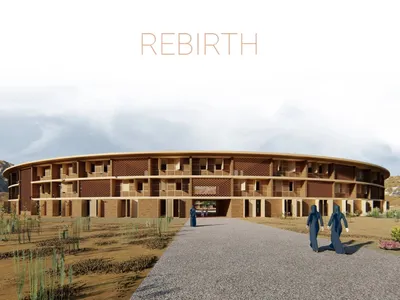
REBIRTH: A Circular Settlement Where Afghan Widows and Their Children Rebuild Life Together
A shortlisted Resile entry turns the circle into a protective ring of timber and brick, gathering homes, classrooms and gardens around a shared landscape.
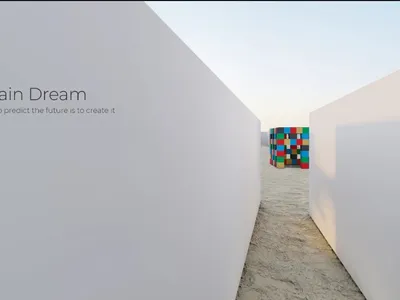
The Main Dream: A Recycled Plastic Kit That Lets Refugee Children Build Their Own Playground
Thirty-centimetre interlocking cubes that connect on three axes turn play into construction, letting children author the spaces they occupy.

Lunar Spiral: A Fibonacci-Driven Moon Settlement Rising from Shackleton Crater
Golden-spiral geometry organises buried infrastructure and orbiting habitable spheres into a lunar base designed to grow as life on the Moon expands.

Comments (0)
Please login or sign up to add comments
No comments yet. Be the first to comment!