
Morris+Company Breaks an 80-Meter London Office Block into Four Distinct Brick Characters
On City Road near Old Street, a ten-story workplace building channels Victorian warehouse grit through prefabricated panelized facades.


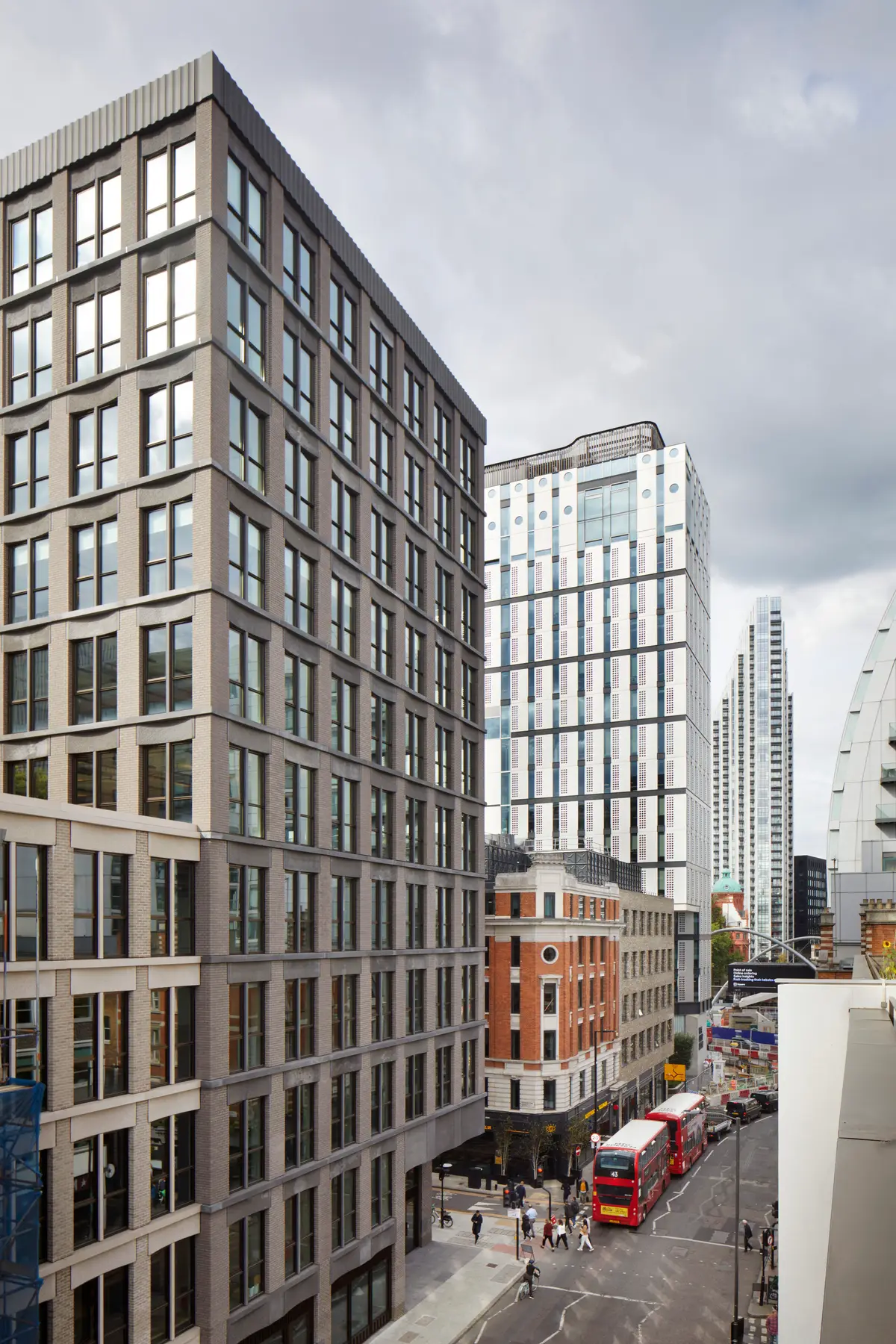
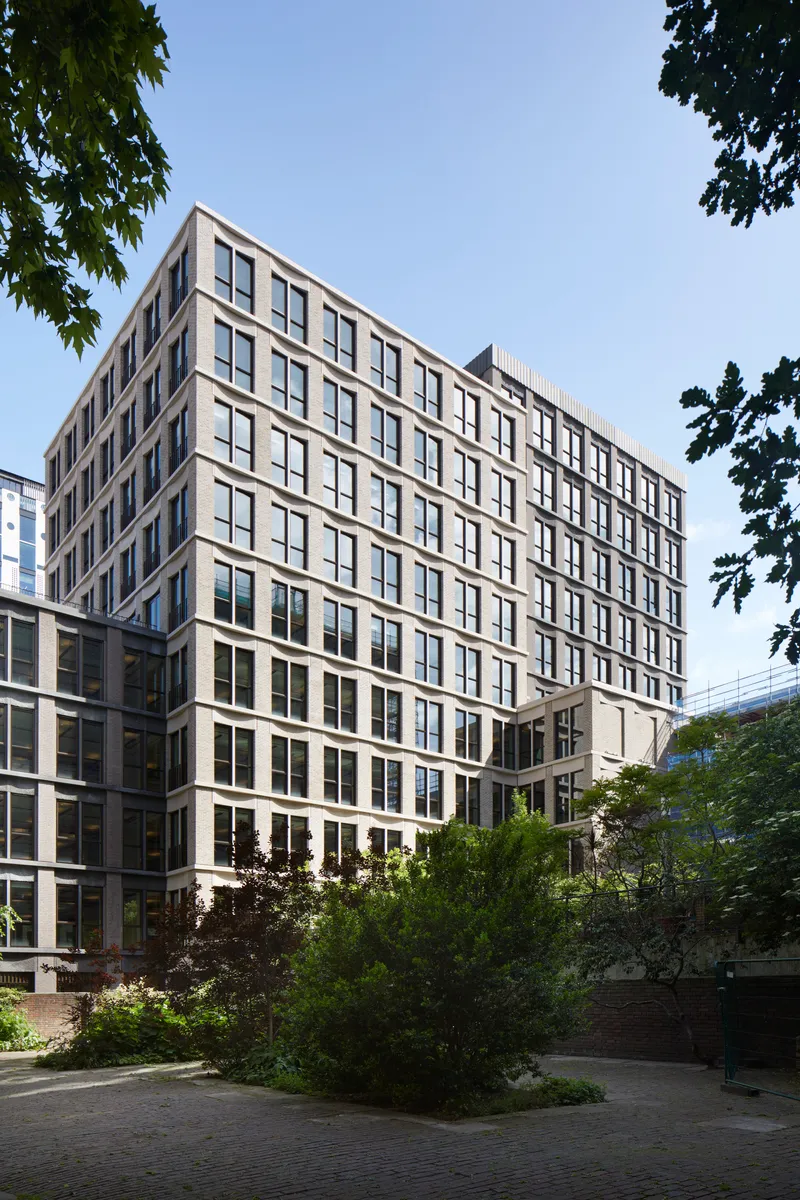
An 80-meter commercial building on City Road could easily become a monotonous slab. Morris+Company avoided that fate with The Featherstone Building by splitting it into what reads as four adjoining structures, each clad in a different combination of two brick tones and precast concrete details. The result is a workplace building that absorbs the grain of its surroundings rather than imposing a single corporate signature on a neighborhood that already has plenty of those.
Completed in 2022 on the corner of City Road and Featherstone Street, the project replaces two 1960s buildings and delivers an 81 percent uplift in floor area. It sits at the intersection of London's financial core and the creative and tech hinterland around Old Street, and it borders the Grade I listed Bunhill Fields cemetery, final resting place of William Blake. That adjacency is not just context: it shapes the building's environmental strategy, its massing, and even the experience of working inside it, where floor-to-ceiling openable windows pull the cemetery's mature tree canopies into the workspace.
A Warehouse Lineage Made Legible
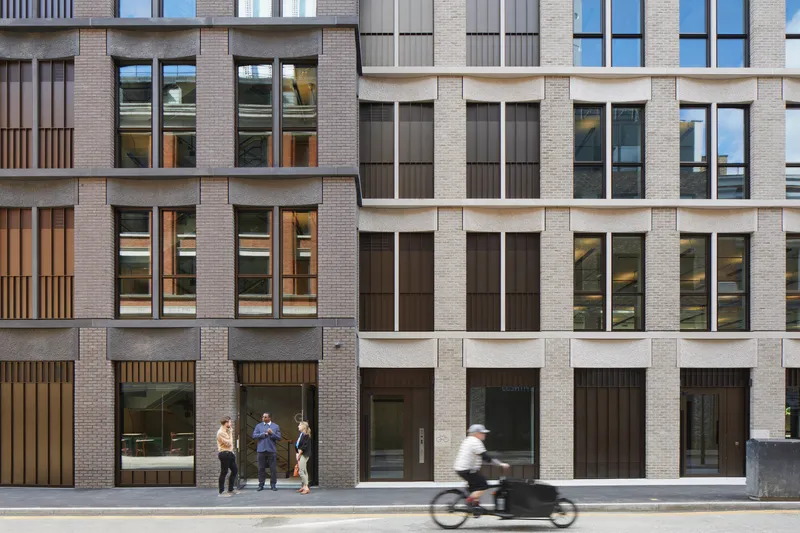
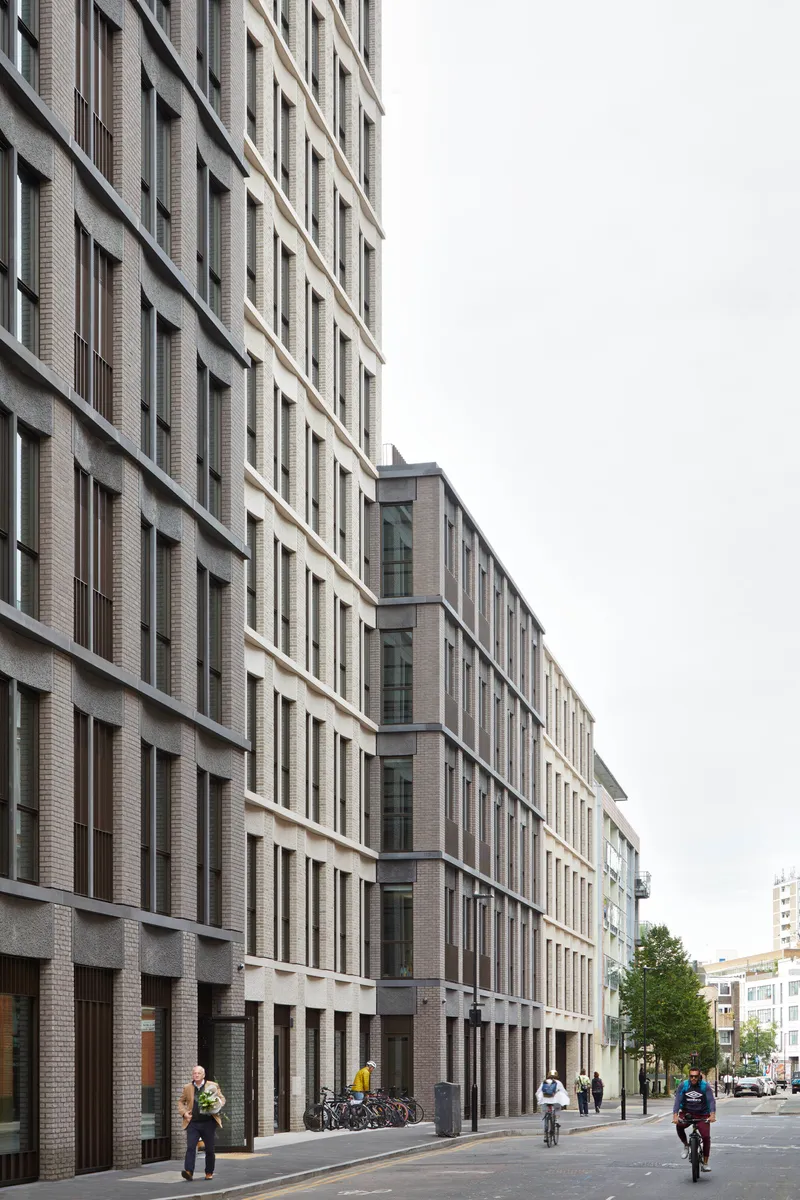
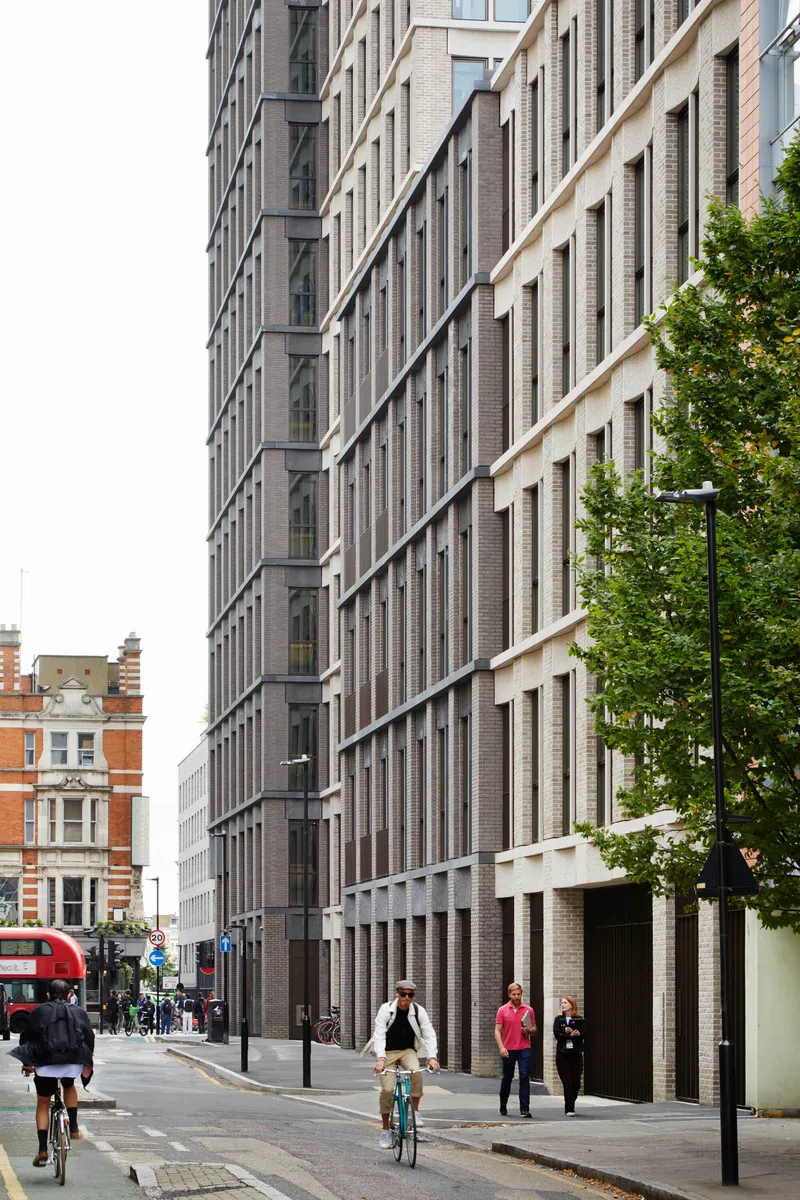
Morris+Company grounded the design in extensive photographic and drawing studies of the area's Victorian warehouse buildings. The influence shows in the proportional discipline of the facades: a regular 3-meter grid, generous 3.125-meter floor-to-ceiling heights, and deep window reveals that give the elevations a convincing sense of mass. Two brick colors, a cinder grey by Wienerberger and a Gibraltar brick by Crest BST, do the heavy compositional lifting. By distributing these across the four "characters," the architects break the long frontage into parts that feel like they were built over time, not delivered in a single contract.
The building steps from eleven stories on City Road down to ten and then five stories as it moves away from the main street. The stagger works in plan as well as section, so each volume meets the next at a slight shift rather than a straight joint. The effect from street level is of distinct buildings that happen to share a family resemblance.
Prefabricated Facades, Traditional Ambitions
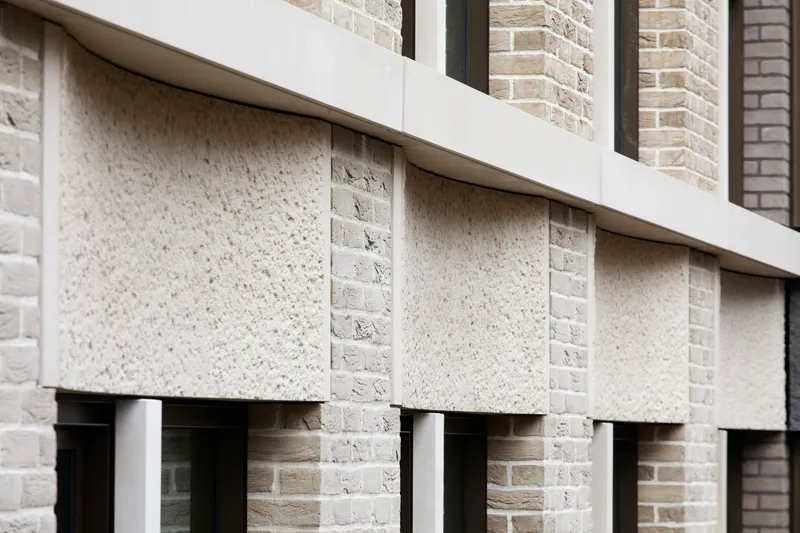
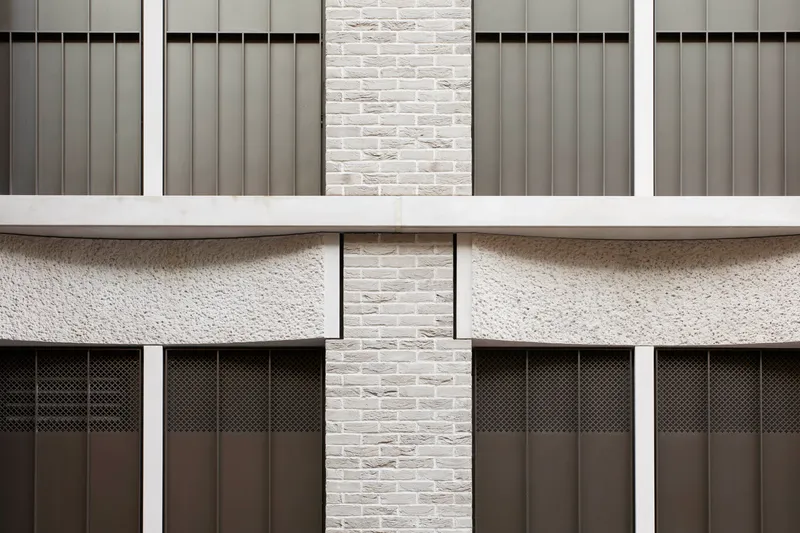
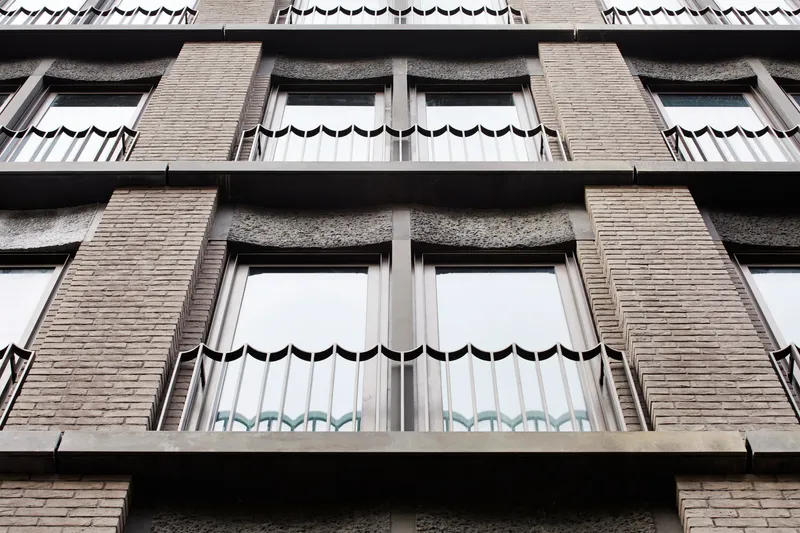
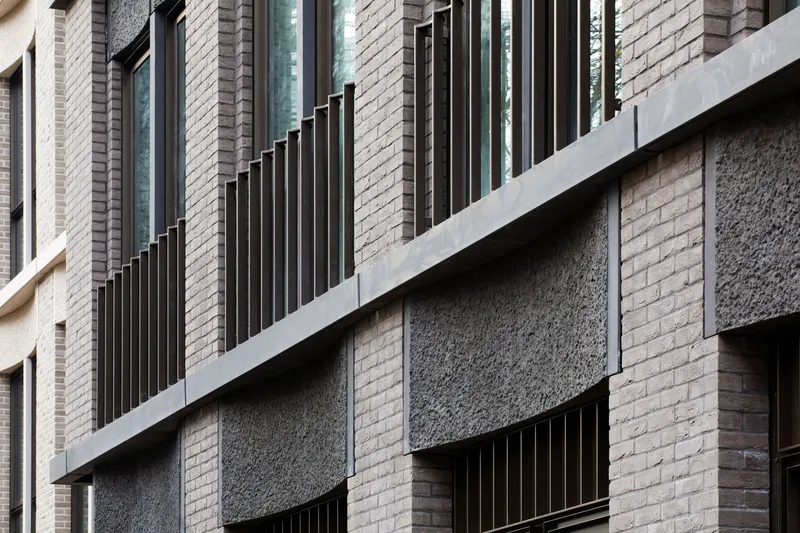
The detail shots reveal scalloped concrete spandrels, white brick piers, and textured metal awnings that would not look out of place on a carefully handcrafted elevation. Yet from the first floor upward, almost every element was manufactured 2,400 miles away in Latvia and shipped as part of a panelized curtain walling system. Just under 900 unitized panels were craned into place in a just-in-time installation sequence, drastically compressing the program and cutting both material waste and embodied carbon.
At ground level, traditional hand-laid masonry was used to achieve the craft finish people actually touch and inspect up close. From the first floor up, brick slips applied to the prefabricated panels take over seamlessly. The join between the two techniques is nearly invisible, which is the whole point: the building wants to read as solid masonry, and it succeeds.
Massing and the Bunhill Fields Edge
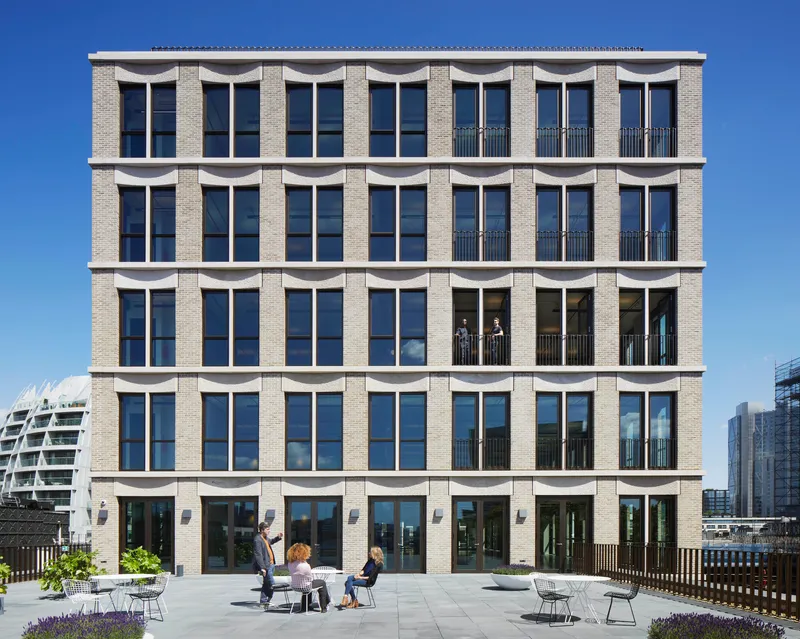
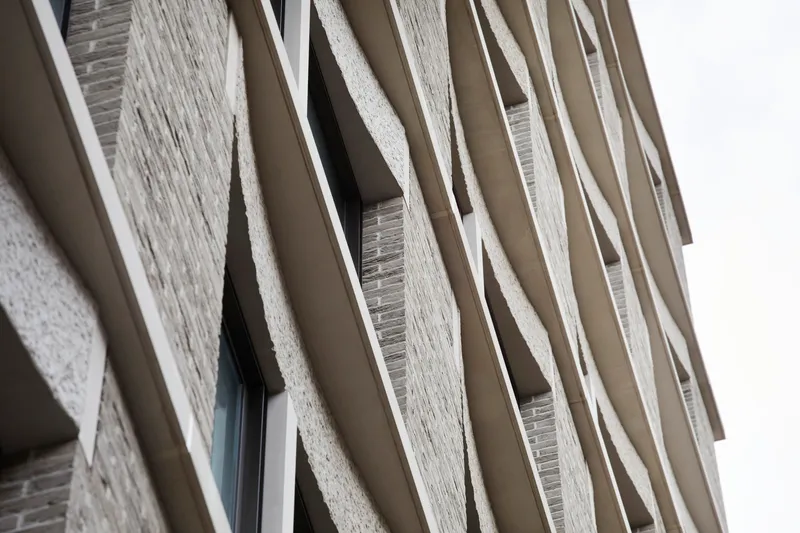
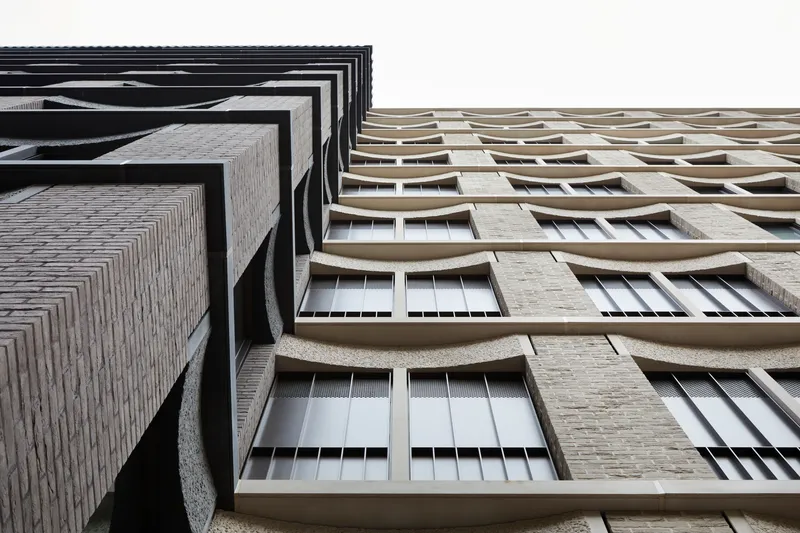
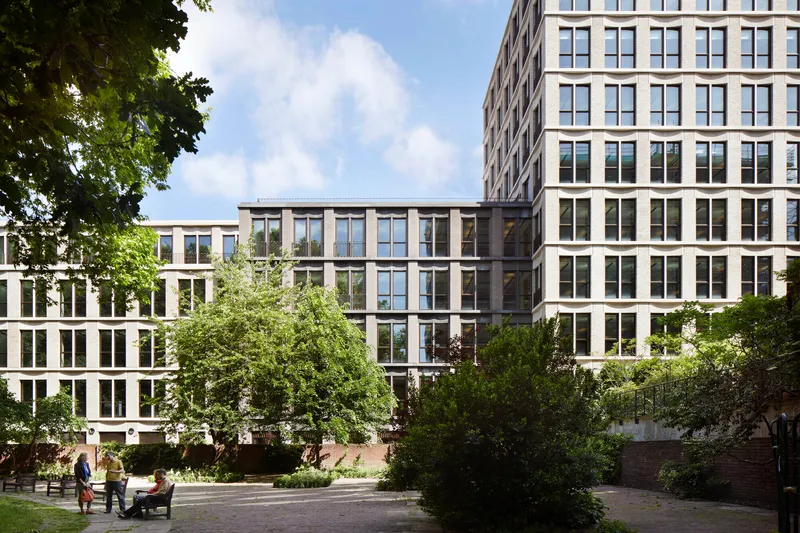
The building's stepped profile is most legible from the courtyard and cemetery edges, where the five-story volume meets the taller blocks with arched white concrete lintels and a rooftop terrace populated with seating. Curved concrete balcony parapets and projecting fins add a sculptural dimension to what could otherwise be a straightforward setback diagram. These moves soften the transition to Bunhill Fields and create outdoor spaces at multiple levels that take advantage of the cemetery's protected tree canopy.
The rooftop pavilion crowns the composition with a biodiverse garden planted with flowers, herbs, and multi-stem species across 400 square feet, delivering a claimed 100 percent biodiversity net gain. In a part of London where commercial rooftops are typically reserved for plant rooms, it is a genuine amenity.
Ground Floor and Common Spaces
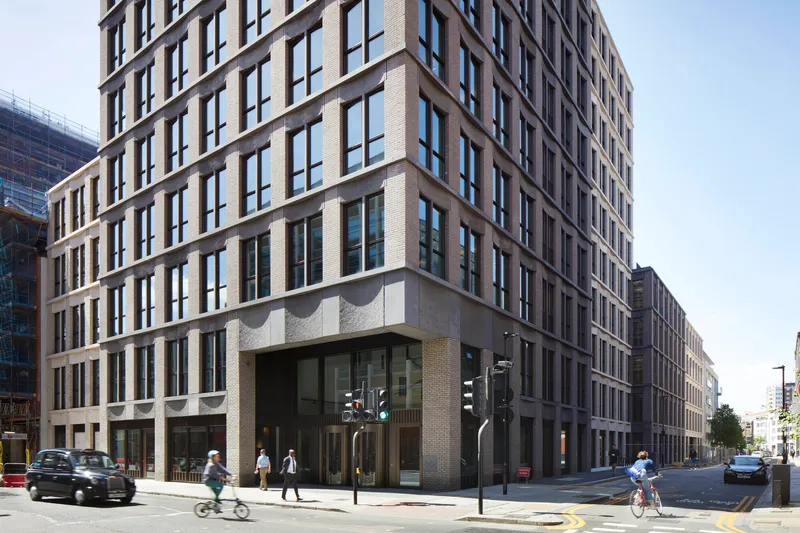
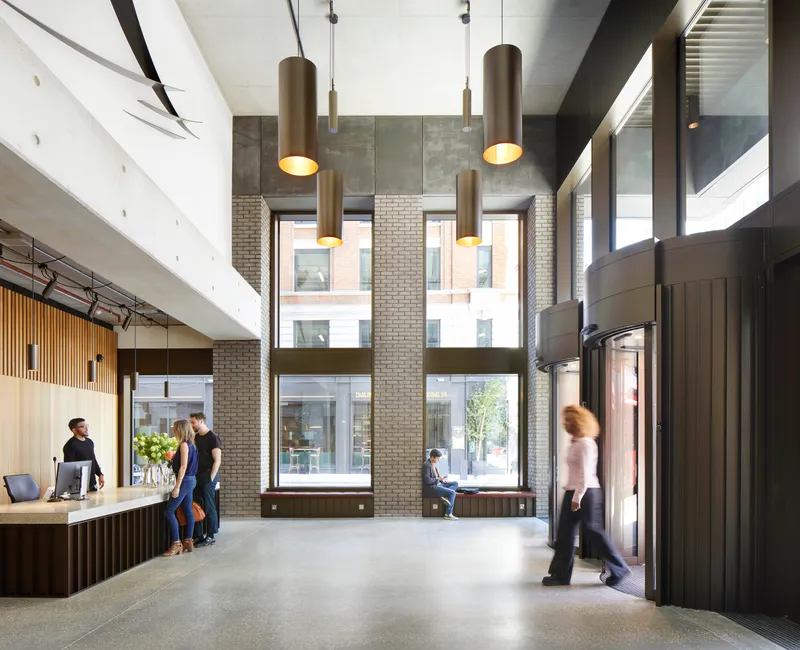
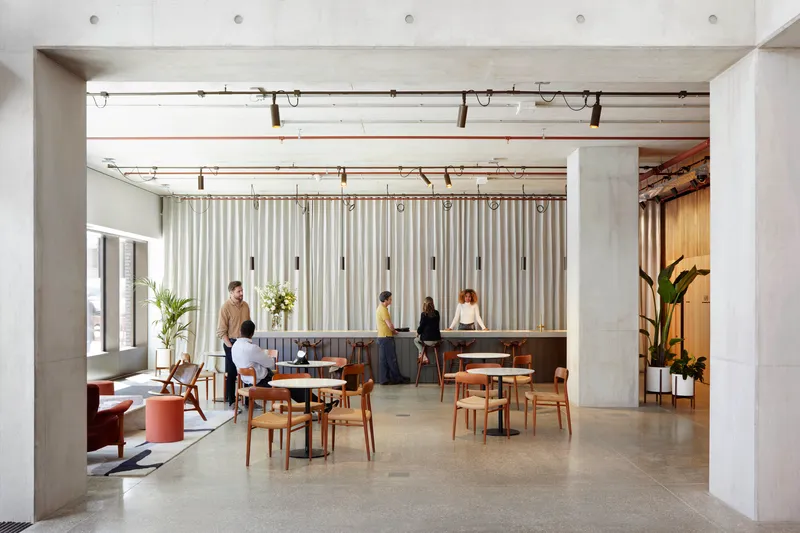
The main entrance occupies a double-height corner recessed to form a sheltering portico. Inside, the reception lobby stretches along floor-to-ceiling glazing with cylindrical bronze pendant lights that set a tone that is warm but not corporate. Exposed concrete beams and columns remain visible throughout the common areas, serving both as an honest expression of structure and as a functional element: the concrete frame provides thermal mass for the building's concrete core cooling system.
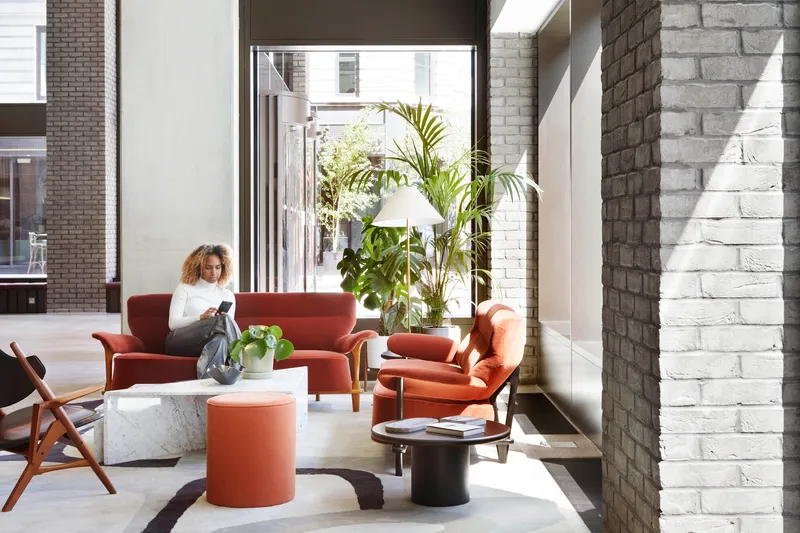
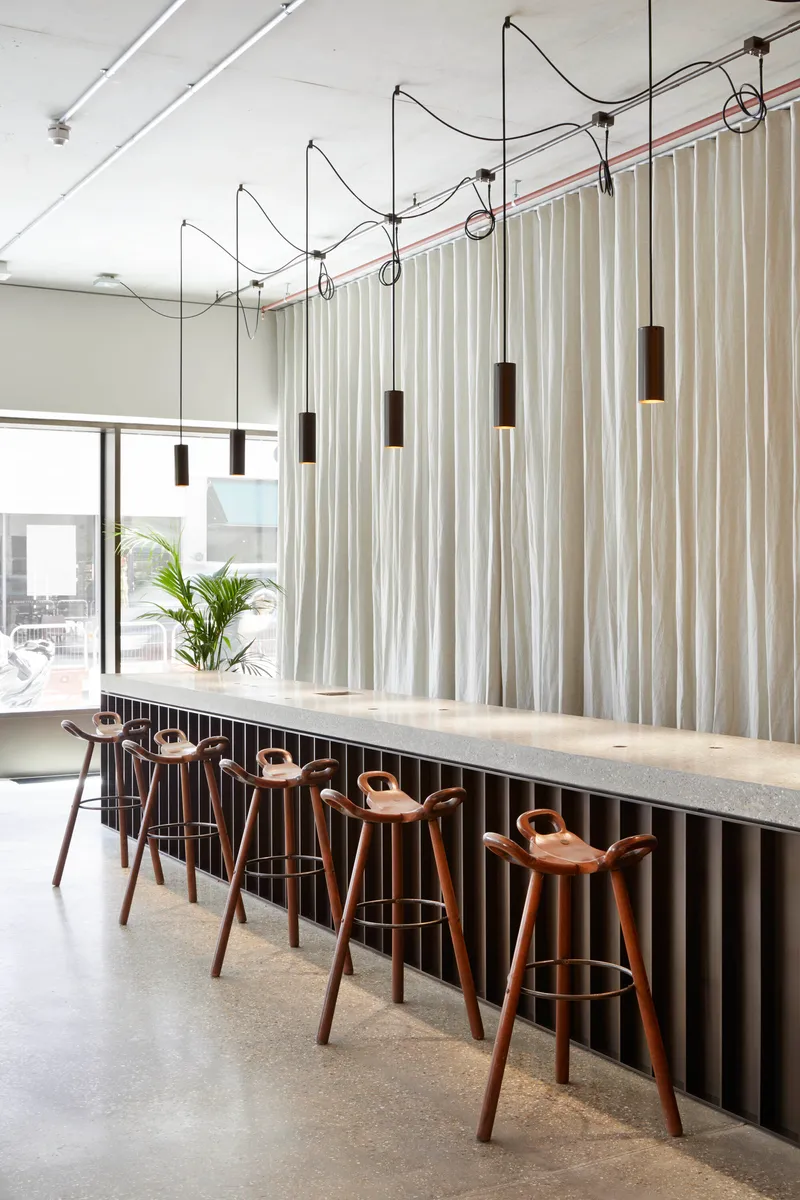
A ground floor café opens to the public, bridging the building's commercial tenants with the wider neighborhood. The interior palette of oak detailing, terracotta upholstery, and white-painted brick walls feels calibrated to the Shoreditch-adjacent vernacular without descending into pastiche. A long bar counter with timber stools under pendant lighting suggests that Morris+Company thought carefully about what would actually draw people in from City Road.
Workspace and Environmental Performance
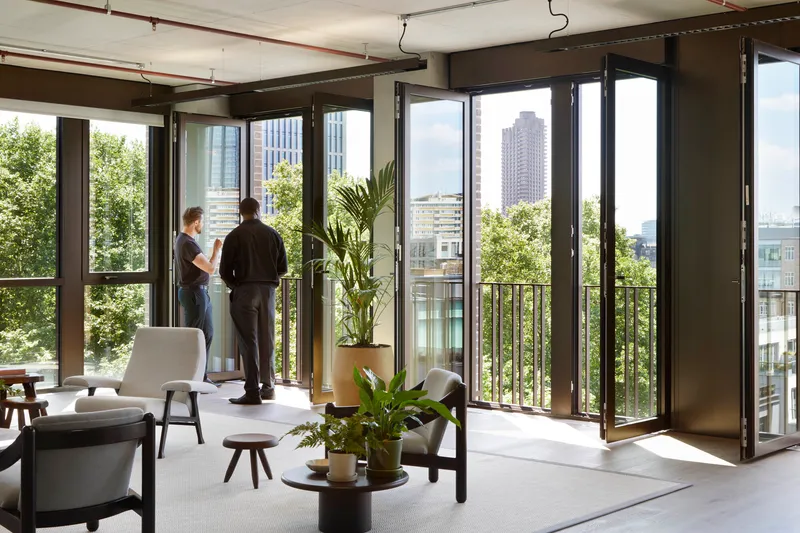
The office floors vary in size as the building steps down, which gives tenants a genuine choice of scale. Fully openable floor-to-ceiling windows bring fresh air and views of the Bunhill Fields tree canopy into every workspace. The environmental strategy pairs these openable windows with a concrete core cooling system, a supply air plenum beneath raised floors, and integrated sensors that tune energy use to actual occupancy. The result is a slate of certifications that reads like a sustainability awards ceremony: BREEAM Outstanding, LEED Platinum, WELL Platinum, WiredScore Platinum, and an EPC rating of A.
Morris+Company also designed the structure with "hard soft spots," built-in provisions that allow future tenants to link floors without major structural intervention. The architects describe this as a loose-fit, long-life philosophy. It is a pragmatic concession to the reality that office buildings outlast their first tenants, and the cheaper you make future change, the less likely a demolition becomes.
Courtyard and Landscape
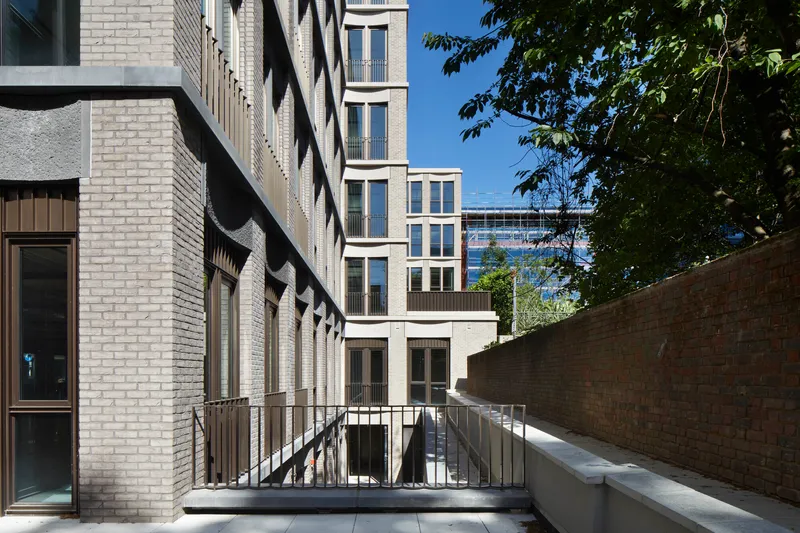
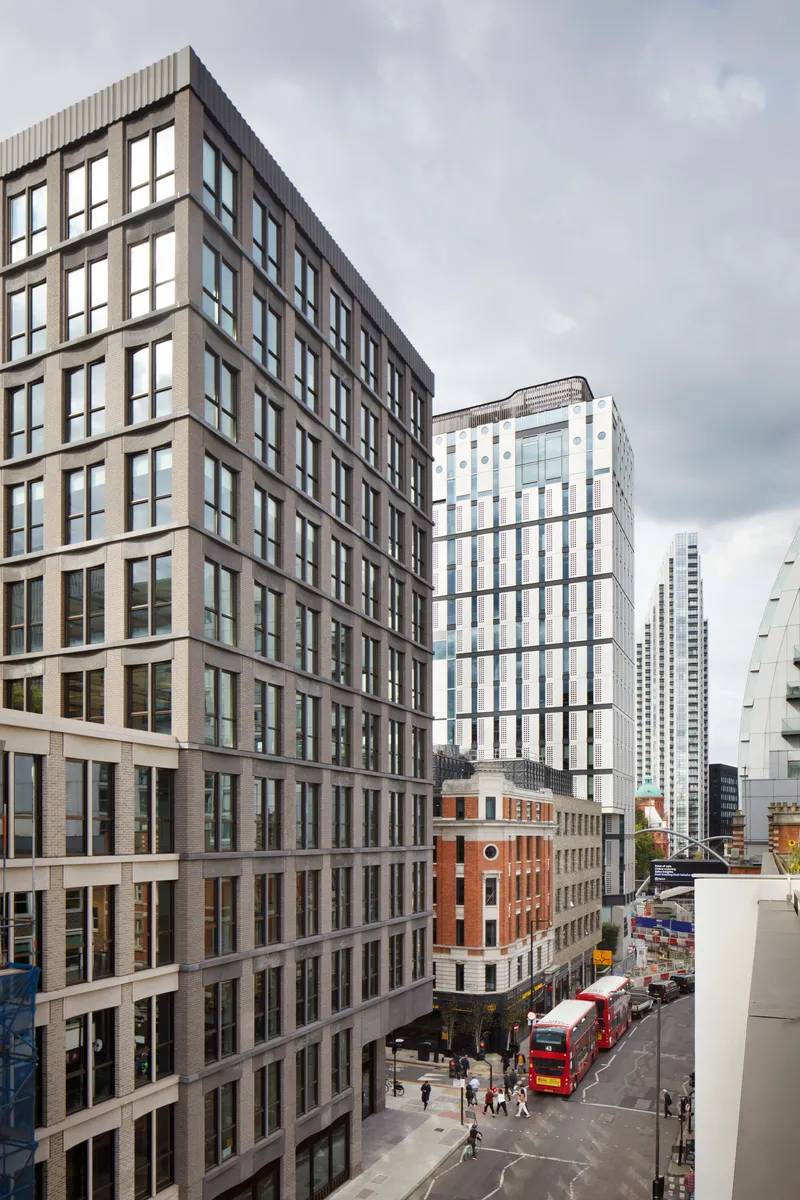
Between the building's volumes, a courtyard draws light and greenery into the lower floors. Brick walls and metal railings frame sunlit passages lined with mature tree foliage, creating a microclimate that feels distinct from the hard urbanism of City Road. For cyclists, 275 parking spaces and shower facilities are tucked into the lower levels, a necessity in this part of London where a substantial share of commuters arrive on two wheels.
Plans and Drawings
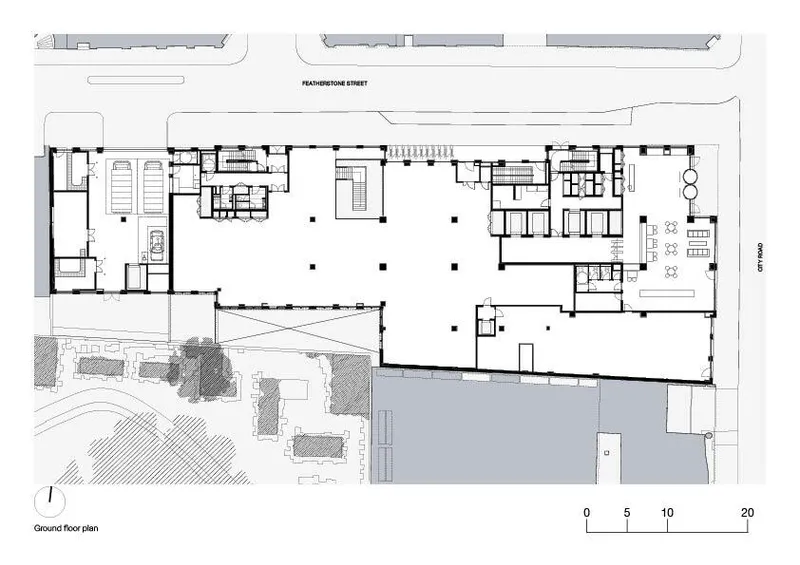
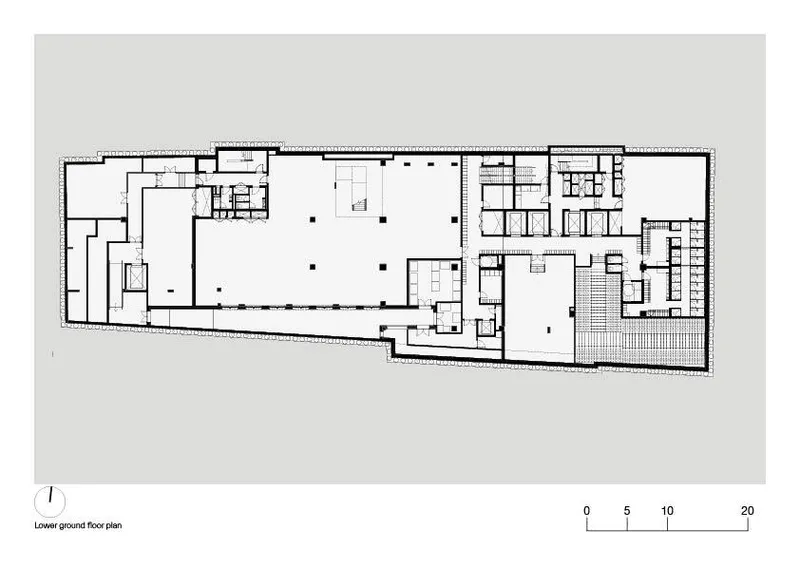
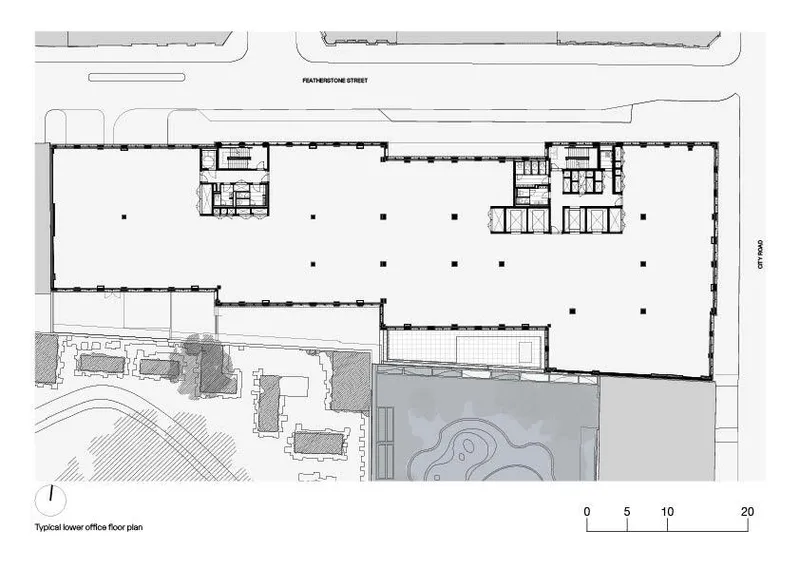
The ground and lower ground floor plans reveal the building's linear massing with clustered service cores arranged to maximize open workspace on the perimeter. The lower ground level splits into two large volumes separated by circulation and support spaces, accommodating the 275-bike store and accessible car parking without consuming the street frontage.
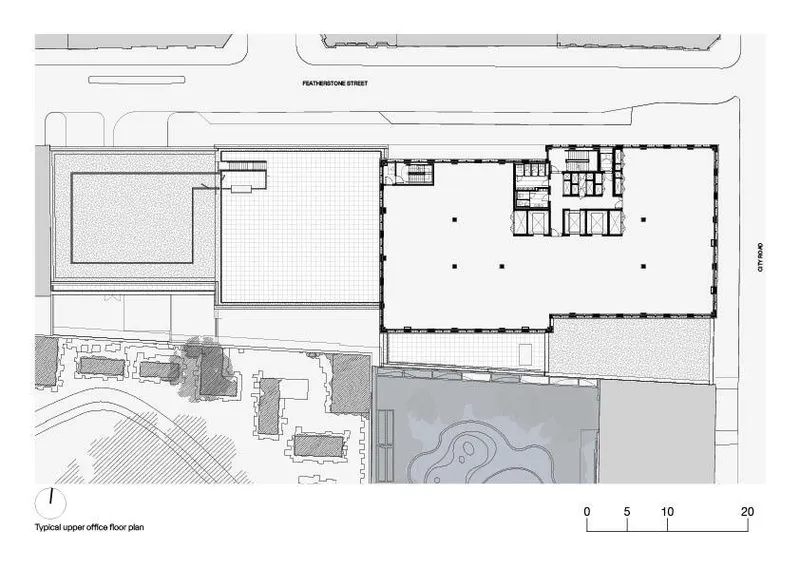
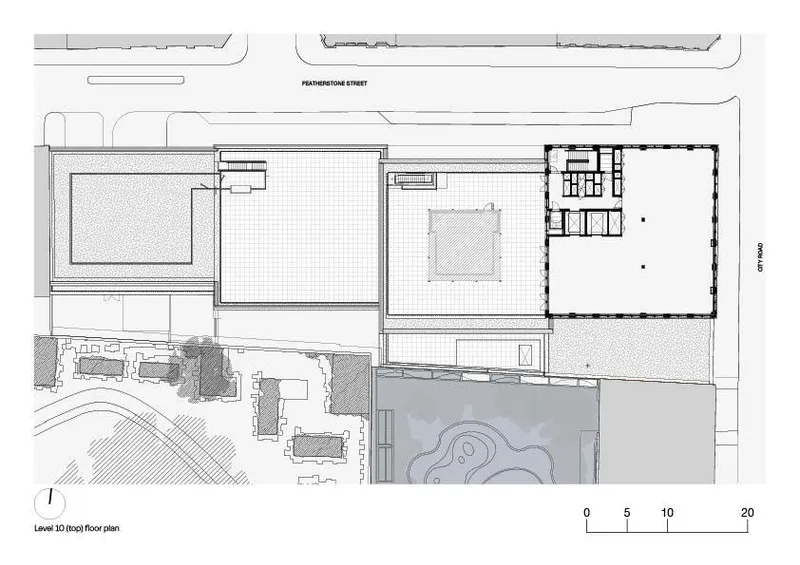
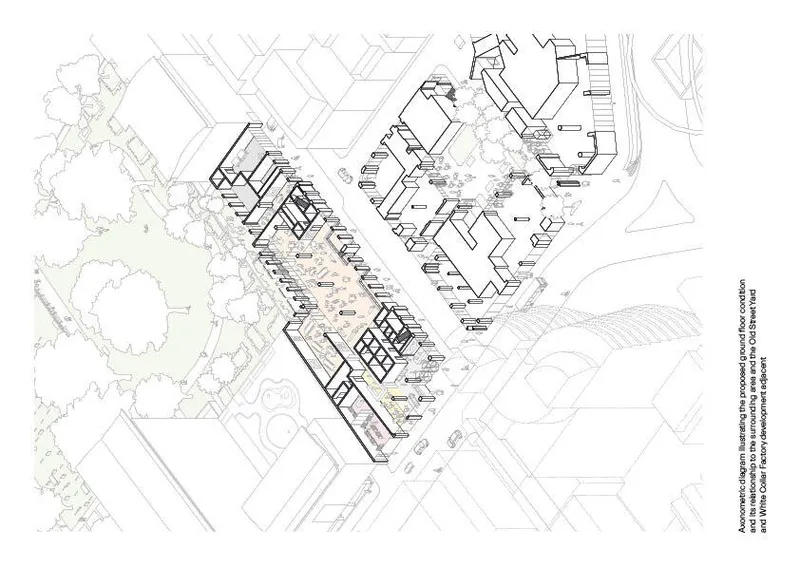
Typical upper floor plans show the progressive reduction in footprint as the massing steps back, freeing rooftop terraces at each setback level. The Level 10 plan isolates the rooftop pavilion as a central enclosed structure surrounded by open terrace, while the axonometric drawing makes the volumetric logic explicit: stacked, shifted blocks that negotiate between a tall City Road frontage and the lower scale of the cemetery edge.
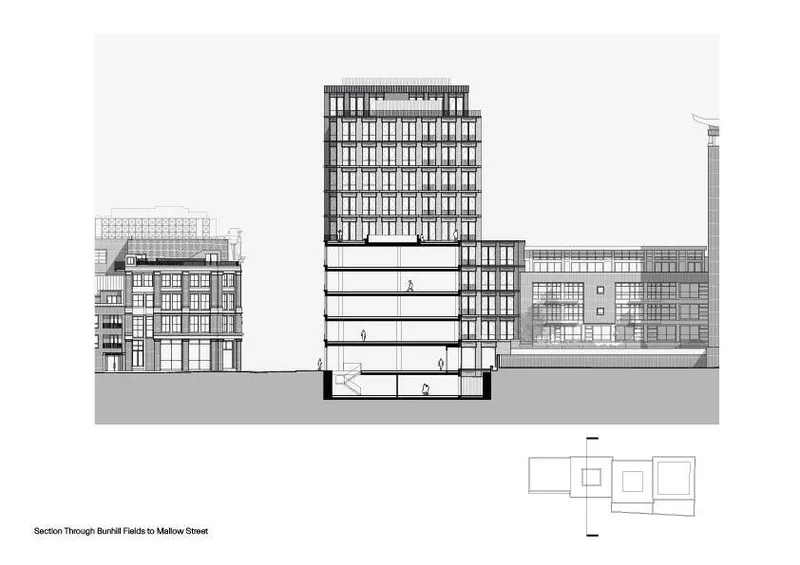
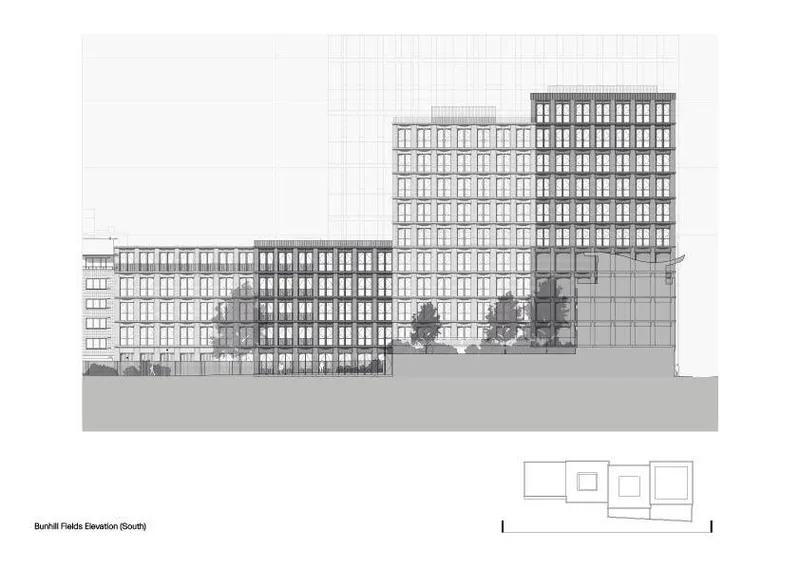
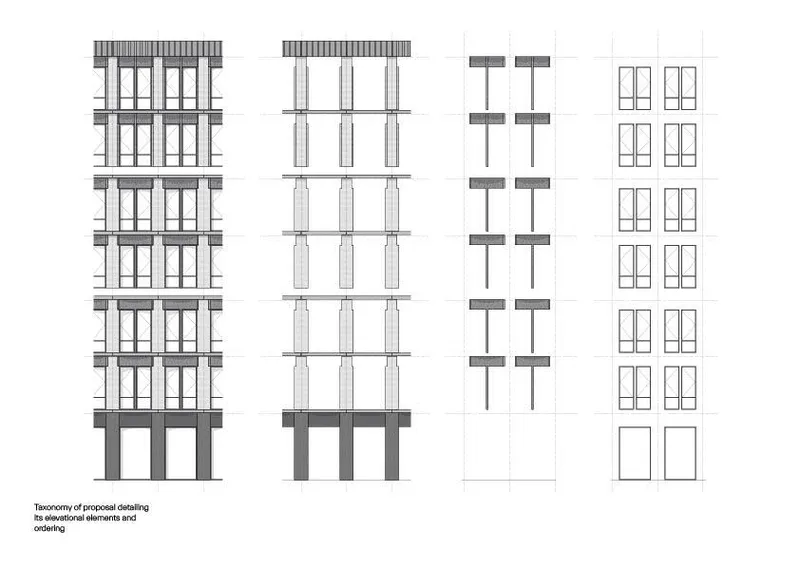
The section drawing confirms the stepped profile and reveals basement levels that extend beneath the full building footprint. The elevation drawing along the street frontage presents the four facade characters side by side, while the elevational taxonomy sheet catalogs the variations in cladding, spandrel, and column treatment that give each "building" its identity. Together, these drawings make a convincing case that the compositional strategy is not superficial: the fragmentation runs through the structure, not just the skin.
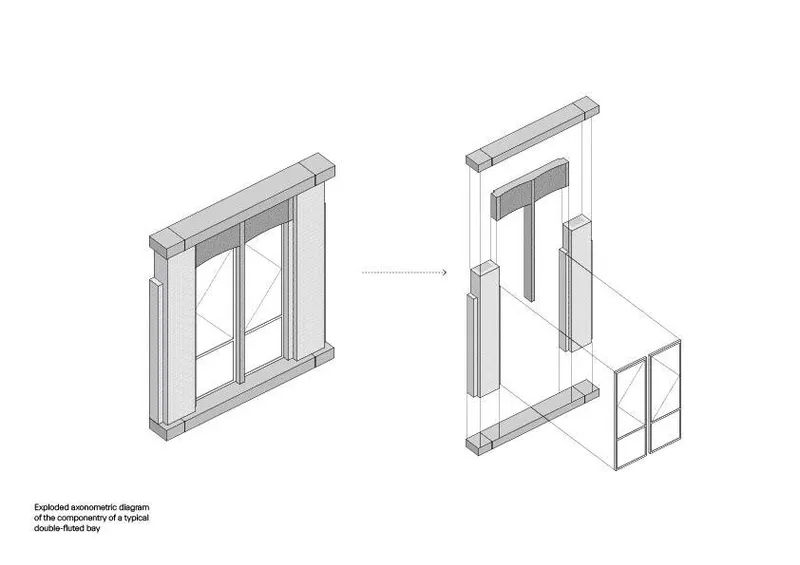
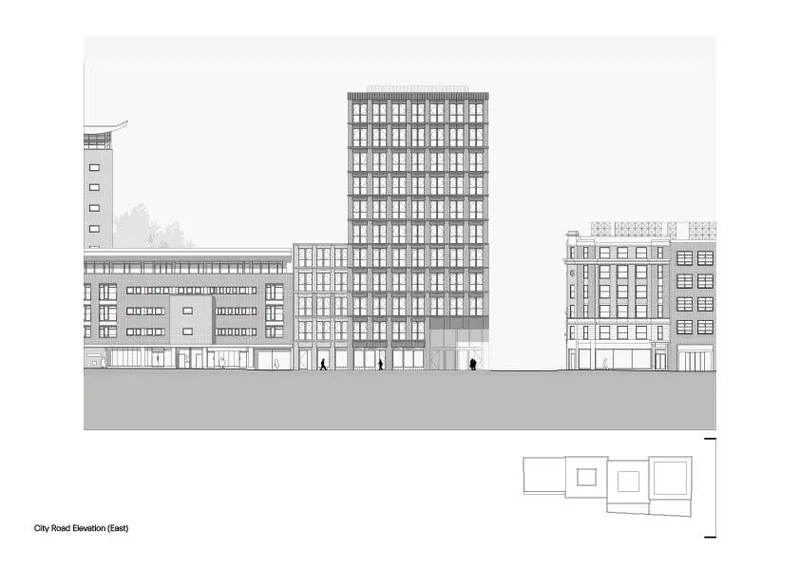
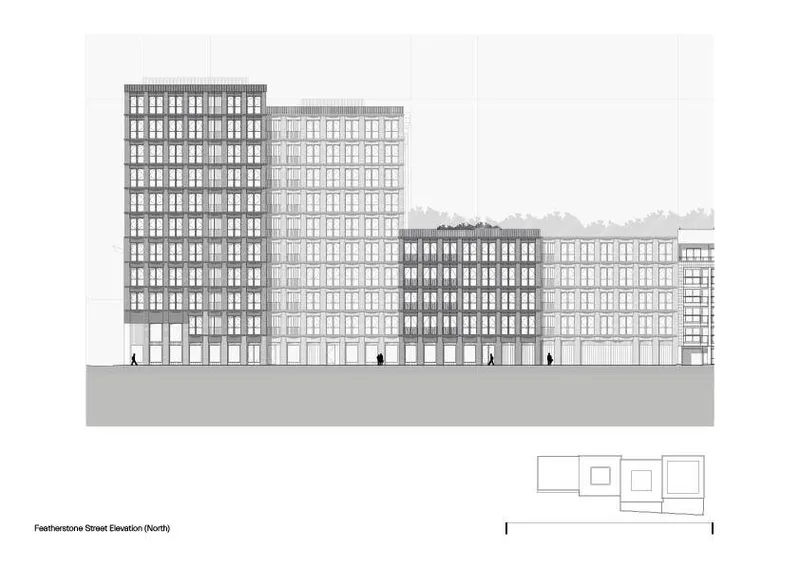
The exploded axonometric of a typical window bay is the most revealing drawing in the set. It shows the unitized panel assembly: frame, spandrel, brick slip, and glazing module arriving as a single component ready for installation. The east and north elevation drawings complete the picture, depicting how the building modulates its height and facade expression across all four faces.
Why This Project Matters
The Featherstone Building matters because it demonstrates that prefabrication and contextual richness are not mutually exclusive. Too many contemporary office buildings in London default to one or the other: either a slick curtain wall that ignores everything around it, or a nostalgic brick facade that conceals standard construction behind a heritage-flavored veneer. Morris+Company managed to ship 900 panels from Latvia and still produce a building that belongs on this particular corner, next to this particular cemetery, within this particular neighborhood's warehouse grammar.
The deeper achievement is structural honesty paired with environmental ambition. The exposed concrete frame does triple duty as structure, thermal mass, and interior finish. The openable windows are not a token gesture but part of a calibrated system. And the built-in provisions for future change acknowledge that the most sustainable building is the one that never needs to be torn down. In a city where commercial buildings are routinely demolished after thirty years, that kind of thinking is worth more than any certification.
The Featherstone Building by Morris+Company. Located on City Road, London, United Kingdom. 15,989 m². Completed in 2022. Photography by Jack Hobhouse.
About the Studio
Company
Share Your Own Work on uni.xyz
If projects like this are the kind of work you want to make, uni.xyz is a place to publish your own, find collaborators, and enter design competitions.


Popular Articles
Popular articles from the community


David Macias Steps a Doorless Stone and Plaster House Down a Tropical Colombian Hillside
In the humid hills of Colombia, Threshold House replaces the front door with an open void and terraces its 850 m² down the slope instead of fighting it.

Cube Design Draws an Ecological Corridor Between Two Shenzhen Hills with the Nankai Building
Beside Shenzhen's container docks, the Nankai Building pairs stacked balconies with a climbing green screen to connect two hillsides across its height.

Jaramillo Van Sluys Arquitectura and Urbanismo Turn a Demolished Registry Lot in Quito into an Orchard Plaza
In Quito's Centro Histórico, a 2,800 m² plaza exposes the San Agustín convent wall and redraws its lost Augustinian orchard in volcanic stone.

Architekt Andreas Gruber Scatters 23 Dark Timber Chalets Across a South Tyrolean Forest Edge
In Molini di Tures, Amonti Chalets breaks a resort into a hamlet of gabled timber houses, with parking, storage and services pushed into the slope.

Similar Reads
You might also enjoy these articles


LAVA Architecten Gives Vocational Education a Sawtooth-Roofed Face on a Mechelen School Campus
In Mechelen, Belgium, a 2,053 m² STEM school on a 6×6 m grid turns workshops and classrooms into rooms that can be rearranged as teaching changes.

KEMA Studio Turns a Derelict Marvila Attic into a 60 m² Lighthouse Apartment Above Lisbon
In Lisbon's Marvila district, a rebuilt roof, four skylights and two plywood volumes turn an unlivable attic into a bright home facing the Tagus.

Pixel Gardens: One Repeated Module Stacked Into a Terraced Social Housing Tower for Famagusta
Salem Bader's shortlisted housing tower builds a vertical neighbourhood from one repeated module, offsetting units to carve terraces, light and air.

Bao Huynh Watercolor Atelier: A Serene Art Retreat in Hội An
Bao Huynh Watercolor Atelier in Hội An blends multifunctional art spaces, sustainable design, local materials, and family-friendly living in a serene environment.

Explore Architecture Competitions
Discover active competitions in this discipline

Challenge to reimagine the Iron Throne

Photograph architecture without architects

Illustrate the lost glory of Angkor Wat - Render Challenge

Design challenge to reuse E-waste
Comments (0)
Please login or sign up to add comments
No comments yet. Be the first to comment!