
Thien Hung Stacks Domestic Life Under a Slatted Timber Skylight in Southern Vietnam
A narrow house for a mother's retirement organizes tiered living spaces around a single vertical shaft of filtered daylight.

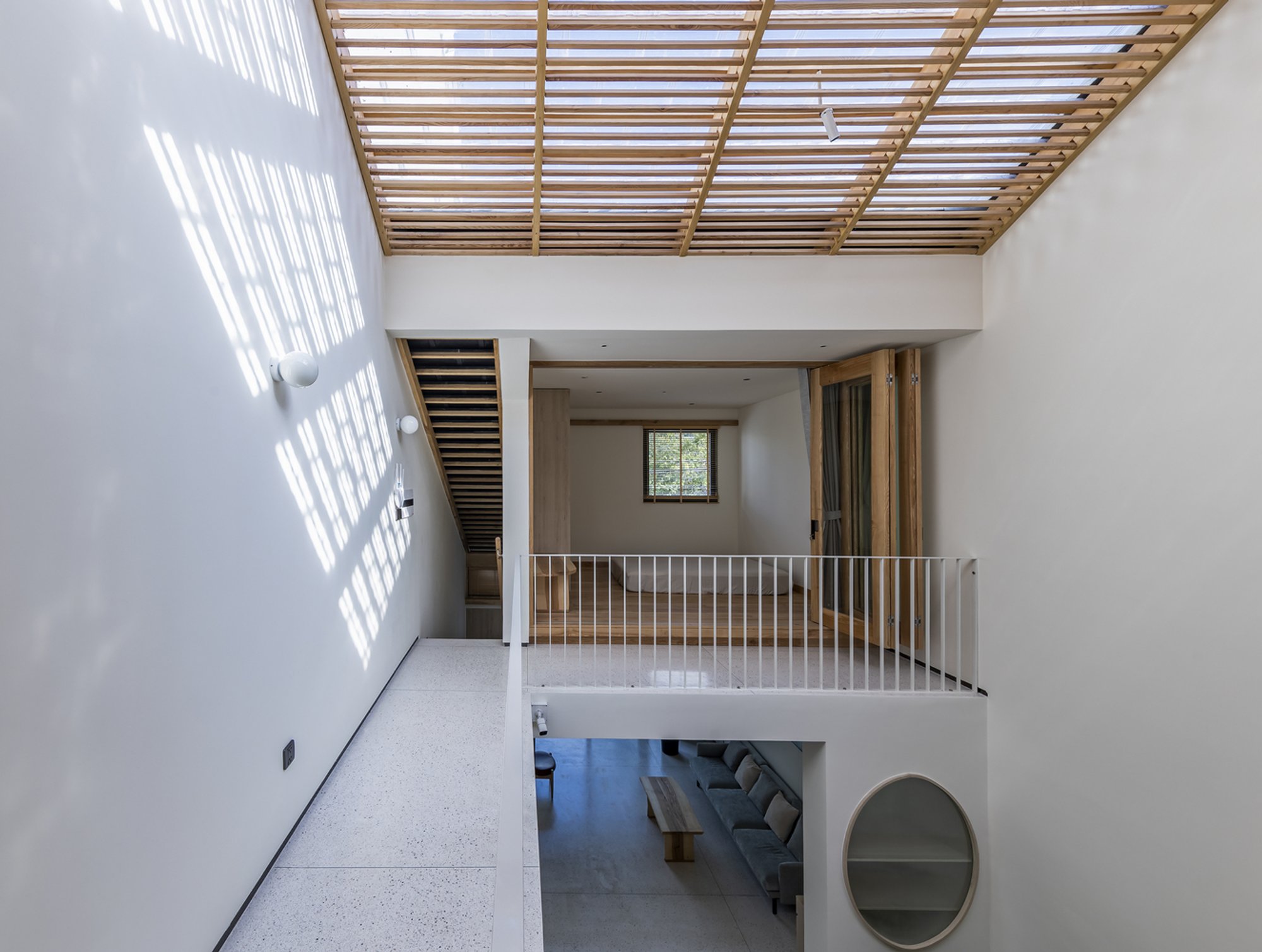
Tube houses are a fact of Vietnamese urbanism, but most designers treat the format as a constraint to mitigate rather than a spatial idea worth amplifying. Thien Hung Design and Construction takes the opposite approach with Mother's Small House, a compact residence that turns the deep, narrow lot into a kind of light instrument. The entire section is organized around a single double-height void capped by a dense grillage of timber slats, which filters and redirects sunlight into every room from the ground floor terrazzo up to the top-level bedroom.
Designed as a retirement retreat for one client's mother, the house solves a familiar brief: how to make a very small footprint feel generous without sacrificing privacy or comfort. The answer here is sectional, not planimetric. Rather than stretching rooms along a corridor, the architects stagger half-levels around the central void, so that every occupied space borrows light and air from its neighbor. The result is a house that reads as a single interconnected room when you look up and as a sequence of intimate alcoves when you look straight ahead.
The Skylight as Protagonist
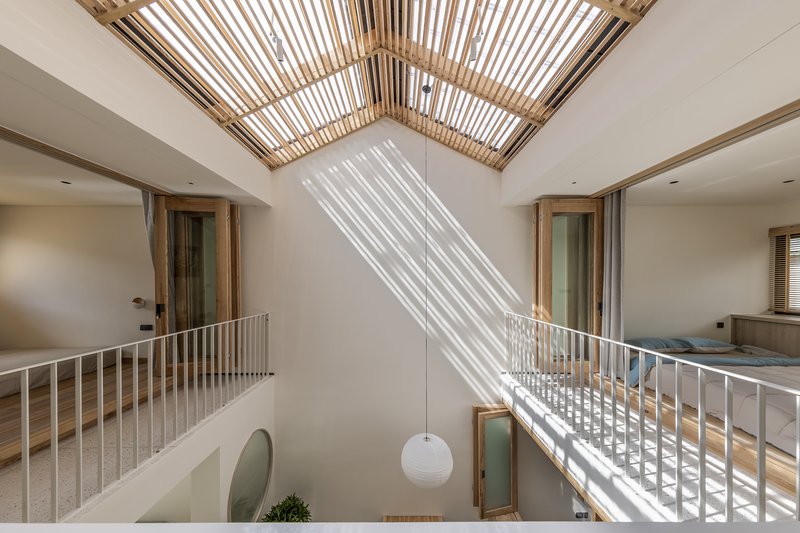
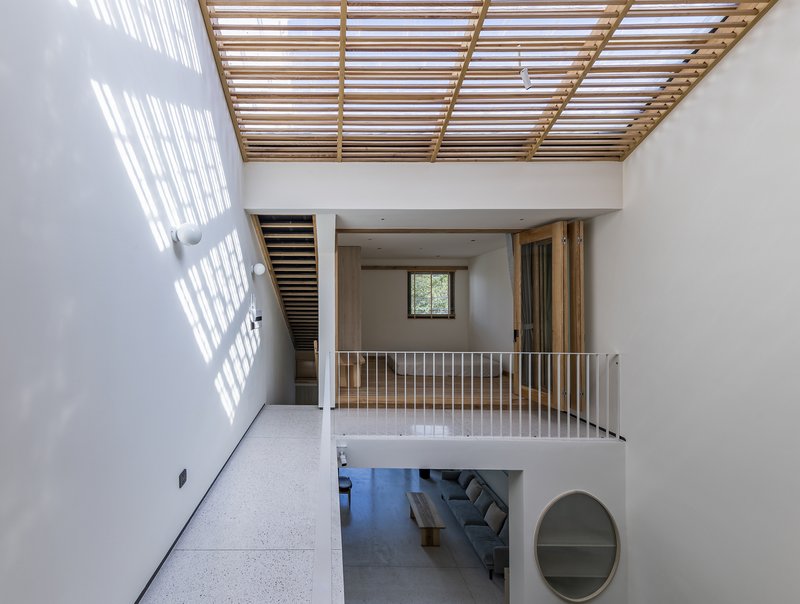
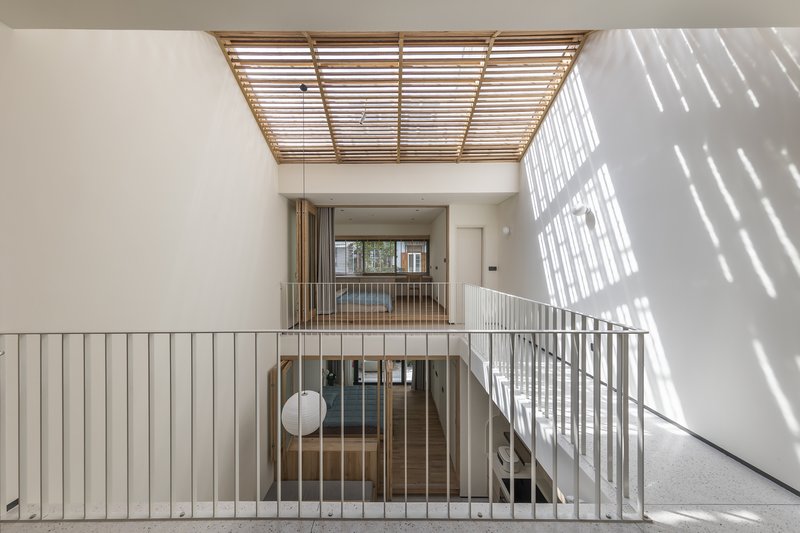
The slatted timber ceiling is the defining element of the entire project. It runs the full width of the void and sits high enough that it catches direct sun for most of the day, projecting crisp diagonal lines across the white walls below. The effect shifts throughout the hours: sharp geometric stripes at midday soften into a warm amber wash by late afternoon. It is a remarkably simple device, just parallel timber battens at a regular spacing, but the commitment to letting it govern the spatial character of the house gives the move real authority.
Critically, the grillage also functions as a climate strategy. The slats allow rising hot air to escape while breaking the force of rain, and the resulting stack effect helps ventilate the lower levels without mechanical intervention. In a Vietnamese climate, that passive cooling capacity is worth more than decoration.
Tiered Living Around the Void
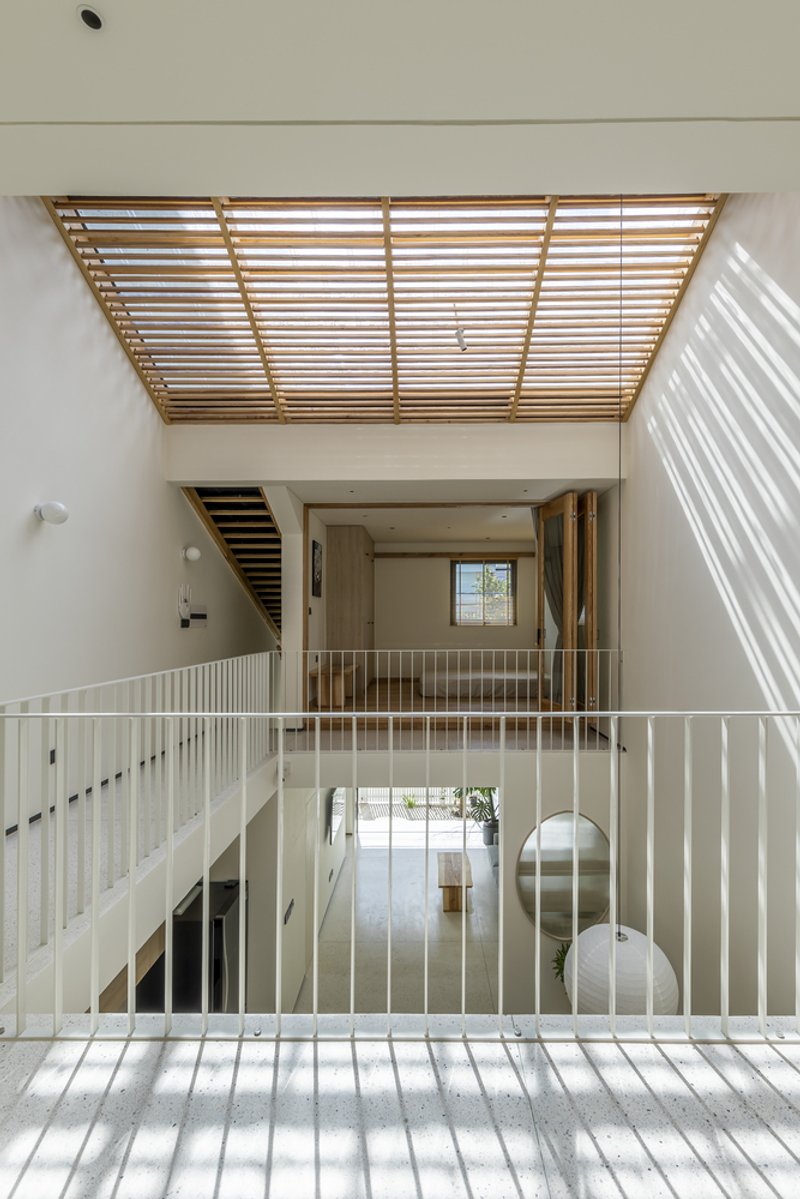
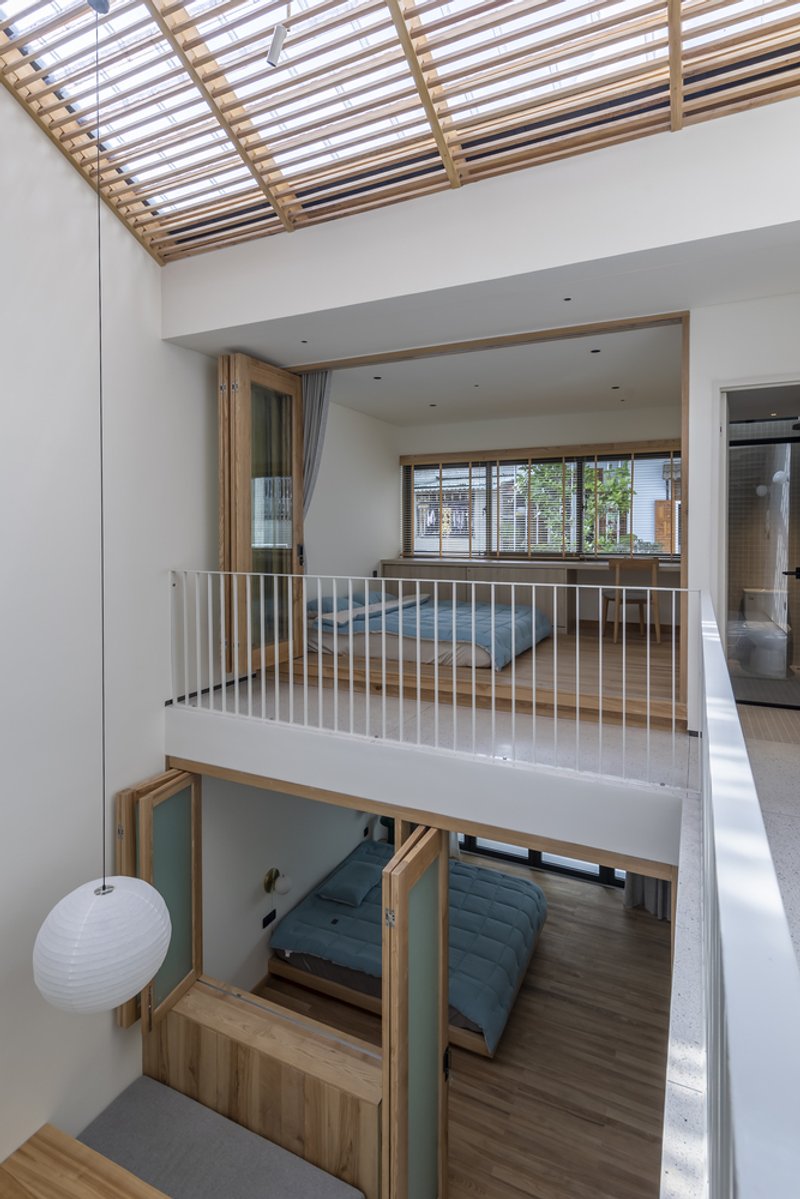
The staggered half-levels are visible in a single glance from the mezzanine, where the open floor plates reveal the full sectional logic. White vertical railings run continuously from floor to ceiling, providing safety without blocking sightlines. A bedroom sits below; a reading nook or secondary living space opens at the intermediate level; the skylight closes the composition overhead. The tiering gives each zone a different ceiling height and a different quality of light, which is a subtle but effective way to differentiate program without adding walls.
The material discipline here deserves mention. White plaster, timber, metal railings, and terrazzo tile make up nearly the entire palette. No accent walls, no decorative tile patterns, no feature cladding. The restraint lets the shadow patterns do the visual work and keeps the house from feeling cluttered despite its modest footprint.
Ground Floor: Dining and Daily Ritual
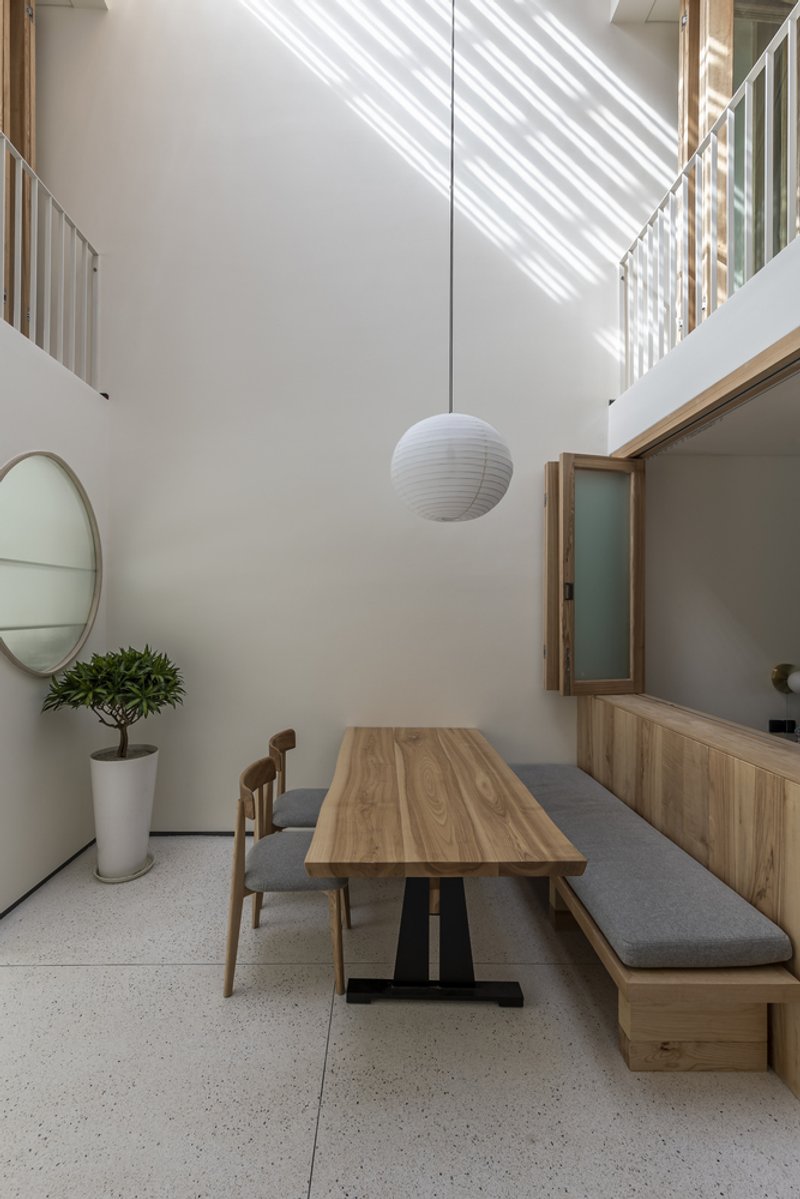
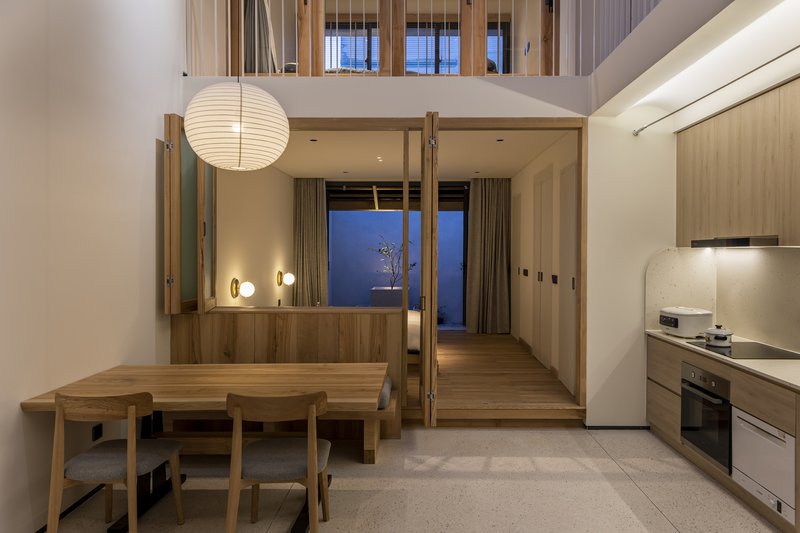
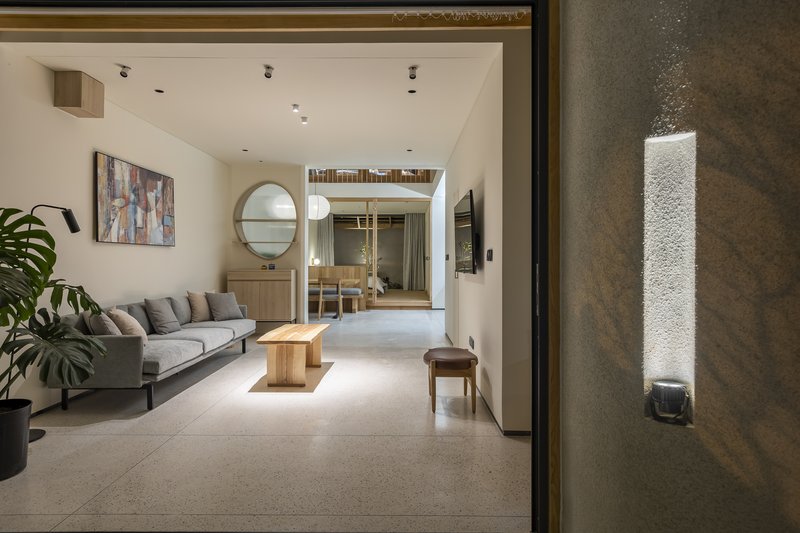
At the ground level, the dining area anchors the social life of the house. A solid timber table sits directly beneath the void, catching dappled sunlight through the overhead slats. The paper globe pendant above the table is one of very few decorative gestures in the house, and it reads as the warm domestic counterpoint to the rigorous geometry overhead. At dusk the relationship flips: the pendant becomes the primary light source, and the skylight dissolves into darkness.
An arched opening separates the dining room from a quieter living zone, where a circular mirror and potted plant soften the otherwise rectilinear language. The arch is a deliberate concession to the client's preference for something warmer than a squared-off threshold, and it works precisely because the rest of the house is so disciplined. One curve among many would be wallpaper; one curve among straight lines is punctuation.
Bedrooms at the Edges
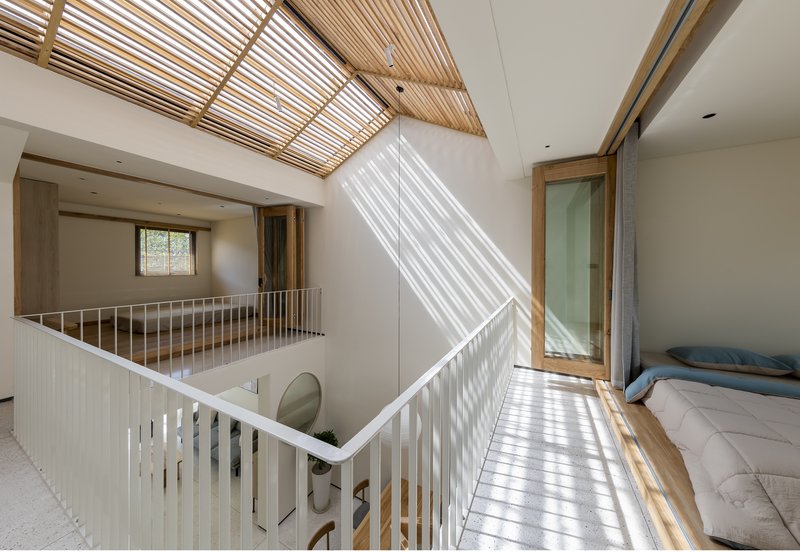
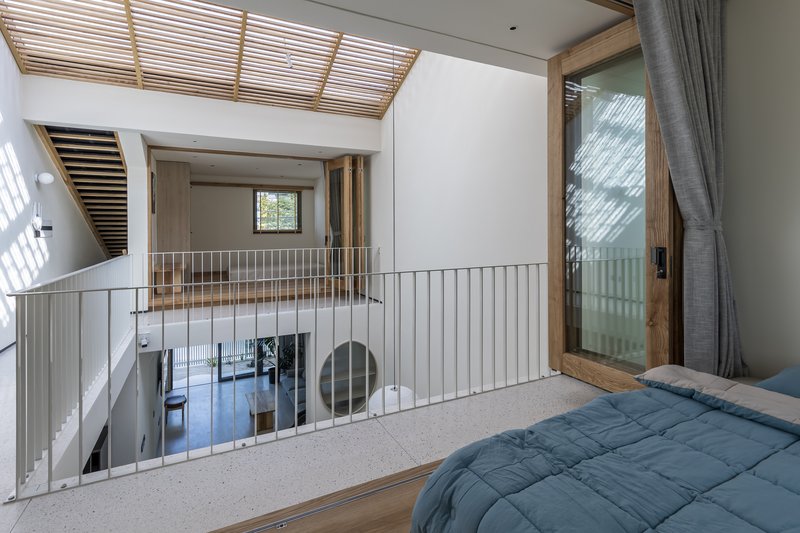
The sleeping spaces are pushed to the perimeter of the section, where they benefit from the borrowed light of the void but retain acoustic separation. The upper bedroom alcove, with its timber floor and direct exposure to the slatted roof, is one of the most photogenic rooms in the house, striped with shadow in a way that recalls a Richard Serra drawing. It is a genuinely compelling space to wake up in.
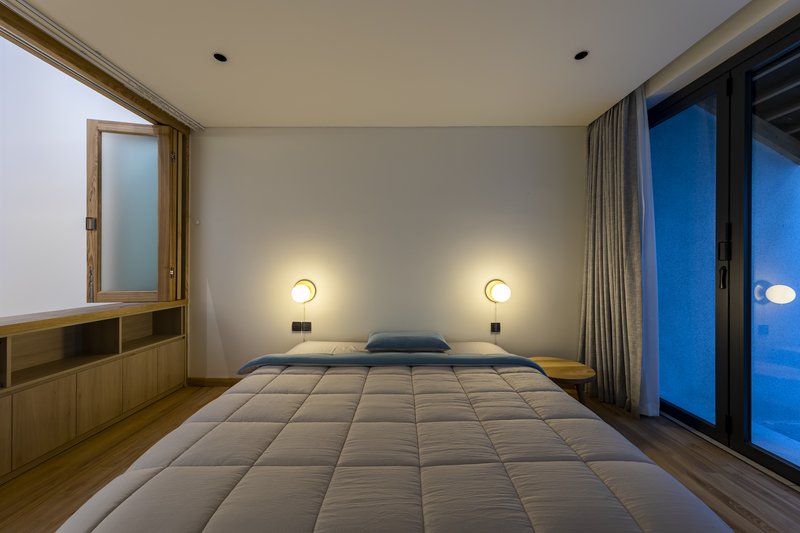
At the rear, a second bedroom opens through sliding glass doors onto a small terrace, offering a view of the sky and a buffer from the street. Paired wall sconces and a low platform bed keep the language minimal, reinforcing the idea that the architecture itself, not the furniture, provides the atmosphere. The dusk photograph captures this well: warm interior light bleeding outward through a simple glass wall, no curtain needed.
Street Face and Courtyard Screen
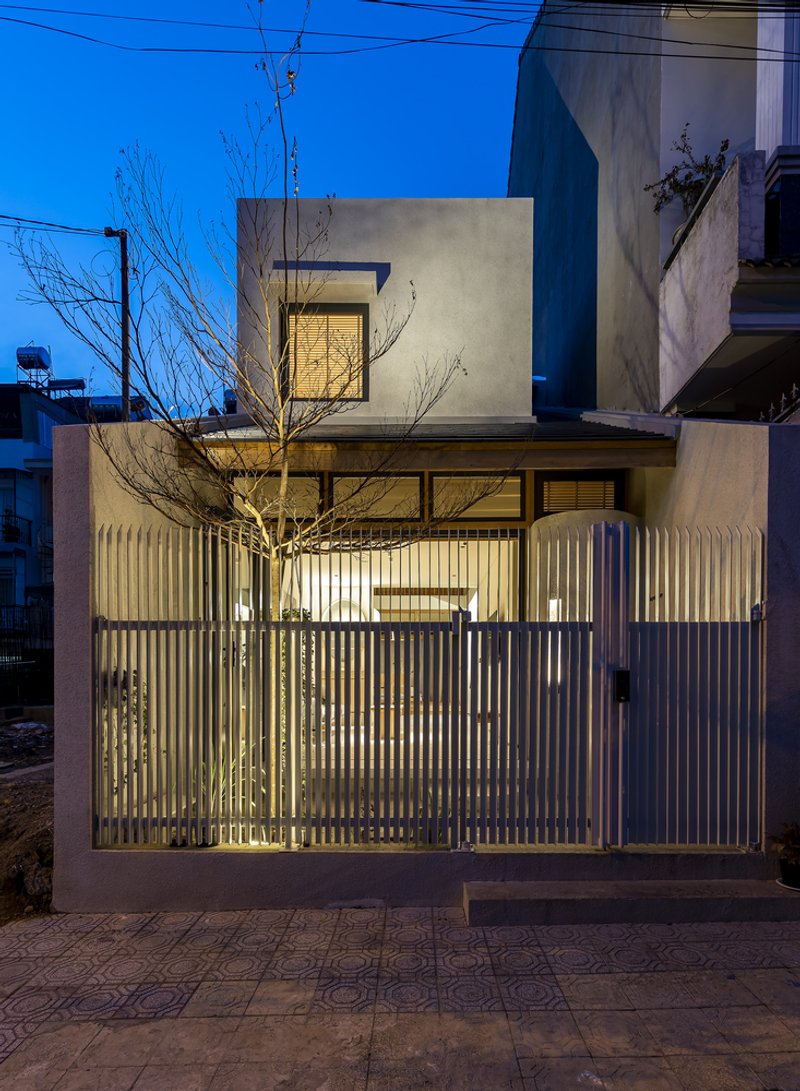
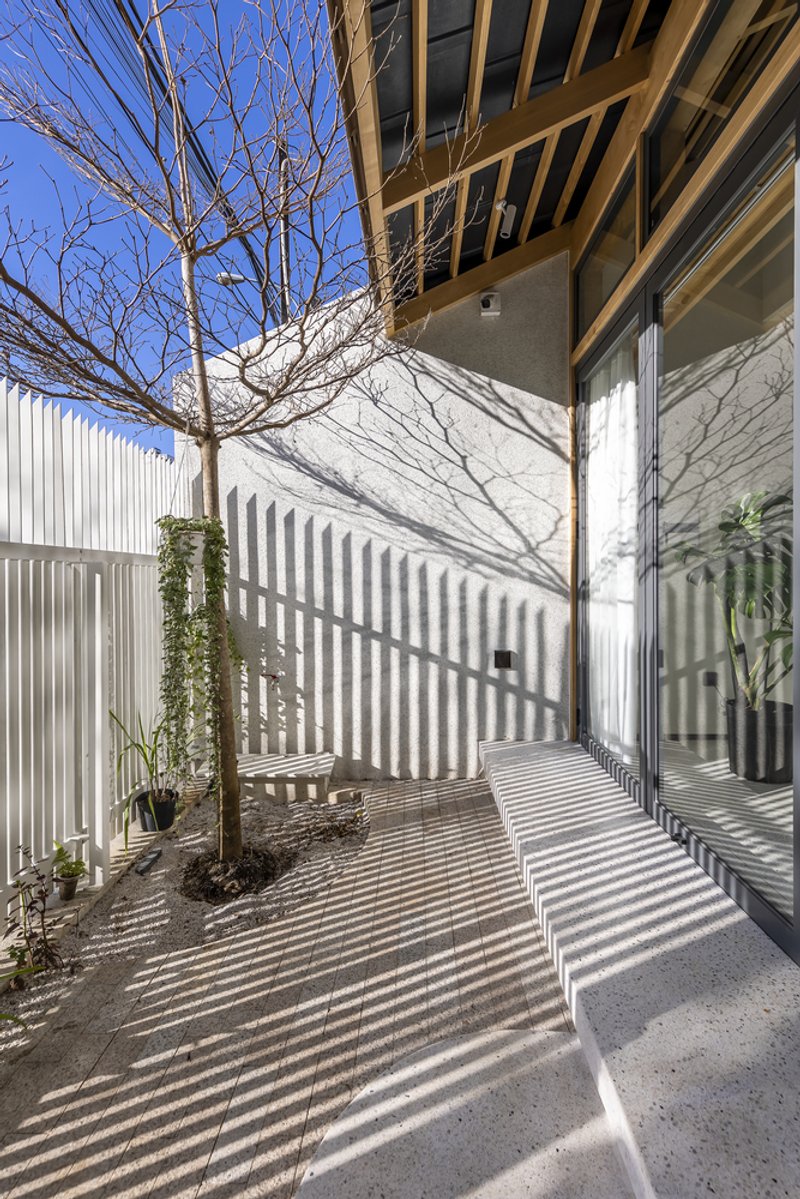
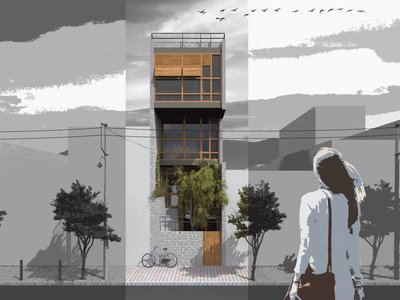
From the street, the house presents a vertical slatted metal gate that echoes the timber skylight inside. The effect at night is particularly strong: the interior glows through the slats like a lantern, signaling inhabitation without exposing the rooms. A bare deciduous tree in front softens the facade and introduces a seasonal register that the metal and concrete cannot provide on their own.
Behind the gate, a small courtyard with corrugated metal screens and planted beds mediates between the public sidewalk and the private interior. The planting is minimal but intentional: low groundcover and a single specimen tree, both scaled to the courtyard's tight proportions. The corrugated screens add a layer of visual texture that catches raking light in the afternoon, a reminder that even the transitional spaces in this house are designed as light-receiving surfaces.
Why This Project Matters
Mother's Small House is not trying to reinvent the Vietnamese tube house. It accepts the format's dimensional constraints and works within them with unusual precision, treating the section as the primary design instrument. The timber skylight grillage, the staggered half-levels, and the consistent material palette all serve a single argument: that a narrow house can be luminous and spatially rich if you control the vertical axis with care. That argument is convincing.
The project also demonstrates something that gets overlooked in discussions of small-house design: restraint is not the same as austerity. The house is warm, livable, and full of atmospheric variation throughout the day. It achieves that quality not through material extravagance but through an understanding of how light, shadow, and proportion create comfort. For a house built around the quiet routines of one person's retirement, that seems exactly right.
Mother's Small House by Thien Hung Design and Construction, Vietnam.
About the Studio
Share Your Own Work on uni.xyz
If projects like this are the kind of work you want to make, uni.xyz is a place to publish your own, find collaborators, and enter design competitions.




Popular Articles
Popular articles from the community

H&P Architects Stack a Vertical River of Brick and Greenery in Hanoi
A perforated terracotta tower in Dong Anh channels water, light, and air through eight staggered levels of domestic life.
Paco Oria Estudio Rebuilds a 1949 Valencian Town House Around Timber, Terracotta, and a New Interior Patio
In Godella, Spain, a semi-detached house from the postwar era is stripped to its party walls and rebuilt with wood and ceramics.
Studio Gram Unfurls a Concrete Curve Through an Adelaide Queen Anne Villa
In Rose Park, a billowing concrete threshold stitches a century-old house to a sun-chasing pavilion organized around an existing pool.
boq architekti Fits a Gabled Family House onto a Tiny Moravian Hillside Plot with No Room for a Garden
A 115 square meter home in South Moravia trades a garden for a rooftop terrace and a fully glazed facade facing the village below.
Similar Reads
You might also enjoy these articles

Olio Towers: A Mid-Rise for Performers That Fuses Housing, Rehearsal, and Stage
Located blocks from Houston's Theater District, this modular tower stacks living units around a central performance atrium.
Oasis: Modular Green Housing Carved into Dhaka's Urban Fabric
A shortlisted Plugin Housing entry reclaims unauthorized settlements in Dhaka with stepped concrete volumes, green roofs, and ventilation-driven design.

Black Hole: A Floating Megastructure for the Post-Physical Era
Emiliano Mazzarotto envisions a spherical, self-scaling arena where e-sports, digital hotels, and holographic stadiums replace traditional public space.
Compact & Sustainable Living in Piraeus: A Four-Level Family Home Built Around Light and Air
A narrow townhouse in one of Greece's densest port cities uses a central atrium and passive strategies to house three generations under one roof.


Explore Architecture Competitions
Discover active competitions in this discipline




The International Standard for Design Portfolios


The Global Benchmark for Architecture Dissertation Awards


The Global Benchmark for Graduation Excellence


Challenge to reimagine the Iron Throne
Comments (0)
Please login or sign up to add comments
No comments yet. Be the first to comment!