
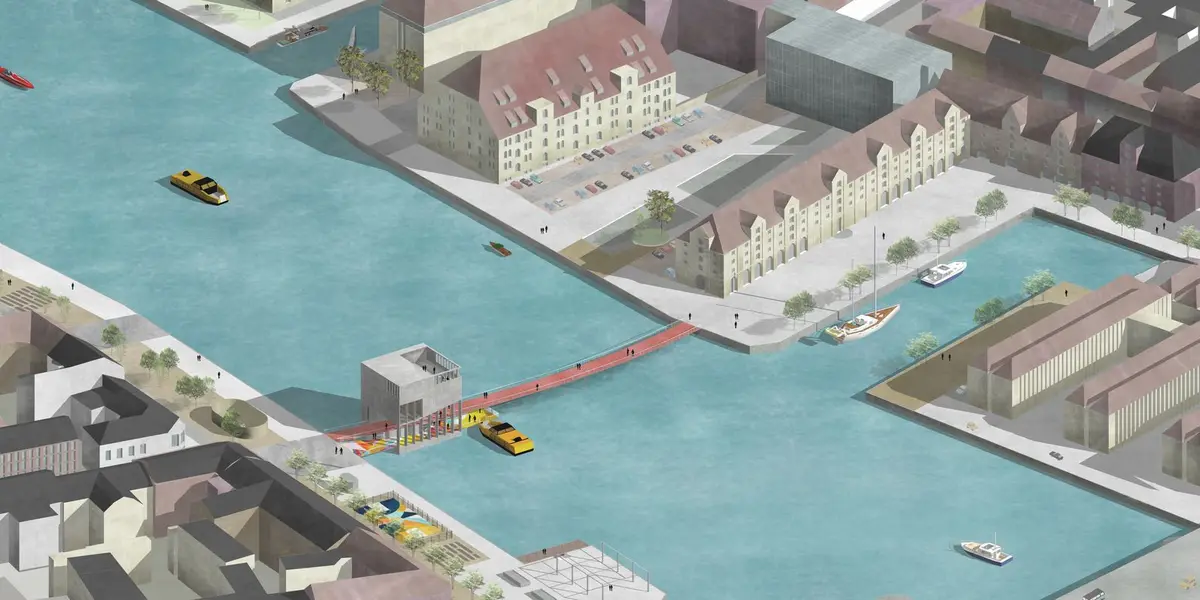
Mobility³: Rethinking the Bridge as a Multimodal Urban Exchange
A two-level bridge in Copenhagen merges pedestrian, cycling, and harbor boat infrastructure into a single civic destination on the water.


A bridge is typically the thinnest possible architecture: a line drawn between two banks, optimized for throughput and nothing else. Mobility³ rejects that premise entirely. Instead of treating the bridge as a conduit, the project recasts it as a thick, inhabited exchange platform where pedestrians, cyclists, and harbor boats converge within a dual-level structure that doubles as public space. Cafes, exhibition areas, repair points, and information centers fill the gaps between modes of transport, turning waiting time into civic time.
Designed by Pierre Brillard for The City Link competition, the project is sited in Copenhagen, a city whose identity is built equally on bicycle culture and maritime infrastructure. That duality is the conceptual engine here. Rather than privileging one mobility over another, Mobility³ positions itself at the intersection of a bridge crossing and a harbor boat station, plugging into the city's existing multimodal network and amplifying it through architecture.
A Double-Height Atrium Where Infrastructure Feels Like a Living Room
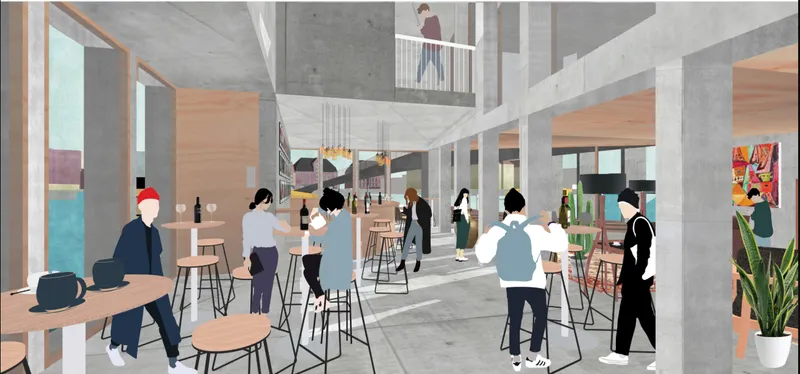
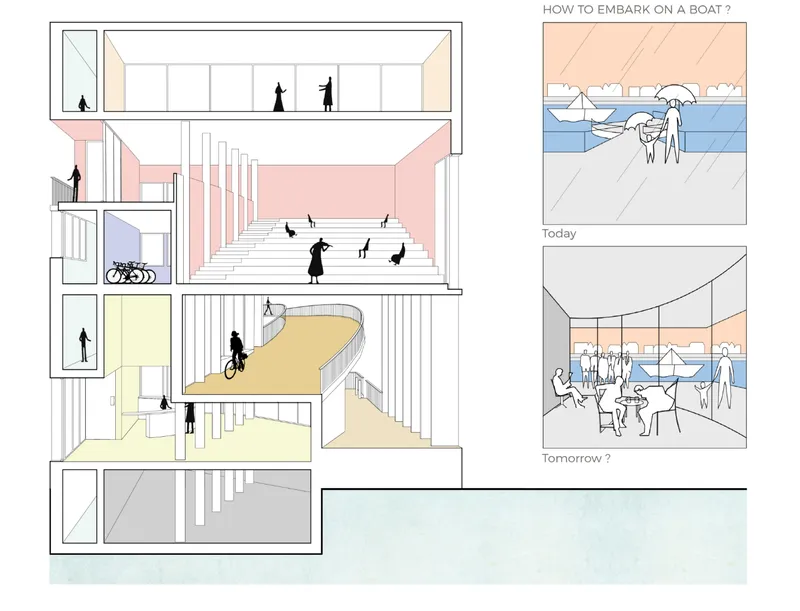
The interior perspective reveals something unusual for a bridge: a double-height atrium held up by raw concrete columns, with silhouetted figures gathering at high-top tables. The space reads less like transit infrastructure and more like a waterfront market hall. This is the programmatic heart of Mobility³, where the moments of pause inherent to multimodal travel (waiting for a boat, locking up a bike) are transformed into opportunities for social exchange. The concrete structural grid provides rhythm and legibility while keeping sightlines open across the full depth of the section.
The Upper Deck: Extending Copenhagen's Public Realm Over Water
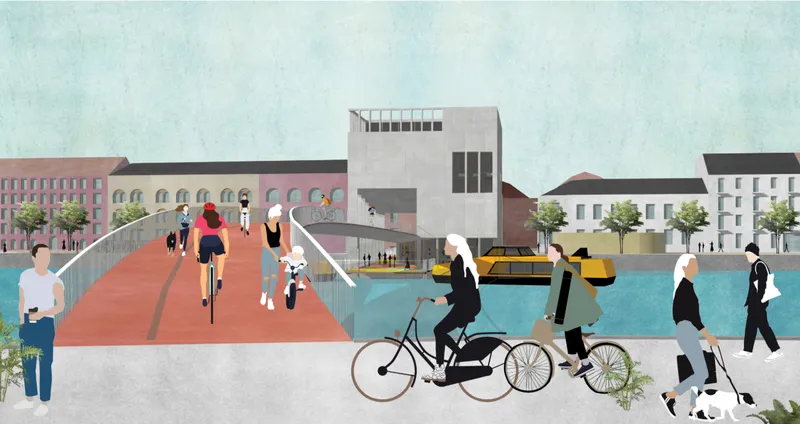
From the exterior, the bridge reads as a natural extension of Copenhagen's street life. The upper level is dedicated to pedestrians and cyclists, acting as a continuation of the city's public realm rather than an interruption of it. Mixed-use buildings flank the canal on both sides, and the bridge slots into this urban grain with a low profile that prioritizes visual engagement with the harbor. Cyclists cross at grade while pedestrians linger at the edges, maintaining the slow, sociable character that defines Copenhagen's best streets.
What makes this more than a scenic crossing is the lower level hidden beneath. Reserved for harbor boats, it integrates water-based mobility directly under the bridge deck, allowing vessels to circulate and dock with access to both banks. The vertical separation keeps each mode efficient on its own terms while preserving spatial continuity between them. You can see the boats from the upper deck; you can hear the cyclists from the dock. The architecture is layered but never sealed off.
Stacked Systems: How the Layers Are Built
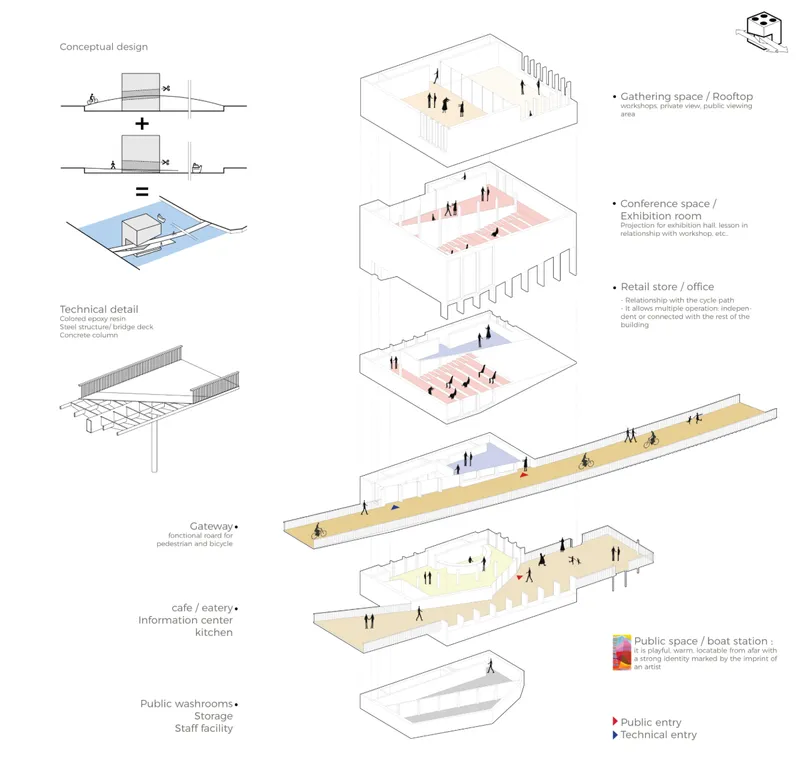
The exploded axonometric drawing pulls the project apart into its constituent systems: structural columns, bridge deck, programmatic inserts, and the boat-level infrastructure below. Each layer is legible as an independent system, yet the drawing makes clear how they lock together into a single coherent framework. Column construction details and technical annotations ground the proposal in material reality, pushing it beyond diagram into something buildable.
The section drawing reinforces this reading. A central staircase connects the upper pedestrian level to the lower boat station, with intermediate floors hosting the cafes, exhibition spaces, and repair points described in the program. Waterfront adjacency diagrams at the margins of the drawing show how the bridge negotiates its relationship to the canal edge on both sides. Circulation is continuous and intuitive: you enter as a cyclist, descend as a passenger, and re-emerge on the opposite bank without ever feeling routed through a terminal.
Why This Project Matters
Mobility³ identifies a blind spot in the way cities design for transport. Urban bridges are almost universally treated as single-purpose connectors, even in cities like Copenhagen where multiple mobility systems already overlap. By stacking pedestrian, cycling, and boat infrastructure into one structure and filling the interstitial space with civic program, the project argues that the bridge itself can become the interchange. No separate terminal building, no adjacent plaza required.
The deeper provocation is about time. Most infrastructure is designed to minimize duration: get across faster, reduce dwell time, eliminate friction. Mobility³ inverts that logic. It treats the time spent switching between modes as valuable, designing comfort, culture, and social life into the gaps. If sustainable mobility depends on people choosing transit over cars, then the experience of transition matters as much as the speed of the journey. Pierre Brillard's proposal makes that case with clarity and architectural specificity.
View the Full Project
About the Designers
Designer: Pierre Brillard
Enter a Design Competition on uni.xyz
uni.xyz runs architecture and design competitions year-round that reward proposals with spatial conviction and real site intelligence.
Project credits: Mobility³ by Pierre Brillard The City Link (uni.xyz).


Popular Articles
Popular articles from the community


Cube Design Draws an Ecological Corridor Between Two Shenzhen Hills with the Nankai Building
Beside Shenzhen's container docks, the Nankai Building pairs stacked balconies with a climbing green screen to connect two hillsides across its height.

LT2A and OPEN Architectes Thread a Brick and Glass High School Through a Wooded Belgian Campus
In Braine-l'Alleud, a 3,000 m² wing for Collège Cardinal Mercier pairs pale brick with a glazed colonnade, deferring to a small chapel and a dense wood.

Architekt Andreas Gruber Scatters 23 Dark Timber Chalets Across a South Tyrolean Forest Edge
In Molini di Tures, Amonti Chalets breaks a resort into a hamlet of gabled timber houses, with parking, storage and services pushed into the slope.

longwave studio Reorganizes a 112 m² Tainan Apartment Around the Daily Routines of a Family and Two Cats
In Tainan, Taiwan, birch plywood, rust-red furniture and a freestanding plaster wall link arrival, storage, work and family life in one apartment.

Similar Reads
You might also enjoy these articles


Aquadapt: An Underwater Habitat That Rewrites Its Rooms by the Hour
Curved modules ring the seabed while one shell shifts from breakfast room to cinema, farm and football pitch as residents' needs change.

Play: Fragments of Their World: Remembered Architecture Rebuilt as a Modular Playground for Refugee Camps
Tom Gardner abstracts domes, arches and towers from the homelands of displaced families into a kit of child-scaled play parts for camp settlements.
REBIRTH: A Circular Settlement Where Afghan Widows and Their Children Rebuild Life Together
A shortlisted Resile entry turns the circle into a protective ring of timber and brick, gathering homes, classrooms and gardens around a shared landscape.
The Main Dream: A Recycled Plastic Kit That Lets Refugee Children Build Their Own Playground
Thirty-centimetre interlocking cubes that connect on three axes turn play into construction, letting children author the spaces they occupy.

Explore Cycling Bridge Competitions
Discover active competitions in this discipline

Design challenge to equip cities with modern furniture

Challenge to reimagine the Iron Throne

Photograph architecture without architects

Illustrate the lost glory of Angkor Wat - Render Challenge
Comments (0)
Please login or sign up to add comments
No comments yet. Be the first to comment!