
multitopia
the utopian nature of agroecosystems

The beginning is nature, not only the setting of this story, but also its main character. I provide nature with narrative power and let it define the reality that surrounds me. I do not limit hiter. I allow the natural environment to create landscapes, views and perspectives. Living places. They define our presence, they witness the actions taken. As recipients, we cannot go beyond the place.
Together with the rest of the biocenosis, we create an ecosystem. Its individual areas - biotopes – unite into a dynamic system, a system connected by a network of various interdependencies. A biotope is always considered in the context of the background of the biocenosis that lives in it. An attempt of symbiosis of all the elements of the ecosystem is utopian. We face the concept of biotopia. The essence of multiopia is the collection of individual biotopias, together with the relationships that bind them. The biotopias with specific characteristics, in combination with agrocenosis, form the agroecosystem. The geometric shapes of the autonomous cultivation units form a coherent system. The whole is closely connected by a communication network that improves the biotopia’s functionality.
I began my search to find similar relationships in different agricultural systems, not only in Spain, but all over Europe and on other continents. The graphic analyzes that I carried out made me come to interesting conclusions. Despite the fact that each agrosystem is different and unique in its own way, in each one we can find some analogous rules of shaping and functioning. If we break them down into simpler factors, it turns out that each farming system consists of dozens or even hundreds of basic elements. Only when multiplied, placed next to each other and overlapped, they define and give the place its character. A significant feature of multitopia is the indispensability of each of the elements for the proper operation of the system. We are talking about maintaining the dynamic balance of the entire system. It is a necessary condition for achieving a permanent and properly functioning system. The utopian composition of biotopias served as the basis for further spatial analysis of the designing site.
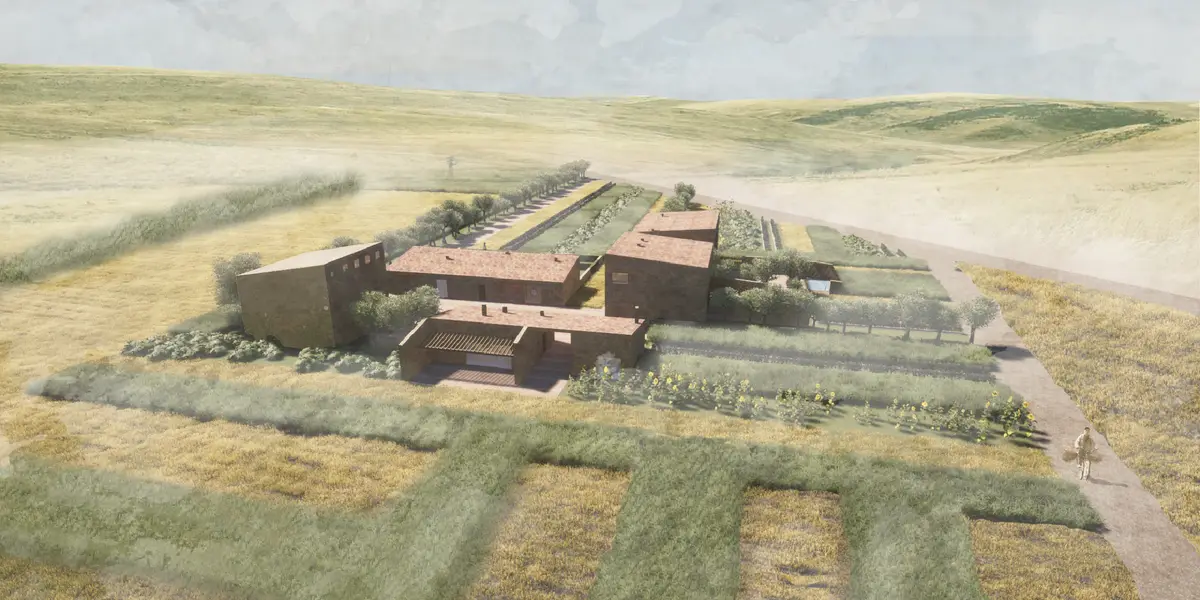
The area designed by me is based on the basis of the formation of the biotope. Functional spaces intertwine and merge into systems. Some work on the principle of complementing individual functions, others appear marked with contrast against the background of the different ones. Despite the apparent complexity of the assumption, it is a logical system based on a simple network of relations between given areas. In other words, the spatial layout of the area I am developing consists of a system of crops, a complex of buildings including both internal and external spaces, as well as buffers connecting them, and the human-nature relations that intertwine everything. The complexity of the plan paradoxically facilitates the use of the site.
In the designing process, I made use of the act of internalizing nature. This is synonymous with the blurring of the boundaries between the interior and the exterior and letting the broadly understood natural environment inside the building. I cultivated this idea in many ways: by choosing natural building materials and using local traditional construction systems, building the relationship between the inhabitants and animals living on the farm, or not restricting the area of farmland to specific sections of the plot. I created space based on the contrasts - I combine what is alive and dynamic with static, and massive with light. By building the spectrum of architectural diversity, I am broadening the spectrum of biodiversity.
Nature plays a leading role in my work. In part, I gave it the task of a designer and allowed it to shape the space. Although this vision sounds too utopian, nature together with architecture establishes a dialogue creating a kind of symbiosis. My goal was to create an architecture shared with nature. The designed complex of buildings adapts to the cultivated in the area of cultivation. My goal was to create an "alive", corresponding architecture with the environment and responding to changes taking place around.
FORM
The most significant factor that influences the final form of the buildings is the local Castilian architecture. The local architecture of the Castilla-La Mancha region is made unique by the selection of building materials and finishes. There is also a visible respect for traditional architecture as well as the history and the culture of the area. Nevertheless, the facilities do not lose functionality, and the simplicity of solutions is noticeable in each of the buildings. I set myself the goal of giving the farmhouse freshness and modernity while respecting regional architecture.
I allowed myself to interpret the traditions and the culture of the place by myself, as well as reach for unconventional inspirations. As a result, the farm emerges from the fields, emphasizing close connection to each other, like many years ago local shepherds' shelters los cucos used to, shape and the roof structure were taken from the local laundries los lavaderos, while the crop storage building towers over the rest of the buildings similar to the windmills erected above the city of Campo de Criptana. Looking closer at the project, we can see more analogies - the windows on the west facade of a residential building are arranged in the shape of a windmill, and the roofs over the terraces cast a shadow similar to the one cast on the walls of the working los molinos. The square windows on top of the crop storage building also mimic the architecture of the local windmills.
The design process I used was based on the process of shaping the ecosystem in the natural environment. We cannot analyze the form of the building without taking into consideration the surrounding nature. Each part of the architectural complex has been shaped individually, as a result of the overlapping of spaces with different functions, and longitudinal fields.
BUILDING STRUCTURE AND MATERIAL SOLUTIONS
When designing the construction of buildings, I was inspired by local methods of constructing and energy-saving solutions used in the Castilla-La Mancha region. The local architecture includes many traditional solutions to reduce energy consumption. Although some of them have been used for decades or even hundreds of years, research shows that they are still irreplaceable in terms of reducing energy consumption and financial aspects. I’ve decided to design the stone walls and in some places cover it with a white plaster. The object made from the described walls has a large energy storage capacity. It is a method of constructing vertical partitions that perfectly fulfills its task due to considerable temperature fluctuations throughout the day. It is a common solution throughout Castilla-La Mancha. The stone wall is in many cases more effective than the current conventional construction solutions. The roof of each building was designed in the form of a pent roof with a wooden structure. I wanted to show the roof structure inside, imitating the local architecture. The roof is covered with a traditional Spanish ceramic tile.
ARCHITECTURE SHARED WITH NATURE
I treat people, animals and plants as equal inhabitants. Being aware of the numerous differences between these groups, I suggest using architecture as a mediator. It has the ability to integrate mentioned environments, and to benefit from the existing correlations. When shaping the space, it turns out that it is possible to blur the differences resulting from the priorities of the needs of individual groups and at the same time draw mutual benefits from them. By balancing between different environments, I have to come to the conclusion that by arranging the spaces in an appropriate way, overlapping and confronting them, we maintain the balance of the whole homestead. The harmony of the system is what guarantees all the inhabitants healthy functioning, trouble-free building relationships and benefits for each of the groups included.


Popular Articles
Popular articles from the community


Co-Life: Senior Housing Design That Reconnects Older Adults With the City
Co-Life reimagines senior housing design through healing gardens, shared streets, workshops, and a sustainable community across generations.

Play: Fragments of Their World
Familiar architecture becomes modular playground design, creating safe spaces where displaced children can learn, connect, imagine and play.

ALGAL REALM: A Bio-Integrated Lunar Habitat Design for Life Beyond Earth
ALGAL REALM reimagines lunar habitat design with algae-powered life support, 3D-printed regolith, and vertical living for a lunar future.

Co-life: Sustainable Architecture for Age-Friendly Community Living
Co-life reimagines sustainable architecture for seniors through courtyards, rammed earth, shared gardens, and spaces designed for belonging.

Similar Reads
You might also enjoy these articles

Day and Night Park: A Time-Based Urban Newsstand in Beijing
A temporary urban newsstand in Beijing blending travel, light, and reading through poetic colors, compact form, and community-focused design.

Modernist Patio Renovation in El Masnou, Barcelona by Oliver Segura Arquitectura + Cebrià Arquitectura
Modernist patio renovation blending tradition and innovation with a movable pool, leveled floors, and Catalan materials in El Masnou.

Alto Residencial Coop: Cooperative Housing Development in Santiago de Compostela by Carbajo Barrios Arquitectos
A linear cooperative housing complex blending white volumes and perforated metal façades, enhancing community living, natural light, privacy, and urban integration.
Vil Genis School by BPA ARCHITECTURE – Massy, France
Vil Genis School in Massy, France, features sustainable design, south-facing classrooms, community integration, accessible spaces, and modern educational architecture.

Comments (0)
Please login or sign up to add comments
No comments yet. Be the first to comment!