
100A Associates Folds Art, Water, and Silence into a Hillside Retreat in South Korea
Mungahwaryeong is a 360 m² hospitality project in Gangseo-gu where architecture becomes a medium for emotional restoration and shared experience.


There is a particular kind of hospitality project that refuses to announce itself. Mungahwaryeong, a 360 m² retreat designed by 100A Associates in Gangseo-gu, South Korea, belongs to this category. Nestled into a wooded hillside with views stretching to the coast, the 2024 project by lead architects Kwang-il An and Sol-ha Park works less like a building and more like a series of carefully calibrated moods: openness giving way to enclosure, communal warmth yielding to private silence. Its name alone, rooted in Korean literary tradition, signals ambitions beyond shelter.
What makes Mungahwaryeong worth studying is its commitment to what 100A Associates calls the "architectural blank," a strategy of restraint that treats space as a canvas rather than a finished composition. The firm has long argued that emptiness is a sophisticated spatial tool, and here that idea finds its most convincing hospitality expression. Rather than curating every experience for the guest, the architecture opens intervals of indeterminacy: a corridor that could be a gallery, a courtyard that functions as both pool terrace and meditation room, bedrooms where the boundary between interior and landscape dissolves entirely.
Arrival Through the Forest
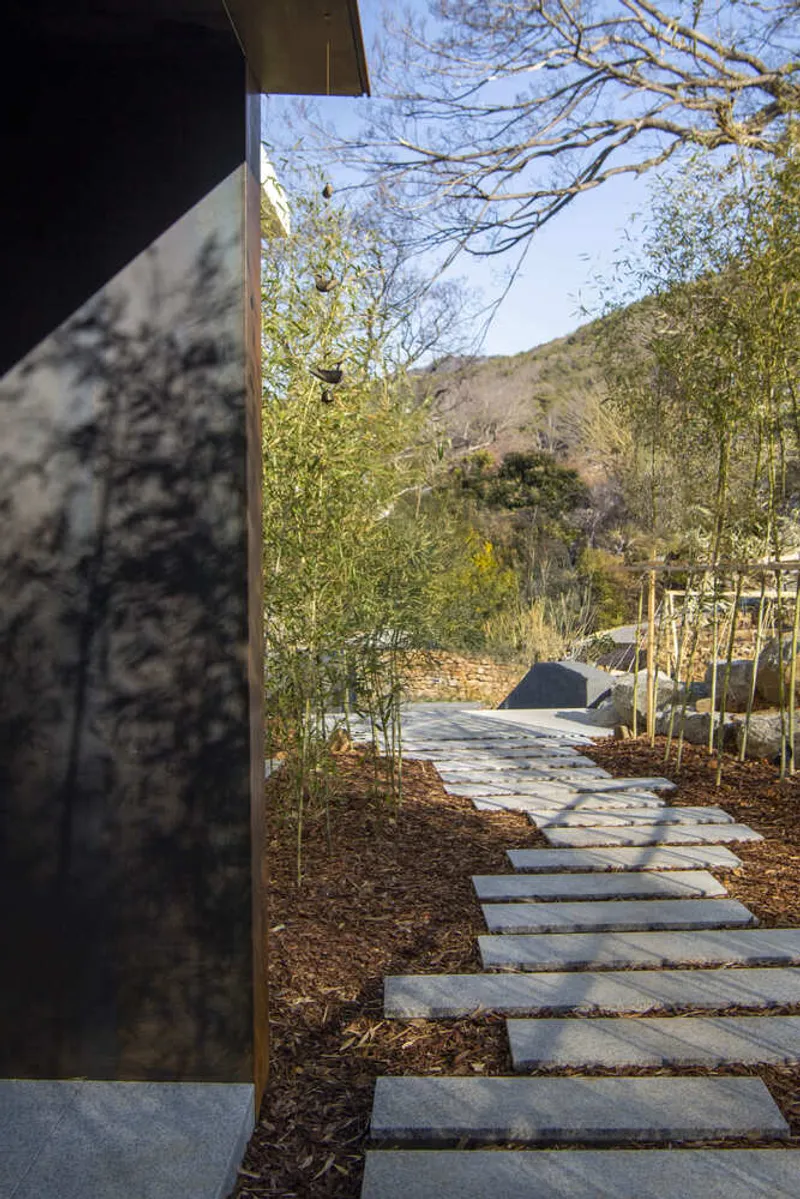

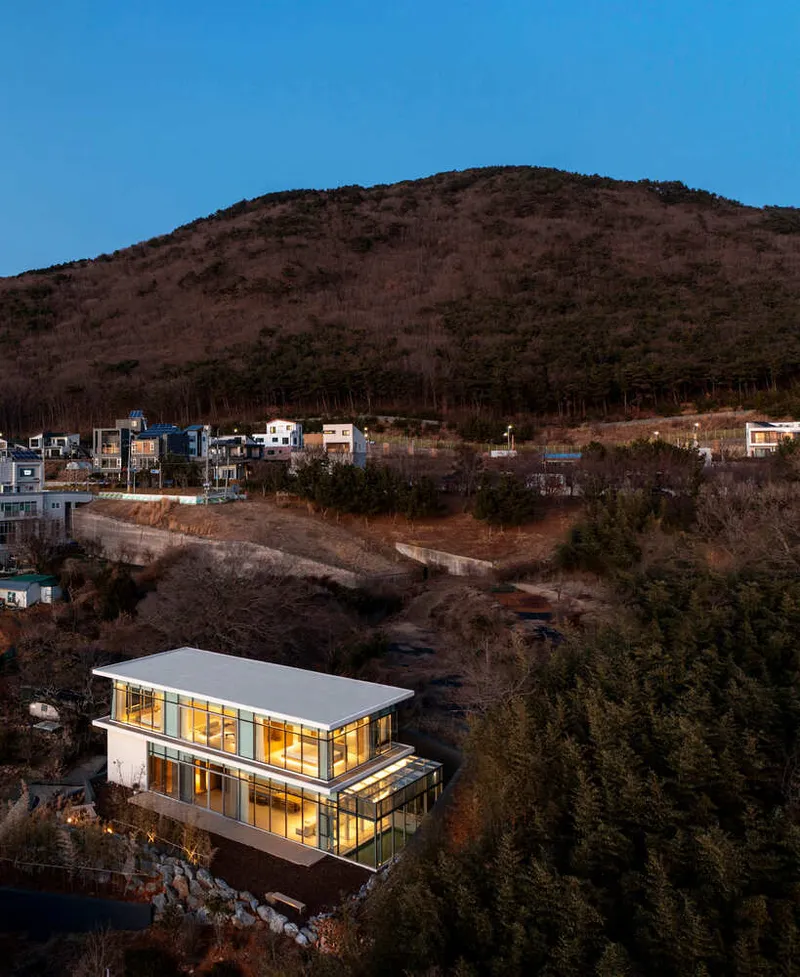
The approach to Mungahwaryeong is deliberately slowed. A stone paver path threads through young birch trees and mulched ground cover, pulling visitors away from the road and into a register of quiet attention. By the time you reach the timber-slatted entry, with its pivoting doors and column-lined corridor, the noise of arrival has faded. The building's two-story form, visible at dusk as a softly illuminated volume perched on the hillside, reads more as a lantern than a monument.
This sequencing is deliberate. Korean spatial tradition has long valued the transitional zone between outside and inside, the threshold space where the visitor sheds one state of mind and enters another. 100A Associates updates this with contemporary materials and proportions, but the choreography is unmistakable: forest, path, corridor, light.
The Courtyard Pool as Spatial Engine
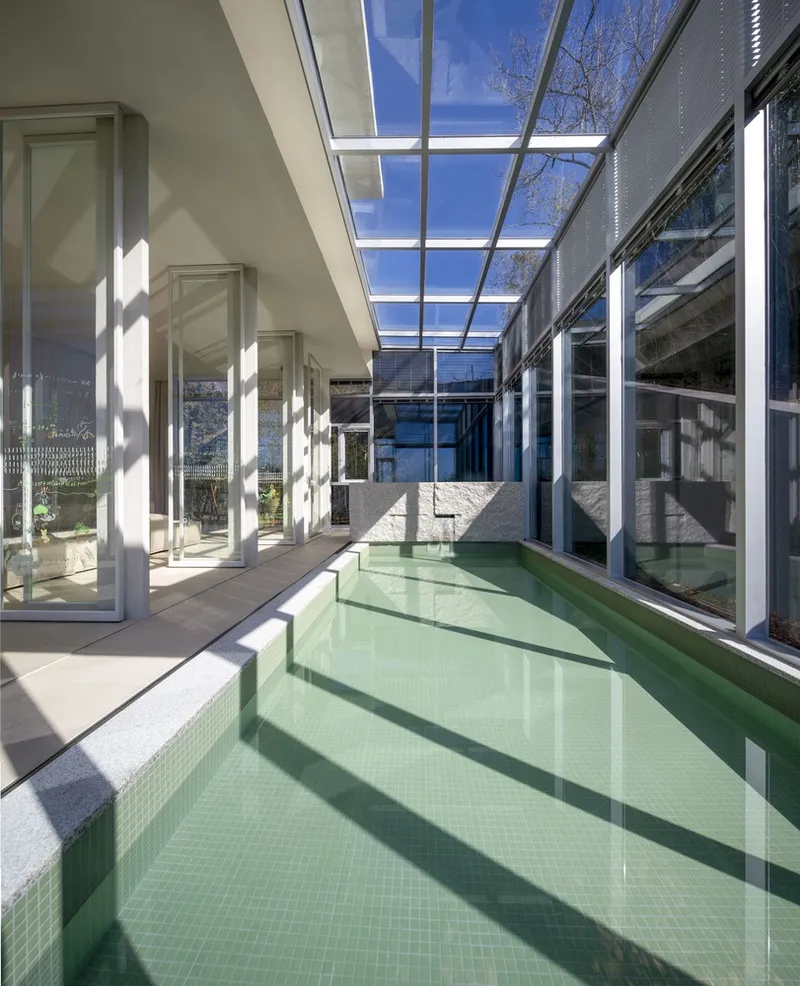
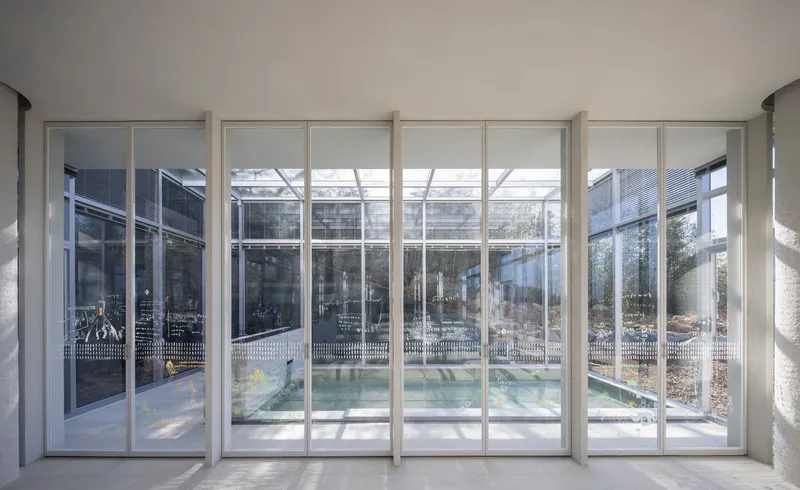
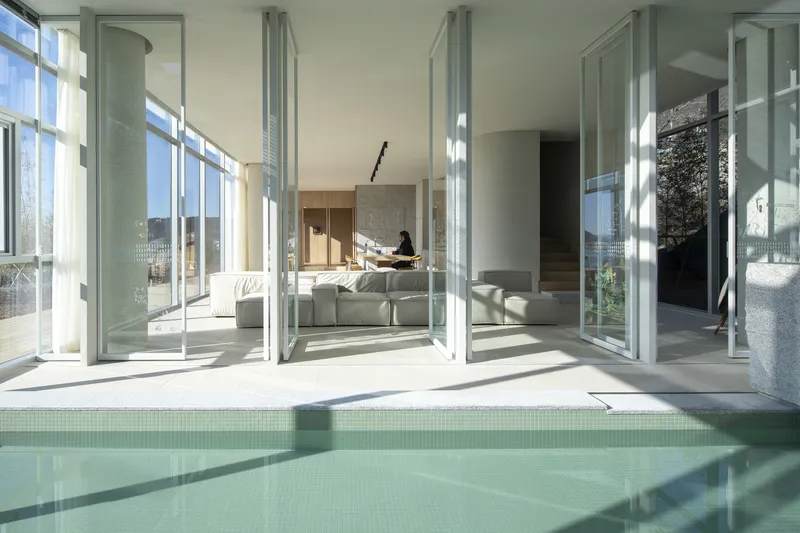
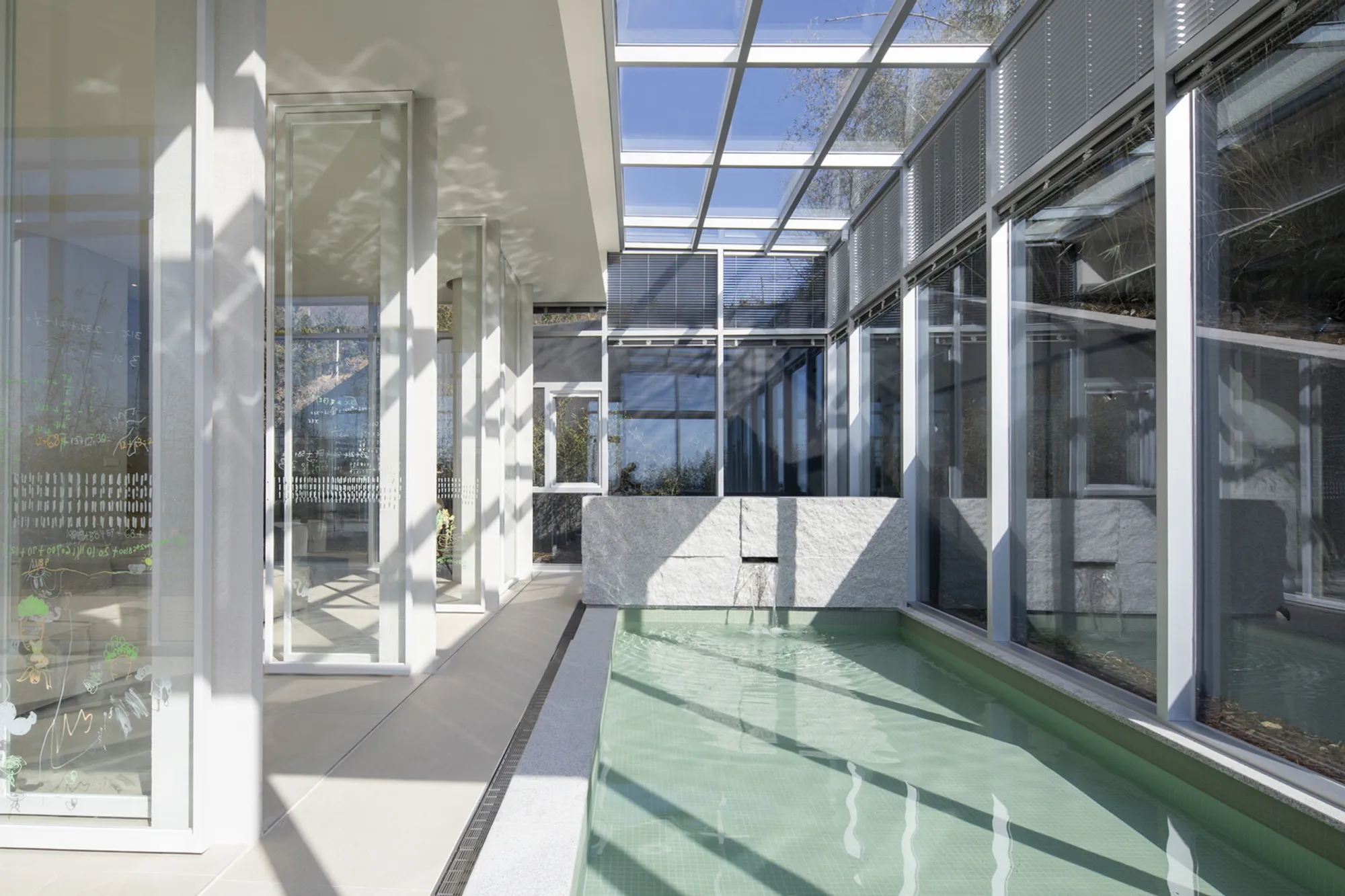
At the center of the plan sits a courtyard pool clad in pale green mosaic tile, topped by a glass skylight that floods the space with filtered midday sun. It is simultaneously the project's structural heart and its most ambiguous room. Flanked by sliding glass doors that can open fully to adjacent living areas, the pool terrace connects interior zones without subordinating them to a single axis. Metal screening and elevated walkways add layers of transparency, letting you see through and across the building at multiple scales.
Water is a recurring motif. The narrow lap pool, the soaking tubs, the reflections on ceiling planes: they slow perception and amplify natural light. In a project this compact, that doubling effect matters. The pool courtyard makes 360 m² feel expansive without sprawl.
Communal Ground Floor: Kitchen, Dining, and Flow
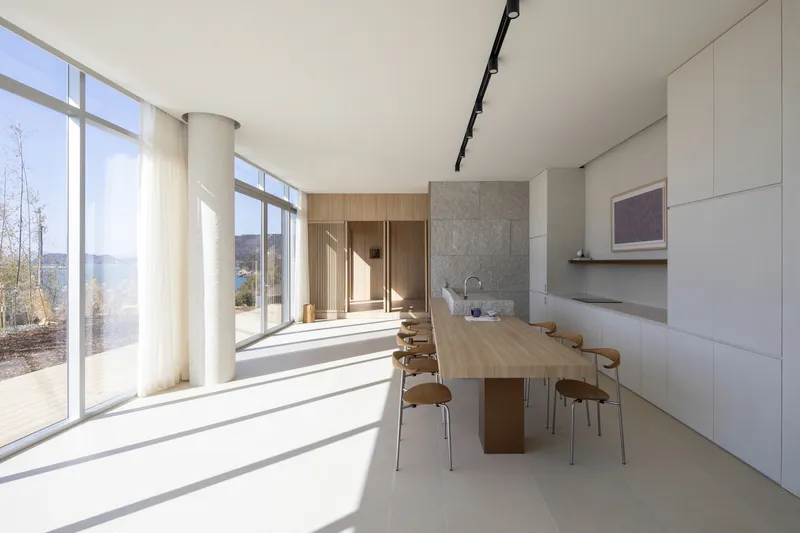

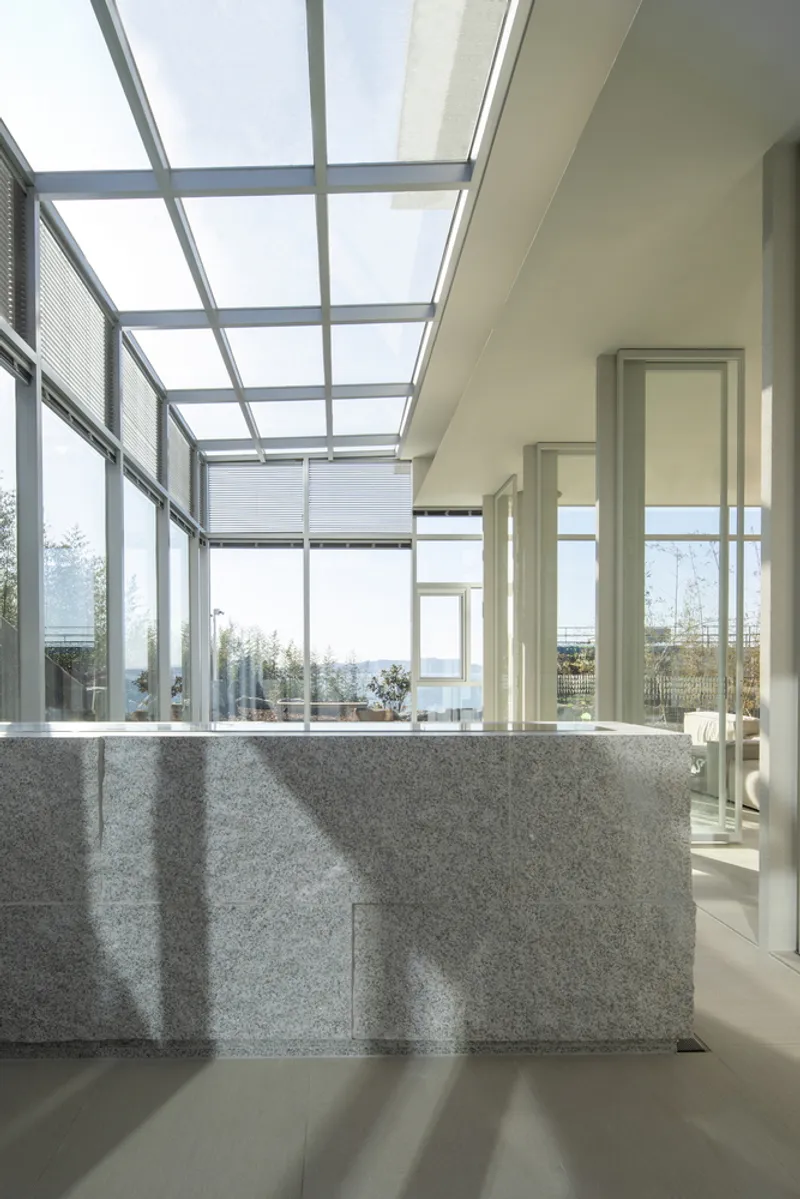
The ground floor is organized as a continuous landscape of communal activity. A timber dining table anchors one zone, drenched in morning sunlight from floor-to-ceiling glazing. Nearby, a terrazzo island beneath a steel-mullioned skylight serves as the kitchen's social center, with timber stools inviting casual gathering. The terrazzo surface reappears as flooring in adjacent corridors, stitching rooms together through material continuity rather than formal symmetry.
There is nothing rigid about the plan at this level. Boundaries between cooking, eating, and lounging are suggested rather than enforced. The architects trust their guests to occupy the space on their own terms, an attitude that only works when the architecture provides a strong enough spatial framework to hold diverse activities without chaos. Here, the cylindrical white columns, the consistent ceiling heights, and the disciplined material palette do that work.
Timber, Plaster, and the Material Logic of Restraint


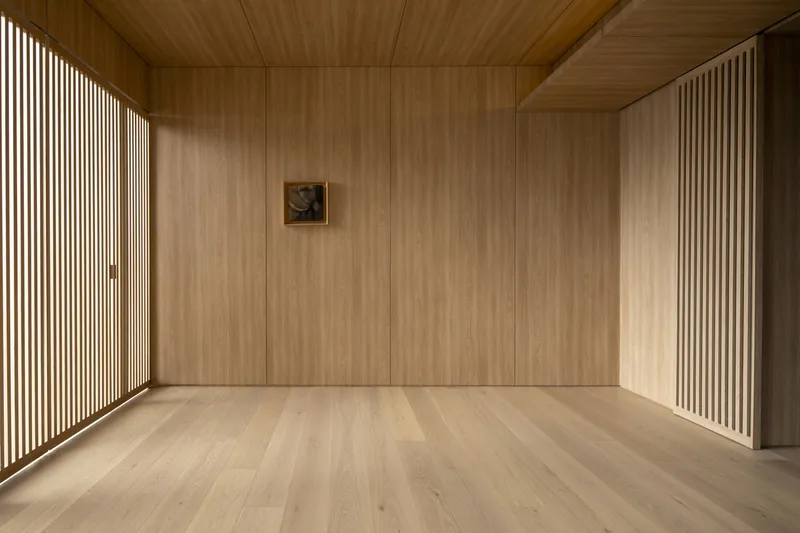
The material vocabulary is tight: timber cladding, plaster columns, terrazzo floors, and full-height glass. Fluted column elements frame doorways between rooms, their vertical rhythm echoing the slatted screens that line several walls and ceilings. In the wood-paneled room, warm light turns the interior into something close to a musical instrument, resonant and specific.
100A Associates avoids the trap of minimalism as austerity. The surfaces here are warm, tactile, and varied in grain. A timber-clad corridor catches angular sunlight through end windows, turning a circulation space into a gallery of light and shadow. This is what the firm means by "blankness": not emptiness, but a refusal to overdetermine. Every surface is finished with enough character to reward close looking but not so much personality that it competes with the people and the landscape.
Living Spaces That Lean Toward the Landscape
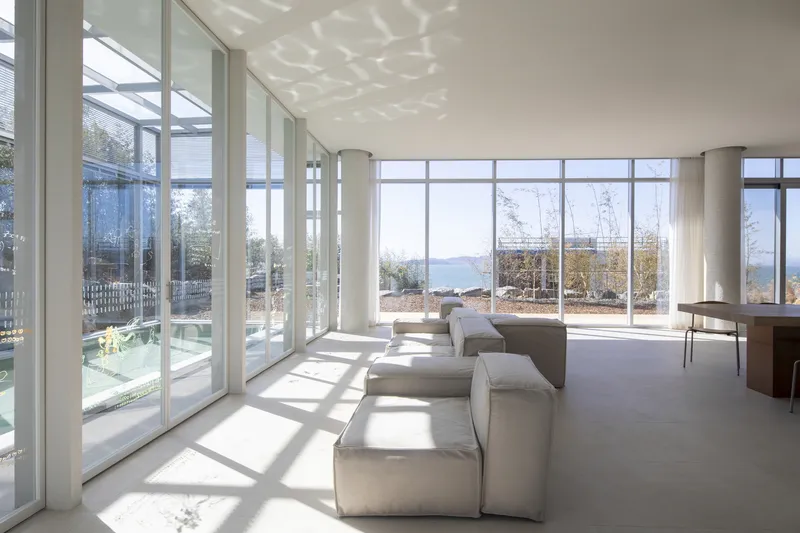
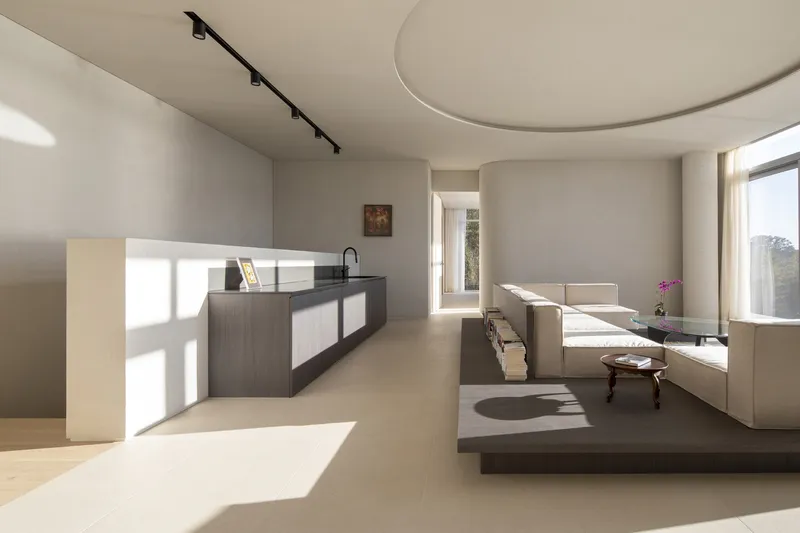

The living room, with its modular seating and latticed screens, captures dappled sunlight and frames views to water. A curved ceiling soffit in an adjacent sitting area creates a sense of embrace without enclosure. These are rooms designed for lingering, for the kind of unstructured time that hospitality architecture too often tries to program away. The burgundy-runnered staircase that rises beside a cylindrical column marks the transition to the upper level, but it does so with a sense of ceremony rather than mere function.
Upper Floor: Private Rooms on the Edge


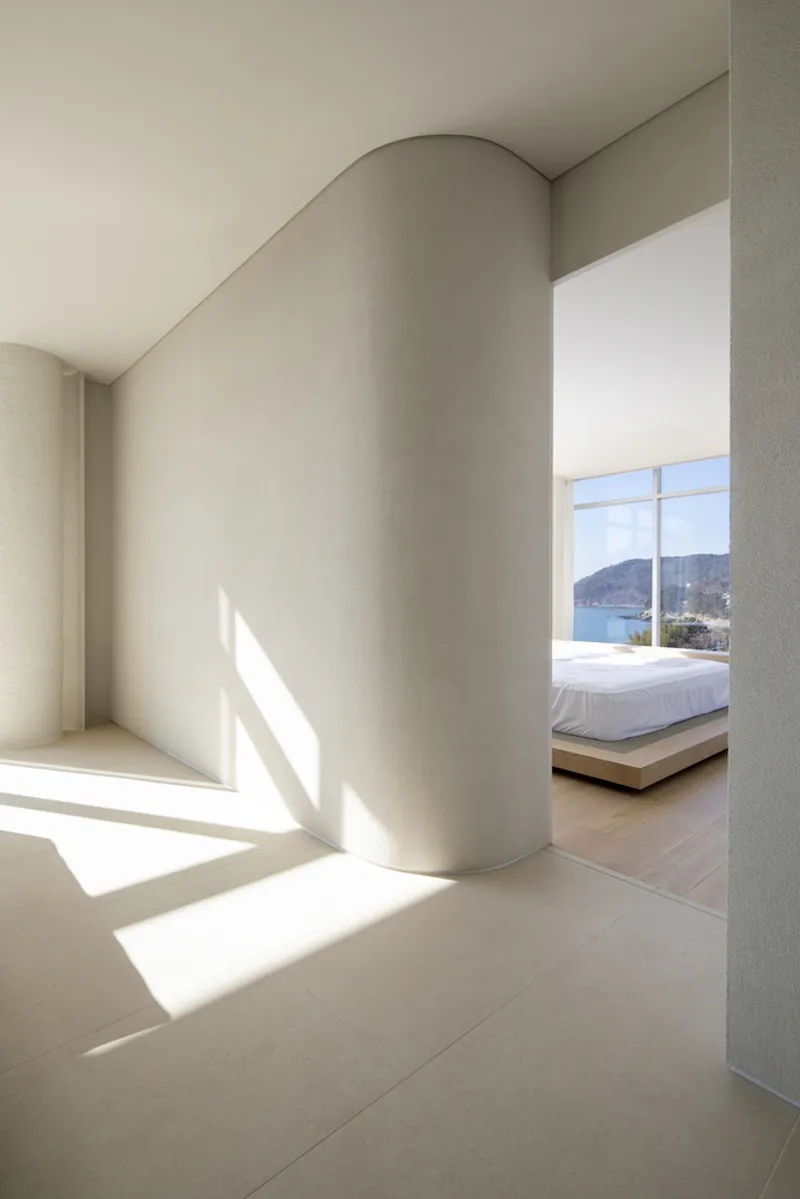
Upstairs, the character shifts decisively. Bedrooms occupy the building's perimeter, each one a glass-walled cell oriented toward the coast or the hillside. Platform beds float against floor-to-ceiling glazing, with sheer curtains the only filter between sleeper and sky. A cylindrical plaster column catches corridor sunlight, guiding you toward a bedroom where the view of water feels close enough to touch.
The contrast with the ground floor is the project's most potent spatial idea. Below, you share. Above, you retreat. 100A Associates understands that genuine hospitality requires both conditions, and that the architecture must make the transition between them feel natural rather than forced. The plan does this through a simple vertical division: public below, private above, with the staircase as mediator.
Bathing as Architecture

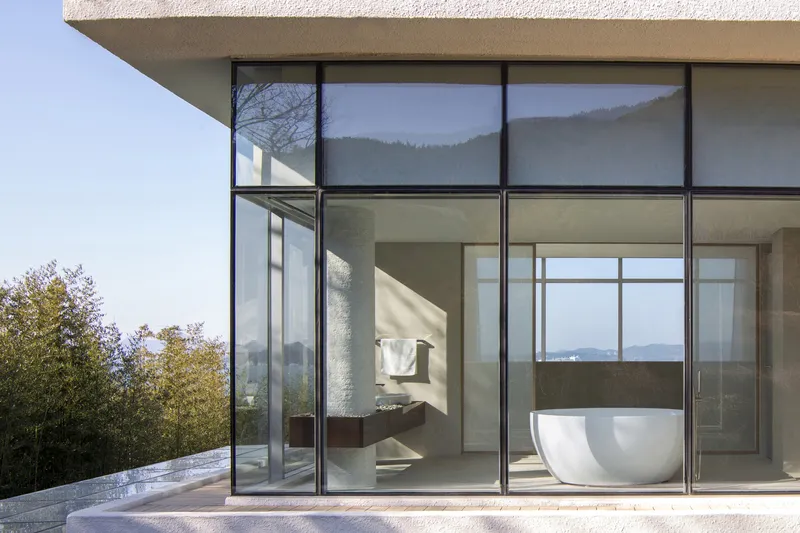

The bathing spaces deserve special attention. A freestanding white tub sits between cylindrical columns in a glass-walled room overlooking bare winter trees and water. Another occupies a corner where gridded glazing opens onto a hillside terrace. A round soaking tub on a tiled floor faces garden and terrace through full-height glass. In each case, the act of bathing is reframed as a spatial experience, one that connects the body to landscape, season, and light.
Korean bathing culture has always treated immersion as a social and restorative act, not merely a hygienic one. These rooms honor that tradition while stripping it of ornament. The architecture does the work of ceremony through proportion, orientation, and transparency.
Terraces and the Coastal Threshold


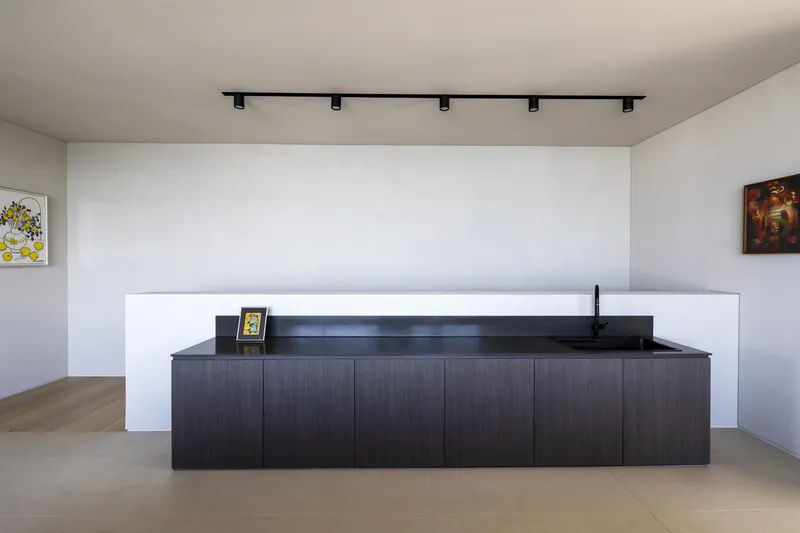
The upper-level terraces extend the building's interior logic outdoors. A cantilevered deck framed by bare winter branches overlooks coastal hills. At twilight, gridded glazing and a cylindrical column create a composed stillness against the sea. These are not decorative balconies; they are outdoor rooms with the same spatial discipline as the interiors. The dark timber kitchen island visible through one opening reminds you that even the most private terrace moment remains connected to the shared life of the house.
Plans and Drawings
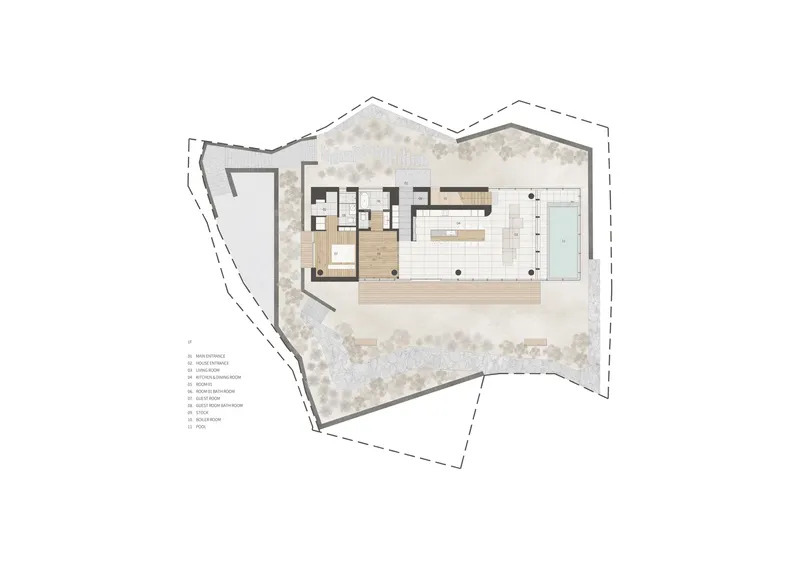

The two floor plans reveal the project's organizational clarity. The ground floor clusters living areas, the pool, and the deck within an irregularly shaped site boundary, using the courtyard pool as the hinge between social zones. The upper floor arranges bedroom suites and bathrooms along a linear deck that maximizes coastal exposure. The irregular site perimeter, far from being a constraint, generates the slightly rotated geometries that give each room its particular relationship to light and view.
Why This Project Matters
Hospitality architecture in East Asia often oscillates between two poles: the ultra-minimal box and the overwrought resort. Mungahwaryeong charts a third path, one grounded in Korean spatial traditions but executed with contemporary confidence. Its strategy of "blankness" is not passivity but a form of active generosity, a refusal to prescribe how guests should feel. The result is a building that gets richer the longer you spend in it, revealing new relationships between rooms, between inside and outside, between solitude and company.
At 360 m², this is a small project with outsized ambitions. 100A Associates demonstrates that hospitality can be a medium for cultural transmission without nostalgia, for sensory richness without excess, and for genuine rest without isolation. That is a rare combination. Mungahwaryeong does not simply house guests; it recalibrates how they pay attention.
Mungahwaryeong by 100A Associates (Lead Architects: Kwang-il An and Sol-ha Park). Located in Gangseo-gu, South Korea. 360 m². Completed 2024. Photography by Jae-yoon Kim.
About the Studio
Share Your Own Work on uni.xyz
If projects like this are the kind of work you want to make, uni.xyz is a place to publish your own, find collaborators, and enter design competitions.




Popular Articles
Popular articles from the community


The Musturak Paradise: Senior Living Architecture for a Connected Future in Temara, Morocco
The Musturak Paradise reimagines senior living architecture in Temara via private homes, social spaces, culture, community, and shared care.

Riyadh For All: Intergenerational Urban Design for Active Aging in Rabat
Riyadh For All reimagines urban design in Rabat with intergenerational co-living, adaptive courtyards, and Moroccan cultural exchange today.

The Earth Pod: 3D Printed Homes for Resilient Refugee Communities
The Earth Pod reimagines refugee housing through 3D printed homes made from clay, combining resilience, self-sufficiency, and rapid shelter.

Co-life: Sustainable Architecture for Age-Friendly Community Living
Co-life reimagines sustainable architecture for seniors through courtyards, rammed earth, shared gardens, and spaces designed for belonging.


Similar Reads
You might also enjoy these articles

FAMM Arquitectura Organizes Ten Villas Around Courtyards and Jungle in Nosara, Costa Rica
El Molino pairs two elongated volumes with deep overhangs and timber louvers to build a compact coastal community five minutes from the beach.
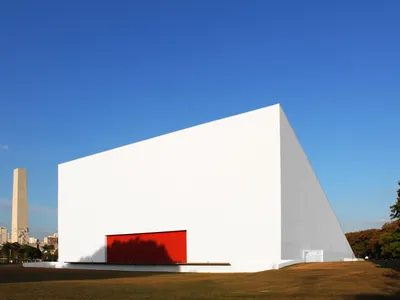
Oscar Niemeyer's Ibirapuera Park Pavilions Define São Paulo's Cultural Identity in Concrete and Curve
A constellation of modernist volumes set within São Paulo's most important urban park, conceived for the city's 400th anniversary in 1954.
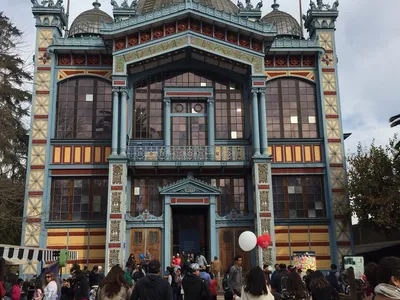
How Henri Picq's 1889 Paris Pavilion Traveled 11,000 Kilometers to Become Santiago's Artequín Museum
A prefabricated iron and glass pavilion built for the Paris Universal Exposition found a second life as a children's art museum in Chile.
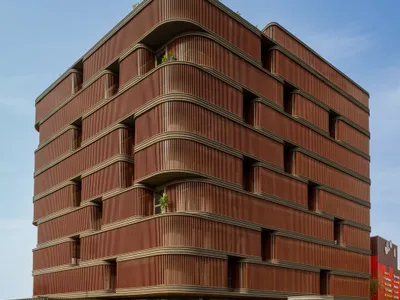
Sanjay Puri Architects Wraps a Jaipur Office Tower in Capsule-Shaped Green Buffers
A nine-level climate-responsive workplace near Jaipur Airport uses stacked planter terraces and aluminium screens to fight 40°C heat.

Explore Architecture Competitions
Discover active competitions in this discipline



Challenge to reimagine the Iron Throne


Photograph architecture without architects


Illustrate the lost glory of Angkor Wat - Render Challenge


Design challenge to reuse E-waste
Comments (0)
Please login or sign up to add comments
No comments yet. Be the first to comment!