
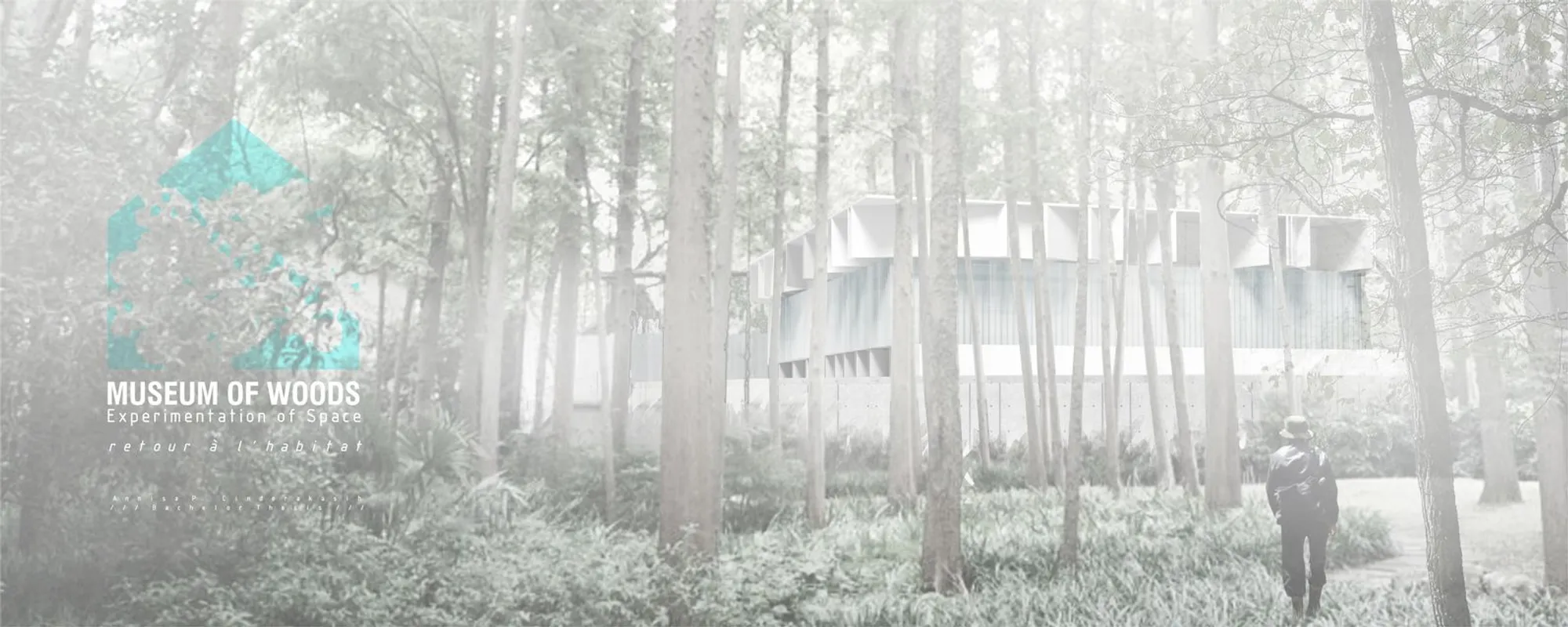
Museum of Woods: Architecture as a Living Archive of Forest Memory
A contemplative journey through water, soil, and wood reframes the museum as a wall-less gallery where nature becomes the exhibit.


What happens when a museum has no walls, no vitrines, no climate-controlled galleries? When the exhibit is the forest itself, and the architecture merely frames your attention as you walk through it? The Museum of Woods proposes exactly this: a sequence of experiential spaces that retrace the collective memory of forests, organized not by curatorial theme but by elemental encounter. Water, soil, wood, and living canopy become the four chapters of a contemplative journey the designer calls die Wanderung, a long walk that treats ecological loss as both spatial and cultural.
Designed by Annisa P Cinderakasih, the project was a shortlisted entry in UnIATA '18, recognized for its sensitive integration of landscape, memory, and ecological storytelling. Rooted in the French concept of retour à l'habitat, a return to dwelling in its deepest sense, the Museum of Woods responds to the accelerating deforestation of Indonesian tropical rainforests by framing architecture as an instrument of awareness rather than domination.
Computational Analysis Meets Forest Logic
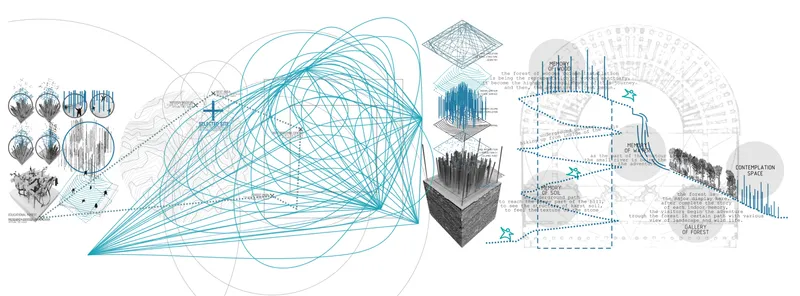
The project begins with rigorous spatial analysis, evident in the composite diagrams that pair blue wireframe meshes with axonometric massing studies. What is immediately striking is how the computational work does not produce a conventional building form. Instead, it generates a structural logic derived from the forest itself: vertical lines read as abstracted tree trunks, establishing a definitive grid that is ordered yet adaptive. The analysis seems aimed not at optimizing floor area or circulation efficiency, but at understanding density, rhythm, and the varying degrees of enclosure that a canopy produces.
Four Memories Along a Descending Contour
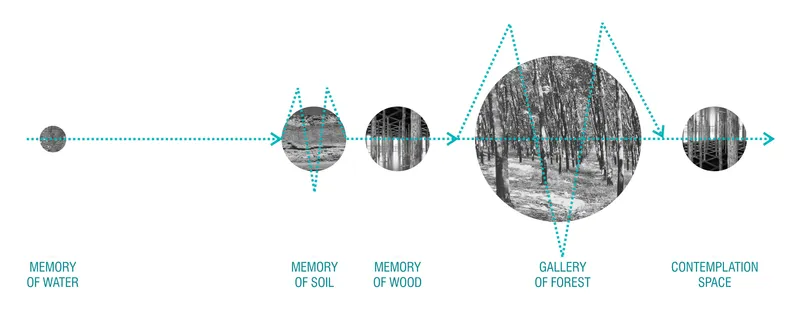
The conceptual framework organizes the museum experience into four interconnected memories. The journey begins at the lowest contour of the site with the Memory of Water, where sound, reflection, and cooling microclimates establish a sensory baseline. It then ascends through the Memory of Soil, where earth and stone reconnect the body to the land, and the Memory of Wood, where structural columns evoke the density of forest growth. The final chapter, the Gallery of Forest, is the moment architecture dissolves entirely into the living canopy, inviting contemplation and pause.
The conceptual diagram traces these thematic connections with dotted lines linking circular forest imagery to each memory stage, making the narrative progression legible at a glance. Crucially, the progression is described as linear yet fluid, reinforcing the idea that memory is experienced in frames, much like film. Each spatial transition is defined not by a door or a threshold wall but by shifts in light, canopy density, ground texture, and sound.
The Theater of Nature Without Walls
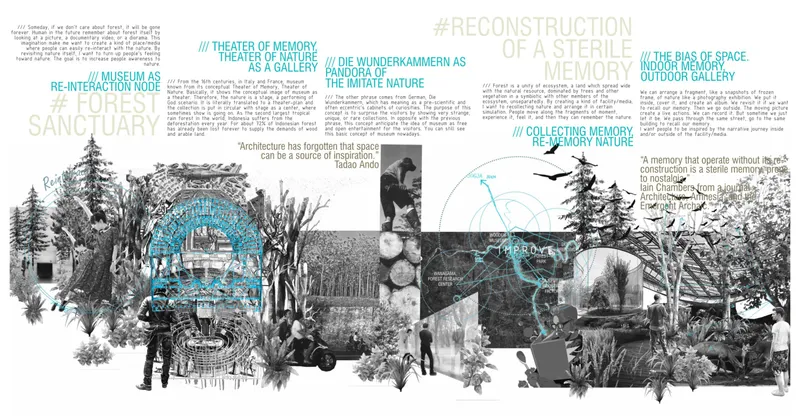
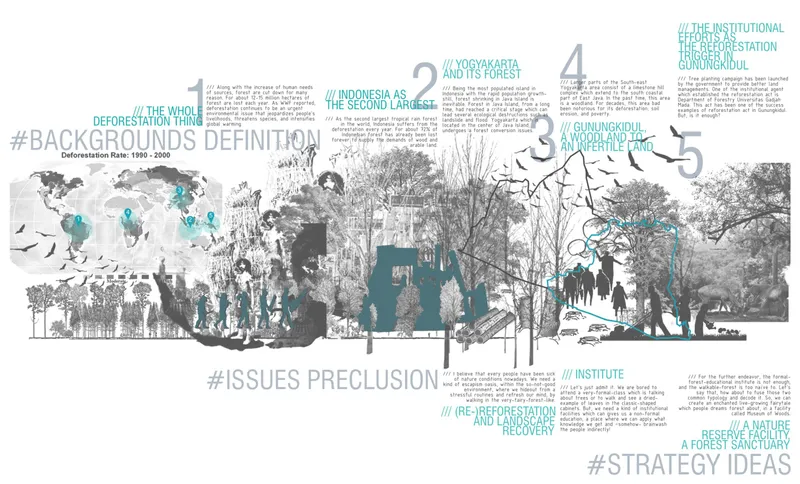
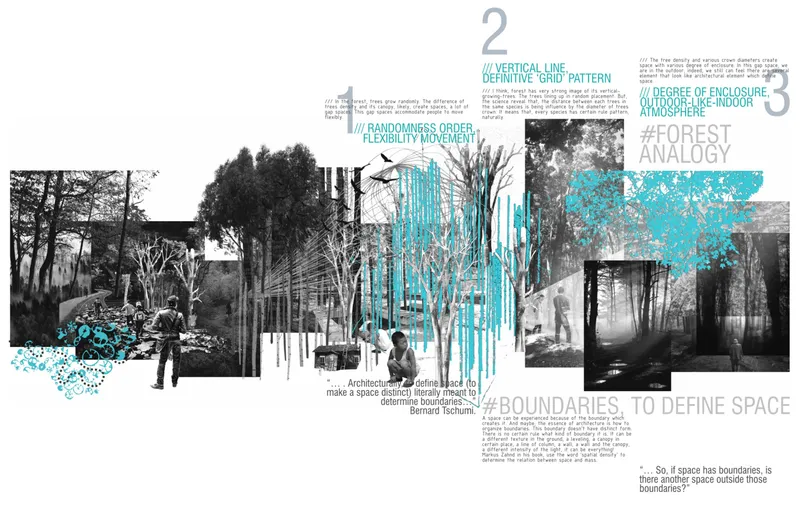
Two key intellectual references anchor the project. The first is the Theater of Memory, an ancient mnemonic technique that maps knowledge onto spatial experience. The second is Die Wunderkammern, the Renaissance cabinets of curiosity that assembled natural fragments into curated collections. The Museum of Woods merges both: fragments of nature, memory, and space are organized into an experiential journey where nothing is static. The mixed-media presentation boards make this legible through layered forest scenes, human silhouettes positioned among trees, and blue diagrammatic overlays that read like analytical annotations on a living landscape.
The deforestation timeline board is particularly sobering. World maps with blue highlights chart the scale of tropical forest loss, contextualizing the project within Indonesia's specific crisis. Forests here are not abstract environmental talking points; they are the sites of erased livelihoods, fragmented ecosystems, and fading cultural identity. By presenting this data alongside layered forest imagery, the designer refuses to let the statistics remain abstract. The architecture becomes a response to a documented wound.
A Diagonal Path Through Contour and Canopy
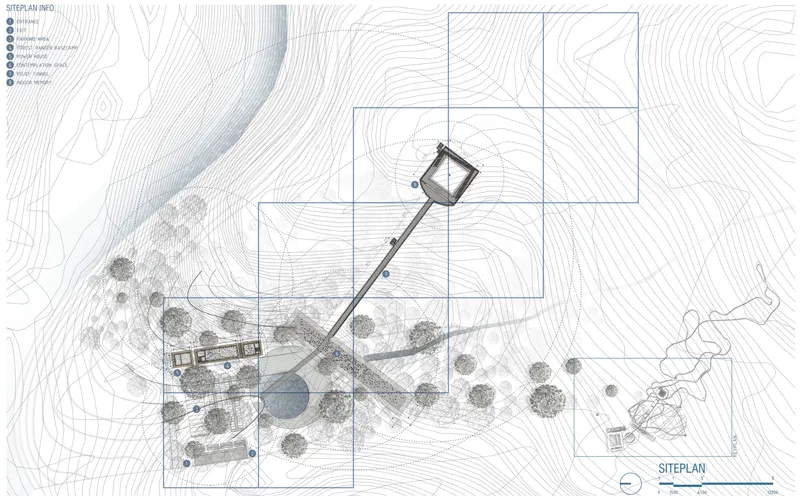
The site plan reveals the spatial strategy in its most distilled form. Contour lines mark a sloping terrain, scattered tree clusters indicate existing vegetation, and a diagonal pathway connects two structures across the landscape. The path is the architecture. Rather than arriving at a single monolithic building, visitors move through a terrain where the degree of enclosure shifts gradually: from open ground to semi-outdoor conditions defined by structural grids to moments of dense canopy overhead. The randomness and flexibility of this layout echo the organic growth patterns of forests themselves, allowing non-linear movement and personal exploration.
The two structures at either end of the diagonal appear deliberately modest in scale, suggesting that the built elements function as anchors for the journey rather than destinations. Boundaries between inside and outside are negotiated through changes in materiality and atmosphere, not through enclosing walls. It is a plan that trusts the landscape to do much of the architectural work.
Why This Project Matters
The Museum of Woods operates on a premise that most museum typologies avoid: the idea that the most powerful exhibit might be one you cannot put behind glass. By structuring an entire architectural experience around elemental encounters with water, soil, wood, and living forest, the project challenges the assumption that sustainable architecture is primarily a technical concern of energy performance and material specification. Here, sustainability is reframed as a cultural project, one that asks what we lose when forests disappear and whether architecture can make that loss viscerally felt.
Annisa P Cinderakasih's contribution is not a building so much as a method of spatial storytelling. The four-chapter memory sequence, the forest-derived structural grid, and the refusal to draw hard boundaries between built form and landscape all point toward an architecture that listens before it speaks. In the context of Indonesia's ongoing deforestation crisis, that posture of attentiveness is not merely aesthetic. It is political, ecological, and urgently necessary.
View the Full Project
About the Designers
Designer: Annisa P Cinderakasih
Enter a Design Competition on uni.xyz
uni.xyz runs architecture and design competitions year-round that reward proposals with spatial conviction and real site intelligence.
Project credits: MUSEUM OF WOODS Experimentation of Space Retour a l'habitat by Annisa P Cinderakasih UnIATA ’18 (uni.xyz).




Popular Articles
Popular articles from the community


Hill & Cross Opera: Sculptural Opera House Architecture Shaped by Tallinn’s Landscape and Identity
Hill & Cross Opera reimagines opera house architecture in Tallinn through its sculptural hill, civic plaza, glass wave and a luminous cross.

Play: Fragments of Their World
Familiar architecture becomes modular playground design, creating safe spaces where displaced children can learn, connect, imagine and play.

The Ocean Hive: Sustainable Architecture for a Self-Sufficient Civilization at Sea
The Ocean Hive imagines sustainable architecture at sea, where modular habitats, algae, wave power and ocean waste sustain a growing colony.

Co-life: Sustainable Architecture for Age-Friendly Community Living
Co-life reimagines sustainable architecture for seniors through courtyards, rammed earth, shared gardens, and spaces designed for belonging.
Similar Reads
You might also enjoy these articles

Lunar Spiral: Space Architecture Shaped by the Mathematics of the Universe
Lunar Spiral reimagines space architecture through Fibonacci geometry, lunar regolith, levitating habitats, and self-sustaining Moon living.
The Main Dream: Modular Architecture for Play, Learning, and Community
A modular playground turns recycled plastic into adaptable spaces where refugee children can play, build, learn, and reconnect.
Play: Fragments of Their World
Familiar architecture becomes modular playground design, creating safe spaces where displaced children can learn, connect, imagine and play.

Wadi Rum Observatory: Desert Architecture Designed for the Night Sky
Wadi Rum Observatory turns desert architecture into a quiet instrument for astronomy, hiding research spaces under Jordan's starlit terrain.

Explore Museum of Woods Competitions
Discover active competitions in this discipline



Challenge to reimagine the Iron Throne


Photograph architecture without architects


Illustrate the lost glory of Angkor Wat - Render Challenge


Design challenge to reuse E-waste
Comments (0)
Please login or sign up to add comments
No comments yet. Be the first to comment!