

Music Practice Building – University of the Andes by Carolina Jaimes + Juan Esteban López + Alejandro Puentes
A partially buried music practice building that blends concrete silence with wooden warmth, creating acoustically refined spaces for musical creation and campus exchange.


A New Centre of Sound and Silence in Bogotá
The Music Practice Building at the University of the Andes in Bogotá is a work that does not seek spectacle, yet becomes unforgettable through subtlety. Conceived as a quiet landmark between the hills, heritage structures and student pathways, the building is known across campus as The Music Box: an architectural instrument shaped not by volume or ornament, but by resonance, acoustic precision and restrained presence. The project, designed by architects Carolina Jaimes, Juan Esteban LópezandAlejandro Puentes, completes a long-awaited need on campus—dedicated space for rehearsal, sound isolation and collaborative musical exploration—without disturbing the historic fabric or landscape continuity of this academic environment.

Though modest in scale at 750 square metres, the building represents seven years of development, acoustic research, cross-disciplinary teamwork and sensitive urban placement. It emerged from a 2017 competition for young architects under 40, a framework established to challenge new voices in Colombian design. The three architects, graduates of the same university, had never collaborated prior to this commission. Their winning proposal convinced the jury by demonstrating that architecture for sound should not dominate visually; instead, it should act as an instrument whose form, material and voids amplify what occurs inside.
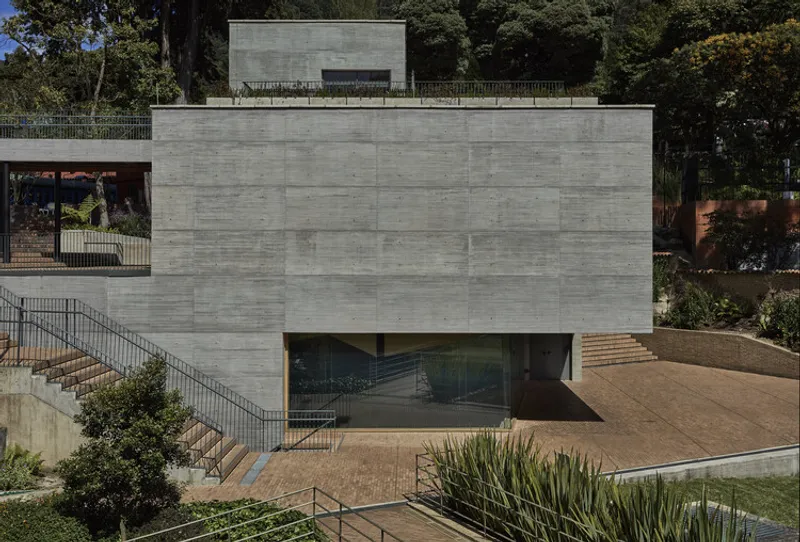

Sited as Silence Between Historic Structures
The building’s placement is central to its architectural narrative. Rather than occupying a dominant stance on the slope between the Faculty of Architecture and the Campito de San José—one of the oldest pavilions on campus—the architects chose to partially sink the building into the terrain. Two-thirds of its volume lies below ground, allowing the landscape and circulation patterns to remain uninterrupted, while preserving open views toward the Eastern Hills of Bogotá. This gesture reflects dual intent: acoustic control and spatial humility.
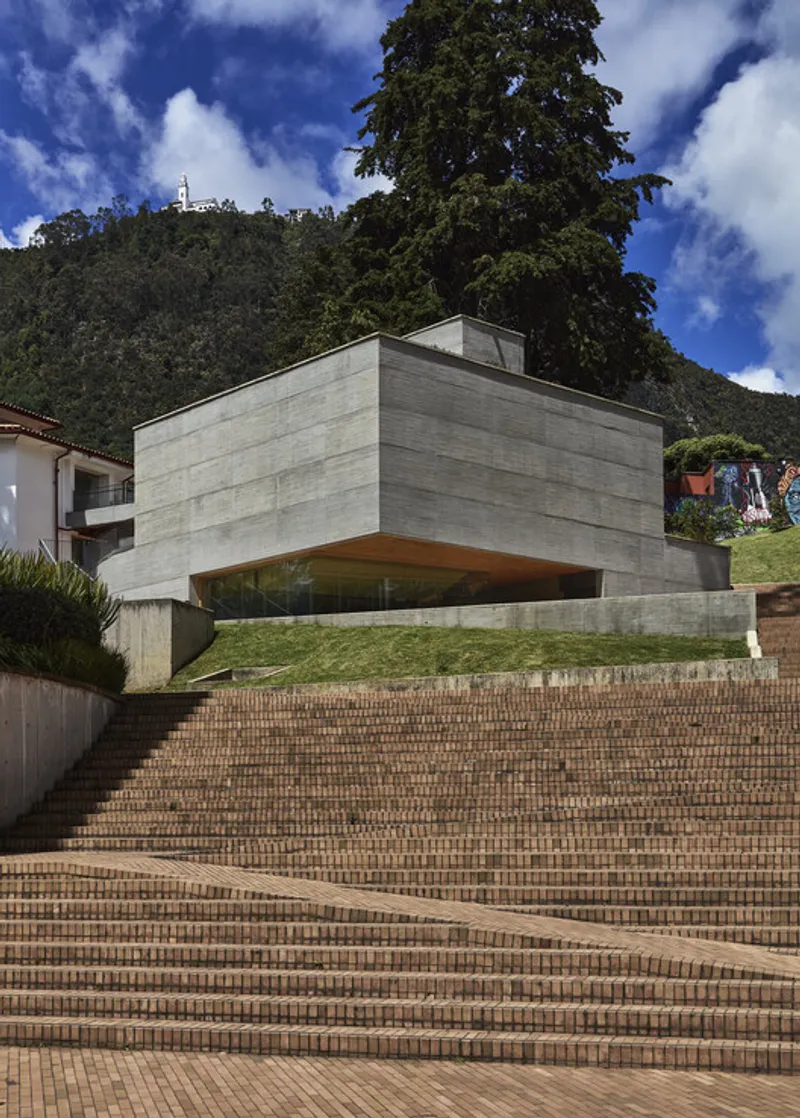
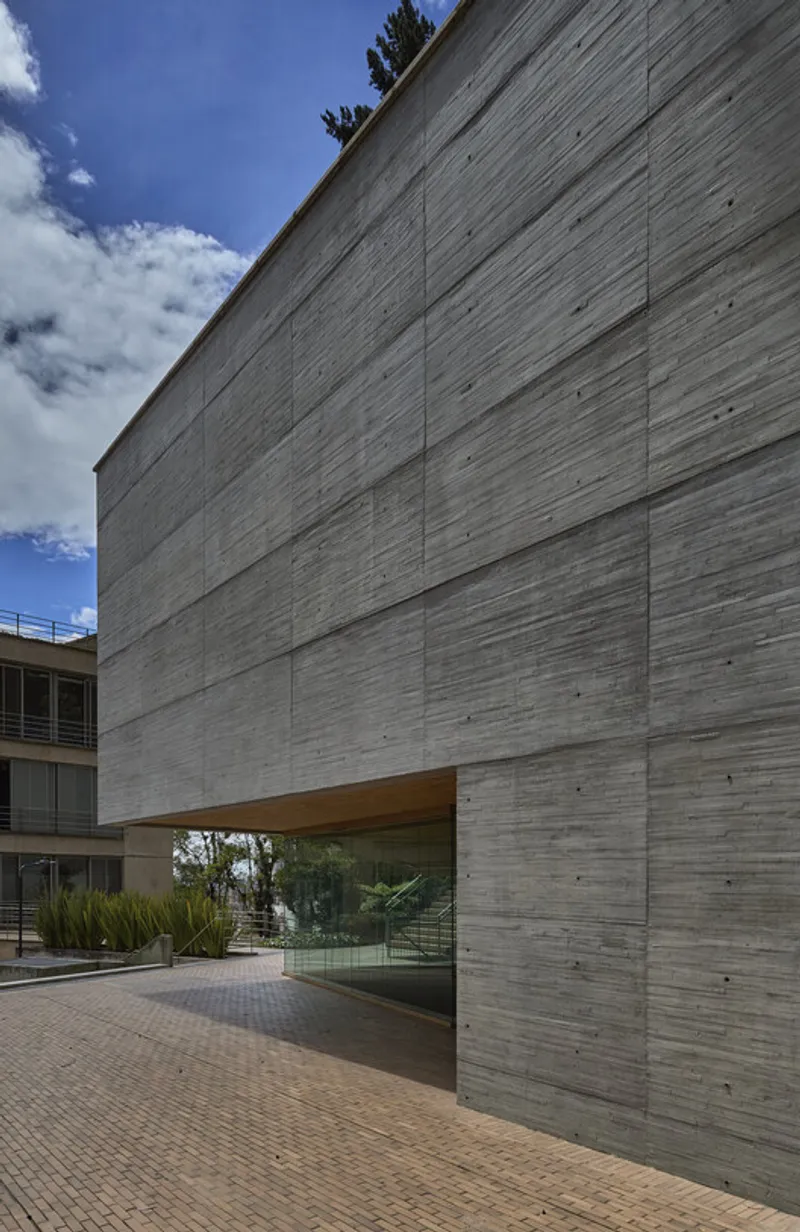
From the exterior, the building is perceived as a rectangular monolith of exposed concrete. Devoid of unnecessary ornament, it reads as stillness—solid, quiet, and almost reticent. This sobriety, however, prepares for an interior atmosphere that shifts dramatically as one descends inward. A central void cuts through the volume, bringing daylight deep underground and forming an atrium-like space that performs architecturally and acoustically. Here, sound expands upward like air rising through an instrument’s chamber, then settles back into practice rooms designed for precision, privacy and study.


The Music Box introduces itself softly, yet becomes a core reference on campus. One encounters it as a silent pause between brick facades and terracotta roofs, as López describes: “The building acts as a silence between the heritage brick and the orange of the neighboring buildings.” It is not the loudest structure, but the one that deepens the conversation.

Architecture as Instrument: Form, Volume, Sound
The conceptual power of The Music Box lies in how it functions as both space and instrument. The competition brief itself referenced the idea of a music box, and the architects adopted the metaphor not as decoration, but as operating logic. Rooms are nested like resonant chambers, circulation is structured like rhythmic flow, and light behaves like a score modulating the emotional tone of the building.
The interior is distributed across three levels, graded carefully according to acoustic intensity. The lowest floors house rehearsal studios and recording rooms requiring absolute isolation. These are designed with a box-in-a-box construction system: structurally separated from the main envelope to avoid vibration transfer. The technique eliminates structural echo and ensures that even the most delicate recording sessions occur without sonic interference from footsteps, exterior noise or adjacent instruments.
The acoustic design was developed in collaboration with WSDG of Miami, specialists in recording environments, along with engineer Daniel Duplat, who tailored the system to Bogotá’s high-altitude humidity and local atmospheric conditions. Each studio is treated with layered insulation, decoupled flooring, absorptive surfaces, and calibrated geometry to eliminate distortion. Sound behaves cleanly and predictably inside, turning practice into precision rather than struggle.
Higher levels of the building shift from isolation to interaction. Control rooms, monitoring spaces and open common areas create opportunities for spontaneous collaboration, discussion and interdisciplinary exchange. The central atrium acts as an acoustic hinge between zones: a resonant cavity that changes character depending on how it is activated—sometimes quiet and still, other times filled with overlapping rehearsals, improvised performance or casual conversation. It is both a gathering void and a sound chamber, spatially binding the floors and shaping perception of the building.

Structural Clarity and Invisible Support
Behind its quiet appearance lies structural rigor. Two immense concrete beams traverse the building and free the subterranean floor from vertical supports. The result is a column-free space, visually uninterrupted, allowing full glass continuity along studio walls. Musicians can see across the plan without obstruction, creating a subtle sense of community even in moments of individual practice.
This structural liberation strengthens the concept of containment and release. The mass of concrete overhead reads heavy yet never oppressive because its support remains unseen. Wood stands in contrast—warm, acoustic, humanising. The meeting of these two materials forms the building’s sensory identity. Concrete holds silence; wood holds sound. Together they produce balance rather than conflict.

Material Duality and Light as Sound
Materiality operates like instrumentation. Exposed concrete communicates permanence and grounding, while interior wood absorbs vibration, warms the atmosphere and makes each studio feel tactilely intimate. The precision and craftsmanship of the interior are not superficial aesthetic gestures but acoustic necessities. Angled wall panels, concealed joints and flush-mounted frames reduce reverb and prevent flutter echo. Timber slats modulate tone, air and resonance. The rooms perform like tuned instruments, ready to receive music.

Light becomes the third material. Gentle, indirect daylight descends from above into the central void, illuminating stair cores and studio entrances without glare. The changing quality of light throughout the day alters the mood—morning brightness sharpens detail; late afternoon softens edges like a muted chord. This modulation creates variety within architectural consistency, transforming circulation from movement into experience.
The exterior shifts through weather and season. On misted Bogotá mornings, the concrete merges with the grey sky, erasing the building’s edges. In heavy rain, water darkens the surface and intensifies its mass. Over years, the architects expect vegetation to grow across roof gardens and along edges, eventually fusing the building into the hillside. The Music Box is designed to age, to mellow, and to find equilibrium in landscape and memory.
Campus Connection, Circulation and Urban Quietness
The building is not only a container for sound; it is a connector of place. Its placement mediates circulation between the Architecture Faculty and the Campito de San José—once a social heart of campus. New pedestrian routes slope gently around and over the structure, preserving accessibility without aggressive intervention. Rain gardens stabilize runoff, while green roofs reduce thermal gain and visually extend the terrain.

Students encounter the building in daily movement: crossing its terraces, descending into its atrium, hearing muted scales through insulated walls. It blends into campus life not by hiding, but by being quietly necessary. Since opening in 2024, it has become a social coordinate: “Let’s meet at the Music Box,” students say. A nickname that once seemed casual has become a term of affection and belonging.
Resonance as Architectural Legacy
For the architects, the building carries personal weight. It is erected on the campus that trained them; it is their contribution to a lineage of Colombian architecture shaped by names such as Bermúdez and Cerón. They describe it as axis mundi—professional center, emotional anchor, and architectural offering to future generations.

Time will complete its identity. As concrete patinas, wood darkens, and plants grow along edges, the building will settle deeper into the hillside. In ten or twenty years, it may appear less new, more inevitable—as though it has always been there, waiting for sound to fill it.
The Music Box demonstrates that architecture for performance does not need spectacle to be powerful. It succeeds by restraint, by listening to the landscape, by shaping silence and resonance into built form. It is not merely a rehearsal building—it is a pause carved into campus, a chamber of memory and potential, an instrument awaiting activation.
All the Photographs are works of Mónica Barreneche




Popular Articles
Popular articles from the community


Play: Fragments of Their World
Familiar architecture becomes modular playground design, creating safe spaces where displaced children can learn, connect, imagine and play.

Co-Life: Senior Housing Design That Reconnects Older Adults With the City
Co-Life reimagines senior housing design through healing gardens, shared streets, workshops, and a sustainable community across generations.

Co-life: Sustainable Architecture for Age-Friendly Community Living
Co-life reimagines sustainable architecture for seniors through courtyards, rammed earth, shared gardens, and spaces designed for belonging.

Lunar Spiral: Space Architecture Shaped by the Mathematics of the Universe
Lunar Spiral reimagines space architecture through Fibonacci geometry, lunar regolith, levitating habitats, and self-sustaining Moon living.


Similar Reads
You might also enjoy these articles


Hodi-Mandai Geram
Project Function: Preservation and revitalization of the Intangible heritage and socio-spatial identity of the Hodi by Housing, Cultural Memory Center, Sacred Grove, landscape, local tourism economy


Olio Towers: A Mid-Rise for Performers That Fuses Housing, Rehearsal, and Stage
Located blocks from Houston's Theater District, this modular tower stacks living units around a central performance atrium.

Oasis: Modular Green Housing Carved into Dhaka's Urban Fabric
A shortlisted Plugin Housing entry reclaims unauthorized settlements in Dhaka with stepped concrete volumes, green roofs, and ventilation-driven design.

Black Hole: A Floating Megastructure for the Post-Physical Era
Emiliano Mazzarotto envisions a spherical, self-scaling arena where e-sports, digital hotels, and holographic stadiums replace traditional public space.


Explore Educational Building Competitions
Discover active competitions in this discipline



Challenge to design public laboratory


Challenge to reimagine the Iron Throne


Photograph architecture without architects


Illustrate the lost glory of Angkor Wat - Render Challenge
Comments (0)
Please login or sign up to add comments
No comments yet. Be the first to comment!