
Muziekwerf Turns a Mennonite Church Into Music
Powerhouse Company transforms Rotterdam's last Mennonite church into a rehearsal and concert venue that honors its vaulted past while tuning it for the fut


Rotterdam has a complicated relationship with its heritage. After wartime destruction erased most of the city's historic core, the few surviving buildings carry outsize cultural weight. So when Powerhouse Company was commissioned by the philanthropic foundation Droom en Daad to repurpose the city's last Mennonite church into a public rehearsal and concert venue, the brief was loaded: make the building perform, acoustically and socially, without erasing the character that makes it worth saving in the first place.
The result, Muziekwerf, is a 930 square meter venue that manages to feel both intimate and civic. Rather than gutting the interior and slotting in a generic concert box, lead architect Nanne de Ru treated the existing architecture as a collaborator. The vaulted ceilings, the brick gables, the generous windows: all of these become part of the acoustic and spatial logic. The intervention reads less as renovation and more as a careful conversation between the building's Mennonite restraint and the warmth that music demands.
Brick and Shade: The Exterior Presence
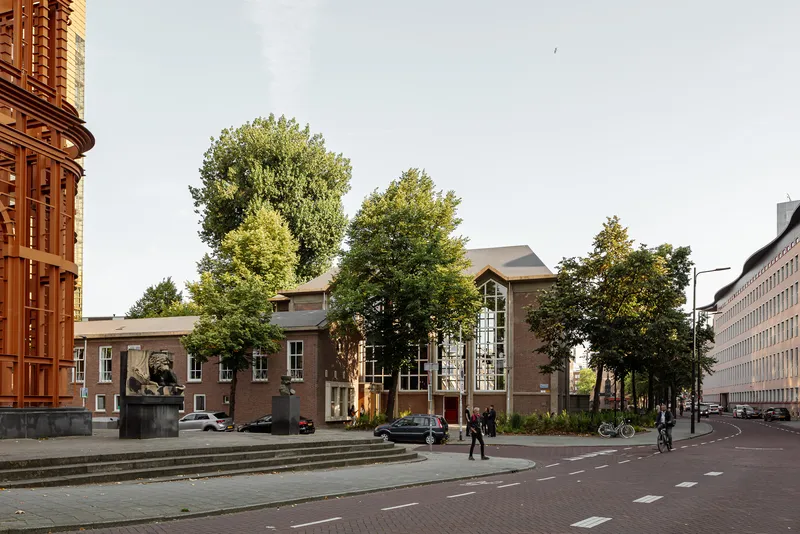
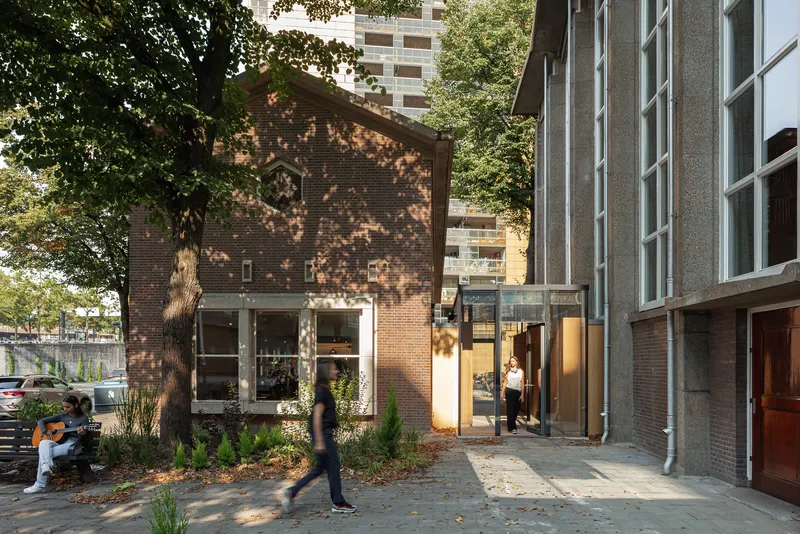
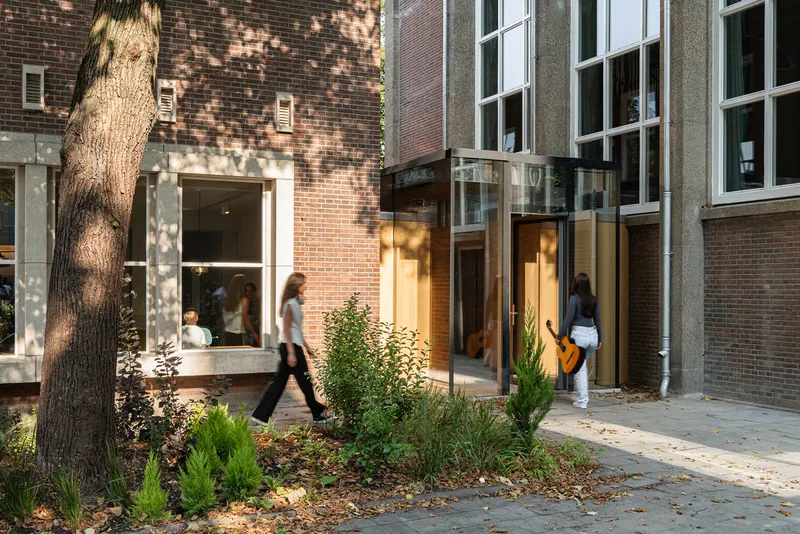
From the street, Muziekwerf barely announces itself. The brick facade, its arched glazing framed by mature trees and dappled light, could still pass for a place of quiet worship. That is precisely the point. Powerhouse Company resisted the urge to brand the exterior with flashy signage or a contrasting material palette. Instead, they let the planted beds and the rhythm of tall windows do the talking. The gable end, glimpsed through tree shade, retains its composed symmetry.
The courtyard elevation reveals a similar restraint. Ground floor glazing opens the building toward its planted surroundings, softening the threshold between public pavement and what happens inside. For a music venue, this porosity matters: it signals accessibility before a single note is played.
The Vaulted Hall: Sacred Geometry for Sound
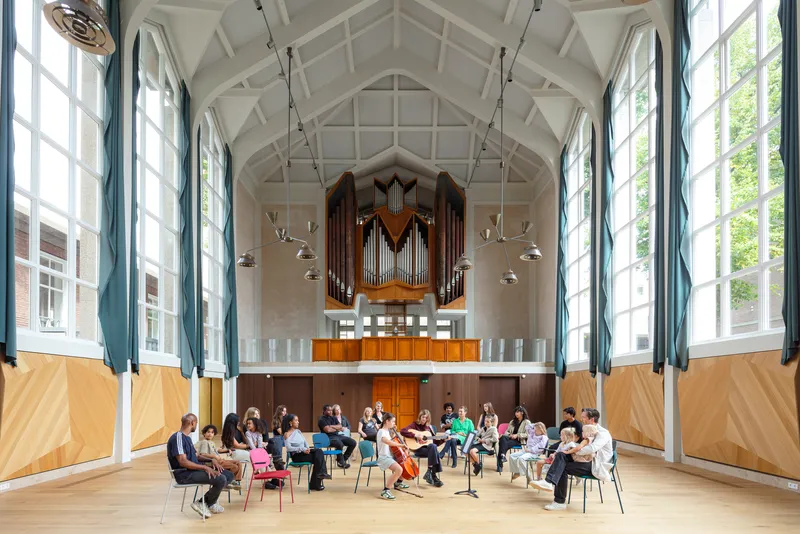
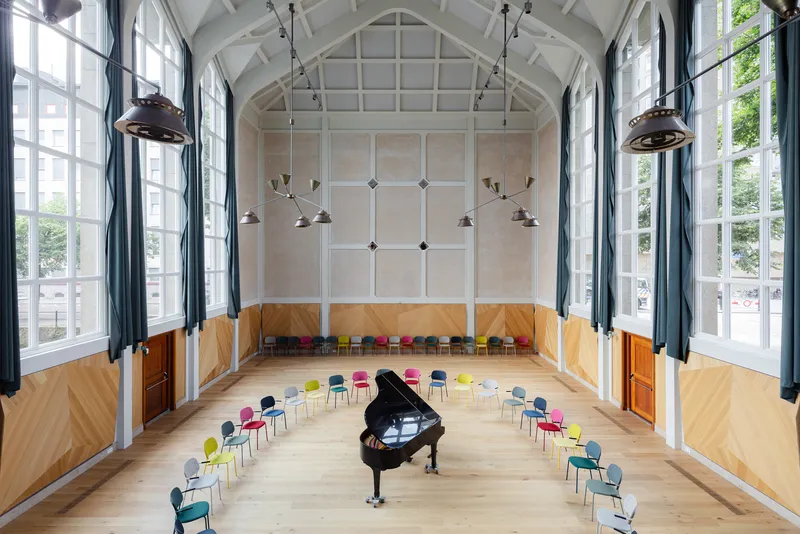
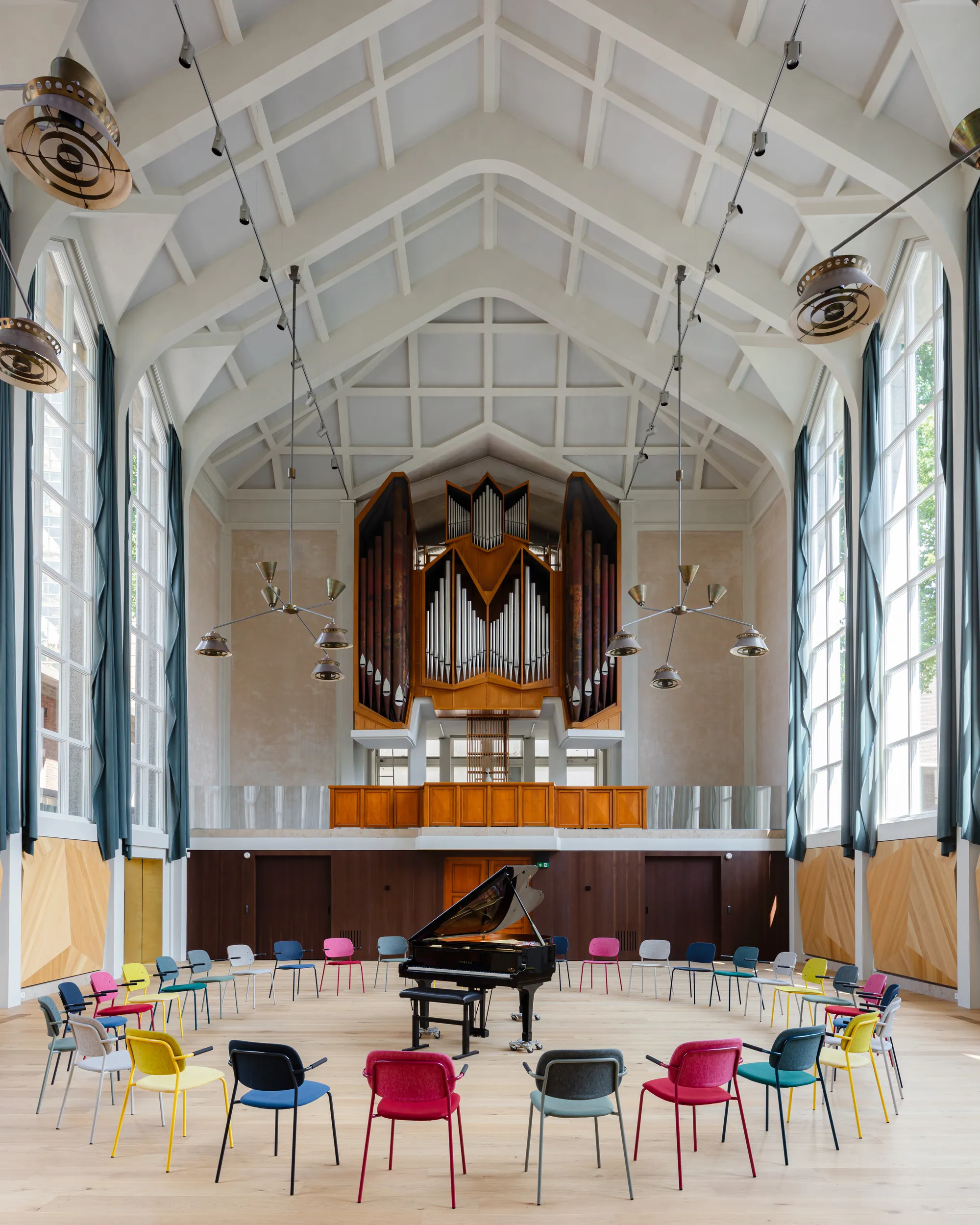
The main hall is the heart of the project, and it is spectacular. The exposed timber ceiling structure rises into a tall vault that gives the room its generous volume, a gift for acoustics that no new build at this budget could replicate. A pipe organ sits on the balcony, connecting the building's congregational past to its musical present. Below, a grand piano is surrounded by colorful chairs arranged in a loose circle, dissolving the hierarchy between performer and audience.
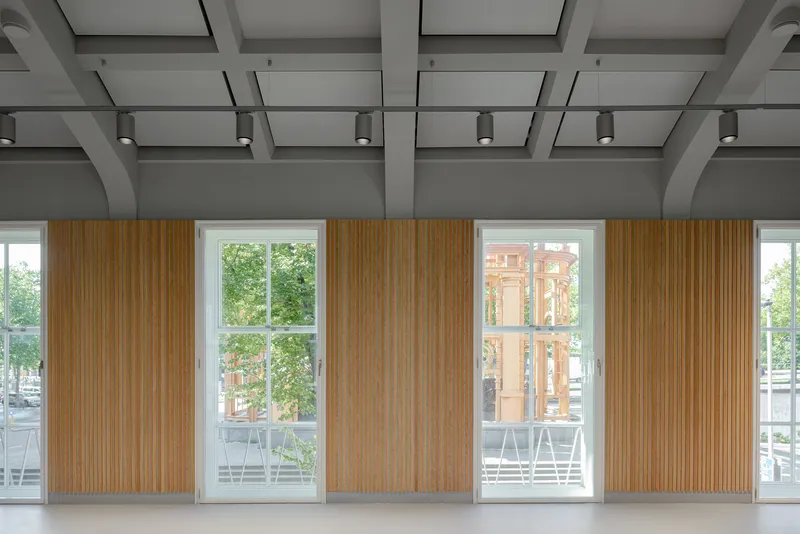
Alternating timber slat panels and tall windows line the walls, working double duty as acoustic diffusers and light sources. The coffered grey ceiling adds further texture to the sound reflections. Industrial pendant lights drop from above, their no-nonsense profiles a deliberate counterpoint to the ornamental ceiling. The overall effect is somewhere between a loft and a chapel, which turns out to be an ideal register for chamber music and rehearsal alike.
Rehearsal Rooms: Timber as Acoustic Instrument
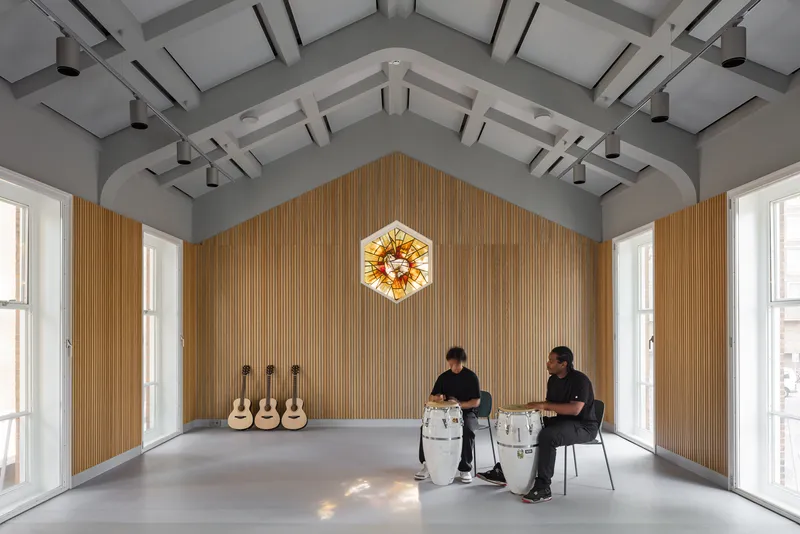
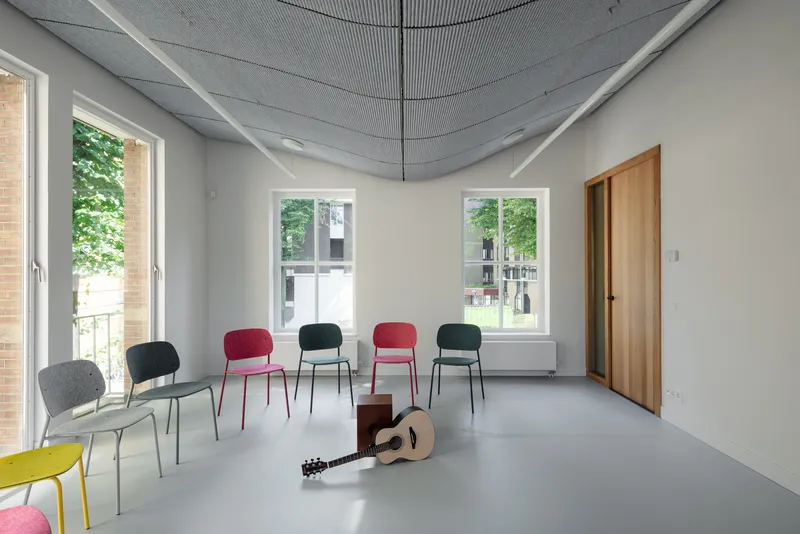
The smaller rehearsal rooms prove that Powerhouse Company thought carefully about the building's acoustic range, not just its showpiece space. One room is lined floor to ceiling with vertical timber cladding, its vaulted ceiling compressing sound into a warm, focused envelope. Two musicians playing hand drums look entirely at home here. The timber functions as much more than decoration: its grain, spacing, and profile are tuned to absorb and scatter mid and high frequencies.
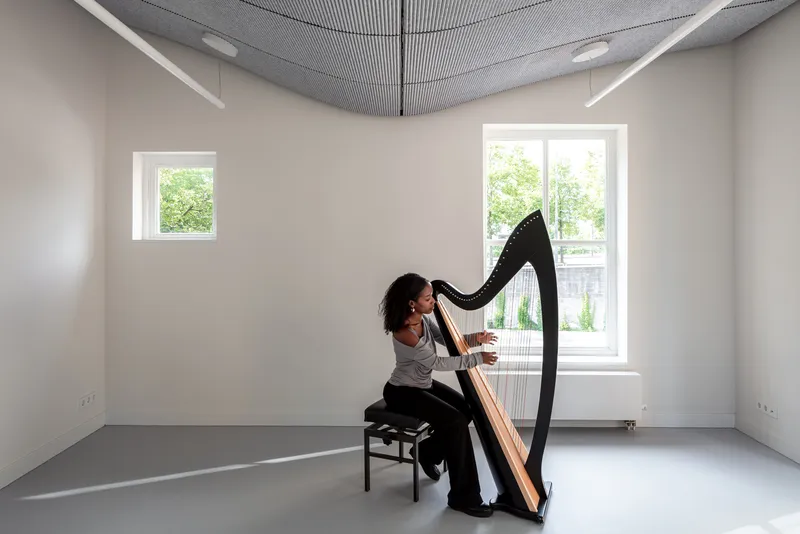
Another practice room features curved acoustic ceiling panels that float above the space like a stretched drum skin. The palette shifts to grey and neutral tones, letting colored chairs provide the only visual accent. A harpist rehearses by the window in one shot, and the room seems scaled perfectly for solo practice: generous enough for the instrument's resonance, tight enough to keep the musician connected to the sound. These are rooms designed by people who understand that musicians need to hear themselves clearly.
Social Spaces: Kitchen, Lounge, and Threshold
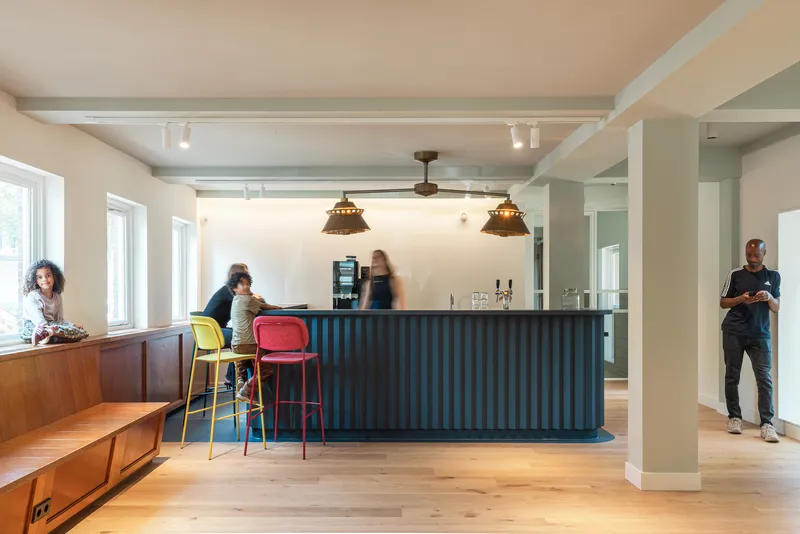
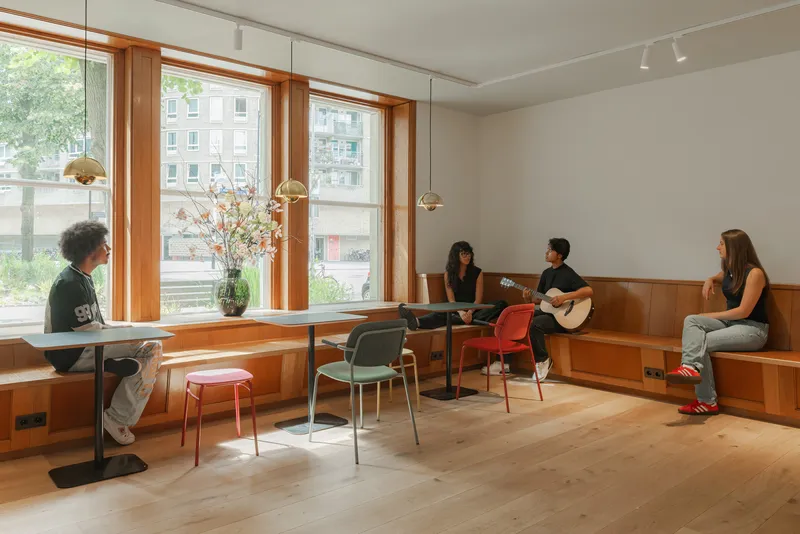
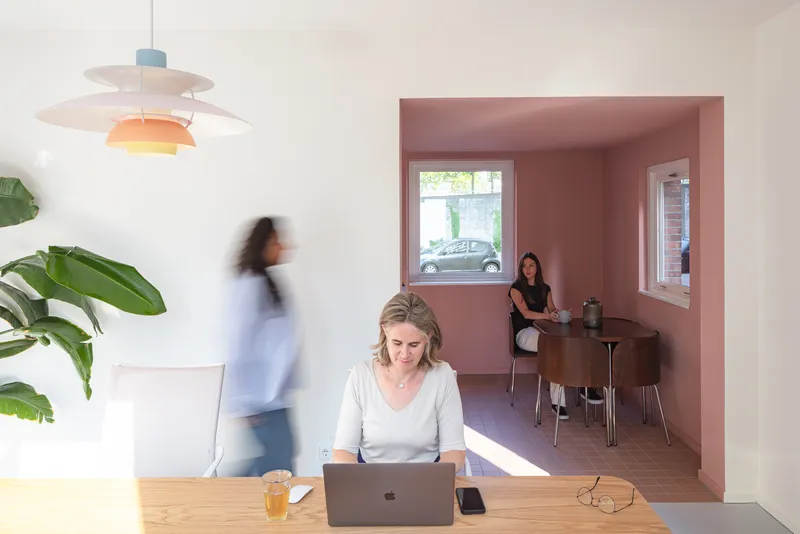
A music venue lives or dies by its social spaces. The open kitchen with its dark fluted island and colorful stools is clearly designed for lingering: pendant lights hang low, and the counter encourages the kind of informal gathering that makes a venue feel like a community hub. Nearby, a lounge area with timber built-in seating along the windows catches afternoon light, hosting casual guitar sessions that blur the boundary between rehearsal and hanging out.
There is also an unexpected pink alcove dining area that adds a playful domestic note to the program. This kind of color confidence is a hallmark of Powerhouse Company's recent work. It signals that the building is not precious about itself. You can eat dinner here, have a meeting, warm up for a performance, or simply sit. The architecture accommodates all of it without hierarchy.
Corridors, Portals, and the Art of Transition
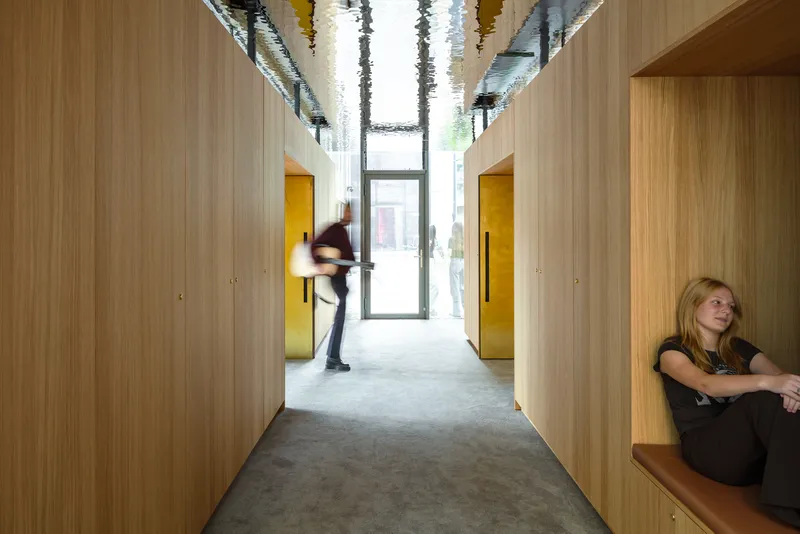
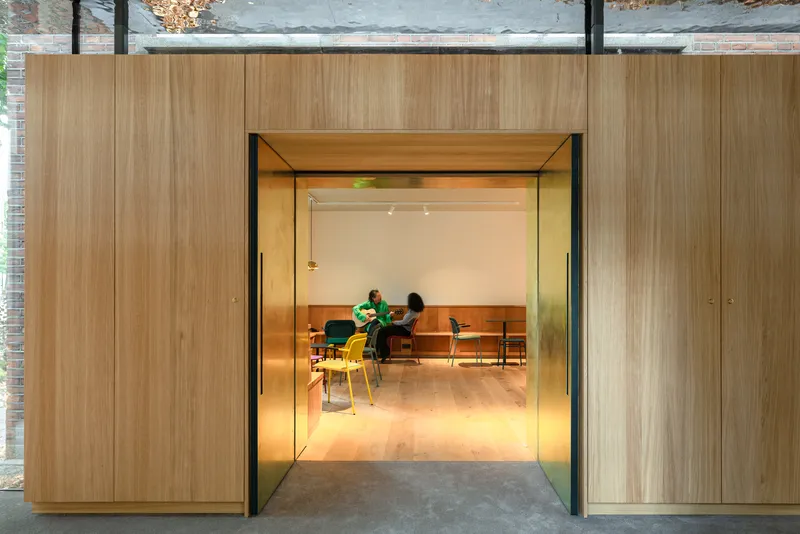
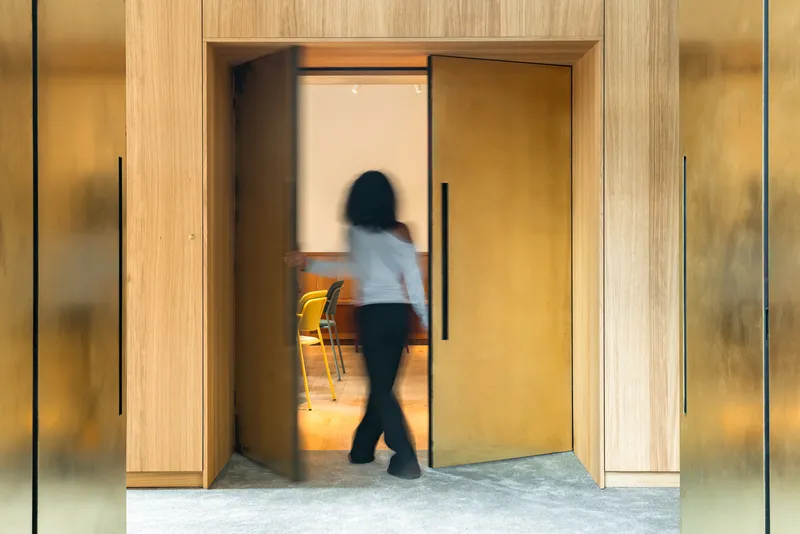
Some of the most considered moments in the project happen in the spaces between rooms. Light wood wall panels, yellow doorways, and a decorative ceiling installation transform what could be dead circulation into something inviting. A timber portal with an angled reveal frames a meeting room beyond, turning a doorway into a stage set. People pass through corridors in motion blur, and the architecture seems calibrated to make that movement feel intentional.
These thresholds do important acoustic work too. Each transition zone acts as a buffer between the rehearsal rooms and the communal spaces, managing sound bleed without resorting to heavy doors or double walls. The material shifts, from timber slats to grey tile wainscoting to glazed partitions, signal acoustic boundaries in a way that feels intuitive rather than institutional.
Details That Earn Their Place
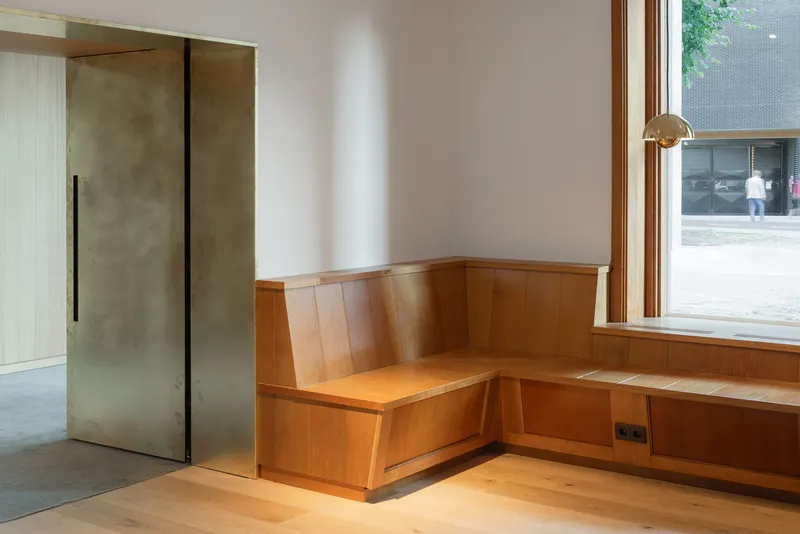
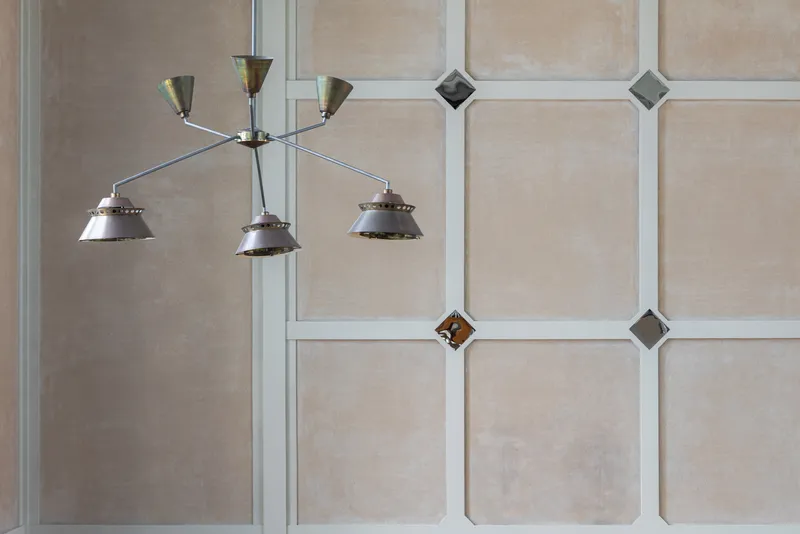
A corner window seat with curved timber paneling and a bronze pendant light is the kind of detail that rewards close attention. It is a reading nook, a warm-up spot, a quiet retreat overlooking the street. Elsewhere, a multi-arm chandelier hangs against a wall panel grid inset with diamond-shaped glass, a nod to the building's ecclesiastical past rendered in a contemporary key. These moments are generous without being showy.
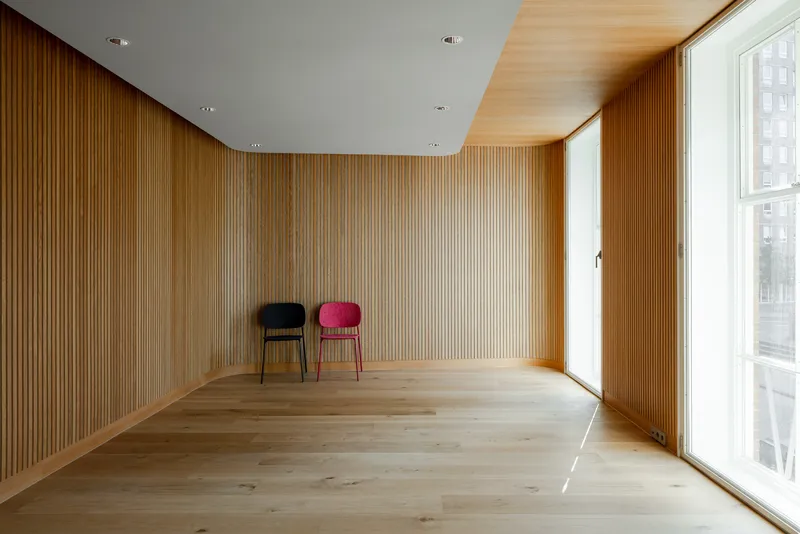
A smaller room lined with vertical timber slats and furnished with two upholstered chairs under natural light feels almost residential. It could serve as a green room, a counseling space, or a place for one-on-one lessons. The architects clearly understood that a music venue needs quiet as much as it needs volume.
Lessons and Gathering
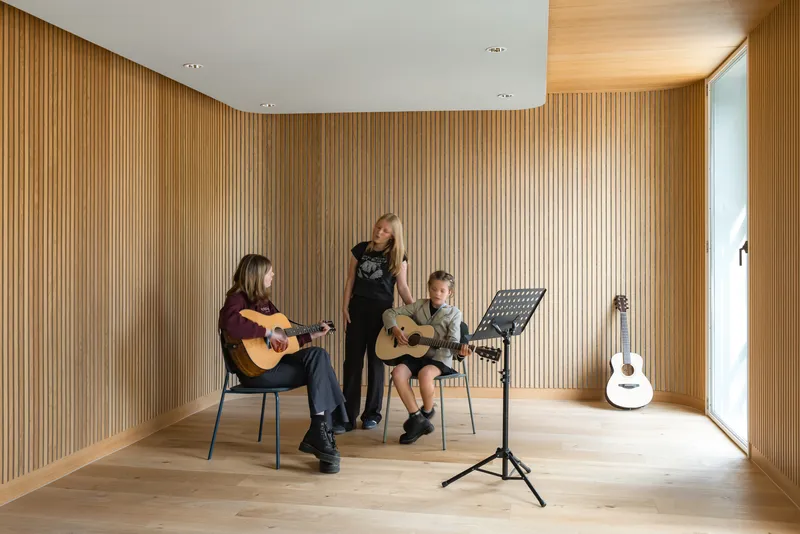
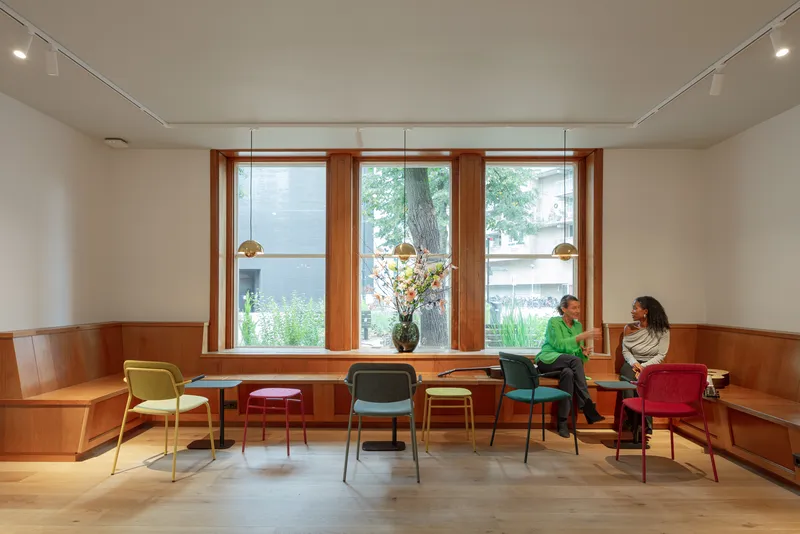
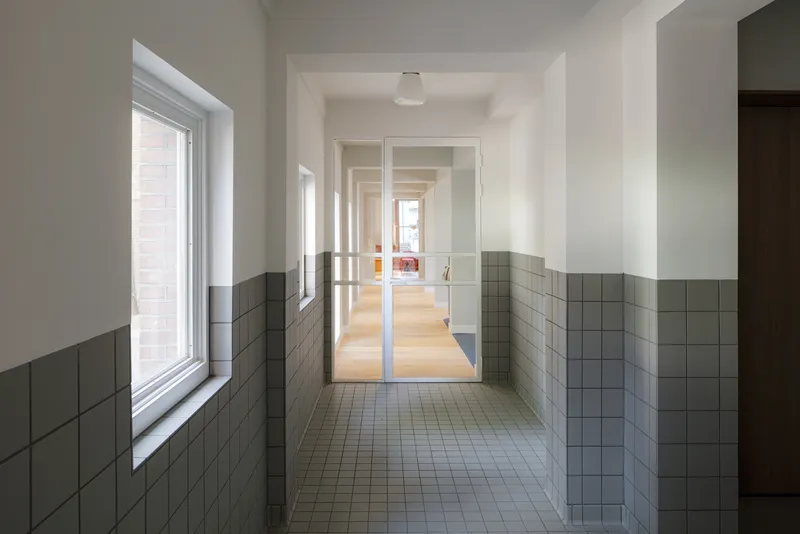
The educational dimension of Muziekwerf comes through in moments like a timber-lined room where three people play guitars beside a music stand, or a gathering room with built-in bench seating where two people sit in conversation. These are not afterthought spaces. They are carefully proportioned, acoustically considered, and flooded with natural light. The corridor with grey tile wainscoting and glass doors leading toward daylit rooms suggests a building organized around clarity: you always know where you are going, and the light pulls you forward.
Plans and Drawings
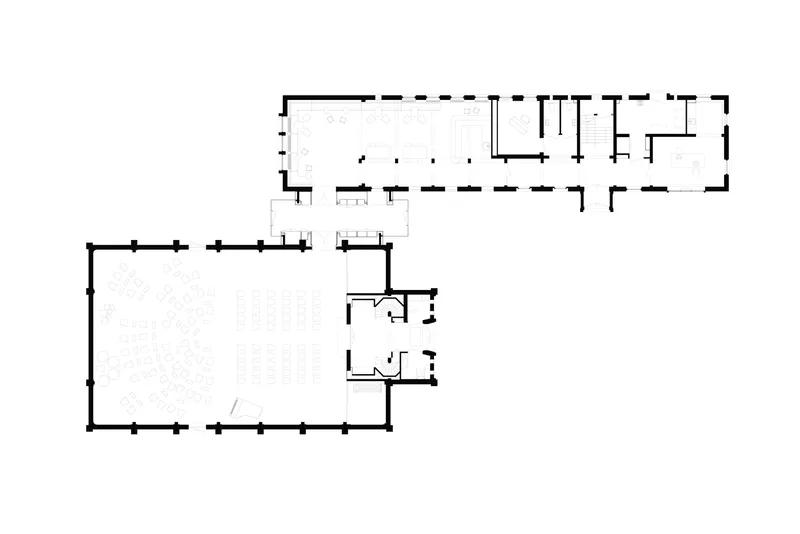
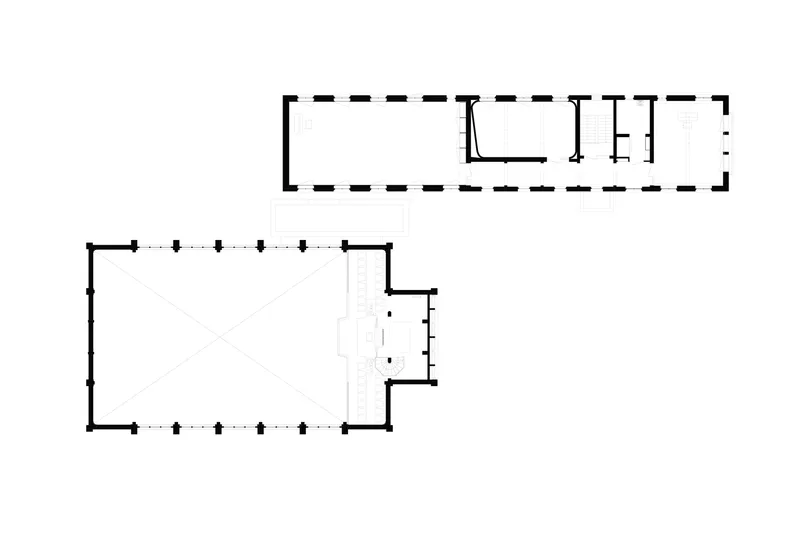
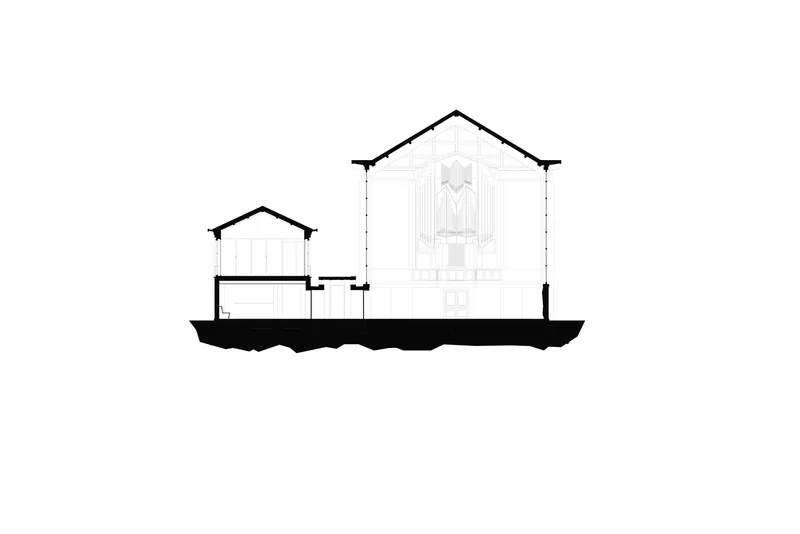
The floor plans confirm what the photographs suggest: two connected halls of different scales, linked by a service spine and a series of smaller rooms that step down in size and acoustic intensity. The larger hall anchors the public program while the rectangular wing houses rehearsal and teaching spaces. A section drawing reveals the dramatic height difference between the two gabled volumes, with a tall central space rising above a solid foundation. The connector between the volumes is where the social and circulatory life of the building happens.
What the drawings make clear is that the plan is organized around acoustic separation as much as spatial flow. Each room type has its own ceiling profile, wall treatment, and relationship to the exterior, ensuring that a harp lesson and a drum rehearsal can coexist without conflict. The architects have threaded a continuous route through the building that allows visitors to experience a gradient of sound environments, from the reverberant main hall to the dampened quiet of the practice rooms.
Why This Project Matters
Adaptive reuse projects often fall into one of two traps: either the original building is treated as a hollow shell to be filled with new program, or it is preserved so reverently that the new use can never fully inhabit it. Muziekwerf avoids both. The Mennonite church's proportions, materials, and light were already suited to a kind of communal gathering, and Powerhouse Company had the intelligence to recognize that music is simply another form of congregation. The acoustic interventions, timber cladding, curved ceiling panels, buffered corridors, are precise and purposeful without competing with the existing architecture.
For Rotterdam, a city that has defined itself through new construction for decades, Muziekwerf is a quiet argument that some of the most compelling architecture comes from listening to what is already there. The building does not shout about its transformation. It invites you in, hands you a chair, and lets the music fill a space that was always waiting for it.
Muziekwerf Rehearsal and Concert Venue by Powerhouse Company, lead architect Nanne de Ru. Rotterdam, The Netherlands. 930 m², completed 2024. Photography by Sebastian van Damme.
About the Studio
Share Your Own Work on uni.xyz
If projects like this are the kind of work you want to make, uni.xyz is a place to publish your own, find collaborators, and enter design competitions.




Popular Articles
Popular articles from the community


Riyadh For All: Intergenerational Urban Design for Active Aging in Rabat
Riyadh For All reimagines urban design in Rabat with intergenerational co-living, adaptive courtyards, and Moroccan cultural exchange today.

Conexión: Biophilic Design Reimagines High-Rise Living in Hong Kong
Conexión reimagines high-rise living in Hong Kong through biophilic design, green facades, shared spaces, daylight, water and nature within.

The Earth Pod: 3D Printed Homes for Resilient Refugee Communities
The Earth Pod reimagines refugee housing through 3D printed homes made from clay, combining resilience, self-sufficiency, and rapid shelter.

Lunar Spiral: Space Architecture Shaped by the Mathematics of the Universe
Lunar Spiral reimagines space architecture through Fibonacci geometry, lunar regolith, levitating habitats, and self-sustaining Moon living.


Similar Reads
You might also enjoy these articles

Bao Huynh Watercolor Atelier: A Serene Art Retreat in Hội An
Bao Huynh Watercolor Atelier in Hội An blends multifunctional art spaces, sustainable design, local materials, and family-friendly living in a serene environment.

Atelier Macri Concept Store Interior Design by CASE-REAL
Atelier Macri store features a "ko" counter, walnut wood details, cork displays, blending retail, gallery, and seamless customer experiences.

Manuel Vargas Izquierdo Stadium and High-Performance Sports Center: Architectural Excellence in Jalpa de Méndez
The Manuel Vargas Izquierdo Stadium blends sustainable design, inclusive sports facilities, and cultural-inspired architecture, revitalizing Jalpa de Méndez’s public spaces.

KAKR Buluh Awar Hall: Revitalizing Community and Ecology Through Bamboo Architecture
Community built bamboo hall revitalizes Buluh Awar village, empowering youth, restoring ecology, celebrating vernacular craftsmanship through sustainable architecture and culture.


Explore Religious Building Competitions
Discover active competitions in this discipline



Design Challenge - Contemporary interpretation of a religious complex


Challenge to design luxury tourism on rails


VR headsets Storefront design competition


Designing a staircase for a client
Comments (0)
Please login or sign up to add comments
No comments yet. Be the first to comment!