
Mymensingh Cultural Complex: Architecture as a Living Record of Bangladeshi Identity
A cultural campus in one of Bangladesh's oldest cultural centers fuses brick vernacular, riverine landscapes, and civic performance spaces.


What does it look like when a building tries to hold an entire region's cultural memory? Not as a museum frozen in time, but as a living organism that absorbs folk traditions, colonial legacies, and contemporary creative ambitions simultaneously. The Mymensingh Cultural Complex proposes an answer: a campus of brick volumes, courtyards, water bodies, and performance spaces organized around the conviction that culture is not a fixed artifact but an evolving framework. The architecture moves from intimate galleries to open amphitheaters, mirroring the way tradition expands outward into public life.
Designed by Md Rakib and published on uni.xyz, the project is sited in Mymensingh, one of Bangladesh's historically richest regions. The city has served as a center of art, literature, and social reform since the Pala Dynasty, through Mughal architectural influence, and into the colonial era. Rakib's research traces this layered timeline and translates it into a spatial programme that includes museums, academic studios, an auditorium, an amphitheater, a community café, and craft shops, all connected by pedestrian pathways that intersect reflecting pools and open courts.
Mapping Centuries of Cultural Sediment

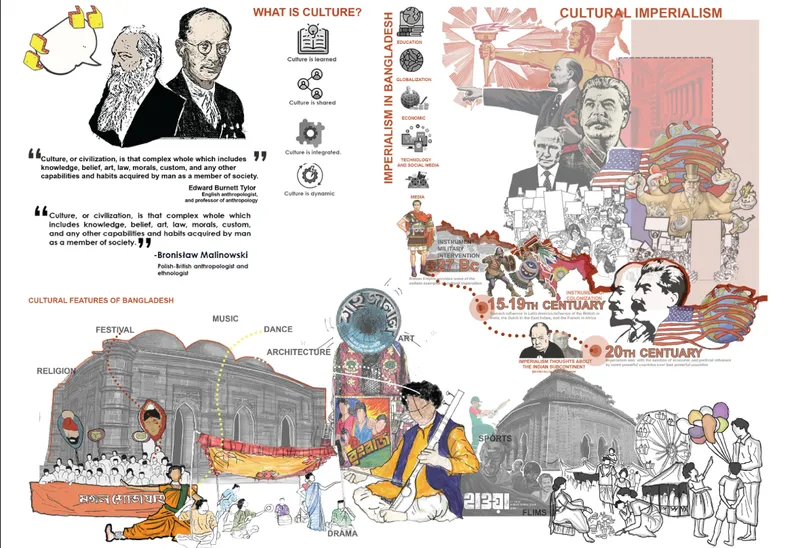
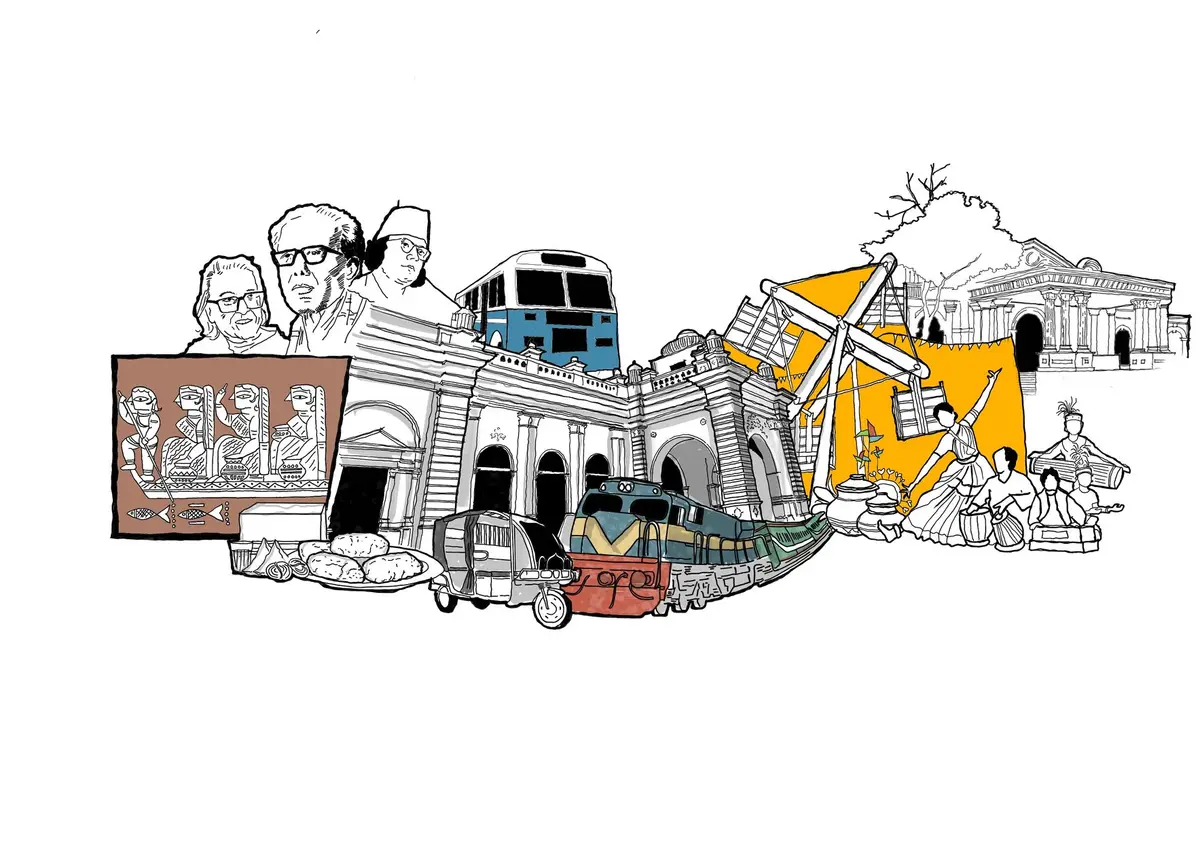
The project begins not with form but with forensic cultural research. An illustrated historical timeline maps activity patterns across a river landscape, tracing the evolution of traditional practices, folk festivals, music, and craftsmanship that define Mymensingh's cultural DNA. A companion collage diagram places definitions of culture alongside portraits, architectural sketches, and records of imperialism's impact on the region. This analytical groundwork draws on anthropological frameworks from Edward Burnett Tylor and Bronislaw Malinowski, who described culture as a "complex whole." For Rakib, these ideas are not academic footnotes; they are the generators that shape spatial organization. The design emerges from the premise that every courtyard, gallery, and plaza must narrate a specific chapter of socio-political and artistic transformation.
Studios, Ponds, and the Riverine Section
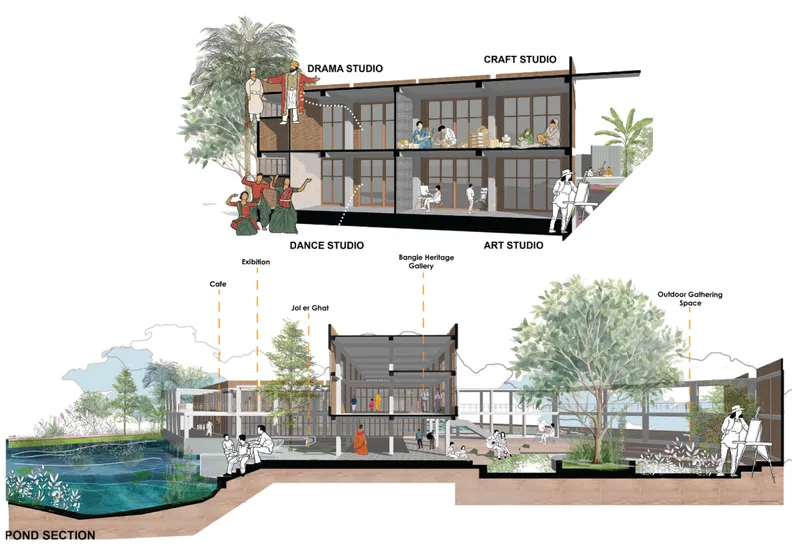
The sectional drawing reveals the complex's most distinctive spatial strategy: multi-level cultural studios arranged around a central pond, with trees and outdoor gathering spaces mediating the transition between built mass and water. This configuration echoes Bangladesh's deep relationship with its riverine landscape. Rather than treating water as ornament, the design treats it as infrastructure, an organizing spine that shapes circulation, microclimate, and social gathering. Stepped ghats descend toward the water's edge, offering informal seating for performances and festivals while supporting passive cooling through evaporative effects.
The site plan orients the built volumes to maintain visual and physical connections with major public landmarks including Jainul Abedin Park and the Circuit House Field. Pedestrian pathways weave through open courts, ensuring fluid circulation without the dominance of vehicular infrastructure. The result is a campus that feels continuous with the city's existing cultural geography rather than imposed upon it.
Brick, Shadow, and the Courtyard as Social Engine

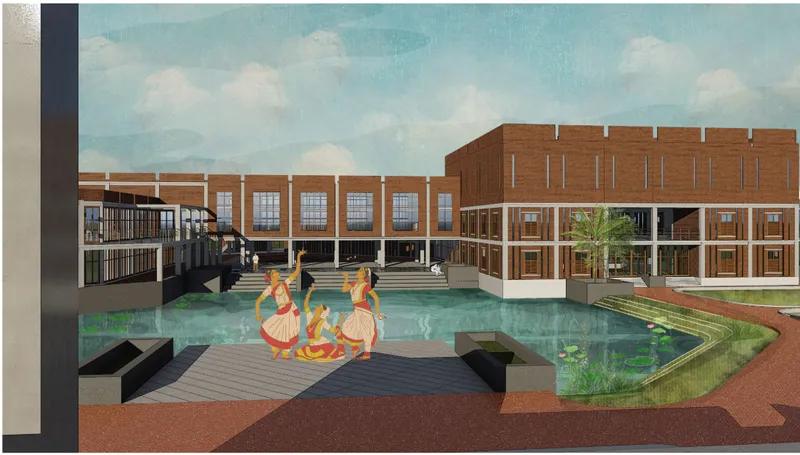
The rendered courtyard views confirm a material palette rooted firmly in the vernacular: local brick, exposed concrete, and shaded verandas. Two-story studio wings frame a central water feature paved with brick-trimmed stone, creating an outdoor room scaled for community gatherings. In one view, dancers perform on a water deck set against the reflecting pool, their movement activating a space that would otherwise read as pure landscape architecture. The vertical fenestration of the brick volumes filters light and air simultaneously, responding to Mymensingh's tropical climate while creating an ever-shifting interplay of shadow across interior and exterior surfaces.
Large openings and deep overhangs ensure climatic responsiveness without relying on mechanical systems. The shaded courtyards and internal terraces serve dual roles: they are passive cooling devices and stages for social interaction. Every spatial transition, from corridor to courtyard, from gallery to ghat, is calibrated to pull people into collective experience. The architecture does not merely house cultural activity; it provokes it.
Inside the Gallery: Brick Screens and Curated Light
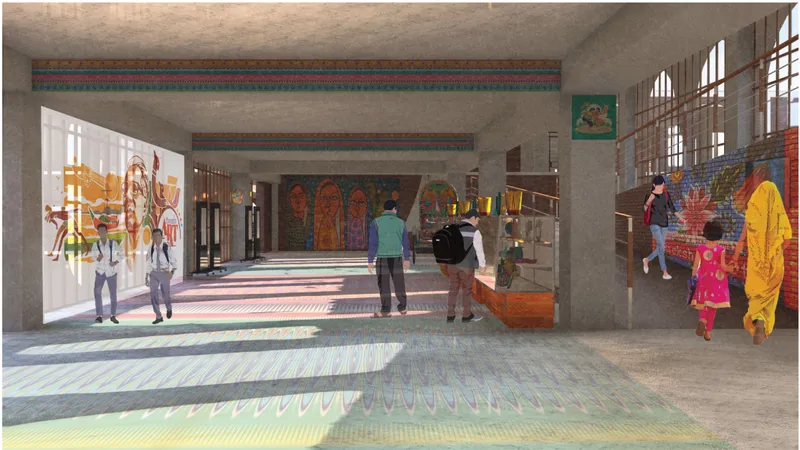
The interior gallery space reveals a quieter register of the same material language. Patterned floor tiles, brick screen walls, and carefully controlled natural light create a corridor where visitors browse displays in an atmosphere that feels both contemporary and grounded in local craft traditions. The brick screens do more than ornament: they filter daylight, provide visual permeability between adjacent spaces, and reference the jali screens found in Mughal and vernacular Bangladeshi architecture. The exhibition galleries and museum spaces are designed to narrate the region's artistic and historical development, functioning as interpretive environments rather than neutral white boxes.
Why This Project Matters
In a rapidly globalizing context where local architectural identity often dissolves into generic commercial typologies, the Mymensingh Cultural Complex offers a deliberate counter-argument. Rakib's design treats culture not as something to be preserved behind glass but as a living process that requires space to evolve, perform, debate, and gather. The programme, spanning museums, studios, an auditorium, an amphitheater, and community retail, is calibrated to serve both scholarly research and everyday civic life. The material choices, local brick and exposed concrete articulated through courtyards, ghats, and verandas, demonstrate that climatic and cultural responsiveness can be the same design strategy.
What makes the project compelling is its refusal to separate analysis from design. The extensive historical and anthropological research is not an appendix; it is the generator of form, programme, and spatial sequence. Every courtyard, reflecting pool, and performance plaza corresponds to a specific reading of Mymensingh's cultural evolution. For a young designer working in Bangladesh, the ambition here is significant: to prove that rigorous regional research, paired with skilled spatial thinking, can produce architecture that is simultaneously modern and deeply rooted. The Mymensingh Cultural Complex argues that the most radical thing a building can do is remember where it comes from.
View the Full Project
About the Designers
Designer: Md Rakib
Enter a Design Competition on uni.xyz
uni.xyz runs architecture and design competitions year-round that reward proposals with spatial conviction and real site intelligence.
Project credits: Mymensingh Cultural Complex by Md Rakib.


Popular Articles
Popular articles from the community


graciastudio Turns a Viewless Tijuana Lot Inward Around a Courtyard of Concrete, Timber and Trees
In Tijuana, Jorge Gracia's GA2 House stacks a timber-clad private floor over exposed concrete and replaces a missing view with a planted interior patio.

ETEH Reworks the Shared Spaces of São Domingos School in Brazil Around Timber, Color and Hanging Plants
At São Domingos School in Brazil, 436 m² of hall, refectory and library are recast with timber joinery, a yellow and blue code and trailing greenery.


Aquadapt: An Underwater Habitat That Rewrites Its Rooms by the Hour
Curved modules ring the seabed while one shell shifts from breakfast room to cinema, farm and football pitch as residents' needs change.

FCC Arquitectura Expands a Portuguese Granite House with a Board-Marked Concrete Wing
In Portugal, JV House pairs a cleaned-up whitewashed and granite dwelling with a timber-shuttered concrete extension, courtyards and a garden pool.

Similar Reads
You might also enjoy these articles
Aquadapt: An Underwater Habitat That Rewrites Its Rooms by the Hour
Curved modules ring the seabed while one shell shifts from breakfast room to cinema, farm and football pitch as residents' needs change.

Play: Fragments of Their World: Remembered Architecture Rebuilt as a Modular Playground for Refugee Camps
Tom Gardner abstracts domes, arches and towers from the homelands of displaced families into a kit of child-scaled play parts for camp settlements.
REBIRTH: A Circular Settlement Where Afghan Widows and Their Children Rebuild Life Together
A shortlisted Resile entry turns the circle into a protective ring of timber and brick, gathering homes, classrooms and gardens around a shared landscape.
The Main Dream: A Recycled Plastic Kit That Lets Refugee Children Build Their Own Playground
Thirty-centimetre interlocking cubes that connect on three axes turn play into construction, letting children author the spaces they occupy.

Explore Bangladesh Competitions
Discover active competitions in this discipline

Design a brochure to showcase the effects of the technosphere

Challenge to illustrate ‘A tale of Two Cities’

Deconstructivism - Illustration Design Challenge
Comments (0)
Please login or sign up to add comments
No comments yet. Be the first to comment!