
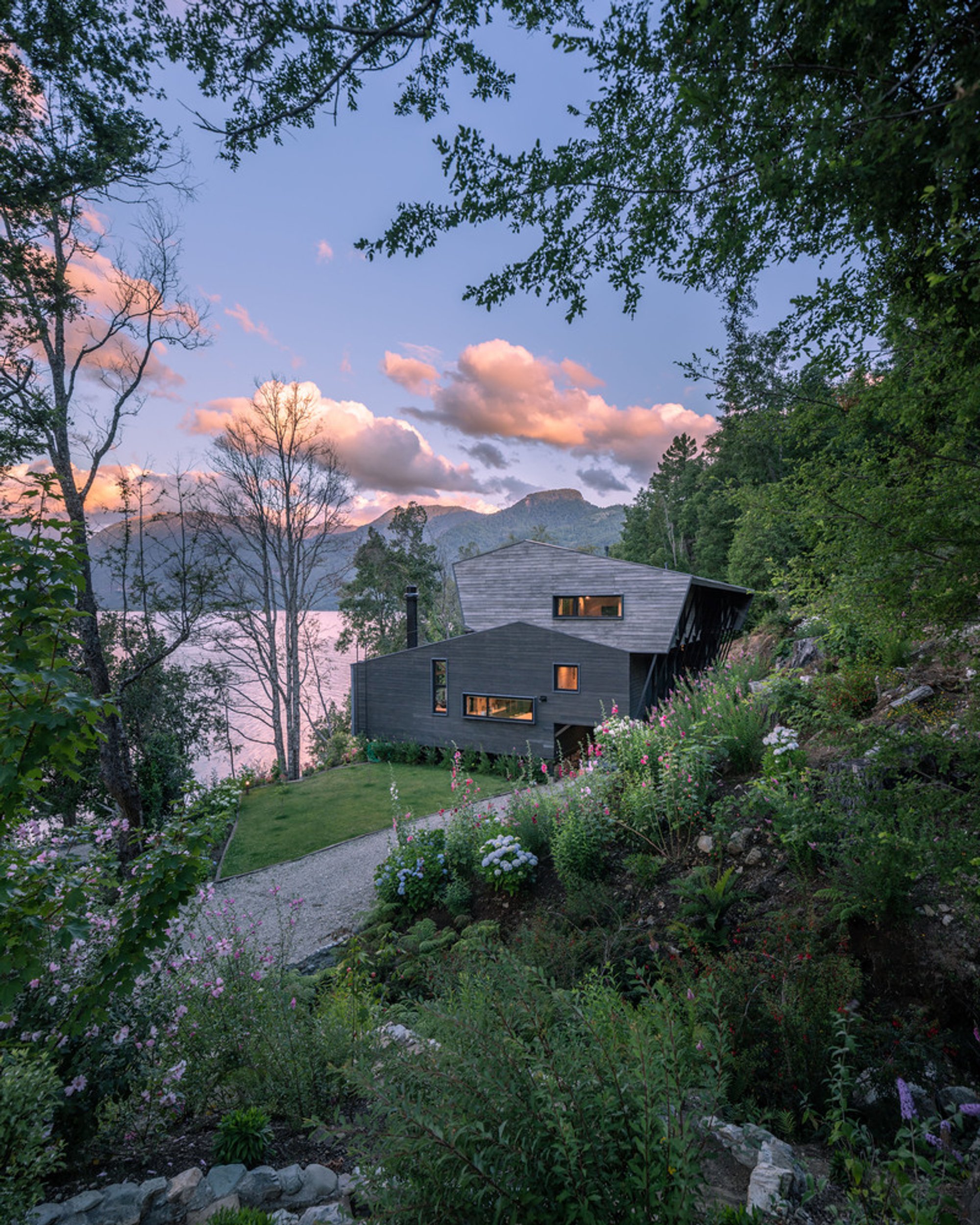
Schwember García-Huidobro Arquitectos Nests a Dark Timber House into a Chilean Lakefront Slope
Namoncahue House stacks shingled volumes above Lake Colico, framing Andean views through a lattice of exposed timber structure.

Building on a steep lakefront site is an exercise in negotiation. The slope dictates where you can dig, how deep you can go, and what you sacrifice in the process. At Namoncahue House, Schwember García-Huidobro Arquitectos chose to work with the terrain rather than flatten it, stacking dark timber volumes that step down toward Lake Colico in Chile's Araucanía region. The result is a house that reads as a cluster of pitched-roof pavilions from the water but operates as a single, vertically interconnected residence from the inside.
What makes Namoncahue genuinely interesting is not the lakeside romance (plenty of houses have that) but the structural frankness with which its timber frame is deployed. Exposed post-and-beam construction, diagonal steel bracing, and truss roofs are left visible everywhere, from the covered decks to the double-height living room. The architecture treats structure as ornament without ever being precious about it. The black-stained exterior cladding gives the house a recessive, almost geological presence on the hillside, while inside, the palette flips to warm, light timber and selective color in the kitchen cabinetry. It is a house designed around the tension between a moody exterior and a luminous interior.
A Dark Shell on a Green Slope
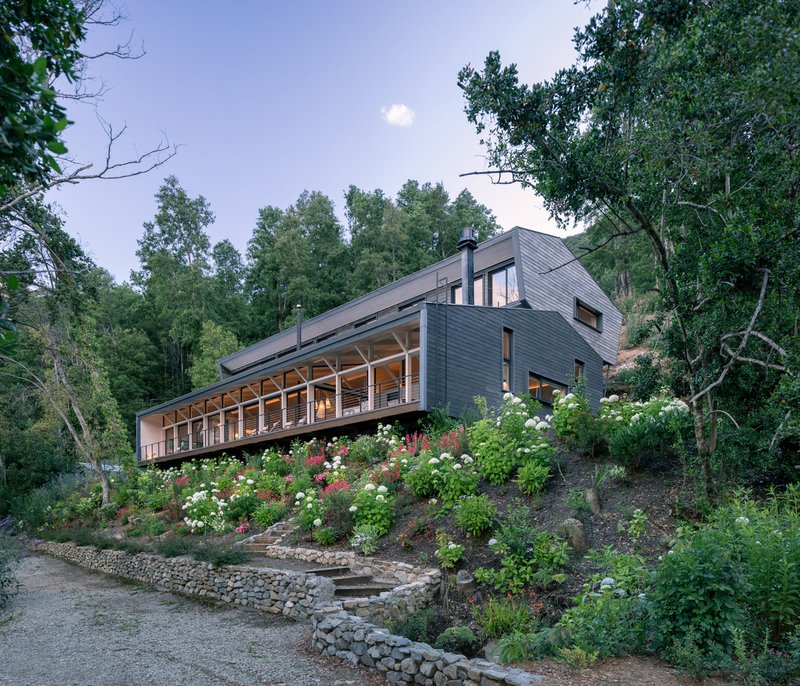
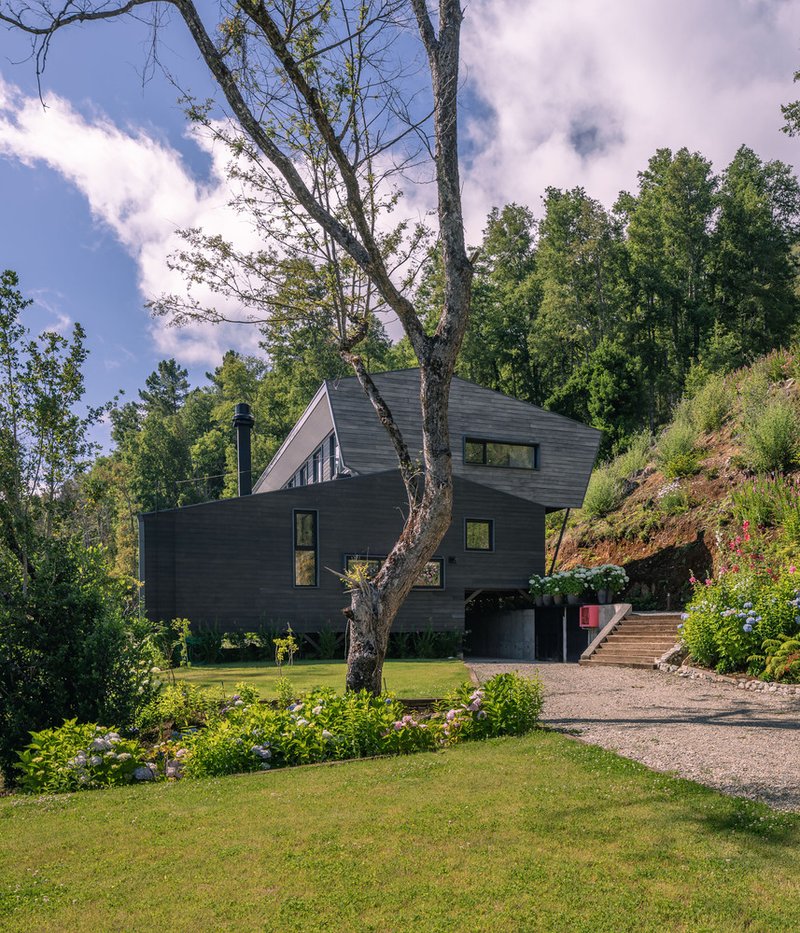
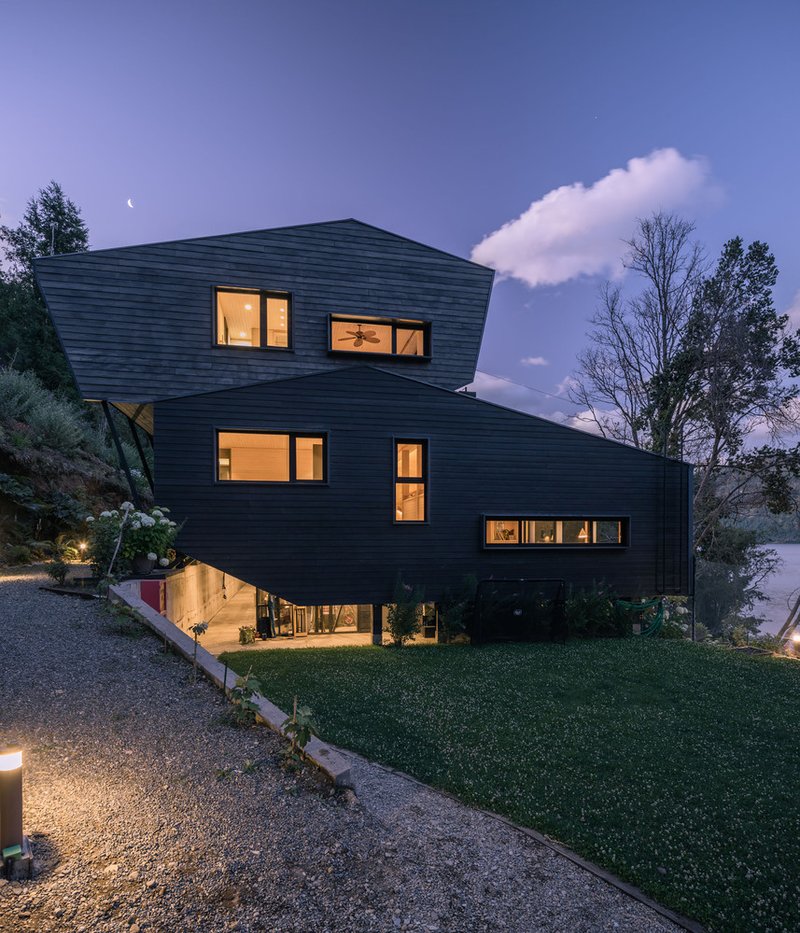
The horizontal black timber siding wraps every volume without interruption, unifying what is actually a complex assembly of staggered gables into a single dark mass. Punched windows are scattered across the facades with a rhythm that looks casual but corresponds precisely to interior conditions: small openings for bathrooms and stairs, larger ones for living spaces. At twilight, those windows glow like embers set into charcoal, giving the house an almost cabin-like warmth despite its considerable size.
Stone retaining walls and terraced gardens soften the transition between building and slope. The landscaping is not cosmetic; it manages stormwater and stabilizes soil on a site with significant grade change. Foxgloves and flowering shrubs have been allowed to grow tall against the dark cladding, reinforcing the sense that the house is slowly being absorbed into its setting.
Stacked Volumes and the Lake Beyond
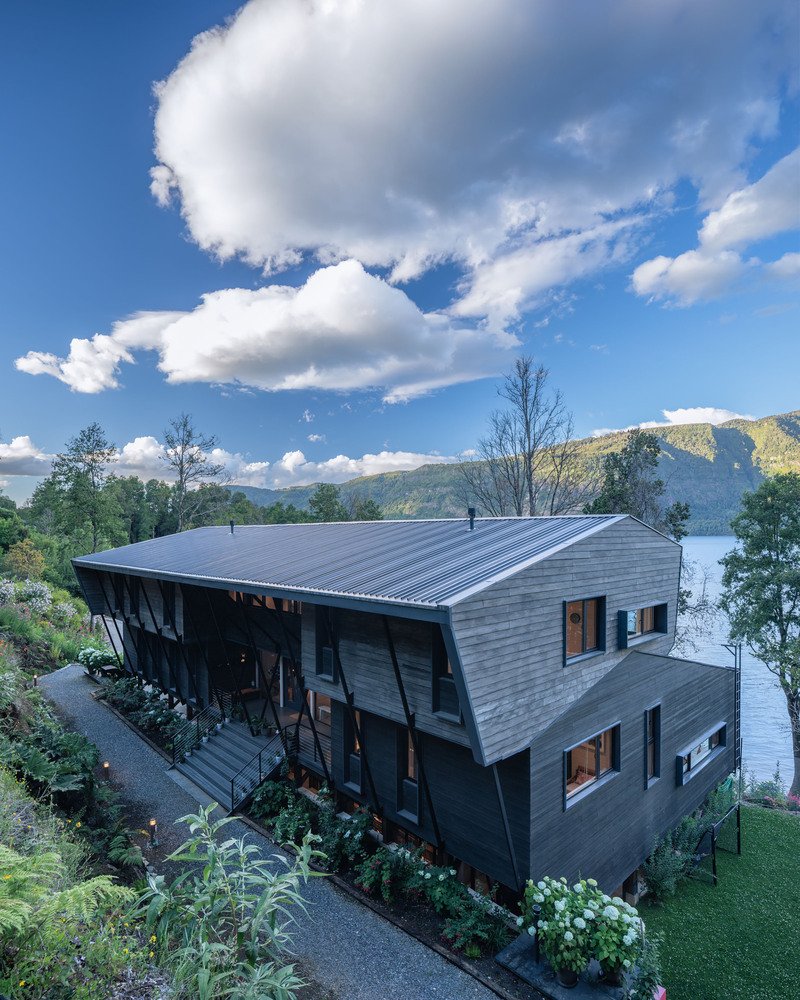
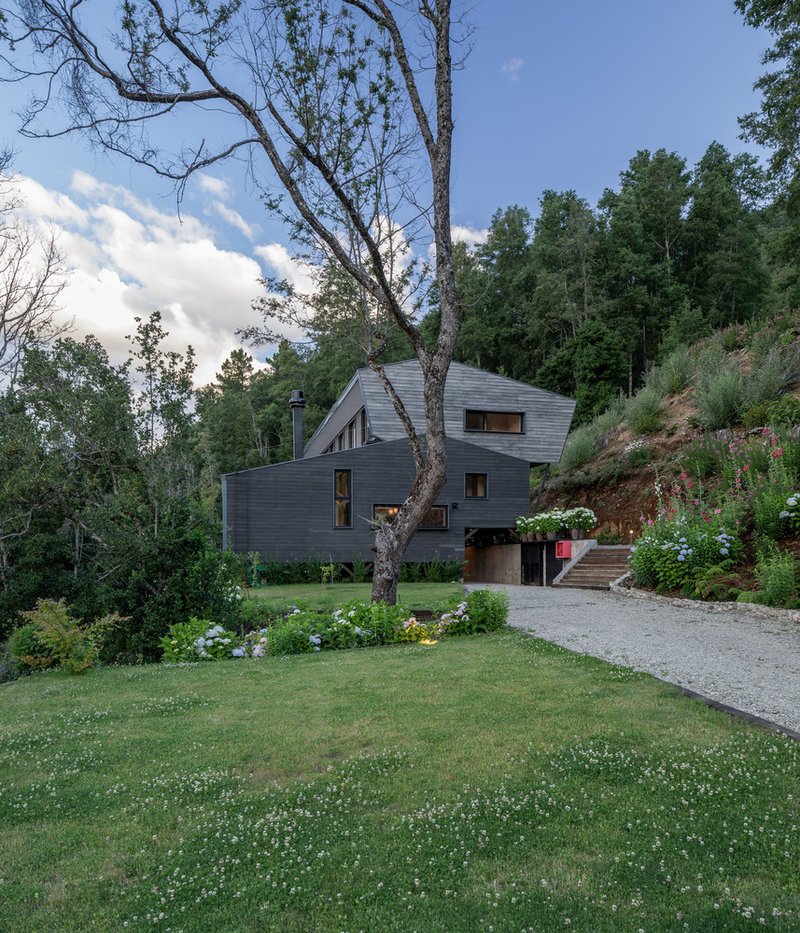
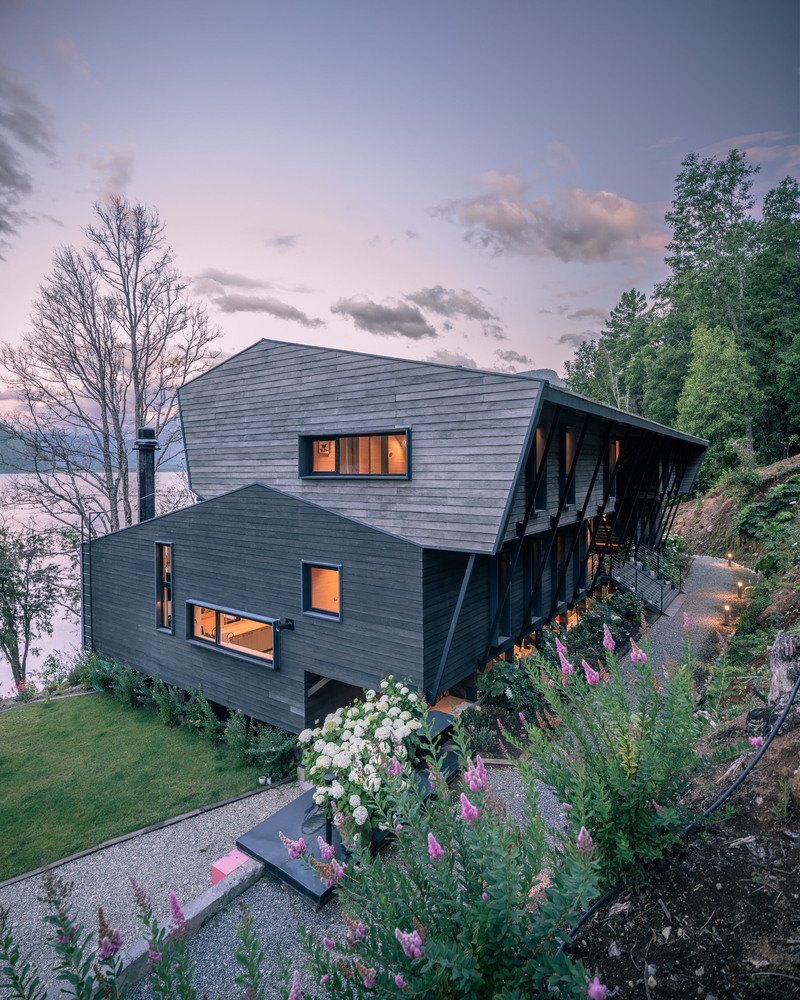
From above, the composition reveals itself: a series of angular, wood-shingled rooflines that stagger down the slope, opening sightlines between volumes toward the lake and the Andes beyond. The massing avoids the monolithic slab approach that too many hillside houses default to. Instead, by breaking the program into discrete pitched forms, the architects create gaps that let light and air penetrate deep into the plan while preserving views from nearly every room.
The elevated vantage also makes clear how effectively the dark cladding disappears against the surrounding forest. At dusk, with sunset light catching the lake and pink clouds overhead, the house becomes a silhouette. It is architecture that knows when to recede.
Structure as Character: The Covered Decks
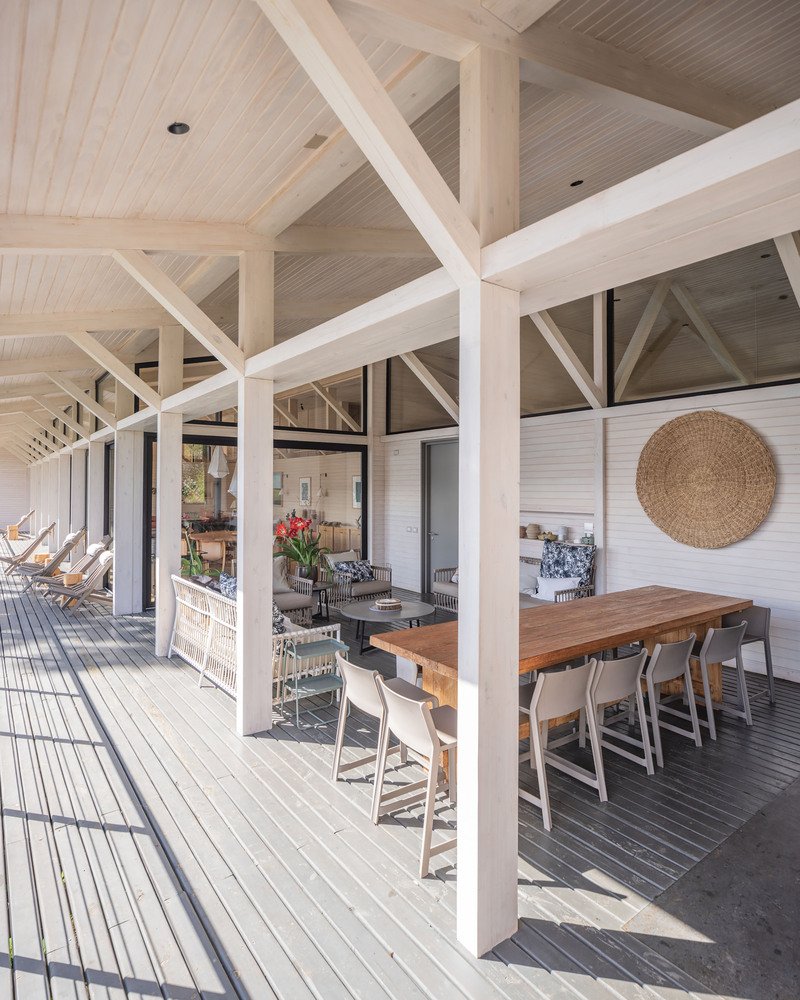
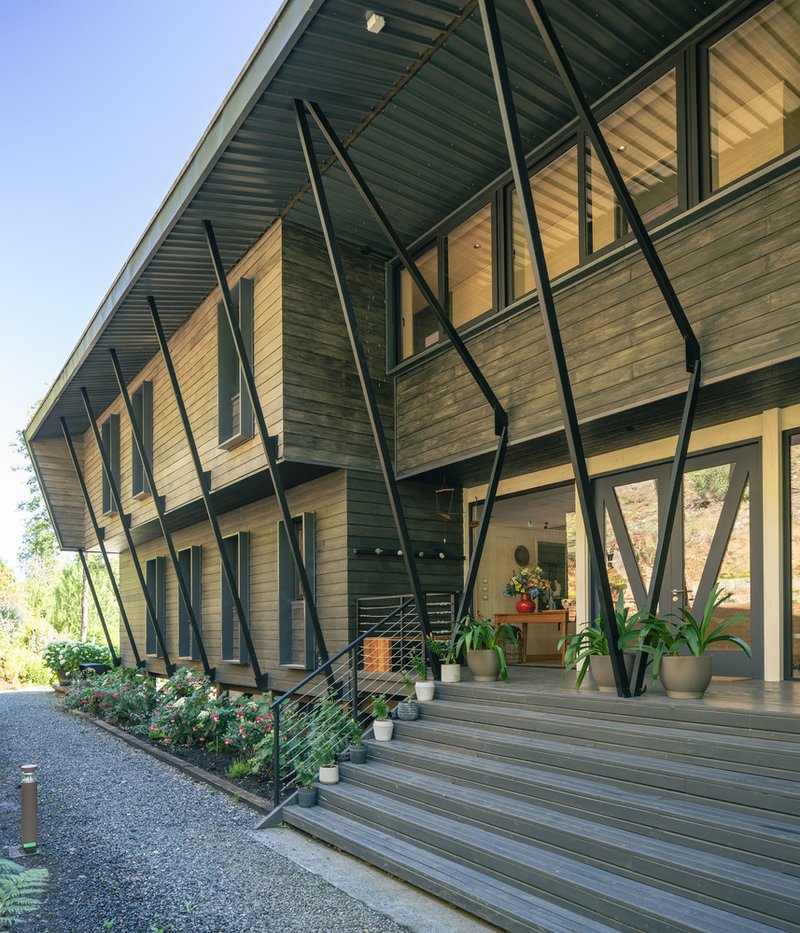
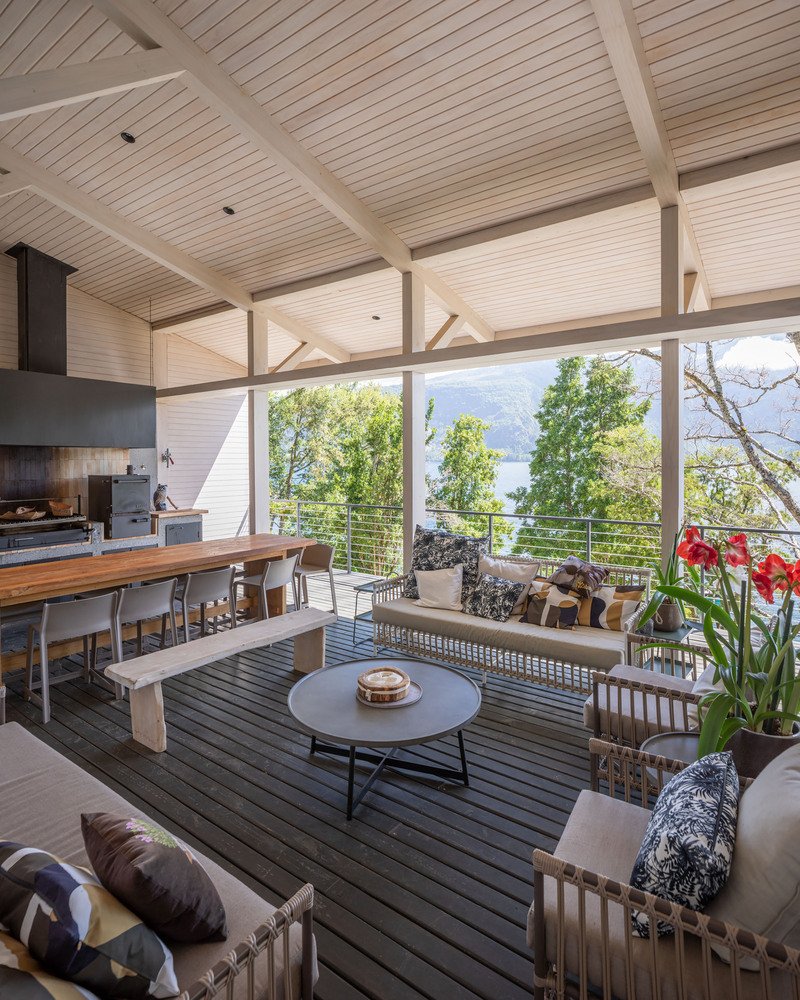
The outdoor living spaces may be the best rooms in the house. Covered decks run along the lake-facing side, sheltered by deep timber soffits and framed by white post-and-beam columns that contrast sharply with the black exterior. Diagonal steel cross-bracing is bolted directly to the timber frame, an honest structural move that gives these terraces a slightly industrial edge. The cable railings keep the visual field open, so you look through the structure to the treetops and mountains rather than at a balustrade.
These transitional spaces, not fully inside and not fully outside, are where the house is most itself. They mediate between the warm interior and the cool lakefront climate, and they give the building's structural logic a public face. You can read exactly how the house stands up just by sitting on the deck.
The Lake Terrace
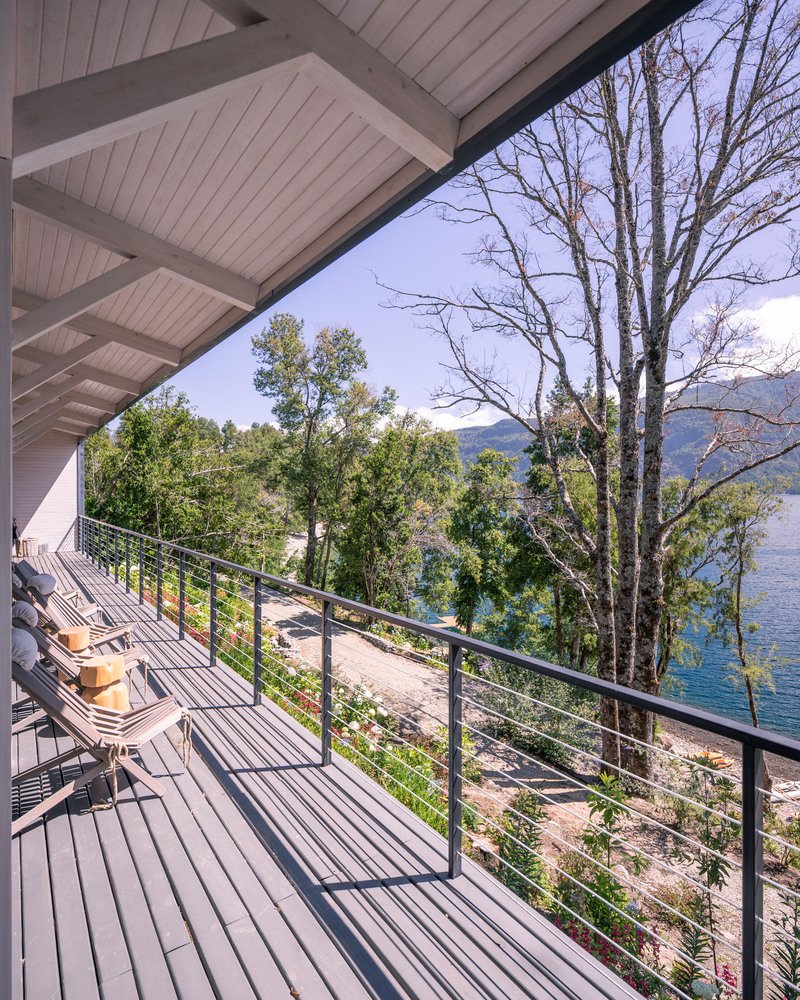
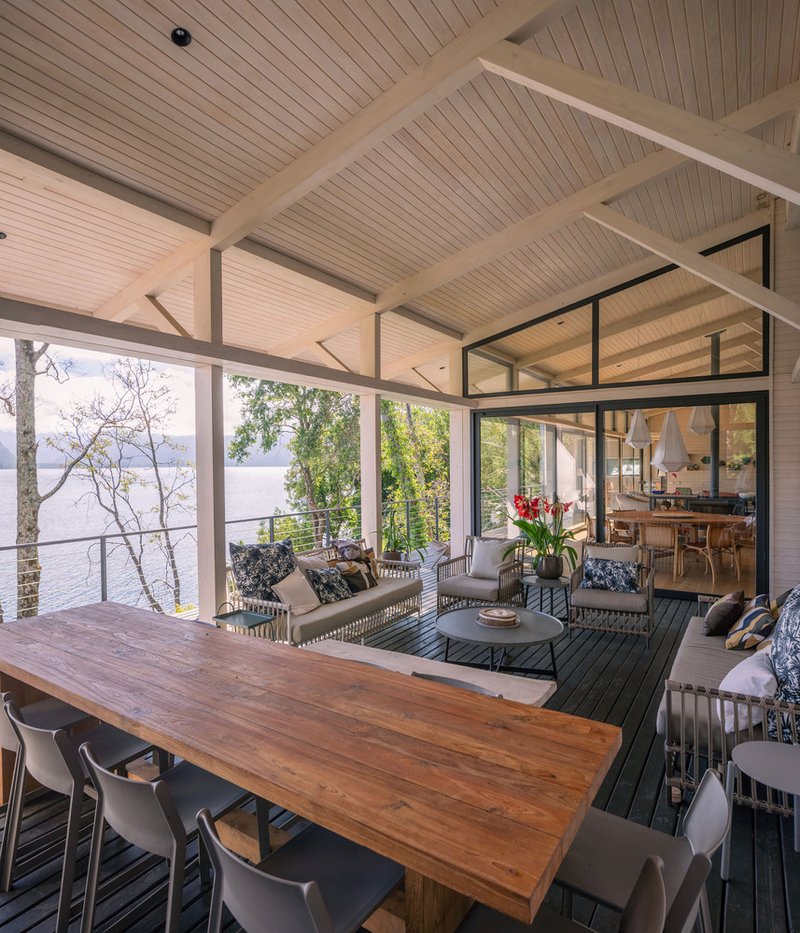
A dining terrace occupies a privileged position beneath exposed timber beams, oriented to frame the lake through a screen of mature trees. The architects resisted the temptation to clear-cut for an unobstructed panorama. By keeping the trees, they gained depth and texture: dappled light, layered foregrounds, and a sense of being in the landscape rather than merely looking at it. The timber slat ceiling overhead compresses the vertical dimension just enough to make the horizontal view feel expansive by contrast.
Inside: Timber Warmth and Vertical Drama
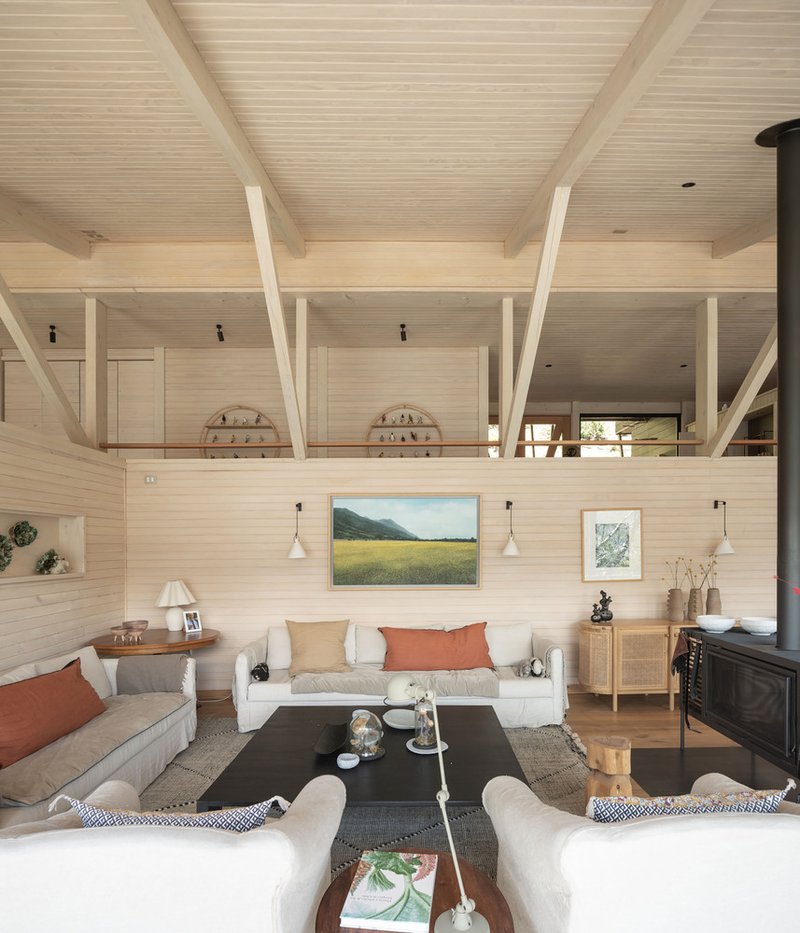
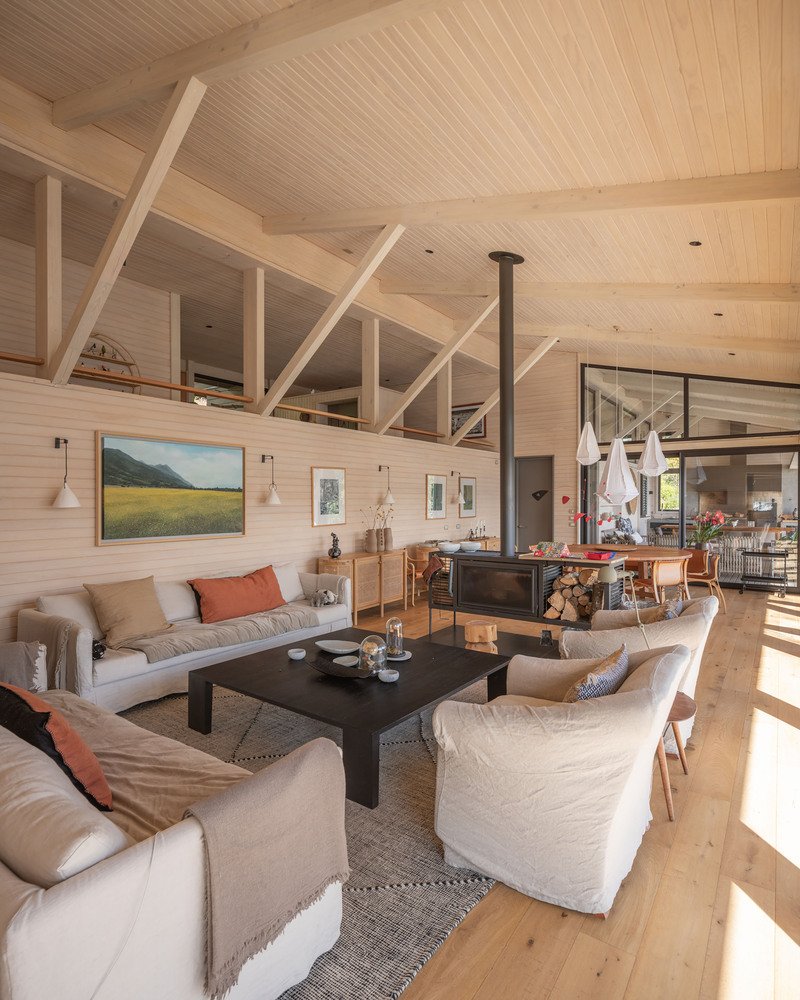
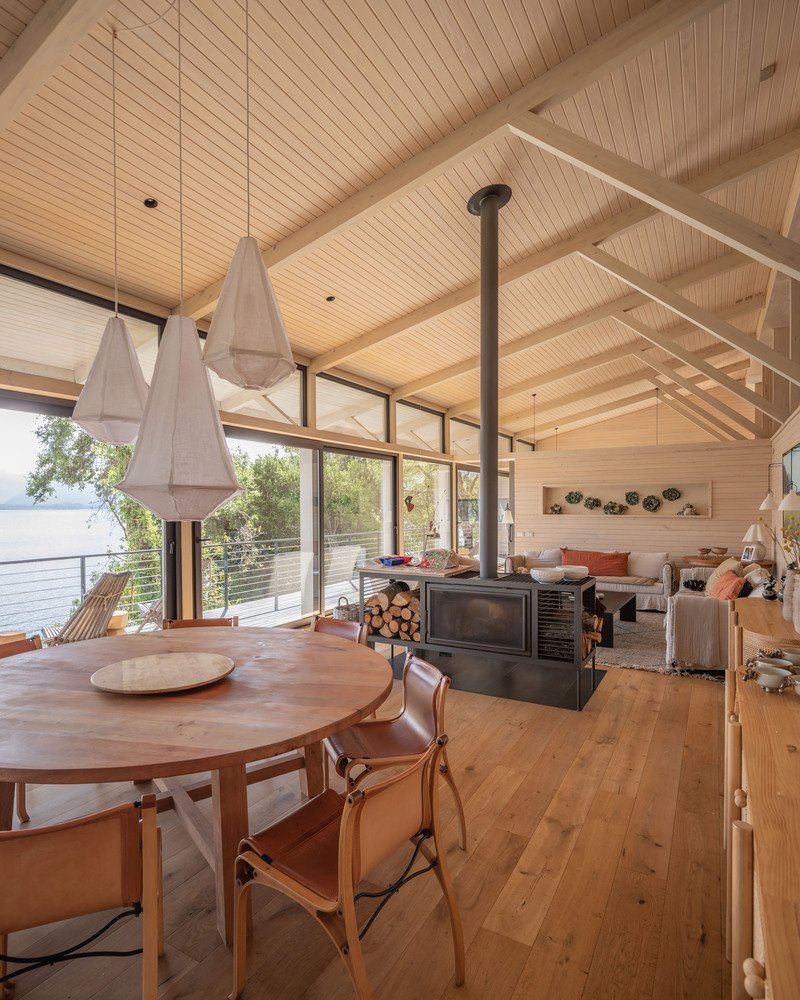
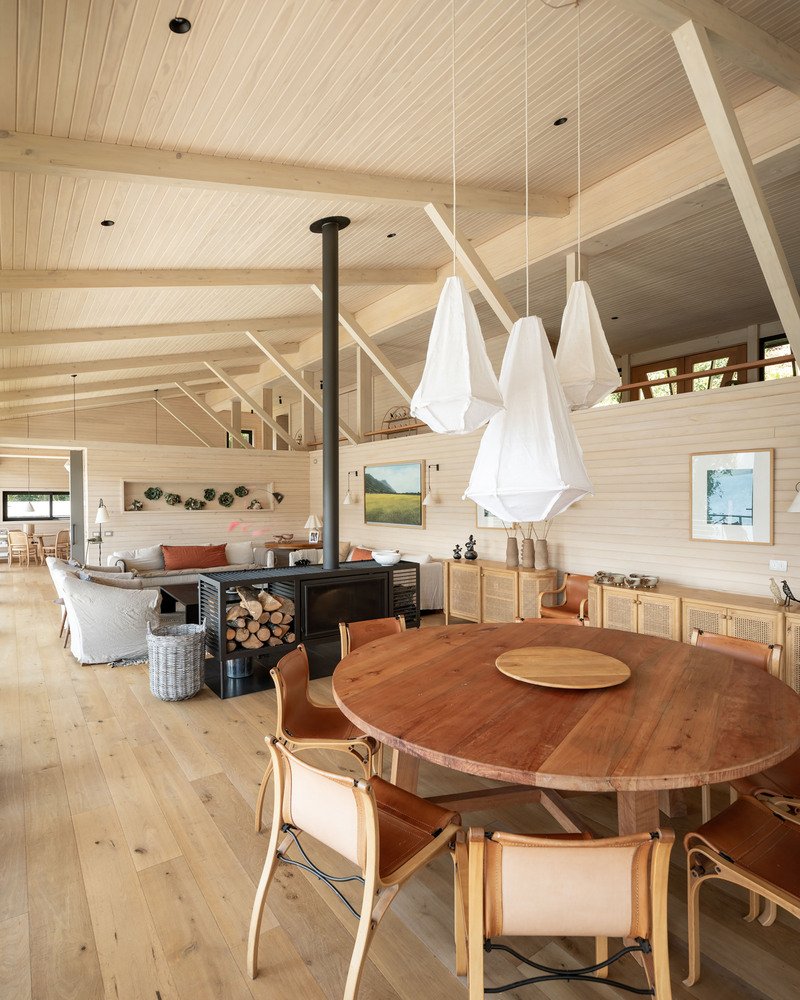
The interior flips the exterior's mood entirely. Where the outside is dark and reticent, the inside is bright, structurally expressive, and vertically generous. The double-height living room is the centerpiece: exposed timber trusses span overhead, an open mezzanine overlooks the seating area, and floor-to-ceiling glazing pulls the lake into the room. A wood-burning stove sits at the spatial crossroads, grounding the volume with the elemental presence of fire.
The vaulted timber ceilings throughout the living spaces amplify what is actually a compact footprint. Because the house steps with the terrain, each level feels like its own pavilion, connected by staircases that thread through the section. The split-level arrangement means that ceilings change height from room to room, creating a rhythmic sequence that prevents the interior from ever feeling monotonous.
Details: Kitchen, Entry, and Domestic Moments
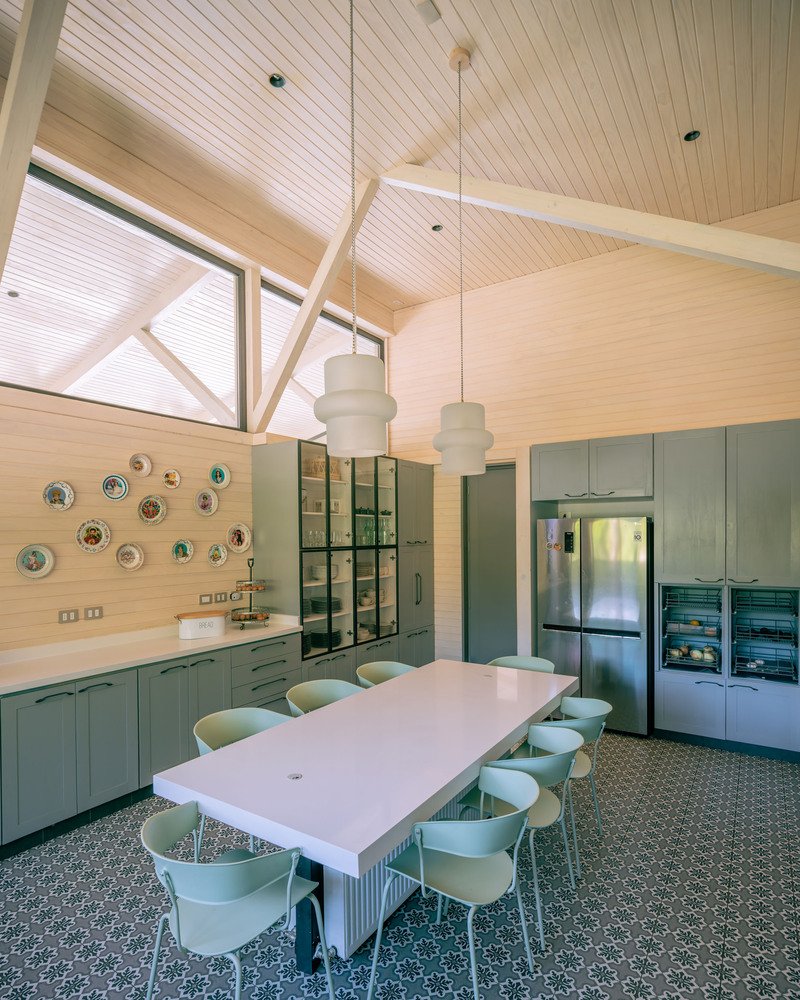
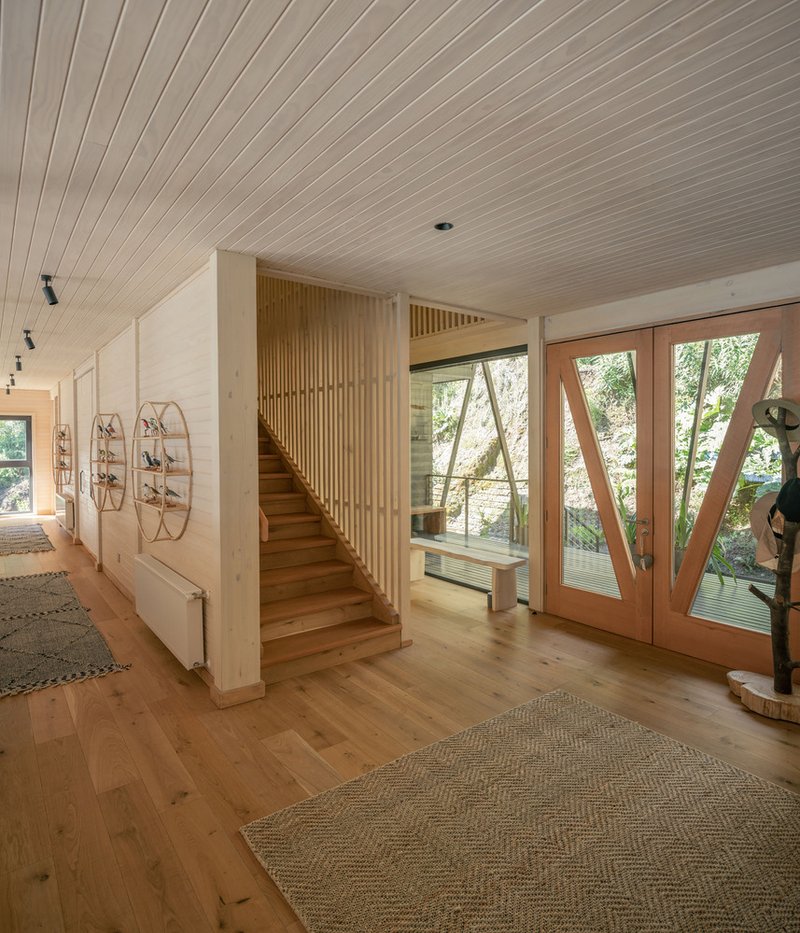
The kitchen deserves a closer look. Sage-green cabinetry against terrazzo flooring and clerestory windows is a deliberate departure from the all-timber palette, introducing a domestic specificity that the rest of the house avoids. It is the one room where color declares itself, and it works precisely because the surrounding context is so restrained. The clerestory windows wash the countertops in indirect afternoon light, keeping the workspace bright without sacrificing wall area for storage.
At the entry, a vertical timber slat screen wraps the staircase, filtering light and partially concealing the circulation core from the main living spaces. It is a simple device, well-executed: it gives the staircase its own spatial identity without walling it off. The circular dining table beneath pendant lights, backed by the wood-burning stove, creates a secondary gathering point that is more intimate than the double-height living room. These are small decisions, but they reveal a house that has been thought through at every scale.
Plans and Drawings
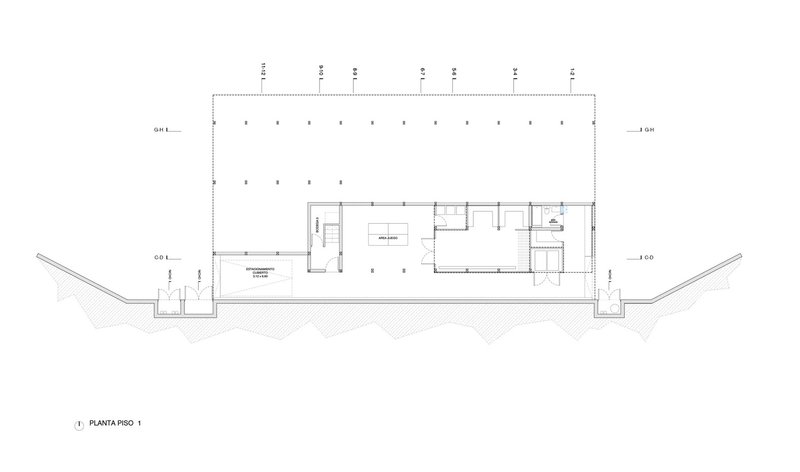
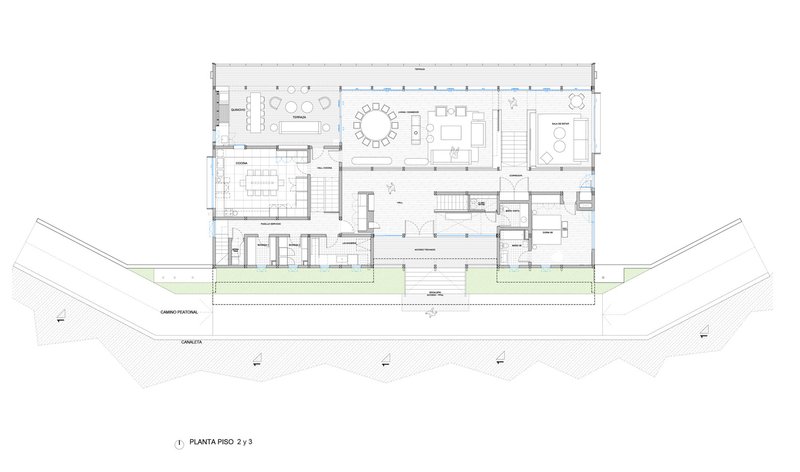
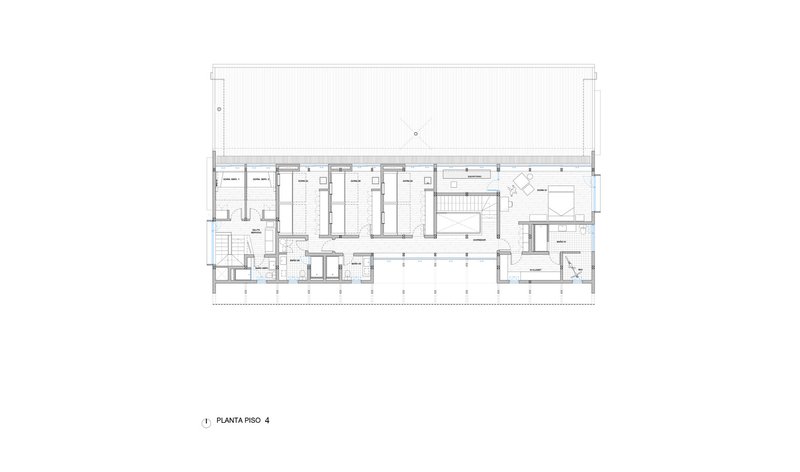
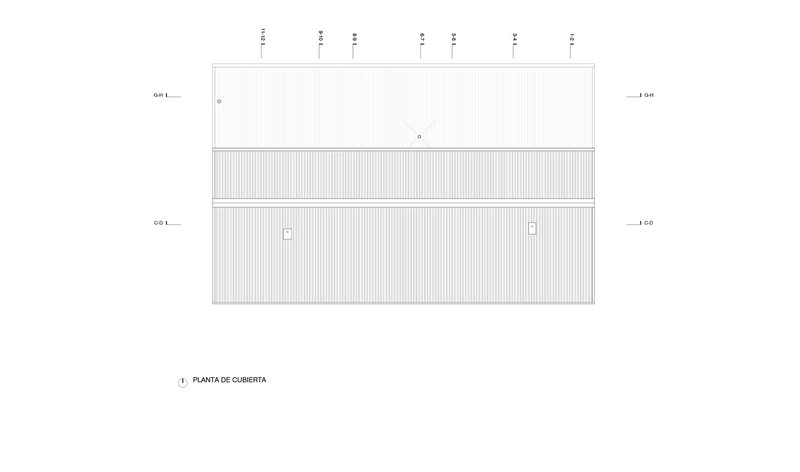
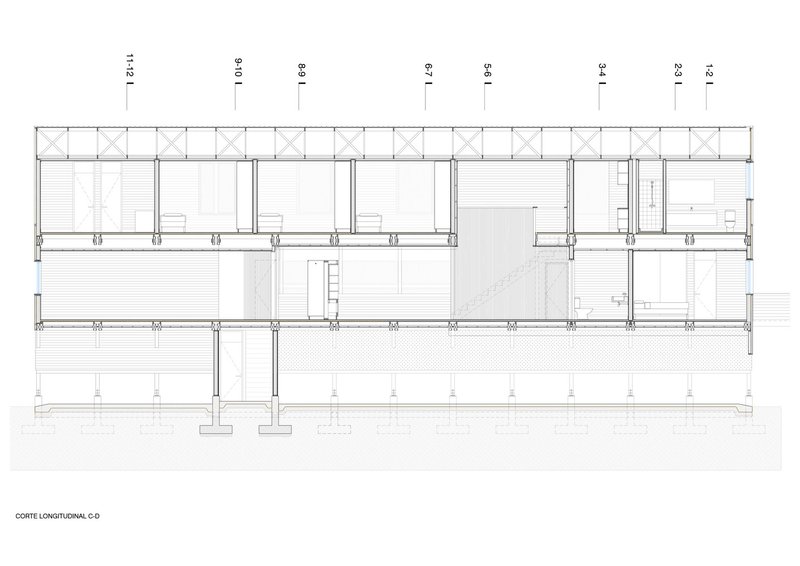
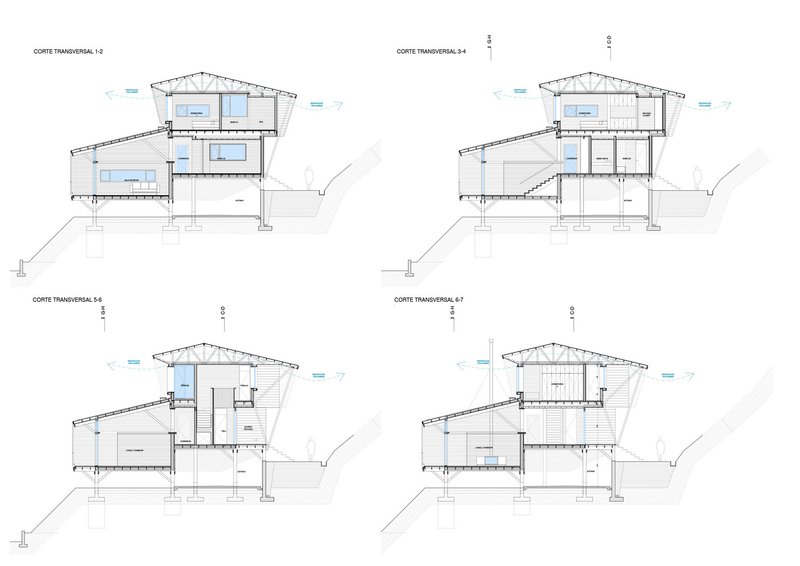
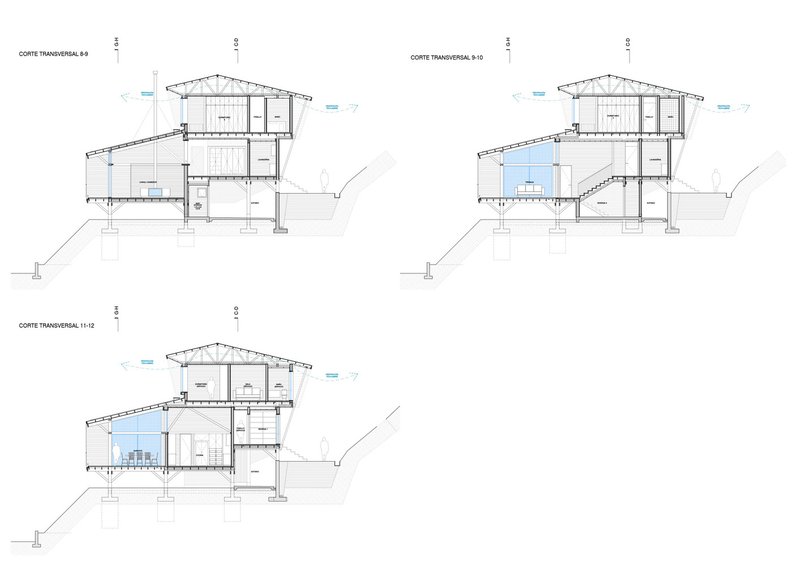
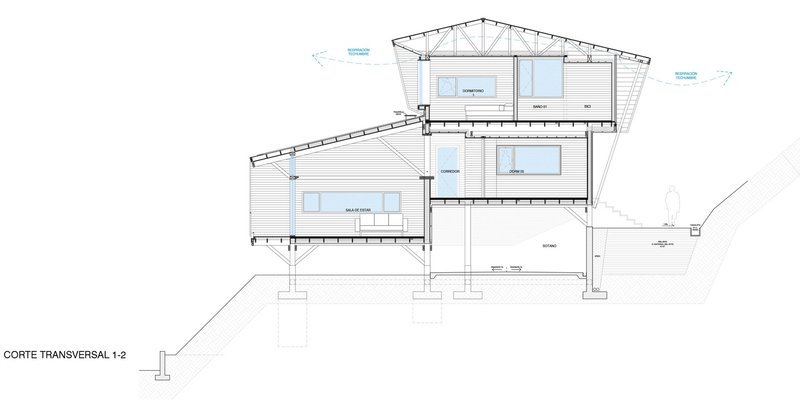
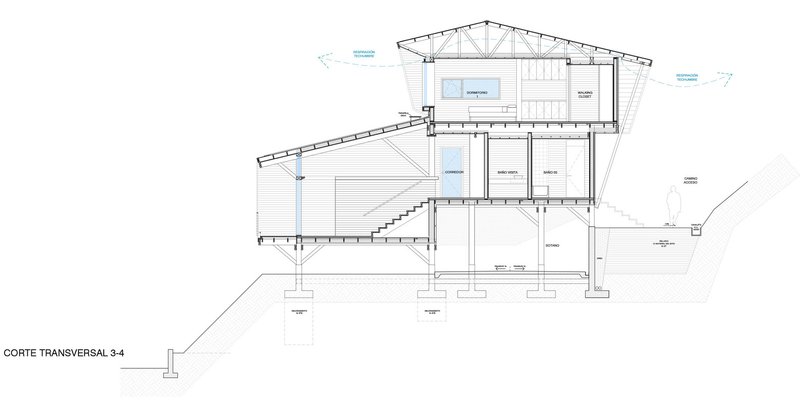
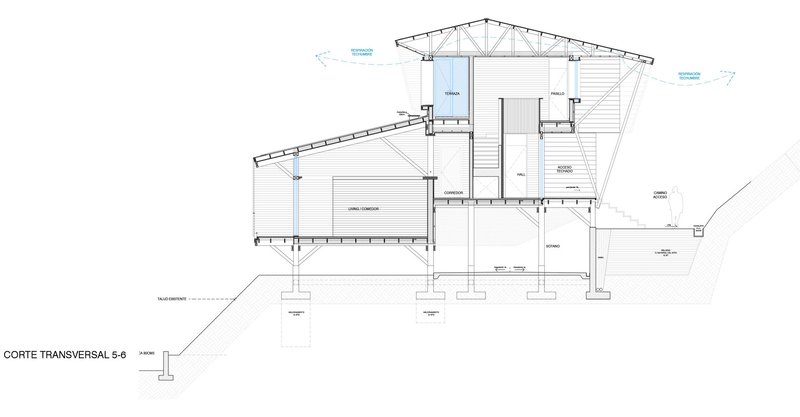
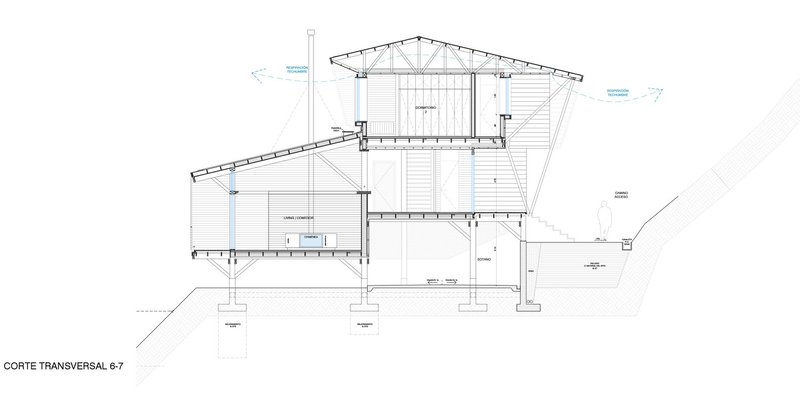
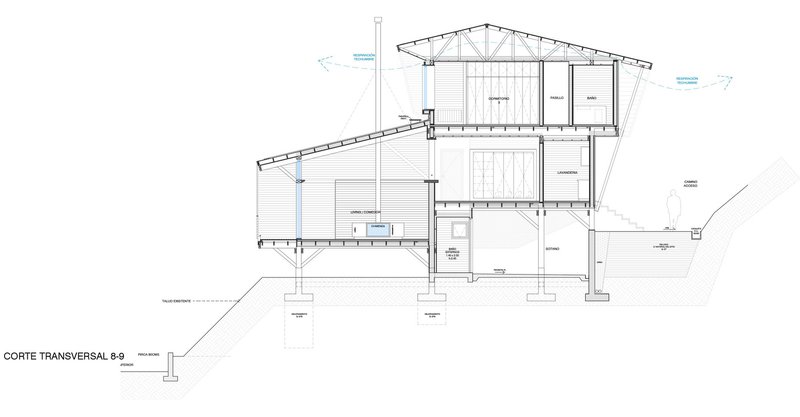
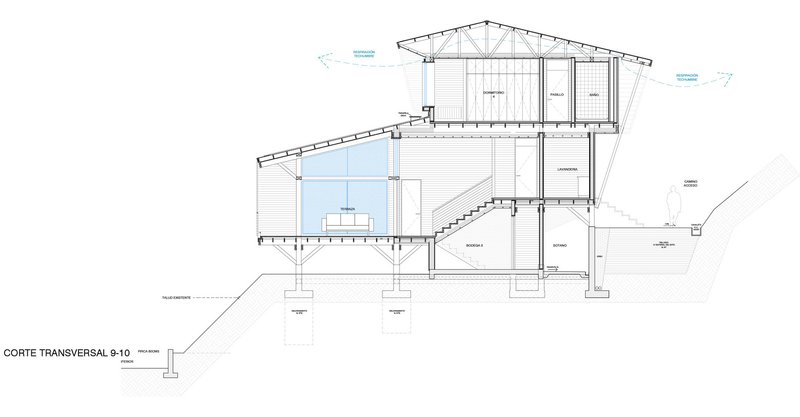
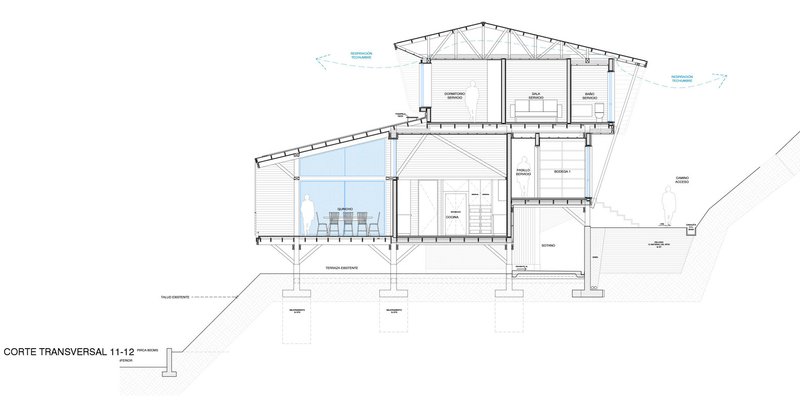
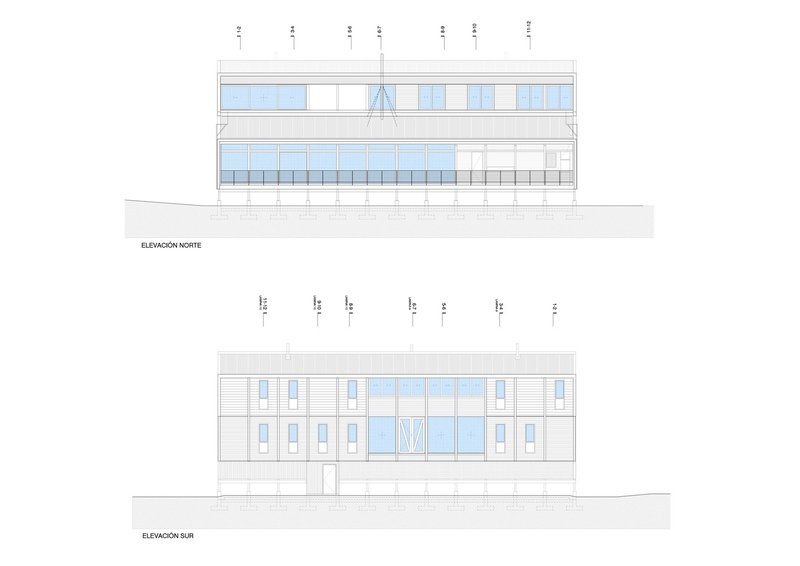
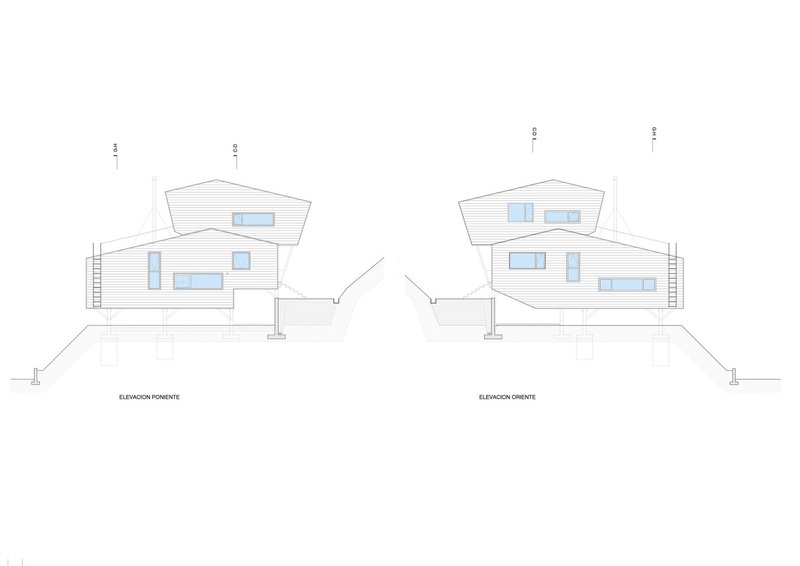
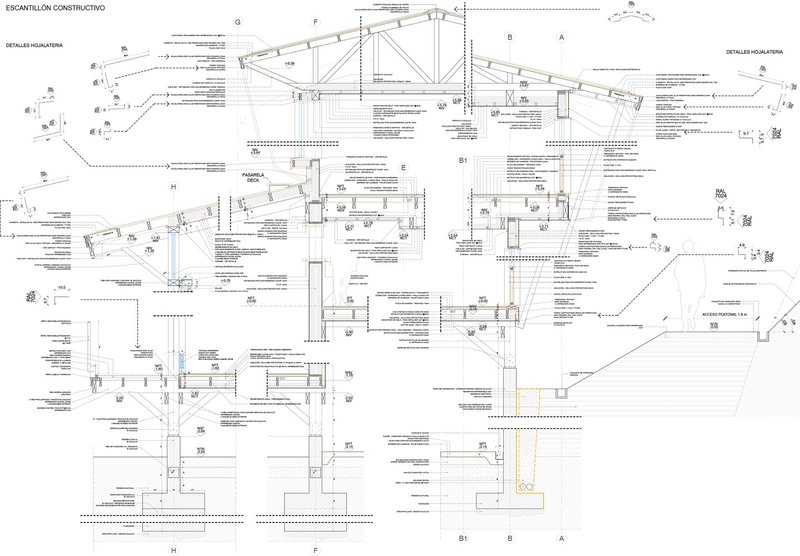
The floor plans confirm the stepping strategy. The lowest level is largely terrace, with a compact service core anchoring the plan. Living spaces and a planted terrace occupy the middle floors, while bedroom suites are pushed to the top, gaining the best views and the most privacy. A generous rooftop terrace caps the composition. The longitudinal section is the most revealing drawing: it shows how the structural column grid marches down the slope on concrete piers, how the split levels interlock, and how the pitched truss roofs create the vaulted ceilings that define the interior experience.
The transverse sections, of which there are many, each slice through a different condition. Some reveal the double-height stair hall; others show the relationship between upper bedrooms and lower living rooms. The construction detail drawing spells out the material logic: timber trusses bearing on posts, steel connections, cladding assemblies, and foundation pier detailing. Taken together, the drawing set tells the story of a house that is structurally ambitious but materially disciplined, built from a limited palette of timber, steel, and concrete deployed with care.
Why This Project Matters
Namoncahue House succeeds because it respects two things simultaneously: the slope it sits on and the structural system that holds it up. Too many hillside houses treat the terrain as a problem to be solved with retaining walls and cantilevers. Here, the stepping massing turns the grade change into an asset, producing a vertical sequence of spaces that would be impossible on flat ground. The decision to expose the timber frame throughout, rather than concealing it behind plasterboard, gives the house an integrity that you can feel in every room.
The dark exterior cladding is more than an aesthetic choice. It is a strategy for making a large house disappear into a forested lakefront, reducing its visual impact on a landscape that is the real protagonist. Schwember García-Huidobro Arquitectos demonstrate here that you can build generously in a sensitive setting without dominating it. The house is ambitious in section, restrained in surface, and honest in structure. That combination is harder to achieve than it looks.
Namoncahue House by Schwember García-Huidobro Arquitectos, Lake Colico, Araucanía Region, Chile. Photography by Nicolás Sánchez.
About the Studio
Share Your Own Work on uni.xyz
If projects like this are the kind of work you want to make, uni.xyz is a place to publish your own, find collaborators, and enter design competitions.




Popular Articles
Popular articles from the community

Cafe MADA: A Chiang Rai Pavilion in a Mango Orchard
BodinChapa Architects threaded a 254 m² black-roofed cafe through an existing mango orchard in Chiang Rai, Thailand, built around mature trees.
Residence BB 214: Quiet Precision in Ludhiana
Minimalist Architecture & Design Studio composes a residence of white volumes, filtered light, and deliberate restraint in Punjab's urban fabric.
Gunawarman 35: Jakarta's Corner of Quiet Complexity
WOFF's mixed-use building in Jakarta pairs translucent glass block walls with a buff brick cylinder to hold coffee, wellness, and work under one roof.
MAKER architecten Rewire a 1972 Brutalist Dormitory on the VUB Campus as a Living Lab
A modular renovation strategy in Belgium breathes new life into Willy Van Der Meeren's modernist student housing without erasing its concrete bones.


Similar Reads
You might also enjoy these articles

Filtering Space: A Gradual Spatial Experience
From urban intensity to spatial calm.


The Ken Roberts Memorial Delineation Competition (Krob)
As the most senior architectural drawing competition currently in operation anywhere in the world, it draws hundreds of entries each year, awarding the very best submissions in a series of medium-based categories.


Waterfront Redevelopment and Urban Revitalization in Mumbai: Forging a New Dawn for Darukhana
A transformative waterfront redevelopment project reimagining Darukhana’s shipbreaking heritage into an inclusive urban future.

OUT-OF-MAP: A Call for Postcards on Feminist Narratives of Public Space
Rhizoma Design and Research Lab invites artists, designers, architects, researchers, and students to reflect on how feminist perspectives can reshape public space. Selected works will be exhibited in Barcelona, October 2026. Submissions open until 15 April 2026.


Explore Architecture Competitions
Discover active competitions in this discipline




The International Standard for Design Portfolios


The Global Benchmark for Architecture Dissertation Awards


The Global Benchmark for Graduation Excellence


Challenge to reimagine the Iron Throne
Comments (0)
Please login or sign up to add comments
No comments yet. Be the first to comment!