
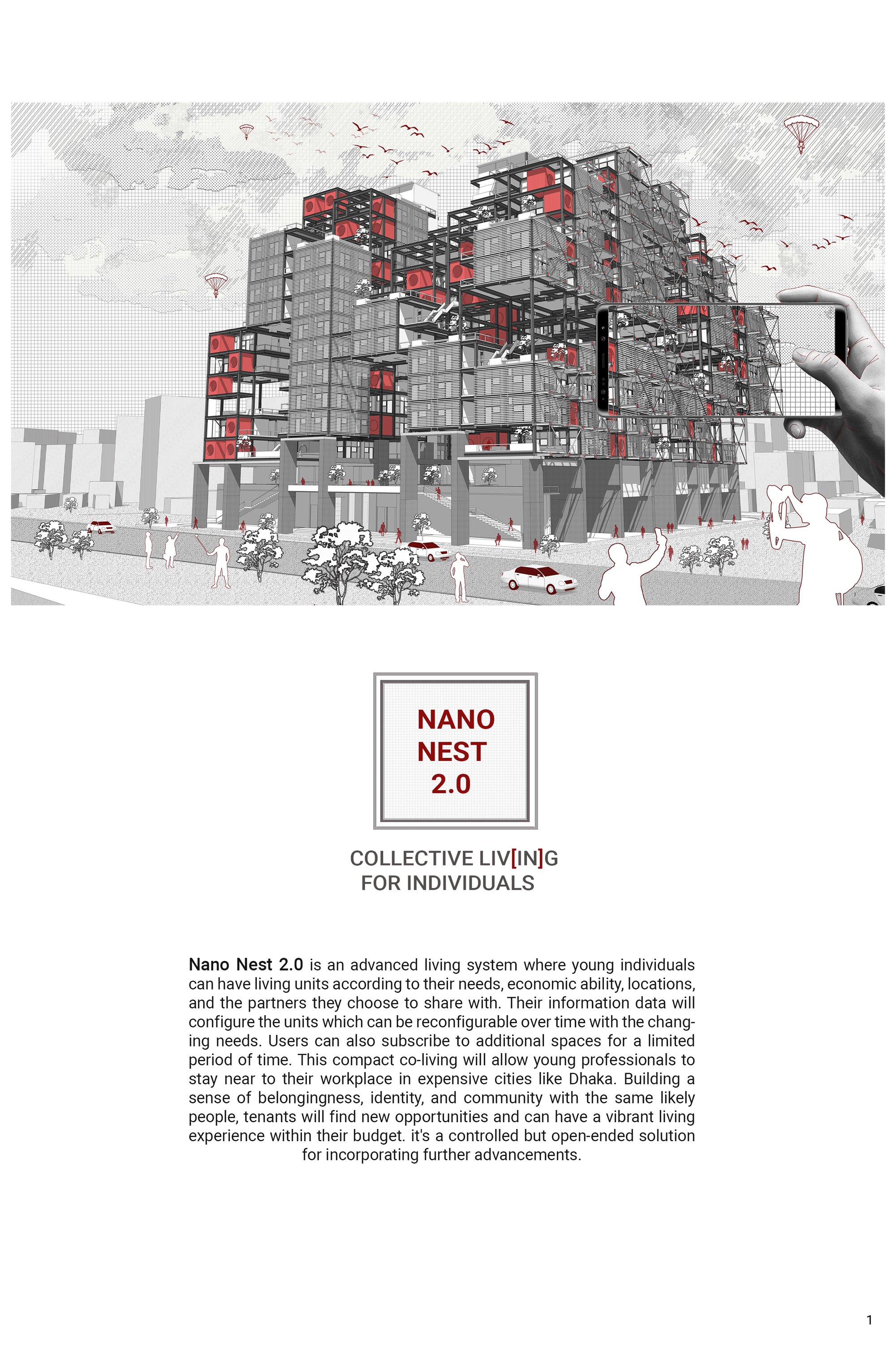
NANO NEST 2.0
COLLECTIVE LIV[IN]G FOR INDIVIDUALS

Dhaka is a very attractive workplace with high living expenses. Mostly young individuals migrate here for better earnings and job facilities without their families . According to Daily Star, 80% of people are tenants. And 57% of tenants are young professionals and students who live without family. Apartments (higher class, middle class, even affordable low-cost housing) are primarily designed for families. But there is no living system (dorm, small-scale apartments, or shared affordable housing) for this particular group of people. The only way to find accommodation here is to share those family apartments with other individuals. But their requirements, functional needs, space using patterns, and time schedules are not matched with those flats. Such as formal dining or living isn't necessary or economical for young individuals but all the apartments Come with this. The same happens in the case of the kitchen, who always has takeaway food. so spaces are become unoccupied and misused though the rent per person is so high. People have unique functional needs too. A person may not bring his family for the whole time for high living expenses here. But it would be logical if he could rent a space for a particular time for a short stay for his wife and family. During the pandemic, it's also difficult to do home office and maintain health issues when they have to share the room. Though they are sharing a flat there is no betterment of lifestyle, privacy, no opportunity for self-development, a sense of community, belongingness, home feelings, or recreation. A young person comes to a big city with some dreams and hope, but all got in vain just to fill the basic need to live. According to Alderfer's and Mashlow’s theory for the betterment of an individual is to ensure his basic needs exist then he will feel relatedness and then then the growth factors. The aim of this project is to find that.
To understand the existing scenario, 20 apartments in different areas of Dhaka have been studied and have conversed with those dwellers. Then an online questionnaire survey has been conducted to understand what’s the preferences, requirements, socio-economical life, and unique functional needs. Such as 85% of people don't want to share bedrooms, and 68% of people want their own washroom. Where 60% of people don’t want any kitchen. Having my own experience of living as a young student in a shared flat with professionals for 2 years before a university dormitory gives a clear idea of how hard to live within a limited budget.
Nano Nest 2.0 is an advanced living system for young professionals Where tenants have their living units according to functional needs, location, and economic ability, can also choose partners to share, and build a homogenous happening community. After data collection on a digital platform, it's very easy for Artificial intelligence to match the most suitable people together to configure housing units according to their requirements. modules are flexible and reconfigurable over time with changing needs by moveable interior partition walls. Modules are compact and functionally optimized as their rent can be minimized, but they are connected with some shared functions and common recreational spaces which don’t have any dedicated function so the community can use those for their common interest. such as gossip, indoor sports, music, or many more and have a better living environment. According to the theory of Oscar Newman ( defensible space) thus renting small spaces and sharing larger functions with others will minimize the rent per person and allow them to act as a big family in co-living . Not just sharing spaces but also sharing life with others by maintaining individual privacy. Thus an individual can feel their existence and then relatedness with a community. and it will bring new possibilities to grow further and young professionals are full of dreams and hope. This indicates the growth factor of the Mashlows theory. thus the perceived density of the compact living will be less among the users and less scope of crime and depressional lonely lifestyle.
Personalization will meet the unique preference of the users. Tenants can also subscribe spaces for a limited time period to occupy their sudden needs such as spouse visiting and maybe a home office. these units are prefabricated which can move horizontally and vertically in a structure and be added with the tenant unit for a limited time
It's a generic solution. one particular order of building formation won’t work on plots with different sizes, shapes, orientations, and microclimates. So this type of building has to be generic and customized according to the site at the same time. parametric building formation can easily give site identity to these generic solutions. By changing different parameters we can customize this kind of building according to site factors with the response of microclimate. Cellular Automata applications have been used to form buildings where previous modules can indicate the locations of future modules. This allows choosing the building mass from a large number of options.
Rampura Hatirjheel has been chosen as a suitable site to imply this generic solution as there is already a huge need for this kind of housing. The building form is the optimization between the parametric building formation and design idea with the local building code in that particular site,
The return per month is higher here. An average of 1000 individuals can live in this compact housing whereas only 560 individuals could live sharing those traditional family apartments with the same footprint.
The aim of this thesis project is to introduce a new type of the living system for individuals in the context of expensive cities like Dhaka wherewith the less rent per person, one may have his living unit within a budget near to his workplace in a better living environment with lots of new possibilities to meet people and make a vibrant community.it's like a snowball effect that attracts more same likely people together and makes the community bigger and bigger. this compact type of living will have a positive effect on the future urban fabric as cities are becoming more expensive. This is a controlled but open-ended solution so further ideas and technology can incorporate into these new types of buildings.




Popular Articles
Popular articles from the community

20 Most Popular Furniture Design Projects of 2025
Modular street systems, parametric benches, and insect hotels: the furniture design projects that captivated architects on uni.xyz in 2025.

1-1 Architects Builds a Nagoya House and Office from Decades of Stockpiled Timber
A 69-square-meter tower in dense residential Nagoya transforms surplus lumber into a home and workplace for a construction company.

Biophilic Architecture and Regenerative Stadium Design: Biophilia Lagos by Rachel George
A regenerative stadium in Lagos transforms landfill into a living ecosystem through biophilic architecture, waste reuse, and environmental healing.
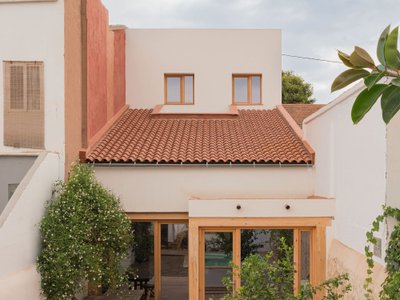
Paco Oria Estudio Rebuilds a 1949 Valencian Town House Around Timber, Terracotta, and a New Interior Patio
In Godella, Spain, a semi-detached house from the postwar era is stripped to its party walls and rebuilt with wood and ceramics.


Similar Reads
You might also enjoy these articles
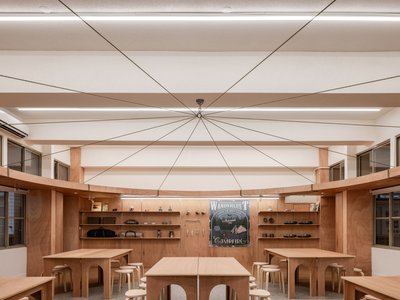
317studio Turns an 87 m² Classroom into a Forest Clearing for Scouts in New Taipei City
A rope canopy, student-made specimens, and campfire geometry replace rows of desks in this Scouting classroom in Xizhi District.
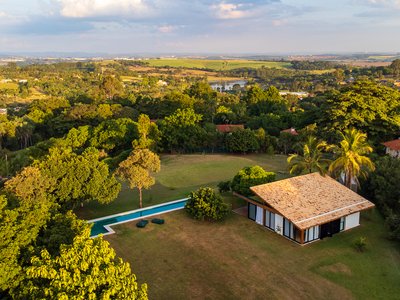
24 7 Arquitetura Builds a Timber Pavilion as a Family's First Act on a 5,000 m² Brazilian Plot
In Jaguariúna, a prefabricated glulam house nestles among mature trees as the opening move of a larger residential masterplan.
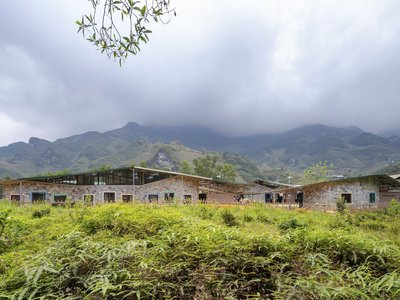
1+1>2 Architects Build a School from 900 Blocks of Hmong Stone on Vietnam's Rocky Plateau
On a barren valley in Ha Giang province, a community quarried its own stone to raise a kindergarten and primary school rooted in Hmong identity.
100A Associates Builds a Volcanic Stone Retreat on Jeju Island Rooted in Ritual and Restraint
Watarstay [Wa:Tar] in Bongseong-ri channels Jeju's basalt, reed, and hemp into a 150 m² hospitality space shaped by contemplation.


Explore Conceptual Architecture Competitions
Discover active competitions in this discipline




The Global Benchmark for Architecture Dissertation Awards


Design challenge to reuse E-waste
Comments (0)
Please login or sign up to add comments
No comments yet. Be the first to comment!