
BIAD Arrays Five Auditoriums Along a Lake in Nantong's Cloud-Shaped Grand Theatre
A 110,000 square meter performing arts complex on the banks of Zilang Lake transforms Nantong's cultural waterfront into a public destination.

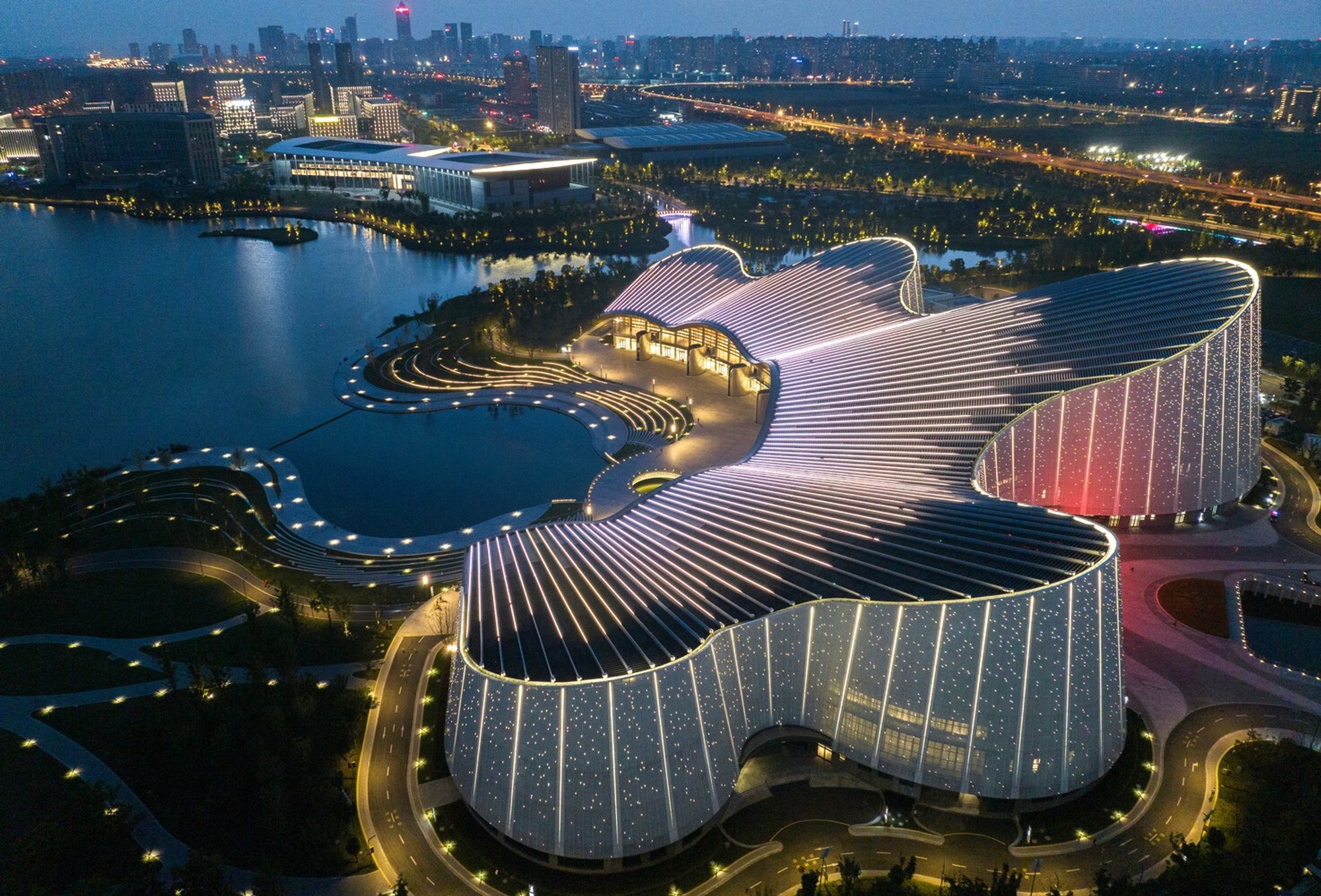
The performing arts center is one of the few building types where architects still get permission to be theatrical. BIAD, working from a planning and concept design originated by Paul Andreu Architecte Paris, has taken that permission seriously in Nantong, producing a 110,916 square meter complex that reads from above like five lobes of cloud settling onto the northeast bank of Zilang Lake. The building houses five distinct auditoriums, from a 300-seat children's theatre to a 1,523-seat opera house, all arranged in a sweeping arc and linked by a continuous circular lobby. At 57 meters tall and spanning nine stories including underground levels, it is not a modest gesture. But the ambition is disciplined: every formal decision ties back to the relationship between city, water, and public life.
What makes Nantong Grand Theatre worth studying is not its scale or its flowing roof, both of which are expected in Chinese cultural buildings of this generation. It is the way the building treats its two faces. The lakeside elevation is almost entirely glass curtain wall, making the interior life of the foyers visible to anyone walking Zilang Lake Park. The city side wraps itself in perforated aluminum panels with varying apertures, filtering urban noise and light while giving the building a more opaque, civic presence. That asymmetry, combined with a ground floor designed to operate independently of performance schedules, turns the theatre into a piece of public infrastructure rather than a sealed cultural box.
A Roof That Reads as Landscape
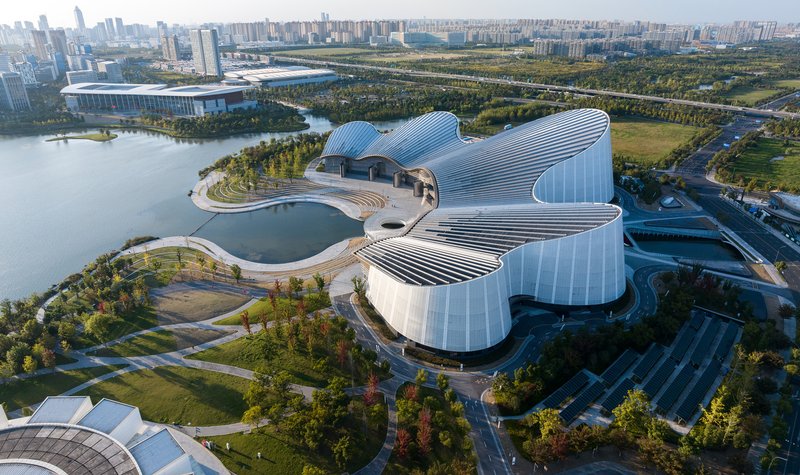
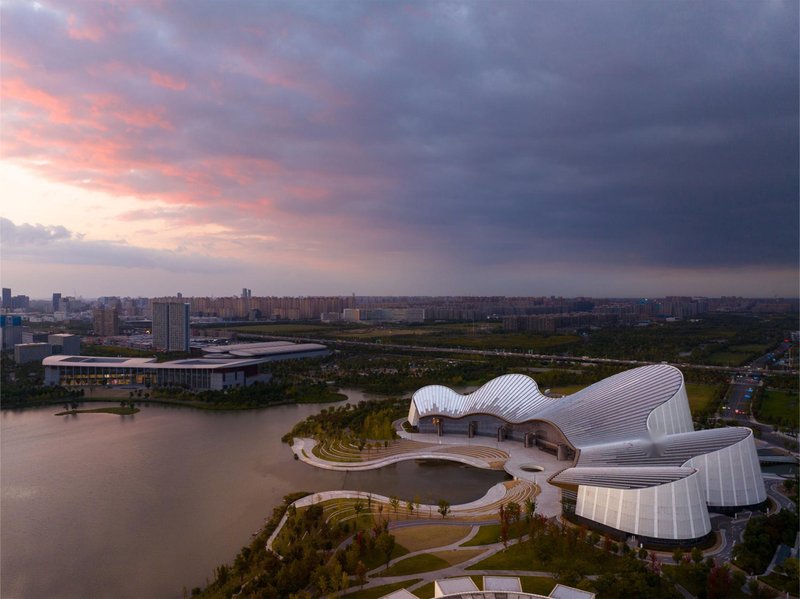
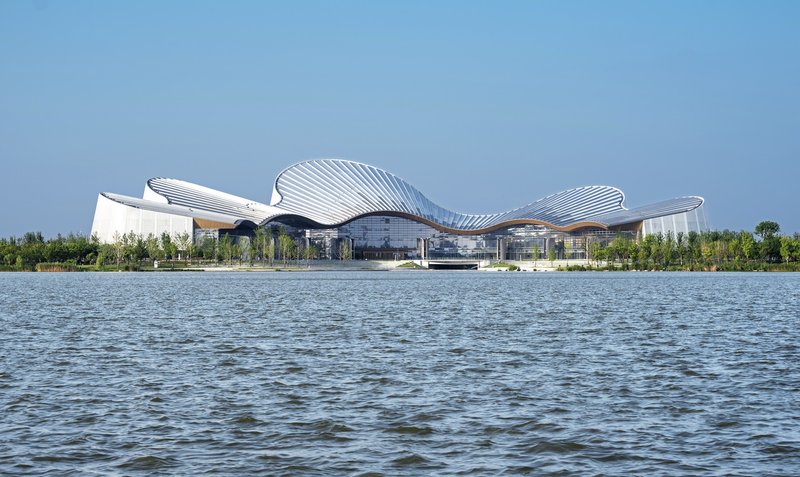
The undulating roof is the building's signature, and from the air it reveals the organizational logic that ground-level views obscure. Five distinct volumes, each containing an auditorium, fan outward from northwest to southeast. The ribbed cladding tracks along the roof in tight parallel lines that reinforce the sense of flow, making the whole composition read less like a building and more like a geological formation. The design concept, named "Qinshanzhushui" (Qin Mountain and Pearl Water), draws from Nantong's location at the confluence of the Yangtze River and the East China Sea. Whether or not you buy the metaphor, the roof succeeds at dissolving the building's mass into the lakeside landscape.
The aerial views also expose how carefully the site plan was negotiated. The theatre sits in a cultural corridor alongside the Nantong Art Museum to the south and the International Convention and Exhibition Center to the west, forming a MICE and arts district within the Central Innovation Zone. Landscaped paths and terraced lawns create a buffer between the building and the water, adding a transitional layer that belongs neither to architecture nor to park but to both.
Two Facades, Two Conversations
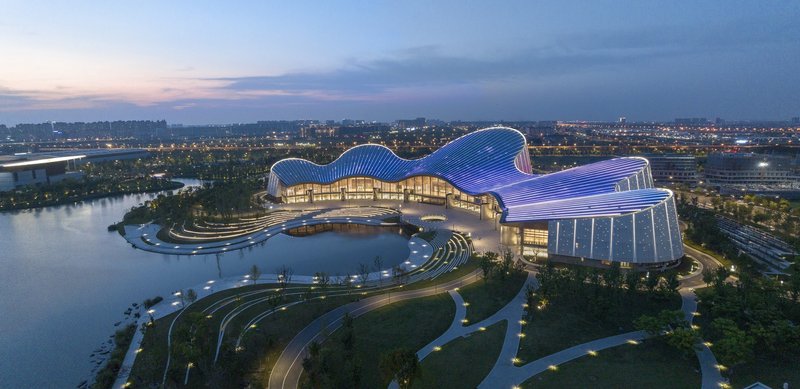
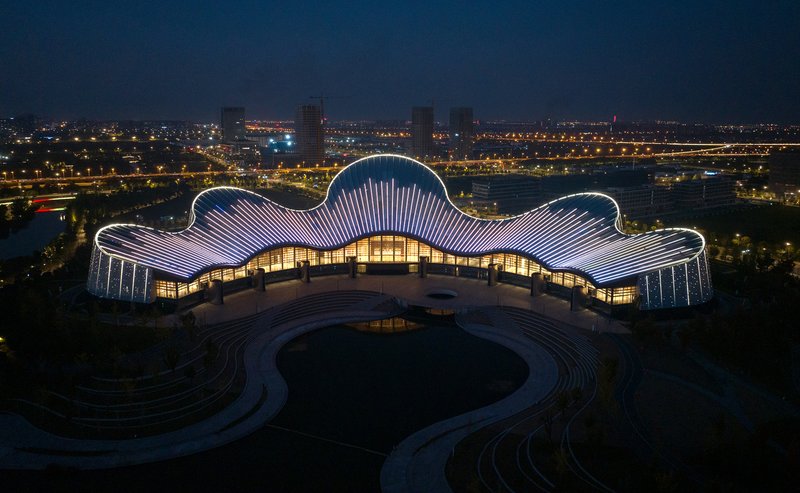
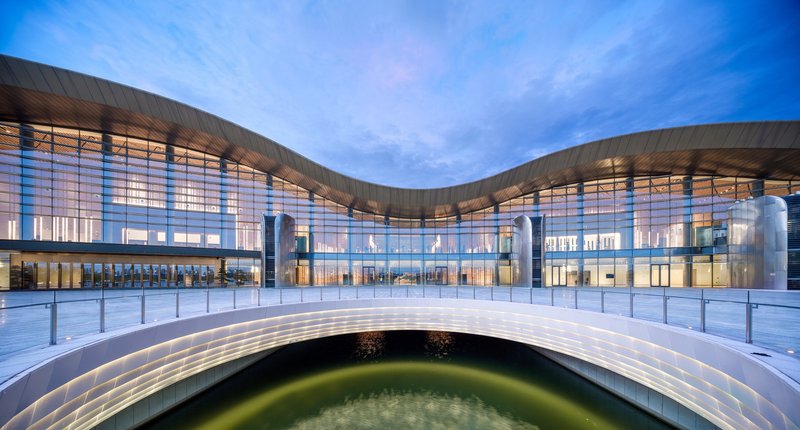
At dusk the building's split personality becomes most legible. The lakeside facade glows through floor-to-ceiling glazing, projecting the warmth of interior lobbies across the water's surface. The entrance forecourt on the urban side, by contrast, presents a more sculptural character: the ribbed aluminum panels catch artificial light and create a textured, almost fabric-like surface. The circular forecourt organizes arrival from the city, channeling visitors toward the north-facing lobby before releasing them into the curving interior.
The night views reveal how the roof's undulations register differently depending on lighting conditions. Under blue uplighting, the lobes appear to levitate. Under warmer tones, they settle. It is a building that changes temperament with the clock, which is the right instinct for a venue that must serve both the drama of an evening performance and the calm of a Sunday lakeside walk.
The Lakeside Edge
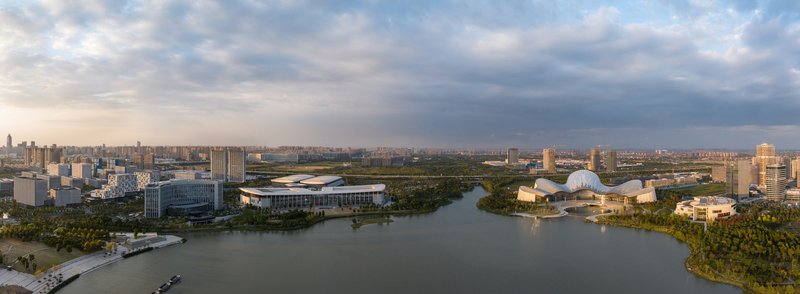
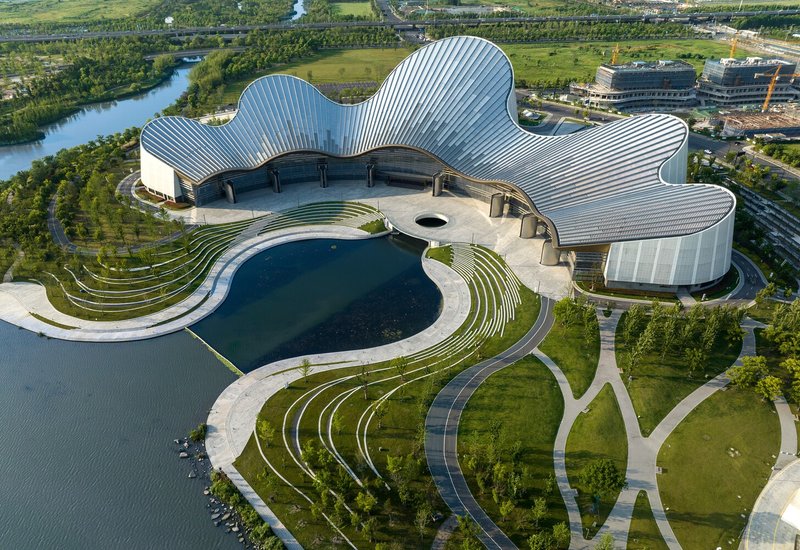
The landscape strategy deserves credit independent of the architecture. Terraced amphitheatre steps descend to the water, creating informal gathering spaces that operate regardless of whether any curtain is rising inside. Curved pathways stitch the theatre grounds into the larger Zilang Lake Park network. The first-floor auxiliary spaces, including a café, souvenir shop, and small exhibition areas, open onto these grounds and keep the building's perimeter active during off-hours. In a country where many grand theatres sit vacant between performances, surrounded by empty plazas, this porosity is a meaningful design decision.
A Lobby as Public Room
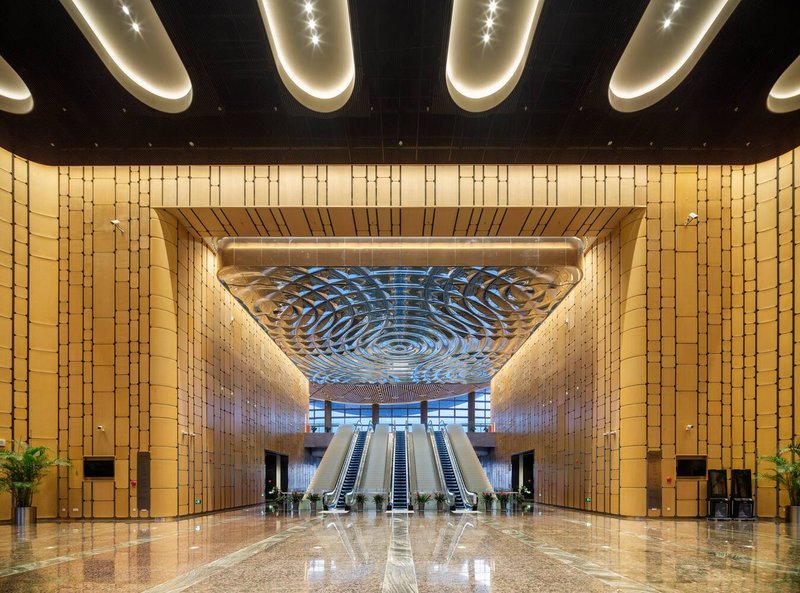
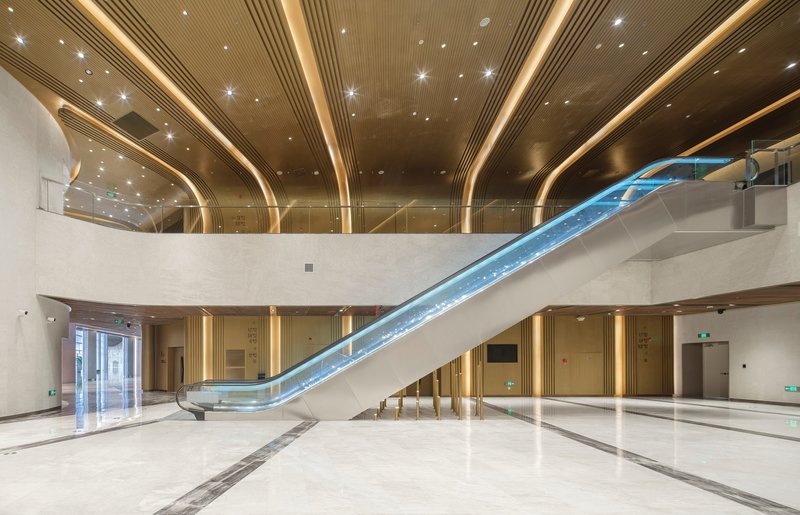
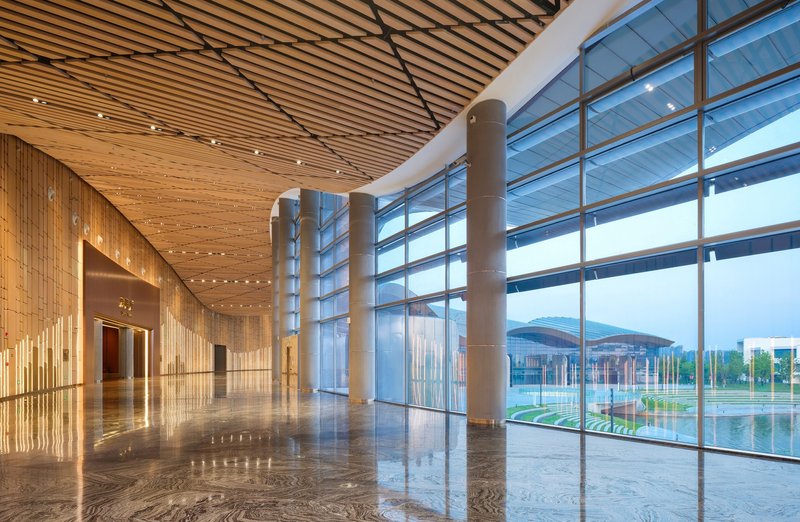
The circular lobby that connects all five auditoriums is the building's civic heart. BIAD designed it as a continuous ring of public space, accessible even to non-ticket holders, with routes leading to an outdoor viewing platform. The main atrium between the Opera House and Concert Hall soars upward beneath stainless steel ceiling panels that catch and fracture light. A canal, rerouted from its original course through the site, runs through the foyer and becomes a spatial axis for the entire complex, visible through a circular glass floor.
Material choices in the lobby are deliberate and layered. Timber-clad walls and horizontal wood slat ceilings introduce warmth against the polished stone floors. Spiral-patterned ceiling oculi above escalators pull natural light deep into the plan. The reflecting pool visible through the glass walls on the lake side collapses the boundary between interior and exterior water, reinforcing the building's central theme. The floating escalators within the double-height atrium manage to feel generous rather than monumental, which is harder to achieve than it looks at this scale.
Five Halls, Five Characters
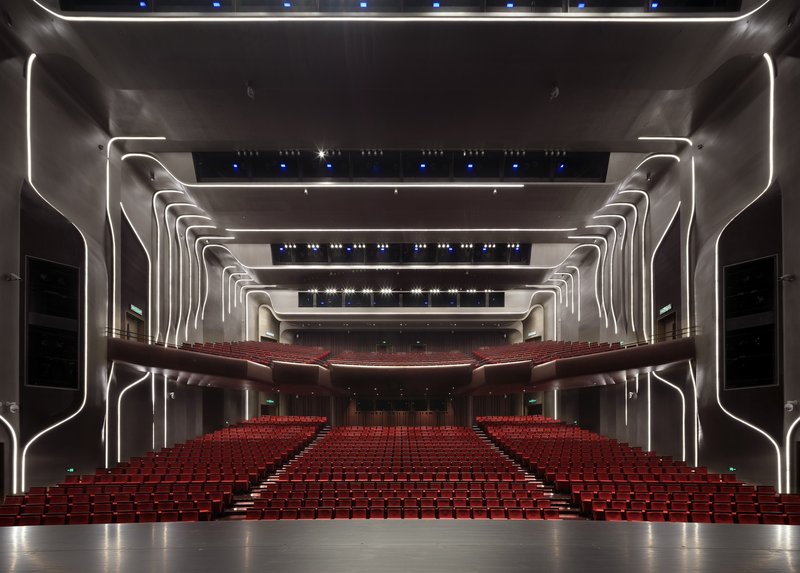
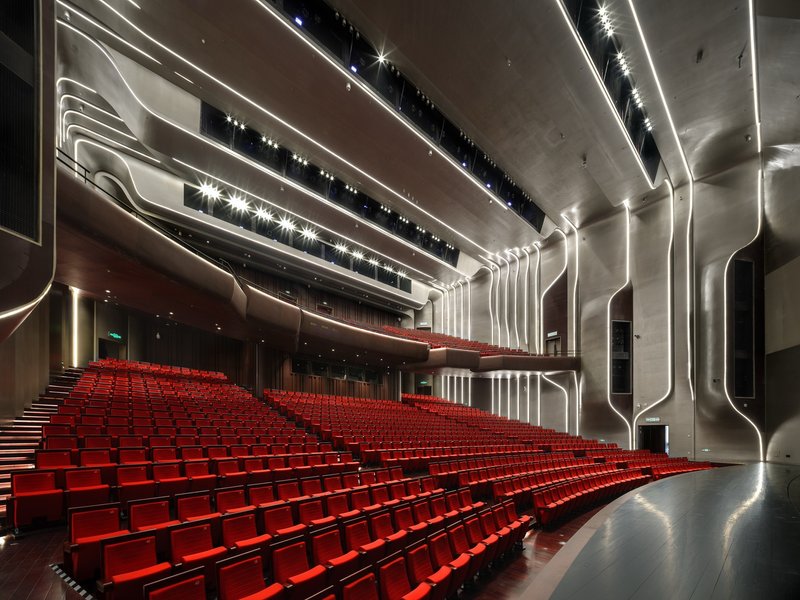
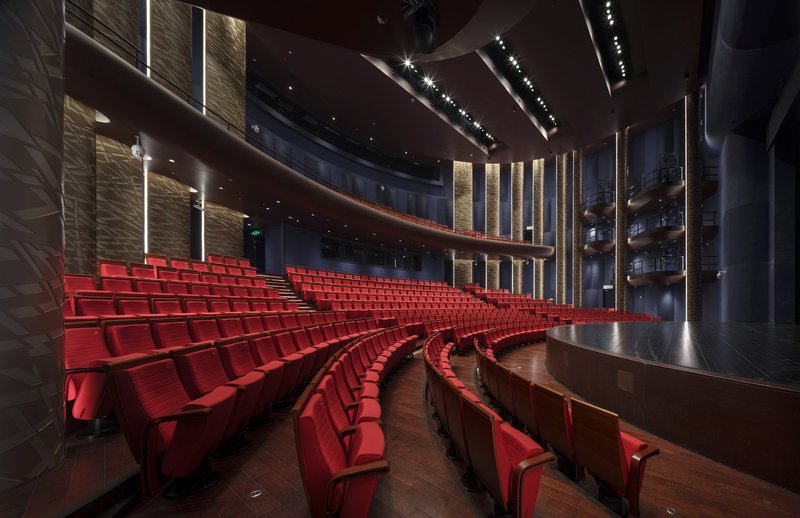
Each auditorium develops its own interior identity while sharing a common material language of GRG (glass fiber reinforced gypsum) panels. These panels are not decorative afterthoughts: their textured surfaces are calibrated to optimize acoustic performance in each room. The Opera House deploys curved white light fixtures above red seating, creating a sense of enveloping warmth. The Drama Theatre uses vertical textured wall panels and layered balconies to build intimacy at 605 seats. The varying scales, from the 300-seat Children's Theatre to the 1,523-seat Opera House, mean that each hall confronts a different acoustic and spatial problem.
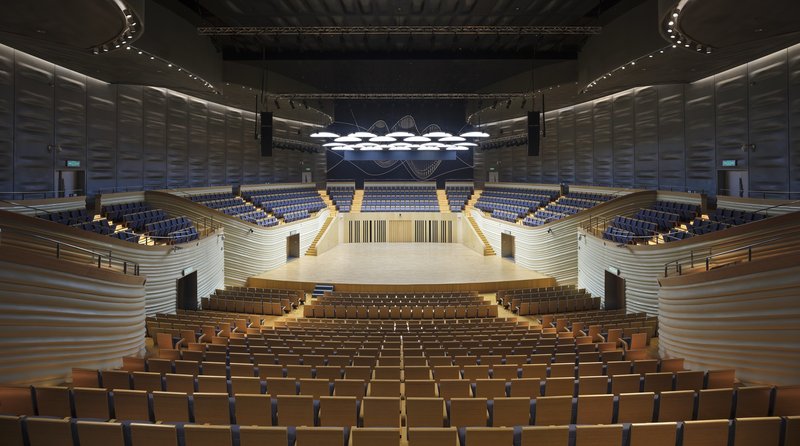
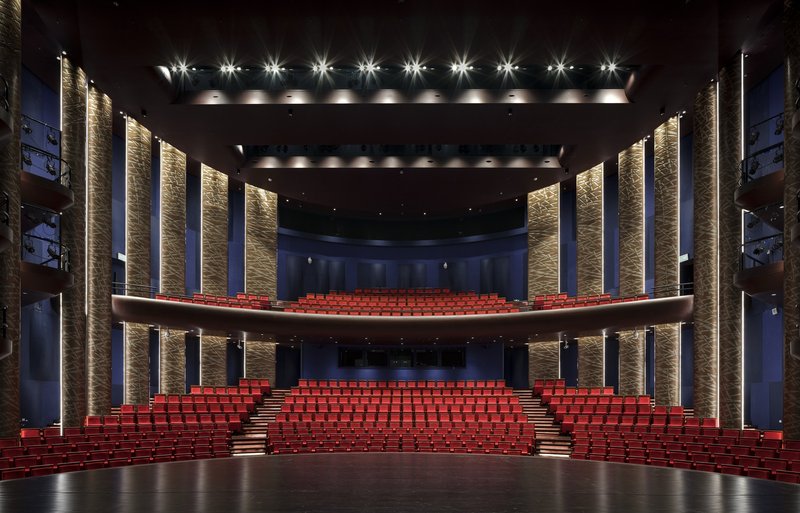
The Concert Hall, equipped with a Rieger pipe organ imported from Austria, arranges tiered seating in brown and blue upholstery around a central stage, placing the audience in close proximity to the performers. The Studio Theatre, the most flexible of the five at 406 seats, rounds out a program that covers the full spectrum from children's programming to symphonic performance. The red velvet and illuminated curved lines in the larger halls nod to classical theatre traditions, while the overall palette stays restrained enough to let the performances, not the room, be the event.
Plans and Drawings
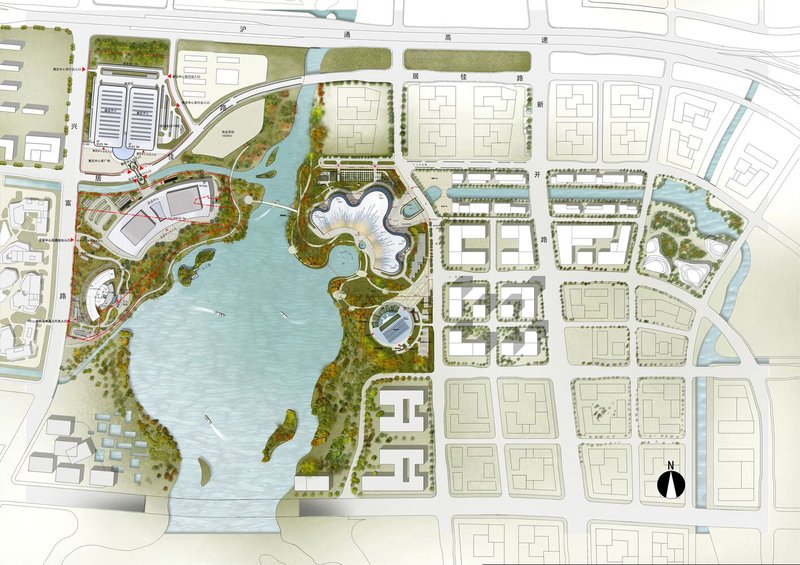
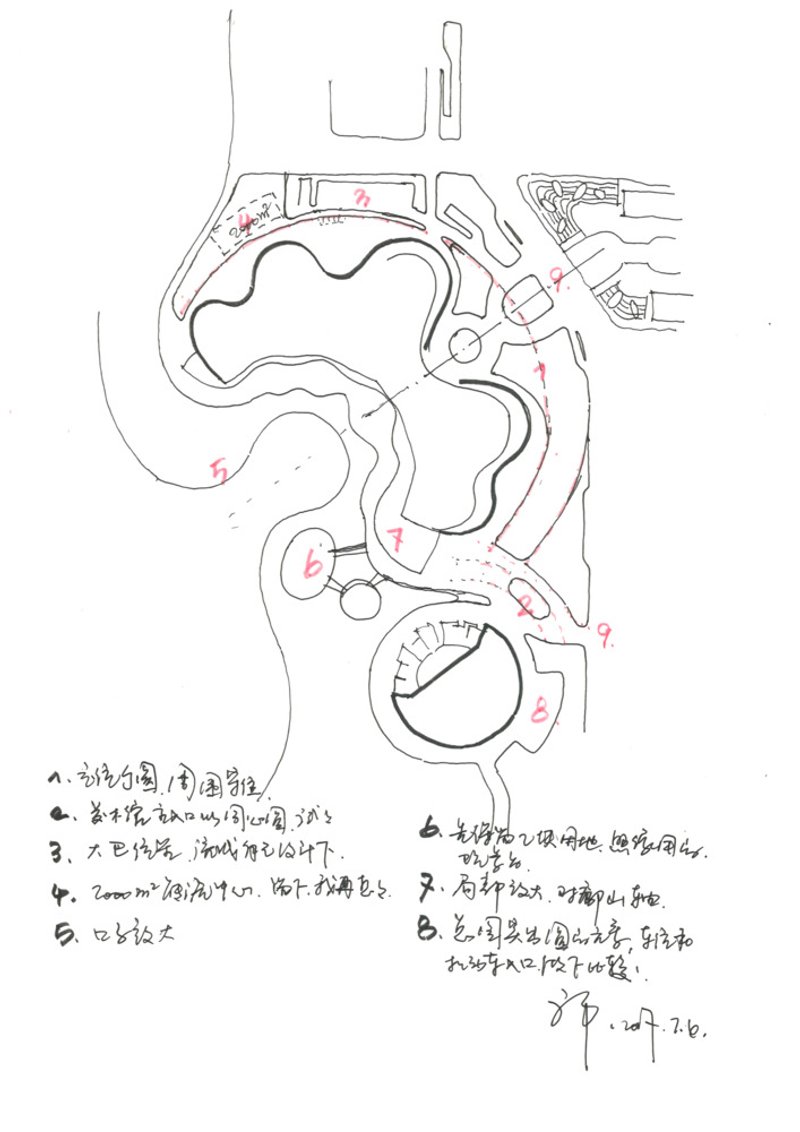
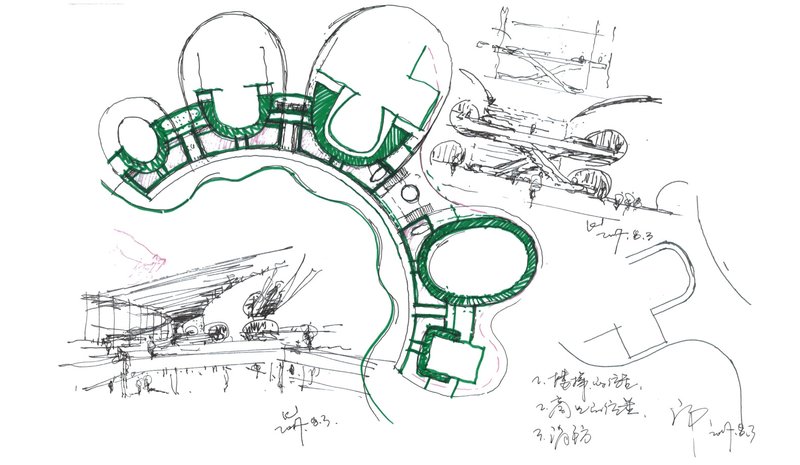
The site plan reveals the project's centripetal logic. Five auditorium volumes, each oriented with their audience-facing foyers toward the lake and their backstage service zones toward Tongsheng Avenue, fan outward from a shared center. The annotated sketches, with their handwritten Chinese notes, hint at the iterative process of adjusting the canal's course and negotiating curved circulation paths through the plan. Green-highlighted zones in the diagrammatic plans show how the public ring connects to individual hall entrances, with visitor flow moving from ground-floor ticketing and security up to second-floor hall access.
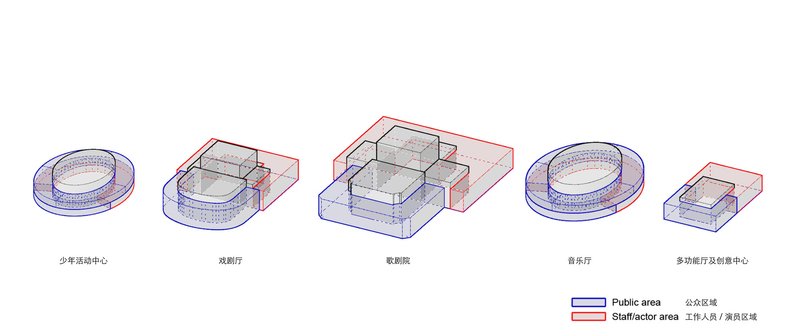
The axonometric diagram, color-coded in blue for public areas and red for staff and service zones, makes the separation of front-of-house and back-of-house legible at a glance. Five autonomous volumes share a common base but maintain their operational independence, a smart strategy for a complex that must accommodate simultaneous performances with different technical requirements, load-in schedules, and audience capacities.
Why This Project Matters
Nantong Grand Theatre matters because it treats a cultural building as urban infrastructure rather than a monument. The decision to keep the ground floor permeable and programmatically independent, the landscape that stitches the building into the park, and the circular lobby that functions as a public room all work against the tendency for grand theatres to become isolated objects. The building does not sit on a pedestal; it meets the water.
The split between glass and perforated aluminum on opposite facades is the kind of clear, legible move that gives a very large building conceptual coherence. BIAD inherited a strong planning framework from Paul Andreu's original concept and developed it into a fully resolved piece of architecture that handles the extraordinary complexity of five simultaneous performance venues, nine stories, and over 4,000 seats without losing its composure. In a generation of Chinese performing arts centers competing for spectacle, Nantong's theatre wins by being useful.
Nantong Grand Theatre by BIAD (planning, concept design, and schematic design by Paul Andreu Architecte Paris, BIAD, and PLUS). Nantong, China. 110,916 m². Completed 2020.
About the Studio
Share Your Own Work on uni.xyz
If projects like this are the kind of work you want to make, uni.xyz is a place to publish your own, find collaborators, and enter design competitions.




Popular Articles
Popular articles from the community

VEIVE Architects Builds a Mountain Hostel That Disappears into a Hangzhou Hillside
On the Huihang Ancient Trail in Xiangjian Village, a shelter of wood, steel, and rammed earth roots itself in the rural landscape.
IDIN Architects Wraps a Hua Hin Hotel Around a Private Courtyard to Escape the City
Dusit D2 Hua Hin turns an urban infill site in Thailand's family vacation heartland into a self-contained resort through courtyard planning.
BLDUS Turns a 250-Square-Foot Screened Porch into a Pine Forest Temple in East Hampton
A gabled cedar pavilion mimics the rhythm of surrounding pines, anchoring a 1990s wooded home to its hollow in Long Island.
OMCM arquitectos Builds a Summer House in Paraguay from Quarry Waste Blocks and Three Sacred Trees
In the young hillside neighborhood of Altos, a 696-square-meter concrete volume hovers on six pillars around three preserved native Yvyraju trees.


Similar Reads
You might also enjoy these articles

Olio Towers: A Mid-Rise for Performers That Fuses Housing, Rehearsal, and Stage
Located blocks from Houston's Theater District, this modular tower stacks living units around a central performance atrium.
Oasis: Modular Green Housing Carved into Dhaka's Urban Fabric
A shortlisted Plugin Housing entry reclaims unauthorized settlements in Dhaka with stepped concrete volumes, green roofs, and ventilation-driven design.

Black Hole: A Floating Megastructure for the Post-Physical Era
Emiliano Mazzarotto envisions a spherical, self-scaling arena where e-sports, digital hotels, and holographic stadiums replace traditional public space.
Compact & Sustainable Living in Piraeus: A Four-Level Family Home Built Around Light and Air
A narrow townhouse in one of Greece's densest port cities uses a central atrium and passive strategies to house three generations under one roof.


Explore Architecture Competitions
Discover active competitions in this discipline




The International Standard for Design Portfolios


The Global Benchmark for Architecture Dissertation Awards


The Global Benchmark for Graduation Excellence


Challenge to reimagine the Iron Throne
Comments (0)
Please login or sign up to add comments
No comments yet. Be the first to comment!