

TANK Architectes Replaces a Toxic 1970s Block at Place de la Nation with Cascading Terraces
A 7,700 square meter office building in Paris uses local quarry sand in its concrete to echo the limestone tones of Haussmann.


Place de la Nation has been a civic landmark for over a century, but its built edges have not always matched that status. When an asbestos-laden 1970s office block needed to come down, TANK Architectes saw the demolition as an opportunity to knit a new building into the Haussmannian grain of the arrondissement rather than simply replacing floor area. The result is a 7,700 square meter intervention that stretches through the block from the Place to rue de Taillebourg, stacking retail at ground level beneath six stories of office space that step back as they rise, trading enclosed floor plate for open terrace.
What makes the project genuinely interesting is the material argument. The concrete is tinted with sand sourced from the Saint-Maximin quarries near Paris, the same geological origin as the limestone that gives Haussmann's boulevards their warm, chalky pallor. It is cast in horizontal strata that read like coursed stone at a distance but reveal themselves as poured concrete up close. That tension between association and honesty runs through everything here: classical proportions meet an irregular structural grid, planted terraces invoke Parisian courtyards while cascading outward in diagonal cuts, and a geothermal system does the work that radiators used to do.
A Facade that Belongs Without Imitating

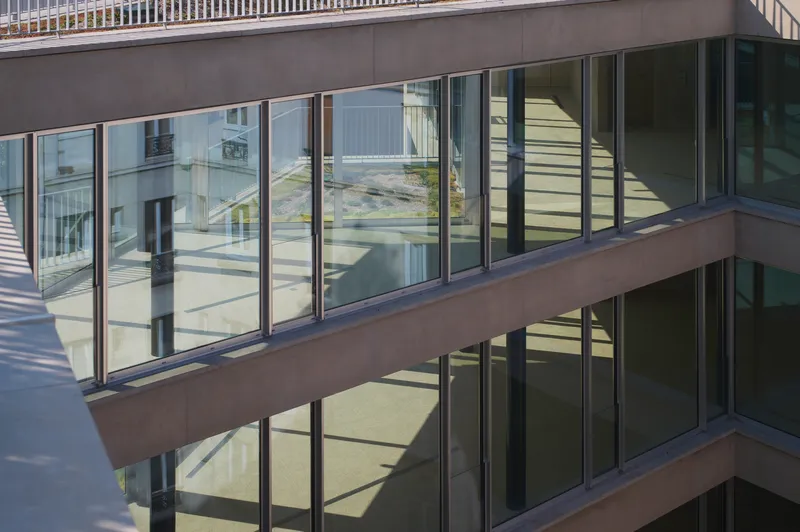
From the street, the building holds the cornice line and the rhythm of its Haussmannian neighbors. Continuous glass bands run between slender concrete slab edges that have been deliberately thinned to avoid the heavy look typical of post-war commercial buildings. The horizontal striations of the concrete catch late afternoon light in much the same way that dressed limestone does, a resemblance that is geological rather than cosmetic since both materials share a mineral origin. Mature trees along the boulevard mediate the scale shift between the fully glazed lower levels and the stacked balconies above.
The offset balconies create a vertical syncopation that prevents the facade from reading as a curtain wall grid. Each floor plate is a different shape, generated by diagonal cuts that extend voids from neighboring courtyards into the body of the building. The effect is a stepped silhouette that grows lighter as it ascends, culminating in a rooftop terrace with unobstructed 360-degree views across the city.
Cascading Green Terraces
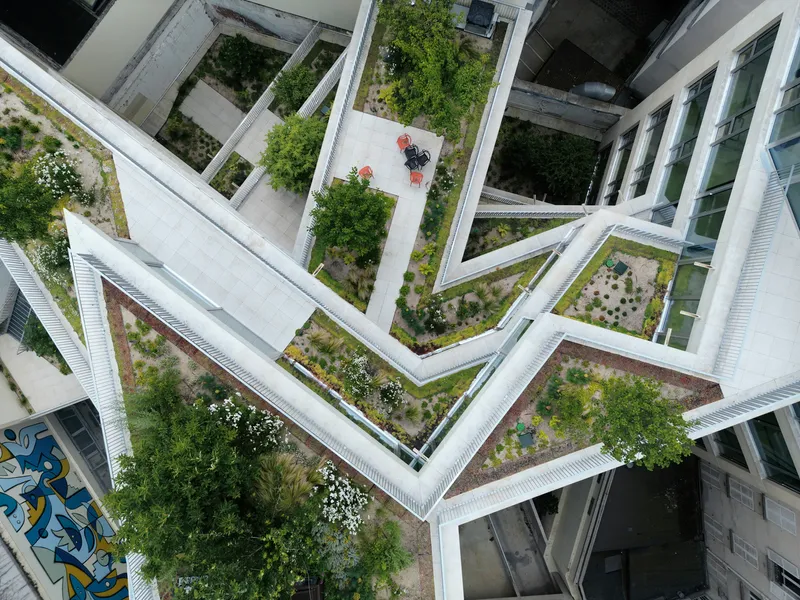
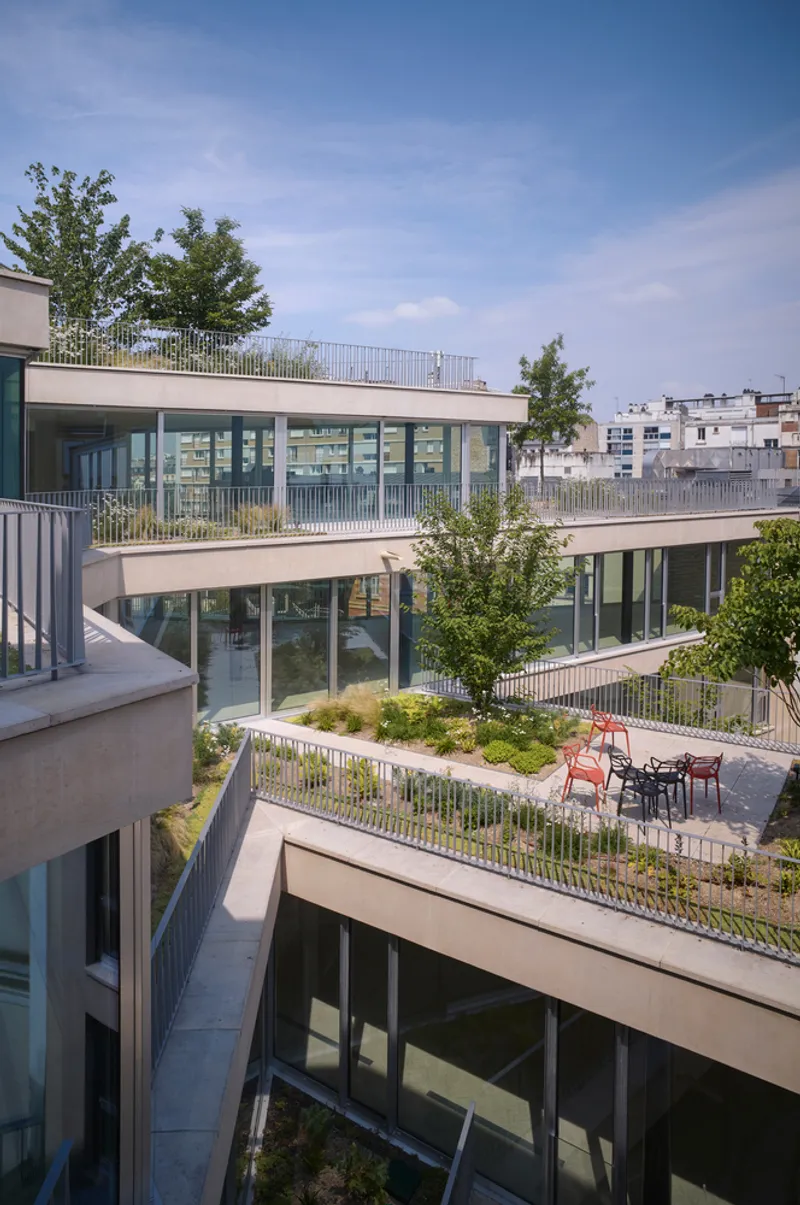
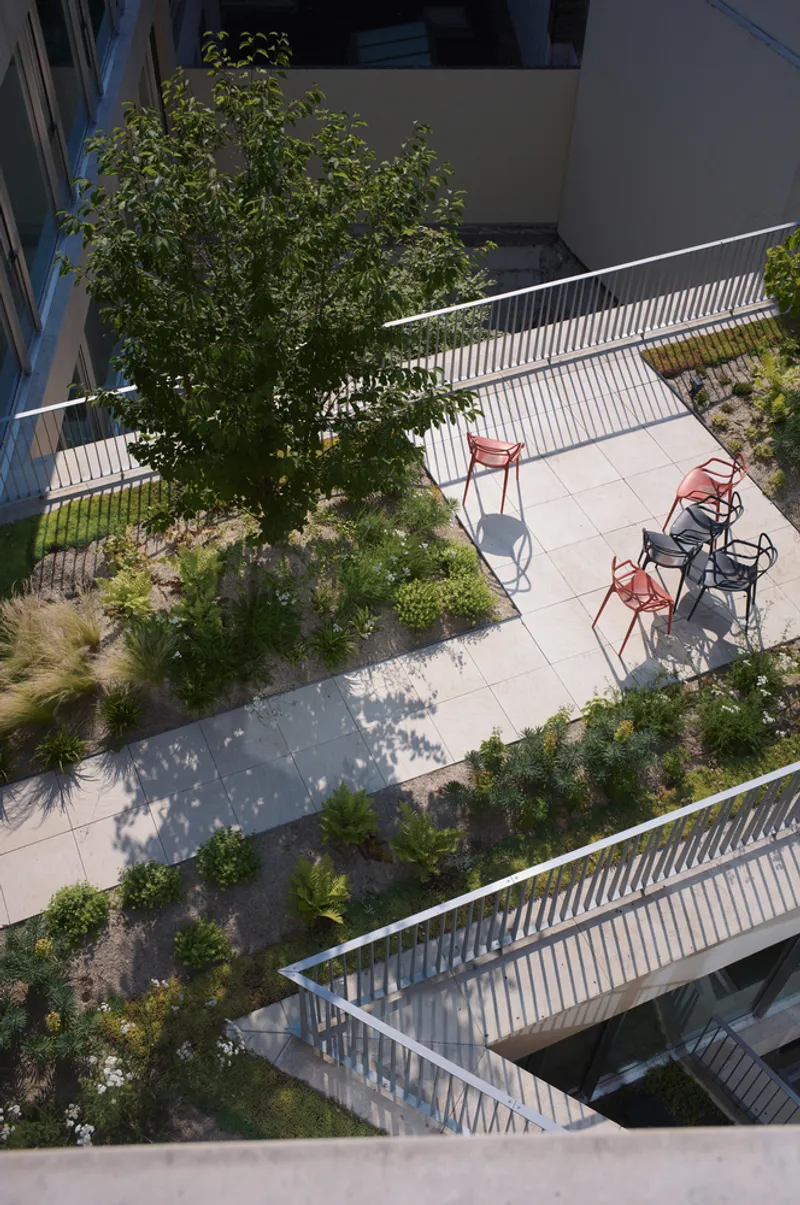
Six hundred square meters of landscaped terraces are layered through the building's vertical section, each level offering a different scale of vegetation and a different frame onto the city. The planting follows City of Paris biodiversity guidelines, prioritizing native and seasonal species that change character through the year. From above, the zigzagging white concrete beams read like a topographic contour map interrupted by green beds and clusters of red cafe chairs, a roofscape that is as much a workspace as the enclosed floors below.
The terraces are not ornamental afterthoughts. They are the consequence of the building's structural logic: as the floor plate shrinks with each ascending level, the freed perimeter becomes usable outdoor space. Diagonal cuts extend adjacent courtyard voids into the building mass, producing irregular terrace shapes that avoid the monotony of simple setbacks. Vertical metal railings and corrugated metal panels give these outdoor rooms a lightweight, almost scaffolding-like quality that contrasts with the heft of the concrete structure.
Interior Light and the Irregular Grid

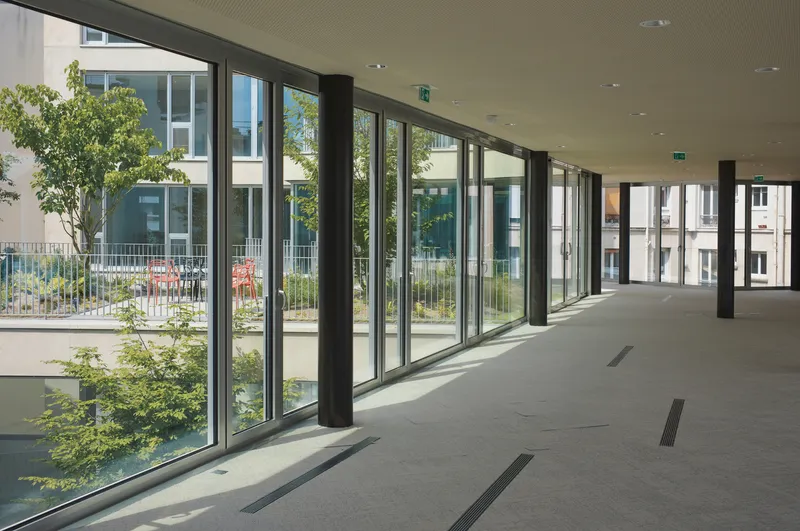
Inside, the structural move that matters most is the irregular column grid. Two thin shear walls and two concrete circulation cores do the heavy lateral work, freeing the floor plates from a rigid bay spacing. Columns taper toward the top, which makes the upper floors feel noticeably more open than the lower ones despite their smaller footprint. Floor-to-ceiling glazing wraps every level, pulling daylight deep into the plan and giving occupants constant visual contact with the planted terraces beyond.
Perforated ceiling panels manage acoustics without closing down the overhead volume, and the interior palette of beige tones deliberately echoes the warm plaster finish of traditional Parisian apartments. It is a subtle choice, but it means the transition from city street to lobby to workspace feels like a continuous atmosphere rather than a series of material ruptures. The entrance hall along Avenue Taillebourg channels visitors past the vertical circulation core and into the landscaped heart of the site, a sequence that puts nature at the center of the daily commute.
Vertical Circulation as Architecture
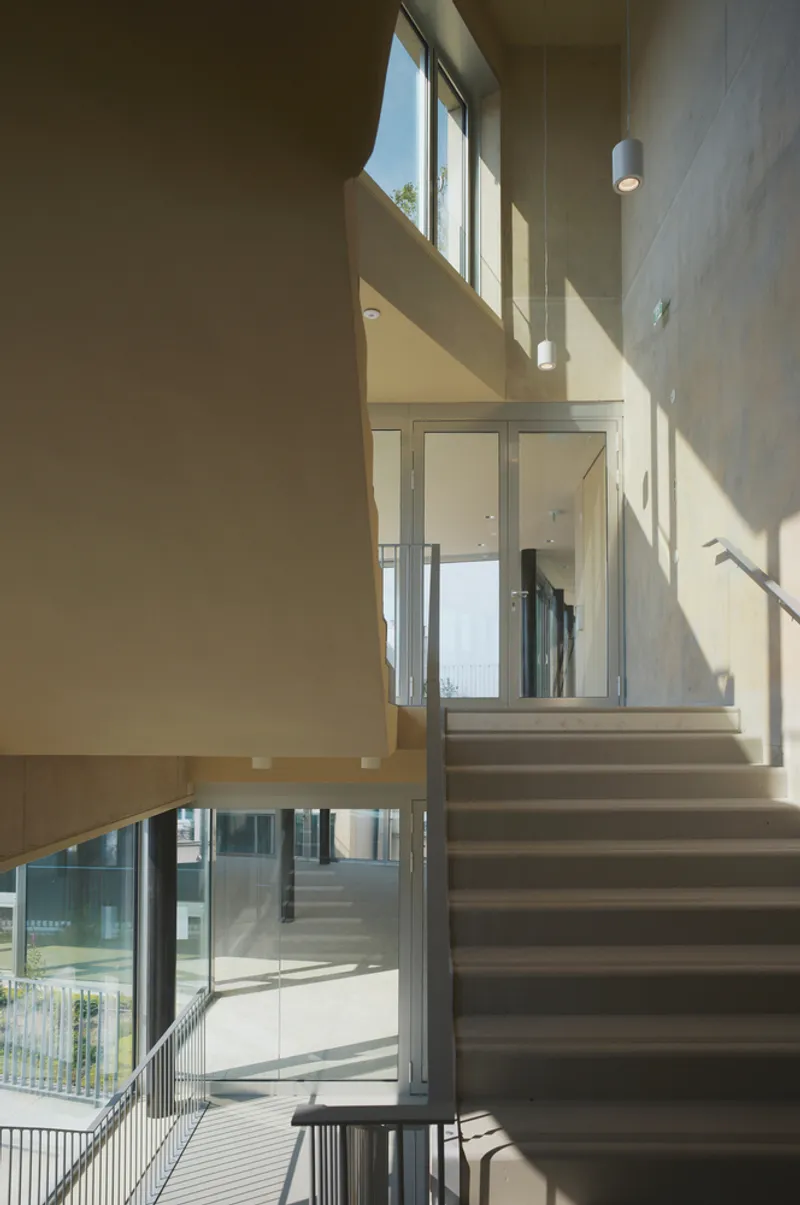
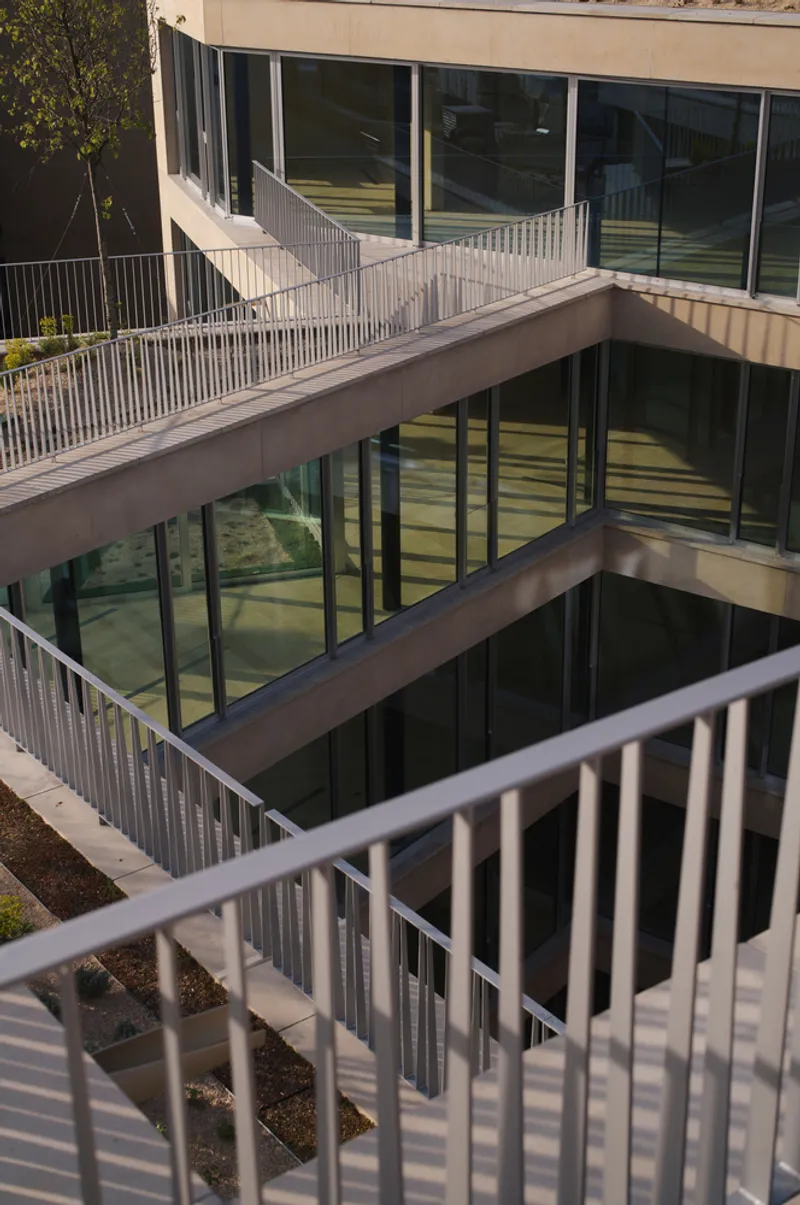
The multi-level stairwell and glass elevator shaft form a slot of light that runs the full height of the building. Clerestory windows at the top throw sharp afternoon shadows down the stair treads, turning a utilitarian element into a kinetic light installation that changes by the hour. The transparency of the circulation core also means that the terraces are visible from the stairs at every level, a persistent reminder that outdoors is never more than a few steps away.
Viewed from the courtyard side, the stacked terraces, glass facades, and concrete slabs stack into a section that reads like an exploded diagram of the building's logic. Each element is legible: structure, enclosure, planting, and circulation. There is no cladding system hiding the relationships between them.
Rooftop and City
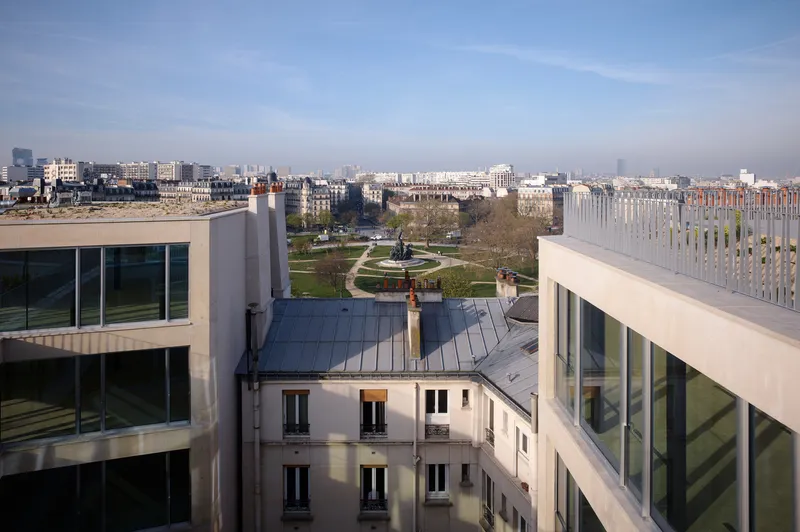

At the fifth floor, the last of the floor plate gives way entirely to a rooftop terrace that looks out over zinc-clad volumes toward the green spaces that were added to Place de la Nation in 2019. That urban redesign, which introduced 6,000 square meters of parkland, pedestrianized side streets, and reduced car traffic, is the broader context that makes this building make sense. TANK's intervention is not an isolated architectural object; it is one piece of a coordinated shift from automobile-scaled infrastructure to a greener, slower public realm.
The fact that the entire construction sits on the preserved existing foundations is worth emphasizing. It means the embodied carbon of the substructure was inherited rather than rebuilt, and it constrained the column positions in ways that forced the architects to work with irregularity rather than impose a new grid. That constraint, arguably, is what gives the building its spatial variety. No two floors feel the same, because no two floors are the same shape.
Why This Project Matters
Parisian office architecture has a bad reputation, and much of it is deserved. The asbestos-laden block that stood here before was a product of the same development pressures that produced bland commercial floor plates across every European capital in the 1970s. What TANK demonstrates is that replacing those buildings does not require either pastiche historicism or a glass-box reset. A third option exists: build with local materials, accept the constraints of the existing foundations, and design the section so that every floor is a negotiation between enclosed workspace and open-air terrace.
The strongest lesson here is about specificity. The Saint-Maximin sand in the concrete, the diagonal cuts generated by neighboring courtyard voids, the planting strategy calibrated to Paris biodiversity standards: none of these decisions could be transplanted to another city without losing their logic. That site-rootedness is what separates a good commercial building from a forgettable one, and it is the quality most commercial development still refuses to invest in.
Nation Office Building Intervention by TANK Architectes. Located at Place de la Nation, Paris, France. 7,700 m². Photography by Julien Lanoo.
About the Studio
TANK Architectes
Official website of TANK Architectes, one of the studios behind this project.
tank.frShare Your Own Work on uni.xyz
If projects like this are the kind of work you want to make, uni.xyz is a place to publish your own, find collaborators, and enter design competitions.



Popular Articles
Popular articles from the community


EW PARK: Sustainable Architecture Reimagines the Future of Urban Parking
EW PARK reimagines city parking as a modular wooden tower combining automation, solar energy, electric mobility, and adaptable urban design.

Riyadh For All: Intergenerational Urban Design for Active Aging in Rabat
Riyadh For All reimagines urban design in Rabat with intergenerational co-living, adaptive courtyards, and Moroccan cultural exchange today.

The Earth Pod: 3D Printed Homes for Resilient Refugee Communities
The Earth Pod reimagines refugee housing through 3D printed homes made from clay, combining resilience, self-sufficiency, and rapid shelter.

Hill & Cross Opera: Sculptural Opera House Architecture Shaped by Tallinn’s Landscape and Identity
Hill & Cross Opera reimagines opera house architecture in Tallinn through its sculptural hill, civic plaza, glass wave and a luminous cross.


Similar Reads
You might also enjoy these articles


Hodi-Mandai Geram
Project Function: Preservation and revitalization of the Intangible heritage and socio-spatial identity of the Hodi by Housing, Cultural Memory Center, Sacred Grove, landscape, local tourism economy


Olio Towers: A Mid-Rise for Performers That Fuses Housing, Rehearsal, and Stage
Located blocks from Houston's Theater District, this modular tower stacks living units around a central performance atrium.

Oasis: Modular Green Housing Carved into Dhaka's Urban Fabric
A shortlisted Plugin Housing entry reclaims unauthorized settlements in Dhaka with stepped concrete volumes, green roofs, and ventilation-driven design.

Black Hole: A Floating Megastructure for the Post-Physical Era
Emiliano Mazzarotto envisions a spherical, self-scaling arena where e-sports, digital hotels, and holographic stadiums replace traditional public space.


Explore Office Building Competitions
Discover active competitions in this discipline



Challenge to reimagine the Iron Throne


Photograph architecture without architects


Illustrate the lost glory of Angkor Wat - Render Challenge


Design challenge to reuse E-waste
Comments (0)
Please login or sign up to add comments
No comments yet. Be the first to comment!