
Moguang Studio Scatters a Design Hotel Across Six Abandoned Plots in a Chinese Ginkgo Valley
In Suizhou's ancient ginkgo groves, charred cedar treehouses and stone courtyards replace forgotten homesteads with quiet intensity.


There are roughly 200 dawn redwoods and ancient ginkgo trees in the valley surrounding Jiukouyan Village in Hubei Province, some more than a thousand years old. The Lost Villa · Ginkgo Valley Design Hotel by Moguang Studio occupies six abandoned homestead plots scattered along a winding road that climbs from the northern village entrance to a man-made reservoir at its southern edge. The total project area is 2,500 square meters, but those numbers obscure the real ambition: to build a hospitality complex that behaves less like a compound and more like a geological feature of the valley itself.
What makes this project worth studying is its refusal to consolidate. Rather than clearing a single footprint and erecting a resort, Moguang Studio adopted a decentralized layout across plots ranging from 120 to 1,050 square meters, each one responding to a different condition of slope, canopy, and existing foundation. The architects call it "appropriate construction," a principle that governs everything from the structural system to the fenestration. It results in a hotel that reads as a series of encounters: a courtyard reception, a cantilevered treehouse, a stone tea pavilion, an infinity pool that stitches mountain to valley. Each is architecturally distinct, yet they share a material language of charred cedar, rubble stone, and rough stucco that anchors them firmly to this particular place.
Village as Sequence
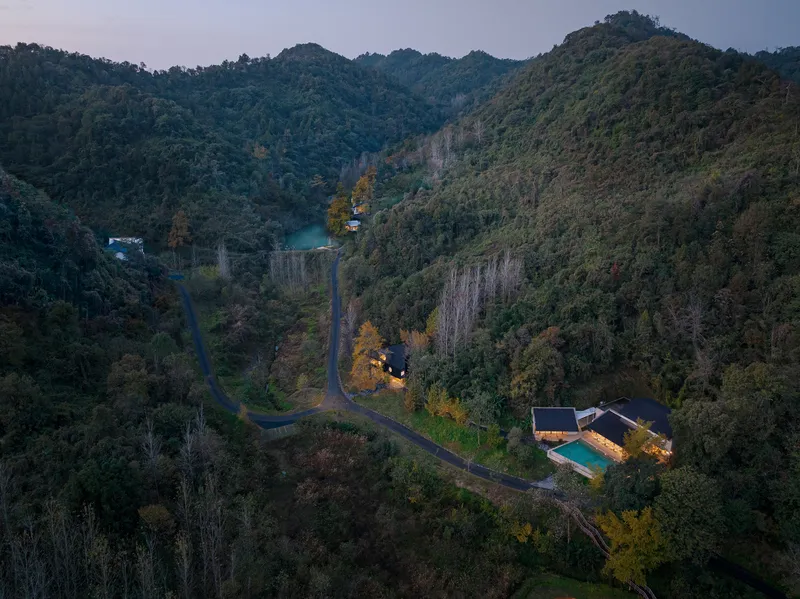
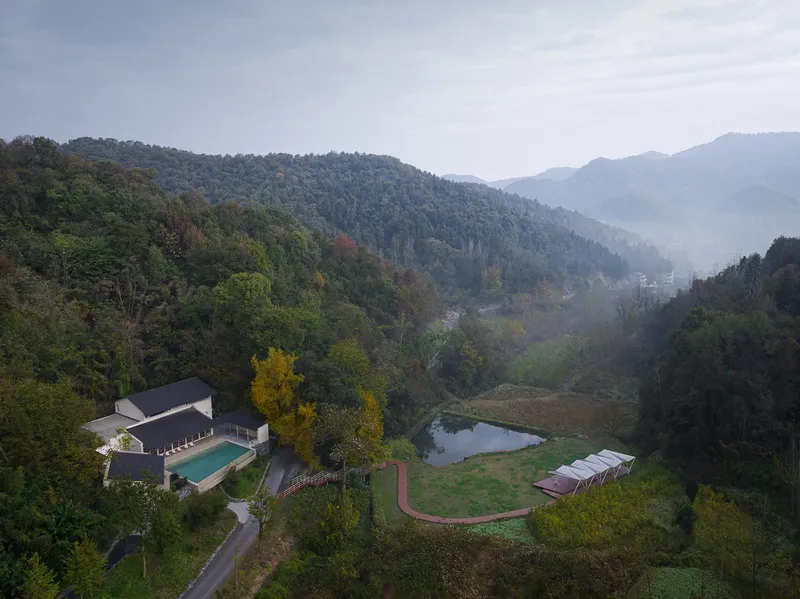
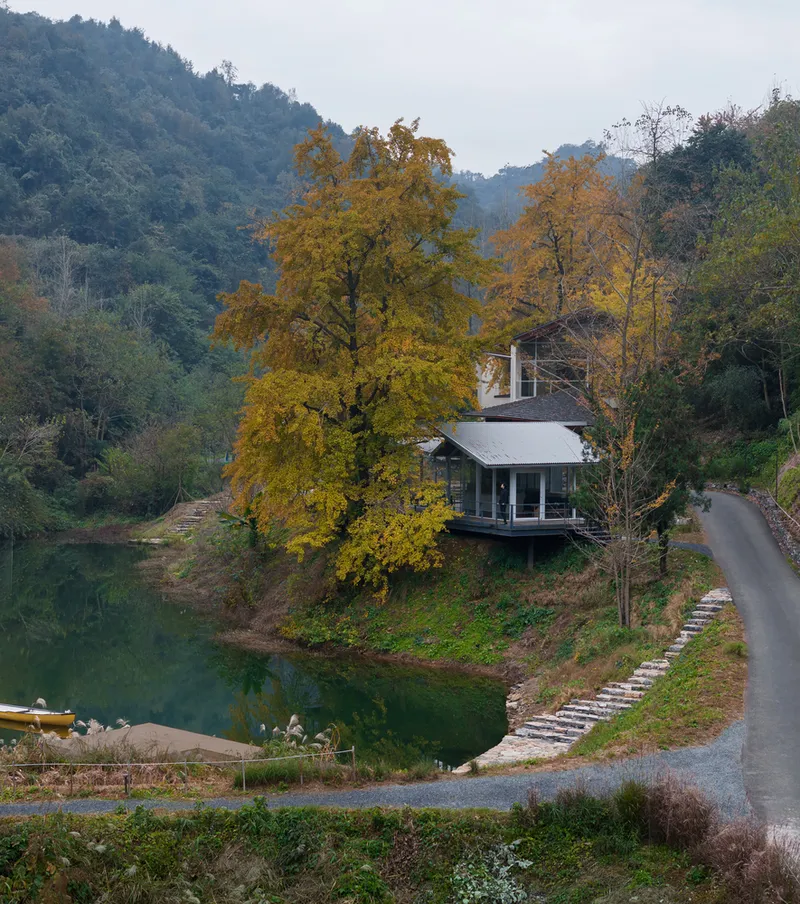
Seen from above, the hotel reads as a constellation of rooftops threaded through forest. The six plots ascend progressively over more than a kilometer, and the winding road between them becomes part of the architectural experience. You do not arrive at this hotel; you enter a valley and discover its parts gradually, each building framed by shifting layers of autumn foliage and terraced hillside. The aerial views reveal how carefully each volume has been sited to avoid the mature trees, tucking into clearings rather than carving them out.
The decision to work with abandoned homestead footprints gives the project an embedded quality that new construction rarely achieves. The architects layered their interventions onto the memory of what was already there: courtyard configurations follow original house plans, retaining walls follow existing terracing. The result is a settlement pattern that feels ancient even where the materials are new.
The Treehouse and the Question of Touch
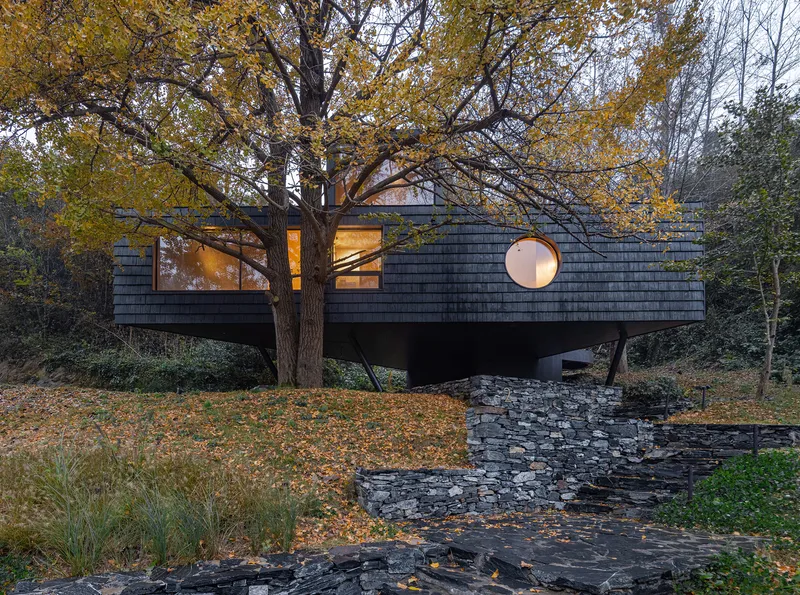
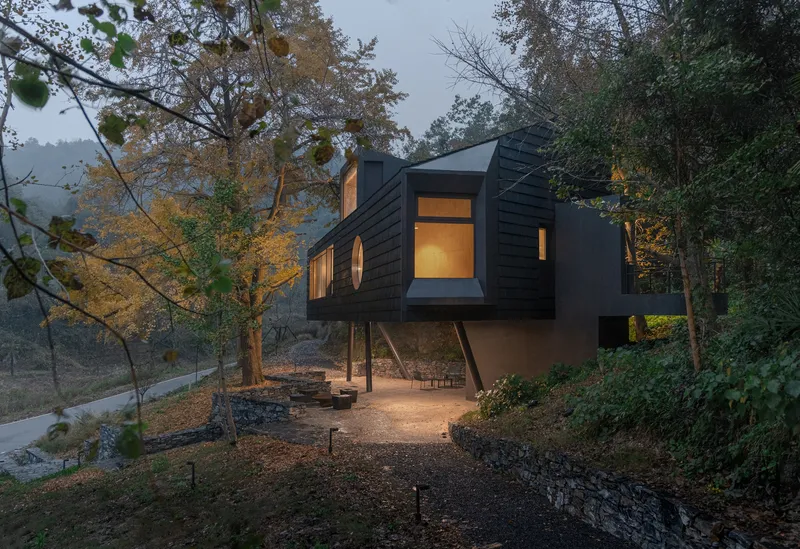
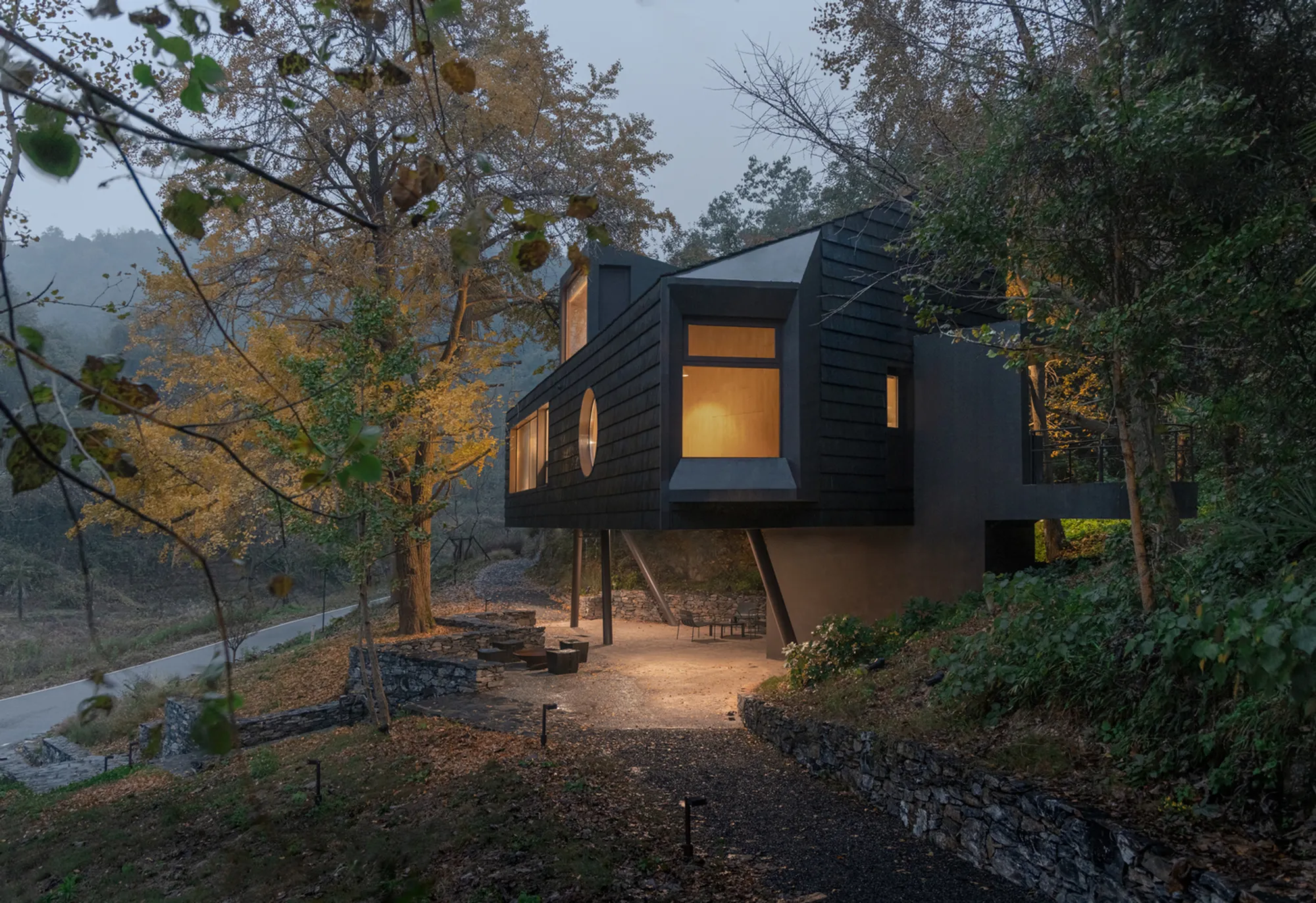
The treehouse is the project's most striking single gesture. Built on a 90-square-meter plot, the 190-square-meter structure uses reinforced concrete shear walls and steel framing on its first floor, shifting to a lightweight steel structure above. The entire volume is elevated on slender columns to preserve the root systems of three ancient ginkgo trees. Below, the open ground level becomes a semi-outdoor space for dining, gathering, and roasting ginkgo nuts: a program dictated by the seasons rather than a room schedule.
The circular porthole window is the detail that lingers. Where conventional hotel architecture relies on floor-to-ceiling glazing to deliver views, Moguang Studio uses geometric openings, circles and angled cuts, that frame specific slices of landscape. The effect is closer to a camera viewfinder than a picture window. The ginkgo canopy doubles as a privacy screen for the two guest rooms, each at least 50 square meters, so the boundary between architecture and tree is deliberately blurred. The charred cedar cladding, cut in 30x45cm planks with select sections polished and finished with matte varnish, deepens the ambiguity: it is wood that looks like bark.
Courtyard Reception and the Sanheyuan Inheritance
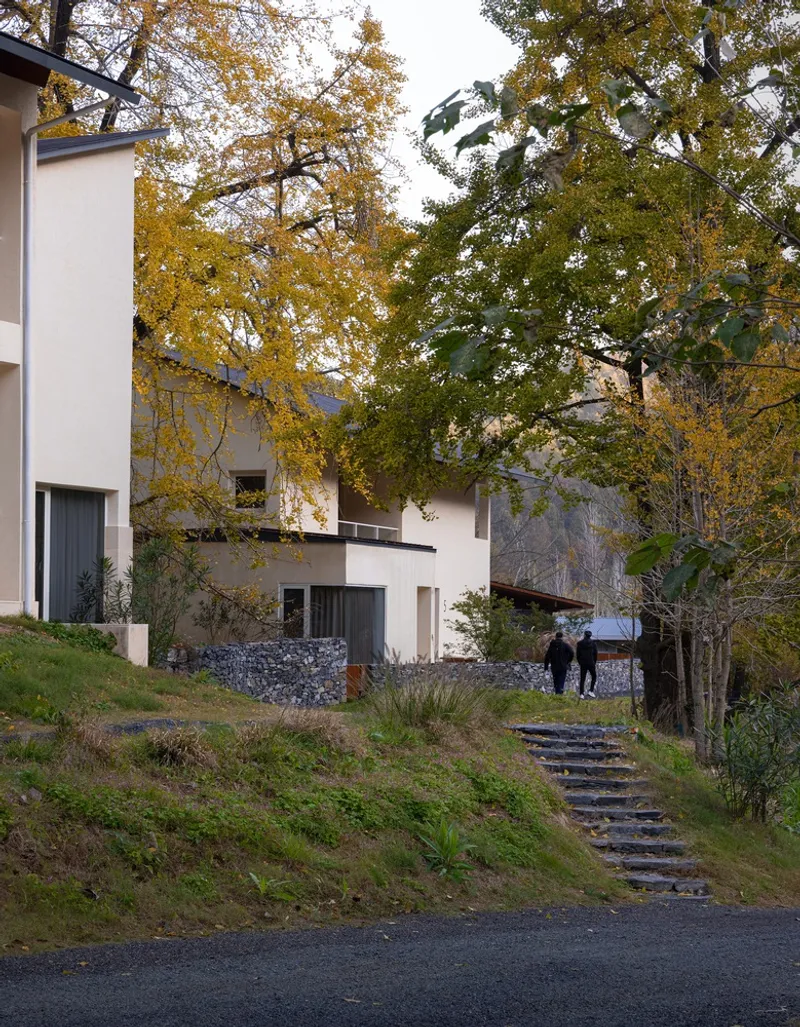
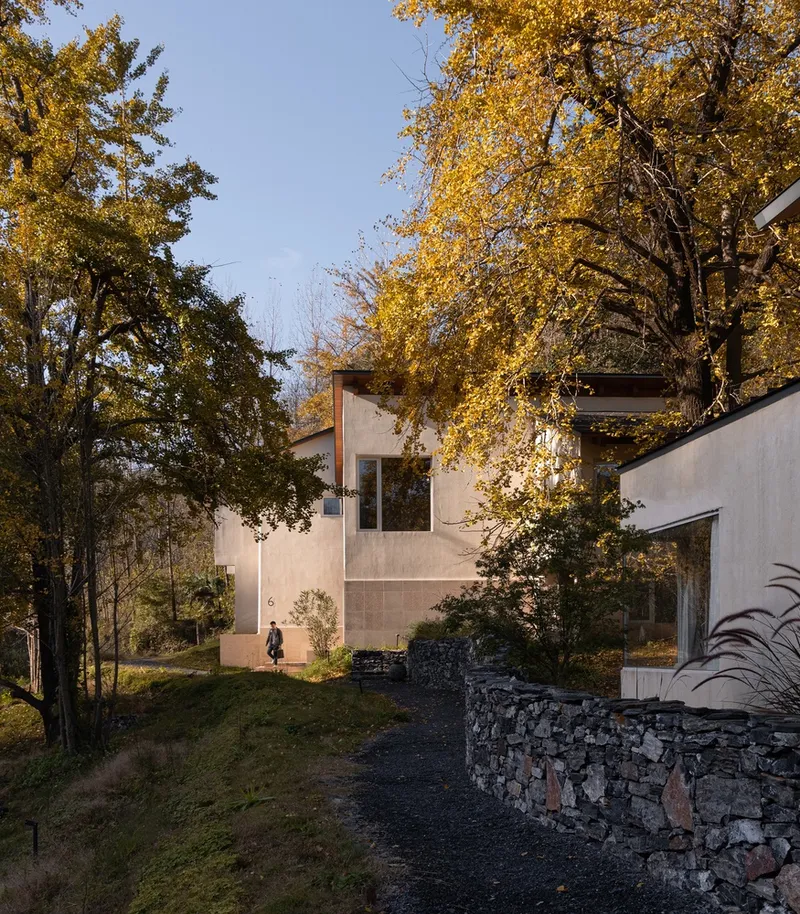
The reception hall follows the sanheyuan layout, a traditional three-sided Chinese courtyard form, adapted to its terrace site with mountains on three sides and terraced fields and ginkgo forest to the southeast. Two-tiered roofs, one higher and one lower, direct the eye toward a central paddling pool. The courtyard configuration traces the footprint of the original village houses, layering dense roofs over solid walls, delicate columns, and sturdy seating in a sequence that compresses the history of the site into a single spatial experience.
White stucco volumes and stepped stone paths anchor the approach. The restraint of the palette, white render against golden ginkgo leaves, rough stone against smooth plaster, gives the reception a monastic calm that sets the tone for the rest of the hotel. Walking paths and framed views expand the perception of space, so a relatively modest footprint feels generous.
Charred Cedar and Local Stone
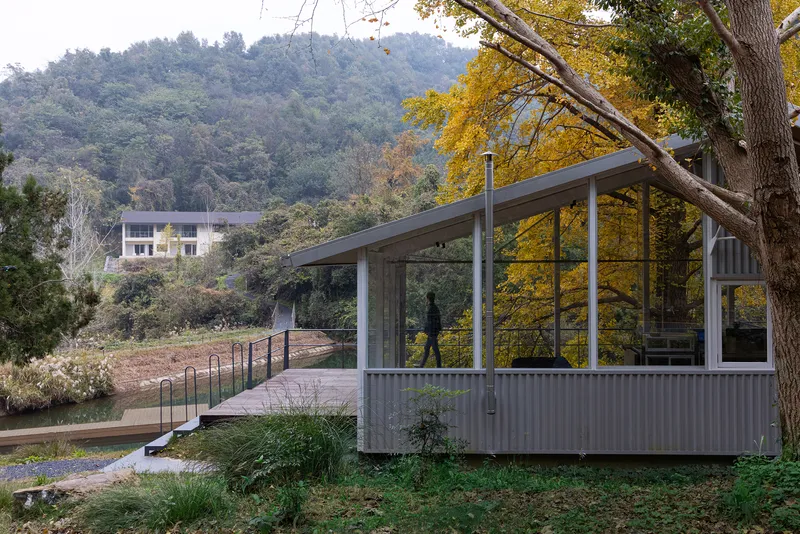
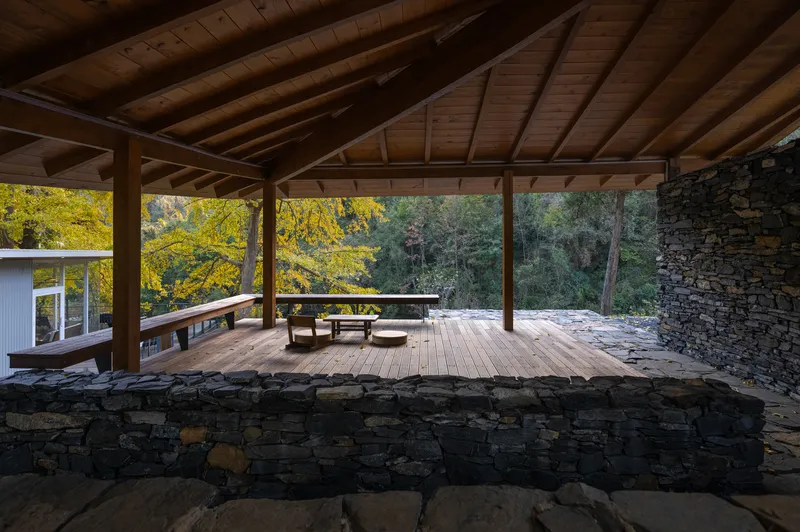
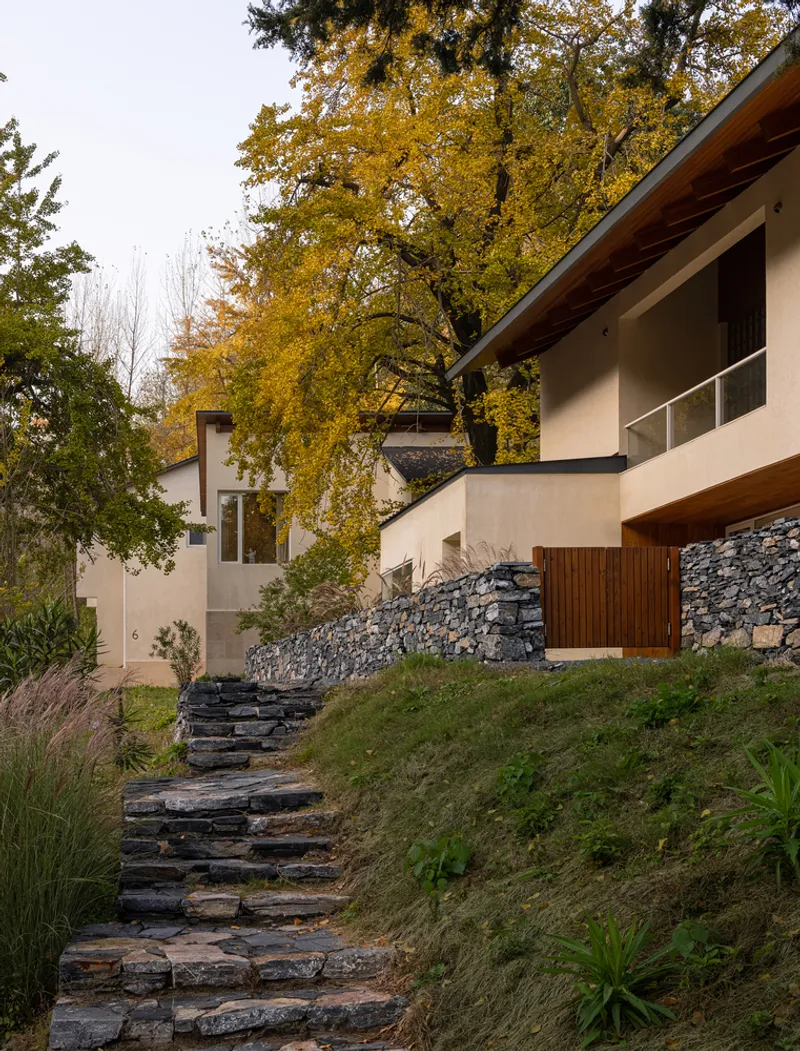
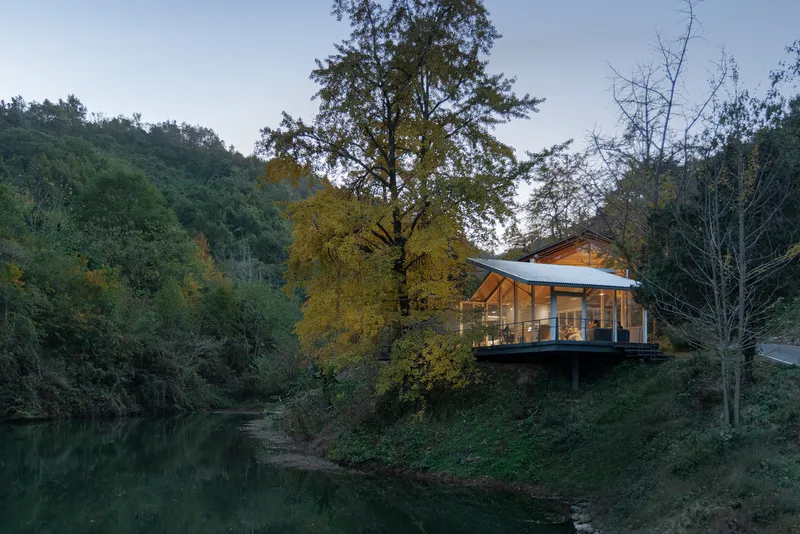
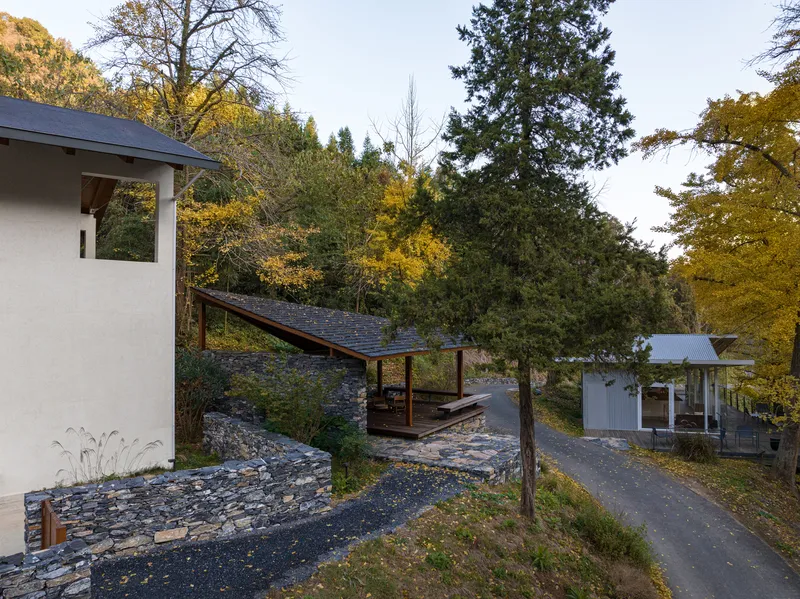
Materiality is where the principle of "appropriate construction" becomes most legible. The tea pavilion uses dark-toned wooden structures, burnt cedar shingles, and local rubble stone, positioned as an intermediary between the white café buildings and the forested slope. Carbonizing the cedar is not merely an aesthetic choice: the charring provides resistance to pests and moisture, extending the life of the wood in Hubei's humid climate. The metallic fluorocarbon paint applied to select surfaces subtly reflects the surrounding vegetation, dissolving hard edges.
Gabion retaining walls built with local stone reinforce the terraced paths between buildings. The decision to source rubble stone locally and to use dry-stacked construction connects the new architecture to the region's existing building traditions. Where many boutique hotels import materials to signal luxury, Moguang Studio roots its material palette in what the valley already provides. The result is not rustic pastiche but a contemporary building language that happens to share its geology with the hillside.
Interior Landscapes
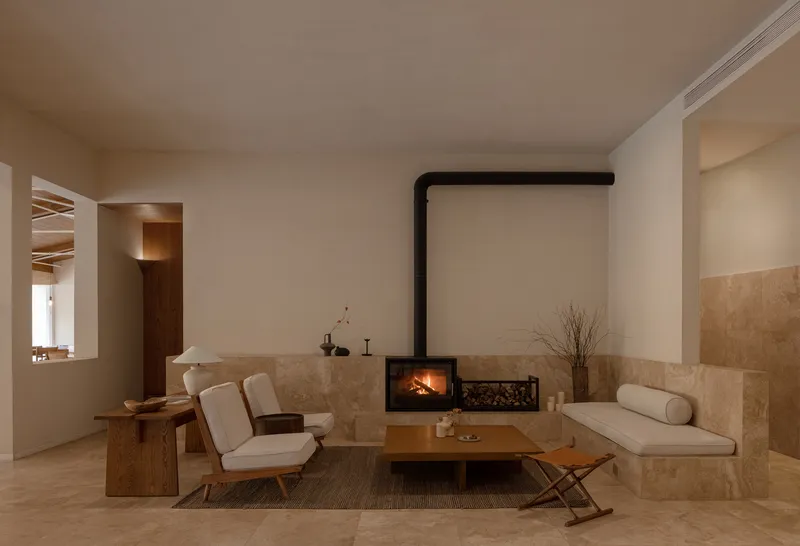
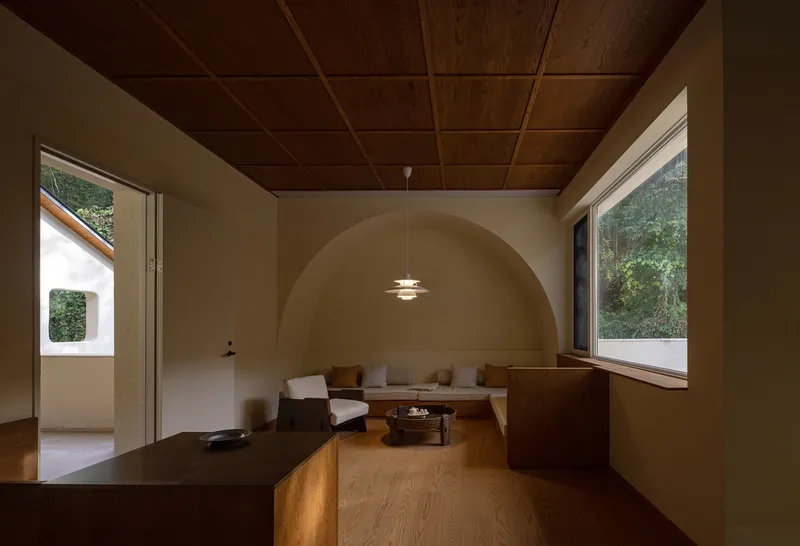
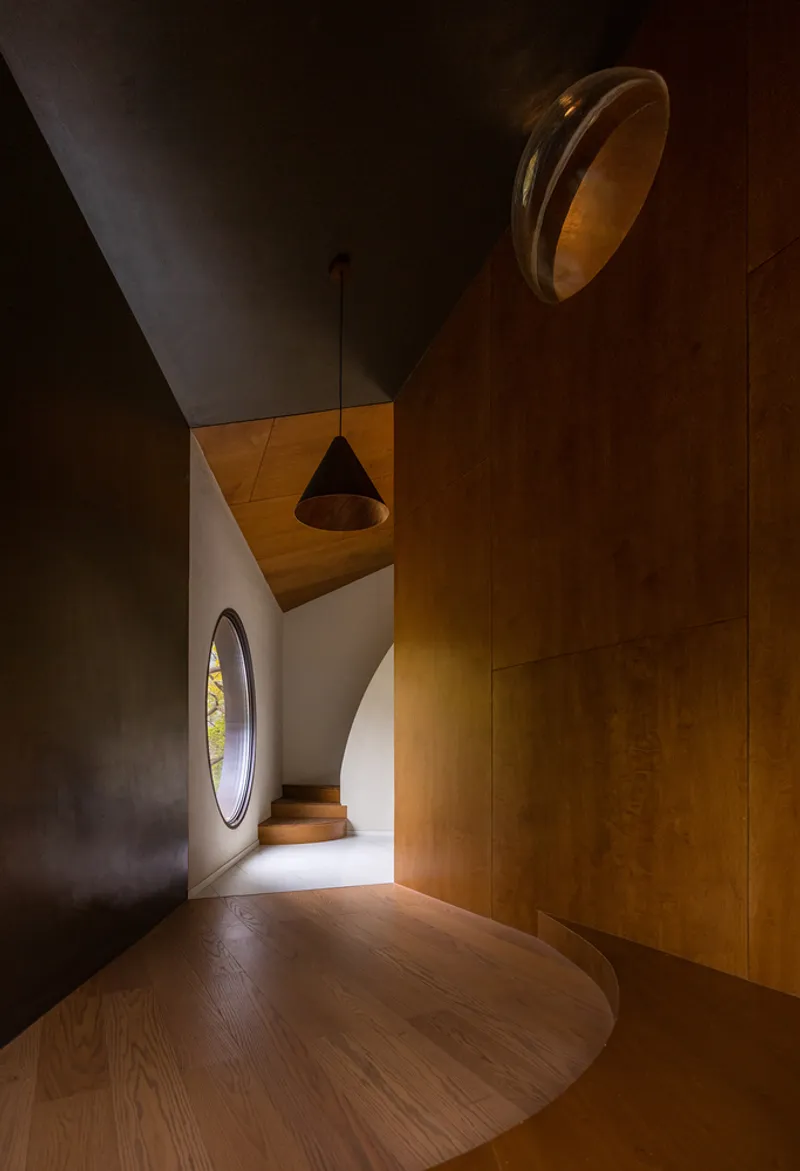
Inside, the rooms trade panoramic glazing for more considered openings. Arched wall recesses frame seating areas. Circular skylights punch through dark corridors, casting pools of light on curved timber flooring. A suspended fireplace flanked by limestone half-walls anchors the living space of one unit, its raw materiality a continuation of the exterior palette brought indoors. The interiors avoid the minimalist anonymity of most design hotels; there is texture everywhere, in the grain of the timber ceiling planks, in the roughness of the limestone wainscoting, in the curvature of a wall that follows no orthogonal logic.
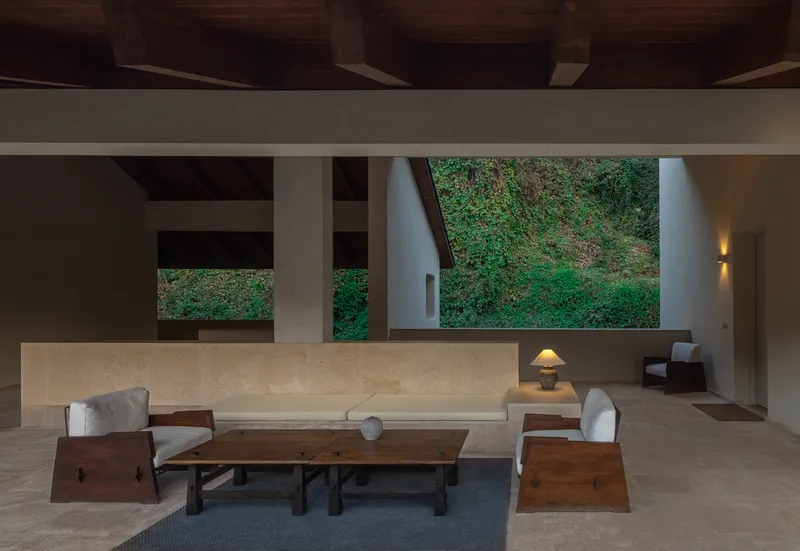
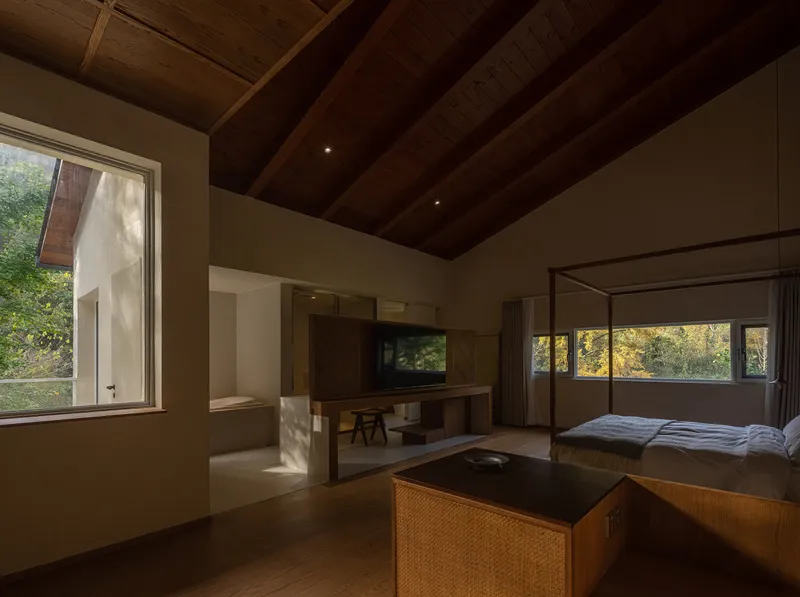
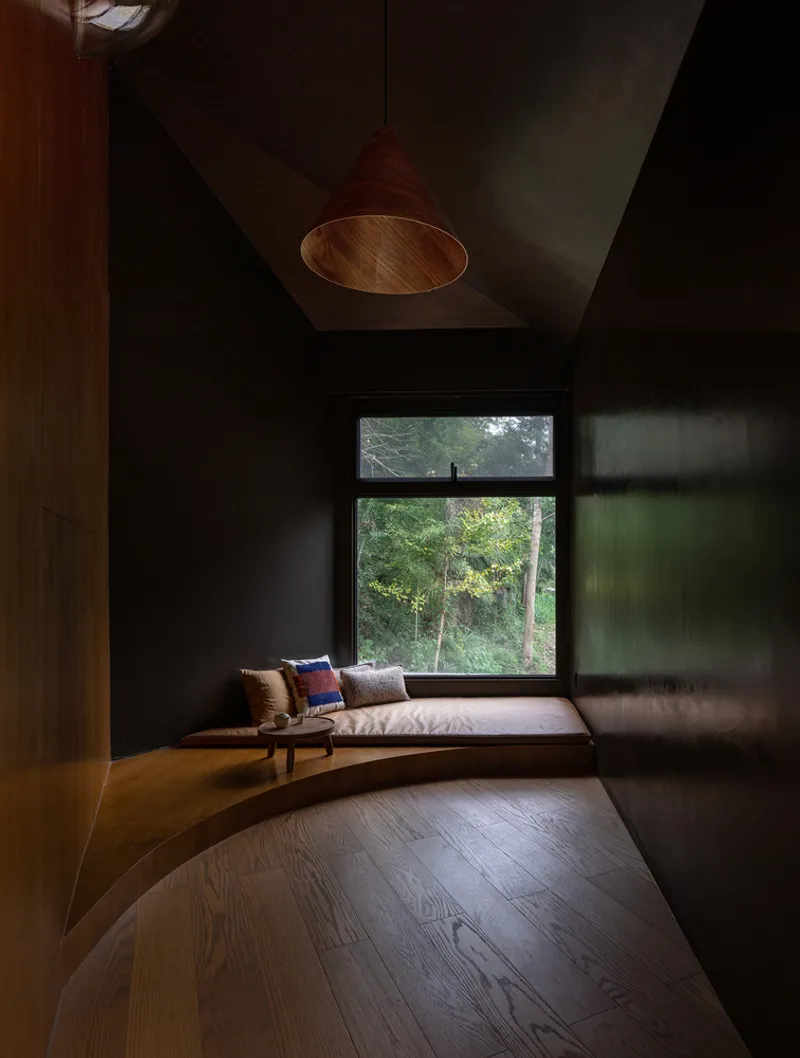
Guest rooms use horizontal ribbon windows to frame the hillside as a continuous band of green or gold depending on the season. The reading alcove, a cushioned bench beneath a low window, is the kind of detail that separates genuine hospitality architecture from mere accommodation. It is a space designed for a specific posture: reclined, quiet, looking outward. The exposed timber ceiling beams overhead are structural but also atmospheric, bringing the scale of the room down to something intimate.
Water as Connective Element
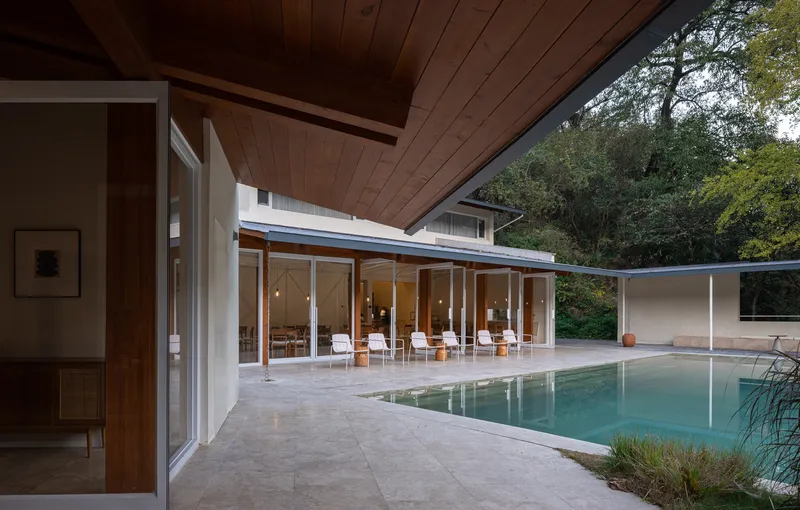
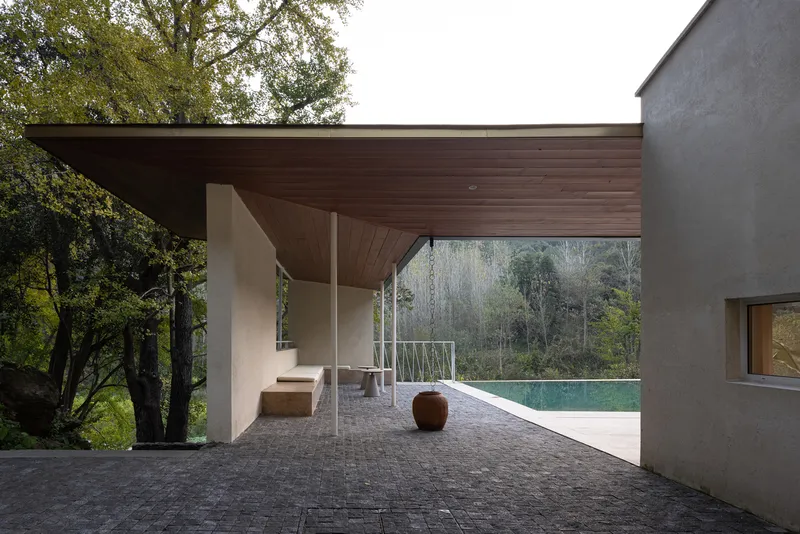
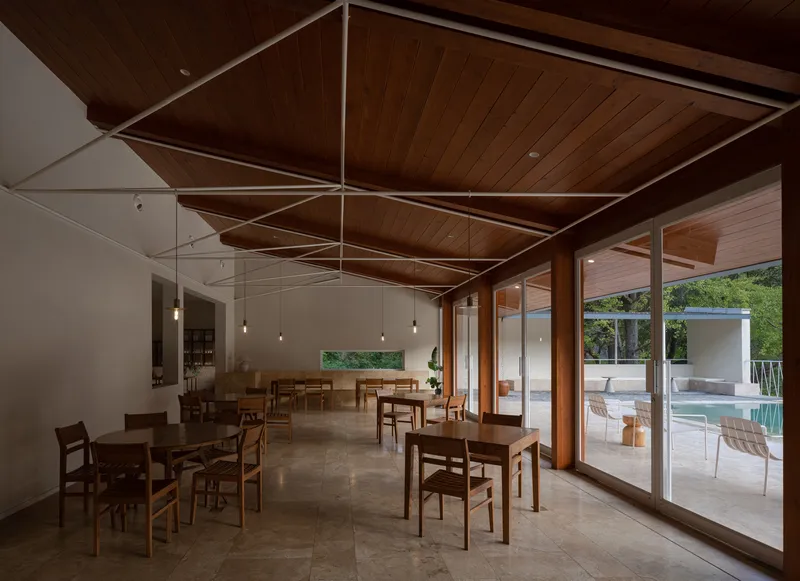
The infinity pool is the project's primary communal space, a mirror that bridges the mountain behind and the valley ahead. At dusk, the limestone paving and timber-ceilinged pavilion frame a scene that collapses the distance between architecture and horizon. The dining hall opens directly onto the pool terrace through full-height glazed doors, its exposed timber ceiling trusses continuing the structural rhythm of the outdoor pavilion. Water connects the program: the reception's central paddling pool, the infinity pool, the small pond near the treehouse, and ultimately the reservoir at the valley's southern end.
Thresholds and Passages
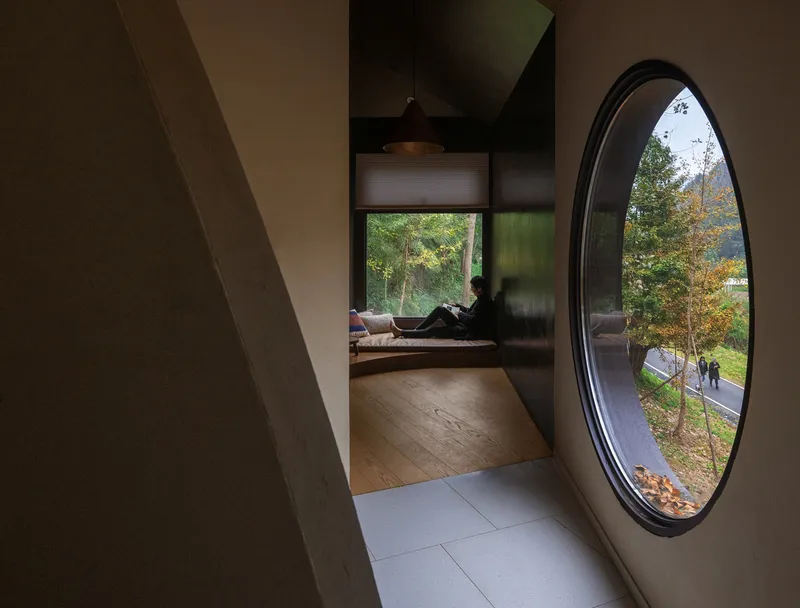
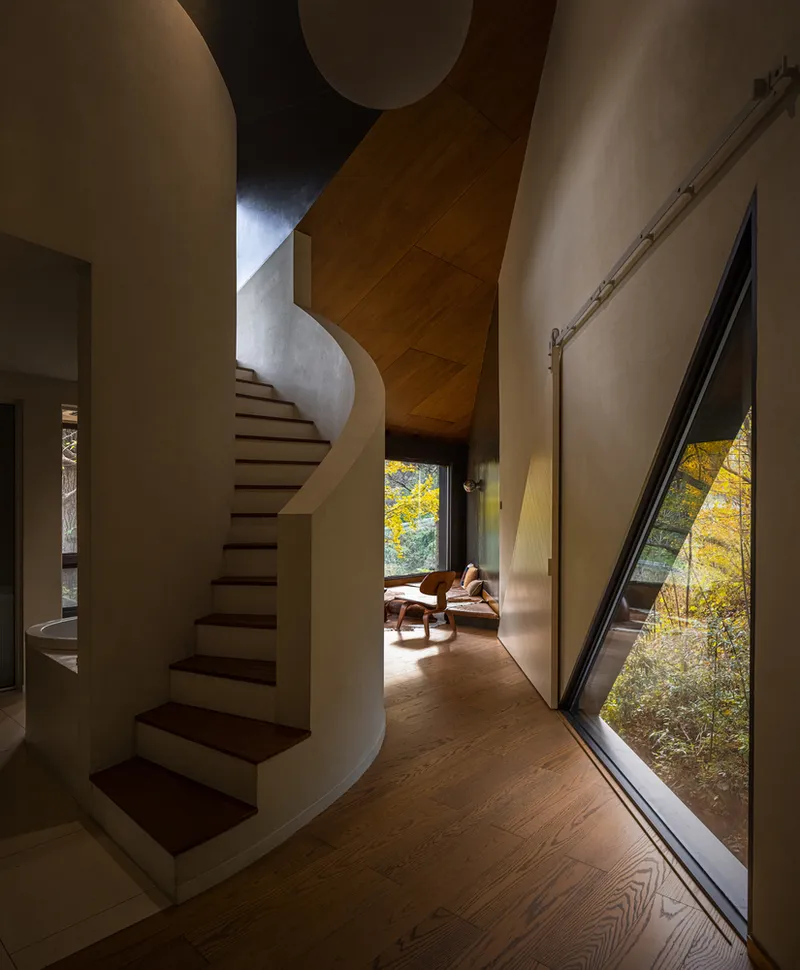
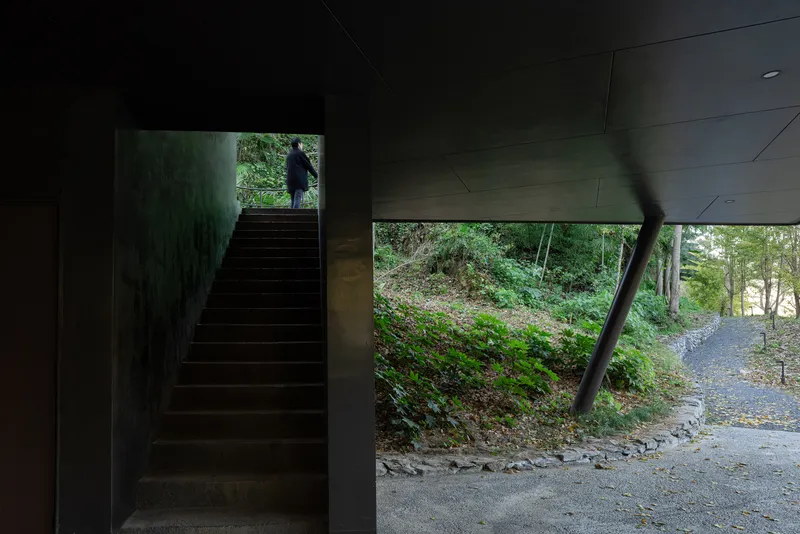
The circular window that frames autumn trees and passing figures is one of the project's signature moves: fenestration as curation. By replacing conventional windows with geometric openings, Moguang Studio turns each wall into a deliberate editorial decision about what you see and what remains hidden. The curved staircase beside an angled window overlooking foliage, the figure silhouetted at an upper landing, these transitional moments are treated with the same care as the main rooms. In a decentralized hotel, where guests move between buildings constantly, the quality of the journey between spaces matters as much as the destination.
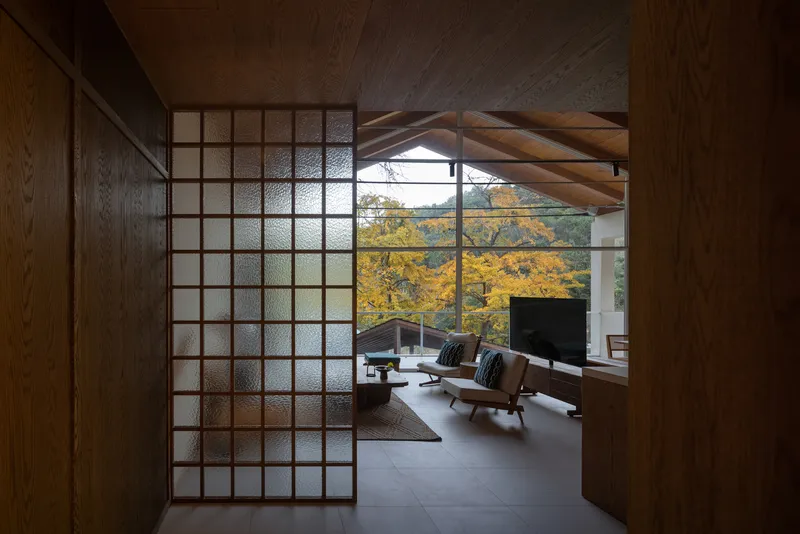
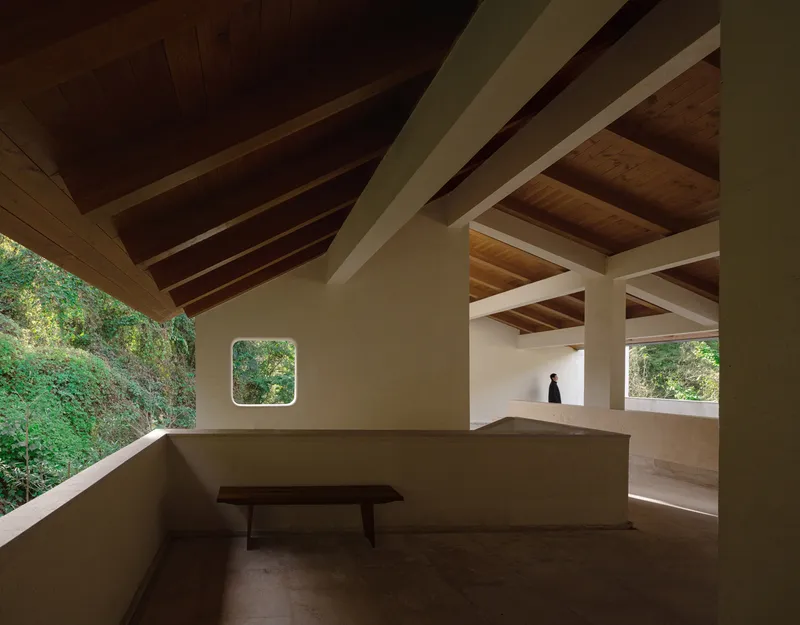
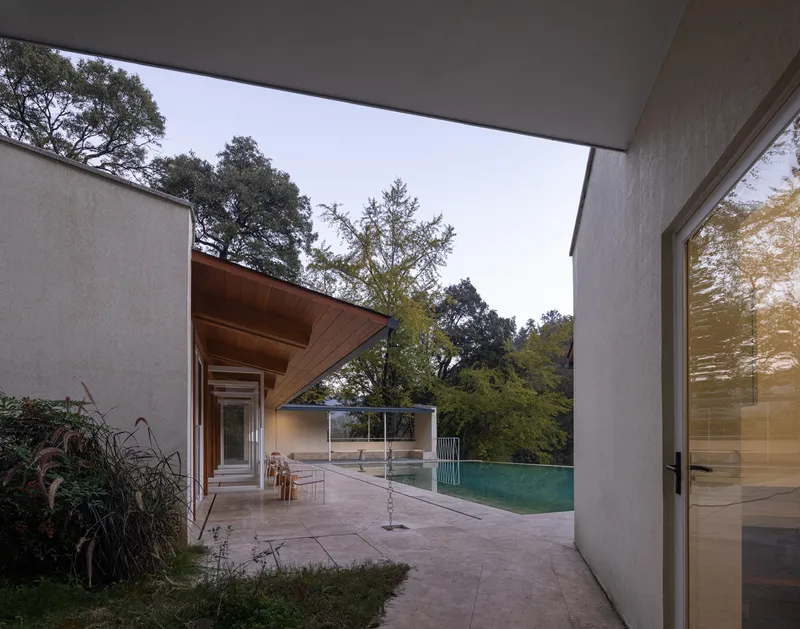
Translucent glass block sliding doors, covered walkways with timber soffits, open-air terraces with square oculus windows: the architects deploy a rich vocabulary of threshold conditions. Operable panels integrated within walls maintain the purity of the facade while allowing rooms to open up or close down in response to weather and mood. The covered walkways are never merely connective; each one frames a specific view, whether of the pool, the oak trees, or the slope beyond.
Plans and Drawings
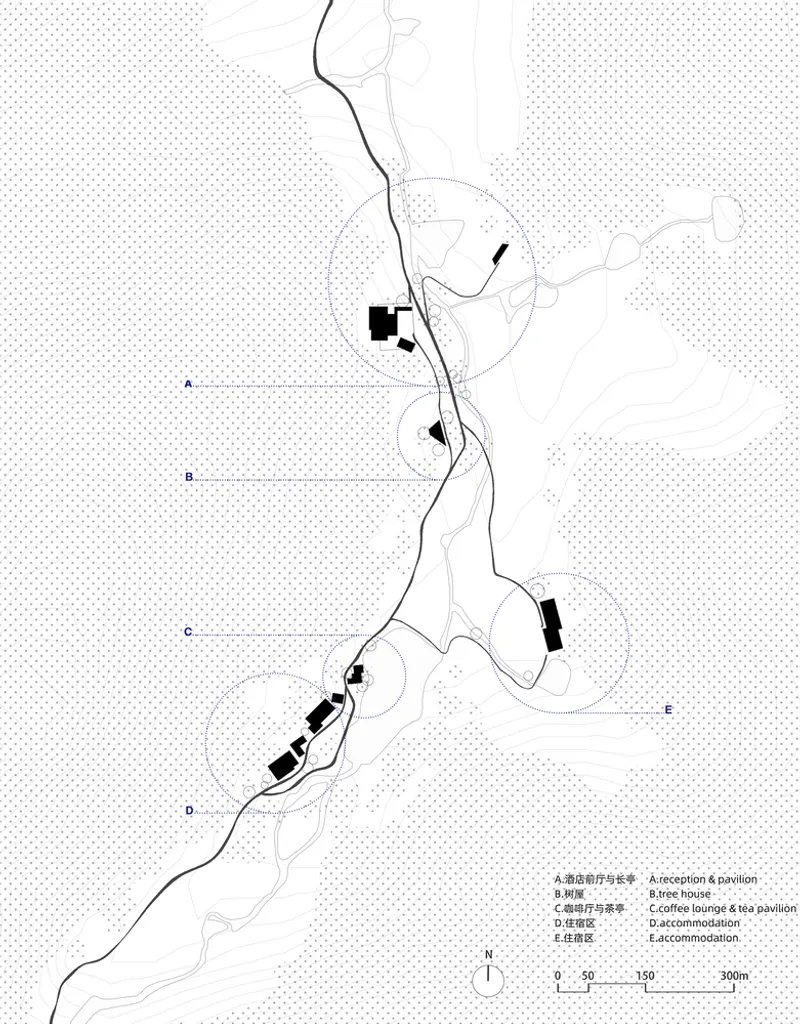
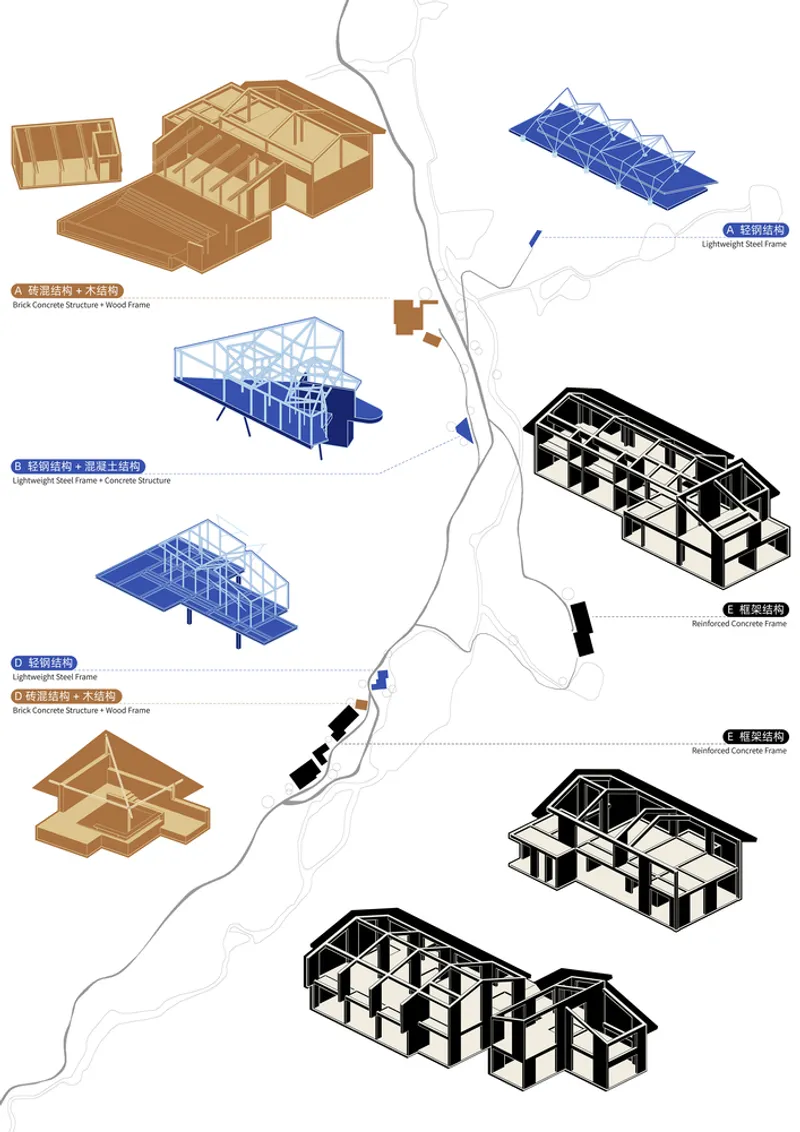
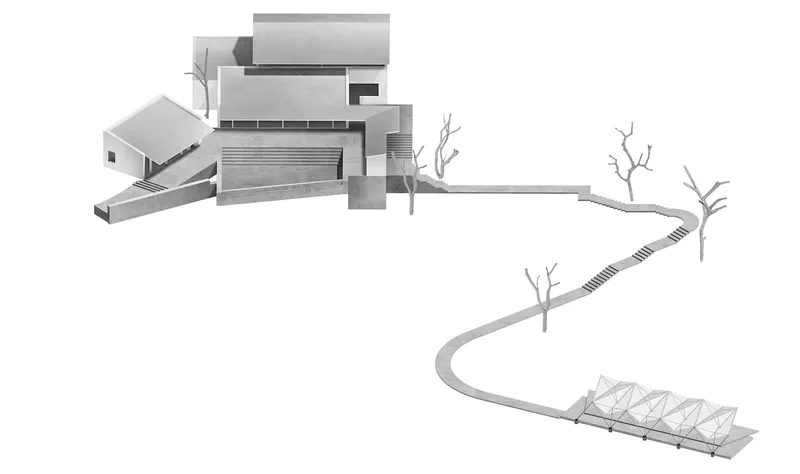
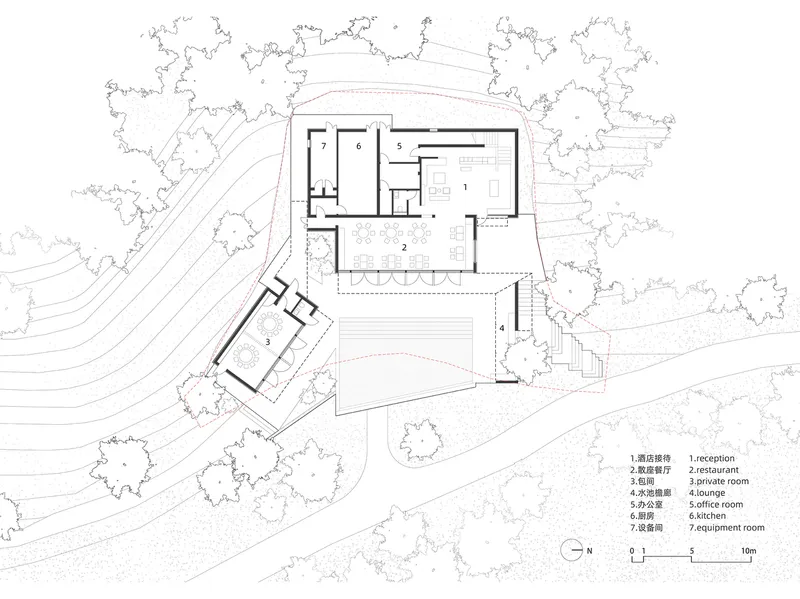
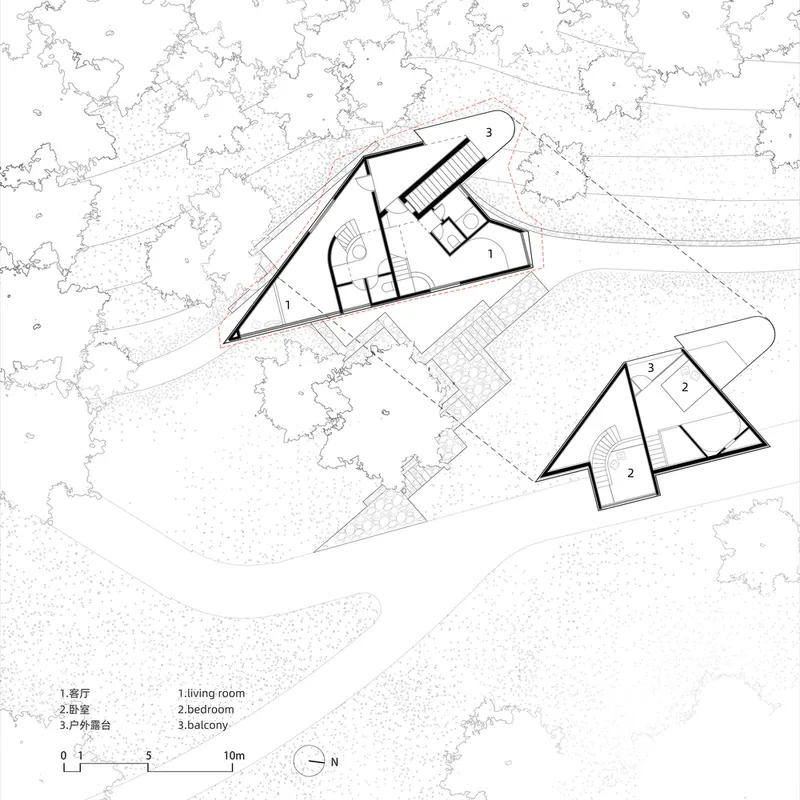
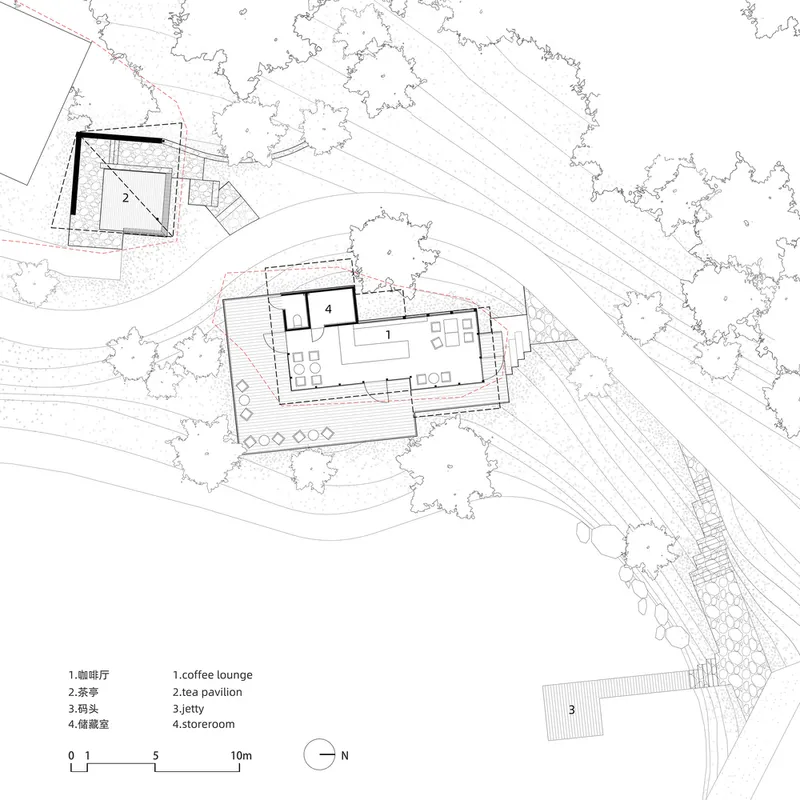
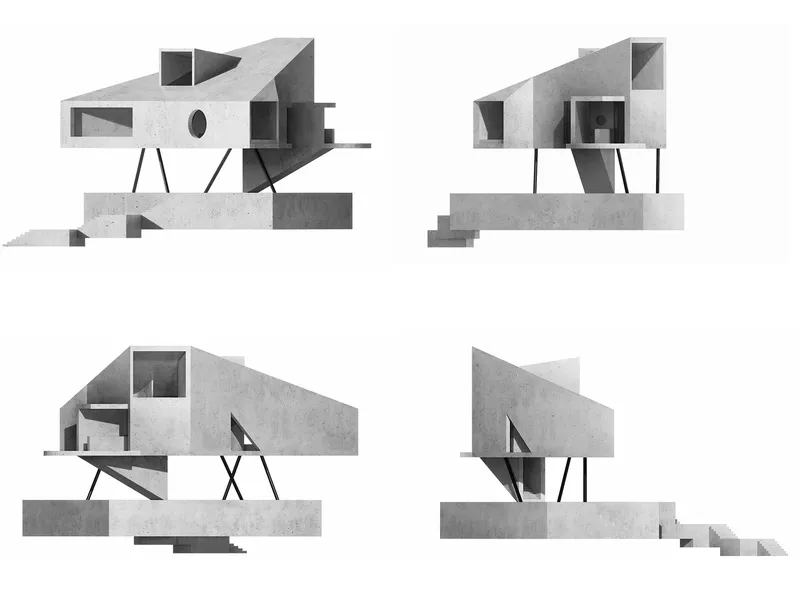
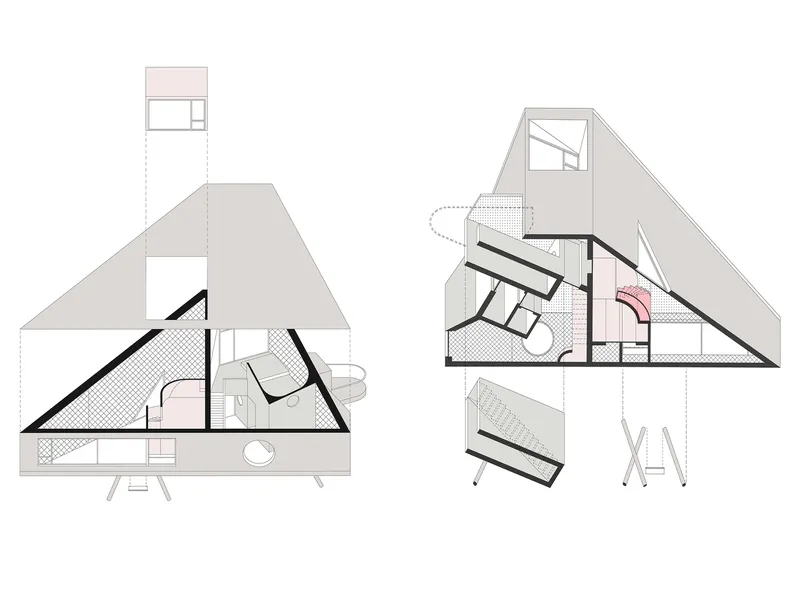
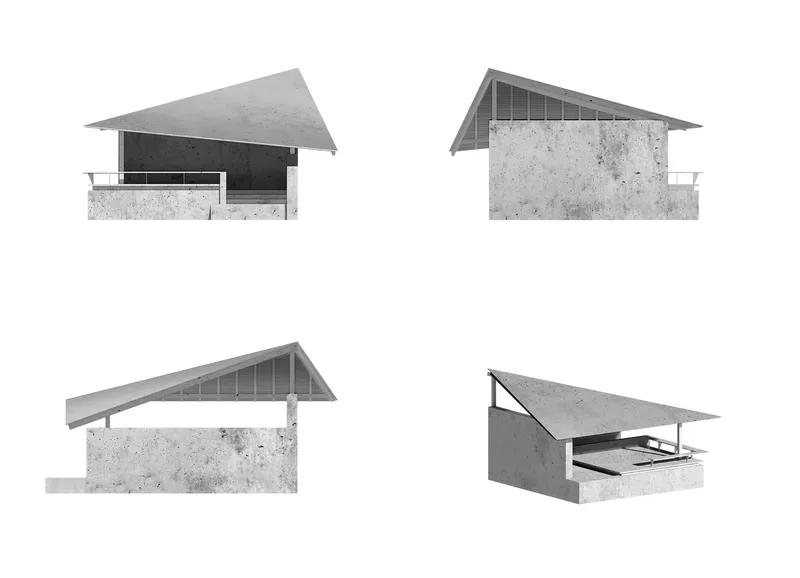
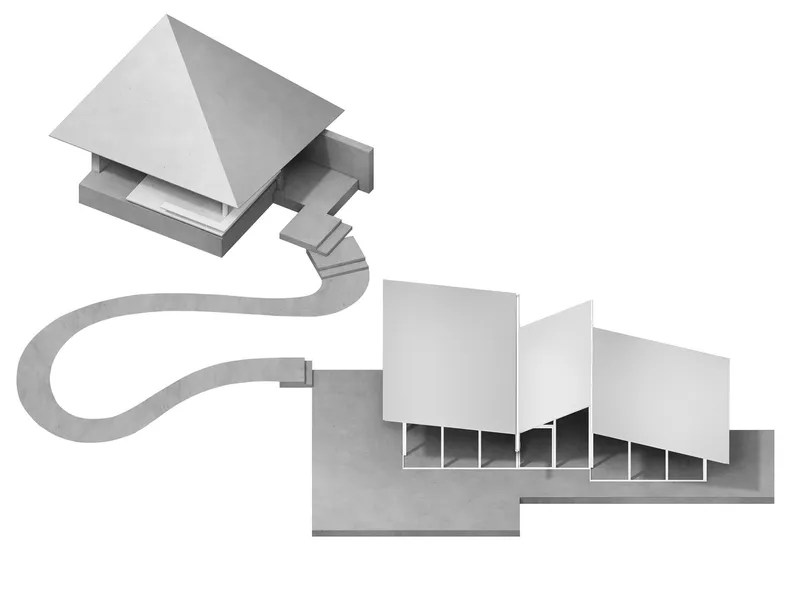
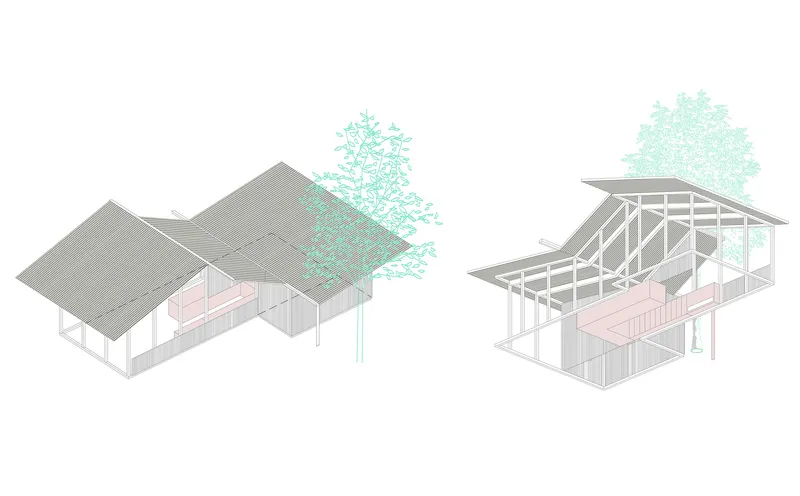
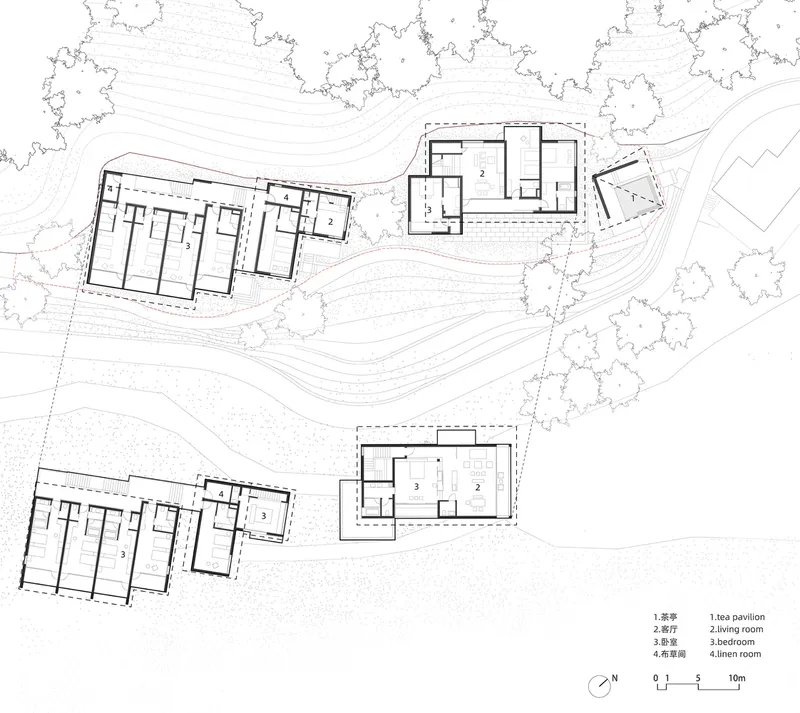
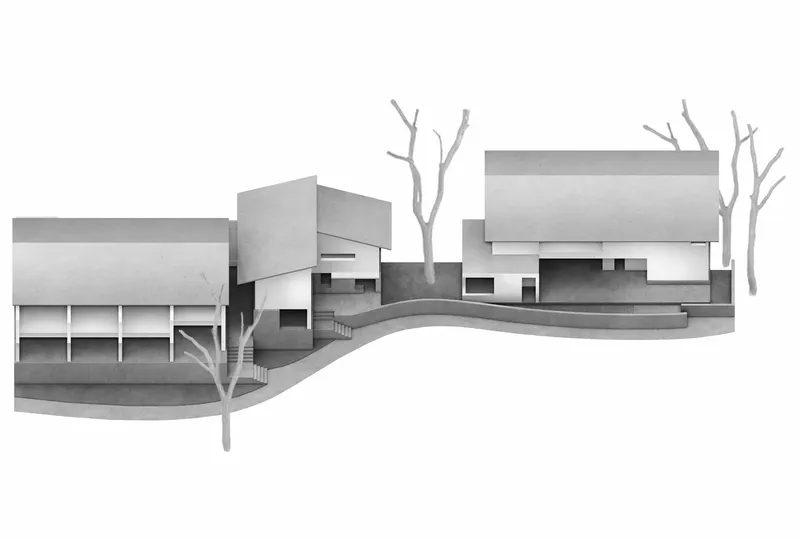
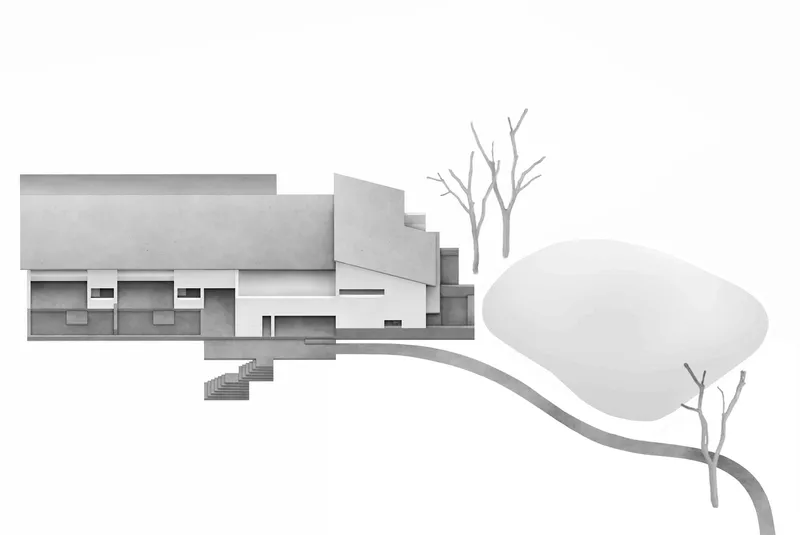
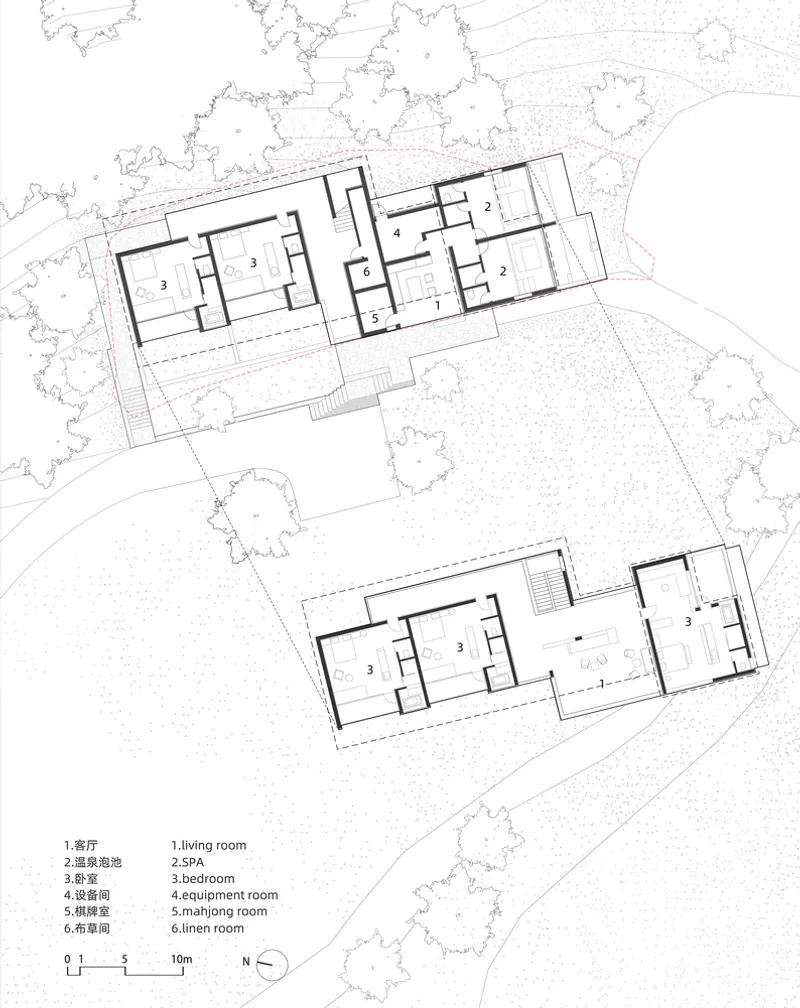
The site plan confirms what the photographs suggest: the buildings are distributed as clusters along a winding path that follows the topography rather than imposing a grid. Axonometric diagrams reveal the hybrid construction systems, concrete shear walls giving way to lightweight steel frames, and show how the pitched roof structures negotiate the existing trees. The floor plans of the reception area show angled wings surrounding the pool terrace, their geometry responding to contour lines rather than cardinal axes. Sections through the treehouse expose the relationship between the elevated living volumes and the open ground below, making explicit the decision to lift the architecture away from the root zone. Physical models, shown in elevation, capture the horizontal volumes and curved ground planes that define the project's relationship to the slope.
Why This Project Matters
China's rural tourism boom has produced a glut of boutique hotels that import urban aesthetics into the countryside, treating landscape as backdrop rather than collaborator. The Lost Villa · Ginkgo Valley Design Hotel takes the opposite approach. By working within the footprints of abandoned homesteads, preserving ancient trees, and sourcing materials locally, Moguang Studio demonstrates that "appropriate construction" is not a compromise but a design strategy capable of producing architecture with genuine specificity. The hotel could not exist anywhere else, and that is its greatest strength.
The decentralized plan is the key lesson here. Scattering the program across six plots forces the architecture to negotiate with the valley at every point rather than imposing a single formal gesture. It also transforms the act of moving between rooms, meals, and amenities into an architectural experience in its own right. The winding kilometer of road between the first building and the last is not dead space; it is the project. For designers working on hospitality in sensitive landscapes, this is a model worth examining closely: not a resort that happens to be in nature, but a piece of nature that happens to contain a hotel.
Lost Villa · Ginkgo Valley Design Hotel by Moguang Studio. Guangjia Chong, Jiukouyan Village, Luoyang Town, Suizhou City, Hubei Province, China. 2,500 m². Completed 2023. Photography by Shengliang Su.
About the Studio
Moguang Studio
Share Your Own Work on uni.xyz
If projects like this are the kind of work you want to make, uni.xyz is a place to publish your own, find collaborators, and enter design competitions.




Popular Articles
Popular articles from the community


Riyadh For All: Intergenerational Urban Design for Active Aging in Rabat
Riyadh For All reimagines urban design in Rabat with intergenerational co-living, adaptive courtyards, and Moroccan cultural exchange today.

The Musturak Paradise: Senior Living Architecture for a Connected Future in Temara, Morocco
The Musturak Paradise reimagines senior living architecture in Temara via private homes, social spaces, culture, community, and shared care.

The Ocean Hive: Sustainable Architecture for a Self-Sufficient Civilization at Sea
The Ocean Hive imagines sustainable architecture at sea, where modular habitats, algae, wave power and ocean waste sustain a growing colony.

Hill & Cross Opera: Sculptural Opera House Architecture Shaped by Tallinn’s Landscape and Identity
Hill & Cross Opera reimagines opera house architecture in Tallinn through its sculptural hill, civic plaza, glass wave and a luminous cross.


Similar Reads
You might also enjoy these articles

Bamboo Housing Challenge 2026: Design Affordable, Sustainable Homes Using Bamboo
An international design competition by Bamboo U and IBUKU inviting architects and designers to reimagine affordable housing using bamboo — with the winning design built full-scale in Bali.

Computational Design & Education: Beegraphy Design Awards Introduces 7th Category (Featuring Jiyun's Innovative Approach)
Dive into Beegraphy’s 7th Design Awards category, where computational design meets education to create immersive, interactive learning tools, inspired by Jiyun’s work.

From Parametric Lighting to Urban Furniture: Join the 2nd Workshop in Beegraphy’s Computational Design Series
Dive into Cutting-Edge Design Techniques and Practical Applications with Industry Experts

Last Call: Unleash Your Architectural Genius in SHAK's Kindergarten Design Competition
Urgent call for architects to join SHAK's kindergarten design competition before the looming deadline


Explore Hospitality Building Competitions
Discover active competitions in this discipline



Challenge to reimagine the Iron Throne


Photograph architecture without architects


Illustrate the lost glory of Angkor Wat - Render Challenge


Design challenge to reuse E-waste
Comments (0)
Please login or sign up to add comments
No comments yet. Be the first to comment!