
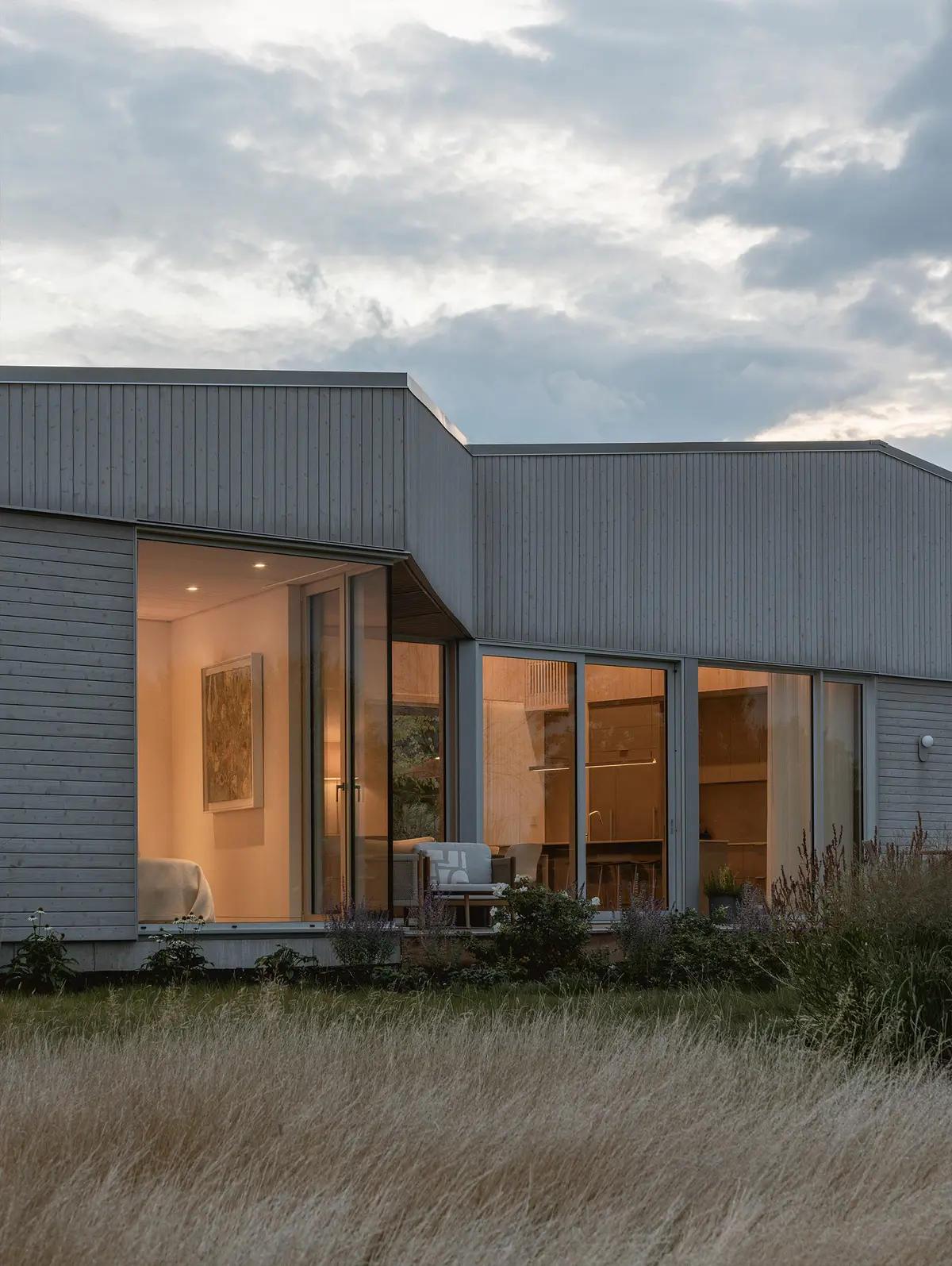
NatureHumaine Splits a Country Retreat into Two Gabled Volumes on a Quebec Meadow
Le Fenil Residence in Memphrémagog anchors itself to the rolling landscape with offset barn forms and floor-to-ceiling glass.


There is a particular kind of quiet that belongs to the Eastern Townships of Quebec, where rolling pastures give way to forested ridges and the light shifts dramatically between seasons. Le Fenil Residence, designed by NatureHumaine and completed in 2024, sits in this landscape not as an intrusion but as a calibrated response to it. The house takes the form of two gabled volumes, offset and rotated to create a composition that reads differently from every angle across the open meadow.
What makes Le Fenil genuinely interesting is the discipline with which the architects balanced openness and enclosure. The house is almost entirely glazed at ground level, dissolving the boundary between interior and field, while the metal-clad upper volumes remain opaque and protective. The result is a building that feels both exposed and sheltered, public and private, depending on where you stand inside it. It is a farmhouse archetype taken apart and reassembled with surgical precision.
Two Barns, One Gesture
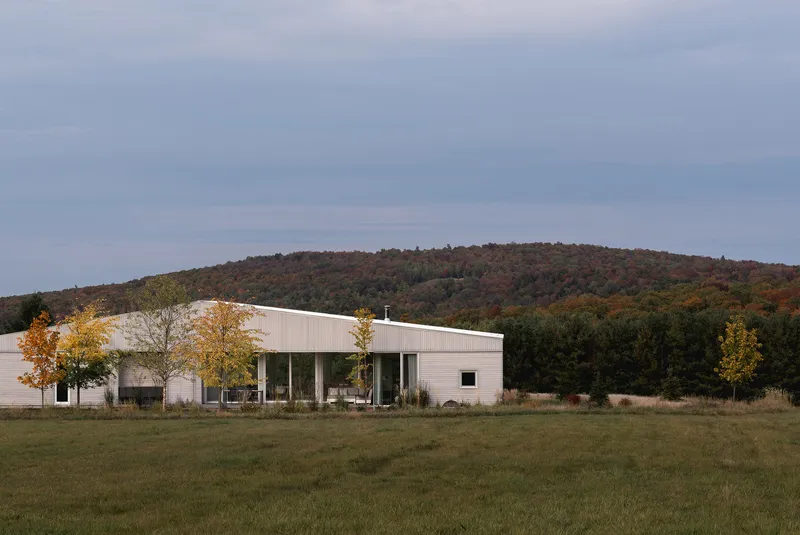
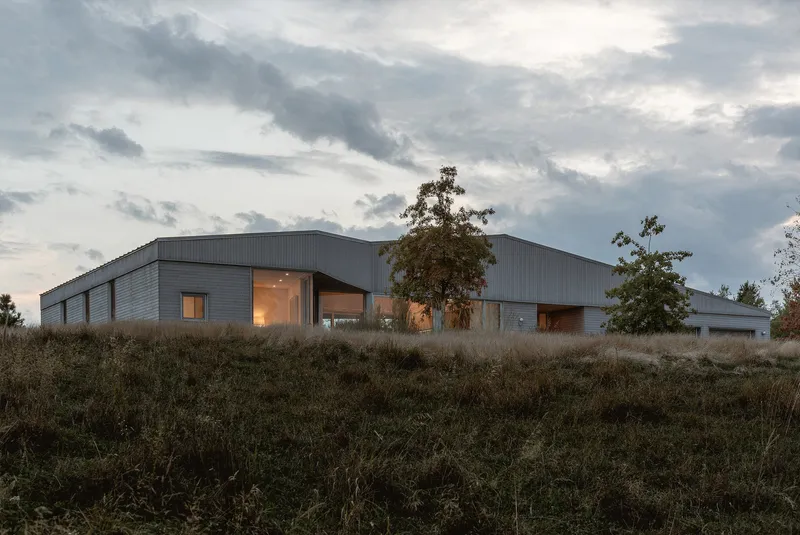
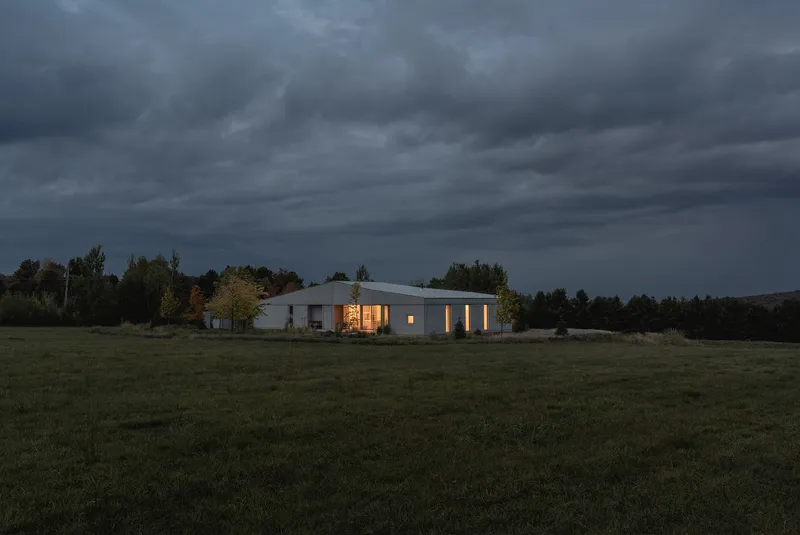
From a distance, Le Fenil reads as a pair of elongated barns placed at a gentle angle to one another. The white metal cladding catches the light differently on each face, and the gap between the two volumes creates a visual break that prevents the house from overwhelming the meadow. At dusk, the glazed ground floor turns the building into a lantern, and the storm clouds that roll over the Memphrémagog hills only intensify the drama.
The offset placement is more than aesthetic. It generates distinct orientations for different parts of the program, allowing the living spaces and bedrooms to address separate views while sharing a common landscape. The composition avoids the monotony that a single long bar would produce and instead offers the kind of articulated silhouette that recalls agricultural outbuildings grouped over time.
Cladding and Materiality
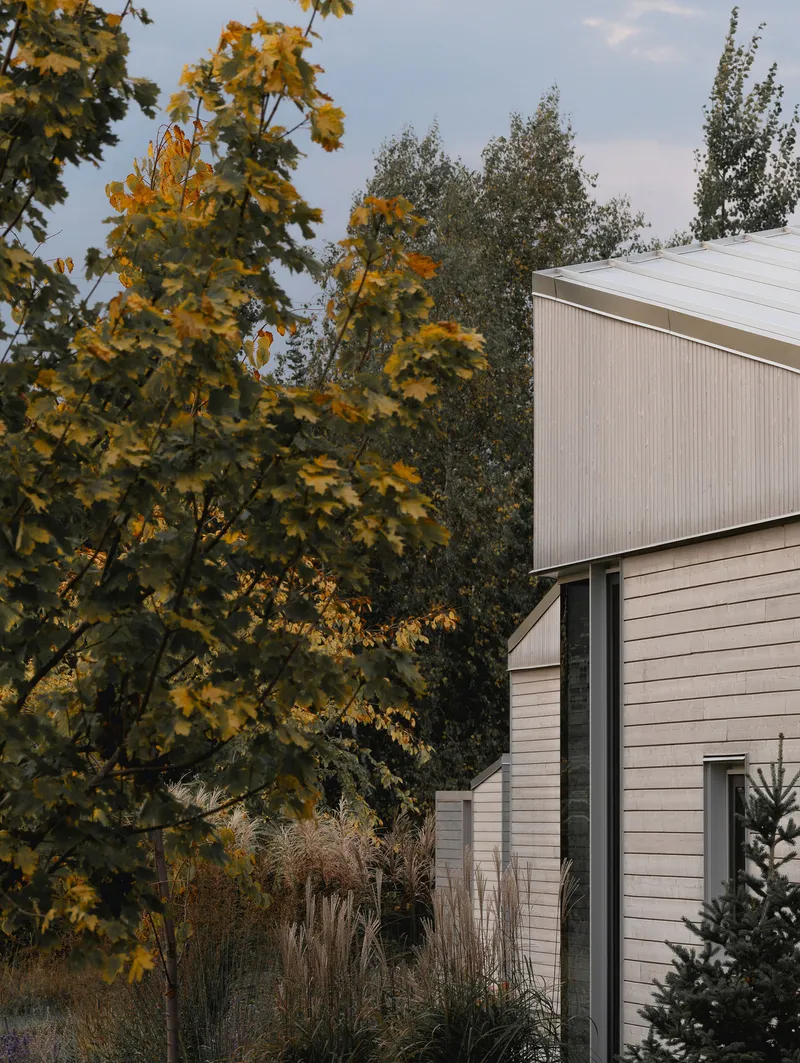
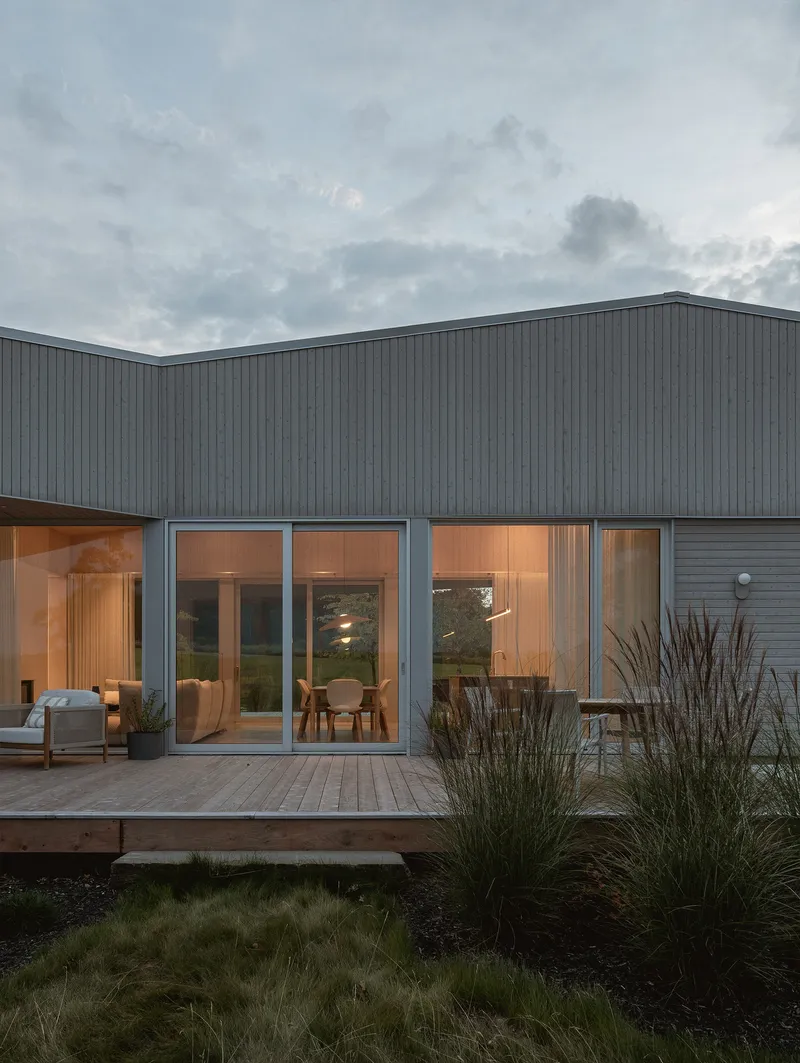
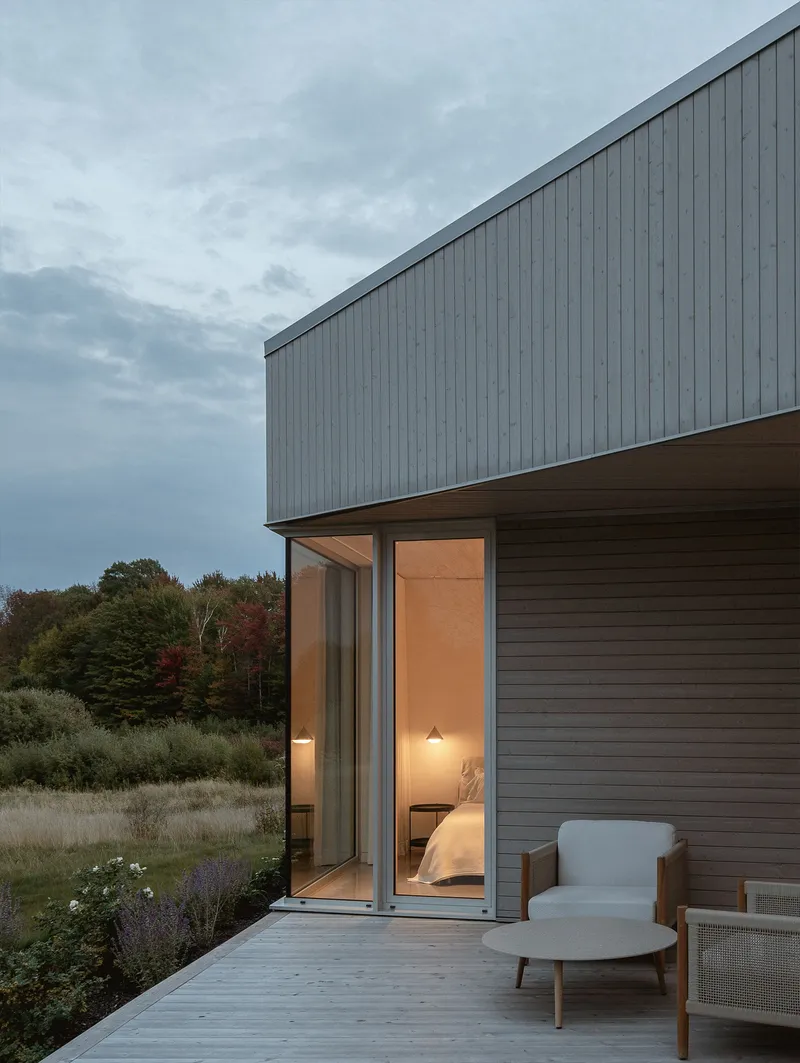
Up close, the material strategy reveals its logic. The upper portions of the volumes are wrapped in ribbed metal siding, oriented vertically, which lends them a taut, slightly industrial character that nods to the region's agricultural vernacular. Below, timber decking and concrete terraces ground the house physically and texturally. The vertical ribs create subtle shadow lines that shift throughout the day, giving the facades a life that flat panels would not.
At the corners, NatureHumaine plays a clever game: the upper volume cantilevers over recessed glazing, creating deep overhangs that shade the glass while reinforcing the sense that the roof is floating above the landscape. Native grasses grow right up to the edge of the timber decks, softening the transition between building and ground.
Living Under Timber
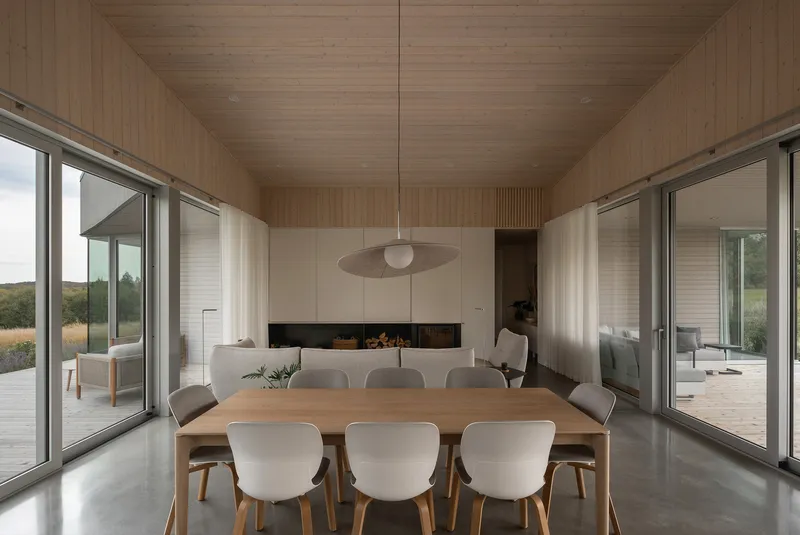
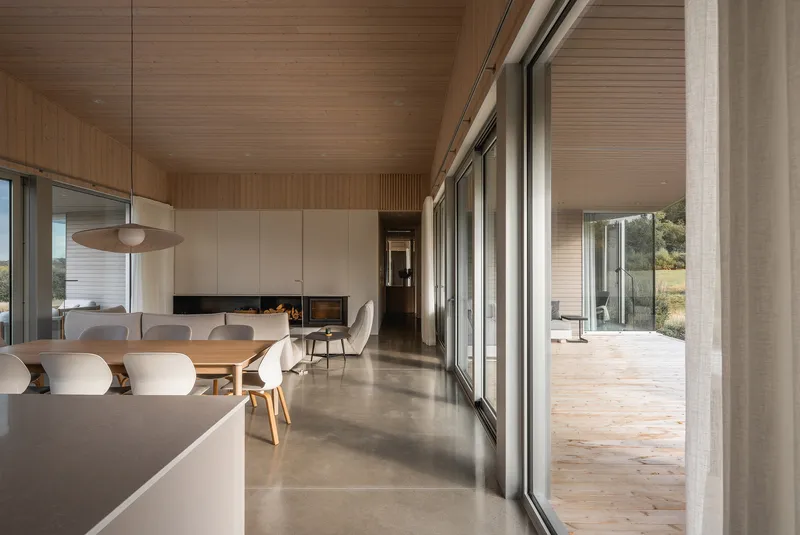
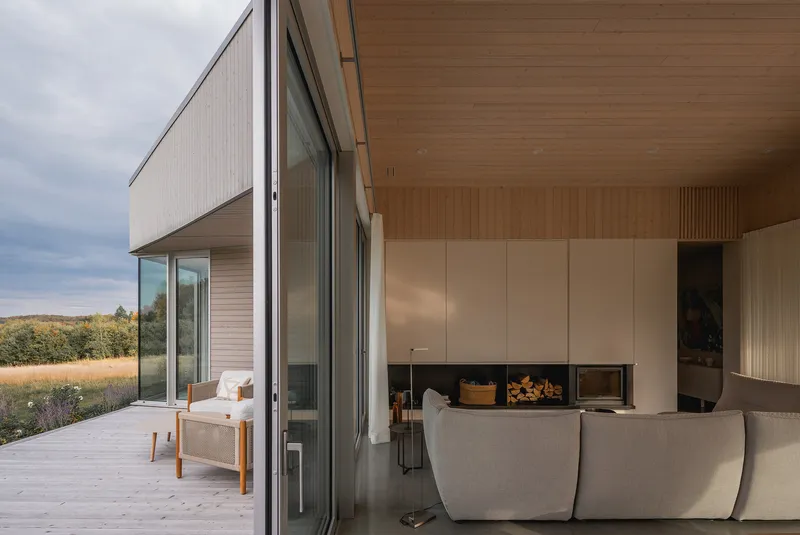
Inside, the ceiling becomes the dominant element. Timber boards line the underside of the gabled roof, wrapping the living spaces in a warm, continuous surface that contrasts with the polished concrete floors below. The dining area sits at the building's most permeable point, flanked by full-height sliding glass doors on both sides, creating a through-view from terrace to terrace. When the doors are open, the room effectively becomes an elevated porch.
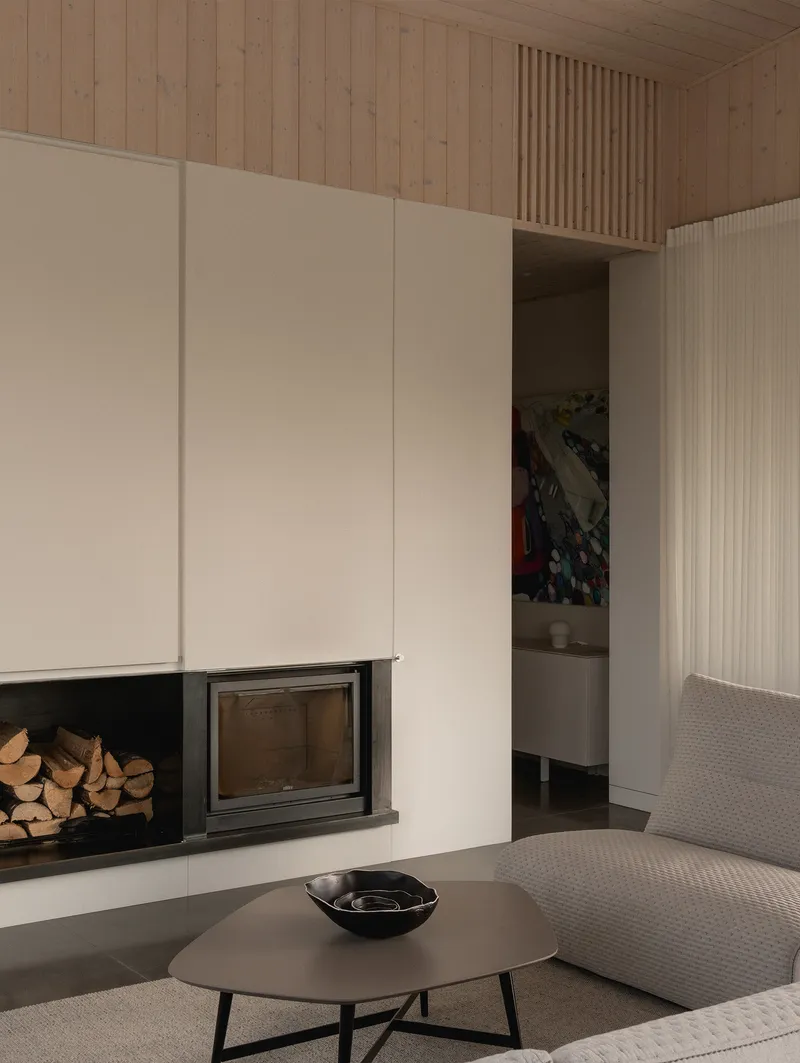
The fireplace wall, finished in pale stone, anchors the living room with a material that feels heavier and more permanent than the timber overhead. A generous firewood niche beneath the hearth turns fuel storage into a design element, and the proportions are generous enough to avoid preciousness. This is a room built for long winters.
Thresholds Between Inside and Out
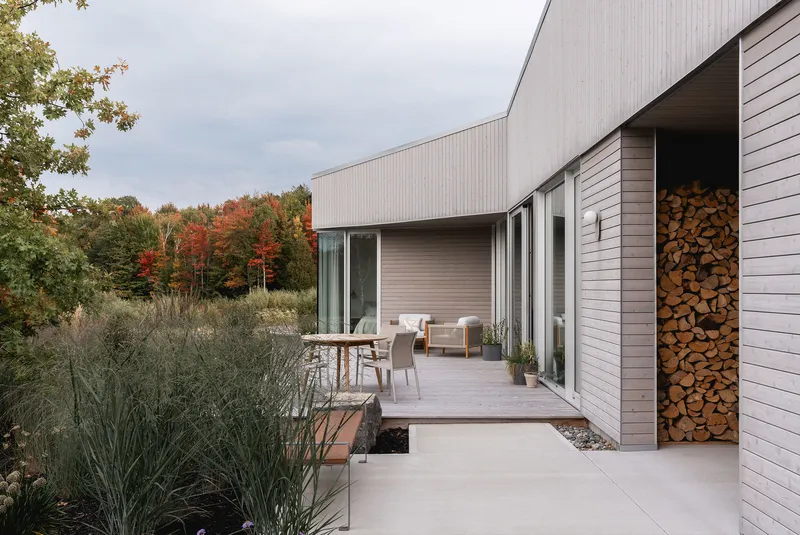
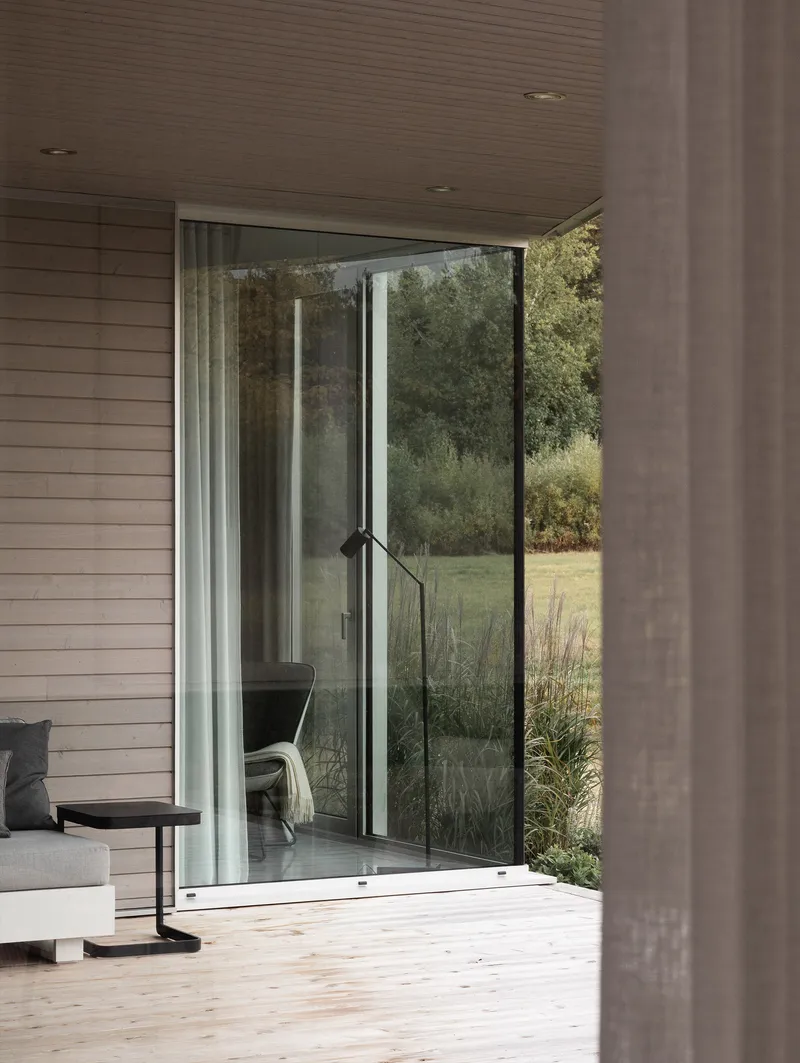
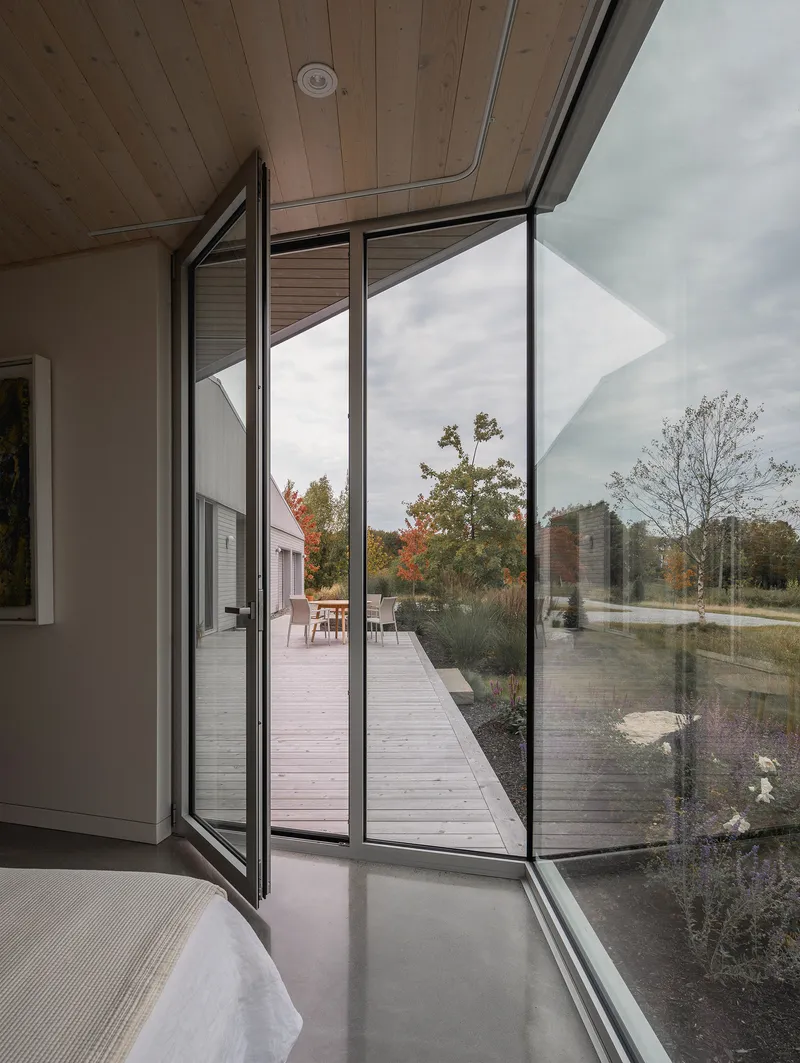
NatureHumaine treats every exterior connection as a threshold worth designing. The concrete terrace with its stacked firewood niche is a functional detail elevated to an architectural moment. Sliding glass panels retract fully to merge the interior with the deck, and the timber surfaces extend from inside to outside without a change in level or material. A pivoting glass door in the bedroom opens onto a private deck framed by autumn foliage, creating an intimate connection to the landscape that the larger living room glazing cannot replicate.
These moments accumulate. The house does not offer a single grand panorama but rather a sequence of framed views, each calibrated to its room's purpose. The kitchen looks toward a distant wooded hillside through a narrow vertical opening. The bedroom frames a solitary tree. The effect is cinematic, each room a different shot of the same landscape.
Private Quarters and Considered Details
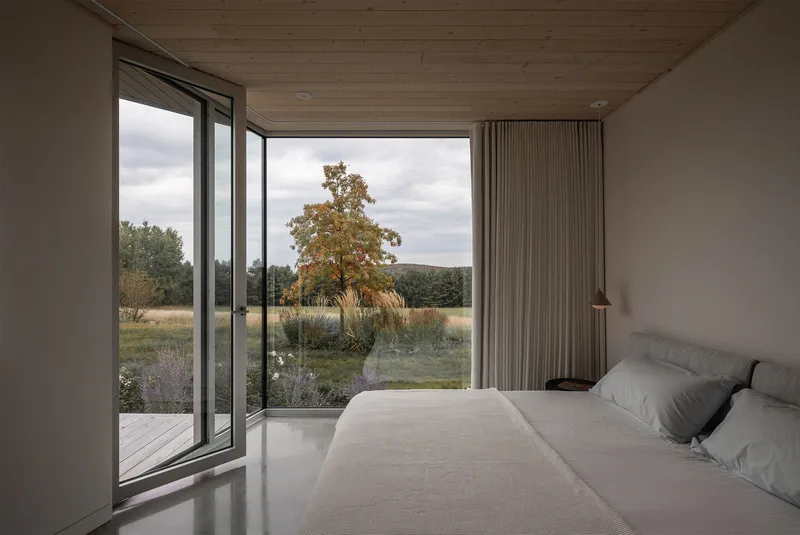
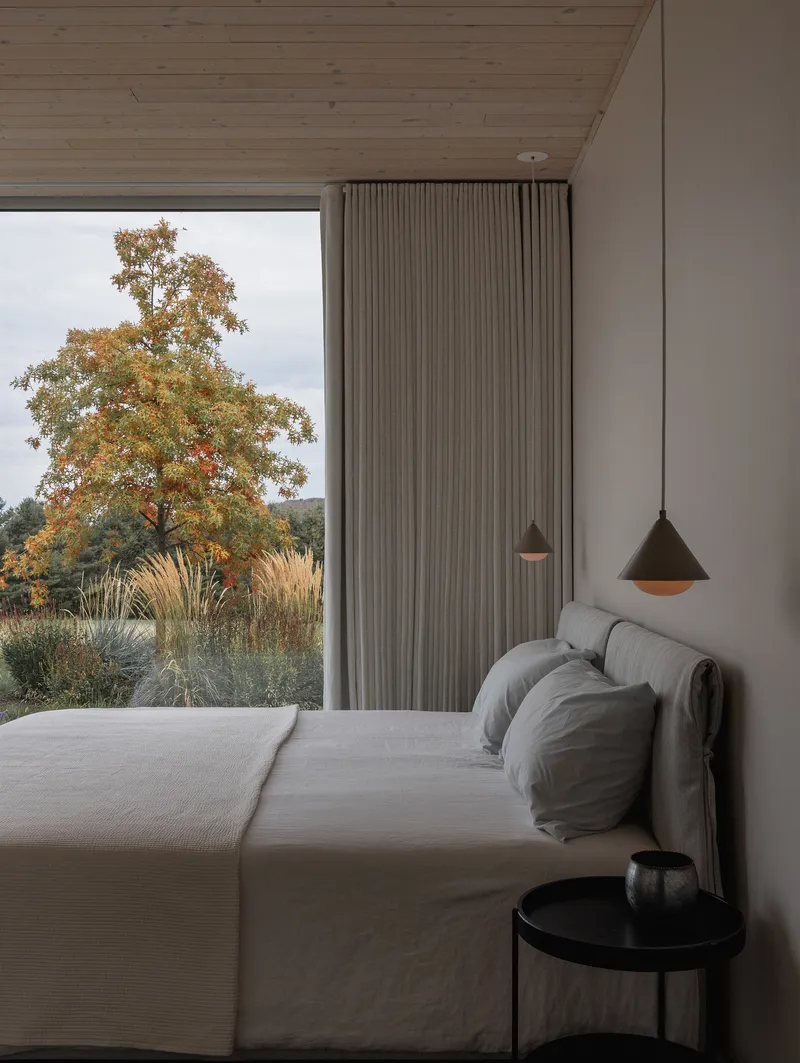
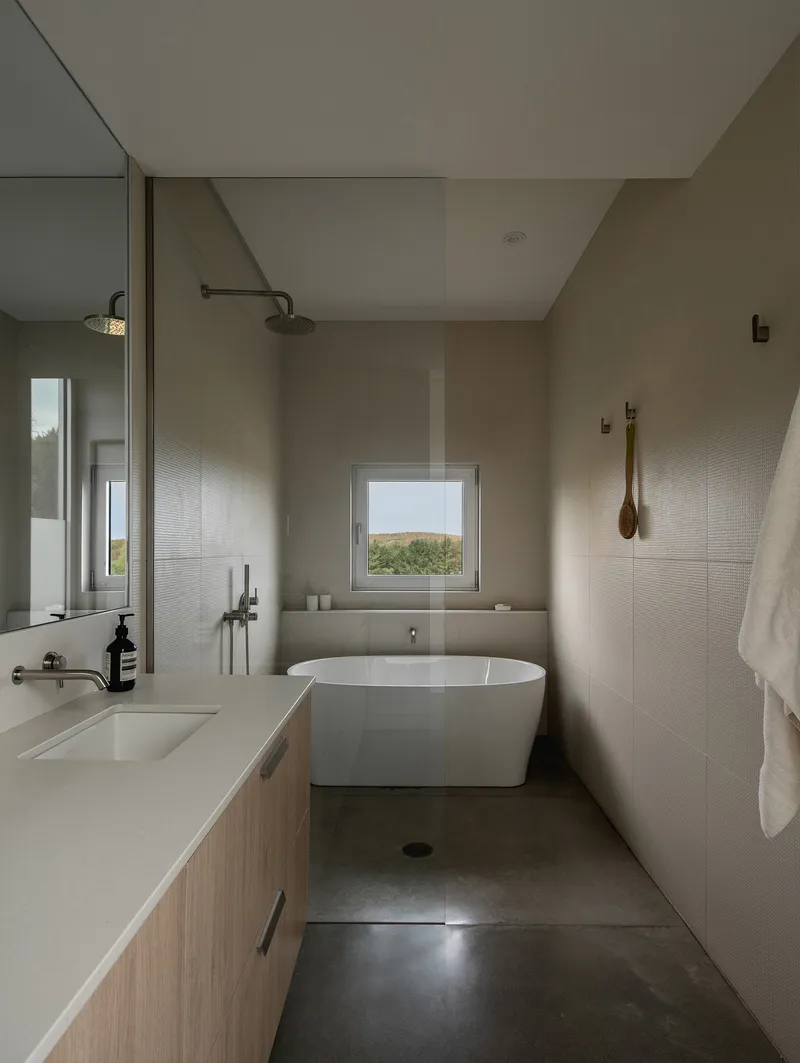
The bedrooms are restrained. Pleated curtain panels filter the view when privacy is needed, transforming full-height glazing into a soft, diffused screen. Pendant lights hang low beside the bed, and the material palette narrows to timber, glass, and fabric. The bathroom continues this restraint: a freestanding tub sits beneath a landscape window, and the glass shower enclosure is detailed simply enough to avoid competing with the view.
There is a deliberate quietness to these rooms. Where the living spaces perform, the bedrooms withdraw. The architects resist the temptation to make every room spectacular and instead let the meadow do the work.
The Kitchen as a Lookout
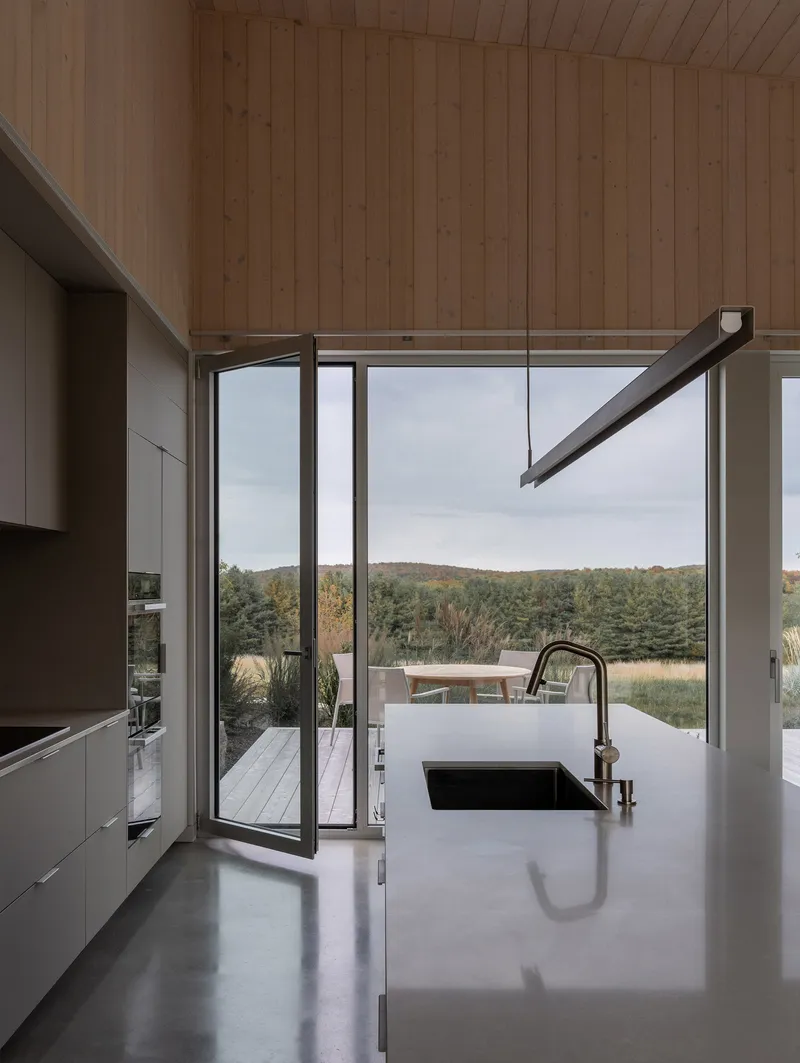
The kitchen island faces a narrow glass door that opens onto the distant hillside, and the composition is deliberately tight. Rather than a panoramic window wall, the view is compressed into a vertical slot that gives the cook a focused connection to the landscape. The island itself is practical, with an integral sink oriented toward the view, and the surrounding surfaces are clean enough to let the timber ceiling remain the dominant interior element.
Plans and Drawings
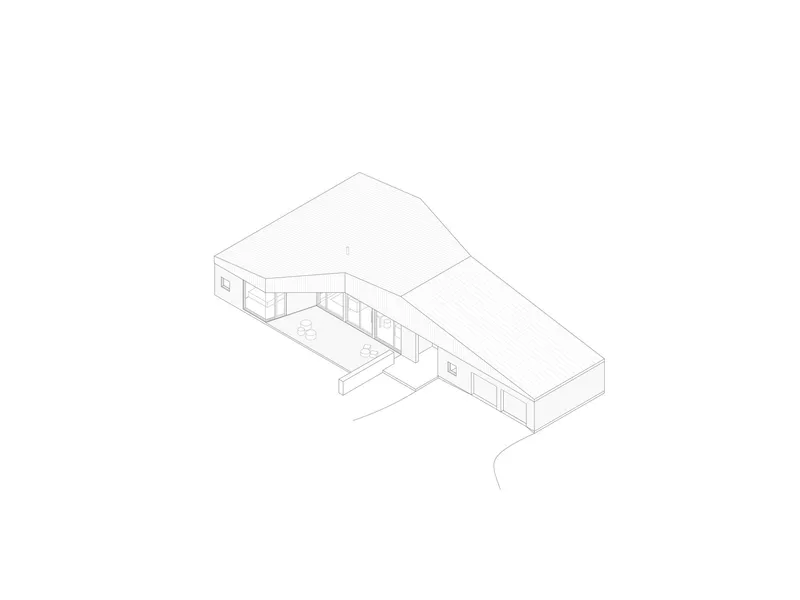
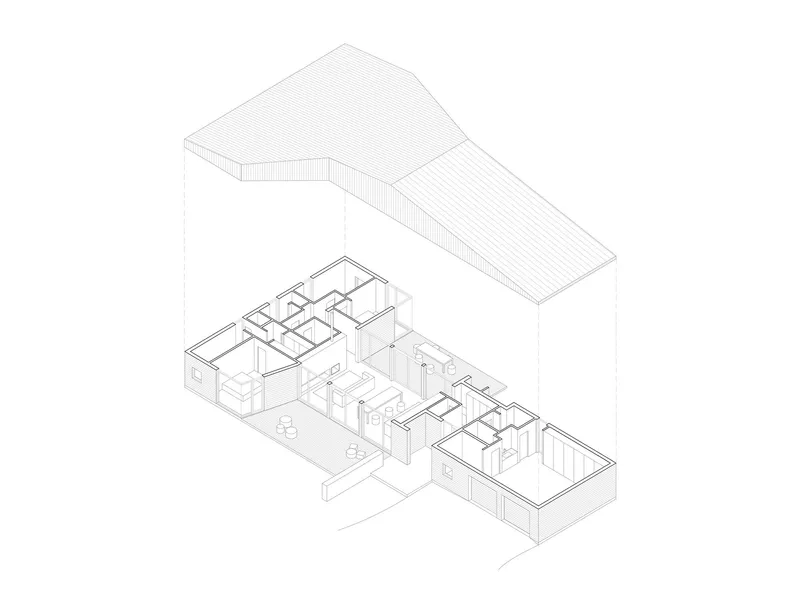
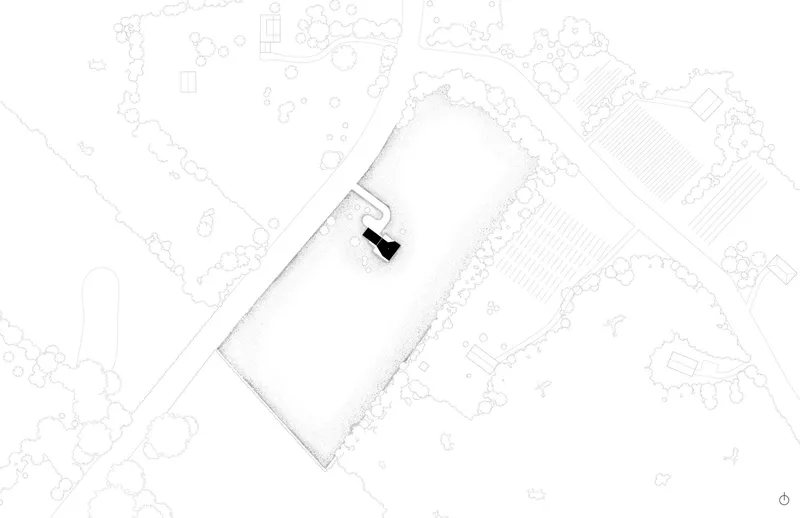
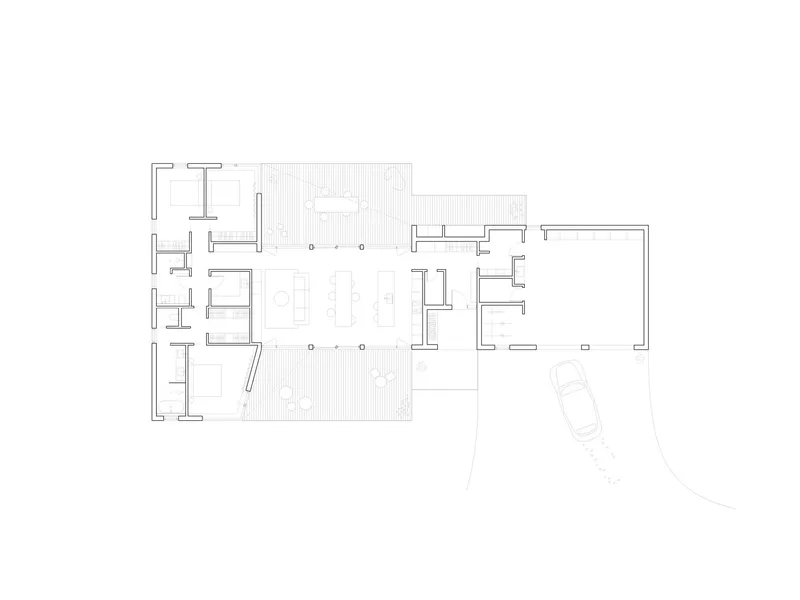
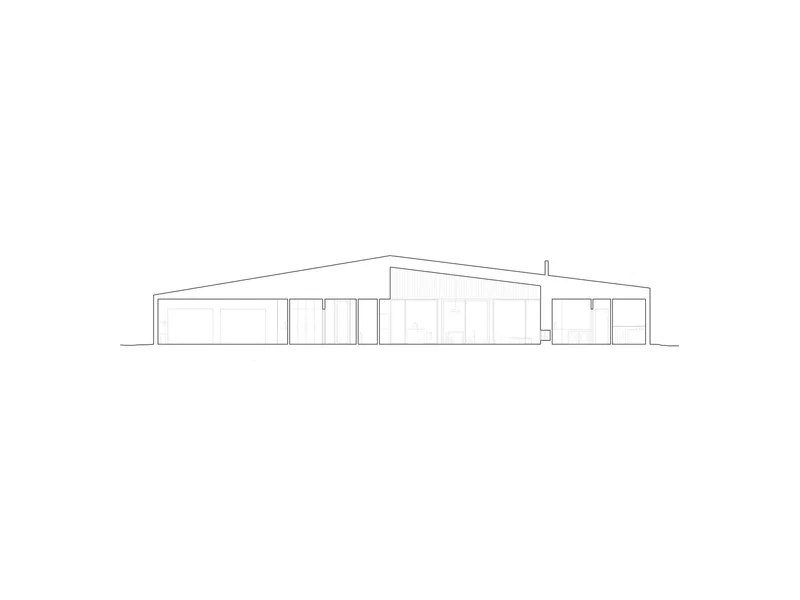
The axonometric drawings reveal the structural logic clearly: two gabled volumes connected by a linking element, with the roof assembly lifted to show how rooms are distributed along a central corridor. A carport anchors one end of the plan. The site drawing confirms what the photographs suggest, that the building's L-shaped footprint creates a sheltered exterior zone while addressing the surrounding topography with minimal grading.
The floor plan is straightforward. Living spaces occupy the larger volume, bedrooms the smaller, and the corridor between them acts as a spine that organizes circulation without wasting space. The elevation drawing shows just how low the house sits in the landscape, with varied rooflines that break the profile into segments that relate to the scale of the surrounding trees rather than competing with the hills beyond.
Why This Project Matters
Le Fenil Residence succeeds because it does not romanticize rural life or treat the countryside as a blank canvas for formal experimentation. The house borrows its proportions and silhouette from the agricultural buildings that have shaped this landscape for generations, but it reinterprets them with contemporary precision. The offset volumes, the dissolution of the ground floor into glass, the careful framing of views: these are architectural moves, not decorative ones, and they serve the daily experience of living in a place where weather, light, and season are always present.
NatureHumaine has built a growing body of work that takes the Canadian landscape seriously without defaulting to log-cabin nostalgia or minimalist abstraction. Le Fenil sits comfortably in that lineage. It is a house that knows where it is, and that knowledge informs every decision from the macro scale of siting down to the position of a pendant light beside a bed. In a market saturated with countryside retreats that photograph well but live poorly, this one appears to do both.
Le Fenil Residence by NatureHumaine, Memphrémagog Regional County Municipality, Canada. Completed 2024. Photography by Raphaël Thibodeau.
About the Studio
Share Your Own Work on uni.xyz
If projects like this are the kind of work you want to make, uni.xyz is a place to publish your own, find collaborators, and enter design competitions.


Popular Articles
Popular articles from the community


The Musturak Paradise: Senior Living Architecture for a Connected Future in Temara, Morocco
The Musturak Paradise reimagines senior living architecture in Temara via private homes, social spaces, culture, community, and shared care.

Lunar Spiral: Space Architecture Shaped by the Mathematics of the Universe
Lunar Spiral reimagines space architecture through Fibonacci geometry, lunar regolith, levitating habitats, and self-sustaining Moon living.

Conexión: Biophilic Design Reimagines High-Rise Living in Hong Kong
Conexión reimagines high-rise living in Hong Kong through biophilic design, green facades, shared spaces, daylight, water and nature within.

Co-life: Sustainable Architecture for Age-Friendly Community Living
Co-life reimagines sustainable architecture for seniors through courtyards, rammed earth, shared gardens, and spaces designed for belonging.

Similar Reads
You might also enjoy these articles

Bao Huynh Watercolor Atelier: A Serene Art Retreat in Hội An
Bao Huynh Watercolor Atelier in Hội An blends multifunctional art spaces, sustainable design, local materials, and family-friendly living in a serene environment.

Atelier Macri Concept Store Interior Design by CASE-REAL
Atelier Macri store features a "ko" counter, walnut wood details, cork displays, blending retail, gallery, and seamless customer experiences.

Manuel Vargas Izquierdo Stadium and High-Performance Sports Center: Architectural Excellence in Jalpa de Méndez
The Manuel Vargas Izquierdo Stadium blends sustainable design, inclusive sports facilities, and cultural-inspired architecture, revitalizing Jalpa de Méndez’s public spaces.

KAKR Buluh Awar Hall: Revitalizing Community and Ecology Through Bamboo Architecture
Community built bamboo hall revitalizes Buluh Awar village, empowering youth, restoring ecology, celebrating vernacular craftsmanship through sustainable architecture and culture.


Comments (0)
Please login or sign up to add comments
No comments yet. Be the first to comment!