
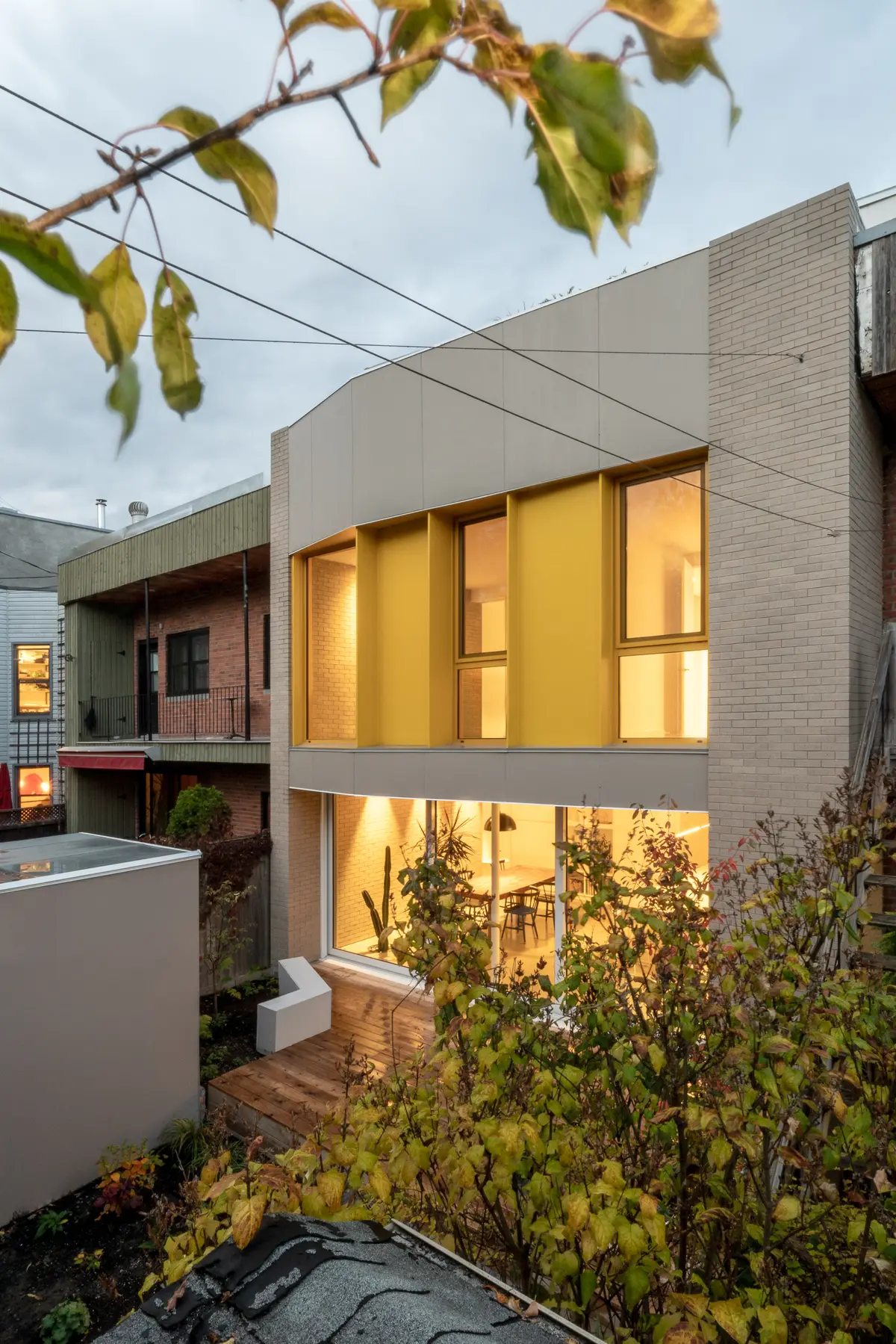
NatureHumaine Wraps a Montréal Family Home in Yellow Accents and Double-Height Light
La Radieuse Residence reimagines a Plateau Mont-Royal semi-detached house as a three-level cocoon of warmth and color.


Plateau Mont-Royal is one of Montréal's densest residential neighborhoods, a place where semi-detached houses sit shoulder to shoulder and backyards open onto shared green alleys. When NatureHumaine took on the expansion and complete renovation of a single-family home here, near Sir Wilfred-Laurier Park, the task was not to invent a new typology but to liberate an existing one. La Radieuse Residence, completed in 2022, reorganizes 2,300 square feet across three levels, using a central steel-and-maple staircase as a spatial spine and a double-height brick volume as the project's gravitational center.
What makes the project worth studying is how it calibrates mood through color and section. A bright yellow palette, visible first on the garden facade and then echoed in window frames, bathroom tiles, and small interior objects, gives the house an identity that is unmistakably playful without becoming a gimmick. Meanwhile, the sectional strategy, splitting the house into ground-floor living spaces, a second-floor children's zone, and a parent's mezzanine above, ensures that every family member has territory while staying connected through open sightlines and shared light.
A Rear Facade That Announces Itself
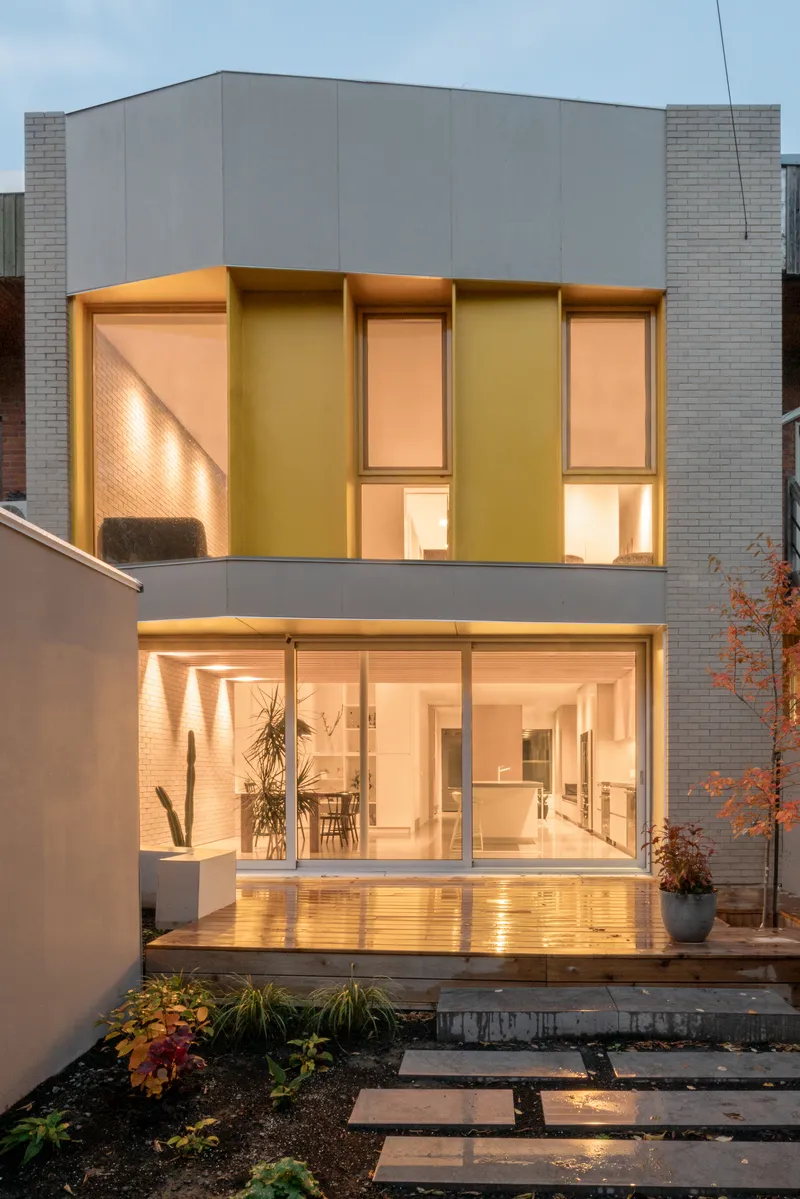
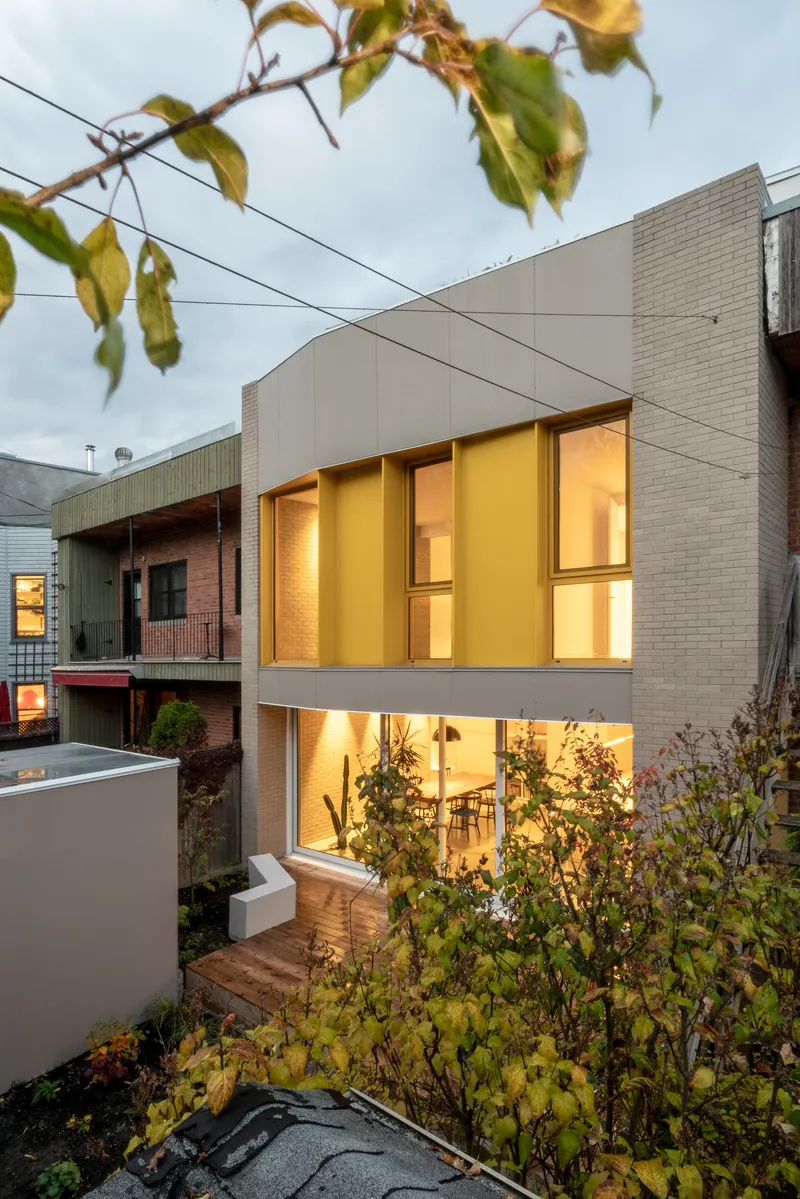
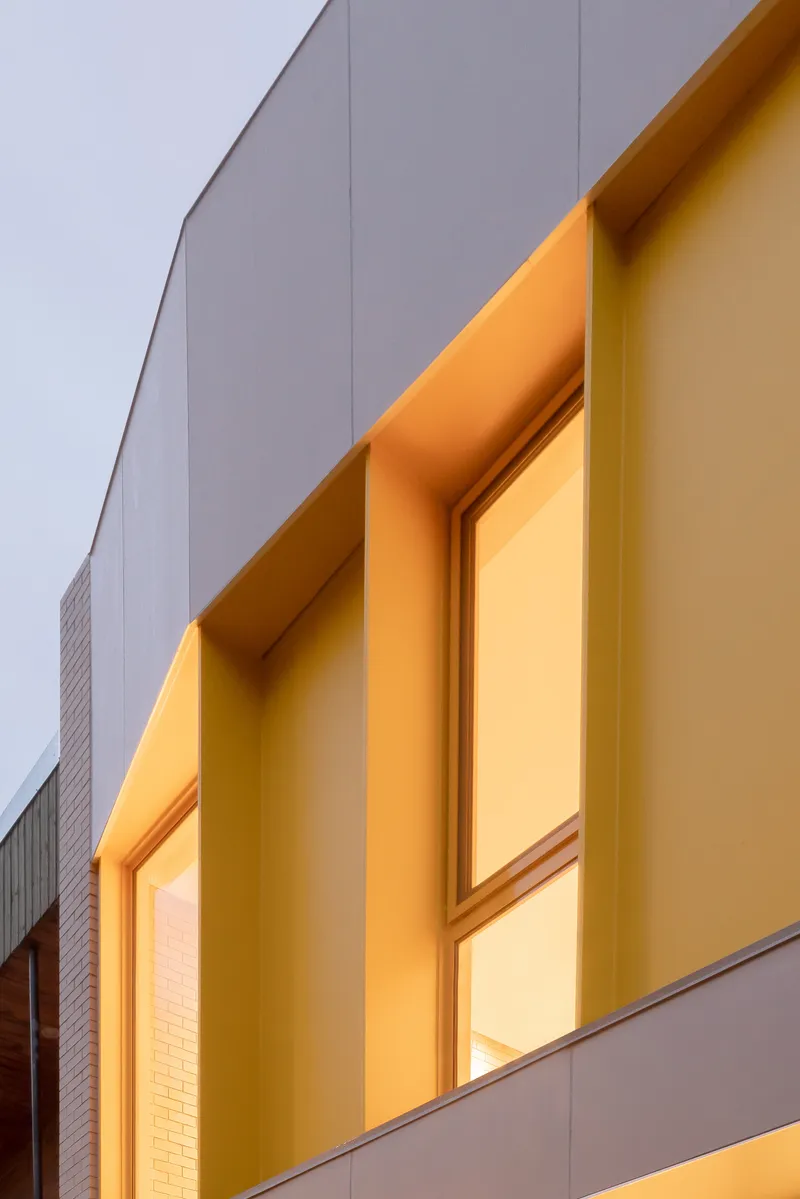
From the green alley behind the house, La Radieuse is impossible to miss. The garden-side facade is painted a saturated yellow that glows against the grey fibrociment cladding of the upper levels, a deliberate signal of the family's dynamic character. At dusk, the warm-lit glazing dissolves the boundary between terrace and interior, while vertical slats on the second-level projection create relief and a deliberate offset from the adjoining facades, granting privacy without resorting to blank walls.
The overhang of the upper floor serves double duty: it shelters the timber deck and planted beds below from rain, while its shadow line gives the composition a horizontal register that reads clearly against the autumn foliage of the surrounding trees. Interstate Brick on the lower portions grounds the house in the material vocabulary of the neighborhood, while the Finex fibrociment panels above signal the intervention as contemporary.
The Double-Height Core
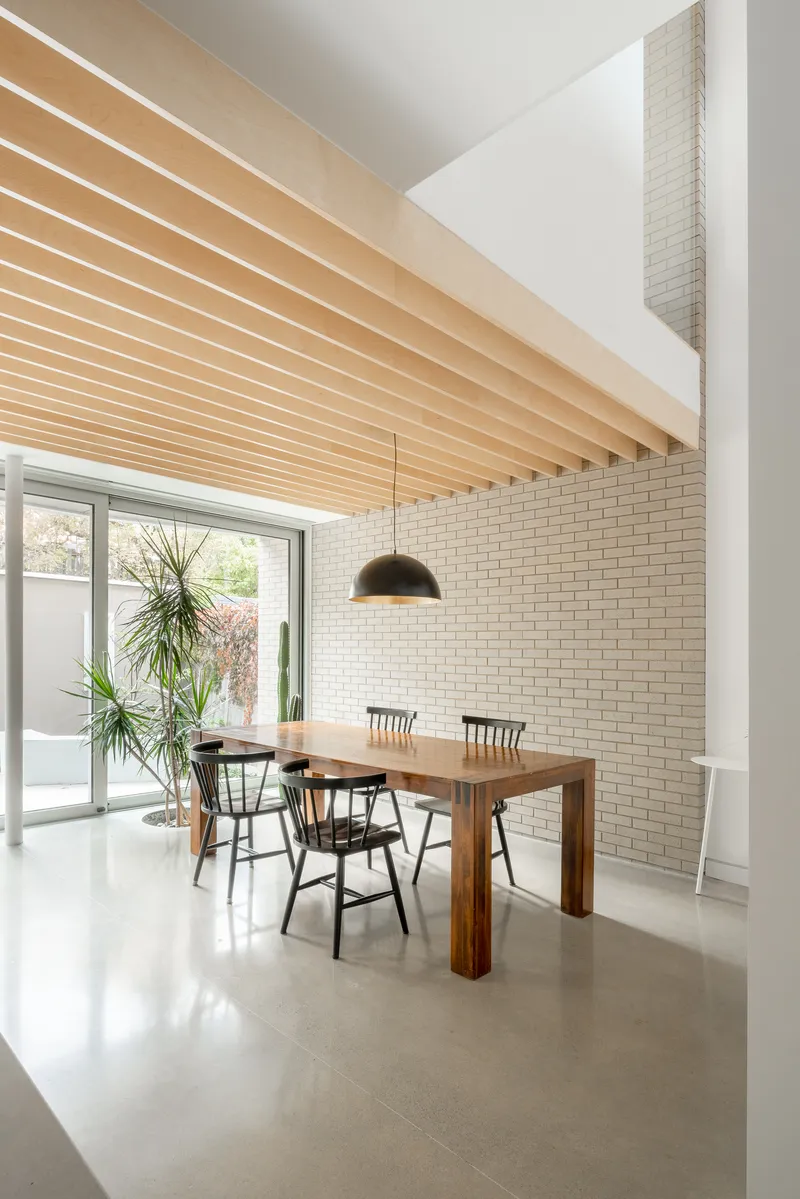
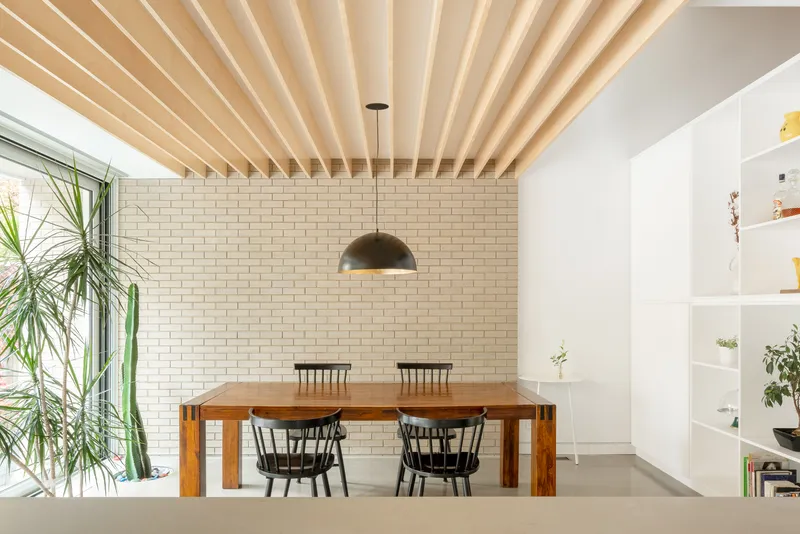
The most consequential architectural move in the house is the double-height space that links the ground-floor dining room with a den above. A white brick wall runs the full height, acting as a textured datum against which furniture and daylight shift throughout the day. Glazed openings at different levels punctuate this volume, pulling diffuse natural light deep into the plan and creating visual connections between floors that would otherwise feel isolated.
Exposed timber joists span the ceiling of the dining area, lending warmth and scale to a space that could easily feel austere in all-white. The timber is left in a pale, natural finish, a strategy NatureHumaine carries through stairs, storage walls, and built-in furnishings to tie the house together materially. Cream brick, timber, and white paint form the three-note chord that repeats on every surface.
Kitchen and Living as One Continuous Field
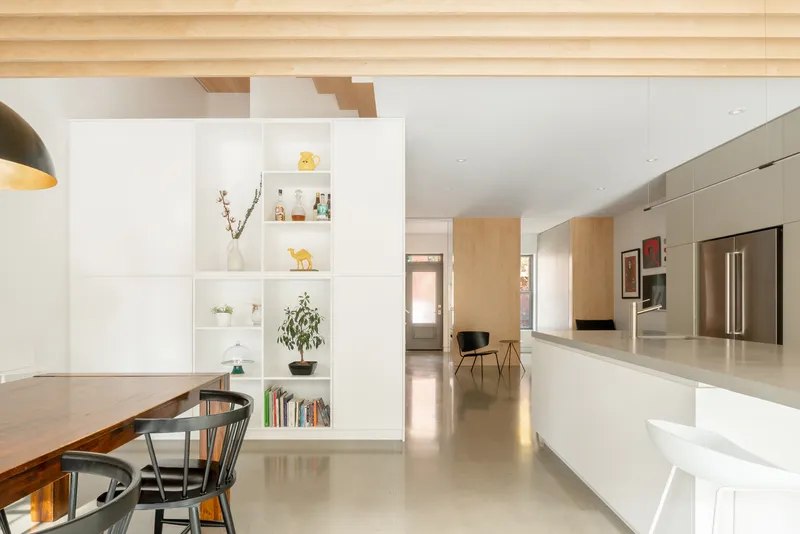
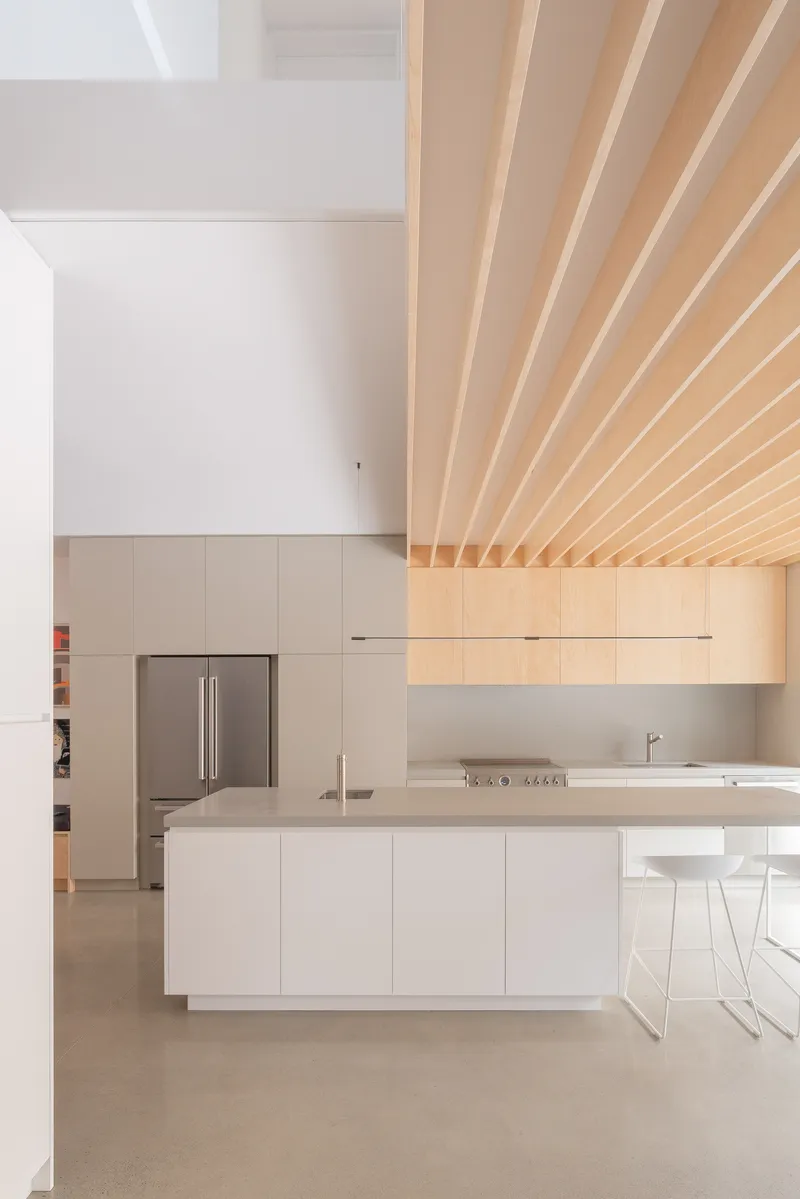
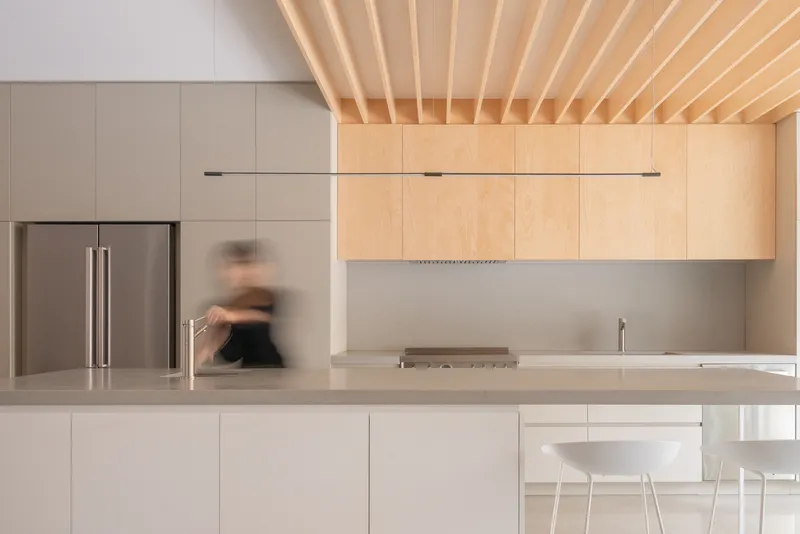
On the ground floor, kitchen, dining, and living areas merge into a single open field organized around the white island. The kitchen cladding is Fenix, a soft-touch laminate that absorbs fingerprints and light in equal measure, while the Caesarstone quartz countertop and backsplash maintain a seamless, easy-to-clean surface. The ribbed timber ceiling transitions into a white painted volume as you move from the kitchen toward the front of the house, subtly marking zones without interrupting flow.
Alumilex aluminum doors and windows along the garden wall open the living space to the terrace, collapsing the distinction between inside and outside during Montréal's brief but intense summers. White built-in shelving flanks the staircase, doubling as a room divider and a display surface that catches light reflected off the timber stair soffit overhead.
The Staircase as Spatial Engine
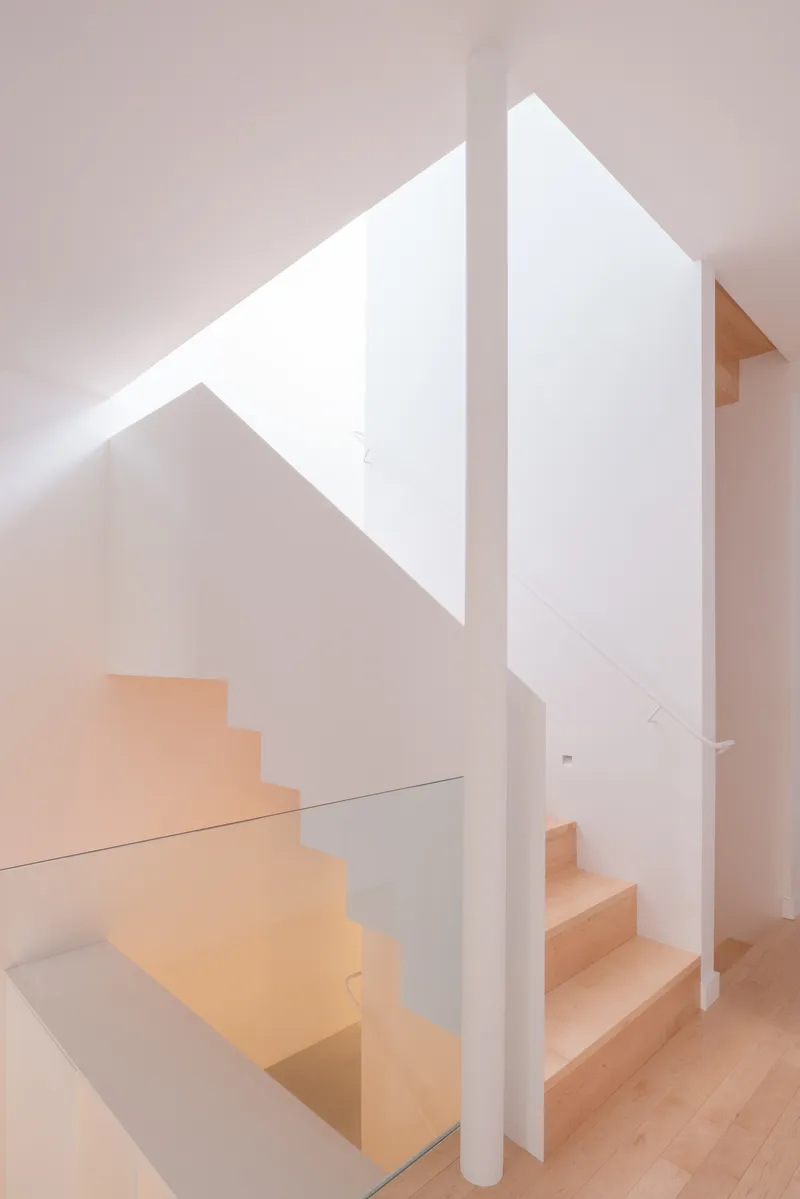
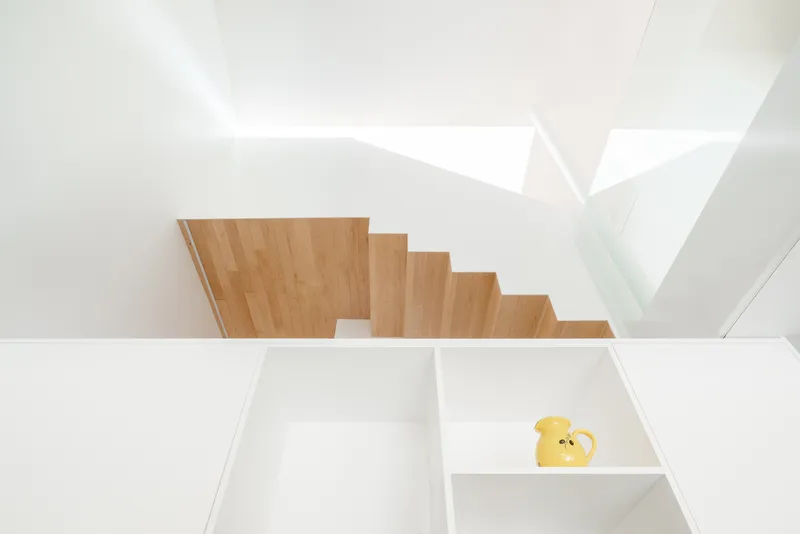
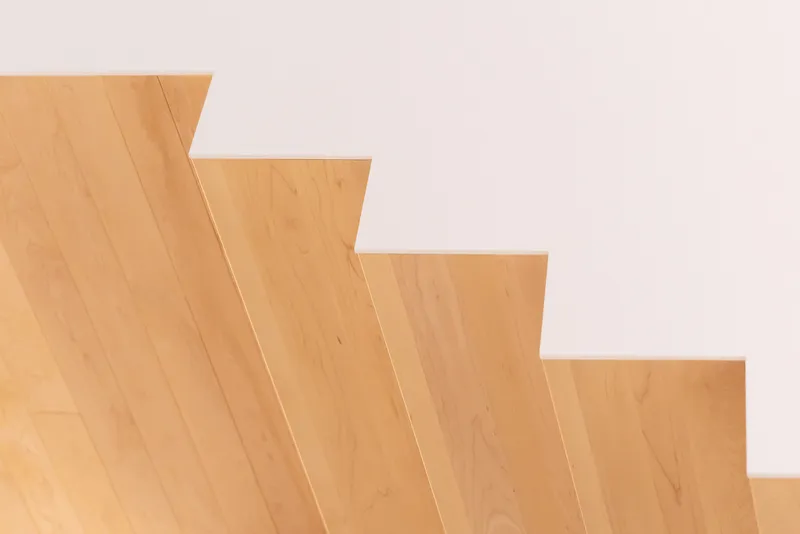
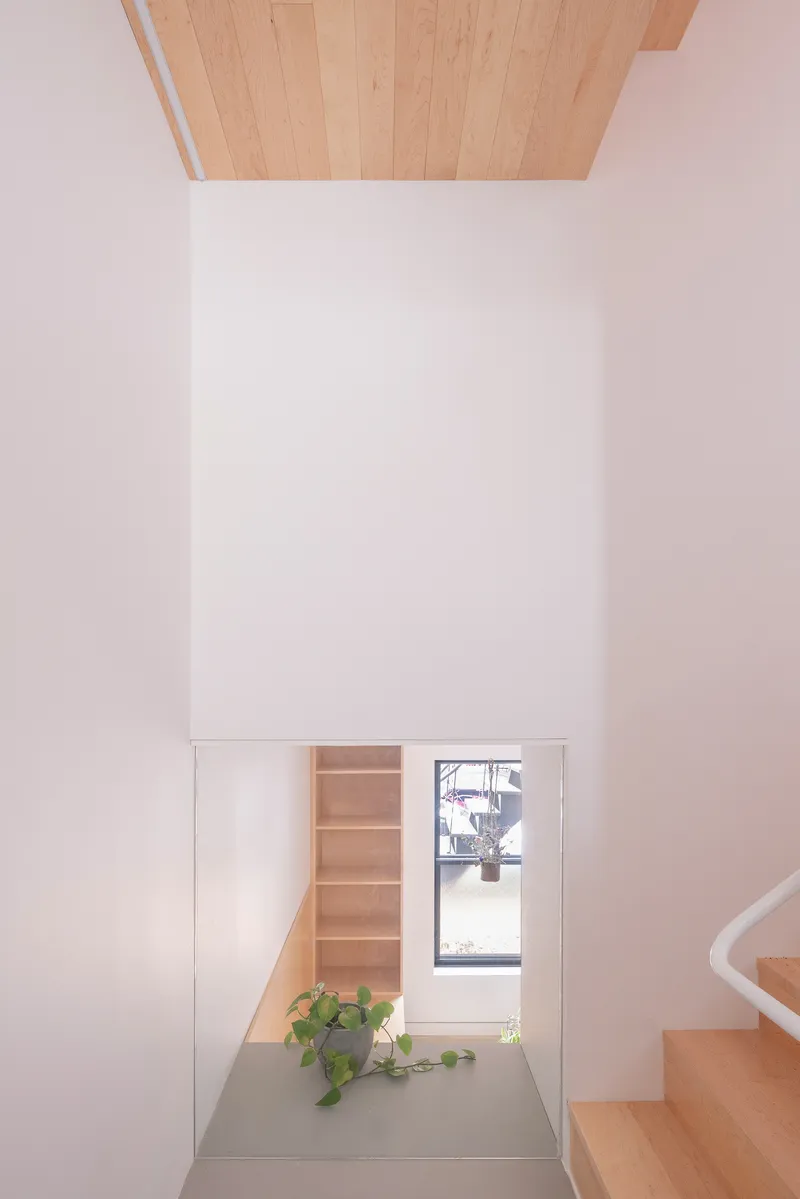
NatureHumaine treats the central staircase not as circulation but as the primary spatial event. White painted steel stringers support maple treads that wrap around a column beneath a triangular skylight, flooding the core of the house with overhead light. Every landing offers a vignette: a small storage compartment holding a yellow pitcher, a glimpse down to the dining table, a framed view of autumn trees outside. The staircase connects all three floors and, critically, it makes that connection feel generous rather than obligatory.
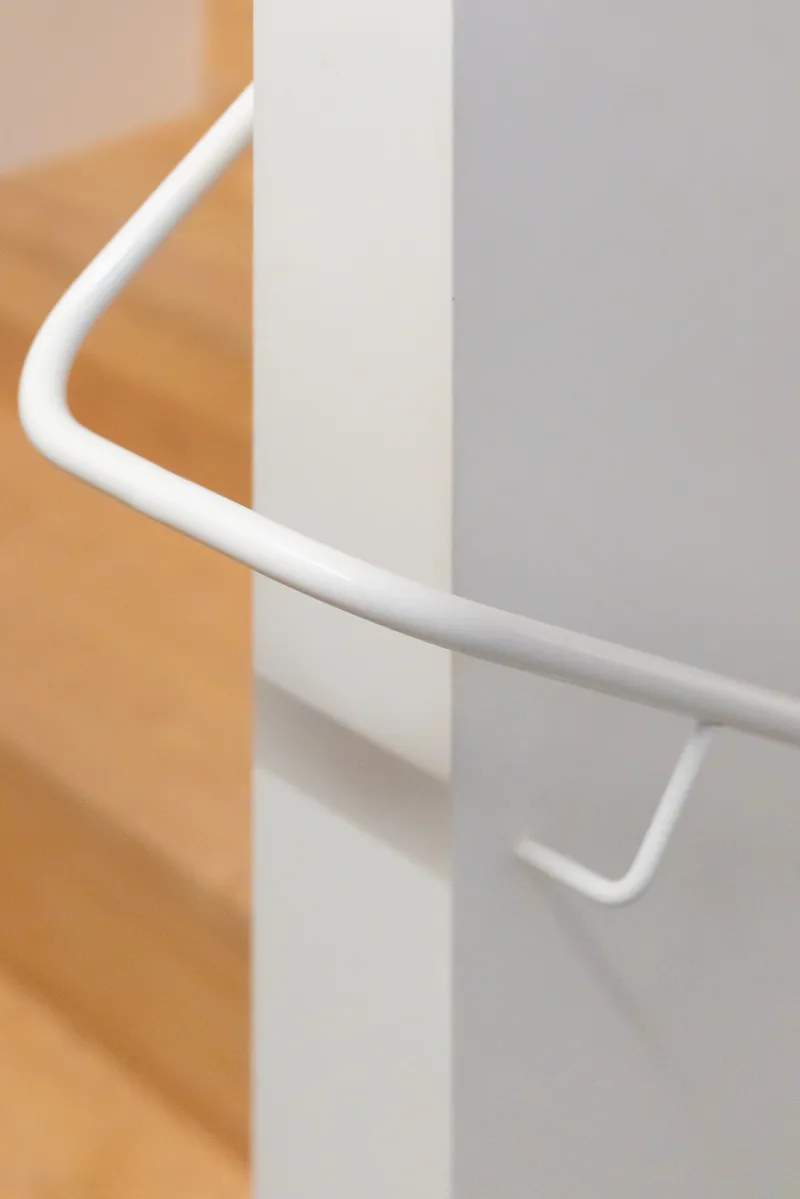
Viewed from above, the descending treads create a graphic spiral against white walls. The tubular metal handrail sits flush against the surface, an almost invisible gesture that keeps the stairwell uncluttered. It is one of those details that matters more for what it does not do: it does not compete with the light.
Children's Floor, Parent's Mezzanine
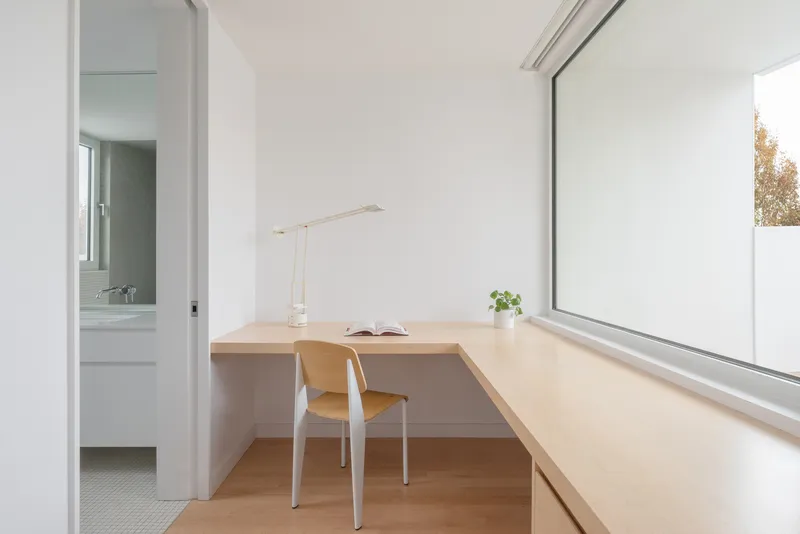
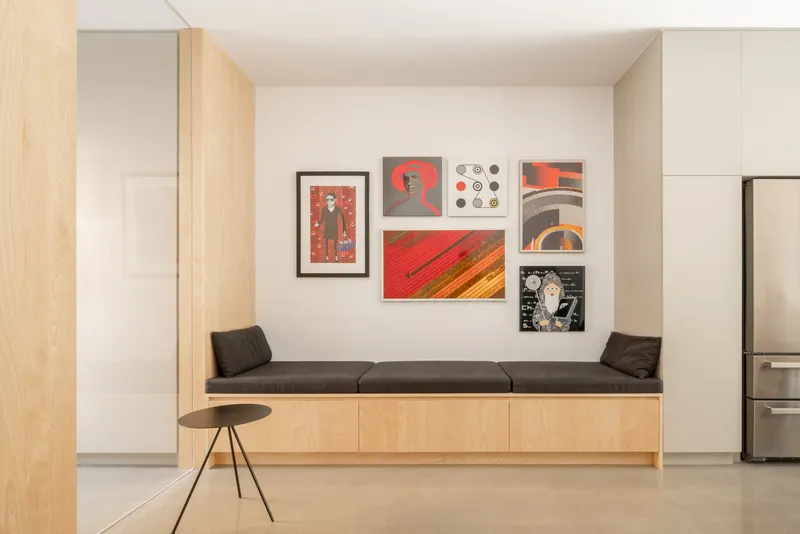
The second floor belongs to the children, with bedrooms, a built-in timber desk beneath a large window, and a gallery wall of framed prints. The atmosphere here is quieter, more enclosed, with lower ceilings and pale wood partitions defining individual rooms. A built-in bench with cushions offers a reading nook that doubles as a decompression zone, somewhere between shared and private.
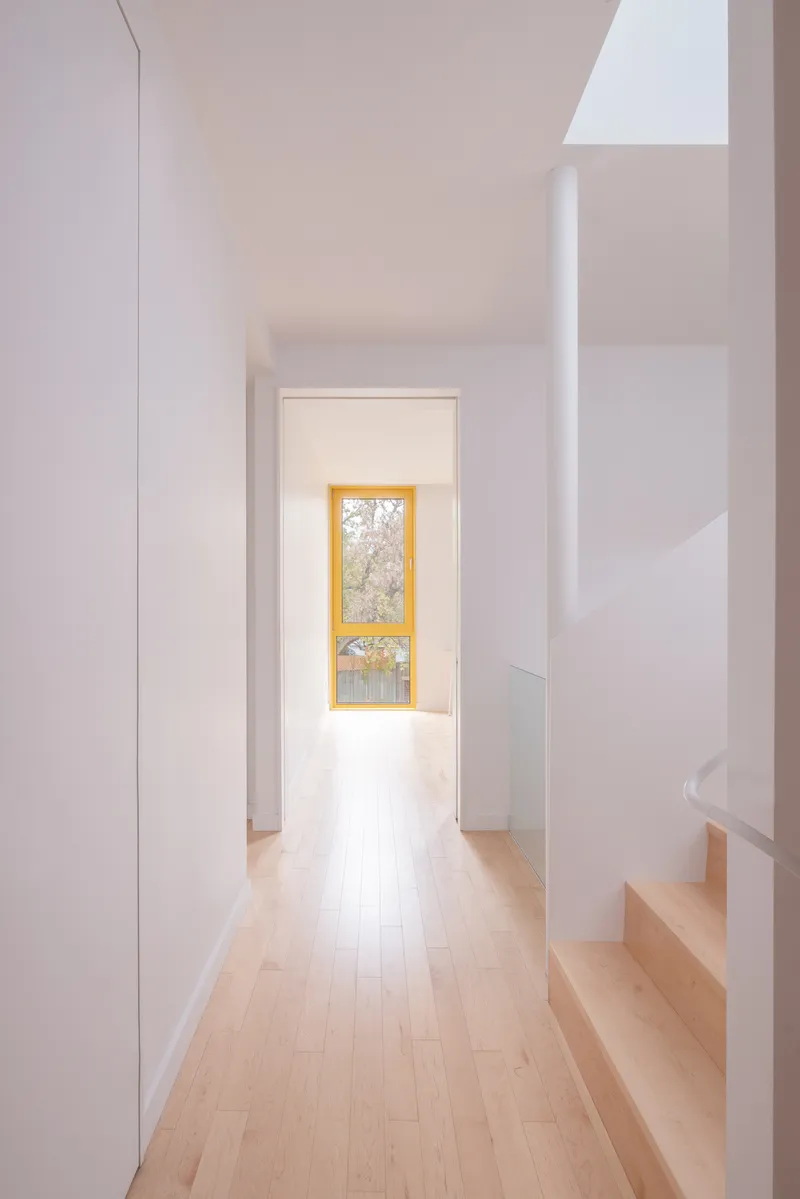
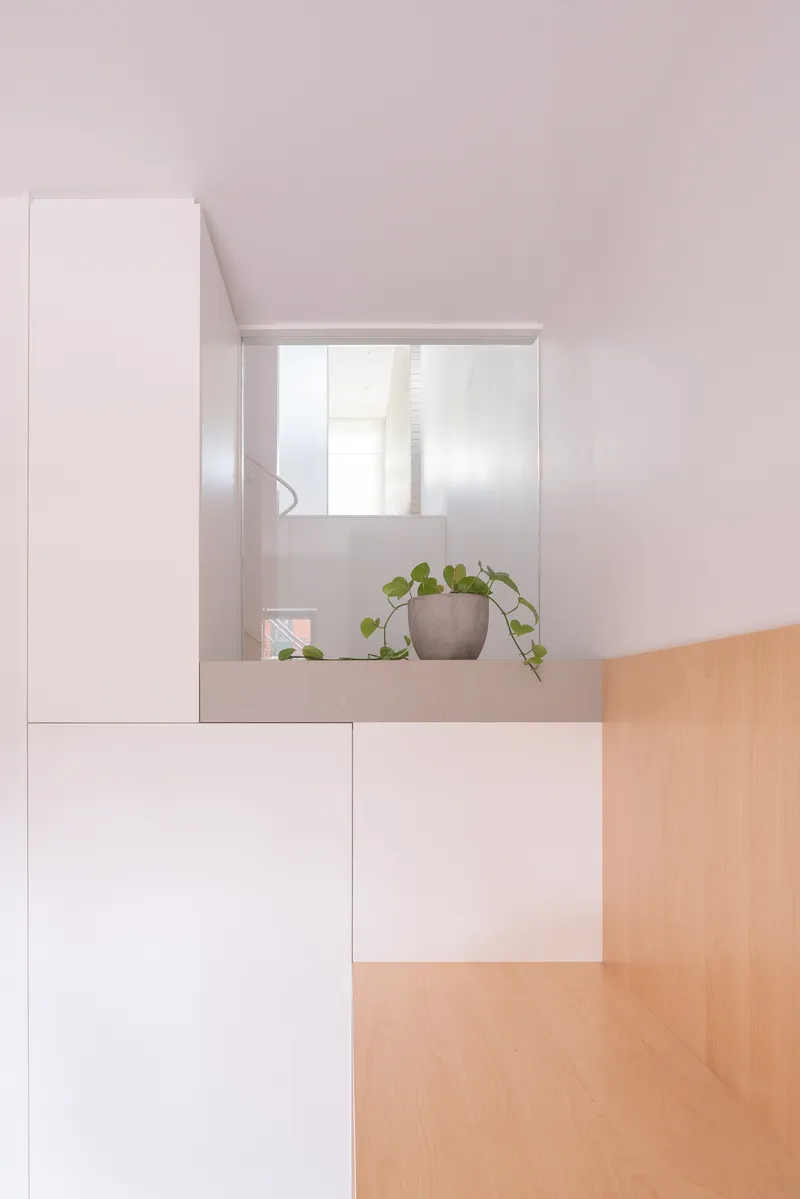
Above, the mezzanine is the parents' retreat. A narrow hallway with light timber flooring terminates at a yellow-framed window, a chromatic bookmark that reminds you of the facade outside. The sectional offset between these two levels means each enjoys its own ceiling height and orientation, but the open stairwell keeps them in acoustic and visual contact. It is a family cocoon with enough air between its layers.
Color as Interior Strategy
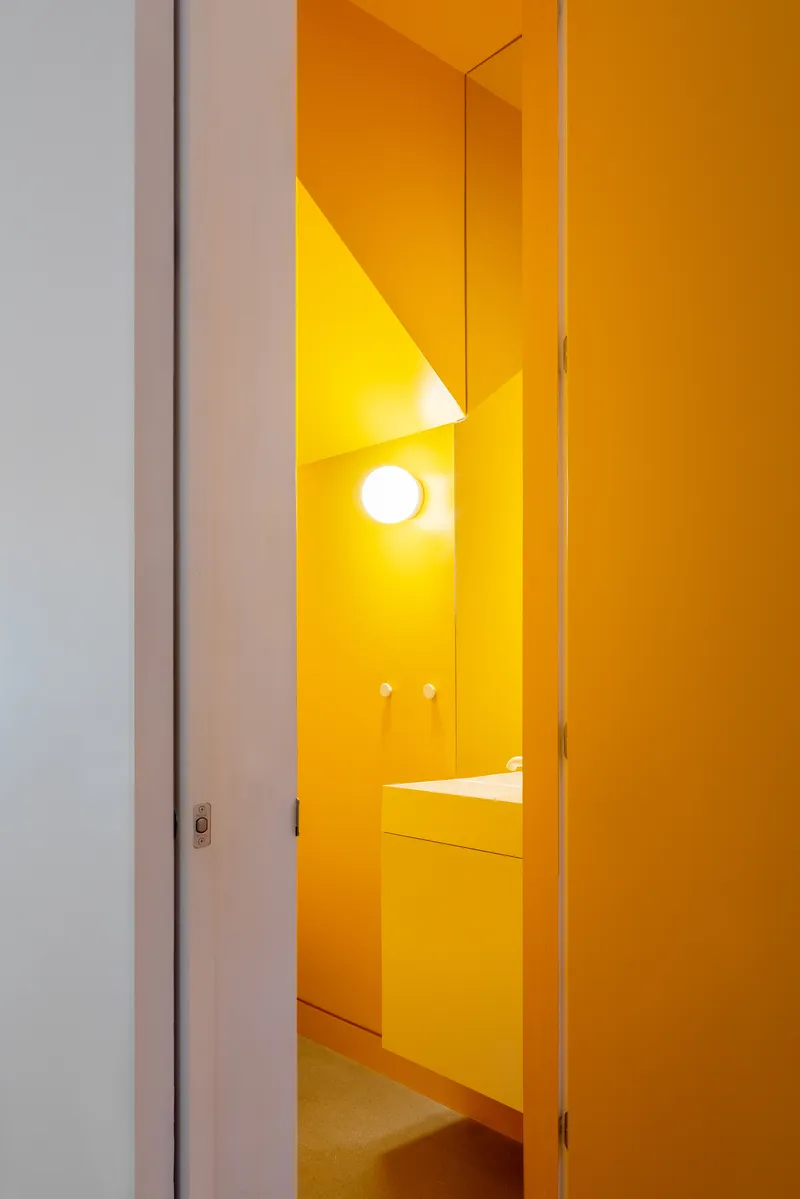
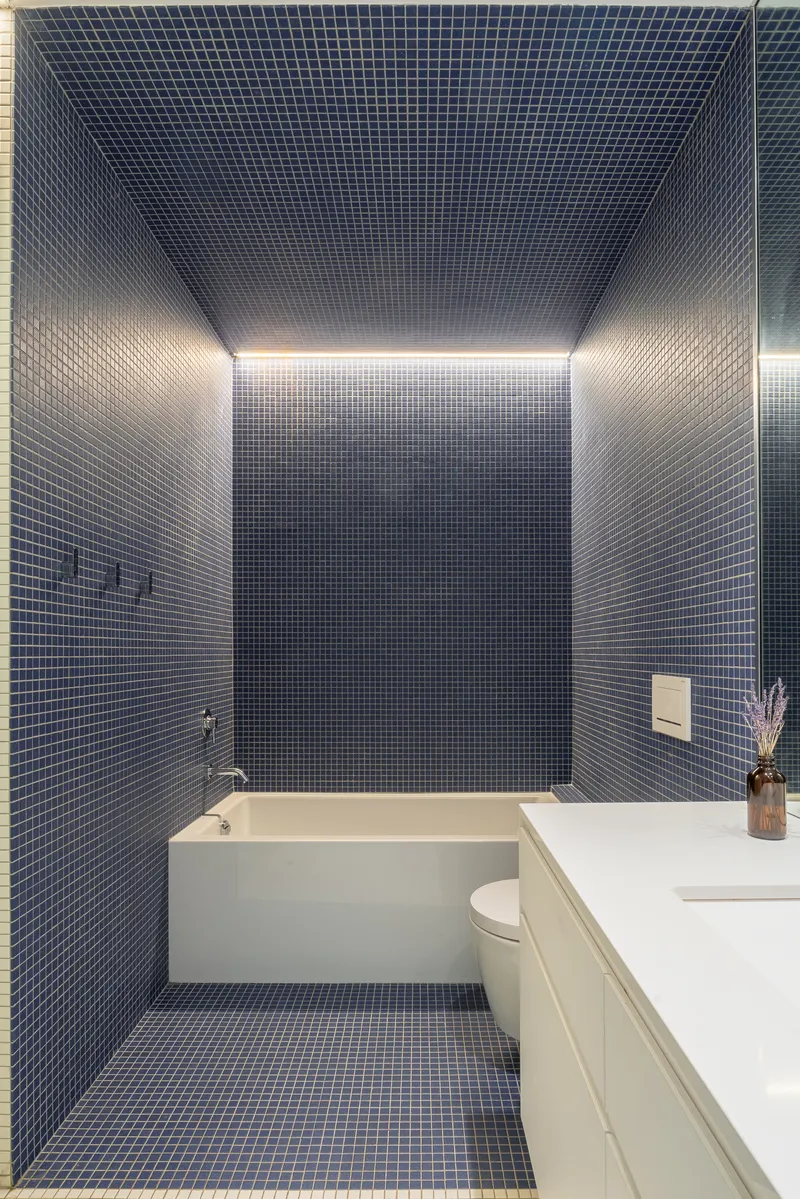
The yellow that blazes across the garden facade reappears indoors with surgical precision. A fully tiled bathroom in yellow surfaces catches you off guard through a narrow doorway, its circular wall sconce casting a warm halo. Elsewhere, a second bathroom is wrapped floor to ceiling in small blue mosaic tiles with concealed perimeter lighting, creating what feels like a tiny underwater chamber. These are not rooms that apologize for their boldness.
NatureHumaine uses color the way other firms use materials: as a way to give each room a distinct emotional register while maintaining a coherent whole. The Corian countertops in the bathrooms provide a smooth, neutral base against which the tile colors sing. A white tubular handrail meeting yellow tile at a corner captures the project's logic in miniature: restrained framework, confident accent.
Built-In Details and Material Consistency
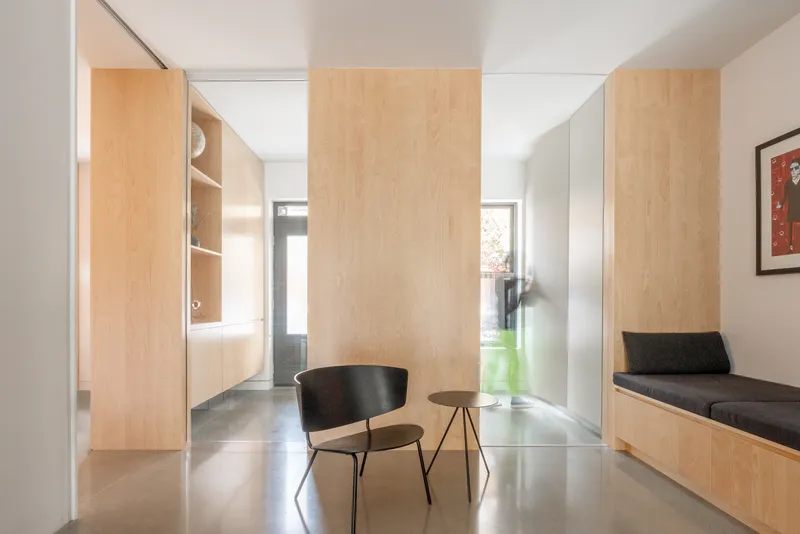
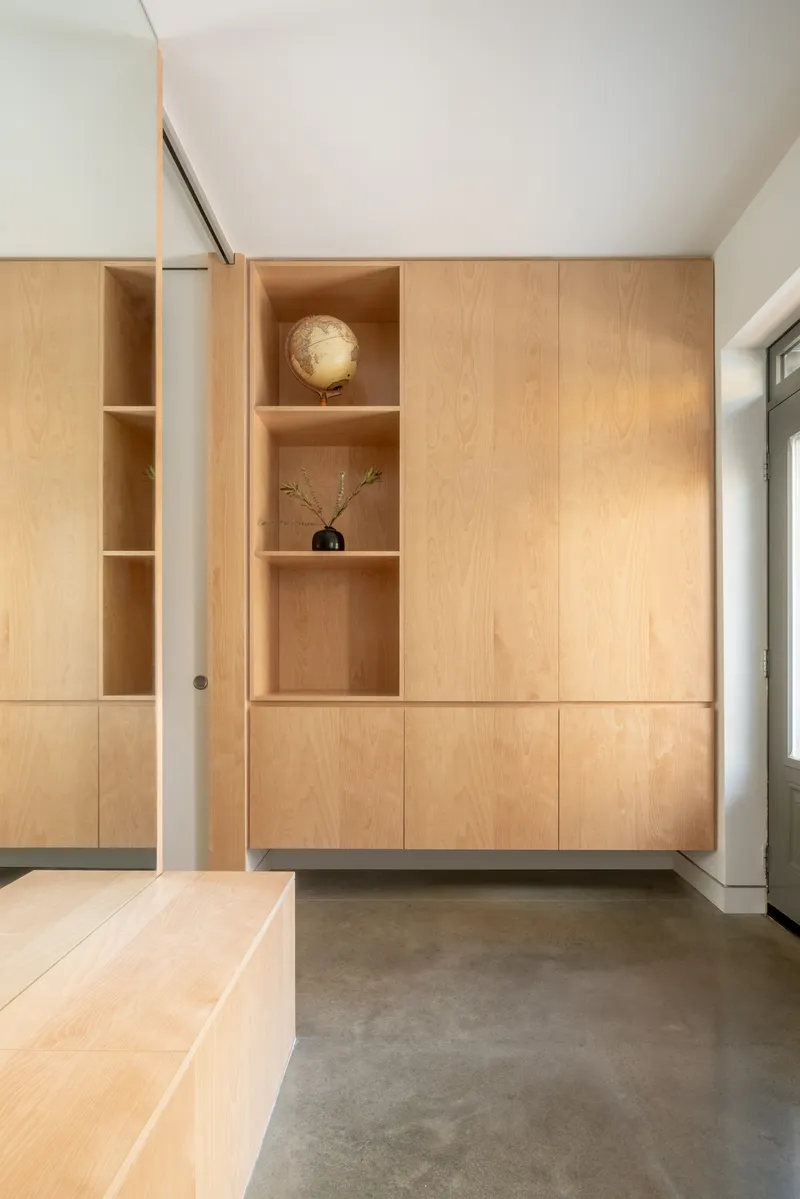
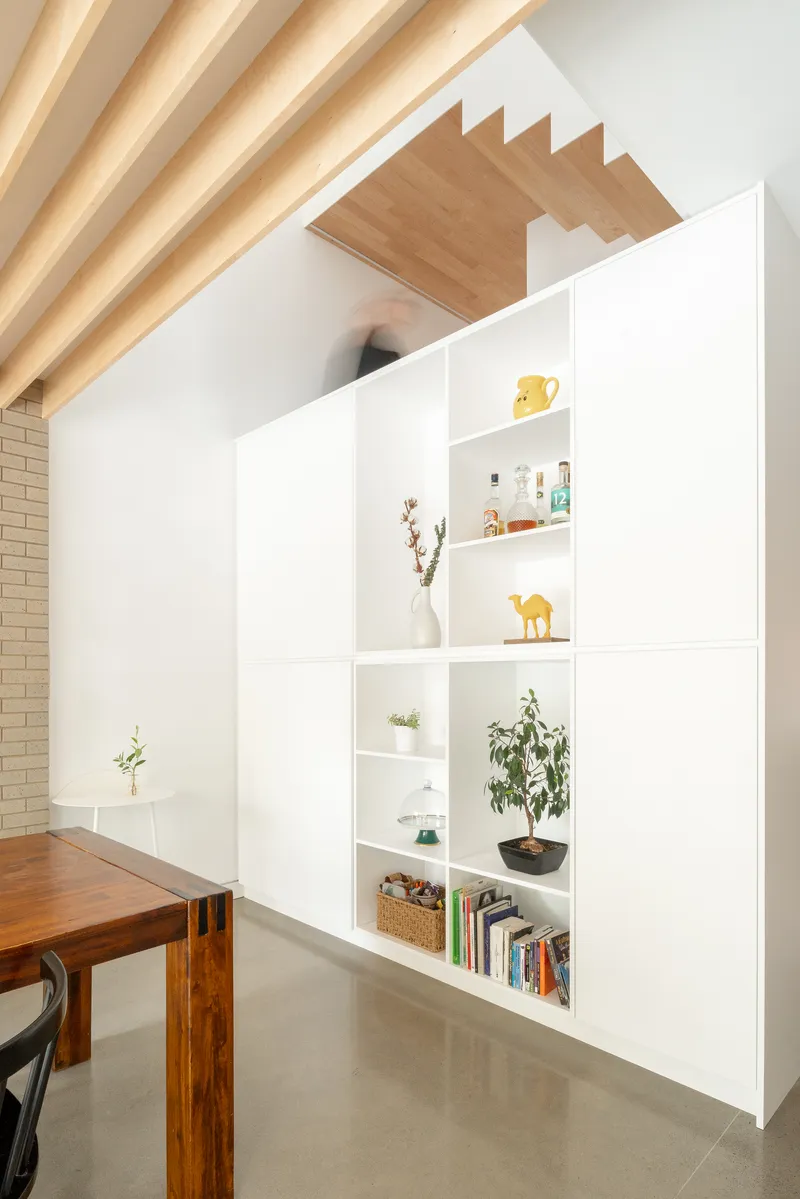
Throughout the house, cabinetry by Ébénisterie CST integrates storage, display, and seating into the architecture rather than furnishing it after the fact. A light wood storage wall with open display niches holds a globe and a small vase, turning utility into composition. The hallway features pale wood partition panels, a built-in bench, and polished concrete flooring that keeps the ground plane cool and continuous.
The consistency of material palette, maple, white brick, Fenix, quartz, means that the house reads as a single gesture despite its compact complexity. Landscape architecture by Friche Atelier extends that coherence outdoors, connecting the timber deck to planted beds that soften the transition from house to alley.
Plans and Drawings
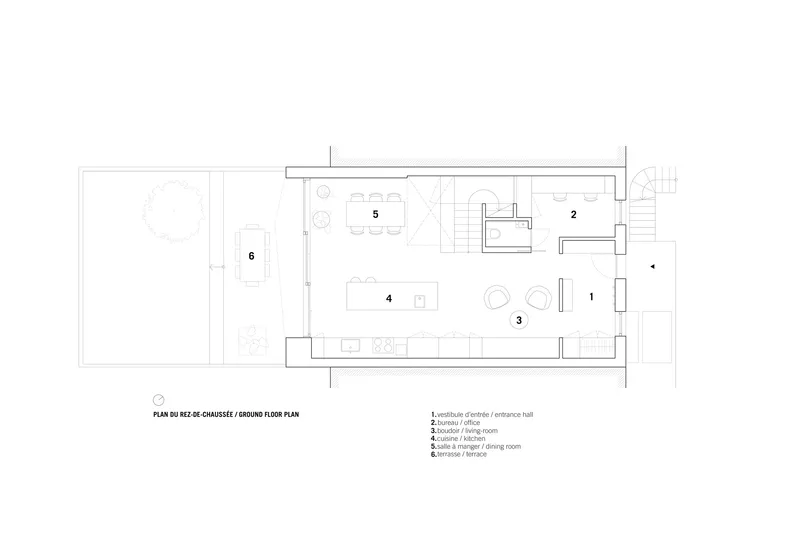
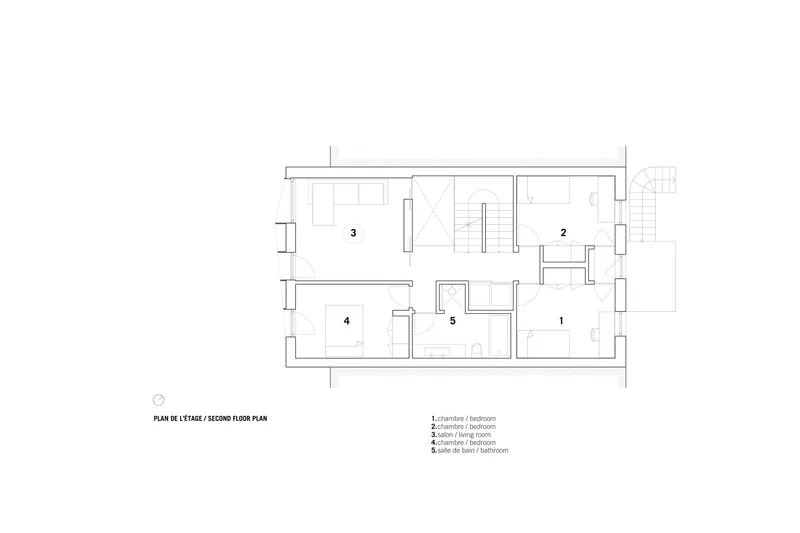
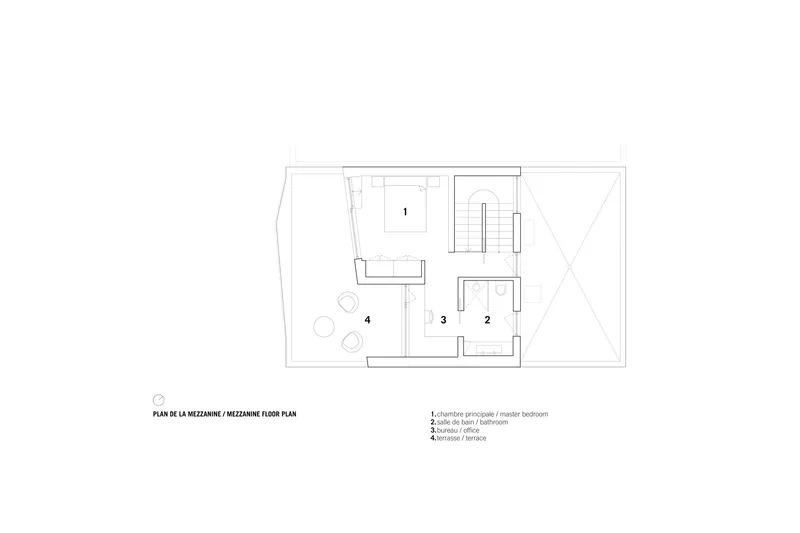
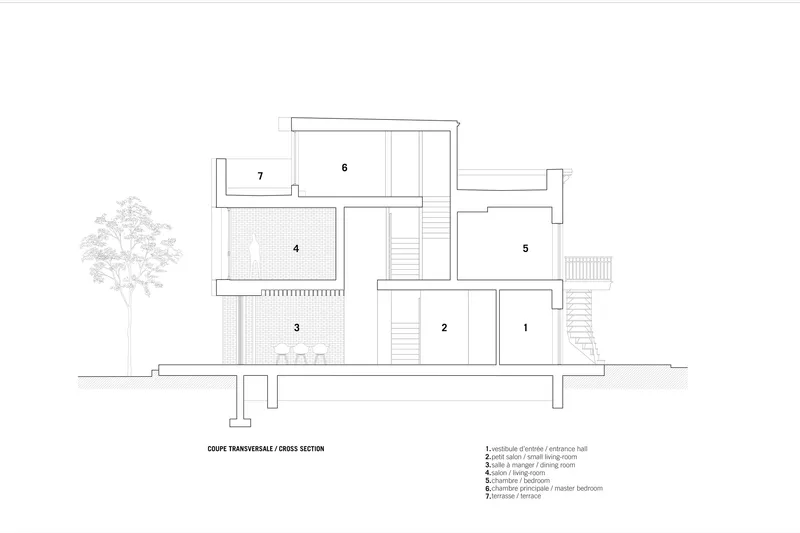
The floor plans reveal how tightly the three levels are organized around the central stairwell. The ground floor is almost entirely open, with kitchen, dining room, and terrace forming a continuous east-west sequence. The second floor subdivides into bedrooms and bathrooms flanking the stair, while the mezzanine condenses the parents' suite into a compact L-shape with its own terrace. The cross section makes the double-height volume legible, showing how the dining room and the den above share a single tall space threaded with light from multiple directions.
Why This Project Matters
La Radieuse is not a house that reinvents the Plateau Mont-Royal row house. It respects the typology's constraints, its party walls, its narrow lots, its alley-facing gardens, and works within them to produce something that feels both specific to its family and instructive for the neighborhood. The sectional ambition, three distinct levels with a double-height void stitching them together, is a real strategy for making 2,300 square feet feel larger than its footprint.
More broadly, the project demonstrates that color can be an architectural tool rather than an afterthought. The yellow facade is not decoration; it is identity. It tells you something about the people inside before you cross the threshold, and it rewards that promise in the tiled bathrooms and framed windows within. NatureHumaine has produced a house that is warm without being precious, compact without being cramped, and playful without losing its composure.
La Radieuse Residence by NatureHumaine, Montréal, Canada. 2,300 sq ft. Completed 2022. Structural engineer: Geniex. Cabinetry: Ébénisterie CST. Landscape architecture: Friche Atelier. Photography by Ronan Mézière.
About the Studio
Share Your Own Work on uni.xyz
If projects like this are the kind of work you want to make, uni.xyz is a place to publish your own, find collaborators, and enter design competitions.


Popular Articles
Popular articles from the community


Co-life: Sustainable Architecture for Age-Friendly Community Living
Co-life reimagines sustainable architecture for seniors through courtyards, rammed earth, shared gardens, and spaces designed for belonging.

ALGAL REALM: A Bio-Integrated Lunar Habitat Design for Life Beyond Earth
ALGAL REALM reimagines lunar habitat design with algae-powered life support, 3D-printed regolith, and vertical living for a lunar future.

The Musturak Paradise: Senior Living Architecture for a Connected Future in Temara, Morocco
The Musturak Paradise reimagines senior living architecture in Temara via private homes, social spaces, culture, community, and shared care.

Play: Fragments of Their World
Familiar architecture becomes modular playground design, creating safe spaces where displaced children can learn, connect, imagine and play.

Similar Reads
You might also enjoy these articles

Bao Huynh Watercolor Atelier: A Serene Art Retreat in Hội An
Bao Huynh Watercolor Atelier in Hội An blends multifunctional art spaces, sustainable design, local materials, and family-friendly living in a serene environment.

Atelier Macri Concept Store Interior Design by CASE-REAL
Atelier Macri store features a "ko" counter, walnut wood details, cork displays, blending retail, gallery, and seamless customer experiences.

Manuel Vargas Izquierdo Stadium and High-Performance Sports Center: Architectural Excellence in Jalpa de Méndez
The Manuel Vargas Izquierdo Stadium blends sustainable design, inclusive sports facilities, and cultural-inspired architecture, revitalizing Jalpa de Méndez’s public spaces.
KAKR Buluh Awar Hall: Revitalizing Community and Ecology Through Bamboo Architecture
Community built bamboo hall revitalizes Buluh Awar village, empowering youth, restoring ecology, celebrating vernacular craftsmanship through sustainable architecture and culture.


Comments (0)
Please login or sign up to add comments
No comments yet. Be the first to comment!