
NH Village Architects Weaves Hanoi's Craft Traditions into a Four-Storey Japanese Restaurant
Akaari Premium Restaurant layers rattan, bamboo, and Bat Trang ceramics across 720 square meters of dining space in a Hanoi urban district.


A Japanese restaurant in Hanoi might default to imported minimalism: bleached wood, clean planes, predictable restraint. NH Village Architects took a different route with Akaari Premium, turning instead to the craft villages on the outskirts of the city and asking what happens when Vietnamese artisanship shapes a Japanese dining experience from the inside out. The result is a 720-square-meter, four-storey interior that feels neither Vietnamese nor Japanese in any obvious sense, but rather like a third thing born from shared material affinities: bamboo, rattan, ceramics, and meticulous handwork.
What makes Akaari worth studying is not the cross-cultural concept alone but the degree to which craft decisions drive the architecture. Woven rattan becomes a wall, a ceiling, a staircase balustrade, a doorway threshold. Bat Trang ceramic tiles line a sushi counter floor. Sanded concrete mixed with gravel anchors common areas. Each of these materials was developed in close collaboration with artisans, and the building reads as a catalog of knitting ratios, weave densities, and joint details worked out between architect and maker. The 4.5-meter floor heights, generous for a converted shophouse pair, give these elements room to breathe and perform environmentally, enabling vertical convection that pulls air through the stacked floors.
Arrival and Threshold
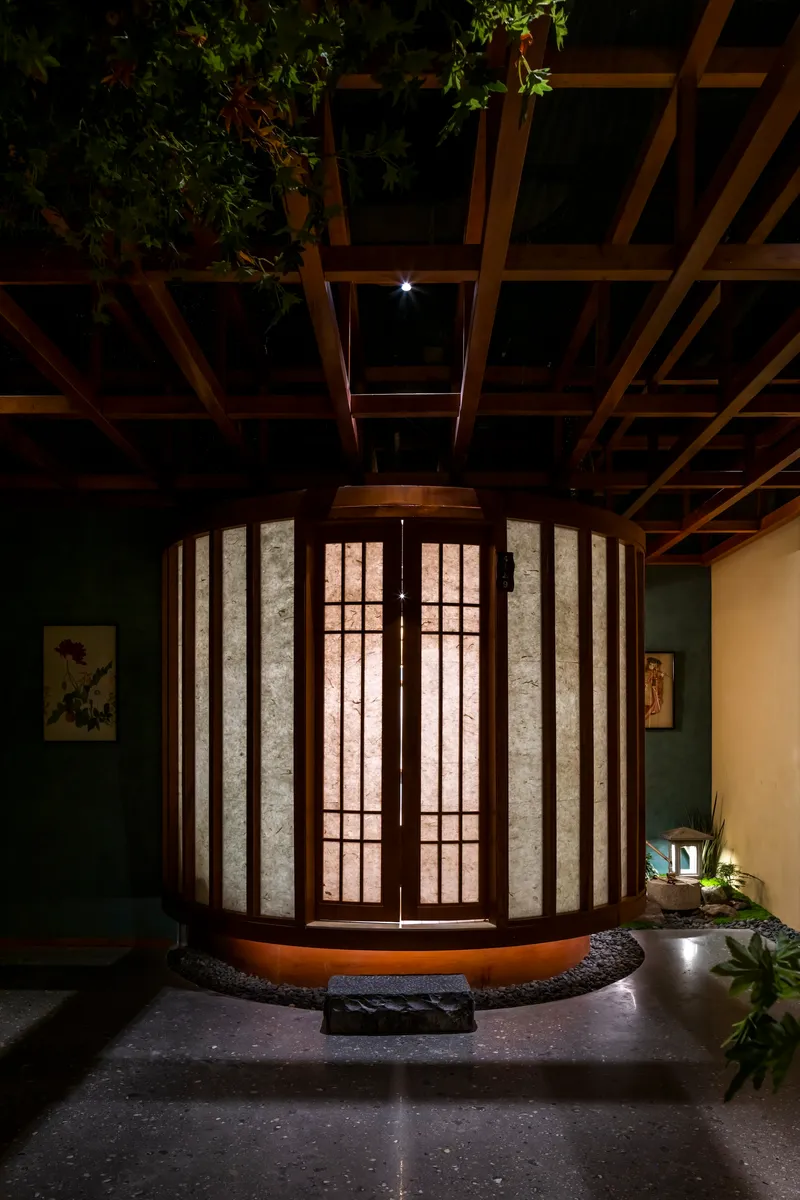
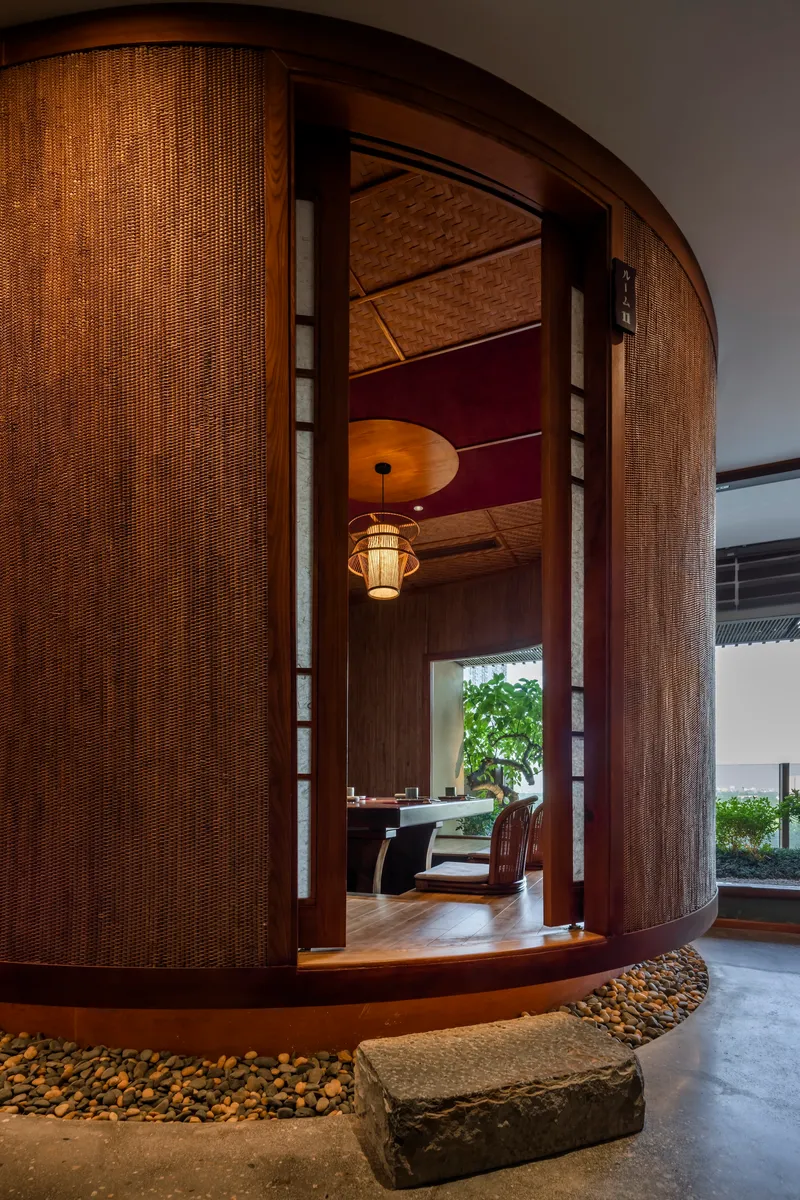

The entry sequence is slow and deliberate. A cylindrical pavilion wrapped in timber framing and translucent paper panels creates a decompression chamber between the street and the dining floors, establishing an immediate tonal shift. River pebbles and stone steps underfoot signal a transition from urban pavement to curated interior landscape. The circular window glimpsed from within the curved vestibule acts as a kind of visual magnet, pulling visitors forward through a compressed threshold before releasing them into the taller volumes beyond.
This choreography is critical. The site consists of two former shophouse apartments at the base of a building in a newly developed urban area, which is to say the exterior context offers little romance. The architects respond by turning the entrance inward, making arrival itself the first course.
Woven Surfaces as Spatial Dividers

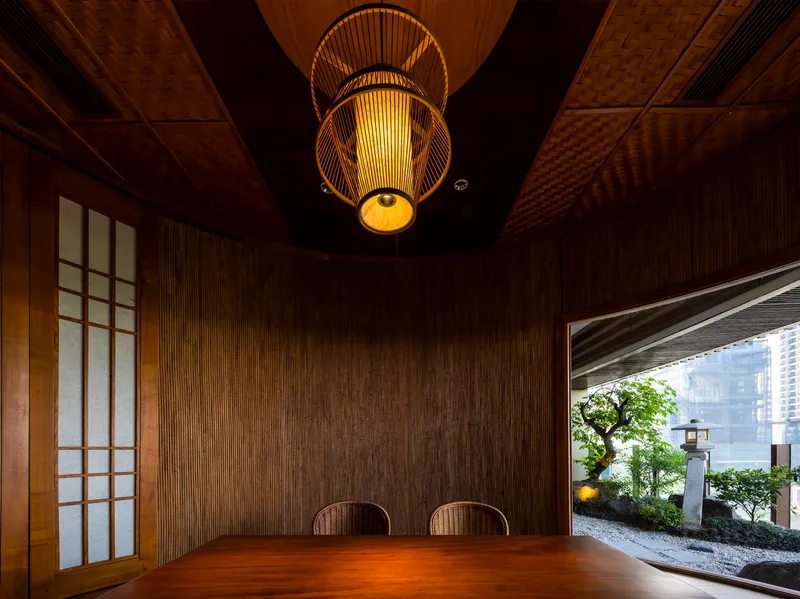

The most structurally inventive move in the project is the use of woven rattan and bamboo not as decorative overlay but as architectural partition. Private dining alcoves are enclosed by panels whose knitting density was carefully calibrated: open enough to admit light and a sense of connection to adjacent gardens, tight enough to provide acoustic and visual separation. The architects studied the size and proportions of each weave pattern to ensure the partitions remained light without defaulting to rigid solid walls.
These are not off-the-shelf products. NH Village worked with craftspeople from traditional villages on Hanoi's outskirts to develop specific knitting styles and construction methods for each location in the building. The arched rattan openings visible in the private rooms echo Japanese shoji proportions while using distinctly Vietnamese craft techniques, a quiet collision of two traditions in a single component.
The Double-Height Lobby and Timber Ceiling
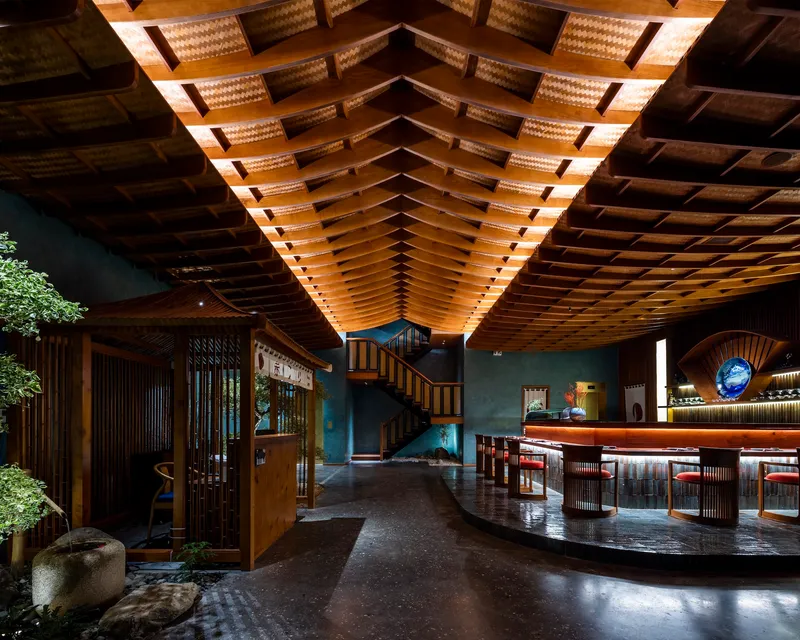
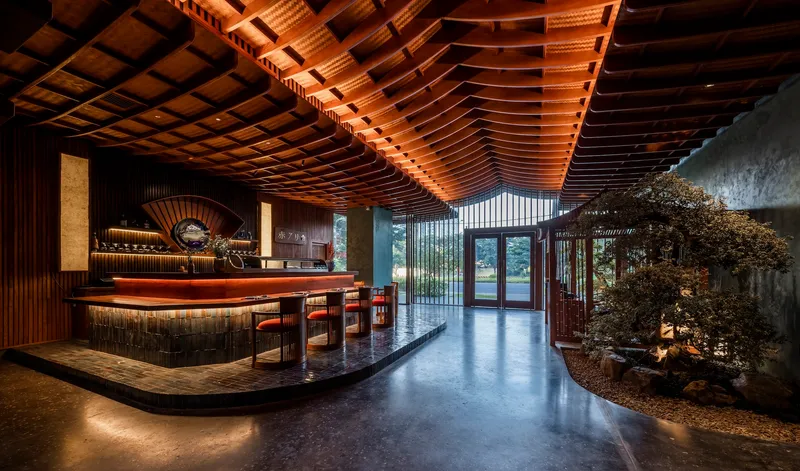

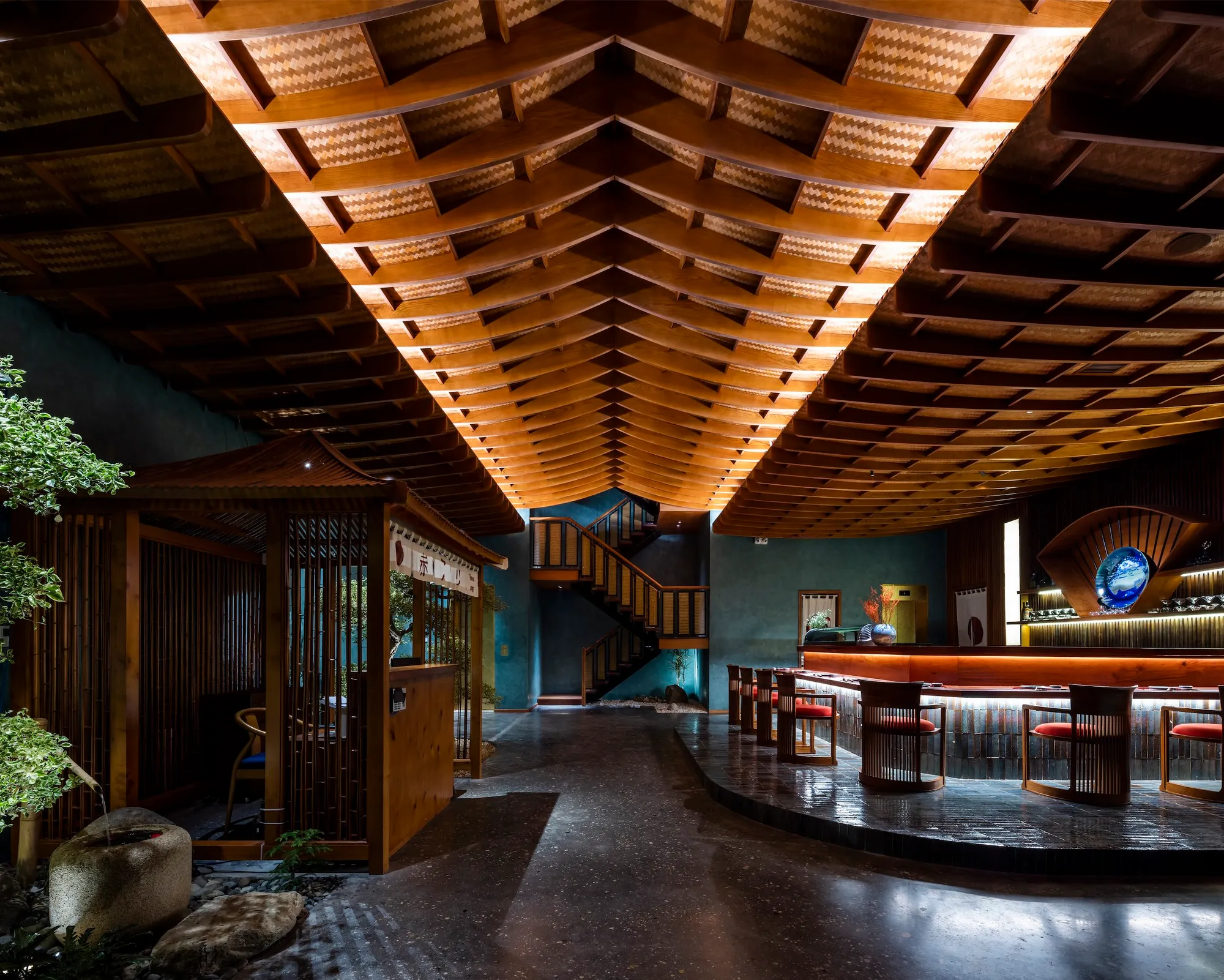
The shared dining spaces on the entrance level and second floor are unified by a vaulted wood-slat ceiling that exploits the 4.5-meter floor heights to powerful effect. The slats curve overhead in gentle arcs, their rhythm broken by integrated linear lighting that washes the wood in warm tones after dark. Below, interior gardens anchor the space and provide orientation: a tree in a courtyard, a patch of gravel, a cluster of stepping stones. These are not ornamental. They function as buffer zones between the glass envelope and the dining rooms, filtering natural light and softening the boundary between inside and out.
The undulating wood-slat ceiling in the reception area, wrapping around a curved timber counter, demonstrates how the architects use consistent material language to connect spaces across floors while allowing each room its own character. The coffered timber structure reads differently in the low-lit dining hall than it does in the brighter lobby, even though the construction logic is the same.
The Vertical Staircase and Climate Strategy
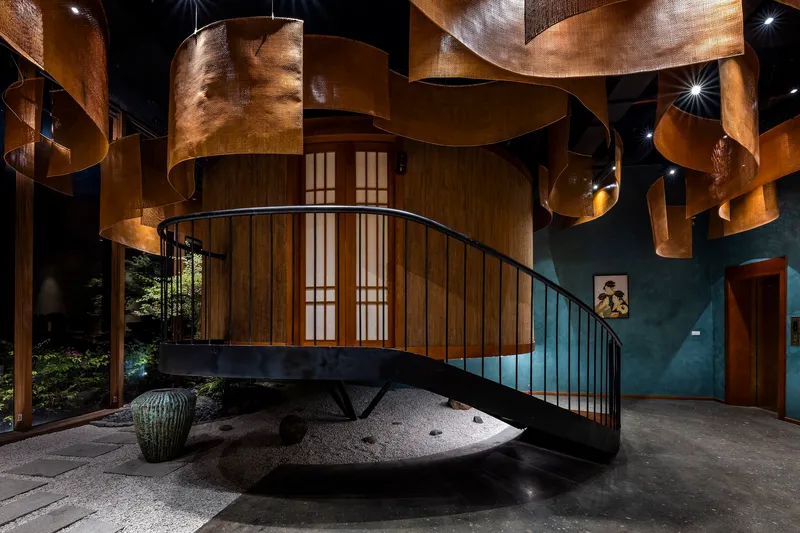
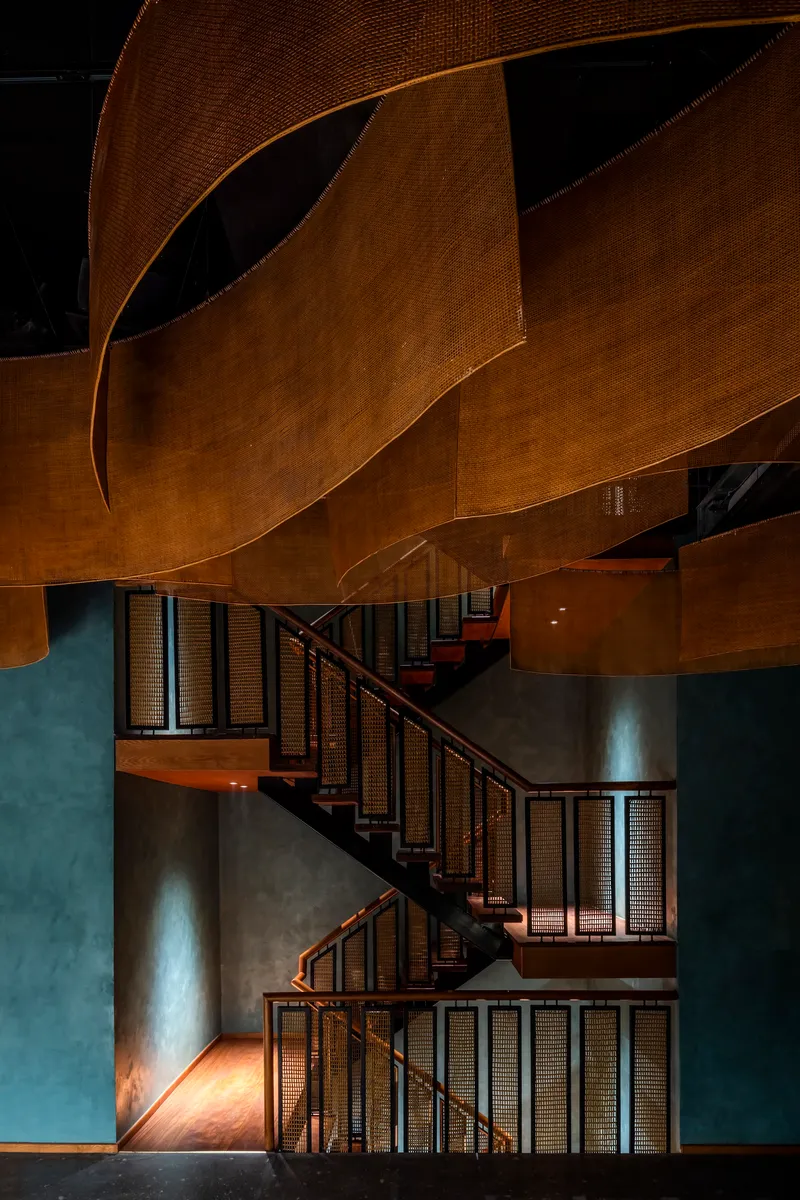
The main staircase is both a circulation spine and an environmental device. Rising through all four floors with switchback landings, it serves as the primary path for vertical air convection, drawing cooler air upward through the building's section. The balustrades are woven panel assemblies that maintain visual continuity with the partition walls on each floor, making the stairway feel like an extension of the dining rooms rather than a utilitarian connector.
The combination of steel structure, wood handrails, and rattan infill panels in the staircase railing system is one of the clearest examples of the project's material strategy: use an industrial frame where structural performance demands it, then let handcraft occupy the visible surface. Beneath the curving woven ceiling forms at the stair landings, the raked gravel garden bed at the base introduces the same ground treatment found in the dining-room courtyards, stitching the vertical and horizontal circulation together.
Dining Rooms and Garden Layers

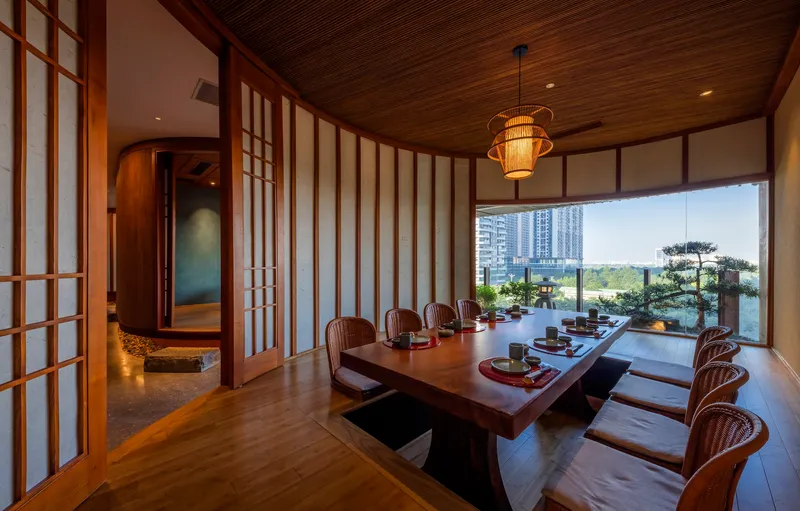
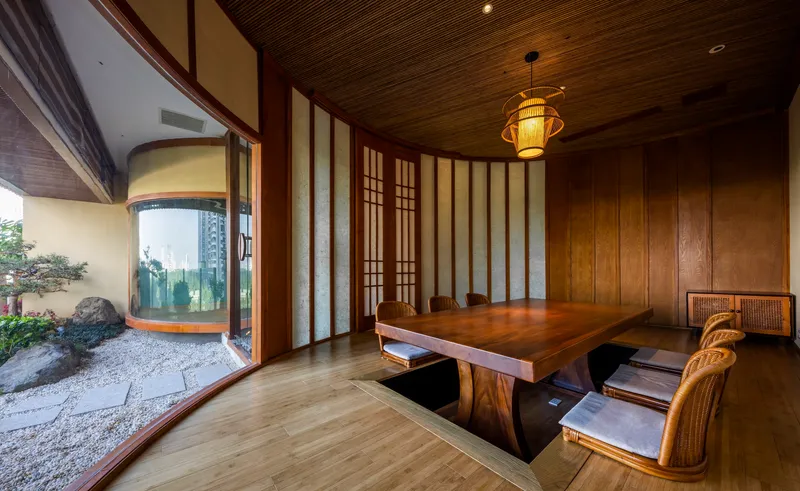
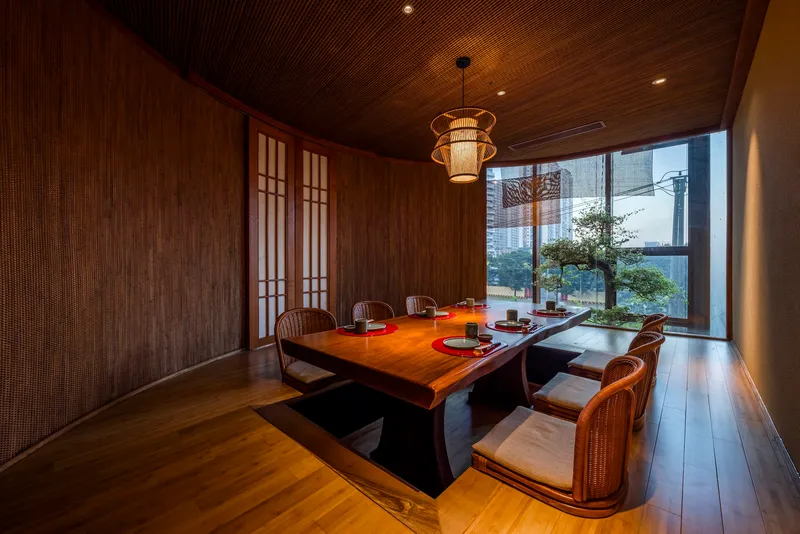
The private dining rooms are arranged at varying heights across the four floors, each with door systems designed to frame views of layered gardens. The landscape strategy works in depth: a narrow planting strip immediately adjacent to each room gives way to wider garden zones, and ultimately to views of a public park to the west of the building. This telescoping of green creates a sense of spatial generosity that belies the 180-square-meter footprint.
In the room with sliding shoji screens opening to a terrace, a single bonsai tree occupies the threshold between interior and exterior, functioning simultaneously as decoration, borrowed landscape, and light filter. The herringbone tile floor in the coffered-ceiling dining room introduces Bat Trang ceramics in a pattern that recalls both Japanese and Vietnamese traditions without belonging firmly to either.
Counter Seating and Craft Ceilings

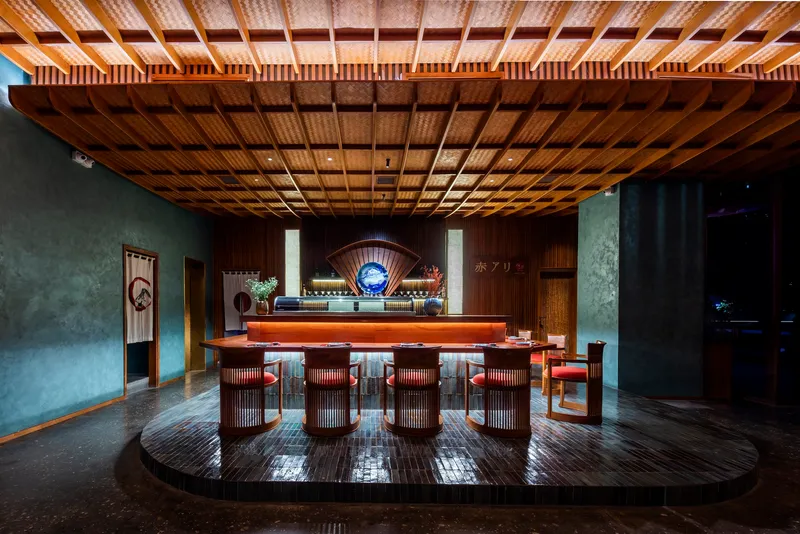

The sushi bar on the second floor anchors the communal dining experience. Here, colorful Bat Trang ceramic tiles cover the floor beneath a woven bamboo coffered ceiling, creating one of the most materially dense moments in the building. The raised circular platform and timber counter with stools set up a theater of preparation that feels intimate despite being open to the larger room.
Throughout the upper floors, pendant lights fabricated by lamp-making artisans hang below latticed ceiling screens. These are not generic fixtures but architectural components developed through the same craft-collaboration process that produced the partitions and railings. The gridded bamboo ceiling over the bar area, backlit to glow in the evening, demonstrates how the woven material system modulates light as effectively as it modulates space.
Corridors and Courtyards After Dark
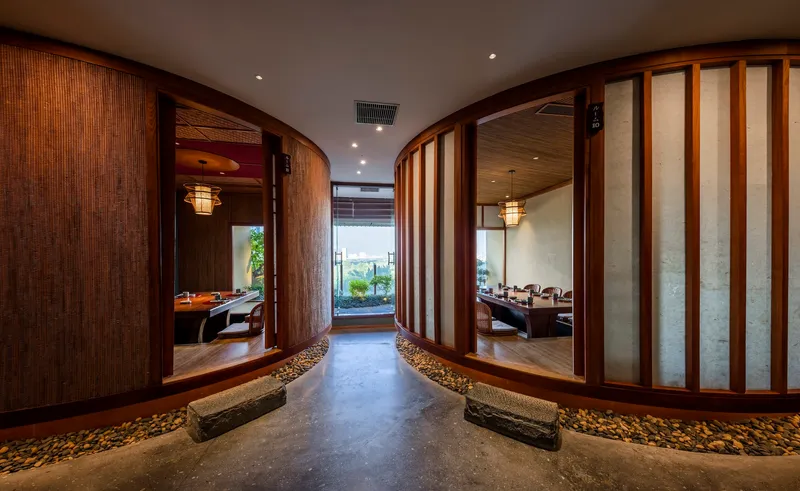

The walkways connecting dining rooms are not neutral corridors. They change direction with deliberate flexibility, lined with curved timber screens and river stone flooring that slow movement and redirect attention toward planted courtyards visible through translucent partitions. At night, warm ambient light transforms these passages into lantern-like volumes, their woven walls glowing from within.
The courtyard view at night, with its stepping stones crossing raked gravel between the curved dining room and the central corridor, reveals how the architects conceived the gardens as rooms in their own right. These are not leftover voids but structured pauses in the dining sequence, calibrated to the same care as any interior space.
Plans and Drawings

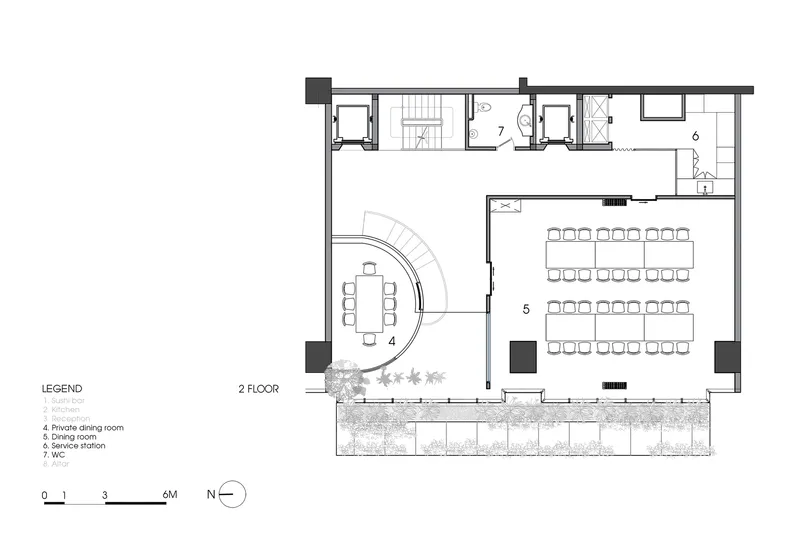

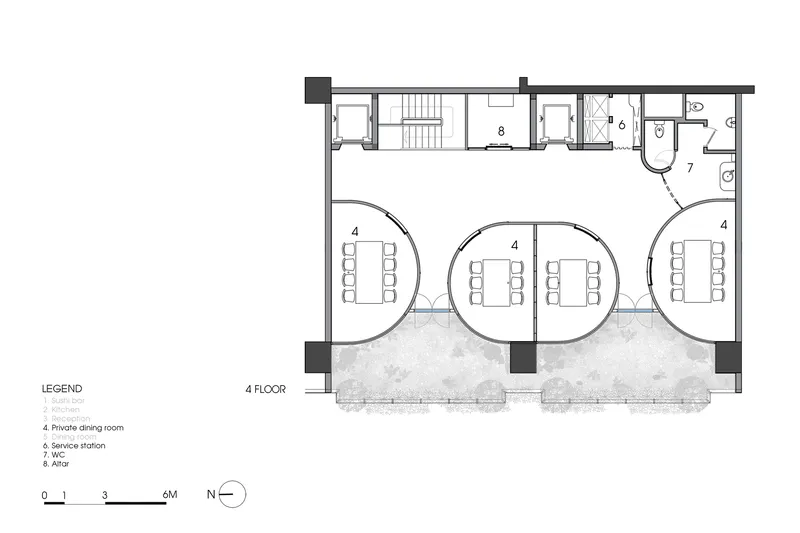
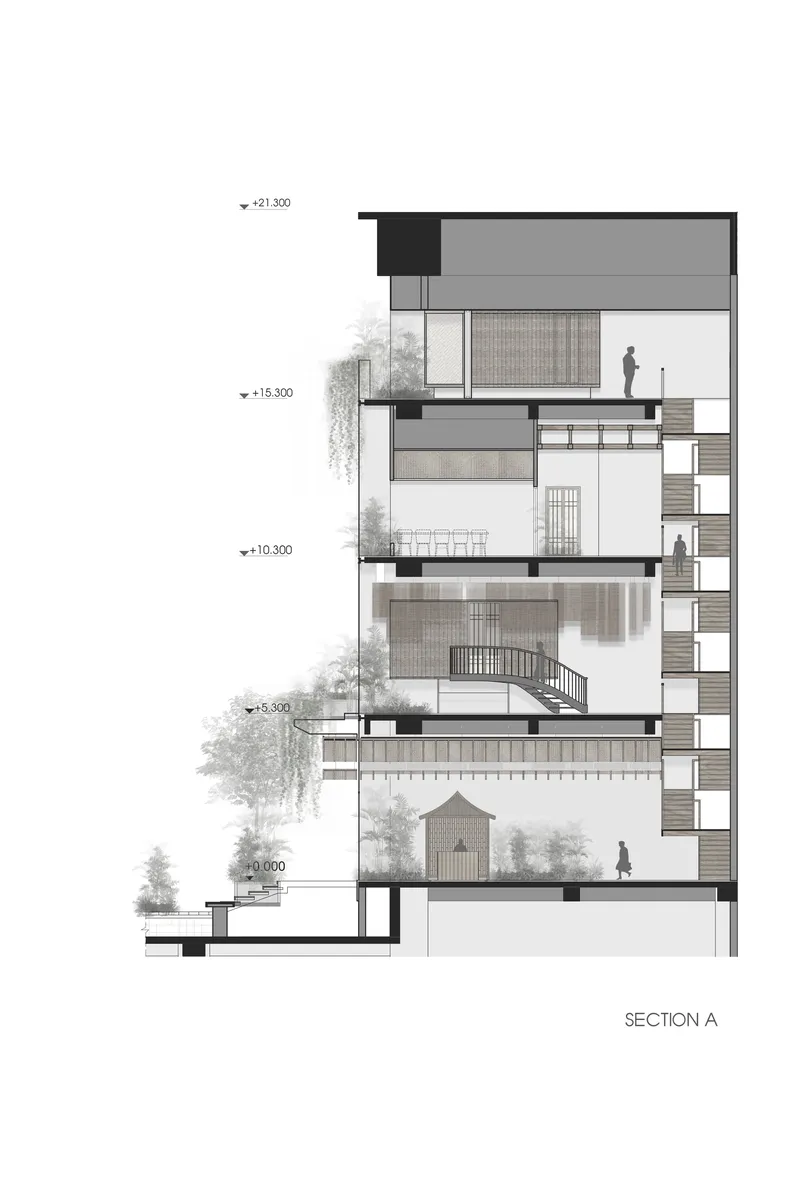
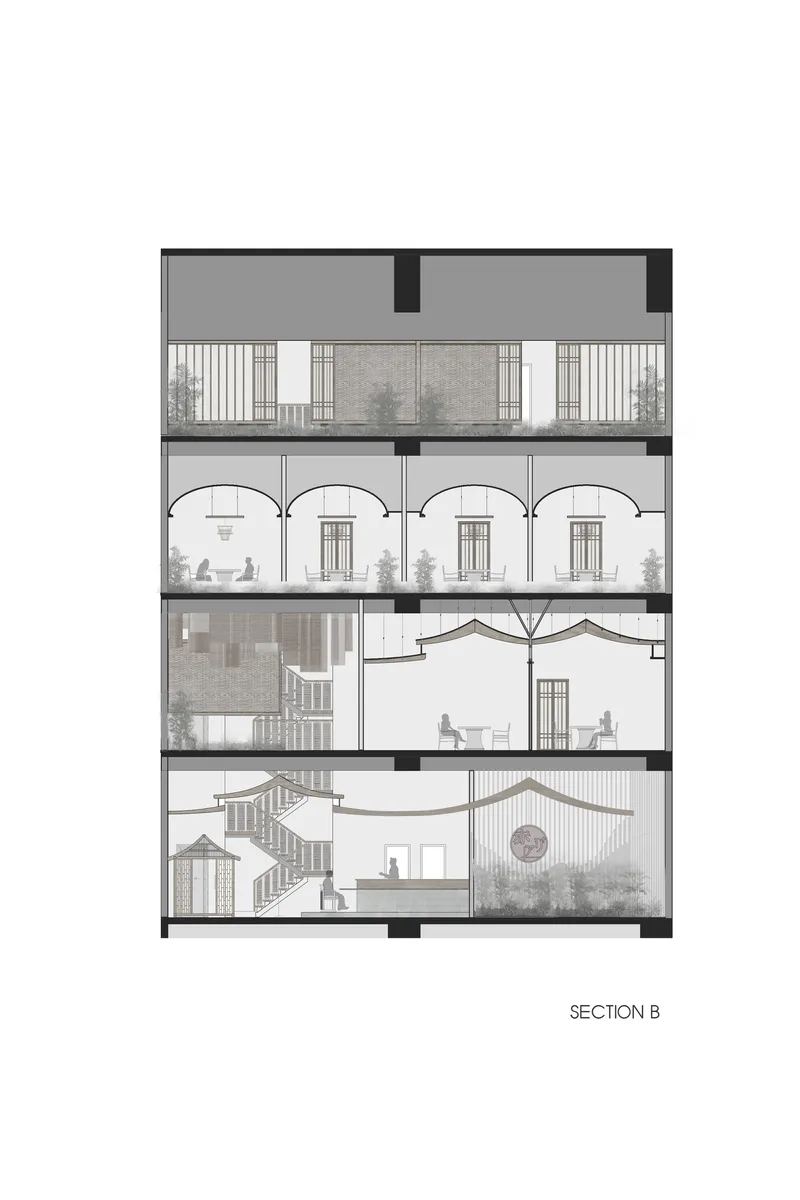
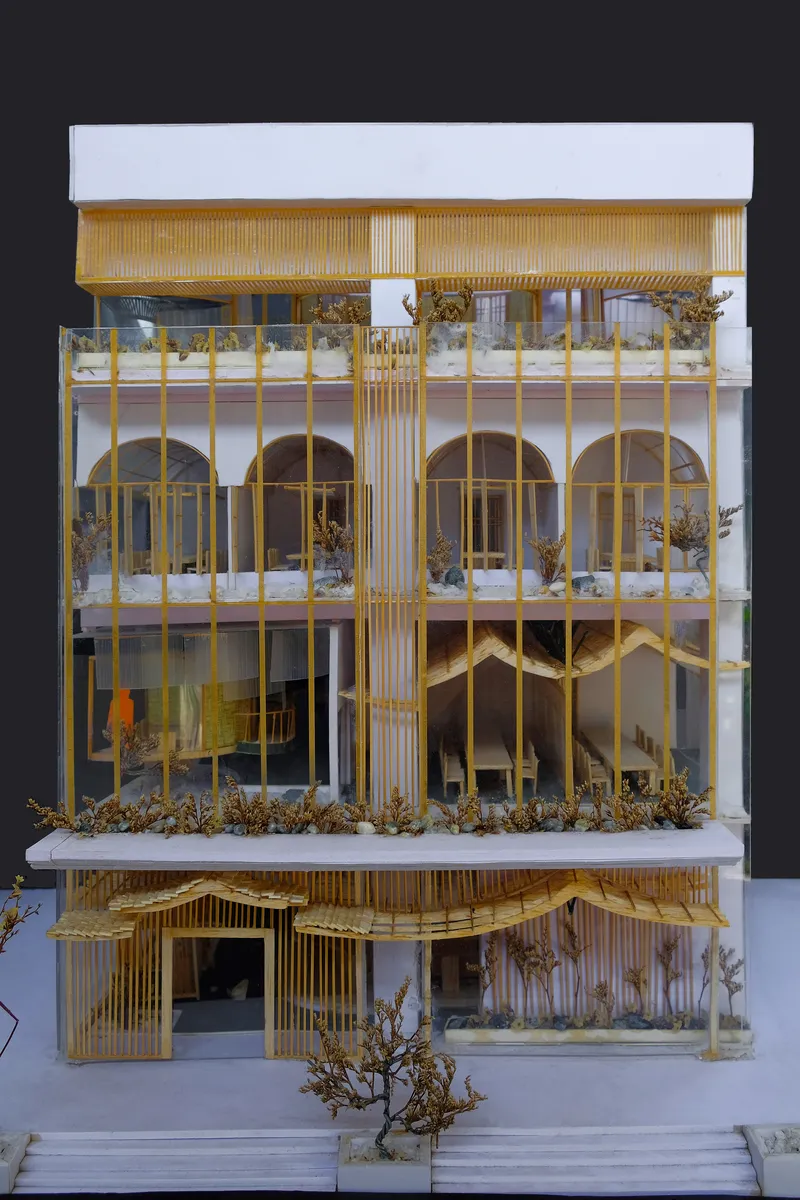

The floor plans reveal the organizational logic clearly: a central sushi bar on the first floor surrounded by seating and flanked by two exterior planting areas, progressively more private dining rooms on upper levels served by a central service corridor, and curved wall partitions that give each room its own geometry while maintaining a coherent circulation path. The sections are particularly revealing, showing how the 4.5-meter floor heights create tall, breathable volumes that the architects exploit for both spatial drama and passive ventilation.
The physical section models confirm what the photographs suggest: the building is organized as a vertical stack of garden-facing rooms threaded by a staircase that doubles as an air chimney. The arched floor openings visible in the model show how the architects cut into the existing concrete structure to introduce the curved geometries that define the interior experience.
Why This Project Matters
Akaari Premium demonstrates that cultural translation in architecture does not require literal quotation. NH Village Architects identified the shared material traditions between Vietnam and Japan, specifically bamboo, ceramics, and woven craft, and used those overlaps as the generative logic for an entire building interior. The result avoids the pastiche that plagues many themed restaurants. There are no cherry blossoms stenciled on walls, no gratuitous torii gates. Instead, there is a rigorous material investigation that produces its own aesthetic, rooted in the specific skills of Hanoi's craft villages and the specific proportions of the existing shophouse structure.
More broadly, the project offers a model for how architects can engage artisan economies as genuine collaborators rather than suppliers. The woven panels, ceramic floors, and handmade light fixtures are not add-ons to a finished design; they are the design. When the knitting ratio of a rattan partition determines how much light enters a room and how much privacy a diner feels, craft becomes structure. That is a proposition worth more than decoration.
Akaari Premium Restaurant by NH Village Architects (lead architects Tran Dai Nghia and Nguyen Phuong Hieu). Hanoi, Vietnam. 720 m². Completed 2022. Photography by Hiroyuki Oki.
About the Studio
Share Your Own Work on uni.xyz
If projects like this are the kind of work you want to make, uni.xyz is a place to publish your own, find collaborators, and enter design competitions.




Popular Articles
Popular articles from the community


AL-JANNAH: Sustainable Architecture and Permaculture for Afghan Widows
AL-JANNAH uses sustainable architecture and permaculture to create resilient oasis of housing, learning, work and renewal for Afghan widows.

The Earth Pod: 3D Printed Homes for Resilient Refugee Communities
The Earth Pod reimagines refugee housing through 3D printed homes made from clay, combining resilience, self-sufficiency, and rapid shelter.

Co-Life: Senior Housing Design That Reconnects Older Adults With the City
Co-Life reimagines senior housing design through healing gardens, shared streets, workshops, and a sustainable community across generations.

The Musturak Paradise: Senior Living Architecture for a Connected Future in Temara, Morocco
The Musturak Paradise reimagines senior living architecture in Temara via private homes, social spaces, culture, community, and shared care.


Similar Reads
You might also enjoy these articles

Bao Huynh Watercolor Atelier: A Serene Art Retreat in Hội An
Bao Huynh Watercolor Atelier in Hội An blends multifunctional art spaces, sustainable design, local materials, and family-friendly living in a serene environment.

Atelier Macri Concept Store Interior Design by CASE-REAL
Atelier Macri store features a "ko" counter, walnut wood details, cork displays, blending retail, gallery, and seamless customer experiences.

Manuel Vargas Izquierdo Stadium and High-Performance Sports Center: Architectural Excellence in Jalpa de Méndez
The Manuel Vargas Izquierdo Stadium blends sustainable design, inclusive sports facilities, and cultural-inspired architecture, revitalizing Jalpa de Méndez’s public spaces.
KAKR Buluh Awar Hall: Revitalizing Community and Ecology Through Bamboo Architecture
Community built bamboo hall revitalizes Buluh Awar village, empowering youth, restoring ecology, celebrating vernacular craftsmanship through sustainable architecture and culture.

Comments (0)
Please login or sign up to add comments
No comments yet. Be the first to comment!