
NiiiZ Design Lab Builds a K-Pop Universe Beneath a Seoul Forest Tower
A 214-square-meter concept store in Seongdong-gu uses OLED floors, octagonal voids, and immersive projections to materialize SM Entertainment's fictional c


K-pop has never been content with simply selling music. The industry's most ambitious labels build entire fictional worlds, lore-laden narratives that fans decode across albums, music videos, and now physical retail. SM Entertainment's 'KWANGYA' is one such universe: a conceptual dimension that links the storylines of its artists. Translating something that abstract into a built environment is a legitimate design problem, and NiiiZ Design Lab has taken a serious swing at it. Tucked into the basement level of Seoul Forest D-Tower in Seongdong-gu, this 214-square-meter concept store functions simultaneously as a retail space, a brand shrine, and an architectural mood ring.
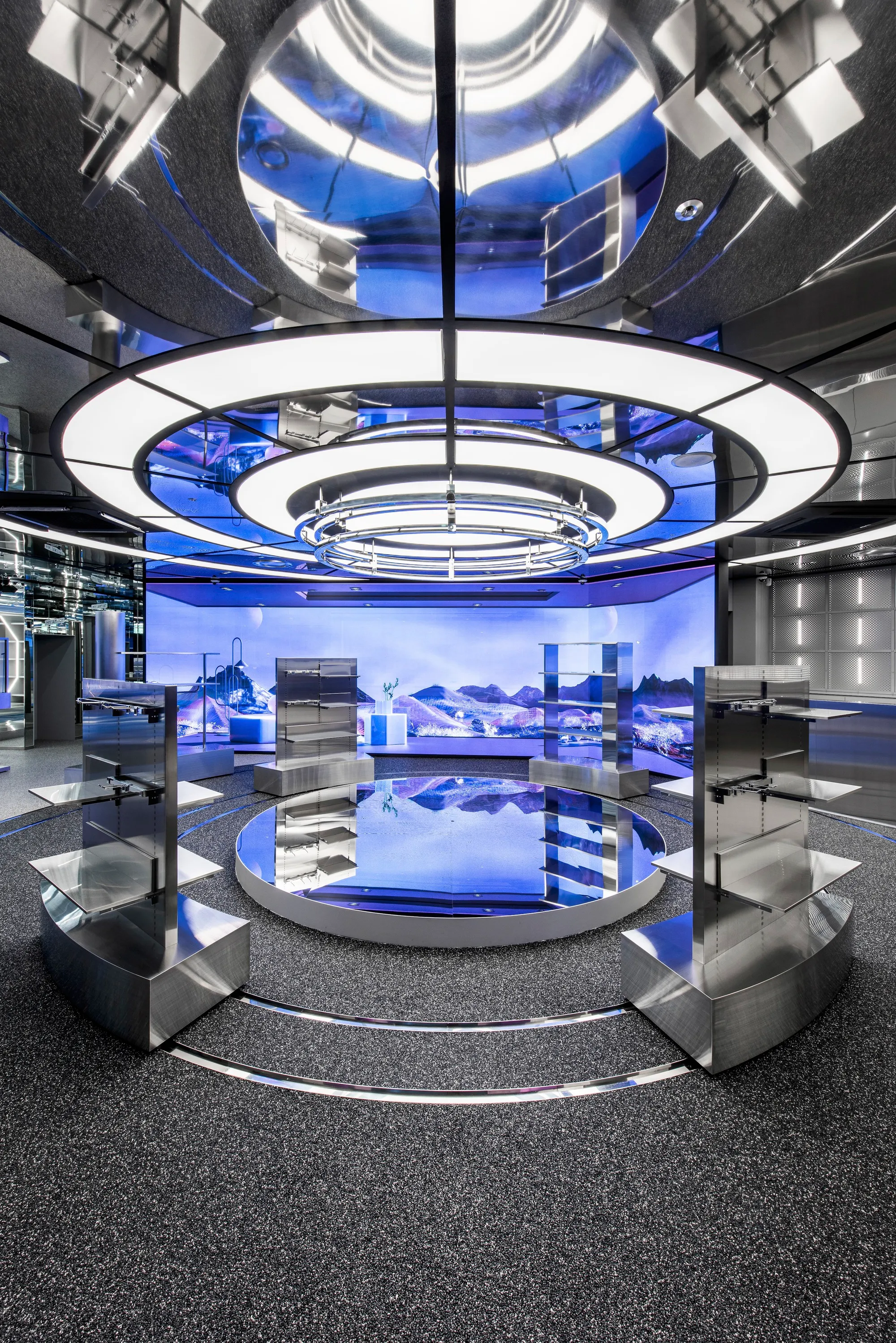
What makes the project worth examining is not the spectacle itself, which is considerable, but the precision with which spectacle is choreographed. The store is organized around a central void punched through the floor, ringed by concentric ceiling fixtures, wrapped in projection screens, and surfaced almost entirely in reflective materials. Every decision serves a single spatial thesis: dissolve the boundaries of the room so that 214 square meters feels like an infinite, mutable landscape. Whether it succeeds depends on how you feel about architecture that is designed to disappear.
The Octagonal Void
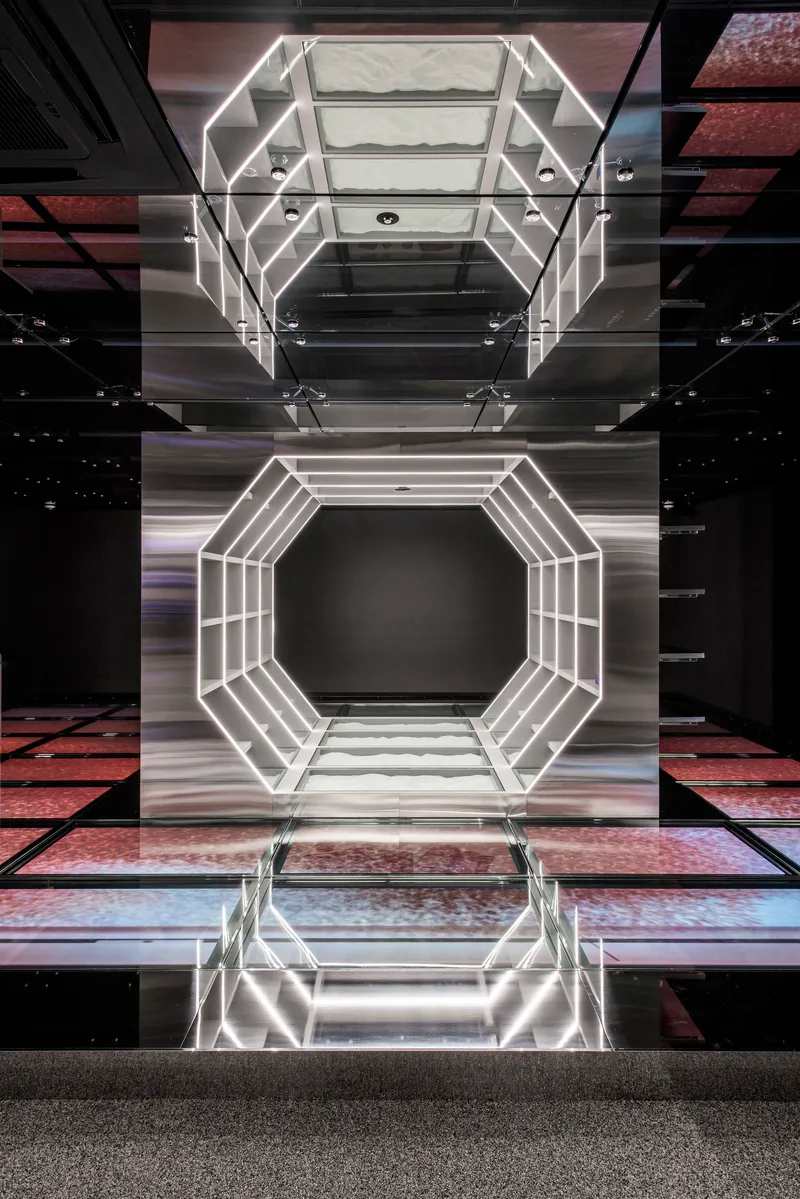
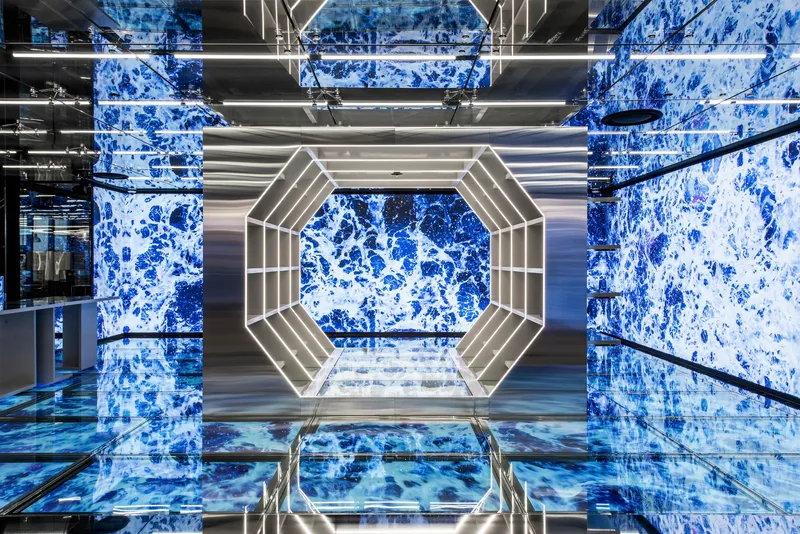
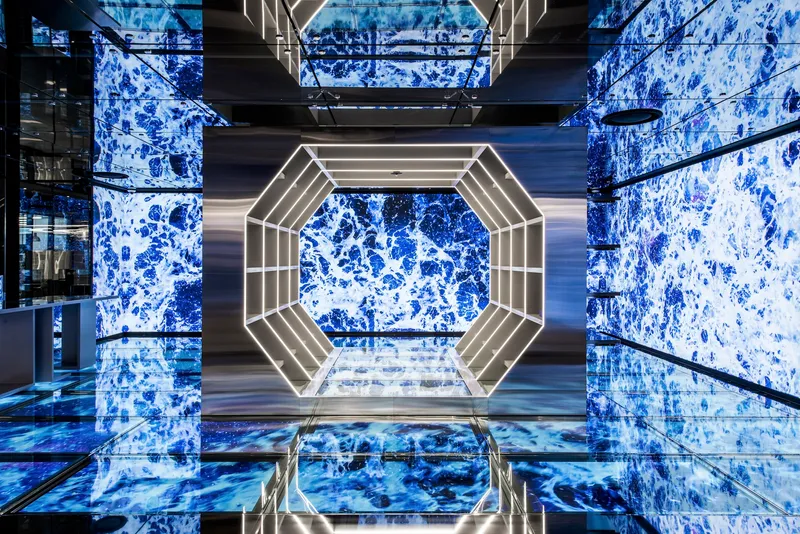
The store's most commanding gesture is an octagonal atrium that cuts vertically through the space, turning a compressed basement floor plate into something with genuine spatial drama. Viewed from below, the void draws the eye upward through a layered frame of illuminated edges, each ring slightly offset, creating the illusion of depth far exceeding the actual ceiling height. Polished flooring at the base catches and doubles the geometry, so the void reads as a shaft that extends in both directions.
This is not decorative openness. The octagonal cut organizes circulation, frames sightlines to the projection walls, and gives the interior a gravitational center. Without it, the store would be a flat box with screens. With it, there is a spatial event that anchors every other decision in the project.
Projections as Architecture
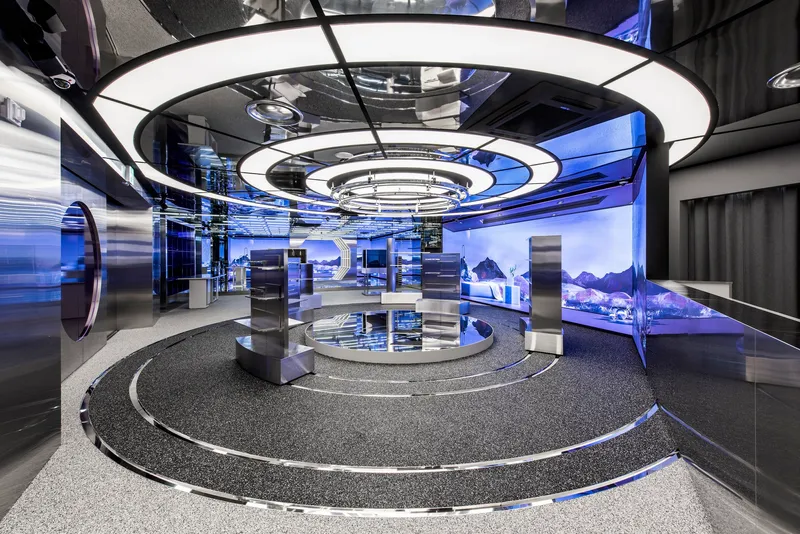
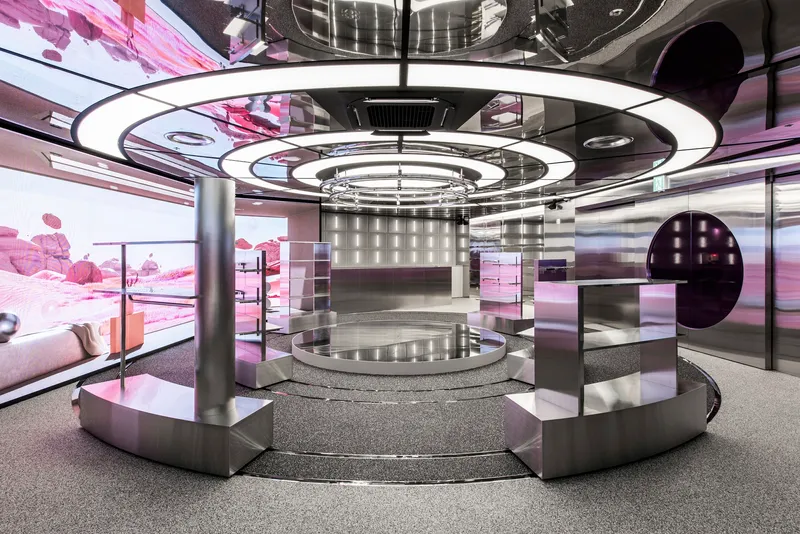
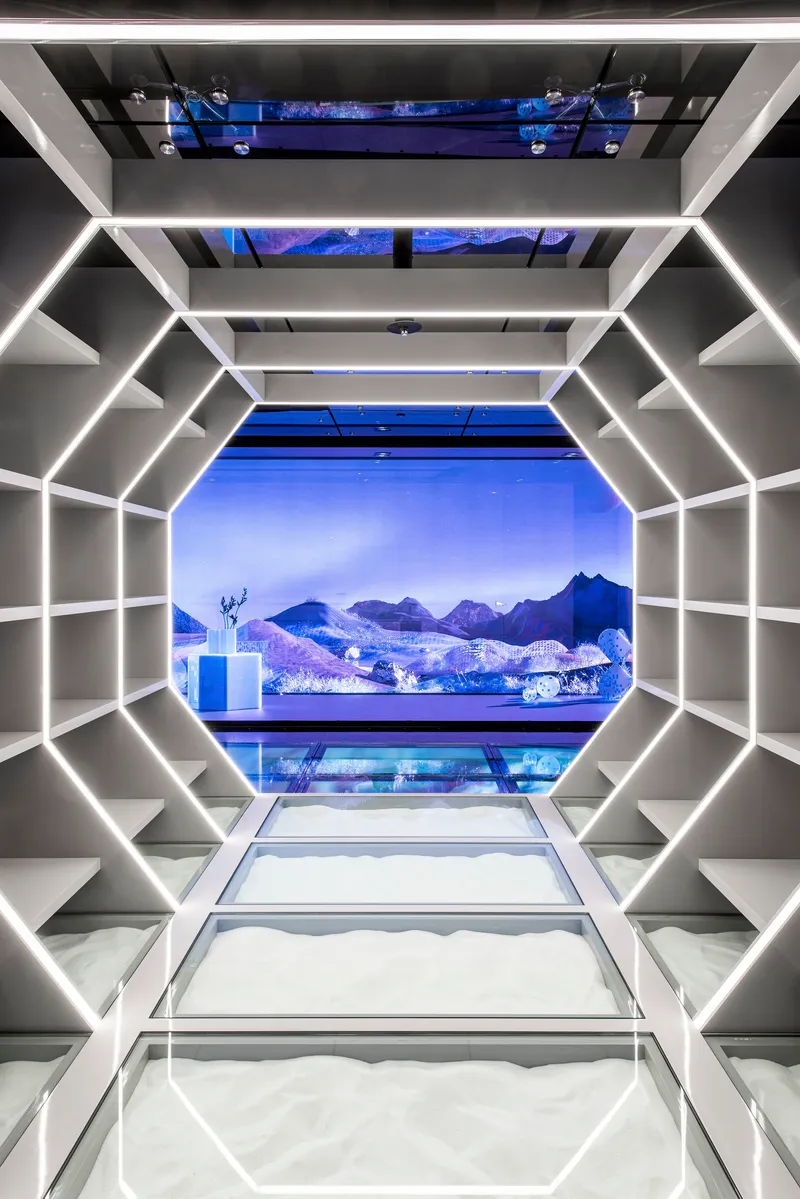
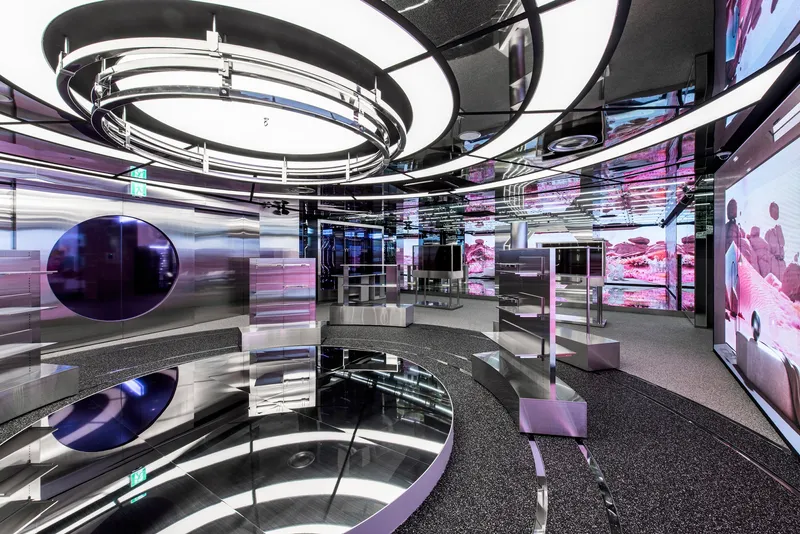
Wraparound projection screens line the perimeter walls, cycling through immersive landscapes that shift the room's atmosphere from glacial blue to pink to violet. These are not accent screens or digital signage. They replace the wall itself as the dominant surface, transforming the enclosure of the room into something closer to a theater scrim. The stepped central platform, ringed by concentric ceiling lights, becomes a stage within this envelope, encouraging visitors to stand at the center and let the projected environment surround them.
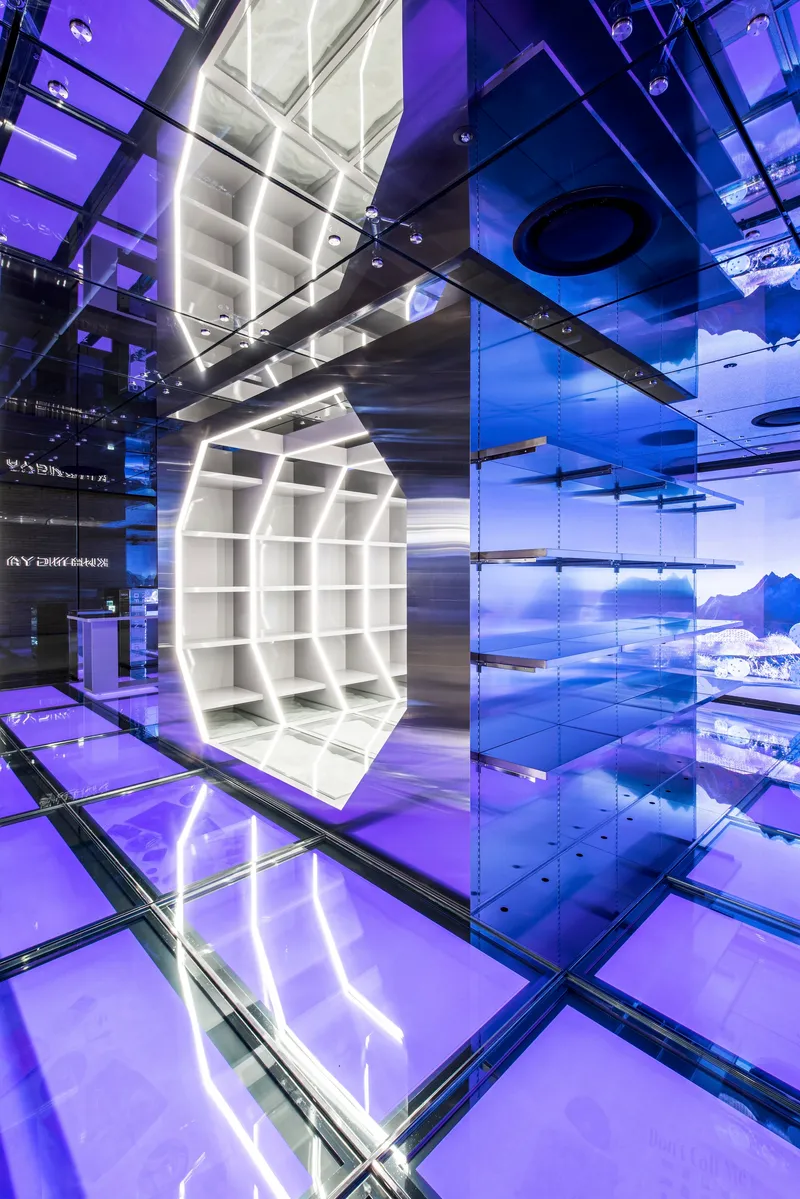
NiiiZ understands that projection only works as spatial material when the architecture cooperates. The physical surfaces are deliberately neutral: brushed steel, black polish, minimal texture. Nothing competes with the light. The LED-edged octagonal passageway visible from one approach frames a projected mountain vista so precisely that it reads as a portal rather than a doorway. That kind of calibration, where the built form and the digital layer reinforce rather than fight each other, separates this from the typical branded LED box.
Glass Floors and Vertical Transparency
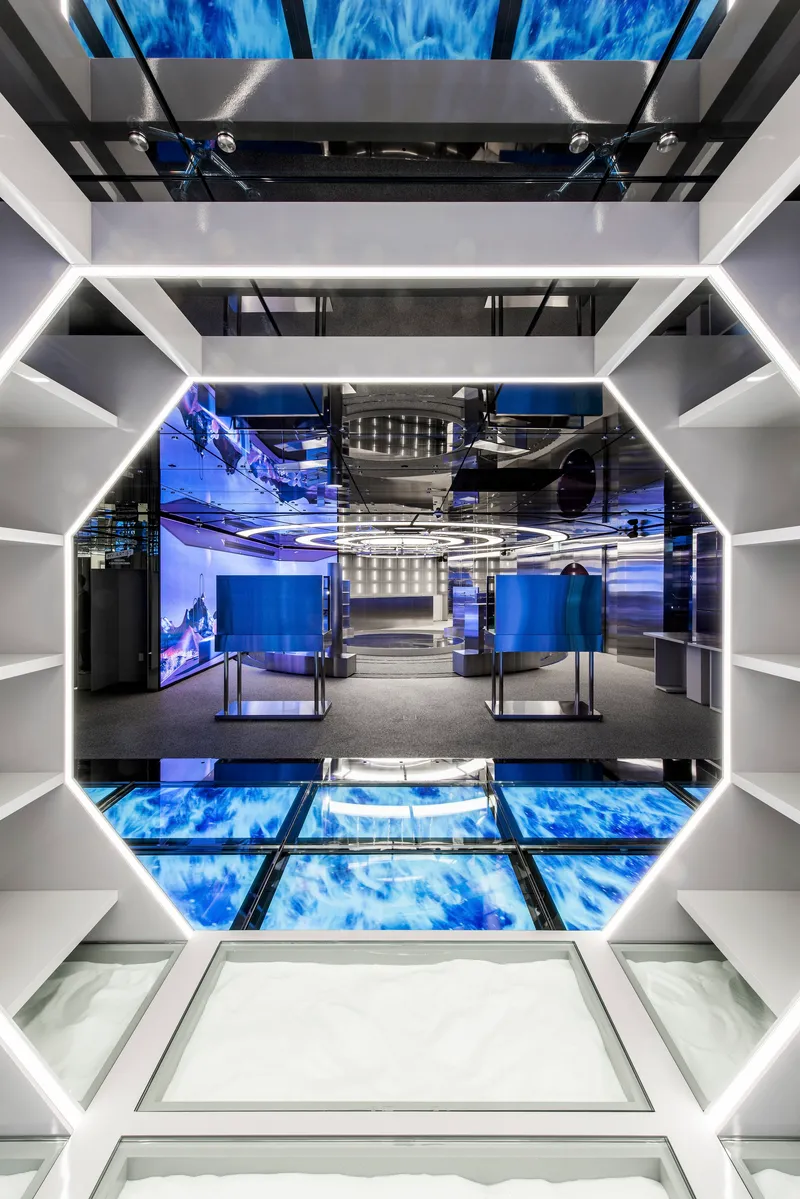
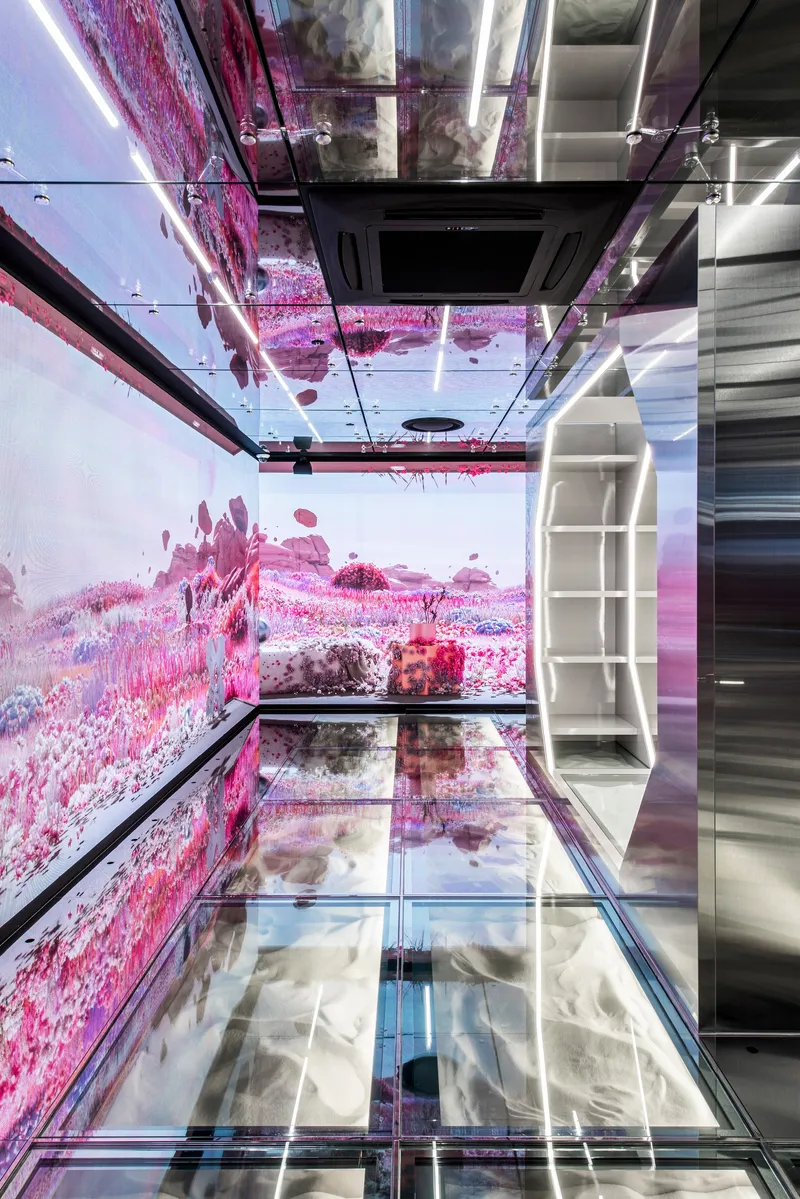
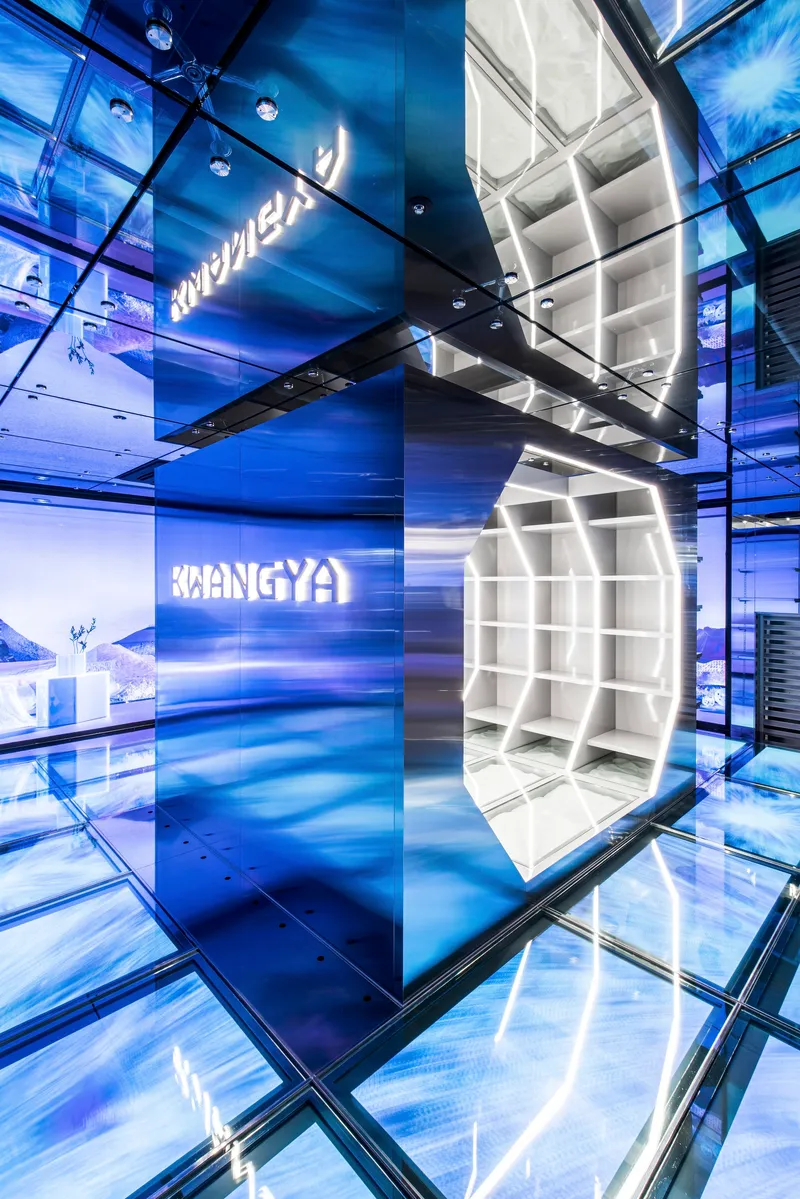
The glass floor panels are the project's riskiest move and arguably its most rewarding. Looking down through the transparent surface, you see projection imagery and suspended display elements in the level below, collapsing the sense of a single floor into a vertically stacked landscape. A white shelving cube hangs within the atrium void, visible through the glass, its clean geometry contrasting sharply with the liquid colors on the surrounding screens.
Thirty-three OLED panels embedded in the floor add another register. The floor itself becomes a display surface, which means the boundary between "walking on" and "looking into" dissolves. It is a disorienting effect, and that disorientation is the point. KWANGYA is supposed to feel like another dimension. The glass floor literalizes that ambition by making the ground beneath your feet uncertain.
Concentric Rings and Reflected Geometry
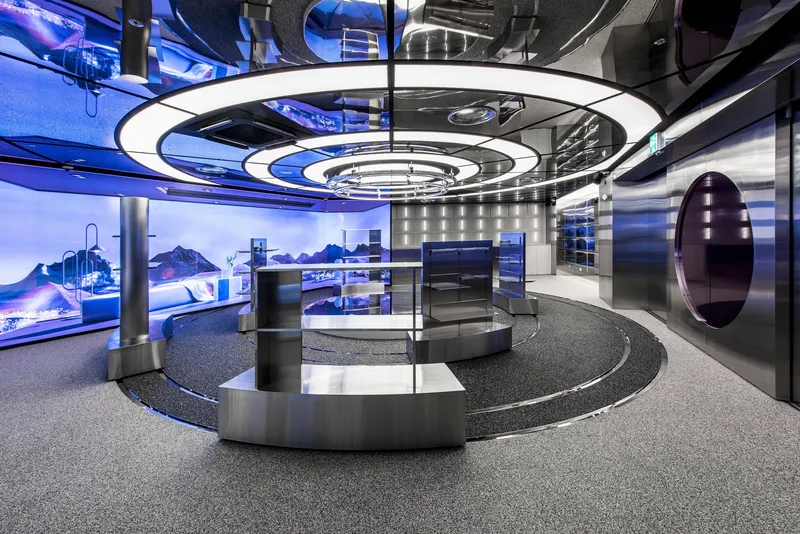
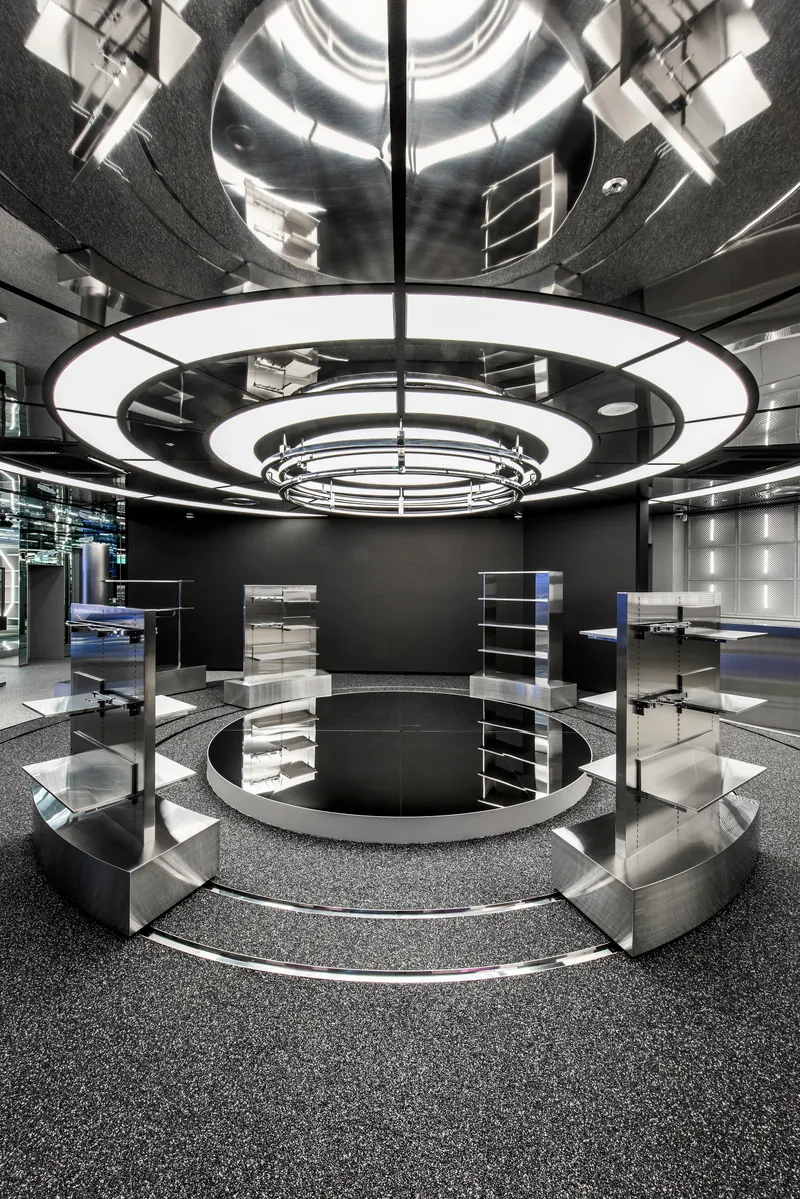
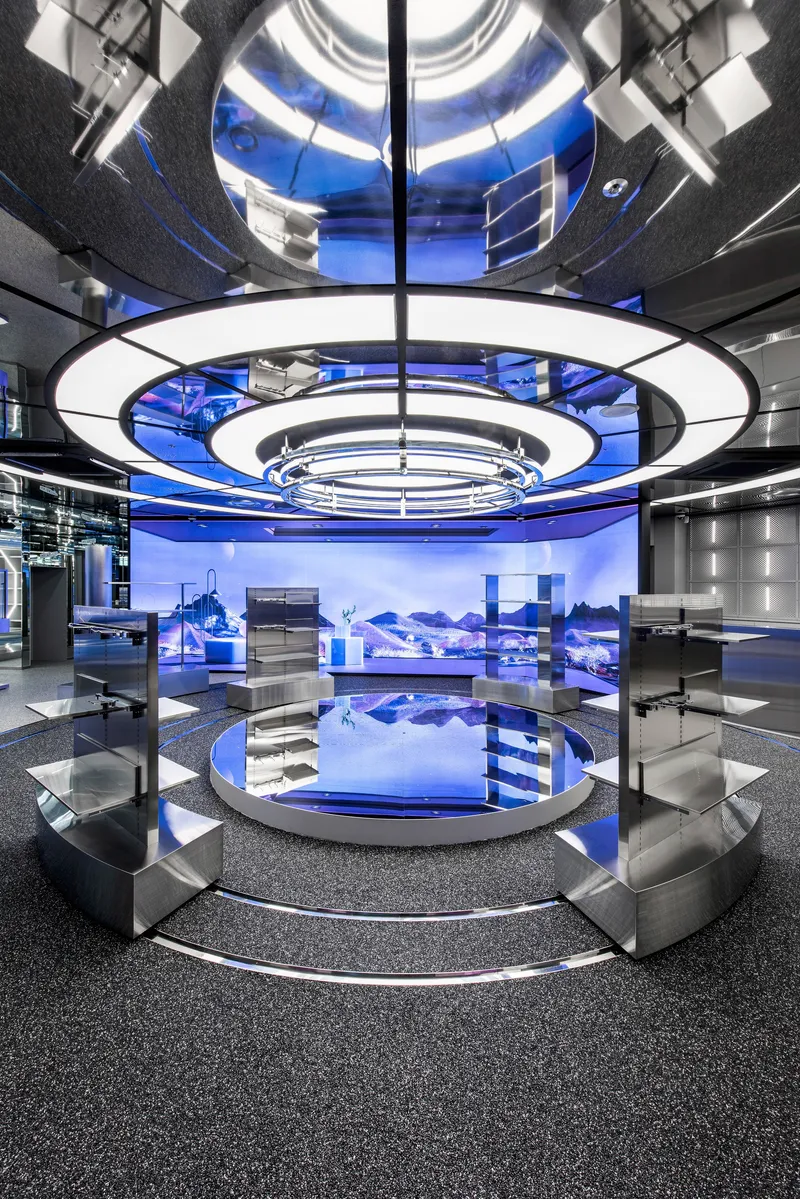
The concentric ring ceiling fixtures are the store's signature motif, repeated across several zones with subtle variations in scale and color. In the main showroom, they hover above a circular counter, their form doubled in the black polished floor below to produce a tunnel-like depth. Mirrored surfaces at the periphery stretch the rings further, so the actual diameter of the room becomes impossible to read at a glance.
NiiiZ is leaning hard on one optical principle here: if you reflect a circle in a polished plane, you get a sphere. The ring fixtures, doubled in the floor, create the sensation of standing inside a luminous orb. It is a simple trick executed with discipline. The material palette, restricted almost entirely to reflective black and brushed metal, exists to serve this one effect. Nothing is left to chance.
Materiality: Steel, Glass, and Restraint
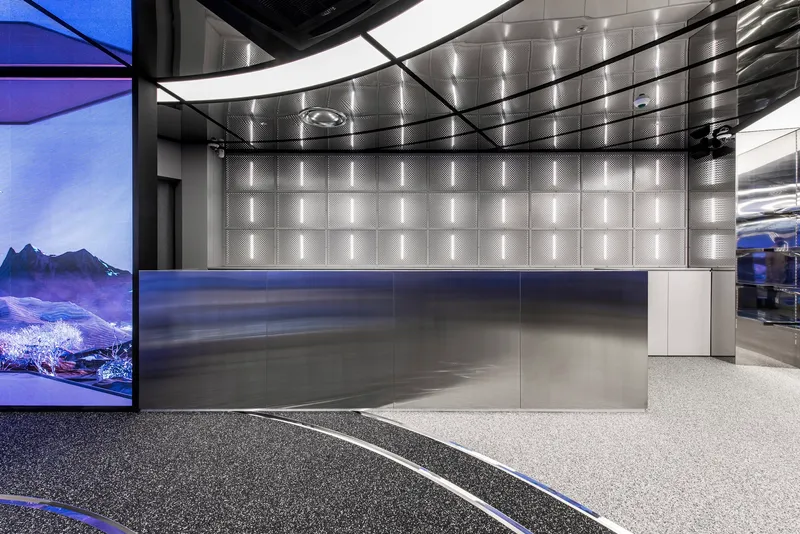
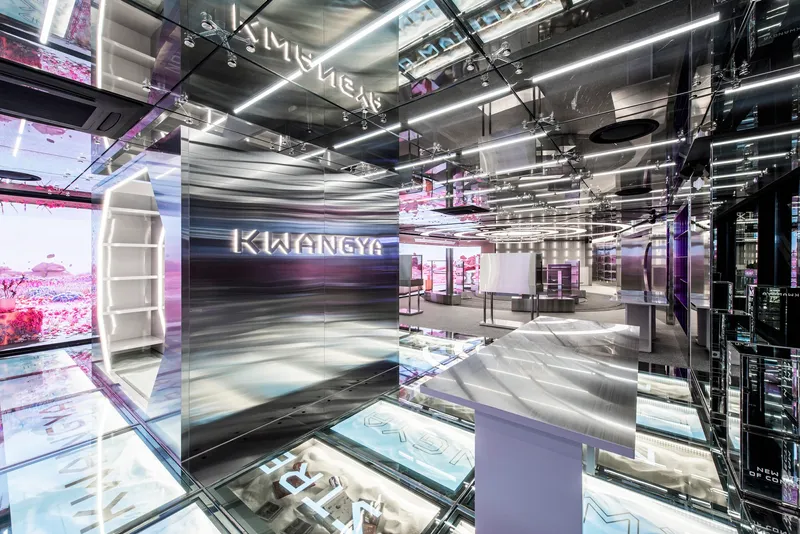

The material vocabulary is deliberately narrow. Brushed stainless steel clads the reception desk and ceiling panels. Quilted metal panels introduce a subtle texture at the threshold without breaking the reflective logic. Curved black metal banding wraps around purple glass panels in the stairwell, one of the few moments where the palette admits a warm, saturated color into the built fabric rather than projecting it.
The restraint is strategic. In a space where light and projection do most of the atmospheric work, the physical materials must either amplify or disappear. NiiiZ chose amplification through reflection. Every surface bounces light, doubles imagery, and multiplies the apparent volume of the room. The toughened glass used for display partitions adds another layer of transparency, keeping sightlines continuous across what could easily have become a cluttered retail floor.
Storefront and Threshold
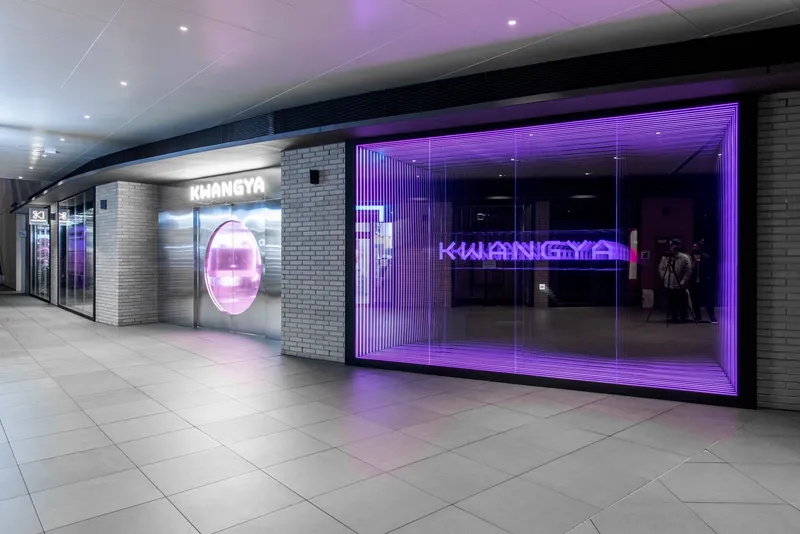
From the mall corridor, the store announces itself with a purple LED-lit glass facade set against grey brick. The contrast is stark and effective: the muted masonry context makes the glowing entry feel like a rupture in the everyday fabric of the building. The threshold is not gradual. You step from a neutral commercial hallway into saturated purple light, and the transition is immediate.
That abruptness is consistent with the project's larger ambition. KWANGYA is framed as another world, and the storefront treats it accordingly. There is no transitional lobby, no buffer. The facade is a boundary line between the ordinary and the constructed fictional, and NiiiZ makes that line as sharp as possible.
Plans and Drawings
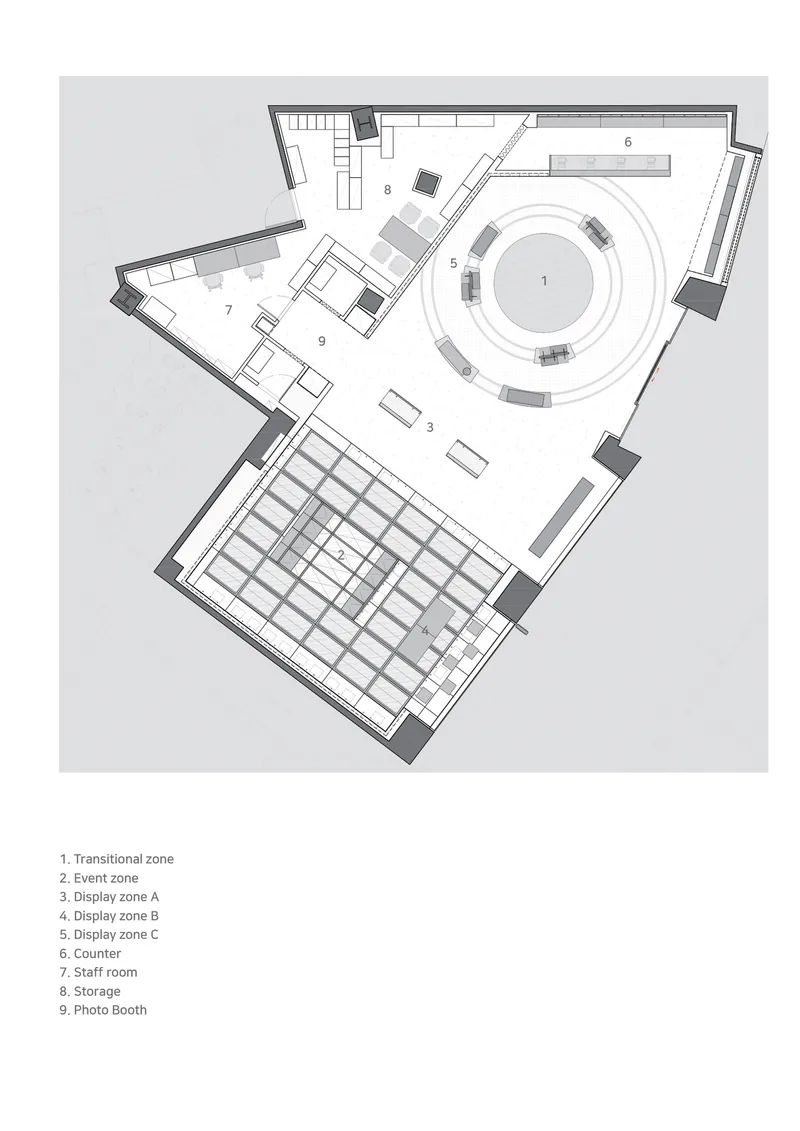
The floor plan reveals the irregular perimeter that NiiiZ had to work within: a basement footprint shaped by the tower above, not by any interior logic. The circular counter zone and grid of display tables are legible as the two primary organizational devices, one curved and centripetal, the other orthogonal and dispersed. The tension between these two geometries gives the plan its energy. Without the concentric ceiling rings overhead unifying everything optically, the plan would read as fragmented. The white shelving cube suspended in the atrium appears almost incidental on plan but becomes the spatial linchpin when experienced in section.
Why This Project Matters
Branded retail interiors are, overwhelmingly, disposable. They are designed for a product cycle, not for longevity, and that is fine. But within that ephemeral category, SM KwangYa@Seoul demonstrates something worth paying attention to: the possibility of using immersive technology as a genuine spatial strategy rather than a surface treatment. The octagonal void, the glass floors, the reflected ring ceilings are not decoration layered on top of a box. They are the architecture. Remove the projections and the OLED panels and the space still has geometric ambition. Turn them on and the geometry multiplies.
For designers working at the intersection of physical space and digital experience, this project offers a useful case study in discipline. NiiiZ kept the material palette tight, committed to a single reflective logic, and let the technology do its work within a framework that makes architectural sense on its own terms. The result is a 214-square-meter room that genuinely feels like a place apart. Whether you care about K-pop is beside the point. What matters is the craft of making a small basement floor plate feel boundless, and the conviction to pursue that idea without hedging.
SM KwangYa@Seoul Concept Store by NiiiZ Design Lab. Located in Seongdong-gu, Seoul, South Korea. 214 m². Completed in 2022. Photography by studio gothic / Jae Sung LEE and Tak Hyun Kim.
About the Studio
Share Your Own Work on uni.xyz
If projects like this are the kind of work you want to make, uni.xyz is a place to publish your own, find collaborators, and enter design competitions.




Popular Articles
Popular articles from the community


Riyadh For All: Intergenerational Urban Design for Active Aging in Rabat
Riyadh For All reimagines urban design in Rabat with intergenerational co-living, adaptive courtyards, and Moroccan cultural exchange today.

The Earth Pod: 3D Printed Homes for Resilient Refugee Communities
The Earth Pod reimagines refugee housing through 3D printed homes made from clay, combining resilience, self-sufficiency, and rapid shelter.

Lunar Spiral: Space Architecture Shaped by the Mathematics of the Universe
Lunar Spiral reimagines space architecture through Fibonacci geometry, lunar regolith, levitating habitats, and self-sustaining Moon living.

The Musturak Paradise: Senior Living Architecture for a Connected Future in Temara, Morocco
The Musturak Paradise reimagines senior living architecture in Temara via private homes, social spaces, culture, community, and shared care.


Similar Reads
You might also enjoy these articles

Bao Huynh Watercolor Atelier: A Serene Art Retreat in Hội An
Bao Huynh Watercolor Atelier in Hội An blends multifunctional art spaces, sustainable design, local materials, and family-friendly living in a serene environment.

Atelier Macri Concept Store Interior Design by CASE-REAL
Atelier Macri store features a "ko" counter, walnut wood details, cork displays, blending retail, gallery, and seamless customer experiences.

Manuel Vargas Izquierdo Stadium and High-Performance Sports Center: Architectural Excellence in Jalpa de Méndez
The Manuel Vargas Izquierdo Stadium blends sustainable design, inclusive sports facilities, and cultural-inspired architecture, revitalizing Jalpa de Méndez’s public spaces.

KAKR Buluh Awar Hall: Revitalizing Community and Ecology Through Bamboo Architecture
Community built bamboo hall revitalizes Buluh Awar village, empowering youth, restoring ecology, celebrating vernacular craftsmanship through sustainable architecture and culture.


Comments (0)
Please login or sign up to add comments
No comments yet. Be the first to comment!