
NO_NAME: A Learning Landscape Where No Room Is Told What to Be
A modular steel grid, scattered geometric volumes and one continuous slope let students, not programmes, decide what each space becomes.


Most schools are written before anyone walks in. The classroom, the corridor, the auditorium and the lab all arrive with their behaviour already scripted. NO_NAME starts from the opposite premise: a school in which no space carries a label, a fixed function or a permanent identity, and in which the people inside decide what each room is for, hour by hour. The proposal treats architecture less as a set of instructions and more as a field of conditions waiting to be read.
Designed by Gaye Gültekin and İmre Bilgin, the project was shortlisted in School of Thought 2020. Their entry frames educational architecture as a participatory system rather than an institutional container, built from a modular grid, a family of geometric volumes and a single continuous slope that ties everything together and reaches out toward the surrounding tree clusters.
A Gridded Frame That Refuses to Name Its Rooms

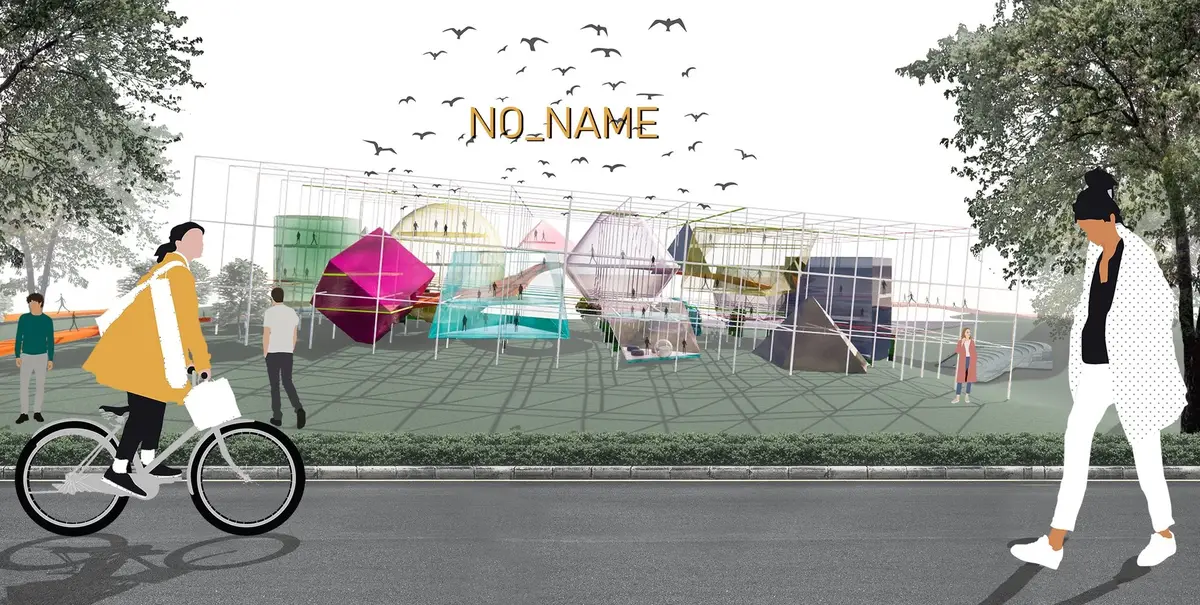
The section elevation lays the strategy bare. A regular gridded frame provides structural coherence, and inside it the designers suspend triangular, hexagonal and circular volumes of varying size and height. Each of these units is a "no_name": a space defined by its qualities of enclosure, openness, height and light exposure rather than by a programme. A tall, glazed volume and a low, enclosed one are not a library and a seminar room; they are simply different atmospheres offered to whoever arrives.
This is a smart inversion of how schools are usually planned. Instead of a brief that dictates spatial types, the grid sets up a neutral order and the volumes supply variety within it. The drawing's lone figure walking beneath the frame, under a pale sun and passing birds, captures the intended mood: the building as a landscape one moves through, not a sequence of doors one is assigned to.
The Slope Works as Corridor, Seat and Stage at Once
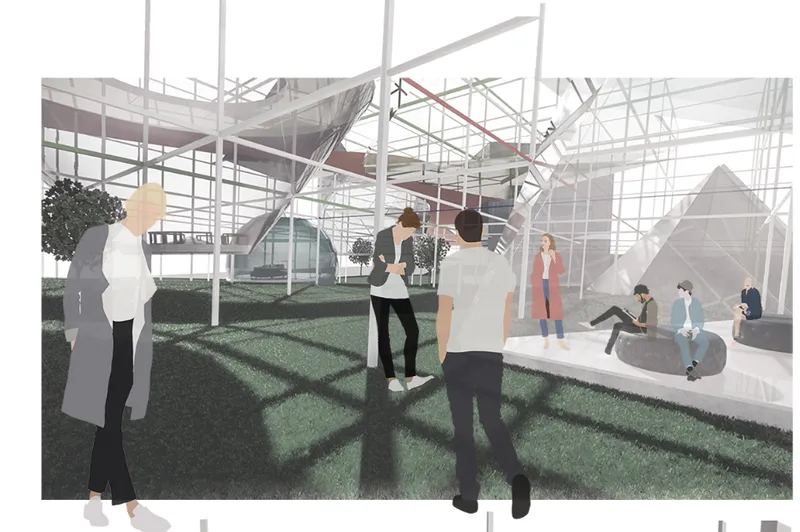
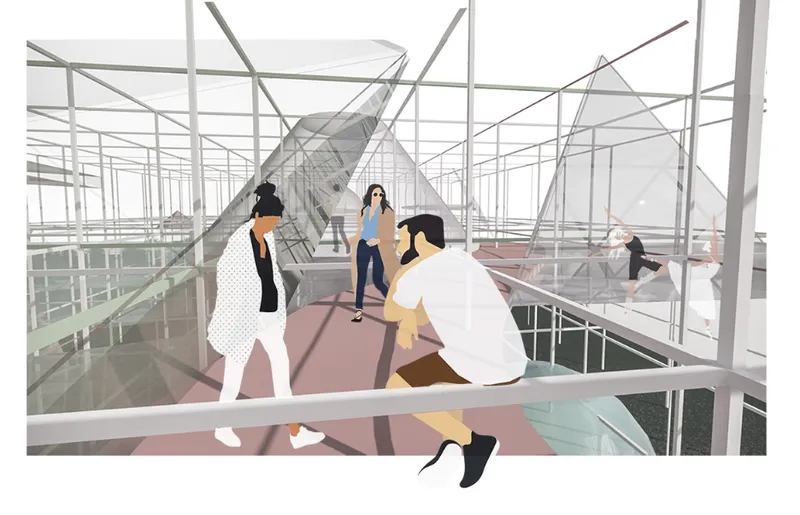
The renders move inside the white steel lattice, where a lawn spreads beneath the structure and people sit on stone seats beside a glass pyramid. Above, the pink elevated walkway threads between translucent pyramidal volumes. This walkway is the visible edge of the project's central spine, the continuous slope that connects every unit while doubling as a place to linger.
Here the project makes its most persuasive argument. By refusing to separate circulation from occupation, the slope turns movement into a social layer: passing someone becomes an opportunity to stop, and a route becomes a room. The dancer stretching in the distance of the walkway render is a small detail, but it shows exactly what the designers want. A surface meant for getting somewhere is quietly claimed for something else.
The Same Volume Can Host a Morning Reader and an Evening Performance
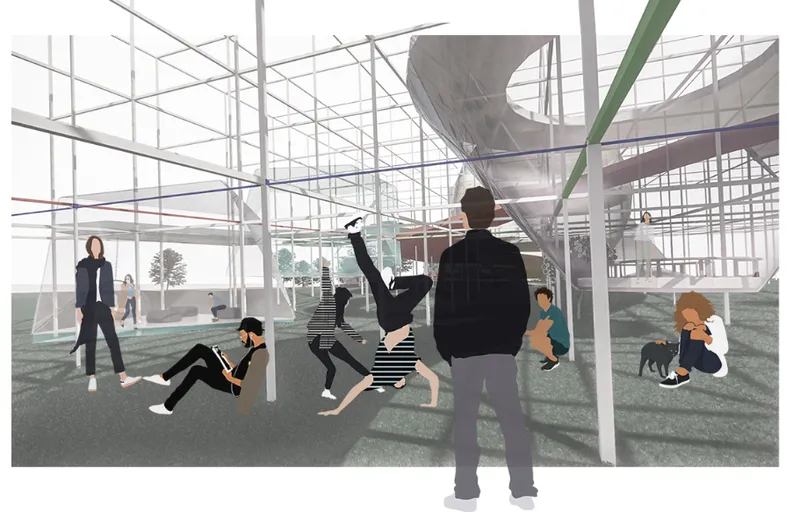

At ground level, the framed hall reads as a loose public interior. A person does a handstand on the grass, others read nearby, and a spiral ramp coils overhead. Along the pink walkway, a curved glass-clad volume reveals seated figures inside while visitors lean on the rail outside. Two kinds of occupation, inside and alongside, share the same moment without either being prescribed.
The designers describe a building that offers a different experience with each visit, where events arise spontaneously and a volume used as a quiet reading zone in the morning might become a performance space later in the day. The renders sell this idea through behaviour rather than diagrams, which is the right instinct. Whether the system can absorb the acoustic and scheduling friction such overlaps create is a question the scheme leaves open, but the spatial invitation is clear and generous.
Where the Path Dissolves Into the Tree Clusters
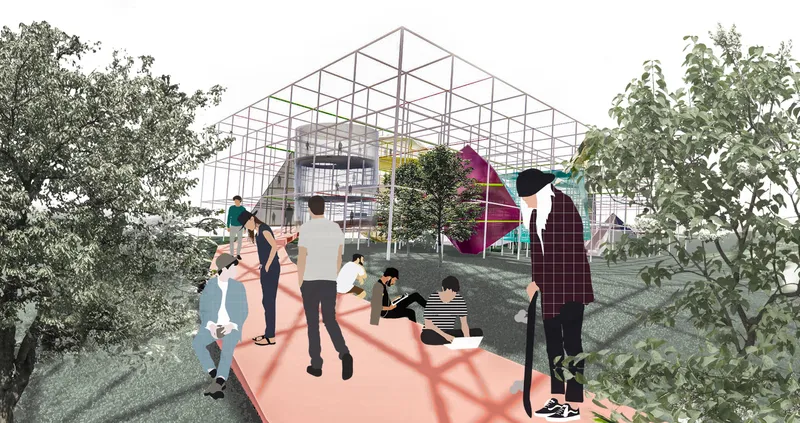
The final render follows the pink path out between leafy trees toward a wireframe pyramid. People read on the ground and an elderly man leans on a cane as he walks. The slope does not stop at the building's edge; it extends into the surrounding tree clusters, carrying the logic of unprogrammed space into the landscape itself.
This extension matters because it blurs a second boundary. Having dissolved the line between functions, the project now dissolves the line between architecture and context. The wireframe pyramid, stripped to its edges, reads almost as a drawing of a volume rather than a volume, a fitting marker for a place where the outdoors becomes just another no_name to occupy. The presence of an older visitor also hints at a school open beyond a single age group, though the source material stops short of defining that audience.
Why This Project Matters
NO_NAME treats the building as a pedagogical tool in its own right. Users are not passive occupants moved between assigned rooms; they shape the environment through movement, interaction and appropriation. That shift aligns the architecture with contemporary models of self-directed and collaborative learning, where adaptability counts for more than standardisation, and it does so through a legible kit of parts: a grid, a set of volumes and one continuous slope.
The proposal's strength lies in its restraint. Rather than designing every scenario, Gültekin and Bilgin design the conditions under which scenarios can happen, then trust users to fill them in. The next step for a scheme like this would be testing how far that openness can stretch before it needs rules of its own. As a shortlisted entry, though, it makes a clear and compelling case that the most instructive thing a school can do is leave its rooms unnamed.
View the Full Project
About the Designers
Designers: Gaye Gültekin, İmre Bilgin
Enter a Design Competition on uni.xyz
uni.xyz runs architecture and design competitions year-round that reward proposals with spatial conviction and real site intelligence.
Project credits: NO_NAME by Gaye Gültekin, İmre Bilgin School of Thought 2020 (uni.xyz).


Popular Articles
Popular articles from the community


The Amber Palace Opera: A Geological Fiction Surfaces on Tallinn's Baltic Waterfront
Pierre Brillard reimagines a Baltic legend as a public landscape, opera house, and waterfront promenade rooted in Tallinn's coastal identity.

Temporary Home for Dogs: A Reversed Zoo Rethinks Animal Shelter Architecture
In Bucharest, a sinuous corridor and freed landscape flip the logic of containment, designing a shelter that works to make itself unnecessary.

Tsunami Convergenics: Turning Catastrophic Ocean Forces into Underwater Housing Infrastructure
A speculative underwater settlement off the coast of Onagawa, Japan, treats tsunamis and typhoons as energy sources rather than threats.

Cloaked Colonization: A Mobile Underwater Habitat That Moves Like a Fish
Micah Abaya's shortlisted EHC Pacific entry reimagines ocean settlement as a dispersed network of self-sustaining architectural organisms.

Similar Reads
You might also enjoy these articles

Healing Façade: A Modular Chapel System That Restores Ethiopia's Sacred Forests
Winner of the Eco-Chapel competition, this circular timber façade collects water from air to rebuild soil and reforest degraded Ethiopian landscapes.
Kaffeebühnen: Where Coffee Shop Architecture Becomes a Civic Stage in Vienna
A linear sequence of timber boxes, transparent shells, and open yards turns the Viennese café tradition into a public performance space.
Eco Chapel: A Modular Forest Pavilion That Grows Like the Landscape It Protects
Hexagonal timber modules weave through existing trees, turning a chapel into a living system for prayer, education, and reforestation.


Urban Forest: A Vertical Ecosystem for 5,000 Workers in Singapore's Changi Business Park
Radially stacked pods and layered green decks turn a 7-acre plot into 47 acres of ecological workspace projected for 2040.

Explore Conceptual Architecture Competitions
Discover active competitions in this discipline

Challenge to reimagine the Iron Throne

Photograph architecture without architects

Illustrate the lost glory of Angkor Wat - Render Challenge

Design challenge to reuse E-waste
Comments (0)
Please login or sign up to add comments
No comments yet. Be the first to comment!