
Nommo Arquitetos Sculpt a Brick Monolith for Four Generations in Southern Brazil
Torrão House in Colombo, Paraná, treats ceramic tile cladding as both ornament and climate strategy on a compact urban plot.


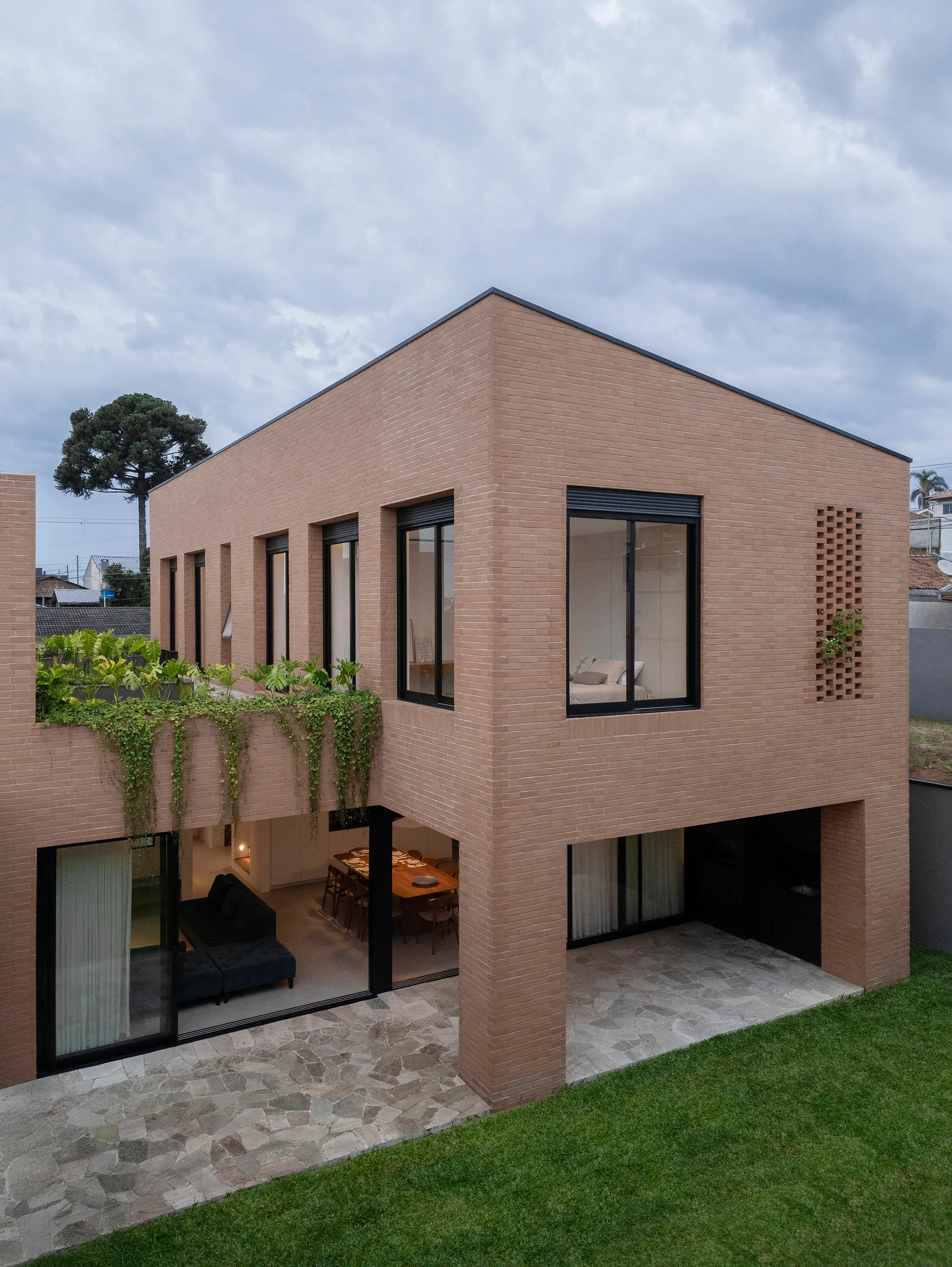
The word torrão in Portuguese conjures a lump of raw earth, something primitive and unrefined. It is a fitting name for a house in Colombo, Paraná, that takes its conceptual cue from a block of clay progressively carved to reveal domestic life within. Designed by Nommo Arquitetos for a couple in their fifties whose household spans four generations, Torrão House condenses 303 square meters of living space onto a tight 390-square-meter rectangular lot while still delivering a generous garden and ample social areas. The result is a compact brick volume that reads as a single, solid form from the street, yet dissolves into courtyards, perforated screens, and planted terraces as you move through it.
What makes the project genuinely interesting is the degree of variation the architects extract from a single material family. Ceramic tiles are laid flat, stacked with bricks, and projected outward in relief to produce a facade that changes character with every shift in sunlight. In a neighborhood the architects describe as chaotic and unadorned, this textural discipline does something unusual: it restores a sense of human scale and craft to the street while also performing the harder work of controlling light, ventilation, and privacy on an east-west oriented plot.
A Brick Facade That Refuses to Sit Still
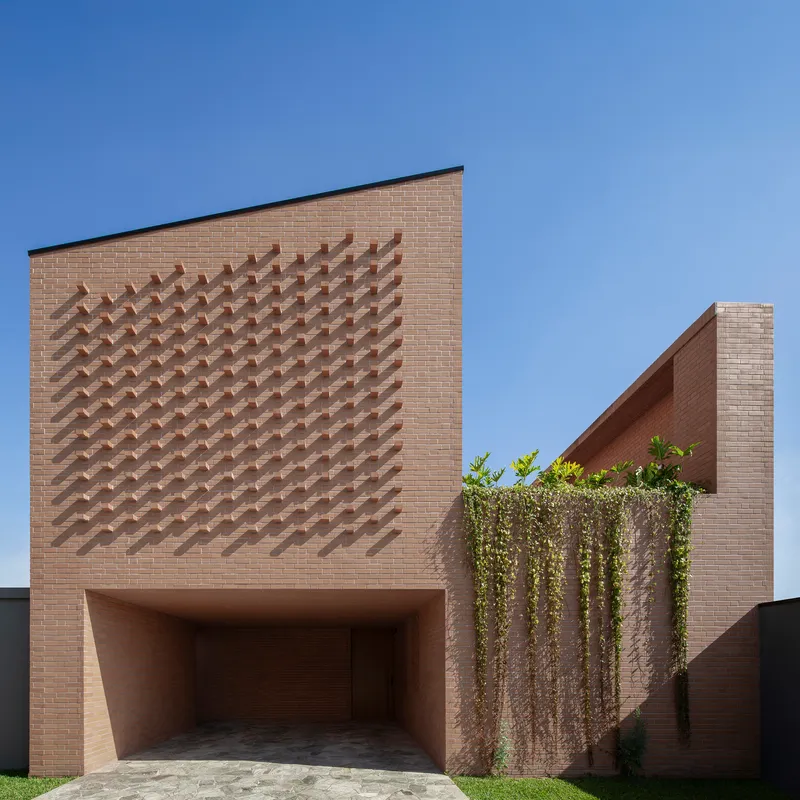
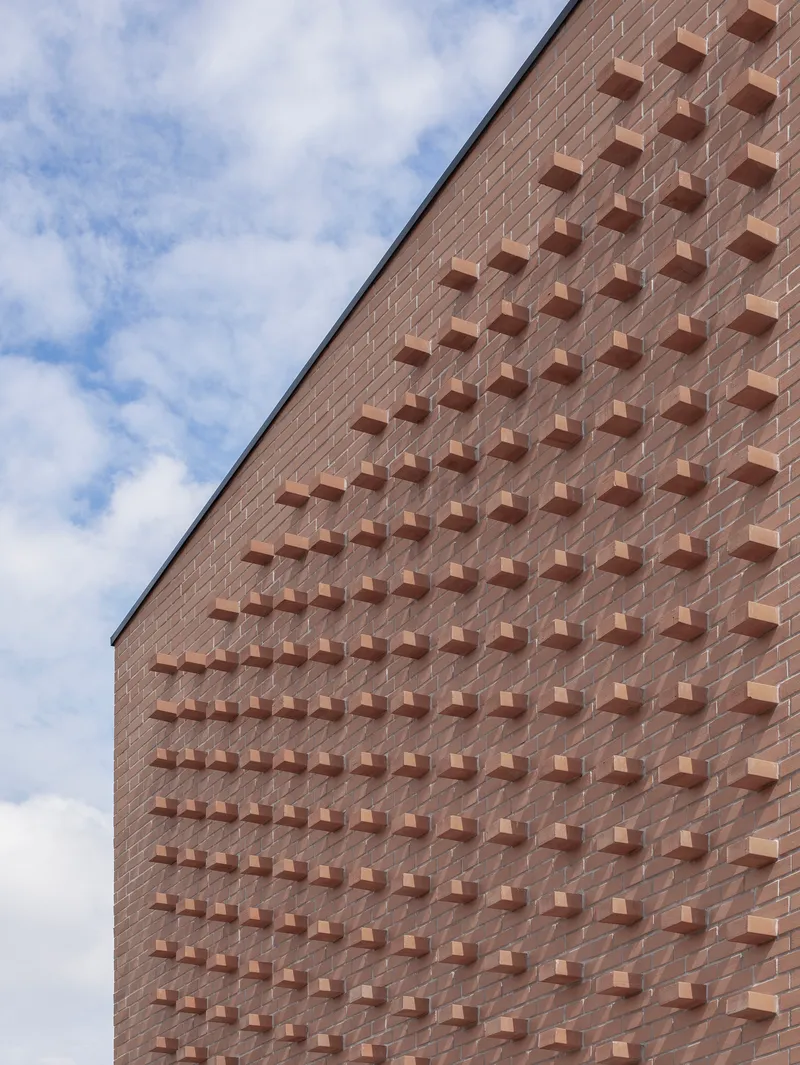
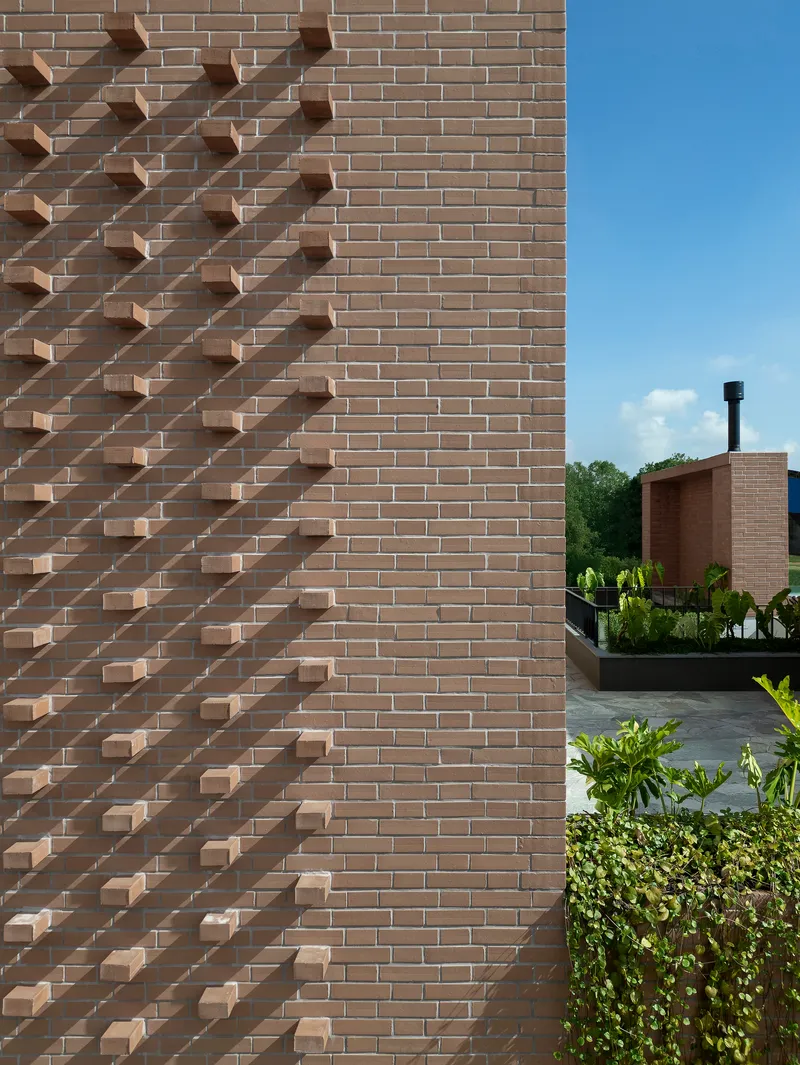
From the street, Torrão House presents itself as a monolithic brick slab punctured by a recessed garage and crowned with a chevron pattern of protruding bricks. Look closer and the surface is anything but uniform. Tiles are rotated, staggered, and pushed outward at precise intervals, creating a grid of small shadows that shifts throughout the day and across the seasons. The technique is not decorative wallpaper; it is a deliberate calibration of depth that gives a two-dimensional wall a three-dimensional life.
The non-homogeneous texture, as the architects put it, celebrates the constructive gesture of stacking and setting. You can sense the labor in it. Against the ordinary residential rooflines of Colombo, the effect is almost confrontational: here is a building that takes its skin seriously in a context where most buildings do not.
Subtractive Logic: Carving Light and Air
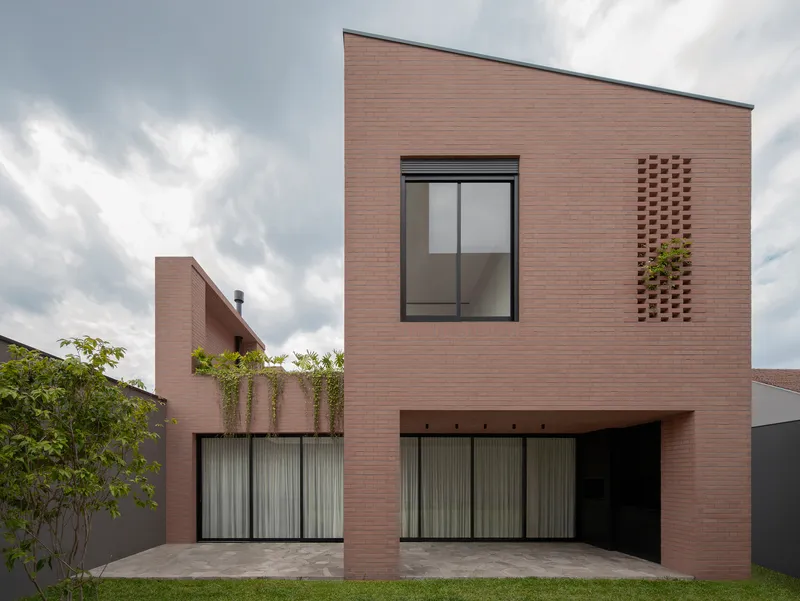
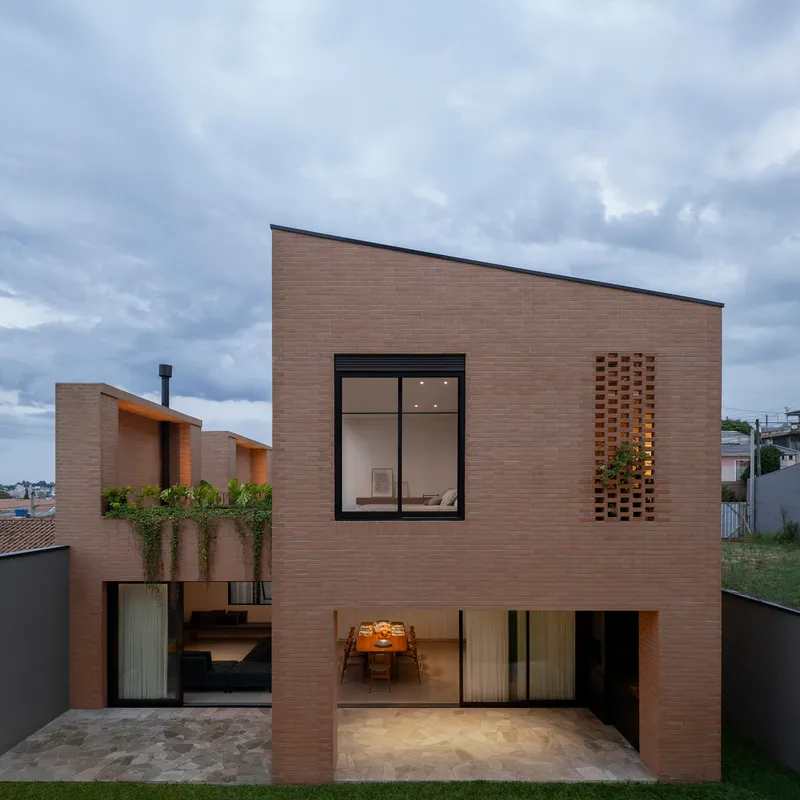
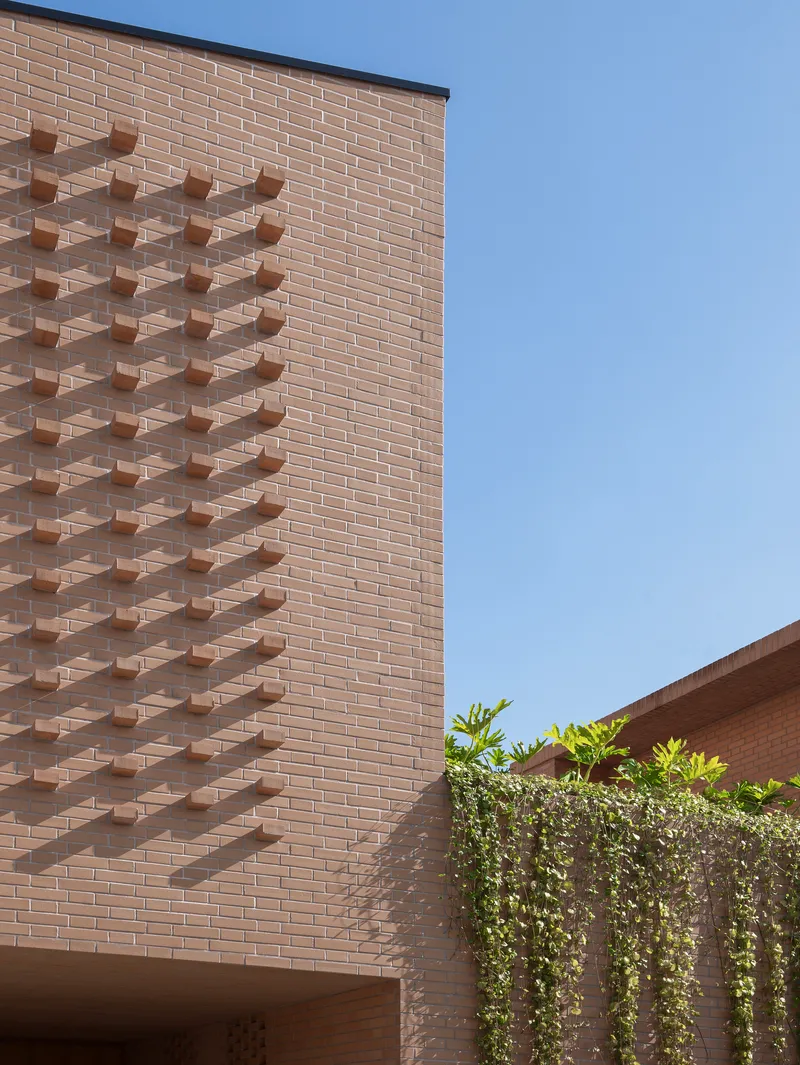
The design concept is essentially subtractive. You start with a solid rectangular volume and then remove prisms to create openings for light, ventilation, and views. Staggered window openings on the upper floor are not aligned for compositional symmetry but placed where the interior program demands them. Perforated brick panels serve as permanent ventilation screens, admitting air while maintaining privacy from the street. The result is a facade that looks different from every angle: sometimes a closed tower, sometimes a layered composition of solids and voids.
On a compact east-west lot, passive climate strategy matters enormously. The perforated screens filter harsh morning and afternoon sun without requiring mechanical shading. Combined with the courtyard cuts that pull daylight deep into the plan, the house manages comfort through geometry rather than technology.
Threshold and Passage
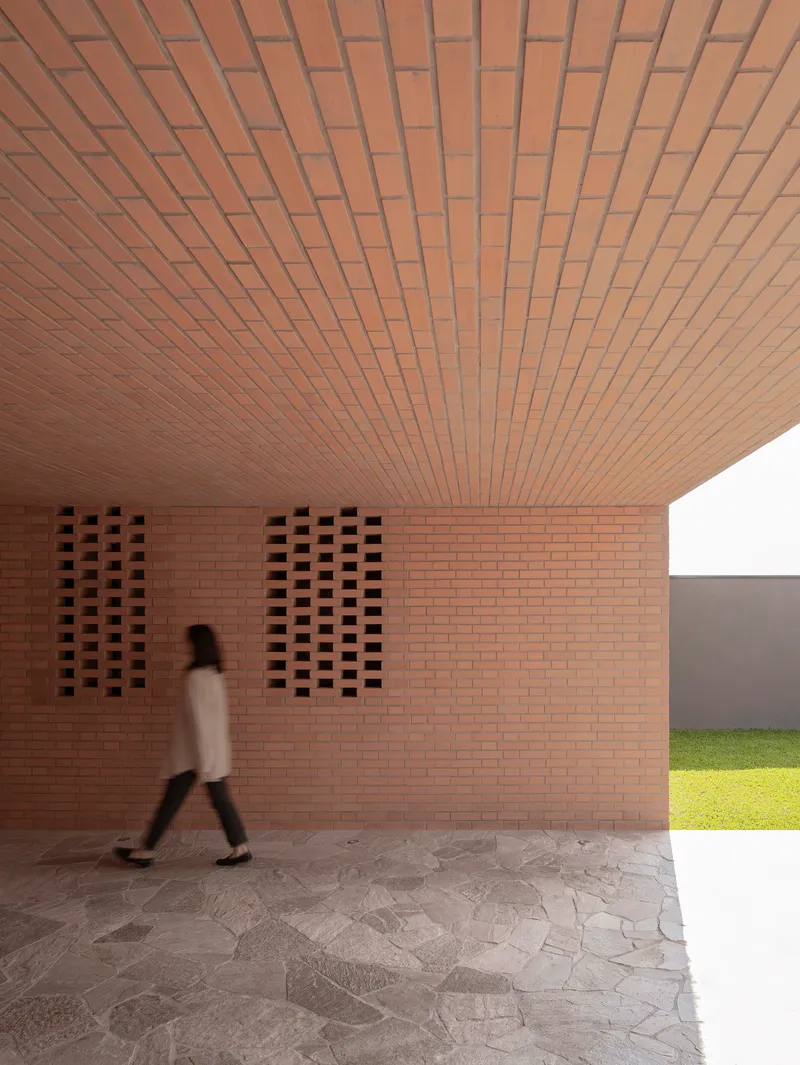
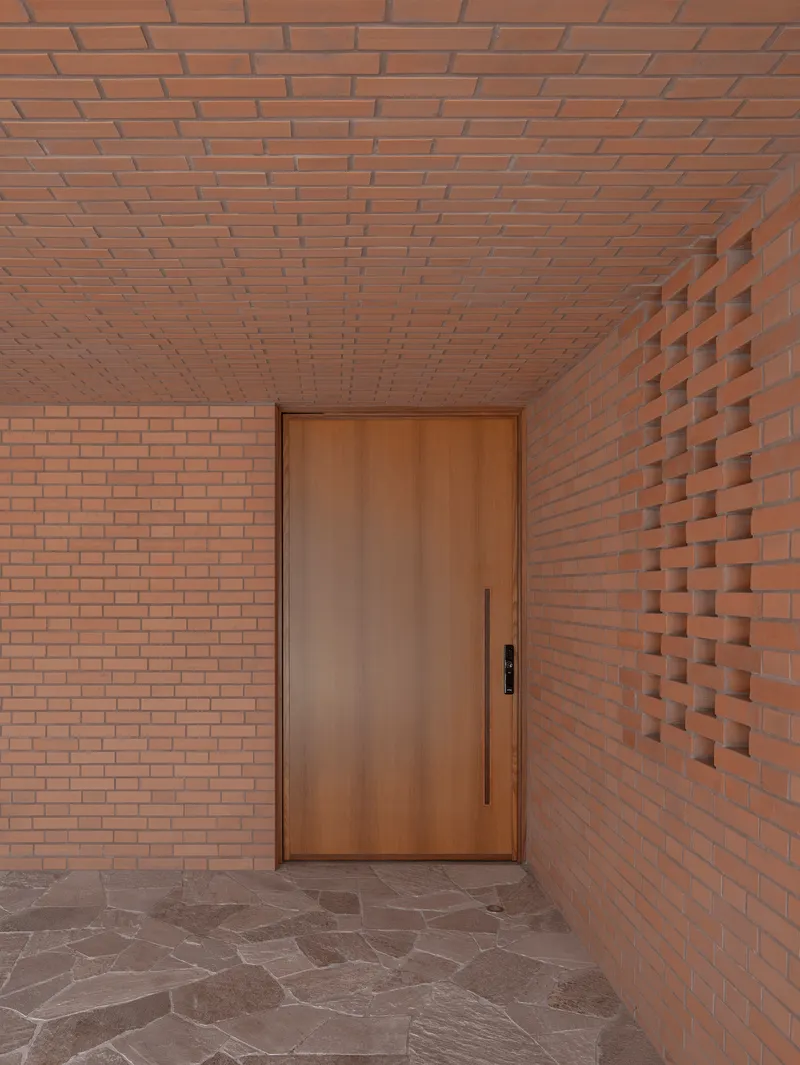
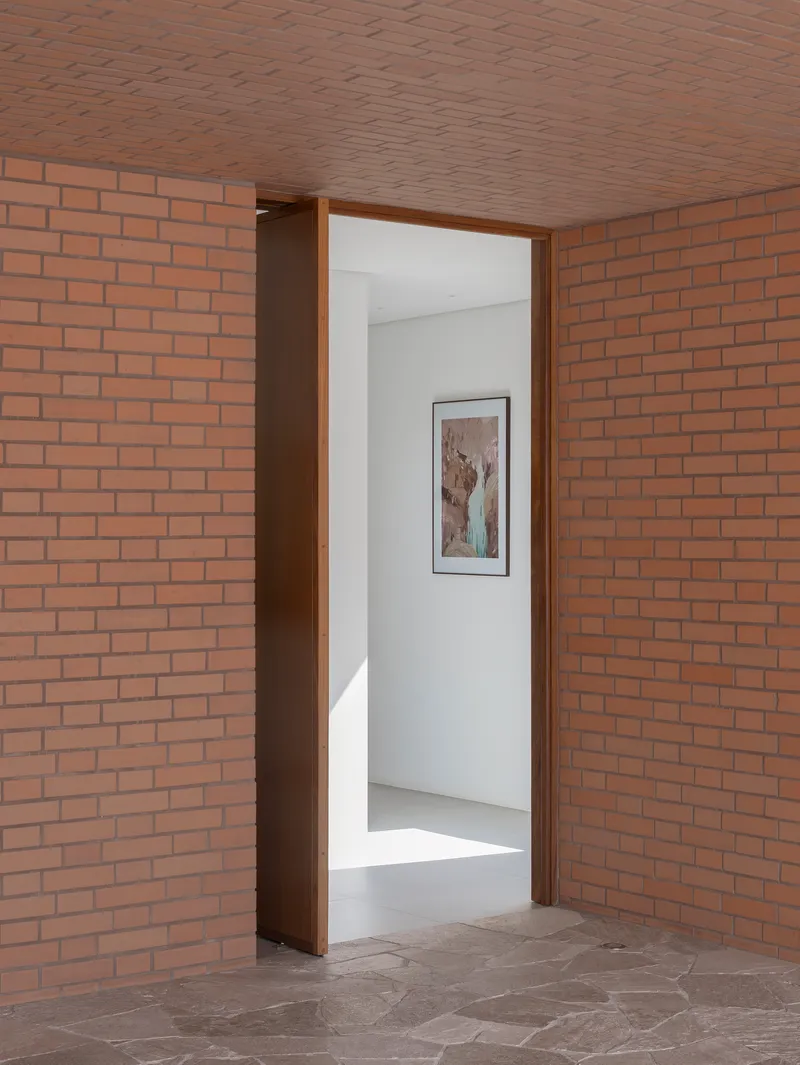
The entry sequence is carefully choreographed. A covered passage with a brick ceiling and perforated side panels compresses the visitor before releasing them into the interior. It is a cinematic trick, old as architecture itself, but it works particularly well here because the brick stays overhead. You are literally inside the material, not just beside it. A timber door flanked by flat and textured brick walls adds a warmth that signals the transition from public to private.
Beyond the vestibule, a brick corridor leads to a white gallery space that acts as a hinge between the social areas and more private rooms. The shift from warm brick to cool white is abrupt and intentional. It tells you the house has two registers: an outward-facing identity rooted in craft and an inward-facing identity rooted in calm.
Living with Four Generations
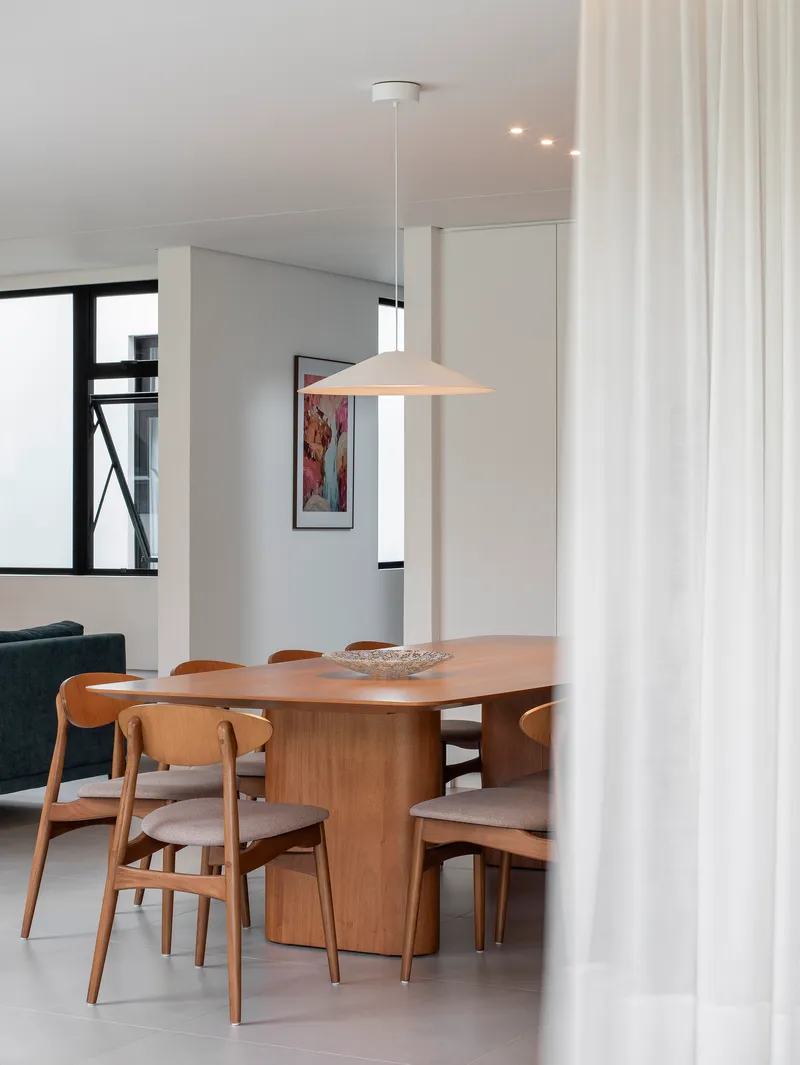
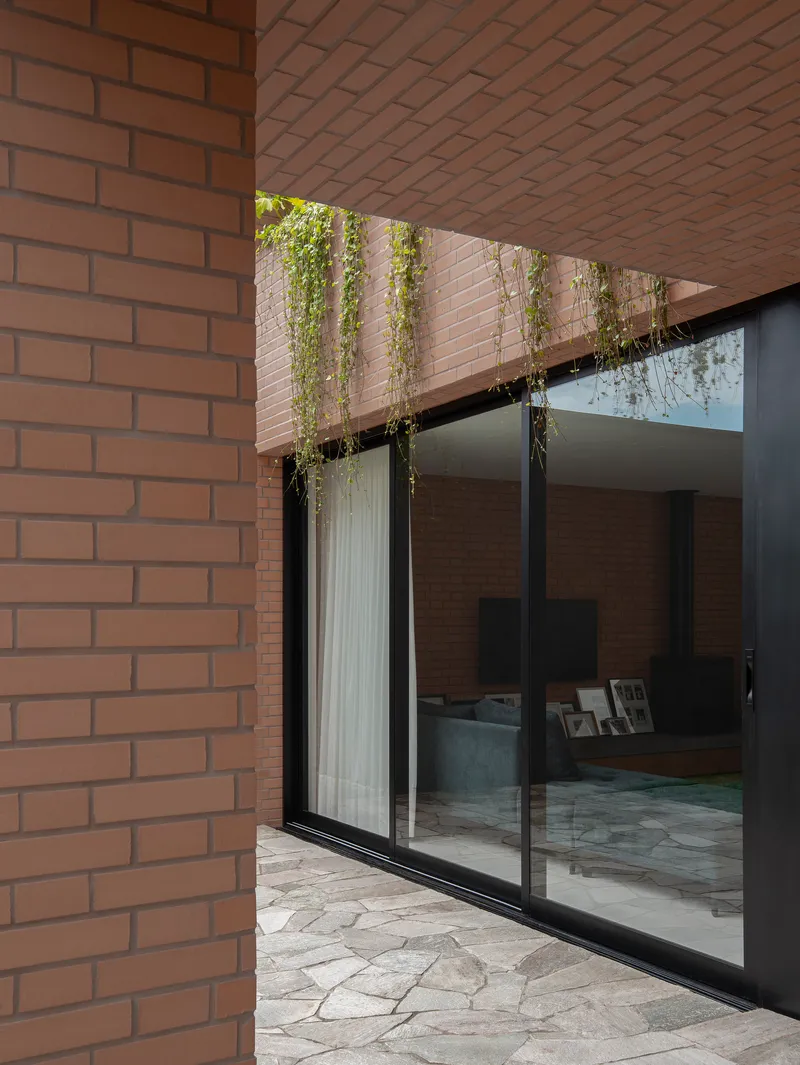
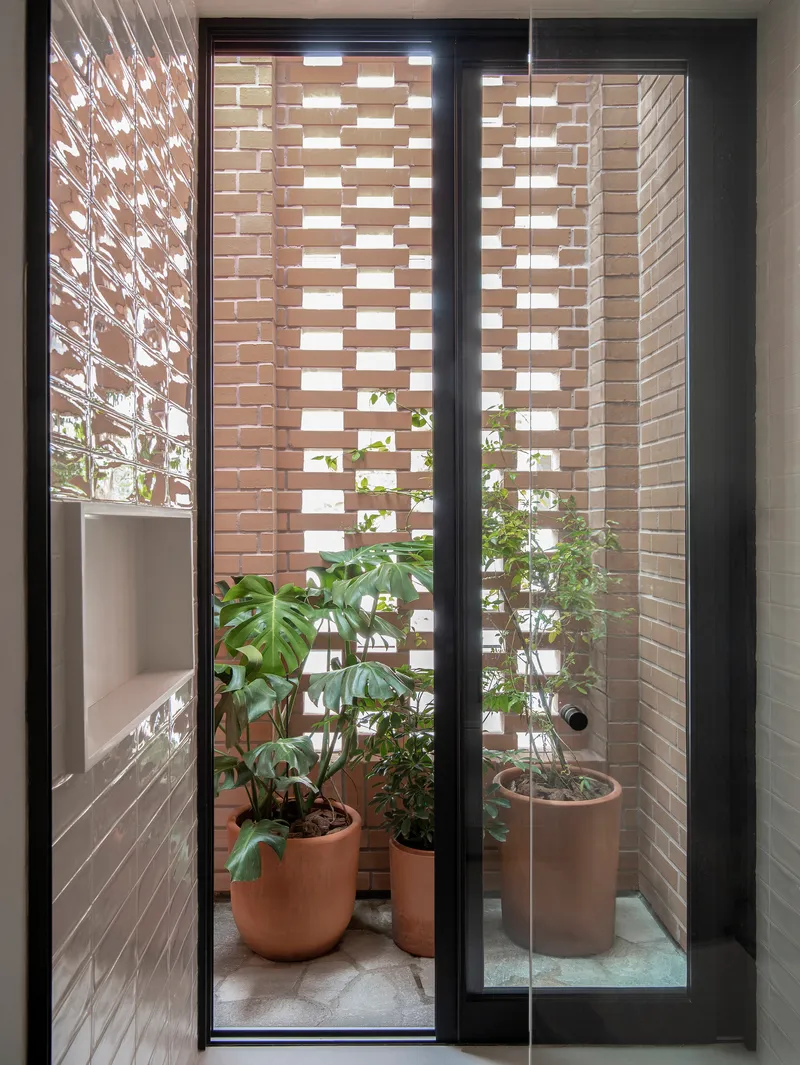
For a mature couple whose household regularly fills with children and grandchildren, the brief prioritized generous social spaces and a large garden. The ground floor opens through sliding glass doors to a courtyard beneath a planted balcony, collapsing the boundary between inside and outside. A dining area, visible through a white curtain, sits at the center of circulation, reinforcing the idea that meals are the gravitational core of the family's daily life.
The narrow courtyard with its perforated brick screen and potted plants operates as a buffer zone: intimate enough for a morning coffee, yet connected to the larger garden beyond. It is the kind of space that rewards slow occupation, changing in quality as sunlight filters through the brick lattice at different hours.
Green Roofs, Planted Balconies, and Cascading Vines
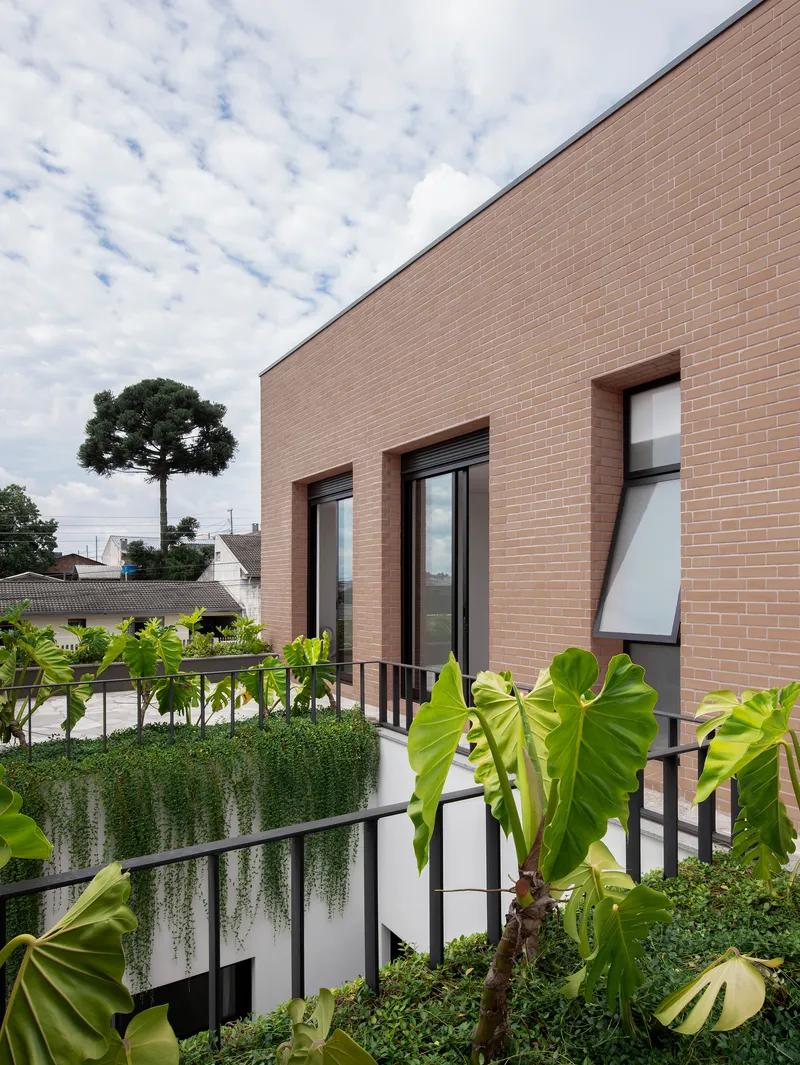
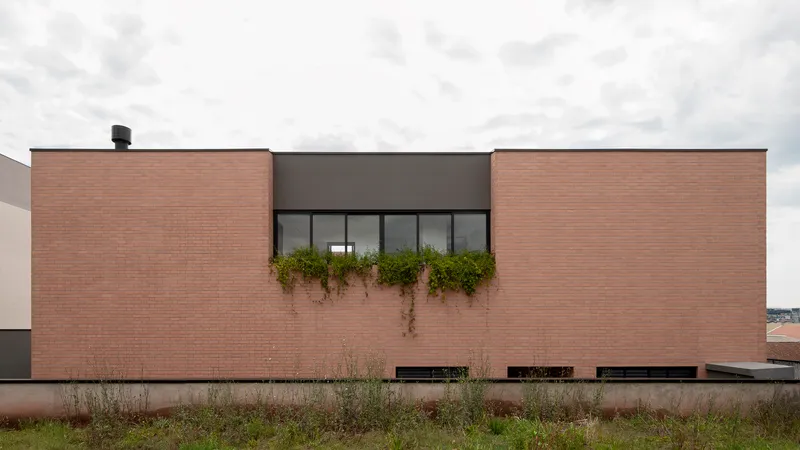
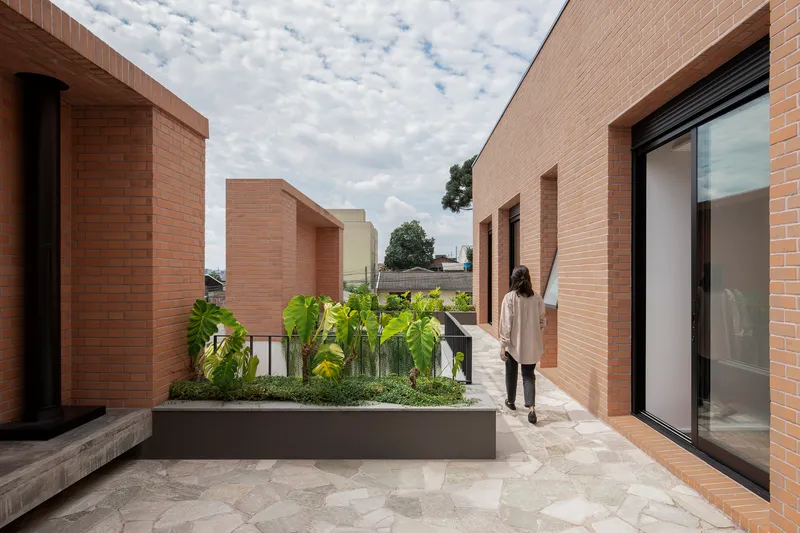
The planting strategy is integral to the architecture, not an afterthought. Cascading vines trail from upper balconies and the rooftop terrace, softening the brick mass and signaling the passage of seasons. The rooftop itself features raised planting beds between brick volumes, effectively turning what could be dead space into a usable garden that compensates for the tight footprint below. Green roof sections at the rear absorb rainwater and provide additional insulation.
Over time, the vegetation will increasingly merge with the architecture. The perforated brick panels already host climbing greenery that grows through the openings, blurring the line between constructed and cultivated surface. It is a long game, and the house is clearly designed to look better a decade from now than it does today.
Interior Restraint
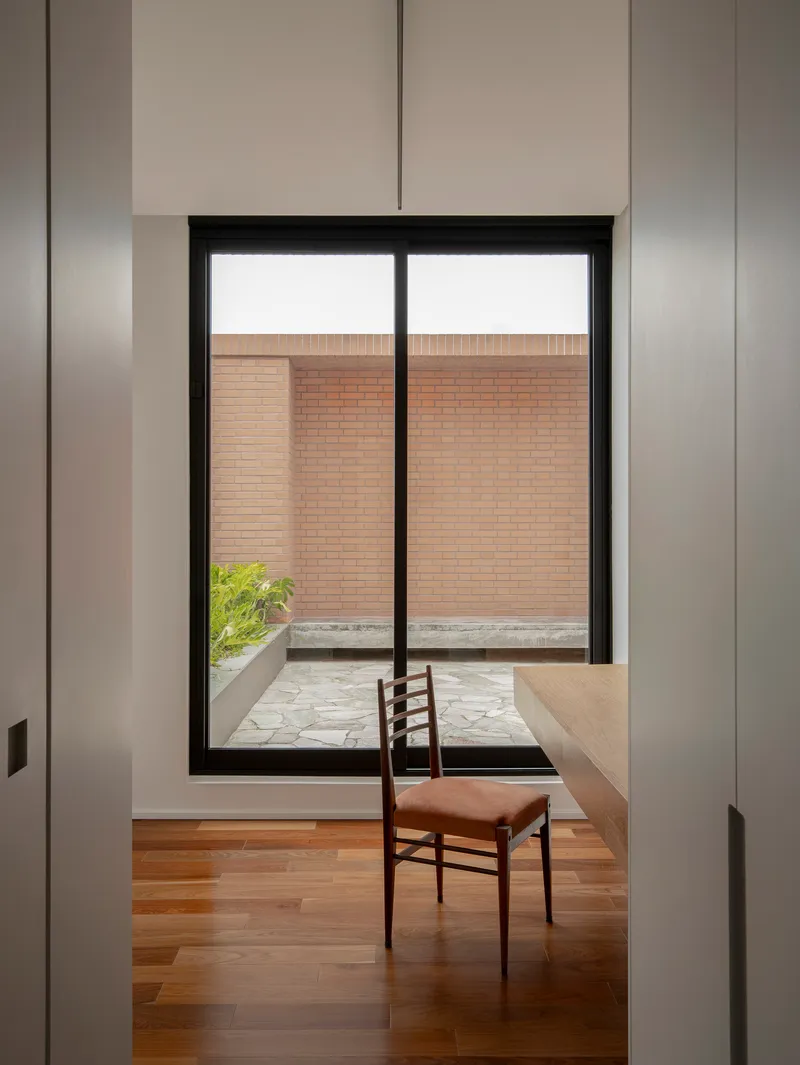
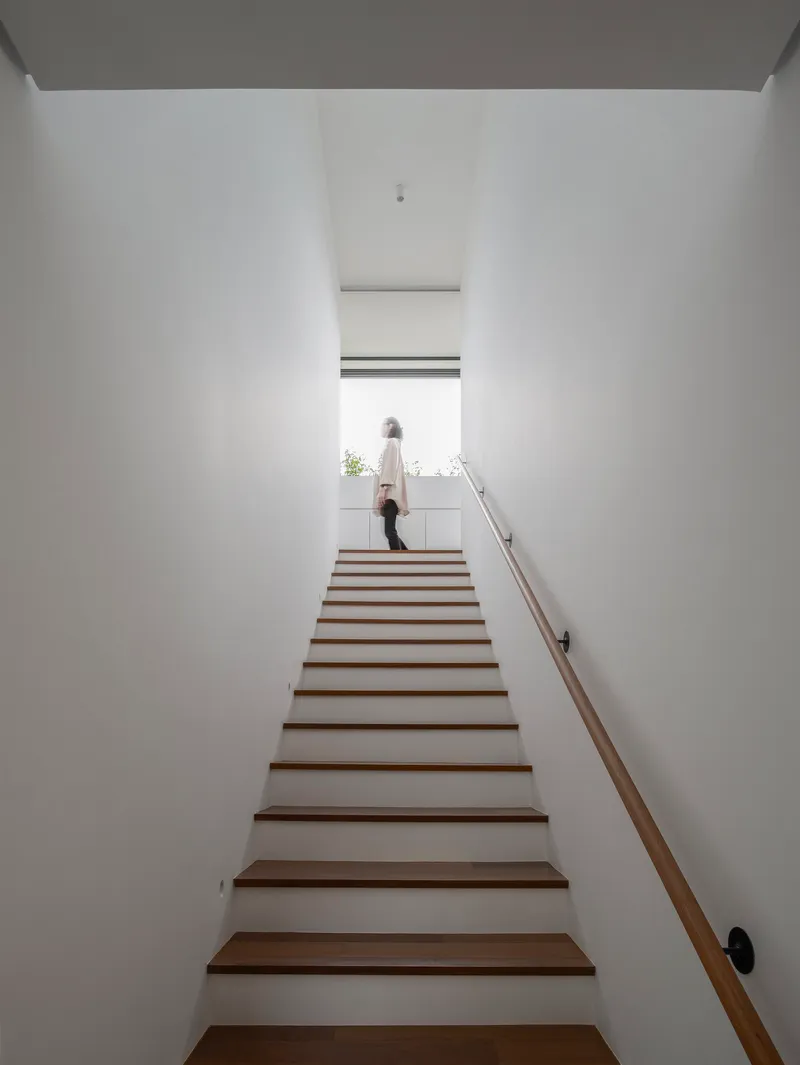
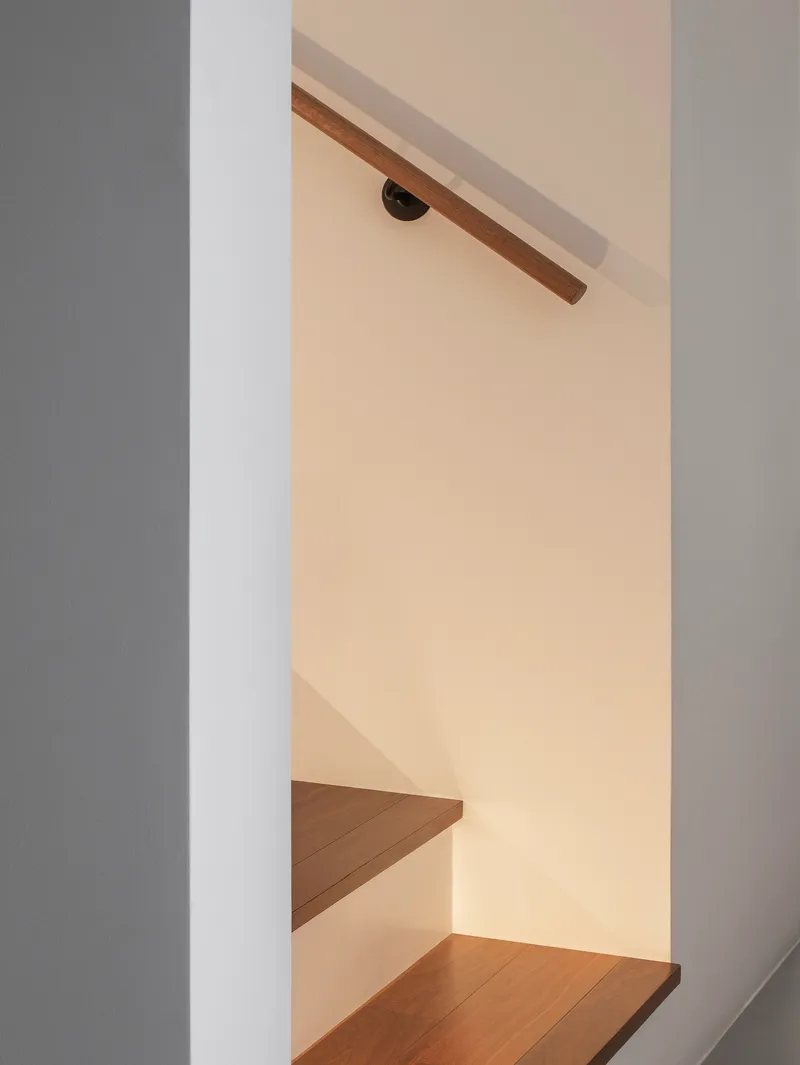
Inside, the palette strips back dramatically. White walls, timber floors, and minimal furniture let the architecture speak through proportion and light rather than material abundance. A workspace with a single timber desk and black-framed window captures this restraint perfectly: it is a room that exists to focus attention. The timber staircase rising between white walls connects the two floors with quiet efficiency, its handrail detailed with a clean wall bracket that suggests considered joinery without calling attention to itself.
The contrast between exterior richness and interior simplicity is the project's strongest spatial move. You experience the house as two different buildings depending on which direction you face. Look out and you see texture, shadow, vegetation. Look in and you see stillness.
Dusk Readings
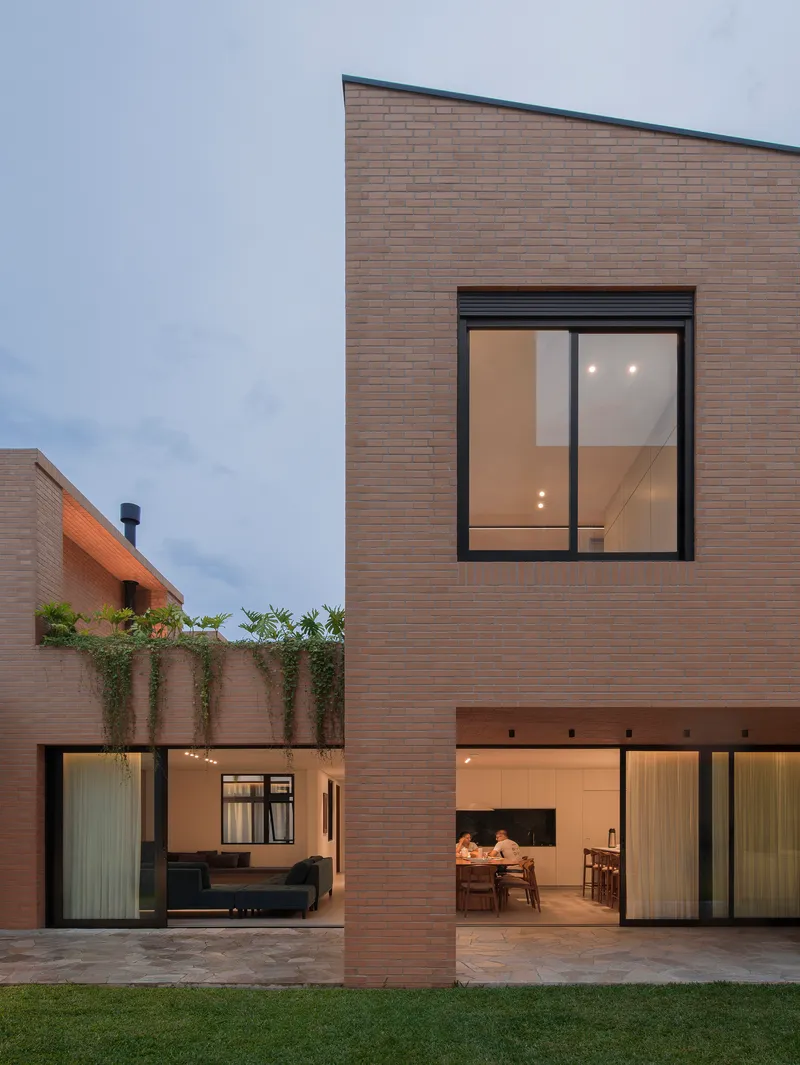
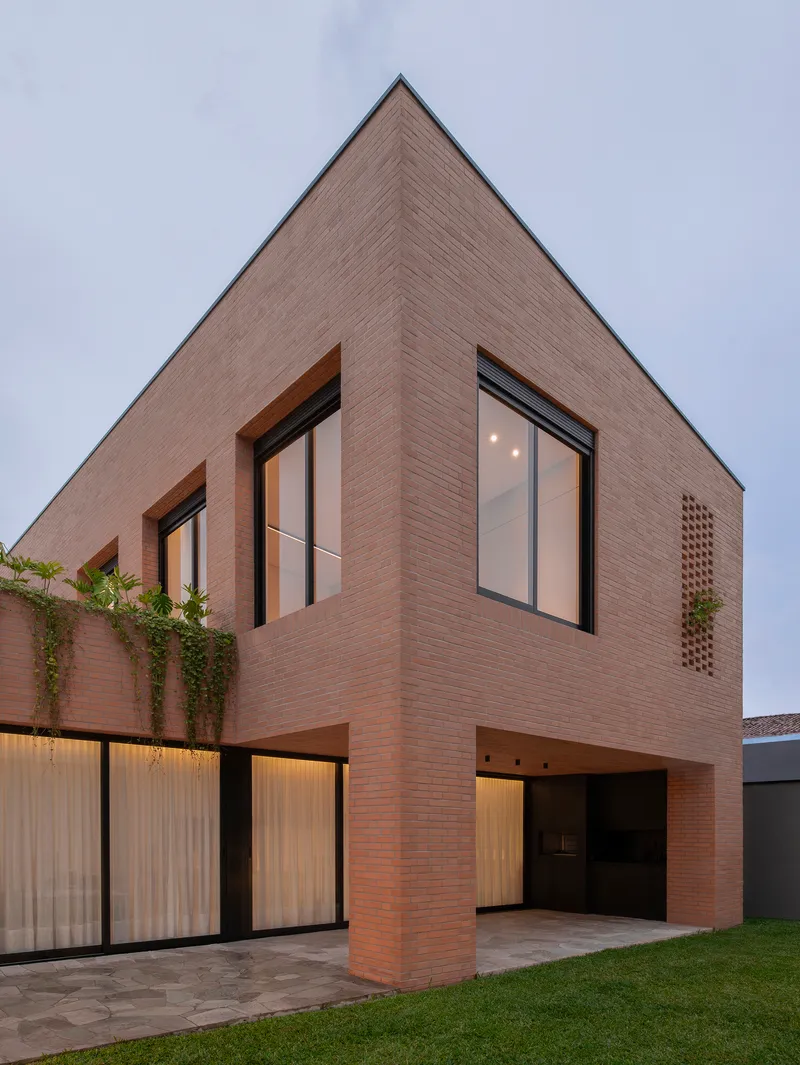
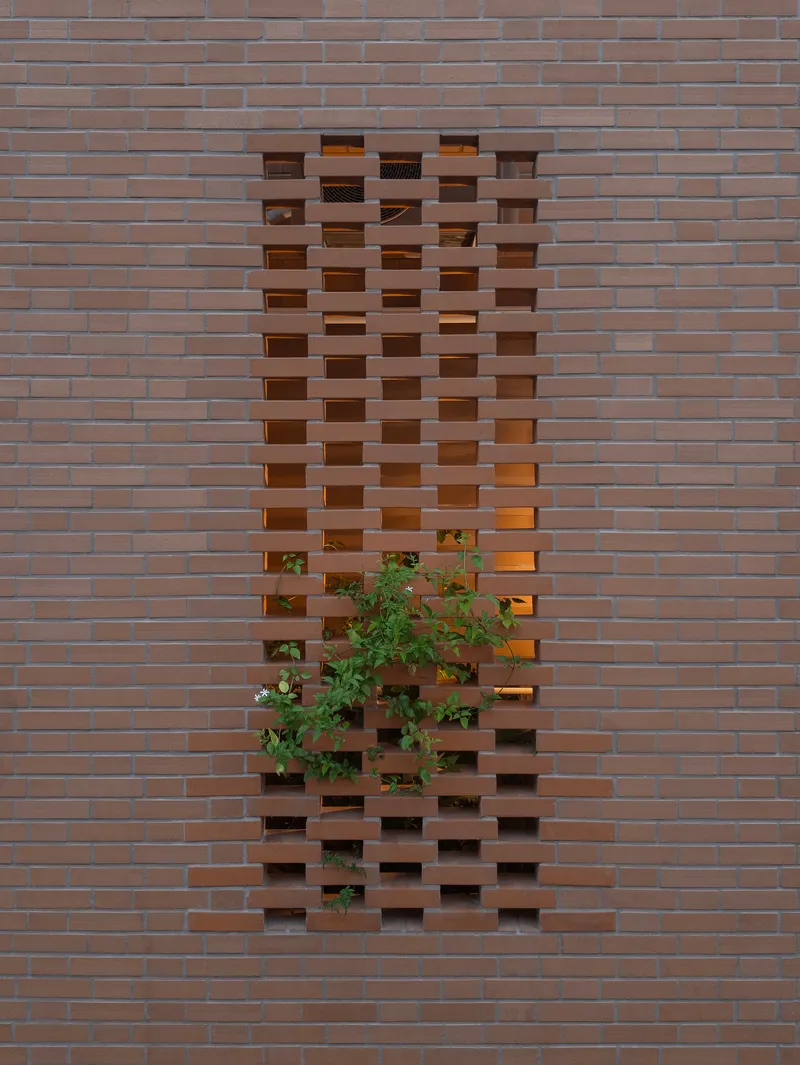
At twilight, the house reveals a second life. Warm light spills through glazed openings and illuminates the perforated brick screens from behind, turning the facade into a lantern of patterned shadow. The gabled rear elevation, visible from the garden, glows against the darkening sky. Climbing greenery caught in the artificial light adds an organic softness that the daytime views only hint at. It is in these evening hours that the interplay between solid and void becomes most legible.
Plans and Drawings
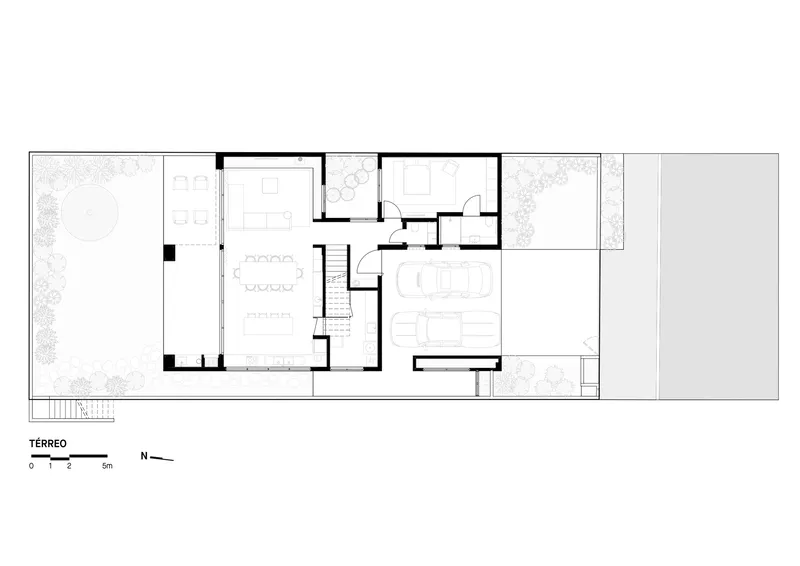
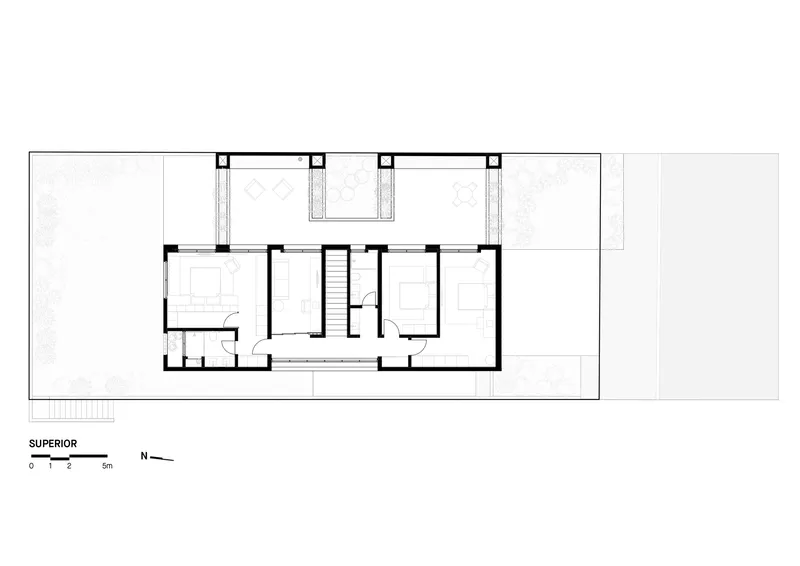
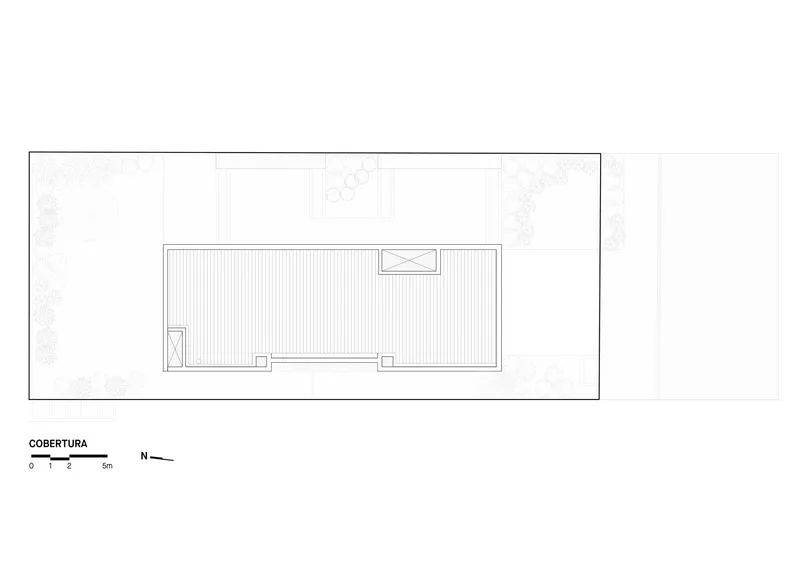
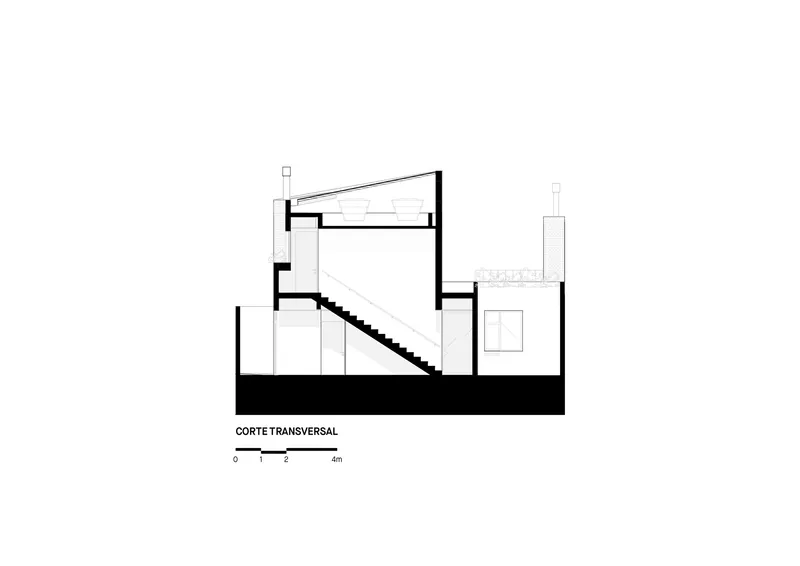
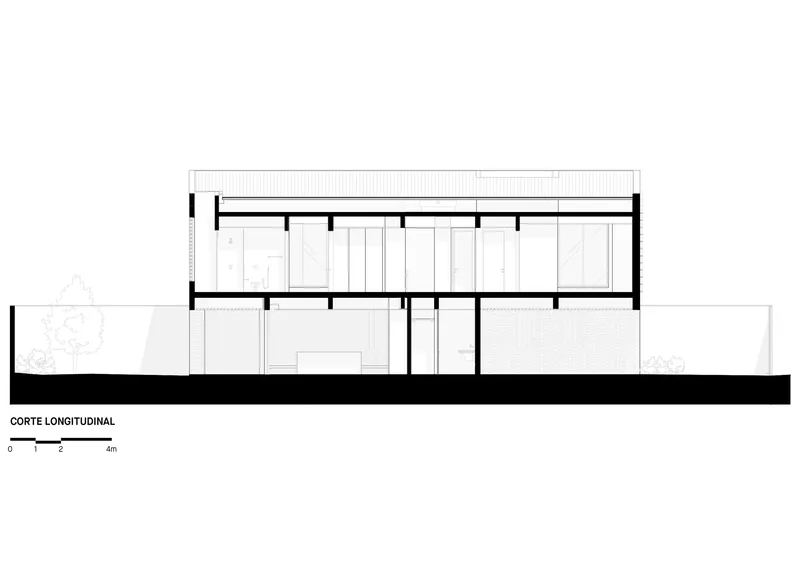
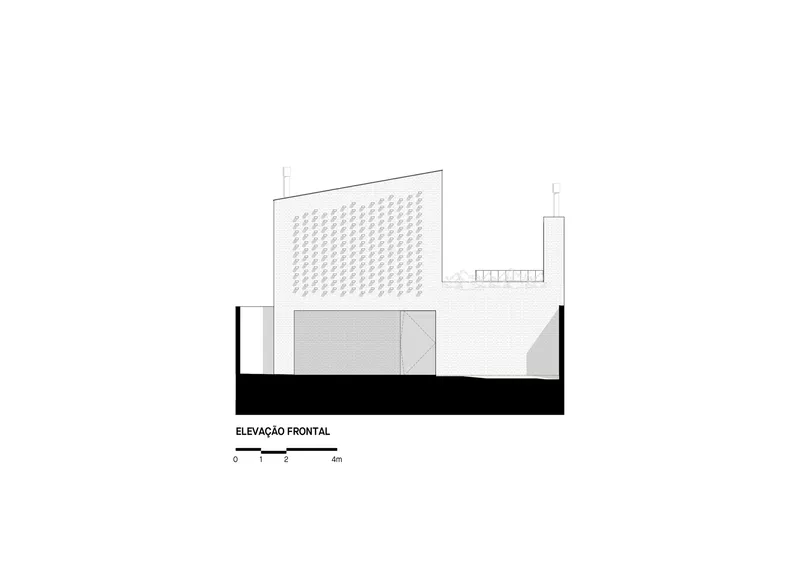
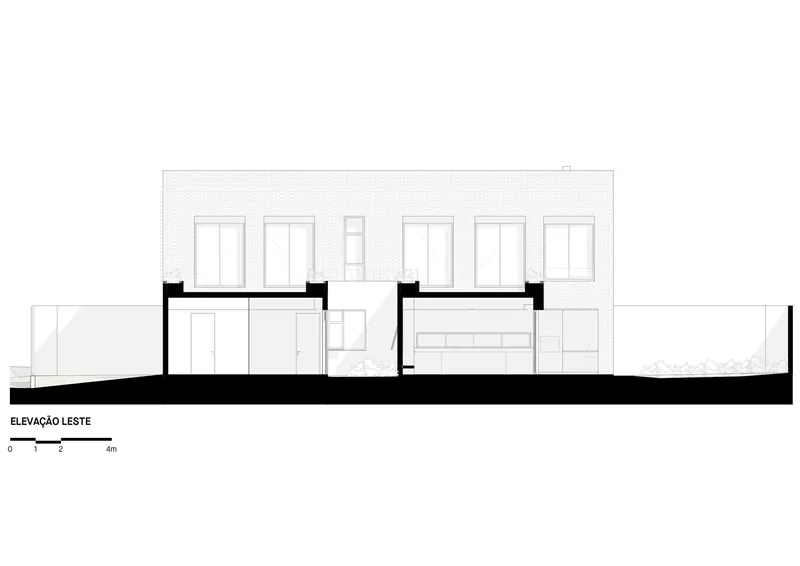
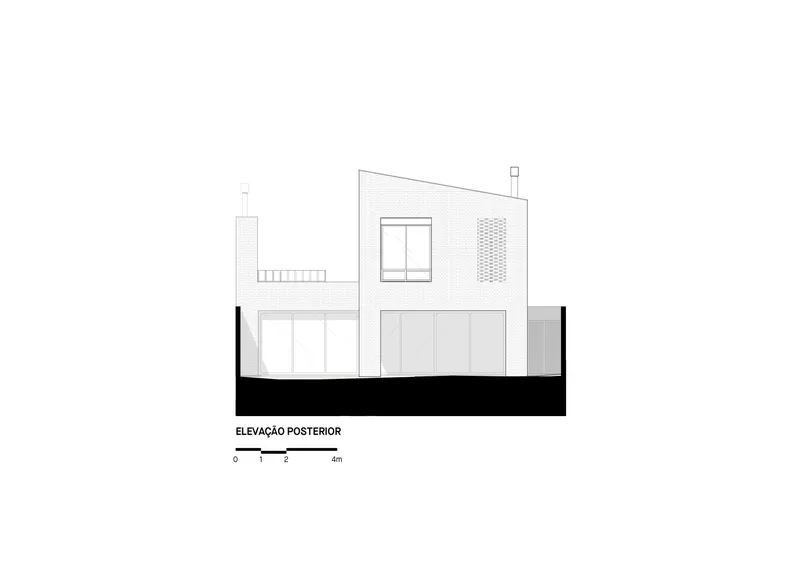
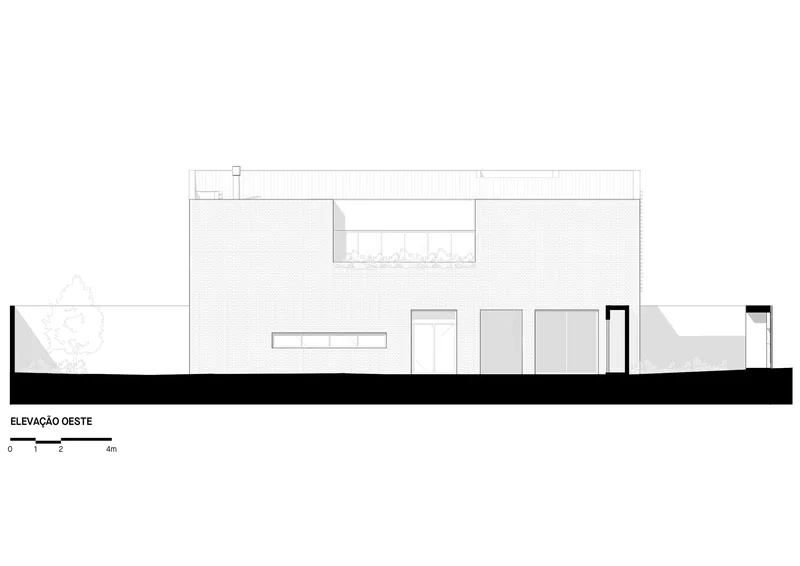
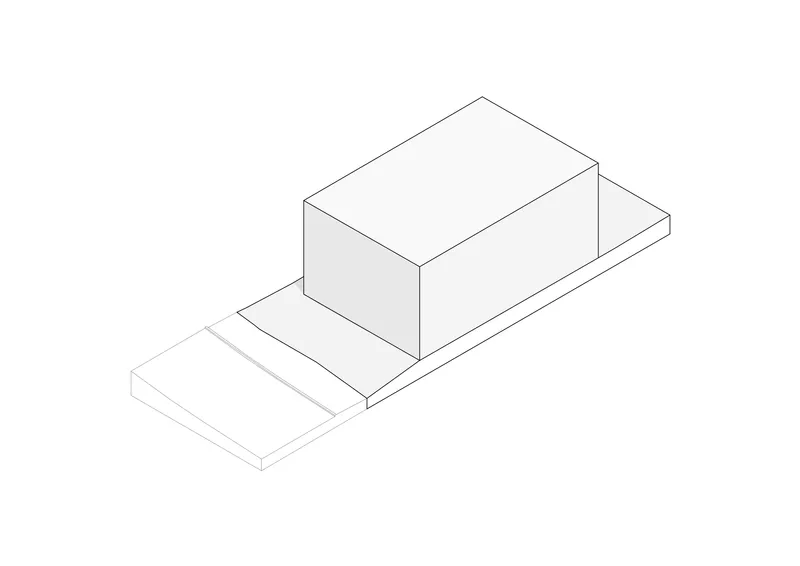
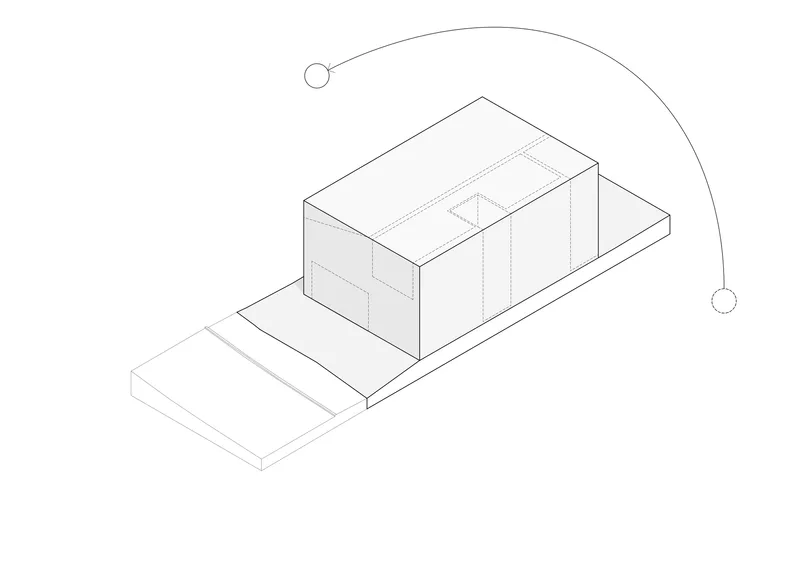
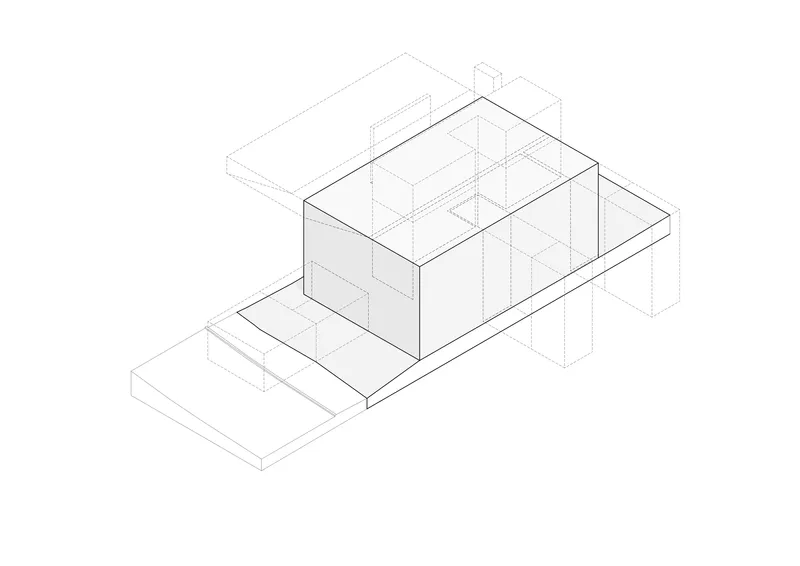
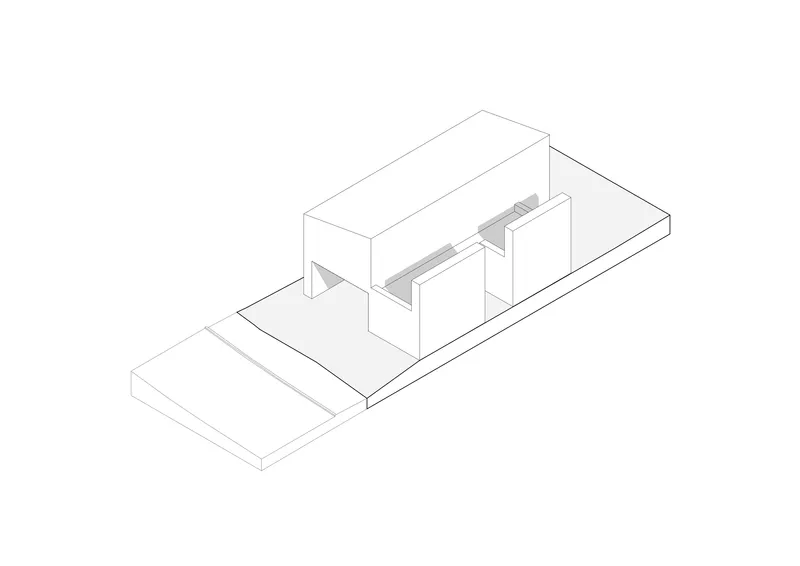
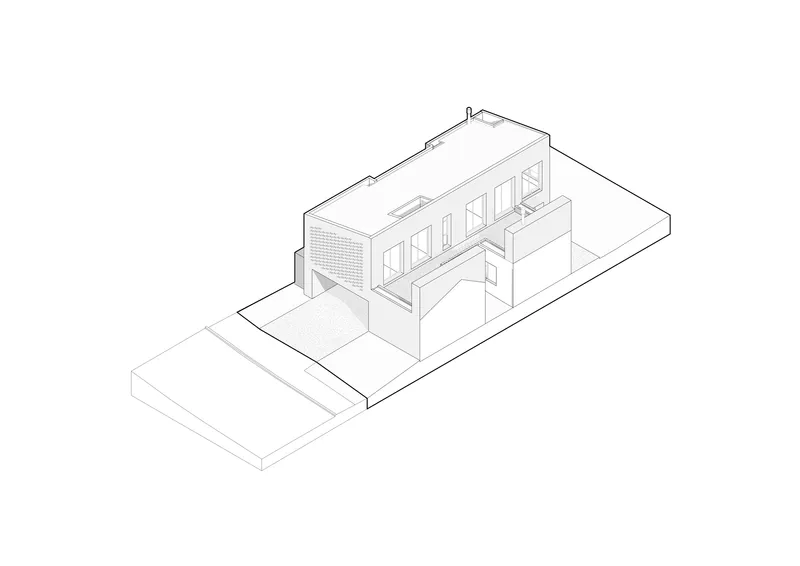
The ground floor plan confirms the subtractive logic: courtyard voids are cut from the rectangular footprint to deliver light and air to the deepest parts of the plan, while a pool area occupies the rear garden. The upper floor distributes bedrooms around the perimeter, each with access to a balcony that projects from the brick mass. Sections reveal how the sloped roof conceals the rooftop terrace and how the staircase acts as a spatial spine connecting the two levels. The axonometric sequence is particularly instructive, showing the design as a progressive assembly: a platform, then solid volumes, then courtyard cuts, then glazed openings, then screens. It reads like a manual for building with clay.
Why This Project Matters
Torrão House argues that a single material, deployed with intelligence and variation, can do the work that most contemporary residential projects distribute across a catalog of finishes. The ceramic tile cladding is structure, ornament, climate device, and cultural statement all at once. In a suburban Brazilian context where off-the-shelf solutions dominate, this commitment to craft stands out not because it is expensive but because it is deliberate. Every surface decision traces back to the concept of sculpting a block of raw earth.
More broadly, the project offers a convincing model for multigenerational living on constrained urban lots. By compressing the built volume and maximizing garden space, Nommo Arquitetos deliver a house that functions for two people on a quiet Tuesday and for twenty on a Sunday. The architecture does not dictate how the family should live; it provides a robust framework that accommodates growth, gatherings, and change. That is a harder thing to design than a striking facade, and they have managed both.
Torrão House by Nommo Arquitetos. Lead architects: Anderson Luis de Almeida, Luis Henrique Abagge, Luana Barichello. Colombo, Paraná, Brazil. 303 m². Completed 2025. Photography by João Vitor Sarturi.
About the Studio
Share Your Own Work on uni.xyz
If projects like this are the kind of work you want to make, uni.xyz is a place to publish your own, find collaborators, and enter design competitions.




Popular Articles
Popular articles from the community


Lunar Spiral: Space Architecture Shaped by the Mathematics of the Universe
Lunar Spiral reimagines space architecture through Fibonacci geometry, lunar regolith, levitating habitats, and self-sustaining Moon living.

The Musturak Paradise: Senior Living Architecture for a Connected Future in Temara, Morocco
The Musturak Paradise reimagines senior living architecture in Temara via private homes, social spaces, culture, community, and shared care.

Riyadh For All: Intergenerational Urban Design for Active Aging in Rabat
Riyadh For All reimagines urban design in Rabat with intergenerational co-living, adaptive courtyards, and Moroccan cultural exchange today.

Co-life: Sustainable Architecture for Age-Friendly Community Living
Co-life reimagines sustainable architecture for seniors through courtyards, rammed earth, shared gardens, and spaces designed for belonging.

Similar Reads
You might also enjoy these articles

Bao Huynh Watercolor Atelier: A Serene Art Retreat in Hội An
Bao Huynh Watercolor Atelier in Hội An blends multifunctional art spaces, sustainable design, local materials, and family-friendly living in a serene environment.

Atelier Macri Concept Store Interior Design by CASE-REAL
Atelier Macri store features a "ko" counter, walnut wood details, cork displays, blending retail, gallery, and seamless customer experiences.

Manuel Vargas Izquierdo Stadium and High-Performance Sports Center: Architectural Excellence in Jalpa de Méndez
The Manuel Vargas Izquierdo Stadium blends sustainable design, inclusive sports facilities, and cultural-inspired architecture, revitalizing Jalpa de Méndez’s public spaces.

KAKR Buluh Awar Hall: Revitalizing Community and Ecology Through Bamboo Architecture
Community built bamboo hall revitalizes Buluh Awar village, empowering youth, restoring ecology, celebrating vernacular craftsmanship through sustainable architecture and culture.




Comments (0)
Please login or sign up to add comments
No comments yet. Be the first to comment!