
Nordic Office of Architecture and Haptic Architects Rebuild Oslo's Government Quarter as a Civic Act of Trust
On the site of Norway's 2011 terrorist attacks, a new government campus in central Oslo answers violence with openness and craft.


Buildings carry memory whether we want them to or not. When a car bomb detonated outside Norway's government offices on 22 July 2011, it tore through the brutalist Høyblokken tower and killed eight people before the perpetrator continued his massacre on Utøya island. The site that remained was scarred, fenced off, and for years essentially severed from the city around it. The first phase of the New Government Quarter, completed in 2026, represents something more difficult than reconstruction: it is the physical argument that a democratic society can absorb catastrophic violence and respond not with fortification but with transparency.
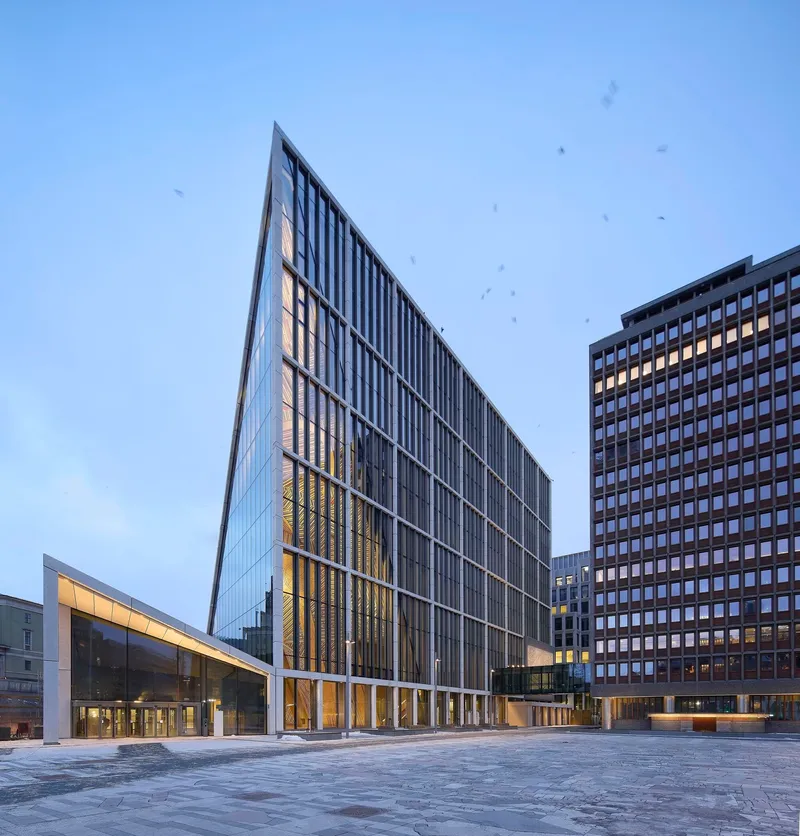
Designed by Nordic Office of Architecture and Haptic Architects, the masterplan arranges five new buildings and two restored ones in a ring around interconnected public spaces, consolidating nearly all Norwegian ministries into a compact campus of approximately 182,000 square meters for some 4,100 employees. Phase one delivers the restored Høyblokken alongside the new A-block and D-block. What makes the project genuinely interesting is not its scale but its posture: a security-critical government precinct that reads from the street as open, glazed, and inviting, threading new pedestrian routes through what was once a car-centric enclave.
The Pyramid Hall and the Weight of Ceremony
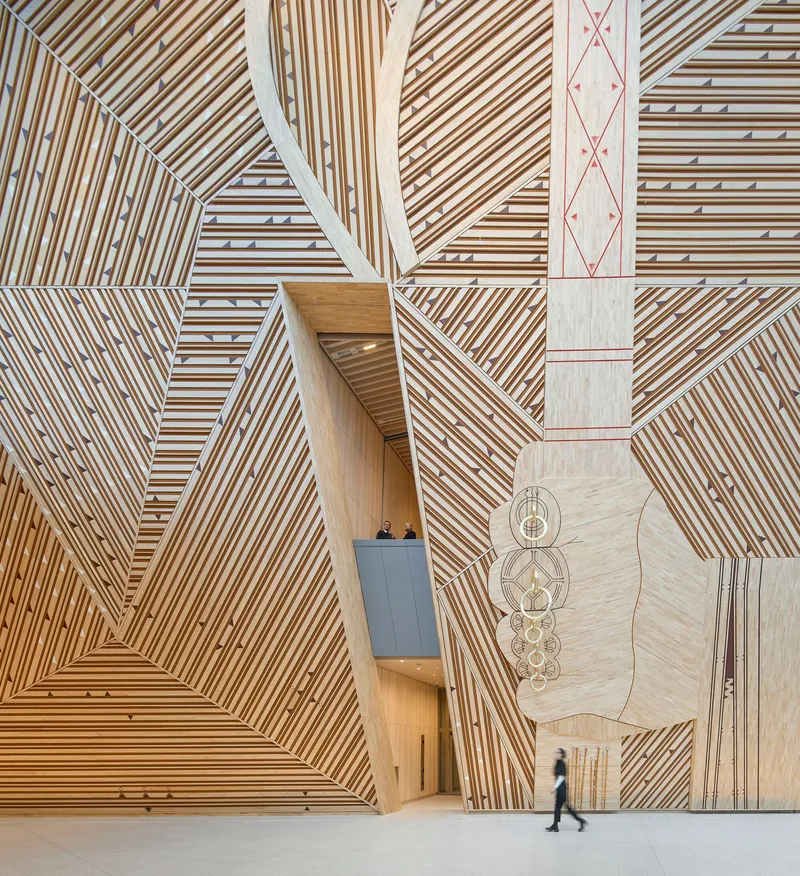
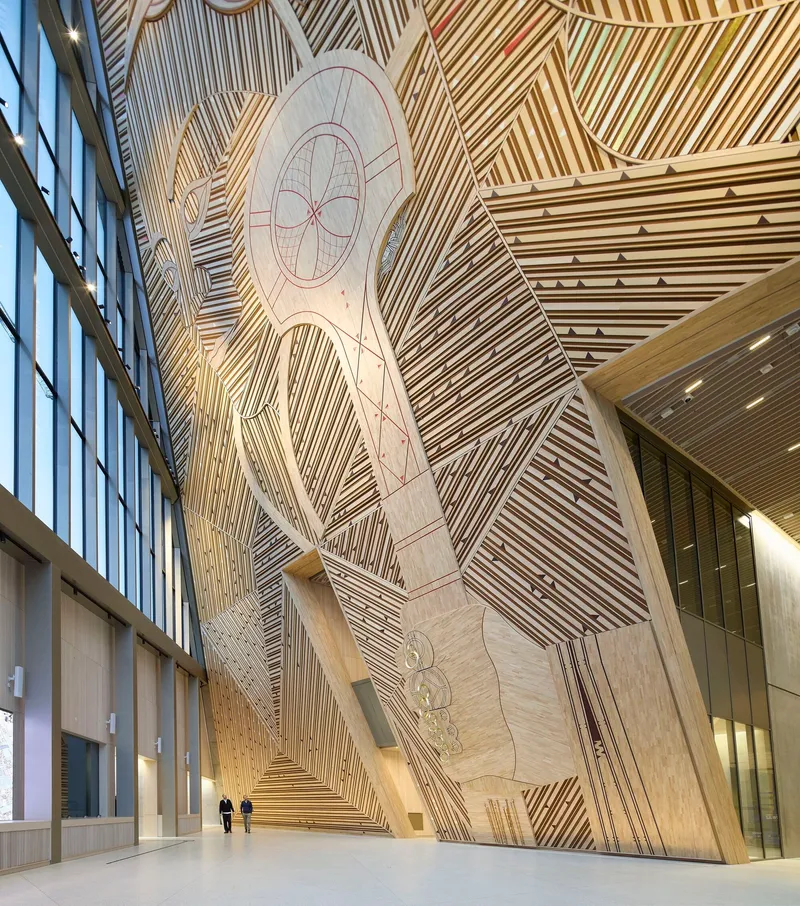
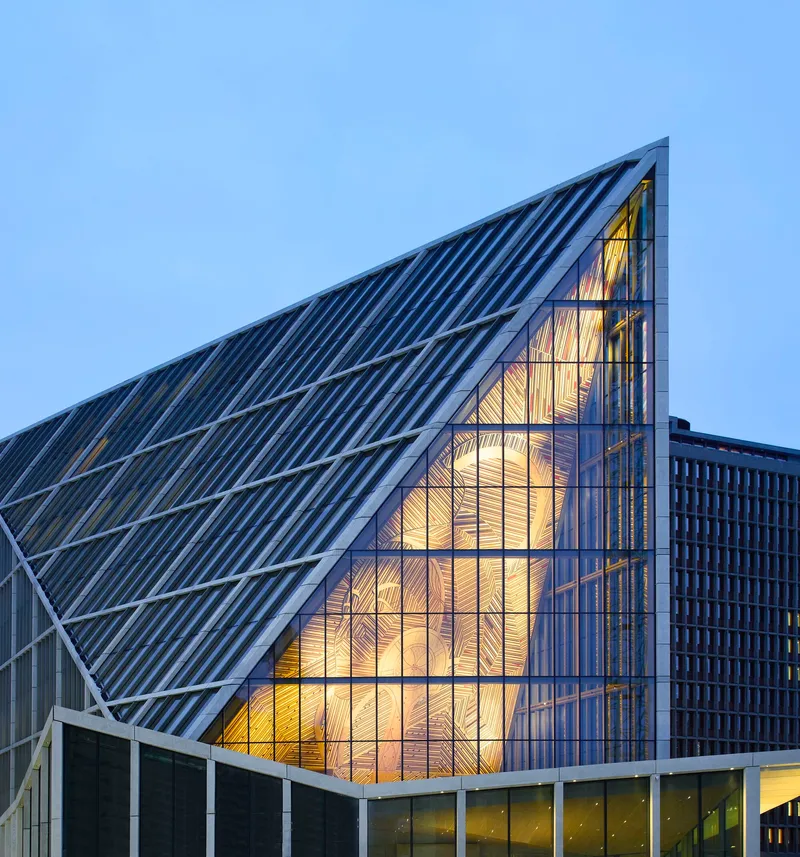
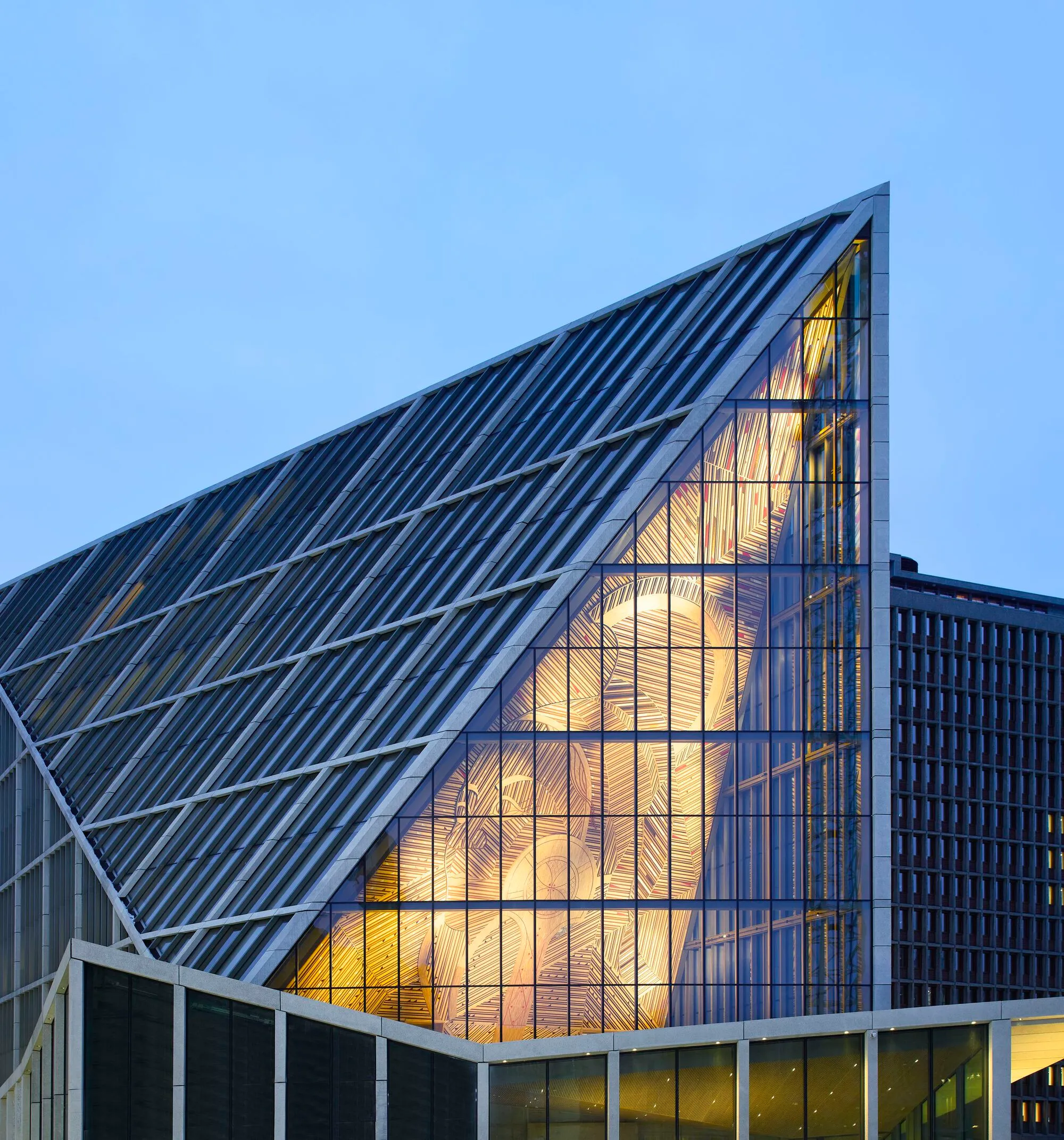
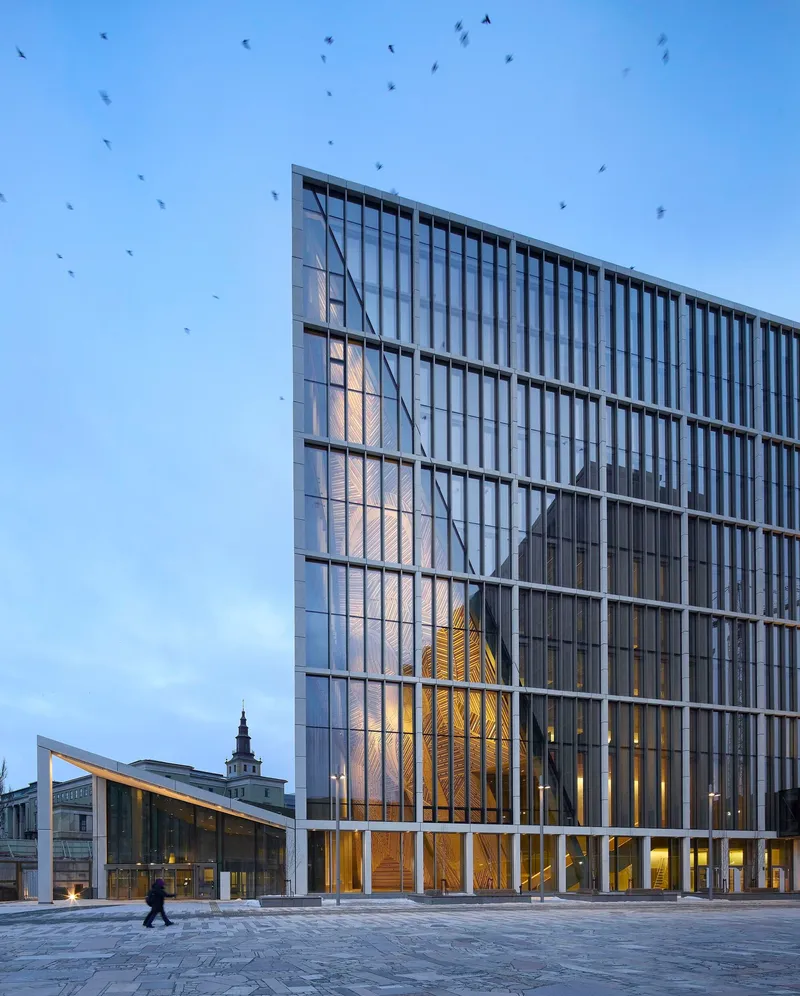
The A-block's 51-metre-high atrium, called the Pyramid Hall, is the emotional center of the project. It functions as the stage where foreign dignitaries are received, and the architects have treated it accordingly: chevron-patterned timber cladding rises the full height of the space, culminating in a triangular glass gable that glows from within at twilight. One wall carries a massive artwork composed of carved figural reliefs set against diagonal wood slats, giving the atrium a civic seriousness that avoids cold monumentality.
The steel frame of the A-block was not an aesthetic choice. It was engineered to accommodate the Picasso concrete murals salvaged from the demolished Y-block, a slab weighing roughly 110 tons that was carefully removed, transported on a temporary mobile structure, and mounted inside the new building. Preserving these works was politically contentious and technically demanding. The result is an interior that layers postwar Norwegian heritage into a 21st-century frame, refusing the clean break that demolition-and-rebuild projects usually assume.
Timber as Democratic Material
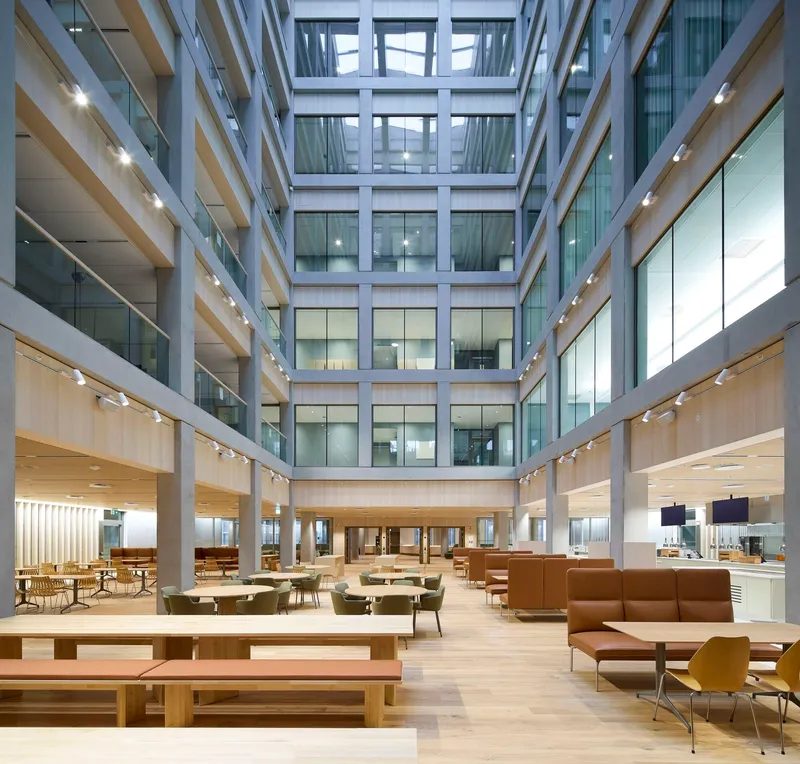
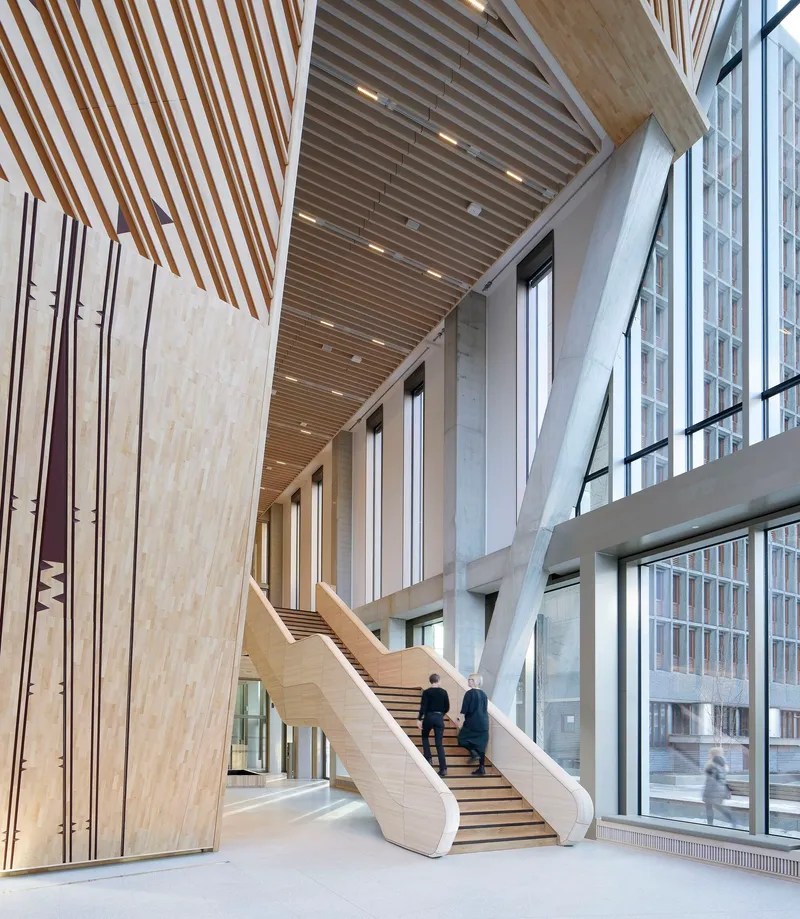
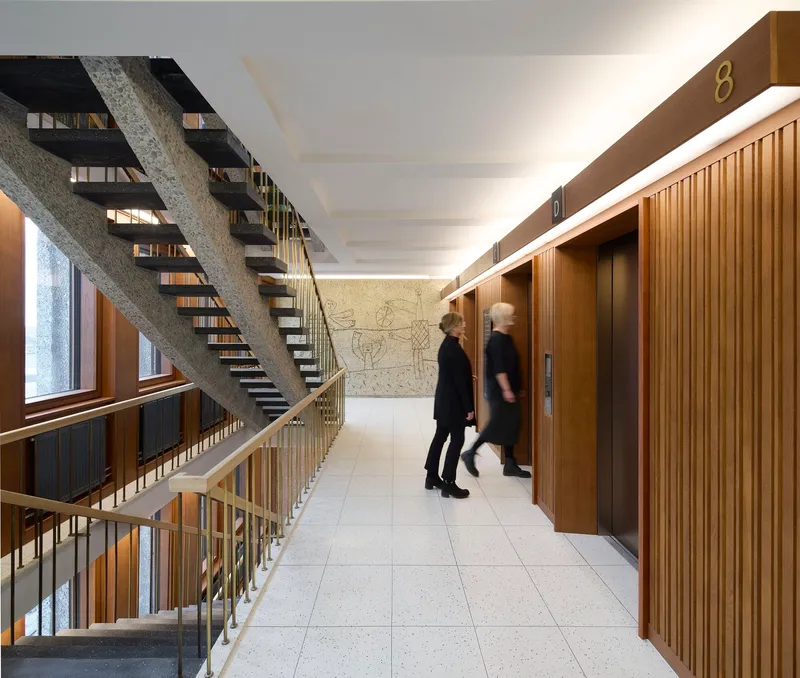
Timber sourced from the nearby Nordmarka forest appears everywhere: in the multi-storey atrium balconies, the sculpted staircases, the elevator lobbies, and the ceiling battens above communal workspaces. The material is not deployed as scenography. It does specific jobs. The double-curved balustrade elements were crafted in collaboration with local boatbuilders, whose expertise in bending wood to precise tolerances allowed forms that would have been prohibitively expensive in milled steel.
The continuous birch-finished corridor at first-floor level links the communal spaces of all seven buildings in what the architects call the Collaboration District. It is a spatial argument for cross-departmental exchange, routing civil servants past shared social zones rather than straight to their own ministry floors. Whether this actually changes bureaucratic behavior is an open question. But the architecture makes the option legible.
The D-Block Facade and Controlled Transparency
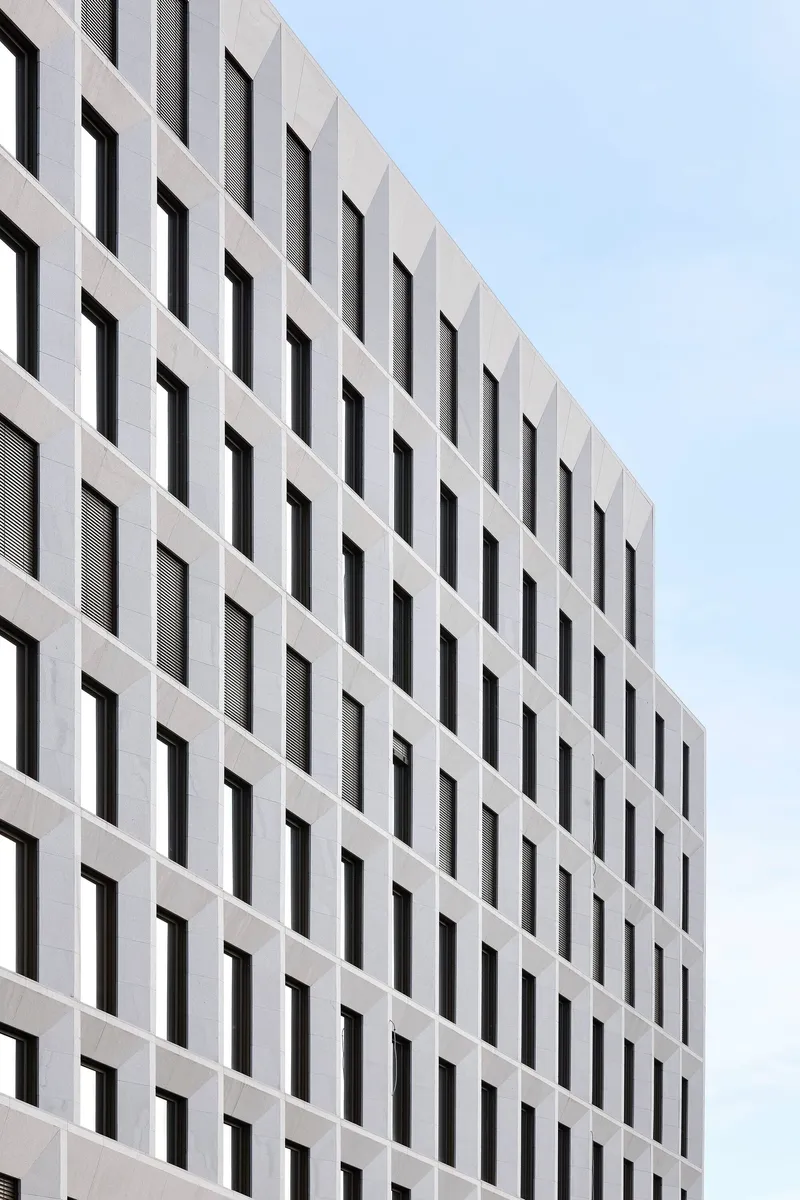
The D-block presents a white precast concrete facade with a tight grid of deep-set rectangular openings proportioned on the golden ratio. It is a quieter, more restrained building than the A-block, and its rhythmic surface reads almost textile-like from a distance. The deep window reveals manage solar gain while preserving generous daylight on the interior, contributing to a passivhaus-standard envelope that relies on seawater-based heating and cooling distributed through thermally active concrete slabs.
The dusk views across the new paved plaza show the full tonal range of the campus: the D-block's opaque solidity set against the A-block's angled glass tower and low glazed wings. The architects had to solve the paradox of every government building erected after a security incident: how to protect without projecting fear. Their answer is generous glazing at ground level, clear sightlines that serve both accessibility and surveillance, and the elimination of car traffic across the district. The openness is not naive. It is strategic.
Interior Atmospheres: From Civic to Intimate
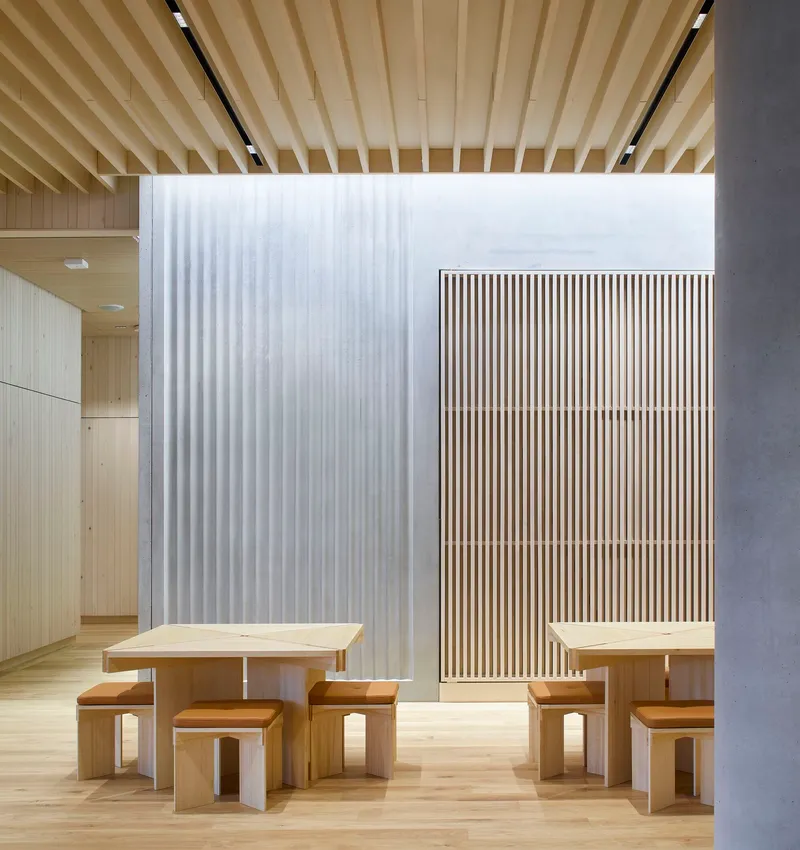
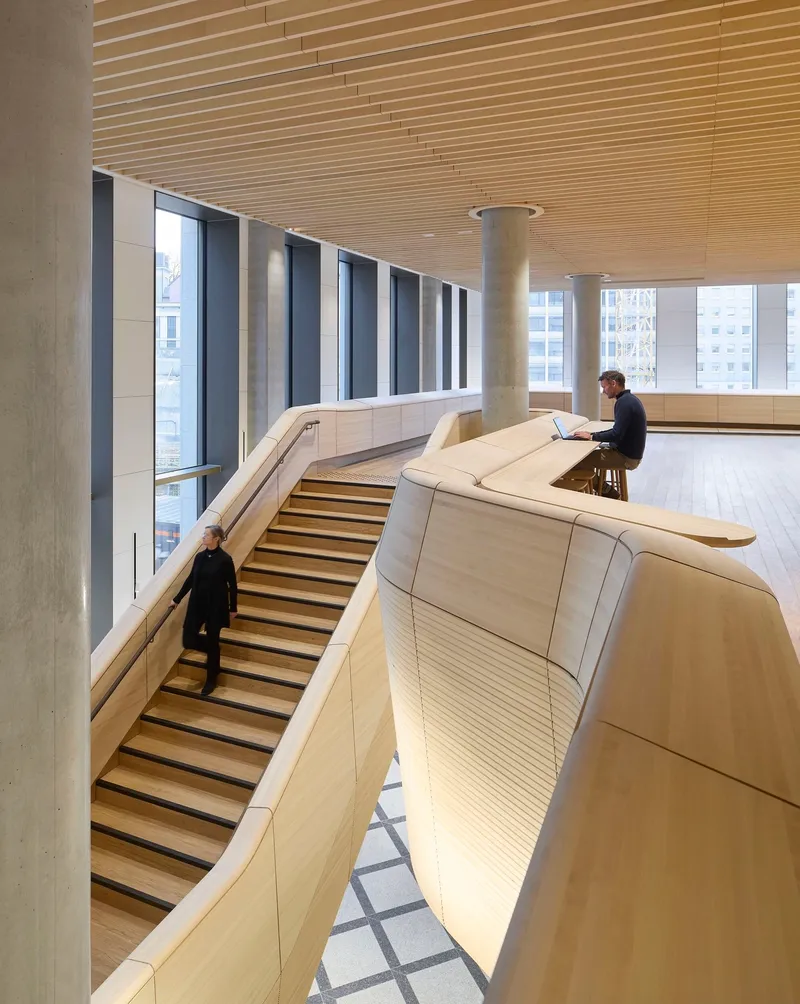
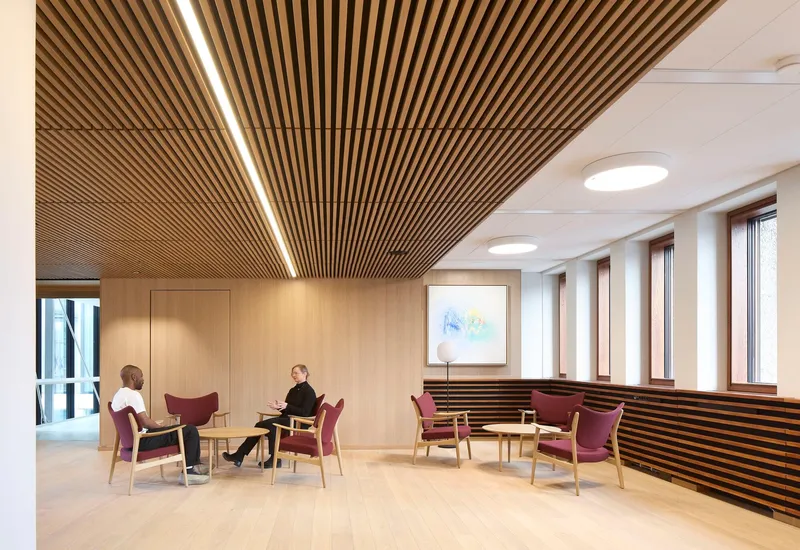
The interiors shift registers convincingly. A reading area beneath a ribbed wood ceiling and translucent curtain offers a calm, almost monastic quality. Curved bleacher seating with slatted wood cladding provides informal gathering space. Meeting lounges with burgundy chairs, circular skylights, and views to the plaza outside strike a tone that is professional without being corporate. Twenty percent of the 15,800 furniture items were reused from previous government buildings, a quiet sustainability measure that also maintains continuity with the institutions these spaces serve.
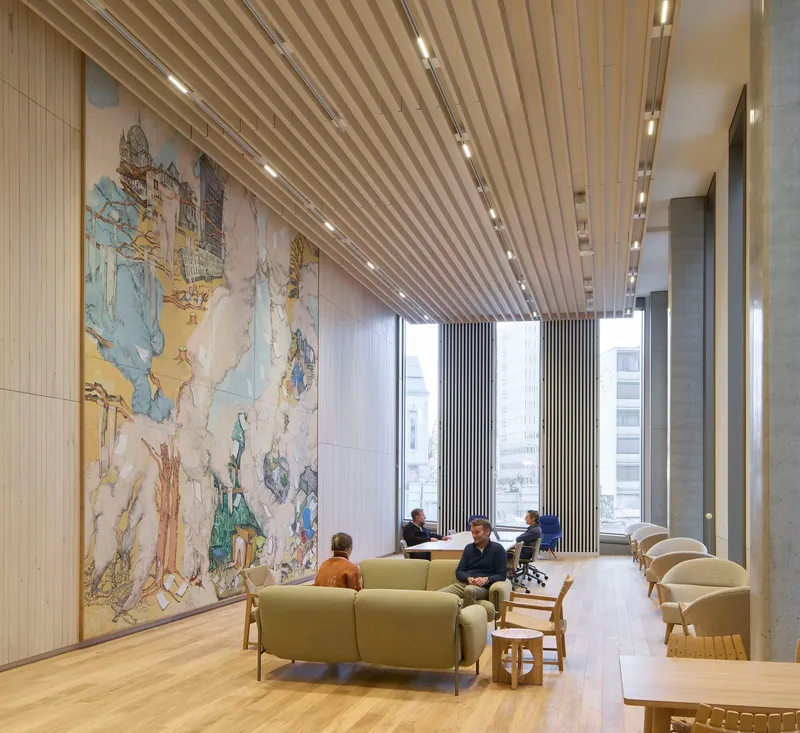
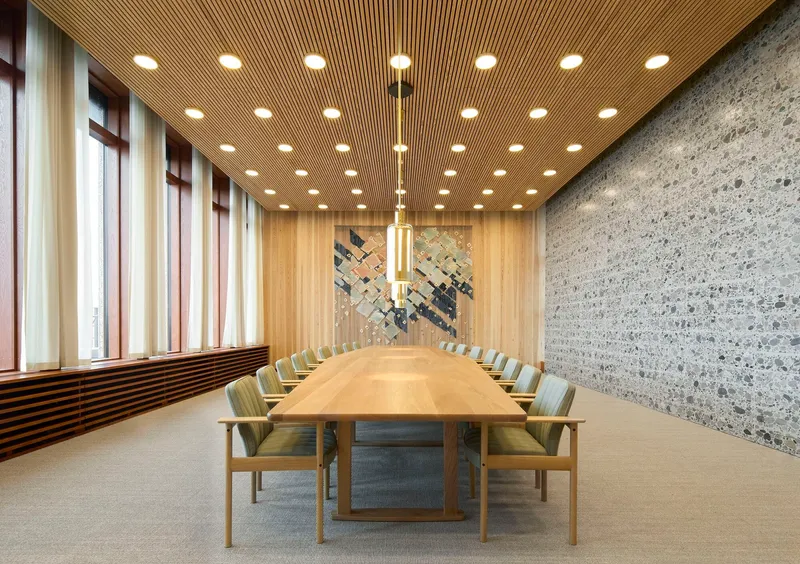
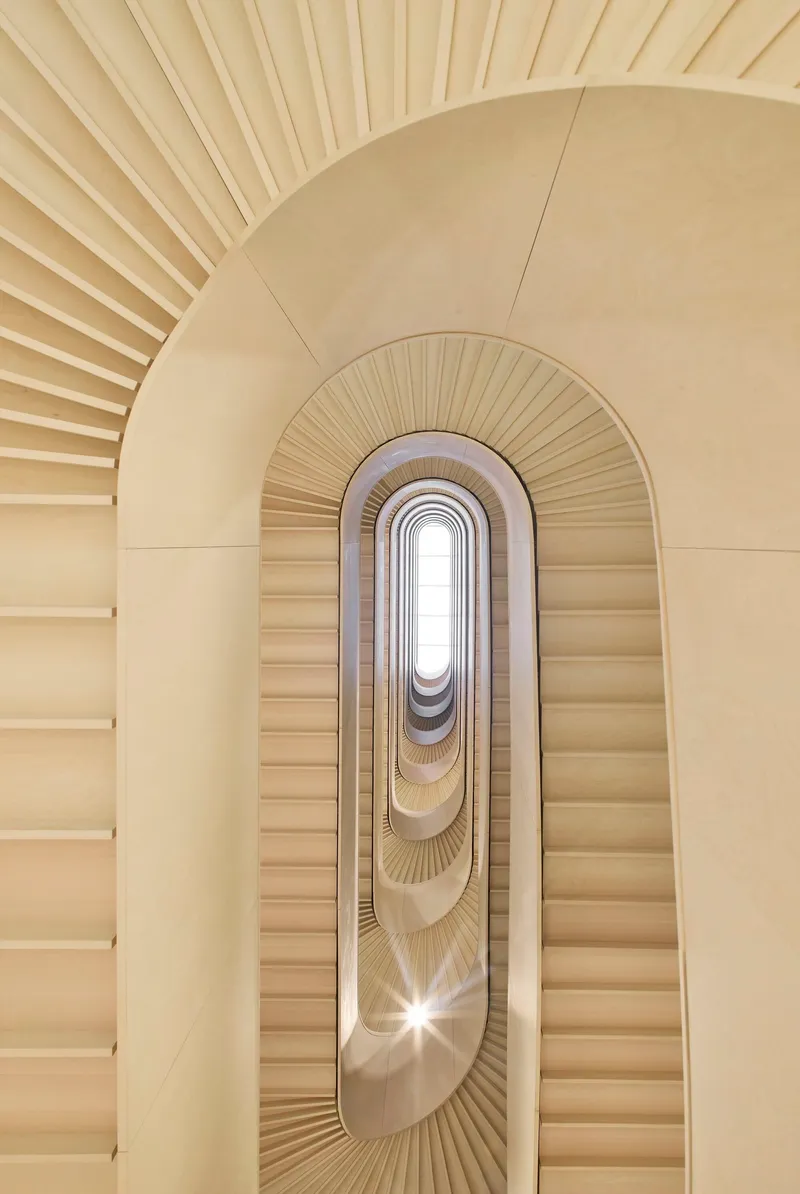
The tapestry by Sámi artist Outi Pieski, spanning over 7,500 square feet, anchors one of the lounge spaces and signals a deliberate broadening of whose culture is represented in the halls of power. Elsewhere, terrazzo columns carried forward from the original Høyblokken interiors sit alongside exposed aggregate walls and new timber joinery, creating a layered materiality that refuses a single architectural vintage. The oval stairwell, shot from below, reveals radiating handrails and a skylight crown that is pure spatial generosity in a building type not known for it.
Detail and Craft at Institutional Scale
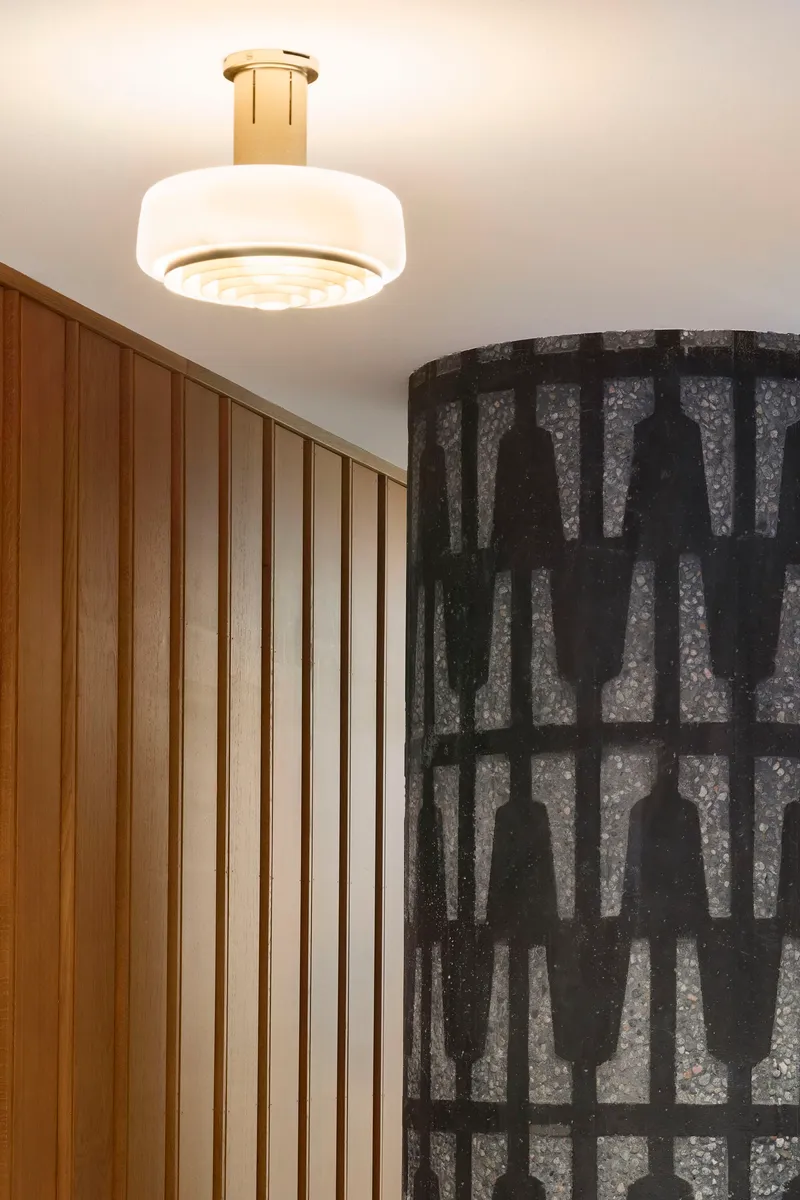
A flush-mounted glass pendant light with a brass fitting, set against vertical wood paneling and patterned dark wallcovering, captures the level of detailing the architects sustained across the campus. Four words reportedly guided the design process: noble, enduring, beautiful, and welcoming. Institutional projects rarely deliver on all four, but the material palette here, composed of Larvikite stone, Nordmarka timber, low-carbon concrete, and terrazzo, has the grain and weight to age well. The collaboration with boatbuilders on the sculpted stair elements suggests a design team willing to source expertise outside the usual consultant network.
Plans and Drawings
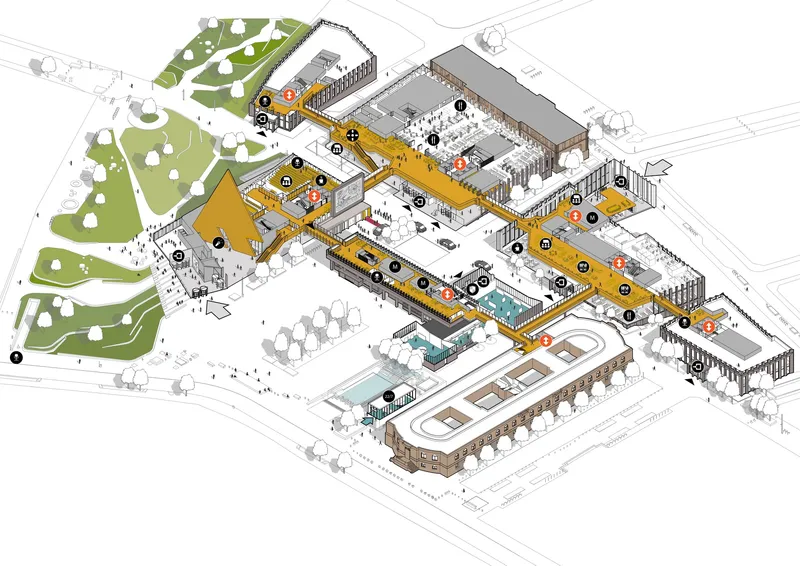
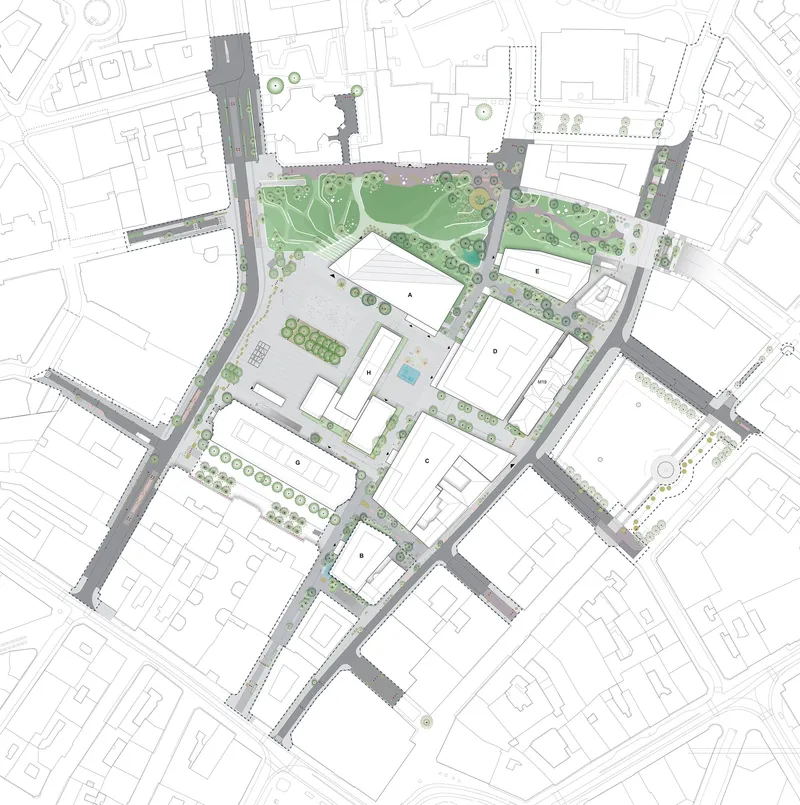
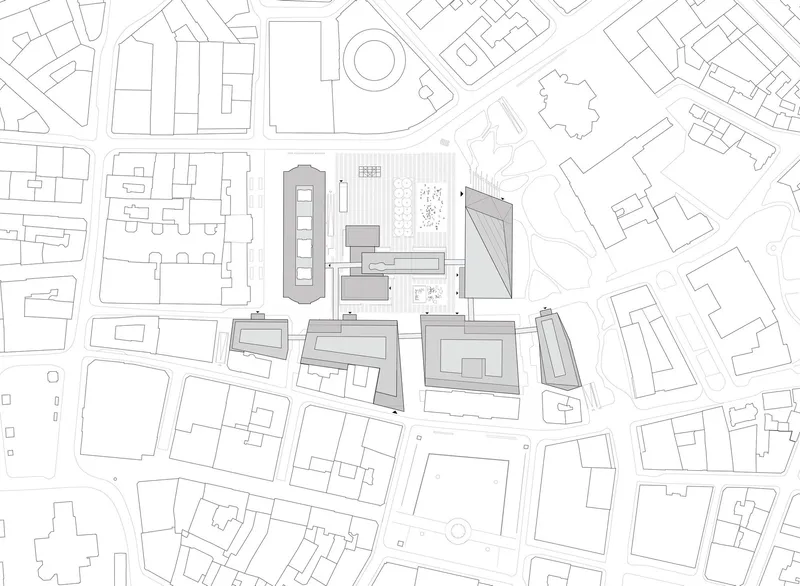
The axonometric drawing reveals the yellow circulation paths that stitch the seven buildings together at first-floor level, making the Collaboration District legible as a continuous spatial system rather than a collection of separate ministries. The site plans show how the masterplan reopens east-west pedestrian and cycling routes that the former Y-block and its surrounding road infrastructure had blocked for decades. A future public park, Regjeringsparken, designed with SLA and Bjørbekk & Lindheim, will introduce native planting and open lawns to the northern edge, further dissolving the boundary between government campus and city.
Why This Project Matters
The New Government Quarter is a test case for whether architecture can embody a political value without merely illustrating it. The value here is trust: trust that government institutions belong to the public, that openness is compatible with security, and that a site of violence can become a site of daily civic life. The architects have avoided the twin traps of memorial architecture (heavy symbolism) and corporate campus design (optimized blandness) to produce something that feels genuinely specific to its context: Norwegian materials, Norwegian craft traditions, and a Norwegian political culture that chose to respond to authoritarianism with more democracy, not less.
What will determine the project's long-term success is less the architecture than the city around it. If the reopened streets and future park actually draw Oslo residents through the campus rather than around it, the design thesis holds. If the Collaboration District produces even marginal increases in cross-ministry exchange, it will have done more than most government buildings manage. And if the 22 July Centre, embedded within the campus as a public museum and learning space, keeps the memory of the attacks present without turning the site into a shrine, then the architects will have pulled off the hardest trick of all: making a building that is simultaneously about the past and the future without being trapped by either.
New Government Quarter Oslo, designed by Nordic Office of Architecture and Haptic Architects. Located in Sentrum, Oslo, Norway. Approximately 182,000 square meters at full completion. Completed 2026. Photography by Hufton Crow.
About the Studio
Share Your Own Work on uni.xyz
If projects like this are the kind of work you want to make, uni.xyz is a place to publish your own, find collaborators, and enter design competitions.


Popular Articles
Popular articles from the community


Co-Life: Senior Housing Design That Reconnects Older Adults With the City
Co-Life reimagines senior housing design through healing gardens, shared streets, workshops, and a sustainable community across generations.

The Musturak Paradise: Senior Living Architecture for a Connected Future in Temara, Morocco
The Musturak Paradise reimagines senior living architecture in Temara via private homes, social spaces, culture, community, and shared care.

The Ocean Hive: Sustainable Architecture for a Self-Sufficient Civilization at Sea
The Ocean Hive imagines sustainable architecture at sea, where modular habitats, algae, wave power and ocean waste sustain a growing colony.

Hill & Cross Opera: Sculptural Opera House Architecture Shaped by Tallinn’s Landscape and Identity
Hill & Cross Opera reimagines opera house architecture in Tallinn through its sculptural hill, civic plaza, glass wave and a luminous cross.


Similar Reads
You might also enjoy these articles

Bao Huynh Watercolor Atelier: A Serene Art Retreat in Hội An
Bao Huynh Watercolor Atelier in Hội An blends multifunctional art spaces, sustainable design, local materials, and family-friendly living in a serene environment.

Atelier Macri Concept Store Interior Design by CASE-REAL
Atelier Macri store features a "ko" counter, walnut wood details, cork displays, blending retail, gallery, and seamless customer experiences.

Manuel Vargas Izquierdo Stadium and High-Performance Sports Center: Architectural Excellence in Jalpa de Méndez
The Manuel Vargas Izquierdo Stadium blends sustainable design, inclusive sports facilities, and cultural-inspired architecture, revitalizing Jalpa de Méndez’s public spaces.

KAKR Buluh Awar Hall: Revitalizing Community and Ecology Through Bamboo Architecture
Community built bamboo hall revitalizes Buluh Awar village, empowering youth, restoring ecology, celebrating vernacular craftsmanship through sustainable architecture and culture.




Comments (0)
Please login or sign up to add comments
No comments yet. Be the first to comment!