

RIVERINE Architecture Builds a Brick Pavilion for Rural Life in Southern Bangladesh
Noshu Molla's House in Gopalganj wraps cantilevered verandas around a compact two-story volume to cool, connect, and frame village life.


A son builds a house in memory of his father so that his mother can stay rooted in the village rather than migrate to an urban apartment. That emotional origin story could easily produce a sentimental building. Instead, RIVERINE Architecture, led by Sharif Jahir Hossain and project architect Muhaiminul Islam, delivered something more disciplined: a 2,200 square foot concrete and brick pavilion near Kathi Bazar in Gopalganj, Bangladesh, that treats the veranda not as ornament but as the primary architectural move.
What makes Noshu Molla's House worth studying is how it splits its floor area into two legible volumes. Roughly 1,300 square feet per floor is enclosed, while 800 square feet per floor is given over to cantilevered verandas and voids that wrap the perimeter. The house is, in effect, a compact core wearing a generous hat. Every room touches the outdoors through these semi-open thresholds, and the result is a home that breathes through its skin rather than relying on mechanical cooling. Completed in 2021, it is a quiet case study in how passive strategy and spatial generosity can coexist on a modest budget.
Brick and Concrete as Equal Partners


The material palette is deliberately restrained: handmade red brick walls and board-formed exposed concrete slabs, columns, and beams. Neither material is subordinate. Brick handles the mass and warmth, while the concrete provides the cantilevers and the structural drama. Board marks on the concrete surfaces register the formwork grain, giving the poured elements a texture that converses with the brick coursing rather than opposing it.
Reused mahogany from the site appears in doors and furniture, closing a small material loop. New fruit trees replace harvested ones, so the landscape is actively regenerating around the building. A renovated pond collects rainwater for year-round domestic use and, in a practical acknowledgment of village life, doubles as a swimming spot.
The Veranda as Climate Machine
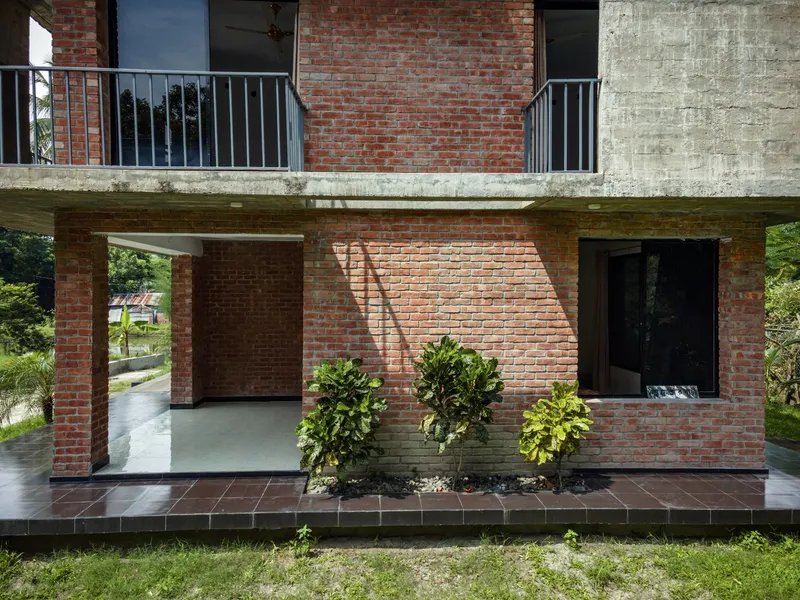
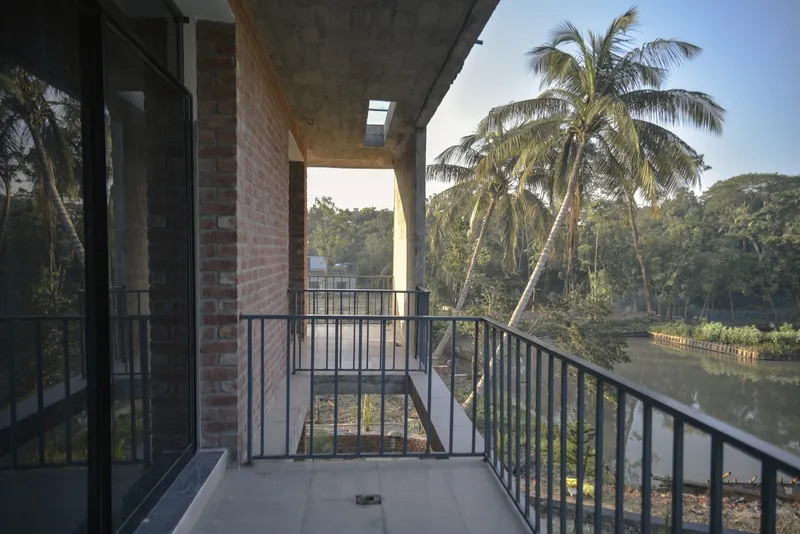
Continuous verandas on both floors do the heavy lifting for thermal comfort. Oriented north-south, the house minimizes solar heat gain on its long facades while channeling prevailing summer winds through the plan. The cantilevered slabs shade the brick walls and large openings below, preventing direct sun from reaching glass surfaces during the hottest hours. Cross ventilation in the upper floor bedrooms relies on this same wrapping porch to create a pressure differential between the shaded perimeter and the interior.
These are not token balconies. At 800 square feet combined per level, the outdoor volume is substantial, functioning as an extension of the living areas rather than a decorative ledge. On the ground floor, planted beds tucked beneath the slab introduce greenery at eye level, softening the transition from lawn to interior. The effect is closer to a courtyard house turned inside out: shelter at the core, garden at the edge.
Approaching the House
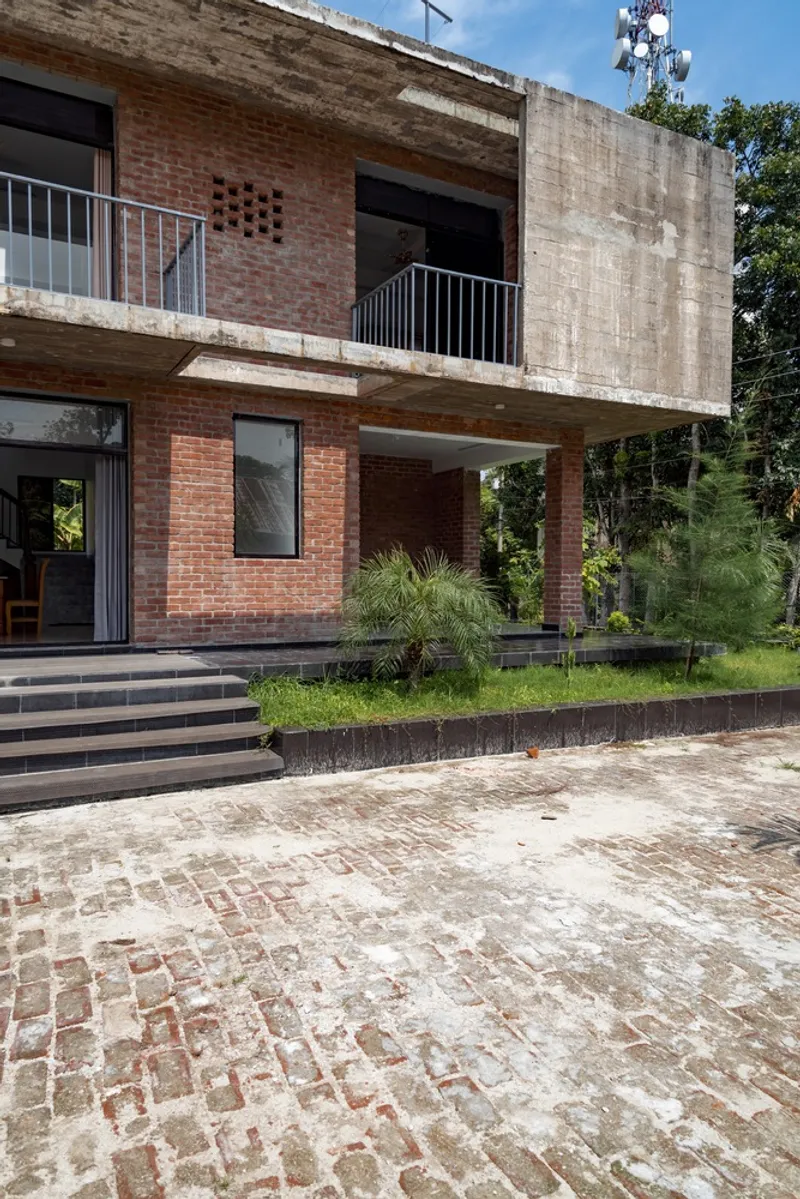

The entry sequence sets the tone. A brick-paved path leads to a stepped plinth beneath the cantilevered concrete volume, compressing the arrival before releasing you into the ground floor's open seating area. The plinth lifts the house off the ground plane, a practical flood-mitigation gesture in southern Bangladesh that also gives the building a sense of quiet formality.
From the rear lawn, the house reads as a horizontal mass framed by coconut palms and jackfruit trees. A metal play structure on the grass hints at the family's investment in outdoor activity; the premises include a small sports field for football and badminton. The building is not a sealed object dropped onto a plot but a component of a larger landscape that includes water, trees, and open ground.
Interior Thresholds
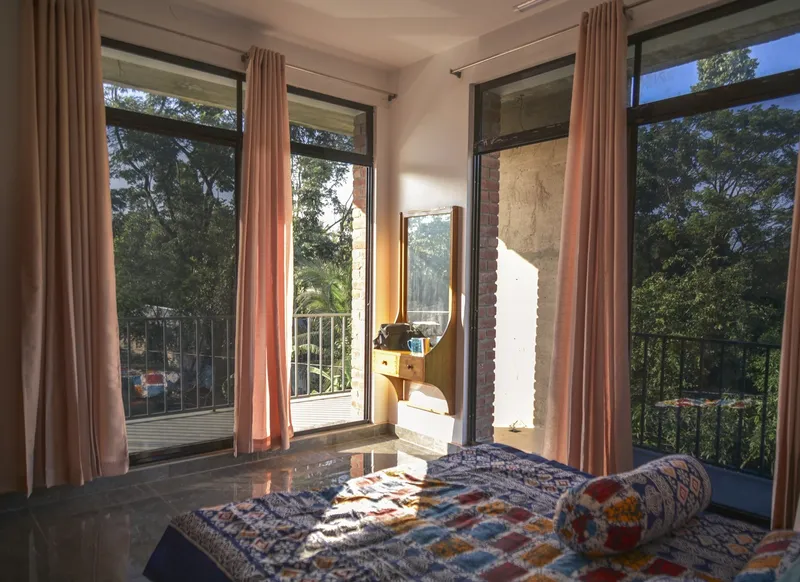

Inside, the planning is compact and legible. The ground floor holds formal living, dining, an informal seating area, one bedroom, a common toilet, and a kitchen, all organized around a centrally positioned staircase. The first floor stacks four bedrooms with en-suite bathrooms around a family living space that sits opposite the stair, ensuring the circulation spine doubles as a shared gathering point.
Glass doors in the bedrooms open directly onto the veranda, and morning light spills across the threshold in a controlled wash. A linear skylight at one balcony corner casts a sharp shadow line down the concrete ceiling, proving that even in a budget-conscious project, light can be choreographed with precision. The interplay between deep shade under the cantilever and bright slices of sky through these openings gives the upper floor a calm, layered atmosphere that a sealed, air-conditioned box could never replicate.
Why This Project Matters
Rural housing in Bangladesh rarely receives serious architectural attention in international discourse. Noshu Molla's House challenges that gap not through spectacle but through rigor. Its strategies, cantilevered shade structures, north-south orientation, cross ventilation, rainwater harvesting, material reuse, are individually unremarkable. Assembled together with this level of spatial discipline, they produce a home that performs well in a hot-humid climate without relying on imported technology or inflated budgets.
RIVERINE Architecture's framing of the house as a pavilion is more than a concept statement; it is a structural commitment. By allocating over a third of the total floor area to open-air verandas, the firm argues that in this climate, the most valuable square footage is the one without walls. For anyone designing in the tropics, that proportion is worth remembering. The house stands as proof that generosity of space and economy of means are not contradictions but collaborators.
Noshu Molla's House by RIVERINE Architecture. Khanar Par, Gopalganj, Bangladesh. 2,200 sq ft. Completed 2021. Lead Architect: Sharif Jahir Hossain. Project Architect: Muhaiminul Islam. Photography by Shakil Ibne Hai.
About the Studio
Share Your Own Work on uni.xyz
If projects like this are the kind of work you want to make, uni.xyz is a place to publish your own, find collaborators, and enter design competitions.


Popular Articles
Popular articles from the community


Juan García Correa, John González and Claudia Rueda Sink a Circular Amphitheater into a Manizales Engineering Building
On the La Nubia campus in Manizales, Colombia, the S1 Building folds labs and offices into a hillside of ramped lawns that double as a campus route.

LT2A and OPEN Architectes Thread a Brick and Glass High School Through a Wooded Belgian Campus
In Braine-l'Alleud, a 3,000 m² wing for Collège Cardinal Mercier pairs pale brick with a glazed colonnade, deferring to a small chapel and a dense wood.

Cube Design Draws an Ecological Corridor Between Two Shenzhen Hills with the Nankai Building
Beside Shenzhen's container docks, the Nankai Building pairs stacked balconies with a climbing green screen to connect two hillsides across its height.

longwave studio Reorganizes a 112 m² Tainan Apartment Around the Daily Routines of a Family and Two Cats
In Tainan, Taiwan, birch plywood, rust-red furniture and a freestanding plaster wall link arrival, storage, work and family life in one apartment.

Similar Reads
You might also enjoy these articles


Hodi-Mandai Geram
Project Function: Preservation and revitalization of the Intangible heritage and socio-spatial identity of the Hodi by Housing, Cultural Memory Center, Sacred Grove, landscape, local tourism economy


Olio Towers: A Mid-Rise for Performers That Fuses Housing, Rehearsal, and Stage
Located blocks from Houston's Theater District, this modular tower stacks living units around a central performance atrium.

Oasis: Modular Green Housing Carved into Dhaka's Urban Fabric
A shortlisted Plugin Housing entry reclaims unauthorized settlements in Dhaka with stepped concrete volumes, green roofs, and ventilation-driven design.

Black Hole: A Floating Megastructure for the Post-Physical Era
Emiliano Mazzarotto envisions a spherical, self-scaling arena where e-sports, digital hotels, and holographic stadiums replace traditional public space.

Explore Housing Competitions
Discover active competitions in this discipline

Challenge to reimagine the Iron Throne

Photograph architecture without architects

Illustrate the lost glory of Angkor Wat - Render Challenge

Design challenge to reuse E-waste
Comments (0)
Please login or sign up to add comments
No comments yet. Be the first to comment!