
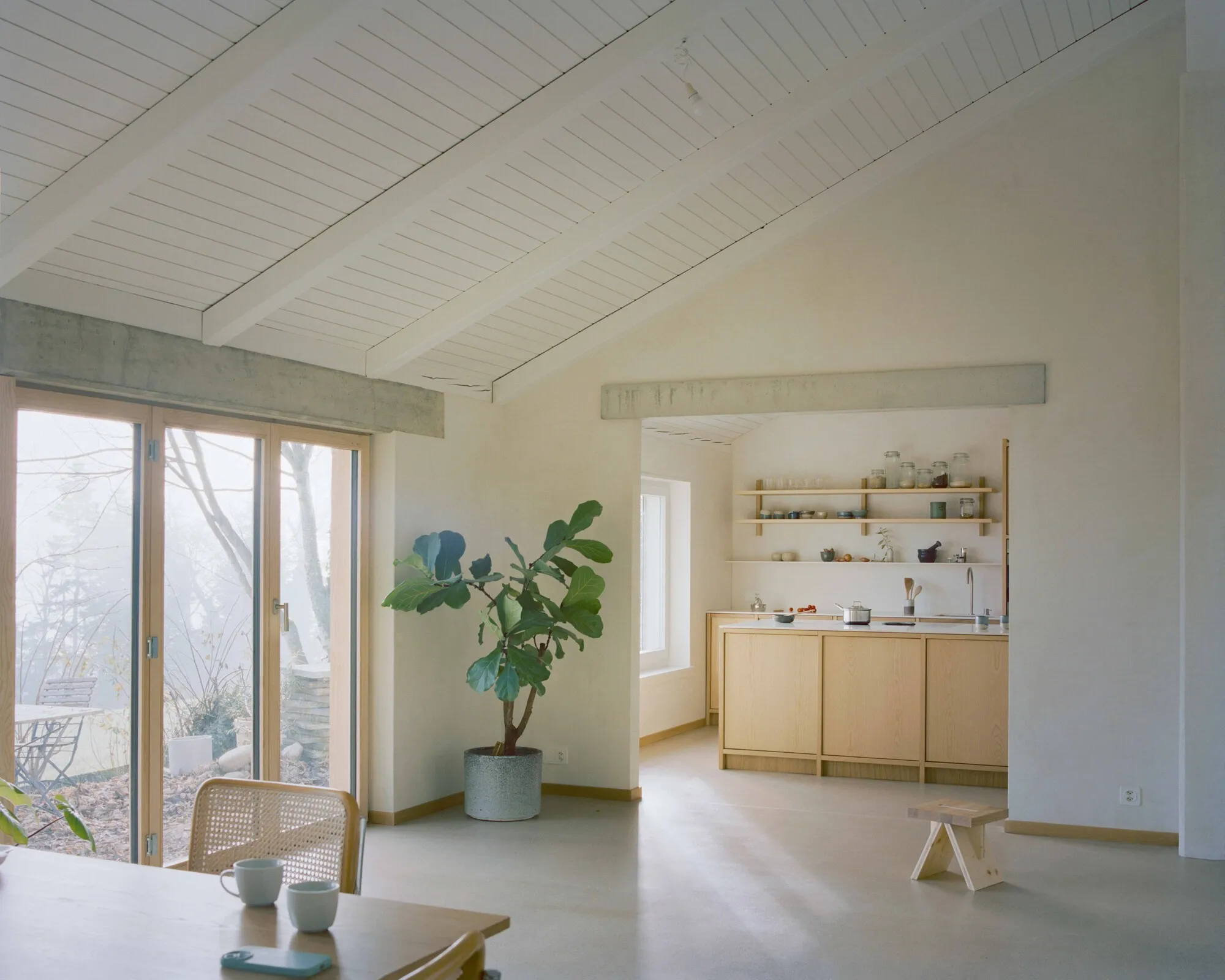
Noue Studio Refines a 1983 Swiss Villa by Swapping Rooms and Stripping Back to Structure
A restrained interior renovation in the misty hills above Neuchâtel reveals the latent spatial quality of a four-decade-old family home.


Renovation projects that aim for restraint often end up feeling timid, as though the architect was afraid to leave a mark. The Family Villa by Noue Studio manages the opposite: a 100 square meter interior intervention in a 1983 house near Rochefort, Switzerland, that is both minimal in its gestures and decisive in its impact. The key move is almost comically simple. The kitchen and the bedroom swapped places. But from that single spatial inversion, a cascade of clarity follows.
Perched in the hills above Neuchâtel, specifically in the village of Montézillon, the house sits under a low-pitched roof surrounded by bare deciduous trees and rocky terrain that dissolves into fog. The existing structure offered honest materials: concrete beams, wooden ceilings, generous glazing. Noue Studio's contribution was to take those elements seriously, stripping back accumulated layers and introducing a vocabulary of solid ash and oak joinery, lime plaster walls, and repainted timber ceilings that let the bones of the building speak for themselves.
A House in the Mist
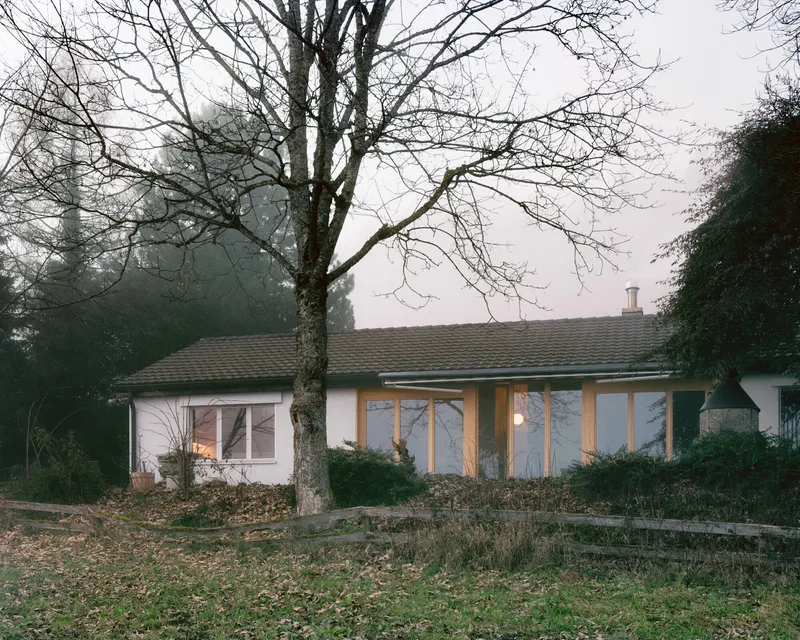
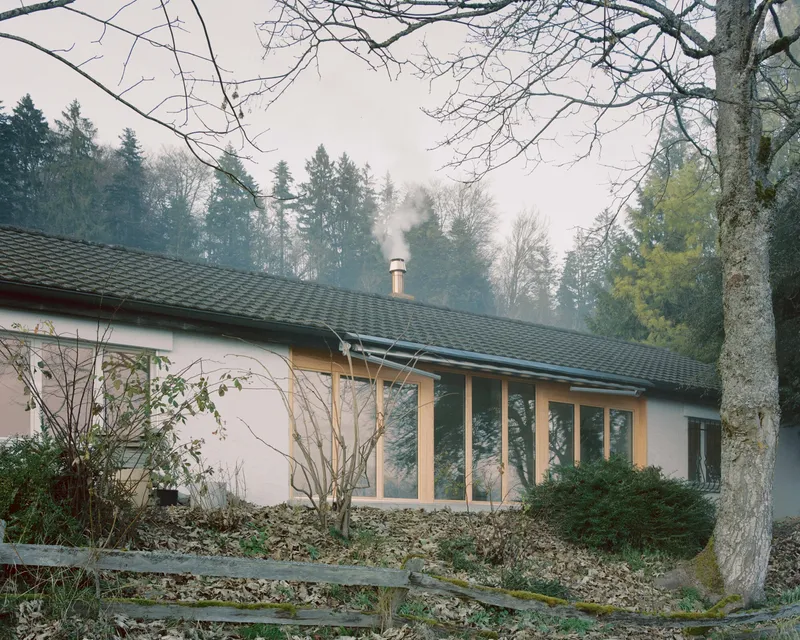
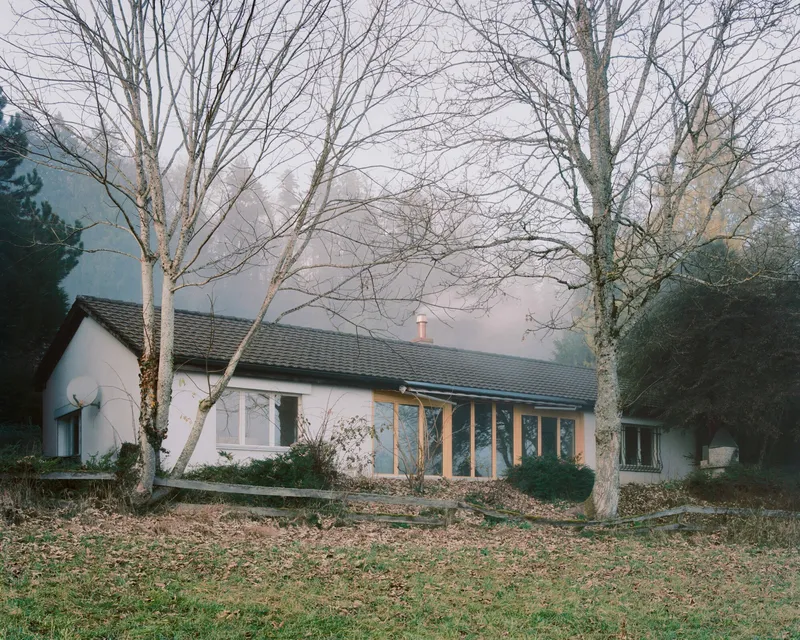
The exterior photographs capture a building that seems to belong to its landscape almost by default. There is nothing performative about the house's relationship to the forested hillside. Its tiled pitched roof, timber-framed windows, and modest single-story profile read as typical late-twentieth-century Swiss residential construction. Chimney smoke curls into the fog. Bare branches press close. It is the kind of house you might walk past without a second glance, which is precisely its charm and the reason the renovation stays interior.
Noue Studio wisely avoided touching the facade. The existing timber-framed window wall facing the garden already provides a strong connection to the outdoors, and the low roof pitch keeps the profile grounded. Any external alteration would have risked disrupting a proportional equilibrium that four decades of weathering have quietly perfected.
Concrete Bones, Timber Skin
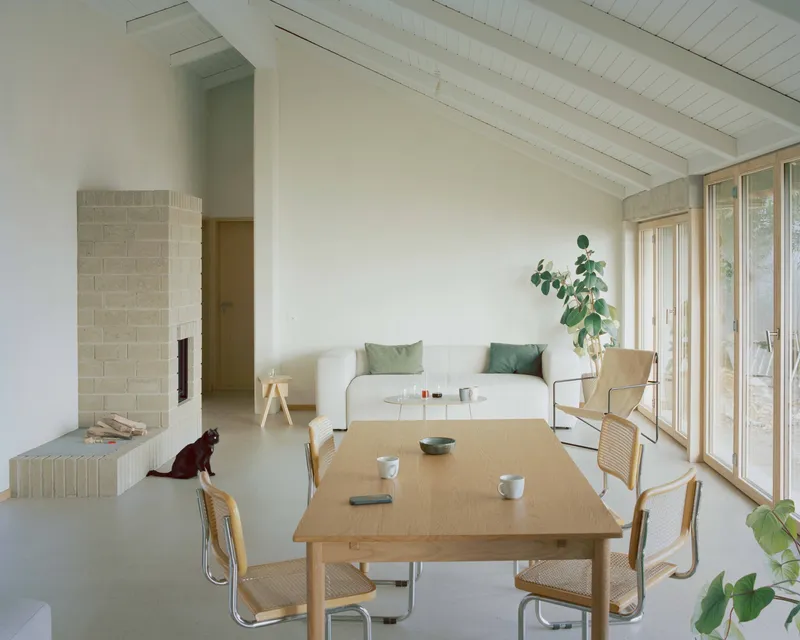
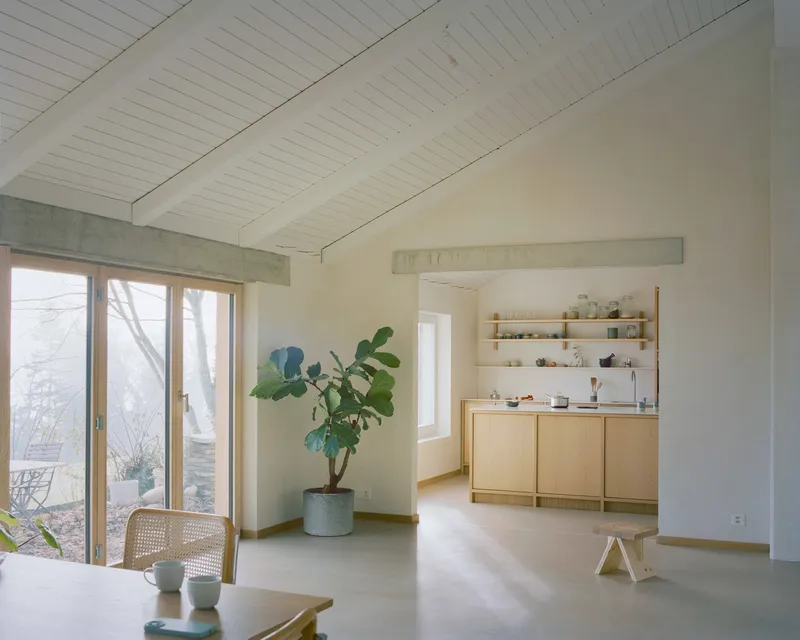
Walk inside and the structural logic of the house becomes immediately legible. Exposed concrete beams span the living space, framing views through sequential rooms like a series of proscenium arches. The decision to leave these beams exposed rather than concealing them behind drywall gives the interior a depth and rhythm that no amount of decorative finishing could achieve. They function as thresholds, not barriers, guiding the eye from the living room through to the kitchen beyond.
Above the concrete, white-painted timber plank ceilings soften the overhead plane and bounce diffused daylight deeper into the floor plan. The contrast between the raw gray of concrete and the warm white of wood creates a tonal palette that the rest of the intervention follows faithfully. It is a two-material composition at its core, and Noue Studio had the discipline to keep it that way.
The Kitchen Swap
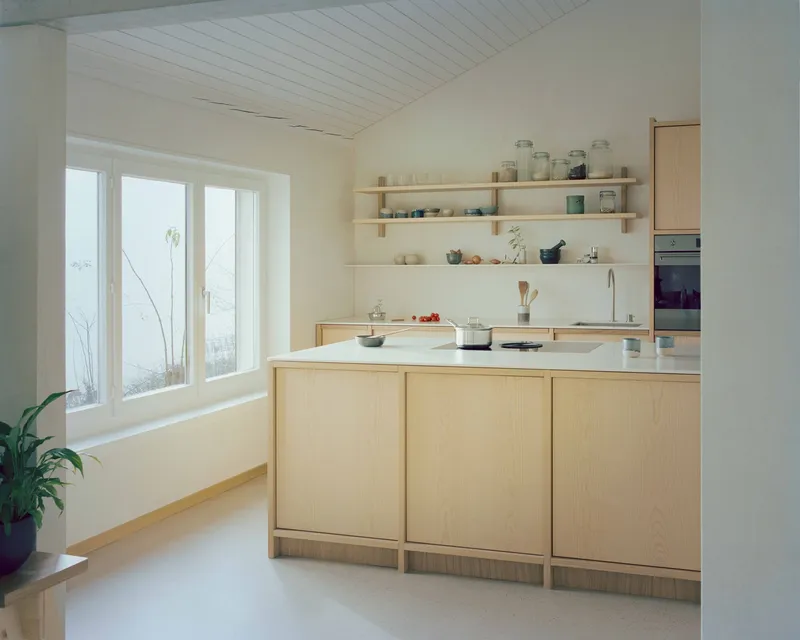
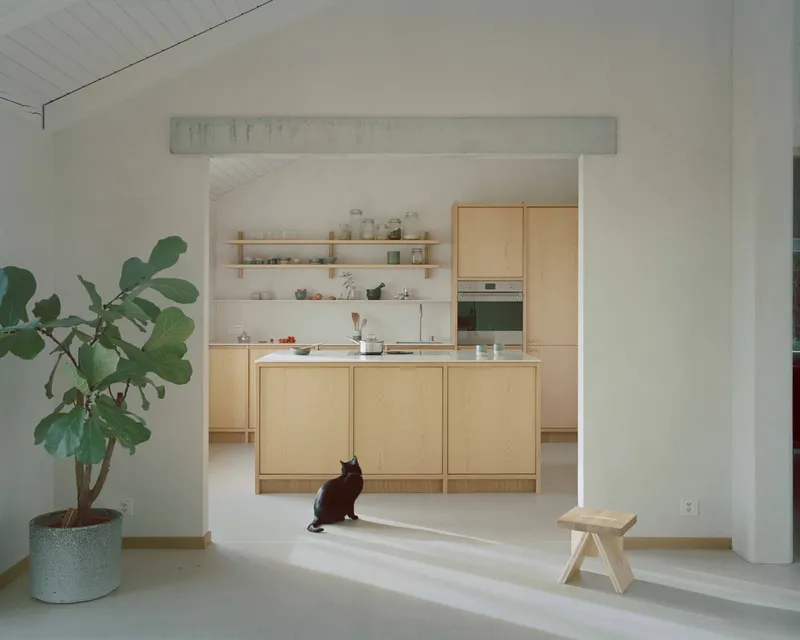
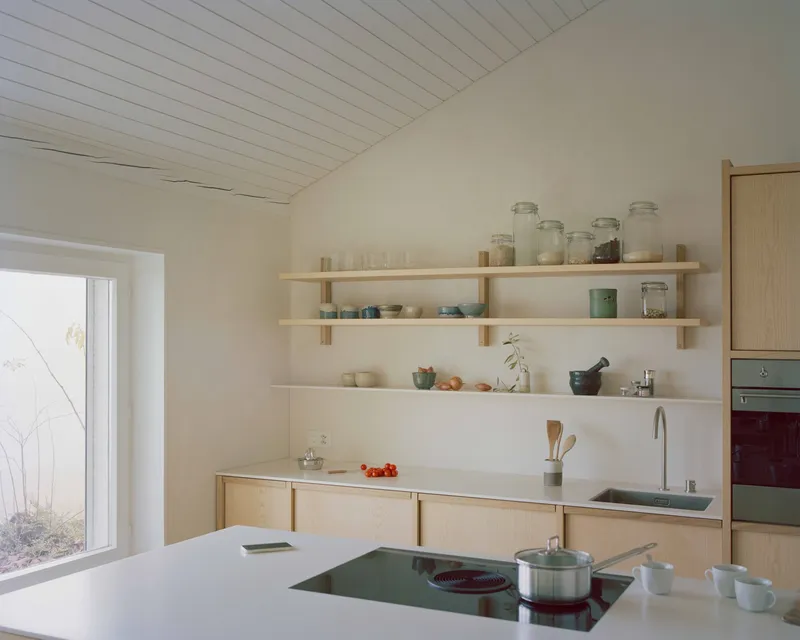
The most consequential design decision in the project is the relocation of the kitchen from its original position to the room formerly occupied by a bedroom. In the new configuration, the kitchen sits at the terminus of the main living axis, visible from the entrance and connected to the dining area through the sequence of concrete-framed openings. This single swap transformed the house from a collection of enclosed rooms into a fluid domestic sequence.
The kitchen itself is a study in considered joinery. Light ash cabinetry with open shelving lines the walls below the sloped white ceiling, and a central island with a cooktop anchors the room. There is nothing showy about the millwork. The proportions are generous, the detailing clean, the material selection consistent. A cat sits on the threshold between kitchen and corridor, perfectly at ease, which is perhaps the most honest review any domestic renovation can receive.
Living with Light and Landscape
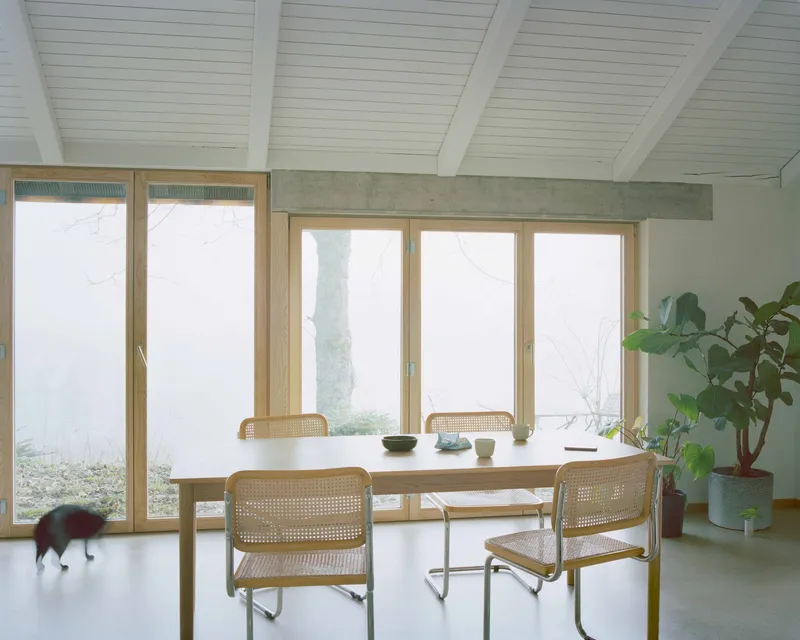
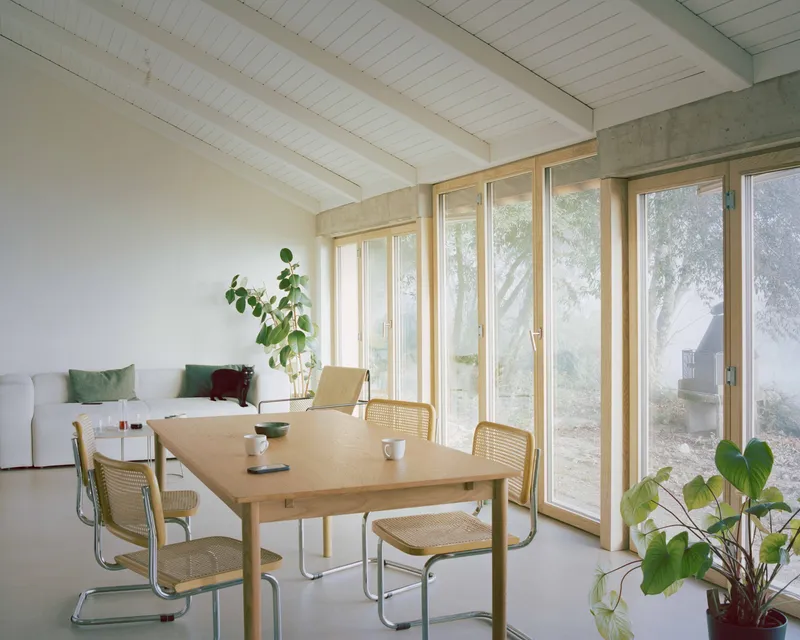
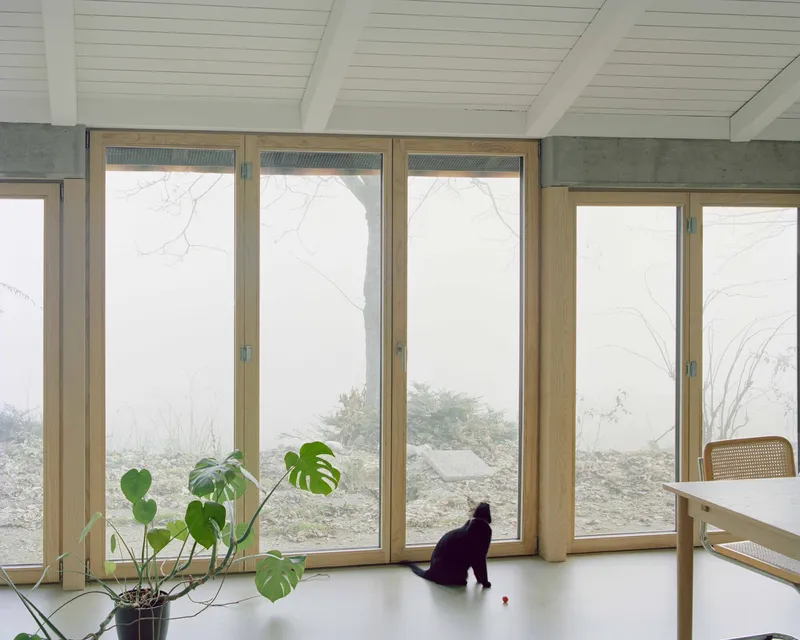
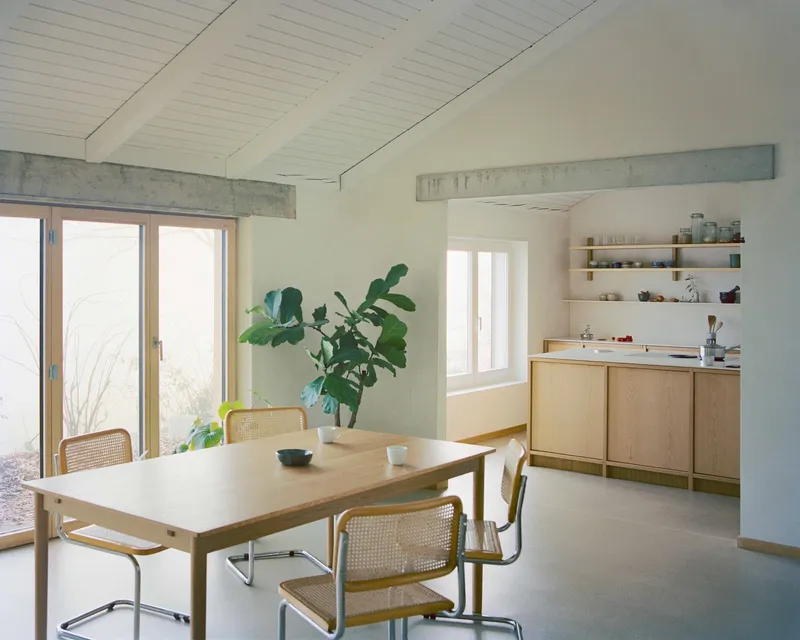
The floor-to-ceiling timber-framed glazing on the garden side remains the house's strongest architectural gesture, and it predates this renovation entirely. What Noue Studio did was ensure the interior spaces actually benefit from it. By clearing the spatial clutter and reorienting the plan, the dining area now sits directly against this glass wall, bathed in the soft, gray-white light that filters through the fog. The concrete beam overhead acts as a datum line, grounding the view and preventing the transparency from feeling exposed.
One image captures a cat perched on the sill of a window that frames a misty, rocky hillside. It is a vignette that communicates more about the project's success than any plan diagram could. The relationship between interior warmth, carefully chosen materials, and the wild, damp landscape outside is the real subject of this renovation. The architecture does not compete with the view; it frames a life oriented toward it.
Corridor as Sequence
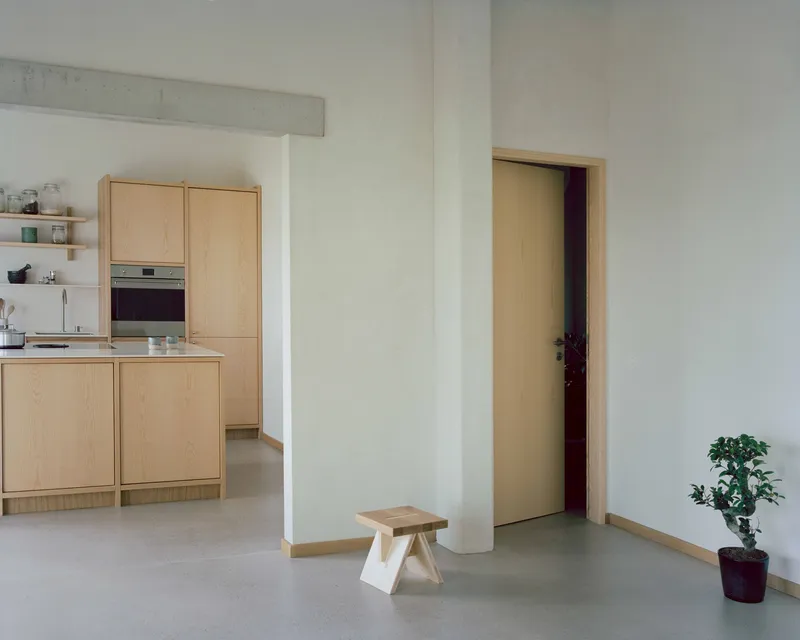
The circulation spaces reveal Noue Studio's attention to what they describe as a gradation of intimacy. The white-walled corridor with its timber-framed doorway and minimal furnishing, a small wooden stool, a potted plant, reads as a decompression zone between the communal living areas and the more private rooms beyond. Lime plaster on the walls gives a slightly textured, matte surface that absorbs light rather than reflecting it, lowering the visual intensity as you move deeper into the plan.
The dining area functions as a hinge between these zones. Exposed concrete lintels overhead, timber cabinetry to one side, glazed doors to the garden on the other: it is the room where structure, craft, and landscape converge most explicitly. Potted plants on the sill soften the material palette without diluting it. Every element earns its place.
Why This Project Matters
The Family Villa is a useful counter-argument to the prevailing logic that renovation must be visibly transformative to be worthwhile. Noue Studio's intervention is almost invisible from the street. The exterior remains untouched. The structural system is unchanged. The budget, one imagines, was modest. Yet the experience of living in this house has been fundamentally altered by a handful of precise decisions: moving a kitchen, exposing concrete, selecting the right timber, and letting lime plaster do the quiet work of unifying a set of rooms that were previously disconnected.
For a 100 square meter house built in 1983, this is a generous afterlife. It suggests that the quality of an existing building is not always visible at first glance; sometimes it takes another architect, working decades later with different priorities, to reveal what was always latent in the structure. That is not a dramatic narrative, but it is an honest one, and honesty is what makes this renovation convincing.
Family Villa, by Noue Studio. Rochefort, Switzerland. 100 m². Completed 2025. Photography by Willem Pab.
About the Studio
Share Your Own Work on uni.xyz
If projects like this are the kind of work you want to make, uni.xyz is a place to publish your own, find collaborators, and enter design competitions.



Popular Articles
Popular articles from the community


The Musturak Paradise: Senior Living Architecture for a Connected Future in Temara, Morocco
The Musturak Paradise reimagines senior living architecture in Temara via private homes, social spaces, culture, community, and shared care.

The Ocean Hive: Sustainable Architecture for a Self-Sufficient Civilization at Sea
The Ocean Hive imagines sustainable architecture at sea, where modular habitats, algae, wave power and ocean waste sustain a growing colony.

Riyadh For All: Intergenerational Urban Design for Active Aging in Rabat
Riyadh For All reimagines urban design in Rabat with intergenerational co-living, adaptive courtyards, and Moroccan cultural exchange today.

Lunar Spiral: Space Architecture Shaped by the Mathematics of the Universe
Lunar Spiral reimagines space architecture through Fibonacci geometry, lunar regolith, levitating habitats, and self-sustaining Moon living.


Similar Reads
You might also enjoy these articles

Bao Huynh Watercolor Atelier: A Serene Art Retreat in Hội An
Bao Huynh Watercolor Atelier in Hội An blends multifunctional art spaces, sustainable design, local materials, and family-friendly living in a serene environment.

Atelier Macri Concept Store Interior Design by CASE-REAL
Atelier Macri store features a "ko" counter, walnut wood details, cork displays, blending retail, gallery, and seamless customer experiences.

Manuel Vargas Izquierdo Stadium and High-Performance Sports Center: Architectural Excellence in Jalpa de Méndez
The Manuel Vargas Izquierdo Stadium blends sustainable design, inclusive sports facilities, and cultural-inspired architecture, revitalizing Jalpa de Méndez’s public spaces.

KAKR Buluh Awar Hall: Revitalizing Community and Ecology Through Bamboo Architecture
Community built bamboo hall revitalizes Buluh Awar village, empowering youth, restoring ecology, celebrating vernacular craftsmanship through sustainable architecture and culture.
Explore Villa Competitions
Discover active competitions in this discipline


Challenge to design mud housing for contemporary communities


Challenge to design luxury tourism on rails


VR headsets Storefront design competition

Designing a staircase for a client
Comments (0)
Please login or sign up to add comments
No comments yet. Be the first to comment!