

Nucleus House by LOZÍ: A Compact Experimental Residence in Tietê, Brazil
Compact experimental house in Tietê, Brazil, organized around a rigid service core, open plan spaces, exposed concrete blocks, and flexible future layouts.


Designed by LOZÍ, Nucleus House is a compact yet conceptually ambitious residential project located in Tietê, Brazil. Completed in 2022, the 73-square-meter house was conceived as an architectural experiment: one that balances market feasibility, spatial flexibility, and constructive clarity within a rapidly expanding urban context.
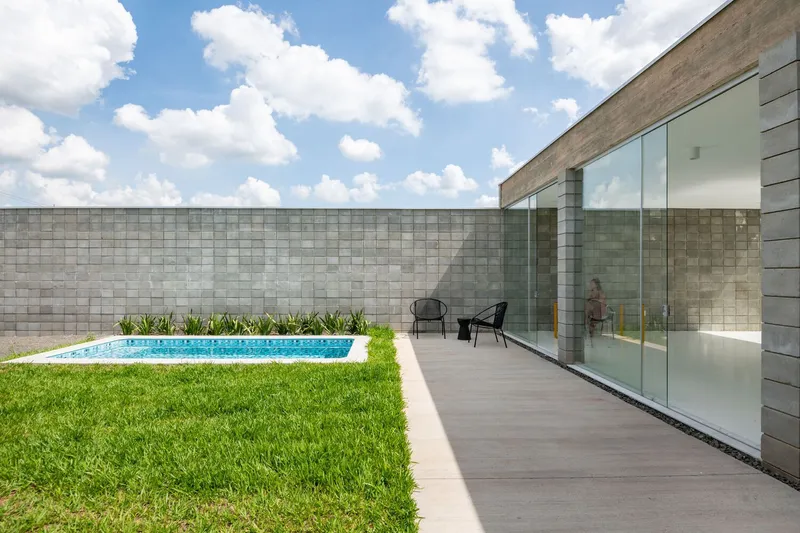
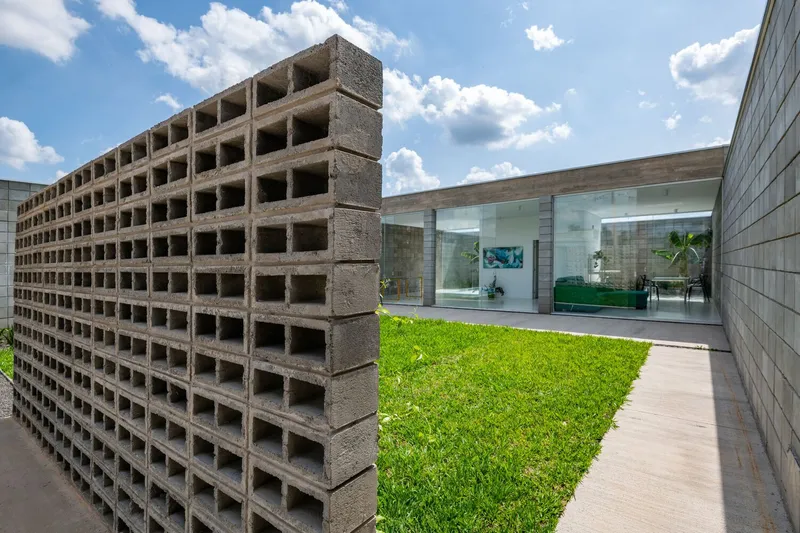
Set within a developing residential neighborhood near consolidated urban areas, the project responds to its surroundings by maintaining a calm, inward-looking character while anticipating future transformations. The house was envisioned not only as a dwelling but also as a prototype for contemporary urban living, capable of adapting to changing lifestyles and future demands.
Spatial Organization and Architectural Concept
The defining principle of Nucleus House lies in its perimeter-based organization. Rather than centering the layout around conventional room divisions, the design begins at the plot’s boundaries. Enclosing walls establish immediate site security while framing the internal spatial experience. Within this perimeter, a rigid central core becomes the functional heart of the house, accommodating two full bathrooms, the laundry area, and the kitchen’s hydraulic wall.

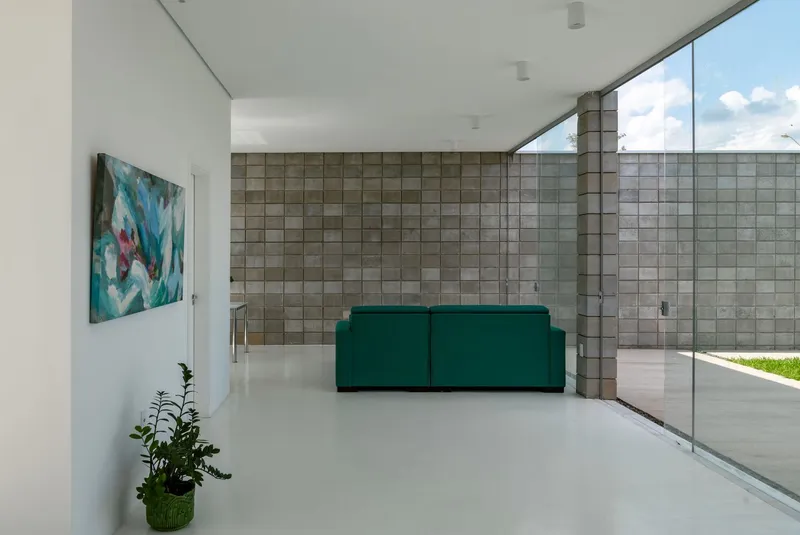
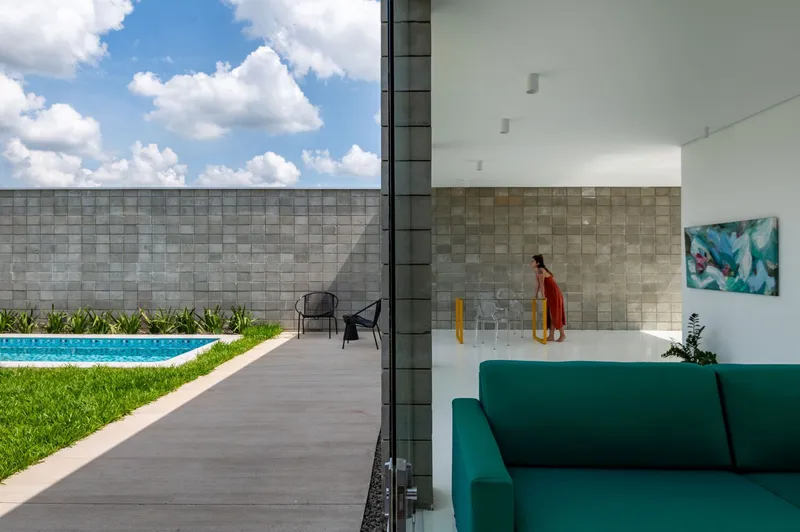
This compact nucleus liberates the remaining space, allowing for an open and integrated floor plan that supports multiple configurations over time. Large glass panels enclose the living areas, ensuring visual continuity between interior and exterior while enhancing natural light and cross-ventilation. The flexible layout also allows the residence to evolve into a more conventional typology, with the potential addition of two bedrooms and a suite.

Site Strategy, Light, and Ventilation
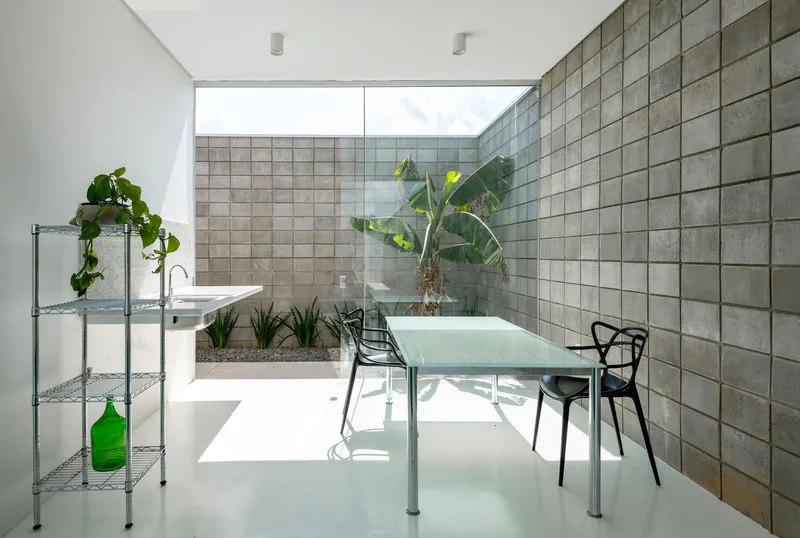
In response to solar orientation, ventilation requirements, and future use of the plot, the house is positioned toward the rear of the site, approximately two meters from the back boundary wall. This strategic setback creates a linear garden and a private service area, improving environmental comfort and reinforcing the relationship between indoor and outdoor spaces.
The open-plan design, combined with generous glazing, promotes passive environmental strategies, reducing reliance on artificial lighting and mechanical ventilation, an approach aligned with contemporary sustainable housing principles in tropical and subtropical climates.

Materiality and Construction System
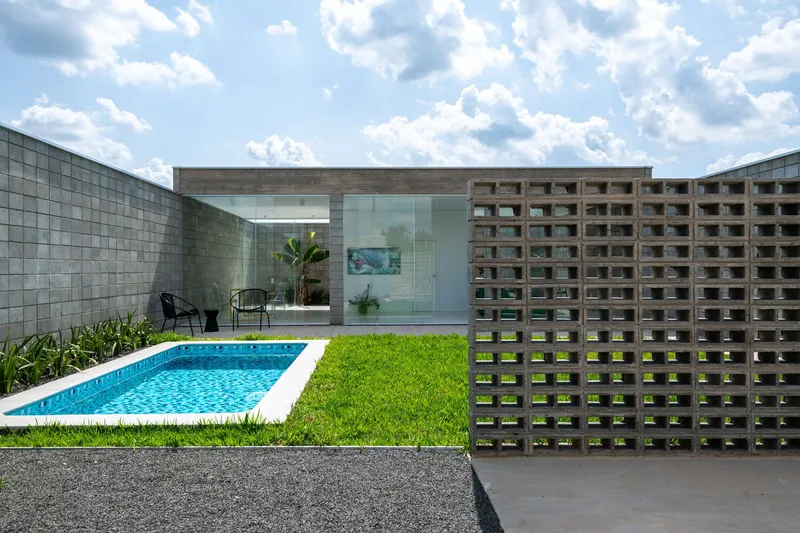
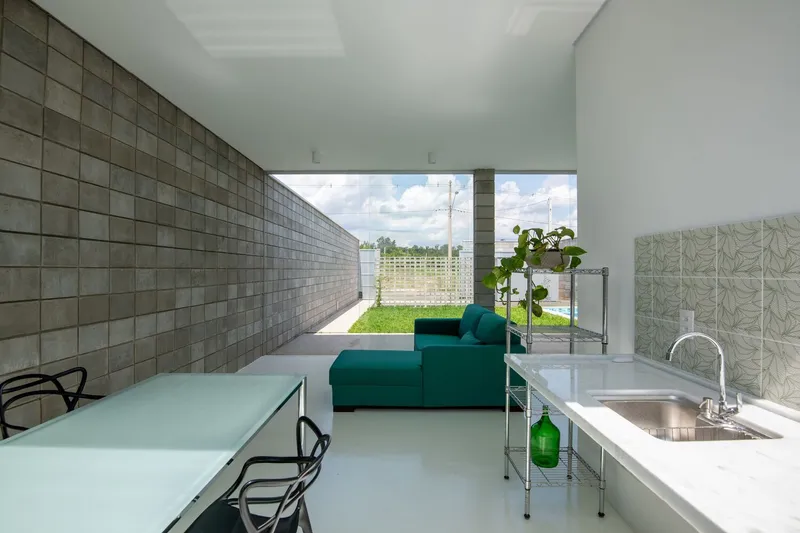
Material choices in Nucleus House reflect both aesthetic experimentation and technical efficiency. The primary construction system uses exposed structural concrete blocks, reinforcing the house’s raw and honest architectural language. In contrast, the central core is finished with plaster and paint, subtly distinguishing service spaces from living areas.
The flooring consists of polished concrete with white epoxy paint, enhancing light reflectance and contributing to a clean, minimal interior atmosphere. Overhead, a butterfly roof with a 6% slope and sandwich-type tiles optimizes rainwater drainage while defining the house’s silhouette. Internally, plasterboard ceilings paired with PET wool insulation ensure thermal and acoustic comfort. A slight reduction in ceiling height at the core accommodates the water tank, reinforcing the hierarchy between served and service spaces.


Exterior Program and Landscape Integration
The front portion of the plot is organized into three distinct outdoor zones, each serving a specific function. A concrete-paved area provides parking for two vehicles, while a pebble-covered zone houses a multi-purpose container that supports auxiliary uses. Completing the sequence is a generous lawn area with a swimming pool, extending the living environment outward and reinforcing the project’s leisure-oriented character.

A Controlled Experiment in Contemporary Housing
From concept to completion, LOZÍ managed and executed the entire construction process, ensuring design intentions were fully realized. Nucleus House stands as a controlled architectural experiment: one that explores compact living, flexible planning, and material honesty within a growing Brazilian urban landscape. Its clear structural logic, adaptable layout, and restrained material palette make it a compelling reference for small houses, experimental residential architecture, and contemporary Brazilian design.


Popular Articles
Popular articles from the community


Temporary Home for Dogs: A Reversed Zoo Rethinks Animal Shelter Architecture
In Bucharest, a sinuous corridor and freed landscape flip the logic of containment, designing a shelter that works to make itself unnecessary.

Tsunami Convergenics: Turning Catastrophic Ocean Forces into Underwater Housing Infrastructure
A speculative underwater settlement off the coast of Onagawa, Japan, treats tsunamis and typhoons as energy sources rather than threats.

The Amber Palace Opera: A Geological Fiction Surfaces on Tallinn's Baltic Waterfront
Pierre Brillard reimagines a Baltic legend as a public landscape, opera house, and waterfront promenade rooted in Tallinn's coastal identity.

Manzana Morphosis: Stretching Barcelona's Grid into a Living Landscape for 2050
A radical reworking of the Eixample manzana turns density into a tool for generous public space, vertical ecology, and environmental performance.

Similar Reads
You might also enjoy these articles


Hodi-Mandai Geram
Project Function: Preservation and revitalization of the Intangible heritage and socio-spatial identity of the Hodi by Housing, Cultural Memory Center, Sacred Grove, landscape, local tourism economy


Olio Towers: A Mid-Rise for Performers That Fuses Housing, Rehearsal, and Stage
Located blocks from Houston's Theater District, this modular tower stacks living units around a central performance atrium.

Oasis: Modular Green Housing Carved into Dhaka's Urban Fabric
A shortlisted Plugin Housing entry reclaims unauthorized settlements in Dhaka with stepped concrete volumes, green roofs, and ventilation-driven design.

Black Hole: A Floating Megastructure for the Post-Physical Era
Emiliano Mazzarotto envisions a spherical, self-scaling arena where e-sports, digital hotels, and holographic stadiums replace traditional public space.

Explore Nio Architects Competitions
Discover active competitions in this discipline

Challenge to reimagine the Iron Throne

Photograph architecture without architects

Illustrate the lost glory of Angkor Wat - Render Challenge

Design challenge to reuse E-waste
Comments (0)
Please login or sign up to add comments
No comments yet. Be the first to comment!