
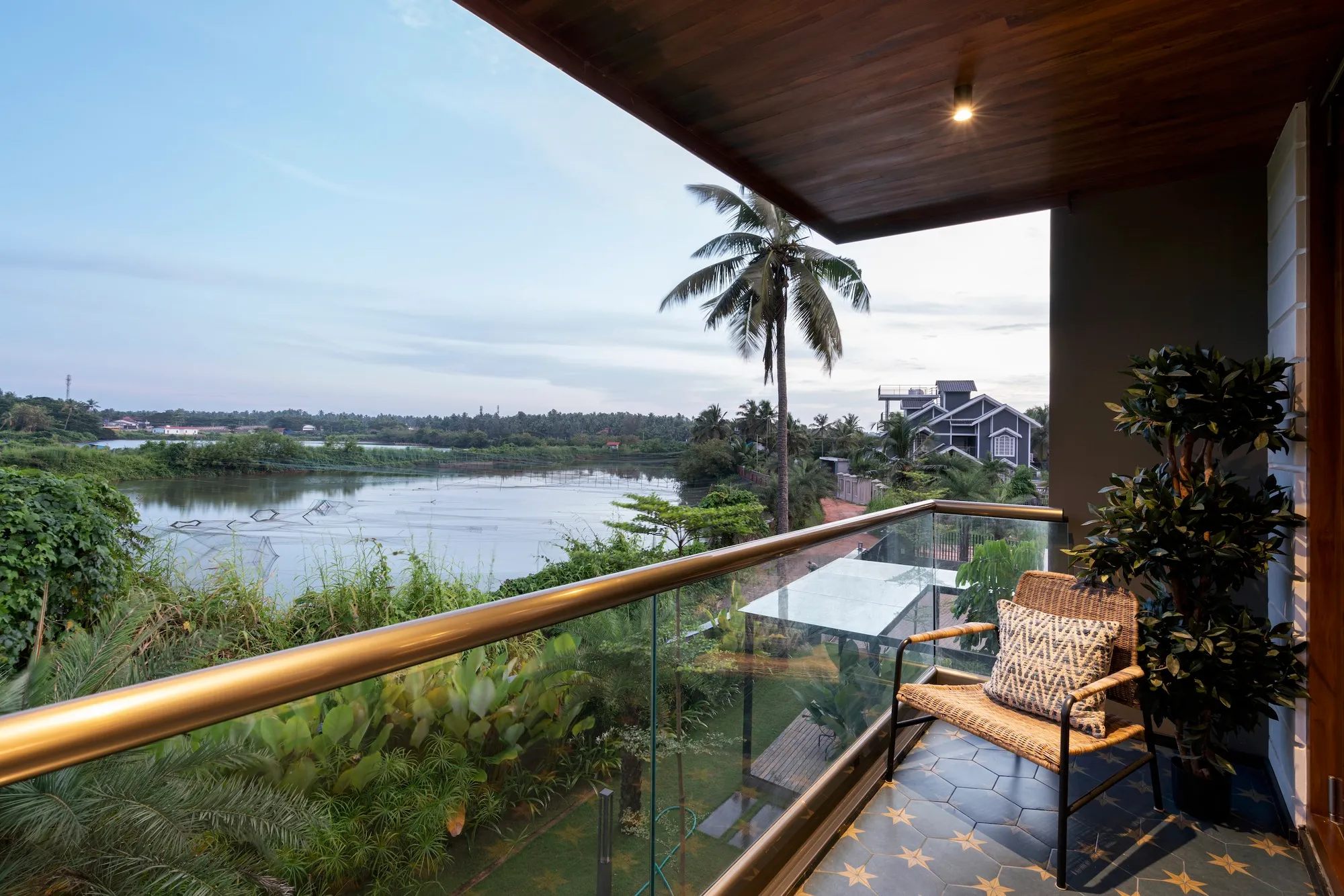
Nufail Shabana Architects Wraps Every Room Around Water in a Kerala Residence
On an urban waterfront in Kannur, the Milash Residence dissolves its corners to frame a life oriented entirely toward water.


There is a specific kind of domestic architecture that treats water not as an amenity but as a structural premise. At the Milash Residence in Kannur (historically Cananor), Kerala, Nufail Shabana Architects designed a 535 square meter house for a nuclear family where every single room is oriented toward a body of water. The house does not merely face a river or pond. It wraps around it, steps down toward it, and opens its corners to bring the horizon inside.
What makes this project genuinely interesting is its refusal to treat privacy and openness as opposites. Sitting on an urban waterfront, the house needs to shield its occupants from the density of the street while simultaneously dissolving every interior boundary that stands between them and the landscape. The solution is architectural: extended slabs shade the glazing, corner-wrapped fenestration eliminates the sense of enclosure, and a careful gradient of transparency moves from the public front to the rear bedrooms. The result is a house that feels both secluded and expansive, a rare trick to pull off at this scale.
Street Face and Shading Strategy

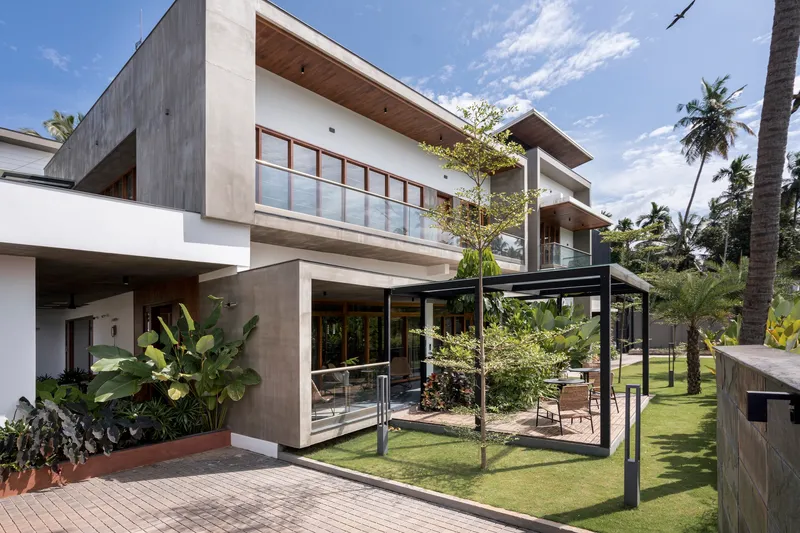
From the street, the Milash Residence presents stacked concrete volumes punctuated by vertical timber screens. The facade is restrained, almost opaque, offering privacy without resorting to blank walls. Palm trees soften the composition, but the real work is done by the extended slab overhangs that shade windows across both levels. These projections serve a dual purpose: they cut direct solar gain in Kerala's tropical climate and create deep shadow lines that give the elevation a horizontal rhythm.
A steel-framed pergola at the garden level introduces a lighter structural language that contrasts with the mass of the concrete above. The overall impression is of a house that is deliberate about what it reveals and what it holds back, a necessary discipline on an urban site.
The Double-Height Foyer as Threshold
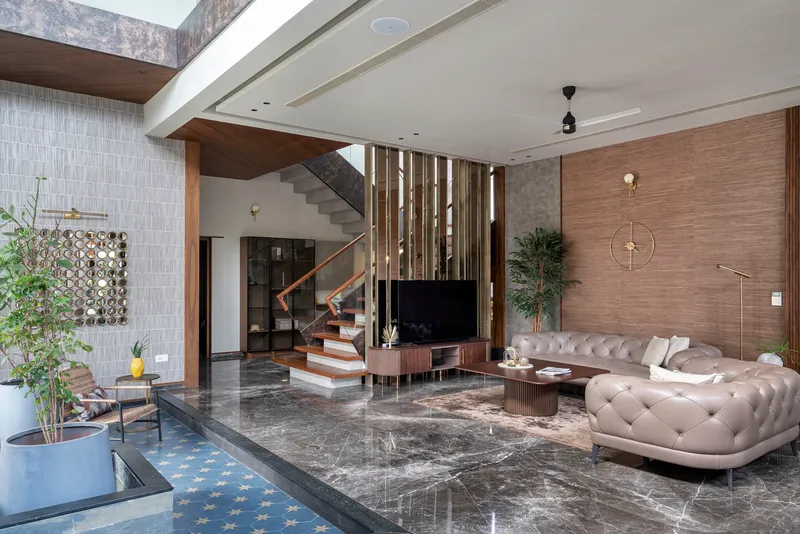


Step inside and the restraint of the facade gives way to volume. The double-height entrance foyer is the hinge of the entire plan, a space designed to receive ample sunlight through a skylight that washes the open staircase in changing light throughout the day. The polished grey stone floor reflects that light upward, amplifying the sense of height. Timber ceiling panels warm the concrete structure and provide acoustic softness in what would otherwise be a hard, reverberant void.
An exposed concrete column at the atrium acts as a quiet structural marker, dividing the visual field without closing it off. The glazed opening above brings the sky into the interior, reinforcing the house's commitment to blurring the line between inside and outside. The staircase itself, rather than being tucked away, becomes a piece of spatial choreography: descending it, you move from the private bedroom level into the communal ground floor with a clear sense of arrival.
Living Spaces and the Wrapping Motif


The living area introduces one of the project's most distinctive moves: a vertical brass and timber screen that divides the double-height interior courtyard from the adjacent living zone. It filters light rather than blocking it, and its materiality, warm metal and wood against cool stone, sets up a tension that runs through the entire house. The rooms are square in plan, but the corner-wrapped fenestration dissolves their geometry, pulling your eye outward in a near-panoramic sweep.
This wrapping motif is not decorative. It is the mechanism by which the architects achieve varying degrees of privacy across different spaces while maintaining a consistent relationship to the landscape. In the upper-level rooms, polished stone floors and timber ceilings create a calm, consistent material palette that lets the view do the talking.
Extended Patios and the Water's Edge


Seen from above, the house reveals its true ambition. The terraced concrete volumes step down toward a pond bordered by tropical vegetation, and extended patios push the inhabitable floor plate out into the landscape. These are not balconies in any conventional sense. They are outdoor rooms with patterned tile floors, concrete soffits, and timber sliding doors that can open or close the boundary between conditioned interior and shaded exterior. At dusk, the covered corridors along the garden become the most compelling spaces in the house: palm trees filter through timber screens, and the patterned tiles catch the last low light.
The landscape patches and water body are not afterthoughts applied to a finished building. They are integrated into the house's plan from the outset, with the L-shaped footprint wrapping around a courtyard pool that mirrors the larger river beyond. The effect is a layered recession from architecture to water to sky.
Bedrooms and the Calibration of Transparency

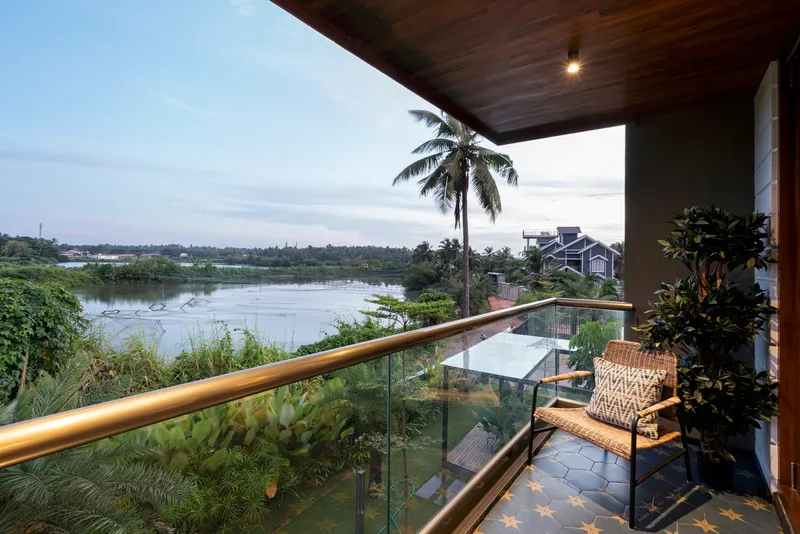
The four bedrooms occupy the upper level and the rear of the plan, where they benefit from the most direct views of the water. A textured grey wall anchors one bedroom's interior, while timber louvered doors control the aperture to the balcony beyond. It is a simple assembly, but it gives the occupant precise control over light, air, and privacy, the three currencies of domestic comfort in a tropical climate.
The covered balcony overlooking the palm-lined river is the project's most evocative space. A timber soffit brings the ceiling plane down to a human scale, and a glass railing disappears at the edge, leaving nothing between the inhabitant and the water but air. This is where the house's thesis is most clearly legible: every design decision, from the extended slabs to the corner fenestration to the stepped section, exists to deliver this moment of unobstructed contact with the landscape.
Plans and Drawings
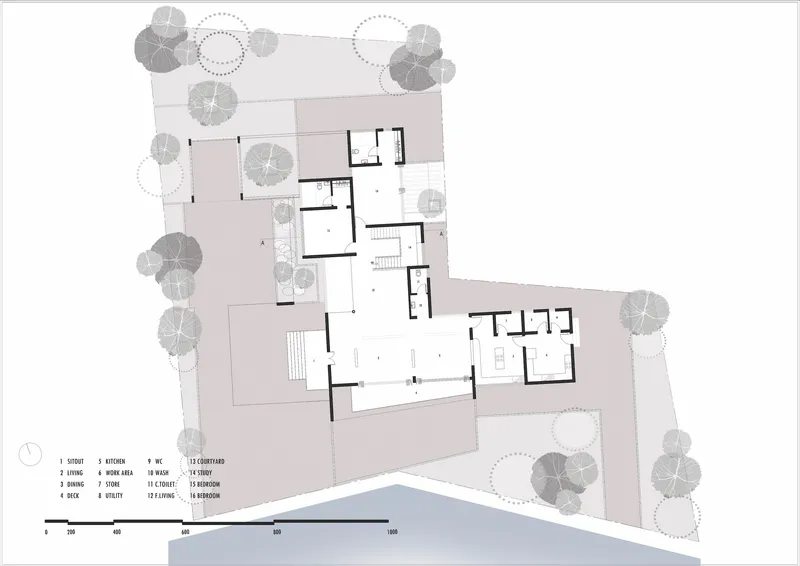
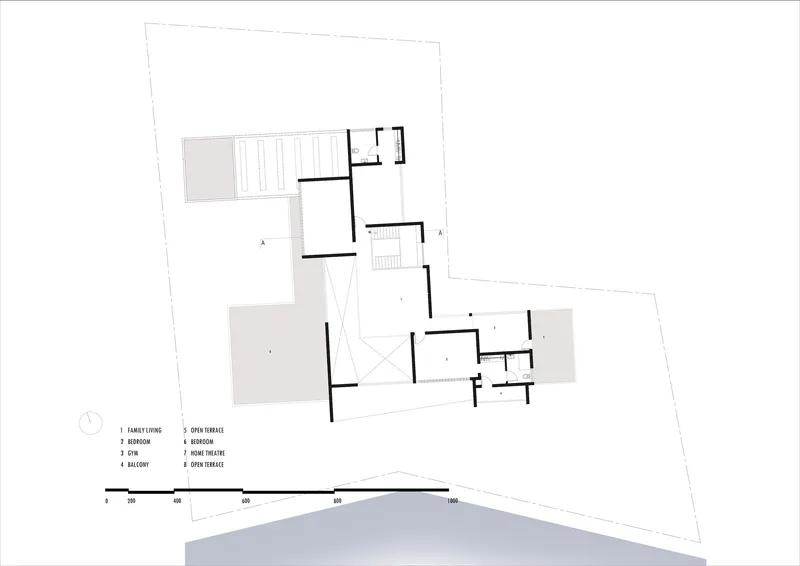
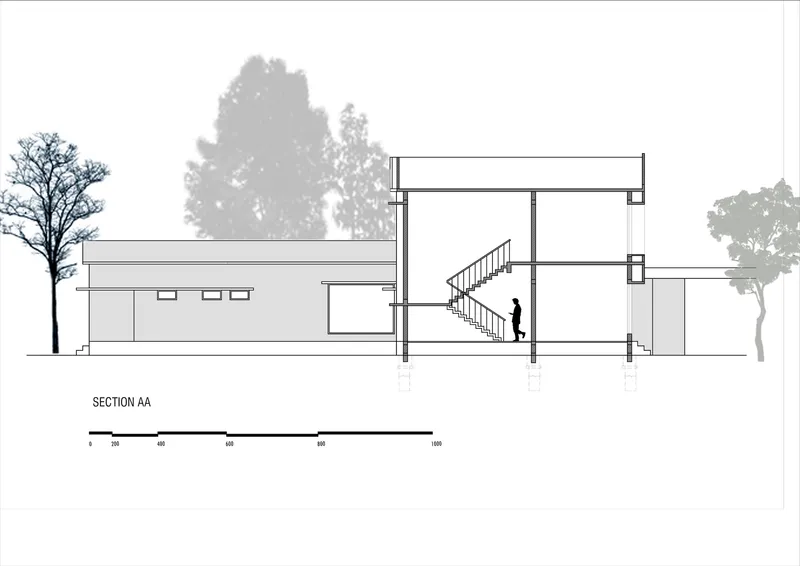
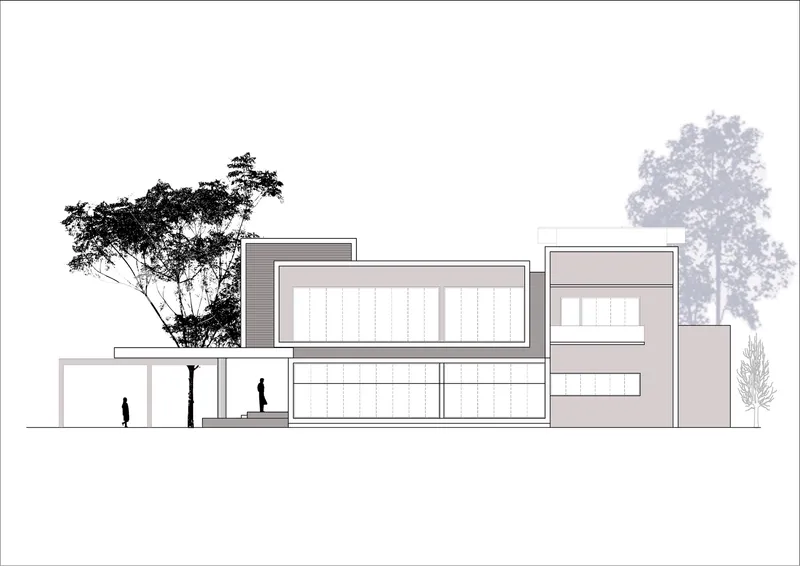
The site plan confirms the L-shaped footprint wrapping a courtyard pool, with the surrounding tree canopy providing both shade and screening from neighbors. The upper-level plan shows the bedroom wing organized along a linear corridor with terraces extending outward, maximizing the waterfront edge for private use. The section drawing reveals the double-height stairwell as the volumetric engine of the plan, with flat roof profiles creating a restrained silhouette that defers to the palms. The elevation drawing, with its vertical slat screens and figures visible through the glazed ground floor, captures the house's essential duality: solid above, transparent below.
Why This Project Matters
The Milash Residence is a useful counterpoint to the tendency in contemporary Indian residential design to treat climate response and spatial openness as separate problems. Here, the extended slabs, the skylights, the timber screens, and the corner fenestration are not applied strategies. They are the architecture. Every element serves simultaneously as climate filter, privacy calibrator, and framing device for the water. The house is disciplined without being rigid, and generous without being wasteful.
For architects working on urban waterfront sites in tropical contexts, the project offers a clear lesson: orientation is not just about which way a building faces. It is about how every room, every threshold, every slab edge participates in a single spatial argument. Nufail Shabana Architects have built a house that is, at its core, about looking at water. And they have made every square meter of the 535 square meter plan serve that ambition.
Milash Residence by Nufail Shabana Architects, Kannur (Cananor), Kerala, India. 535 m², completed 2022. Photography by Turtle Arts Photography.
About the Studio
Share Your Own Work on uni.xyz
If projects like this are the kind of work you want to make, uni.xyz is a place to publish your own, find collaborators, and enter design competitions.




Popular Articles
Popular articles from the community


Co-life: Sustainable Architecture for Age-Friendly Community Living
Co-life reimagines sustainable architecture for seniors through courtyards, rammed earth, shared gardens, and spaces designed for belonging.

The Earth Pod: 3D Printed Homes for Resilient Refugee Communities
The Earth Pod reimagines refugee housing through 3D printed homes made from clay, combining resilience, self-sufficiency, and rapid shelter.

Conexión: Biophilic Design Reimagines High-Rise Living in Hong Kong
Conexión reimagines high-rise living in Hong Kong through biophilic design, green facades, shared spaces, daylight, water and nature within.

The Ocean Hive: Sustainable Architecture for a Self-Sufficient Civilization at Sea
The Ocean Hive imagines sustainable architecture at sea, where modular habitats, algae, wave power and ocean waste sustain a growing colony.


Similar Reads
You might also enjoy these articles

Bao Huynh Watercolor Atelier: A Serene Art Retreat in Hội An
Bao Huynh Watercolor Atelier in Hội An blends multifunctional art spaces, sustainable design, local materials, and family-friendly living in a serene environment.

Atelier Macri Concept Store Interior Design by CASE-REAL
Atelier Macri store features a "ko" counter, walnut wood details, cork displays, blending retail, gallery, and seamless customer experiences.

Manuel Vargas Izquierdo Stadium and High-Performance Sports Center: Architectural Excellence in Jalpa de Méndez
The Manuel Vargas Izquierdo Stadium blends sustainable design, inclusive sports facilities, and cultural-inspired architecture, revitalizing Jalpa de Méndez’s public spaces.

KAKR Buluh Awar Hall: Revitalizing Community and Ecology Through Bamboo Architecture
Community built bamboo hall revitalizes Buluh Awar village, empowering youth, restoring ecology, celebrating vernacular craftsmanship through sustainable architecture and culture.




Comments (0)
Please login or sign up to add comments
No comments yet. Be the first to comment!