
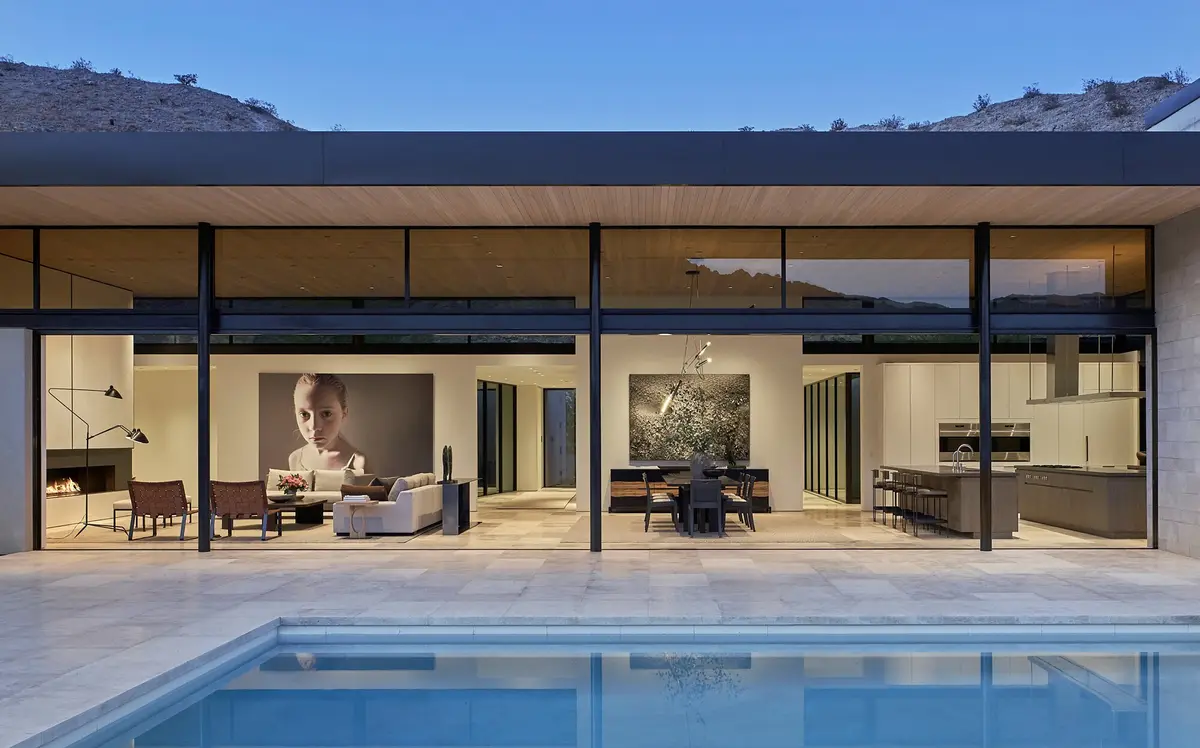
o2 Architecture Branches a Zero-Energy Desert Home Around Courtyards in Palm Desert
In the Santa Rosa foothills, a 7,500-square-foot residence uses courtyard micro-climates to tame the Coachella Valley sun.


Desert houses in the Coachella Valley tend to fall into two camps: the glass pavilion that worships the view while ignoring the climate, or the fortress that walls out the heat and takes the landscape with it. At Kawish Court House, o2 Architecture sidesteps that binary entirely. The firm breaks a five-bedroom, 7,500-square-foot program into discrete branches that radiate from a central living core, stitching together interior and exterior space through a series of courtyards. Each courtyard creates its own micro-climate, tempering the harsh desert air while pulling views of the Santa Rosa foothills deep into the plan.
What makes the project genuinely interesting is how rigorously it treats passive strategy not as an add-on but as the generator of form. The long wings run east-west, keeping fenestration on the north and well-shaded south faces while refusing to put glass where it would bake. Clerestories pull in mountain views without admitting direct sun. Photovoltaic panels and battery storage push the house to zero net energy. The courtyard, that ancient organizational device of arid climates, is deployed here with the precision of a contemporary energy model. The result is a house that looks relaxed but is, in fact, working very hard.
Arrival and Facade
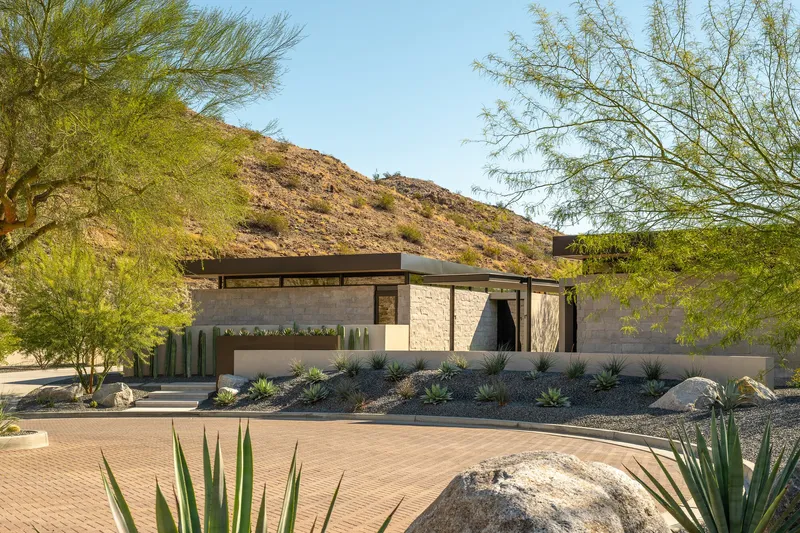
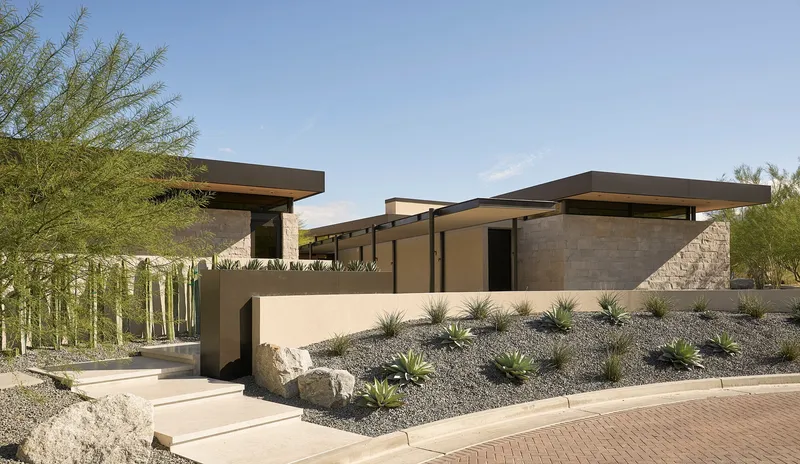
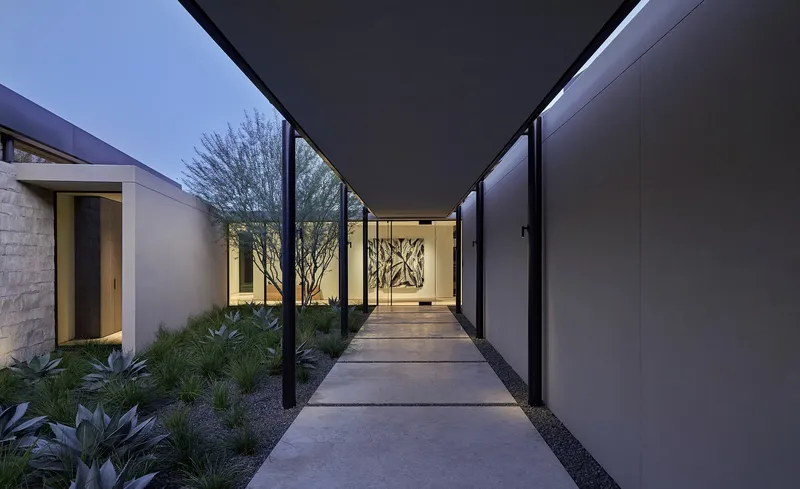
The entry sequence is deliberately understated. Arriving along a private drive, you encounter low stone walls and flat roof planes that hug the rocky hillside rather than compete with it. Stucco and limestone volumes cantilever gently, suggesting shelter without monumentality. A floating concrete walkway threads between planted courtyards at dusk, compressing space and light before releasing you into the interior. It is a procession calibrated to slow you down, to shift your attention from car to body to landscape.
The material palette reinforces this restraint. Limestone cladding reads as an extension of the desert floor, while timber soffits overhead warm the approach without resorting to domesticity. Desert plantings soften the hardscape, but the planting beds are tight and deliberate, never attempting to simulate a garden that doesn't belong here.
Courtyards as Climate Machines
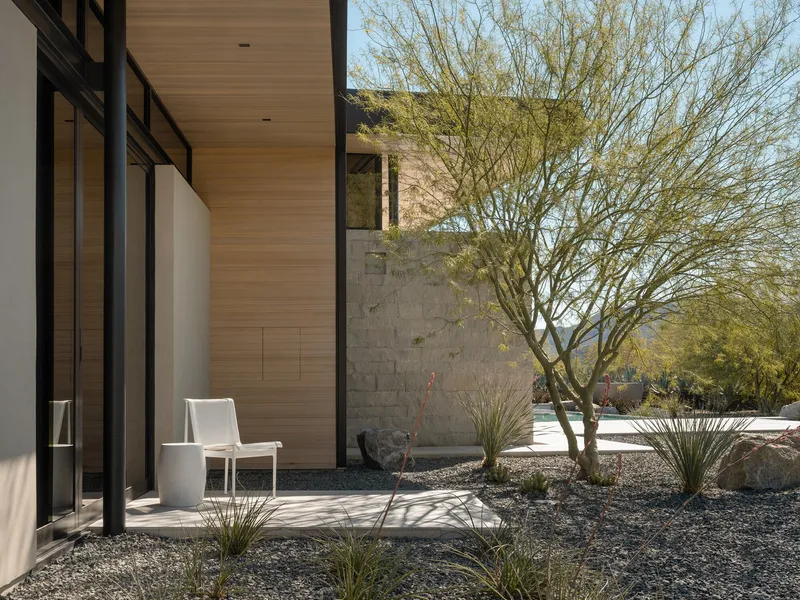
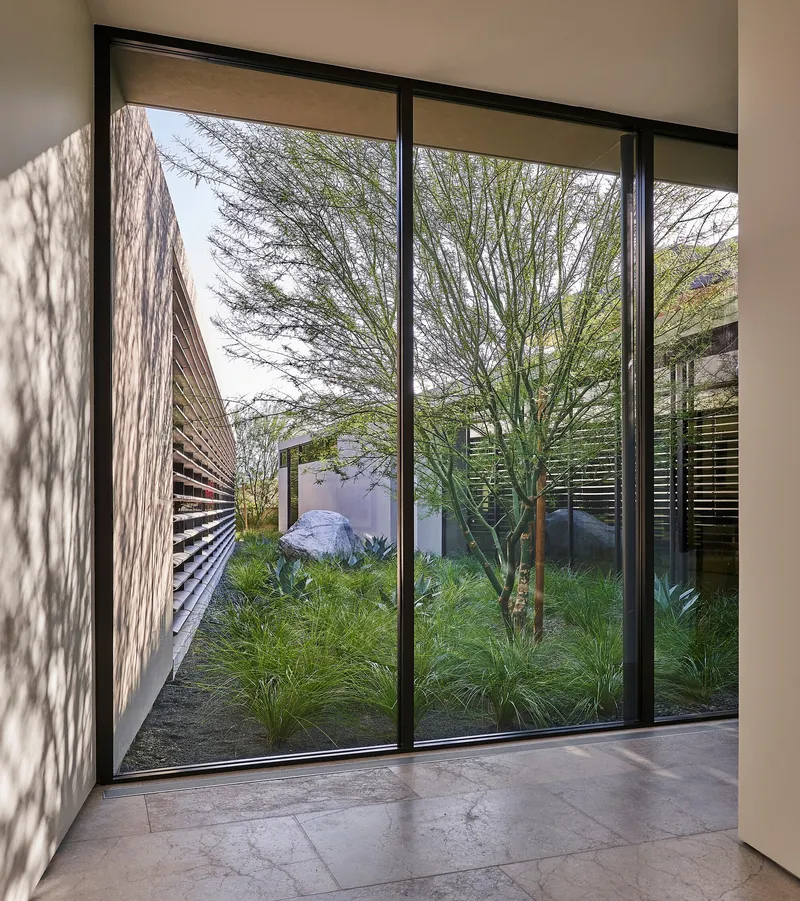
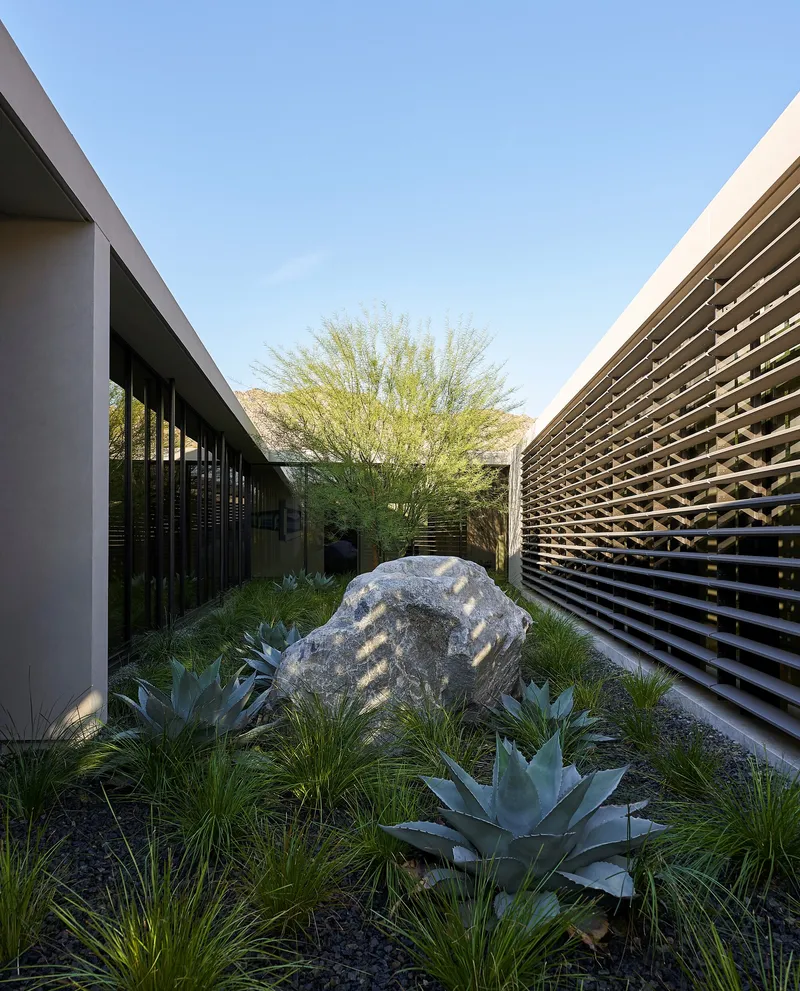
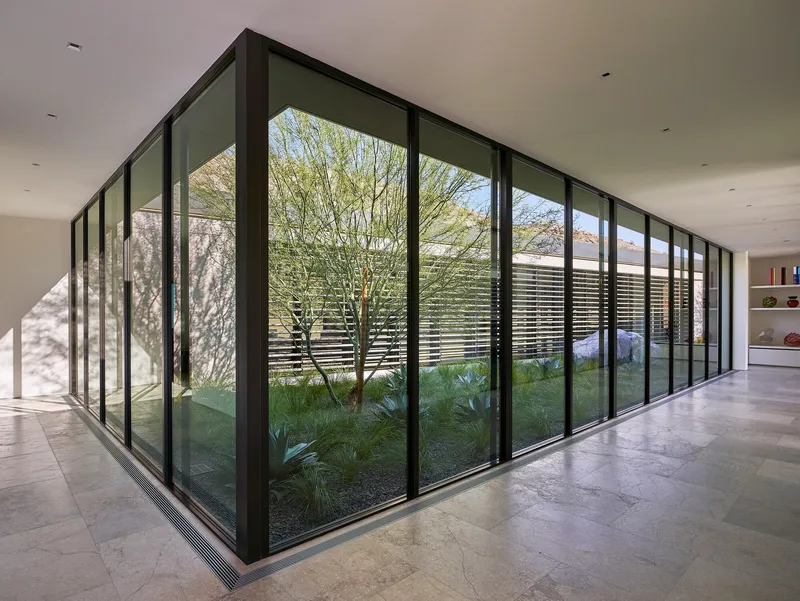
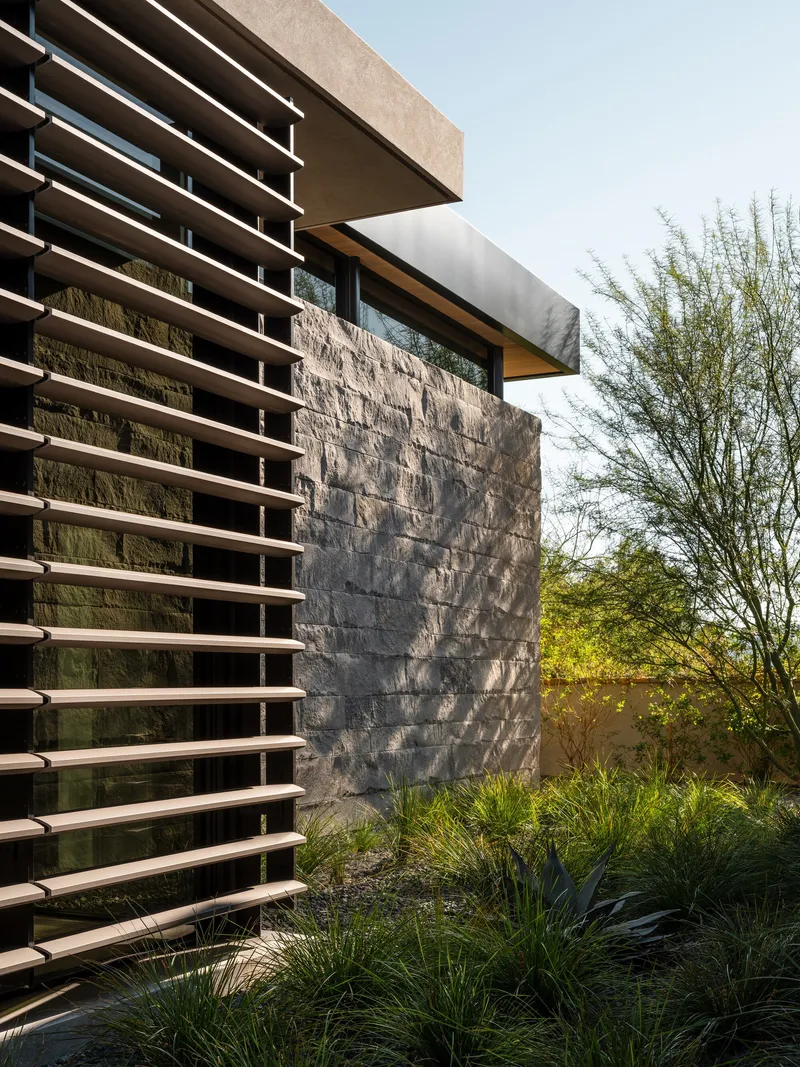
The courtyards are the intellectual engine of the house. Rather than treating outdoor rooms as leftover space between wings, o2 Architecture uses them to establish program clarity and thermal regulation simultaneously. A gravel courtyard with a palo verde tree sits against a limestone wall and wood soffit, creating a pocket of filtered shade. Another encloses a sculptural boulder and native grasses behind a horizontal louver screen that controls both view and airflow. These are not decorative gestures. They are functional insertions that buffer conditioned rooms from the full force of the desert.
The louver screens deserve particular attention. Horizontal timber slats modulate light and privacy without sealing off the outdoors. They allow the house to breathe while still maintaining the thermal envelope. The interplay between glazed walls, louvered screens, and planted beds generates a layered threshold condition that you experience differently at every hour of the day.
Light Control and the Hallway as Event
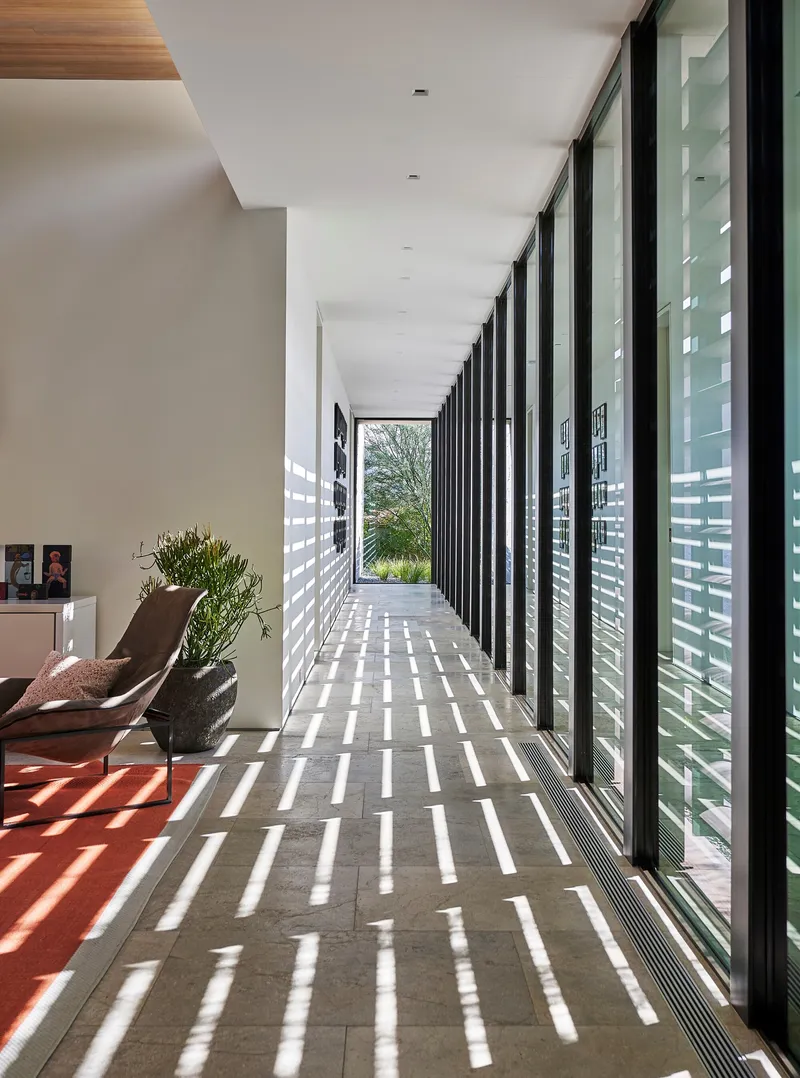
One of the most compelling moments in the house is the long hallway where a louvered screen wall casts striped sunlight across a limestone floor and timber ceiling insert. Circulation in desert houses is often treated as dead space, but here it becomes a calibrated light instrument. The stripes shift and dissolve through the day, turning a simple corridor into a sun clock.
Corner courtyards wrapped in full-height black-framed glazing bring planted gardens into the interior periphery, ensuring that even the most enclosed rooms maintain a visual connection to the ground plane. A young tree or a cluster of agave becomes a framed composition, the glass acting less as a window than as a vitrine for the landscape.
The Central Living Core
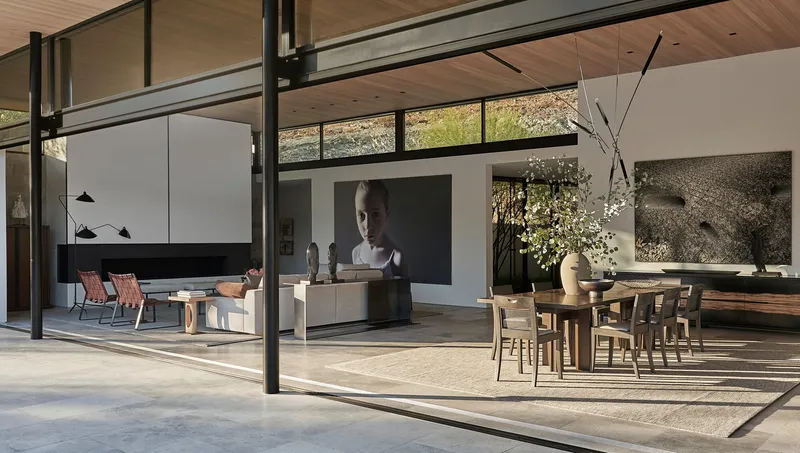
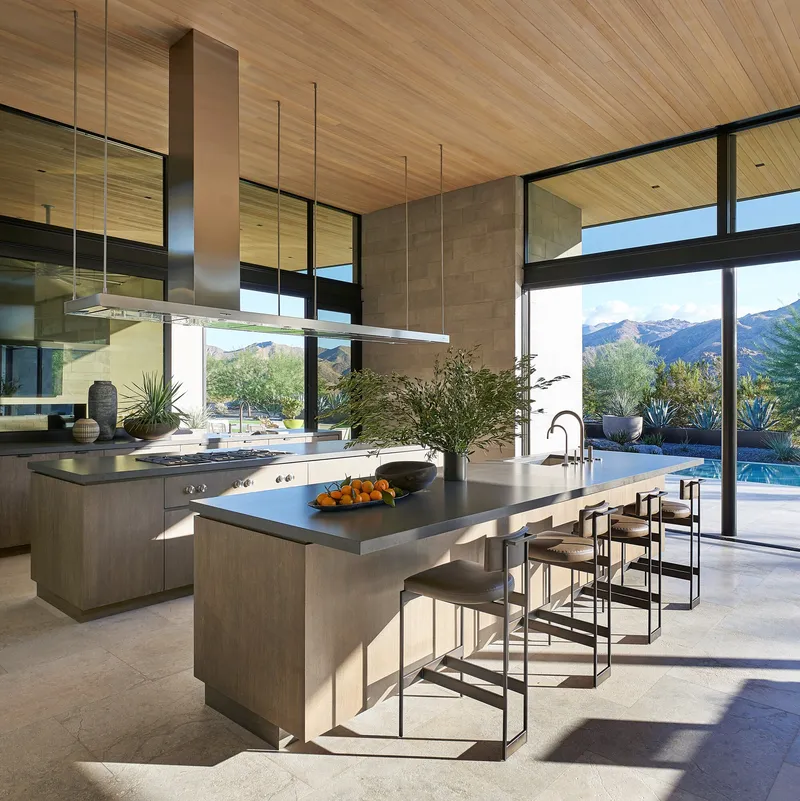
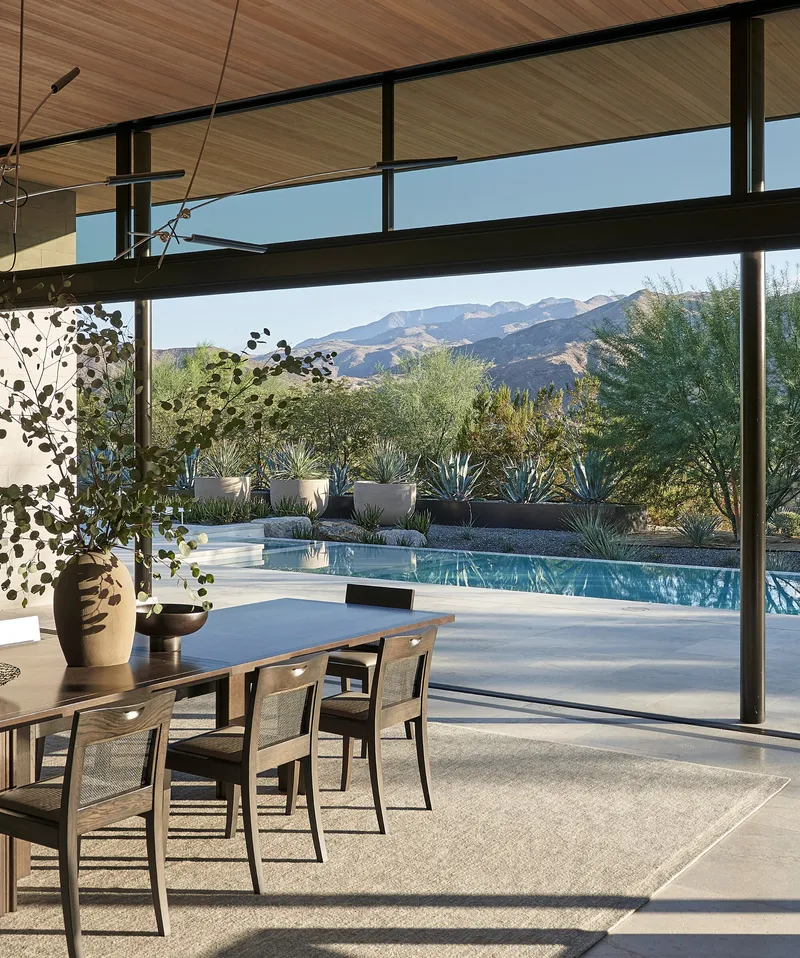
The core living area, roughly 2,500 square feet, is designed for the owners when they are unaccompanied by guests. It is a smart decision for a house of this size: rather than rattling around in 7,500 square feet, the couple inhabits a tightly proportioned sequence of kitchen, dining, and living spaces that feel generous without feeling vacant. Steel-framed glass walls dissolve the boundary to pool and mountains, while a wood ceiling plane runs continuously from interior to exterior, blurring the threshold.
The kitchen features twin islands and glazed walls that face the pool terrace and the mountain range beyond. The dining area, framed by the same timber ceiling, extends that sightline further. These rooms are not just open plan; they are oriented plan, every axis aimed at a specific view or a specific relationship to the sun's path.
Clerestories and Mountain Views
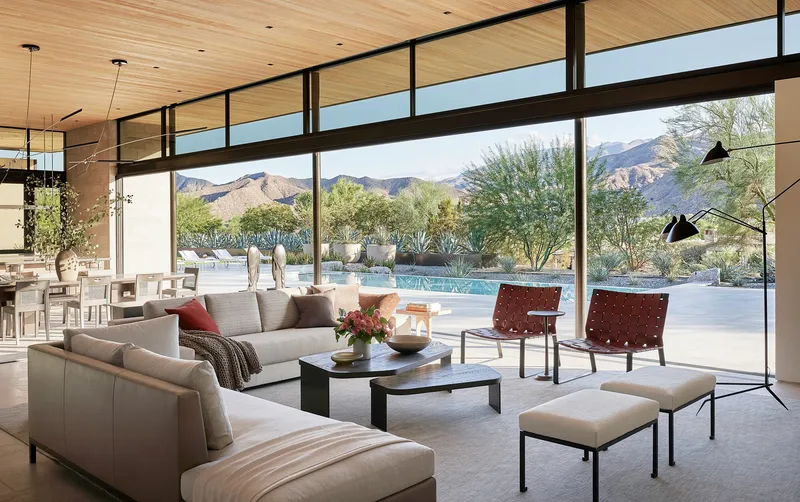
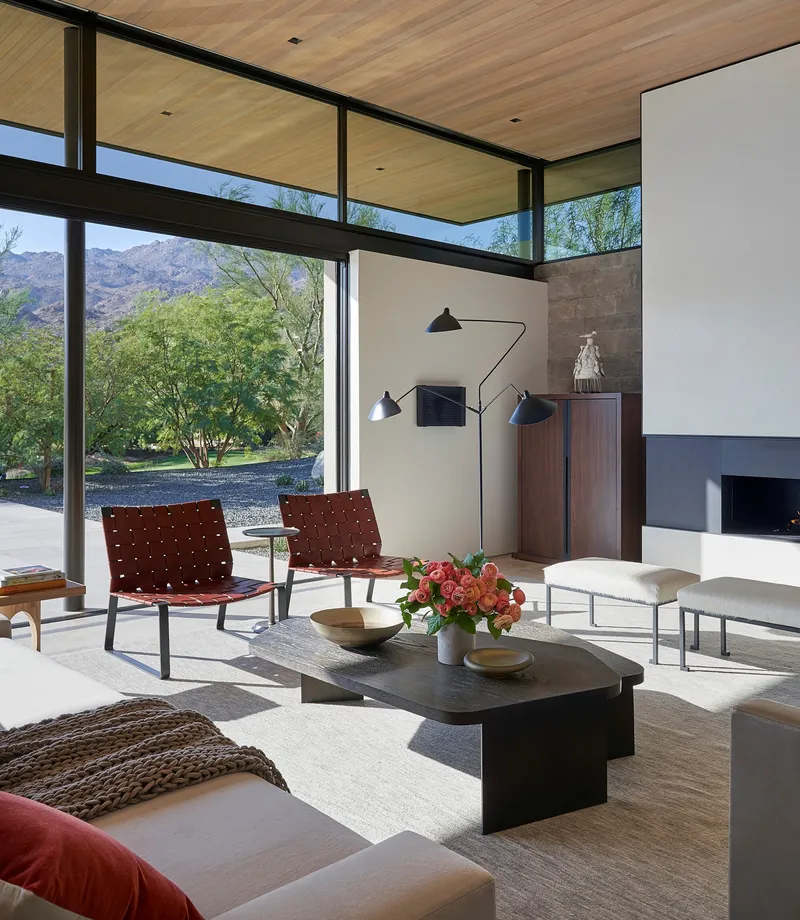
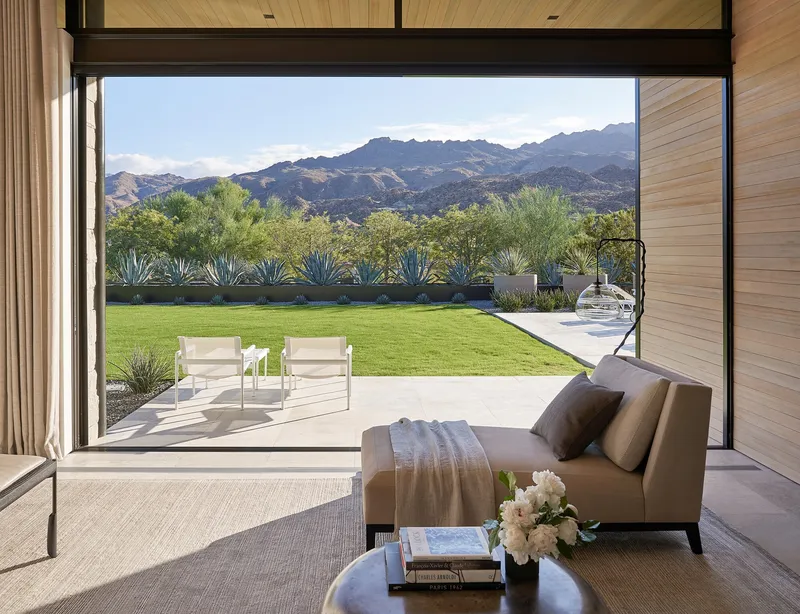
Clerestory windows are used throughout to pull in southern and northern mountain views at ceiling height, bringing the landscape into rooms without opening up the lower walls to heat gain. The living room in particular benefits from this strategy: seated, you look through full-height glass to the pool terrace and desert floor; standing, the clerestories reveal the ridgeline above. It is a layered framing that rewards both postures.
Large-scale walls, kept deliberately opaque, serve as surfaces for the owners' extensive art collection. The tension between framed landscape and hung artwork creates a gallery-like quality in the public rooms, where the view and the art compete for your attention on roughly equal terms.
Private Rooms and Outdoor Connection
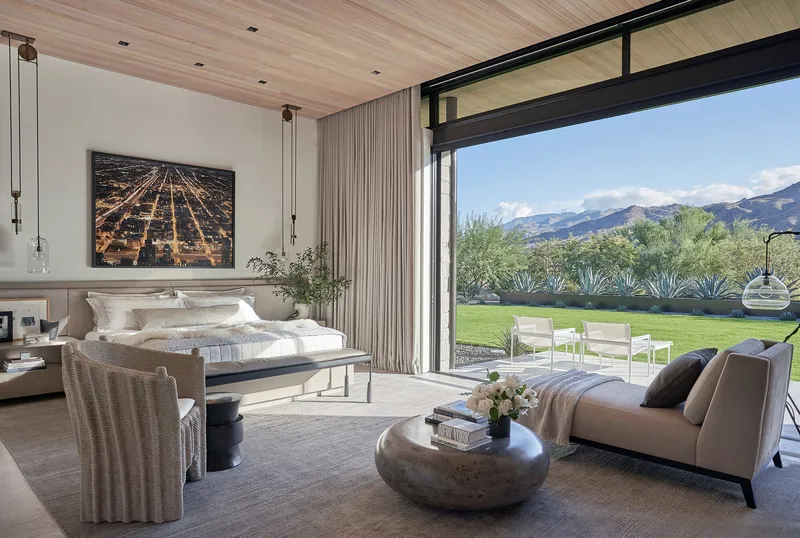
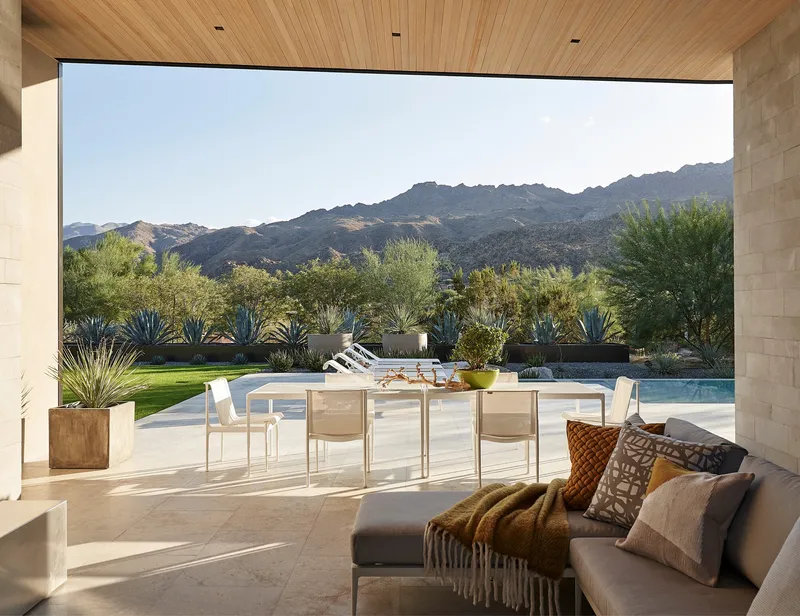
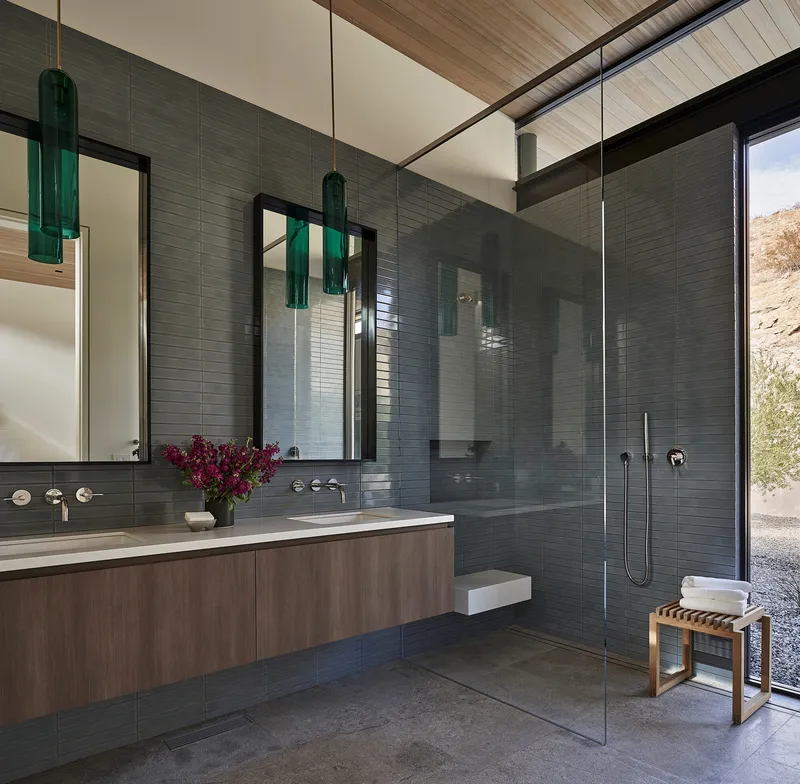
The bedrooms occupy the outer branches, each opening through floor-to-ceiling glass doors to lawn and desert plantings. Fitness and home office are placed at opposite ends of the house, a separation that acknowledges the reality of working from home without letting it colonize the living spaces. Bathrooms are finished with grey tile and floating vanities, cleanly detailed without drawing undue attention to themselves.
From interior seating areas, wood-clad overhangs frame views toward the pool and the mountain landscape beyond. The overhang depth is calibrated to shade the glass at peak sun angles while still admitting low winter light. It is the kind of dimensional decision that separates a well-considered desert house from one that merely looks the part.
Plans and Drawings
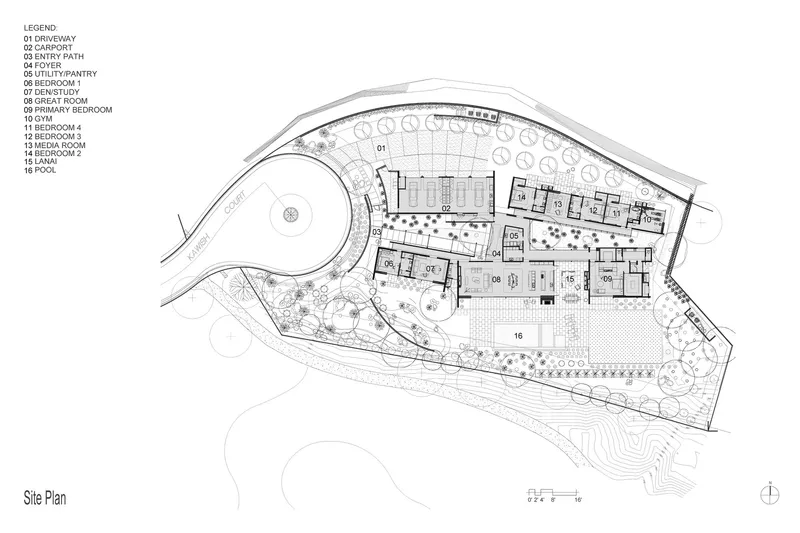
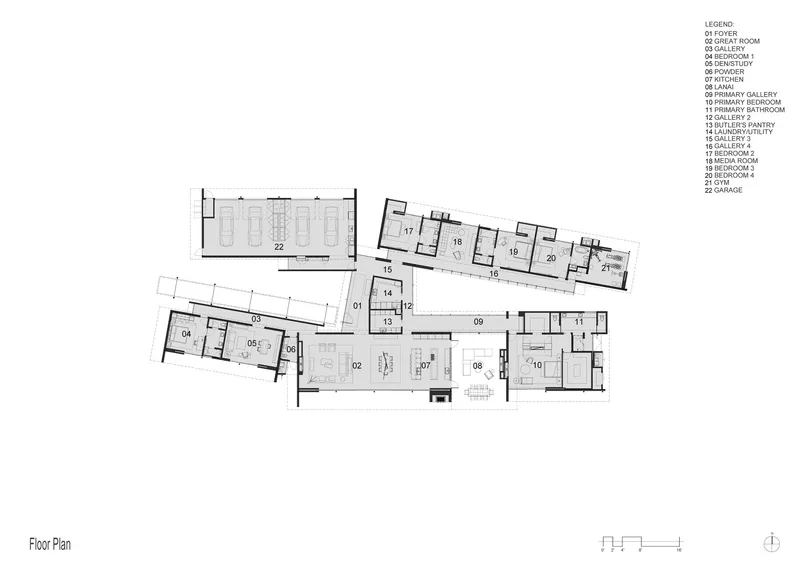
The site plan reveals the logic of the branching strategy clearly. A curved driveway approaches from the north, while the pool and primary outdoor terrace face south toward the golf fairway. The floor plan shows a linear arrangement of rooms radiating from the central great room and dining area, with courtyards carved into the junctions between wings. The east-west orientation of the long arms is immediately legible, confirming that the passive solar strategy is not an afterthought but the organizing principle of the entire layout.
Why This Project Matters
Kawish Court House matters because it demonstrates that zero-net-energy performance and spatial generosity are not competing goals. Too many sustainable houses wear their virtue on their sleeve, sacrificing comfort or atmosphere for the sake of metrics. Here, the passive strategies generate the architecture itself: the branching plan, the courtyard micro-climates, the clerestory light, the louver screens. Remove the energy ambition and you lose the design.
It also matters as a reminder that the courtyard is not a nostalgic gesture. In the Coachella Valley, where summer temperatures routinely exceed 110°F, the courtyard is a survival tool. o2 Architecture treats it with the seriousness it deserves, using it to organize program, regulate temperature, and frame landscape simultaneously. The result is a house that belongs to its place without being trapped in regional pastiche.
Kawish Court House by o2 Architecture, Palm Desert, United States. 7,500 square feet. Completed 2020. Photography by Mike Schwartz & Lance Gerber.
About the Studio
Share Your Own Work on uni.xyz
If projects like this are the kind of work you want to make, uni.xyz is a place to publish your own, find collaborators, and enter design competitions.


Popular Articles
Popular articles from the community


Aquadapt: An Underwater Habitat That Rewrites Its Rooms by the Hour
Curved modules ring the seabed while one shell shifts from breakfast room to cinema, farm and football pitch as residents' needs change.


FCC Arquitectura Expands a Portuguese Granite House with a Board-Marked Concrete Wing
In Portugal, JV House pairs a cleaned-up whitewashed and granite dwelling with a timber-shuttered concrete extension, courtyards and a garden pool.

Opera on the Sea: Driftwood Logic Shapes a Timber Opera House on Estonia's Coast
Trevor Orgill's opera house translates the entangled drift of floating timber into a civic building where wood, water, and music converge.

ETEH Reworks the Shared Spaces of São Domingos School in Brazil Around Timber, Color and Hanging Plants
At São Domingos School in Brazil, 436 m² of hall, refectory and library are recast with timber joinery, a yellow and blue code and trailing greenery.

Similar Reads
You might also enjoy these articles

LAVA Architecten Gives Vocational Education a Sawtooth-Roofed Face on a Mechelen School Campus
In Mechelen, Belgium, a 2,053 m² STEM school on a 6×6 m grid turns workshops and classrooms into rooms that can be rearranged as teaching changes.

KEMA Studio Turns a Derelict Marvila Attic into a 60 m² Lighthouse Apartment Above Lisbon
In Lisbon's Marvila district, a rebuilt roof, four skylights and two plywood volumes turn an unlivable attic into a bright home facing the Tagus.

Pixel Gardens: One Repeated Module Stacked Into a Terraced Social Housing Tower for Famagusta
Salem Bader's shortlisted housing tower builds a vertical neighbourhood from one repeated module, offsetting units to carve terraces, light and air.

Bao Huynh Watercolor Atelier: A Serene Art Retreat in Hội An
Bao Huynh Watercolor Atelier in Hội An blends multifunctional art spaces, sustainable design, local materials, and family-friendly living in a serene environment.


Comments (0)
Please login or sign up to add comments
No comments yet. Be the first to comment!