

Oasis of the Kakadu: Biophilic Pavilions Rooted in Aboriginal Knowledge
A runner-up entry in We Australia reimagines sustainable architecture through organic forms, indigenous wisdom, and immersive cultural spaces in the outbac


What does it mean to build architecture that doesn't merely sit on the land but grows from its cultural and ecological memory? Oasis of the Kakadu proposes an answer: a cluster of organic-form pavilions scattered across the Australian outback, shaped by biophilic principles and the deep environmental knowledge of Aboriginal communities. Rather than importing a foreign architectural language onto the site, the project treats indigenous ways of living as the primary design logic, producing structures that blend with sand, vegetation, and sky.
Designed by Sahar Sadegh and Seyedmohammad Ahmadshahi, the project was a runner-up entry in the We Australia competition. The brief called for work that engages with Australian identity, and these designers responded with a proposal that bridges modern construction techniques with traditional knowledge, creating immersive spaces where visitors experience the connection between indigenous life and the surrounding environment.
Pavilions as Landscape: Scattering Organic Forms Across the Desert
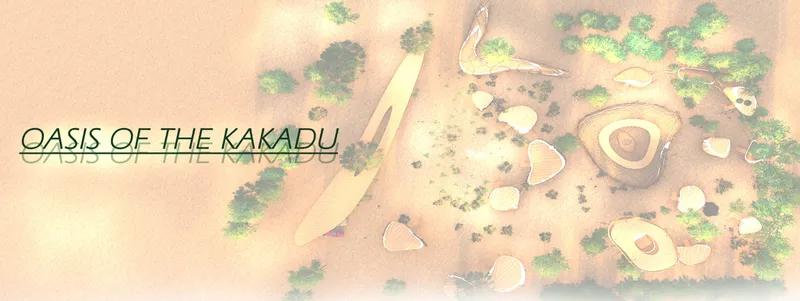
From the aerial view, the pavilions read less like buildings and more like geological formations. Curved, shell-like roofs cluster loosely across a sandy terrain dotted with sparse vegetation, their placement avoiding rigid grids in favor of a layout inspired by the natural landscapes of Australia. The effect is deliberate: the structures minimize their ecological footprint by working with the terrain rather than grading it flat. Locally sourced, sustainable materials ensure the buildings age alongside the land instead of degrading against it.
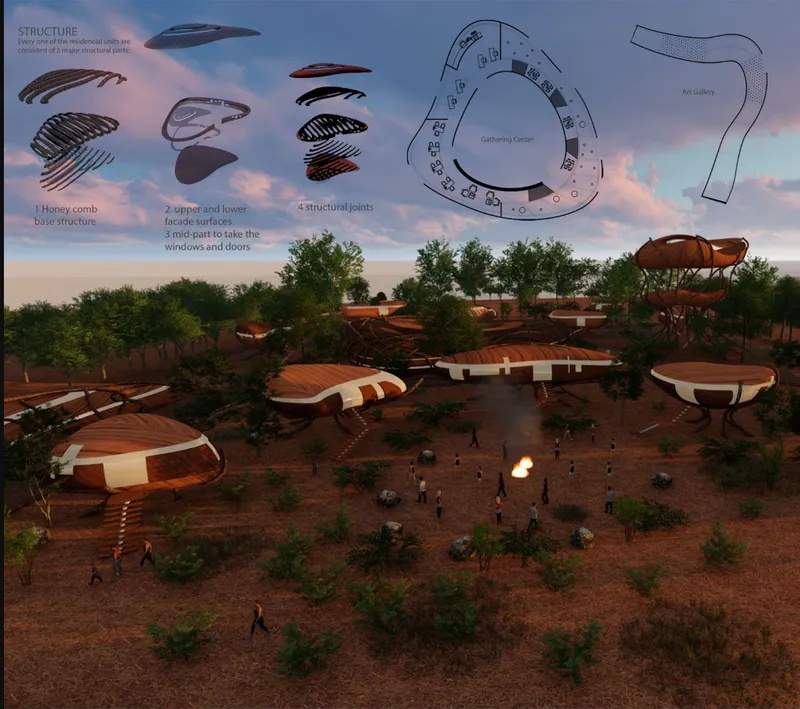
The evening rendering reveals a gathering center at the heart of the complex, its structural diagram and floor plan overlaid against a sunset sky. Here the programme becomes legible: a central communal space anchors the dispersed pavilions, drawing visitors inward for shared experience. The structural system uses flowing, continuous surfaces that carry loads through curvature rather than heavy frames, reinforcing the project's commitment to material efficiency.
Curved Rooflines and Twilight Pathways
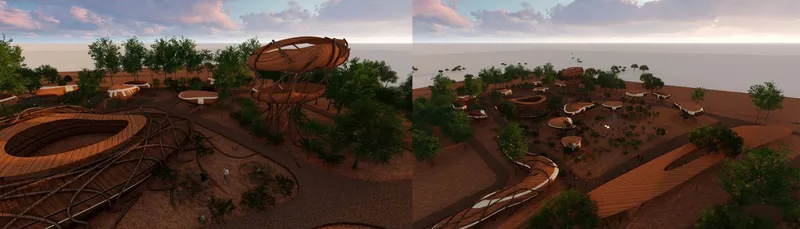
At dusk the complex reveals its full spatial ambition. A panoramic rendering shows the curved-roof pavilions arranged among trees, their silhouettes echoing the canopy forms around them. The architects clearly studied how natural landforms and vegetation create shelter and microclimates, then translated those observations into built form. The result is an architecture of resilience and adaptability, qualities the designers explicitly tie to Aboriginal traditions of living within, not against, the environment.
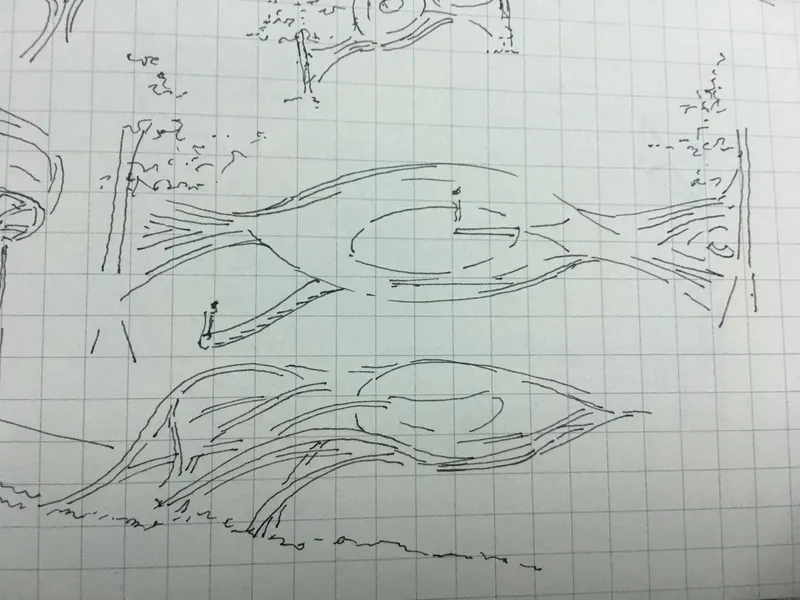
A sketch elevation on graph paper strips the project back to its formal DNA: fluid, layered roof forms rising from a horizontal ground plane. Multiple strata of curvature overlap and interlock, suggesting that the roof is not a single gesture but a composite system. The hand-drawn quality of the sketch communicates process. These forms were arrived at iteratively, tested against proportion and site before being rendered digitally.
Pod Structures Nestled into Terrain

A twilight view through trees shows illuminated pathways threading between pavilions, turning circulation into an act of discovery rather than a direct route. Visitors move through the landscape the way one might walk through bushland: paths curve, sightlines shift, and each pavilion reveals itself gradually. The lighting strategy is restrained, marking edges and thresholds without overwhelming the darkness, preserving the quality of the night sky that is inseparable from outback experience.
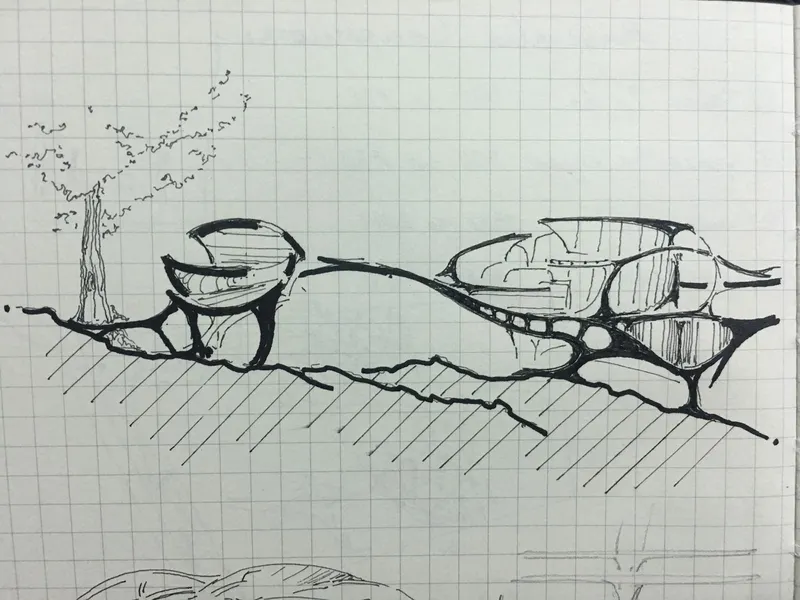
A cross-section sketch shows two pod-like structures with interior seating nestled into sloping terrain beside a tree. The section is revealing: the pods partially embed themselves in the ground, using the earth as thermal mass and wind protection. Interior spaces are compact, intimate, and oriented toward the landscape. Seating is integrated into the structure itself, reducing the need for freestanding furniture and reinforcing the idea that every element serves both structural and experiential purposes.
Radiating Plans and a Central Core
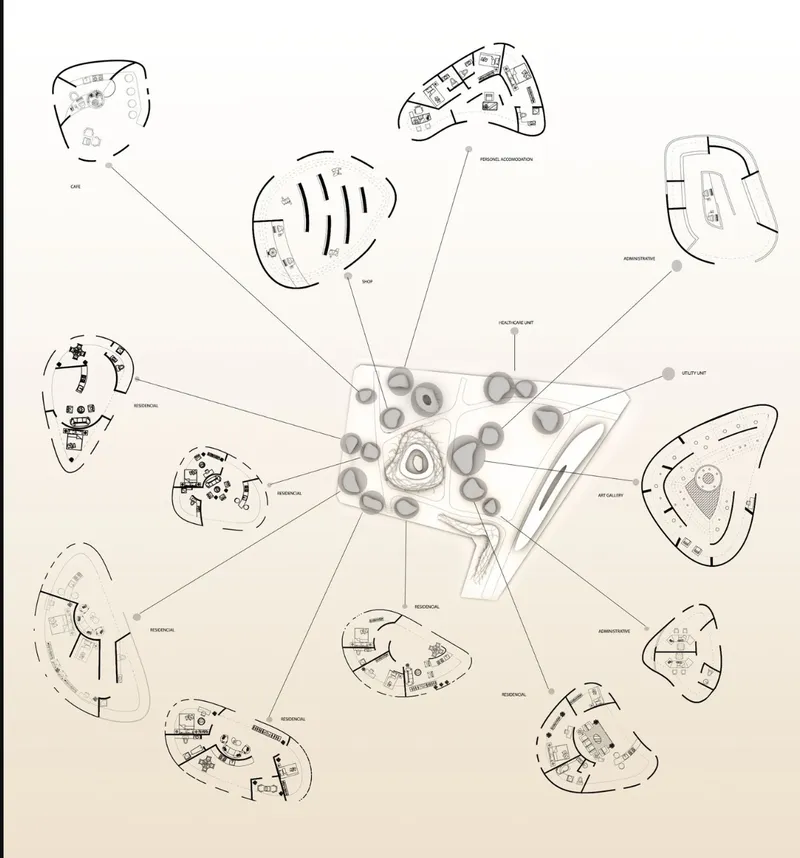
An exploded axonometric drawing dissects one of the multi-level structures, revealing curving, lobed floor plans that radiate from a central core. The diagram makes the organizational logic explicit: a vertical circulation spine anchors horizontal extensions that reach outward like branches. Each lobe can house a different programme, from interactive cultural exhibition spaces to contemplative rooms, while the central core manages access and services. The organic geometry is not arbitrary; it allows each wing to orient independently toward views, breezes, or shade.
Why This Project Matters
Oasis of the Kakadu is significant because it treats indigenous knowledge not as decorative inspiration but as a functional design methodology. The decision to use locally sourced materials, to embed structures into terrain, and to scatter pavilions across the landscape in non-hierarchical patterns all derive from observed Aboriginal principles of coexistence with the land. The project moves sustainability from a checklist of technologies into a philosophical framework rooted in thousands of years of practice.
For Sadegh and Ahmadshahi, the proposal is also an argument about the future of cultural architecture: that preserving heritage is not about freezing it in a museum case but about making it spatially inhabitable. By designing interactive and immersive spaces where visitors engage directly with indigenous traditions and philosophies, the project ensures that ancestral wisdom is transmitted through experience rather than text. It is a thoughtful, carefully drawn entry that earns its place as a runner-up by grounding ambitious ideas in legible architectural propositions.
View the Full Project
About the Designers
Designers: Sahar Sadegh, Seyedmohammad Ahmadshahi
Enter a Design Competition on uni.xyz
uni.xyz runs architecture and design competitions year-round that reward proposals with spatial conviction and real site intelligence.
Project credits: Oasis of the Kakadu by Sahar Sadegh, Seyedmohammad Ahmadshahi We Australia (uni.xyz).



Popular Articles
Popular articles from the community


The Musturak Paradise: Senior Living Architecture for a Connected Future in Temara, Morocco
The Musturak Paradise reimagines senior living architecture in Temara via private homes, social spaces, culture, community, and shared care.

The Ocean Hive: Sustainable Architecture for a Self-Sufficient Civilization at Sea
The Ocean Hive imagines sustainable architecture at sea, where modular habitats, algae, wave power and ocean waste sustain a growing colony.
AL-JANNAH: Sustainable Architecture and Permaculture for Afghan Widows
AL-JANNAH uses sustainable architecture and permaculture to create resilient oasis of housing, learning, work and renewal for Afghan widows.

The Earth Pod: 3D Printed Homes for Resilient Refugee Communities
The Earth Pod reimagines refugee housing through 3D printed homes made from clay, combining resilience, self-sufficiency, and rapid shelter.

Similar Reads
You might also enjoy these articles

Day and Night Park: A Time-Based Urban Newsstand in Beijing
A temporary urban newsstand in Beijing blending travel, light, and reading through poetic colors, compact form, and community-focused design.

Modernist Patio Renovation in El Masnou, Barcelona by Oliver Segura Arquitectura + Cebrià Arquitectura
Modernist patio renovation blending tradition and innovation with a movable pool, leveled floors, and Catalan materials in El Masnou.

Alto Residencial Coop: Cooperative Housing Development in Santiago de Compostela by Carbajo Barrios Arquitectos
A linear cooperative housing complex blending white volumes and perforated metal façades, enhancing community living, natural light, privacy, and urban integration.
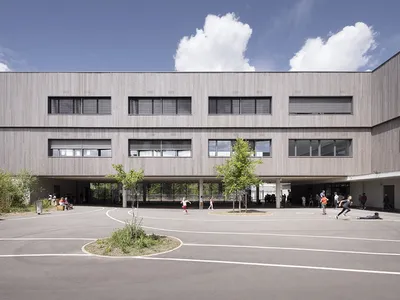
Vil Genis School by BPA ARCHITECTURE – Massy, France
Vil Genis School in Massy, France, features sustainable design, south-facing classrooms, community integration, accessible spaces, and modern educational architecture.


Explore Green Oasis Competitions
Discover active competitions in this discipline



Challenge to design locus for the upliftment of human rights


Design challenge to reuse E-waste
Comments (0)
Please login or sign up to add comments
No comments yet. Be the first to comment!